
Showing 5 items matching "padmasambhava"
-
 Great Stupa of Universal Compassion
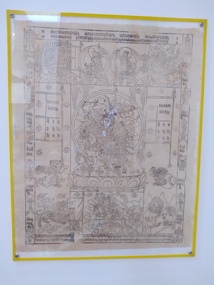
Print - Woodblock print featuring Gesar, Unknown
... Padmasambhava...This woodblock print on hand-made paper depicts Gesar, a legendary Tibetan warrior king who is invoked as a protector of the Buddha's teachings and emanation of Padmasambhava. Gesar's image is surrounded by four magical animals - garuda (top left), makara (top right), tiger (bottom left) and snow lion (bottom right). ...Widely recognised as a great Buddhist teacher, he played an important role in spreading Buddhism in Tibet. Padmasambhava Tibetan Buddhism Woodblock printing This woodblock print on hand-made paper depicts Gesar, a legendary Tibetan warrior king who is invoked as a protector of the Buddha's teachings and emanation of Padmasambhava. ...Woodblock printing in Tibet began to flourish from the 10th century onwards, driven by the high demand for Buddhist scriptures and images. Monasteries saw woodblock printing as a means to preserve and propagate authentic Buddhist teachings. The durability of woodblocks made them ideal for creating lasting impressions of sacred texts, enabling mass production and wide dissemination.This woodblock print on hand-made paper depicts Gesar, a legendary Tibetan warrior king who is invoked as a protector of the Buddha's teachings and emanation of Padmasambhava. Gesar's image is surrounded by four magical animals - garuda (top left), makara (top right), tiger (bottom left) and snow lion (bottom right). The print is framed using acrylic sheets. padmasambhava, tibetan buddhism, woodblock printing -
 Great Stupa of Universal Compassion
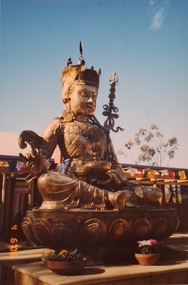
Photograph (item) - Set of photographs of the Padmasambhava statue, c2003
... The photographs document the arrival of and artistic details of the Padmasambhava statue....The photographs document the arrival of and artistic details of the Padmasambhava statue. The Padmasambhava statue was commissioned in Asia and delivered to the stupa in approx. 2003. ...The photographs document the arrival of and artistic details of the Padmasambhava statue.The Padmasambhava statue was commissioned in Asia and delivered to the stupa in approx. 2003. Lama Zopa said it was very important to create this statue and build the stupa around it as Padmasambhava's energy would help overcome obstacles to the speedy construction of the stupa. 33 photographs have printed "Moonpeak Pictures McLeodGanj 22Nov03" on the verso side.photographic records, great stupa archive -
 Great Stupa of Universal Compassion
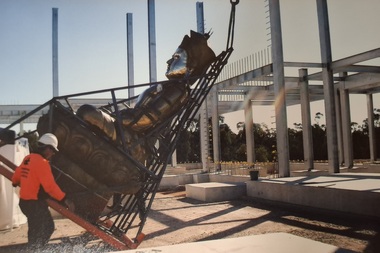
Photograph (item) - Set of photographs from the arrival and consecration of the Padmasambhava statue, c2003
... The photographs document the arrival and consecration of the Padmasambhava statue in 2007. ...The photographs document the arrival and consecration of the Padmasambhava statue in 2007. The Padmasambhava statue was commissioned in Asia and delivered to the stupa in approx. 2003. ...The photographs document the arrival and consecration of the Padmasambhava statue in 2007. The Padmasambhava statue was commissioned in Asia and delivered to the stupa in approx. 2003. Lama Zopa said it was very important to create this statue and build the stupa around it as Padmasambhava's energy would help overcome obstacles to the speedy construction of the stupa. photographic records, great stupa archive -
 Great Stupa of Universal Compassion
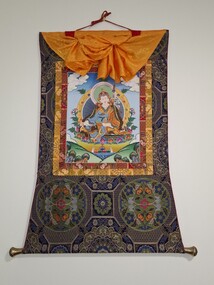
Artwork, other - Guru Padmasambhava thangka
... A Tibetan thangka depicting Guru Padmasambhava. Framed in a traditional silk brocade border; a wooden dowel is inserted in a sleeve along the bottom edge of the fabric frame. ...Artwork, other Guru Padmasambhava thangka ...Thangkas are cloth scrolls unique to Tibetan Buddhism, depicting deities, venerated spiritual figures, or common religious symbols. Intended for personal meditation or instruction of monastic students, they are invested with the spirit of a deity to whom they are consecrated. A thangka is a composite three-dimensional object consisting of a picture panel which is painted or embroidered; a brocade mounting; and one or more of the following: a silk cover, leather corners, wooden dowels at the top and bottom and metal or wooden decorative knobs on the bottom dowel. Guru Padmasambhava (meaning 'Lotus-born', signifying his mythical origin as a being emerging from a lotus flower), also known as Guru Rinpoche, is seen as a manifestation of Buddha Shakyamuni. His teachings and legacy are deeply ingrained in Tibetan culture as he was responsible for bringing advanced Buddhist Tantric teachings to Tibet in the 8th century.A Tibetan thangka depicting Guru Padmasambhava. Framed in a traditional silk brocade border; a wooden dowel is inserted in a sleeve along the bottom edge of the fabric frame. buddhist art, tibetan buddhism, holy objects -
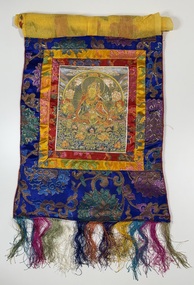 Great Stupa of Universal Compassion
Artwork, other - Padmasambhava thangka
... This thangka portrays Padmasambhava seated on a lotus with a red cap, the legs crossed, the right hand holding a dorje (vajra) and the left resting in his lap. ...Artwork, other Padmasambhava thangka ...Thangkas are cloth scrolls unique to Tibetan Buddhism, depicting deities, venerated spiritual figures, or religious symbols. Intended for personal meditation or instruction of monastic students, they are invested with the spirit of a deity to whom they are consecrated. The design of a thangka allows it to be rolled up for easy transport, a feature that was essential for traveling monks and practitioners in nomadic regions. Padmasambhava thangkas are used to invoke protection, dispel obstacles, and deepen tantric practice. His image serves as a powerful reminder of transformation, spiritual resilience, and the integration of wisdom and compassion.This thangka portrays Padmasambhava seated on a lotus with a red cap, the legs crossed, the right hand holding a dorje (vajra) and the left resting in his lap. Smaller deities or lineage masters appear above and below him, each enclosed in circular frames, signifying the transmission of teachings. The thangka is framed with layers of silk brocade in yellow, red, orange and blue, with floral and cloud motifs that evoke the celestial realm. A decorative fringe at the bottom adds ceremonial richness, while the yellow fabric-covered rod at the top allows the thangka to be hung for ritual or meditative use.buddhist art, tibetan buddhism, holy objects
