
Showing 9 items matching "paisley shawl"
-
 Kew Historical Society Inc
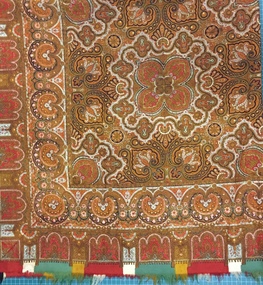
Clothing, Paisley Shawl, 20th Century
... Paisley Shawl...paisley shawl...Machine woven paisley shawl, based on traditional hand-woven Kashmiri designs. ...Paisley Shawl Clothing ...Imitation Kashmiri shawls were produced in large numbers in Europe in the second half of the 19th and also in the 20th centuries. The first mechanised production of such shawls was made possible by the invention of the Jacquard loom in France in the 1820s. Machine woven paisley shawl, based on traditional hand-woven Kashmiri designs. paisley shawl, shawls -
 Embroiderers Guild, Victoria
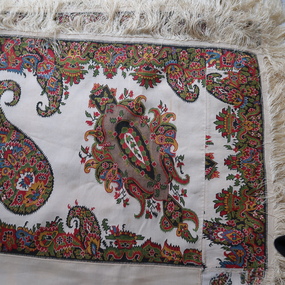
Clothing - Paisley Shawl
... Paisley Shawl...Paisley shawls were a fashionable item of women's clothing in Europe during the late eighteenth and nineteenth centuries. ...Silk/cotton paisley shawl with fringe. Cream background, brightly coloured Paisley motifs on borders, pieced borders - ? ...Paisley shawls were a fashionable item of women's clothing in Europe during the late eighteenth and nineteenth centuries. ...Paisley shawls were a fashionable item of women's clothing in Europe during the late eighteenth and nineteenth centuries. Many were made of intricately woven and delicate wool, as well as examples being printed onto silks, wools, and cotton. These pieces were highly decorative. Although now known as the Paisley pattern, the teardrop motif originated in Persia and India. There are various theories about the early history of the paisley motif, and it would appear that it originated in Iran during the early first millennium AD. At this date it was a bulbous, almond shaped form, which was often flowery and without the prominent hook so common in later examples. This motif is specifically known as a buteh. The end of the 17th century saw the hooked buteh becoming a popular motif in neighbouring Mughal India (c. 1526-1857). It was used especially on the fine woollen shawls that were hand woven and sometimes embroidered in Kashmir in northern India. The motif travelled from India to Africa, Southeast and East Asia, but in particular to Europe. In the late eighteenth century, the buteh became even more popular as it was featured on the Kashmir shawls that were being exported in vast quantities to Europe. Joséphine de Beauharnais, wife of Napoleon Bonaparte, for example, is said to have owned over 200 of these shawls. The buteh or paisley motif is actually one of the few non-geometric design forms that can be found throughout the world. It is worn by men, women and children of all ages, literally from the cradle to the grave. Moreover, it is worn by people of many different ethnic and cultural backgrounds. Silk/cotton paisley shawl with fringe. Cream background, brightly coloured Paisley motifs on borders, pieced borders - ? recycled from another item. -
 National Wool Museum
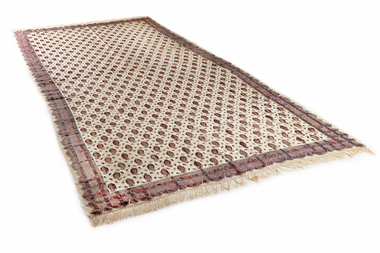
Clothing - Paisley Shawl, 1800 - 1830
... Paisley Shawl...Shawl...19th Century...Fashion...Clothing...Design...Paisley...Wool and silk fringed cream coloured shawl featuring a paisley pattern in tones of maroon, green, blue, brown and cream....Clothing Paisley Shawl ...Shawl of Jane Francis (nee Piper) 1809-1891 This fine woven silk and woollen shawl is from Shetland, Scotland and belonged orginally to Jane Francis. Jane was born in Devon near the village of Bradworthy. She married Joseph Francis (1803-1878) in 1830 in the Bradworthy Parish, Devon, England and wore the shawl over her wedding dress on her wedding day. Jane and Joseph came to Geelong in 1853 with their family. Jane’s sister and brother were in Geelong and their eldest daughter Elizabeth had arrived in 1849. They arrived on the ship 'Euphemus' at Point Henry, Geelong, on July 20, 1853 and travelled across the bay in the steamer Duncan Hoyle. Jane was wearing the shawl on her arrival in Geelong. They went to live in Sharp Street Chilwell in a house owned by their son in law, John Price, which they later purchased. Jane became well known as a ‘midwife’ having had 10 children of her own. She is known to have delivered twin girls in Fyans Street; Ada and Myrtle Downie in 1884. Jane’s youngest son William (1848-1932) was a spinning master, timekeeper and pay clerk at the Victorian Woollen Mill (later the Godfrey Hirst Excelsior Number Two mill) and together with William Cook owned a wool scour on the Barwon River at Marnockvale. William’s grandson Arthur (1917-1992) was a wool classer undertaking his course at the Gordon Institute and became a wool valuer at Strachan & Co. For a time he taught part time in the Gordon course. Arthur’s son Robert was also a wool classer and worked at the Australian Wool Testing Authority. The shawl was used as a bed spread at 'Woodstock' by Jane's son William and then by his two children Laura and Eve. After their deaths, Eve in 1947 and Laura in 1963, the shawl was passed to their youngest sister Ethel (Effie) Frier (nee Francis). She had no children and it was passed on to grandniece Pat Norman (nee Hughan). Pat then passed the shawl to cousin Carollyn Williams (nee Francis) who donated the shawl to the National Wool Museum. - Donor, 2026 The Francis family were tenant farmers, and the donor speculated that the shawl could potentially have been a wedding gift from the land owners.Wool and silk fringed cream coloured shawl featuring a paisley pattern in tones of maroon, green, blue, brown and cream.shawl, 19th century, fashion, clothing, design, paisley, migration, geelong, point henry -
 Embroiderers Guild, Victoria
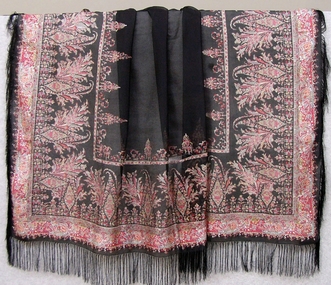
Clothing - Silk Paisley Style Shawl, Mid 18th century
... Silk Paisley Style Shawl...Large silk shawl with 130 mm black silk fringe. Black centre with colourful, dense floral or paisley (Jal) patterned border on 4 sides....Clothing Silk Paisley Style Shawl ...Originally belonged to the wife of William Pitt, first Earl of Chatham, 1708-78, and has been handed down from generation to generation and was the property of the donor.William Pitt, 1st Earl of Chatham (15 November 1708 – 11 May 1778) was a British Whig statesman who served as Prime Minister of Great Britain from 1766 to 1768.Large silk shawl with 130 mm black silk fringe. Black centre with colourful, dense floral or paisley (Jal) patterned border on 4 sides.embroidery, weaving, shawls, mid 18th century, france? -
 Embroiderers Guild, Victoria
Clothing - Shawl, 1860-80
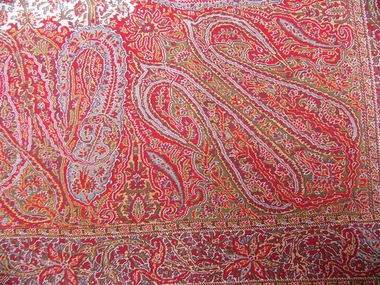
... Paisley shawl with silk warp threads of pink, red, black and yellow, weft of white wool....Textile Weaving Shawls 1860-80 Scotland Paisley shawl with silk warp threads of pink, red, black and yellow, weft of white wool. ...These shawls were copied from the embroidered shawls of Cashmere made in India. At the height of their popularity nearly every bride was given one on her wedding day.Paisley shawl with silk warp threads of pink, red, black and yellow, weft of white wool.textile, weaving, shawls, 1860-80, scotland -
 Embroiderers Guild, Victoria
Accessory - Shawl, circa 1850
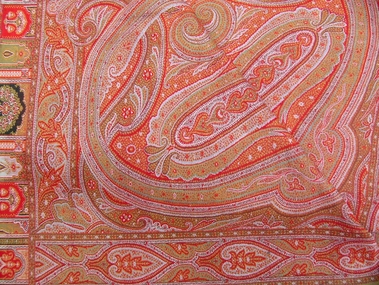
... Classical Paisley harness [loom} shawl woven in many colours with a red background and Persian style motifs....Well used Weaving Shawls 1840-60 Scotland Classical Paisley harness [loom} shawl woven in many colours with a red background and Persian style motifs. ...Brought to Australia by a pioneer family, 1849-51. Well usedClassical Paisley harness [loom} shawl woven in many colours with a red background and Persian style motifs.weaving, shawls, 1840-60, scotland -
 Whitehorse Historical Society Inc.
Clothing - Shawl
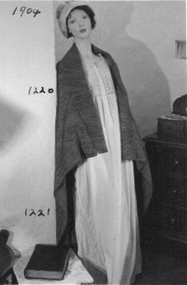
... Shawl in paisley pattern in cream, red and green. ...William Hill 0n 13th January 1843. costume female Shawl in paisley pattern in cream, red and green. ...Silk shawl worn by Miss Jean Young at her marriage to Mr. William Hill 0n 13th January 1843.Shawl in paisley pattern in cream, red and green. Majority of the fringe is missing.costume, female -
 Embroiderers Guild, Victoria
Accessory - Shawl, c. 1819-1830
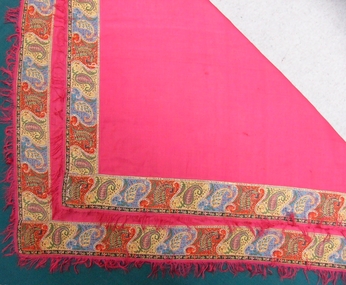
... Paisley border has been let in, and fringe attached to it. Accessory Shawl ...Plain turkey red fabric with paisley border and pine cone floral style in red, blue, green and yellow. Paisley border has been let in, and fringe attached to it.weaving, scotland, 1920-40, shawls -
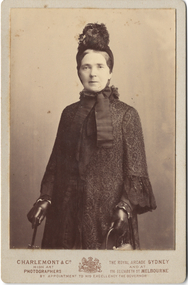 Kew Historical Society Inc
Photograph - Cabinet Card, Mrs Merritt, 1881-1891
... The paisley pattern was to become ubiquitous in the 19th century as a design on everything from carpets, to shawls, to clothing....The paisley pattern was to become ubiquitous in the 19th century as a design on everything from carpets, to shawls, to clothing. ...Charlemont & Co., operated out of the Academy Studio, 114 Elizabeth Street from 1890 to 1898. The sitter’s identity has been established as a Mrs. Merritt. While we know that she is not the Mrs Merritt who was to be the wife of the future Mayor of Kew, there were two Mrs Merritts who were shopkeepers in High Street, Kew. Mrs Lucy Merritt operated a bootmaker’s shop, and subsequently a “boot warehouse” from 1888 until the 1920s. Miss Laura Merritt established a dressmaker’s shop in High Street in 1910. Her business also lasted until the 1920s, albeit changed to that of a bookseller and stationer. Silver albumen cabinet card by Charlemont & Co., who operated out of the Academy Studio, 114 Elizabeth Street from 1890 to 1898. In this portrait of Mrs Merritt, she is posed gazing directly at the lens, thus achieving a potentially more intimate relationship with the viewer. All that is revealed however in this supposedly more direct pose is her face. As with an earlier generation, her hair is centrally parted and flattened to accommodate her bonnet, which is surmounted by feathers. The detail in her coat-dress is sharply revealed by new photographic processes that allowed firms like Charlemont & Co., to capture greater light and shade, as well as the detail of fabrics. The entire garment is beaded with what is probably Parisian jet. The beading is arranged in a ‘paisley’ design. The paisley pattern was to become ubiquitous in the 19th century as a design on everything from carpets, to shawls, to clothing.Mrs Merrittcharlemont & co., mrs merritt
