
Showing 32 items matching "paper reel"
-
 Flagstaff Hill Maritime Museum and Village
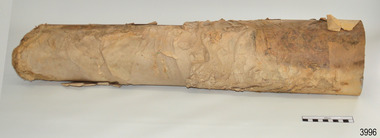
Functional object - Paper, circa 1908
... ...paper...reel...This roll or reel of paper was part of a consignment carried as cargo of the Falls of Halladale. ...This roll or reel of paper was part of a consignment carried as cargo of the Falls of Halladale. ...This roll or reel of paper was part of a consignment carried as cargo of the Falls of Halladale. The iron-hulled, four-masted barque, the Falls of Halladale, was a bulk carrier of general cargo. She left New York in August 1908 on her way to Melbourne and Sydney. In her hold, along with 56,763 tiles of unusual beautiful green American slates (roofing tiles), 5,673 coils of barbed wire, 600 stoves, 500 sewing machines, 6500 gallons of oil, 14400 gallons of benzene, and many other manufactured items, were 117 cases of crockery and glassware. Three months later and close to her destination, a navigational error caused the Falls of Halladale to be wrecked on a reef off the Peterborough headland at 3 am on the morning of the 15th of November, 1908. The captain and 29 crew members all survived, but her valuable cargo was largely lost, despite two salvage attempts in 1908-09 and 1910. ABOUT THE ‘FALLS OF HALLADALE’ (1886 - 1908) Built: in1886 by Russell & Co., Greenock shipyards, River Clyde, Scotland, UK. The company was founded in 1870 (or 1873) as a partnership between Joseph Russell (1834-1917), Anderson Rodger and William Todd Lithgow. During the period 1882-92 Russell & Co., standardised designs, which sped up their building process so much that they were able to build 271 ships over that time. In 1886 they introduced a 3000 ton class of sailing vessel with auxiliary engines and brace halyard winches. In 1890 they broke the world output record. Owner: Falls Line, Wright, Breakenridge & Co, 111 Union Street, Glasgow, Scotland. Configuration: Four masted sailing ship; iron-hulled barque; iron masts, wire rigging, fore & aft lifting bridges. Size: Length 83.87m x Breadth 12.6m x Depth 7.23m, Gross tonnage 2085 ton Wrecked: the night of 14th November 1908, Curdies Inlet, Peterborough south west Victoria Crew: 29 The Falls of Halladale was a four-masted sailing ship built-in 1886 in Glasgow, Scotland, for the long-distance cargo trade and was mostly used for Pacific grain trade. She was owned by Wright, Breakenridge & Co of Glasgow and was one of several Falls Line ships, all of which were named after waterfalls in Scotland. The lines flag was of red, blue and white vertical stripes. The Falls of Halladale had a sturdy construction built to carry maximum cargo and able to maintain full sail in heavy gales, one of the last of the ‘windjammers’ that sailed the Trade Route. She and her sister ship, the Falls of Garry, were the first ships in the world to include fore and aft lifting bridges. Previous to this, heavily loaded vessels could have heavy seas break along the full length of the deck, causing serious injury or even death to those on deck. The new, raised catwalk-type decking allowed the crew to move above the deck stormy conditions. This idea is still used today on the most modern tankers and cargo vessels and has proved to be an important step forward in the safety of men at sea. On 4th August 1908, with new sails, 29 crew, and 2800 tons of cargo, the Falls of Halladale left New York, bound for Melbourne and Sydney via the Cape of Good Hope. The cargo on board was valued at £35,000 and included 56,763 tiles of American slate roofing tiles (roof slates), 5,673 coils of barbed wire, 600 stoves, 500 sewing machines, 6,500 gallons of oil, 14,400 gallons of benzene, plumbing iron, 117 cases of crockery and glassware and many other manufactured items. The Falls of Halladale had been at sail for 102 days when, at 3 am on the night of 14th November 1908, under full sail in calm seas with a six knots breeze behind and misleading fog along the coast, the great vessel rose upon an ocean swell and settled on top of a submerged reef near Peterborough on the south-west Victoria’s coast. The ship was jammed on the rocks and began filling with water. The crew launched the two lifeboats and all 29 crew landed safely on the beach over 4 miles away at the Bay of Islands. The postmistress at Peterborough, who kept a watch for vessels in distress, saw the stranding and sent out an alert to the local people. A rescue party went to the aid of the sailors and the Port Campbell rocket crew was dispatched, but the crew had all managed to reach shore safely by the time help arrived. The ship stayed in full sail on the rocky shelf for nearly two months, attracting hundreds of sightseers who watched her slowly disintegrate until the pounding seas and dynamiting by salvagers finally broke her back, and her remains disappeared back into deeper water. The valuable cargo was largely lost, despite two salvage attempts in 1908-09 and 1910. Further salvage operations were made from 1974-1986, during which time 22,000 slate tiles were recovered with the help of 14 oil drums to float them, plus personal artefacts, ship fittings, reams of paper and other items. The Court of Marine Inquiry in Melbourne ruled that the foundering of the ship was entirely due to Captain David Wood Thomson’s navigational error, not too technical failure of the Clyde-built ship. The shipwreck is a popular site for divers, about 300m offshore and in 3 – 15m of water. Some of the original cargo can be seen at the site, including pieces of roof slate and coils of barbed wire. The roll of paper is an example of cargo brought to Australia in the early 20th century. It is also significant for its association with the Falls of Halladale shipwreck, which is listed on the Victorian Heritage Register (No. S255). She was one of the last ships to sail the Trade Routes. She is one of the first vessels to have fore and aft lifting bridges. She is an example of the remains of an International Cargo Ship and also represents aspects of Victoria’s shipping industry. The wreck is protected as a Historic Shipwreck under the Commonwealth Historic Shipwrecks Act (1976).Roll of paper. Paper was part of a large consignment of paper listed as part of the cargo manifesto. It was recovered from the wreck of the ship Falls of Halladale. A section of the paper has been cut away after it was recovered.flagstaff hill, warrnambool, shipwrecked coast, flagstaff hill maritime museum, maritime museum, shipwreck coast, flagstaff hill maritime village, great ocean road, falls of halladale, shipwreck peterborough, 1908 shipwreck, great clipper ships, russell & co., paper, reel, roll, paper reel, paper roll, cargo, consignment -
 Flagstaff Hill Maritime Museum and Village
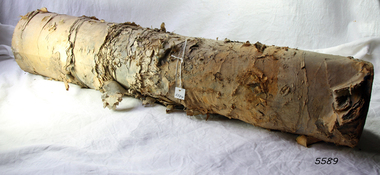
Functional object - Paper, circa 1908
... ...paper...reel...This roll or reel of paper was part of a consignment carried as cargo of the Falls of Halladale. ...This roll or reel of paper was part of a consignment carried as cargo of the Falls of Halladale. ...This roll or reel of paper was part of a consignment carried as cargo of the Falls of Halladale. The iron-hulled, four-masted barque, the Falls of Halladale, was a bulk carrier of general cargo. She left New York in August 1908 on her way to Melbourne and Sydney. In her hold, along with 56,763 tiles of unusual beautiful green American slates (roofing tiles), 5,673 coils of barbed wire, 600 stoves, 500 sewing machines, 6500 gallons of oil, 14400 gallons of benzene, and many other manufactured items, were 117 cases of crockery and glassware. Three months later and close to her destination, a navigational error caused the Falls of Halladale to be wrecked on a reef off the Peterborough headland at 3 am on the morning of the 15th of November, 1908. The captain and 29 crew members all survived, but her valuable cargo was largely lost, despite two salvage attempts in 1908-09 and 1910. ABOUT THE ‘FALLS OF HALLADALE’ (1886 - 1908) Built: in1886 by Russell & Co., Greenock shipyards, River Clyde, Scotland, UK. The company was founded in 1870 (or 1873) as a partnership between Joseph Russell (1834-1917), Anderson Rodger and William Todd Lithgow. During the period 1882-92 Russell & Co., standardised designs, which sped up their building process so much that they were able to build 271 ships over that time. In 1886 they introduced a 3000 ton class of sailing vessel with auxiliary engines and brace halyard winches. In 1890 they broke the world output record. Owner: Falls Line, Wright, Breakenridge & Co, 111 Union Street, Glasgow, Scotland. Configuration: Four masted sailing ship; iron-hulled barque; iron masts, wire rigging, fore & aft lifting bridges. Size: Length 83.87m x Breadth 12.6m x Depth 7.23m, Gross tonnage 2085 ton Wrecked: the night of 14th November 1908, Curdies Inlet, Peterborough south west Victoria Crew: 29 The Falls of Halladale was a four-masted sailing ship built-in 1886 in Glasgow, Scotland, for the long-distance cargo trade and was mostly used for Pacific grain trade. She was owned by Wright, Breakenridge & Co of Glasgow and was one of several Falls Line ships, all of which were named after waterfalls in Scotland. The lines flag was of red, blue and white vertical stripes. The Falls of Halladale had a sturdy construction built to carry maximum cargo and able to maintain full sail in heavy gales, one of the last of the ‘windjammers’ that sailed the Trade Route. She and her sister ship, the Falls of Garry, were the first ships in the world to include fore and aft lifting bridges. Previous to this, heavily loaded vessels could have heavy seas break along the full length of the deck, causing serious injury or even death to those on deck. The new, raised catwalk-type decking allowed the crew to move above the deck stormy conditions. This idea is still used today on the most modern tankers and cargo vessels and has proved to be an important step forward in the safety of men at sea. On 4th August 1908, with new sails, 29 crew, and 2800 tons of cargo, the Falls of Halladale left New York, bound for Melbourne and Sydney via the Cape of Good Hope. The cargo on board was valued at £35,000 and included 56,763 tiles of American slate roofing tiles (roof slates), 5,673 coils of barbed wire, 600 stoves, 500 sewing machines, 6,500 gallons of oil, 14,400 gallons of benzene, plumbing iron, 117 cases of crockery and glassware and many other manufactured items. The Falls of Halladale had been at sail for 102 days when, at 3 am on the night of 14th November 1908, under full sail in calm seas with a six knots breeze behind and misleading fog along the coast, the great vessel rose upon an ocean swell and settled on top of a submerged reef near Peterborough on the south-west Victoria’s coast. The ship was jammed on the rocks and began filling with water. The crew launched the two lifeboats and all 29 crew landed safely on the beach over 4 miles away at the Bay of Islands. The postmistress at Peterborough, who kept a watch for vessels in distress, saw the stranding and sent out an alert to the local people. A rescue party went to the aid of the sailors and the Port Campbell rocket crew was dispatched, but the crew had all managed to reach shore safely by the time help arrived. The ship stayed in full sail on the rocky shelf for nearly two months, attracting hundreds of sightseers who watched her slowly disintegrate until the pounding seas and dynamiting by salvagers finally broke her back, and her remains disappeared back into deeper water. The valuable cargo was largely lost, despite two salvage attempts in 1908-09 and 1910. Further salvage operations were made from 1974-1986, during which time 22,000 slate tiles were recovered with the help of 14 oil drums to float them, plus personal artefacts, ship fittings, reams of paper and other items. The Court of Marine Inquiry in Melbourne ruled that the foundering of the ship was entirely due to Captain David Wood Thomson’s navigational error, not too technical failure of the Clyde-built ship. The shipwreck is a popular site for divers, about 300m offshore and in 3 – 15m of water. Some of the original cargo can be seen at the site, including pieces of roof slate and coils of barbed wire. The roll of paper is an example of cargo brought to Australia in the early 20th century. It is also significant for its association with the Falls of Halladale shipwreck, which is listed on the Victorian Heritage Register (No. S255). She was one of the last ships to sail the Trade Routes. She is one of the first vessels to have fore and aft lifting bridges. She is an example of the remains of an International Cargo Ship and also represents aspects of Victoria’s shipping industry. The wreck is protected as a Historic Shipwreck under the Commonwealth Historic Shipwrecks Act (1976).Roll of paper. Paper has remains of a wooden peg up through the centre and a lot of sedimentation. This roll was recovered from the wreck of the Falls of Halladale. It was part of a large consignment of paper listed as part of the cargo manifesto.flagstaff hill, warrnambool, shipwrecked coast, flagstaff hill maritime museum, maritime museum, shipwreck coast, flagstaff hill maritime village, great ocean road, falls of halladale, shipwreck peterborough, 1908 shipwreck, great clipper ships, russell & co., paper, reel, roll, paper reel, paper roll, cargo, consignment -
 Flagstaff Hill Maritime Museum and Village
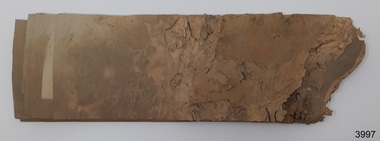
Functional object - Paper, circa 1908
... ...paper reel...These sheets of paper were from a roll or reel of paper that was part of a consignment carried as cargo of the Falls of Halladale. ...These sheets of paper were from a roll or reel of paper that was part of a consignment carried as cargo of the Falls of Halladale. ...These sheets of paper were from a roll or reel of paper that was part of a consignment carried as cargo of the Falls of Halladale. The iron-hulled, four-masted barque, the Falls of Halladale, was a bulk carrier of general cargo. She left New York in August 1908 on her way to Melbourne and Sydney. In her hold, along with 56,763 tiles of unusual beautiful green American slates (roofing tiles), 5,673 coils of barbed wire, 600 stoves, 500 sewing machines, 6500 gallons of oil, 14400 gallons of benzene, and many other manufactured items, were 117 cases of crockery and glassware. Three months later and close to her destination, a navigational error caused the Falls of Halladale to be wrecked on a reef off the Peterborough headland at 3 am on the morning of the 15th of November, 1908. The captain and 29 crew members all survived, but her valuable cargo was largely lost, despite two salvage attempts in 1908-09 and 1910. ABOUT THE ‘FALLS OF HALLADALE’ (1886 - 1908) Built: in1886 by Russell & Co., Greenock shipyards, River Clyde, Scotland, UK. The company was founded in 1870 (or 1873) as a partnership between Joseph Russell (1834-1917), Anderson Rodger and William Todd Lithgow. During the period 1882-92 Russell & Co., standardised designs, which sped up their building process so much that they were able to build 271 ships over that time. In 1886 they introduced a 3000 ton class of sailing vessel with auxiliary engines and brace halyard winches. In 1890 they broke the world output record. Owner: Falls Line, Wright, Breakenridge & Co, 111 Union Street, Glasgow, Scotland. Configuration: Four-masted sailing ship; iron-hulled barque; iron masts, wire rigging, fore & aft lifting bridges. Size: Length 83.87m x Breadth 12.6m x Depth 7.23m, Gross tonnage 2085 ton Wrecked: the night of 14th November 1908, Curdies Inlet, Peterborough south west Victoria Crew: 29 The Falls of Halladale was a four-masted sailing ship built-in 1886 in Glasgow, Scotland, for the long-distance cargo trade and was mostly used for Pacific grain trade. She was owned by Wright, Breakenridge & Co of Glasgow and was one of several Falls Line ships, all of which were named after waterfalls in Scotland. The lines flag was of red, blue and white vertical stripes. The Falls of Halladale had a sturdy construction built to carry maximum cargo and able to maintain full sail in heavy gales, one of the last of the ‘windjammers’ that sailed the Trade Route. She and her sister ship, the Falls of Garry, were the first ships in the world to include fore and aft lifting bridges. Previous to this, heavily loaded vessels could have heavy seas break along the full length of the deck, causing serious injury or even death to those on deck. The new, raised catwalk-type decking allowed the crew to move above the deck stormy conditions. This idea is still used today on the most modern tankers and cargo vessels and has proved to be an important step forward in the safety of men at sea. On 4th August 1908, with new sails, 29 crew, and 2800 tons of cargo, the Falls of Halladale left New York, bound for Melbourne and Sydney via the Cape of Good Hope. The cargo on board was valued at £35,000 and included 56,763 tiles of American slate roofing tiles (roof slates), 5,673 coils of barbed wire, 600 stoves, 500 sewing machines, 6,500 gallons of oil, 14,400 gallons of benzene, plumbing iron, 117 cases of crockery and glassware and many other manufactured items. The Falls of Halladale had been at sail for 102 days when, at 3 am on the night of 14th November 1908, under full sail in calm seas with a six knots breeze behind and misleading fog along the coast, the great vessel rose upon an ocean swell and settled on top of a submerged reef near Peterborough on the south-west Victoria’s coast. The ship was jammed on the rocks and began filling with water. The crew launched the two lifeboats and all 29 crew landed safely on the beach over 4 miles away at the Bay of Islands. The postmistress at Peterborough, who kept a watch for vessels in distress, saw the stranding and sent out an alert to the local people. A rescue party went to the aid of the sailors and the Port Campbell rocket crew was dispatched, but the crew had all managed to reach shore safely by the time help arrived. The ship stayed in full sail on the rocky shelf for nearly two months, attracting hundreds of sightseers who watched her slowly disintegrate until the pounding seas and dynamiting by salvagers finally broke her back, and her remains disappeared back into deeper water. The valuable cargo was largely lost, despite two salvage attempts in 1908-09 and 1910. Further salvage operations were made from 1974-1986, during which time 22,000 slate tiles were recovered with the help of 14 oil drums to float them, plus personal artefacts, ship fittings, reams of paper and other items. The Court of Marine Inquiry in Melbourne ruled that the foundering of the ship was entirely due to Captain David Wood Thomson’s navigational error, not too technical failure of the Clyde-built ship. The shipwreck is a popular site for divers, about 300m offshore and in 3 – 15m of water. Some of the original cargo can be seen at the site, including pieces of roof slate and coils of barbed wire. The roll of paper from which the sheets were cut is an example of cargo brought to Australia in the early 20th century. It is also significant for its association with the Falls of Halladale shipwreck, which is listed on the Victorian Heritage Register (No. S255). She was one of the last ships to sail the Trade Routes. She is one of the first vessels to have fore and aft lifting bridges. She is an example of the remains of an International Cargo Ship and also represents aspects of Victoria’s shipping industry. The wreck is protected as a Historic Shipwreck under the Commonwealth Historic Shipwrecks Act (1976).Wad of paper sheets that was cut from a roll of paper. Three sides of the sheets are straight and the other side is rough due to exposure to sea water for many years. The roll was part of a large consignment of paper listed on the cargo manifesto of the wreck of the ship Falls of Halladale. flagstaff hill, warrnambool, shipwrecked coast, flagstaff hill maritime museum, maritime museum, shipwreck coast, flagstaff hill maritime village, great ocean road, falls of halladale, shipwreck peterborough, 1908 shipwreck, great clipper ships, russell & co., paper, paper reel, paper roll, cargo, consignment, paper sheets, wad of paper -
 Greensborough Historical Society
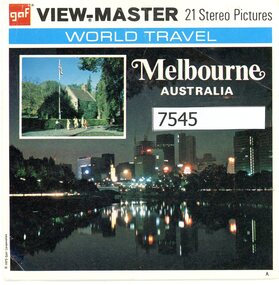
Leisure object - View-Master, GAF Corporation, Melbourne Australia, 1973
... 3 View-Master reels in paper cover. Each reel has 7 stereo photographs....This set is of Melbourne landmarks in the 1970s. view-master toys melbourne 3 View-Master reels in paper cover. Each reel has 7 stereo photographs. ...View-Masters were a popular toy, the Reels showed stereo pictures of many subjects. This set is of Melbourne landmarks in the 1970s.3 View-Master reels in paper cover. Each reel has 7 stereo photographs.view-master, toys, melbourne -
 Bendigo Historical Society Inc.
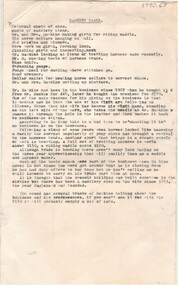
Document - AULSEBROOK COLLECTION: HARNESS MAKER REEL AND ARTICLE
... Aulsebrook Collection: Harness Maker Reel and Article -1 Fools gaps sized paper, typed -Reel for harness making -article referring to history and people behind the business -no date...Harness Making Aulsebrook Aulsebrook Collection: Harness Maker Reel and Article -1 Fools gaps sized paper, typed -Reel for harness making -article referring to history and people behind the business -no date Document AULSEBROOK COLLECTION: HARNESS MAKER REEL AND ARTICLE ...Aulsebrook Collection: Harness Maker Reel and Article -1 Fools gaps sized paper, typed -Reel for harness making -article referring to history and people behind the business -no dateharness making, aulsebrook -
 Vision Australia
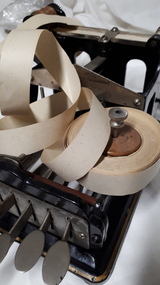
Functional object - Object, Stainsby-Wayne embossed shorthand typewriter with spool of paper, 1930-1940's
... Black metal typewriter which has seven keys and a small reel of paper...paper or the machine for each line. Speeds of 80 - 140 words per minute can be obtained. braille equipment royal victorian institute for the blind 415 Stainsby-Wayne Embossed Shorthand Typewriter Patented * Alfred Wayne * Birm, ENG Black metal typewriter which has seven keys and a small reel of paper Stainsby-Wayne embossed shorthand typewriter with spool of paper Functional object Object ...Henry Stainsby (1859-1925), Supt. of the Birmingham Royal Institution for the Blind, (later General Secretary of the British & Foreign Blind Association) along with Birmingham manufacturer Albert Wayne, introduced their Shorthand Braille Writer, circa 1910-1940. Used at the Royal Victorian Institute for the Blind. These machines were often supplied with a case, to deaden the sound when in use. The machine was designed to take down verbatim reports from dictation. As the strip of paper passes automatically through the machine, no time is needed to adjust the paper or the machine for each line. Speeds of 80 - 140 words per minute can be obtained.Black metal typewriter which has seven keys and a small reel of paper415 Stainsby-Wayne Embossed Shorthand Typewriter Patented * Alfred Wayne * Birm, ENGbraille equipment, royal victorian institute for the blind -
 Kiewa Valley Historical Society
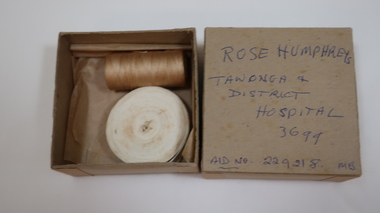
Sewing Kit - Tawonga and District Hospital
... Brown cardboard square box lined with beige tissue paper. Containing one reel beige cotton on cardboard reel and a roll of cotton tape with handwritten name 'Rose Humphreys'.... / HO 20171L Brown cardboard square box lined with beige tissue paper. Containing one reel beige cotton on cardboard reel and a roll of cotton tape with handwritten name 'Rose Humphreys' Sewing Kit - Tawonga and District Hospital ...Brown cardboard square box lined with beige tissue paper. Containing one reel beige cotton on cardboard reel and a roll of cotton tape with handwritten name 'Rose Humphreys'Handwritten with biro on top of the box: Rose Humphreys / Tawonga & / District/ Hospital /3699 / Aid No: 229218 MB On one side: 41and on the opposite side: Pension No. / HO 20171L tawonga district hospital, sewing kit -
 Melbourne Tram Museum
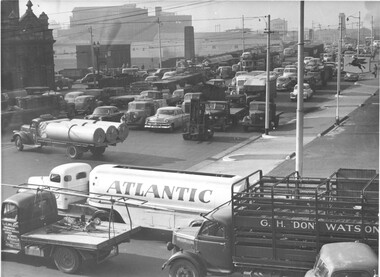
Photograph - Spencer & Clarendon Sts traffic issues - set of 3, Melbourne & Metropolitan Tramways Board (MMTB), 1954
... Note the truck carrying paper reels has come out of the Mobil Service Station and is turning south onto the bridge. ...Note the truck carrying paper reels has come out of the Mobil Service Station and is turning south onto the bridge. ...1 - "Spencer Street looking south from the roof of Hamill tyre service, tramcar held up in northbound traffic for a period of 3.5 minutes, date 28.9.54, time 0835 hrs. In the background is part of the Fish market building, the bridge itself carrying very heavy traffic. In the foreground is coming out of Siddeley Street, is an "Atlantic" petrol tanker and trucks for L & G Wilson carriers, and G H 'Don' Watson cattle truck. Note the truck carrying paper reels has come out of the Mobil Service Station and is turning south onto the bridge. Traffic is also struggling to exit Queens Wharf Road onto the bridge as well. The W2 class, is running to East Preston on Route 9 service. Note the Pioneer Tour coach, "CDR" petrol tanker and a forklift truck in the traffic mix. 2 - "Clarendon Street at Whiteman Street looking north (from tray of tramways truck), northbound trams held up by traffic across tracks, date 13-10-54, time 0810hrs". In the view is W5 class No. 808, running a Thornbury route 9B service. Another "Thornbury" bound tram can be glimpsed in the traffic ahead. In the background are the Robar Tea House, Hart & Co, Robur Tea advert, Bullen's Circus, and Vincent's pills. 3 - "Spencer Street from Batman Hill Hotel, looking south, general view of traffic, dated 22-10-54, time 1712 hrs". Has in the view, W2 class tram 574, running to "East Preston" route 9 service, and W2 No.566, running to "Hawthorn" on route 27 service. In the background is the Victorian Railways Head office, the Tea House and the railway viaduct. Note also the advertising for both Philips and Berger Master (Paints). Yields information about the traffic issues in Clarendon and Spencer Sts. 1954Black and white photograph with handwritten details of time and location on the rear. - set of 3.On the rear of each print is the details - see Context.trams, tramways, traffic congestion, w2 class, tram 808, tram 574, w5 class, clarendon st, spencer st, tram 566, route 9, route 27, route 9b -
 Orbost & District Historical Society
cotton reels, first half 20th century
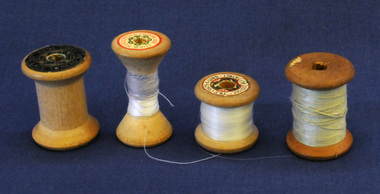
... Four wooden cotton reels. 2495.1 is an empty reel with paper labels at both ends. " Best Linen lace thread Barbours No 50 200 yards Wm Barbour & Sons Ltd Lisburn Ireland" 2495.2 is a wooden reel with thick linen thread. ...Helena Warren was a popular Orbost identity who was well known as an accomplished photographer and needleworker, needlework cotton-reels Warren-Helena Four wooden cotton reels. 2495.1 is an empty reel with paper labels at both ends. " Best Linen lace thread Barbours No 50 200 yards Wm Barbour & Sons Ltd Lisburn Ireland" 2495.2 is a wooden reel with thick linen thread. ...These cotton reels were owned and used by Helena Warren of Newmerella. Helena Francis Warren (nee McKeown) was married to William John Warren and lived in Newmerella. She was a fine amateur photographer who supplied the photos for the Back-To-Orbost celebration book in 1937 and also designed the Back-To-Orbost badge. She was known for her soft toy making. (by Ivy Rodwell in from Personalities and Stories of the Early Orbost District by Mary Gilbert).Helena Warren was a popular Orbost identity who was well known as an accomplished photographer and needleworker,Four wooden cotton reels. 2495.1 is an empty reel with paper labels at both ends. " Best Linen lace thread Barbours No 50 200 yards Wm Barbour & Sons Ltd Lisburn Ireland" 2495.2 is a wooden reel with thick linen thread. On one end " H11 underlined" 2495.3 is a narrow wooden reel with white thread and grey wound over it. It has paper labels at both ends. " J. & P. Coats 500 yards No 50 457 metres - Chain Brand Mercerised Cotton MR WHITE" 2495.4 is a wooden reel with synthetic thread - one paper label. "J. & P. Coats 6 Cord 200 yards 40 183 metres"needlework cotton-reels warren-helena -
 Glenelg Shire Council Cultural Collection
Film - Film - S-E Storm/ Main breakwater, Oct-63
... Front: Oct '63/ B/W S/E/Storm/Main/B/WATER/ (blue pen and white sticky tape, top of reel) Back: outside general (on paper sticky-taped to one side of reel....Port of Portland Authority Port of Portland Archives Front: Oct '63/ B/W S/E/Storm/Main/B/WATER/ (blue pen and white sticky tape, top of reel) Back: outside general (on paper sticky-taped to one side of reel. ...Port of Portland AuthorityFront: Oct '63/ B/W S/E/Storm/Main/B/WATER/ (blue pen and white sticky tape, top of reel) Back: outside general (on paper sticky-taped to one side of reel.port of portland archives -
 The Beechworth Burke Museum
Photograph, 1886
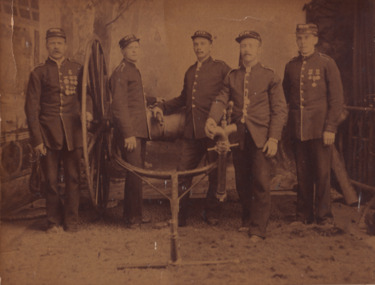
... Reel/ J.E Bray Photo / J.Payne (absent) , J. Scott / G. Duncan / C. Ellen / J. Anderson / F. Lloyd / Reverse: 97.22 / 84-253-1 / BMMA3123 Members of Beechwoth Fire Brigade 1886 Sepia rectangular photograph printed on photographic paper and mounted on card Photograph Photograph ...Photograph of the winners of the six-men hose and reel event in Sandhurst on the 10th March 1886. There are 5 men pictured in the photograph all wearing dress uniforms and medals posing with a hand-drawn hose reel and stand pipe. Pictured from left to right: J. Scott / G. Duncan / C. Ellen / J. Anderson / F. Lloyd /. This photograph was take by James E. Bray (1832-1891).Sepia rectangular photograph printed on photographic paper and mounted on cardObverse: Winners of the six-men hose and reel event, Sandhurst, March 10th 1986 / Prize: Fifty Guinea Hose Reel/ J.E Bray Photo / J.Payne (absent) , J. Scott / G. Duncan / C. Ellen / J. Anderson / F. Lloyd / Reverse: 97.22 / 84-253-1 / BMMA3123 Members of Beechwoth Fire Brigade 1886emergency services, beechworth, sandhurst, burke museum, photograph, fire brigade, fire -
 The Beechworth Burke Museum
Certificate - Photograph, January 1st 1895
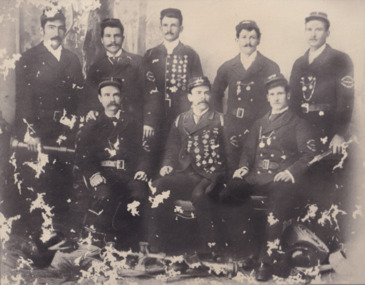
... Reel Practice / at the intercolonial Demonstration / Held at Albury, NSW / Jan 1st 1895/ T. Coswello / H. Thompson / F. Dunn / H.O. David / F. Lloyd, (capt) / J. Davis / H. Duncan, (Lieut) / T. Shennan Reverse: BMM 6933 Black and white certificate reproduction printed on matte photographic paper ...This certificate was awarded to Beechworth Fire Brigade for winning the eight men hose & reel practice at the inter-colonial Demonstration held at Albury, NSW on January 1st 1895. Pictured from left to right: T. Coswello / H. Thompson / F. Dunn / H.O. David / F. Lloyd, (capt) / J. Davis / H. Duncan, (Lieut) / T. Shennan. Black and white certificate reproduction printed on matte photographic paperObverse: Beechworth Fire Brigade / Winners of the Eight Men Hose & Reel Practice / at the intercolonial Demonstration / Held at Albury, NSW / Jan 1st 1895/ T. Coswello / H. Thompson / F. Dunn / H.O. David / F. Lloyd, (capt) / J. Davis / H. Duncan, (Lieut) / T. Shennan Reverse: BMM 6933emergency services, burke museum, fire brigade, fire, beechworth, 1895, albury, beechworth fire brigade -
 The Beechworth Burke Museum
Photograph, c1950s
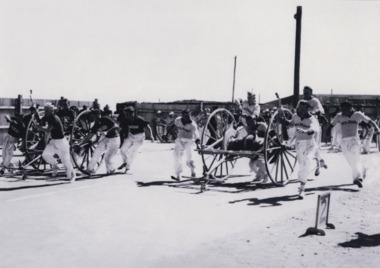
... reels into the fire service in the mid 1800s. This was to assist in getting hose and other necessary equipment to the scene of a fire faster. Brigades soon find that competing with other brigades improved their training and efficiency. The State Championship became the peak of the season's competitions conducted by districts and associations across the state. emergency services beechworth fire brigade firemen photograph competition black and white fire Black and white rectangular photo reproduction printed on matte photographic paper Photograph Photograph ...Photograph of 2 teams with hoses and reels in a race as part of a CFA competition. Fire brigade competitions have been running for almost 150 years with the first State Championship held in Melbourne in 1874. State Championships have continued every year since 1873. The event goes on regardless of weather conditions or natural disasters. The only cancellations being due to WWI and WWII. In the 1950s, the Rural State Championships were developed to reflect the unique skills of rural brigades. The competitions started out as 'Demonstrations' with the introduction of hose reels into the fire service in the mid 1800s. This was to assist in getting hose and other necessary equipment to the scene of a fire faster. Brigades soon find that competing with other brigades improved their training and efficiency. The State Championship became the peak of the season's competitions conducted by districts and associations across the state. Black and white rectangular photo reproduction printed on matte photographic paperemergency services, beechworth, fire brigade, firemen, photograph, competition, black and white, fire -
 Flagstaff Hill Maritime Museum and Village
Equipment - Surgical silks and sutures, Teleflex (manufacturers of Deknatel), Early 1900s
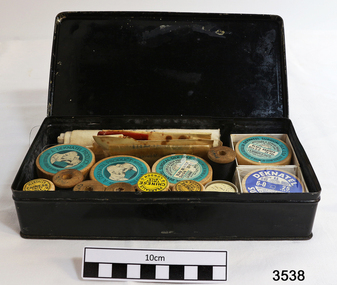
... paper bags in the box containing a suture bobbin. 'PEARSALL'S LONDON' printed on some bobbins. 'J A DEKNATEL & SON INC, QUEENS VILLAGE, LONG ISLAND NEW YORK' printed on others. Black tin with hinged lid, containing reels ...Through many millennia, various suture materials were used or proposed. Needles were made of bone or metals such as silver, copper, and aluminium bronze wire. Sutures were made of plant materials (flax, hemp and cotton) or animal material (hair, tendons, arteries, muscle strips and nerves, silk, and catgut).[citation needed] The earliest reports of surgical suture date to 3000 BC in ancient Egypt, and the oldest known suture is in a mummy from 1100 BC. A detailed description of a wound suture and the suture materials used in it is by the Indian sage and physician Sushruta, written in 500 BC. The Greek father of medicine, Hippocrates, described suture techniques, as did the later Roman Aulus Cornelius Celsus. The 2nd-century Roman physician Galen described sutures made of surgical gut or catgut. In the 10th century, the catgut suture along with the surgery needle were used in operations by Abulcasis. The gut suture was similar to that of strings for violins, guitars, and tennis racquets and it involved harvesting sheep or cow intestines. Catgut sometimes led to infection due to a lack of disinfection and sterilization of the material. Joseph Lister endorsed the routine sterilization of all suture threads. He first attempted sterilization with the 1860s "carbolic catgut," and chromic catgut followed two decades later. Sterile catgut was finally achieved in 1906 with iodine treatment. The next great leap came in the twentieth century. The chemical industry drove production of the first synthetic thread in the early 1930s, which exploded into production of numerous absorbable and non-absorbable synthetics. The first synthetic absorbable was based on polyvinyl alcohol in 1931. Polyesters were developed in the 1950s, and later the process of radiation sterilization was established for catgut and polyester. Polyglycolic acid was discovered in the 1960s and implemented in the 1970s. Today, most sutures are made of synthetic polymer fibers. Silk and, rarely, gut sutures are the only materials still in use from ancient times. In fact, gut sutures have been banned in Europe and Japan owing to concerns regarding bovine spongiform encephalopathy. Silk suture is still used today, mainly to secure surgical drains. https://en.wikipedia.org/wiki/Surgical_suture#:~:text=Sutures%20were%20made%20of%20plant,a%20mummy%20from%201100%20BC. This tin contains a variety of surgical threads and accessories that were used by Dr W.R.Angus. It was donated to Flagstaff Hill Maritime Village by the family of Doctor William Roy Angus, Surgeon and Oculist. It is part of the “W.R. Angus Collection” that includes historical medical equipment, surgical instruments and material once belonging to Dr Edward Ryan and Dr Thomas Francis Ryan, (both of Nhill, Victoria) as well as Dr Angus’ own belongings. The Collection’s history spans the medical practices of the two Doctors Ryan, from 1885-1926 plus that of Dr Angus, up until 1969. ABOUT THE “W.R.ANGUS COLLECTION” Doctor William Roy Angus M.B., B.S., Adel., 1923, F.R.C.S. Edin.,1928 (also known as Dr Roy Angus) was born in Murrumbeena, Victoria in 1901 and lived until 1970. He qualified as a doctor in 1923 at University of Adelaide, was Resident Medical Officer at the Royal Adelaide Hospital in 1924 and for a period was house surgeon to Sir (then Mr.) Henry Simpson Newland. Dr Angus was briefly an Assistant to Dr Riddell of Kapunda, then commenced private practice at Curramulka, Yorke Peninsula, SA, where he was physician, surgeon and chemist. In 1926, he was appointed as new Medical Assistant to Dr Thomas Francis Ryan (T.F. Ryan, or Tom), in Nhill, Victoria, where his experiences included radiology and pharmacy. In 1927 he was Acting House Surgeon in Dr Tom Ryan’s absence. Dr Angus had become engaged to Gladys Forsyth and they decided he would take time to further his studies overseas in the UK in 1927. He studied at London University College Hospital and at Edinburgh Royal Infirmary and in 1928, was awarded FRCS (Fellow from the Royal College of Surgeons), Edinburgh. He worked his passage back to Australia as a Ship’s Surgeon on the on the Australian Commonwealth Line’s SS Largs Bay. Dr Angus married Gladys in 1929, in Ballarat. (They went on to have one son (Graham 1932, born in SA) and two daughters (Helen (died 12/07/1996) and Berenice (Berry), both born at Mira, Nhill ) Dr Angus was a ‘flying doctor’ for the A.I.M. (Australian Inland Ministry) Aerial Medical Service in 1928 . The organisation began in South Australia through the Presbyterian Church in that year, with its first station being in the remote town of Oodnadatta, where Dr Angus was stationed. He was locum tenens there on North-South Railway at 21 Mile Camp. He took up this ‘flying doctor’ position in response to a call from Dr John Flynn; the organisation was later known as the Flying Doctor Service, then the Royal Flying Doctor Service. A lot of his work during this time involved dental surgery also. Between 1928-1932 he was surgeon at the Curramulka Hospital, Yorke Peninsula, South Australia. In 1933 Dr Angus returned to Nhill where he’d previously worked as Medical Assistant and purchased a share of the Nelson Street practice and Mira hospital from Dr Les Middleton one of the Middleton Brothers, the current owners of what was once Dr Tom Ryan’s practice. Dr L Middleton was House Surgeon to the Nhill Hospital 1926-1933, when he resigned. [Dr Tom Ryan’s practice had originally belonged to his older brother Dr Edward Ryan, who came to Nhill in 1885. Dr Edward saw patients at his rooms, firstly in Victoria Street and in 1886 in Nelson Street, until 1901. The Nelson Street practice also had a 2 bed ward, called Mira Private Hospital ). Dr Edward Ryan was House Surgeon at the Nhill Hospital 1884-1902 . He also had occasions where he successfully performed veterinary surgery for the local farmers too. Dr Tom Ryan then purchased the practice from his brother in 1901. Both Dr Edward and Dr Tom Ryan work as surgeons included eye surgery. Dr Tom Ryan performed many of his operations in the Mira private hospital on his premises. He too was House Surgeon at the Nhill Hospital 1902-1926. Dr Tom Ryan had one of the only two pieces of radiology equipment in Victoria during his practicing years – The Royal Melbourne Hospital had the other one. Over the years Dr Tom Ryan gradually set up what was effectively a training school for country general-practitioner-surgeons. Each patient was carefully examined, including using the X-ray machine, and any surgery was discussed and planned with Dr Ryan’s assistants several days in advance. Dr Angus gained experience in using the X-ray machine there during his time as assistant to Dr Ryan. Dr Tom Ryan moved from Nhill in 1926. He became a Fellow of the Royal Australasian College of Surgeons in 1927, soon after its formation, a rare accolade for a doctor outside any of the major cities. He remained a bachelor and died suddenly on 7th Dec 1955, aged 91, at his home in Ararat. Scholarships and prizes are still awarded to medical students in the honour of Dr T.F. Ryan and his father, Dr Michael Ryan, and brother, John Patrick Ryan. ] When Dr Angus bought into the Nelson Street premises in Nhill he was also appointed as the Nhill Hospital’s Honorary House Surgeon 1933-1938. His practitioner’s plate from his Nhill surgery states “HOURS Daily, except Tuesdays, Fridays and Saturday afternoons, 9-10am, 2-4pm, 7-8pm. Sundays by appointment”. This plate is now mounted on the doorway to the Port Medical Office at Flagstaff Hill Maritime Village, Warrnambool. Dr Edward Ryan and Dr Tom Ryan had an extensive collection of historical medical equipment and materials spanning 1884-1926 and when Dr Angus took up practice in their old premises he obtained this collection, a large part of which is now on display at the Port Medical Office at Flagstaff Hill Maritime Village in Warrnambool. During his time in Nhill Dr Angus was involved in the merging of the Mira Hospital and Nhill Public Hospital into one public hospital and the property titles passed on to Nhill Hospital in 1939. In 1939 Dr Angus and his family moved to Warrnambool where he purchased “Birchwood,” the 1852 home and medical practice of Dr John Hunter Henderson, at 214 Koroit Street. (This property was sold in1965 to the State Government and is now the site of the Warrnambool Police Station. ). The Angus family was able to afford gardeners, cooks and maids; their home was a popular place for visiting dignitaries to stay whilst visiting Warrnambool. Dr Angus had his own silk worm farm at home in a Mulberry tree. His young daughter used his centrifuge for spinning the silk. Dr Angus was appointed on a part-time basis as Port Medical Officer (Health Officer) in Warrnambool and held this position until the 1940’s when the government no longer required the service of a Port Medical Officer in Warrnambool; he was thus Warrnambool’s last serving Port Medical Officer. (The duties of a Port Medical Officer were outlined by the Colonial Secretary on 21st June, 1839 under the terms of the Quarantine Act. Masters of immigrant ships arriving in port reported incidents of diseases, illness and death and the Port Medical Officer made a decision on whether the ship required Quarantine and for how long, in this way preventing contagious illness from spreading from new immigrants to the residents already in the colony.) Dr Angus was a member of the Australian Medical Association, for 35 years and surgeon at the Warrnambool Base Hospital 1939-1942, He served as a Surgeon Captain during WWII1942-45, in Ballarat, Victoria, and in Bonegilla, N.S.W., completing his service just before the end of the war due to suffering from a heart attack. During his convalescence he carved an intricate and ‘most artistic’ chess set from the material that dentures were made from. He then studied ophthalmology at the Royal Melbourne Eye and Ear Hospital and created cosmetically superior artificial eyes by pioneering using the intrascleral cartilage. Angus received accolades from the Ophthalmological Society of Australasia for this work. He returned to Warrnambool to commence practice as an ophthalmologist, pioneering in artificial eye improvements. He was Honorary Consultant Ophthalmologist to Warrnambool Base Hospital for 31 years. He made monthly visits to Portland as a visiting surgeon, to perform eye surgery. He represented the Victorian South-West subdivision of the Australian Medical Association as its secretary between 1949 and 1956 and as chairman from 1956 to 1958. In 1968 Dr Angus was elected member of Spain’s Barraquer Institute of Barcelona after his research work in Intrasclearal cartilage grafting, becoming one of the few Australian ophthalmologists to receive this honour, and in the following year presented his final paper on Living Intrasclearal Cartilage Implants at the Inaugural Meeting of the Australian College of Ophthalmologists in Melbourne In his personal life Dr Angus was a Presbyterian and treated Sunday as a Sabbath, a day of rest. He would visit 3 or 4 country patients on a Sunday, taking his children along ‘for the ride’ and to visit with him. Sunday evenings he would play the pianola and sing Scottish songs to his family. One of Dr Angus’ patients was Margaret MacKenzie, author of a book on local shipwrecks that she’d seen as an eye witness from the late 1880’s in Peterborough, Victoria. In the early 1950’s Dr Angus, painted a picture of a shipwreck for the cover jacket of Margaret’s book, Shipwrecks and More Shipwrecks. She was blind in later life and her daughter wrote the actual book for her. Dr Angus and his wife Gladys were very involved in Warrnambool’s society with a strong interest in civic affairs. Their interests included organisations such as Red Cross, Rostrum, Warrnambool and District Historical Society (founding members), Wine and Food Society, Steering Committee for Tertiary Education in Warrnambool, Local National Trust, Good Neighbour Council, Housing Commission Advisory Board, United Services Institute, Legion of Ex-Servicemen, Olympic Pool Committee, Food for Britain Organisation, Warrnambool Hospital, Anti-Cancer Council, Boys’ Club, Charitable Council, National Fitness Council and Air Raid Precautions Group. He was also a member of the Steam Preservation Society and derived much pleasure from a steam traction engine on his farm. He had an interest in people and the community He and his wife Gladys were both involved in the creation of Flagstaff Hill, including the layout of the gardens. After his death (28th March 1970) his family requested his practitioner’s plate, medical instruments and some personal belongings be displayed in the Port Medical Office surgery at Flagstaff Hill Maritime Village, and be called the “W. R. Angus Collection”. The repair of open wounds is essential to prevent infection and death. The W.R. Angus Collection is significant for still being located at the site it is connected with, Doctor Angus being the last Port Medical Officer in Warrnambool. The collection of medical instruments and other equipment is culturally significant, being an historical example of medicine from late 19th to mid-20th century. Dr Angus assisted Dr Tom Ryan, a pioneer in the use of X-rays and in ocular surgery. Black tin with hinged lid, containing reels and packets of surgical silk, gut and metal suture threads, scalpel blades, chamois and metal blade holder with tensioned chamois piece across top. (W.R. Angus Collection)‘MEDRAFIL, Dr MULLER- MEERNACH, Nr O, MADE IN GERMANY.’ printed on one of the paper bags in the box containing a suture bobbin. 'PEARSALL'S LONDON' printed on some bobbins. 'J A DEKNATEL & SON INC, QUEENS VILLAGE, LONG ISLAND NEW YORK' printed on others.flagstaff hill, warrnambool, shipwrecked-coast, flagstaff-hill, flagstaff-hill-maritime-museum, maritime-museum, shipwreck-coast, flagstaff-hill-maritime-village, surgical silks and sutures, dr w r angus, medical equipment, surgical instrument, dr ryan, ophthalmology, s.s. largs bay, warrnambool base hospital, nhill base hospital, flying doctor, medical history, medical treatment, mira hospital, medical education, sutures, surgical silk -
 Kiewa Valley Historical Society
Box Sewing Kit, pre 1952
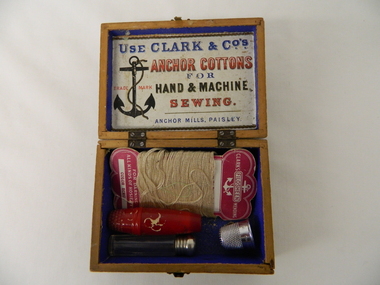
... paper. The lid is fastened to the bottom section with two small hinges each having four screws. Each side is fixed to the other by a mortise groove. At the front of the box is a small clasp for complete closure. The box contains needles, darrning thread, thimble, a glass vial with metal screwtop and a red plastic cylindrical container with a thimble screw on top(contains a small reel with three different cotton thread compartments)....paper. The lid is fastened to the bottom section with two small hinges each having four screws. Each side is fixed to the other by a mortise groove. At the front of the box is a small clasp for complete closure. The box contains needles, darrning thread, thimble, a glass vial with metal screwtop and a red plastic cylindrical container with a thimble screw on top(contains a small reel with three different cotton thread compartments). ...This "sewing and darning" box was purchased before 1952 (the date that the Clark Brothers merged with J&P Coats). It was in an era where the production and alteration/modification to any household or personal clothing was carried out by a family member/s. This was at the period where self sufficiency in rural and especially remote areas was a requirement and not just a hobby. Clothing modifications and "hand me downs" was a way of life. The long and tiresome journey from home to millinery shops was a great force to ensure that home sewing was carried out in the majority of residential and farm areas.This sewing box was donated by a pioneer family in the Kiewa Valley. Its significance points to an era before the establishment of the Kiewa Hydro Electricity Scheme and the establishment of the Mount Beauty Township. It was a time when the rural industries of the Kiewa Valley was rich in production of beef, dairy products, tobacco leaf and before the mass of alpine adventurers that tourism sparked. It was a time rural enterprises out shone tourism.This wooden sewing box is covered with decorative paper. The lid is fastened to the bottom section with two small hinges each having four screws. Each side is fixed to the other by a mortise groove. At the front of the box is a small clasp for complete closure. The box contains needles, darrning thread, thimble, a glass vial with metal screwtop and a red plastic cylindrical container with a thimble screw on top(contains a small reel with three different cotton thread compartments).On outside lid "FROM A FRIEND. I DO NOT WISH THEE GRANDEUR, NOR YET A STORE OF WEALTH, I WISH THEE RICHER TREASURE, CONTENTMENT, PEACE & HEALTH", On inside lid "USE CLARK & CO ANCHOR COTTONS FOR HAND & MACHINE SEWING ANCHOR MILLS, PAISLEY" Each of the different sewing boxes from the Clark Bros. has a label with different "friend" passages.sewing box, hand stitching, domestic clothes alterations, haberdashery -
 Bendigo Historical Society Inc.
Newspaper - Kangaroo Flat Gold Mine Collection: Gold Miner in Crisis, Road to Nowhere, January 9, 2007
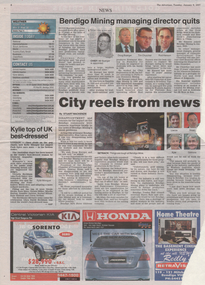
... paper, image of two miners walking into Bendigo Mining N.L. portal to Swan Decline. Sub-headlines '150 Jobs to go at Bendigo Mining, Doug Buerger departs, gold production to cease. Headlines of articles in pages two and three: Bendigo Mining managing director quits; City reels...paper, image of two miners walking into Bendigo Mining N.L. portal to Swan Decline. Sub-headlines '150 Jobs to go at Bendigo Mining, Doug Buerger departs, gold production to cease. Headlines of articles in pages two and three: Bendigo Mining managing director quits; City reels ...Three page article, Bendigo Advertiser, January 9, 2007. Front page of paper, image of two miners walking into Bendigo Mining N.L. portal to Swan Decline. Sub-headlines '150 Jobs to go at Bendigo Mining, Doug Buerger departs, gold production to cease. Headlines of articles in pages two and three: Bendigo Mining managing director quits; City reels from news; Jobs to be slashed, Bendigo Mining halts its gold productionbendigo mining n.l., bendigo, mining, gold, douglas buerger, peter mccarthy, managing director, tim churcher, rod hanson -
 Bendigo Historical Society Inc.
Ephemera - Emu Creek Bush Band Collection: Old Time Dance Guide
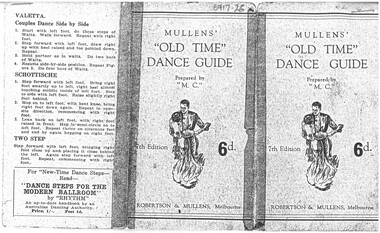
... reels. The fourth edition was published in 1937 and the 7th Edition was published in 1944. Robertson and Mullens , publishing company was formed in 1922 by the merger of George Robertson and Company and Melville and Mullen. Mullen and Robertson were friends who had immigrated from Scotland together and had initially set up separate bookselling and publishing businesses. The business operated out of 107-113 Elizabeth St., Melbourne and was delisted as a public company in 1960. Emu Creek Bush Band Australian Colonial Dance Old Time Dance Guide A photocopy of Mullens Old Time Dance Guide on white paper ...First published in 1932 and designed to fit into an average sized pocket for easy reference, this booklet was published in response to an upswing in the popularity of old time dances and reels. The fourth edition was published in 1937 and the 7th Edition was published in 1944. Robertson and Mullens , publishing company was formed in 1922 by the merger of George Robertson and Company and Melville and Mullen. Mullen and Robertson were friends who had immigrated from Scotland together and had initially set up separate bookselling and publishing businesses. The business operated out of 107-113 Elizabeth St., Melbourne and was delisted as a public company in 1960.A photocopy of Mullens Old Time Dance Guide on white paper with black text featuring an illustration of a man and a woman dancing in formal attire. The reverse side features a description of how the dances were to be performed. The publishers of the guide were Robertson and Mullens of Melbourne.emu creek bush band, australian colonial dance, old time dance guide -
 National Vietnam Veterans Museum (NVVM)
Functional object - Sewing kit, Army
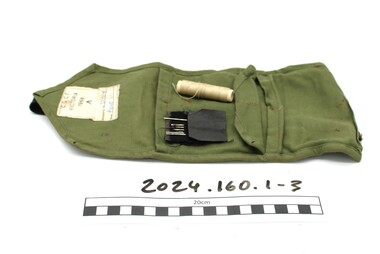
... Contains a reel of beige sewing cotton and black folded paper pack containing seven sewing needles....Contains a reel of beige sewing cotton and black folded paper pack containing seven sewing needles. ...Standard item issued to National Serviceman Pte R M Bowd, who served in 3RAR in 1971 during the conflict in Vietnam. These sewing kits were colloquially known as Housewives.Khaki cotton, Army issue sewing kit. Inside has two pouches; the bottom one with a flap. Outside has black tape used to keep kit closed when rolled up. Contains a reel of beige sewing cotton and black folded paper pack containing seven sewing needles.C.G.C.F Victoria 1968 Regimental No. 3797139 Name Bowd R.M.sewing kit, r.m.bowd, 3797139, bowd, equipment, housewife -
Coal Creek Community Park & Museum
Booklet - Music Book, The Australian Music Book no. 37 Reels, Jigs, Hornpipes
... Paper back music book number 37 in the series of Australian Music books titled Reels, Jigs and Hornpipes. ...Paper back music book number 37 in the series of Australian Music books titled Reels, Jigs and Hornpipes. ...Paper back music book number 37 in the series of Australian Music books titled Reels, Jigs and Hornpipes. Made in Australia. -
 Ballarat Tramway Museum
Photograph - Colour Photograph/s, Peter Henry, c2014
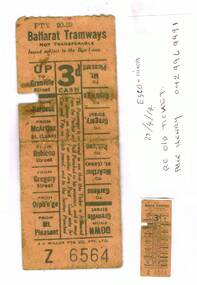
... Reel competitions that were regularly held. He was with the Warburton CFA at the time. Has badges for Geelong 1936 and Bendigo 1930, so ticket would have been in the 1930’s. Peter now lives at Linton. Attached to the sheet of A4 paper...Reel competitions that were regularly held. He was with the Warburton CFA at the time. Has badges for Geelong 1936 and Bendigo 1930, so ticket would have been in the 1930’s. Peter now lives at Linton. Attached to the sheet of A4 paper ...Demonstrates aspects of the method of ticketting systems used by ESCo and yields information on the design of the ticket. Has an association with the donor's father.Colour ink jet printed photograph and enlarged photograph of an ESCo tram ticket No. Z 6564, 3d cash fare, up and down directions to specific destinations on the ticket - light brown colour. Donated by Peter Henry 22/4/14 who advised in a phone call on 26/6/14. Story behind the ticket. Peter Henry’s father was involved in the CFA and travelled to Ballarat for the Hose and Reel competitions that were regularly held. He was with the Warburton CFA at the time. Has badges for Geelong 1936 and Bendigo 1930, so ticket would have been in the 1930’s. Peter now lives at Linton. Attached to the sheet of A4 paper is an actual size of the ticket and a donation note.trams, tramways, tickets, esco -
 Ballarat Tramway Museum
Photograph - Colour Photograph/s, Carolyn Dean, 26/11/1996 12:00:00 AM
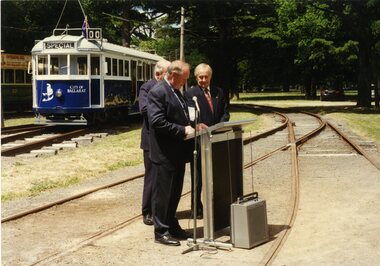
... reels of new trolley wire to the Museum by the Victorian Minister for Transport, Alan Brown on 26 Nov. 1996. Features President Richard Gilbert, local member, Paul Jenkins (member for Ballarat West)and Mayor of the City of Ballarat, James Coghlan. All on Kodak paper...reels of new trolley wire to the Museum by the Victorian Minister for Transport, Alan Brown on 26 Nov. 1996. Features President Richard Gilbert, local member, Paul Jenkins (member for Ballarat West)and Mayor of the City of Ballarat, James Coghlan. All on Kodak paper ...Set of seven colour photographs taken by Carolyn Dean of the presentation of two reels of new trolley wire to the Museum by the Victorian Minister for Transport, Alan Brown on 26 Nov. 1996. Features President Richard Gilbert, local member, Paul Jenkins (member for Ballarat West)and Mayor of the City of Ballarat, James Coghlan. All on Kodak paper. 847.1 - Richard Gilbert speaking with Paul Jenkins and Alan Brown in background, with 671 behind. 847.2 - Paul Jenkins Speaking 847.3 - as for 847.1 847.4 - ditto 847.5 - Alan Brown speaking and Paul Jenkins 847.6 - Alan Brown on horse tram No. 1 847.7 - Paul Jenkins and Alan Brown on No. 1 See November 1996 Fares Please!All "26.11.96 / Photo Carolyn Dean"trolley wire, minister for transport, ceremonies, presentations, tram 671, tram 1 -
 Ballarat Tramway Museum
Photograph - Colour Photograph/s set of 5, Carolyn Dean, 4/03/1997 12:00:00 AM
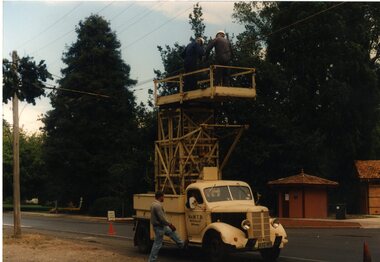
... All photos on AGFA paper. 1139.1 - Working on the trolley wire just to the north of Gardens Loop 1139.2 - Alan Snowball's Ute and trailer with wire reel, North Gardens area. 1139.3 - Replacing wire -group photo around behind truck - used on page 38 of Trolley Wire. 1139.4 - General photo of work with Ute and trailer in foreground and tower truck in background. ...All photos on AGFA paper. 1139.1 - Working on the trolley wire just to the north of Gardens Loop 1139.2 - Alan Snowball's Ute and trailer with wire reel, North Gardens area. 1139.3 - Replacing wire -group photo around behind truck - used on page 38 of Trolley Wire. 1139.4 - General photo of work with Ute and trailer in foreground and tower truck in background. ...Set of five colour photographs of Trolley Wire replacement in Wendouree Parade sent to the Editor of Trolley Wire - 2 used in the May 1997 issue of Trolley Wire. All photos by Carolyn Dean. All photos taken on 4-3-1997. All photos on AGFA paper. 1139.1 - Working on the trolley wire just to the north of Gardens Loop 1139.2 - Alan Snowball's Ute and trailer with wire reel, North Gardens area. 1139.3 - Replacing wire -group photo around behind truck - used on page 38 of Trolley Wire. 1139.4 - General photo of work with Ute and trailer in foreground and tower truck in background. Wire run out for a number of pole lengths - used on page 38 of Trolley Wire. 1139.5 - Photo of work on trolley wire replacement with tower truck. All have in black ink "4.3.97" and "Photo by / Carolyn Dean". 1139.3 has "Gardens Loop" in blue ink on top edge, and white sticker with "Photo 56 / 14.4 x 9.5cm" written on in black ink. 1139.4 - has white sticker with "Photo 57 / 14.5 and 7cm" written on in black ink.trolley wire, btm, wendouree parade, overhead -
 Ballarat Tramway Museum
Photograph - Colour Photograph/s, Carolyn Dean, 26/11/1996 12:00:00 AM
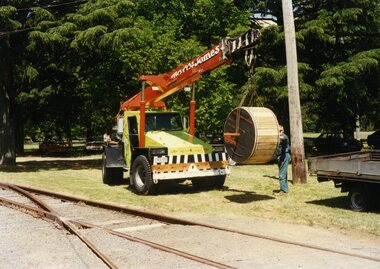
... paper. See also Reg. Item No. 503 (Newspaper Cutting) and Item 721 for photo used on page 29 as well as these three photos used on pages 28 and 29. 1141.1 - Two reels of trolley wire on delivery truck on side of depot fan. 1141.2 - Off loading one of the reels with the Barry James Tractor Crane. 1141.3 - Photo of Alan Brown speaking with Member for Ballarat West Paul Jenkins alongside and Richard Gilbert standing some distance away. ...paper. See also Reg. Item No. 503 (Newspaper Cutting) and Item 721 for photo used on page 29 as well as these three photos used on pages 28 and 29. 1141.1 - Two reels of trolley wire on delivery truck on side of depot fan. 1141.2 - Off loading one of the reels with the Barry James Tractor Crane. 1141.3 - Photo of Alan Brown speaking with Member for Ballarat West Paul Jenkins alongside and Richard Gilbert standing some distance away. ...Set of three colour photographs of the delivery and hand over of the Trolley Wire by the Minister of Transport Mr. Alan Brown on 26/11/1996 sent to the Editor of Trolley Wire - used in the February 1997 issue of Trolley Wire. All photos by Carolyn Dean. All photos on Kodak paper. See also Reg. Item No. 503 (Newspaper Cutting) and Item 721 for photo used on page 29 as well as these three photos used on pages 28 and 29. 1141.1 - Two reels of trolley wire on delivery truck on side of depot fan. 1141.2 - Off loading one of the reels with the Barry James Tractor Crane. 1141.3 - Photo of Alan Brown speaking with Member for Ballarat West Paul Jenkins alongside and Richard Gilbert standing some distance away. Trams 671 and 33 in the background.All have date of photo "26.11.96" along top edge and "Photo / Carolyn Dean" towards bottom right hand corner. Also various cropping marks on the photo used in publication.trolley wire, btm, overhead -
 Lakes Entrance Historical Society
Equipment - Collection of Sewing/Knitting/Crochet Equipment, c1900 -1920
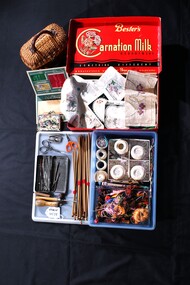
... Large Plastic box containing 8 reels crochet cottons (Coats), 1 fine crochet hook, 1 small embroidery scissors, 1 crochet pattern, embroidery silks. Red Box containing crochet butterfly paper patterns, Embroidery pieces unfinished....Large Plastic box containing 8 reels crochet cottons (Coats), 1 fine crochet hook, 1 small embroidery scissors, 1 crochet pattern, embroidery silks. Red Box containing crochet butterfly paper patterns, Embroidery pieces unfinished. ...This wonderful collection of craft equipment has been lovingly preserved by the donor, much of it is 100 years old.Twenty two bamboo knitting needles. Small sewing basket containing small embroidered sewing kit. Small tin containing 14 crochet hooks with covers, 9 fine crochet hooks, one fine latch hook. Small plastic box containing 1 awl, 1 thimble, 1 large crochet hook, 3 embroidery scissors, 1 tiny screw driver, large sewing needles. Large Plastic box containing 8 reels crochet cottons (Coats), 1 fine crochet hook, 1 small embroidery scissors, 1 crochet pattern, embroidery silks. Red Box containing crochet butterfly paper patterns, Embroidery pieces unfinished.craft supplies, equipment, collections -
Lakes Entrance Historical Society
Equipment - Projector
... Removable cover for access to bulb, lens is interchangeable with editor accessory, includes plastic bag containing ten 8 mm reels, eight of which are used, also a paper index...Removable cover for access to bulb, lens is interchangeable with editor accessory, includes plastic bag containing ten 8 mm reels, eight of which are used, also a paper index PHOTOGRAPHY Projectors ALDIS slide projector, complete with power cable and adaptor, green in colour Equipment Projector ...Removable cover for access to bulb, lens is interchangeable with editor accessory, includes plastic bag containing ten 8 mm reels, eight of which are used, also a paper indexALDIS slide projector, complete with power cable and adaptor, green in colourphotography, projectors -
 Melbourne Athenaeum Archives
Theatre program, Cass & Sons, The Interrupted Honeymoon / Doctor Syn (films) shown at the Athenaeum Theatre in 1937, 1937
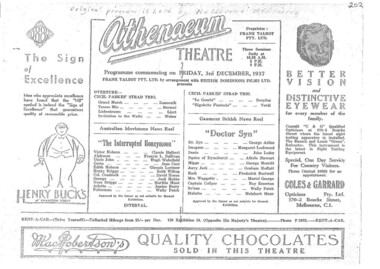
... Frank Talbot, who leased the Athenaeum Theatre, made an agreement in 1932 with the British company to show British movies exclusively at the Athenaeum Theatre, the first agreement of this kind to be made in the world. athenaeum theatre program programme the interrupted honeymoon doctor syn frank talbot pty ltd british dominions films ltd cecil parkes' strad trio australian movietone news reel gaumont british news reel athenaeum theatre program programme the interrupted honeymoon doctor syn frank talbot pty ltd british dominions films ltd cecil parkes' strad trio australian movietone news reel gaumont british news reel Paper program for two films shown at the Athenaeum Theatre commencing Friday 3rd December 1937 The Interrupted Honeymoon / Doctor Syn (films) shown at the Athenaeum Theatre in 1937 Theatre program Cass & Sons ...The two films screened were produced by the British company Gaumont-British Dominions. Frank Talbot, who leased the Athenaeum Theatre, made an agreement in 1932 with the British company to show British movies exclusively at the Athenaeum Theatre, the first agreement of this kind to be made in the world. Paper program for two films shown at the Athenaeum Theatre commencing Friday 3rd December 1937athenaeum theatre, program, programme, the interrupted honeymoon, doctor syn, frank talbot pty ltd, british dominions films ltd, cecil parkes' strad trio, australian movietone news reel, gaumont british news reel, athenaeum theatre, program, programme, the interrupted honeymoon, doctor syn, frank talbot pty ltd, british dominions films ltd, cecil parkes' strad trio, australian movietone news reel, gaumont british news reel -
 Melbourne Legacy
Film, Shrine, 1981
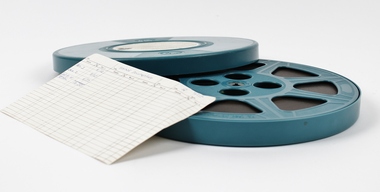
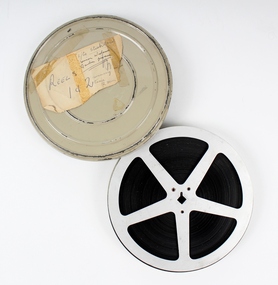
... reel inside. Lid has a sticker with information about the film. Film is 700 feet at 16mm. Piece of double-sided paper loose inside the tin with information on run time and last checked for inspection....reel inside. Lid has a sticker with information about the film. Film is 700 feet at 16mm. Piece of double-sided paper loose inside the tin with information on run time and last checked for inspection. ...Sound and colour. A film about the Shrine of Remembrance which was made in April 1981 (from the label). Documents the history of the Shrine by interspersing images of war with returned servicemen's marches. The film shows archival images of Australia in 1914 and accounts from WWI, which gave rise to the campaign to build the Shrine in the 1920s. Gen.Sir John Monash, after consulting with Legacy, lent his support and it was opened in 1934 by the Duke of Gloucester, becoming the focus of commemoration in Victoria. The forecourt with the Eternal Flame was added in 1954 to commemorate the fallen of WWII and was dedicated by Queen Elizabeth II. Junior Legatees are shown paying their respects at one of their annual commemorations. This film has been digitised to preserve its content. Melbourne Legacy gratefully acknowledges the support of the Victorian Government and Public Record Office Victoria for making this possible.Legacy were instrumental in campaigning for the building of the Shrine. Blue plastic circular tin with fitted reel inside. Lid has a sticker with information about the film. Film is 700 feet at 16mm. Piece of double-sided paper loose inside the tin with information on run time and last checked for inspection.Lid sticker is as follows: KEY NO. 810422 / PRINT NO. 1 LENGTH 17 mins / TITLE "SHRINE" VICTORIAN FILM CORPORATION / 409 KING STREET, MELBOURNE 3000 / BOX 4361 MAIL EXCHANGE 3001 / 03-329 7033 Sticker underneath is as follows to the naked eye: VICTORIAN FILM LABORATORIES / VICTORIAN FILM CORPORATION / SHRINE / G STREET HAWTHORN 8180461 Documentation inside tin is as follows: Side 1: Details, Run 1 / BRK 1, 4:12 / BRK 2, 8:05 / Credits 41, 4:33 / TOTAL, 16:50 Side 2: TDX Date / Run 1: TO BE DUBBED, 25.4.81 / No. of Breaks: 2 Remarks: Fair, Light Int scratches, Light broken scratches / Total Duration / Run 1: 16.50shrine of remembrance, history -
 Melbourne Legacy
Film, Senior Widows Garden Picnic
... Senior Widows Garden Picnic, Reels 1&2, running time 12 min (hand written on paper in biro and pencil). ...Senior Widows Garden Picnic, Reels 1&2, running time 12 min (hand written on paper in biro and pencil). ...Large gathering of widows in an unidentified Botanic Garden listening to Navy and Army bands whilst they chat and drink tea. Some of them have brought flasks whilst others get their tea from an urn. We see one widow taking money from participants. TBC This film has been digitised to preserve its content. Melbourne Legacy gratefully acknowledges the support of the Victorian Government and Public Record Office Victoria for making this possible.Legacy providing a venue for widows of deceased ex service personnel and deceased veterans to give them a social outing. Significant in the manner of visual recording of the era, and the social benefit that Legacy provide.A film on a metal spool in a metal canister. Label says it is of a Widows picnic.Cannister lid L/Strickland. Senior Widows Garden Picnic, Reels 1&2, running time 12 min (hand written on paper in biro and pencil). Cannister base 20/9 (written in texta). 22 min 08 sec. 16mm sound no colour.widows, concert -
 Melbourne Legacy
Audio - Recording, tape, Address by the PM of Australia RG Menzies 1960, 1960
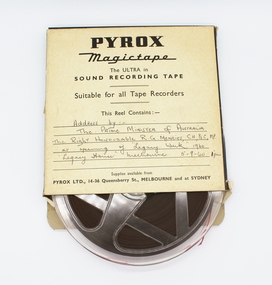
... Bottom of box in black print, PYROX/ Magictape/ The ultrain sound recording tape/Suitable for all Tape recorders/This reel contains. supplies available from PYROX LTD 14-36 Queensberry St, Melbourne and at Sydney Spool, Paper adhered to spool with cello tape. ...Bottom of box in black print, PYROX/ Magictape/ The ultrain sound recording tape/Suitable for all Tape recorders/This reel contains. supplies available from PYROX LTD 14-36 Queensberry St, Melbourne and at Sydney Spool, Paper adhered to spool with cello tape. ...A recording of a speech by PM Robert Menzies at Legacy House during the launch of Legacy Week in 1960. The Prime Minister is recognising the importance of the welfare carried out by Legacy for the families of service personnel who have died as a result war or since. The event was covered in the press, with a photo appearing in The Age on 6 September 1960. The article was saved in a scrapbook of press clippings. The content of the speech is not known as the tape hasn't been played. there are two speeches by Sir Robert Menzies in the archive, one undated and one from 1967.A record that prominent Australians were asked to promote Legacy during Legacy Week.An audio tape recording of an address by the Prime Minister Robert Menzies at Legacy House in 1960.Hand written in black ink on the label: Address by:- The Prime Minister of Australia The Right Honourable R.G.Menzies, C.H., Q.C.,M.P. at opening of "Legacy Week 1960 Legacy House Melbourne 5-9-60 at 1 pm". Front of box in white print, Special Sound recording tape for highest frequency response. In red print PYROX. In white print Magictape finest quality recording tape. Side of box in white print Magictape sound recording tape (printed on 3 sides). Bottom of box in black print, PYROX/ Magictape/ The ultrain sound recording tape/Suitable for all Tape recorders/This reel contains. supplies available from PYROX LTD 14-36 Queensberry St, Melbourne and at Sydney Spool, Paper adhered to spool with cello tape. Hand written in blue biro Prime Minister R.G.Menzies "Legacy Week' 1960 speech, legacy week, legacy promotion, robert menzies -
 Whitehorse Historical Society Inc.
Functional object - Cotton Reel, Crochet Cotton
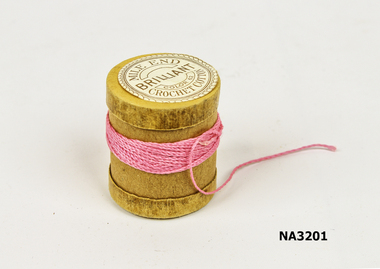
... A cotton reel made of cardboard comprising a cylinder with cap at each end. It has a small amount of pink crochet cotton with paper label at each end....A cotton reel made of cardboard comprising a cylinder with cap at each end. It has a small amount of pink crochet cotton with paper label at each end. ...From the Betty McPhee Sewing collection.A cotton reel made of cardboard comprising a cylinder with cap at each end. It has a small amount of pink crochet cotton with paper label at each end.Mile End Crochet Cotton Brilliant Clark's 100 yards.handcrafts, crocheting or crochet work
