
Showing 272 items matching "paper roll"
-
 Hume City Civic Collection
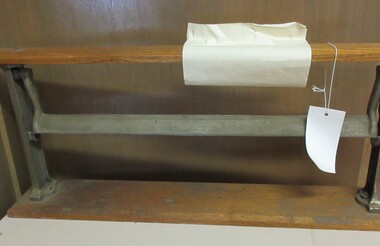
Paper Roll Holder
... Paper Roll Holder...This paper roll holder would have been used in a retail premises. ...This paper roll holder would have been used in a retail premises. ...This paper roll holder would have been used in a retail premises. Large brown paper rolls were able to be cut to any length for wrapping goods.Two wooden bevelled pieces, narrow piece on top wider piece on bottom with steel support ends and moveable centre piece screwed to wood pieces. Steel ends have "U" shaped holder in inside at centre.Steel ends have two raised diamond patterns. "24in CLARENCE 24in"shops, george evans collection -
 Tatura Irrigation & Wartime Camps Museum
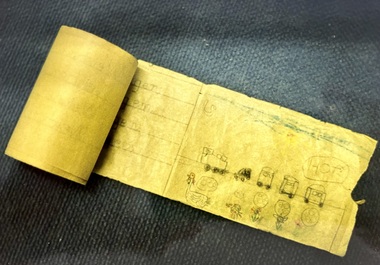
Toilet roll paper- illustrated, 1940's
... Toilet roll paper- illustrated...roll...paper...Illustrated paper toilet roll. School work. Text in German...Text in German Toilet roll paper- illustrated ...School work of 6-7 year old Gretl Frank on standard issue toilet paper in Camp 3. Gretl was the daughter of Kurt and Emma FrankIllustrated paper toilet roll. School work. Text in Germantoilet roll, paper, school, frank g, hurnung g, camp 3, tatura, war camps, documents, education -
 National Wool Museum
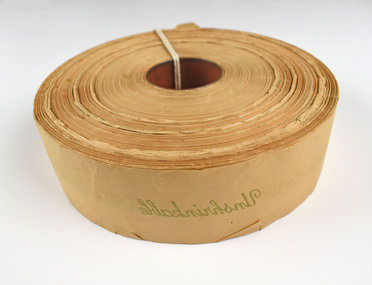
Paper Roll
... Paper Roll...Transfers used to iron onto textiles. Unshrinkable Paper Roll ...Transfers used to iron onto textiles.Unshrinkable -
 Flagstaff Hill Maritime Museum and Village
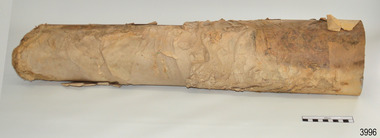
Functional object - Paper, circa 1908
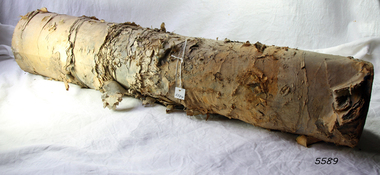
... paper...reel...roll...This roll or reel of paper was part of a consignment carried as cargo of the Falls of Halladale. ...Roll of paper. Paper was part of a large consignment of paper listed as part of the cargo manifesto. ...The wreck is protected as a Historic Shipwreck under the Commonwealth Historic Shipwrecks Act (1976). flagstaff hill warrnambool shipwrecked coast flagstaff hill maritime museum maritime museum shipwreck coast flagstaff hill maritime village great ocean road falls of halladale shipwreck peterborough 1908 shipwreck great clipper ships russell & co. paper reel roll paper reel paper roll cargo consignment Roll of paper. ...This roll or reel of paper was part of a consignment carried as cargo of the Falls of Halladale. The iron-hulled, four-masted barque, the Falls of Halladale, was a bulk carrier of general cargo. She left New York in August 1908 on her way to Melbourne and Sydney. In her hold, along with 56,763 tiles of unusual beautiful green American slates (roofing tiles), 5,673 coils of barbed wire, 600 stoves, 500 sewing machines, 6500 gallons of oil, 14400 gallons of benzene, and many other manufactured items, were 117 cases of crockery and glassware. Three months later and close to her destination, a navigational error caused the Falls of Halladale to be wrecked on a reef off the Peterborough headland at 3 am on the morning of the 15th of November, 1908. The captain and 29 crew members all survived, but her valuable cargo was largely lost, despite two salvage attempts in 1908-09 and 1910. ABOUT THE ‘FALLS OF HALLADALE’ (1886 - 1908) Built: in1886 by Russell & Co., Greenock shipyards, River Clyde, Scotland, UK. The company was founded in 1870 (or 1873) as a partnership between Joseph Russell (1834-1917), Anderson Rodger and William Todd Lithgow. During the period 1882-92 Russell & Co., standardised designs, which sped up their building process so much that they were able to build 271 ships over that time. In 1886 they introduced a 3000 ton class of sailing vessel with auxiliary engines and brace halyard winches. In 1890 they broke the world output record. Owner: Falls Line, Wright, Breakenridge & Co, 111 Union Street, Glasgow, Scotland. Configuration: Four masted sailing ship; iron-hulled barque; iron masts, wire rigging, fore & aft lifting bridges. Size: Length 83.87m x Breadth 12.6m x Depth 7.23m, Gross tonnage 2085 ton Wrecked: the night of 14th November 1908, Curdies Inlet, Peterborough south west Victoria Crew: 29 The Falls of Halladale was a four-masted sailing ship built-in 1886 in Glasgow, Scotland, for the long-distance cargo trade and was mostly used for Pacific grain trade. She was owned by Wright, Breakenridge & Co of Glasgow and was one of several Falls Line ships, all of which were named after waterfalls in Scotland. The lines flag was of red, blue and white vertical stripes. The Falls of Halladale had a sturdy construction built to carry maximum cargo and able to maintain full sail in heavy gales, one of the last of the ‘windjammers’ that sailed the Trade Route. She and her sister ship, the Falls of Garry, were the first ships in the world to include fore and aft lifting bridges. Previous to this, heavily loaded vessels could have heavy seas break along the full length of the deck, causing serious injury or even death to those on deck. The new, raised catwalk-type decking allowed the crew to move above the deck stormy conditions. This idea is still used today on the most modern tankers and cargo vessels and has proved to be an important step forward in the safety of men at sea. On 4th August 1908, with new sails, 29 crew, and 2800 tons of cargo, the Falls of Halladale left New York, bound for Melbourne and Sydney via the Cape of Good Hope. The cargo on board was valued at £35,000 and included 56,763 tiles of American slate roofing tiles (roof slates), 5,673 coils of barbed wire, 600 stoves, 500 sewing machines, 6,500 gallons of oil, 14,400 gallons of benzene, plumbing iron, 117 cases of crockery and glassware and many other manufactured items. The Falls of Halladale had been at sail for 102 days when, at 3 am on the night of 14th November 1908, under full sail in calm seas with a six knots breeze behind and misleading fog along the coast, the great vessel rose upon an ocean swell and settled on top of a submerged reef near Peterborough on the south-west Victoria’s coast. The ship was jammed on the rocks and began filling with water. The crew launched the two lifeboats and all 29 crew landed safely on the beach over 4 miles away at the Bay of Islands. The postmistress at Peterborough, who kept a watch for vessels in distress, saw the stranding and sent out an alert to the local people. A rescue party went to the aid of the sailors and the Port Campbell rocket crew was dispatched, but the crew had all managed to reach shore safely by the time help arrived. The ship stayed in full sail on the rocky shelf for nearly two months, attracting hundreds of sightseers who watched her slowly disintegrate until the pounding seas and dynamiting by salvagers finally broke her back, and her remains disappeared back into deeper water. The valuable cargo was largely lost, despite two salvage attempts in 1908-09 and 1910. Further salvage operations were made from 1974-1986, during which time 22,000 slate tiles were recovered with the help of 14 oil drums to float them, plus personal artefacts, ship fittings, reams of paper and other items. The Court of Marine Inquiry in Melbourne ruled that the foundering of the ship was entirely due to Captain David Wood Thomson’s navigational error, not too technical failure of the Clyde-built ship. The shipwreck is a popular site for divers, about 300m offshore and in 3 – 15m of water. Some of the original cargo can be seen at the site, including pieces of roof slate and coils of barbed wire. The roll of paper is an example of cargo brought to Australia in the early 20th century. It is also significant for its association with the Falls of Halladale shipwreck, which is listed on the Victorian Heritage Register (No. S255). She was one of the last ships to sail the Trade Routes. She is one of the first vessels to have fore and aft lifting bridges. She is an example of the remains of an International Cargo Ship and also represents aspects of Victoria’s shipping industry. The wreck is protected as a Historic Shipwreck under the Commonwealth Historic Shipwrecks Act (1976).Roll of paper. Paper was part of a large consignment of paper listed as part of the cargo manifesto. It was recovered from the wreck of the ship Falls of Halladale. A section of the paper has been cut away after it was recovered.flagstaff hill, warrnambool, shipwrecked coast, flagstaff hill maritime museum, maritime museum, shipwreck coast, flagstaff hill maritime village, great ocean road, falls of halladale, shipwreck peterborough, 1908 shipwreck, great clipper ships, russell & co., paper, reel, roll, paper reel, paper roll, cargo, consignment -
 Flagstaff Hill Maritime Museum and Village
Functional object - Paper, circa 1908
... paper...reel...roll...This roll or reel of paper was part of a consignment carried as cargo of the Falls of Halladale. ...Roll of paper. Paper has remains of a wooden peg up through the centre and a lot of sedimentation. ...The wreck is protected as a Historic Shipwreck under the Commonwealth Historic Shipwrecks Act (1976). flagstaff hill warrnambool shipwrecked coast flagstaff hill maritime museum maritime museum shipwreck coast flagstaff hill maritime village great ocean road falls of halladale shipwreck peterborough 1908 shipwreck great clipper ships russell & co. paper reel roll paper reel paper roll cargo consignment Roll of paper. ...This roll or reel of paper was part of a consignment carried as cargo of the Falls of Halladale. The iron-hulled, four-masted barque, the Falls of Halladale, was a bulk carrier of general cargo. She left New York in August 1908 on her way to Melbourne and Sydney. In her hold, along with 56,763 tiles of unusual beautiful green American slates (roofing tiles), 5,673 coils of barbed wire, 600 stoves, 500 sewing machines, 6500 gallons of oil, 14400 gallons of benzene, and many other manufactured items, were 117 cases of crockery and glassware. Three months later and close to her destination, a navigational error caused the Falls of Halladale to be wrecked on a reef off the Peterborough headland at 3 am on the morning of the 15th of November, 1908. The captain and 29 crew members all survived, but her valuable cargo was largely lost, despite two salvage attempts in 1908-09 and 1910. ABOUT THE ‘FALLS OF HALLADALE’ (1886 - 1908) Built: in1886 by Russell & Co., Greenock shipyards, River Clyde, Scotland, UK. The company was founded in 1870 (or 1873) as a partnership between Joseph Russell (1834-1917), Anderson Rodger and William Todd Lithgow. During the period 1882-92 Russell & Co., standardised designs, which sped up their building process so much that they were able to build 271 ships over that time. In 1886 they introduced a 3000 ton class of sailing vessel with auxiliary engines and brace halyard winches. In 1890 they broke the world output record. Owner: Falls Line, Wright, Breakenridge & Co, 111 Union Street, Glasgow, Scotland. Configuration: Four masted sailing ship; iron-hulled barque; iron masts, wire rigging, fore & aft lifting bridges. Size: Length 83.87m x Breadth 12.6m x Depth 7.23m, Gross tonnage 2085 ton Wrecked: the night of 14th November 1908, Curdies Inlet, Peterborough south west Victoria Crew: 29 The Falls of Halladale was a four-masted sailing ship built-in 1886 in Glasgow, Scotland, for the long-distance cargo trade and was mostly used for Pacific grain trade. She was owned by Wright, Breakenridge & Co of Glasgow and was one of several Falls Line ships, all of which were named after waterfalls in Scotland. The lines flag was of red, blue and white vertical stripes. The Falls of Halladale had a sturdy construction built to carry maximum cargo and able to maintain full sail in heavy gales, one of the last of the ‘windjammers’ that sailed the Trade Route. She and her sister ship, the Falls of Garry, were the first ships in the world to include fore and aft lifting bridges. Previous to this, heavily loaded vessels could have heavy seas break along the full length of the deck, causing serious injury or even death to those on deck. The new, raised catwalk-type decking allowed the crew to move above the deck stormy conditions. This idea is still used today on the most modern tankers and cargo vessels and has proved to be an important step forward in the safety of men at sea. On 4th August 1908, with new sails, 29 crew, and 2800 tons of cargo, the Falls of Halladale left New York, bound for Melbourne and Sydney via the Cape of Good Hope. The cargo on board was valued at £35,000 and included 56,763 tiles of American slate roofing tiles (roof slates), 5,673 coils of barbed wire, 600 stoves, 500 sewing machines, 6,500 gallons of oil, 14,400 gallons of benzene, plumbing iron, 117 cases of crockery and glassware and many other manufactured items. The Falls of Halladale had been at sail for 102 days when, at 3 am on the night of 14th November 1908, under full sail in calm seas with a six knots breeze behind and misleading fog along the coast, the great vessel rose upon an ocean swell and settled on top of a submerged reef near Peterborough on the south-west Victoria’s coast. The ship was jammed on the rocks and began filling with water. The crew launched the two lifeboats and all 29 crew landed safely on the beach over 4 miles away at the Bay of Islands. The postmistress at Peterborough, who kept a watch for vessels in distress, saw the stranding and sent out an alert to the local people. A rescue party went to the aid of the sailors and the Port Campbell rocket crew was dispatched, but the crew had all managed to reach shore safely by the time help arrived. The ship stayed in full sail on the rocky shelf for nearly two months, attracting hundreds of sightseers who watched her slowly disintegrate until the pounding seas and dynamiting by salvagers finally broke her back, and her remains disappeared back into deeper water. The valuable cargo was largely lost, despite two salvage attempts in 1908-09 and 1910. Further salvage operations were made from 1974-1986, during which time 22,000 slate tiles were recovered with the help of 14 oil drums to float them, plus personal artefacts, ship fittings, reams of paper and other items. The Court of Marine Inquiry in Melbourne ruled that the foundering of the ship was entirely due to Captain David Wood Thomson’s navigational error, not too technical failure of the Clyde-built ship. The shipwreck is a popular site for divers, about 300m offshore and in 3 – 15m of water. Some of the original cargo can be seen at the site, including pieces of roof slate and coils of barbed wire. The roll of paper is an example of cargo brought to Australia in the early 20th century. It is also significant for its association with the Falls of Halladale shipwreck, which is listed on the Victorian Heritage Register (No. S255). She was one of the last ships to sail the Trade Routes. She is one of the first vessels to have fore and aft lifting bridges. She is an example of the remains of an International Cargo Ship and also represents aspects of Victoria’s shipping industry. The wreck is protected as a Historic Shipwreck under the Commonwealth Historic Shipwrecks Act (1976).Roll of paper. Paper has remains of a wooden peg up through the centre and a lot of sedimentation. This roll was recovered from the wreck of the Falls of Halladale. It was part of a large consignment of paper listed as part of the cargo manifesto.flagstaff hill, warrnambool, shipwrecked coast, flagstaff hill maritime museum, maritime museum, shipwreck coast, flagstaff hill maritime village, great ocean road, falls of halladale, shipwreck peterborough, 1908 shipwreck, great clipper ships, russell & co., paper, reel, roll, paper reel, paper roll, cargo, consignment -
 Flagstaff Hill Maritime Museum and Village
Functional object - Paper, circa 1908
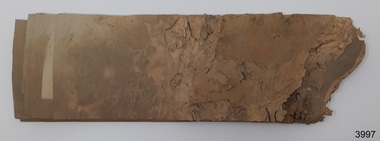
... ...paper roll...These sheets of paper were from a roll or reel of paper that was part of a consignment carried as cargo of the Falls of Halladale. ...Wad of paper sheets that was cut from a roll of paper. Three sides of the sheets are straight and the other side is rough due to exposure to sea water for many years. ...These sheets of paper were from a roll or reel of paper that was part of a consignment carried as cargo of the Falls of Halladale. ...These sheets of paper were from a roll or reel of paper that was part of a consignment carried as cargo of the Falls of Halladale. The iron-hulled, four-masted barque, the Falls of Halladale, was a bulk carrier of general cargo. She left New York in August 1908 on her way to Melbourne and Sydney. In her hold, along with 56,763 tiles of unusual beautiful green American slates (roofing tiles), 5,673 coils of barbed wire, 600 stoves, 500 sewing machines, 6500 gallons of oil, 14400 gallons of benzene, and many other manufactured items, were 117 cases of crockery and glassware. Three months later and close to her destination, a navigational error caused the Falls of Halladale to be wrecked on a reef off the Peterborough headland at 3 am on the morning of the 15th of November, 1908. The captain and 29 crew members all survived, but her valuable cargo was largely lost, despite two salvage attempts in 1908-09 and 1910. ABOUT THE ‘FALLS OF HALLADALE’ (1886 - 1908) Built: in1886 by Russell & Co., Greenock shipyards, River Clyde, Scotland, UK. The company was founded in 1870 (or 1873) as a partnership between Joseph Russell (1834-1917), Anderson Rodger and William Todd Lithgow. During the period 1882-92 Russell & Co., standardised designs, which sped up their building process so much that they were able to build 271 ships over that time. In 1886 they introduced a 3000 ton class of sailing vessel with auxiliary engines and brace halyard winches. In 1890 they broke the world output record. Owner: Falls Line, Wright, Breakenridge & Co, 111 Union Street, Glasgow, Scotland. Configuration: Four-masted sailing ship; iron-hulled barque; iron masts, wire rigging, fore & aft lifting bridges. Size: Length 83.87m x Breadth 12.6m x Depth 7.23m, Gross tonnage 2085 ton Wrecked: the night of 14th November 1908, Curdies Inlet, Peterborough south west Victoria Crew: 29 The Falls of Halladale was a four-masted sailing ship built-in 1886 in Glasgow, Scotland, for the long-distance cargo trade and was mostly used for Pacific grain trade. She was owned by Wright, Breakenridge & Co of Glasgow and was one of several Falls Line ships, all of which were named after waterfalls in Scotland. The lines flag was of red, blue and white vertical stripes. The Falls of Halladale had a sturdy construction built to carry maximum cargo and able to maintain full sail in heavy gales, one of the last of the ‘windjammers’ that sailed the Trade Route. She and her sister ship, the Falls of Garry, were the first ships in the world to include fore and aft lifting bridges. Previous to this, heavily loaded vessels could have heavy seas break along the full length of the deck, causing serious injury or even death to those on deck. The new, raised catwalk-type decking allowed the crew to move above the deck stormy conditions. This idea is still used today on the most modern tankers and cargo vessels and has proved to be an important step forward in the safety of men at sea. On 4th August 1908, with new sails, 29 crew, and 2800 tons of cargo, the Falls of Halladale left New York, bound for Melbourne and Sydney via the Cape of Good Hope. The cargo on board was valued at £35,000 and included 56,763 tiles of American slate roofing tiles (roof slates), 5,673 coils of barbed wire, 600 stoves, 500 sewing machines, 6,500 gallons of oil, 14,400 gallons of benzene, plumbing iron, 117 cases of crockery and glassware and many other manufactured items. The Falls of Halladale had been at sail for 102 days when, at 3 am on the night of 14th November 1908, under full sail in calm seas with a six knots breeze behind and misleading fog along the coast, the great vessel rose upon an ocean swell and settled on top of a submerged reef near Peterborough on the south-west Victoria’s coast. The ship was jammed on the rocks and began filling with water. The crew launched the two lifeboats and all 29 crew landed safely on the beach over 4 miles away at the Bay of Islands. The postmistress at Peterborough, who kept a watch for vessels in distress, saw the stranding and sent out an alert to the local people. A rescue party went to the aid of the sailors and the Port Campbell rocket crew was dispatched, but the crew had all managed to reach shore safely by the time help arrived. The ship stayed in full sail on the rocky shelf for nearly two months, attracting hundreds of sightseers who watched her slowly disintegrate until the pounding seas and dynamiting by salvagers finally broke her back, and her remains disappeared back into deeper water. The valuable cargo was largely lost, despite two salvage attempts in 1908-09 and 1910. Further salvage operations were made from 1974-1986, during which time 22,000 slate tiles were recovered with the help of 14 oil drums to float them, plus personal artefacts, ship fittings, reams of paper and other items. The Court of Marine Inquiry in Melbourne ruled that the foundering of the ship was entirely due to Captain David Wood Thomson’s navigational error, not too technical failure of the Clyde-built ship. The shipwreck is a popular site for divers, about 300m offshore and in 3 – 15m of water. Some of the original cargo can be seen at the site, including pieces of roof slate and coils of barbed wire. The roll of paper from which the sheets were cut is an example of cargo brought to Australia in the early 20th century. It is also significant for its association with the Falls of Halladale shipwreck, which is listed on the Victorian Heritage Register (No. S255). She was one of the last ships to sail the Trade Routes. She is one of the first vessels to have fore and aft lifting bridges. She is an example of the remains of an International Cargo Ship and also represents aspects of Victoria’s shipping industry. The wreck is protected as a Historic Shipwreck under the Commonwealth Historic Shipwrecks Act (1976).Wad of paper sheets that was cut from a roll of paper. Three sides of the sheets are straight and the other side is rough due to exposure to sea water for many years. The roll was part of a large consignment of paper listed on the cargo manifesto of the wreck of the ship Falls of Halladale. flagstaff hill, warrnambool, shipwrecked coast, flagstaff hill maritime museum, maritime museum, shipwreck coast, flagstaff hill maritime village, great ocean road, falls of halladale, shipwreck peterborough, 1908 shipwreck, great clipper ships, russell & co., paper, paper reel, paper roll, cargo, consignment, paper sheets, wad of paper -
 Federation University Historical Collection
Computer, Hewlet Packard, Hewlet Packard Type 9825B Computer
... Grey desktop computer with keyboard and paper roll....Used by the Physics Department at the Ballarat College of Advanced Education. ballarat college of advanced education Grey desktop computer with keyboard and paper roll. Hewlet Packard Type 9825B Computer Computer Hewlet Packard ...Used by the Physics Department at the Ballarat College of Advanced Education.Grey desktop computer with keyboard and paper roll.ballarat college of advanced education -
 The Ed Muirhead Physics Museum
Hewlett Packard 9120A Calculator
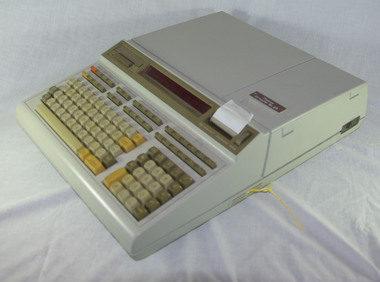
... Scientific and programmeable calculator with paper roll printout...Scientific and programmeable calculator with paper roll printout Hewlett Packard 9120A Calculator ...Scientific and programmeable calculator with paper roll printout -
The Ed Muirhead Physics Museum
Hewlett Packard 9100B Calculator
... Scientific and Programmeable Calculator with paper roll printout...Scientific and Programmeable Calculator with paper roll printout Hewlett Packard 9100B Calculator ...Scientific and Programmeable Calculator with paper roll printout -
 Uniting Church Archives - Synod of Victoria
Historic Document, Act of Separation and deed of demission for the Free Church of Scotland, 1843
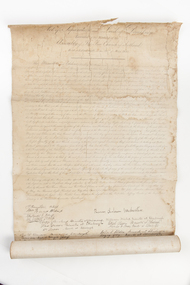
... 1 linen on paper roll in tube case. ...The Assembly of the Free Church of Scotland was formed in 1843 by withdrawal from the Church of Scotland. free church of scotland cairns, adam "Act of separation and Deed of Demission Executed at the meeting of the Assembly of the Free Church of Scotland Held in Edinburough on the 25th May 1843" 1 linen on paper roll in tube case. Act of Separation and deed of demission for the Free Church of Scotland Historic Document ...The Assembly of the Free Church of Scotland was formed in 1843 by withdrawal from the Church of Scotland. 1 linen on paper roll in tube case. "Act of separation and Deed of Demission Executed at the meeting of the Assembly of the Free Church of Scotland Held in Edinburough on the 25th May 1843"free church of scotland, cairns, adam -
 Wodonga & District Historical Society Inc
Functional object - Paper Dispenser - Mann & Son
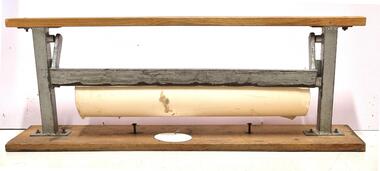
... An empty paper roll is included....An empty paper roll is included. Paper Dispenser - Mann & Son Functional object Paper Dispenser - Mann & Son ...J. Mann and Sons was first established as a farm produce store in 1921. The range of products was extended in the 1930s and included groceries and hardware, as well as the first petrol bowser in Wodonga outside the store. After WWII, the premises were extended and the range of products continued to increase. In the 1960s the Mann Family opened a new supermarket in Wodonga, in addition to the hardware business, providing steel, plumbing and industrial supplies, and they employed over 100 people at one stage. With changes in the retail industry, the Mann Family sold the main hardware business to Bunnings and the steel and rural produce business to the Kelly brothers in 2006.This item was an important everyday feature in many stores when items were wrapped in brown paper before the introduction of plastic bags.The paper dispenser has a wooden top and base, with a cast iron frame and lever. There is a removable metal rod which holds the paper roll in place. It was used for dispensing brown wrapping paper. The Blade" lever is not sharp, but was used to stabilise the paper roll so the paper can be easily torn off at the required length. An empty paper roll is included.mann wodonga, wodonga businesses -
 Greensborough Historical Society
Equipment - Piano Roll, Anglo-American Player Roll Co, Gonna build a big fence around Texas, 1930c
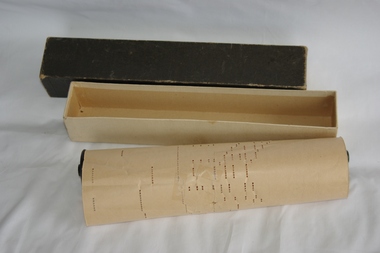
... Paper piano roll in box...Music in punched tape format to be played on a "Player piano" An early form of recorded music piano rolls music rolls player pianos Broadway word roll 2807; Foxtrot (Friend-Olson). Played by Les Luscombe Paper piano roll in box Gonna build a big fence around Texas Equipment Piano Roll Anglo-American Player Roll Co. ...Music in punched tape format to be played on a "Player piano"An early form of recorded musicPaper piano roll in boxBroadway word roll 2807; Foxtrot (Friend-Olson). Played by Les Luscombepiano rolls, music rolls, player pianos -
Blacksmith's Cottage and Forge
Dispenser, wrapping paper, Unknown
... Used in shops for holding brown paper roll to wrap parcels. Paper was torn off against the metal ;blade on the swing bar....Used in shops for holding brown paper roll to wrap parcels. Paper was torn off against the metal ;blade on the swing bar. brown paper parcels shop keeper wrapping shops shopping Non Wooden horizontal beam and vertical cross metal bar holding rod and metal swing bar with wooden top bar. ...Used in shops for holding brown paper roll to wrap parcels. Paper was torn off against the metal ;blade on the swing bar.Wooden horizontal beam and vertical cross metal bar holding rod and metal swing bar with wooden top bar. Base is badly scratched and worn paint. Nonbrown paper, parcels, shop keeper, wrapping, shops, shopping -
 Orbost & District Historical Society
piano roll, Anglo-American Player Roll Co, 1930's
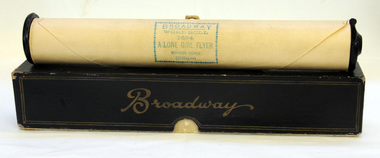
... To make a piano roll, when the recording artist depresses a key on a specially wired-up piano, a signal is sent to a recording machine, which punches holes in a moving roll of paper. Originally, editing was done by punching extra holes by hand or patching unwanted holes with sticky tape but eventually the process was done by computer.• The music is A Lone Girl Flyer with the words and music by Jack O'Hagan. ... Brown paper roll of pianola paper (.1) in black box (.2) with lid. ...It is an example of musical recreation of the 1930's. pianola lone-girl-flyer johnson-amy music Broadway Brown paper roll of pianola paper (.1) in black box (.2) with lid. ...To make a piano roll, when the recording artist depresses a key on a specially wired-up piano, a signal is sent to a recording machine, which punches holes in a moving roll of paper. Originally, editing was done by punching extra holes by hand or patching unwanted holes with sticky tape but eventually the process was done by computer.• The music is A Lone Girl Flyer with the words and music by Jack O'Hagan. It was published in Melbourne by Allan's, c1930 and was dedicated to Miss Amy Johnson, a pioneering English aviator, the first female pilot to fly alone from Britain to Australia. It is an example of musical recreation of the 1930's. Brown paper roll of pianola paper (.1) in black box (.2) with lid. Broadway hard roll 1694 - A lone Girl Flyer ( march song O'Hagan). It has a duty stamp attached - Allan & Co Music Co Ltd MelbourneBroadwaypianola lone-girl-flyer johnson-amy music -
 Whitehorse Historical Society Inc.
Leisure object - Pianola Roll and Box
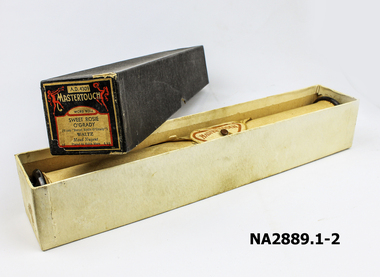
... Brown paper roll with imprinted with with holes associated with music that is to be played. ...Purchased from Turriff Antiques Bendigo musical instruments accessories MasterTouch Word Roll A.D.4309|Sweet Rosie O'Grady from Sweet Rosie O'Grady Waltz Brown paper roll with imprinted with with holes associated with music that is to be played. ...Purchased from Turriff Antiques BendigoBrown paper roll with imprinted with with holes associated with music that is to be played. Black bakelite circular ends. Contained in a black and white cardboard box.MasterTouch Word Roll A.D.4309|Sweet Rosie O'Grady from Sweet Rosie O'Grady Waltzmusical instruments, accessories -
The Ed Muirhead Physics Museum
BURROUGHS Elec. Adding J4191/2
... Output on Paper Roll Plaque ‘S.A. Burroughs/Paris. Made in France / Universel (sic) A.P. ...M p 114 (from 1892) Fig 88 Output on Paper Roll Plaque ‘S.A. Burroughs/Paris. Made in France / Universel (sic) A.P. ...M p 114 (from 1892) Fig 88Output on Paper Roll Plaque ‘S.A. Burroughs/Paris. Made in France / Universel (sic) A.P. Series J/ Volts 240 AMP 0.2’ -
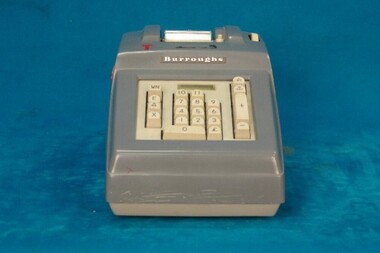 The Ed Muirhead Physics Museum
BURROUGHS Elec. Adding J4191/2
... Output on Paper Roll Plaque ‘S.A. Burroughs/Paris. Made in France / Universel (sic) A.P. ...Output on Paper Roll Plaque ‘S.A. Burroughs/Paris. Made in France / Universel (sic) A.P. ...Output on Paper Roll Plaque ‘S.A. Burroughs/Paris. Made in France / Universel (sic) A.P. Series J/ Volts 240 AMP 0.2’ -
 Ballarat Tramway Museum
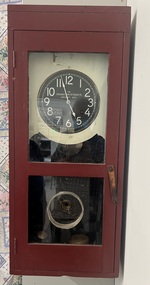
Functional object - Cincinnati "bundy" clock, Cincinnati Time Recorder Co. of Ohio, 1920s
... Cincinnati "bundy" clock comprising a pendulum operated clock upper section and a lower recording and printing section with a paper roll within a red painted wooden case. ...Cincinnati "bundy" clock comprising a pendulum operated clock upper section and a lower recording and printing section with a paper roll within a red painted wooden case. Functional object Cincinnati "bundy" clock Cincinnati Time Recorder Co. of Ohio ...This type of clock was used on the Port Melbourne bus route until its replacement by the Automatic Vehicle Monitoring system (AVM) to record the departure time of bus services from a specific point along the route. Possibly used at the terminus itself. Clock obtained by the Museum from the MMTB at the time of its replacement c1980. Conductors rather than drivers "Punched" the clock when this bus route was operated by half-cab buses. Was originally in a steel case when received. The Museum made the perspex insert in the front door to enable operation by a key c1985 when it was installed in the Museum's Mess Room. See item 9566 for a key that was used.Demonstrates a MMTB Cincinnati manufactured time recording clock. The MMTB also made their own.Cincinnati "bundy" clock comprising a pendulum operated clock upper section and a lower recording and printing section with a paper roll within a red painted wooden case. Has No. 81 in pencil on the clock face.tramways, buses, cincinnati, time recorder clocks -
 Flagstaff Hill Maritime Museum and Village
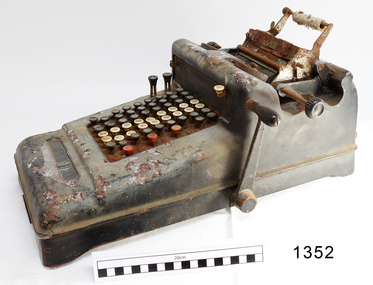
Adding Machine
... Key handle for print-out and three fraction keys. Paper roll dispenser at top of machine....Key handle for print-out and three fraction keys. Paper roll dispenser at top of machine. Adding Machine ...Adding machine with Burroughs inscribed on front. Six columns of numbers with total, subtotal and repeat. Key handle for print-out and three fraction keys. Paper roll dispenser at top of machine.flagstaff hill, warrnambool, shipwrecked-coast, flagstaff-hill, flagstaff-hill-maritime-museum, maritime-museum, shipwreck-coast, flagstaff-hill-maritime-village, adding machine, burroughs -
 Beechworth RSL Sub-Branch
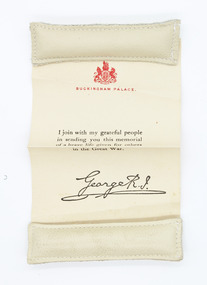
Certificate, c. 1923
... Cream coloured card paper rolled into scroll for transport inside card cylinder (0060.1). ...Cream coloured card paper rolled into scroll for transport inside card cylinder (0060.1). ...This cylinder was constructed for the postage of two documents (0060.2 and 0060.3), to notify the family of Pte James Thomas Newton (945215) 3rd Battalion, Australian Imperial Force, of his passing. The documents appear to be addressed to M A Newton, though James Thomas Newton's next of kin is listed as David Newton, his father. James Thomas enlisted on 18 July 1916, joining the 3rd battalion, first in "B" Company and . James Thomas' service records indicate that he died on 9 October 1916 in a field hospital, Liverpool, NSW. He was ailed by bronchial pneumonia for 13 days before succumbing to the illness. A telegram suggests that the family were notified on the day of his death and received the cylinder and documents in the post 6 years later. Cream coloured card paper rolled into scroll for transport inside card cylinder (0060.1). Note bears embossed stamp of the British crest above red printed text "BUCKINGHAM PALACE". A signature from King George V is at the bottom of the text.Handwritten signature "George R. I."post, postal, postage, death notice, certificate, private james thomas newton, 3rd battalion, australian imperial force, first world war, world was i, world war 1 -
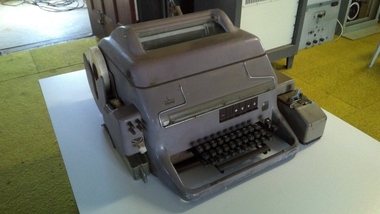 Nhill Aviation Heritage Centre
Telex Machine
... Grey colour, Teletype machine with key board and original teletype paper tape roll installed....This system overcome the problem of errors in verbal transmission and recording of information These units were serviced by the PMG (Post Master General) These were the type used in the Aeradio building. teletype, telex, information (front) Siemens Australia (back) Fernschrieber Fs Sk 2186/1 240V Grey colour, Teletype machine with key board and original teletype paper tape roll installed. Telex Machine ...This system overcome the problem of errors in verbal transmission and recording of information These units were serviced by the PMG (Post Master General) These were the type used in the Aeradio building. Grey colour, Teletype machine with key board and original teletype paper tape roll installed.(front) Siemens Australia (back) Fernschrieber Fs Sk 2186/1 240Vteletype, telex, information -
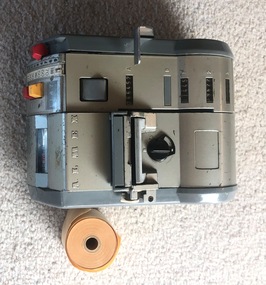 Melbourne Tram Museum
Functional object - Ticket Machine, AB Almex, Stockholm, Almex, c1975
... Use on Z class trams. Has a spare paper roll. See Reg Item 3020 for a manual - "Almex - How to operate your Almex Model E"...Use on Z class trams. Has a spare paper roll. See Reg Item 3020 for a manual - "Almex - How to operate your Almex Model E" Almex Functional object Ticket Machine AB Almex, Stockholm ...Ticket Machine - Almex - grey / metallic case with various buttons, levers, number registers for accounting purposes. Use on Z class trams. Has a spare paper roll. See Reg Item 3020 for a manual - "Almex - How to operate your Almex Model E"trams, tramways, tickets, ticket machines, camberwell depot, z class -
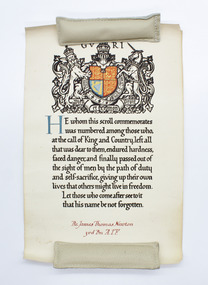 Beechworth RSL Sub-Branch
Certificate, c. 1923
... Cream coloured card paper rolled into scroll for transport inside card cylinder (0060.1). ...Cream coloured card paper rolled into scroll for transport inside card cylinder (0060.1). ...This cylinder was constructed for the postage of two documents (0060.2 and 0060.3), to notify the family of Pte James Thomas Newton (945215) 3rd Battalion, Australian Imperial Force, of his passing. The documents appear to be addressed to M A Newton, though James Thomas Newton's next of kin is listed as David Newton, his father. James Thomas enlisted on 18 July 1916, joining the 3rd battalion, first in "B" Company and . James Thomas' service records indicate that he died on 9 October 1916 in a field hospital, Liverpool, NSW. He was ailed by bronchial pneumonia for 13 days before succumbing to the illness. A telegram suggests that the family were notified on the day of his death and received the cylinder and documents in the post 6 years later. Cream coloured card paper rolled into scroll for transport inside card cylinder (0060.1). Certificate is printed with standard text and British crest above which is a "G V R" indicating the certificate was issued by King George V. Certificate features handwritten calligraphy notation of the recipient's name at the bottom of the text block.Handwritten notation reads "Pte. James Thomas Newton/3rd Bn A.I.F."post, postal, postage, death notice, certificate, private james thomas newton, 3rd battalion, australian imperial force, first world war, world was i, world war 1 -
Stawell Historical Society Inc
Archive - Drawings, St Matthews Uniting Church Plans, 20/4/1977
... Paper in brown cardboard Roll Holder...Sheet 1 - Line drawing of suggested ideas for interior of St Matthews Presbytery 20/4/1977 Sheet 1A - Organ at South end bet set on ceiling of Narthex set back against wall 20/4/1977 Sheet 1B - Organ at South end but set lower into front wall of glass screen of Narthex 20/4/1977 Sheel 1C - Organ at South end set overhanging front screen of Narthex Screen 20/4/1977 Sheet 2 - Proposed Glorious Cross in Metal, Lead, Glass 20/4/1977 Religion Paper in brown cardboard Roll Holder St Matthews Uniting Church Plans Archive Drawings ...Sheet 1 - Line drawing of suggested ideas for interior of St Matthews Presbytery 20/4/1977 Sheet 1A - Organ at South end bet set on ceiling of Narthex set back against wall 20/4/1977 Sheet 1B - Organ at South end but set lower into front wall of glass screen of Narthex 20/4/1977 Sheel 1C - Organ at South end set overhanging front screen of Narthex Screen 20/4/1977 Sheet 2 - Proposed Glorious Cross in Metal, Lead, Glass 20/4/1977Paper in brown cardboard Roll Holderreligion -
Stawell Historical Society Inc
Archive - Blueprint, Methodist Church Main Street Plans, 20/10/1965
... Paper in brown Cardboard roll holder...Alterations and additions to Stawell Methodist Church Main Street Earle and Associates Architects 25/10/1965 Job 6455 Drawing 3 Religion Paper in brown Cardboard roll holder Methodist Church Main Street Plans Archive Blueprint ...Alterations and additions to Stawell Methodist Church Main Street Earle and Associates Architects 25/10/1965 Job 6455 Drawing 3Paper in brown Cardboard roll holderreligion -
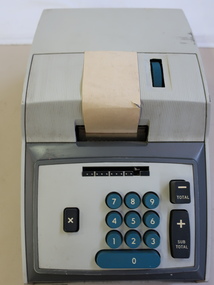 Kiewa Valley Historical Society
Adding Machine - Addmaster
... Beige and grey plastic covered adding machine with blue numbers and black function keys. Paper roll winder and dispenser at the top of the machine. ...Beige and grey plastic covered adding machine with blue numbers and black function keys. Paper roll winder and dispenser at the top of the machine. ...An adding machine is like a calculator enabling the user to do addition and subtraction and multiplication and division by repetition. Adding machines provided a printed receipt for each entry and calculators display information on a screen.Adding machines were used in the office and were replaced by calculators and comptometers.Used by a resident of the Kiewa Valley and possibly in the SECV office.Formerly UKV 242 or Contex UKV 253 - Electric (no cord). Beige and grey plastic covered adding machine with blue numbers and black function keys. Paper roll winder and dispenser at the top of the machine. Charcoal coloured plastic base with label and patent information. A blue handle for carrying. 2 small grooved wheels on the base.Left hand front: Addmaster label and logo Base: Label on base - "Addmaster Corp. Made in USA serial number 175614". Patent information labeladding machine, addmaster, mathematics -
 Lakes Entrance Historical Society
Machine - Adding machine, 1955 c
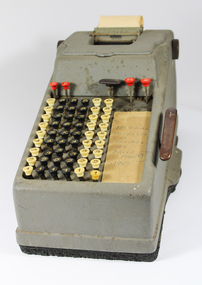
... Includes power cable and paper docket roll, converted from Imperial to Decimal in 1969, bought from Australian Paper Mills 1955c by donor, used in Lakes Entrance Caravan Park and Traralgon during 1960's and 1970's...Includes power cable and paper docket roll, converted from Imperial to Decimal in 1969, bought from Australian Paper Mills 1955c by donor, used in Lakes Entrance Caravan Park and Traralgon during 1960's and 1970's COMMERCE Office Equipment Stationery Electric Adding machine, grey case sits on black rubble pad, 9 rows of 6 keys Machine Adding machine ...Includes power cable and paper docket roll, converted from Imperial to Decimal in 1969, bought from Australian Paper Mills 1955c by donor, used in Lakes Entrance Caravan Park and Traralgon during 1960's and 1970'sElectric Adding machine, grey case sits on black rubble pad, 9 rows of 6 keyscommerce, office equipment, stationery -
Stawell Historical Society Inc
Archive - Blueprint, St Matthew Uniting Church Plans, 12/10/1997
... Paper & Tracing Paper in brown Cardboard roll holder...Cottman 12/10/1979 Religion Paper & Tracing Paper in brown Cardboard roll holder St Matthew Uniting Church Plans Archive Blueprint ...Proposed alterations to Uniting Church St Matthews Stawell N.H. Cottman 12/10/1979Paper & Tracing Paper in brown Cardboard roll holderreligion -
 Sunshine and District Historical Society Incorporated
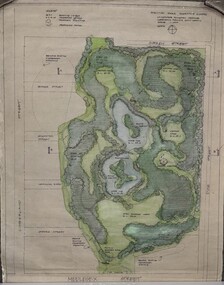
Plan - Proposed "Rock View Park" - Formerly McGraths Quarry Cnr Duke St & Surrey St, Kirby, John
... Rolled up paper map showing in color - lake paths and housing lots...Rock View Park McGraths Quarry Quarry Duke Street Surrey Street Sunshine North Proposed "Rock View Park" - Formerly McGraths Quarry Cnr Duke St & Surrey St Rolled up paper map showing in color - lake paths and housing lots Plan Proposed "Rock View Park" - Formerly McGraths Quarry Cnr Duke St & Surrey St Kirby, John ...Proposed "Rock View Park" - Formerly McGraths Quarry Cnr Duke St & Surrey Strock view park, mcgraths quarry, quarry, duke street, surrey street, sunshine north -
 Kiewa Valley Historical Society
Pianola Rolls
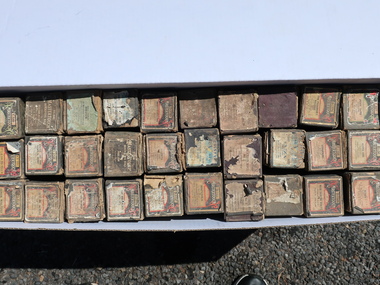
... end are metal or Bakorlite, paper rolled onto a cardboard core. Boxes are dark colours. ... end are metal or Bakorlite, paper rolled onto a cardboard core. Boxes are dark colours. ...Pianola roll is a music storage medium used to operate a player piano, piano player or reproducing piano. The roll moves over a reading system known as a tracker bar; the playing cycle for each musical note is triggered when a perforation crosses the bar. They have been in continuous production since at least 1896. These rolls are c1920s.Used and owned by a resident of the Kiewa Valley. An alternative form of musical entertainment in the home. The music itself is historic and an example of what songs were popular in the 1920s.Stored in 2 boxes. Box 1. Mastertouch Rolls = 21; Universal Song Roll = 1; Vocalsty Song Roll = 3; Gulbransen Roll = 3 Box 2. Mastertouch = 2; Unidentified = 18 Most rolls are in original cardboard boxes with labels on the end. Rolls in various condition. Most rolls intact. Rolls of paper end are metal or Bakorlite, paper rolled onto a cardboard core. Boxes are dark colours. They ore continuous rolls of paper with holes punched into them. These perforations represent note control data.pianola rolls, music, entertainment
