
Showing 50 items matching "papuan campaign"
-
 Moorabbin Air Museum
Book - USAAF in the Pacific WW2, Pacific Sweep
... ...Papuan campaign...USAAF in the Pacific WW2 The Phillipines Java Defence of Australia & New Guinea Guadalcanal Central Solomons Papuan campaign Holding the line in New Guinea Lae & Finschhafen Bougainville & Rabaul The Admiralty Islands & Hollandia Wrapup in New Guinea Leyte Mindoro & Luzon Formosa / Indochina & North to victory Story of USAAF fighter pilots who flew in South & South West Pacific in WW2, circa 1974 Pacific Sweep Book USAAF in the Pacific WW2 ...Story of USAAF fighter pilots who flew in South & South West Pacific in WW2, circa 1974non-fictionStory of USAAF fighter pilots who flew in South & South West Pacific in WW2, circa 1974the phillipines, java, defence of australia & new guinea, guadalcanal, central solomons, papuan campaign, holding the line in new guinea, lae & finschhafen, bougainville & rabaul, the admiralty islands & hollandia, wrapup in new guinea, leyte, mindoro & luzon, formosa / indochina & north to victory -
 Stawell Historical Society Inc
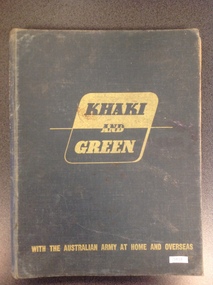
Book, Khaki and Green - With the Australian Army at Home and Overseas, 1945
... Relates soldiers' experiences since October 1942 Covering the African desert and Papua Campaigns...Relates soldiers' experiences since October 1942 Covering the African desert and Papua Campaigns Hard back Green Material Cover, Print mostly in Khaki Except on Front where Khaki is in Green on Khaki Rectangle. ...Items contributed by service men, for their families at home.Hard back Green Material Cover, Print mostly in Khaki Except on Front where Khaki is in Green on Khaki Rectangle. Book 3 in series of 6 published for the Australian Military Forces by The Australian War Memorial Canberra A.C.T. during WW2.Khaki and Green with the Australian Army at Home and Overseas. Relates soldiers' experiences since October 1942 Covering the African desert and Papua Campaignsstawell ww2 -
 Doncaster RSL Sub Branch
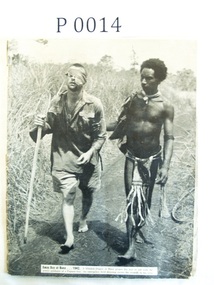
War In New Guinea, The F.G. Johnstone Publishing Company Sydney, War In New Guinea, Mid 1940s
... One phase of the Papuan campaign as seen by the camera of George Silk a department of Information photographer, 1942...One phase of the Papuan campaign as seen by the camera of George Silk a department of Information photographer, 1942 Official War Photographs of the Battle for Australia 40 Page Pamphlet with black and white photograph on front cover of Cpl. ...One phase of the Papuan campaign as seen by the camera of George Silk a department of Information photographer, 194240 Page Pamphlet with black and white photograph on front cover of Cpl. F.R.Smith of Queensland, with his tommy gun near Gona Front line.Official War Photographs of the Battle for Australia -
Unions Ballarat
Punks for West Papua : The documentary, Brennan, Antony (Ash), Circa 2016
... Back cover: short description of content; quote from Benny Wenda, Leader of the Free West Papua Campaign, United Liberation Movement for West Papua....Back cover: short description of content; quote from Benny Wenda, Leader of the Free West Papua Campaign, United Liberation Movement for West Papua. ...Jody Bartolo and his band 'Diggers with Attitude' founded Punks for West Papua with the aim to raise money and awareness for the Free West Papua cause. West Papua was overtaken in 1969 by a rigged vote by Indonesia. The Indonesian military has killed hundreds of thousands of West Papuans since then. There has been a ban on journalists and foreign aid to enter West Papua which means that the killings of hundreds of thousands of West Papuans by Indonesian military have been kept secret. The West Papuan plight has thus not received due attention over a significant number of years. Teaser clip available at: http://www.hiredguntv.com/yatte-yattah.htmlRelevant to the history of West Papua and the Indonesian military presence and violence. Use of music to draw attention to the issues faced by West Papua.DVD. Cover: photographs, coloured black, white, red and blue.Front cover: title and film maker's name; awards won; West Papuan flag. Back cover: short description of content; quote from Benny Wenda, Leader of the Free West Papua Campaign, United Liberation Movement for West Papua.btlc, ballarat trades hall, ballarat trades and labour council, bartolo, jody, diggers with attitude, punks for west papua, indonesian military, west papua, occupation/war - west papua, music - punk, documentaries -
 Lara RSL Sub Branch
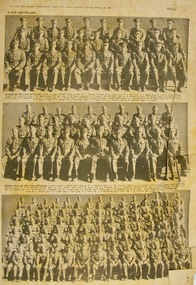
Newspaper, 17th Australian Infantry Brigade, February 22nd 1940
... The 17th Brigade fought in the Western Desert Campaign in Libya, the Battle of Greece, the Battle of Wau, the Salamaua-Lae campaign in Papua, and in the Aitape-Wewak campaign in New Guinea. ...The 17th Brigade fought in the Western Desert Campaign in Libya, the Battle of Greece, the Battle of Wau, the Salamaua-Lae campaign in Papua, and in the Aitape-Wewak campaign in New Guinea. ...The 17th Australian Infantry Brigade was an infantry brigade in the Australian Army. First formed in 1917 during World War I, it did not see any action. Reformed during World War II, before being disbanded in 1946. Today, its name is perpetuated by the 17th Combat Service Support Brigade, which was raised as a logistics formation in May 2006. The 17th Brigade was reformed on 13 October 1939, again as part of the 6th Division, recruited from Victoria. The 17th Brigade fought in the Western Desert Campaign in Libya, the Battle of Greece, the Battle of Wau, the Salamaua-Lae campaign in Papua, and in the Aitape-Wewak campaign in New Guinea. The photographs are of national significance as they may reflect the only known photographs of individuals from WW2.4 page newspaper pictures of 17th Brigade, Second AIFThe Argus 17th Australian Infantry Brigade, Second AIF, Souvenir Supplement, Thursday, February 22, 1940 Page 1 2/5th Battalion - Picture 1 Officers of the 2/5th Battalion; Picture 2 Senior NCO's of the 2/5th Battalion; Picture 3 A Company 2/5th Battalion Page 2 B Company 2/5th Battalion; C Company 2/5th Battalion; D Company 2/5th Battalion Page 3 Headquarters 2/2nd Field Regiment 6th Divisional Artillery; 3rd Battery 2/2nd Field Regiment 6th Divisional Artillery Page 4 Officers, NCO's and men of 2/2nd Field Company, 6th Divisional Engineers; Officers NCO's and men 2/2nd Field Ambulance and 2/2nd Australian General Hospital 6th Divisional Australian Army Medical Corpsaif, army, 17th brigade, second aif, 2/5th battalion, australian army, australian infantry brigade, 2/2nd field aumbulance, 2/2nd australian general hospital, 6th divisional australian army medical corps, 6th divisional engineers -
 Wangaratta RSL Sub Branch
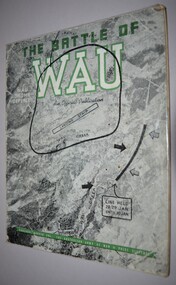
Book - Booklet, The Battle of Wau, c1944
... This booklet gives historical accounts of the pivotal WWII campaign in Papua New Guinea where Australian forces secured a critical victory over the Japanese in early 1943. ...This booklet gives historical accounts of the pivotal WWII campaign in Papua New Guinea where Australian forces secured a critical victory over the Japanese in early 1943. ...This booklet gives historical accounts of the pivotal WWII campaign in Papua New Guinea where Australian forces secured a critical victory over the Japanese in early 1943. It was released by the Department of Information in 1943/1944, and features contemporary maps and illustrations. Booklet belonged to Robert Francis ISKOV VX15237 born at Glenrowan served with the 59th Battalion CMF before joining the 2/14th Battalion at Caulfield in September 1940. He disembarked for the Middle East in November, 1940 and fought in the Syrian campaign in 1941. In 1942 the 2/14th Battalion returned to Australia and sent to Papua where he fought at the Battle of Isurava before the battalion was sent to Gona. On 1943 Bob returned to Australia to undertake officer training and in 1945 with the 2/23rd Battalion sailed to Morotai and served with the battalion on Tarakan. He returned to Australia in November, 1945 and discharged a month later.Soft cover booklet covered in plastic contains 32 pages including maps and illustrations. Cover has black and white copy of aerial photograph with writing highlighted in green. Brochure number one. The Australian Army at War. Price sixpence.ww2, new guinea, booklet, the battle of wau -
 Lara RSL Sub Branch
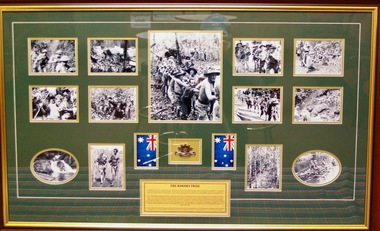
Framed collection of the Kokoda Trail, The Kodoka Trail, Circa 2018
... The Kokoda Track (or Trail) is a single-file thoroughfare that runs 96 kilometres (60ml) overland) - 60 kilometres (37ml) in a straight line - through the Owen Stanley Range in Papua New Guinea (PNG).The trail was First used by Europeans in the 1890s by miners struggling northwards to the Yodda Kokoda goldfields. During the Pacific War of World War 2 a series of battles were fought from July 1942 to January 1943 between Japanese and Australian forces. One of the bloodiest campaigns ...The Kokoda Track (or Trail) is a single-file thoroughfare that runs 96 kilometres (60ml) overland) - 60 kilometres (37ml) in a straight line - through the Owen Stanley Range in Papua New Guinea (PNG).The trail was First used by Europeans in the 1890s by miners struggling northwards to the Yodda Kokoda goldfields. During the Pacific War of World War 2 a series of battles were fought from July 1942 to January 1943 between Japanese and Australian forces.One of the bloodiest campaigns of World War 2,which has forever sealed the relation ship between Australia and Papua New Guinea began 61 years ago. This Photographic Memorial is dedicated to those Australian and Papua New Guinea forces who fought against the Japanese with courage and fortitude on the Kokoda Trail.Rectangular shaped glass covered picture frame showing a collection of photos,two flags and a Rising sun badge. The Kododa Trail.kokoda track, world war 2, papua new guinea, australian forces, lara r.s.l. -
 Lara RSL Sub Branch
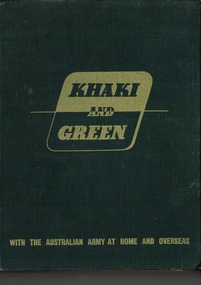
Book, Khaki and Green, 1943
... It speaks of desert and jungle epitomising the two major regions of the campaign in which Australians have participated since October 1942 - the overthrow of Rommel's forces at El Alamein and the smashing of the Chinese in Papua....It speaks of desert and jungle epitomising the two major regions of the campaign in which Australians have participated since October 1942 - the overthrow of Rommel's forces at El Alamein and the smashing of the Chinese in Papua. ...Khaki and Green is a summary of the scope of the activities of the Australian soldiers since last they related their experiences, in book form. To their homeland. It speaks of desert and jungle epitomising the two major regions of the campaign in which Australians have participated since October 1942 - the overthrow of Rommel's forces at El Alamein and the smashing of the Chinese in Papua.Collection of servicemen recounts, poems and cartoons from World War 2Faded light green hardcover front and back with title in centre symmetrical green and back lettering (shadowed) With the Australian Army at home and overseas. Text is repeated on spine of book. Front and back inside pages has an illustrations of a kit bag and it's contents and text - Palestine, United Kingdom, Egypt, Libya, Greece, Crete, Eritrea, Cyprus, Syria, Siam, Malaya, Java, Ambon, Ceylon, China, New Britain, Ocean islands, Nauru, New Caledonia, New Guinea, Solomon's, Papua, Timor, Dutch New Guinea. Photos, illustrations, cartoons, poems. There are three copies held at the Lara RSL Sub Branch.To the memory of fallen comrades ‘They gave their lives. For the public gift they received a praise which never ages and a tomb most glorious – not so much the tomb in which they lie, but that in which their fame survives, to be remembered forever when occasion comes for word or dead…. ‘ blaney, aif, 6th and 7th division, poetry, middle east, south west pacific, darwin, nassau bay, kokoda, rats of moresby, bullybeef, night patrol, jungle fighters, prisoners of war, world war 2, ww2 -
 Lara RSL Sub Branch
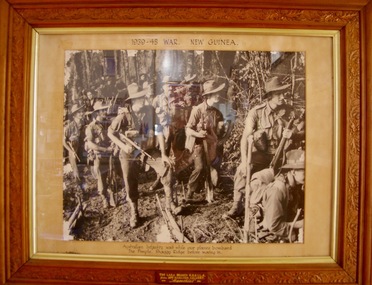
Photograph, Australian infantry in New Guinea 1939/45 war
... The Battle of the Shaggy Ridge was part of the Markham and Ramu Valley – Finisterre Range campaign, consisting of a number of actions fought by Australian and Japanese troops in Papua New Guinea in World War II. ...The Battle of the Shaggy Ridge was part of the Markham and Ramu Valley – Finisterre Range campaign, consisting of a number of actions fought by Australian and Japanese troops in Papua New Guinea in World War II. ...The Battle of the Shaggy Ridge was part of the Markham and Ramu Valley – Finisterre Range campaign, consisting of a number of actions fought by Australian and Japanese troops in Papua New Guinea in World War II. Following the Allied capture of Lae and Nadzab, the Australian 9th Division had been committed to a quick follow up action on the Huon Peninsula in an effort to cut off the withdrawing Japanese. Once the situation on the Huon Peninsula stabilised in late 1943, the 7th Division had pushed into the Markham and Ramu Valleys towards the Finisterre Range with a view to pushing north towards the coast around Bogadjim, where they would meet up with Allied forces advancing around the coast from the Huon Peninsula, before advancing towards Madang.In late December 1943, the Australian offensive to take Shaggy Ridge began, focused on an attack on The Pimple.[13] The Pimple was one of three rocky outcrops, held by the Japanese on the ridge line.Framed Photograph of Australian infantry waiting while our planes" bombard the Pimple,"Shaggy Ridge before moving in. Australian infantry waiting while our planes" bombard the Pimple,"Shaggy Ridge before moving in. THE LARA BRANCH R.S.S.I.L.A. FROM MRS HAMILTON CALVERT =MEMORIES=ww2, papua new guinea, world war 2, lara r.s.l., photographs, australian infantry, shaggy ridge -
 Australian Commando Association - Victoria
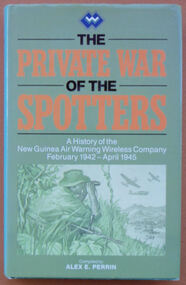
Book, The Private War of the Spotters: A history of the New Guinea Air Warning Wireless Company, February 1942-April 1945
... And in July 1942 the station at Buna signalled Port Moresby with news of the Japanese landings in Papua, marking the beginning of the Kokoda campaign. The dangers involved in the company’s work had also been made clear by this time. ...The history of the New Guinea Air Warning Wireless Company. This reprinted version contains a map of the dispositions of Spotting Stations August 1943, additional MID awards listed and some additions to the nominal roll. The New Guinea Air Warning Wireless Company was formed in Port Moresby in late January 1942 and was granted “Separate Independent Establishment” status in October 1943. The company’s “founding father” was Major Don Small, who had witnessed Japanese air raids on Rabaul and realised that having lacked an effective early-warning system around New Britain meant that the defenders were taken by surprise. At the time, gaps had also appeared in the coast-watching communications network because the territory administration ordered the withdrawal of civilian wireless operators when Japan entered the war. The first influx of men into the company consisted largely of volunteers from the 39th Infantry Battalion, which was stationed at Port Moresby. Initial training was rudimentary, hasty, and was sometimes even carried out on en route to a new station. The first party of company personnel, or “spotters”, left Port Moresby as early as 1 February 1942, bound for the strategically important Samarai area, at the tip of Papua. In the first month of the company’s existence 16 spotter stations were established on the coast of Papua and in the mountains around Port Moresby. At the end of 1942 there were 61 operational stations being run by 180 men. The company’s high-water mark was in late 1944, by which time over 150 stations had been set up in Papua and New Guinea behind enemy lines. On 3 February 1942 the company issued its first air warning in Papua, when spotters at Tufi saw Japanese aircraft about to attack Port Moresby for the first time. The following month the company was responsible for the first Japanese killed in action in Papua by Australian ground forces, when spotters from Gona engaged the crew of a downed Japanese bomber. And in July 1942 the station at Buna signalled Port Moresby with news of the Japanese landings in Papua, marking the beginning of the Kokoda campaign. The dangers involved in the company’s work had also been made clear by this time. In July 1942 a party of spotters attempting to set up a station at Misima Island, off Milne Bay, was intercepted by a Japanese destroyer, resulting in the company’s first operational losses. Anticipating the direction of the campaign as a whole, the company’s focus moved north and north-west over the three years of its existence. In May 1942 a network was set up in the Wau area in association with the activities of Kanga Force. As part of the Wau network, spotter Ross Kirkwood audaciously constructed an observation post overlooking the Japanese airstrip at Salamaua. Kirkwood’s position was photographed by Damian Parer on the understanding that the pictures would not be published. They nevertheless appeared in a Sydney newspaper. The day after the publication of the photographs the observation post was attacked by the Japanese and Kirkwood was lucky to escape. In June 1944 the company’s headquarters were moved to Nadzab. By that time, spotter stations existed behind Japanese lines, as far north as Hollandia, and the company began to train Americans to perform similar work in the Philippines. In early 1945 the company moved to Balcombe, Victoria, where its members were posted to other units of the Australian Corps of Signals.gray plasticnon-fictionThe history of the New Guinea Air Warning Wireless Company. This reprinted version contains a map of the dispositions of Spotting Stations August 1943, additional MID awards listed and some additions to the nominal roll. The New Guinea Air Warning Wireless Company was formed in Port Moresby in late January 1942 and was granted “Separate Independent Establishment” status in October 1943. The company’s “founding father” was Major Don Small, who had witnessed Japanese air raids on Rabaul and realised that having lacked an effective early-warning system around New Britain meant that the defenders were taken by surprise. At the time, gaps had also appeared in the coast-watching communications network because the territory administration ordered the withdrawal of civilian wireless operators when Japan entered the war. The first influx of men into the company consisted largely of volunteers from the 39th Infantry Battalion, which was stationed at Port Moresby. Initial training was rudimentary, hasty, and was sometimes even carried out on en route to a new station. The first party of company personnel, or “spotters”, left Port Moresby as early as 1 February 1942, bound for the strategically important Samarai area, at the tip of Papua. In the first month of the company’s existence 16 spotter stations were established on the coast of Papua and in the mountains around Port Moresby. At the end of 1942 there were 61 operational stations being run by 180 men. The company’s high-water mark was in late 1944, by which time over 150 stations had been set up in Papua and New Guinea behind enemy lines. On 3 February 1942 the company issued its first air warning in Papua, when spotters at Tufi saw Japanese aircraft about to attack Port Moresby for the first time. The following month the company was responsible for the first Japanese killed in action in Papua by Australian ground forces, when spotters from Gona engaged the crew of a downed Japanese bomber. And in July 1942 the station at Buna signalled Port Moresby with news of the Japanese landings in Papua, marking the beginning of the Kokoda campaign. The dangers involved in the company’s work had also been made clear by this time. In July 1942 a party of spotters attempting to set up a station at Misima Island, off Milne Bay, was intercepted by a Japanese destroyer, resulting in the company’s first operational losses. Anticipating the direction of the campaign as a whole, the company’s focus moved north and north-west over the three years of its existence. In May 1942 a network was set up in the Wau area in association with the activities of Kanga Force. As part of the Wau network, spotter Ross Kirkwood audaciously constructed an observation post overlooking the Japanese airstrip at Salamaua. Kirkwood’s position was photographed by Damian Parer on the understanding that the pictures would not be published. They nevertheless appeared in a Sydney newspaper. The day after the publication of the photographs the observation post was attacked by the Japanese and Kirkwood was lucky to escape. In June 1944 the company’s headquarters were moved to Nadzab. By that time, spotter stations existed behind Japanese lines, as far north as Hollandia, and the company began to train Americans to perform similar work in the Philippines. In early 1945 the company moved to Balcombe, Victoria, where its members were posted to other units of the Australian Corps of Signals.world war ii, special operations, new guinea, new guinea air warning wireless company -
 Monbulk RSL Sub Branch
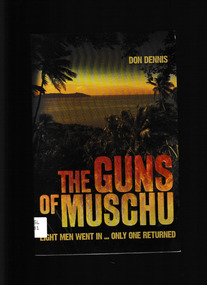
Book, Allen & Unwin, The guns of Muschu, 2006
... World war 1939 – 1945 – Campaigns – Papua new Guinea World war 1939 – 1945 – Personal narratives – Australia During the night of 11 April 1945, eight Australian Z Special commandos landed on Japanese-held Muschu Island, off the coast of New Guinea. ...During the night of 11 April 1945, eight Australian Z Special commandos landed on Japanese-held Muschu Island, off the coast of New Guinea. Their mission was to reconnoitre the island's defences and confirm the location of two concealed naval guns that commanded the approaches to Wewak Harbour. But the secret mission went horribly wrong. Unknown to them, their presence had been discovered within hours of their landing. With no means of escape, the island became a killing ground. Nine days later, on the New Guinea mainland, the only survivor staggered back through the Japanese lines to safety... This is the remarkable true story of that survivor.Maps, p.255.non-fictionDuring the night of 11 April 1945, eight Australian Z Special commandos landed on Japanese-held Muschu Island, off the coast of New Guinea. Their mission was to reconnoitre the island's defences and confirm the location of two concealed naval guns that commanded the approaches to Wewak Harbour. But the secret mission went horribly wrong. Unknown to them, their presence had been discovered within hours of their landing. With no means of escape, the island became a killing ground. Nine days later, on the New Guinea mainland, the only survivor staggered back through the Japanese lines to safety... This is the remarkable true story of that survivor. world war 1939 – 1945 – campaigns – papua new guinea, world war 1939 – 1945 – personal narratives – australia -
 Monbulk RSL Sub Branch
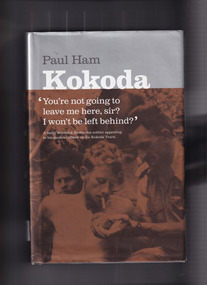
Book, Paul Ham, Kokoda, 2004
... campaign has been told from both sides of the conflict. In a unique and balanced portrayal, renowned journalist Paul Ham recounts both the Australian and Japanese perspectives of the events on the hellish Papuan jungle trail where thousands fought and died during World War II. ...For the first time ever, the compelling story of the infamous Kokoda Track campaign has been told from both sides of the conflict. In a unique and balanced portrayal, renowned journalist Paul Ham recounts both the Australian and Japanese perspectives of the events on the hellish Papuan jungle trail where thousands fought and died during World War II. Based on extensive research in Australia and Japan, and including previously unpublished documents, Kokoda intimately relates the stories of ordinary soldiers in 'the world's worst killing field', and examines the role of commanders in sending ill-equipped, unqualified Australian troops into battles that resulted in near 100 per cent casualty rates. It was a war without mercy, fought back and forth along 90 miles (145 km) of river crossings, steep inclines and precipitous descents, with both sides wracked by hunger and disease, and terrified of falling into enemy hands. Defeat was unthinkable: the Australian soldier was fighting for his homeland against an unyielding aggressor; the Japanese ordered to fight to the death in a bid to conquer 'Greater East AsiaIndex, bib, ill, p.602.non-fictionFor the first time ever, the compelling story of the infamous Kokoda Track campaign has been told from both sides of the conflict. In a unique and balanced portrayal, renowned journalist Paul Ham recounts both the Australian and Japanese perspectives of the events on the hellish Papuan jungle trail where thousands fought and died during World War II. Based on extensive research in Australia and Japan, and including previously unpublished documents, Kokoda intimately relates the stories of ordinary soldiers in 'the world's worst killing field', and examines the role of commanders in sending ill-equipped, unqualified Australian troops into battles that resulted in near 100 per cent casualty rates. It was a war without mercy, fought back and forth along 90 miles (145 km) of river crossings, steep inclines and precipitous descents, with both sides wracked by hunger and disease, and terrified of falling into enemy hands. Defeat was unthinkable: the Australian soldier was fighting for his homeland against an unyielding aggressor; the Japanese ordered to fight to the death in a bid to conquer 'Greater East Asiaworld war 1939 – 1945 – campaigns – kokoda, world war 1939-1945 - campaigns - south west pacific -
 Monbulk RSL Sub Branch
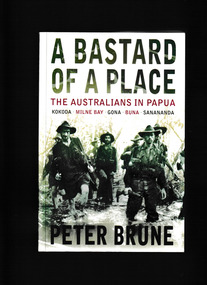
Book, Allen and Unwin, A bastard of a place : the Australians in Papua : Kokoda, Milne Bay, Gona, Buna, Sanananda, 2004
... World war 1939 – 1945 – Campaigns – New Guinea World war 1939 – 1945 – Campaigns – Kokoda In 1942 and early 1943 Papua New Guinea was 'a bastard of a place' to fight a war. ...In 1942 and early 1943 Papua New Guinea was 'a bastard of a place' to fight a war. This book gives us the final, all-encompassing story of the five battles that changed Australia forever. The compelling narrative resonates with the voices of both the well-trained AIF volunteer, and the young Militia conscript who triumphed together. The author interviewed hundreds of these soldiers and himself travelled the treacherous terrain and bloody battlegrounds where so many of their mates perished, and reveals the inside story of how Generals MacArthur and Blamey sacrificed many of the senior Australian field commanders as scapegoats to protect their own positions. A Bastard of a Place restores Milne Bay, Gona, Buna and Sanananda to their rightful place beside Kokoda to what they should collectively be for all Australians - sacred ground.Index, bibliography, notes, ill, maps, p.691.non-fictionIn 1942 and early 1943 Papua New Guinea was 'a bastard of a place' to fight a war. This book gives us the final, all-encompassing story of the five battles that changed Australia forever. The compelling narrative resonates with the voices of both the well-trained AIF volunteer, and the young Militia conscript who triumphed together. The author interviewed hundreds of these soldiers and himself travelled the treacherous terrain and bloody battlegrounds where so many of their mates perished, and reveals the inside story of how Generals MacArthur and Blamey sacrificed many of the senior Australian field commanders as scapegoats to protect their own positions. A Bastard of a Place restores Milne Bay, Gona, Buna and Sanananda to their rightful place beside Kokoda to what they should collectively be for all Australians - sacred ground.world war 1939 – 1945 – campaigns – new guinea, world war 1939 – 1945 – campaigns – kokoda -
 Monbulk RSL Sub Branch
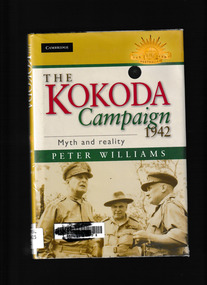
Book, Peter Williams, The Kokoda Campaign 1942 : myth and reality, 2012
... World war 1939 – 1945 – Campaigns – Kokoda Kokoda Track Papua New Guinea The fighting on the Kokoda track in WWII is second only to Gallipoli in the Australian national consciousness. ...The fighting on the Kokoda track in WWII is second only to Gallipoli in the Australian national consciousness. In this important book, the author explains what really happened on the Kokoda track in 1942.Index, bibliography, notes, ill, maps, p.304.non-fictionThe fighting on the Kokoda track in WWII is second only to Gallipoli in the Australian national consciousness. In this important book, the author explains what really happened on the Kokoda track in 1942.world war 1939 – 1945 – campaigns – kokoda, kokoda track papua new guinea -
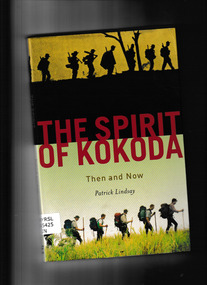 Monbulk RSL Sub Branch
Book, Hardie Grant Book, The spirit of Kokoda : then and now, 2002
... World war 1939 – 1945 – Campaigns – Kokoda Kokoda Track Papua New Guinea Australia lost its innocence in 1942. ...Australia lost its innocence in 1942. Japan had conquered Asia and the Pacific,and were at our doorstep. Our finest troops were fighting in the Middle East. All that stood between the Japanese onslaught and our homeland was a handful of 18-year-old militia troops who had never fired a shot in angerIndex, bibliography, notes, ill, maps, p.193.non-fictionAustralia lost its innocence in 1942. Japan had conquered Asia and the Pacific,and were at our doorstep. Our finest troops were fighting in the Middle East. All that stood between the Japanese onslaught and our homeland was a handful of 18-year-old militia troops who had never fired a shot in angerworld war 1939 – 1945 – campaigns – kokoda, kokoda track papua new guinea -
 Monbulk RSL Sub Branch
Book, Geoffrey Hamlyn-Harris, Through mud and blood to victory, 1993
... World war 1939 – 1945 – Campaigns – Kokoda Kokoda Track - Papua New Guinea An abbreviated account of the Kokoda campaign during World War Two p.100. ...An abbreviated account of the Kokoda campaign during World War Twop.100.non-fictionAn abbreviated account of the Kokoda campaign during World War Twoworld war 1939 – 1945 – campaigns – kokoda, kokoda track - papua new guinea -
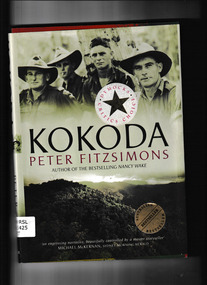 Monbulk RSL Sub Branch
Book, Hachette, Kokoda, 2008
... World war 1939 – 1945 – Campaigns – Kokoda Kokoda track 1942 Kokoda, 1942. In the muddy, treacherous mountains of Papua New Guinea, a small force of young Australian soldiers - some of them still teenagers - are up against highly trained, experienced Japanese troops. ...Kokoda, 1942. In the muddy, treacherous mountains of Papua New Guinea, a small force of young Australian soldiers - some of them still teenagers - are up against highly trained, experienced Japanese troops. Many believed that the all-conquering Imperial Japanese Army was unstoppable. But this is the story of how these brave young Aussies faced up to some of the world's best soldiers on a narrow, precarious jungle track - and defeated them.Index, bibliography, notes, ill, maps, p.479.non-fictionKokoda, 1942. In the muddy, treacherous mountains of Papua New Guinea, a small force of young Australian soldiers - some of them still teenagers - are up against highly trained, experienced Japanese troops. Many believed that the all-conquering Imperial Japanese Army was unstoppable. But this is the story of how these brave young Aussies faced up to some of the world's best soldiers on a narrow, precarious jungle track - and defeated them.world war 1939 – 1945 – campaigns – kokoda, kokoda track 1942 -
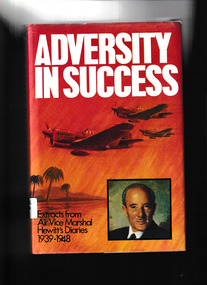 Monbulk RSL Sub Branch
Book, Langate Publishing, Adversity in Success, 1980
... World war 1939 – 1945 – Campaigns – Papua new Guinea World war 1939 – 1945 – Personal narratives – Australia This book is based on the personal recollections of Air Vice Marshal JE Hewitt during the Pacific campaigns. ...This book is based on the personal recollections of Air Vice Marshal JE Hewitt during the Pacific campaigns.Ill, p.330.non-fictionThis book is based on the personal recollections of Air Vice Marshal JE Hewitt during the Pacific campaigns.world war 1939 – 1945 – campaigns – papua new guinea, world war 1939 – 1945 – personal narratives – australia -
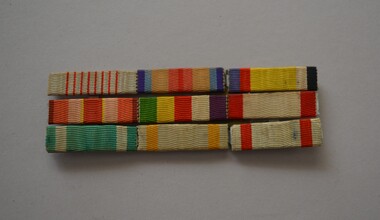 Wangaratta RSL Sub Branch
Medal - Japanese Medal Ribbons, c1930-1940
... campaign in 1941. In 1942 the 2/14th Battalion returned to Australia and sent to Papua where he fought at the Battle of Isurava before the battalion was sent to Gona. ...campaign in 1941. In 1942 the 2/14th Battalion returned to Australia and sent to Papua where he fought at the Battle of Isurava before the battalion was sent to Gona. ...On 10/12/1942 near Gona in New Guinea whilst guiding the 39th battalion into a village Sgt Bob ISKOV and fellow soldier Lt Jack Schwind VX15289 of Wangaratta were confronted by three Japanese Officers and were given the order to shoot by their Battalion Commander. The Japanese soldiers were later identified as a Lieutenant Colonel and one a Major who had in their possession valuable documents including a Map of Darwin defenses. Robert Francis ISKOV VX15237 born at Glenrowan served with the 59th Battalion CMF before joining the 2/14th Battalion at Caulfield in September 1940. He disembarked for the Middle East in November, 1940 and fought in the Syrian campaign in 1941. In 1942 the 2/14th Battalion returned to Australia and sent to Papua where he fought at the Battle of Isurava before the battalion was sent to Gona. In 1943 Bob returned to Australia to undertake officer training and in 1945 with the 2/23rd Battalion sailed to Morotai and served with the battalion on Tarakan. He returned to Australia in November, 1945 and discharged a month later. This set of ribbons worn by the Japanese Lieutenant Colonel are identified from top row left to right as follows:- 2600th National Anniversary Imperial Rule Commemorative Medal -1940 China Incident Medal for service in China -1937-45 Manchukuo National Foundation Merit Medal - 1932-34 (more commemorative than merit) Manchurian Incident Medal - 1931-34 (commemorative) Showa Grand Enthronement Commemorative Medal Order of the Rising Sun - Military/civilian meritorious service Order of the Golden Kite -Military Bravery/Leadership (abolished 1947) Order of the Sacred Treasure - military/civilian long and distinguished service medal Manchurian Order of the Auspicious Cloud Set of nine in three rows of striped medal ribbons in various colours.japanese medal ribbons, ww2, civil and military, new guinea, gona, 39th battalion, sgt bob iskov, lt jack schwind, 2/14 battalion -
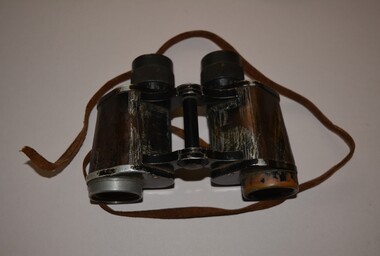 Wangaratta RSL Sub Branch
Equipment - Japanese Binoculars, TOKO, c1930-1942
... campaign in 1941. In 1942 the 2/14th Battalion returned to Australia and sent to Papua where he fought at the Battle of Isurava before the battalion was sent to Gona. ...campaign in 1941. In 1942 the 2/14th Battalion returned to Australia and sent to Papua where he fought at the Battle of Isurava before the battalion was sent to Gona. ...On 10/12/1942 near Gona whilst guiding the 39th battalion into a village Sgt Bob ISKOV and fellow soldier Lt Jack Schwind were confronted by three Japanese Officers and were given the order to shoot by their Battalion Commander. They were later identified as a Lieutenant Colonel and one a Major who had in their possession valuable documents including a Map of Darwin defenses. Robert Francis ISKOV VX15237 born at Glenrowan served with the 59th Battalion CMF before joining the 2/14th Battalion at Caulfield in September 1940. He disembarked for the Middle East in November, 1940 and fought in the Syrian campaign in 1941. In 1942 the 2/14th Battalion returned to Australia and sent to Papua where he fought at the Battle of Isurava before the battalion was sent to Gona. On 1943 Bob returned to Australia to undertake officer training and in 1945 with the 2/23rd Battalion sailed to Morotai and served with the battalion on Tarakan. He returned to Australia in November, 1945 and discharged a month later. Binoculars housed in brown leather case were removed from deceased Japanese Lt Colonel together with medal ribbons and valuable documents including Map of Darwin defenses. They were made by TOKO or Tokyo Optical Co a major military optics manufacturer for the Japanese military during WW2 Black painted metal binoculars originally covered in black leather with little remaining. The brown leather strap is well worn and missing stud fixing on right side.Magna 8x30 88711 To Ko Scale Field 7.5ww2, new guinea, gona, 39th battalion, sgt bob iskov, lt jack schwind, japanese binoculars, toko -
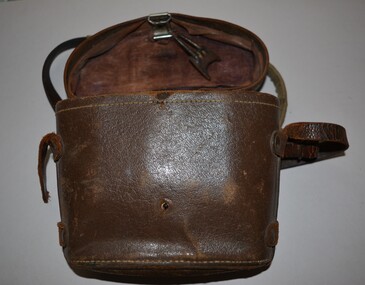 Wangaratta RSL Sub Branch
Container - Japanese Binocular Case, c1930-1942
... campaign in 1941. In 1942 the 2/14th Battalion returned to Australia and sent to Papua where he fought at the Battle of Isurava before the battalion was sent to Gona. ...campaign in 1941. In 1942 the 2/14th Battalion returned to Australia and sent to Papua where he fought at the Battle of Isurava before the battalion was sent to Gona. ...On 10/12/1942 near Gona whilst guiding the 39th battalion into a village Sgt Bob ISKOV and fellow soldier Lt Jack Schwind were confronted by three Japanese Officers and were given the order to shoot by their Battalion Commander. They were later identified as a Lieutenant Colonel and one a Major who had in their possession valuable documents including a Map of Darwin defenses. Robert Francis ISKOV VX15237 born at Glenrowan served with the 59th Battalion CMF before joining the 2/14th Battalion at Caulfield in September 1940. He disembarked for the Middle East in November, 1940 and fought in the Syrian campaign in 1941. In 1942 the 2/14th Battalion returned to Australia and sent to Papua where he fought at the Battle of Isurava before the battalion was sent to Gona. On 1943 Bob returned to Australia to undertake officer training and in 1945 with the 2/23rd Battalion sailed to Morotai and served with the battalion on Tarakan. He returned to Australia in November, 1945 and discharged a month later. Binoculars housed in brown leather case were removed from deceased Japanese Lt Colonel together with medal ribbons and valuable documents including Map of Darwin defenses. They were made by TOKO or Tokyo Optical Co a major military optics manufacturer for the Japanese military during WW2 Brown leather look binocular case lined in brown colour cloth. Long narrow leather strap fixed along sides by leather secured in place by metal studs. Fitted lid is attached by leather strap fixed in place by four metal studs at rear. At front is a spring closing mechanism which is broken.ww2, new guinea, gona, 39th battalion, sgt bob iskov, lt jack schwind, japanese binoculars, toko -
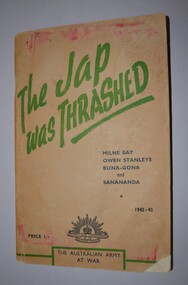 Wangaratta RSL Sub Branch
Book - Booklet, The Jap was Thrashed - Milne Bay Owen Stanleys Guna-Gona and Sanananda 1942-43, c1944
... campaign in 1941. In 1942 the 2/14th Battalion returned to Australia and sent to Papua where he fought at the Battle of Isurava before the battalion was sent to Gona. ...campaign in 1941. In 1942 the 2/14th Battalion returned to Australia and sent to Papua where he fought at the Battle of Isurava before the battalion was sent to Gona. ...This book, contains 128 pages including photographs and maps, chronicles the Australian Army's campaigns against Japanese forces in New Guinea during World War II, specifically the battles at Milne Bay, the Owen Stanley Range, Buna, Gona, and Sanananda. Published under the authority of General Sir Thomas Blamey, it served as an official morale-boosting narrative to highlight the resilience of the Australian soldier. Booklet belonged to Robert Francis ISKOV VX15237 born at Glenrowan served with the 59th Battalion CMF before joining the 2/14th Battalion at Caulfield in September 1940. He disembarked for the Middle East in November, 1940 and fought in the Syrian campaign in 1941. In 1942 the 2/14th Battalion returned to Australia and sent to Papua where he fought at the Battle of Isurava before the battalion was sent to Gona. On 1943 Bob returned to Australia to undertake officer training and in 1945 with the 2/23rd Battalion sailed to Morotai and served with the battalion on Tarakan. He returned to Australia in November, 1945 and discharged a month later.Cream colour cardboard soft cover booklet with green and black writing and crest on front cover.Price 1/- The Australian Army at Warww2, new guinea, the jap was thrashed, booklet -
 Wangaratta RSL Sub Branch
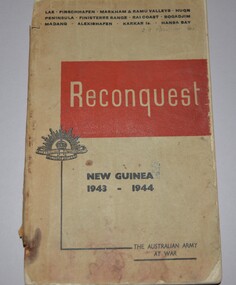
Book - Booklet, Director General of Public Relations Australian Army, Reconquest New Guinea 1943-1944, c1944
... campaign in 1941. In 1942 the 2/14th Battalion returned to Australia and sent to Papua where he fought at the Battle of Isurava before the battalion was sent to Gona. ...campaign in 1941. In 1942 the 2/14th Battalion returned to Australia and sent to Papua where he fought at the Battle of Isurava before the battalion was sent to Gona. ...The Reconquest of New Guinea in 1943–1944 was a massive, grueling Allied offensive that shattered the Japanese Eighteenth Army through a combination of amphibious assaults, airborne operations, and brutal jungle warfare. Booklet belonged to Robert Francis ISKOV VX15237 born at Glenrowan served with the 59th Battalion CMF before joining the 2/14th Battalion at Caulfield in September 1940. He disembarked for the Middle East in November, 1940 and fought in the Syrian campaign in 1941. In 1942 the 2/14th Battalion returned to Australia and sent to Papua where he fought at the Battle of Isurava before the battalion was sent to Gona. On 1943 Bob returned to Australia to undertake officer training and in 1945 with the 2/23rd Battalion sailed to Morotai and served with the battalion on Tarakan. He returned to Australia in November, 1945 and discharged a month later.Soft cover booklet containing 160 pages including maps and photographs. Cover is cream colour cardboard with black print and rising sun crest.Front Cover - The Australian Army at War. Rear Cover - Overseas Edition Not For Public Sale ww2, new guinea, booklet, reconquest -
 Wangaratta RSL Sub Branch
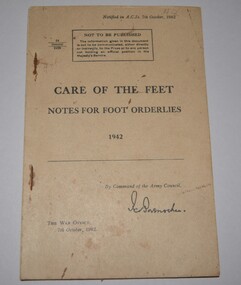
Booklet, J T Picken and Sons, Care of the Feet - Notes for Foot Orderlies, c1942
... campaign in 1941. In 1942 the 2/14th Battalion returned to Australia and sent to Papua where he fought at the Battle of Isurava before the battalion was sent to Gona. ...campaign in 1941. In 1942 the 2/14th Battalion returned to Australia and sent to Papua where he fought at the Battle of Isurava before the battalion was sent to Gona. ...The 1942 "Care of the Feet" booklet refers to a restricted military pamphlet published by the British War Office on October 7, 1942, titled "Care of the Feet - Notes for Foot Orderlies". It was marked as a restricted document ("Not to be published") and issued by the Army Council. Booklet belonged to Robert Francis ISKOV VX15237 born at Glenrowan served with the 59th Battalion CMF before joining the 2/14th Battalion at Caulfield in September 1940. He disembarked for the Middle East in November, 1940 and fought in the Syrian campaign in 1941. In 1942 the 2/14th Battalion returned to Australia and sent to Papua where he fought at the Battle of Isurava before the battalion was sent to Gona. On 1943 Bob returned to Australia to undertake officer training and in 1945 with the 2/23rd Battalion sailed to Morotai and served with the battalion on Tarakan. He returned to Australia in November, 1945 and discharged a month later.Cream cardboard covered booklet containing 48 pages including diagrams. Not to be Publishedww2, new guinea, booklet, care of the feet - notes for foot orderlies, 1942 -
 Wangaratta RSL Sub Branch
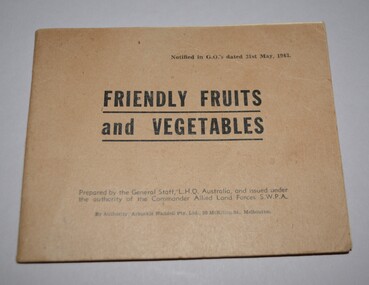
Booklet, Arbuckle Waddell Pty Ltd, Friendly Fruits and Vegetables, c1943
... campaign in 1941. In 1942 the 2/14th Battalion returned to Australia and sent to Papua where he fought at the Battle of Isurava before the battalion was sent to Gona. ...campaign in 1941. In 1942 the 2/14th Battalion returned to Australia and sent to Papua where he fought at the Battle of Isurava before the battalion was sent to Gona. ..."Friendly Fruits and Vegetables" is a specific WWII-era jungle survival guide which served as a visual pamphlet to help downed aircrews identify edible jungle plants, avoid dangerous ones, and find survival resources Booklet belonged to Robert Francis ISKOV VX15237 born at Glenrowan served with the 59th Battalion CMF before joining the 2/14th Battalion at Caulfield in September 1940. He disembarked for the Middle East in November, 1940 and fought in the Syrian campaign in 1941. In 1942 the 2/14th Battalion returned to Australia and sent to Papua where he fought at the Battle of Isurava before the battalion was sent to Gona. On 1943 Bob returned to Australia to undertake officer training and in 1945 with the 2/23rd Battalion sailed to Morotai and served with the battalion on Tarakan. He returned to Australia in November, 1945 and discharged a month later.Cream cardboard covered booklet containing 71 pages including photographs. ww2, new guinea, booklet, 1943, friendly fruits and vegetables, aircrews -
 Wangaratta RSL Sub Branch
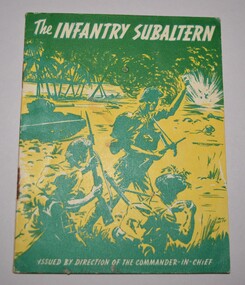
Booklet, LHQ Press, The Infantry Subaltern's Task, c1943
... campaign in 1941. In 1942 the 2/14th Battalion returned to Australia and sent to Papua where he fought at the Battle of Isurava before the battalion was sent to Gona. ...campaign in 1941. In 1942 the 2/14th Battalion returned to Australia and sent to Papua where he fought at the Battle of Isurava before the battalion was sent to Gona. ..."The Infantry Subaltern's Task," was an official tactical booklet issued by the Australian Army's Land Headquarters (South West Pacific Area) designed to instruct newly commissioned subalterns (platoon commanders) on jungle warfare, leadership, and operational realities in the Pacific. Booklet belonged to Robert Francis ISKOV VX15237 born at Glenrowan served with the 59th Battalion CMF before joining the 2/14th Battalion at Caulfield in September 1940. He disembarked for the Middle East in November, 1940 and fought in the Syrian campaign in 1941. In 1942 the 2/14th Battalion returned to Australia and sent to Papua where he fought at the Battle of Isurava before the battalion was sent to Gona. On 1943 Bob returned to Australia to undertake officer training and in 1945 with the 2/23rd Battalion sailed to Morotai and served with the battalion on Tarakan. He returned to Australia in November, 1945 and discharged a month later.Green yellow and white soft cover booklet containing 20 pages. Front cover depicts three soldiers and a tank in foreground of river and palm trees. Issued by direction of the Commander in Chiefww2, new guinea, booklet, 1943, the infantry subaltern, swpa -
 Wangaratta RSL Sub Branch
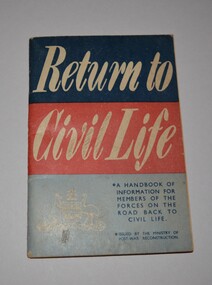
Booklet, Thomas Henry Tennant, Return to Civil Life - A handbook of information for members of the forces on the road back to civil life, 1/9/1945
... campaign in 1941. In 1942 the 2/14th Battalion returned to Australia and sent to Papua where he fought at the Battle of Isurava before the battalion was sent to Gona. ...campaign in 1941. In 1942 the 2/14th Battalion returned to Australia and sent to Papua where he fought at the Battle of Isurava before the battalion was sent to Gona. ...The Return to Civil Life booklet is a194 handbook issued by the Australian Ministry of Post-War Reconstruction to guide WWII service members returning to civilian life. Booklet belonged to Robert Francis ISKOV VX15237 born at Glenrowan served with the 59th Battalion CMF before joining the 2/14th Battalion at Caulfield in September 1940. He disembarked for the Middle East in November, 1940 and fought in the Syrian campaign in 1941. In 1942 the 2/14th Battalion returned to Australia and sent to Papua where he fought at the Battle of Isurava before the battalion was sent to Gona. On 1943 Bob returned to Australia to undertake officer training and in 1945 with the 2/23rd Battalion sailed to Morotai and served with the battalion on Tarakan. He returned to Australia in November, 1945 and discharged a month later. Tri colour soft cover booklet containing 55 pages Issued by the Ministry of Post War Reconstructionww2, new guinea, booklet, return to civil life, 1945 -
 Wangaratta RSL Sub Branch
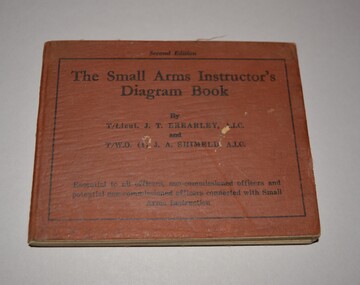
Book, Halstead Press Pty Limited, The Small Arms Instructor's Diagram Book, 1942
... campaign in 1941. In 1942 the 2/14th Battalion returned to Australia and sent to Papua where he fought at the Battle of Isurava before the battalion was sent to Gona. ...campaign in 1941. In 1942 the 2/14th Battalion returned to Australia and sent to Papua where he fought at the Battle of Isurava before the battalion was sent to Gona. ...The Small Arms Instructor's Diagram Book (1942) is a military training aid containing visual illustrations, mechanism plates, and trajectory diagrams used by Commonwealth forces during World War II. Booklet belonged to Robert Francis ISKOV VX15237 born at Glenrowan served with the 59th Battalion CMF before joining the 2/14th Battalion at Caulfield in September 1940. He disembarked for the Middle East in November, 1940 and fought in the Syrian campaign in 1941. In 1942 the 2/14th Battalion returned to Australia and sent to Papua where he fought at the Battle of Isurava before the battalion was sent to Gona. On 1943 Bob returned to Australia to undertake officer training and in 1945 with the 2/23rd Battalion sailed to Morotai and served with the battalion on Tarakan. He returned to Australia in November, 1945 and discharged a month later.A monograph publication by T/Lieut. J. T Brearley and T/W.O (1) J.A.ShimeldBrown cloth covered hard cover book containing 92 pages mainly of diagrams.Second Editionww2, new guinea, 1942, instructor's diagram book, small arms, second edition -
 Wangaratta RSL Sub Branch
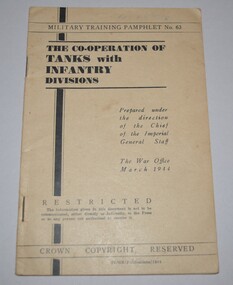
Pamphlet - Military Training Pamphlet No 63, The Co-operation of Tanks with Infantry Divisions, 1944
... campaign in 1941. In 1942 the 2/14th Battalion returned to Australia and sent to Papua where he fought at the Battle of Isurava before the battalion was sent to Gona. ...campaign in 1941. In 1942 the 2/14th Battalion returned to Australia and sent to Papua where he fought at the Battle of Isurava before the battalion was sent to Gona. ...Military Training Pamphlet (MTP) No. 63, "The Co-Operation of Tanks with Infantry Divisions" is a World War II British Army publication issued by the War Office in 1944. It established the tactical framework for combined arms operations leading up to the invasion of North-West Europe. Booklet belonged to Robert Francis ISKOV VX15237 born at Glenrowan served with the 59th Battalion CMF before joining the 2/14th Battalion at Caulfield in September 1940. He disembarked for the Middle East in November, 1940 and fought in the Syrian campaign in 1941. In 1942 the 2/14th Battalion returned to Australia and sent to Papua where he fought at the Battle of Isurava before the battalion was sent to Gona. On 1943 Bob returned to Australia to undertake officer training and in 1945 with the 2/23rd Battalion sailed to Morotai and served with the battalion on Tarakan. He returned to Australia in November, 1945 and discharged a month later.Soft cover pamphlet with black lettering containing 30 pages Restricted Crown Copyright Reservedww2, 1944, war office, military training pamphlet -
 Wangaratta RSL Sub Branch
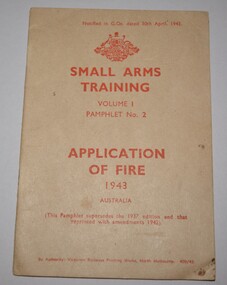
Pamphlet - Small Arms Training, Victorian Railways Printing Works, Application of Fire, 1943
... campaign in 1941. In 1942 the 2/14th Battalion returned to Australia and sent to Papua where he fought at the Battle of Isurava before the battalion was sent to Gona. ...campaign in 1941. In 1942 the 2/14th Battalion returned to Australia and sent to Papua where he fought at the Battle of Isurava before the battalion was sent to Gona. ...Australian Army manual focusing on the principles of effective rifle fire. Covering essential skills such as estimating distance, assessing wind effects, and understanding angles, this pamphlet provided soldiers with the knowledge needed for accurate marksmanship in combat. Booklet belonged to Robert Francis ISKOV VX15237 born at Glenrowan served with the 59th Battalion CMF before joining the 2/14th Battalion at Caulfield in September 1940. He disembarked for the Middle East in November, 1940 and fought in the Syrian campaign in 1941. In 1942 the 2/14th Battalion returned to Australia and sent to Papua where he fought at the Battle of Isurava before the battalion was sent to Gona. On 1943 Bob returned to Australia to undertake officer training and in 1945 with the 2/23rd Battalion sailed to Morotai and served with the battalion on Tarakan. He returned to Australia in November, 1945 and discharged a month later.Soft cover pamphlet with red lettering containing 31 pages and diagramsVolume 1 Pamphlet 2 Pamphlet supersedes the 1937 edition and that reprinted with amendments 1942.ww2, military training pamphlet, small arms training, 1943
