
Showing 31 items matching "paris exposition"
-
 Embroiderers Guild, Victoria
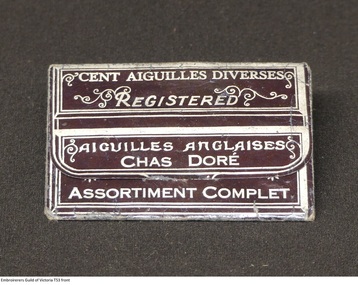
Tool - Needle Packet, after 1900
... Paris Exposition...Needle packet by Henry Milward & Sons, promoting their needles as having won Gold Medal at the Paris Exposition of 1900...Needle packet by Henry Milward & Sons, promoting their needles as having won Gold Medal at the Paris Exposition of 1900 Needle packet by Henry Milward & Sons, promoting their needles as having won Gold Medal at the Paris Exposition of 1900 Paris Exposition Milward Sewing Needle Henry Milward & Sons. ...Needle packet by Henry Milward & Sons, promoting their needles as having won Gold Medal at the Paris Exposition of 1900Needle packet by Henry Milward & Sons, promoting their needles as having won Gold Medal at the Paris Exposition of 1900Black paper needle packet, Gloss on outside, silver printing. Dark grey matt paper inside with two paper leaves with black cotton fabric holding steel needles. Larger paper leaf contains 14 needles and the smaller 67 (16.33.18) needles. Celluloid flap, Slit closureHenry Milward & Sons. Medaille D'or Paris 1900. Registered quality. Cent Aiguilles Diverses. Registered Aiguilles Anglaises Chas Dore. Assortment Completparis exposition, milward, sewing needle -
 Mont De Lancey
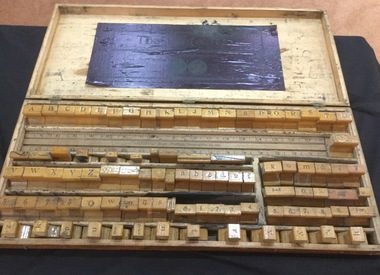
Printing set, c1900
... Medal was awarded in Paris Exposition in 1900....Medal was awarded in Paris Exposition in 1900. printing blocks printing equipment Wooden child's printing set in box, with letters of the alphabet and numbers. ...Medal was awarded in Paris Exposition in 1900.Wooden child's printing set in box, with letters of the alphabet and numbers. Has metal hinges. Patented 5/2/1901printing blocks, printing equipment -
 Melton City Libraries
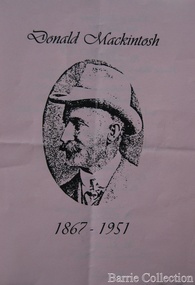
Booklet, Donald Mackintosh, 1997
... Donald Mackintosh an Olympic gold medallist marksman. 1900 Games Shooting Donald Mackintosh Universal Paris Exposition pigeon shooting events won the Prix (Grand) de l’Exposition The grande Prix Centenaire 3rd de Paris tied ??? ...Donald Mackintosh an Olympic gold medallist marksman. 1900 Games Shooting Donald Mackintosh Universal Paris Exposition pigeon shooting events won the Prix (Grand) de l’Exposition The grande Prix Centenaire 3rd de Paris tied ??? ...Donald Mackintosh an Olympic gold medallist marksman. 1900 Games Shooting Donald Mackintosh Universal Paris Exposition pigeon shooting events won the Prix (Grand) de l’Exposition The grande Prix Centenaire 3rd de Paris tied ??? Winner of the Grand Prix Monte Carlo twice The London Gun Club Challenge Cup (3 times in a row) The Melbourne Gun Club Challenge (3 times in a row) The Gran Prize of Italy The Grand Prize Aix les Bains The Belgian Championship The Milan Grand Prize The Madrid Grand Prize as a result was declared the Champion of the WorldRestoration of Donald Mackintosh's grave site at the Melton Cemeterylocal identities, sport -
 Federation University Historical Collection
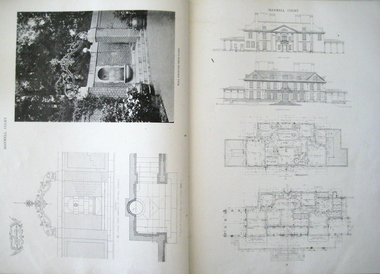
Book, The work of Charles A. Platt, 1913
... In 1900, Charles received a bronze medal at the Paris Exposition Universelle. In 1907 he designed a townhouse for Sara Delano Roosevelt on East 65th Street in New York. ...In 1900, Charles received a bronze medal at the Paris Exposition Universelle. In 1907 he designed a townhouse for Sara Delano Roosevelt on East 65th Street in New York. ...Charles Platt was born in New York in 1861 and died in 1933. He studied art at the National Academy of Design. In 1880, Charles went to Paris to study landscape painting and, while there, he travelled to Italy with his brother. Though he was influenced by Italian detailing, his designs were not copies of Italian gardens He was known as an architect and illustrator not as a garden designer. In 1880, he trained as an etcher with Stephen Parrish in Gloucester, Massachusetts. He also trained at the National Academy of Design and the Art Students League in New York and later in Paris with Gustave Boulanger and Jules Joseph Lefebvre at the Académie Julian. Charles exhibited his paintings and etchings and gained his first audience in Paris Salon of 1885. Betweem 1880 – 1890 , he made hundreds of etchings of architecture and landscapes. In 1900, Charles received a bronze medal at the Paris Exposition Universelle. In 1907 he designed a townhouse for Sara Delano Roosevelt on East 65th Street in New York. Eleanor Roosevelt called Charles A. Platt "an architect of great taste" who with the townhouse had "made the most of every inch of space." and in 1918, he designed the Freer Art Gallery in Washington. Book, Hard brown Cover. Title on the spine "The work of Charles A. Platt". Manufactural details on spine. Page no. 181. Black & white plates and plans. Stamped on page 43, 93, 123, 135, 161, 171"Picton Hopkins & Sons PTY.LTD"architecture design, domestic architecture, designs and plans, landscape gardening -
 Melton City Libraries
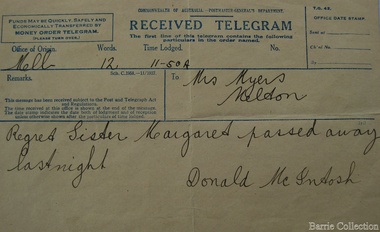
Document, Telegram from Donald McIntosh, Unknown
... Donald Mackintosh – notes from eeb notebook with re binding 1900 Games Shooting Donald Mackintosh Universal Paris Exposition pigeon shooting events won the Prix (Grand) de l’Exposition The grande Prix Centenaire 3rd de Paris tied ??? ...Donald Mackintosh – notes from eeb notebook with re binding 1900 Games Shooting Donald Mackintosh Universal Paris Exposition pigeon shooting events won the Prix (Grand) de l’Exposition The grande Prix Centenaire 3rd de Paris tied ??? ...Donald Mackintosh – notes from eeb notebook with re binding 1900 Games Shooting Donald Mackintosh Universal Paris Exposition pigeon shooting events won the Prix (Grand) de l’Exposition The grande Prix Centenaire 3rd de Paris tied ??? the Grand Prix Monte Carlo twice The London Gun Club Challenge Cup (3 times in a row) The Melbourne Gun Club Challenge (3 times in a row) The Gran Prize of Italy The Grand Prize Aix les Bains The Belgian Championship The Madrid Grand Prize as a result was declared the Champion of the World recorded Sydney Morning Herald and Australasian. Items of importance from Martha Myers/ Marjorie collection. Donald bought a freestanding gramophone to encourage Marjorie in her music studies to be able to listen to the great artists and composers and performers of the time He also bought an oil and watercolour paintings of the same scene at the Mitta Mitta river. The artist was Margery McCann sister of the well known artist (his work is in the State Library Gallery) Photograph of Donald and his friend Jock Lauder. Sheet music Francis and Day 4th Album if Harry Lauder’s Popular Songs. Roamin’ in the Gloamin Allans & Co. Christmas and New Year card signed From D & M Macintosh 1933- Melton Village of Stars – includes Marjorie Myers, twice winner of South Street Competitions, pianoforte Ballarat. May Ferris, Gold Medal for highest marks for L.L.C.M. Exam London College of Music in the Commonwealth. Telegram sent to Mrs Myers from McIntoshlocal identities -
 Bendigo Historical Society Inc.
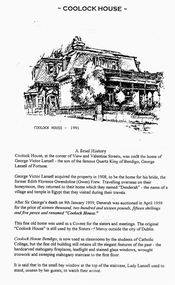
Document - Coolock or Denderah House - A brief History and Auction, 1959 and 1991
... Artworks (oil paintings, watercolors, prints, miniatures) Decorative items (marble sculptures, ormolu, cloisonné, porcelain, silverware)Household goods (rugs, curtains, carpets, kitchenware, linen, glassware) Collectibles (books, musical instruments, clocks, sporting goods, firearms) Garden and outdoor items (garden seats, pot plants, tools)Staff quarters and utility items (beds, wardrobes, kitchen equipment) Several pieces by renowned makers (Waring and Gillow, London) Unique items such as an exhibition French ornamental bedroom suite made for the Paris Exposition of 1880, and items from the "Fortuna" collection A wide range of silver and crystal tableware, antique carpets, and rare collectiblesStructure and Organization The catalog is organized by room and area (Drawing Room, Dining Room, Study, Bedrooms, Hall, Yard, Kitchen, Staff Quarters, etc.), with each lot described in detail....Artworks (oil paintings, watercolors, prints, miniatures) Decorative items (marble sculptures, ormolu, cloisonné, porcelain, silverware)Household goods (rugs, curtains, carpets, kitchenware, linen, glassware) Collectibles (books, musical instruments, clocks, sporting goods, firearms) Garden and outdoor items (garden seats, pot plants, tools)Staff quarters and utility items (beds, wardrobes, kitchen equipment) Several pieces by renowned makers (Waring and Gillow, London) Unique items such as an exhibition French ornamental bedroom suite made for the Paris Exposition of 1880, and items from the "Fortuna" collection A wide range of silver and crystal tableware, antique carpets, and rare collectiblesStructure and Organization The catalog is organized by room and area (Drawing Room, Dining Room, Study, Bedrooms, Hall, Yard, Kitchen, Staff Quarters, etc.), with each lot described in detail. bendigo fortuna george lansell coolck house denderah denderah auction george victor lansell edith lansell edith frew catholic college sisters of mercy Coolock House - A brief History and Auction This item contains the following document: 11217.59a A black and white brochure of Coolock House in 1991 with a brief history and a sketch of the house 11217.59b The auction catalog (24 pages) and sale notice for the estate of the late Sir George Lansell, held at his residence "Denderah" in Bendigo on April 7th and 8th, 1959. ...Coolock House, on the corner of View and Valentine Streets in Bendigo has a rich history marked by notable ownership and varied uses. Acquired in 1908 by George Victor Lansell, son of Bendigo's famous "Quartz King" George Lansell, as a home for himself and his bride, Edith Florence Gwendoline (Gwen) Frew. The couple named the house "Denderah" after a village and temple in Egypt they visited on their honeymoon. After Sir George's death in January 1959, the property was auctioned and renamed "Coolock House." It Served as a convent for the Sisters of Mercy and as a venue for meetings. The original "Coolock House" name is also associated with a Sisters of Mercy house outside Dublin. Currently, Coolock House is used as classrooms for Catholic College students in Bendigo. The building retains elegant historical features such as hand-carved mahogany fireplaces, leadlight and stained glass windows, wrought ironwork, and a sweeping mahogany staircase. A notable anecdote is that Lady Lansell would watch guests arrive from a small bay window at the top of the staircase. Coolock House remains a significant heritage building, blending its storied past with ongoing educational use. 1959 AUCTION The auction catalog (24 pages) and sale notice for the estate of the late Sir George Lansell, held at his residence "Denderah" in Bendigo on April 7th and 8th, 1959. The auction was conducted by Sandhurst and Northern District Trustees Limited and Agency Company Executors, as executors of George Victor Lansell's will. The property and its contents were offered for sale over two days, with viewing available the day before. The freehold property was specifically offered at 3 p.m. on April 7th. Highest bidder for each lot is the purchaser; disputes resolved by the auctioneer.25% deposit required immediately after winning a lot; full payment and removal by April 10th. The catalog lists hundreds of lots, including: Fine furniture (antique satinwood, mahogany, walnut, oak, Chippendale, French Buhl, etc.) Artworks (oil paintings, watercolors, prints, miniatures) Decorative items (marble sculptures, ormolu, cloisonné, porcelain, silverware)Household goods (rugs, curtains, carpets, kitchenware, linen, glassware) Collectibles (books, musical instruments, clocks, sporting goods, firearms) Garden and outdoor items (garden seats, pot plants, tools)Staff quarters and utility items (beds, wardrobes, kitchen equipment) Several pieces by renowned makers (Waring and Gillow, London) Unique items such as an exhibition French ornamental bedroom suite made for the Paris Exposition of 1880, and items from the "Fortuna" collection A wide range of silver and crystal tableware, antique carpets, and rare collectiblesStructure and Organization The catalog is organized by room and area (Drawing Room, Dining Room, Study, Bedrooms, Hall, Yard, Kitchen, Staff Quarters, etc.), with each lot described in detail.Coolock House - A brief History and Auction This item contains the following document: 11217.59a A black and white brochure of Coolock House in 1991 with a brief history and a sketch of the house 11217.59b The auction catalog (24 pages) and sale notice for the estate of the late Sir George Lansell, held at his residence "Denderah" in Bendigo on April 7th and 8th, 1959. The auction was conducted by Sandhurst and Northern District Trustees Limited and Agency Company Executors, as executors of George Victor Lansell's willnon-fictionbendigo, fortuna, george lansell, coolck house, denderah, denderah auction, george victor lansell, edith lansell, edith frew, catholic college, sisters of mercy -
 City of Moorabbin Historical Society (Operating the Box Cottage Museum)
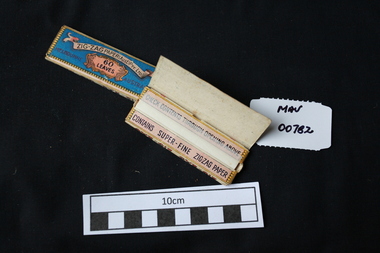
Manufactured objects, Cigarette papers ‘Zig Zag' x 2, 20thC
... Gold medal at 1900 Universal Exposition in Paris. 1860 Samuel Ramsden, a Yorkshire man, founded first paper mill in Victoria on the banks of the Yarra River, Fairfield, Melbourne. ...Gold medal at 1900 Universal Exposition in Paris. 1860 Samuel Ramsden, a Yorkshire man, founded first paper mill in Victoria on the banks of the Yarra River, Fairfield, Melbourne. ...Rolling papers are small sheets, rolls, or leaves of paper which are sold for rolling cigarettes either by hand or with a rolling machine. When rolling a cigarette, one fills the rolling paper with tobacco. Rolling papers are most commonly made with wood pulp, hemp, flax, or rice straw as a base material. Zig-Zag papers, made in France, were the first interleaved brand (hence the name). Gold medal at 1900 Universal Exposition in Paris. 1860 Samuel Ramsden, a Yorkshire man, founded first paper mill in Victoria on the banks of the Yarra River, Fairfield, Melbourne. This was the Australian Paper and Pulp Company which for most of its history was called The Australian Paper Manufacturers Ltd. until it changed its name in 1986 to Amcor. In 1919 the company opened its mill on the corner of Upper Heidelberg Road and The Chandler Highway in Fairfield and remains there today. 2 packets of precut cigarette papers 'Zig Zag ' Paper Aust. Pty. Ltd. 60 leavesZIG ZAG PAPER AUST. PTY LTD 60 LEAVESciggarettes, cigarette papers, tobacco, moorabbin, cheltenham, early settlers, australian paper manufacturers, fairfield melbourne, zig zag cigarette papers ltd. amcor ltd, -
 Bendigo Historical Society Inc.
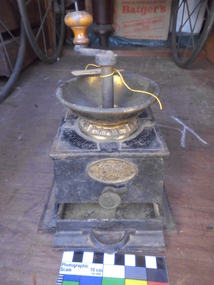
Machine - CAST IRON COFFEE GRINDER
... Paris Silver Medal 1878 Awarded T. & C. Clark & Co. Plaque Also contains images of a replica of the Jules-Clement Chaplain Art Nouveau Designed Silver Medal Exhibition Prize, consisting of a laureate bust of Marianne Facing Left surrounded by the words Republique Francaise. Beside It an Image of Victory Hovering Above the Exhibition Wearing a Laurel Wreath Blowing a Bugle Announcing Manufacturing Success & Excellence & Below Him Cupin (Child Genius) Holding A Banner with T & C Clark & Co. Around the Outside Edge Exposition...Paris Silver Medal 1878 Awarded T. & C. Clark & Co. Plaque Also contains images of a replica of the Jules-Clement Chaplain Art Nouveau Designed Silver Medal Exhibition Prize, consisting of a laureate bust of Marianne Facing Left surrounded by the words Republique Francaise. Beside It an Image of Victory Hovering Above the Exhibition Wearing a Laurel Wreath Blowing a Bugle Announcing Manufacturing Success & Excellence & Below Him Cupin (Child Genius) Holding A Banner with T & C Clark & Co. Around the Outside Edge Exposition ...Black Cast-Iron Coffee Grinder with Circular Copper Bowl on top and a curved metal handle which is attached to a central grinding mechanism. Main body shape almost square tapers slightly closer to the top. Coffee grinder has a large pullout tray contained in the bottom of the mill. 140 cm High x 40 cm Wide Previous Catalogue Number 103 Inscription T & C Clark & Co Manufacturer Additional Inscription contained in an elliptical brass plaque Paris Silver Medal 1878 Awarded T. & C. Clark & Co. Plaque Also contains images of a replica of the Jules-Clement Chaplain Art Nouveau Designed Silver Medal Exhibition Prize, consisting of a laureate bust of Marianne Facing Left surrounded by the words Republique Francaise. Beside It an Image of Victory Hovering Above the Exhibition Wearing a Laurel Wreath Blowing a Bugle Announcing Manufacturing Success & Excellence & Below Him Cupin (Child Genius) Holding A Banner with T & C Clark & Co. Around the Outside Edge Exposition Paris Universelle Internationale De 1878.T & C Clarke Manufacturerdomestic equipment, food consumption, coffee grinder -
 Flagstaff Hill Maritime Museum and Village
Decorative object - Peacock, Minton Majolica life-size model, Paul Comolera, artist, Designed: c. 1873; Made: c. 1875
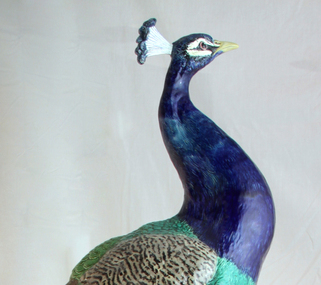
... These peacocks were so admired that Minton & Co. used them as exhibition showpieces at International Exhibitions in London, Paris, and the United States of America, ensuring the company had a worldwide reputation. So, when Melbourne hosted an International Exposition in 1880, Minton & Co. sent out ceramics and tiles, and in particular, this peacock was intended to be part of their exhibit in the British Court in the Exhibition Building, built in the Carlton Gardens. ...These peacocks were so admired that Minton & Co. used them as exhibition showpieces at International Exhibitions in London, Paris, and the United States of America, ensuring the company had a worldwide reputation. So, when Melbourne hosted an International Exposition in 1880, Minton & Co. sent out ceramics and tiles, and in particular, this peacock was intended to be part of their exhibit in the British Court in the Exhibition Building, built in the Carlton Gardens. ...This majestic peacock embodies the technical achievement, skill and ingenuity of artisans during the 19th century. It is now known as the 'Loch Ard Peacock' and was designed and modelled in 1873 by Paul Comolera (1818-1897) and fired in one piece at the Minton factory at Stoke-on-Trent in the United Kingdom in 1875. The peacock has been portrayed in symbolic motifs and has figured heavily in folktales and fables since antiquity, and many cultures around the world see it as a symbol of beauty, rebirth and power. Wealthy Victorians loved majolica, and the large peacock would have been the ultimate home accessory as a conservatory ornament – combining their desire for nature, the exotic and vibrant colours. The peacock model was listed in catalogues by Minton & Co. for a retail price of 35 guineas or sold as a pair for 90 guineas. Minton & Co. was founded in 1793 by Thomas Minton (1765–1836) and became a famous pottery and porcelain manufacturer. Comolera was a French artist and sculptor, renowned for dramatic naturalistic forms and life-size renditions of birds and animals that won him admiration in public and artistic circles. He was employed by Minton & Co. from 1873 to 1880, and the life-sized peacock became his best-known work. Comolera kept a live peacock loaned from the nearby Duke of Sutherland's Trentham Hall Estate in his studio to create a life-size model of fine buff earthenware model, which was then hand painted in brilliantly coloured green and blue glazes to mimic the peafowl’s dazzling plumage. There are no surviving production records, but according to documents in the Minton Archive, nine peacocks were made by Comolera. However, today, some historians now believe that twelve were fired at the Minton factory; research is ongoing. These peacocks were so admired that Minton & Co. used them as exhibition showpieces at International Exhibitions in London, Paris, and the United States of America, ensuring the company had a worldwide reputation. So, when Melbourne hosted an International Exposition in 1880, Minton & Co. sent out ceramics and tiles, and in particular, this peacock was intended to be part of their exhibit in the British Court in the Exhibition Building, built in the Carlton Gardens. The early dispatch date (1878) indicates that the company may have intended to exhibit their wares, including the peacock, at the 1879 Sydney International Exhibition, but the company did not take up this option. The ship that Minton & Co. used to bring the peacock and their other wares to the Australian colonies was the ill-fated Loch Ard, which sunk after striking Mutton Bird Island near Port Campbell, Victoria, in calm foggy weather in June 1878 on the final leg of the ship's journey to Melbourne. The loss of 52 lives made it one of Victoria’s worst shipwrecks. Therefore, this peacock never made it to the grand exposition in Melbourne, as Minton & Co. had planned. Charles McGillivray dragged this peacock, still in its original packing case, onto the beach in the gorge just two days after the Loch Ard went down. The peacock was rescued unscathed apart from a chip on its beak (only repaired in 1988). After a disagreement with a Melbourne Customs Officer, Joseph Daish, McGillivray stopped his salvage operations, leaving the peacock on the beach. The second salvagers were James Miller and Thomas Keys. Miller was a member of the firm Howarth, Miller and Matthews, Geelong, who had brought the salvage rights to the Loch Ard wreck on 10 June. When Miller and Keys arrived at the wreck site, a storm had washed many of the salvaged goods, including this peacoc,k back into the sea. The two men found the peacock in its case ‘bobbing along in the water’ and pulled it back to the beach. To ensure the peacock wasn't washed out to sea again, Miller and Keys hauled the packing case containing the peacock up the gorge's cliff face to the top, ready to be transported. In an interview in 1928, Keys claimed that at the time of the rescue, the head had broken from the body. This account was proven to be true in 1988, following the birds' display in Brisbane. This peacock began its life in Australia, not in the grandeur of an International Exhibition as intended, but in the hallway of a simple domestic house in Geelong. It appears Minton & Co. did not attempt to buy this peacock back. Florence Miller, daughter of James Miller (Loch Ard salvage rights holder), later remarked that the only item of real value rescued from the wreck had been the peacock and that this had been kept by her father in the family home at Malvern for many years and became a treasured family possession. As such, this 'Loch Ard peacock' was almost forgotten and mistaken with other Minton peacocks around the world. Miss Florence Miller tried to sell the peacock due to financial difficulties in the 1930s but was unsuccessful. While attempting to sell her Loch Ard relic, it was displayed in the window of the old Argus newspaper office, which was at 76 Collins Street, Melbourne; the Argus had relocated to the corner of Elizabeth and La Trobe Streets in 1926. Between 1935 and 1939, the old Argus building was occupied by the Joshua N. McClelland Print Room, which sold not only paintings and prints but also antiques and authentic replicas, as well as hosting exhibitions. Miss Florence Miller loaned her peacock for display at the Victorian Historical Exhibition held in the National Gallery on 1st June 1935, the 57th anniversary of the Loch Ard wreck. As a result, the peacock attracted public attention in books, newspapers and magazine articles that told the story of its survival from a shipwreck. Miss Florence Miller was keen to sell the peacock, even writing overseas to Captain Blain on November 30th, 1938, about the possibility of a sale, but this became no longer possible due to the outbreak of war. Recent information points to the Loch Ard peacock being owned by John S R Heath before its sale to Frank Ridley-Lee in May 1941. Research is ongoing, but it seems likely that John Samuel Robert Heath, a leading Melbourne dentist with a practice in Collins Street, and his wife, a dental mechanic, had purchased Miss Miller’s Loch Ard peacock before its sale in 1941. They were lovers of fine arts, music, wine and food. The peacock in the window of the old Argus building could have attracted their attention as they had already purchased the old stone Presbyterian Church on Warrigal Road, Oakleigh, in 1933 and had converted its interior. The home, renamed The Studio, even included Melbourne’s first all-electric kitchen. The peacock was perfect for display in the Studio’s entrance. A magazine article published after the conversion was completed included photographs of the interior. The picture of the ‘portico’ had a caption below that stated, “Some of her [Mrs Heath’s] finest pottery was salvaged from the Loch Ard Wreck”. In 2025, Heath’s two remaining sons remember running around in the entrance with the peacock standing there, oblivious to its value. Heath was an accomplished artist, studying under Max Meldrum. He painted and exhibited his works at The Studio and in a public exhibition, and he was a finalist eight times in the coveted Archibald Prize portrait competition, including the submission of his self-portrait that is now part of his grandson’s collection. The next owner of the Loch Ard Peacock was Frank Ridley-Lee. He displayed it at his home in Ivanhoe after buying it at an auction in May 1941. The peacock remained in the hands of the Ridley-Lee family until it was offered for sale by auction in 1975 as part of an art collection belonging to Mrs Ridley-Lee's estate. The peacock was not sold at this time, as the reserve price of $4500 was not met. This news was passed on to the board of the newly created Flagstaff Hill Maritime Village. Urgent efforts were made to collect the necessary money through fundraising by the Warrnambool City Council and public donations. The Fletcher Jones Company and the Victorian Government contributed half the cost. On 9 September 1975, the Loch Ard peacock was purchased by Flagstaff Hill Maritime Village, and it found a new home at the maritime museum. Since then, it has only left Warrnambool twice. Firstly, in 1980, at the centenary celebrations of the Royal Exhibition Building in Melbourne, and secondly, in 1988, the peacock was given pride of place at the entrance to the Victorian Pavilion at the Brisbane World Expo, acknowledging that this Minton Majolica peacock is the most significant shipwreck object in Australia. The Minton majolica peacock is considered of historical social and aesthetic significance to Victoria and is one of only a few 'objects' registered on the Victorian Heritage Register (H 2132), as it is a most notable and rare object associated with the Minton factory of the 1870s and works by the celebrated sculptor Paul Comolera along with the wreck of the Loch Ard on the Victorian coastline. This Minton peacock is historically significant for its rarity; it was one of only 9-12 known to exist. The shipwreck of the Loch Ard is also of significance for Victoria and is registered on the Victorian Heritage Register Ref (S 417). Flagstaff Hill has a varied collection of artefacts from Loch Ard and its collection is significant for being one of the largest accumulation of artefacts from this notable Victorian shipwreck. The collections object is to also give us a snapshot into history so we can interpret the story of this tragic event. The collection is also archaeologically significant as it represents aspects of Victoria's shipping history that allows us to interpret Victoria's early social and historical themes. The collection is historically significant is that it is associated, unfortunately with the worst and best-known shipwreck in Victoria's history. The peacock, resplendent in polychrome glaze, stands perched on a rocky plinth decorated with vines, leaves, flowers, blackberries and wild mushrooms. The peacock’s breast is cobalt blue; the wings and legs are in naturalistic colours. The tail is a mass of feathers coloured in green, ochre blue and brown — a fantastic display of artistry and Minton expertise. Inscribed at the base :P Comolera, and a Minton & Co. design number: 2045.flagstaff hill, warrnambool, maritime museum, shipwreck coast, loch ard, loch ard gorge, peacock, paul comolera, victorian heritage register, minton peacock, minton & co., stoke upon trent, bird figures, mintons, ceramics, international expositions, majolica, naturalistic, staffordshire, john samuel robert heath, peacock statue, loch ard peacock, majorca peacock -
 4th/19th Prince of Wales's Light Horse Regiment Unit History Room
Instrument - Trumpet, Cavalry, Couesnon Cie, 1901 (exact)
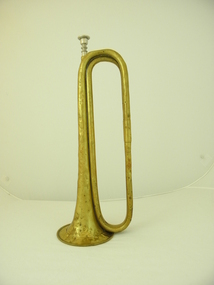
... Crest with inscription: "Exposition Universelle De Paris" with circular logo with inscribed "1900". ...Each squadron had a trumpeter sergeant, equipped with a cavalry trumpet, who was employed at the Squadron Headquarters trumpet cavalry musical instrument 2nd light horse mounted rifles Crest with inscription: "Exposition Universelle De Paris" with circular logo with inscribed "1900". ...The 2nd Light Horse Regiment was raised at Enoggera in Queensland on 18 August 1914. Its recruits came mainly from Queensland but some hailed from the northern rivers district of New South Wales. The 2nd was one of three regiments of the 1st Light Horse Brigade – the first Australian mounted formation raised by Australia during the First World War. The regiment sailed from Brisbane on 25 September and disembarked in Egypt on 9 December. The 2nd Light Horse Regiment deployed to Gallipoli without its horses and landed there on 12 May 1915, joining the New Zealand and Australian Division. It played a defensive role for most of the campaign but did attack the Turkish trenches opposite Quinn’s Post, one of the most contested positions along the ANZAC Line. The first assault wave was mown down and fortunately the officer commanding the attack had the wisdom and courage to call it off. The 2nd was withdrawn from the front line in September and left the peninsula on 18 December. Back in Egypt, the 2nd Light Horse joined the ANZAC Mounted Division. Between January and May 1916, the regiment was deployed to protect the Nile valley from bands of pro-Turkish Senussi Arabs. On 18 May, as part of its parent brigade, it joined the forces defending the Suez Canal. The 1st Light Horse Brigade played a significant role in turning back the Turkish advance on the canal at the battle of Romani on 4 August. In ensuing days the regiments of the brigade participated in the immediate follow-up of the defeated Turks, but were soon withdrawn to rest. The 2nd Light Horse Regiment rejoined the Allied advance across the Sinai in November and was subsequently involved in the fighting to secure the Turkish outposts on the Palestine frontier – Maghdaba on 23 December 1916 and Rafa on 9 January 1917. A stint of protective duty along the line of communications through the Sinai followed. The 2nd’s next major engagement was the abortive second battle of Gaza on 19 April. Gaza finally fell on 7 November, after a wide outflanking move via Beersheba, in which the 1st Light Horse Brigade played a part. With the capture of Gaza, the Turkish position in southern Palestine collapsed. The 2nd Light Horse Regiment participated in the advance to Jaffa that followed, and was then committed to operations to clear and occupy the west bank of the Jordan River. It was involved in the Amman (24–27 February) and Es Salt (30 April–4 May) raids and the repulse of a major German and Turkish attack on 14 July 1918. The final British offensive of the campaign was launched along the Mediterranean coast on 19 September 1918, with the ANZAC Mounted Division taking part in a subsidiary effort east of the Jordan aimed at Amman. Turkey surrendered on 30 October 1918. The 2nd Light Horse Regiment sailed for Australia on 13 March 1919 without their horses, which were either shot or transferred to Indian cavalry units. Events in the daily routine of the soldier were signalled by bugle and trumpet calls. This trumpet is signicant because historically, it was issued to the 2nd Australian Light Horse Regiment in 1912. This Regiment served with distinction in Gallipoli and Palestine in World War 1. It is probable, but not confirmed, that tthe trumpet was used by the Regiment during these operations. Each light horse regiment was divided into four squadrons. Each squadron had a trumpeter sergeant, equipped with a cavalry trumpet, who was employed at the Squadron Headquarters Technically called a cavalry trumpet, this brass instrument can be described as a "simple trumpet" ie. the direct forerunner of the modern valve trumpet. It is in E flat not B flat as is the bugle. Both were carried slung over the player's body by means of green tasselled cords.Crest with inscription: "Exposition Universelle De Paris" with circular logo with inscribed "1900". "Hors Concours Membre De Jury". Logo formed of initials (not deciphered). "Couesnon Cie 94 Rue Dangouleme Paris". Bomb burst type logo with "01" in centre. "W H Paling & Co Ltd Sydney NSW Brisbane" On bell: "Mounted Rifles (2nd ALH)" trumpet, cavalry, musical instrument, 2nd light horse, mounted rifles -
 Wangaratta RSL Sub Branch
Postcard - Embroidered Postcard, c. 1917
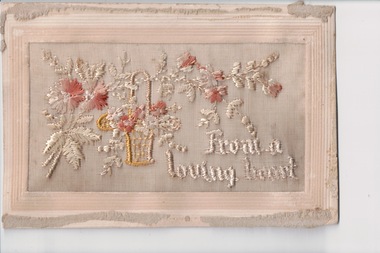
... Embroidered silk postcards were first made in 1900 for the Paris Exposition. The popularity of silk postcards peaked during the First World War 1914 - 1918.They were mostly embroidered by French women in their homes and then sent to the factories for cutting and mounting on cards. ...Postcard from WWI soldier William West (1268) of the 29 Infantry Battalion, 5th Pioneers Battalion while posted in France to his family at home.Embroidered silk postcards were first made in 1900 for the Paris Exposition. The popularity of silk postcards peaked during the First World War 1914 - 1918.They were mostly embroidered by French women in their homes and then sent to the factories for cutting and mounting on cards. Many of the cards were illustrated with patriotic symbols, flags, slogans, or sentimental texts. During the First World War, many Allied officers and soldiers based in France sent silk embroidered postcards to their loved ones back homeWhite rectangular postcard with embroidered beige, brown and yellow flower and foliate decoration on front. Handwritten message on the back.Front: "From a loving heart" (embroidered) Back: "To my dear Alice / Best love from Will xxxxxx / xxxxxxxx"wwi, postcard, embroidered postcard, paris depose, fabrication francaise -
 Wangaratta RSL Sub Branch
Postcard - Embroidered Postcard, c. 1917
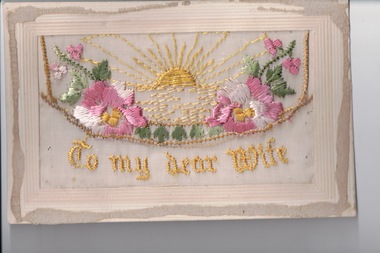
... Embroidered silk postcards were first made in 1900 for the Paris Exposition. The popularity of silk postcards peaked during the First World War 1914 - 1918.They were mostly embroidered by French women in their homes and then sent to the factories for cutting and mounting on cards. ...Postcard from WWI soldier William West (1268) of the 29 Infantry Battalion, 5th Pioneers Battalion while posted in France to his family at home.Embroidered silk postcards were first made in 1900 for the Paris Exposition. The popularity of silk postcards peaked during the First World War 1914 - 1918.They were mostly embroidered by French women in their homes and then sent to the factories for cutting and mounting on cards. Many of the cards were illustrated with patriotic symbols, flags, slogans, or sentimental texts. During the First World War, many Allied officers and soldiers based in France sent silk embroidered postcards to their loved ones back homeWhite rectangular postcard with embroidered pink flower, green foliate and yellow rising sun decoration on front. Handwritten message on the back.Front: "To my dear Wife" (embroidered) Back: "Best love from your loving / H[usband] ??????? France ???? 1919 / ???? presents / money on ??? to not / so you keep ?????"wwi, postcard, embroidered postcard -
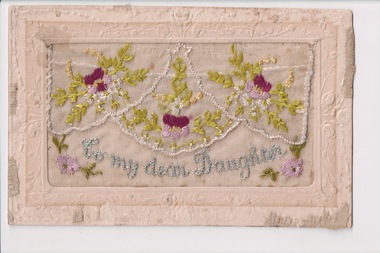 Wangaratta RSL Sub Branch
Postcard - Embroidered Postcard, c. 1916
... Embroidered silk postcards were first made in 1900 for the Paris Exposition. The popularity of silk postcards peaked during the First World War 1914 - 1918.They were mostly embroidered by French women in their homes and then sent to the factories for cutting and mounting on cards. ...Postcard from WWI soldier William West (1268) of the 29 Infantry Battalion, 5th Pioneers Battalion while posted in France to his family at home.Embroidered silk postcards were first made in 1900 for the Paris Exposition. The popularity of silk postcards peaked during the First World War 1914 - 1918.They were mostly embroidered by French women in their homes and then sent to the factories for cutting and mounting on cards. Many of the cards were illustrated with patriotic symbols, flags, slogans, or sentimental texts. During the First World War, many Allied officers and soldiers based in France sent silk embroidered postcards to their loved ones back homeWhite rectangular postcard with embroidered pink, purple flowers green foliate decoration on front. Handwritten message on the back.Front: "To my dear Daughter" (embroidered) Back: "France / 23/1/1916 / To Dear Little Enid / From Daddy Dear / Best Love / xxxxxxxxxxxxxxxx"wwi, postcard, embroidered postcard -
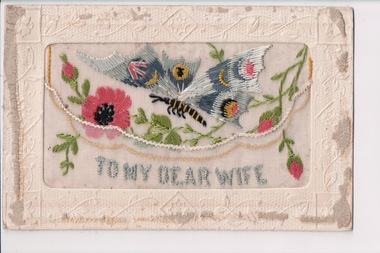 Wangaratta RSL Sub Branch
Postcard - Embroidered Postcard, c. 1917
... He was a Driver with the 10th ASC, Embroidered silk postcards were first made in 1900 for the Paris Exposition. The popularity of silk postcards peaked during the First World War 1914 - 1918.They were mostly embroidered by French women in their homes and then sent to the factories for cutting and mounting on cards. ...Postcard from WWI soldier William West (1268) of the 29 Infantry Battalion, 5th Pioneers Battalion while posted in France to his family at home, 1917. Mentioned in postcard George Buse 2208 born Yarraville who enlisted on 10/9/1914 aged 21 years 3 months. He embarked on 20/10/1914 and returned to Australia in 1919. He was a Driver with the 10th ASC,Embroidered silk postcards were first made in 1900 for the Paris Exposition. The popularity of silk postcards peaked during the First World War 1914 - 1918.They were mostly embroidered by French women in their homes and then sent to the factories for cutting and mounting on cards. Many of the cards were illustrated with patriotic symbols, flags, slogans, or sentimental texts. During the First World War, many Allied officers and soldiers based in France sent silk embroidered postcards to their loved ones back homeWhite rectangular postcard with embroidered pink flowers, green foliate and blue winged butterfly decoration on front. Handwritten message on the back.Front: "To my dear Wife" (embroidered) Back: "To Enid from dad xx / xxxxxx / France / Feb 26/2/1917 / My Dear Alice / Just a PC to let you I'm still well and hope are all the same I have not see Joe lately I may see him sometime or the other I hope you enjoyed yourself on your holidays they will do you good. I'm in a rest station I have not been too well I think I will be back with the battalion in a few days you can tell ??[ma]?? I met Pugger Loney he is in the 15 ambulance he looks well and it just as fat as ever I'm goin gover to see youn George Buse tomorrow well I have not much new to tell only all is well so I will now close with best love from loving husband Will xxxxxxxx"wwi, postcard, embroidered postcard, william west 1268, george buse 2208 -
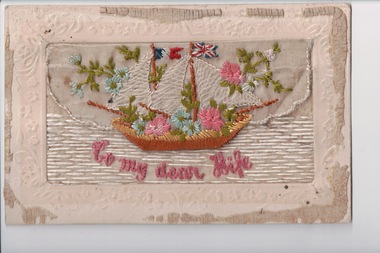 Wangaratta RSL Sub Branch
Postcard - Embroidered Postcard, c. 1917
... Embroidered silk postcards were first made in 1900 for the Paris Exposition. The popularity of silk postcards peaked during the First World War 1914 - 1918.They were mostly embroidered by French women in their homes and then sent to the factories for cutting and mounting on cards. ...Postcard from WWI soldier William West (1268) of the 29 Infantry Battalion, 5th Pioneers Battalion while posted in France to his family at home.Embroidered silk postcards were first made in 1900 for the Paris Exposition. The popularity of silk postcards peaked during the First World War 1914 - 1918.They were mostly embroidered by French women in their homes and then sent to the factories for cutting and mounting on cards. Many of the cards were illustrated with patriotic symbols, flags, slogans, or sentimental texts. During the First World War, many Allied officers and soldiers based in France sent silk embroidered postcards to their loved ones back homeWhite rectangular postcard with embroidered sailing boat with flying french flag and union jack. Also pink, blue flowers and green foliate decoration on front. Handwritten message on the back.Front: "To my dear Wife" (embroidered) Back: "My dear Alice / France / Just a PC to let you know I'm well and hope you are all the same I have not see Joe yet over here but I believe he is alright so far well there not much news to tell you get more news over there than we do. I hope Jack and Father are working. I wrote to Jack he aut to have my letters by now well this all the news ???? as long as you know I'm well ?????? bye best love Will xxxxxx"wwi, postcard, embroidered postcard -
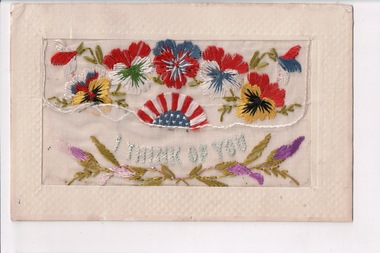 Wangaratta RSL Sub Branch
Postcard - Embroidered Postcard, c. 1917
... Embroidered silk postcards were first made in 1900 for the Paris Exposition. The popularity of silk postcards peaked during the First World War 1914 - 1918.They were mostly embroidered by French women in their homes and then sent to the factories for cutting and mounting on cards. ...Postcard from WWI soldier William West (1268) of the 29 Infantry Battalion, 5th Pioneers Battalion while posted in France to his family at home.Embroidered silk postcards were first made in 1900 for the Paris Exposition. The popularity of silk postcards peaked during the First World War 1914 - 1918.They were mostly embroidered by French women in their homes and then sent to the factories for cutting and mounting on cards. Many of the cards were illustrated with patriotic symbols, flags, slogans, or sentimental texts. During the First World War, many Allied officers and soldiers based in France sent silk embroidered postcards to their loved ones back homeWhite rectangular postcard with embroidered flowers and green foliate decoration on front. Handwritten message on the back.Front: "I THINK OF YOU" (embroidered) Back: "Write Soon / O[ct]? / To Enid / From [Dad] / Best [lo]ve / xxxxx" wwi, postcard, embroidered postcard, carte postale -
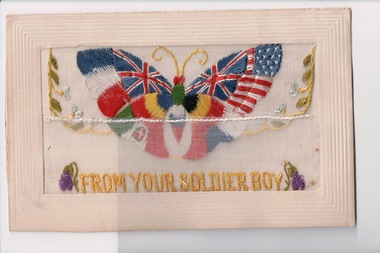 Wangaratta RSL Sub Branch
Postcard - Embroidered Postcard, c. 1917
... Embroidered silk postcards were first made in 1900 for the Paris Exposition. The popularity of silk postcards peaked during the First World War 1914 - 1918.They were mostly embroidered by French women in their homes and then sent to the factories for cutting and mounting on cards. ...Postcard from WWI soldier William West (1268) of the 29 Infantry Battalion, 5th Pioneers Battalion while posted in France to his family at home.Embroidered silk postcards were first made in 1900 for the Paris Exposition. The popularity of silk postcards peaked during the First World War 1914 - 1918.They were mostly embroidered by French women in their homes and then sent to the factories for cutting and mounting on cards. Many of the cards were illustrated with patriotic symbols, flags, slogans, or sentimental texts. During the First World War, many Allied officers and soldiers based in France sent silk embroidered postcards to their loved ones back homeWhite rectangular postcard with embroidered butterfly representing the flags and colours of different countries. Front: "FROM YOUR SOLDIER BOY" (embroidered) wwi, postcard, embroidered postcard, carte postale -
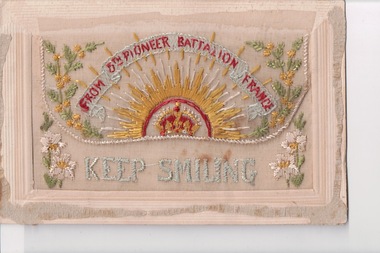 Wangaratta RSL Sub Branch
Postcard - Embroidered Postcard, c. 1917
... Embroidered silk postcards were first made in 1900 for the Paris Exposition. The popularity of silk postcards peaked during the First World War 1914 - 1918.They were mostly embroidered by French women in their homes and then sent to the factories for cutting and mounting on cards. ...Postcard from WWI soldier William West (1268) of the 29 Infantry Battalion, 5th Pioneers Battalion while posted in France to his family at home.Embroidered silk postcards were first made in 1900 for the Paris Exposition. The popularity of silk postcards peaked during the First World War 1914 - 1918.They were mostly embroidered by French women in their homes and then sent to the factories for cutting and mounting on cards. Many of the cards were illustrated with patriotic symbols, flags, slogans, or sentimental texts. During the First World War, many Allied officers and soldiers based in France sent silk embroidered postcards to their loved ones back homeWhite rectangular postcard with embroidered yellow rising sun, crown, banner and foliate decoration. Handwritten message on backFront: "FROM 5TH PIONEER BATTALION FRANCE" "KEEP SMILING" (embroidered) Back: "To Enid best love from Dad xxxxxx / France June 28/6/1917" "My Dear Mary / just a pc to let you know I'm still well and hope you are all the same I have not seen Joe yet is is still warm over here yet we have been out shooting to day I feel tired. I wish it was all over I full up of it. I seen Dexter the other night he is looking well on it ?? I'm beginning to think it is never going to end well this all at present love Will love from your loving husband xxx / xxxx " wwi, postcard, embroidered postcard, carte postale -
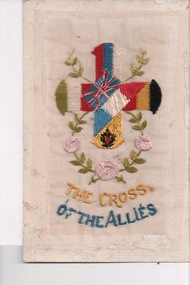 Wangaratta RSL Sub Branch
Postcard - Embroidered Postcard, c. 1917
... Embroidered silk postcards were first made in 1900 for the Paris Exposition. The popularity of silk postcards peaked during the First World War 1914 - 1918.They were mostly embroidered by French women in their homes and then sent to the factories for cutting and mounting on cards. ...Postcard from WWI soldier William West (1268) of the 29 Infantry Battalion, 5th Pioneers Battalion while posted in France to his family at home.Embroidered silk postcards were first made in 1900 for the Paris Exposition. The popularity of silk postcards peaked during the First World War 1914 - 1918.They were mostly embroidered by French women in their homes and then sent to the factories for cutting and mounting on cards. Many of the cards were illustrated with patriotic symbols, flags, slogans, or sentimental texts. During the First World War, many Allied officers and soldiers based in France sent silk embroidered postcards to their loved ones back homeWhite rectangular postcard (portrait orientation) with embroidered cross representing flags and colours of different countries. Flower and foliate decoration beneath. Handwritten message on backFront: "THE CROSS OF THE ALLIES" (embroidered) Back: "to Enid from Dad / best love little girlie xxxxxx"wwi, postcard, embroidered postcard, carte postale -
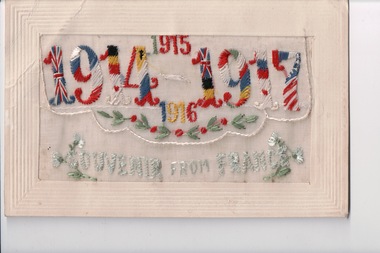 Wangaratta RSL Sub Branch
Postcard - Embroidered Postcard, c. 1917
... Embroidered silk postcards were first made in 1900 for the Paris Exposition. The popularity of silk postcards peaked during the First World War 1914 - 1918.They were mostly embroidered by French women in their homes and then sent to the factories for cutting and mounting on cards. ...Postcard from WWI soldier William West (1268) of the 29 Infantry Battalion, 5th Pioneers Battalion while posted in France to his family at home.Embroidered silk postcards were first made in 1900 for the Paris Exposition. The popularity of silk postcards peaked during the First World War 1914 - 1918.They were mostly embroidered by French women in their homes and then sent to the factories for cutting and mounting on cards. Many of the cards were illustrated with patriotic symbols, flags, slogans, or sentimental texts. During the First World War, many Allied officers and soldiers based in France sent silk embroidered postcards to their loved ones back homeWhite rectangular postcard with embroidered numbers representing flags and colours of different countries. Front: "1914 / 1915 / 1916 / 1917" "Souvenir from France" (embroidered)wwi, postcard, embroidered postcard, carte postale -
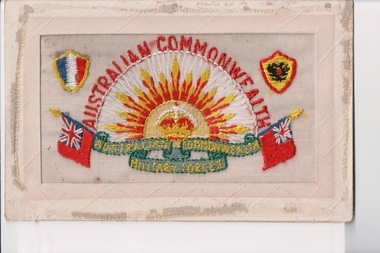 Wangaratta RSL Sub Branch
Postcard - Embroidered Postcard, c. 1917
... Embroidered silk postcards were first made in 1900 for the Paris Exposition. The popularity of silk postcards peaked during the First World War 1914 - 1918.They were mostly embroidered by French women in their homes and then sent to the factories for cutting and mounting on cards. ...Postcard from WWI soldier William West (1268) of the 29 Infantry Battalion, 5th Pioneers Battalion while posted in France to his family at home.Embroidered silk postcards were first made in 1900 for the Paris Exposition. The popularity of silk postcards peaked during the First World War 1914 - 1918.They were mostly embroidered by French women in their homes and then sent to the factories for cutting and mounting on cards. Many of the cards were illustrated with patriotic symbols, flags, slogans, or sentimental texts. During the First World War, many Allied officers and soldiers based in France sent silk embroidered postcards to their loved ones back homeWhite rectangular postcard with embroidered yellow, orange, red, white rising sun badge, green banner and english maritime flags.Front: "AUSTRALIAN COMMONWEALTH" "Australian Commonwealth Military Forces" (embroidered) Back: "To Alice best of love from loving husband Will xxxxxxx write soon"wwi, postcard, embroidered postcard, carte postale -
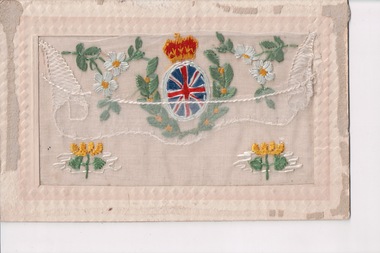 Wangaratta RSL Sub Branch
Postcard - Embroidered Postcard, c. 1917
... Embroidered silk postcards were first made in 1900 for the Paris Exposition. The popularity of silk postcards peaked during the First World War 1914 - 1918.They were mostly embroidered by French women in their homes and then sent to the factories for cutting and mounting on cards. ...Postcard from WWI soldier William West (1268) of the 29 Infantry Battalion, 5th Pioneers Battalion while posted in France to his family at home.Embroidered silk postcards were first made in 1900 for the Paris Exposition. The popularity of silk postcards peaked during the First World War 1914 - 1918.They were mostly embroidered by French women in their homes and then sent to the factories for cutting and mounting on cards. Many of the cards were illustrated with patriotic symbols, flags, slogans, or sentimental texts. During the First World War, many Allied officers and soldiers based in France sent silk embroidered postcards to their loved ones back homeWhite rectangular postcard with embroidered foliate and flowers, laurel wreath beneath oval union jack and crown. Handwritten message on back.Back: "To Enid From Dad / With best love / from France xxxxxxx"wwi, postcard, embroidered postcard, carte postale -
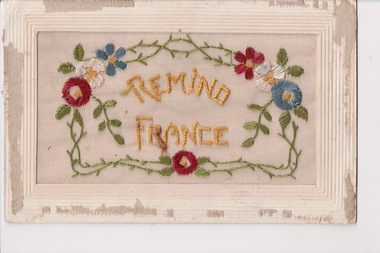 Wangaratta RSL Sub Branch
Postcard - Embroidered Postcard, c. 1916
... Embroidered silk postcards were first made in 1900 for the Paris Exposition. The popularity of silk postcards peaked during the First World War 1914 - 1918.They were mostly embroidered by French women in their homes and then sent to the factories for cutting and mounting on cards. ...Postcard from WWI soldier William West (1268) of the 29 Infantry Battalion, 5th Pioneers Battalion while posted in Egypt to his family at home.Embroidered silk postcards were first made in 1900 for the Paris Exposition. The popularity of silk postcards peaked during the First World War 1914 - 1918.They were mostly embroidered by French women in their homes and then sent to the factories for cutting and mounting on cards. Many of the cards were illustrated with patriotic symbols, flags, slogans, or sentimental texts. During the First World War, many Allied officers and soldiers based in France sent silk embroidered postcards to their loved ones back homeWhite rectangular postcard with embroidered foliate and flowers bordering a message. Handwritten message on back.Front: "Remind / France" (embroidered) Back: "1268 2 of 5 Pioneers Battalion" "Egypt / May 28 1916" "My dear Alice just a PC to let you know I'm well and hope you are all the same I got a letter from you yesterday and Enid PC but I have not got the money yet did you ??? if you need not send enny more till I send for it well I have not seen joe since you say you are goin gto town for a trip it will not hurt you i wish I was going to will my eyes are a bit weak yet it is the sand and flys. well this is all at present. Best love to all from your loving husband Will xxxxx"wwi, postcard, embroidered postcard, carte postale -
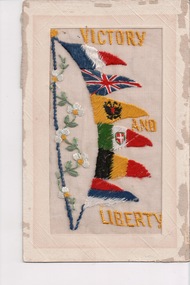 Wangaratta RSL Sub Branch
Postcard - Embroidered Postcard, c. 1916
... Embroidered silk postcards were first made in 1900 for the Paris Exposition. The popularity of silk postcards peaked during the First World War 1914 - 1918.They were mostly embroidered by French women in their homes and then sent to the factories for cutting and mounting on cards. ...Postcard from WWI soldier William West (1268) of the 29 Infantry Battalion, 5th Pioneers Battalion while posted in France to his family at home.Embroidered silk postcards were first made in 1900 for the Paris Exposition. The popularity of silk postcards peaked during the First World War 1914 - 1918.They were mostly embroidered by French women in their homes and then sent to the factories for cutting and mounting on cards. Many of the cards were illustrated with patriotic symbols, flags, slogans, or sentimental texts. During the First World War, many Allied officers and soldiers based in France sent silk embroidered postcards to their loved ones back homeWhite rectangular postcard with embroidered flags. Handwritten message on back.Front: "Victory / and / Liberty" (embroidered) Back: "To Alice from Will / Best love / hope you are all well as it leave me at present / xxxxxx"wwi, postcard, embroidered postcard, carte postale -
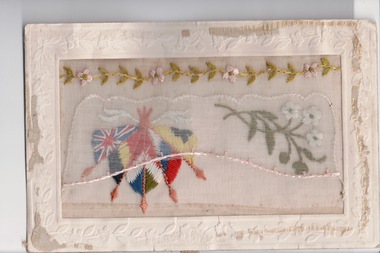 Wangaratta RSL Sub Branch
Postcard - Embroidered Postcard, c. 1916
... Embroidered silk postcards were first made in 1900 for the Paris Exposition. The popularity of silk postcards peaked during the First World War 1914 - 1918.They were mostly embroidered by French women in their homes and then sent to the factories for cutting and mounting on cards. ...Postcard from WWI soldier William West (1268) of the 29 Infantry Battalion, 5th Pioneers Battalion while posted in France to his family at home.Embroidered silk postcards were first made in 1900 for the Paris Exposition. The popularity of silk postcards peaked during the First World War 1914 - 1918.They were mostly embroidered by French women in their homes and then sent to the factories for cutting and mounting on cards. Many of the cards were illustrated with patriotic symbols, flags, slogans, or sentimental texts. During the First World War, many Allied officers and soldiers based in France sent silk embroidered postcards to their loved ones back homeWhite rectangular postcard with embroidered flags, foliate and flowers. Handwritten message on back.Back: "My dear Alice / just a PC to let you ???? Joe ??? well and hope you are all the same / plenty of beer / best love Will xxxx"wwi, postcard, embroidered postcard, carte postale -
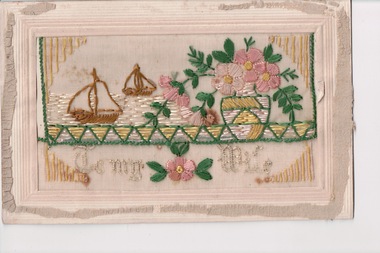 Wangaratta RSL Sub Branch
Postcard - Embroidered Postcard, c. 1916
... Embroidered silk postcards were first made in 1900 for the Paris Exposition. The popularity of silk postcards peaked during the First World War 1914 - 1918.They were mostly embroidered by French women in their homes and then sent to the factories for cutting and mounting on cards. ...Postcard from WWI soldier William West (1268) of the 29 Infantry Battalion, 5th Pioneers Battalion while posted in France to his family at home.Embroidered silk postcards were first made in 1900 for the Paris Exposition. The popularity of silk postcards peaked during the First World War 1914 - 1918.They were mostly embroidered by French women in their homes and then sent to the factories for cutting and mounting on cards. Many of the cards were illustrated with patriotic symbols, flags, slogans, or sentimental texts. During the First World War, many Allied officers and soldiers based in France sent silk embroidered postcards to their loved ones back homeWhite rectangular postcard with embroidered scene depicting two brown sail boats and vase of pink flowers. Handwritten message on back.Front: "To my Wife" (embroidered) Back: "My dear Alice just a PC to let you know I'm still well I heard Joe is in Hospital with a sore throught I have not heard from you latly this is all at present all well and hope you are all the same / best love Will xxxxx"wwi, postcard, embroidered postcard, carte postale -
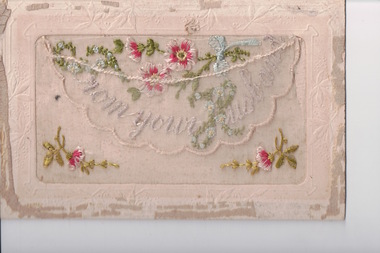 Wangaratta RSL Sub Branch
Postcard - Embroidered Postcard, c. 1917
... Embroidered silk postcards were first made in 1900 for the Paris Exposition. The popularity of silk postcards peaked during the First World War 1914 - 1918.They were mostly embroidered by French women in their homes and then sent to the factories for cutting and mounting on cards. ...Postcard from WWI soldier William West (1268) of the 29 Infantry Battalion, 5th Pioneers Battalion while posted in France was sent to his wife at home, 1917.Embroidered silk postcards were first made in 1900 for the Paris Exposition. The popularity of silk postcards peaked during the First World War 1914 - 1918.They were mostly embroidered by French women in their homes and then sent to the factories for cutting and mounting on cards. Many of the cards were illustrated with patriotic symbols, flags, slogans, or sentimental texts. During the First World War, many Allied officers and soldiers based in France sent silk embroidered postcards to their loved ones back homeWhite rectangular postcard with embroidered pink flower and green foliate decoration on front. Handwritten message on the back.Front: "From your husband" (embroidered) Back: "Write soon / Best Love / to West / do not forget to / send that / France / Jan 23/1/1917 / My Dear Alice / Just a P.C. to let you know I'm still well and hope you are all the same Best love / to all from Will xxxxxxxxxxxxx"wwi, postcard, embroidered postcard, paris depose, fabrication francaise -
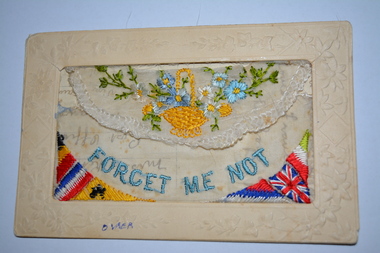 Wangaratta RSL Sub Branch
Postcard
... Embroidered silk postcards were first made in 1900 for the Paris Exposition. The popularity of silk postcards peaked during the First World War 1914 - 1918.They were mostly embroidered by French women in their homes and then sent to the factories for cutting and mounting on cards. ...Silk postcard from France written by unknown WW1 soldier from Milawa addressed to Mrs G Kittle/Kettle c/- Post Office Milawa. WW1 service records reveal Charles James KETTLE 29741 was born in Milawa and enlisted on 15/4/1916 aged 39 years. He embarked on the 3/10/1916 and served in France prior to being diagnosed with a tumour and whilst being repatriated home died on 10/8/1917 and was buried at sea. Listed place of association was Wangaratta. Embroidered silk postcards were first made in 1900 for the Paris Exposition. The popularity of silk postcards peaked during the First World War 1914 - 1918.They were mostly embroidered by French women in their homes and then sent to the factories for cutting and mounting on cards. Many of the cards were illustrated with patriotic symbols, flags, slogans, or sentimental texts. During the First World War, many Allied officers and soldiers based in France sent silk embroidered postcards to their loved ones back homeRectangle cream cardboard postcard with embossed border containing coloured embroidered stitch work of a basket and in words “forget me not” on silk Handwritten inside - just a souvenir of your beloved France from one of the boys from Milawa addressed to Mrs G Kettle/Kittle Post Office Milawa via Wangaratta Victoria embroidered postcard, ww1, milawa -
 Linton and District Historical Society Inc
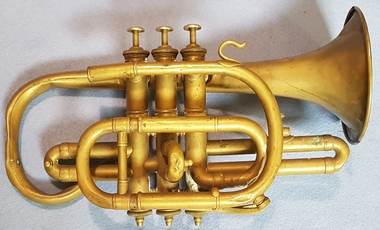
Instrument - Cornet, Brass, Cased, Cornet, Owned and Used by W H Nicholls, Linton Brass Band
... The manufacturer's name "Gautrot Brevete, Paris" is imprinted on the bell, along with the inscription "Exposition Universelle de Paris, 1889, Medaille d'Or". ...The manufacturer's name "Gautrot Brevete, Paris" is imprinted on the bell, along with the inscription "Exposition Universelle de Paris, 1889, Medaille d'Or". ...The cornet was owned and used by W H Nicholls, a member of the Linton Brass Band, most likely in the 1890s or early 1900s. The cornet was donated to Linton & District Historical Society in 2017 by Robyn Nicholls, of Blackburn. It is understood in the Nicholls family that Robyn's late husband, Graeme Nicholls, inherited the cornet from his great-grandfather, William Henry Nicholls (1845-1902). However it is also possible that the cornet was owned and played by Graeme's grandfather, also named William Henry Nicholls (1880-1943).Brass cornet with mouthpieces, in original dark wooden case which has red fabric lining. Instrument is approximately 30cm in length, has a 12 cm bell and three valves. A small portable sheet-music holder is also in the carrying case. The manufacturer's name "Gautrot Brevete, Paris" is imprinted on the bell, along with the inscription "Exposition Universelle de Paris, 1889, Medaille d'Or". EXHIBITION / UNIVERSELLE / DE PARIS / 1889 / MEDAILLE D'OR / Gautrot Brevete / PARIS.linton brass band, musical instruments -
 University of Melbourne, Burnley Campus Archives
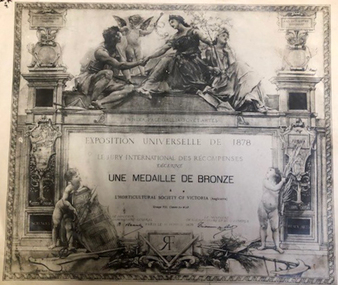
Certificate - Award Certificate, Exposition Universelle de 1878, 1878
... exposition universelle...international exhibition...paris...Exposition Universelle de 1878 le Jury International des Recompenses Decerne UNE MEDAILLE DE BRONZE a L'Horticultural Society of Victoria (Angleterre) Grouuupe VII, Classes 72 et 73, Le Senateur Commissaire-General B Krantz PARIS LE 21 OCTTOBER 1878 Le Minstre De L'Agrigulture et du Commerce (signed)....Certificate stating that Le Jury International des Récompenses Décerne, Une Médaille de Bronze à L'Horticultual Society of Victoria (Angleterre) Groupe VII, Classes 72 et 73, Paris le 21 Octobre 1878. exposition universelle international exhibition paris france jury international des recompenses horticultural society of victoria 1878 Exposition Universelle de 1878 le Jury International des Recompenses Decerne UNE MEDAILLE DE BRONZE a L'Horticultural Society of Victoria (Angleterre) Grouuupe VII, Classes 72 et 73, Le Senateur Commissaire-General B Krantz PARIS LE 21 OCTTOBER 1878 Le Minstre De L'Agrigulture et du Commerce (signed). ...Certificate stating that Le Jury International des Récompenses Décerne, Une Médaille de Bronze à L'Horticultual Society of Victoria (Angleterre) Groupe VII, Classes 72 et 73, Paris le 21 Octobre 1878.Original and copy ( 2 ) of award. Black and white print of decorative certificate.Exposition Universelle de 1878 le Jury International des Recompenses Decerne UNE MEDAILLE DE BRONZE a L'Horticultural Society of Victoria (Angleterre) Grouuupe VII, Classes 72 et 73, Le Senateur Commissaire-General B Krantz PARIS LE 21 OCTTOBER 1878 Le Minstre De L'Agrigulture et du Commerce (signed).exposition universelle, international exhibition, paris, france, jury international des recompenses, horticultural society of victoria, 1878
