
Showing 461 items matching "park david "
-
 Beechworth Honey Archive
Publication, Impact of commercial honeybees on flora and fauna in Ngarkat Conservation Park. (Paton, David C.). Canberra, 1999, 1999
... Impact of commercial honeybees on flora and fauna in Ngarkat Conservation Park. (Paton, David C.). Canberra, 1999....Impact of commercial honeybees on flora and fauna in Ngarkat Conservation Park. (Paton, David C.). Canberra, 1999. Publication ...33 pages. -
 Emerald Museum & Nobelius Heritage Park
Photograph - Emerald Park Village concept drawing, circa 1970's
... park...concept... David...Emerald Park Village Concept, David Moyle Collection – ex Emerald policeman, per Kevin Teasdale...David Moyle, Sherbrooke Historical Society, Swinburne Technical School. A Sherbrooke Shire sub-committee was formed with Sherbrooke Historical Society and consultants was formed. The project was shelved when funding was withdrawn after the federal double dissolution was initiated by Governor General Kerr. emerald village park concept David Moyle Collection Emerald Park Village Concept, David Moyle Collection – ex Emerald policeman, per Kevin Teasdale B&W photograph of Emerald Park Village Community & Transport Museum concept drawing. ...Concept of proposed Emerald Pioneer Village in early 1970's. Contributors were David Moyle, Sherbrooke Historical Society, Swinburne Technical School. A Sherbrooke Shire sub-committee was formed with Sherbrooke Historical Society and consultants was formed. The project was shelved when funding was withdrawn after the federal double dissolution was initiated by Governor General Kerr.B&W photograph of Emerald Park Village Community & Transport Museum concept drawing.Emerald Park Village Concept, David Moyle Collection – ex Emerald policeman, per Kevin Teasdaleemerald, village, park, concept, david moyle collection -
 Federation University Historical Collection
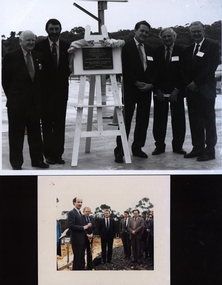
Photograph - colour, Turning the sod at the University of Ballarat Technology Park, 1989, 03/08/1989
... park...david white...A number of people watch David White, Minister for Industry, Technology and Resources turn the first sod of Ballarat's Technology Park. ...University of Ballarat is a predecessor institution of Federation University Australia. ballarat technology park southern region data centre university of ballarat technology park federation university technology park david white john sharpham john beaumont stephen elder john mildren turn the sod A number of people watch David White, Minister for Industry, Technology and Resources turn the first sod of Ballarat's Technology Park. ...University of Ballarat is a predecessor institution of Federation University Australia. A number of people watch David White, Minister for Industry, Technology and Resources turn the first sod of Ballarat's Technology Park. Left to right: David White; John Sharpham (Director, Ballarat University College); John Beaumont (Director, Ballarat Technology Park); Stephen Elder M.L.A.; John Mildren M.H.R.ballarat technology park, southern region data centre, university of ballarat technology park, federation university technology park, david white, john sharpham, john beaumont, stephen elder, john mildren, turn the sod -
 Kew Historical Society Inc
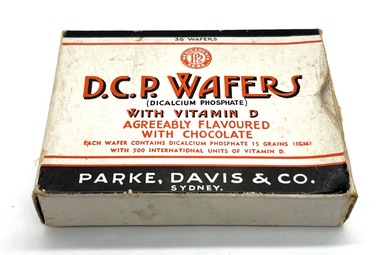
Container - D.C.P. Wafers
... ...park David & Co -- sydney...The active ingredient - Dibasic calcium phosphate. containers park David & Co -- sydney D.c.p wafers Small printed cardboard box, once containing wafers of D.C.P. ...D.C.P. Wafers were produced by Park, Davis & Co, Sydney. This U.S.-based company was started in Detroit in 1866. It was once the largest pharmaceutical company in the world. The active ingredient - Dibasic calcium phosphate. Small printed cardboard box, once containing wafers of D.C.P. Wafers, containers, park david & co -- sydney, d.c.p wafers -
Glen Eira Historical Society
Document - PRENTICE STREET, 13, ELSTERNWICK
... Park... Cohen David...Elsternwick Prentice Street Edwardian Styles Harleston Park Cohen David Caulfield North Balaclava Road Verandahs Real estate agents Document PRENTICE STREET, 13, ELSTERNWICK ...Newspaper article dated 14/07/2006 on 13 Prentice Street Elsternwick, on forthcoming sale of property, includes two coloured photographs. Gives brief interior features.elsternwick, prentice street, edwardian styles, harleston park, cohen david, caulfield north, balaclava road, verandahs, real estate agents -
Glen Eira Historical Society
Letter - Allison Road, 59, Elsternwick
... Park... Ballantyne David...It includes 3 photographs of the property Land subdivision Beemery Park Ballantyne David Jeffries Charles Lethbridge Reginald E. ...This file contains 3 items 1.Typed carbon copy of correspondence dated 4 August 1989 from Brighton Historical Society detailing the history of the property from 1892 to 1974 2. An undated unattributed handwritten chronological listing of property owner of 59 Allison Rd, Elsternwick from 1892 to 1974 3. A copy of House of the Week from the Domain newspaper dated 1-2 March 2013 on the fortcoming auction of 59 Allison St. Elsternwick. It includes 3 photographs of the propertyland subdivision, beemery park, ballantyne david, jeffries charles, lethbridge reginald e., dunn john g., jamieson j.b., swale richard, swale k. mrs, swale charlotte, swale robert, shilton h.w., mclnnes c., shilton i.j., swale david, house names, lurgancanty -
Whitehorse Historical Society Inc.
Article, War memorial is moved, 1988
... park...duncan...david...clubs and associations mitcham returned servicemens league halliday park duncan david brandenburg john p The Mitcham (bugler) war memorial has been moved from outside Mitcham Memorial Hall to Halliday Park. ...The Mitcham (bugler) war memorial has been moved from outside Mitcham Memorial Hall to Halliday Park.The Mitcham (bugler) war memorial has been moved from outside Mitcham Memorial Hall to Halliday Park. Nunawading Council will bear the cost of moving the memorial and will also be upgrading Halliday Park.The Mitcham (bugler) war memorial has been moved from outside Mitcham Memorial Hall to Halliday Park.clubs and associations, mitcham returned servicemens league, halliday park, duncan, david, brandenburg, john p -
 Surrey Hills Historical Society Collection
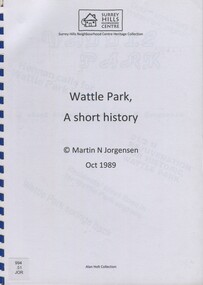
Book, Wattle Park: a short history, Oct-89
... park...(mr )david pureau...This book includes a description of the early settlement of Wattle Park; who owned the farms prior to it becoming parkland; and the development and management since including the Melbourne and Metropolitan Tramways Board. wattle park trees box trees golden wattle trees she-oak trees (mr) james atkinson aborigines first tree (mr) hector bell croquet golf orienteering (mr) henry de carle (mr) john lawler (mr) walter craig (mrs) eliza welch the grange (miss) effie eliza ball hawthorn tramways trust (mr) - membrey metropolitan tramways park (mr )david pureau by-laws g. t. usher o. fenwick f. c. garyder e bennet a. snowden g. tweedy (mr) (sir) arthur stanly (mr)alan holt (mrs) a bennet world war 1939-1945 eucalypts elm trees ash trees (ms) faye shepherd This book includes a description of the early settlement of Wattle Park; who owned the farms prior to it becoming parkland; and the development and management since including the Melbourne and Metropolitan Tramways Board. ...This book includes a description of the early settlement of Wattle Park; who owned the farms prior to it becoming parkland; and the development and management since including the Melbourne and Metropolitan Tramways Board.This book includes a description of the early settlement of Wattle Park; who owned the farms prior to it becoming parkland; and the development and management since including the Melbourne and Metropolitan Tramways Board.wattle park, trees, box trees, golden wattle trees, she-oak trees, (mr) james atkinson, aborigines, first tree, (mr) hector bell, croquet, golf, orienteering, (mr) henry de carle, (mr) john lawler, (mr) walter craig, (mrs) eliza welch, the grange, (miss) effie eliza ball, hawthorn tramways trust, (mr) - membrey, metropolitan tramways park, (mr )david pureau, by-laws, g. t. usher, o. fenwick, f. c. garyder, e, bennet, a. snowden, g. tweedy, (mr) (sir) arthur stanly, (mr)alan holt, (mrs) a bennet, world war, 1939-1945, eucalypts, elm trees, ash trees, (ms) faye shepherd -
 Federation University Historical Collection
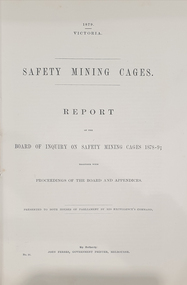
Booklet - Reports, John Ferres, Government Printer, Safety Mining Cages. Report of the Board of Enquiry on Safety Cages 1878-9; together with proceedings of the Board and Appendices, 1879
... ...david park...That the board have witnessed trials of all the inventions brought under their notice, and from the result of their observations the members are of opinion that the adoption of these safety appliances will afford additional security to the large section of the community engaged in mining operations. safety cages safety mining cages george collins levey mining mitchell and osborne's patent safety catches for mining cages mining cages seymour's patent safety cage pryor's safety cage white's safety cage mining accidents dyke's freehold gmc creswick angelo mining co castlemaine britannia qmc ballarat alexander kennedy smith george r. fincham henry roberts williams robert clark r. richardson allan's patent balalrat hassan's patent daylesford david white charles stewart w.h. grainger h.b. nicholas t. hassan r. allan a.k. smith james thomson william collard smith j.h. seymour john s. delbridge william buttle james davidson j.p. carolin r. clark thomas eyre george marshall g. thureau william bottoms robert carr j.c. march john keam david park j.a. lewis lester's hotel, ballarat robert allan nancarrow saftey cage robert malachi serjeant robert henderson g.f. smith r.w. newman william benson f. bennett john sharp thomas couchman john a. wallace john small william h. grainger james cowling tools 48 foolscap pages report stitched together. ...From the Argus, Friday 18 July 1879:- SAFETY MINING CAGES. The report of the board on safety mining cages was laid on the table of the Legislative Assembly fortnight The board, which has tested the following inventions Nances, Williams patent, Jackson and Middleton's patent Sesmours patent, Allans patent, and Hassan a patent, reports as follows - 1. That the preponderance of evidence given by miners and others qualified to form an opinion is strongly in favour of the adop-tion of a safety cage for general use in the mines of this colony, provided that a reliable invention can be brought forward, and its practical utility satisfactorily determined 2. That in view of the rapid increase of cage accidents, and supported by the evidence before them, the board are of opinion that some special provision should be made to check such a prolific source of danger as is shown to exist in the working of the shaft and machinery employed for winding purposes. 3. That this check could be imposed by means of such a regulation as that at present contained in the statute, i e -" Every cage used in a mine shall be fitted with special and suitable appliances to prevent its sudden fall down a shaft and also to prevent its coming into contact with the poppet heads." The board, however, consider that mine proprietors should be permitted to exercise their own discretion in the selection of safety cages, but safety hooks and balance catches must be used in connexion with every case 4. That the board have witnessed trials of all the inventions brought under their notice, and from the result of their observations the members are of opinion that the adoption of these safety appliances will afford additional security to the large section of the community engaged in mining operations.48 foolscap pages report stitched together. safety cages, safety mining cages, george collins levey, mining, mitchell and osborne's patent safety catches for mining cages, mining cages, seymour's patent safety cage, pryor's safety cage, white's safety cage, mining accidents, dyke's freehold gmc creswick, angelo mining co castlemaine, britannia qmc ballarat, alexander kennedy smith, george r. fincham, henry roberts williams, robert clark, r. richardson, allan's patent balalrat, hassan's patent daylesford, david white, charles stewart, w.h. grainger, h.b. nicholas, t. hassan, r. allan, a.k. smith, james thomson, william collard smith, j.h. seymour, john s. delbridge, william buttle, james davidson, j.p. carolin, r. clark, thomas eyre, george marshall, g. thureau, william bottoms, robert carr, j.c. march, john keam, david park, j.a. lewis, lester's hotel, ballarat, robert allan, nancarrow saftey cage, robert malachi serjeant, robert henderson, g.f. smith, r.w. newman, william benson, f. bennett, john sharp, thomas couchman, john a. wallace, john small, william h. grainger, james cowling, tools -
Glen Eira Historical Society
Book - Carnegie Primary School No. 2897
... Park Sung Chul... Pemberton Michael... Reisman Elizabeth... Richards Kylie... Savrone Leah... Tia Charlie... Tran Paul... Wiseman Derek... Wright Dean... Wyatt Marilyn... Andre Ryan... Breeze Ginaya... Brown James... Campbell Chad... Charles Benjamin... Devon John... Diakmoumis Stacey... Diamantis Chris... Duljas Michael... Grammatos Harry... Hill Bradd... Karim Salim... Lindsay Amanda... Lynch Jennifer... Marrello Sol... Momandwall Shaker... Moutsos Ireni... Oram Scott... O’Sughrue Kristy... Panevin David...Webster Vivian Stehle Siggy Truong Le Sen McPherson Barbara Mitchell Eva Moutsos Mark Chan Benjamin Wilson Del Jewell Christopher Mitchell Keith Grant Marilyn Caskie Alastair Dixon Dennis Armstrong John Lucas Edward Clark Deanne Coutts Natalie Flood Zivanja Derham Peter Momandwall Shaper Couper Jarrod Heslop Joanne Breeze Ginaya Caskie Fiona Filippone Nadya McMahon Nina Hedges Nigel Williams Shae Grimm Karen McGregor Clare Vagenes John Gallagher Glenn McAlister Rob Varga Marilyn Hunter Debbie Courtney Cathy Booth Carol McMahon Mary Brown Danielle Burska Maciej Campbell Jason Chryssis Aris D’Arcy Michael Delaney Matthew Doukas Vivian Dower Samantha Fournarakis Andrew Genoli Amanda Grammatos Jimmy Harrington Melanie Karamoshos John Karim Sadruddin Kennedy Russel Lalani Zahra Lightfoot Kylie Looby Mark Louange Veronica Park Sung Mi Perera Dennis Pozvek Julie Scurry Kate Sievers sarah Smith Matthew Svarnas Dennis Vassiliou Denise Wright Tracey Zouzounis Spirros Adahall Jojie Agar Jude Anderson Lynette Black Renae Bobrowski Ursula Caskie Catherine Devon Hayley Diakoumis Maria Duljas Kristie Evans Lindsay Faucett Ebony Filippone Annette Fournarakis Jimmy Francese Sean Gibson Jay Gordon Michelle Guslitser Dora King Jane Lianos Villi Lorkin Christopher Macleod Cheryl Maggs Amberley Mitchell Keith Mucic Renae O’Brien Jessica Park Matthew Pozvek Richard Psarras Nancy Rhodes Suzanne Simons Emma Smith Christopher Spokes Melanie Tia Michael Timewell Amanda Vavoudis Peter Abbott Kristi Allender Daniel Bobrowski Jacob Carey Rebecca Carter Daimein Catramados John Christou Eugenia Couper Jarrod Healey Michael Kalaitzakis Nick Kennedy Rebecca Macleod Suzanne Mavridis Angelo Morosini Amanda Mowforth Dustin Okolicsanyi George Park Sung Chul Pemberton Michael Reisman Elizabeth Richards Kylie Savrone Leah Tia Charlie Tran Paul Wiseman Derek Wright Dean Wyatt Marilyn Andre Ryan Breeze Ginaya Brown James Campbell Chad Charles Benjamin Devon John Diakmoumis Stacey Diamantis Chris Duljas Michael Grammatos Harry Hill Bradd Karim Salim Lindsay Amanda Lynch Jennifer Marrello Sol Momandwall Shaker Moutsos Ireni Oram Scott O’Sughrue Kristy Panevin David Park Catherine Pozvek Louise Stratton Alisa Timewell Rebecca Tsigos Stam Yeow Sook Ling Anderson Peter Batson Tracey Black Craig Brain Jason Breeze Benjamin Brown Kylie Carrington Harata Caskie Fiona Catramados Hercule Chan Daphne Christou Chris Clarke Simone Diamantis Anthony Faucett Sara Flood Natalia Holmes Gavin Kotrotsos Tony Kuk Robin Mitchell David Okolicsanyi Steve Pemberton Samuel Soos Melinda Stephenson Gabrielle Tran Pauline Vassiliou Evan Agar Natalia Bennett Tracey Buhmann Wayne Couper Clare Faucett Sean Filippone Nadya Filippone Marie Gallagher Glenn Gelman Roman Grant Shawn Hill Tania Jewel Chris Kaliappa Danny Kiss Robert Liacopoulos Aris Louey David Macleod Mike Malamas Voula Oram Michelle Scurry Ivan Wardley Amanda Zouzounis Sam Anderson Robert Antoniou Nick Carey Tamara Derham Peter Diep Dianne Filippone Danielle Flood Zivanja Frangos Katina Handley Scott Harrison Robin Heath Cheryl Hedges Megan Hedges Nigel Hudson Raelene Jacovou Daniel Katrotsos George Kuk Maggie Leung Tracy Lightfoot Wendy McMahon Nina Taylor Stephen Vassiliou Litsa Liddelow E. ...Carnegie Primary School centenary book (96 pages x 2 copies) ‘The First Hundred Years NO2897. Carnegie Primary School 1888-1988’ compiled and edited by Isabel Couper and Deidre Lynch. A detailed history of the school’s beginnings. Many informative memories and recollections from school’s first students and teachers; includes social history of area and people, football teams, debutante sets and school. Also a reprinted newspaper article from school’s Golden Anniversary and photo of school band; and a couple of social history photographs.anderson james, murrumbeena, glen huntly railway station, carnegie state school, wesleyan hall, neerim road, railway stations, carnegie primary school, rosstown, toolambool road, lynch deidre, mcvey claire, ross william murray, findlay francis, couper isabel, brown wesley, rosstown state school, brisbane w, carnegie uniting church, liddelow m.h., evans thomas, selboskar phyl, centenaries, margaret street, caulfield, brewster mr., taylor mr., draper mrs., mcfarlane mr., rule thomas, teachers, campbell ada, ‘ava’, campbell aubrey, campbell vera, matthews ben, hewitts road, matthews funeral service, funeral parlours, leo amy, leo alfie, rudge family, rudge mr., transport, phillips store, general store, phillips corner, emily street, hamlya family, pitt family, sheppard family, pemberton mr., pemberton mrs., dunlop misses, preschools, whitlam family, whitlam gordon, woods family, woods lorna, swaggie, swagman, liddelow amy, anderson mr., anderson archie, dunlop bill, phillips linda, hansen alice, lodge laura, fox arthur , hamlyn eric, hansen dagmar, cooper lina , woods lorna, waite family, cove family, johansen family, koornang road, market gardens, sheppard ernie, wood a.m., ‘nisava’, wood family, wood bill, evans rachel, evans thomas, wood millicent, whitfield mr., griffiths mr., wood malcolm, wood forest, wood joe, roxburgh miss, grange road, clifton street, lord street, wood frederick geo, egan miss dressmakers, whitlam fred, whitlam christine, whitlam george, whitlam gough, whitlam freda, whitfield mr., patterson road, graceburn avenue, griffiths r.h., koornang road, scales mr., reid athol, lording dr., mernda ave, farmstead, lord reserve, leman’s swamp, koornang park, cobby harry, larkin aircraft company, dawson howard, rosedale avenue, spencer reg, turner ruth, turner jack, turner noreen, turner marie, morton alan, morton barney, gardiner martin, frogmore estate, oakleigh road, frogmore road, koornang park, hunt club kennels, raeke miss, morgan miss, pitt winnie, jiggins mr., smith mr., blundy violet, ryall ray, mimosa road, wolseley mr., wolseley family, wolseley ted, brunstein madge, murrumbeena cricket club, sinclair alan, sincliar tinny, thomas ted, walker alec, bone bob, footballers, middleton colin, farquahson mrs., eddy family, eddy rose, wolseley jack, buswell stan, buswell doug, buswell. stan jnr., irving nell, brims ethel, bailey bruce, eason sisters, hands hilda, windlow isabel, madden road, glenhuntly road, griffiths rita, jackson jean, scott mr., ward ‘cap’, caulfield grammar school, kokaribb road, carnegie traders, cricket teams, carnegie south, ward marjory, ryan mr., phillips tony, phillips bessie, buckley street, phillips harriet, phillips marion, phillips ernest, phillips hilda, phillips david, phillips florence, phillips linda, lihou miss, jersey parade, meake family, skewe family, mansfield family, fraser jean, collister alma, sturges millie, retallick girls, lillywhite family, mason nellie, johns nancy, bowsfield family, jenner family, chisholm emma, chisholm doris, chisholm ivy, chisholm netta, chisholm beryl, chisholm eileen, wadsworth ethel, luke mr., plummer t.w., raecke miss, sargent ron, sarkie family, reid family, meake violet, collett reg, mcneil miss, scales mr., carmody thomas william, steele miss, young mac, young margaret, cooper cyril, cooper bill, whiteside d., broadbent neil, broadbent mr., carnegie theatre, theatres, morton family, clarke family, quickand neals grocery store, grocers, billy guyatt’s, shops, spencer the removalist, removalists, collister harold, collister bill, caulfield band, bands, carthews the drapers, drapers, mccarrons alec blacksmiths, skewes keith, oliver frank, pitt ‘squeaker’, knevitt ‘skeeter’ harry, jockeys, britter jack, stanistreet family, gear rita, culleen billy, tailors, sherwoods butchers, butchers, jersey parade, riley didlo, verne harry, cooper horace, cooper linda, cooper martin, cooper claude, cooper reginald, cooper stanley, cooper gladys, cooper muriel, cooper percival, cooper cyril, beaumont w.a., whittfield joe, beaumont eileen, major mary anne sister, major myrtle, major bessie, major alma, stagholl walter, stagholl margaret, stagholl eric, robertson bessie, robertson fred, robertson norman, robertson donald, robertson alma, robertson alan, baird neil, baird john, baird rosemary, dunn helen, baird ian, baird heather, baird dianne, petrie stuart, petrie richard, bailey ron, gaunt mabel, reading harold, reading marge, irwin joyce, dickson margaret, dickson jennifer, dickson peter, wood malcolm, wood millicent, wood forest, wood joe, sinclair ‘trinny’, roberts ‘fly’, footballers, malcolm mr., henderson reg, henderson alice, brew l., rule mr., philbrick mr., wood mr., trembath mr., keogh mr., plummer tom, lane a., fox ernest, souters, market gardeners, fox belle, fox bella, fox vern, couper margaret, couper sandra, couper peter, couper narelle, couper clare, couper jarrod, scott mr., doughty will, doughty tom, lloyd miss, islingworth master, adams joyce, hogan mr., markus jean, cosgrove joan, cosgrove mrs., cosgrove mr., marshall jim, kellow fred, fretwell elizabeth, fretwell betty, shepparson ave, singers, edmonson miss, butters shirley, harwood vera, bracher lloyd, dewhurst irene, dewhurst jack, boyle mr., gow jack, welch len, stanistreet harry, stanistreet jack, stanistreet kathleen, stanistreet frank, stanistreet kingsley, ‘ray sullivan’s harmony boys’, carnegie memorial hall, st. anthony’s hall, welch len, gibbons norm, ashley sylvia, crosswell edna, marks peggy, worth phyllis, cleal jean, tabner edith, jenkins elva, mcintosh gladys, worth reg, waters cyril, downard rex, wild mavis, wild darby, hill roland, eason jean, tyers noel, tyers clive, witten hope, strickland doris, chisholm beryl, harwood family, battershill sid, battershill walter, dixon mavis, boyle mr., ford hilda, forsythe miss, edmonsen miss, ryan mr., grimsley mr., allaway mrs., grant mrs., bone bob, bone bruce, w. bone & son nursery men, bone norman, bone jack, bone william, railway road, green kevin, paris marjorie, mimosa road, green joan, allaway winnie, elliot miss, mcburney mr., purdy mrs., allaway suzanne, barron shirley, hogan mr., rutherford mrs., curtin mr., mckee’s, stores, whelan’s, coles, koornang road, gardiner marty, grange road dairy, dairies, mcwhinney’s tuck shop, shops, williams dorothy, kennedy irene regina, rigby miss, grimsley steve, grimsley muriel, grimsley jack, grimsley margaret, grimsley aimee, grimsley bill, blinkinsop steve, blinkinsop jeannie, mathers max, howie rex, major mr., flatmans paddock, crossover, reid eric, reid athol, lowe margaret, lowe dorothy, lowe ian, poliomyelitis epidemic diseases, forsythe miss, cuddihy miss, dougall keith, grace miss, hattam’s, stores, driver wally, perry max, perry don, perry jack, meagher j., ‘hostile’, racehorses, edney jack, carthews the drapers, fretwell elizabeth, kellow fred, muddyman bill, graceburn ave, caulfield junior citizens band, bands, luke mr., luke percy, luke maise, luke nessie, luke geoff, luke ross, luke jan, luke lynette, bolton douglas, anderson mrs., mcburney mr., hogan mr., scott mr., tyers s., ross j., ryan j., irvine j., muirhead mrs., muirhead j., mcnab m., buller l., emmanuel p., buller m., paton v., moor j., condron a., bibby d., matthews n., holman l., cotterell m., whelan j., jennion g., walker b., taylor e., green a., turner r., matthews e., smith joan, gardiner marty, dairies, hanson family, cove family, gallop family, barrett family, barrett w.a., bolch family, bolch b., burke w., burke bill, burke s., mobbs h., young g., young c., burke m., ward c., hopwood g., gordon mr., milk bars, cooper cr., phillips t., swindell mr., grogan mr., wadsworth mrs., bourke mrs., lewis mrs., worsley mrs., quickenstead mrs., brown wesley, musicians, purdy h., curtain les, jenner’s dairy, riley’s wood yard, occupations, jenner vic, jenner les, grant noel, parker george, connolly keith, purdy mr., glen huntly picture theatre, picture theatres, irvine jack, law christie, hatter bob, joppick les, driver geoff, curtin mrs., frederick street, ormond, waters ron, carnegie junior citizens band, carnegie salvation army band – bands, whelan evan, irwin ray, balgleish jack, cowen laurie, smyth wally, lambeth margaret, kind lorraine, bondini joy, tredennick miss, linton miss, heath graham, shiell bill, shiell myrtle, archard bess, bull joan, craig ida, collins dorrie, collins doreen, diggans jess, cornthwaite h., cripps e., dougall n., dixon joyce, francis d., evans mrs., glass peg, greene jess, grace merle, hocking freda, jillings mrs., price mrs., day kitty, kerr may, mason marge, kind sylvia, muirhead d, mcconchie netta, needham nancy, nickless w, o’connor linda, pilven mrs., ryall h., strother ivy, singleton mrs., kelly phyl, waters von, usher mrs., trotter maude, watson mrs., williams mabel, withers olive, aarsmann norma, shiell norma, close peter, ‘wild cherry’ cake shop, rudi miss, anderson miss, eddy mr., hunter jean, nelson vera, fisher john, hunter ron, read jean, smith brian, newsreaders, nelson miss, singleton billy, quon miss, mchutchison george, valma smith, millar royal r., donoghue nora, lester mr., roberts tom, andreisen colin, miles alec, hine mr., baker mr., clements george, bracher lloyd, dimick miss, muir judy, dunn margaret, sant richard, myring miss, ryan mr., armstrong margaret, share wally, howie rex, barclay bob, rockman udo, hoult david, eisfelder kevin, jacques mr., smith mr., magee mr., stehle belinda, wallace mr., james mrs., main mr., wood miss, verso mr., mcpherson mrs., felotico miss, stehle john, howards mrs., collard mrs., webster vivian, stehle siggy, truong le sen, mcpherson barbara, mitchell eva, moutsos mark, chan benjamin, wilson del, jewell christopher, mitchell keith, grant marilyn, caskie alastair, dixon dennis, armstrong john, lucas edward, clark deanne, coutts natalie, flood zivanja, derham peter, momandwall shaper, couper jarrod, heslop joanne, breeze ginaya, caskie fiona, filippone nadya, mcmahon nina, hedges nigel, williams shae, grimm karen, mcgregor clare, vagenes john, gallagher glenn, mcalister rob, varga marilyn, hunter debbie, courtney cathy, booth carol, mcmahon mary, brown danielle, burska maciej, campbell jason, chryssis aris, d’arcy michael, delaney matthew, doukas vivian, dower samantha, fournarakis andrew, genoli amanda, grammatos jimmy, harrington melanie, karamoshos john, karim sadruddin, kennedy russel, lalani zahra, lightfoot kylie, looby mark, louange veronica, park sung mi, perera dennis, pozvek julie, scurry kate, sievers sarah, smith matthew, svarnas dennis, vassiliou denise, wright tracey, zouzounis spirros, adahall jojie, agar jude, anderson lynette, black renae, bobrowski ursula, caskie catherine, devon hayley, diakoumis maria, duljas kristie, evans lindsay, faucett ebony, filippone annette, fournarakis jimmy, francese sean, gibson jay, gordon michelle, guslitser dora, king jane, lianos villi, lorkin christopher, macleod cheryl, maggs amberley, mitchell keith, mucic renae, o’brien jessica, park matthew, pozvek richard, psarras nancy, rhodes suzanne, simons emma, smith christopher, spokes melanie, tia michael, timewell amanda, vavoudis peter, abbott kristi, allender daniel, bobrowski jacob, carey rebecca, carter daimein, catramados john, christou eugenia, couper jarrod, healey michael, kalaitzakis nick, kennedy rebecca, macleod suzanne, mavridis angelo, morosini amanda, mowforth dustin, okolicsanyi george, park sung chul, pemberton michael, reisman elizabeth, richards kylie, savrone leah, tia charlie, tran paul, wiseman derek, wright dean, wyatt marilyn, andre ryan, breeze ginaya, brown james, campbell chad, charles benjamin, devon john, diakmoumis stacey, diamantis chris, duljas michael, grammatos harry, hill bradd, karim salim, lindsay amanda, lynch jennifer, marrello sol, momandwall shaker, moutsos ireni, oram scott, o’sughrue kristy, panevin david, park catherine, pozvek louise, stratton alisa, timewell rebecca, tsigos stam, yeow sook ling, anderson peter, batson tracey, black craig, brain jason, breeze benjamin, brown kylie, carrington harata, caskie fiona, catramados hercule, chan daphne, christou chris, clarke simone, diamantis anthony, faucett sara, flood natalia, holmes gavin, kotrotsos tony, kuk robin, mitchell david, okolicsanyi steve, pemberton samuel, soos melinda, stephenson gabrielle, tran pauline, vassiliou evan, agar natalia, bennett tracey, buhmann wayne, couper clare, faucett sean, filippone nadya, filippone marie, gallagher glenn, gelman roman, grant shawn, hill tania, jewel chris, kaliappa danny, kiss robert, liacopoulos aris, louey david, macleod mike, malamas voula, oram michelle, scurry ivan, wardley amanda, zouzounis sam, anderson robert, antoniou nick, carey tamara, derham peter, diep dianne, filippone danielle, flood zivanja, frangos katina, handley scott, harrison robin, heath cheryl, hedges megan, hedges nigel, hudson raelene, jacovou daniel, katrotsos george, kuk maggie, leung tracy, lightfoot wendy, mcmahon nina, taylor stephen, vassiliou litsa, liddelow e., anderson james h., boardman thomas h., rule thomas, whitfield j.p., griffiths r.h., scales e., boyle j.b., ryan owen w., eddy h.m., millar royal r., lester russel a., donoghue r., bracher a. lloyd (acting principle), o’brien john d., moller henry r., monahan t.v., barclay robert l., somerville albert v., magee frank c. (acting principle), wallis keith, laing allan i., verso ron (acting principle), wood moira (acting principle), tonkin ernest, share wallace (acting principle), howie rex, harding malcolm (acting principle), crowe brian, schmidt david (acting principle), lynch deidre (acting principle), o’keeffe leo, brierley bob, brierley marjorie, couper isabel, couper peter, lindsay janine, lynch deidre, selboskar phyl, stehle siggy, webster jennifer -
 Sunshine and District Historical Society Incorporated
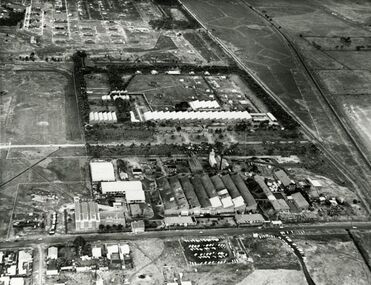
Photograph - ICI / Leathercloth Factory Late 1950's Aerial Photograph, Ian Russell, 1950's
... Park...Tilburn Road...David...ICI Leathercloth Station Road Deer Park Tilburn Road David Meale Imperial Chemical Industries 5382.01 - ICI Leathercloth Factory Late 1950s Aerial Photograph.jpg 5382.02 - ICI Leathercloth Factory Late 1950s Aerial Photograph Thank You Letter.jpg Black & White Photograph and Letter Photograph ICI / Leathercloth Factory Late 1950's Aerial Photograph Ian Russell ...The Deer Park Leathercloth Factory was a major ICI (Imperial Chemical Industries) operation on Station Road, producing “Leathercloth” — a nitrocellulose‑based synthetic coated fabric — and formed part of the wider Deer Park explosives and chemical manufacturing complex. It’s one of the most significant industrial heritage sites in the City of Brimbank.This aerial photograph of the ICI / Leathercloth Factory captures the layout of the factory and the adjacent residential houses in Station Road in the late 1950's. The thankyou letter from the site Manager David Meale 25th September 1986 includes the details of the photographer, Ian Russell.5382.01 - ICI Leathercloth Factory Late 1950s Aerial Photograph.jpg 5382.02 - ICI Leathercloth Factory Late 1950s Aerial Photograph Thank You Letter.jpg ici, leathercloth, station road, deer park, tilburn road, david meale, imperial chemical industries -
 Federation University Historical Collection
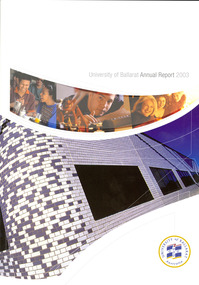
Book, University of Ballarat Annual Report, 2003, 2003
... The contents include: Global Innovation Centre, university of Ballarat Technology Park, David Caro, Kerry Cox, Peter Mathews, Sally Wellard, Frank Hurley, Rosalyn Schute, John Smyth, Colin Bourke, honorary doctorate, Alan Webb, William McGregor, Julian Lowe, John Edwards, International Beer Awards, Camp Street, Miwako Inoue, Ballarat Technology Park, earn as you learn. .3) Financial Statements 2003...The contents include: Global Innovation Centre, university of Ballarat Technology Park, David Caro, Kerry Cox, Peter Mathews, Sally Wellard, Frank Hurley, Rosalyn Schute, John Smyth, Colin Bourke, honorary doctorate, Alan Webb, William McGregor, Julian Lowe, John Edwards, International Beer Awards, Camp Street, Miwako Inoue, Ballarat Technology Park, earn as you learn. .3) Financial Statements 2003 University of Ballarat Annual Report, 2003 Book Book ...White, blue and grey soft covered book. The contents include: Global Innovation Centre, university of Ballarat Technology Park, David Caro, Kerry Cox, Peter Mathews, Sally Wellard, Frank Hurley, Rosalyn Schute, John Smyth, Colin Bourke, honorary doctorate, Alan Webb, William McGregor, Julian Lowe, John Edwards, International Beer Awards, Camp Street, Miwako Inoue, Ballarat Technology Park, earn as you learn. .3) Financial Statements 2003university of ballarat, annual report, david caro, kerry cox, sally wellard, jim burrough, frank hurley, pater mathews, rosalyn schute, colin bourke, w. john smyth, honorary doctorate - alan kenneth webb, william mcgregor, bill mcgregor, national centre for sustainability, international students, bul ayuel bulkoch, lucy caniogo, harmohan singh, thim lai, pernilla honor'e, tom bodey, university of ballarat pipe band, bruce morgan, gillian hehir, trevor hastings, cameron sultie, leigh pyke, peter ocic, rosette arnold, robert hook, john brumby, stan jeffrey, sarah birks, john o'loughlin, leeanne pitman, kim sumner, chris grant -
 Clunes Museum
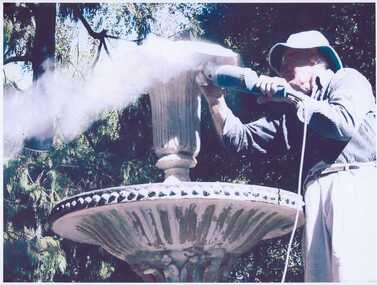
Photograph
... EIGHT COLOURED PHOTOGRAPHS, TOGETHER WITH A LAMINATED REPORT RECOGNISING THE VOLUNTARY RESTORATION WORK OF THE QUEENS PARK FOUNTAIN BY DAVID COLEMAN AND LESLIE CAREY....QUEENS PARK RESTORATION CEREMONY 13TH JULY 2008 local history photography photographs queens park EIGHT COLOURED PHOTOGRAPHS, TOGETHER WITH A LAMINATED REPORT RECOGNISING THE VOLUNTARY RESTORATION WORK OF THE QUEENS PARK FOUNTAIN BY DAVID COLEMAN AND LESLIE CAREY. Photograph PHOTOGRAPH ...QUEENS PARK RESTORATION CEREMONY 13TH JULY 2008EIGHT COLOURED PHOTOGRAPHS, TOGETHER WITH A LAMINATED REPORT RECOGNISING THE VOLUNTARY RESTORATION WORK OF THE QUEENS PARK FOUNTAIN BY DAVID COLEMAN AND LESLIE CAREY.local history, photography, photographs, queens park -
 Melbourne Tram Museum
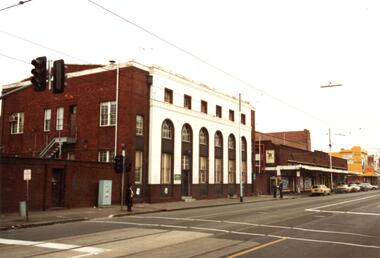
Photograph - Set of 16 Colour Photograph/s, Public Transport Corporation (PTC), May. 1991
... All dated May 1991, unless noted otherwise. .1 - Brunswick depot looking from Sydney Road. .2 - ditto - car parking area adjacent to depot .3 - ditto - from railway line looking at the depot car shed .4 - East Preston depot from the south east. .5 - East Preston depot car park cnr. David St and Plenty Rd. .6 - Building adjacent to the car park, BTR automatic Transmission specialists which was owned by the PTC. .7 - House at 63 David St Preston, assumed owned by the PTC - dated 13-3-1986 .8 - Camberwell depot - car shed. .9 - ditto - entry and office. .10 - Office from the depot side. .11 - Malvern depot - No. 1 shed and office .12 - Malvern depot - No. 2 shed .13 - Coldblo road with tram track .14 - House at 28 Stanhope St which was PTC owned. .15 - rear of above. .16 - Stanhope St tramway hall....1 - .3 -"Brunswick Tram depot May 1991" in ink on the rear. .4 - "East Preston Tram Depot May 1991" .5 - "East Preston depot car park cnr. David St and Plenty Rd. May 1991" .6 - "Factory at 261 - 267 Plenty Rd Preston Tramways owned building" .7 - "63 David St Preston 13-3-86 (1pm) .8 - 10 - "Camberwell Depot May 1991" 11 - 13 "Malvern Depot May 1991" .14 and .15 - 28 Stanhope St Malvern May 1991" .16 - "Stanhope St Hall Malvern May 1991"...Trams tramways Camberwell Depot East Preston Depot Malvern Depot Brunswick Depot Property Stanhope St .1 - .3 -"Brunswick Tram depot May 1991" in ink on the rear. .4 - "East Preston Tram Depot May 1991" .5 - "East Preston depot car park cnr. David St and Plenty Rd. May 1991" .6 - "Factory at 261 - 267 Plenty Rd Preston Tramways owned building" .7 - "63 David St Preston 13-3-86 (1pm) .8 - 10 - "Camberwell Depot May 1991" 11 - 13 "Malvern Depot May 1991" .14 and .15 - 28 Stanhope St Malvern May 1991" .16 - "Stanhope St Hall Malvern May 1991" Set of 16 colour prints of tram depots and/or associated land holdings. ...Set of 16 colour prints of tram depots and/or associated land holdings. All dated May 1991, unless noted otherwise. .1 - Brunswick depot looking from Sydney Road. .2 - ditto - car parking area adjacent to depot .3 - ditto - from railway line looking at the depot car shed .4 - East Preston depot from the south east. .5 - East Preston depot car park cnr. David St and Plenty Rd. .6 - Building adjacent to the car park, BTR automatic Transmission specialists which was owned by the PTC. .7 - House at 63 David St Preston, assumed owned by the PTC - dated 13-3-1986 .8 - Camberwell depot - car shed. .9 - ditto - entry and office. .10 - Office from the depot side. .11 - Malvern depot - No. 1 shed and office .12 - Malvern depot - No. 2 shed .13 - Coldblo road with tram track .14 - House at 28 Stanhope St which was PTC owned. .15 - rear of above. .16 - Stanhope St tramway hall.1 - .3 -"Brunswick Tram depot May 1991" in ink on the rear. .4 - "East Preston Tram Depot May 1991" .5 - "East Preston depot car park cnr. David St and Plenty Rd. May 1991" .6 - "Factory at 261 - 267 Plenty Rd Preston Tramways owned building" .7 - "63 David St Preston 13-3-86 (1pm) .8 - 10 - "Camberwell Depot May 1991" 11 - 13 "Malvern Depot May 1991" .14 and .15 - 28 Stanhope St Malvern May 1991" .16 - "Stanhope St Hall Malvern May 1991"trams, tramways, camberwell depot, east preston depot, malvern depot, brunswick depot, property, stanhope st -
Tatura Irrigation & Wartime Camps Museum
Photograph, Rodney Shire Council 1912-13
... .; Frank Mitchell; W.N. Wilson; David Park; F.J. Camp??; T. Martin (Sec.); W.T.A. ....; Frank Mitchell; W.N. Wilson; David Park; F.J. Camp??; T. Martin (Sec.); W.T.A. ...Rodney Shire Council 1912-13.|Back: ? ; H. S. Davy (Press); D.M. McLennan jnr.; Frank Mitchell; W.N. Wilson; David Park; F.J. Camp??; T. Martin (Sec.); W.T.A. Martin.|Front: John Lilford; J.W. Wilson; R. Stewart; S. Lancaster; R.E. Pogue.|Shire of Rodney|TaturaSepia photo -
 Bendigo Historical Society Inc.
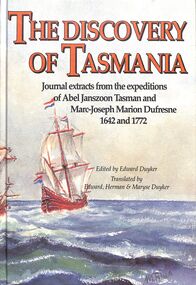
Book - The Discovery of Tasmania, 1992
... Printed and Bound in Tasmania by Tasmanian Government Printing Office, Hobart. St. David's Park Publishing, GPO Box 307C, Hobart, Tasmania, Australia 7001. 1992....Printed and Bound in Tasmania by Tasmanian Government Printing Office, Hobart. St. David's Park Publishing, GPO Box 307C, Hobart, Tasmania, Australia 7001. 1992. ...Journal extracts from the expeditions of Abel Janszoon and Marc-Joseph Marion Dufresne 1642 and 1772. Edited by Edward Duyker. Translated by Edward, Hermit & Maryse Duyker. Hard cover book with 106 pages. Book cover has coloured wrap around watercolour illustration of two sailing ships passing tall cliffs. Cover design by Mary G. Reynolds. Book included black and white maps, photographs and illustrations. Printed and Bound in Tasmania by Tasmanian Government Printing Office, Hobart. St. David's Park Publishing, GPO Box 307C, Hobart, Tasmania, Australia 7001. 1992.Written in ink on Title page. Signature of Donor. 17/7/25 To the Bendigo Historical Society with very best wishes.tasmania, abel tasman, dufresne -
 Melbourne Tram Museum
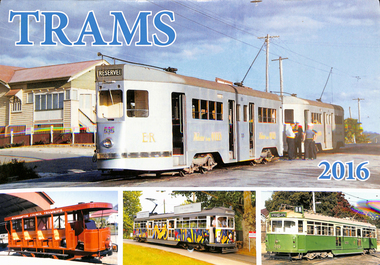
Ephemera - Calendar, Topmill Pty Ltd, "Trams - 2016", 2015
... Photos by Peter Winspur, Maurice Kelly, Arthur Perry, Kym Smith, Archer Park, Ken Smith and David Kirby...Photos by Peter Winspur, Maurice Kelly, Arthur Perry, Kym Smith, Archer Park, Ken Smith and David Kirby "Trams - 2016" Ephemera Calendar Topmill Pty Ltd ...Wall Calendar - heavy card covers, 12 gloss art pages inside, titled "Trams - 2016" containing full colour photographs of Brisbane, Rockhampton, Melbourne, Bendigo, Ballarat, Adelaide, Hobart, Sydney, Valley Heights, Has a punched hole along the top edge to enable wall use. Provides dates for holidays, school holidays and Pension payment days and phases of the moon. Produced by Topmill Pty Ltd and distributed by Gordon & Gotch Pty Ltd. Photos by Peter Winspur, Maurice Kelly, Arthur Perry, Kym Smith, Archer Park, Ken Smith and David Kirbytrams, tramways, ballarat, bendigo, adelaide, sydney, brisbane, rockhampton, hobart, valley heights, tram 40, tram 880, tram 1000, tram 219, tram 14 -
 Ringwood and District Historical Society
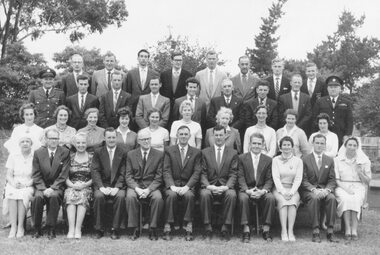
Photograph, Peter Payens, Ringwood Council Staff when Ringwood was declared a city in March, 1960
... City Engr.), Jozsef Benzinger (Supt. Parks & Gdns.), David Wilson (Eng.) and Jeffrey Porter (Eng.). ...City Engr.), Jozsef Benzinger (Supt. Parks & Gdns.), David Wilson (Eng.) and Jeffrey Porter (Eng.). ...Black and White Photograph (2copies) and list of staff names. Catalogue card reads, '1960. Council Staff when Ringwood was declared a city, March 1960'. One copy has stamp of "Peter Payens of Ringwood Studios". Second copy has stamp of Brian Pump. On separate typed sheet: Typed below photograph, "Ringwood City Council Staff - 1960". Typed sheet in sleeve lists the staff in photograph and reads, "Photograph of Town Hall staff taken on the occasion of Ringwood being proclaimed a CITY 1960. Standing (back row left to right) Robert Moore (Rates Office), James Allen (Health Inspt), Robert Glassford (Eng. Asst.), James Rouse (Rates), Howard Tyrell (Dept. City Engr.), Jozsef Benzinger (Supt. Parks & Gdns.), David Wilson (Eng.) and Jeffrey Porter (Eng.). Second Row down, Wally Ross (Traffic Insp), Murray Jones (Eng.), Jim Clerk (Bldg. Insp.), Ernie Dall (Bld. Dept.), Jim Johnson (Rates), Les Steeth (Dog Ranger), Billy Duff (Hall Kpr). Clarrie Burns (Works Supt.), Keith Gore (Ch. Hall Kpr).Second row up from bottom - Marg McAdam (Health Ctre), Gwen Collocott (Rates - Accts. Machinist), Mabs Cleverly (Sec. D.T.C.), June Eyres (Steno), Nancy Gibson (H. Help), Judy Hubbard (Steno), Hazel Lyons (Sec. C/Eng.), Wilhelmina van Wijngaarden, (rates), Sr. Hildebard Weinroider (Health Care), Maureen Charlwood (Telephonist).Bottom row - Sr. Edna Ahlslton (Health Care), Lindsay Ewart (Rate Colltr), Jean Matthews (Sec. T/C.), Vic Faravoni (D.T.C.), Dr. Wm. Hewitt (Med.O.Health), Fred Dwerryhouse (Town Clerk), Alan Robertson (City Eng.), Ray Forde (Con.Eng.), Kit Gurling (typist/engrs.), Des Steele (Bldg.Suryor), Sr. Linda Turnley (Health Centre-H'mont). -
 Eltham District Historical Society Inc
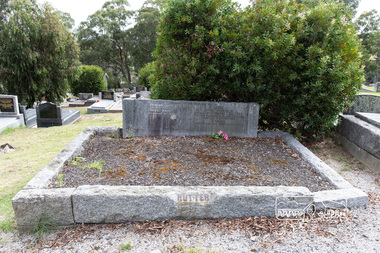
Photograph, Peter Pidgeon, Grave of Beulah Alice Rutter and children, June and Samuel, Eltham Cemetery, Victoria, 5 April 2021
... Tragedy struck the family again December 19, 1940 when daughter June was killed after falling from the Heidelberg train on to an adjacent track into the path of a Reservoir train at Victoria Park station. Sons David and Donald both served in the R.A.A.F. during the Second World War and were killed in action, David in Libya in 1941 and Donald in Germany in 1945. ...Tragedy struck the family again December 19, 1940 when daughter June was killed after falling from the Heidelberg train on to an adjacent track into the path of a Reservoir train at Victoria Park station. Sons David and Donald both served in the R.A.A.F. during the Second World War and were killed in action, David in Libya in 1941 and Donald in Germany in 1945. ...Hubert and Beulah Alice (Simpson) Rutter had five children: Hubert Jnr. (Joe) in 1913, David in 1915, June in 1917, Donald in 1922 and Samuel in 1926. Samuel died as an infant aged 17 days. Hubert was a notable figure in Eltham and beyond, with a career as a mining manager in Australia and Malaya. He served in the AIF in the First World War. While the children were growing up at ‘Yarra Braes’, Eltham, their father was an Eltham Shire Councillor in the 1920s, shire president in 1928 and a leading figure in establishing the Shire of Eltham War Memorial League, which was responsible for building the Shire of Eltham War Memorial tower at Kangaroo Ground, near where the Shire Offices were located until the 1930s. The Rutter name was commemorated after the war at Eltham High School with one of the schoolhouses named ‘Rutter House’ and at Geelong Grammar School until the 1960s where a ‘Rutter Badge’ was awarded to junior boys for leadership. The family home, ‘Yarra Braes’ was destroyed in the devasting Black Friday bushfire, 13 January 1939 and Beulah relocated to Toorak, Hubert working in Western Australia. Tragedy struck the family again December 19, 1940 when daughter June was killed after falling from the Heidelberg train on to an adjacent track into the path of a Reservoir train at Victoria Park station. Sons David and Donald both served in the R.A.A.F. during the Second World War and were killed in action, David in Libya in 1941 and Donald in Germany in 1945. The wreck of his plane and his body were not recovered at the time and Hubert never ceased to chase down leads as to his whereabouts. Beulah never gave up hope that Donald was still alive. Hubert had received several reports shortly after the war that his son was still alive but these were ultimately accepted as misidentification. Such was the anguish of the grieving parents, their son’s plane not found to confirm the fact for certain. Hubert wrote to the Air Force in frustration, failing to understand how the plane could disappear when it crashed in a relatively populated area. Unfortunately the answers came too late for Beulah who died in 1946 and was buried in Eltham Cemetery along with her daughter June and baby Samuel. Donald’s plane was eventually located and his body recovered in 1949. He is buried in the Hanover War Cemetery, Germany. David is commemorated on Column 245, Alamein Memorial, Egypt. Both David and Donald are commemorated on Eltham’s Roll of Honour Board, commissioned by the Eltham War Memorial Trust to be hung in the Baby Health Centre, part of the Eltham War Memorial building precinct. Hubert Senior and Hubert Junior both continued to work in the mining industry in Western Australia. Hubert senior died 1957 at Plantagenet Western Australia and Hubert junior in 1979 at Gascoyne, Western Australia. Sacred to the memory of Beulah AliceBeloved wife of Hubert Rutter Died August 21st 1946 also June Beloved daughter of Beulah and Hubert Rutter Died 19th December 1940 aged 23 years Also her baby brother Samuel Died 7th October 1926, aged 17 daysBorn Digitaleltham cemetery, gravestones, beulah alice rutter, hubert rutter, june rutter, samuel rutter -
 City of Melbourne Libraries
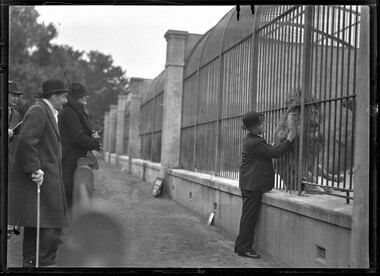
Photograph, Bull, Hugh Jones, 1897-1993, Vice-regal visit to Zoo: Lord Huntingfield greets the King of the Beasts
... Baron von Mueller secured employment at Royal Park for Andrew and David and they helped to lay out the gardens, plant trees and take care of a collection of deer, pheasants, hares and partridges. ...Baron von Mueller secured employment at Royal Park for Andrew and David and they helped to lay out the gardens, plant trees and take care of a collection of deer, pheasants, hares and partridges. ...Photographer notations on slide: "Vice Regal visit to zoo B42" Published: The Age, Tuesday 26 June 1934, page 11. Published title: VICE-ROYALTY GREETS THE KING OF THE BEASTS AT THE ZOO. Published caption: “Lord Huntingfield experienced a pleasant “induction ceremony” as Patron of the Royal Zoological and Acclimatisation Society yesterday, when he made a tour of the Zoological Gardens. The picture shows the Governor, accompanied by Lady Huntingfield, inspecting the King of the Beasts, who is submitting to a little playful treatment from the Director of the Gardens, Mr. Wilkie, while the Director whispers in his ear that a distinguished visitor has come to see him.” Trove article identifier: http://nla.gov.au/nla.news-article204818472 Description: A man wearing a hat and suit strokes a caged lion, observed by a man in a hat, scarf and overcoat who is leaning on a walking stick, and a woman in a hat and coat, holding a handbag. They stand behind a protective rail. Research by project volunteer, Fiona Collyer: Andrew Arthur Wellesley Wilkie, 1853-1948, was Director of the Melbourne Zoo from 1923 to 1936 and was associated with the zoo for 70 years. He first worked as a horticultural assistant to Government botanist Baron Ferdinand von Mueller at the Botanical Gardens at the age of 13, along with his older brother David. One of Andrew’s jobs was to capture moths for the National Herbarium. In 1857, a group of prominent Melburnians assembled at St. Patrick’s Hall to form the Zoological Society of Victoria, with the aim of introducing animals and plants from overseas. It was conceived, “For the purposes of science and for that of affording the public the advantages of studying the habits of the animal creation in properly arranged zoological gardens.” The Victorian Government granted 32 acres (13 hectares) of land to the Zoological Society at the southern end of Richmond Paddock on the opposite bank to the Botanical Gardens. (This is where AAMI Stadium and Collingwood Football Club now stand.) In 1861, the Zoological Society of Victoria was renamed The Acclimatisation Society of Victoria. Unfortunately the Yarra River frontage was damp, swampy and subject to flooding, so the animals were briefly housed at the Botanical Gardens until in 1862, the City of Melbourne donated 55 acres (22 hectares) of land at Royal Park for the fledgling zoo. Baron von Mueller secured employment at Royal Park for Andrew and David and they helped to lay out the gardens, plant trees and take care of a collection of deer, pheasants, hares and partridges. Initially the zoo was used for the acclimatisation of animals recovering from the long voyage to Australia and for breeding them for sport. In 1872, the zoo bought two lions, a leopard and a cheetah that had been seized from circus showmen Keith and Phillips when they were unable to pay the bill of butcher Mr T K Bennet of Bourke Street. The first zoo director, Mr. Albert Le Souef, negotiated with captains of ships to buy animals at overseas ports they visited and soon a multitude of exotic species arrived, including a ten-year-old Indian elephant in 1878. In 1923, after being head keeper for some years, Andrew was appointed director of the zoo. By 1933, the zoo had 110 different species of animals, 200 species of birds and 72 species of reptiles under Andrew’s care. He had personally planted all but six trees and laid out the garden beds. As director he lobbied authorities for funds to build more humane enclosures for the animals. In June 1928, Table Talk magazine wrote of Andrew Wilkie: “Up at the Zoo there is a humble gentleman who is a lion among the lions, who knows the proper specific to employ when the boa constrictor has chilblains, and who is a friend and confidant of Queenie the elephant. His fount of zoological lore has never been plumbed. It is bottomless, like his good fellowship and geniality. Every day he may be seen somewhere in the grounds of that growing sanctuary for the strange and arresting fauna and creeping things of the world, and I assure you as one who is privy to his passion that that area and its inhabitants are rarely out of his thoughts.” Andrew retired from the zoo in 1936 at the age of 83 and in 1948 died at his home in Brunswick aged 94. He and his wife Josephine had six children. Roy, aged 28 in 1934, was a former Wirth’s circus lion who had been left at the zoo at 10 years of age. Andrew visited Roy every day on his rounds and the pair formed a close and affectionate bond. Wireless Weekly magazine in February 1933 reported, “Roy was delighted to see Mr Wilkie, and in a docile manner, approached the bars of his cage and had his head vigorously rubbed by the director, who daily carries out this act of kindness.” As reported in The Herald on 27 October 1936, “Mr Wilkie has also found the old lion docile. He has not shown the animal any particular favouritism, but the lion has shown him a faithfulness that none of the keepers can claim. When Mr Wilkie approaches the bars the lion rolls over and lets the director stroke him and pull his tail. He gets very excited if Mr Wilkie passes without climbing over the protecting rail for a little game.” A 1930 newsreel film shows Andrew stroking Roy’s mane through the bars and the blissed out big cat lying on his back while lifting his chin for a rub. Another newsreel film from the time shows Andrew stroking a lioness and playfully pulling her tail. The Victorian Acclimatisation Society was founded in 1861 by Edward Wilson, 1813-1878, then owner and editor of The Argus newspaper. He said that Australian indigenous animals were practically useless, providing only “a little sport and an occasional meal”. The Society believed that Australia’s plants and animals were vastly inferior to those in Europe. They wanted to introduce and acclimatise to Victoria “all innoxious animals, birds, fishes, insects and vegetables, whether useful or ornamental” for sport and for the table, and to spread indigenous animals and plants from the colony around the world. Their motto was “if it lives, we want it”. The Society was primarily responsible for introducing sparrows, starlings, sambar and hog deer, ostriches, brown trout, blackberries, and carp to the Murray River. They released the European songbirds, thrush and blackbird to quell the homesickness of British settlers. The Society also sent Australian animals like platypus, echidnas, kangaroos and koalas to Europe for scientific and novelty purposes. Thomas Austin, a wealthy sheep farmer of Barwon Park, Winchelsea (property now owned by the National Trust) was a member and in 1859 he introduced hares, blackbirds, thrushes and partridges onto his property. He is probably best known for introducing 24 breeding rabbits onto his estate as game for shooting parties. Thomas quipped, “The introduction of a few rabbits could do little harm and might provide a touch of home, in addition to a spot of hunting." In 2022, genomic data confirmed that Australia’s feral rabbit population is entirely descended from these rabbits. Biological control has brought the rabbit population down from an estimated high of 10 billion rabbits in the 1920s to approximately 200 million today, inhabiting 70% of Australian landmass (5.3 million square kilometres). In 1872, the Acclimatisation Society was renamed The Zoological and Acclimatisation Society of Victoria and they focused on importing exotic animals for display purposes to the zoo. In 1937, the Royal Acclimatisation Society of Victoria was recreated as the Zoological Board of Victoria with a focus on research of native animals threatened with extinction. In an editorial for The Argus newspaper, 16 March 1856, Edward Wilson lamented: "…this country has been shamelessly stolen from the blacks. Had they been like the New Zealanders or the North American Indians, we should have bought their land, and supplied them with the means of living when we took it... In less than twenty years we have nearly swept them off the face of the earth. We have shot them down like dogs. In the guise of friendship we have issued corrosion sublimate in their damper, and consigned whole tribes to the agonies of an excruciating death. We have made them drunkards, and infected them with disease which has rotted the bones of their adults, and made such few children as are born amongst them a sorrow and a torture from the very instant of their birth. We have made them outcasts on their own land, and are rapidly consigning them to entire annihilation. There are but a few of them left, comparatively. This is what we would do for that few. We would feed and clothe every one of them.” [Note: this last sentence is italicized in the original newspaper article text]. Lord Huntingfield, (William Charles Arcedeckne Vanneck) 1883-1969, Governor of Victoria 1934-1939, was a British Conservative Party politician and the first ever Australian-born Governor of an Australian state (although he was always considered British). He was patron of the Royal Zoological and Acclimatisation Society of Victoria and was acting Governor-General for six months during the absence of Lord Gowie in 1938. Lady Huntingfield (née Margaret Eleanor Crosby) 1884-1943, his American-born wife showed great interest in social welfare and the advancement of women and children. She was president of the City Newsboys Society and Patroness of the Girls Friendly Society. In 1937, rose breeder Alister Clark named a yellow hybrid tea rose for her. In 1940, the City of Melbourne opened the Lady Huntingfield Free Kindergarten in North Melbourne, now the Lady Huntingfield Early Learning and Family Services Centre. Lady Huntingfield died in London in 1943 after her house was bombed during a German airstrike. The Lady Huntingfield Memorial Scholarship was established after the City of Melbourne raised £1000 in a public appeal conducted in her memory for students undertaking a Social Work degree at the University of Melbourne. It is awarded annually to this day. The Queen Victoria Hospital named a bed in her honour. References: VICE-ROYALTY GREETS THE KING OF BEASTS AT THE ZOO. (1934, June 26). The Age (Melbourne, Vic. : 1854 - 1954), p. 11. Retrieved August 18, 2024, from http://nla.gov.au/nla.news-article204818472 Prominent Personalities ANDREW WILKIE (1928, June 7). Table Talk (Melbourne, Vic. : 1885 - 1939), p. 15. Retrieved August 29, 2024, from http://nla.gov.au/nla.news-article146562949 'Thomas Austin (pastoralist)', Wikipedia, https://en.wikipedia.org/wiki/Thomas_Austin_(pastoralist) 'Edward Wilson (journalist)', Wikipedia, https://en.wikipedia.org/wiki/Edward_Wilson_(journalist) THE WOMAN'S WORLD (1934, June 26). The Herald (Melbourne, Vic. : 1861 - 1954), p. 14. Retrieved August 19, 2024, from http://nla.gov.au/nla.news-article243164806 MR. WILKIE CAN PULL THE OLD LION'S TAIL (1936, October 27). The Herald (Melbourne, Vic. : 1861 - 1954), p. 4. Retrieved August 18, 2024, from http://nla.gov.au/nla.news-article248551307 Director Of Zoo Will Retire Tomorrow--With White Kitten (1936, December 30). The Herald (Melbourne, Vic. : 1861 - 1954), p. 8. Retrieved August 18, 2024, from http://nla.gov.au/nla.news-article244655203 LIGHT CAR CLUB IN CARICATURE (1931, August 25). The Sun News-Pictorial (Melbourne, Vic. : 1922 - 1954; 1956), p. 24. Retrieved August 19, 2024, from http://nla.gov.au/nla.news-article276250310 'The Acclimatisation Society was driven by misguided ideals about 'fixing nature' in Australia', ABC News, https://www.abc.net.au/news/2022-11-04/acclimatisation-society-introduced-species-history-listen/101588262?utm_source=abc_news_app&utm_medium=content_shared&utm_campaign=abc_news_app&utm_content=safari 'Dr Andrew Wilkie Director Of Melbourne Zoo, With Lion (1930) Video', Pond5 Inc., https://www.pond5.com/stock-footage/item/155691351-dr-andrew-wilkie-director-melbourne-zoo-lion-1930 'Kodak Cinegraph Compilation No 12', ACMI Collection, YouTube.com [Zoo footage at 8.33 minutes, Mr Wilkie at 11.04 minutes], https://www.youtube.com/watch?v=OZZqgSNsP0k THE ABORIGINES. (1856, March 16). The Argus (Melbourne, Vic. : 1848 - 1957), p. 4. Retrieved September 28, 2024, from http://nla.gov.au/nla.news-article4833244Photographer notations on slide: "Vice Regal visit to zoo B42".1930-1939, melbourne zoo, animals, hunting, wildlife, royal park, gardens -
 City of Melbourne Libraries
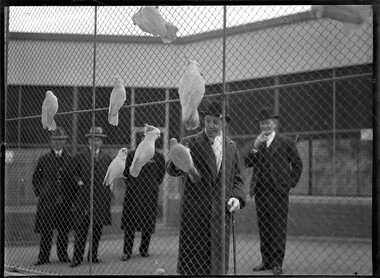
Photograph, Bull, Hugh Jones, 1897-1993, Vice-regal visit to zoo: Governor (Lord Huntingfield) meets the cockatoos
... Baron von Mueller secured employment at Royal Park for Andrew and David and they helped to lay out the gardens, plant trees and take care of a collection of deer, pheasants, hares and partridges. ...Baron von Mueller secured employment at Royal Park for Andrew and David and they helped to lay out the gardens, plant trees and take care of a collection of deer, pheasants, hares and partridges. ...A group of five men dressed in hats and overcoats look at caged cockatoos. Research by project volunteer, Fiona Collyer: On 25 June 1934, new Victorian Governor, His Excellency Lord Huntingfield and his wife Lady Huntingfield made an official visit to the Melbourne Zoological Gardens in order to grant his patronage to the Royal Zoological and Acclimatisation Society. The zoo director, Mr. Andrew Wilkie, introduced them to the cockatoos in the flight aviary. The Argus newspaper reported the visit in the following morning’s issue: "Birds' Greeting To Governor. Visit to Zoological Gardens. "A Very Important Society." "Cheery shouts of "Hullo!" and requests for drinks greeted His Excellency the Governor (Lord Huntingfield) on one of his official visits yesterday morning. Lady Huntingfield, who accompanied him, was asked loudly for a kiss. They were inspecting the huge cockatoo aviary at the Zoological Gardens after Lord Huntingfield had granted his patronage to the Royal Zoological and Acclimatisation Society. Both obviously enjoyed the democratic experience. It was explained to them that most of the cockatoos had been presented by residents of flats, whose neighbours objected to the noise of the birds, while others were protected birds which had been surrendered. Lord Huntingfield recalled that he had taken two Australian cockatoos to England when he left Australia in his youth. One, a galah, had lived in England for many years." In 1929, the Zoo built a commodious new flight aviary at the cost of several thousand pounds and Zoo director, Mr Andrew Wilkie, sent out an appeal published in newspapers Australia-wide for donations of parrots from all states. Many of the parrot species he wanted were protected and a special permit needed for their capture, however Mr Wilkie guaranteed he would obtain authority from the Fisheries and Game Department and that the cost of transit would be borne by the Zoo. The wanted birds were "Parrots - Black-tailed, Rock Pebbler, King, Superb, Grass (all kinds), Swamp or Ground, Mallee or Ringneck" and "Cockatoo[s] - Black, Pink or Major Mitchell, Gang-Gang". The Zoo asked that the birds be sent in boxes large enough to prevent overcrowding, contain food and water and the Zoo notified on the type and number of birds in transit. All boxes were to be addressed to 'The Zoo, Melbourne'. A letter from a reader appeared in the Weekly Times newspaper's popular "Camp-fire Circle" page for "Young Australians", 11 May 1929: "Dear Pal, I am much interested in your page, especially the nature notes. I have a pet parrot, but I don’t like to see it shut up in a cage, so I am giving it to the Melbourne Zoo. It can whistle 'Pretty Joey' and 'What's the Matter with Father' and is just learning to whistle for the dog... Wishing you and the Camp-fire Circle success." - Murray Holmes (Gorae, Vic.) The fate of this talented parrot is unknown, however in 1932, this young naturist, T Murray Holmes, 1912-1947, collected for the first time a type specimen, blue star sun orchid from Gorae (near Portland, Victoria), and it was named in his honour, Thelymitra holmesii. Murray was described by orchid collector W H Nicholls as "a youthful and energetic orchidologist, who added much to our knowledge of the orchids of south-western Victoria." Murray Holmes enlisted in the army in 1941 and fought in the Middle East before being sent to Java. In 1942 he was captured by the Japanese and became a prisoner of war for three years, working on the notorious Thai-Burma railway. Murray's health was undermined though ill treatment and starvation and he returned to Australia after the war, broken and sick. He died aged 35 in 1947. He was intensely interested in the flora and fauna of the Gorae area to the end. Murray's parents received over 200 tributes of respect for their son - too many to answer personally so they put a notice in the Portland Guardian thanking "all kind friends and relatives for letters, cards, floral tributes and personal expressions of sympathy received in their recent sad bereavement - the lamented death of their loved son, Murray." Andrew Arthur Wellesley Wilkie, 1853-1948, was Director of the Melbourne Zoo from 1923 to 1936 and was associated with the zoo for 70 years. He first worked as a horticultural assistant to Government botanist Baron Ferdinand von Mueller at the Botanical Gardens at the age of 13, along with his older brother David. One of Andrew’s jobs was to capture moths for the National Herbarium. In 1857, a group of prominent Melburnians assembled at St. Patrick’s Hall to form the Zoological Society of Victoria, with the aim of introducing animals and plants from overseas. It was conceived, “For the purposes of science and for that of affording the public the advantages of studying the habits of the animal creation in properly arranged zoological gardens.” The Victorian Government granted 32 acres (13 hectares) of land to the Zoological Society at the southern end of Richmond Paddock on the opposite bank to the Botanical Gardens. (This is where AAMI Stadium and Collingwood Football Club now stand.) In 1861, the Zoological Society of Victoria was renamed The Acclimatisation Society of Victoria. Unfortunately the Yarra River frontage was damp, swampy and subject to flooding, so the animals were briefly housed at the Botanical Gardens until in 1862, the City of Melbourne donated 55 acres (22 hectares) of land at Royal Park for the fledgling zoo. Baron von Mueller secured employment at Royal Park for Andrew and David and they helped to lay out the gardens, plant trees and take care of a collection of deer, pheasants, hares and partridges. Initially the zoo was used for the acclimatisation of animals recovering from the long voyage to Australia and for breeding them for sport. In 1872, the zoo bought two lions, a leopard and a cheetah that had been seized from circus showmen Keith and Phillips when they were unable to pay the bill of butcher Mr T K Bennet of Bourke Street. The first zoo director, Mr. Albert Le Souef, negotiated with captains of ships to buy animals at overseas ports they visited and soon a multitude of exotic species arrived, including a ten-year-old Indian elephant in 1878. In 1923, after being head keeper for some years, Andrew was appointed director of the zoo. By 1933, the zoo had 110 different species of animals, 200 species of birds and 72 species of reptiles under Andrew’s care. He had personally planted all but six trees and laid out the garden beds. As director he lobbied authorities for funds to build more humane enclosures for the animals. In June 1928, Table Talk magazine wrote of Andrew Wilkie: “Up at the Zoo there is a humble gentleman who is a lion among the lions, who knows the proper specific to employ when the boa constrictor has chilblains, and who is a friend and confidant of Queenie the elephant. His fount of zoological lore has never been plumbed. It is bottomless, like his good fellowship and geniality. Every day he may be seen somewhere in the grounds of that growing sanctuary for the strange and arresting fauna and creeping things of the world, and I assure you as one who is privy to his passion that that area and its inhabitants are rarely out of his thoughts.” Andrew retired from the zoo in 1936 at the age of 83 and in 1948 died at his home in Brunswick aged 94. He and his wife Josephine had six children. The Victorian Acclimatisation Society was founded in 1861 by Edward Wilson, 1813-1878, then owner and editor of The Argus newspaper. He said that Australian indigenous animals were practically useless, providing only “a little sport and an occasional meal”. The Society believed that Australia’s plants and animals were vastly inferior to those in Europe. They wanted to introduce and acclimatise to Victoria “all innoxious animals, birds, fishes, insects and vegetables, whether useful or ornamental” for sport and for the table, and to spread indigenous animals and plants from the colony around the world. Their motto was “if it lives, we want it”. The Society was primarily responsible for introducing sparrows, starlings, sambar and hog deer, ostriches, brown trout, blackberries, and carp to the Murray River. They released the European songbirds, thrush and blackbird to quell the homesickness of British settlers. The Society also sent Australian animals like platypus, echidnas, kangaroos and koalas to Europe for scientific and novelty purposes. Thomas Austin, a wealthy sheep farmer of Barwon Park, Winchelsea (property now owned by the National Trust) was a member and in 1859 he introduced hares, blackbirds, thrushes and partridges onto his property. He is probably best known for introducing 24 breeding rabbits onto his estate as game for shooting parties. Thomas quipped, “The introduction of a few rabbits could do little harm and might provide a touch of home, in addition to a spot of hunting." In 2022, genomic data confirmed that Australia’s feral rabbit population is entirely descended from these rabbits. Biological control has brought the rabbit population down from an estimated high of 10 billion rabbits in the 1920s to approximately 200 million today, inhabiting 70% of Australian landmass (5.3 million square kilometres). In 1872, the Acclimatisation Society was renamed The Zoological and Acclimatisation Society of Victoria and they focused on importing exotic animals for display purposes to the zoo. In 1937, the Royal Acclimatisation Society of Victoria was recreated as the Zoological Board of Victoria with a focus on research of native animals threatened with extinction. In an editorial for The Argus newspaper, 16 March 1856, Edward Wilson lamented: "...this country has been shamelessly stolen from the blacks. Had they been like the New Zealanders or the North American Indians, we should have bought their land, and supplied them with the means of living when we took it... In less than twenty years we have nearly swept them off the face of the earth. We have shot them down like dogs. In the guise of friendship we have issued corrosion sublimate in their damper, and consigned whole tribes to the agonies of an excruciating death. We have made them drunkards, and infected them with disease which has rotted the bones of their adults, and made such few children as are born amongst them a sorrow and a torture from the very instant of their birth. We have made them outcasts on their own land, and are rapidly consigning them to entire annihilation. There are but a few of them left, comparatively. This is what we would do for that few. We would feed and clothe every one of them.” [Note: this last sentence is italicized in the original newspaper article text]. Lord Huntingfield, (William Charles Arcedeckne Vanneck) 1883-1969, Governor of Victoria 1934-1939, was a British Conservative Party politician and the first ever Australian-born Governor of an Australian state (although he was always considered British). He was patron of the Royal Zoological and Acclimatisation Society of Victoria and was acting Governor-General for six months during the absence of Lord Gowie in 1938. Lady Huntingfield (née Margaret Eleanor Crosby) 1884-1943, his American-born wife showed great interest in social welfare and the advancement of women and children. She was president of the City Newsboys Society and Patroness of the Girls Friendly Society. In 1937, rose breeder Alister Clark named a yellow hybrid tea rose for her. In 1940, the City of Melbourne opened the Lady Huntingfield Free Kindergarten in North Melbourne, now the Lady Huntingfield Early Learning and Family Services Centre. Lady Huntingfield died in London in 1943 after her house was bombed during a German airstrike. The Lady Huntingfield Memorial Scholarship was established after the City of Melbourne raised £1000 in a public appeal conducted in her memory for students undertaking a Social Work degree at the University of Melbourne. It is awarded annually to this day. The Queen Victoria Hospital named a bed in her honour. References: Prominent Personalities ANDREW WILKIE (1928, June 7). Table Talk (Melbourne, Vic. : 1885 - 1939), p. 15. Retrieved August 29, 2024, from http://nla.gov.au/nla.news-article146562949 BIRDS' GREETING TO GOVERNOR (1934, June 26). The Argus (Melbourne, Vic. : 1848 - 1957), p. 6. Retrieved August 19, 2024, from http://nla.gov.au/nla.news-article10950051 Zoo Appealing For Parrots And Cockatoos To Fill Aviary For Children’s Instruction (1929, April 11). The Sun News-Pictorial (Melbourne, Vic. : 1922 - 1954; 1956), p. 31. Retrieved August 23, 2024, from http://nla.gov.au/nla.news-article275757361 LETTERS FROM READERS (1929, May 11). Weekly Times (Melbourne, Vic. : 1869 - 1954), p. 50. Retrieved October 6, 2024, from http://nla.gov.au/nla.news-article223183144 Correspondence. (1929, April 18). Corryong Courier (Vic. : 1894 - 1945), p. 6. Retrieved August 30, 2024, from http://nla.gov.au/nla.news-article269039262 'Edward Wilson (journalist)', Wikipedia, https://en.wikipedia.org/wiki/Edward_Wilson_(journalist) 'Thomas Austin (pastoralist)', Wikipedia, https://en.wikipedia.org/wiki/Thomas_Austin_(pastoralist) 'The Acclimatisation Society was driven by misguided ideals about 'fixing nature' in Australia', ABC News, https://www.abc.net.au/news/2022-11-04/acclimatisation-society-introduced-species-history-listen/101588262? utm_source=abc_news_app&utm_medium=content_shared&utm_campaign=abc_news_app&utm_content=safari Touching Canine Devotion. (1942, September 21). Portland Guardian (Vic. : 1876 - 1953), p. 1 (EVENING). Retrieved October 6, 2024, from http://nla.gov.au/nla.news-article64381989 OBITUARY (1947, August 11). Portland Guardian (Vic. : 1876 - 1953), p. 2 (EVENING). Retrieved August 26, 2024, from http://nla.gov.au/nla.news-article64412155 Family Notices (1947, September 11). Portland Guardian (Vic. : 1876 - 1953), p. 2 (EVENING). Retrieved October 10, 2024, from http://nla.gov.au/nla.news-article64412476 'Thelymitra holmesii', Wikipedia, https://en.wikipedia.org/wiki/Thelymitra_holmesii THE ABORIGINES. (1856, March 16). The Argus (Melbourne, Vic. : 1848 - 1957), p. 4. Retrieved September 28, 2024, from http://nla.gov.au/nla.news-article4833244Photographer notations on slide: "Vice Regal visit to zoo B42".zoos, governors, 1930-1939, cockatoos -
 City of Melbourne Libraries
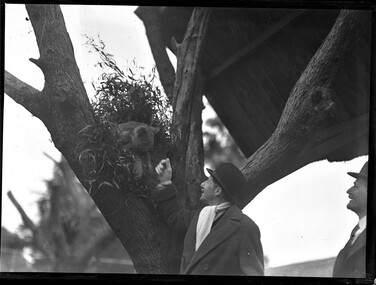
Photograph, Bull, Hugh Jones, 1897-1993, Vice-regal visit to zoo: Governor (Lord Huntingfield) and koala
... Baron von Mueller secured employment at Royal Park for Andrew and David and they helped to lay out the gardens, plant trees and take care of a collection of deer, pheasants, hares and partridges. ...Baron von Mueller secured employment at Royal Park for Andrew and David and they helped to lay out the gardens, plant trees and take care of a collection of deer, pheasants, hares and partridges. ...Published: (1934, June 26). The Age (Melbourne, Vic. : 1854 - 1954), p. 11. Published title: VICE-ROYALTY GREETS THE KING OF THE BEASTS AT THE ZOO. Published caption: Lord Huntingfield experienced a pleasant “induction ceremony” as Patron of the Royal Zoological and Acclimatisation Society yesterday, when he made a tour of the Zoological Gardens. The picture shows the Governor, accompanied by Lady Huntingfield, inspecting the King of Beasts, who is submitting to a little playful treatment from the Director of the Gardens, Mr. Wilkie, while the Director whispers in his ear that a distinguished visitor has come to see him. (Inset), is a picture of Lord Huntingfield greeting one of the Koalas. Trove article identifier: http://nla.gov.au/nla.news-article204818472 Description: A man wearing a hat, scarf and overcoat reaches up to pat a koala in a tree watched by a man in a hat and suit. Research by project volunteer, Fiona Collyer: In 1932, the Zoo built an Australian native animal enclosure which visitors could enter and closely view koalas, wallabies, kookaburras and magpies all placed together. The branches of the trees in the enclosure were cut so that visitors could easily see and feed the koalas sitting in them. The cost to feed each koala fresh gum leaves was fifteen shillings per week. By 1924, Queensland was the last stronghold in Australia for the koala. They were functionally extinct in South Australia, only a few hundred in NSW, and an estimated population of 1000 animals remained in Victoria. There had been a six-month open season on koalas in Queensland in 1919 where over a million had been slaughtered, however with its vast, dense forests it was impossible to accurately know their numbers. Koala fur is tough, warm and waterproof and was in high demand from consumers in Canada, Britain and the US to make hats and gloves and for lining greatcoats. In 1927, with Queensland suffering a crippling drought and high unemployment, the cash-strapped McCormack Labor Government declared an “Open Season” on koalas and “opossums” for their skins, for the month of August. (Possums were often called “opossums” at this time but they are actually possums). There were widespread protests from many groups including the Nature Lovers League, Wild Life Preservation Society of Australia, Queensland Museum, C.W.A. Royal Australian Ornithologist Union, Boy Scouts, religious and women’s groups. There were letters to newspapers from ordinary people, editorials and pleas to women to refuse to wear or purchase koala fur. People questioned the masculinity of koala hunters as it was felt that no proper bushman or sportsman would kill such a defenceless creature. The Brisbane Courier newspaper led the campaign, devoting six columns a day to “Spare the Bear”. Author Vance Palmer sent an impassioned letter to the editor of the The Brisbane Courier, 19 July 1927: “Sir- It is be hoped that the disgust which all humane people have felt at the declaration of an open season for native bears in August will not be allowed to fade away until some protest... so overwhelming and effective that the question will never be raised again. For the shooting of our harmless and loveable native bear is nothing less than barbarous. His case is entirely different from that of other furred animals. No one has ever accused him of spoiling the farmers’ wheat, eating the squatters’ grass or even spreading the prickly pear. There is not a social vice that can be put down to his account. In addition, he is comparatively defenceless. He affords no sport to the gunman, and can be trusted to present a sitting target to the creature mean enough to aim at him. For this reason he has been almost blotted out already from some areas, in days when our fauna and flora were held in such little regard that the settlers’ first instinct was to shoot every strange animal and to sink his axe into every unfamiliar tree.” The Anglican Archbishop of Brisbane, Gerald Sharp, had his letter published in The Brisbane Courier on 16 July 1927: “Sir... The extermination of fauna so distinctive of our country, especially of such harmless and pretty creatures as our native bears, seems to me a shameful thing, and this is likely to mean their extermination.” But it was all to no avail. Known as “Black August”, the government was unmoved by the public’s outrage. 10,000 licences were issued to hunters and “the slaughter of the innocents” went ahead. The newspapers were full of stories of dreadful cruelty against the helpless, benign creatures by the heartless hunters who not only used guns and spotlights but wire snares and cyanide baits so that pelts wouldn’t be damaged. Infant koalas were left orphaned and unlikely to survive without their mothers. Top quality pelts were sold at an average price of 56 shillings and 9 pence per dozen, poor quality skins for as little as 2 1/2 pence each. In December 1927, the Minister for Agriculture and Stock, Mr W. Forgan Smith told the Parliament that during the August open season 597,985 koala pelts worth £139,595 had netted the state’s coffers £6000. 952,194 “opossum” pelts were sold and £9000 made for the State. The backlash that followed helped topple the Queensland Labor Government in 1929. The Wild Life Preservation Society of Australia lobbied the Prime Minister Mr Stanley Bruce to refuse to issue exportation permits for koala pelts and from 10 November 1927 the Commonwealth Government suspended the issuing of permits. In 1930, the Society made a direct appeal to USA President Herbert Hoover and he signed an order prohibiting the importation of koala and wombat fur to USA, eliminating a major market. Koala pelts were often deliberately mislabelled “wombat” to get around restrictions. The ban most likely saved the koala from probable extinction. Three years later the Australian Federal Government banned the export of koala products. This movement against koala killing was really the first conservation campaign in Australia. It raised awareness of the vulnerability of a beloved animal and eventually brought about national parks and national laws for their protection. By 1936, community opposition to possum open seasons was beginning. The koala was made a Protected Species in all states in 1937, meaning no one is allowed to harm a koala, however the laws protecting the gum trees they rely on for food and shelter are weak. The Australian Government estimates the wild koala population in Australia is between 225,000 and 500,000 in 2024. The Australian Koala Foundation estimates the national population at less than 60,000 in 2021 with a 30% decline in three years. Habitat loss from land clearing, dog attacks, road deaths, chlamydia, bushfires and drought exacerbated by climate change, continues to cause their decline. Over eight million koalas were killed for their pelts between 1888 and 1927. Any one of the annual harvests killed more koalas than are alive now. At this time, children were also being taught to appreciate Australian native animals. In 1933, “Blinky Bill: The Quaint Little Australian” book for children was published by Angus and Robertson. It was written and illustrated by New Zealand-born author Dorothy Wall and “Dedicated to my son Peter and all other Peters and Johns and Bobs and Toms and Marys and Bettys and Joans and Pats and all kind children.” The book tells the story of Blinky Bill - a mischievous, patched knickerbocker-wearing koala and his mother and father. The story has messages of conservation and instances of human unkindness and cruelty. Mr. and Mrs. Koala and young Blinky lead a mostly idyllic family life amongst a variety of other animals in the forest. However it all changes in chapter two, when Blinky Bill’s father is distressingly shot by a hunter. There is a harrowing description of Mr. Koala’s shooting and eventual death. “The Koala family lived so happily; never thinking of harm, or that anything could happen to disturb their little home, as all they asked for were plenty of fresh gum-leaves and the warm sun. They had no idea such things as guns were in the world or that a human being had a heart so cruel that he would take a pleasure in seeing a poor little body riddled with bullets hanging helplessly from the tree-top... That same being might just as well take his gun and shoot baby kookaburras, so helpless were they all and so trusting.” “Poor Mr. Koala one day was curled up asleep in his favourite corner, when the terrible thing happened. Bang! He opened his eyes in wonder. What was that? Did the limb of the tree snap where that young cub of his was skylarking? ... bang! again. This time he felt a stinging pain in his leg... Peering over the bough of the tree he saw a man on the ground with something long and black in his arms... Another bang and his ear began to hurt. Bang! again and now his little body was stinging all over. He grunted loudly and slowly climbed up the tree, calling Mrs. Koala and Blinky as he went. He managed to reach the topmost branch... Tears were pouring down his poor little face. He brushed them away with his front paws and cried just like a baby. Fortunately Mrs. Koala and Blinky Bill were hiding in the leaves quite motionless, and the shadows of the tree made them appear as part of it. The man with the gun stood and waited a long time, then walked away, whistling as he went - the only sound to be heard in the bush except the cries of the little bear far up in the tree.” Blinky and his mother quietly and fearfully wait for Mr. Koala to wake. In the morning, grunting and crying, they feel his lifeless body with their paws. Eventually Mrs. Koala realises that her husband is dead and that they need to move to a safe place. After travelling deeper into the forest, Mrs. Koala and Blinky meet koalas Mrs. Grunty and her son Snubby and she describes how she was captured as a baby by koala fur trappers to be a pet for a little girl. The trapper forgot to bring gum leaves for the koala so they try to feed her cake, milk and bananas, making her sick. The little girl’s father relays something he read in the paper: “During the year 1920 to 1921, two hundred and five thousand six hundred and seventy-nine koalas were killed and their skins sold to the fur market, under the name of wombat.” They place the koala in a box with a teddy bear for company. The baby koala’s health deteriorates and the alarmed trapper returns her to the bush. Mrs. Grunty tells Mrs. Koala that she and Blinky are the only bears that she has seen for ten years: “I remember well the little girl’s father telling her... that not so many years ago the bush was alive with us bears, from Queensland to the south of Victoria. Now, we are so rare that we have become a curiosity, something to put in zoos, for children to see; and actually in museums. I believe our grandparents sit there in glass cases, stuffed with something inside to make them appear alive, and, oh dear, glass eyes. In New South Wales, I think we could wander for miles from one corner to another and never meet a bear. I don’t know why we were all killed. As you know, we don’t eat the farmers’ crop or ruin their orchards. All we asked for were our own gum-trees.” At the end of the book, Dorothy tells her readers - “The kindest action of all would be to leave the koala baby in his own bushland, among his own playmates, with the sun, the sky, the birds, and the gum-trees, where he will grow to manhood and live for many years - happy as he should be.” In 1934, a “Wild Zoo”, the Sir Colin Mackenzie Sanctuary, opened on 32 hectares of land, formerly part of Coranderrk Aboriginal Reserve in the Yarra Valley, exclusively displaying Australian native animals, birds and reptiles. It was later renamed Healesville Sanctuary and is now managed by Melbourne Zoo and home to over 200 species of Australian native fauna. The Sanctuary is committed to rescuing, breeding, researching and raising awareness of the vulnerability of Australian animals. Andrew Arthur Wellesley Wilkie, 1853-1948, was Director of the Melbourne Zoo from 1923 to 1936 and was associated with the zoo for 70 years. He first worked as a horticultural assistant to Government botanist Baron Ferdinand von Mueller at the Botanical Gardens at the age of 13, along with his older brother David. One of Andrew’s jobs was to capture moths for the National Herbarium. In 1857, a group of prominent Melburnians assembled at St. Patrick’s Hall to form the Zoological Society of Victoria, with the aim of introducing animals and plants from overseas. It was conceived, “For the purposes of science and for that of affording the public the advantages of studying the habits of the animal creation in properly arranged zoological gardens.” The Victorian Government granted 32 acres (13 hectares) of land to the Zoological Society at the southern end of Richmond Paddock on the opposite bank to the Botanical Gardens. (This is where AAMI Stadium and Collingwood Football Club now stand.) In 1861, the Zoological Society of Victoria was renamed The Acclimatisation Society of Victoria. Unfortunately the Yarra River frontage was damp, swampy and subject to flooding, so the animals were briefly housed at the Botanical Gardens until in 1862, the City of Melbourne donated 55 acres (22 hectares) of land at Royal Park for the fledgling zoo. Baron von Mueller secured employment at Royal Park for Andrew and David and they helped to lay out the gardens, plant trees and take care of a collection of deer, pheasants, hares and partridges. Initially the zoo was used for the acclimatisation of animals recovering from the long voyage to Australia and for breeding them for sport. In 1872, the zoo bought two lions, a leopard and a cheetah that had been seized from circus showmen Keith and Phillips when they were unable to pay the bill of butcher Mr T K Bennet of Bourke Street. The first zoo director, Mr. Albert Le Souef, negotiated with captains of ships to buy animals at overseas ports they visited and soon a multitude of exotic species arrived, including a ten-year-old Indian elephant in 1878. In 1923, after being head keeper for some years, Andrew was appointed director of the zoo. By 1933, the zoo had 110 different species of animals, 200 species of birds and 72 species of reptiles under Andrew’s care. He had personally planted all but six trees and laid out the garden beds. As director he lobbied authorities for funds to build more humane enclosures for the animals. In June 1928, Table Talk magazine wrote of Andrew Wilkie: “Up at the Zoo there is a humble gentleman who is a lion among the lions, who knows the proper specific to employ when the boa constrictor has chilblains, and who is a friend and confidant of Queenie the elephant. His fount of zoological lore has never been plumbed. It is bottomless, like his good fellowship and geniality. Every day he may be seen somewhere in the grounds of that growing sanctuary for the strange and arresting fauna and creeping things of the world, and I assure you as one who is privy to his passion that that area and its inhabitants are rarely out of his thoughts.” Andrew retired from the zoo in 1936 at the age of 83 and in 1948 died at his home in Brunswick aged 94. He and his wife Josephine had six children. The Victorian Acclimatisation Society was founded in 1861 by Edward Wilson, 1813-1878, then owner and editor of The Argus newspaper. He said that Australian indigenous animals were practically useless, providing only “a little sport and an occasional meal”. The Society believed that Australia’s plants and animals were vastly inferior to those in Europe. They wanted to introduce and acclimatise to Victoria “all innoxious animals, birds, fishes, insects and vegetables, whether useful or ornamental” for sport and for the table, and to spread indigenous animals and plants from the colony around the world. Their motto was “if it lives, we want it”. The Society was primarily responsible for introducing sparrows, starlings, sambar and hog deer, ostriches, brown trout, blackberries, and carp to the Murray River. They released the European songbirds, thrush and blackbird to quell the homesickness of British settlers. The Society also sent Australian animals like platypus, echidnas, kangaroos and koalas to Europe for scientific and novelty purposes. Thomas Austin, a wealthy sheep farmer of Barwon Park, Winchelsea (property now owned by the National Trust) was a member and in 1859 he introduced hares, blackbirds, thrushes and partridges onto his property. He is probably best known for introducing 24 breeding rabbits onto his estate as game for shooting parties. Thomas quipped, “The introduction of a few rabbits could do little harm and might provide a touch of home, in addition to a spot of hunting." In 2022, genomic data confirmed that Australia’s feral rabbit population is entirely descended from these rabbits. Biological control has brought the rabbit population down from an estimated high of 10 billion rabbits in the 1920s to approximately 200 million today, inhabiting 70% of Australian landmass (5.3 million square kilometres). In 1872, the Acclimatisation Society was renamed The Zoological and Acclimatisation Society of Victoria and they focused on importing exotic animals for display purposes to the zoo. In 1937, the Royal Acclimatisation Society of Victoria was recreated as the Zoological Board of Victoria with a focus on research of native animals threatened with extinction. In an editorial for The Argus newspaper, 16 March 1856, Edward Wilson lamented: "...this country has been shamelessly stolen from the blacks. Had they been like the New Zealanders or the North American Indians, we should have bought their land, and supplied them with the means of living when we took it... In less than twenty years we have nearly swept them off the face of the earth. We have shot them down like dogs. In the guise of friendship we have issued corrosion sublimate in their damper, and consigned whole tribes to the agonies of an excruciating death. We have made them drunkards, and infected them with disease which has rotted the bones of their adults, and made such few children as are born amongst them a sorrow and a torture from the very instant of their birth. We have made them outcasts on their own land, and are rapidly consigning them to entire annihilation. There are but a few of them left, comparatively. This is what we would do for that few. We would feed and clothe every one of them.” [Note: this last sentence is italicized in the original newspaper article text]. Lord Huntingfield, (William Charles Arcedeckne Vanneck) 1883-1969, Governor of Victoria 1934-1939, was a British Conservative Party politician and the first ever Australian-born Governor of an Australian state (although he was always considered British). He was patron of the Royal Zoological and Acclimatisation Society of Victoria and was acting Governor-General for six months during the absence of Lord Gowie in 1938. Lady Huntingfield (née Margaret Eleanor Crosby) 1884-1943, his American-born wife showed great interest in social welfare and the advancement of women and children. She was president of the City Newsboys Society and Patroness of the Girls Friendly Society. In 1937, rose breeder Alister Clark named a yellow hybrid tea rose for her. In 1940, the City of Melbourne opened the Lady Huntingfield Free Kindergarten in North Melbourne, now the Lady Huntingfield Early Learning and Family Services Centre. Lady Huntingfield died in London in 1943 after her house was bombed during a German airstrike. The Lady Huntingfield Memorial Scholarship was established after the City of Melbourne raised £1000 in a public appeal conducted in her memory for students undertaking a Social Work degree at the University of Melbourne. It is awarded annually to this day. The Queen Victoria Hospital named a bed in her honour. References: VICE-ROYALTY GREETS THE KING OF BEASTS AT THE ZOO. (1934, June 26). The Age (Melbourne, Vic. : 1854 - 1954), p. 11. Retrieved August 23, 2024, from http://nla.gov.au/nla.news-article204818472 Prominent Personalities ANDREW WILKIE (1928, June 7). Table Talk (Melbourne, Vic. : 1885 - 1939), p. 15. Retrieved August 29, 2024, from http://nla.gov.au/nla.news-article146562949 'Edward Wilson (journalist)', Wikipedia, https://en.wikipedia.org/wiki/Edward_Wilson_(journalist) 'Thomas Austin (pastoralist)', Wikipedia, https://en.wikipedia.org/wiki/Thomas_Austin_(pastoralist) 'The Acclimatisation Society was driven by misguided ideals about 'fixing nature' in Australia', ABC News, https://www.abc.net.au/news/2022-11-04/acclimatisation-society-introduced-species-history-listen/101588262?utm_campaign=abc_news_web&utm_content=link&utm_medium=content_shared&utm_source=abc_news_web Blinky Bill: the quaint little Australian (eBook); by Dorothy Wall, 1933, 2023, Project Gutenberg Australia, https://gutenberg.net.au/ebooks04/0400571h.html "Black August": Queensland's Open Season on koalas in 1927 (thesis); Glenn Fowler, 1993, Australian National University, https://www.savethekoala.com/wp-content/uploads/2018/11/Black-August.pdf Unfair game: Queensland's Open Season on koalas in 1927; Jacqui Donegan, 2000, University of Queensland, https://mesto-ku.narod.ru/koalas.pdf OPEN SEASON CONDEMNED. (1927, July 19). The Brisbane Courier (Qld. : 1864 - 1933), p. 15. Retrieved September 5, 2024, from http://nla.gov.au/nla.news-article21863465 COUNTRY WOMEN'S ASSOCIATION. (1927, July 30). The Brisbane Courier (Qld. : 1864 - 1933), p. 25. Retrieved September 20, 2024, from http://nla.gov.au/nla.news-article21866965 AUSTRALIA: Barnardo's children at Melbourne Park Zoo (1929), British Pathé, YouTube, https://www.youtube.com/watch?v=_Wcrbo_cHpI 'Kodak Cinegraph Compilation No 8', ACMI Collection, https://www.youtube.com/watch?v=MCrBng5RwFI KOALA SKINS. EXPORT BAN SOUGHT. (1927, August 4). The Brisbane Courier (Qld. : 1864 - 1933), p. 10. Retrieved September 15, 2024, from http://nla.gov.au/nla.news-article21868746 THE ABORIGINES. (1856, March 16). The Argus (Melbourne, Vic. : 1848 - 1957), p. 5. Retrieved September 28, 2024, from http://nla.gov.au/nla.news-article4833244 Koala Bears (1937), British Pathé, YouTube, https://www.youtube.com/watch?v=XbqgMtyuzwE Australian Koala Bear (Earliest Archive Footage: 1929), Pond5, https://www.pond5.com/stock-footage/item/152767491-australian-koala-bear-earliest-archive-footage-1929Photographer notations on slide: "Vice Regal visit to zoo B42".1930-1939, zoos, governors, koalas, conservation, possums, botanic gardens -
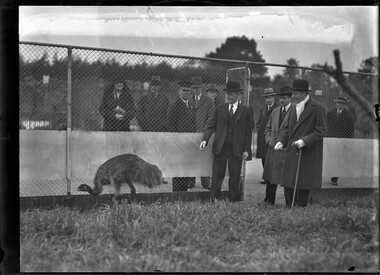 City of Melbourne Libraries
Photograph, Bull, Hugh Jones, 1897-1993, Vice-regal visit to zoo: Lord Huntingfield meets an emu
... Baron von Mueller secured employment at Royal Park for Andrew and David and they helped to lay out the gardens, plant trees and take care of a collection of deer, pheasants, hares and partridges. ...Baron von Mueller secured employment at Royal Park for Andrew and David and they helped to lay out the gardens, plant trees and take care of a collection of deer, pheasants, hares and partridges. ...Photographer notations on slide: "Vice Regal visit to Zoo B42" Not published. Description: A group of men and one woman all dressed in hats and overcoats stand by a wire fence while watching an emu. Research by project volunteer, Fiona Collyer: On 25 June 1934, new Victorian Governor, His Excellency Lord Huntingfield and his wife Lady Huntingfield made an official visit to the Melbourne Zoological Gardens in order to grant his patronage to the Royal Zoological and Acclimatisation Society. During the visit, zoo director Mr. Andrew Wilkie introduced them to some of the zoo’s inhabitants, including an emu. After the First World War, many returned soldiers took up the Government’s offer of land in the Soldier Settlement Scheme. Most of the veterans had little or no farming experience and much of the land offered was of poor quality, with blocks often too small to be viable. Many of the settlers had ongoing physical and mental injuries from the war. The Western Australian government allocated land to 5000 former soldiers but by 1929, one quarter of the men had already abandoned their land, unable to make a living. Not only was the world economy struggling with the Great Depression, but the settlers also had to contend with plummeting wheat and wool prices, crippling drought and rabbit infestation. The Scullin Government (Oct 1929-Jan 1932) had promised subsidies to the Western Australian farmers if they increased their wheat crops but were unable to pass the legislation in the Senate. The new Lyons Government (Jan 1932-April 1939) abandoned the legislation and the subsidies were never paid, bringing calls from Western Australia of secession from Australia. In October 1932, a deputation of soldier settlers from the Campion wheatbelt region in Western Australia, petitioned Commonwealth Minister for Defence, Western Australian Senator Sir George Pearce, for assistance. A mob of 20,000 emus were migrating to the coast after breeding and were gathering along the eastern side of the Number 1 Rabbit Proof Fence, attracted to the ripening crops and the dams the farmers had built. They were heading towards Campion, 303 kilometres east of Perth, eating and trampling the wheat, destroying the fences and letting the rabbits in. Having witnessed firsthand the effectiveness of machine guns in killing people in war, the former soldiers thought the guns would be ideal for killing emus. Sir George, wanting to demonstrate that his government was sympathetic to the settlers and hoping to quell Western Australian succession talk, agreed. However, he stipulated that no expense would be incurred by the Commonwealth Government and only active military personnel could use the machine guns. The farmers had to pay for the ammunition, food and accommodation for the military for the length of the operation. The cost for the ammunition was £50 for 10,000 rounds. Sir George also felt the operation would provide excellent target practice for the soldiers! The operation was headed by Major Gwynydd Purves Wynn-Aubrey Meredith, 1887-1975, of the Seventh Heavy Battery of the Royal Australian Artillery, and assisted by Sergeant S. McMurray and Gunner J. O'Halloran. They were equipped with two American-designed Lewis light machine guns and 10,000 rounds. Each magazine held 47 rounds of ammunition and the gun was capable of firing 500 to 600 rounds per minute with effective firing range of 800 metres. A cinematographer from British Movietone News accompanied the soldiers in order to record what was expected to be not only an easy victory but also useful propaganda for both the military and the Lyons Government. Emu (Dromaius novaehollandiae, meaning New Holland Racer) is a species of long-necked flightless bird endemic to Australia. The Tasmanian and the dwarf King and Kangaroo Island subspecies were hunted to extinction after the European settlement of Australia. It is the second largest bird in the world after the ostrich, standing up to 1.9 metres tall and weighing up to 50 kilograms. The Emu has long, powerful legs with three forward facing toes and is the only bird with calf muscles. It is able to jump 2.1 metres into the air and run 50 kilometres per hour. It communicates by drumming and booming through an inflatable neck sac which can be heard up to two kilometres away. Along with its tough hide and a body more feathers than flesh, the emu can be a tricky target. Emus had been a protected native species until 1922, when the government changed their status to “vermin” in response to the emus breaking down fences and destroying crops. Major Meredith told the press that Colonel Oswald V. Hoad of the 1st Cavalry Division NSW had especially requested he send 100 emu skins to replenish the plumage on his Light Horsemen’s hat tops. On the first day of the Emu War, 2 November 1932, Major Meredith spotted a mob of emus out of range of the guns, so he asked the farmers to use their vehicles to drive the emus towards the fence and the guns. The panicked birds split into small groups, kicking up the dust and scattering every which way. Only six were killed, though some were wounded. After that, the emus became very wary of humans. On 4 November, Major Meredith staged a dawn ambush at a dam. As 1000 emus approached to drink, the soldiers opened fire, killing 12 emus. After reloading, the gun jammed and the emus dispersed in all directions, and were not sighted again that day. The West Australian newspaper reported on 4 November 1932 that, “The emus have proved that they are not so stupid as they are usually considered to be. Each mob has its leader, always an enormous black-plumed bird standing fully six-feet high, who keeps watch while his fellows busy themselves with the wheat. At the first suspicious sign, he gives the signal, and dozens of heads stretch up out of the crop. A few birds will take fright, starting a headlong stampede for the scrub, the leader always remaining until his followers have reached safety.” In a later attempt, they mounted a gun onto the bed of a truck in order to chase and mow down the birds. However the truck couldn’t drive fast enough over the rough terrain and it was too bumpy to fire the gun accurately. The birds easily outran the truck except for one hapless emu who faltered while being chased and fell under the truck, its body wedging in the steering gear, causing the driver to crash the truck, and bringing down half a chain of the rabbit proof fence. RSPCA inspector Mr. Arthur Austin arrived with a rifle and knife in order to finish the work of the Lewis guns and dispatch injured emus. He said that while his society was sympathetic to the stricken settlers, he was anxious that wounded birds should not be left to suffer. Major Meredith told the inspector, “What speed can you run? You have to be better than Peter Pan if you want to catch wounded emus that make for the scrub.” (Racehorse “Peter Pan” had won the 1932 Melbourne Cup a few weeks earlier.) The commentator of the British Movietime newsreel uses a jocular tone to optimistically proclaim, “The scouts [emus] of the advancing army have keen eyesight, and in order to get close to the main body, our lads have to do some real stalking, with the enemy watching events through their periscopes raised up over the heads of corn... Instead of the birds ruining the farmers, tables are turned, there will be no more damage down here for many a day to come once the enemy is eliminated.” Emus proved tougher adversaries than expected, barely breaking stride even when badly injured from machine gun bullets, and the suspicious emus soon learnt to stay out of range of the men and their guns. Meanwhile, in the eastern states concern was being expressed about the cruelty of machine-gunning the native birds. Senator James Guthrie UAP of Victoria suggested that there must be “more humane, if less spectacular methods” of coping with the pests. People wrote letters to the newspapers to express their dismay at the inhumane methods used. R.F. Bellchambers from Humbug Scrub, 25 November 1932, lamented that, “At the present rate of extinctions, it will shortly be necessary to go to the Museum to see the remains of our fauna.” The Murchison Times published a letter on 16 November 1932 from “Clay Pan Joe”: “War on Emus. Slaughter of innocent birds would be more appropriate... The birds may be a nuisance and it may be necessary to destroy them, but why cause so much suffering amongst these innocent birds.” E.S. Playford of Norton’s Summit wrote to The Advertiser, 22 November 1932, that “...habitation on the earth would be impossible without bird life. Therefore, it is unwise to say that any bird is useless. Is sentiment dying? Are we so keen on personal gain that our lovely and unique birds have to be ruthlessly slaughtered in thousands and their bodies left rotting in the sun?” In Sydney, picture palace patrons expressed “considerable concern” after viewing the Movietone News newsreel of emus fleeing from the barrage of machine-guns, and wounded emus in the fields in Campion. The press had a field day, dubbing it the “The Emu War” and joking that the “Chicago method” was being used against the feathered foe. The Daily News newspaper published a cartoon depicting the emus outrunning and outsmarting the soldiers. In Parliament NSW Senator James Dunn called Sir George the “Minister for the Emu War”. Labor member Mr. Rosevear, midst great laughter, asked if the minister would consider declaring an armistice and withdrawing his troops from the Western Front. Prime Minister Joe Lyons was asked if medals would be struck for those taking part in the war. Labor parliamentarian Mr. A.E. Green declared any medals should go to the emus who had “won every round so far”. With the embarrassing press coverage and poor results, Sir George ordered a stop to the project on 9 November, and Major Meredith and the soldiers departed for Perth. The WA Premier Sir James Mitchell and the Campion farmers demanded they return, citing the continued destruction of crops and fences by the emus. Major Meredith and his two gunners were allowed to return on 13 November and seemingly having learnt from their previous experiences, had slightly more success this time killing emus. The operation finally finished on 10 December with Major Meredith reporting “definite kills” of 986 emus for 9860 rounds of ammunition, coincidentally and conveniently exactly 10% of the number of rounds used. A further 2500 birds were said to have died from their injuries and although this is a disputed figure, even if accurate, the ratio of rounds expended to emu casualties was thought too high to justify continuing. The operation barely caused a dint in the marauding mob of 20,000 emus. “There’s only one way to kill an emu”, one of the party bitterly remarked: “Shoot him through the back of the head when his mouth is closed or through the front of his mouth when his mouth is open. That’s how hard it is.” Australian ornithologist Dominic L. Serventy noted that “The machine-gunners’ dreams of point blank fire into serried masses of Emus were soon dissipated. The Emu command had evidently ordered guerrilla tactics, and its unwieldy army soon split up into innumerable small units that made use of the military equipment uneconomic. A crestfallen field force therefore withdrew from the combat area after about a month.” Major Meredith expressed the greatest of respect for the enemy. He said, “If we had a military division with the bullet-carrying capacity of these birds, it would face any army in the world. They could face machine guns with the invulnerability of tanks. They are like Zulus, whom even dum dum bullets would not stop." The Major’s official report stated that there were no human casualties in “The Emu War.” Emus are considered the victors of “The Great Emu War.” Western Australian farmers requested military assistance in 1934, 1943 and 1948, including using bombs, but the government refused. The bounty system instigated in 1923 continued, with farmers using rifles against their fleet-footed foe, with 57,034 bounties for dead emus claimed in six months in 1934 in Western Australia alone. 284,704 emus were killed in Western Australia between 1945 and 1960. The other most effective defence against the emus was the construction of a robust, vermin proof fence spanning over a long distance. Emus were formally protected in 1999 by the Environment Protection and Biodiversity Conservation Act. It’s estimated there are between 625,000 to 725,000 wild emus in Australia in 2024. An emu and a kangaroo feature on Australia’s coat of arms, holding up a shield illustrated with symbols of the six states. The animals symbolise the nation moving forward as neither animal can walk backwards. Campion is now a ghost town. A book about the operation, “Letters from the Emu War” by J.A. Bryden was published in 2023 by Playtime Books. In 2024, an Australian film called “The Emu War” was released, starring Damian Callinan and Luke McGregor. Andrew Arthur Wellesley Wilkie, 1853-1948, was Director of the Melbourne Zoo from 1923 to 1936 and was associated with the zoo for 70 years. He first worked as a horticultural assistant to Government botanist Baron Ferdinand von Mueller at the Botanical Gardens at the age of 13, along with his older brother David. One of Andrew’s jobs was to capture moths for the National Herbarium. In 1857, a group of prominent Melburnians assembled at St. Patrick’s Hall to form the Zoological Society of Victoria, with the aim of introducing animals and plants from overseas. It was conceived, “For the purposes of science and for that of affording the public the advantages of studying the habits of the animal creation in properly arranged zoological gardens.” The Victorian Government granted 32 acres (13 hectares) of land to the Zoological Society at the southern end of Richmond Paddock on the opposite bank to the Botanical Gardens. (This is where AAMI Stadium and Collingwood Football Club now stand.) In 1861, the Zoological Society of Victoria was renamed The Acclimatisation Society of Victoria. Unfortunately the Yarra River frontage was damp, swampy and subject to flooding, so the animals were briefly housed at the Botanical Gardens until in 1862, the City of Melbourne donated 55 acres (22 hectares) of land at Royal Park for the fledgling zoo. Baron von Mueller secured employment at Royal Park for Andrew and David and they helped to lay out the gardens, plant trees and take care of a collection of deer, pheasants, hares and partridges. Initially the zoo was used for the acclimatisation of animals recovering from the long voyage to Australia and for breeding them for sport. In 1872, the zoo bought two lions, a leopard and a cheetah that had been seized from circus showmen Keith and Phillips when they were unable to pay the bill of butcher Mr T K Bennet of Bourke Street. The first zoo director, Mr. Albert Le Souef, negotiated with captains of ships to buy animals at overseas ports they visited and soon a multitude of exotic species arrived, including a ten-year-old Indian elephant in 1878. In 1923, after being head keeper for some years, Andrew was appointed director of the zoo. By 1933, the zoo had 110 different species of animals, 200 species of birds and 72 species of reptiles under Andrew’s care. He had personally planted all but six trees and laid out the garden beds. As director he lobbied authorities for funds to build more humane enclosures for the animals. In June 1928, Table Talk magazine wrote of Andrew Wilkie: “Up at the Zoo there is a humble gentleman who is a lion among the lions, who knows the proper specific to employ when the boa constrictor has chilblains, and who is a friend and confidant of Queenie the elephant. His fount of zoological lore has never been plumbed. It is bottomless, like his good fellowship and geniality. Every day he may be seen somewhere in the grounds of that growing sanctuary for the strange and arresting fauna and creeping things of the world, and I assure you as one who is privy to his passion that that area and its inhabitants are rarely out of his thoughts.” Andrew retired from the zoo in 1936 at the age of 83 and in 1948 died at his home in Brunswick aged 94. He and his wife Josephine had six children. The Victorian Acclimatisation Society was founded in 1861 by Edward Wilson, 1813-1878, then owner and editor of The Argus newspaper. He said that Australian indigenous animals were practically useless, providing only “a little sport and an occasional meal”. The Society believed that Australia’s plants and animals were vastly inferior to those in Europe. They wanted to introduce and acclimatise to Victoria “all innoxious animals, birds, fishes, insects and vegetables, whether useful or ornamental” for sport and for the table, and to spread indigenous animals and plants from the colony around the world. Their motto was “if it lives, we want it”. The Society was primarily responsible for introducing sparrows, starlings, sambar and hog deer, ostriches, brown trout, blackberries, and carp to the Murray River. They released the European songbirds, thrush and blackbird to quell the homesickness of British settlers. The Society also sent Australian animals like platypus, echidnas, kangaroos and koalas to Europe for scientific and novelty purposes. Thomas Austin, a wealthy sheep farmer of Barwon Park, Winchelsea (property now owned by the National Trust) was a member and in 1859 he introduced hares, blackbirds, thrushes and partridges onto his property. He is probably best known for introducing 24 breeding rabbits onto his estate as game for shooting parties. Thomas quipped, “The introduction of a few rabbits could do little harm and might provide a touch of home, in addition to a spot of hunting." In 2022, genomic data confirmed that Australia’s feral rabbit population is entirely descended from these rabbits. Biological control has brought the rabbit population down from an estimated high of 10 billion rabbits in the 1920s to approximately 200 million today, inhabiting 70% of Australian landmass (5.3 million square kilometres). In 1872, the Acclimatisation Society was renamed The Zoological and Acclimatisation Society of Victoria and they focused on importing exotic animals for display purposes to the zoo. In 1937, the Royal Acclimatisation Society of Victoria was recreated as the Zoological Board of Victoria with a focus on research of native animals threatened with extinction. In an editorial for The Argus newspaper, 16 March 1856, Edward Wilson lamented: "...this country has been shamelessly stolen from the blacks. Had they been like the New Zealanders or the North American Indians, we should have bought their land, and supplied them with the means of living when we took it... In less than twenty years we have nearly swept them off the face of the earth. We have shot them down like dogs. In the guise of friendship we have issued corrosion sublimate in their damper, and consigned whole tribes to the agonies of an excruciating death. We have made them drunkards, and infected them with disease which has rotted the bones of their adults, and made such few children as are born amongst them a sorrow and a torture from the very instant of their birth. We have made them outcasts on their own land, and are rapidly consigning them to entire annihilation. There are but a few of them left, comparatively. This is what we would do for that few. We would feed and clothe every one of them.” [Note: this last sentence is italicized in the original newspaper article text]. Lord Huntingfield, (William Charles Arcedeckne Vanneck) 1883-1969, Governor of Victoria 1934-1939, was a British Conservative Party politician and the first ever Australian-born Governor of an Australian state (although he was always considered British). He was patron of the Royal Zoological and Acclimatisation Society of Victoria and was acting Governor-General for six months during the absence of Lord Gowie in 1938. Lady Huntingfield (née Margaret Eleanor Crosby) 1884-1943, his American-born wife showed great interest in social welfare and the advancement of women and children. She was president of the City Newsboys Society and Patroness of the Girls Friendly Society. In 1937, rose breeder Alister Clark named a yellow hybrid tea rose for her. In 1940, the City of Melbourne opened the Lady Huntingfield Free Kindergarten in North Melbourne, now the Lady Huntingfield Early Learning and Family Services Centre. Lady Huntingfield died in London in 1943 after her house was bombed during a German airstrike. The Lady Huntingfield Memorial Scholarship was established after the City of Melbourne raised £1000 in a public appeal conducted in her memory for students undertaking a Social Work degree at the University of Melbourne. It is awarded annually to this day. The Queen Victoria Hospital named a bed in her honour. References: VICE-ROYALTY GREETS THE KING OF BEASTS AT THE ZOO. (1934, June 26). The Age (Melbourne, Vic. : 1854 - 1954), p. 11. Retrieved August 23, 2024, from http://nla.gov.au/nla.news-article204818472 Prominent Personalities ANDREW WILKIE (1928, June 7). Table Talk (Melbourne, Vic. : 1885 - 1939), p. 15. Retrieved August 29, 2024, from http://nla.gov.au/nla.news-article146562949 'Edward Wilson (journalist)', Wikipedia, https://en.wikipedia.org/wiki/Edward_Wilson_(journalist) 'Thomas Austin (pastoralist)', Wikipedia, https://en.wikipedia.org/wiki/Thomas_Austin_(pastoralist) 'The Acclimatisation Society was driven by misguided ideals about 'fixing nature' in Australia', ABC News, https://www.abc.net.au/news/2022-11-04/acclimatisation-society-introduced-species-history-listen/101588262?utm_campaign=abc_news_web&utm_content=link&utm_medium=content_shared&utm_source=abc_news_web THE ABORIGINES. (1856, March 16). The Argus (Melbourne, Vic. : 1848 - 1957), p. 5. Retrieved September 28, 2024, from http://nla.gov.au/nla.news-article4833244 WAR ON EMUS. (1932, November 4). The West Australian (Perth, WA : 1879 - 1954), p. 12. Retrieved September 29, 2024, from http://nla.gov.au/nla.news-article32588972 'The Great Emu War: how it started and who won', ABC Australia, https://www.youtube.com/watch?v=Y1wA0PKeJqc Advertising (1932, November 25). The West Australian (Perth, WA : 1879 - 1954), p. 2. Retrieved October 26, 2024, from http://nla.gov.au/nla.news-article32584578 Emu Chasers Must Outstrip Peter Pan (1932, November 9). The Labor Daily (Sydney, NSW : 1924 - 1938), p. 5. Retrieved October 10, 2024, from http://nla.gov.au/nla.news-article237042749 WAR ON EMUS (1932, November 22). The Advertiser (Adelaide, SA : 1931 - 1954), p. 18. Retrieved October 15, 2024, from http://nla.gov.au/nla.news-article73997254 WAR ON EMUS. (1932, October 28). The Labor Daily (Sydney, NSW : 1924 - 1938), p. 6. Retrieved October 24, 2024, from http://nla.gov.au/nla.news-article237046601 EMU WAR (1932, December 3). Mirror (Perth, WA : 1921 - 1956), p. 7. Retrieved October 24, 2024, from http://nla.gov.au/nla.news-article75626301 Machine Gun Offensive Against Emus. (1932, November 10). Western Mail (Perth, WA : 1885 - 1954), p. 3 (PICTORIAL SECTION). Retrieved October 24, 2024, from http://nla.gov.au/nla.news-article37766670 A THOUSAND BIRDS IN LUCK. (1932, November 10). Western Mail (Perth, WA : 1885 - 1954), p. 28. Retrieved October 11, 2024, from http://nla.gov.au/nla.news-article37766849 New Strategy In A War On The Emu (1953, July 5). The Sunday Herald (Sydney, NSW : 1949 - 1953), p. 13. Retrieved October 11, 2024, from http://nla.gov.au/nla.news-article18516559 This is a nice emu-that was! (1932, November 5). The Daily News (Perth, WA : 1882 - 1955), p. 9 (HOME EDITION). Retrieved September 30, 2024, from http://nla.gov.au/nla.news-article82878309 LOCAL AND GENERAL (1932, November 16). The Murchison Times (Cue, WA : 1924 - 1937), p. 2. Retrieved October 14, 2024, from http://nla.gov.au/nla.news-article257500260 Taking Him for a Ride! (1932, October 13). The Daily News (Perth, WA : 1882 - 1955), p. 6 (HOME EDITION). Retrieved September 30, 2024, from http://nla.gov.au/nla.news-article83717338 'The Emu War', History Nuggets, https://historynuggets.squarespace.com/nuggets/2018/4/21/the-emu-war New Strategy In A War On The Emu (1953, July 5). The Sunday Herald (Sydney, NSW : 1949 - 1953), p. 13. Retrieved October 23, 2024, from http://nla.gov.au/nla.news-article18516559 'This is the story of how Australia went to war with emus and lost', First Dog on the Moon, https://www.theguardian.com/commentisfree/2018/jul/26/this-is-the-story-of-how-australia-went-to-war-with-emus-and-lost Photographer notations on slide: "Vice Regal visit to Zoo B42"emu wars, governors, melbourne zoo, city of melbourne, 1930-1939, hunting, lord huntingfield, lady huntingfield, royal park, animals, wildlife -
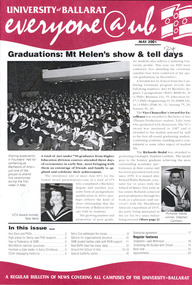 Federation University Historical Collection
Magazine - Booklet, University of Ballarat, Everyone@UB, 2001
... Redundancy, video conferencing Images: Steve Matthews, Craig Holloway, Peter Pilven, Sneha Kirubakaran, Phil Honeywood, Kerry Cox, David Manterfield, Martin Westbrooke, Ram Karan, Barry Jones, Gael Ramsay, Jenny Hargave, Heather Hatfield. .16) Jeff Kennett, Honorary Doctorate, Technology Park, Mary Atkinson, Ian Wright, Internet, Disability Action Plan, Robert Munt obituary, Sandra Stepcich obituary, Virginia Fenwlon, East Timor, Centre for Environmental Management, Wayne Jolly, 130th anniversary, Craig Hurley, Barry Wemyss, John Murray, Tori Power, Grant Curnow. ...Redundancy, video conferencing Images: Steve Matthews, Craig Holloway, Peter Pilven, Sneha Kirubakaran, Phil Honeywood, Kerry Cox, David Manterfield, Martin Westbrooke, Ram Karan, Barry Jones, Gael Ramsay, Jenny Hargave, Heather Hatfield. .16) Jeff Kennett, Honorary Doctorate, Technology Park, Mary Atkinson, Ian Wright, Internet, Disability Action Plan, Robert Munt obituary, Sandra Stepcich obituary, Virginia Fenwlon, East Timor, Centre for Environmental Management, Wayne Jolly, 130th anniversary, Craig Hurley, Barry Wemyss, John Murray, Tori Power, Grant Curnow. ...The University of Ballarat in 1998 comprised the Mt Helen Campus, SMB (Ballarat School of Mines) Campus and the Horsham Campus. It's current name is Federation University Australia. In 1998 Everyone@UB was a monthly staff newsletter edited by Peter Baird in consultation with Don Moconachie.A series of monthly bulletins covering all University of Ballarat campuses. .1) University merger, John Bailey, Michael Adermann, Vice-Chancellor, Jenny Nemeth, Katherine Birkin, Rowena Coutts, Ballarat Technology Park, Ron Wild .2) Chancellor appointment, Chancellor retirement, Geoffrey Blainey tribute, David Caro, Katherine Birkin, Arno Besse, George Murdoch, Bullarook, Stephen Kemmus, Neville French, ceramics, Tristan Smith, Horsham, Arnhem Land film, Ararat, Kerry Cox, anorexia, salary packages, University of Ballarat Brass Band, Natalie Radomski, becoming a university. Images: Geoffrey Blainey, David Caro, David James, Katherine Birkin, Arno Besse, George Murdoch, Geoffrey Blainey, Stephen Kemmis, Neville French, John Ackland, Richard Jardine, Glen Auld, Dennis Arne, Andrew Kotsonis, Kerry Cox, Suzanne McLaren, Marcia Pope, Rosemary Green, Leonie Otago, Natalie Rodomski .5) October 1998 - Carolyn Taylor, misogyny, Horsham campus building under construction, David Caro, Miranda Kerr, Martin Westbrook, Iain Reid, virtual monitors, teaching practice, Joanne Knight, John Pidgeon, Sally Buckland, arsenic, Ian Rae, Bob Allan, Patricia Cartwright, Matthew Baker, Sundru Sivamalai, Janine Smith, Pat Mann, International Student Market Research, Steve Mennen, Copyright, internet to the outback, Charters Towers, Engineering students, Darryl Dyason, Andrew McDougall, Dianne Jacono, Ross Morgan, Keith Boast, Cranbrook Academy of Art (Detroit), Helmut Stenzel, Mt Helen vegetation, Jan Bedggood, Ann-Maree Haintz, Kathleen Lakey, Adrienne Ryan, Fiona Schmidt. .11) Phil Candy, flexible learning, strategic planning. .12) diving, Reconciliation, Learning City, Student residence, Alex Rubinov, Graduate Centre, Ceramics, horse, Wimmera, tree regeneration, student poverty, UB museum, David Manterfeild, Heather Hatfeild. Redundancy, video conferencing Images: Steve Matthews, Craig Holloway, Peter Pilven, Sneha Kirubakaran, Phil Honeywood, Kerry Cox, David Manterfield, Martin Westbrooke, Ram Karan, Barry Jones, Gael Ramsay, Jenny Hargave, Heather Hatfield. .16) Jeff Kennett, Honorary Doctorate, Technology Park, Mary Atkinson, Ian Wright, Internet, Disability Action Plan, Robert Munt obituary, Sandra Stepcich obituary, Virginia Fenwlon, East Timor, Centre for Environmental Management, Wayne Jolly, 130th anniversary, Craig Hurley, Barry Wemyss, John Murray, Tori Power, Grant Curnow. Images: Vivienne Witwer, Claire Hetherington, Ian Wright, Virginia Fenelin .17) Broadband, AARNet, David James Retirement, wetlands, Debbie Eagles, Centre for Rural and Regional Health, numeracy, nursing, Sue Turale, Max Palmer, Camp Street, Arts Academy, library, SMB scholarship, Landcare, Mallee pipeline, Verna Barry, Alice Mills, Marian Brown, .18) Fiji, Texans, Greenhill, Robert Whitson, Ian Clark, Abororiginal history, Yuille St, Peter Baird, Martin Westrbrook, Robert Allen, Arts Academy, John McGrath, Phil Ruglen, 3BBB, John Ferrier .21) Beverley. Lassiter, Vice-ChAncellor appointment, Kerry Cox, Craig Hurley, Barry Wemyss, Ceramics, Bill Pryor, University Games, Olympics, Broken Hill, Alex Rubinov, Jonathan Halls, Dare to be different, Wayne Muir, Student Union Refit. Images: Wayne Muir, Alex Ruminov, Kerry Cox .22) December 2000 - nursing, David James, Phil Candy, John McLean, Debbie Eagles, brewery, brewing, Meredith Sussex, Lyn Faneco, TAFE,Joy Nunn, ARC, mosaics, Timor, Alfredo Pires, Centre for Rural and Regional Health, diabetes, kangaroos, Murray-Darling, Leagher Homestead, David Welch, Joy Nunn, Jill Blee, Maryanne Coutts, positive discrimination, Theresa Saunders, Imelda Crebbin .23) March 2001 - Nancy Lange, Paul Lambeth, Yvonne Button, Don Pennell, Natalie Radomski, Marcia Pope, McKinnon Walker, Marc Brodie, TAFE, WorldSkills, Horticulture, Ararat, Website, library, Leeanne Pitman, Liz Hartmann, nursing, Miranda Walker, Ciaran Pier, Anxiety Disorders, volcano, brewing, beer, Peter Aldred, Rob Greig, Jeremy Smith, Alice Mills, Geoff Burgess, .24) May 2001 - Graduations, Talia Venn, Stephen Carthew, Honory Doctorate, Steve Monaghetti, Heather Moore, Brendan O'Brien, Bill Pryr, Terry O'Brien, Carole Wilson, Carolyn Taylor, rape law reform, Federation at the Ballarat School of Mines, Work Skills, Debbie Eagles, Sue Purtle, Longerenong, Mohair, Early Childhood, Horsham, Kerry Cox, Willy Hobbs, David Firth, Kim Durban, BAPA, maryanne Coutts, Ewen McDonald, butterflys, Fukuoaka INstitute of Technology, Jane Wilkinson .25) Wayne Robinson, Neil McAdam retirement, Anne Beggs Sunter, nursing, Eileen Sellers, Hannelore Best, international nursing, Francis Adams, copyright, Roy Taylor, Wendy Bolger, unplugged, Horsham, Robert Irvine, Horsham graduations, Anxiety Clinic, Carole Wilson, Heart Mat, University of Ballarat Mission, Diabetes, Emelia Martinez-Brawley. Images include Wayne Robinson, Anne Beggs Sunter, Eileen Sellers, Hannelore Best, Phil Candy. Meg Tasker, Roy Taylor, Wendy Bolger, Robert Irvine, Angus McLachlan, Roger Castleman, Stephen Roberts, Philip Smith, Bob Allen, Rob Greig, Dennis Jeandet, Carole Wilson, Doug Lloyduniversity of ballarat, ballarat school of mines, wetland, broadband, david janes, smb, kennett, leadership, eagles, centre for rural and regional health, microwave, turale, arts academy, camp street, library, landcare, mallee, mallee pipeline, barry, verna barry, mills, brown, palmer, caro, geoffrey blainey, blainey, birkin, besse, kemmis, adermann, ackland, jardine, auld, mclaren, pope, green, otago, radomski, honorary doctorate, munt, stepcich, wemyss, rubinov, muir, everyone@ub, robinson, horsham, stawell, ararat, fukuoaka, taylor, moneghetti, coutt, hatfeild, westbrooke, karan, bailey, james, nemeth, wild, de bono, texas, sharpam, fiji, clark, ruyg, kropp, sugget, baird, allen, westbrook, rural health, stacpoole, mcgrath, ruglen, ferrier, manterfield, pilven, michael adermann, tafe, mount helen vegetation, dennis arne -
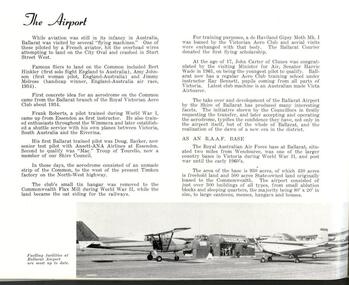 Federation University Historical Collection
Book, Shire of Ballarat, 1963, 1963
... park...ballarat high school...wendouree west state school...ewing house...ballarat grammar school...ballarat teachers' college...learmonth presbyterian church...st mathew's wendouree...st mary's redemptorist monastery...norm doodt...pre-mixed concrete...wendouree bowls club...ballarat shire councillors...rex hollioake...david...ballarat shire shire of ballarat c.e. brown learmonth sire hall gold memorial miners rest reticulated water australian timken ballarat airport joe white maltings franklin caravans kirk's reservoir white swan reservoir electricity lucas unilever australia ballarat gas company coronet caravans lindsay gunn martin stoneware w. r. walton m.b. john ballarat agricultural and pastoral society planning scheme webcona estate brown's heavy haulage ballarat mental hospital alfredton pre-school centre wendouree recreaton reserve wendouree pre-school wendouree youth club corporation saleyards arch of victory lake burrumbeet perry park ballarat high school wendouree west state school ewing house ballarat grammar school ballarat teachers' college learmonth presbyterian church st mathew's wendouree st mary's redemptorist monastery norm doodt pre-mixed concrete wendouree bowls club ballarat shire councillors rex hollioake david baird thomas ford william troup wilfred hirst charles brown charles giot william walton david powell john pemberton hugh patterson alexander mcdonald edward edwards james mitchell White covered book with multiple images. ...White covered book with multiple images.ballarat shire, shire of ballarat, c.e. brown, learmonth sire hall, gold memorial, miners rest reticulated water, australian timken, ballarat airport, joe white maltings, franklin caravans, kirk's reservoir, white swan reservoir, electricity, lucas, unilever australia, ballarat gas company, coronet caravans, lindsay gunn, martin stoneware, w. r. walton, m.b. john, ballarat agricultural and pastoral society, planning scheme, webcona estate, brown's heavy haulage, ballarat mental hospital, alfredton pre-school centre, wendouree recreaton reserve, wendouree pre-school, wendouree youth club, corporation saleyards, arch of victory, lake burrumbeet, perry park, ballarat high school, wendouree west state school, ewing house, ballarat grammar school, ballarat teachers' college, learmonth presbyterian church, st mathew's wendouree, st mary's redemptorist monastery, norm doodt, pre-mixed concrete, wendouree bowls club, ballarat shire councillors, rex hollioake, david baird, thomas ford, william troup, wilfred hirst, charles brown, charles giot, william walton, david powell, john pemberton, hugh patterson, alexander mcdonald, edward edwards, james mitchell -
 Federation University Historical Collection
Book, University of Ballarat Annual Report, 1998, 1998
... Contents include: David Caro, Geoffrey Blainey, Ararat Campus, Horsham Campus, Stawell Campus, David James, Multi-sector, multi-campus, industry partnership, Ballarat Technology Park, Aboriginal Education Centre....Contents include: David Caro, Geoffrey Blainey, Ararat Campus, Horsham Campus, Stawell Campus, David James, Multi-sector, multi-campus, industry partnership, Ballarat Technology Park, Aboriginal Education Centre. ...The university of Ballarat is a precedessor institution of Federation University Australia.Multicoloured soft covered book of 56 pages. Contents include: David Caro, Geoffrey Blainey, Ararat Campus, Horsham Campus, Stawell Campus, David James, Multi-sector, multi-campus, industry partnership, Ballarat Technology Park, Aboriginal Education Centre.university of ballarat, multi-sector university, university of ballarat establishment, ballarat academy of performing arts, bapa, viosh, david caro, geoffrey blainey, david james -
 Federation University Historical Collection
Book, University of Ballarat Annual Report, 2008, 2008
... Contents include: Timeline, merger between University of Ballarat and the Ballarat School of Mines, David Battersby, Jacinta Allan, Robert R. T. Smith, 2020 Vision and Agenda, Peter Gell, IBM, Technology Park, Geoffrey Blainey, Karen Douglas, John Brumby, Graduation Procession, David Waldron, Robyn Brandenburg, beer awards, Victoria Mitchell, VIOSH 30th anniversary, Fadi Charcher, Colin Trembath, Ballarat Railway Station, Shelley Nash, James Coglan. ...Contents include: Timeline, merger between University of Ballarat and the Ballarat School of Mines, David Battersby, Jacinta Allan, Robert R. T. Smith, 2020 Vision and Agenda, Peter Gell, IBM, Technology Park, Geoffrey Blainey, Karen Douglas, John Brumby, Graduation Procession, David Waldron, Robyn Brandenburg, beer awards, Victoria Mitchell, VIOSH 30th anniversary, Fadi Charcher, Colin Trembath, Ballarat Railway Station, Shelley Nash, James Coglan. ...Black soft covered book. Contents include: Timeline, merger between University of Ballarat and the Ballarat School of Mines, David Battersby, Jacinta Allan, Robert R. T. Smith, 2020 Vision and Agenda, Peter Gell, IBM, Technology Park, Geoffrey Blainey, Karen Douglas, John Brumby, Graduation Procession, David Waldron, Robyn Brandenburg, beer awards, Victoria Mitchell, VIOSH 30th anniversary, Fadi Charcher, Colin Trembath, Ballarat Railway Station, Shelley Nash, James Coglan. Ballarat Foundation, Sandra Herbert, Horsham, possum skin cloak. university of ballarat, ballarat school of mines, battersby, david battersby, jacinta allan, university of ballarat timeline, robert h.t. smith, geoffrey blainey, karen douglas, academic procession, john brumby, australasian international beer awards, david waldron, robyn brandenberg, colin trembath, shelley nash, sandra herbert, possum skin cloak diana nikkelson, kelly barrett, bianca nikkelson -
 Federation University Historical Collection
Book, University of Ballarat Annual Report, 2010, 2010
... Barker Library refurbishment, Ashley Toth, Golden Key, Indigenous Education, William Harvey, Robyn Brandenburg, Diane Clinging, David Gao, Bronwyn Blaiklock, UB Technology Park, ...Barker Library refurbishment, Ashley Toth, Golden Key, Indigenous Education, William Harvey, Robyn Brandenburg, Diane Clinging, David Gao, Bronwyn Blaiklock, UB Technology Park, University of Ballarat Annual Report, 2010 Book Book ...In 2010 the University of Ballarat celebrated 140 years of technical education on 26 October.Blue and white soft covered book featuring an image of three men and a woman. Contents include: David Battersby, Catherine King, Robert Hook, Jannine Bennett, Clare Gervasoni, Geoffrey Blainey, Robert H. T. Smith, charter, honorary doctorate Wai Man-Woo, David Suzuki, beer awards, Equine Centre, Science and Engineering Building, Aboriginal Education Centre, E. J. Barker Library refurbishment, Ashley Toth, Golden Key, Indigenous Education, William Harvey, Robyn Brandenburg, Diane Clinging, David Gao, Bronwyn Blaiklock, UB Technology Park, university of ballarat, ballarat school of mines, annual report, 2010, anniversary, 140th anniversary, david battersby, catherine king, robert h.t. smith, ted lovett, shirley morgan, tim stares, e.j. barker library refurbishment, geoffrey blainey research centre, geoffrey blainey research centre opening, geoffrey blaing, e.j. barker, ashley toth, tom gleeson, graeme hood, bronwyn blaiklock, robyn brandenberg, diane clingin -
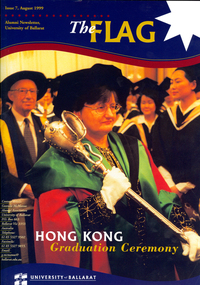 Federation University Historical Collection
Magazine - Newsletter, The Flag, 1995-2001, 1995-2001
... Sandy Blythe, Geoffrey Blainey,Jamie Shaw, Kiran Mazumdar, Stuart Pursell, Tony Singh, Ballarat Teachers' College, Frank Nolan, Carolyn Blackman. .4) David James, Malini Chitaranjan, Chandker Varadhan, Lola Montez, Regina Molloy, Bert Labont'e, Jayne Reynolds, Amanda Sandwith, Roger Short, Stephen Kemmis, Barney Glover, Thomas O'Donnell, Sandy Blythe, Laurier Prosser, John Sharpham, Jack Barker, Xiaoli Jiang, Catherine Pearce, Nepal, Ballarat Teachers' College, John Culvenor, Richards Medal, Karl McCann. .5) Gwenda McManus, David James, Ron Wild, Merger, Wimmera Institute of TAFE, Katherine Birkin. .6) David Caro, Chancellor appointment, David James, Ellen Sellers, Ballarat Teachers' College Reunion, Briana Folkes, Lorri Coburn, Paul O'Donohue, Graeme Kelly, Tracy Plunkett, Julie Kellett, Unisports rehabilitation, Hong Kong graduation, China, koalas. .7) Hong Kong graduation, David Janes, Argentina, Richard Alder, threatened animals, reconciliation, Leoda Atkinson, mural, Jodie Lowe, indigenous Australians, Sue Turale, nursing, Hong Kong, Geoffrey Richards, Janice Edwards, Laura Chibnall, Franky Christiano, Nessa Jenkins, Kerrie Powell. .8) David James, Graduate Centre, Greenhill Enterprise Centre, Warren Young, Parks Victoria, Maxitrans, netball, John Magrath, maths, Catering for the Olympics, Eddie Turker, Maryanne Coutts, Sonia Colville, Daryl Wisely, Laura Wakeling. .9) Camp Street Redevelopment, Arts Academy, David James, Gwenda McManus, Doug Lloyd, Ian Gordon, University Appeal, Hong Kong, Sue Turale, Edward Wong, Hakodate University, Paris, nursing, Malaysia, Yuri Tanabe, Amanda Mead, Mary Modeen, Barry Judd. .10) Kerry Cox, Gwenda McManus, wildlife, MartinWestbrooke Brian McLennan Art Scholarship. ...Sandy Blythe, Geoffrey Blainey,Jamie Shaw, Kiran Mazumdar, Stuart Pursell, Tony Singh, Ballarat Teachers' College, Frank Nolan, Carolyn Blackman. .4) David James, Malini Chitaranjan, Chandker Varadhan, Lola Montez, Regina Molloy, Bert Labont'e, Jayne Reynolds, Amanda Sandwith, Roger Short, Stephen Kemmis, Barney Glover, Thomas O'Donnell, Sandy Blythe, Laurier Prosser, John Sharpham, Jack Barker, Xiaoli Jiang, Catherine Pearce, Nepal, Ballarat Teachers' College, John Culvenor, Richards Medal, Karl McCann. .5) Gwenda McManus, David James, Ron Wild, Merger, Wimmera Institute of TAFE, Katherine Birkin. .6) David Caro, Chancellor appointment, David James, Ellen Sellers, Ballarat Teachers' College Reunion, Briana Folkes, Lorri Coburn, Paul O'Donohue, Graeme Kelly, Tracy Plunkett, Julie Kellett, Unisports rehabilitation, Hong Kong graduation, China, koalas. .7) Hong Kong graduation, David Janes, Argentina, Richard Alder, threatened animals, reconciliation, Leoda Atkinson, mural, Jodie Lowe, indigenous Australians, Sue Turale, nursing, Hong Kong, Geoffrey Richards, Janice Edwards, Laura Chibnall, Franky Christiano, Nessa Jenkins, Kerrie Powell. .8) David James, Graduate Centre, Greenhill Enterprise Centre, Warren Young, Parks Victoria, Maxitrans, netball, John Magrath, maths, Catering for the Olympics, Eddie Turker, Maryanne Coutts, Sonia Colville, Daryl Wisely, Laura Wakeling. .9) Camp Street Redevelopment, Arts Academy, David James, Gwenda McManus, Doug Lloyd, Ian Gordon, University Appeal, Hong Kong, Sue Turale, Edward Wong, Hakodate University, Paris, nursing, Malaysia, Yuri Tanabe, Amanda Mead, Mary Modeen, Barry Judd. .10) Kerry Cox, Gwenda McManus, wildlife, MartinWestbrooke Brian McLennan Art Scholarship. ...Eleven copies of the University of Ballarat Alumni newsletter called The Flag. .1) David James, Gwenda McManus, Kerrie Edwards, Steve Bracks, Cordell Kent, Australian Native Gold, Koori Education Unit, Pat Hope, Rozeena Begum, Lidcha Mul. .2) Gwenda McManus, Wilhelmus, David James, University Mace, Trefor Prest, Steve Moneghetti, Shaun Creighton, Peter Blackburn, David Waite, Sandy Blythe, Kim Ross, Michael Wilson, Betty Gill, Betty Fish, Tom Hill, Bill Pryor . .3) David James. Sandy Blythe, Geoffrey Blainey,Jamie Shaw, Kiran Mazumdar, Stuart Pursell, Tony Singh, Ballarat Teachers' College, Frank Nolan, Carolyn Blackman. .4) David James, Malini Chitaranjan, Chandker Varadhan, Lola Montez, Regina Molloy, Bert Labont'e, Jayne Reynolds, Amanda Sandwith, Roger Short, Stephen Kemmis, Barney Glover, Thomas O'Donnell, Sandy Blythe, Laurier Prosser, John Sharpham, Jack Barker, Xiaoli Jiang, Catherine Pearce, Nepal, Ballarat Teachers' College, John Culvenor, Richards Medal, Karl McCann. .5) Gwenda McManus, David James, Ron Wild, Merger, Wimmera Institute of TAFE, Katherine Birkin. .6) David Caro, Chancellor appointment, David James, Ellen Sellers, Ballarat Teachers' College Reunion, Briana Folkes, Lorri Coburn, Paul O'Donohue, Graeme Kelly, Tracy Plunkett, Julie Kellett, Unisports rehabilitation, Hong Kong graduation, China, koalas. .7) Hong Kong graduation, David Janes, Argentina, Richard Alder, threatened animals, reconciliation, Leoda Atkinson, mural, Jodie Lowe, indigenous Australians, Sue Turale, nursing, Hong Kong, Geoffrey Richards, Janice Edwards, Laura Chibnall, Franky Christiano, Nessa Jenkins, Kerrie Powell. .8) David James, Graduate Centre, Greenhill Enterprise Centre, Warren Young, Parks Victoria, Maxitrans, netball, John Magrath, maths, Catering for the Olympics, Eddie Turker, Maryanne Coutts, Sonia Colville, Daryl Wisely, Laura Wakeling. .9) Camp Street Redevelopment, Arts Academy, David James, Gwenda McManus, Doug Lloyd, Ian Gordon, University Appeal, Hong Kong, Sue Turale, Edward Wong, Hakodate University, Paris, nursing, Malaysia, Yuri Tanabe, Amanda Mead, Mary Modeen, Barry Judd. .10) Kerry Cox, Gwenda McManus, wildlife, MartinWestbrooke Brian McLennan Art Scholarship. Anne Saunders, Shenzhen, Hong Kong. .11) CFA, Kerry Cox, Wayne Robinson appointment, Terry Lloyd, Empire Rubber, Churchill Fellowship, Russell Rees, bus mural, Janice Croggon, John McDonald, Imogen Schwarz, Andrew Dark, Jacqueline Dark, building, Jeff Goodiesonmcmanus, kent, bracks, vermeend, university games, greenhill, netball, magrath, coutts, turker, colville, wisely, wakeling, moneghetti, alder, atkinson, lowe, tirale, richards, blackburn, pryor, blainey, shaw, pursell, singh, blackman, wild, ballarat school of mines, wimmera, wimmera institute of tafe, merger, birkin, caro, sellers, folkes, coburn, o'donogue, kelly, plunkett, kellett, unisports, hong kong, alumni, koala, muzumdar-shaw, arts academy, camp street precinct, camp street -
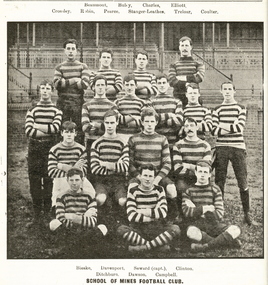 Federation University Historical Collection
Book, Ballarat School of Mines Students' Magazine, 1907-1909, 1907-9
... Kerr, A visit to the Briseis Mine, and New Brothers' Home, Mining Engineers in Tasmania, Obituaries for David Ham and Matthew Lyndsay, Pioneer Mining at Leichhardt, Automatic Ore Feeders and Chacedony Park by J.H. ...Kerr, A visit to the Briseis Mine, and New Brothers' Home, Mining Engineers in Tasmania, Obituaries for David Ham and Matthew Lyndsay, Pioneer Mining at Leichhardt, Automatic Ore Feeders and Chacedony Park by J.H. ...Bound volume of the Ballarat School of Mines Students' Magazine for 1907-1909. Articles include the location and pegging of a tramway Route, the transmission of Power by Rope Driving by A.E.C. Kerr, A visit to the Briseis Mine, and New Brothers' Home, Mining Engineers in Tasmania, Obituaries for David Ham and Matthew Lyndsay, Pioneer Mining at Leichhardt, Automatic Ore Feeders and Chacedony Park by J.H. Adams. Images include the Ballarat School of Mines Football Team and the Ballarat School of Mines Sports Committee. 1907 * Hubert Krause 1908 * The location and Pegging of a Tramway Route by Yamba * The Unity of things by John Brittain * The transmission of power by Rope Driving, by A.E.C. Kerr * A visit to the Briseis Mine, and New Brothers' Home (includes photographs) * Mining Engineers in Tasmania * Limericks Sluiced at Snake Valley * David Ham Obituary * Matthew Lyndsay Obituary * Some Bunsen Memories by Professor Alfred Mica Smith * Geological Camp to Daylesford * Practical Mathematics by Hubert F. Hall * Pioneer Mining - Leickhardt * Automatic Ore Feeders * A Unique Ore Deposit (Lucknow Goldfield, NSW) * A country Ramble * The Alkaline Titration for Zinc * Chalcedony Park, Arizona, United States of America by J.H. Adams * Notetaking at Lectures * Smelter Cost-Keeping by Oliver E. Jaeger * Benefits of Physical Culture * Mineral Tasmania and its Wonderful Resources by F.F. Bradford * A holiday Trip to Queensland * The Compression of Air as Applied to Mining * Machine V Hand Drilling * The mining in the Malay States * William Thomas Grownow Obituary (includes image) * Timbering Stopes (Includes images) * Trip to Melbourne * Two Problems of Alluvial Mining by Richard Hain * The Berry Leads (includes plan of mines) * Black Pudding Supper * Observations for Meridian * NOtes on Coking Plants (includes plan) * How Old is the Earth * Conglomerations * A Pat Formula * The making of a Suitable Muffle for General Assay Work * Reduction of Gold Chloride by Charcoal * Chemical Definitions * Old Boys (R.J. Allen, W.B. Blyth, F. Brinsden, Lindsay D. Cameron, George W. Cornwell, John M. Currie, C.M. Harris, T. Wighton-Hood, W. Lakeland, W.S. Macartney, Fred A. Marriott, Karl B. Moore, G.E. Sander, Sherb. H. Sheppard, Norman S. Stuckby, John Sutherland, Lewis A. Westcott, Walter White, O.C. Witherden, Gerald Young) 1909 * The Graduates Problem * An Interesting Nevada Cyanide Plant (Bamberger De Lamar Gold Mines) * Easter Geological Camp to Ingliston * New Methods for the Volumetric Estimation of Lead * William Charles Kernott Obituary * Mount Morgan Mine by G.W. Williams * Tin Dredging at Tingha, New South Wales * Notes on the Iodide estimation of Copper * Photograph of the Ballarat School of Mines Students' Association Committee * The Importance of Mine Ventilation to the Students by F. Howells * Life in Mining Camp * Wise Words to Mining School Students * Military Search Lights * Gleaning s on resistance * Ministerial Visit to the Ballarat School of Mines by the Hon. A.A. Billson, Minister of Education , accompanied by Frank Tate, Director of Education. * Picture Making in Photography Composition * Mountains of Fire * A Walking Engine - New Military Machine - Guns into Action - Caterpillar No. 1. (Tank) * Fireless Locomotives * Elmore Concentrating Process (includes plan of Elmore Concentrator) * Mount Pani Limited * Surveying for Irrigation * Weights and Measures * Carbon Monoxide * Joseph Francis Usher obituary * The Problem of the Metalliferous Veins * Ballarat School of Mines Ambulance Class * Treatment of Gold in a battery Without the Use of Copper Plates by E.C. Hurdsfield * Meteorites * Werribee Gorge * Dredging in the Ovens Valley * Electrical Chatter - Electrocution by an Imaginary Eye-Witness * The Electric Furnace in Iron Metallurgy ballarat school of mines, ballarat school of mines football team, football, sports, tramway, mining engineers, david ham, matthew lyndsay, jack adams, berry lead, hepburn consuls, madame berry, west ristori, ristori no 1, allendale, dyke's co, charleson's mill, australian extended, mining, r.j. allen,, w.b. blyth, f. brinsden, lindsay d. cameron, george w. cornwell, john m. currie, c.m. harris, t. wighton-hood, w. lakeland, w.s. macartney, fred a. marriott, karl b. moore, g.e. sander, sherb. h. sheppard, norman s. stuckby, john sutherland, lewis a. westcott, walter white, o.c. witherden, gerald young, ballarat school of mines students' association, hubert krause, krause, vfl, afl
