
Showing 136 items matching "parks wide"
-
 Whitehorse Historical Society Inc.
Pamphlet, Collina Glen, 2004 - 2007
... ...Parks Wide...Collina Glen Bushland Vegetation Action Statement by Parks Wide stating management recommendations, a sketch of the area, and plant list. ...Collina Glen Mitcham City of Whitehorse Arrowsmith Valda Parks Wide Parks and Reserves Collina Glen Bushland Vegetation Action Statement by Parks Wide. ...Collina Glen Bushland Vegetation Action Statement by Parks Wide.Collina Glen Bushland Vegetation Action Statement by Parks Wide stating management recommendations, a sketch of the area, and plant list. Also copies of letters and emails to and from Valda Arrowsmith and Whitehorse Council.Collina Glen Bushland Vegetation Action Statement by Parks Wide. collina glen, mitcham, city of whitehorse, arrowsmith, valda, parks wide, parks and reserves -
Whitehorse Historical Society Inc.
Letter - Correspondence, Casella Hollow Reserve, 2003 -2006
... ...Parks Wide...Casella Hollow Reserve Mitcham Arrowsmith Valda Parks Wide Parks and Reserves Copies of letters & emails to and from Valda Arrowsmith & the city of Whitehorse. ...Copies of letters & emails to and from Valda Arrowsmith & the city of Whitehorse.Copies of letters & emails to and from Valda Arrowsmith & the city of Whitehorse in regard to Casella Hollow Reserve.Copies of letters & emails to and from Valda Arrowsmith & the city of Whitehorse. casella hollow reserve, mitcham, arrowsmith, valda, parks wide, parks and reserves -
 Ambulance Victoria Museum
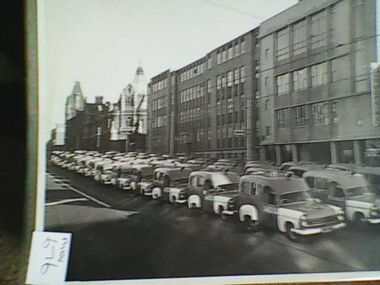
Photograph, Ambulances, 1958
... at least 52 ambulances parked four wide in front of the Victorian Civil Ambulance Service headquarters Latrobe Street Melbourne...Black and white photograph of at least 52 ambulances parked four wide in front of the Victorian Civil Ambulance Service headquarters...at least 52 ambulances parked four wide in front of the Victorian Civil Ambulance Service headquarters Latrobe Street Melbourne HADDRICK HOUSE CAR REPAIRERS VICTORIAN CIVIL AMBULANCE SERVICE Black and white photograph of at least 52 ambulances parked four wide in front of the Victorian Civil Ambulance Service headquarters Photograph, Ambulances ...at least 52 ambulances parked four wide in front of the Victorian Civil Ambulance Service headquarters Latrobe Street MelbourneBlack and white photograph of at least 52 ambulances parked four wide in front of the Victorian Civil Ambulance Service headquartersHADDRICK HOUSE CAR REPAIRERS VICTORIAN CIVIL AMBULANCE SERVICE -
 Flagstaff Hill Maritime Museum and Village
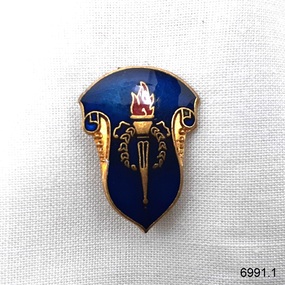
Badge - Legacy donor's badge, A.J. Parkes, Mid-1900s
... The badge was made by A.J. Parkes, an Australia-wide firm that has been making badges for over a century. ...Embossed:“$10”and “A.J. PARKES” “AUST. WIDE” ...The badge was made by A.J. Parkes, an Australia-wide firm that has been making badges for over a century. ...This Legacy donor's badge is one of a set of badges collected by Dr W R Angus from the organisations in which he was involved. The badge was made by A.J. Parkes, an Australia-wide firm that has been making badges for over a century. The $10', embossed on the back dates the badge after February 1966, when Australian money changed to decimal currency. A donation of $10 would be recognised by the gift of this badge. The set of badges is now part of Flagstaff Hill’s comprehensive W.R. Angus Collection, donated by the family of Dr W R Angus, surgeon and oculist. The W.R. Angus Collection: - The W.R. Angus Collection includes historical medical equipment, surgical instruments and material belonging to Dr Edward Ryan and Dr Thomas Francis Ryan, (both of Nhill, Victoria) and Dr Angus’ own belongings. The Collection’s history spans the medical practices of the two Doctors Ryan, from 1885-1926 plus that of Dr Angus, up until 1969. It includes historical medical and surgical equipment and instruments from the doctors Edward and Thomas Ryan of Nhill, Victoria. Dr Angus married Gladys in 1927 at Ballarat, the nearest big city to Nhill where he began as a Medical Assistant. He was also Acting House surgeon at the Nhill hospital where their two daughters were born. During World War II He served as a Military Doctor in the Australian Defence Forces. Dr Angus and his family moved to Warrnambool in 1939, where Dr Angus operated his own medical practice. He later added the part-time Port Medical Officer responsibility and was the last person appointed to that position. Both Dr Angus and his wife were very involved in the local community, including the planning stages of the new Flagstaff Hill and the layout of the gardens there. Dr Angus passed away in March 1970.This badge is significant for connecting Doctor Angus with organisations that he supported. The W.R. Angus Collection is significant for still being located at the site it is connected with, Doctor Angus being the last Port Medical Officer in Warrnambool. The Collection includes historical medical objects that date back to the late 1800s.Legacy appeal badge; a rectangular, shield-shaped metal and enamel badge, blue enamel on gold, with the Legacy symbol of a flaming torch in the centre. It has a vertical stick pin and inscriptions on the back. Made by A.J. Parks, Australia. The badge was given to donors of $10. This badge is part of a set of badges collected by Dr W R Angus. the set represents organisations that he was involved in, and is part of the W.R. Angus Collection.Embossed:“$10”and “A.J. PARKES” “AUST. WIDE” flagstaff hill, warrnambool, maritime village, maritime museum, shipwreck coast, great ocean road, badge, legacy badge, organisation badge, a.j. parkes, $10, ten dollars, donor's badge, legacy appeal, w.r. angus collection -
 Bendigo Historical Society Inc.
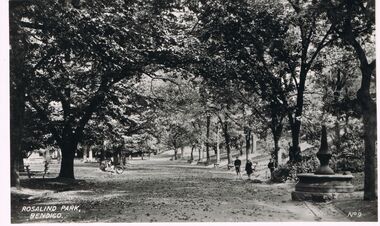
Photograph - BENDIGO - ROSALIND PARK
... Three people taking in the sights of the park. Wide access path middle centre....Three people taking in the sights of the park. Wide access path middle centre. Photograph BENDIGO - ROSALIND PARK. ...Photograph - black and white. Photograph of Rosalind Park, Bendigo. Right hand corner of photo is No.9. fountain to the right centre. Three people taking in the sights of the park. Wide access path middle centre.place, public gardens, rosalind park, rosalind park. bendigo. -
 Sunshine and District Historical Society Incorporated
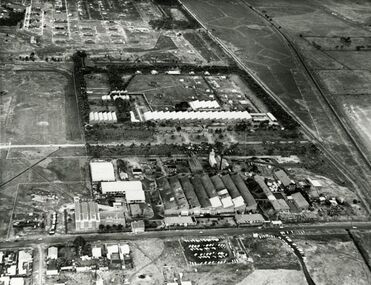
Photograph - ICI / Leathercloth Factory Late 1950's Aerial Photograph, Ian Russell, 1950's
... The Deer Park Leathercloth Factory was a major ICI (Imperial Chemical Industries) operation on Station Road, producing “Leathercloth” — a nitrocellulose‑based synthetic coated fabric — and formed part of the wider Deer Park explosives and chemical manufacturing complex. ...The Deer Park Leathercloth Factory was a major ICI (Imperial Chemical Industries) operation on Station Road, producing “Leathercloth” — a nitrocellulose‑based synthetic coated fabric — and formed part of the wider Deer Park explosives and chemical manufacturing complex. ...The Deer Park Leathercloth Factory was a major ICI (Imperial Chemical Industries) operation on Station Road, producing “Leathercloth” — a nitrocellulose‑based synthetic coated fabric — and formed part of the wider Deer Park explosives and chemical manufacturing complex. It’s one of the most significant industrial heritage sites in the City of Brimbank.This aerial photograph of the ICI / Leathercloth Factory captures the layout of the factory and the adjacent residential houses in Station Road in the late 1950's. The thankyou letter from the site Manager David Meale 25th September 1986 includes the details of the photographer, Ian Russell.5382.01 - ICI Leathercloth Factory Late 1950s Aerial Photograph.jpg 5382.02 - ICI Leathercloth Factory Late 1950s Aerial Photograph Thank You Letter.jpg ici, leathercloth, station road, deer park, tilburn road, david meale, imperial chemical industries -
 Sunshine and District Historical Society Incorporated
Archive - Gwen Mousley Collection - History of St John's, Deer Park + news of the wider church
... Bundle of newspaper cuttings, extracts from church journals, notices, articles, letters,many re St John's, Deer Park, and the wider church. Small sheet re Gwen Mousley's retirement as organist at St John's (1997). ...Archive Gwen Mousley Collection - History of St John's, Deer Park + news of the wider church ...Part of Gwen Mousley CollectionSome dates added to cuttingsst. johns church, deer park, miles street, church -
 Orbost & District Historical Society
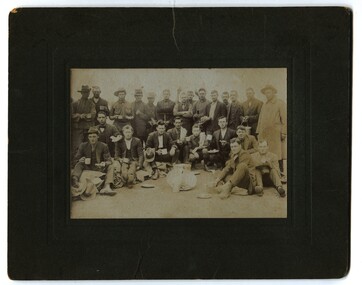
black and white photographs, September 1914
... The land was previously known as Mornington Park. It was a wide field, suitable for military practice, including training for the Light Horse regiments. ...The land was previously known as Mornington Park. It was a wide field, suitable for military practice, including training for the Light Horse regiments. ...Broadmeadows was home to the major army training camp for the Australian Imperial Force. The land was previously known as Mornington Park. It was a wide field, suitable for military practice, including training for the Light Horse regiments. It is the current location of the Maygar Army Barracks on Camp Road in Broadmeadows. To reach the camp, soldiers marched from Victoria Barracks in St Kilda Road and headed north up Sydney Road, only resting near Fawkner Cemetery. Soldiers slept in tents and food was basic. Training was hard, but it did not prepare soldiers for a modern war with machine guns, gas, shells and aeroplanes – technology that did not exist in previous wars. Some men only completed a few months training before departing on troopships from Port Melbourne. Once overseas, some soldiers received further training in Egypt. It is likely that these men are associated with the Orbost district.This photograph is a reminder of the personal stories of those who were involved in WW1.Two copies of a black / white photograph on dark grey buff cards. The photos show a group of soldiers having a meal. Some are sitting on the ground with others standing behind them.on back of 989.1 - "Sept 14 Broadmeadows"w.w.1 broadmeadows-army-training-camp -
 Musculoskeletal Health Australia (now held by the Glen Eira Historical Society)
Photograph - Objects
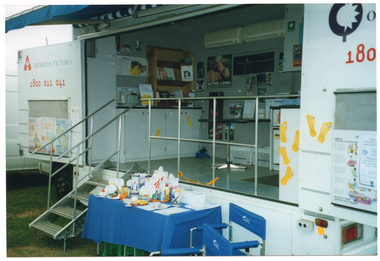
... COL photo of a large van parked on the grass. Wide double doors on the side of the van are open, displaying the text "Arthritis Victoria 1800 011 041" on one door, and "Osteoporosis Victoria 1800 011 041" (partially obscured) on the other door. ...This photo depicts the Healthy Bones Bus set up at an ACME Field Day at Timboon. arthritis foundation of victoria afv osteoporosis victoria ov arthritis victoria av acme field day healthy bones bus outreach education information stall healthy food heathy diet calcium bone health strong bones timboon moyne shire sponsorship partnership C2000s [On a yellow sticky note, handwritten in black ink] ACME Field Day - Timboon COL photo of a large van parked on the grass. Wide double doors on the side of the van are open, displaying the text "Arthritis Victoria 1800 011 041" on one door, and "Osteoporosis Victoria 1800 011 041" (partially obscured) on the other door. ...ACME Field Day is an expo event where exhibitors, particularly from the agricultural sector, can display and promote their products. In the early 2000s, Arthritis Victoria brought its Healthy Bones Bus to an Acme Field Day event in Timboon to spread the 'strong bones, healthy joints' message to south west Victoria. This initiative was made possible through a partnership with the Moyne Shire Council. This photo depicts the Healthy Bones Bus set up at an ACME Field Day at Timboon.COL photo of a large van parked on the grass. Wide double doors on the side of the van are open, displaying the text "Arthritis Victoria 1800 011 041" on one door, and "Osteoporosis Victoria 1800 011 041" (partially obscured) on the other door. Inside the van, there are built-in cupboards, shelves displaying brochures and fact sheets, a small table, and two air conditioning units up high on one wall. In front of the van, next to the retractable metal steps, there is a small table covered with a bright blue tablecloth. On it, there is a range of healthy food items such as cereals, various types of milk, cheeses, a plastic ice cream container, some canned food, and some fresh fruit. Next to the table, there is a bright blue fabric deck chair.[On a yellow sticky note, handwritten in black ink] ACME Field Day - Timboonarthritis foundation of victoria, afv, osteoporosis victoria, ov, arthritis victoria, av, acme field day, healthy bones bus, outreach, education, information stall, healthy food, heathy diet, calcium, bone health, strong bones, timboon, moyne shire, sponsorship, partnership, c2000s -
 Parks Victoria - Cape Nelson Lightstation
Furniture - Chair, Douglas
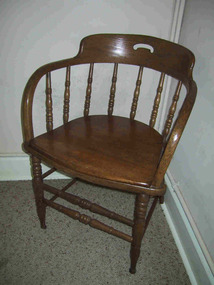
... The chair complements the lightstation’s nineteenth century office desk and small number of other nineteenth century furnishings in the wider Parks Victoria lightstation collection, the majority of which are domestic items. ...The chair complements the lightstation’s nineteenth century office desk and small number of other nineteenth century furnishings in the wider Parks Victoria lightstation collection, the majority of which are domestic items. ...The chair’s turned legs and bowed, spindle back are typical characteristics of the popular ‘Douglas’ chair, which descends from the long evolutionary line of ‘Windsor’ style cottage chairs. Also known as ‘Captains’ chairs, they were made on a large scale in England, America and Australia from around the 1860s in various timbers, with seats ranging from heavy pine to cane and in later models, plywood. Australiana expert, Peter Cuffley writes that they were just as much a part of Australia’s frontier experience as they were America’s; Holtermans’ 1872 photographs of the New South Wales gold towns show Douglas chairs, and they appear in illustrations of the exploits of the Kelly gang drawn in the late 1870s. Many Australians now are more likely to associate them with public offices and governments departments’. The chairs met the need for a degree of comfort and tough resilience under rough handling on hard floors. The Cape Nelson chair is known to have been used as a visitor’s chair, presumably in the head keeper’s office. No other examples of nineteenth century style chairs survive among the reliably provenanced furnishings in the five other lightstation collections. The chair complements the lightstation’s nineteenth century office desk and small number of other nineteenth century furnishings in the wider Parks Victoria lightstation collection, the majority of which are domestic items. The Douglas chair has first level contributory significance for its historical value and relative rarity as a lightstation office furnishing.The chair has turned legs and bowed, spindle back . -
 Parks Victoria - Cape Nelson Lightstation
Equipment - Rescue Harness
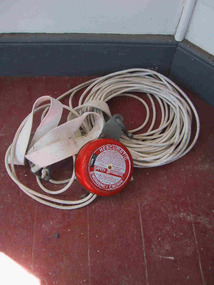
... The device complements a number of other items of rescue equipment held in the wider Parks Victoria lightstation collection which attest to the dangers inherent in lightstation work and necessity for first aid kits, resuscitators, life buoys, life jackets and other devices such as harnesses and pulleys used for moving people. ...The device complements a number of other items of rescue equipment held in the wider Parks Victoria lightstation collection which attest to the dangers inherent in lightstation work and necessity for first aid kits, resuscitators, life buoys, life jackets and other devices such as harnesses and pulleys used for moving people. ...The ‘Resumatic’ brand, British made, lightweight device comprises a red pulley with attached length of white rope and harness. Information on the item indicates that it was the property of the Department of Transport, Australia. The Commonwealth Lighthouse Service was associated with the Department of Shipping and Transport in 1951 and the Navigational Aids Branch of the Department of Transport in 1972 so the harness may date to this period. The easily operated descent device was used for automatic, controlled descents from overhead structures, such as towers and other buildings and did not require a power source or tools. The user needed to make sure the unit is secured to an anchor point so that the cable could be dropped to the ground. As soon as it was secured the user could put on the support harness, step off the edge and travel down to safety. The device complements a number of other items of rescue equipment held in the wider Parks Victoria lightstation collection which attest to the dangers inherent in lightstation work and necessity for first aid kits, resuscitators, life buoys, life jackets and other devices such as harnesses and pulleys used for moving people. These include a bosun’s chair and harness with pulley, Royal Flying Doctor first aid cabinet, resuscitator kit and case, first aid kit, lifebuoy and cork fragments x 4 all in the Gabo Island collection; a rescue basket, resuscitation kit and case, and pulleys and ropes at Cape Otway; rescue stretcher made of bamboo at Wilsons Promontory; and a rescue anchor at Cape Schanck. The Cape Nelson rescue harness, although unique in the broader lightstation collection, is a relatively common device that is still manufactured more or less the same in England. It has second level contributory significance for offering insights into the various methods used in rescue operations by Victoria’s lightstations.Length of white rope attached to a harness and a red pully device.yes -
 Flagstaff Hill Maritime Museum and Village
Equipment - Juggling Club, late 19th to early 20th century
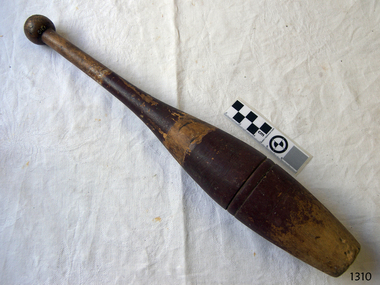
... parks, parties, shows on television or theatre, schools and parties. Juggles also compete at International Championships to obtain world records, performing as individuals or in groups or teams. Contemporary champion juggler David Cain performs a Juggling History Show that both entertains and educates his audience. His routines date from the early 1600s to the 20th century. He uses a wide...parks, parties, shows on television or theatre, schools and parties. Juggles also compete at International Championships to obtain world records, performing as individuals or in groups or teams. Contemporary champion juggler David Cain performs a Juggling History Show that both entertains and educates his audience. His routines date from the early 1600s to the 20th century. He uses a wide ...This wooden juggling club or exercise club may also be referred to as a juggling pin. It is very similar in shape to a bowling pin or an Indian club. It dates approximately to the early 20th century. It may have been used as one of a pair for gymnastics or exercise, or part of a larger set used by a juggler for entertainment in a circus or carnival. At some time it may have been used with a ball or disc as part of a Skittles or bowling game set. The historical collection of Federation University Australia, Victoria, includes a very similar but slightly shorter club, labelled ‘timber skittle”, as can be seen in their photograph. Another example of very similar-shaped, same-sized clubs can be seen in the collection of Nobelius Heritage Park and Emerald Museum, Emerald, Victoria. JUGGLING Jugglers entertain audiences with their tricks and routines at events such as circuses, amusement parks, parties, shows on television or theatre, schools and parties. Juggles also compete at International Championships to obtain world records, performing as individuals or in groups or teams. Contemporary champion juggler David Cain performs a Juggling History Show that both entertains and educates his audience. His routines date from the early 1600s to the 20th century. He uses a wide variety of equipment in his acts including juggling clubs. EXERCISE Exercise clubs or Indian clubs were used in 19th century Victorian times as part of exercise or strengthening programs when they were swung in certain patterns and movements. Even in the early 20th century workplace a few minutes of Indian club swinging was common practice for the relief of tension. A video clip of an American school room in 1904 shows a group of boys and girls skilfully wielding clubs in an exercise sequence (see ‘Links” section). The 1904 and 1932 Olympic Games had an event called Club Swinging. Rhythmic gymnastics was added to the Olympic Program at the L.A. Games in 1984 where competitors use apparatus such as rope, hoop, ball, ribbon and clubs. The clubs come in a variety of weights and heights and have been used from the mid-1800s until around the 1930s in schools and military institutions. They are decorated in a variety of patterns and colours and some have feature lines or scored rings on them. This juggling club is significant for its association with education, entertainment and sport in the late 19th and early 20th century.Wooden juggling club (or pin, skittle or Indian club). Vintage, bottle-shaped club with a flat, slightly concave, base. Its turned, solid timber body tapers out from the base then in again to a very narrow handle with a round knob joined onto the top. Two concentric feature lines are scored into the wider part of club. It was possibly used in exercise, gymnastics or as a skittle. Sections of the club have two brown painted stripes; paint on the lower strip has been worn off at the base . There are remnants of white paint in two areas, possibly the remains of a maker’s name or decoration. There also appears to be an inscription stamped into the wooden handle but this is illegible. Late 19th to early 20th century.Remnants of what appears to be stamped lettering and painted labelling.flagstaff hill, warrnambool, shipwrecked coast, flagstaff hill maritime museum, maritime museum, shipwreck coast, flagstaff hill maritime village, great ocean road, wooden skittle, entertainment, bowling skittle, wooden juggling pin, wooden juggling club, wooden exercise club, indian club, exercise club, club swinging, rhythmic gymnastics, sport equipment, juggling equipment, wooden club -
 Bunjil Park Aboriginal Education & Cultural Centre
Sharpening stones
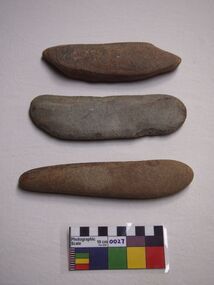
... Park. They are fine sandstone and range from 18cm to 19.5cm long and 4 to 6 cm wide....Park. They are fine sandstone and range from 18cm to 19.5cm long and 4 to 6 cm wide. ...A set of 3 sharpening stones found on site at Bunjil Park. They are fine sandstone and range from 18cm to 19.5cm long and 4 to 6 cm wide. -
 The Beechworth Burke Museum
Photograph, c1900
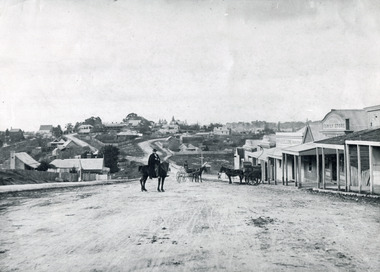
... wide dirt road in Beechworth. He is outside a row of businesses, including R.McKenzie & Sons Grain Store and Mackenzie Family Store (Wholesale & Retail Est. 1855), along a sloping hill. Behind the main rider are a parked...wide dirt road in Beechworth. He is outside a row of businesses, including R.McKenzie & Sons Grain Store and Mackenzie Family Store (Wholesale & Retail Est. 1855), along a sloping hill. Behind the main rider are a parked ...Believed to have been taken sometime between 1858 and 1908, featuring a man with moustache, dressed in hat and long riding coat, seated on a bob-tailed horse, is stopped in the middle of a wide dirt road in Beechworth. He is outside a row of businesses, including R.McKenzie & Sons Grain Store and Mackenzie Family Store (Wholesale & Retail Est. 1855), along a sloping hill. Behind the main rider are a parked horse and laden two-wheeled cart backed up directly outside the grain store's verandah, and another man is driving a horse and four-wheeled wagon forward towards them. At the bottom of the hill is a bridge (Newtown Bridge) with forked road on the far side, leading to a number of houses on both sides of another hill. This image is looking down Bridge Street, Newtown, Beechworth and across to Ford Street (left) and High Street (right). Road-making was a focus of town development during the 1850s, and the wide streets were created on the instructions of the surveyor-general to be between sixty-six and ninety-nine feet wide to give the town a pleasing aspect.This photograph is important in showing the development and expansion of the various businesses and buildings in Bridge Street of Newtown, Beechworth. Black and white rectangular photograph printed on paperReverse: 6980/ PH 118/ 1998.00059/beechworth, new town, newtown, newtown beechworth, local business, mackenzie family store, mackenzie's family store, mackenzie, grain store, bridge, ford steet, high street, colonial australia, australian gold rushes, mining technology, beechworth historic district, indigo gold trail, migration, indigo shire, mckenzie and sons grainstore, mckenzie family store, mckenzie, newtown bridge -
 The Beechworth Burke Museum
Animal specimen - Tawny Frogmouth, Trustees of the Australian Museum, 1860-1880
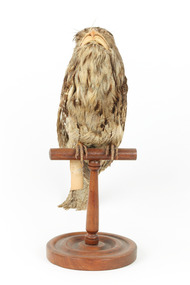
... . / More-Park / See Catalogue, page 7 / This Tawny Frogmouth has a broad head and a creamy beige coloured wide triangular beak with a hooked tip. ...The Tawny Frogmouth, although often mistaken for an owl, is a nocturnal Australian bird of the Podargidae family that is more closely related to the nightjars. They are widespread in terms of distribution and can be found all across mainland Australia and Tasmania in a diverse variety of habitats from woodlands, forests and urban areas. Masters of camouflage, the Tawny Frogmouth sleeps during the day on tree branches in a stiff upward facing position (as with this specimen) to mimic broken tree branches, their feathers assist in this deception as the mottled grey and brown colours blend into the environment seamlessly. This specimen differs in colours from the usual appearance of a Tawny Frogmouth, as the beak is usually a olive-grey to blackish tone and the plumage is generally more dominantly grey all over the bird. This specimen is part of a collection of almost 200 animal specimens that were originally acquired as skins from various institutions across Australia, including the Australian Museum in Sydney and the National Museum of Victoria (known as Museums Victoria since 1983), as well as individuals such as amateur anthropologist Reynell Eveleigh Johns between 1860-1880. These skins were then mounted by members of the Burke Museum Committee and put-on display in the formal space of the Museum’s original exhibition hall where they continue to be on display. This display of taxidermy mounts initially served to instruct visitors to the Burke Museum of the natural world around them, today it serves as an insight into the collecting habits of the 19th century.This specimen is part of a significant and rare taxidermy mount collection in the Burke Museum. This collection is scientifically and culturally important for reminding us of how science continues to shape our understanding of the modern world. They demonstrate a capacity to hold evidence of how Australia’s fauna history existed in the past and are potentially important for future environmental research. This collection continues to be on display in the Museum and has become a key part to interpreting the collecting habits of the 19th century.This Tawny Frogmouth has a broad head and a creamy beige coloured wide triangular beak with a hooked tip. The plumage on the head and back of the bird is a combination of darker and rufous browns, mottled with streaks of cream and grey. The underside of the bird from the bottom of the beak to the tail tip is a lighter cream colour with streaks of rufous-brown. The feet are an orange-brown colour. This specimen is adopting the skyward looking pose associated with the species, mimicking dead tree branches.1a. / More-Park / See Catalogue, page 7 /taxidermy mount, taxidermy, burke museum, beechworth, australian museum, skin, reynell eveleigh johns, bird, australian birds, tawny frogmouth, frogmouth -
 The Beechworth Burke Museum
Animal specimen - Red Wattle Bird, Trustees of the Australian Museum, 1860-1880
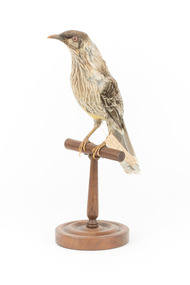
... parks. Known for its loud and conspicuous presence, the red wattlebird primarily forages in trees, although it occasionally searches for food on the ground. As one of the world's largest nectar-feeding birds, it consumes nectar from a wide variety of flowering plants, supplementing its diet with insects. ...parks. Known for its loud and conspicuous presence, the red wattlebird primarily forages in trees, although it occasionally searches for food on the ground. As one of the world's largest nectar-feeding birds, it consumes nectar from a wide variety of flowering plants, supplementing its diet with insects. ...The red wattlebird is a passerine bird native to southern Australia. Measuring 33–37 cm (13–14.5 inches) in length, it ranks as the second-largest species among Australian honeyeaters. The species was first described by John White in 1790, and three subspecies are currently recognised. The red wattlebird is found across southeast Queensland, New South Wales, Victoria, South Australia, and southwest Western Australia, inhabiting open forests, woodlands, and urban gardens or parks. Known for its loud and conspicuous presence, the red wattlebird primarily forages in trees, although it occasionally searches for food on the ground. As one of the world's largest nectar-feeding birds, it consumes nectar from a wide variety of flowering plants, supplementing its diet with insects. Territorial and sometimes aggressive, it defends rich nectar sources from other bird species. Breeding occurs throughout its range, with the species constructing cup-shaped nests in trees and raising one or two broods annually. Despite localized declines due to habitat loss, the red wattlebird is listed as Least Concern on the IUCN Red List. This specimen was falsely identified as a yellow wattlebird in original catalogue records and is part of a collection of almost 200 animal specimens that were originally acquired as skins from various institutions across Australia, including the Australian Museum in Sydney and the National Museum of Victoria (known as Museums Victoria since 1983), as well as individuals such as amateur anthropologist Reynell Eveleigh Johns between 1860-1880. These skins were then mounted by members of the Burke Museum Committee and put-on display in the formal space of the Museum’s original exhibition hall where they continue to be on display. This display of taxidermy mounts initially served to instruct visitors to the Burke Museum of the natural world around them, today it serves as an insight into the collecting habits of the 19th century.This specimen is part of a significant and rare taxidermy mount collection in the Burke Museum. This collection is scientifically and culturally important for reminding us of how science continues to shape our understanding of the modern world. They demonstrate a capacity to hold evidence of how Australia’s fauna history existed in the past and are potentially important for future environmental research. This collection continues to be on display in the Museum and has become a key part to interpreting the collecting habits of the 19th century.The red wattlebird has predominantly grey-brown plumage, featuring red eyes, pale pinkish-red wattles on each side of the neck, white streaking on the chest, and a prominent yellow patch on the lower belly. Swing-tag: 58a. / Wattled - Honeyeater / See catalogue page 18taxidermy mount, taxidermy, animalia, burke museum, beechworth, australian museum, skin, bird, yellow wattlebird, tasmanian wattlebird, anthochaera paradoxa, australian birds, wattlebird, red wattlebird -
Federation University Historical Collection
Book - Book - Scrapbook, Ballarat College of Advanced Education: Scrapbook of newspaper cutting, Book 19; October 1986 to February 1987
... The cuttings cover the period from 4 October 1986 to 26 February 1987. . employment advertisements application for enrolment outline of courses ballarat college of advanced education bcae honor for students european wasps geology head retires philip day kaolin waste used on roads physical education display ray richards entertainer painted a paradise off to hawaii patrick hope dean of business thelma rungkat librarian call for wide review e j tippett obituary keith twyford applied biology mystery of platypus $205000 to increase student intake engineers find answers how to make a good drop rhonda galbally awards for our stars victorian regional theatre company david adden brooke selwyn hoffman sculptor study by video coming managing your health ohs courses begin dennis else champagne prize for kym hodder symphony orchestra for ballarat book of the year award garry kinnane more courses better facilities peter widmer exhibition michael wilson beauty in ceramics east in ballarat brew pacific malting susan parks on exchange from u s students without housing cracks in tertiary system simon woodward actor hamlet record enrolments in business courses sensitivity in paintings tamara bekier hamlet my shock Book with yellow cover, front. ...Newspaper cuttings relating to Ballarat College of Advanced Education. These are from various newspapers and include The Age, Ballarat Courier, The Australian, The Herald. The cuttings cover the period from 4 October 1986 to 26 February 1987. . Book with yellow cover, front. Spiral bound.employment advertisements, application for enrolment, outline of courses, ballarat college of advanced education, bcae, honor for students, european wasps, geology head retires, philip day, kaolin waste used on roads, physical education display, ray richards entertainer, painted a paradise, off to hawaii, patrick hope, dean of business, thelma rungkat librarian, call for wide review, e j tippett obituary, keith twyford applied biology, mystery of platypus, $205000 to increase student intake, engineers find answers, how to make a good drop, rhonda galbally, awards for our stars, victorian regional theatre company, david adden brooke, selwyn hoffman sculptor, study by video coming, managing your health, ohs courses begin, dennis else, champagne prize for kym hodder, symphony orchestra for ballarat, book of the year award, garry kinnane, more courses better facilities, peter widmer exhibition, michael wilson, beauty in ceramics, east in ballarat brew, pacific malting, susan parks on exchange from u s, students without housing, cracks in tertiary system, simon woodward actor, hamlet, record enrolments in business courses, sensitivity in paintings, tamara bekier, hamlet my shock -
 Flagstaff Hill Maritime Museum and Village
Book - Referance Book, Field Naturalist Club of Victoria, A Census of The Plants of Victoria, 1928
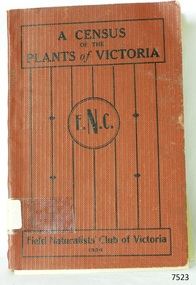
... Park. The book's contents record the natural state of Victoria's plants and environment at the time (1928). The book is a useful reference for a wide range of plant enthusiasts, from the time it was written to modern times. ...The book, 'A Census of the Plants of Victoria', is a comprehensive reference book of plant varieties and their distribution in the Australian State of Victoria. This second edition was published by the Field Naturalists' Club of Victoria, and printed in Melbourne. It contains indexes to aid the students, botanists and plant enthusiasts in their search for information.Orange-brown front cover with black printed text, vertical lines and rectangular borders around the upper title, and lower publishing group, and a central circular logo of the publishing group, Field Naturalists' Club of Victoria. Title: (in full) A Census of the Plants of Victoria With their Regional Distributions and the Vernacular Names as adopted by the Plant Names Committee of the Field Naturalists' Club of Victoria. Publisher: Field Naturalists Club of Victoria Edition: Second Edition Date: 1928non-fictionThe book, 'A Census of the Plants of Victoria', is a comprehensive reference book of plant varieties and their distribution in the Australian State of Victoria. This second edition was published by the Field Naturalists' Club of Victoria, and printed in Melbourne. It contains indexes to aid the students, botanists and plant enthusiasts in their search for information.warrnambool, shipwreck coast, flagstaff hill maritime museum, flagstaff hill maritime village, book, a census of the plants of victoria, field naturalists' club of victoria, plant names, plant species, distribution of plants, victoria's plants, plant identification -
 Flagstaff Hill Maritime Museum and Village
Badge - Legacy Appeal badge, A.J. Parkes, 1966
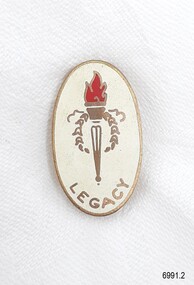
... The badge was made by A.J. Parkes of Brisbane, an Australia-wide firm that has been making badges for over a century. ...The badge was made by A.J. Parkes of Brisbane, an Australia-wide firm that has been making badges for over a century. ...This Legacy badge is one of a set of badges collected by Dr W R Angus from the organisations in which he was involved. The badge was made by A.J. Parkes of Brisbane, an Australia-wide firm that has been making badges for over a century. The $2' and "£1" (one pound) embossed on the back dates the badge dates the badge to the year 1966 when Australian money was in the process of converting from pounds and pence to decimal currency's dollars and cents. It is interesting to note that the dollar sign "$2" has two vertical lines through the 'S', but the Australian currency sign for a dollar has only one vertical line. The badge may have been produced before the date of decimal conversion, which began on February 14th, 1966. A J Parkes may have ordered the badges before the published use of the dollar symbol. The set of badges is now part of Flagstaff Hill’s comprehensive W.R. Angus Collection, donated by the family of Dr W R Angus, surgeon and oculist. The W.R. Angus Collection: - The W.R. Angus Collection includes historical medical equipment, surgical instruments and material belonging to Dr Edward Ryan and Dr Thomas Francis Ryan, (both of Nhill, Victoria) and Dr Angus’ own belongings. The Collection’s history spans the medical practices of the two Doctors Ryan, from 1885-1926 plus that of Dr Angus, up until 1969. It includes historical medical and surgical equipment and instruments from the doctors Edward and Thomas Ryan of Nhill, Victoria. Dr Angus married Gladys in 1927 at Ballarat, the nearest big city to Nhill where he began as a Medical Assistant. He was also Acting House surgeon at the Nhill hospital where their two daughters were born. During World War II He served as a Military Doctor in the Australian Defence Forces. Dr Angus and his family moved to Warrnambool in 1939, where Dr Angus operated his own medical practice. He later added the part-time Port Medical Officer responsibility and was the last person appointed to that position. Both Dr Angus and his wife were very involved in the local community, including the planning stages of the new Flagstaff Hill and the layout of the gardens there. Dr Angus passed away in March 1970.This badge is significant for connecting Doctor Angus to organisations that he supported. It is also historically significant for representing Australia's conversion to decimal currency. The W.R. Angus Collection is significant for still being located at the site it is connected with, Doctor Angus being the last Port Medical Officer in Warrnambool. The Collection includes historical medical objects that date back to the late 1800s.Legacy Appeal badge; an oval-shaped metal and enamel badge, white enamel on gold, with the Legacy symbol of a flaming torch in the centre. It has a vertical stick pin and inscriptions on the back. It was made by A.J. Parks, Brisbane. The badge was given to a donor of $2 (£1 or one pound) to Legacy. This badge is part of a set of badges collected by Dr W R Angus. the set represents organisations that he was involved in, and is part of the W.R. Angus Collection.Embossed: "PARIVETTE 77-“ "A J PARKES" "BRISBANE" "£1" (one pound) "$2” (2 dollars) flagstaff hill, warrnambool, maritime village, maritime museum, shipwreck coast, great ocean road, badge, legacy badge, organisation badge, a.j. parkes, donor's badge, £1 badge, $2 badge, 14th february 1966, australian decimal conversion, brisbane, legacy appeal, w.r. angus collection -
 Greensborough Historical Society
Photographs, Photographs by Maria Barbaro, 2009_
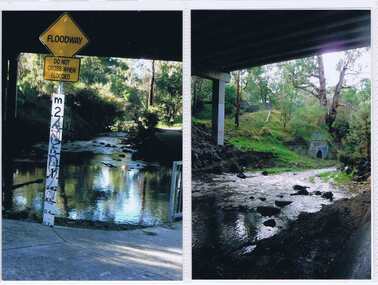
... Taken in the Greensborough area, photos cover a wide range of natural and built landscapes, including the Plenty River; parks and gardens; the Greensborough Hotel; Ashmead; Greensborough railway station....Taken in the Greensborough area, photos cover a wide range of natural and built landscapes, including the Plenty River; parks and gardens; the Greensborough Hotel; Ashmead; Greensborough railway station. ...A collection of over 170 photographs taken by artist Maria Barbaro as studies for her paintings. Taken in the Greensborough area, photos cover a wide range of natural and built landscapes, including the Plenty River; parks and gardens; the Greensborough Hotel; Ashmead; Greensborough railway station.A variety of photographs of the Greensborough area in the early 21st Century.Folder containing approx 150 colour photographs of Greensborough area. Each photograph 10x15cmmaria barbaro, greensborough -
City of Moorabbin Historical Society (Operating the Box Cottage Museum)
Document, Cover of the booklet 'The Story of Box Cottage Museum', 2016
... wider community. Glen Eira City Council Community Grant 2016 was obtained to finance the printing by MKR Printing Ltd Carnegie. city of moorabbin, lewis laurie, mkr printing ltd carnegie, brighton, dendy henry, box william, box elizabeth, rietman august, rietman frieda, box cottage museum ormond, box alonzo, glen eira city council, city of moorabbin historical society, ormond, bentleigh, cheltenham Cover of Booklet Front; The Story of Box Cottage Museum / Home of the City of Moorabbin Historical Society Inc. / Joyce Park, Jasper Rd., Ormond, Melbourne 3204 / compiled by / City of Moorabbin Historical Society Inc. / with support from Glen Eira City Council. ...2015 Booklet compiled by CMHS members D. Maynard, Fran & Holger Bader for sale as a fund raiser to assist the preservation of the artefacts in Box Cottage Museum Ormond. Glen Eira City Council Community Grant 2016 was obtained to finance the printing by MKR Printing Ltd Carnegie. Since the Booklet was produced to raise funds for Box Cottage Museum copies are available $5 each on application to CMHS PO Box 4028 McKinnon or [email protected] Booklet compiled by CMHS members D. Maynard, Fran & Holger Bader for sale as a fund raiser to assist the preservation of the artefacts in Box Cottage Museum Ormond whilst providing information about early settlement in Moorabbin area for visitors, schools and the wider community. Glen Eira City Council Community Grant 2016 was obtained to finance the printing by MKR Printing Ltd Carnegie. A5 glossy, colour Cover of the booklet 20 pages with photographsCover of Booklet Front; The Story of Box Cottage Museum / Home of the City of Moorabbin Historical Society Inc. / Joyce Park, Jasper Rd., Ormond, Melbourne 3204 / compiled by / City of Moorabbin Historical Society Inc. / with support from Glen Eira City Council. Back; Box Cottage Museum, Joyce Park, Ormond, Vic, 3204 / Home of the City of Moorabbin Historical Society Inc. A0020547E / Box Cottage Museum is proudly sponsored by the City of Glen Eira / copyright CMHS 2015 city of moorabbin, lewis laurie, mkr printing ltd carnegie, brighton, dendy henry, box william, box elizabeth, rietman august, rietman frieda, box cottage museum ormond, box alonzo, glen eira city council, city of moorabbin historical society, ormond, bentleigh, cheltenham -
Glenelg Shire Council Cultural Collection
Photograph - Photograph - Glenelg Regional Library Bookmobile, c. 1963
... Sourced from Casterton Town Hall (former Shire of Glenelg) Front: Photographer's stamp 'Glenelg Regional Regional Library Bookmobile' handwritten in blue biro Back: Line in blue biro, arrowed each end, drawn across width of photo. 3" wide written above line Black and white photo. Glenelg Regional Library Bookmobile, parked in driveway of library building. ...Sourced from Casterton Town Hall (former Shire of Glenelg)Black and white photo. Glenelg Regional Library Bookmobile, parked in driveway of library building. Passenger side door open, man standing with one foot on bottom step, other on ground. 'Glenelg Regional Library' on side of van.Front: Photographer's stamp 'Glenelg Regional Regional Library Bookmobile' handwritten in blue biro Back: Line in blue biro, arrowed each end, drawn across width of photo. 3" wide written above line -
Glenelg Shire Council Cultural Collection
Photograph, Portland Wool Exchange, n.d
... Port of Portland Authority Port of Portland Front: [Grid lines drawn in blue pen] 4½" wide (lower centre, blue pen) Back: 177 (centre, pencil) View of brick building with "Portland Wool Exchange" signage on wall near door. Cars parked ...Port of Portland AuthorityFront: [Grid lines drawn in blue pen] 4½" wide (lower centre, blue pen) Back: 177 (centre, pencil)port of portland -
 Glenelg Shire Council Cultural Collection
Photograph, Ro Ro vessel at Alcoa berth, n.d
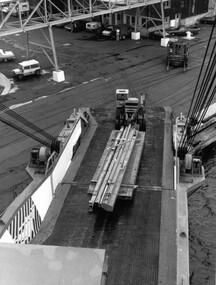
... wide x 26 cm (lower centre) (pencil) (drawn crop marks on back edges, pencil). Front loader truck loading long steel strutts onto ship via a cargo bay ramp. A forklift truck and several cars are in background, parked ...Port of Portland Authority archives.Front: (no inscriptions) Back: 19 x 26 (lower left) (pencil-crossed out) P.11. (G) (lower left, pencil). 19 cm wide x 26 cm (lower centre) (pencil) (drawn crop marks on back edges, pencil).port of portland -
Glenelg Shire Council Cultural Collection
Photograph - Photograph - Thomas Borthwick & Sons, n.d
... wide. Full page in pencil. 6 Black and white aerial photo of Thomas Borthwick & Sons, showing car parks, cattle in holding paddocks, factory buildings and dam on right of photo. ...Port of Portland Authority ArchivesBack: Frame drawn in pencil. 94% in green pencil. Reduce to 53 cms wide. Full page in pencil. 6 -
 Flagstaff Hill Maritime Museum and Village
Functional object - Rod, Approx. 1871
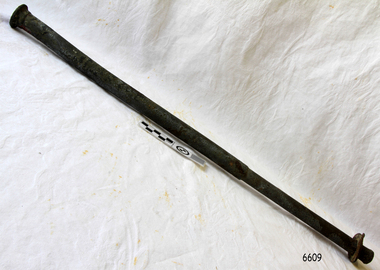
... Park and Apollo Bay Museum. Flagstaff Hill Maritime Village also has several artefacts from the wreck. There seemed to be no personal luggage or clothing. “The Eric the Red is historically significant as one of Victoria's major 19th century shipwrecks. (Heritage Victoria Eric the Red; HV ID 239) The wreck led to the provision of an additional warning light placed below the Cape Otway lighthouse to alert mariners to the location of Otway Reef. The site is archaeologically significant for its remains of a large and varied cargo and ship's fittings being scattered over a wide ...This rod was salvaged from the American three-masted wooden clipper ship, Eric the Red, named after the Viking discoverer, Eric the Red. The ship first traded in coal between America and Britain and later traded in guano nitrates from South America. In 1879 its hull was re-metalled and the vessel was in first class condition. On 10th June 1880 Eric the Red departed New York under the command of Captain Z Allen, with 24 crew plus two passengers. It was heading for Melbourne and then Sydney. The ship was commissioned by American trade representatives to carry a special cargo of 500 American exhibits for the U.S.A. pavilion at Melbourne’s first International Exhibition. The items included furniture, ironmongery, wines, chemicals, dental and surgical instruments, paper, cages, bronze lamp trimmings, axles, stamped ware, astronomical and time globes, and samples of corn and the choicest of leaf tobacco. Also on board was general merchandise such as cases of kerosene and turpentine, brooms, Bristol's Sarsaparilla, Wheeler and Wilson sewing machines, Wheeler’s thresher machine, axe handles and tools, cases of silver plate, toys, pianos and organs, carriages and Yankee notions. The ship had been at sea for 85 days when, on 4th September 1880, it hit the Otway Reef on the southwest coast of Victoria and was quickly wrecked. Captain and crew ended up on floating parts, or in the long boat or the sea. He was amongst the 23 battered and injured men who were rescued by the steamer Dawn and later taken to Warrnambool, where they received great hospitality and care. Four men lost their lives; three crew and one passenger. Captain Allen took the train back to Melbourne and then returned to America. The captain and crew of the Dawn were recognised by the United States Government in July 1881 for their humane efforts, being thanked and presented with substantial monetary rewards, medals and gifts. The salvaging ship Pharos collected Wheeler and Wilson sewing machines, nests of boxes, bottles of Bristol’s sarsaparilla, pieces of common American chairs, axe handles, a Wheelers’ Patent thresher and a sailor’s trunk with the words “A. James” on the front. A ship’s flag board bearing the words “Eric the Red” was found on the deckhouse; finally, those on board the Pharos had found the name of the wrecked vessel. The government steamer Victoria and a steamer S.S. Otway picked up flotsam and wreckage. A whole side of the hull and three large pieces of the other side of the hull, with some of the copper sheathing stripped off, had floated onto Point Franklin. Some of the vessel's yards and portions of its masts were on shore with pieces of canvas attached, confirming that the vessel had been under sail. On shore were many cases of Diamond Oil kerosene labelled R. W. Cameron and Company, New York. large planks of red pine, portions of a small white boat and a large, well-used oar. There were sewing machines, some consigned to ‘Long and Co.”, and notions, axe and scythe handles, hay forks, wooden pegs, rolls of wire, some branded “T.S” and Co, Melbourne”, and kegs of nails branded “A.T. and Co.” from the factory of A. Field and Son, Taunton, Massachusetts. Other cargo remains included croquet balls and mallets, buggy fittings, rat traps, perfumery, cutlery and Douay Bibles, clocks, bicycles, chairs, a flywheel, a cooking stove, timber, boxes, pianos, organs, wooden clothes pegs and a ladder. There were three cases of goods meant for the Exhibition Other items salvaged from amongst the debris floating in the sea were chairs, doors, musical instruments, washing boards, nests of trunks and flycatchers. Most of the goods were saturated and smelt of kerosene. A section of the hull lies buried in the sand at Parker River Beach. An anchor with a chain is embedded in the rocks east of Point Franklin and a second anchor, thought to be from Eric the Red, is on display at the Cape Otway light station. A life belt was once on the veranda of Rivernook Guest House in Princetown with the words “ERIC THE RED / BOSTON”. Parts of the ship are on display at Bimbi Park Caravan Park and Apollo Bay Museum. Flagstaff Hill Maritime Village also has several artefacts from the wreck. There seemed to be no personal luggage or clothing. “The Eric the Red is historically significant as one of Victoria's major 19th century shipwrecks. (Heritage Victoria Eric the Red; HV ID 239) The wreck led to the provision of an additional warning light placed below the Cape Otway lighthouse to alert mariners to the location of Otway Reef. The site is archaeologically significant for its remains of a large and varied cargo and ship's fittings being scattered over a wide area. The site is recreationally and aesthetically significant as it is one of the few sites along this coast where tourists can visit identifiable remains of a large wooden shipwreck, and for its location set against the background of Cape Otway, Bass Strait, and the Cape Otway lighthouse.“ (Victorian Heritage Database Registration Number S239, Official Number 8745 USA)Iron rod with flat lugged washer. The rod is made of a heavy metal with encrustations and signs of rusting on the surface. It is stepped down in diameter mid-shaft and is slightly bowed on the narrower end. The narrow end flares out slightly in the last few centimetres with a burred foot and has a circular head on the wider end. The washer on the narrower end cannot move past the centre or the narrow end of the rod. The washer is a different metal from the rod and has a small lug jutting out along the circumference in one position. The rod was recovered from the wreck of the ship the Eric the Red.flagstaff hill, warrnambool, shipwrecked-coast, flagstaff-hill, flagstaff-hill-maritime-museum, maritime-museum, shipwreck-coast, flagstaff-hill-maritime-village, rod, iron-rod, eric the red, steamer dawn, cape otway reef, 1880, captain allen, usa pavillion, melbourne exhibition, melbourne international exhibition, captain jones, medal, united states government, pharos, a. james, flag board, steamer victoria, steamer otway, diamond oil, r w cameron and company, long and co., t s and co melbourne, a. field and son, taunton, massachusetts, ketch apollo, ship nail -
 City of Moorabbin Historical Society (Operating the Box Cottage Museum)
Personal Effects, lady's mantilla style haircomb, 20thC
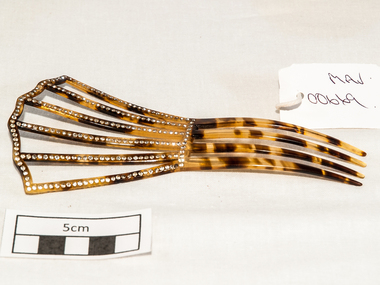
... wide range of synthetic or semi-synthetic organics that are malleable and can be moulded into solid objects of diverse shapes. Due to their relatively low cost, ease of manufacture, versatility, and imperviousness to water, plastics are used in an enormous and expanding range of products. They displaced many traditional materials, such as wood, stone, horn and bone, leather, paper, metal, glass, and ceramic, in most of their former uses including jewellery. Parkesine is considered the first man-made plastic. The plastic material was patented by Alexander Parkes...wide range of synthetic or semi-synthetic organics that are malleable and can be moulded into solid objects of diverse shapes. Due to their relatively low cost, ease of manufacture, versatility, and imperviousness to water, plastics are used in an enormous and expanding range of products. They displaced many traditional materials, such as wood, stone, horn and bone, leather, paper, metal, glass, and ceramic, in most of their former uses including jewellery. Parkesine is considered the first man-made plastic. The plastic material was patented by Alexander Parkes ...A hair fashion accessory for 20thCentury ladies. Plastic is a material consisting of any of a wide range of synthetic or semi-synthetic organics that are malleable and can be moulded into solid objects of diverse shapes. Due to their relatively low cost, ease of manufacture, versatility, and imperviousness to water, plastics are used in an enormous and expanding range of products. They displaced many traditional materials, such as wood, stone, horn and bone, leather, paper, metal, glass, and ceramic, in most of their former uses including jewellery. Parkesine is considered the first man-made plastic. The plastic material was patented by Alexander Parkes, In Birmingham, UK in 1856.The world's first fully synthetic plastic was bakelite, invented in New York in 1907 by Leo Baekeland who coined the term 'plastics'. After World War I, improvements in chemical technology led to an explosion in new forms of plastics, with mass production beginning in the 1940s during World War 11 due to shortages of silk and ivory.A plastic, tortoise shell pattern, lady's hair-comb in the mantilla style with diamante decoration.hair fashion, hairdressing, coiffure, plastic, personal effects, jewellery, moorabbin, bentleigh, cheltenham, early settlers, world war 1 1914-1918, world war 11 1939-1945, silk, ivory, bakelite, -
 City of Moorabbin Historical Society (Operating the Box Cottage Museum)
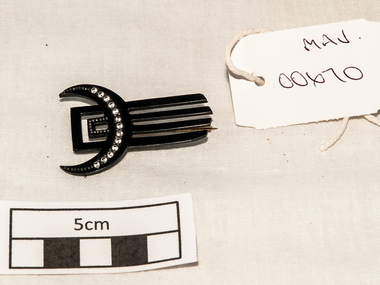
Jewellery, small plastic brooch, 20thC
... wide range of synthetic or semi-synthetic organics that are malleable and can be moulded into solid objects of diverse shapes. Due to their relatively low cost, ease of manufacture, versatility, and imperviousness to water, plastics are used in an enormous and expanding range of products. They displaced many traditional materials, such as wood, stone, horn and bone, leather, paper, metal, glass, and ceramic, in most of their former uses including jewellery. Parkesine is considered the first man-made plastic. The plastic material was patented by Alexander Parkes...wide range of synthetic or semi-synthetic organics that are malleable and can be moulded into solid objects of diverse shapes. Due to their relatively low cost, ease of manufacture, versatility, and imperviousness to water, plastics are used in an enormous and expanding range of products. They displaced many traditional materials, such as wood, stone, horn and bone, leather, paper, metal, glass, and ceramic, in most of their former uses including jewellery. Parkesine is considered the first man-made plastic. The plastic material was patented by Alexander Parkes ...A plastic, costume jewellery, fashion accessory for early 20th Century ladies Plastic is a material consisting of any of a wide range of synthetic or semi-synthetic organics that are malleable and can be moulded into solid objects of diverse shapes. Due to their relatively low cost, ease of manufacture, versatility, and imperviousness to water, plastics are used in an enormous and expanding range of products. They displaced many traditional materials, such as wood, stone, horn and bone, leather, paper, metal, glass, and ceramic, in most of their former uses including jewellery. Parkesine is considered the first man-made plastic. The plastic material was patented by Alexander Parkes, In Birmingham, UK in 1856.The world's first fully synthetic plastic was bakelite, invented in New York in 1907 by Leo Baekeland who coined the term 'plastics'. After World War I, improvements in chemical technology led to an explosion in new forms of plastics, with mass production beginning in the 1940s during World War 11 due to shortages of silk and ivory. A small, black plastic brooch with a verticle pin at back and diamante decoration .fashion, costume jewellery, personal effects, moorabbin, bentleigh, cheltenham, early settlers, jewellery, plastic -
 Montmorency–Eltham RSL Sub Branch
Album - Nicholson Photo Album
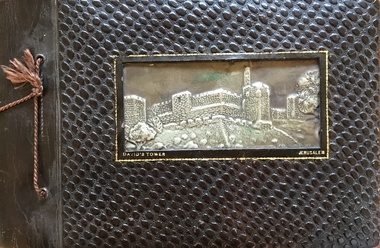
... The wider Watson family was well-known in the area, and the sisters Kathleen and Ruby were residents in the Glen Park area in Eltham North. ...The wider Watson family was well-known in the area, and the sisters Kathleen and Ruby were residents in the Glen Park area in Eltham North. ...Photographic record of overseas places visited by local resident who was a member of armed service during WW2. Des Nicholson was born in Northcote in 1909. He enlisted in the military in mid 1940, having already served 2 years in the Citizens’ Forces. Before he signed up, he lived in Kew with his mother, Isabella. His enlistment documents indicate that he was employed as a transport driver, although his discharge papers state that he was a hairdresser. His photo album shows pictures of him demonstrating skills in that area in various deployments overseas; his enlistment documents refer to his unit being the 8th Division Petrol Company, while for much of his service he was assigned to Nursing Duties in the 2/7 Australian General Hospital. His overseas postings included travels through India to the Middle East, Egypt and Greece. While fulfilling these duties, he was an interested photographer, keeping records of the sights he saw in many of the places he visited, as well as photos of the military living conditions and the people he worked with on a day-to-day basis. The ‘tourist’ photos Des took would be of particular interest as a current-day comparison for those folk who might be familiar with the locations he passed through. After the war, Des again lived with his mother but eventually, in 1953, he married Kathleen Watson who lived in Eltham. The wider Watson family was well-known in the area, and the sisters Kathleen and Ruby were residents in the Glen Park area in Eltham North. After Des and Kath married they continued to live in Kath and Ruby’s house near where the current soccer and cricket sporting complex is now located. Ruby never married and they evidently stayed in the same place until, one by one, they each died in the early 2000s. Photos taken by a resident of Eltham while on active service overseasPhoto AlbumOn Front Cover: DAVID'S TOWER JERUSALEMphotographs, ww2, overseas, india, middle east -
 Greensborough Historical Society
Photograph, Main Road bridge looking to township of Greensborough, 1929c
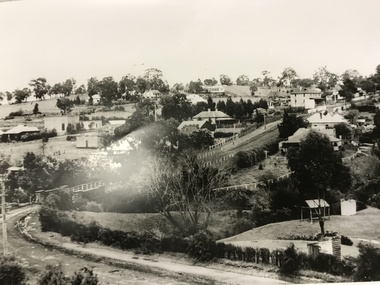
... park. Looking up Main Street we see the old Chapman house at the corner of Poulter Avenue and some newer houses below this. The stone river bridge appears to be only a single lane wide and the road approaching the bridge is unsealed. ...park. Looking up Main Street we see the old Chapman house at the corner of Poulter Avenue and some newer houses below this. The stone river bridge appears to be only a single lane wide and the road approaching the bridge is unsealed. ...View of Main Street Greensborough from Partington's Hill including Plenty River bridge and Marble Hall on corner of Carter Street (now Para Road) and Main Street. This view of Greensborough Park shows the old pan toilets, the hawthorn fence line and the rather undeveloped roadside area of the park. Looking up Main Street we see the old Chapman house at the corner of Poulter Avenue and some newer houses below this. The stone river bridge appears to be only a single lane wide and the road approaching the bridge is unsealed. The rail bridge shows evidence of soot from steam trains and at the extreme left of picture the two concrete buildings indicate the line had been electrified. This occurred in 1923. Sparse housing is seen in the Flintoff Street and Grimshaw Street area.Part of a collection of photographic enlargements of views of Greensborough in the early 1900s.Black and white enlargement of photographic imagemain street greensborough, marble hall, greensborough railway, chapman house, greensborough park, poulter avenue greensborough, carter street, para road
