
Showing 3 items matching "parrot family"
-
 Cobden & District Historical Society
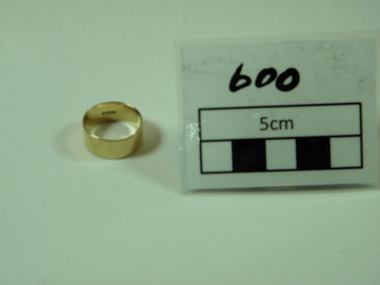
wedding ring, 1857
... ...parrot family...This gold ring inscribed with the initials E.P.once belonged to Mrs Emma Parrot (nee Hales ) who married to Charles Parrot in 1857. The Parrot family were some of the earliest settlers in the district and there is now a Parrot Street in Cobden. ...This gold ring inscribed with the initials E.P.once belonged to Mrs Emma Parrot (nee Hales ) who married to Charles Parrot in 1857. The Parrot family were some of the earliest settlers in the district and there is now a Parrot Street in Cobden. early settlers gold wedding ring parrot family cobden 1850s This is a plain gold band that is known as a wedding ring and was given by a man to his wife on the occasion of their marrige. wedding ring ...This gold ring inscribed with the initials E.P.once belonged to Mrs Emma Parrot (nee Hales ) who married to Charles Parrot in 1857. The Parrot family were some of the earliest settlers in the district and there is now a Parrot Street in Cobden. This is a plain gold band that is known as a wedding ring and was given by a man to his wife on the occasion of their marrige.early settlers, gold wedding ring, parrot family, cobden, 1850s -
 The Beechworth Burke Museum
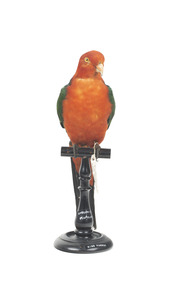
Animal specimen - King Parrot, Trustees of the Australian Museum, 1860-1880
... King parrots are normally encountered in pairs or family groups. This particular specimen has duller colour and appears more orange with a misshapen head ...King parrots are normally encountered in pairs or family groups. This particular specimen has duller colour and appears more orange with a misshapen head Animal specimen King Parrot Trustees of the Australian Museum Burke Museum Committee ...This specimen is part of a collection of almost 200 animal specimens that were originally acquired as skins from various institutions across Australia, including the Australian Museum in Sydney and the National Museum of Victoria (known as Museums Victoria since 1983), as well as individuals such as amateur anthropologist Reynell Eveleigh Johns between 1860-1880. These skins were then mounted by members of the Burke Museum Committee and put-on display in the formal space of the Museum’s original exhibition hall where they continue to be on display. This display of taxidermy mounts initially served to instruct visitors to the Burke Museum of the natural world around them, today it serves as an insight into the collecting habits of the 19th century. The red-and green Australian King-Parrot is seldom seen flying above the tree tops of the dense forests which it inhabits — it prefers to fly below tree level, weaving in and out through the tree trunks instead. When they are disturbed by a person, they usually fly off with a harsh screech, and often do not land until they are lost to view. Their flight is swift and strong, characterised by deep, rhythmic wing-beats and regularly punctuated with rapid twists and turns.This specimen is part of a significant and rare taxidermy mount collection in the Burke Museum. This collection is scientifically and culturally important for reminding us of how science continues to shape our understanding of the modern world. They demonstrate a capacity to hold evidence of how Australia’s fauna history existed in the past and are potentially important for future environmental research. This collection continues to be on display in the Museum and has become a key part to interpreting the collecting habits of the 19th century. Male Australian King-Parrots are the only Australian parrots with a completely red head. Females are similar to males except that they have a completely green head and breast. Both sexes have a red belly and a green back, with green wings and a long green tail. King parrots are normally encountered in pairs or family groups. This particular specimen has duller colour and appears more orange with a misshapen head Label: National Museum Victoria / King Parrot / Aprosmietus W5435 / Gris (recht) Mount: APPOSMICTUS / SCAPULARIS / King Parrottaxidermy, parrot, bird, king parrot -
 Mont De Lancey
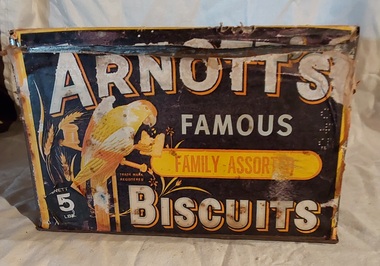
Container, Arnott's Pty Ltd, Biscuit Tin, c1920's
... Family Assorted Biscuits tin, NETT 5LBS 645. Trademark Registered. It is square shaped with a hinged lid. It has a paper label with black, yellow, red and white lettering, on the front, top and sides. 'Please keep the lid closed to preserve contents'. On the left side of the tin's paper label is a parrot...Family Assorted Biscuits tin, NETT 5LBS 645. Trademark Registered. It is square shaped with a hinged lid. It has a paper label with black, yellow, red and white lettering, on the front, top and sides. 'Please keep the lid closed to preserve contents'. On the left side of the tin's paper label is a parrot ...c.1924 Arnott's Family Assorted biscuits were popular as they are today. The tin would have been reused as a storage container for other household items.An antique metal ARNOTT'S Famous Family Assorted Biscuits tin, NETT 5LBS 645. Trademark Registered. It is square shaped with a hinged lid. It has a paper label with black, yellow, red and white lettering, on the front, top and sides. 'Please keep the lid closed to preserve contents'. On the left side of the tin's paper label is a parrot sitting on a wooden perch eating a biscuit. Wheat stalks and flowers decorate around the bird. It is very rare.On the top of the tin is a paper label in black the red saying ' 'This tin is the property of Arnott's Biscuits Pty Ltd., N.S.W. Division. Forty Cents Deposit paid on this tin will be refunded on return in returned in good order and condition with this label attached. Keep the lid closed down. In red lettering 'Arnott's FAMILY ASSORTED'. Stamped on the base is ' 'This tin is the property of William Arnott Pty. Ltd. Homebush 5037'. No. 6095 stamped onto base. biscuits, biscuit containers, foodstuffs
