
Showing 11 items matching "participation in community sport "
-
 Marysville & District Historical Society
THE TRIANGLE NEWS-VOL 36 NO 23-JUNE 26 2009
... ...participation in community sport & recreation...marysville victoria australia new cafe cross country ski hire greg and lianne mcewen new mobile coffee van marysville central update volunteers needed cathedral views natural therapies progress report wanted what's on when buxton progress assocn meeting murrindindi regional tourism assocn agm marysville & district lions club upper goulburn wine & food expo business recovery information sessions lake mountain resort murrindindi shire council sustainable building workshop moreland energy foundation murrindindi climate network kinglake west hall tourism industry recovery workshops mobile vet service triangle distribution centre taggerty odd job service black spur inn michael & margaret wood senior citizens hall seniors affected by bushfires concert advertisements lions triangle tool library church notices councillor comment marysville christian fellowship new firewood distribution plan house signs ready alexandra masonic centre marysville medical clinic fallons free bus service mayor's chair participation in community sport & recreation picsar council rate waiver murrindindi bushfire reconstruction vision for marysville upper goulburn food & wine trail marysville & triangle phoenix workshop victorian bushfire reconstruction & recovery authority vbrra land for sale triangle arts group marysville & lake mountain visitor centre volunteers required tarra warra museum of art new free entry program latest news from matdg THE TRIANGLE NEWS-VOL 36 NO 23-JUNE 26 2009 ...marysville, victoria, australia, new cafe, cross country ski hire, greg and lianne mcewen, new mobile coffee van, marysville central update, volunteers needed, cathedral views natural therapies, progress report, wanted, what's on when, buxton progress assocn meeting, murrindindi regional tourism assocn agm, marysville & district lions club, upper goulburn wine & food expo, business recovery information sessions, lake mountain resort, murrindindi shire council, sustainable building workshop, moreland energy foundation, murrindindi climate network, kinglake west hall, tourism industry recovery workshops, mobile vet service, triangle distribution centre, taggerty odd job service, black spur inn, michael & margaret wood, senior citizens hall, seniors affected by bushfires concert, advertisements, lions triangle tool library, church notices, councillor comment, marysville christian fellowship, new firewood distribution plan, house signs ready, alexandra masonic centre, marysville medical clinic, fallons free bus service, mayor's chair, participation in community sport & recreation, picsar, council rate waiver, murrindindi bushfire reconstruction, vision for marysville, upper goulburn food & wine trail, marysville & triangle phoenix workshop, victorian bushfire reconstruction & recovery authority, vbrra, land for sale, triangle arts group, marysville & lake mountain visitor centre, volunteers required, tarra warra museum of art, new free entry program, latest news from matdg -
 Yarra City Council
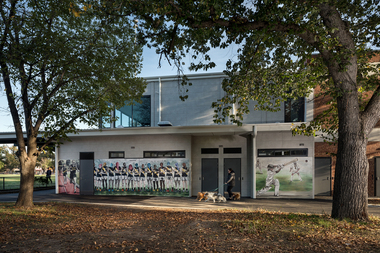
Artwork, other - Mural, Fiona McMonagle, The Park, 2022
... community’s diverse interests and values and enables participation and interaction. 'The Park' focuses on the recreational uses of Citizens Park and its role as a community space in an area that is changing rapidly. The mural consists of three panels that address inclusivity and access to sport...community’s diverse interests and values and enables participation and interaction. 'The Park' focuses on the recreational uses of Citizens Park and its role as a community space in an area that is changing rapidly. The mural consists of three panels that address inclusivity and access to sport ...'The first panel celebrates the long history of runners that use the park. Richmond Harriers Athletics Club was established in 1913 and is the oldest athletics club in Victoria. The central panel depicts young female footballers and recognises female athletes and the popularity of women and girls' teams in contemporary sports. The final panel depicts a children’s cricket match. The young players are represented through the depiction of a game that is part of our national psyche and firmly entrenched in Australian culture.'Inner-city parks like Citizens Park have many diverse uses. They provide places to play, to exercise and to relax. They are spaces for community and are often subject to competing values and interests. The re-development of the Jack Dyer Pavilion at Citizens Park allows for the growth of the local community’s diverse interests and values and enables participation and interaction. 'The Park' focuses on the recreational uses of Citizens Park and its role as a community space in an area that is changing rapidly. The mural consists of three panels that address inclusivity and access to sport. Three core sporting groups who each utilize the pavilion and park as a public recreational space are represented: children, sport teams and runners. In fostering the representation of these groups, the panels also attest to the past, present, and future of this important space.Three sporting groups are represented: athletics/runners, women footballers in line formation and young cricketers in action/play. Accompanying plaquesport, women, community, richmond, parks -
 Victorian Aboriginal Corporation for Languages
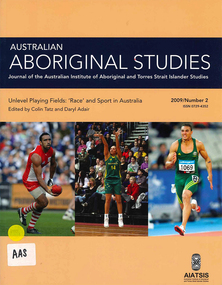
Periodical, Australian Institute of Aboriginal and Torres Strait Islander Studies, Australian Aboriginal studies : journal of the Australian Institute of Aboriginal and Torres Strait Islander Studies, 2009
... sport was their private domain and strictly controlled non-white participation. Australian Rules football, established in Darwin from 1916, was the first sport in which ?Coloured? sportsmen challenged this domination. Football became a battleground for recognition, rights and identity for all groups. The ?Coloured? community...sport was their private domain and strictly controlled non-white participation. Australian Rules football, established in Darwin from 1916, was the first sport in which ?Coloured? sportsmen challenged this domination. Football became a battleground for recognition, rights and identity for all groups. The ?Coloured? community ...Darkness and a little light: ?Race? and sport in Australia Colin Tatz (AIATSIS & Australian National University) and Daryl Adair (University of Technology Sydney) Despite ?the wonderful and chaotic universe of clashing colors, temperaments and emotions, of brave deeds against odds seemingly insuperable?, sport is mixed with ?mean and shameful acts of pure skullduggery?, villainy, cowardice, depravity, rapaciousness and malice. Thus wrote celebrated American novelist Paul Gallico on the eve of the Second World War (Gallico 1938 [1988]:9-10). An acute enough observation about society in general, his farewell to sports writing also captures the ?clashing colors? in Australian sport. In this ?land of the fair go?, we look at the malice of racism in the arenas where, as custom might have it, one would least want or expect to find it. The history of the connection between sport, race and society - the long past, the recent past and the social present - is commonly dark and ugly but some light and decency are just becoming visible. Coming to terms: ?Race?, ethnicity, identity and Aboriginality in sport Colin Tatz (AIATSIS & Australian National University) Notions of genetic superiority have led to some of the world?s greatest human calamities. Just as social scientists thought that racial anthropology and biology had ended with the cataclysm of the Second World War, so some influential researchers and sports commentators have rekindled the pre-war debate about the muscular merits of ?races? in a new discipline that Nyborg (1994) calls the ?science of physicology?. The more recent realm of racial ?athletic genes?, especially within socially constructed black athletic communities, may intend no malice but this search for the keys to their success may well revive the old, discredited discourses. This critical commentary shows what can happen when some population geneticists and sports writers ignore history and when medical, biological and sporting doctrines deriving from ?race? are dislocated from any historical, geographic, cultural and social contexts. Understanding discourses about race, racism, ethnicity, otherness, identity and Aboriginality are essential if sense, or nonsense, is to be made of genetic/racial ?explanations? of sporting excellence. Between the two major wars boxing was, disproportionately, a Jewish sport; Kenyans and Ethiopians now ?own? middle- and long-distance running and Jamaicans the shorter events; South Koreans dominate women?s professional golf. This essay explores the various explanations put forward for such ?statistical domination?: genes, biochemistry, biomechanics, history, culture, social dynamics, the search for identity, alienation, need, chance, circumstances, and personal bent or aptitude. Traditional games of a timeless land: Play cultures in Aboriginal and Torres Strait Islander communities Ken Edwards (University of Southern Queensland) Sports history in Australia has focused almost entirely on modern, Eurocentric sports and has therefore largely ignored the multitude of unique pre- European games that are, or once were, played. The area of traditional games, especially those of Aboriginal and Torres Strait Islander peoples, is an important aspect of the cultural, social and historical experiences of Indigenous communities. These activities include customs of play that are normally not associated with European notions of competitive sport. Overall, this paper surveys research undertaken into traditional games among Indigenous Australians, as well as proposals for much needed further study in this area. Culture, ?race? and discrimination in the 1868 Aboriginal cricket tour of England David Sampson As a consequence of John Mulvaney?s important historical research, the Aboriginal cricket and performance tour of Britain in 1868 has in recent decades become established as perhaps the most famous of all public events in contact history involving Aborigines, white settlers and the British metropolis. Although recognition of its importance is welcome and significant, public commemorations of the tour have enveloped the tour in mythologies of cricket and nation. Such mythologies have obscured fundamental aspects of the tour that were inescapable racial and colonial realities of the Victorian era. This reappraisal of the tour explores the centrality of racial ideology, racial science and racial power imbalances that enabled, created and shaped the tour. By exploring beyond cricketing mythology, it restores the central importance of the spectacular performances of Aboriginal skills without which the tour would have been impossible. Such a reappraisal seeks to fully recognise the often trivialised non-cricketing expertise of all of the Aboriginal performers in 1868 for their achievement of pioneering their unique culture, skills and technologies to a mass international audience. Football, ?race? and resistance: The Darwin Football League, 1926?29 Matthew Stephen (Northern Territory Archive Service) Darwin was a diverse but deeply divided society in the early twentieth century. The Commonwealth Government introduced the Aboriginals Ordinance 1911 in the Northern Territory, instituting state surveillance, control and a racially segregated hierarchy of whites foremost, then Asians, ?Coloureds? (Aborigines and others of mixed descent) and, lastly, the so-called ?full-blood? Aborigines. Sport was important in scaffolding this stratification. Whites believed that sport was their private domain and strictly controlled non-white participation. Australian Rules football, established in Darwin from 1916, was the first sport in which ?Coloured? sportsmen challenged this domination. Football became a battleground for recognition, rights and identity for all groups. The ?Coloured? community embraced its team, Vesteys, which dominated the Northern Territory Football League (NTFL) in the 1920s. In 1926, amidst growing racial tension, the white-administered NTFL changed its constitution to exclude non-white players. In reaction, ?Coloured? and Chinese footballers formed their own competition - the Darwin Football League (DFL). The saga of that colour bar is an important chapter in Australia?s football history, yet it has faded from Darwin?s social memory and is almost unknown among historians. That picture - Nicky Winmar and the history of an image Matthew Klugman (Victoria University) and Gary Osmond (The University of Queensland) In April 1993 Australian Rules footballer Nicky Winmar responded to on-field racist abuse by lifting his jersey and pointing to his chest. The photographic image of that event is now famous as a response to racial abuse and has come to be seen as starting a movement against racism in football. The racial connotations in the image might seem a foregone conclusion: the power, appeal and dominant meaning of the photograph might appear to be self-evident. But neither the fame of the image nor its racial connotation was automatic. Through interviews with the photographers and analysis of the use of the image in the media, we explore how that picture came to be of such symbolic importance, and how it has remained something to be re-shown and emulated. Rather than analyse the image as a photograph or work of art, we uncover some of its early history and explore the debates that continue to swirl around its purpose and meaning. We also draw attention to the way the careful study of photographs might enhance the study of sport, race and racism. ?She?s not one of us?: Cathy Freeman and the place of Aboriginal people in Australian national culture Toni Bruce (University of Waikato) and Emma Wensing (Independent scholar) The Sydney 2000 Olympic Games generated a national media celebration of Aboriginal 400 metre runner Cathy Freeman. The construction of Freeman as the symbol of national reconciliation was evident in print and on television, the Internet and radio. In contrast to this celebration of Freeman, the letters to the editor sections of 11 major newspapers became sites for competing claims over what constitutes Australian identity and the place of Aboriginal people in national culture. We analyse this under-explored medium of opinion and discuss how the deep feelings evident in these letters, and the often vitriolic responses to them, illustrate some of the enduring racial tensions in Australian society. Sport, physical activity and urban Indigenous young people Alison Nelson (The University of Queensland) This paper challenges some of the commonly held assumptions and ?knowledges? about Indigenous young people and their engagement in physical activity. These include their ?natural? ability, and the use of sport as a panacea for health, education and behavioural issues. Data is presented from qualitative research undertaken with a group of 14 urban Indigenous young people with a view to ?speaking back? to these commentaries. This research draws on Critical Race Theory in order to make visible the taken-for-granted assumptions about Indigenous Australians made by the dominant white, Western culture. Multiple, shifting and complex identities were expressed in the young people?s articulation of the place and meaning of sport and physical activity in their lives. They both engaged in, and resisted, dominant Western discourses regarding representations of Indigenous people in sport. The paper gives voice to these young people in an attempt to disrupt and subvert hegemonic discourses. An unwanted corroboree: The politics of the New South Wales Aboriginal Rugby League Knockout Heidi Norman (University of Technology Sydney) The annual New South Wales Aboriginal Rugby League Knockout is so much more than a sporting event. Involving a high level of organisation, it is both a social and cultural coming together of diverse communities for a social and cultural experience considered ?bigger than Christmas?. As if the planning and logistics were not difficult enough, the rotating-venue Knockout has been beset, especially since the late 1980s and 1990s, by layers of opposition and open hostility based on ?race?: from country town newspapers, local town and shire councils, local business houses and, inevitably, the local police. A few towns have welcomed the event, seeing economic advantage and community good will for all. Commonly, the Aboriginal ?influx? of visitors and players - people perceived as ?strangers?, ?outsiders?, ?non-taxpayers? - provoked public fear about crime waves, violence and physical safety, requiring heavy policing. Without exception, these racist expectations were shown to be totally unfounded. Research report: Recent advances in digital audio recorder technology provide considerable advantages in terms of cost and portability for language workers.b&w photographs, colour photographs, tablessport and race, racism, cathy freeman, nicky winmar, rugby league, afl, athletics, cricket, digital audio recorders -
 Sunshine and District Historical Society Incorporated
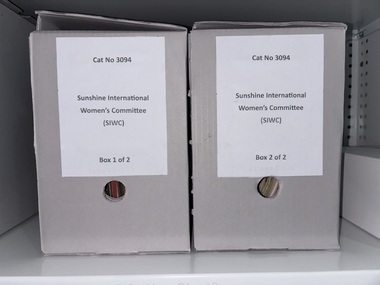
Archive - Sunshine International Women's Committee (SIWC)
... community 1977 by Jill Cullen, Elizabeth Fahey & Sr. Chanel Williams including comments on Marian College, St. Paul's Primary School and St. Paul's Kindergarten|Western Region Urban Enviroment Advisory Centre Inc WESTURB|Mary MacKllop Beatification Function Sydney 19th January 1995|School adjustment survey|Palm Sunday & Nuclear Disarmament|Women & Sport - Increasing female participation in sport|Stop Australia's Nuclear Visitors "USS Warships" sponsored by Sunshine City Council flyer|Letter to Gwen Goedecke from Jane Howarth, Convenor 'Save the Children of Iraq' (1999)...community 1977 by Jill Cullen, Elizabeth Fahey & Sr. Chanel Williams including comments on Marian College, St. Paul's Primary School and St. Paul's Kindergarten|Western Region Urban Enviroment Advisory Centre Inc WESTURB|Mary MacKllop Beatification Function Sydney 19th January 1995|School adjustment survey|Palm Sunday & Nuclear Disarmament|Women & Sport - Increasing female participation in sport|Stop Australia's Nuclear Visitors "USS Warships" sponsored by Sunshine City Council flyer|Letter to Gwen Goedecke from Jane Howarth, Convenor 'Save the Children of Iraq' (1999) 2 boxes of a large collection of documents on the Sunshine International Women's Committee (SIWC) Archive Sunshine International Women's Committee (SIWC) ...Came from the Gwen Goedecke CollectionSunshine International Women's Committee (SIWC) 1975 - 2000s|Women's issues in the West|International Women's Year|Correspondence|Minutes|Financial Statements|Flyers for events|Newspaper Articles|Correspondence regarding the publication of this Women of the West book|Brief history of the Women's committee|School experience and the community 1977 by Jill Cullen, Elizabeth Fahey & Sr. Chanel Williams including comments on Marian College, St. Paul's Primary School and St. Paul's Kindergarten|Western Region Urban Enviroment Advisory Centre Inc WESTURB|Mary MacKllop Beatification Function Sydney 19th January 1995|School adjustment survey|Palm Sunday & Nuclear Disarmament|Women & Sport - Increasing female participation in sport|Stop Australia's Nuclear Visitors "USS Warships" sponsored by Sunshine City Council flyer|Letter to Gwen Goedecke from Jane Howarth, Convenor 'Save the Children of Iraq' (1999)sunshine international women's committee, siwc -
 Broadmeadows Historical Society & Museum
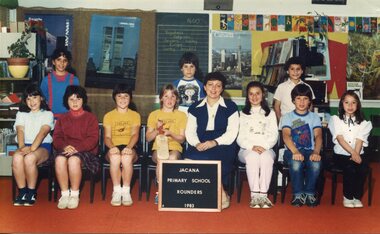
Photograph - Group Photograph, Jacana Primary School; Rounders, 1983, 1983
... community ties. Sport and physical education were central to student life at Jacana Primary, with games like rounders offering opportunities for teamwork, physical development, and social interaction. Rounders, a bat-and-ball game with similarities to baseball, was a popular playground and inter-school sport during the 1980s, especially among primary-aged students. The 1983 Rounders group photograph captures the spirit of school sport during this era—highlighting the importance of participation...community ties. Sport and physical education were central to student life at Jacana Primary, with games like rounders offering opportunities for teamwork, physical development, and social interaction. Rounders, a bat-and-ball game with similarities to baseball, was a popular playground and inter-school sport during the 1980s, especially among primary-aged students. The 1983 Rounders group photograph captures the spirit of school sport during this era—highlighting the importance of participation ...Jacana Primary School, established in 1959 in Melbourne’s northern suburbs, was part of a post-war expansion of public education aimed at supporting families in rapidly growing suburban communities. By 1983, the school had become a well-established institution, known for its inclusive environment and strong community ties. Sport and physical education were central to student life at Jacana Primary, with games like rounders offering opportunities for teamwork, physical development, and social interaction. Rounders, a bat-and-ball game with similarities to baseball, was a popular playground and inter-school sport during the 1980s, especially among primary-aged students. The 1983 Rounders group photograph captures the spirit of school sport during this era—highlighting the importance of participation, camaraderie, and school pride. It also reflects broader trends in 1980s school life, including uniforms, hairstyles, and recreational activities. As Jacana Primary has since closed, this image serves as a valuable record of the school’s vibrant sporting culture and its role in shaping the everyday experiences of students in Melbourne’s north.The 1983 Rounders group photograph from Jacana Primary School is a culturally and historically significant artefact that captures the spirit of student life and sport during a formative period in the school’s history. Taken in the early 1980s, the image reflects the importance of physical education and recreational activities in fostering teamwork, resilience, and social connection among students. Rounders, a popular playground sport at the time, was emblematic of the informal yet meaningful ways children engaged with one another and built community within the school setting. The photograph also offers a visual snapshot of the era, showcasing the fashion, hairstyles, and outdoor culture of Australian primary schools in the 1980s. As Jacana Primary School has since closed, this image serves as a lasting tribute to the everyday experiences that shaped the lives of students and staff. It preserves the memory of a school that played a vital role in the social and educational development of children in Melbourne’s northern suburbs.A colour photograph on satin finish paper(Back blue label): PH-5388, (Back-stamp): Fujicolor /Paperjacana, jacana primary school, group photograph, team photograph, rounders, 1983 -
 Broadmeadows Historical Society & Museum
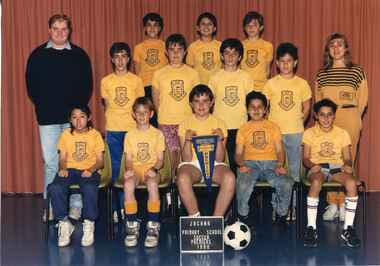
Photograph - Team Photograph, Jacana Primary School: Soccer Premiers 1990
... sport’s popularity mirrored the cultural heritage of many students, making it both a recreational and symbolic activity. The 1990 Soccer Premiers photograph captures a moment of triumph and togetherness during this dynamic period. More than a record of athletic success, it embodies the school’s values of inclusion, participation, and community...sport’s popularity mirrored the cultural heritage of many students, making it both a recreational and symbolic activity. The 1990 Soccer Premiers photograph captures a moment of triumph and togetherness during this dynamic period. More than a record of athletic success, it embodies the school’s values of inclusion, participation, and community ...Jacana Primary School, established in 1959 amid Melbourne’s post-war suburban expansion, was a cornerstone of the Jacana community for over four decades. Built to serve families settling in newly developed housing estates in the northern corridor, the school quickly became a hub for education, inclusion, and community connection. Its student population reflected the area’s growing diversity, with many migrant families contributing to a vibrant and evolving school culture. By the late 1980s, Jacana Primary had earned recognition not only for its academic programs but also for its strong commitment to extracurricular activities. Soccer, in particular, emerged as a defining feature of school life. It united students across cultural and social backgrounds, fostering teamwork, resilience, and a deep sense of school pride. The sport’s popularity mirrored the cultural heritage of many students, making it both a recreational and symbolic activity. The 1990 Soccer Premiers photograph captures a moment of triumph and togetherness during this dynamic period. More than a record of athletic success, it embodies the school’s values of inclusion, participation, and community spirit. It stands as a testament to Jacana Primary’s role in nurturing personal growth and social cohesion through sport. Though Jacana Primary School closed in the early 2000s, its legacy lives on in images like this—offering a window into the lived experiences of students and the social fabric of Melbourne’s northern suburbs during a time of transformation.The 1990 Soccer Premiers photograph from Jacana Primary School is a culturally and historically significant artifact that reflects the school’s role as a vital educational and social institution in Melbourne’s northern suburbs. Established in 1959 during a period of rapid suburban development, Jacana Primary served a diverse and growing community, including many migrant families whose cultural backgrounds enriched the school’s identity. This image captures more than a moment of sporting success—it embodies the inclusive spirit, resilience, and camaraderie that defined Jacana Primary’s approach to education. Soccer was a central part of school life, bridging cultural divides and fostering a sense of belonging among students. The photograph stands as a testament to the school’s commitment to holistic development, where extracurricular activities played a key role in shaping character and community cohesion. Although Jacana Primary School closed in the early 2000s, its legacy endures through visual records like this one, offering valuable insight into the lived experiences of students and the evolving social fabric of Melbourne’s northern corridor during a transformative era.A colour photograph on Matte embossed photo paper.PH-5339(blue label) This paper/ Manufactured/ By Kodakjacana primary school, photograph, school photograph, education, soccer team, 1990, jacana -
 Broadmeadows Historical Society & Museum
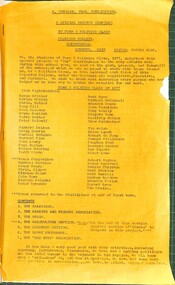
Document - School Project, A Jubilee Year Publication, 1977
... sport, and alumni—and its collaborative spirit. It offers a rare and valuable insight into how students of the time understood and interpreted the structure and culture of their school community. As a preserved artifact, this publication contributes meaningfully to the archival record of Salesian College. It not only documents the educational and social environment of the late 1970s but also highlights the enduring values of participation ...This 1977 Jubilee Year publication was a special project undertaken by the Form 5 Politics Class at Salesian College, Rupertswood, as part of the school’s commemorative efforts to reflect on its past, present, and future. Created during a year of celebration and reflection, the project was both a civic and educational exercise, allowing students to explore the structure and culture of their school through the lens of political systems. Organised under the themes of Legislative, Executive, and Judicial branches, the publication presents a unique and structured interpretation of the college’s operations and community life. It includes contributions on key aspects of the school such as the Salesian order, the Parents and Friends Association, academic and sporting programs, the media, and the Old Boys’ Association. The project reflects the educational ethos of the time—encouraging inquiry, collaboration, and pride in one’s school. It also highlights the role of student voice in shaping the narrative of the college’s history. As a student-led initiative, this publication stands as a testament to the creativity, engagement, and reflective spirit of the 1977 cohort.This 1977 Jubilee Year publication, compiled by the Form 5 Politics Class at Salesian College, Rupertswood, is a significant historical document that captures the voice, perspective, and civic engagement of students during a milestone year in the college’s history. Created as a special project, the publication reflects a thoughtful and structured examination of the school’s identity through the lens of political systems—Legislative, Executive, and Judicial—demonstrating both creativity and critical thinking. The document is notable for its student-led authorship, its comprehensive scope—including reflections on the Salesians, the Parents and Friends Association, media, agriculture, academics, sport, and alumni—and its collaborative spirit. It offers a rare and valuable insight into how students of the time understood and interpreted the structure and culture of their school community. As a preserved artifact, this publication contributes meaningfully to the archival record of Salesian College. It not only documents the educational and social environment of the late 1970s but also highlights the enduring values of participation, reflection, and pride in community that continue to define the Rupertswood legacy.A 27 page stapled document, with a yellow front page (cover), detailing the history of Salesian College, Sunbury to 1977.salesian college, rupertswood, sunbury, 1977, jubilee -
 Broadmeadows Historical Society & Museum
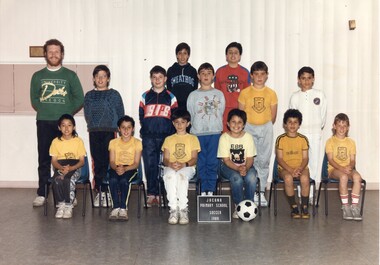
Photograph - Team Photograph, Jacana Primary School: Soccer Team 1989
... Sport, particularly soccer, played a central role in school life. It was a unifying force that brought students together across cultural and social backgrounds, fostering teamwork, resilience, and school spirit. Soccer’s popularity reflected broader demographic trends, as many students came from communities where the sport held cultural significance. The 1989 soccer team photograph captures this dynamic period in the school’s history. It represents more than athletic achievement—it reflects the values of inclusion, participation...Sport, particularly soccer, played a central role in school life. It was a unifying force that brought students together across cultural and social backgrounds, fostering teamwork, resilience, and school spirit. Soccer’s popularity reflected broader demographic trends, as many students came from communities where the sport held cultural significance. The 1989 soccer team photograph captures this dynamic period in the school’s history. It represents more than athletic achievement—it reflects the values of inclusion, participation ...Jacana Primary School was established in 1959 during a period of significant suburban growth in Melbourne’s northern corridor. Located in the suburb of Jacana, the school was part of a broader post-war initiative to provide accessible public education to families settling in newly developed housing estates. The area became home to a diverse population, including many migrant families, contributing to a rich and evolving community identity. By the late 1980s, Jacana Primary had developed a strong reputation not only for its academic programs but also for its vibrant extracurricular activities. Sport, particularly soccer, played a central role in school life. It was a unifying force that brought students together across cultural and social backgrounds, fostering teamwork, resilience, and school spirit. Soccer’s popularity reflected broader demographic trends, as many students came from communities where the sport held cultural significance. The 1989 soccer team photograph captures this dynamic period in the school’s history. It represents more than athletic achievement—it reflects the values of inclusion, participation, and pride that defined Jacana Primary’s approach to education. The image also serves as a visual record of the school’s role in shaping community cohesion and providing opportunities for personal growth beyond the classroom. Jacana Primary School closed in the early 2000s, but its legacy endures through photographs like this one, which offer valuable insights into the lived experiences of students and the social fabric of Melbourne’s northern suburbs during a time of transformation.This 1989 colour photograph of Jacana Primary School’s soccer team captures the vitality and camaraderie of a school that stood as a pillar of its community from 1959 until its closure in the early 2000s. Far more than a routine team portrait, the image embodies the spirited sporting culture that was central to student life and community connection during the late 1980s. The photograph preserves treasured memories of teamwork, school pride, and youthful enthusiasm, offering a lens into the social atmosphere and extracurricular priorities of the time. It serves as a visual testament to the role of sport in promoting inclusion, resilience, and a sense of belonging—values that were deeply embedded in Jacana Primary’s educational philosophy and community legacy in Melbourne’s northern suburbs.A colour photograph of a school Soccer team on satin finish photo paper.PH-4119 (white label) Top Centre PH-4404(blue label) Top Centre Right Manufactures mark; This paper/ Manufactured/ By Kodakjacana primary school, photograph, school photograph, education, soccer team, 1989 -
Broadmeadows Historical Society & Museum
Photograph - Team Photograph, Jacana Primary School: Cricket 1986
... community engagement through sport. It also illustrates the inclusive and energetic environment that characterised student life in the late 1980s, a time when schools increasingly embraced holistic education models that valued physical activity and social development alongside academic achievement. As part of Jacana Primary’s visual archive, this image contributes to a broader understanding of how sporting programs shaped student experiences and reinforced community bonds. It stands as a testament to the school’s enduring legacy and its commitment to nurturing well-rounded individuals through meaningful participation...community engagement through sport. It also illustrates the inclusive and energetic environment that characterised student life in the late 1980s, a time when schools increasingly embraced holistic education models that valued physical activity and social development alongside academic achievement. As part of Jacana Primary’s visual archive, this image contributes to a broader understanding of how sporting programs shaped student experiences and reinforced community bonds. It stands as a testament to the school’s enduring legacy and its commitment to nurturing well-rounded individuals through meaningful participation ...This 1986 colour photograph of Jacana Primary School’s cricket team offers a vivid snapshot of a school that played a foundational role in its local community from its establishment in 1959 until its closure in the early 2000s. The image serves as a valuable archival record, preserving the spirit and identity of the school during a period marked by social and educational transformation in Melbourne’s northern suburbs. Cricket, a sport deeply embedded in Australian culture, was a key component of Jacana Primary’s extracurricular offerings. The photograph reflects the school’s emphasis on fostering teamwork, discipline, and community engagement through sport. It also illustrates the inclusive and energetic environment that characterised student life in the late 1980s, a time when schools increasingly embraced holistic education models that valued physical activity and social development alongside academic achievement. As part of Jacana Primary’s visual archive, this image contributes to a broader understanding of how sporting programs shaped student experiences and reinforced community bonds. It stands as a testament to the school’s enduring legacy and its commitment to nurturing well-rounded individuals through meaningful participation in school life.This vibrant 1986 colour photograph of Jacana Primary School’s cricket team captures the energy and pride of a school that stood as a pillar of its community from its founding in 1959 until its closure in the early 2000s. More than just a snapshot, it preserves treasured memories of student life and highlights the school’s strong sporting culture, where teamwork and camaraderie were nurtured through active participation. The image also offers a glimpse into the social atmosphere of the late 1980s, reflecting the inclusive and spirited environment that defined Jacana Primary. As part of the school’s visual archive, it contributes to a deeper understanding of how extracurricular activities like cricket played a vital role in shaping student experiences and fostering lasting community connections.A colour photograph on Matte photograph paperBack: Top left Corner: PH-2127 (blue label) Manufacturer's Mark: Fujicolor Paperjacana primary school, photograph, school photograph, education, 1986, cricket -
 Broadmeadows Historical Society & Museum
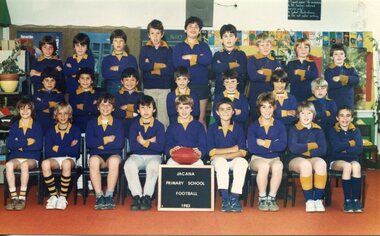
Photograph - Team Photograph, Jacana Primary School: Football Team 1983
... participation, and the celebration of diversity. As part of Jacana Primary’s visual archive, it stands as a lasting record of how schools helped shape local identity and cohesion during a transformative era in Melbourne’s suburban development. This photograph of Jacana Primary School’s 1983 football team is a significant historical record that reflects the social and cultural dynamics of Melbourne’s northern suburbs during a period of rapid suburban growth and demographic change. Taken at a time when schools were central to community life, the image captures the role of sport ...Jacana Primary School, founded in 1959 amid the rapid suburban expansion of Melbourne’s northern corridor, emerged during a time of significant public investment in education and infrastructure. Located near Broadmeadows, the school served a growing population of working-class families, many of whom were newly arrived migrants. This diverse community shaped the school’s inclusive and multicultural character. By the early 1980s, Jacana Primary had become more than just a place of learning—it was a central hub for community life. Team sports, particularly football, played a vital role in the daily rhythm of the school. Football’s growing popularity, especially among migrant communities, made it a natural fit for fostering teamwork, physical fitness, and social connection among students. The 1983 football team photograph captures this vibrant period in the school’s history. It reflects the importance of extracurricular activities in promoting school spirit, cultural exchange, and community engagement. The image also embodies the values of public education at the time: equity, participation, and the celebration of diversity. As part of Jacana Primary’s visual archive, it stands as a lasting record of how schools helped shape local identity and cohesion during a transformative era in Melbourne’s suburban development. This photograph of Jacana Primary School’s 1983 football team is a significant historical record that reflects the social and cultural dynamics of Melbourne’s northern suburbs during a period of rapid suburban growth and demographic change. Taken at a time when schools were central to community life, the image captures the role of sport, particularly football, fostering inclusion, teamwork, and school pride. The photograph is especially meaningful within the context of Jacana’s diverse student population, shaped by post-war migration and working-class settlement. Soccer, a sport embraced by many migrant communities, served as a unifying activity that transcended language and cultural barriers. It provided students with a sense of belonging and identity, while also promoting physical health and social development. As part of Jacana Primary School’s visual archive, this image contributes to a broader understanding of how public education supported multicultural integration and community cohesion in late 20th-century Victoria. It stands as a testament to the enduring value of extracurricular programs in shaping student experiences and strengthening the social fabric of local neighbourhoods. A colour photograph on matte finish photo paper.PH-5431(blue label) Top left Corner Manufactures mark; Fujicolor/ Paperjacana primary school, photograph, school photograph, education, 1983, football -
 Broadmeadows Historical Society & Museum
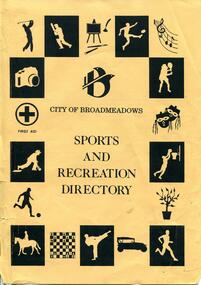
Document - Directory, City of Broadmeadows Sports and Recreation Directory, May 1993
... The directory demonstrates the role of local government in promoting community participation and records many organisations that may no longer exist or have changed substantially since publication. City of Broadmeadows Recreation Sport ...Printed directory comprising 53 pages including covers. Printed on tan-coloured paper with black ink text and illustrations. Originally bound with two metal staples along the spine, positioned near the top and bottom edges. Front cover substantially torn along the left spine edge. General wear, creasing and handling marks consistent with age and previous storage conditions. Damage is attributable to historic poor handling and storage practices.non-fictioncity of broadmeadows, recreation, sport, community organisations, local history, municipal services, clubs and societies, leisure activities, victoria
