
Showing 89 items matching "patient centred care"
-
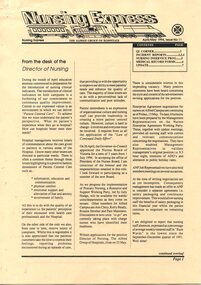 Alfred Hospital Nurses League - Nursing History Collection
Newsletter - Nursing Newsletter, Alfred Hospital nursing administration, The Alfred Group of Hospitals Nursing Express, April/ May 1994, April/May 1994
... ...patient centred care...Alfred Hospital newsletter featuring nursing related articles, including primary nursing, report from nursing study tour to Beth Israel Hospital, USA,quality improvement, enterprise agreement negotiations, nursing education inservice programs, upcoming nursing seminars & conferences, report from wound management conference Insight into nursing practice in the 1990's Alfred Hospital Nursing nursing newsletters primary nursing primary care nursing patient centred care quality improvement wound management Holes at upper left where a staple has been removed Newsletter with pages printed on both sides[black ink on yellow background]. ...Alfred Hospital newsletter featuring nursing related articles, including primary nursing, report from nursing study tour to Beth Israel Hospital, USA,quality improvement, enterprise agreement negotiations, nursing education inservice programs, upcoming nursing seminars & conferences, report from wound management conferenceInsight into nursing practice in the 1990'sNewsletter with pages printed on both sides[black ink on yellow background]. On the first page below the title there is an illustration of a train engine pulling two carriages. There is an index and editorial on this pageHoles at upper left where a staple has been removedalfred hospital, nursing, nursing newsletters, primary nursing, primary care nursing, patient centred care, quality improvement, wound management -
 The Beechworth Burke Museum
Audio - Oral History, Jennifer Williams, Mr and Mrs Don Hayes, 20th May 2000
... patient training centre where those destined for discharge would be trained on how to cope in the world outside of the hospital grounds they were so used to. Both talk openly and with heartfelt candour, recalling their years spent among the patients of the hospital community, their sense of humour and compassion are evident and although the times and the jobs were definitely hard and the wages low, this couple cared deeply about the people they worked with and sit among those people from the local area who established Beechworth as a significant social welfare region. ...patient training centre where those destined for discharge would be trained on how to cope in the world outside of the hospital grounds they were so used to. Both talk openly and with heartfelt candour, recalling their years spent among the patients of the hospital community, their sense of humour and compassion are evident and although the times and the jobs were definitely hard and the wages low, this couple cared deeply about the people they worked with and sit among those people from the local area who established Beechworth as a significant social welfare region. ...In this interview we hear from Don and Bobbie Hayes who met and were married in Beechworth. Mrs Hayes was born in Beechworth to a blacksmith and a teacher who had moved to the area not long before she was born in 1925. She discusses her family and the struggle her mother had being a city woman relocated to the bush and into a family who didn't accept her for her Methodist religious beliefs as they were a staunch Catholic family. After working in the Tannery when they first moved to Beechworth from Melbourne, Don got a job in the 1950's at the Beechworth Mental hospital known as Mayday Hills (est. 1862) and continued working there for the next thirty six years. Starting as a nurse Don would be one of three or four staff known then as attendants, who would oversee up to forty patients in a ward taking them out to work the land and gardens or chop wood on the grounds. Mrs Hayes also worked in the Hospital and discusses the need at the time to be earning to pay for large medical bills that came from two of their children, one having a congenital heart problem which was not covered by hospital benefits and the other displaced hips that required surgery. By the end of his time working at the hospital, Don was in charge of the patient training centre where those destined for discharge would be trained on how to cope in the world outside of the hospital grounds they were so used to. Both talk openly and with heartfelt candour, recalling their years spent among the patients of the hospital community, their sense of humour and compassion are evident and although the times and the jobs were definitely hard and the wages low, this couple cared deeply about the people they worked with and sit among those people from the local area who established Beechworth as a significant social welfare region. This oral history recording was part of a project conducted by Jennifer Williams in the year 2000 to capture the everyday life and struggles in Beechworth during the twentieth century. This project involved recording seventy oral histories on cassette tapes of local Beechworth residents which were then published in a book titled: Listen to what they say: voices of twentieth century Beechworth. These cassette tapes were digitised in July 2021 with funds made available by the Friends of the Burke.The significance of this oral history lies in the firsthand accounts from two people who were directly involved in the significant nursing work undertaken at Mayday Hills Mental hospital from the 1950's. Hearing the stories from those who were there and had lived experience, adds depth and we gain valuable insight into how and what the asylum was like for those who worked there and colourful details about the kinds of patients they encountered too, it adds human and personal context to what could otherwise become statistic and abstract information about a historic site. This oral history account is socially and historically significant as it is a part of a broader collection of interviews conducted by Jennifer Williams which were published in the book 'Listen to what they say: voices of twentieth-century Beechworth.' While the township of Beechworth is known for its history as a gold rush town, these accounts provide a unique insight into the day-to-day life of the town's residents during the 20th century, many of which will have now been lost if they had not been preserved.This is a digital copy of a recording that was originally captured on a cassette tape. The cassette tape is black with a horizontal white strip and is currently stored in a clear flat plastic rectangular container. It holds up 40 minutes of recordings on each side.listen to what they say, beechworth, oral history, burke museum, mayday hills hospital, may day hills, beechworth mental asylum, mental hospital, asylum, nursing, hospital, patient training centre, patients, social welfare -
 Geoffrey Kaye Museum of Anaesthetic History
Container - Ampoule, Propofol, Biochemie Australia (Novartis)
... care to induce unconsciousness. Propofol doesn't dissolve in water so it comes in a white, oily solution and must be refrigerated before it’s used. The solution consists of soybean oil, fats purified from egg yolks, and glycerol. Propofol is used as an “induction agent”—the drug that causes loss of consciousness— for general anaesthesia in major surgery. In lower doses it is also used for “conscious sedation” of patients getting procedures on an outpatient basis at ambulatory surgery centres...care to induce unconsciousness. Propofol doesn't dissolve in water so it comes in a white, oily solution and must be refrigerated before it’s used. The solution consists of soybean oil, fats purified from egg yolks, and glycerol. Propofol is used as an “induction agent”—the drug that causes loss of consciousness— for general anaesthesia in major surgery. In lower doses it is also used for “conscious sedation” of patients getting procedures on an outpatient basis at ambulatory surgery centres ...Propofol is an induction agent for anaesthesia and also used in intensive care to induce unconsciousness. Propofol doesn't dissolve in water so it comes in a white, oily solution and must be refrigerated before it’s used. The solution consists of soybean oil, fats purified from egg yolks, and glycerol. Propofol is used as an “induction agent”—the drug that causes loss of consciousness— for general anaesthesia in major surgery. In lower doses it is also used for “conscious sedation” of patients getting procedures on an outpatient basis at ambulatory surgery centres. The main reason propofol is the agent of choice is because it allows for very rapid recovery, is the perfect drug for insertion of laryngeal masks and is the agent of choice for infusions. It has largely replaced thiopentone, the original drug of choice, but this is still available in Australia and used in specific situations. Propofol was linked to the death of Michael Jackson. Large clear glass ampoule with adhered manufacturer's label blue on white label containing the milky liquid of Propofol BC, 20mls.propofol, local anaesthetic, intensive care, jackson, michael, biochemie australia (novartis) -
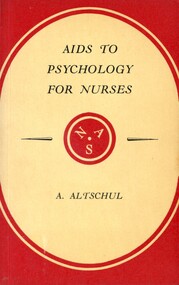 Alfred Hospital Nurses League - Nursing History Collection
Book - Textbook, A Altschul 1919-2001, Aids to psychology for nurses, 1962
... Author was a pioneerng figure in British psychiatric nursing.her work shifted the role of psychiatric nursing from simple 'doctor's assistant' to a therapeutic partnership with the patient Insight into psychology in the 1960's nursing study and teaching human development personality psychiatric nursing psychological reaction to illness motivation This vintage book was designed to cover psychological principles necessary for nurses in their training and work for effective patient communication and care At the base of the front endpage is a printed black and white donation sticker: black Maltese cross in circle, 'This book was donated to Alfred Archival Association Nursing Division by' Marjorie Connor [handwritten black ink]. previous catalogue number is also written on this label [black ink] Book with red and cream cover. Front cover has a large cream oval in the centre ...This vintage book was designed to cover psychological principles necessary for nurses in their training and work for effective patient communication and careBook with red and cream cover. Front cover has a large cream oval in the centre of which is a red circle with crean margin and the lettter N A S also in cream. Above this circle is the title [black print] and below is the author's name. The oval is superimposed on a red background. Title [black ink] and N A S [white print on individual red circles] are printed on spinenon-fictionThis vintage book was designed to cover psychological principles necessary for nurses in their training and work for effective patient communication and carenursing study and teaching, human development, personality, psychiatric nursing, psychological reaction to illness, motivation -
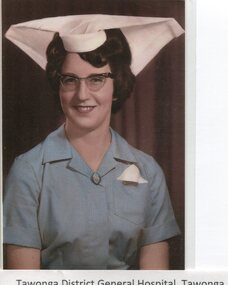 Kiewa Valley Historical Society
Photographs - Tawonga District General Hospital - Set of 21
... patients as the Hospital and Charities Board was not prepared to have it within the SEC controlled area. It was not until the gate at Tawonga South was taken down that the hospital was moved to the main centre of population at Mount Beauty. tawonga district hospital mt beauty hospital medical health care s.e.c. 1.Tawonga District General Hospital Tawonga; 2. ...In the early stages of the Kiewa Hydro-Electric Scheme the State Electricity Commission took over the financial and construction responsibility of the Tawonga District General Hospital building at a cost of 27,000 pounds. This included the removal and re-erection of the ex-military Bonegilla ward from Wodonga while in addition they carried out all the necessary building works that allowed the hospital to operate as a functional unit. The work was completed and handed over to the Hospital Committee of Management on September 1, 1949. Local residents raised 3,400 pounds through fund raising. The balance was met by the SEC and the Hospital and Charities Commission. The initial project was to provide for a basic temporary hospital which was later to include an Operating Theatre, Offices, Store, Mortuary and a Nurse’s Home, until the establishment of a permanent medical premises. Following the opening, 455 patients were admitted to the Tawonga District General Hospital and 254 operations were performed in the first year. The hospital relocated to Mount Beauty in the former SEC administration offices located in the town centre. Official opening of the 18 bed Tawonga District General Hospital on April 29 in 1961. Alpine Health CEO Mr Lyndon Seys oversaw the opening of the new Mount Beauty Hospital in November 2001 alongside Board of Management President Mr Andrew Randell, other board members and politicians. The Kiewa Hydro-Electric Scheme the State Electricity Commission played a pivotal part in the planning and initial funding of the Tawonga District General Hospital, with a view to providing medical support for its many workers on the Hydro scheme. Later, spouse and family members of workers were also able to access medical assistance The hospital was originally located in Tawonga away from the majority of the patients as the Hospital and Charities Board was not prepared to have it within the SEC controlled area. It was not until the gate at Tawonga South was taken down that the hospital was moved to the main centre of population at Mount Beauty. 1. Early nurses uniform; 2. Hospital Opening Ceremony; 3-7. Nursing Staff; 8. Delivery Room; 9. Mens Ward; 10.Enclosed Veranda; 11. Main Ward; 12-13. Kitchen; 14. Opening Ceremony 1949; 15.Original Hospital at Tawonga; 16-18. Relocated Hospital at Mt Beauty; 19. Rear of hospital and Matron’s quarters; 20. Hospital and Kiewa Valley House; 21. Renovated Hospital in 20001.Tawonga District General Hospital Tawonga; 2. Kiewa construction engineer Mr HHC Williams speaking at the opening of the hospital. Health Minister the Hon CP Gartside performed the official opening. L to R: TH Mitchell MLA; Manager of the hospital Mr RH Kronberg (obscured) Hon CP Gartside; CL McVilley; LT Knevitt; Matron AI Tarnish & W Sealey: 4. Dedicated Nursing Staff; 5. Nurse Campbell (nee Reid); 6. Sister Seager 1955 (nee Janice Burnett. First District Nurse; 7. L to R: Sister F Rosengrove; Sister J Griffiths; Matron AI Tarnish; Nurse D Satori; Nurse D Tregonning; Sister E Hill & Sister S O’Shannessy; 8. In the early years Tawonga District General Hospital had the second highest birth rate in Australia; 9. The men’s ward catered for men only in the early years of the hospitals operation; 10. The enclosed verandah at the original Tawonga District General Hospital allowed for an additional 10 beds; 11. Tawonga District General Hospital, Tawonga Main Ward. Ward ready and waiting for patients at Tawonga Hospital. Complete with lovely vases of flowers for every bed. Nice touch by the nurses; 12. Kitchen of Tawonga District General Hospital, Mt Beauty. The hospital kitchen provided meals for patients and a 3 course dinner for Meals on Wheels. In 1977, 11,795 meals were produced at an average cost of $2.60 per meal; 13. Tawonga District General Hospital, Tawonga. Kitchen. Kitchen staff employed in the old Tawonga District General Hospital 1949-1961; 14. The official opening ceremony of the Tawonga District General Hospital, 1949. The official ceremony was attended by a large number of residents and Tawonga District General Hospital was open for public inspection; 15. Original Tawonga District General Hospital transported form Bonegilla began operations in 1949; 16. In 1961, the Tawonga District General Hospital relocated to take a central position in the town of Mt Beauty in the former SEC Administration building; 19. The rear of the Tawonga District General Hospital and Matron’s house seen from Holland St, Mt Beauty during a snow storm in the mid 1960’s; 21. Tawonga District General Hospital & Kiewa Valley House, 2000. tawonga district hospital, mt beauty hospital, medical, health care, s.e.c. -
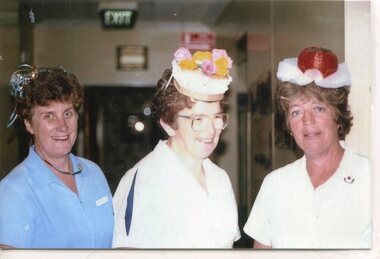 Kiewa Valley Historical Society
Photographs – Photographs of staff from Tawonga District General Hospital & Alpine Health – Set of 13 colour photographs
... patients were admitted to the Tawonga District General Hospital and 254 operations were performed in the first year. The hospital relocated to Mount Beauty in the former SEC administration offices located in the town centre. Official opening of the 18 bed Tawonga District General Hospital on April 29 in 1961. Kiewa Valley House nursing home was officially opened on March 6th, 1985, with a new lounge extension opening in May, 1993. Prior to this, residents had to travel to Beechworth, Wangaratta or Wodonga for care...patients were admitted to the Tawonga District General Hospital and 254 operations were performed in the first year. The hospital relocated to Mount Beauty in the former SEC administration offices located in the town centre. Official opening of the 18 bed Tawonga District General Hospital on April 29 in 1961. Kiewa Valley House nursing home was officially opened on March 6th, 1985, with a new lounge extension opening in May, 1993. Prior to this, residents had to travel to Beechworth, Wangaratta or Wodonga for care ...In the early stages of the Kiewa Hydro-Electric Scheme the State Electricity Commission took over the financial and construction responsibility of the Tawonga District General Hospital building at a cost of 27,000 pounds. This included the removal and re-erection of the ex-military Bonegilla ward from Wodonga while in addition they carried out all the necessary building works that allowed the hospital to operate as a functional unit. The work was completed and handed over to the Hospital Committee of Management on September 1, 1949. Local residents raised 3,400 pounds through fund raising. The balance was met by the SEC and the Hospital and Charities Commission. The initial project was to provide for a basic temporary hospital which was later to include an Operating Theatre, Offices, Store, Mortuary and a Nurse’s Home, until the establishment of a permanent medical premises. Following the opening, 455 patients were admitted to the Tawonga District General Hospital and 254 operations were performed in the first year. The hospital relocated to Mount Beauty in the former SEC administration offices located in the town centre. Official opening of the 18 bed Tawonga District General Hospital on April 29 in 1961. Kiewa Valley House nursing home was officially opened on March 6th, 1985, with a new lounge extension opening in May, 1993. Prior to this, residents had to travel to Beechworth, Wangaratta or Wodonga for care. The old weatherboard building was demolished around the late 1900’s to early 2000’s and replaced with a new modern brick building. Alpine Health CEO Mr Lyndon Seys oversaw the opening of the new Mount Beauty Hospital in November 2001 alongside Board of Management President Mr Andrew Randell, other board members and politicians.The Kiewa Hydro-Electric Scheme the State Electricity Commission played a pivotal part in the planning and initial funding of the Tawonga District General Hospital, with a view to providing medical support for its many workers on the Hydro scheme. Later, spouse and family members of workers were also able to access medical assistance. Many SEC workers and their families have received high medical care at Tawonga District General Hospital and Alpine Health and/or as residents of Kiewa Valley House over the years. A number of family members of SECV workers as well as other dedicated staff have provided high quality medical attention and support in all three facilities as nursing staff, support staff and volunteers. Many past staff members and their families still remain living in the Kiewa Valley area Set of 13 colour photographs of past nursing staff and support staff from Tawonga District General Hospital, Kiewa Valley House & Alpine Health 1. Marg Hickey, Barbara Clark & Margaret Ranton 2. Cheryl Clutterbuck & Rosemary Forrest 3. Margaret Ranton 4. Margaret Ranton holding unknown infant 5. Gwen Goss 6. Barbara Clark & Margaret Ranton 7. Margaret Ranton, Sue Zeinert & Jenny Piera 8. Margaret Ranton, Gloria Ryder & Jenny Piera 9. Sue Wesley, Ruth Barton, Margaret Ranton, Rosemary Forrest & Nola Henry 10. F Bogaski & H Sigmund 11. Maintenance Supervisor H Sigmund 12. Gardener Fred Keat & Handyman Joe Trezise (1977) 13. Nursing staff in new hospital 1-9 No markings 10 F Bogaski & H Sigmund 11. Maintenance Supervisor H Sigmund 12. Gardener Fred Keat & Handyman Joe Trezise (1977) 13. Nursing staff in new hospital tawonga district general hospital, kiewa valley house, alpine health -
 Warrnambool and District Historical Society Inc.
Domestic object, Drink Coasters (4)
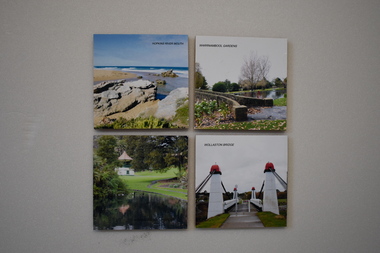
... The major aim of the organization was realized in 2016 when the South West Regional Cancer Care Centre was opened in a new building in Ryot Street and services to assist cancer patients in Warrnambool continue to be extended. ...The major aim of the organization was realized in 2016 when the South West Regional Cancer Care Centre was opened in a new building in Ryot Street and services to assist cancer patients in Warrnambool continue to be extended. ...These coasters depict scenes from Warrnambool – the Botanic Gardens, The Hopkins River mouth and the Wollaston Bridge. All are areas of historical and tourist interest. The coaster were produced to raise funds for Peters Project in Warrnambool, a charity organization dedicated to bringing improved cancer care services to Warrnambool. The organization was founded in 2008 by Vicki Jellie in memory of her husband Peter who died of cancer. The major aim of the organization was realized in 2016 when the South West Regional Cancer Care Centre was opened in a new building in Ryot Street and services to assist cancer patients in Warrnambool continue to be extended. These coasters are of some interest as examples of fund-raising material produced by the Peters Project committee to assist with the campaign to bring improved cancer care services to Warrnambool..1 .2.3.4 A wooden drink coaster with a felt base and a colour photograph pasted on the top section.1 Warrnambool Gardens .2 Hopkins River Mouth .3 Wollaston Bridge .4 Warrnambool Gardenspeter’s project, warrnambool, vicki jellie, warrnambool souvenirs -
 Royal District Nursing Service (now known as Bolton Clarke)
Photograph - Photograph, black and white, Barry Sutton, 24.04.1974
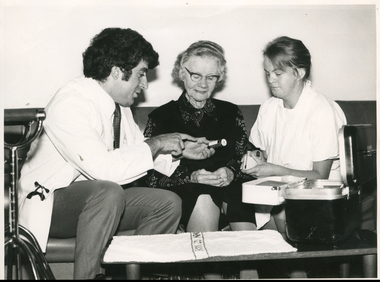
... patients in District areas with the regular RDNS Sister when required. Every member of staff, both professional and non professional staff, received regular education in the Education Department. In 1980, a Home Health Aide pilot study, funded by the Federal Government, the Brotherhood of St. Laurence and RDNS, with the program written and taught by Sr. Rowley, was evaluated as successful, and Home Health Aides were employed and worked in RDNS Centres under the supervision of the RDNS Sisters. royal district nursing service rdns rdns patient care ...A Medical Student is explaining the use of a bottle of testing tablets to a lady who is a patient of RDNS. The Royal District Nursing Service (RDNS) Sister is holding testing equipment; i.e. the eye dropper and test tube in the receptacle, in her hands, and is observing the Medical Student giving instructions to the lady. The photograph is taken in the lady's home.Education was an integral part of Melbourne District Nursing Society (MDNS) from its inception in 1885, later called Royal District Nursing Service, (RDNS). Only Trained nurses (Nurses) were employed by the Society, and on visits to patients they taught the necessity of hygiene and cleanliness, as well as the need for a good diet, to bring about good health. Doctor’s lectures were later given at the MDNS home to instruct patients and their families on prevention of disease. Education to patients continued throughout the years regarding health care and the use of equipment in the home. In 1961 Education programs commenced at MDNS with Trained nurses (Sisters) receiving In-service education. Sr. Pat (Paddy) Rowley was a leader in In-service Education and established the RDNS Department of Community Nursing Education in 1962. Staff could also apply for scholarships to further their education outside of RDNS. At RDNS many programs were run, including: a Post Basic Course, Cardiac Rehabilitation Nursing, Haematology/Oncology Nursing, Palliative Care program, Diabetic Stabilization Program, Leg Ulcer Management Program, Wound Care Specialist Program, HIV/AIDS Nursing Care, Cystic Fibrosis Home Support, Veterans Home Care Program, Breast Cancer Support Program, Continence Management Program, Stomal Therapy Program, In-Home Lactation Support Program. RDNS Sisters attended several hospitals to observe and learn special care needed to some patients, e.g. to the Austin Hospital to learn the care required for paraplegic and quadriplegic patients at home and to Mount Royal Hospital to observe the care of patients in the rehabilitation ward. RDNS moved its Education Department from 452 St. Kilda Road to 448 St. Kilda Road in 1974. A Community Nursing Education Program was extended to student nurses from hospitals and to other nursing organizations. These Education programs kept the RDNS Sisters abreast of new techniques, such as changes in technology for e.g. new testing methods for detecting glucose levels in Diabetic patients. Sr. Nan Deakin obtained a Post Basic Certificate in Psychiatric Nursing and included this area in her Education lectures. Sr. Daphne Geldard specialized in the area of Alzheimer’s disease and Dementia. These Sisters visited patients in District areas with the regular RDNS Sister when required. Every member of staff, both professional and non professional staff, received regular education in the Education Department. In 1980, a Home Health Aide pilot study, funded by the Federal Government, the Brotherhood of St. Laurence and RDNS, with the program written and taught by Sr. Rowley, was evaluated as successful, and Home Health Aides were employed and worked in RDNS Centres under the supervision of the RDNS Sisters.In the left foreground of this black and white photograph is the partial view of two metal 4 prong sticks.To their right, seated on a long dark vinyl type couch, is a Medical Student who has short curly black hair; is wearing a white hospital coat over grey trousers, a white shirt, and a tie with small black and white squares. A stethoscope is folded in the pocket of his coat. He is turned toward the right of the photograph and is holding, on its side, a small bottle in his left hand and is pointing his right index finger to writing on its label. An elderly lady who is wearing glasses and has wavy grey hair is sitting to his right and is looking at the label on the bottle. She is wearing a black skirt and black sleeveless jacket over a black and white patterned blouse. Her hands are clasped in her lap. Sitting to her right, and facing the lady, is a Royal District Nursing Service (RDNS) Sister who has her long dark hair drawn back. She is wearing a white short sleeve gown over her uniform, and is holding a white oblong receptacle which holds a test tube, which has dark fluid in the bottom, and an eye dropper. In front of her, is a white 'inner tray' which is clipped onto the front edge of an open oblong black RDNS nursing case which is in the right foreground of the photograph sitting on a long, narrow, low table. On the table and to the left of the case a small white hospital drape runs along the table.Barry Sutton MA 24royal district nursing service, rdns, rdns patient care, rdns education -
 Royal District Nursing Service (now known as Bolton Clarke)
Photograph - Photograph, black and white, Barry Sutton, 01.05.1974
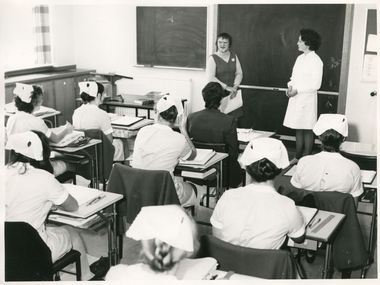
... Centres. This lecture prepares each nurse before she goes out for a week with an RDNS Sister to visit patients who are receiving nursing care in their home....Centres. This lecture prepares each nurse before she goes out for a week with an RDNS Sister to visit patients who are receiving nursing care in their home. ...This black and white photograph is taken in the Education Department at Western General Hospital. Sr, Nan Deakin is a Nurse Educator with RDNS and is giving a lecture about District Nursing to hospital student nurses before each nurse goes to RDNS Centres. This lecture prepares each nurse before she goes out for a week with an RDNS Sister to visit patients who are receiving nursing care in their home.During their training, Student nurses from several hospitals either attended the Royal District Nursing Service (RDNS), Education Department, or, a RDNS Nurse Educator travelled to the appropriate hospital’s Education Department to educate the Trainees on District nursing through the RDNS Community Nursing Program. Following the lectures Students went to a RDNS Centre and each student accompanied a Trained nurse (Sister) for a week observing and gaining knowledge of all facets of nursing care in the home. This gave them an insight into the home conditions and situations patients faced after discharge from hospital. During 1971 there were 584 Student nurses who received District field experience with RDNS.This black and white photograph shows the back view of three rows of hospital student nurses in their white uniforms and caps, sitting at small tables facing toward, on the left, Royal District Nursing Service (RDNS), Nurse Educator, Sister Nan Deakin, and their hospital Tutor Sister who is wearing her white uniform. The Sisters are standing in front of a large blackboard at the rear of the photograph facing the group. A smaller blackboard is attached to the wall to the left. On the right, the Tutor Sister has short dark curly hair and is standing side-on turned toward Sr. Deakin who is to her left. Sr. Deakin has short dark straight hair; is wearing glasses; and is wearing her RDNS uniform of a light grey skivvie under a darker V neck tunic style frock. She has her hands crossed and is holding sheets of paper in her right hand. There is a dark table to her left with a book and a short collapsible lectern on it. To the left of that is a row of short wooden cupboards and above that an open window with a horizontal striped curtain on the far end. The metal framed tables in front of the nurses have white wooden tops and have books, papers, pens and rulers on them.Barry Sutton MA 75royal district nursing service, rdns, rdns education, western general hospital students, sister nan deakin -
 Royal District Nursing Service (now known as Bolton Clarke)
Photograph - Photograph, black and white, Barry Sutton, 01.05.1974
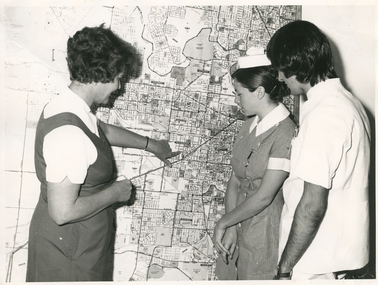
... Centre. The map had different colour pins to identify streets where patients lived who were currently receiving nursing care from RDNS Sisters working in these areas (districts)....Centre. The map had different colour pins to identify streets where patients lived who were currently receiving nursing care from RDNS Sisters working in these areas (districts). ...Sister Ellen Anderson is the Supervisor of the Royal District Nursing Service, (RDNS) Footscray Centre. She is wearing her RDNS uniform of a short sleeve white blouse under a royal blue V neck tunic style dress. Sr. Anderson is showing two Student nurses from Western General Hospital the map with the areas covered by Footscray Centre. The map had different colour pins to identify streets where patients lived who were currently receiving nursing care from RDNS Sisters working in these areas (districts).During their training, Student nurses from several hospitals either attended the Royal District Nursing Service (RDNS), Education Department, or, a RDNS Nurse Educator travelled to the appropriate hospital’s Education Department to educate the Trainees on District nursing through the RDNS Community Nursing Program. Following the lectures Students went to a RDNS Centre and each Student accompanied a Trained nurse (Sister) for a week observing and gaining knowledge of all facets of nursing care in the home. This gave them an insight into the home conditions and situations patients faced after discharge from hospital. During 1971 there were 584 Student nurses who received field experience with RDNS. From its inception as Melbourne District Nursing Society (MDNS), in 1885, their Trained nurses (Nurses) worked in specific areas, 'districts'. The first Nurse worked east and west, between Victoria Parade and Flinders Street and, north and south, between Spencer Street and Spring Street. When a second Nurse was employed they divided this area at Elizabeth Street so each Nurse could attend to patients in the same area giving continuity of care. As the Society expanded, becoming Melbourne District Nursing Service, then, with Royal patronage, Royal District Nursing Service (RDNS) many Centres were opened throughout the Melbourne Metropolitan area and outer suburbs. The District nurse's areas (districts) grew and were divided within Shire boundaries for e.g. Knox 1, Knox 2, Knox 3, Knox 4, within the area of the Shire of Knox. A map covering the Centre’s Districts was attached to a wall, and its different colour pins identified streets where patients lived who were currently receiving nursing care from the RDNS Trained nurses (Sisters) working in these areas (districts).On the left of this black and white photograph is Royal District Nursing Service (RDNS), Sister Ellen Anderson, who has short dark curly hair and is wearing her RDNS uniform of a short sleeve white blouse under a dark V neck tunic style frock. She is standing side-on, towards the right of the photograph, and with her left hand is pointing to an area on a large map attached to the wall in the background. To her right, is a Student nurse who is facing Sr. Anderson, and looking at the area on the map. Under her white nurses cap, she has her long dark hair drawn back, and is wearing her hospital uniform of a short sleeve checked dress with white collar and cuffs; a nursing watch is attached to its upper left; her hands are clasped in front of her. To her right, is a male Student nurse who has collar length straight dark hair, and is wearing white trousers and a short sleeve white top with pens in the left upper pocket. He is looking at the areas on the map.. Barry Sutton MA 77 informationroyal district nursing service, rdns, rdns education, rdns centre, rdns district map, sister ellen anderson -
 Royal District Nursing Service (now known as Bolton Clarke)
Photograph - Photograph, black and white, Barry Sutton, 01.05.1974
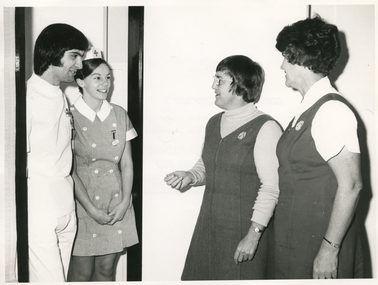
... patients in the same area giving continuity of care. As the Society expanded, becoming Melbourne District Nursing Service, then, with Royal patronage, Royal District Nursing Service (RDNS) many Centres were opened throughout the Melbourne Metropolitan area and outer suburbs. ...The photograph is taken at Western General Hospital. Royal District Nursing Service (RDNS) Nurse Educator, Sister Nan Deakin, after teaching the RDNS Community Nursing Education program to the Western General's two Student nurses is introducing them to Sister Ellen Anderson, Supervisor of the RDNS Footscray Centre. Sr. Anderson will arrange for the Students to go on District nursing visits with RDNS Trained nurses (Sisters) from Footscray Centre who administer nursing care in the community. Sister Deakin is wearing the RDNS winter uniform of a blue/grey skivvie under a blue/grey V neck tunic style frock made of herringbone winter material. Sister Anderson is wearing the RDNS summer uniform of a white short sleeve blouse under a royal blue V neck tunic style frock. The RDNS logo is seen on the upper left on both uniforms.During their training, Student nurses from several hospitals either attended the Royal District Nursing Service (RDNS), Education Department, or, a RDNS Nurse Educator travelled to the appropriate hospital’s Education Department to educate the Trainees on District nursing through the RDNS Community Nursing Program. Following the lectures Students went to an RDNS Centre and each Student accompanied a Trained nurse (Sister) for a week observing and gaining knowledge of all facets of nursing care in the home. This gave them an insight into the home conditions and situations patients faced after discharge from hospital. During 1971 there were 584 student nurses who received field experience with RDNS. From its inception as Melbourne District Nursing Society (MDNS), in 1885, their Trained nurses (Nurses) worked in specific areas, 'districts'. The first Nurse worked east and west, between Victoria Parade and Flinders Street and, north and south, between Spencer Street and Spring Street. When a second Nurse was employed they divided this area at Elizabeth Street so each Nurse could attend to patients in the same area giving continuity of care. As the Society expanded, becoming Melbourne District Nursing Service, then, with Royal patronage, Royal District Nursing Service (RDNS) many Centres were opened throughout the Melbourne Metropolitan area and outer suburbs. The District nurse's areas (districts) grew and were divided within Shire boundaries for e.g. Knox 1, Knox 2, Knox 3, Knox 4, within the area of the Shire of Knox. A map covering the Centre’s Districts was attached to a wall, and its different colour pins identified streets where patients lived who were currently receiving nursing care from the RDNS Trained nurses (Sisters) working in these areas (districts).On the far left of this black and white photograph is a male Student nurse, who has collar length, straight dark hair. He is wearing his hospital uniform of white trousers and top. To his right, is a Student nurse who is wearing her white nursing cap, with motif in the centre front, over her long drawn back dark hair. and her short sleeve uniform checked frock, with white two breasted buttons down it, and with white collar and cuffs. A nursing watch is attached to its upper left. Both are standing in the dark framed doorway of a room and are looking to the right and smiling at Royal District Nursing Service (RDNS), Nurse Educator, Sister Nan Deakin. She has short dark hair; is wearing glasses, and is wearing her RDNS uniform of a light grey skivvie under a darker V neck tunic style frock. To the right of her, is RDNS Sister Ellen Anderson who has short curly dark hair and is wearing her RDNS uniform of a white short sleeve blouse, under a dark V neck tunic style frock. They are standing side-on facing the Students. Barry Sutton MA 78royal district nursing service, rdns, rdns education, western general hospital students, sister nan deakin, sister ellen anderson -
 Royal District Nursing Service (now known as Bolton Clarke)
Photograph - Photograph, black and white, Barry Sutton, 01.05.1974
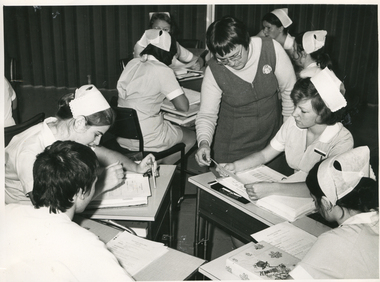
... Following the lectures Students went to a RDNS Centre and each student accompanied a Trained nurse (Sister) for a week observing and gaining knowledge on all facets of nursing care in the home. This gave them an insight into the home conditions and situations patients faced after discharge from hospital. ...This black and white photograph is taken in the Education Department at the Western General Hospital where the Student nurses are doing their nursing training. Trained nurse (Sister) Nan Deakin, RDNS Nurse Educator, is checking information written by one of the Student nurses following a lecture she gave the students on Community Nursing. Following their time in the Education Department, the Student nurses will go to an RDNS Centre to receive education in the field from an RDNS Sister working in the community. During their training, Student nurses from several hospitals either attended the Royal District Nursing Service (RDNS), Education Department, or, a RDNS Nurse Educator travelled to the appropriate hospital’s Education Department to educate the Trainees on District nursing through the RDNS Community Nursing Program. Following the lectures Students went to a RDNS Centre and each student accompanied a Trained nurse (Sister) for a week observing and gaining knowledge on all facets of nursing care in the home. This gave them an insight into the home conditions and situations patients faced after discharge from hospital. During 1971 there were 584 student nurses who received field experience with RDNS.This black and white photograph shows a group of eight female Hospital Student nurses, some partly hidden, and one male Student nurse, sitting randomly in a group about the room; each at a small metal framed, white wooden top table. The tables have books, printed sheets and white sheets of paper on them. The female Student nurses are wearing white nursing caps and checked uniforms with white collars and cuffs. They have a variety of hair styles, some with long hair drawn back. Standing to the right, in the centre of the group, is Royal District Nursing Service (RDNS), Nurse Educator, Sister Nan Deakin, who has short dark hair and is wearing glasses. She is wearing her RDNS uniform of a light grey skivvie under a dark V neck tunic style dress with the RDNS logo on its upper left. She is looking down at a sheet of paper held by one of the Student nurses, who has short wavy dark hair. The nurse is holding the sheet of paper with both hands and is looking at it. The rear group of four students appear to be in discussion. The others are looking at sheets of paper on their tables. The male Student nurse, in the left foreground, has short dark hair and is wearing a white uniform. Closed dark concertina doors are in the background.Barry Sutton MA 79royal district nursing service, rdns, rdns education, western general hospital students, sister nan deakin -
 Royal District Nursing Service (now known as Bolton Clarke)
Photograph - Photograph, black and white, c.1960
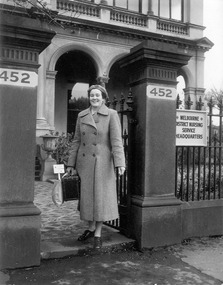
... care to a patient in their home situated in a Melbourne suburb. She is wearing the MDNS winter uniform grey wool coat over her grey cotton dress with white collar. A red Maltese cross is attached to the centre...care to a patient in their home situated in a Melbourne suburb. She is wearing the MDNS winter uniform grey wool coat over her grey cotton dress with white collar. A red Maltese cross is attached to the centre ...Sister Beryl Hawker is a District Nurse working for the Melbourne District Nursing Service (MDNS) and is leaving their Headquarters at 452 St. Kilda Road, Melbourne to give nursing care to a patient in their home situated in a Melbourne suburb. She is wearing the MDNS winter uniform grey wool coat over her grey cotton dress with white collar. A red Maltese cross is attached to the centre of her grey wool beret. Her nursing case contains an apron, hand towel, thermometer, instruments, dressings and lotions.The Trained nurses of the Melbourne District Nursing Society (MDNS), later known as Royal District Nursing Service (RDNS), visited patients in their home and gave best practice care in many fields of nursing and to people of many cultures throughout its 130 years of expansion. Initial visits not only assessed the specific nursing situation but the situation as a whole. Their patients ranged in age from babes, children, adults to the elderly and referrals were taken from Hospitals, General Practitioners and allied Health facilities. Some of the care provided was: – Post-Natal care given to mother and babe, Wound Care following various types of surgery, accidents, burns, cancer, leg ulcers etc. Supervising and teaching Diabetic Care, including teaching and supervising people with Diabetes to administer their own Insulin, and administering Insulin to those unable to give their own injections. Administering other injections and setting up weekly medication boxes. The Sisters performed Catheterizations on adults suffering from conditions such as Quadriplegia, Paraplegia, Multiple Sclerosis (MS), Motor Neurone Disease (MND) and Guillan-Barre Syndrome, and when required at school on children for e.g. those with Spina Bifida. The Sisters visited those requiring Cystic Fibrosis support and care; those requiring Haemo-Oncology care, including visiting children at school; those requiring Home Enteral Feeding care, and those requiring IV therapy at home and home Dialysis. Palliative Care was given including pain relief with the use of syringe drivers, personal care as needed, and advice and support to both patient and family. RDNS provided Stoma management to those needing Urostomy, Ileostomy and Colostomy care and those requiring Continence care. HIV/AIDS nursing care was provided; visits to Homeless Persons were made. Personal care was given to patients ranging in age and with varying mobility problems, such as those with MS, MND, Guillan-Barre Syndrome, Quadriplegia, Paraplegia, Acquired Brain Injury, following a Cerebrovascular Accident (Stroke), those with severe Arthritis and those with a form of Dementia. When necessary the elderly were assisted with personal care and advice given on safety factors with the use of hand rails, bath or shower seats, and hand showers. Rehabilitation with an aim towards independence remained at the forefront of the Sister’s minds and when possible using aids and instruction on safe techniques enabled the person to become fully independent. All care included giving advice and support to the patient and their Carers. The Sisters liaised with the persons Doctor, Hospital and allied Health personal when necessary.Sister Beryl Hawker, who has short dark hair, is smiling as she is leaving Melbourne District Nursing Service (MDNS) Headquarters. She is wearing the MDNS uniform of an ankle length double breasted grey wool coat and wool beret with a central Maltese cross. Part of the MDNS insignia is seen at the top of her left sleeve. In her right hand she is carrying a rectangular nursing case and a light colour soft material bag. She is standing in front of the open metal spike gate between the two square grey concrete pillars of the gateway; the black numbers '452' are written on a white background on the top section of each pillar. A spiked metal fence is attached and running to the right of the right pillar; attached to this and close to the pillar, is a white plaque with black capital letters reading: 'Melbourne District Nursing Service Headquarters'. In the background is a paved path leading to part of a building with part of three arches seen and above this some concrete balustrade. A large pedestal concrete flower urn sits next to the partially seen steps leading up to the building. Some low bushes are seen behind the fence and in front of the building.59134-11melbourne district nursing service, mdns, mdns uniform, mdns headquarters, sister beryl hawker, royal district nursing service, rdns -
 Royal District Nursing Service (now known as Bolton Clarke)
Photograph - Photograph, black and white, 17.10.1952
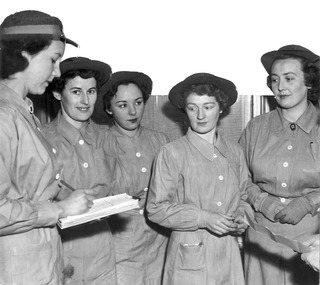
... patient and their Carers. The Sisters liaised with the persons Doctor, Hospital and allied Health personal when necessary. melbourne district nursing society mdns mdns uniforms royal district nursing service rdns sister j. faust sister m. sexton sister b. nunn sister e. blair sister b. white Operator 59. Finisher 30 This photograph depicts five Melbourne District Nursing Society (MDNS) Sisters of varying heights standing in a row. They are wearing their grey long sleeve uniform dresses which have peaked collars, a pocket on the upper left and lower right, and white buttons down the centre ...The Melbourne District Nursing Society (MDNS) Trained nurses (Sisters) are receiving their morning briefing from Matron D. Tupper before leaving their Headquarters at 39 Victoria Parade, Collingwood to go to their areas (districts) in the Melbourne suburbs to give nursing care to patients in their homes The Sisters averaged 30 calls a day each, mainly wound dressings; personal care, mostly sponges in bed; and injections (insulin and diabetes management). The Trained nurses of the Melbourne District Nursing Society (MDNS), later known as Royal District Nursing Service (RDNS), visited patients in their home and gave best practice care in many fields of nursing, and to people of many cultures, throughout its 130 years of expansion. Initial visits not only assessed the specific nursing situation but the situation as a whole. Their patients ranged in age from babes, children, adults to the elderly and referrals were taken from Hospitals, General Practitioners and allied Health facilities. Some of the care the Sisters provided is as follows: – Post-Natal care given to mother and babe, Wound Care following various types of surgery, accidents, burns, cancer, leg ulcers etc. Supervising and teaching Diabetic Care, including teaching and supervising people with Diabetes to administer their own Insulin, and administering Insulin to those unable to give their own injections. Administering other injections and setting up weekly medication boxes. The Sisters performed Catheterizations on adults suffering from conditions such as Quadriplegia, Paraplegia, Multiple Sclerosis (MS), Motor Neurone Disease (MND) and Guillan-Barre Syndrome, and when required at school on children for e.g. those with Spina Bifida. The Sisters visited those requiring Cystic Fibrosis support and care; those requiring Haemo-Oncology care, including visiting children at school; those requiring Home Enteral Feeding care, and those requiring IV therapy at home and home Dialysis. Palliative Care was given including pain relief with the use of syringe drivers, personal care as needed, and advice and support to both patient and family. The Sisters provided Stoma management to those needing Urostomy, Ileostomy and Colostomy care and those requiring Continence care. HIV/AIDS nursing care was provided; visits to Homeless Persons were made. Personal care was given to patients ranging in age and with varying mobility problems, such as those with MS, MND, Guillan-Barre Syndrome, Quadriplegia, Paraplegia, Acquired Brain Injury, to those following a Cerebrovascular Accident (Stroke), those with severe Arthritis and those with a form of Dementia. When necessary the elderly were assisted with personal care and advice given on safety factors with the use of hand rails, bath or shower seats, and hand showers. Rehabilitation with an aim towards independence remained at the forefront of the Sister’s minds and when possible using aids and instruction on safe techniques enabled the person to become fully independent. All care included giving advice and support to the patient and their Carers. The Sisters liaised with the persons Doctor, Hospital and allied Health personal when necessary.This photograph depicts five Melbourne District Nursing Society (MDNS) Sisters of varying heights standing in a row. They are wearing their grey long sleeve uniform dresses which have peaked collars, a pocket on the upper left and lower right, and white buttons down the centre. They are all wearing their grey brimmed hats over their short dark curled hair. From left to right is Sister (Sr) J Faust, who is looking down at a clipboard she is holding in her left hand which has paper held on it by a black bulldog clip. There is writing on the top sheet of white paper and she is holding a pen in her right hand poised near a section of writing on the paper. Next is Sr. M Sexton who is looking at the camera, then Sr. B Nunn who is looking towards a mainly hidden person on the far right. The next two are Sr E Blair, who has items in her lower pocket, and Sr B White who are both looking at the clipboard and paper held by Sr. Faust. In the far lower right corner of the photograph you can see the fingers of hands holding a sheet of paper. There is no further vision of this person.Operator 59. Finisher 30melbourne district nursing society, mdns, mdns uniforms, royal district nursing service, rdns, sister j. faust, sister m. sexton, sister b. nunn, sister e. blair, sister b. white -
Kew Historical Society Inc
Journal, Kewriosity : March 1989
... patients urged to help Royal Women's [Kew Auxiliary of the Royal Women’s Hospital] / p5. St George's fair / p5. Caring for Kewites [Sacred Heart and St. Anne's Caring Group] / p5. Kew Community House / Judy Price p6. Neighbourhood Watch / p6. Keeping you informed [Citizens' Advice Bureau] / p6. Excerpts from Festival program / p7. Penguin Club / p7. Playgroup vacancies [Woodlands Avenue Playgroup] / p7. Australia Day Honours [Jeanne Pratt, Professor Joseph Isaac, Laszlo Benyei, Dr William Keane, Vernon Hillman] / p7. Life Education [Centres ...Kew Festival [1989] / p1. [Kew Festival's] Chairman's address / Tom Indovino p2. [Kew Festival calendar of events] / p2. A Festival message from the Mayor / Cr Allen Martin p2. Commentary / Cr Allen Martin p3. Footy News [Kew Football Club] / p3. Being pestered [bees and wasps, mosquitoes, rodents] / p3. Dates for March / p4. Notices / p4. Probus Club for Kew women / p5. Asthma Foundation needs helpers / p5. Ex-patients urged to help Royal Women's [Kew Auxiliary of the Royal Women’s Hospital] / p5. St George's fair / p5. Caring for Kewites [Sacred Heart and St. Anne's Caring Group] / p5. Kew Community House / Judy Price p6. Neighbourhood Watch / p6. Keeping you informed [Citizens' Advice Bureau] / p6. Excerpts from Festival program / p7. Penguin Club / p7. Playgroup vacancies [Woodlands Avenue Playgroup] / p7. Australia Day Honours [Jeanne Pratt, Professor Joseph Isaac, Laszlo Benyei, Dr William Keane, Vernon Hillman] / p7. Life Education [Centres] / p7. [Kew Festival ] Program highlights / p8. Streetstyle skateboard context / p8. 'Blithe Spirit' [The Hartwell Players] / p8.Kewriosity was a local newsletter combining Kew Council and community news. It was published between November 1983 and June 1994, replacing an earlier Kewriosity [broad] Sheet (1979-84). In producing Kewriosity, Council aimed to provide a range of interesting and informative articles covering its deliberations and decision making, together with items of general interest and importance to the Kew community and information not generally available through daily media outlets.non-fictionKew Festival [1989] / p1. [Kew Festival's] Chairman's address / Tom Indovino p2. [Kew Festival calendar of events] / p2. A Festival message from the Mayor / Cr Allen Martin p2. Commentary / Cr Allen Martin p3. Footy News [Kew Football Club] / p3. Being pestered [bees and wasps, mosquitoes, rodents] / p3. Dates for March / p4. Notices / p4. Probus Club for Kew women / p5. Asthma Foundation needs helpers / p5. Ex-patients urged to help Royal Women's [Kew Auxiliary of the Royal Women’s Hospital] / p5. St George's fair / p5. Caring for Kewites [Sacred Heart and St. Anne's Caring Group] / p5. Kew Community House / Judy Price p6. Neighbourhood Watch / p6. Keeping you informed [Citizens' Advice Bureau] / p6. Excerpts from Festival program / p7. Penguin Club / p7. Playgroup vacancies [Woodlands Avenue Playgroup] / p7. Australia Day Honours [Jeanne Pratt, Professor Joseph Isaac, Laszlo Benyei, Dr William Keane, Vernon Hillman] / p7. Life Education [Centres] / p7. [Kew Festival ] Program highlights / p8. Streetstyle skateboard context / p8. 'Blithe Spirit' [The Hartwell Players] / p8. publications -- city of kew (vic.), kewriosity, council newsletters, community newsletters -
 Ambulance Victoria Museum
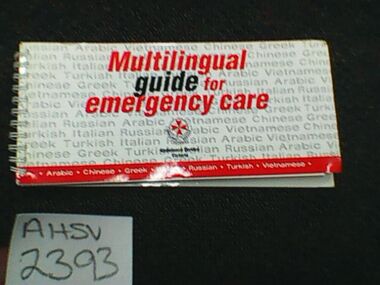
Book, Multilingual guide for emergency care, Circa 2000
... created by ambulance officer Lindsay O'Brien to help communicate with non English speaking patients lindsay o'brien Arabic Chinese Greek Italian Russian Turkish Vietnamese Spiral bound booklet with Ambulance Service Victoria logo in centre Book, Multilingual guide for emergency care ...created by ambulance officer Lindsay O'Brien to help communicate with non English speaking patientsSpiral bound booklet with Ambulance Service Victoria logo in centreArabic Chinese Greek Italian Russian Turkish Vietnameselindsay o'brien -
 Royal District Nursing Service (now known as Bolton Clarke)
Photograph - Photograph, black and white:, 1952
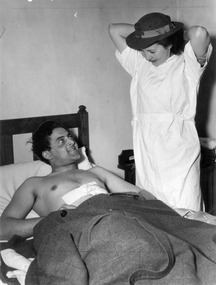
... centre. Sister J. Faust is about to redress a wound on Mr. Spartel's abdomen. The photograph is a record of wound care being given by MDNS trained nurses in a patients home during the 1950s. ...centre. Sister J. Faust is about to redress a wound on Mr. Spartel's abdomen. The photograph is a record of wound care being given by MDNS trained nurses in a patients home during the 1950s. ...The photograph is taken in Mr. Spartel's home in St. Kilda. The MDNS uniform worn under her white gown was a dark grey cotton frock with a belt. The grey stiffened and brimmed felt hat had a light grey hatband with a red Maltese cross attached in the centre. Sister J. Faust is about to redress a wound on Mr. Spartel's abdomen. The photograph is a record of wound care being given by MDNS trained nurses in a patients home during the 1950s. This photograph appeared along with an article in The Sun newspaper Oct 17 1952.The Trained nurses (Nurses) of the Melbourne District Nursing Society (MDNS), from its inception in 1885, provided wound care to their patients, who ranged in age from the very young to the elderly. As research developed better products and dressing materials, the methods and medication applied to wounds changed. MDNS received Royal patronage in 1966 and as Royal District Nursing Service (RDNS), the Education department developed programs, such as the Wound Specialist program, and the Leg Ulcer Management Program, to provide their Trained nurses (Sisters) with methods of best quality care. The Sisters liaised with the patient’s Doctors and hospitals to provide information on the progress of patient’s wounds and to receive any change of wound care from the Doctors. When RDNS introduced Wound Care Specialists they carried out assessments and provided advice and support to the District Sisters working in the field. On the left of the black and white photograph is Mr. George Spartel, who has dark short curly hair and is lying on his bed. His shoulders and head are resting on the white pillow with his head against the wooden slatted backrest of his bed. His torso is bare and part of a white wound dressing can be seen on his upper abdominal area. A dark grey covering is over the lower portion of his body. He is smiling and looking up at Sister J. Faust from Melbourne District Nursing Society (MDNS) who is standing to the right of his bed.Sister Faust, who has dark curled hair, has her arms raised behind her neck as she reaches the ties on the white gown she is wearing over her uniform. She is wearing her grey brimmed uniform hat. Behind her is a wooden table, with a dark coloured radio on its right, and a jug with a doily over it, on the right.mdns, melbourne district nursing society (1885-1957), nurses, mdns uniforms, rdns, royal district nursing service, rdns wound care, mr george spartel, sister j. faust -
 Royal District Nursing Service (now known as Bolton Clarke)
Photograph - Photograph, black and white, Barry Sutton, 1973
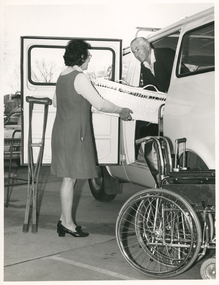
... Centre at Chessell Street, South Melbourne. From the founding of the Melbourne District Nursing Society (MDNS), in 1885, known as the Royal District Nursing Service (RDNS) from 1966, equipment was loaned and demonstrated to patients, and their family members, to enable them to care for their loved ones in their home. ...The photograph is taken in the car park at Royal District Nursing Service ( RDNS) Headquarters, 452 St. Kilda Rd, Melbourne. Sr. Harris is assisting to load the bassinet and the other nursing equipment into the RDNS Van for Mr. Pincher to deliver to the appropriate RDNS Centre or to patient's homes. In 1971 the Commission shop donated a Van to Royal District Nursing Service (RDNS), to be used by the Maintenance crew for delivery of equipment and transporting goods and documents between RDNS Centres and Headquarters. It was also used for transporting Maintenance staff, and the equipment they required, to do maintenance work at RDNS Centres as needed. The Commission Van was kept at the RDNS Service Centre at Chessell Street, South Melbourne. From the founding of the Melbourne District Nursing Society (MDNS), in 1885, known as the Royal District Nursing Service (RDNS) from 1966, equipment was loaned and demonstrated to patients, and their family members, to enable them to care for their loved ones in their home. In the 1970s RDNS employed a Physiotherapist who taught RDNS staff the correct transferring techniques, including the use of a hoist when this became available. RDNS staff taught and used these techniques in patient’s homes to undertake safe transfer of the patient and to reduce physical strain on RDNS Sisters and family members. Each RDNS Centre had a room or shed where equipment for loan was kept, and Headquarters also kept additional equipment which could be transported to Centres as required.On the left of the black and white photograph is Royal District Nursing (RDNS), Sister Betty Harris, who is standing side-on in front of the open door of a white Van. She wears glasses, has dark curled hair, and is smiling, as she has her arms outstretched with her right hand under a white bassinet as she passes it to Mr. Pincher who is standing in and leaning out of the opening of the Van. Mr. Pincher has wavy light colour hair and is smiling at Sr. Harris as he is holding the other end of the bassinet. He is wearing a dark cardigan over a white shirt. On the far left of the photograph, part of an RDNS car is seen and in front of this part of a walking frame. A pair of wooden crutches lean against the open Van door and a wheelchair and a 4 pronged stick are to the right of Sr. Harris. Behind them part of the Van with part of a window in its upper area are seen. Sr. Harris is wearing her RDNS uniform of a light grey skivvie under a darker V neck tunic style frock.rdns, royal district nursing service, rdns equipment, rdns uniform, sister betty harris, mr pincher -
 Royal District Nursing Service (now known as Bolton Clarke)
Photograph - Digital image, c.1922
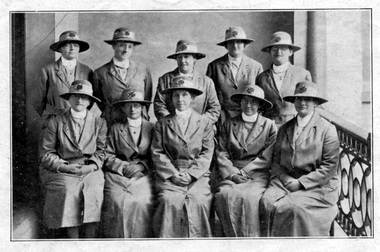
... centre of the hatband which was introduced in 1921. These Sisters, plus two others visited 29.079 visits in the metropolitan area and in suburbs as far distant as Elwood, Glen Huntly, Deepdene, Essendon and Fairfield. Of the 1666 patients on the books 394 were midwifery patients nursed in their own homes. It is believed the Matron in the photograph is Matron Reynolds. In February 1885 it was recognized that nursing care ...The photograph appeared in the MDNS Annual Report of 1922 and is taken on the veranda of the Melbourne District Nursing Society (MDNS) Nurses Home at 39 Victoria Parade, Collingwood. The Sisters lived and worked out of the Nurses Home from June 1914 to 1953. They attended the disadvantaged in the inner suburbs of Melbourne. The Sisters and Matron are wearing the grey uniform and hat with a red Maltese cross is in the centre of the hatband which was introduced in 1921. These Sisters, plus two others visited 29.079 visits in the metropolitan area and in suburbs as far distant as Elwood, Glen Huntly, Deepdene, Essendon and Fairfield. Of the 1666 patients on the books 394 were midwifery patients nursed in their own homes. It is believed the Matron in the photograph is Matron Reynolds. In February 1885 it was recognized that nursing care was needed for the sick poor in inner Melbourne. The Melbourne District Nursing Society (MDNS) was founded on the 17th of February with one Trained nurse (Nurse) who qualified under the Hospital training system, commencing on the 1st of May, and a second employed six months later, both working in the now CBD, ie from Spencer Street to Spring Street and from Victoria Parade to Flinders Street. From its inception the Society was at the forefront of health care. They provided high quality nursing care; educated their patients in the curing and prevention of disease; teaching the importance of cleanliness and good nutrition, both by verbal instruction and demonstration, even supplying soup and milk when needed. At that time they walked the streets and lane ways amid the slums of inner Melbourne carrying their nursing bag containing lotion, ointments, powders, liniment, bandages, dressings, a case of spirits, and the Nurse's own clean apron. The also supplied equipment, such as earthenware hot water bottles, splints, urinals, bed pans, bed cradles, feeding mugs, and air-cushions as well as providing clean bed linen and nightdresses and clothes as necessary. In 1891 the first Nurses Home was rented for 1 year at £65 per annum at 66 Cardigan Street, Carlton; Nurses wages were now £60 per annum. A Doctor gave lectures from the Home to the public on the understanding and prevention of diseases. The Society decided to commence a Midwifery Service and Nurse Fowler, who had previously worked for the Society, was re-employed as their first trained Midwife. She began home births in August 1893 giving them Ante Natal care, taking midwifery bundles and providing clothes for the babe as needed. Following birth, she gave Post-natal care to the mother and babe twice a day for three days and then daily for a week, and longer if required. She resigned after twelve months and Nurse Wilkie was appointed to the position. As well as walking, the Nurses used Public transport in the limited areas it ran, though a taxi was used by the Nurses and Midwife in emergencies and at night. Late in 1891 the Society moved to larger rented premises at 49 Drummond Street and in 1902 moved to 188 Leicester Street, Carlton. The Nurses were becoming exhausted, particularly in the heat of summer. Permission to use bicycles was given to them in 1898 and the Society decided to purchase their own in 1903. A business man offered ‘new free wheel’ bicycles at £13 each, which included maintenance for one year. Bells and wooden frames were added at a cost of £5 per frame so the Nurses could carry extra equipment. Nurses bags were strapped to the handlebars. Soup was made for those in need 2-3 times a week, and if patients could not arrange to have it collected, the soup was delivered by the Nurses on their bicycles. Their use caused a change in uniform, with white pith helmets, and veils covering them and tied under their chins, now being used. In 1904 the Society relocated to rented premises at 5 Royal Terrace, Nicholson Street in Fitzroy. In 1913 a Nurse had her ‘board and residence, uniforms, bicycles and laundry expenses’ provided and was paid £50 a year for her first six months. At the end of a year her salary was increased by £5, and later she earned £60 a year. Over the years the Nurses complained their veils became wet in the rain and asked for a change of uniform, but this did not occur until 1921. In 1914 the Society was at last able to purchase their own premises, 'Floraston' 39 Victoria Parade in Collingwood. During the Spanish Influenza epidemic, in 1919, MDNS appealed for assistance to procure Motor vehicles so the Nurses could visit an influx of cases. Through trusts, grants and donations four 'Ford 'T Model' cars were procured which enabled the Nurses to triple their visits. It was recorded on the 21st of May, that the seven Nurses had visited 1,212 persons with influenza in the last three months, how many visits to each is not known. In the whole of 1918 the Nurses, including midwifery cases, visited 1,100 persons. It was also recorded on May 7th the Nurses were delivering 100 quarts of soup to the needy each morning. In winter they also carried wood in the cars to distribute to their destitute patients as needed. In 1921-22 many of the people nursed by the Trained nurses (Sisters) suffered from malignant and tubercular disease, often the Sister would visit to find the patient was desperately ill living in a room alone and no one there to even give them a drink. In these cases the Sister would send them to hospital, but if possible most cases were nursed in their home. During July 1921- 30 June 1922 the four Midwifery trained Sisters averaged 8 confinement cases a week and sometimes gave Post Natal care to 15 to 18 patients a day. At the time of confinement a Student from the Women's Hospital accompanied the MDNS Sister and if complications occurred the patient was transferred to the Women's Hospital. The Society often had to provide blankets, sheets, set of baby clothes and night gowns for the mother. In many instances the Society provided milk for many months. The midwifery Sisters often travelled long distances in the cars Through constant use the cars were in such a poor state they were sold in 1927 and the Sisters went back to using public transport, as well as their bicycles which continued to be used in inner areas until 1945.. The Midwives used taxis when a birth was imminent. Black and white photograph showing 9 Sisters, 5 standing at rear and Matron, in the centre, of 4 seated Sisters on a balcony wearing their Melbourne District Nursing Society (MDNS) uniforms of grey coats, with revered collars and belt, over their partly seen grey uniforms with white collars. Five of the Sisters are wearing glasses. All are wearing grey brimmed hats with a Maltese cross in the centre of the lighter colour hatband. Part of deep metal scroll work of the veranda rail can be seen. A concrete wall is behind the Sisters.mdns, mdns matron, miss reynolds, royal district nursing service, rdns, melbourne district nursing society, mdns uniforms -
 Royal District Nursing Service (now known as Bolton Clarke)
Photograph - Photograph, black and white:, Barry Sutton, 10.08.1971
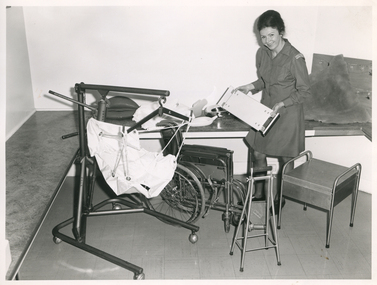
... Centre. She is wearing the RDNS grey uniform dress which has the insignia "Royal District Nursing Service" written in white on a grey background attached to the upper sleeves. The photograph is showing some of the equipment which is available for temporary loan to RDNS patients. From the founding of the Melbourne District Nursing Society (MDNS), in 1885, known as the Royal District Nursing Service (RDNS) from 1966, equipment was loaned and demonstrated to patients and their family members, to enable them to care for their loved ones in their home. ...Sr. Scott is in a room in the Royal District Nursing Service (RDNS) Melbourne Centre. She is wearing the RDNS grey uniform dress which has the insignia "Royal District Nursing Service" written in white on a grey background attached to the upper sleeves. The photograph is showing some of the equipment which is available for temporary loan to RDNS patients.From the founding of the Melbourne District Nursing Society (MDNS), in 1885, known as the Royal District Nursing Service (RDNS) from 1966, equipment was loaned and demonstrated to patients and their family members, to enable them to care for their loved ones in their home. In the 1970s RDNS employed a Physiotherapist who taught RDNS staff the correct transferring techniques, including the use of a hoist when this became available. RDNS staff taught and used these techniques in patient’s homes to undertake safe transfer of the patient and to reduce physical strain on RDNS nursing staff and family members. Each RDNS Centre had a room or shed where equipment for loan was kept. Headquarters also kept additional equipment which could be transported to Centres as required. Black and white digital image portraying Sister Scott, who is smiling and has her dark hair drawn up, checking equipment. She is holding a bath seat in her hands. Behind her on a table, left to right, is an air cushion, draw sheets, male urinal, female urinal, bed pan and a sheepskin which is in front of a wooden board with rows of cup hooks and names under each hook. In the left foreground is a hoist with a white sling hanging from either side of the front hanger. To its right is a closed wheelchair, a 4 pronged walking stick, and a commode to the right of Sr. Scott.Barry Sutton Photographer. Quote KL 49rdns, rdns equipment, rdns uniform, royal district nursing service, sister scott -
 Royal District Nursing Service (now known as Bolton Clarke)
Photograph - Digital image, Barry Sutton, 10.08.1971
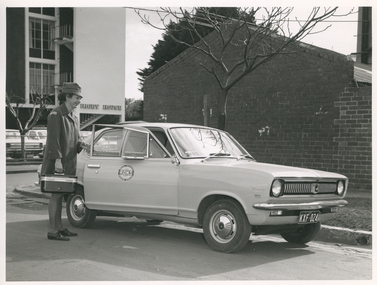
... patients in their homes in the community to administer nursing care as advised by a Doctor. The RDNS insignia on the door of the car is a round badge with a royal blue circle around the edge with the words "Royal District Nursing Service" in white, and the centre section is in three parts ,with the upper and lower sections white, and a royal blue centre strip with the large white capital letters "RDNS"....patients in their homes in the community to administer nursing care as advised by a Doctor. The RDNS insignia on the door of the car is a round badge with a royal blue circle around the edge with the words "Royal District Nursing Service" in white, and the centre section is in three parts ,with the upper and lower sections white, and a royal blue centre strip with the large white capital letters "RDNS". ...The RDNS Sister is about to leave to visit patients in their homes in the community to administer nursing care as advised by a Doctor. The RDNS insignia on the door of the car is a round badge with a royal blue circle around the edge with the words "Royal District Nursing Service" in white, and the centre section is in three parts ,with the upper and lower sections white, and a royal blue centre strip with the large white capital letters "RDNS".Royal District Nursing Service (RDNS) has had various modes of transport over the last 130 plus years. At first, from 1885 as Melbourne District Nursing Society (MDNS), their Trained nurses (Nurses) walked the streets and lane ways amid the slums of central Melbourne. As the Society expanded public transport was used, and bicycles were bought by the Society in 1903 and used in inner areas until 1945. During the Spanish flu epidemic, in 1919, MDNS appealed for assistance to procure Motor vehicles so the Nurses could visit an influx of cases. Through trusts, grants and donations four 'Ford T Model' cars were procured which enabled the Nurses to triple their visits. Through constant use the cars were in such a poor state two were sold in 1922 and the others later. In 1922-23 three Peugeot cars were purchased and a woman Chauffeur, 'Miss Sword', was employed who lived in the Home and was also in charge of the garage. MDNS was expanding and a Motor Auxiliary was formed in 1929 to take the Trained nurses (Sisters) to patients, and some Sisters used their own cars; even a motorcycle was used by one Sister in 1933. All these forms of transport were intermingled and in the early 1950s, and now as Melbourne District Nursing Service, seven Ford Prefect cars were bought followed by twelve Ford Anglia cars 1955. Having received Royal patronage; the now Royal District Nursing Service (RDNS) had its own fleet of Holden vehicles by the mid 1960s and the Motor Auxiliary ceased operating in 1971 as by then all staff employed were required to have a driving licence. Seat-belts had been introduced to Victoria in 1959 and District fitted them to their cars from 1962, even though they did not become compulsory until 1970. The Holden vehicles were replaced with grey Holden Torana vehicles. After several years the fleet was changed to white Toyota Corolla vehicles. The Melways Directory of maps was introduced in 1966, which was a boon to the Sisters, though it was a few years before it went beyond Seville, so a large paper map was used by the Sisters visiting patients in the areas passed Seville. By 2009 there were 598 cars in the fleet and the Sisters travelled 9 million 200,000 kilometres – this is equivalent to 12 trips to the moon and back. Black and White Photograph of a Royal District Nursing Service (RDNS) Sister about to enter one of the new light grey 2 door Holden Torana RDNS cars. The Sister, who is smiling, is wearing her uniform grey peaked hat over her long dark hair which is drawn back. She is wearing her long grey coat with the RDNS insignia on the upper sleeve and is holding the partly opened driver side door of the car with her left hand. She is holding the handle on the top of her rectangular black nursing case with her right hand. To the right, the grill and black number plate, with the white writing displaying "KXF 024", can be seen. The round RDNS insignia is on the upper centre of the car door. The car is the same width all over, has a flat bonnet which joins a sloping windscreen adjoining a flat roof which runs along and joins a short back window running down to a boot. A black tyred wheel can be seen under wheel arches at the front and near the rear of the vehicle. In the background to the left is a mid size bare tree; behind this portions of several parked cars and behind them a multi storey building with the Written words "Rioby House". To its right and directly behind the car is a mid size bare tree and behind that the end view of a brick building with a hip roof. Barry Sutton Photographer. Quote KL 52rdns transport, rdns uniform, royal district nursing service, rdns -
 Royal District Nursing Service (now known as Bolton Clarke)
Photograph - Digital image, Barry Sutton, 12.07.1972
... RDNS Sisters left in RDNS Torana vehicles from this Centre each morning to give nursing care to patients in surrounding suburbs and returned to the Centre after their visits. ...RDNS Sisters left in RDNS Torana vehicles from this Centre each morning to give nursing care to patients in surrounding suburbs and returned to the Centre after their visits. ...The photograph is taken outside the new Royal District Nursing Service (RDNS) Caulfield Centre. RDNS Sisters left in RDNS Torana vehicles from this Centre each morning to give nursing care to patients in surrounding suburbs and returned to the Centre after their visits. Gradually over the years, Melbourne District Nursing Service (MDNS), later known as Royal District Nursing Service (RDNS) from 1966 when they received Royal patronage, opened Centres throughout the Melbourne Metropolitan area and outer suburbs. In 1972 The Melbourne Centre which was conducted from RDNS Headquarters, 452 St. Kilda Road, was relocated to Caulfield and it became the Caulfield Centre. Their Trained nurses (Sisters) left from these Centres each morning to carry out their nursing visits in a specific area (district), taking any sterilized equipment needed with them. They returned at the end of the day to write up their patients nursing histories, clean and reset any equipment used ready for re-sterilization, and contact other medical and community personal as necessary. Most of the RDNS cars were housed at each Centre, only a few being driven home by a Sister. This is a black and white photograph of two RDNS two door grey Torana cars parked on the road outside a flat roof, one storey, light coloured brick building. The building is in three sections with the centre section set back. Part of the back of a white car can be seen in the driveway to the left of the set back section. Three large white framed windows can be seen along the end view of the left hand section and even larger windows are seen in the centre section. A small water tank and piping sit on a platform on the roof of both the left and right hand sections of the building. White fascia with dark trim above it edges the roof on each sections of the building. Some pencil shape type shrubs and a bare tree is seen in front of the building and a low light coloured brick fence runs across the property and down either side of the drive, with the footpath and nature strip in front of this. The back of a white car is seen on the road in the far right of the photograph and part of a wooden fence and parts of two large trees with leaves can be seen.Barry Sutton Photographer's Stamp. Quote KY 5rdns, royal district nursing service, rdns transport, rdns centre -
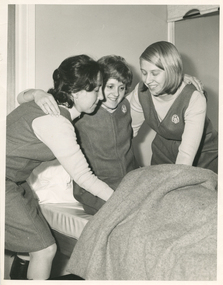 Royal District Nursing Service (now known as Bolton Clarke)
Photograph - Photograph, black and white, Barry Sutton, 19.07.1972
... care for their loved ones. RDNS at first held workshops given by a contracted private Physiotherapist, before employing their own Physiotherapist in 1975, who taught staff the correct transfer techniques, not only for safety of the patient, but to reduce physical strain on RDNS nursing staff and patient’s family members. When required the Physiotherapist accompanied the Sister on her visit to the patient in their home. rdns royal district nursing service rdns uniform rdns physiotherapist rdns centre ...This photograph is taken in a room in the RDNS Heidelberg Centre. The Sisters are demonstrating a lifting technique to staff members. The Sisters are wearing their RDNS winter uniforms which are a blue/grey skivvie under a blue/grey V neck tunic style herringbone winter material dress with the RDNS insignia on the upper left. From the founding of the Melbourne District Nursing Society (MDNS) in 1885, known as Royal District Nursing Service (RDNS) from 1966, the rehabilitation of patients to insure they were able to live independently in their own homes was at the forefront of care given by their Trained nurses. As well as teaching and supervising the use of equipment, their Trained nurses taught them safe transfer techniques. These techniques were also taught to family members to enable them to care for their loved ones. RDNS at first held workshops given by a contracted private Physiotherapist, before employing their own Physiotherapist in 1975, who taught staff the correct transfer techniques, not only for safety of the patient, but to reduce physical strain on RDNS nursing staff and patient’s family members. When required the Physiotherapist accompanied the Sister on her visit to the patient in their home.Black and white photograph of three Royal District Nursing Service (RDNS) Sisters demonstrating a safe bed transfer. From Left to Right is the side on view of Sisters Daphne Geldard, who has short dark curled hair with her left arm around the back of Sister Elizabeth Francis, and her right arm under her legs. Sister Francis has short dark hair and is smiling. She has her right arm over the shoulders of Sr. Geldard, and her left arm is over the shoulder of Sr. Bev Armstrong. Her buttocks are slightly off the bed which has a white pillow and grey blanket. Sr. Armstrong is facing both Sisters. She has short straight blonde hair and has her eyes closed. She has her right arm around the back of Sr. Frances and her left arm is under her legs. The three Sisters are wearing light coloured skivvies under a darker V neck tunic style dress with the RDNS insignia on the upper left. Barry Sutton's Photographer's Stamp. Reprint Quote Number: KY22 Handwritten on back of photo are the names of the RDNS staff members and the location is Heidelberg Centrerdns, royal district nursing service, rdns uniform, rdns physiotherapist, rdns centre, sister daphne geldard, sister elizabeth francis, sister bev armstrong -
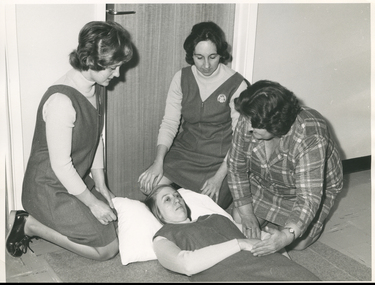 Royal District Nursing Service (now known as Bolton Clarke)
Photograph - Photograph, black and white, Barry Sutton, 19.07.1972
... Centre. The RDNS Sisters are wearing their winter uniforms of a blue/grey skivvie under a blue/grey V neck tunic style herringbone winter material dress, From the founding of the Melbourne District Nursing Society (MDNS) in 1885, known as Royal District Nursing Service (RDNS) from 1966, the rehabilitation of patients to insure they were able to live independently in their own homes was at the forefront of care given by their Trained nurses. ...Mrs P.. Cosh is a private Physiotherapist contracted by RDNS to educate RDNS nursing staff in safe transferring techniques. This photograph is taken in the Heidelberg Centre. The RDNS Sisters are wearing their winter uniforms of a blue/grey skivvie under a blue/grey V neck tunic style herringbone winter material dress,From the founding of the Melbourne District Nursing Society (MDNS) in 1885, known as Royal District Nursing Service (RDNS) from 1966, the rehabilitation of patients to insure they were able to live independently in their own homes was at the forefront of care given by their Trained nurses. As well as teaching and supervising the use of equipment, their Trained nurses taught them safe transfer techniques. These techniques were also taught to family members to enable them to care for their loved ones. RDNS at first held workshops given by a contracted private Physiotherapist before employing their own Physiotherapist in 1975 who taught staff the correct techniques, not only for safety of the patient, but to reduce physical strain on RDNS nursing staff and patient’s family members. When required the Physiotherapist accompanied the Sister on her visit to the patient in their home.On the left in the black and white photograph is Royal District Nursing Service (RDNS) Sister Elizabeth Francis, who has curled dark hair and is kneeling on a mat looking down at Sr. Bev. Armstrong, who has straight blonde hair and is lying on a mat on the floor with her head resting on a white pillow and her right arm resting across her body. Behind and slightly to the right of Sr. Armstrong is Sr. Daphne Geldard who has short dark curled hair. She is kneeling on the mat and looking down at Sr. Armstrong. To her right is Physiotherapist Mrs. P. Cosh, who has dark short curled hair and is wearing a check suite. She is looking at Sr. Armstrong and has her left hand resting on the out edge of Sr. Armstrong's right hand. The RDNS Sisters are wearing a light coloured skivvie under a darker V neck tunic style dress. A closed wooden door is behind the Sisters with pale walls either side. Lino tiles are on the floor either side the mat on which Sr. Armstrong lay.Barry Sutton Photographer's Stamp, Quote KY28, names of staff hand written on back of photographrdns, royal district nursing service, nurses uniforms, rdns physiotherapist, sister elizabeth francis, sister bev armstrong, sister daphne geldard, mrs p. cosh -
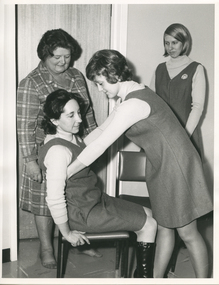 Royal District Nursing Service (now known as Bolton Clarke)
Photograph - Photograph, black and white, Barry Sutton, 19.07.1972
... Centre teaching RDNS staff a safe method of lifting and transferring Sr. Geldard from a chair. From the founding of the Melbourne District Nursing Society (MDNS) in 1885, known as Royal District Nursing Service (RDNS) from 1966, the rehabilitation of patients to insure they were able to live independently in their own homes was at the forefront of care given by their Trained nurses. ...Miss Kosch is a private physiotherapist contracted by RDNS. She is at RDNS Heidelberg Centre teaching RDNS staff a safe method of lifting and transferring Sr. Geldard from a chair. From the founding of the Melbourne District Nursing Society (MDNS) in 1885, known as Royal District Nursing Service (RDNS) from 1966, the rehabilitation of patients to insure they were able to live independently in their own homes was at the forefront of care given by their Trained nurses. As well as teaching and supervising the use of equipment, their Trained nurses taught them safe transfer techniques. These techniques were also taught to family members to enable them to care for their loved ones. RDNS at first held workshops given by a contracted private Physiotherapist before employing their own Physiotherapist in 1975 who taught staff the correct techniques, not only for safety of the patient, but to reduce physical strain on RDNS nursing staff and patient’s family members. When required the Physiotherapist accompanied the Sister on her visit to the patient in their home.Standing in the rear left of the black and white photograph is Ms Kosch, who has short curled dark hair and is wearing a check suit. She is looking down at Royal District Nursing Service (RDNS). Sister (Sr) Daphne Geldard, who has collar length curled dark hair, and is seated in front of her on a padded kitchen type chair. To Sr. Geldard's right, standing, is Sr Elizabeth Francis who has short dark curled hair and is bending forward with her arms outstretched under Sr. Geldard's armpits. She has her right leg braced against Sr. Geldard's right knee Sr Bev. Armstrong, who has short blonde hair, is standing at the right rear observing the procedure. The three Sisters are wearing a grey skivvie under a darker V neck tunic style dress with the RDNS insignia on the upper left. A black below knee boot is seen on Sr. Geldard's right leg. A closed dark wooden door with a white surround is behind Ms Kosch and to its right another chair is seen against the wall. Photographers stamp , names of staff, date and location. Quote KY 35rdns, royal district nursing service, rdns uniform, rdns physiotherapy, sister elizabeth francis, sister daphne geldard, sister bev armstrong, ms kosch -
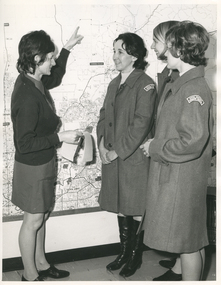 Royal District Nursing Service (now known as Bolton Clarke)
Photograph - Photograph, black and white, Barry Sutton, 19.07.1972
... patients in the same area giving continuity of care. As the Society expanded, becoming Melbourne District Nursing Service, then, with Royal patronage, Royal District Nursing Service (RDNS) many Centres were opened throughout the Melbourne Metropolitan area and outer suburbs. ...This photograph is taken in the office at RDNS Heidelberg Centre, and the RDNS Educator, Sr. Gawith is showing RDNS Sisters the areas covered by Heidelberg Centre. Sr. Gawith is wearing the RDNS uniform of a grey frock and red cardigan and the other three Sisters are wearing the newer RDNS uniform of a blue/grey herringbone coat with a curved material RDNS insignia attached on the upper sleeve. From its inception as Melbourne District Nursing Society (MDNS), in 1885, their trained nurses worked in specific areas, 'districts'. Their first Trained nurse (Nurse) worked east and west, between Victoria Parade and Flinders Street and, north and south, between Spencer Street and Spring Street. When a second Nurse was employed they divided this area at Elizabeth Street so each Nurse could attend to patients in the same area giving continuity of care. As the Society expanded, becoming Melbourne District Nursing Service, then, with Royal patronage, Royal District Nursing Service (RDNS) many Centres were opened throughout the Melbourne Metropolitan area and outer suburbs. The District nurse's (Sisters) areas (districts) grew and were divided within Shire boundaries for e.g. Knox 1, Knox 2, Knox 3, Knox 4, within the area of the Shire of Knox. On the left of the black and white photograph is Royal District Nursing Service (RDNS) Sister (Sr) Mary Gawith, who has short dark curled hair. She is standing side-on and looking to the right as, with her extended left arm she is pointing her finger to an area on a large map attached to the wall. She is holding some white sheets of paper in her right hand. To her right and looking towards her are Sr. Daphne Geldard, who has short curled hair, is smiling, and has her hands clasped in front of her. On the right next to her, and partly hidden, is Sr. Bev. Armstrong who is smiling and has short straight blonde hair. In the front right of the photograph and partly hiding Sr. Armstrong is Sr. Elizabeth Francis, who has short dark curled hair and has her hands clasped in front of her. Sr. Gawith is wearing a grey uniform dress and dark cardigan. The other Sisters are wearing grey uniform coats with the RDNS insignia on the upper sleeve. Sr. Geldard is wearing below the knee black boots.Barry Sutton photographer's stamp, quote number KY 40, names of staff in the photograph.rdns, royal district nursing service, rdns district map, rdns uniform, rdns education, sister daphne geldard, sister elizabeth francis, sister bev armstrong, sister mary gawith -
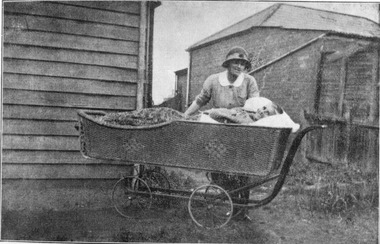 Royal District Nursing Service (now known as Bolton Clarke)
Photograph - Digital image, c.1920
... patient, and depicts a MDNS Sister attending to a lady who is lying in a wicker bed pram in the rear garden of her home. The wicker bed pram enabled the lady to enjoy fresh air and to be moved about easily. The image shows the MDNS uniform of a grey cotton frock with white collar, and a grey brimmed hat with a red Maltese cross in the centre of the hatband. In 1885, 50 years after Melbourne was founded, it was recognized that nursing care ...This digital image is taken at the home of a Melbourne District Nursing Society (MDNS) patient, and depicts a MDNS Sister attending to a lady who is lying in a wicker bed pram in the rear garden of her home. The wicker bed pram enabled the lady to enjoy fresh air and to be moved about easily. The image shows the MDNS uniform of a grey cotton frock with white collar, and a grey brimmed hat with a red Maltese cross in the centre of the hatband. In 1885, 50 years after Melbourne was founded, it was recognized that nursing care was needed for the sick poor in inner Melbourne. The Melbourne District Nursing Society (MDNS) was founded in February 1885 with one Trained nurse, known as 'Nurse' in those days, and a second employed six months later,. The two Nurses worked in the now CBD, ie from Spencer Street to Spring Street and from Victoria Parade to Flinders Street. At that time they walked the streets and lane ways amid the slums of inner Melbourne carrying their nursing bags containing lotion, ointments, powders, liniment, bandages, dressings, a case of spirits, and the Nurse's own clean apron, soap and small towel. They supplied equipment on loan, such as earthenware hot water bottles, splints, urinals, bed pans, bed cradles, feeding mugs, and air-cushions as well as providing blankets and clean bed linen, and nightdresses as necessary. From its inception the Society was at the forefront of health care and liaised with Doctors. They provided high quality nursing care to a range of people, often in destitute situations, some lying on rags on the floor as they had no bed, others with just a bed and maybe a thin blanket, a chair and nothing else. Their ages ranged from babes, children, adults to the elderly. The Nurses gave medications as ordered, dressed wounds e.g. to the injured, and surgical cases, and to those with leg ulcers; attended to patients with ‘surgical ailments’ such as ‘hip disease’; gave care to those with acute illnesses such as bronchitis, pleurisy, pneumonia, measles, and scarlet fever, as well as those with chronic illnesses such as consumption (tuberculosis), heart disease, arthritis, cancer, debility, neuritis and paralysis. This image shows a Melbourne District Nursing Society (MDNS) Trained nurse (Sister) wearing a grey uniform with white collar, and a grey brimmed hat, which has a hatband with Maltese cross applied, standing behind and attending an elderly lady patient laying in a wicker bed pram outside her home. The Sister has her right hand resting on the pram and is looking down at the lady, and the lady, who has short grey hair, is smiling and looking toward the camera. Her body is covered with a floral cover. To the left, part of the horizontal weatherboards of a wooden house can be seen, and to the right and rear, a brick, tiled hip roof, building can be seen. The wicker bed pram has four spoked wheels and a metal frame that bends up to form a handle on its right hand side.melbourne district nursing society, mdns, mdns nurses, mdns patient care, mdns uniforms, rdns, royal district nursing service -
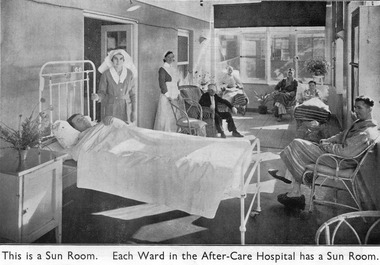 Royal District Nursing Service (now known as Bolton Clarke)
Photograph - Digital image, c.1935
... The After-care hospital continued to operate at the same address in Collingwood until 1985 when it became the Melbourne Geriatric Centre. mdns after- care hospital melbourne district nursing society rdns royal district nursing service This digital Image shows six men patients and nursing staff in a Sun Room in the Melbourne District Nursing Society After-Care Hospital. ...Each Ward in the Melbourne District Nursing Society After-Care Hospital, at 45 Victoria Parade, Collingwood, had a Sun Room which was well lit by its many windows. This digital image is taken in one of the Sun Rooms and shows the type of hospital beds, furniture and the uniforms worn by Sisters and nurses in the 1930s.Melbourne District Nursing society opened the After-Care Home, situated at 39 Victoria Parade Collingwood in 1926 following a public appeal for funds. The name changed from 'Home' to 'Hospital' in 1934. The After-Care Home was originally established to provide nurse-managed convalescent care to poor and underprivileged people who could not look after themselves at home due to illness or on release from hospital. Opening in 1926, at a cost of £27,000, the home included maternity, children’s and adult wards as well as accommodation for Matron, twelve nurses and four domestic staff. In 1930 an ante-natal clinic was opened at the home. During 1934 the Women’s Welfare Clinic including, at the time, a very controversial Family Planning Clinic, the first of its kind in Australia, was opened to support women at risk following multiple and difficult pregnancies. Major extensions occurred in 1936. Each Ward in the After-Care Hospital at 45 Victoria Parade, Collingwood, had a Sun Room which was well lit by its many windows. Several donors gave money to furnish some of the Wards. Following Government intervention, the After-Care Hospital was separated from the Melbourne District Nursing Society in 1957. The District division of Melbourne District Nursing Society became the Melbourne District Nursing Service and moved to 452 St Kilda Road; later, in 1966, with Royal patronage this became Royal District Nursing Service (RDNS). The After-care hospital continued to operate at the same address in Collingwood until 1985 when it became the Melbourne Geriatric Centre. This digital Image shows six men patients and nursing staff in a Sun Room in the Melbourne District Nursing Society After-Care Hospital. In the left foreground is a low bedside cupboard, beside it is a man with short dark hair lying in an iron framed hospital bed with a white cover pulled up to his shoulders. A Sister, who is looking at the camera, is wearing a grey uniform with a white collar, and a white veil over her short dark hair; she is standing behind, and at the head of the bed with her right hand holding the vertical bar of the bed frame. Behind her is an open door and then a nurse wearing a long white apron over her grey long sleeved uniform; she has a white cap over her shoulder length dark hair and is looking at the camera. Both of her hands are resting on an empty cane chair. Next along is a man with a bandage wrapped around his head and over his left eye. He is wearing dark clothing and is sitting on a padded cane chair, as are the rest of the men in the room. To the rear, in front of four long windows, are another two men, one on the left has short white hair and is wearing light clothing, and to his right is a man with short dark hair and is wearing a dark dressing gown over light colour pyjamas. On his right is a large vase of flowers on a tall white stand. On the right hand side of the photograph are another two men with short dark hair and wearing dressing gowns; part of a wall with windows can be seen behind them.mdns, after- care hospital, melbourne district nursing society, rdns, royal district nursing service -
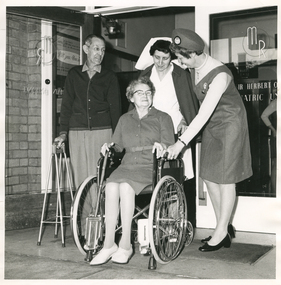 Royal District Nursing Service (now known as Bolton Clarke)
Photograph - Photograph, black and white, Barry Sutton, 20.07.1972
... At the time of a patient’s discharge, the Liaison Sister forwarded information on their diagnosis and instructions regarding the care required at home to the appropriate RDNS Centre, and in turn the attending District Sister wrote a report of progress and any queries to the hospital Doctor, via the Liaison Sister, at the time the patient was attending outpatients. ...This RDNS Liaison Sister is reassuring a lady who is being discharged from Mount Royal Rehabilitation Hospital regarding the visits she will receive from RDNS Sisters in her home. The Liaison Sister had previously visited the lady in the Ward to ascertain the care she would require at home and this information had been passed to the appropriate RDNS Centre and to the Sister who would be visiting the lady in her home. The RDNS Sister is wearing her RDNS winter uniform of a blue/grey skivvie under a blue/grey winter material herringbone V neck tunic style frock. She is wearing her blue/grey herringbone winter material hat.Liaison had occurred between doctors and the Trained nurses (Nurses) of the Melbourne District Nursing Society (MDNS), from its inception in 1885. This increased when Midwifery was introduced in August 1893 with close liaising with the Women’s Hospital. As District nursing grew it was recognized that closer liaising between many Public Hospitals would be beneficial, for not only the MDNS, later called Royal District Nursing Service (RDNS), Trained nurses (Sisters), but also for the patients and the hospitals. In August 1964 a Liaison Officer commenced at the Alfred Hospital. This soon increased to Liaison Officers working full time at several Public Hospitals. At the time of a patient’s discharge, the Liaison Sister forwarded information on their diagnosis and instructions regarding the care required at home to the appropriate RDNS Centre, and in turn the attending District Sister wrote a report of progress and any queries to the hospital Doctor, via the Liaison Sister, at the time the patient was attending outpatients. Any new instructions were then sent back to the District Sister. Liaising also occurred between District field staff and Doctors when patients were referred by General Practitioners and did not attend a Hospital. Rehabilitation of patients to insure they were able to live independently in their own homes was at the forefront of care given by the RDNS Sisters.On the right of the black and white photograph is a Royal District Nursing Service (RDNS) Sister, who is wearing her uniform hat over her short curled hair, and a pale skivvie under a V neck tunic style grey dress. She is leaning forward with her left hand on the arm of a wheelchair, and is smiling at a lady, who has short curly hair; is wearing glasses and grey frock with a belt, and is sitting in wheelchair. She is holding the tops of walking sticks with both her hands; the foot of the sticks are resting on the ground. The footplates of the wheelchair are open and the lady has her feet on the ground. To her left stands a gentleman who has short dark hair and is wearing a buttoned up dark cardigan over a light coloured shirt, peaks showing, and light trousers. He is holding a 4 prong stick in his right hand and is looking at the lady. A Hospital Sister, who is wearing a dark cape over her white uniform and a white veil over her short dark curly hair is standing behind the wheelchair looking down at the lady. In the background, part of a brick wall can be seen on the left and to the right of this an open glass door and to its right is a closed glass door with writing on it.Barry Sutton Photographer's stamprdns, royal district nursing service, rdns uniform, rdns liaison, rdns rehabilitation -
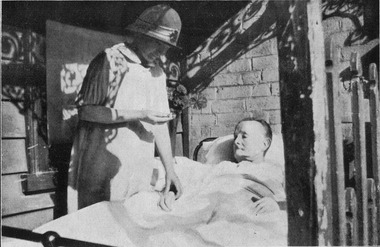 Royal District Nursing Service (now known as Bolton Clarke)
Photograph - Photograph, black and white, c.1930
... care included giving advice and support to the patient and their Carers. The Sisters liaised with the persons Doctor, Hospital and allied Health personal when necessary. melbourne district nursing society mdns mdns uniforms rdns royal district nursing service This black and white photograph shows a Melbourne District Nursing Society (MDNS) Trained nurse (Sister) standing on the left of a man who is in his bed on the veranda of his home. She is wearing a white gown over her uniform and her grey uniform hat, which has a hatband showing a Maltese cross in the centre ...This photograph shows a Melbourne District Nursing Society (MDNS) Sister visiting a patient in his home. The photograph shows her taking his temperature and pulse and carrying out basic nursing observations. The Sister kept a record of this information in the man's Nursing History at MDNS Headquarters and conveyed it to the patient's Doctor as required.The Trained nurses of the Melbourne District Nursing Society (MDNS), later known as Royal District Nursing Service (RDNS), visited patients in their home and gave best practice care in many fields of nursing, and to people of many cultures, throughout its 130 years of expansion. Initial visits not only assessed the specific nursing situation but the situation as a whole. Their patients ranged in age from babes, children, adults to the elderly and referrals were taken from Hospitals, General Practitioners and allied Health facilities. Some of the care the Sisters provided is as follows: – Post-Natal care given to mother and babe, Wound Care following various types of surgery, accidents, burns, cancer, leg ulcers etc. Supervising and teaching Diabetic Care, including teaching and supervising people with Diabetes to administer their own Insulin, and administering Insulin to those unable to give their own injections. Administering other injections and setting up weekly medication boxes. The Sisters performed Catheterizations on adults suffering from conditions such as Quadriplegia, Paraplegia, Multiple Sclerosis (MS), Motor Neurone Disease (MND) and Guillan-Barre Syndrome, and when required at school on children for e.g. those with Spina Bifida. The Sisters visited those requiring Cystic Fibrosis support and care; those requiring Haemo-Oncology care, including visiting children at school; those requiring Home Enteral Feeding care, and those requiring IV therapy at home and home Dialysis. Palliative Care was given including pain relief with the use of syringe drivers, personal care as needed, and advice and support to both patient and family. The Sisters provided Stoma management to those needing Urostomy, Ileostomy and Colostomy care and those requiring Continence care. HIV/AIDS nursing care was provided; visits to Homeless Persons were made. Personal care was given to patients ranging in age and with varying mobility problems, such as those with MS, MND, Guillan-Barre Syndrome, Quadriplegia, Paraplegia, Acquired Brain Injury, to those following a Cerebrovascular Accident (Stroke), those with severe Arthritis and those with a form of Dementia. When necessary the elderly were assisted with personal care and advice given on safety factors with the use of hand rails, bath or shower seats, and hand showers. Rehabilitation with an aim towards independence remained at the forefront of the Sister’s minds and when possible using aids and instruction on safe techniques enabled the person to become fully independent. All care included giving advice and support to the patient and their Carers. The Sisters liaised with the persons Doctor, Hospital and allied Health personal when necessary.This black and white photograph shows a Melbourne District Nursing Society (MDNS) Trained nurse (Sister) standing on the left of a man who is in his bed on the veranda of his home. She is wearing a white gown over her uniform and her grey uniform hat, which has a hatband showing a Maltese cross in the centre; she has her left hand on the man's right wrist and is looking down at a watch she is holding in her right hand. The man, who has short dark hair, is holding a thermometer in his mouth. He is partly propped up with his head resting on a white covered pillow; part of the iron frame of the bed is seen to its left. Most of his body is covered with light coloured bedclothes; part of his pyjamas can be seen. Part of a vase of flowers is seen just behind the Sister's left arm. In the left of the photograph, part of the weatherboards of the house can be seen with a window, partly obscured with a blind. To the right of the man is a veranda post and some pickets of a wooden fence; behind him part of a brick wall is seen.melbourne district nursing society, mdns, mdns uniforms, rdns, royal district nursing service
