
Showing 26 items matching "peony"
-
 Embroiderers Guild, Victoria
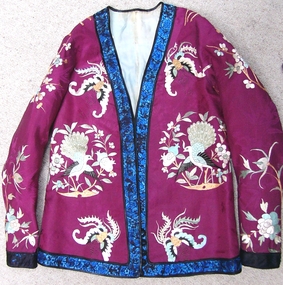
Clothing - Ladies jacket, Early 20th century
... In Chinese embroidery, the combination of bats, peacocks, and peony roses creates a rich tapestry of highly auspicious symbols, primarily associated with wishes for happiness, wealth, beauty, and high rank. ...Magenta brocade with embroidered motifs of bats, peacocks and peony roses in coloured silks using satin stitch. ...Jacket is edged with a band of black silk embroidered with blue peony roses. Clothing Ladies jacket ...In Chinese embroidery, the combination of bats, peacocks, and peony roses creates a rich tapestry of highly auspicious symbols, primarily associated with wishes for happiness, wealth, beauty, and high rank. When these motifs appear together, as they often do in intricate antique textiles or Mandarin squares, they collectively represent a desire for a life filled with wealth, prestige, and abundant happiness. Magenta brocade with embroidered motifs of bats, peacocks and peony roses in coloured silks using satin stitch. Jacket is edged with a band of black silk embroidered with blue peony roses.embroidery, silk embroidery, oriental, garments, 1900-20, china -
 Embroiderers Guild, Victoria
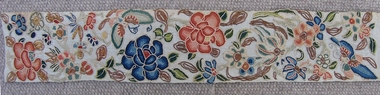
Clothing - Chinese Floral Sleeve Band, Late 19th Century
... ...peony...Sleeve band of grey brocade silk, embroidered design of peonies, and butterflies in coloured silk thread in Pekin knot stitch. ...China Late 19th century silk sleeve band flower peony butterfly Sleeve band of grey brocade silk, embroidered design of peonies, and butterflies in coloured silk thread in Pekin knot stitch. ...Chinese sleeve embroidery bands, or wanxiu became popular in the late 19th century during the Qing Dynasty, evolving from the traditional Han cuff embroidery and Manchu styles. These detachable, decorated bands were added to women's informal jackets and robes, often featuring symbolic motifs like landscapes, flowers, and auspicious symbols. They served both a decorative function, displaying artistic skill and personal wishes, and a practical one by covering the sleeves when hands were folded at the waist. History and evolution: Origins: The practice of embroidering cuffs on robes existed during the previous Ming Dynasty for Han women, and this was adopted by the Manchu rulers who founded the Qing Dynasty. Qing Dynasty (1644-1911): The practice was popularized and elaborated upon during this era, with detachable bands becoming a fashionable element for informal wear. Symbolism: The embroidery included a complex visual vocabulary of wishes for a long life, many offspring, and a happy marriage, derived from nature, mythology, and classical literature. Functionality: Women would fold their arms, often with their hands inside the sleeves, so the embroidered bands, which were sewn to hang down the back of the jacket, would be displayed prominently down the front. 19th century peak: The late 19th century was the peak of their popularity, with intricate designs becoming fashionable and even influenced by court tastes, such as those favoured by the Empress Dowager Cixi. Later developments: The late 19th century saw the introduction of chemical 'aniline' dyes from Europe, leading to brighter, bolder colours in embroidery. Motifs and their Meanings: Auspicious symbols: Designs often included symbols for good fortune, wealth, and longevity. Natural imagery: Birds, flowers, and landscapes were common motifs that could represent natural beauty or convey specific symbolic meanings. Figurative scenes: Bands could also feature narrative scenes from classical stories or legends. The choice of motifs allowed women to express personal desires, cultural values, and aesthetic preferences, reflecting a more personal and informal style than official court attire.Sleeve band of grey brocade silk, embroidered design of peonies, and butterflies in coloured silk thread in Pekin knot stitch. Flowers are outlined in cream crinkle cord. china, late 19th century, silk, sleeve band, flower, peony, butterfly -
 Friends of Westgarthtown
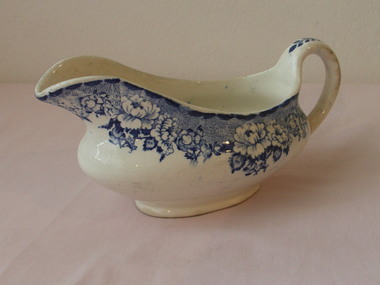
Domestic object - Gravy jug, … Pottery'
... ...peony...Maker's mark on base, circular stamp with female figure in centre. 'PEONY' printed at top, '… Pottery Coy Ltd. ...'PEONY' printed at top, '… Pottery Coy Ltd. ...White china gravy boat with blue floral pattern on exterior, extending from rim to around 1/3 down the side, and leaf pattern on rounded handle. Large spout or lip for pouring. Some blue marks on inside.Maker's mark on base, circular stamp with female figure in centre. 'PEONY' printed at top, '… Pottery Coy Ltd. Glasgow' printed around circle, some missing because of bad printing. 'Made in Scotland' at bottom.domestic items, food & drink consumption, gravy, boat, container, blue and white, china, peony, scotland, glasgow -
 Villa Alba Museum
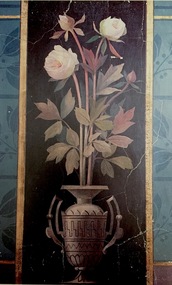
Postcard - Peonies, Dado Panel, Upper Hall, Villa Alba, Suzie Dickson, 1990-2010
... Peonies - No. 6 in a series of dado panels to the Upper Hall, Villa Alba Museum, Kew....Postcard Peonies, Dado Panel, Upper Hall, Villa Alba Suzie Dickson ...The Villa Alba Restoration Fund was established by the Villa Alba Preservation Committee. As part of a fundraising activity, they commissioned Suzie Dickson to photograph six panels in the Upper Hall that had been uncovered to date by conservators. The dado panels extend along the entire upper hall. Many are still to be restored.Peonies - No. 6 in a series of dado panels to the Upper Hall, Villa Alba Museum, Kew.villa alba museum - kew (vic), interior design - 19th century, paterson brothers - decorators - melbourne, signor rizzi - artist, villa alba preservation committee -
 Embroiderers Guild, Victoria
Accessory - Pair of Chinese Sleeve Bands, Mid 19th Century
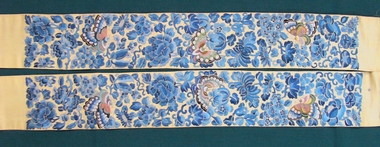
... Pale gold satin. Design of peonies embroidered in shades of blue satin stitch with coloured butterflies.....Embroidery Garments Silk Embroidery Mid 19th Century China Oriental Pale gold satin. Design of peonies embroidered in shades of blue satin stitch with coloured butterflies.. ...Chinese sleeve embroidery bands, or wanxiu became popular in the late 19th century during the Qing Dynasty, evolving from the traditional Han cuff embroidery and Manchu styles. These detachable, decorated bands were added to women's informal jackets and robes, often featuring symbolic motifs like landscapes, flowers, and auspicious symbols. They served both a decorative function, displaying artistic skill and personal wishes, and a practical one by covering the sleeves when hands were folded at the waist. History and evolution: Origins: The practice of embroidering cuffs on robes existed during the previous Ming Dynasty for Han women, and this was adopted by the Manchu rulers who founded the Qing Dynasty. Qing Dynasty (1644-1911): The practice was popularized and elaborated upon during this era, with detachable bands becoming a fashionable element for informal wear. Symbolism: The embroidery included a complex visual vocabulary of wishes for a long life, many offspring, and a happy marriage, derived from nature, mythology, and classical literature. Functionality: Women would fold their arms, often with their hands inside the sleeves, so the embroidered bands, which were sewn to hang down the back of the jacket, would be displayed prominently down the front. 19th century peak: The late 19th century was the peak of their popularity, with intricate designs becoming fashionable and even influenced by court tastes, such as those favoured by the Empress Dowager Cixi. Later developments: The late 19th century saw the introduction of chemical 'aniline' dyes from Europe, leading to brighter, bolder colours in embroidery. Motifs and their Meanings: Auspicious symbols: Designs often included symbols for good fortune, wealth, and longevity. Natural imagery: Birds, flowers, and landscapes were common motifs that could represent natural beauty or convey specific symbolic meanings. Figurative scenes: Bands could also feature narrative scenes from classical stories or legends. The choice of motifs allowed women to express personal desires, cultural values, and aesthetic preferences, reflecting a more personal and informal style than official court attire.Pale gold satin. Design of peonies embroidered in shades of blue satin stitch with coloured butterflies..embroidery, garments, silk embroidery, mid 19th century, china, oriental -
 Embroiderers Guild, Victoria
Textile - Silk Embroidered Peonies and Butterflies
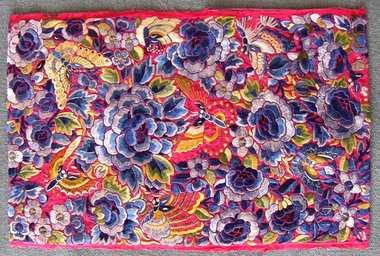
... Red silk background embroidered in an all over design of peonies and butterflies in shades of blues, greens and yellows....Textile Silk Embroidered Peonies and Butterflies ...According to the donor this is Indian work on Madras silk.Red silk background embroidered in an all over design of peonies and butterflies in shades of blues, greens and yellows.embroidery, garments, silk embroidery, oriental, india -
 Mont De Lancey
Cloisonne - Vase
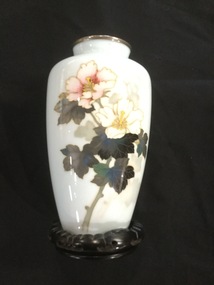
... Pale blue Japanese Cloisonne vase with peony flower design in pink and white with green leaves on black wooden stand. ...They were decorated with geometric or schematic designs, with thick cloison walls. vases Pale blue Japanese Cloisonne vase with peony flower design in pink and white with green leaves on black wooden stand. ...Purchased by Mr. & Mrs. H. N. Lord in Japan in 1960. The Japanese word for cloisonne ware is SHIPPO or seven treasured ware. It is an ancient technique for decorating metalwork objects. The resulting objects can also be called cloisonné. The decoration is formed by first adding compartments or cells to the metal object. This is done by soldering or sticking silver or gold wires or thin strips placed on edge. These are visible in the finished piece, separating the different compartments. Coloured enamel is the usual filling for the cells. Cloisonné enamel objects are worked on with enamel powder made into a paste, which then is fired in a kiln. In older times inlays of cut gemstones were often used. They were decorated with geometric or schematic designs, with thick cloison walls. Pale blue Japanese Cloisonne vase with peony flower design in pink and white with green leaves on black wooden stand. vases -
 Embroiderers Guild, Victoria
Accessory - Chinese Sleeve Bands
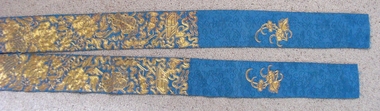
... Embroidered in gold metallic thread on blue silk fabric in a pattern of peonies, bats and other auspicious symbols....Embroidered in gold metallic thread on blue silk fabric in a pattern of peonies, bats and other auspicious symbols. ...Purchased in Singapore circa 1920 and believed to be old then. Never been worn. Chinese sleeve embroidery bands, or wanxiu became popular in the late 19th century during the Qing Dynasty, evolving from the traditional Han cuff embroidery and Manchu styles. These detachable, decorated bands were added to women's informal jackets and robes, often featuring symbolic motifs like landscapes, flowers, and auspicious symbols. They served both a decorative function, displaying artistic skill and personal wishes, and a practical one by covering the sleeves when hands were folded at the waist. History and evolution: Origins: The practice of embroidering cuffs on robes existed during the previous Ming Dynasty for Han women, and this was adopted by the Manchu rulers who founded the Qing Dynasty. Qing Dynasty (1644-1911): The practice was popularized and elaborated upon during this era, with detachable bands becoming a fashionable element for informal wear. Symbolism: The embroidery included a complex visual vocabulary of wishes for a long life, many offspring, and a happy marriage, derived from nature, mythology, and classical literature. Functionality: Women would fold their arms, often with their hands inside the sleeves, so the embroidered bands, which were sewn to hang down the back of the jacket, would be displayed prominently down the front. 19th century peak: The late 19th century was the peak of their popularity, with intricate designs becoming fashionable and even influenced by court tastes, such as those favoured by the Empress Dowager Cixi. Later developments: The late 19th century saw the introduction of chemical 'aniline' dyes from Europe, leading to brighter, bolder colours in embroidery. Motifs and their Meanings: Auspicious symbols: Designs often included symbols for good fortune, wealth, and longevity. Natural imagery: Birds, flowers, and landscapes were common motifs that could represent natural beauty or convey specific symbolic meanings. Figurative scenes: Bands could also feature narrative scenes from classical stories or legends. The choice of motifs allowed women to express personal desires, cultural values, and aesthetic preferences, reflecting a more personal and informal style than official court attire.A pair of sleeve bands. Embroidered in gold metallic thread on blue silk fabric in a pattern of peonies, bats and other auspicious symbols.embroidery, metal thread, embroidery, garments, japan -
 Bendigo Historical Society Inc.
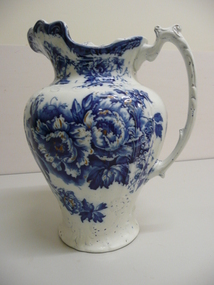
Functional object - CHINA JUG
... Large blue and white china jug with handle, from wash set, floral peony design with small amount of gilding, fluted top....DOMESTIC EQUIPMENT Ablutions water jug Large blue and white china jug with handle, from wash set, floral peony design with small amount of gilding, fluted top. ...Large blue and white china jug with handle, from wash set, floral peony design with small amount of gilding, fluted top.domestic equipment, ablutions, water jug -
 Embroiderers Guild, Victoria
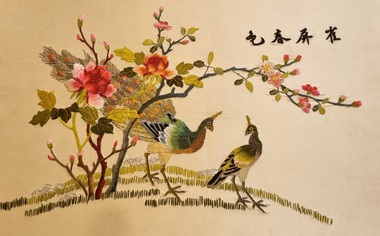
Textile - Korean Embroidered Silk Picture Peacocks, Early - mid 20th C
... Silk embroidery of a pair of peacocks under cherry blossom and peonies. Cream silk background with colourful satin stitch embroidery using silk threads....Four characters - Chinese 'Hanzi' or Korean 'Hanja' Silk embroidery of a pair of peacocks under cherry blossom and peonies. Cream silk background with colourful satin stitch embroidery using silk threads. ...Traditional embroidery (chasu) in Korea has a history of more than 2,000 years. Since prehistoric times, the need for sewing led ancient Koreans to use needles made from fish or other animal bones to weave animal skin, tree bark and leaves. After society got more advanced, chasu was introduced as a method of adding colour and detail.Silk embroidery of a pair of peacocks under cherry blossom and peonies. Cream silk background with colourful satin stitch embroidery using silk threads.Four characters - Chinese 'Hanzi' or Korean 'Hanja' -
 Embroiderers Guild, Victoria
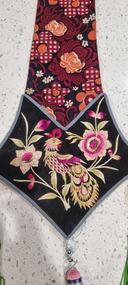
Textile - Pair of Chinese Decorative Hanging Panels
... Traditional motifs like peonies and birds (phoenix or rooster) represent cultural symbols of prosperity and beauty....Traditional motifs like peonies and birds (phoenix or rooster) represent cultural symbols of prosperity and beauty. ...Traditional motifs like peonies and birds (phoenix or rooster) represent cultural symbols of prosperity and beauty.Silk satin stitch on black cotton in pale greens, peach and shades of pink and red. Floral pattern with central symbolic bird. Three tassels hanging from lower edge - two green and one pink. Floral printed cotton hanging bands and backing. -
 Embroiderers Guild, Victoria
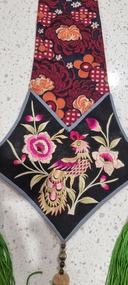
Textile - Pair of Chinese Decorative Hanging Panels
... Traditional motifs like peonies and birds (phoenix or rooster) represent cultural symbols of prosperity and beauty....Traditional motifs like peonies and birds (phoenix or rooster) represent cultural symbols of prosperity and beauty. ...Traditional motifs like peonies and birds (phoenix or rooster) represent cultural symbols of prosperity and beauty.Silk satin stitch on black cotton in pale greens, peach and shades of pink and red. Floral pattern with central symbolic bird. Three tassels hanging from lower edge - two green and one beige. Floral printed cotton hanging bands and backing. -
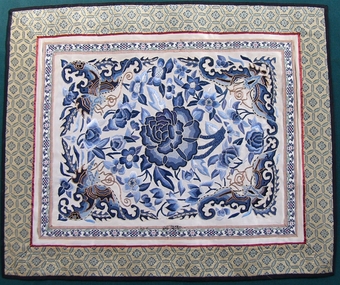 Embroiderers Guild, Victoria
Textile - Mat, 1980
... Cream silk mat with blue silk embroidery in a traditional Chinese design with peonies, bats and plum blossoms. The border is made of two rows of woven braid....Bought by donor in Hong Kong in 1983 Embroidery Silk Embroidery Oriental Mats 1960-80 China Cream silk mat with blue silk embroidery in a traditional Chinese design with peonies, bats and plum blossoms. The border is made of two rows of woven braid. ...Bought by donor in Hong Kong in 1983Cream silk mat with blue silk embroidery in a traditional Chinese design with peonies, bats and plum blossoms. The border is made of two rows of woven braid.embroidery, silk embroidery, oriental, mats, 1960-80, china -
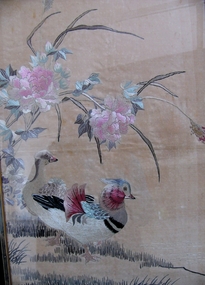 Embroiderers Guild, Victoria
Textile - Chinese Embroidered Panel with Ducks
... Cream silk background with two Mandarin ducks by water along with sprays of peonies and grasses. All worked in fine floss silk with delicate colours of white, pink, grey and green....Embroidery Panel Japan Silk Embroidery Oriental Cream silk background with two Mandarin ducks by water along with sprays of peonies and grasses. All worked in fine floss silk with delicate colours of white, pink, grey and green. ...Cream silk background with two Mandarin ducks by water along with sprays of peonies and grasses. All worked in fine floss silk with delicate colours of white, pink, grey and green.embroidery, panel, japan, silk embroidery, oriental -
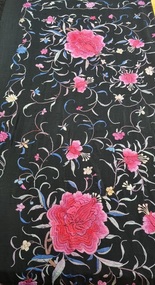 Embroiderers Guild, Victoria
Textile - Chinese Black Silk Embroidered Piano Shawl, 1920's
... Vintage black silk piano shawl, with colourful, intricate floral foliage vine leaf design and large peony flowers in pink and blue silk. 250 mm hand-knotted black fringe....Vintage black silk piano shawl, with colourful, intricate floral foliage vine leaf design and large peony flowers in pink and blue silk. 250 mm hand-knotted black fringe. ...Known as Manton de Manila, these garments became popular in Spain for flamenco and often produced in China for the export market during the 1920's. Donor's grandfather was a Sea Captain, often using the Asian trading routes. This came from her grandmother.Vintage black silk piano shawl, with colourful, intricate floral foliage vine leaf design and large peony flowers in pink and blue silk. 250 mm hand-knotted black fringe. -
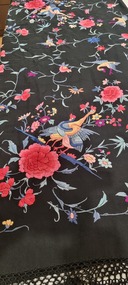 Embroiderers Guild, Victoria
Textile - Chinese Black Silk Embroidered Piano Shawl, 1920's
... Vintage black silk piano shawl, with colourful, intricate floral foliage vine leaf design and large peony flowers and birds in pink, yellow, orange and blue silk. 250 mm hand-knotted black fringe....Vintage black silk piano shawl, with colourful, intricate floral foliage vine leaf design and large peony flowers and birds in pink, yellow, orange and blue silk. 250 mm hand-knotted black fringe. ...Known as Manton de Manila, these garments became popular in Spain for flamenco and often produced in China for the export market during the 1920's.Vintage black silk piano shawl, with colourful, intricate floral foliage vine leaf design and large peony flowers and birds in pink, yellow, orange and blue silk. 250 mm hand-knotted black fringe. -
 Embroiderers Guild, Victoria
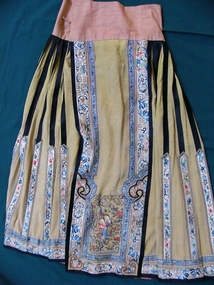
Clothing - Chinese Embroidered Skirt, 19th century
... Gourds: fertility and good fortune. Peony: wealth and honour (fugui). Blossoms: bring forth fruit and therefore bring forth prosperity. ...Gourds: fertility and good fortune. Peony: wealth and honour (fugui). Blossoms: bring forth fruit and therefore bring forth prosperity. ...Symbolism: Woman with a fan (shan) - a symbol of longevity and a pun for goodness. Gourds: fertility and good fortune. Peony: wealth and honour (fugui). Blossoms: bring forth fruit and therefore bring forth prosperity. Meander pattern: represents longevity.Lemon silk skirt lined with coral coloured silk. There is a broad cotton waist band with loops at each end, through which a tie would have been used to fasten the skirt. The reason for the cotton at the top was so that it didn't slip, as silk would have done. There is a central front panel bordered in black satin. within this is an embroidered floral and 'meander' or Greek key pattern. The 'meander' pattern is done in couched goldwork. Within this is another border of embroidered, machine made braid. The central motif of two women in a garden setting is embroidered on silk mesh and appliqued onto the background fabric. One of the women holds a fan, the other has her arms raised up and she bends slightly forward. Behind the woman with the fan there a is a little fence/bridge. To the left of the other woman is what appears to be a vase with a flower, next to what may be a gourd shaped vase. Worked in Pekin knot stitch and couched gold.embroidery, garment, silk embroidery, oriental, 19th century, china -
 Whitehorse Historical Society Inc.
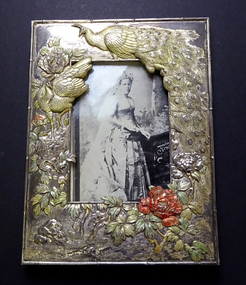
Photo Frame
... Frame is of a raised silver design with silver peacocks in a garden with pink peonies, green leaves and silver rock edged by bamboo. ...Frame is of a raised silver design with silver peacocks in a garden with pink peonies, green leaves and silver rock edged by bamboo. ...Marian Jenkins married Richard Henry Hinde in 1886Photo Frame (includes a photo of Marion Hinde see NA2376 Wedding Dress). Frame is of a raised silver design with silver peacocks in a garden with pink peonies, green leaves and silver rock edged by bamboo. NP124 photo, ND1729 Marriage Certificate, ND1730 Correspondence. -
 Embroiderers Guild, Victoria
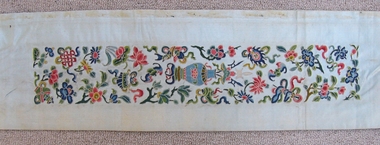
Accessory - Chinese Floral Sleeve Band
... Subjects chosen are flower vase, bats, sea creatures and peony flowers....Subjects chosen are flower vase, bats, sea creatures and peony flowers. Accessory Chinese Floral Sleeve Band ...Chinese sleeve embroidery bands, or wanxiu became popular in the late 19th century during the Qing Dynasty, evolving from the traditional Han cuff embroidery and Manchu styles. These detachable, decorated bands were added to women's informal jackets and robes, often featuring symbolic motifs like landscapes, flowers, and auspicious symbols. They served both a decorative function, displaying artistic skill and personal wishes, and a practical one by covering the sleeves when hands were folded at the waist. History and evolution: Origins: The practice of embroidering cuffs on robes existed during the previous Ming Dynasty for Han women, and this was adopted by the Manchu rulers who founded the Qing Dynasty. Qing Dynasty (1644-1911): The practice was popularized and elaborated upon during this era, with detachable bands becoming a fashionable element for informal wear. Symbolism: The embroidery included a complex visual vocabulary of wishes for a long life, many offspring, and a happy marriage, derived from nature, mythology, and classical literature. Functionality: Women would fold their arms, often with their hands inside the sleeves, so the embroidered bands, which were sewn to hang down the back of the jacket, would be displayed prominently down the front. 19th century peak: The late 19th century was the peak of their popularity, with intricate designs becoming fashionable and even influenced by court tastes, such as those favoured by the Empress Dowager Cixi. Later developments: The late 19th century saw the introduction of chemical 'aniline' dyes from Europe, leading to brighter, bolder colours in embroidery. Motifs and their Meanings: Auspicious symbols: Designs often included symbols for good fortune, wealth, and longevity. Natural imagery: Birds, flowers, and landscapes were common motifs that could represent natural beauty or convey specific symbolic meanings. Figurative scenes: Bands could also feature narrative scenes from classical stories or legends. The choice of motifs allowed women to express personal desires, cultural values, and aesthetic preferences, reflecting a more personal and informal style than official court attire.Classical Chinese design, a wide band of pale green satin is partly decorated with a band of embroidery. Pekin knot stitch outlined with a very fine white cord is worked in shades of pink, blue, yellow and green. Subjects chosen are flower vase, bats, sea creatures and peony flowers.On reverse 438/4103embroidery, garments, china, silk embroidery, poeny, flower, vase, bat, animals -
 Bendigo Historical Society Inc.
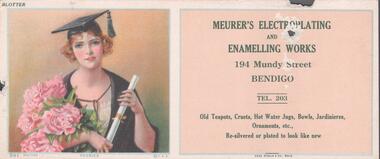
Document - BENDIGO BUSINESSES COLLECTION: MEURER'S ELECTROPLATING
... On the left a drawing of a young lady in her graduation gown with a bunch of peonies....On the left a drawing of a young lady in her graduation gown with a bunch of peonies. Document BENDIGO BUSINESSES COLLECTION: MEURER'S ELECTROPLATING ...Blotter paper advertising Meurer's electroplating and enamelling works, 194 Mundy Street, Bendigo, tel. 203. Old teapots, cruets, hot water jugs, bowls, jardinières, ornaments, etc. Re-silvered or plated to look like new. On the left a drawing of a young lady in her graduation gown with a bunch of peonies.bendigo, business, meurer -
 Embroiderers Guild, Victoria
Accessory - Pair of Chinese Embroidered Sleeve Bands, 19 th C
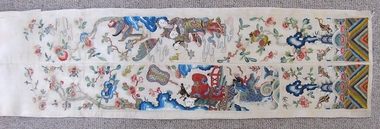
... One holds a fan and the other is wearing a black hat. More flowers, peonies and blossoms are above the figures. ...One holds a fan and the other is wearing a black hat. More flowers, peonies and blossoms are above the figures. ...Chinese sleeve embroidery bands, or wanxiu became popular in the late 19th century during the Qing Dynasty, evolving from the traditional Han cuff embroidery and Manchu styles. These detachable, decorated bands were added to women's informal jackets and robes, often featuring symbolic motifs like landscapes, flowers, and auspicious symbols. They served both a decorative function, displaying artistic skill and personal wishes, and a practical one by covering the sleeves when hands were folded at the waist. History and evolution: Origins: The practice of embroidering cuffs on robes existed during the previous Ming Dynasty for Han women, and this was adopted by the Manchu rulers who founded the Qing Dynasty. Qing Dynasty (1644-1911): The practice was popularized and elaborated upon during this era, with detachable bands becoming a fashionable element for informal wear. Symbolism: The embroidery included a complex visual vocabulary of wishes for a long life, many offspring, and a happy marriage, derived from nature, mythology, and classical literature. Functionality: Women would fold their arms, often with their hands inside the sleeves, so the embroidered bands, which were sewn to hang down the back of the jacket, would be displayed prominently down the front. 19th century peak: The late 19th century was the peak of their popularity, with intricate designs becoming fashionable and even influenced by court tastes, such as those favoured by the Empress Dowager Cixi. Later developments: The late 19th century saw the introduction of chemical 'aniline' dyes from Europe, leading to brighter, bolder colours in embroidery. Motifs and their Meanings: Auspicious symbols: Designs often included symbols for good fortune, wealth, and longevity. Natural imagery: Birds, flowers, and landscapes were common motifs that could represent natural beauty or convey specific symbolic meanings. Figurative scenes: Bands could also feature narrative scenes from classical stories or legends. The choice of motifs allowed women to express personal desires, cultural values, and aesthetic preferences, reflecting a more personal and informal style than official court attire. Symbolism: Mountains and sea, clouds and waves - Good luck. Dragon/fish tail/flaming pearl = Good fortune. This refers to the legend 'liyutiaolongmen' - a carp rising from the waves with the head already changed into a dragon implies the wish for success in the civil service examination. It is an allegory for the persistent effort needed to overcome obstacles. Male with black hat - Zhuang Yuan conferred. Among patterns with implied meanings , patterns related to the pursuits of scholarly honour and official rand include mainly the 'three number ones'. 'Zheng Yuan conferred' and 'carp jumping over the dragon gate'. In feudal society, examiners for the official positions had to go through three different levels of examinations. Bats - the work for bat is 'fu' and is a visual pun for the word happiness 'fu'. Rhino horn - wealth and good fortune. The ruyi sceptre - is a curved decorative Chinese object that symbolizes power, good fortune, and the wish that “things go as you desire.” The head of the sceptre resembles the 'lingzhi' of the 'longevity fungus'. Pomegranate - fertility ie; offspring, a virtue in China. Boy holding the flowering branch in the arms of the woman - in the selection of officials through imperial examinations in feudal society, the winner of an official position is described as ' having picked the crown'. 'Gui' (sweet scented osmanthus) and 'gui' (high rank or official) are very close in sound Chinese. In this design the boy in the woman's arms is seen waving a sweet scented osmanthus, thus an auspicious message is delivered. Information from Dr Rachel Silberstein, visiting Associate Professor at Rhode Island School of Design. "This pair of sleeve bands are two halves of a scene known as "tian xian song zi" or "Heavenly immortals deliver a son". The historical origins of this saying is a story from 'The History of the Wei Imperial records', involving the Emperor Sheng and an immortal maiden who presents him with a son. After this, the expression "tian xian song zi" came to be used as good wishes for marriage, closely associated with 'qilin song zi' (the qilin delivers a son), another popular topic in nianhua popular prints". Both cuffs show figures in an outdoor setting, done in colourful silk thread on a ivory satin. Reading from the bottom to the top of the cuff both have pointed mountains, clouds and sea with a rhino horn and a 'rui' coming out of the waves. Left cuff: above the sea there are a fish/dragon and a flaming pearl. Next two male figures standing on a bridge. One holds a fan and the other is wearing a black hat. More flowers, peonies and blossoms are above the figures. Right cuff: Above the water and mountains is a bat, peonies and pomegranates. Above these are three figures and another bat. The figure in there rear holds a feathered fan, while the front figure holds a child, who is holding a flowering branch. Above the trio is a low pagoda and blossoms. Silk satin stitch, Pekin knots and couched gold metal thread.embroidery, garments, silk embroidery, china, landscape, garden, figures -
 Embroiderers Guild, Victoria
Clothing - Chinese Silk Embroidery Cloud Collar, 19 th C
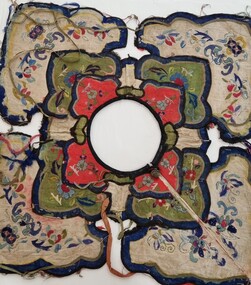
... Historically hand-embroidered with silk and metallic threads, often featuring auspicious motifs such as peonies, lotuses, butterflies, phoenixes, and lucky clouds, and edged with beads or tassels. ...Historically hand-embroidered with silk and metallic threads, often featuring auspicious motifs such as peonies, lotuses, butterflies, phoenixes, and lucky clouds, and edged with beads or tassels. ...Late 19th century cloud shaped collar, A Yunjian (云肩), or "cloud collar," is a traditional Chinese detachable cape-like or shawl-like accessory worn over the shoulders. Shape & Design: Typically structured with four or eight lobed panels that drape over the shoulders like floating clouds, symbolizing the vault of heaven and the connection between man and nature. Historically hand-embroidered with silk and metallic threads, often featuring auspicious motifs such as peonies, lotuses, butterflies, phoenixes, and lucky clouds, and edged with beads or tassels. Traced back centuries through Dunhuang cave murals and Tang/Yuan official wear, it became an elaborate element of women's fashion and traditional bridal attire during the Ming and Qing dynasties.Yunjian cloud collar. Four lobed collar in red, green and cream silk embroidered in fine gold metal thread. Floral and bat motifs. Secured by anornate brass button.floral, bat, china, collar -
 University of Melbourne, Burnley Campus Archives
Book - Register, Census of Plants in Burnley Gardens, 1939-1945
... "Cannas on hand" planted 18 July 1939, July 1941, Peonies, Rhododendrons, Herbaceous Perennials 1943, Plants to be moved or destroyed on account of rebuilding signed EE Pescott dated 1911, and other notes of plants seen and desired in the garden. ..."Cannas on hand" planted 18 July 1939, July 1941, Peonies, Rhododendrons, Herbaceous Perennials 1943, Plants to be moved or destroyed on account of rebuilding signed EE Pescott dated 1911, and other notes of plants seen and desired in the garden. ...Notes and lists compiled in a loose leaf binder of the Burnley Gardens perenials. Status and descriptions. Moving or destroying. Heights of trees Burnley recorded 25/5/1945 by surveyor.File of loose pages with handwritten and typescript notes in different writing. Some notes dated 1943/1944, 1911, 1939, 1941, 1945. Lists of plants, including alphabetical list : roses (Total 1,364) with name, colour, type, ref. No. "Cannas on hand" planted 18 July 1939, July 1941, Peonies, Rhododendrons, Herbaceous Perennials 1943, Plants to be moved or destroyed on account of rebuilding signed EE Pescott dated 1911, and other notes of plants seen and desired in the garden. Name, height, colour, size, foliage colour, growing notes etc. Separate list by surveyor of heights of trees burnley 25/5/1945 - Sequoia sempervirens, pinus canariensis (near azaleas) etcHand written on front page. Crossed out ;Estimates Expenditure & Revenue' 'Votes & Estimates' CENSUS OF PLANTS IN BURNLEY GARDENSflowers, roses, rhododendrons, herbaceous perennials, plants, foliage, burnley plant list, heights of trees, e.e. pescott -
 Embroiderers Guild, Victoria
Clothing - Chinese Embroidered Skirt, 19th century
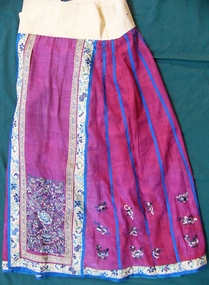
... The skirt has a wide front panel embroidered with slowers in shades of blue and white, the central flower, a peony, is in a vase or urn. There are varius symbols inthe embroidery surrounding the central flower. ...The skirt has a wide front panel embroidered with slowers in shades of blue and white, the central flower, a peony, is in a vase or urn. There are varius symbols inthe embroidery surrounding the central flower. ...Symbolism: Fish - abundance. Scrolls- happiness and prosperity. Fan - longevity. Chrysanthemum - longevity. Because these skirts were worn under knee length jackets , the embroidery only came up to where it would meet the bottom of the jacket. 'Chinese Dress from the Qing Dynasty to the Present' 2008 Valery Garrett. Symbolism - from C.A.S.Williams ' Chinese Symbolism and Art Motifs' 2006 and 'Hidden Meanings in Chinese Art'2006 Terese Tse Bartholomew.Cyclamen coloured, self patterned silk damask skirt with godets bordered in mid blue and lined with aqua silk. It has a wide cotton waist band with a loop at each end. The band was made in cotton (or hemp) to stop the skirt from slipping down. It was fastened by means of a tie or button. The skirt has a wide front panel embroidered with slowers in shades of blue and white, the central flower, a peony, is in a vase or urn. There are varius symbols inthe embroidery surrounding the central flower. Machine embroidered braid forms a border around this central area and beyond this is another hand embroidered border on white with blue and flesh coloured pink flowers. The godets have small embroidered motifs of fish, scrolls, fans and chrysanthemums. Embroidered in Pekin knot stitch outlined in metal thread. Pound sign 5-15-0 written in pencil on waistband.embroidery, garment, silk embroidery, china, 19th century -
 Embroiderers Guild, Victoria
Accessory - Pair of Chinese Sleeve Bands
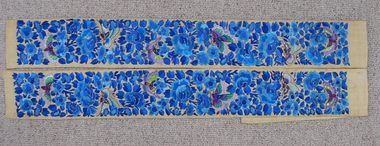
... Butterfly is a symbol of happiness and conjugal bliss. Peonies - flowers of happiness. Chinese sleeve embroidery bands, or wanxiu became popular in the late 19th century during the Qing Dynasty, evolving from the traditional Han cuff embroidery and Manchu styles. ...Butterfly is a symbol of happiness and conjugal bliss. Peonies - flowers of happiness. Chinese sleeve embroidery bands, or wanxiu became popular in the late 19th century during the Qing Dynasty, evolving from the traditional Han cuff embroidery and Manchu styles. ...Butterfly is a symbol of happiness and conjugal bliss. Peonies - flowers of happiness. Chinese sleeve embroidery bands, or wanxiu became popular in the late 19th century during the Qing Dynasty, evolving from the traditional Han cuff embroidery and Manchu styles. These detachable, decorated bands were added to women's informal jackets and robes, often featuring symbolic motifs like landscapes, flowers, and auspicious symbols. They served both a decorative function, displaying artistic skill and personal wishes, and a practical one by covering the sleeves when hands were folded at the waist. History and evolution: Origins: The practice of embroidering cuffs on robes existed during the previous Ming Dynasty for Han women, and this was adopted by the Manchu rulers who founded the Qing Dynasty. Qing Dynasty (1644-1911): The practice was popularized and elaborated upon during this era, with detachable bands becoming a fashionable element for informal wear. Symbolism: The embroidery included a complex visual vocabulary of wishes for a long life, many offspring, and a happy marriage, derived from nature, mythology, and classical literature. Functionality: Women would fold their arms, often with their hands inside the sleeves, so the embroidered bands, which were sewn to hang down the back of the jacket, would be displayed prominently down the front. 19th century peak: The late 19th century was the peak of their popularity, with intricate designs becoming fashionable and even influenced by court tastes, such as those favoured by the Empress Dowager Cixi. Later developments: The late 19th century saw the introduction of chemical 'aniline' dyes from Europe, leading to brighter, bolder colours in embroidery. Motifs and their Meanings: Auspicious symbols: Designs often included symbols for good fortune, wealth, and longevity. Natural imagery: Birds, flowers, and landscapes were common motifs that could represent natural beauty or convey specific symbolic meanings. Figurative scenes: Bands could also feature narrative scenes from classical stories or legends. The choice of motifs allowed women to express personal desires, cultural values, and aesthetic preferences, reflecting a more personal and informal style than official court attire.Old gold satin embroidered with blue flowers and leaves in silks. Butterflies worked in mauve, green, blue, cream, burgundy and aquamarine.embroidery, garments, silk embroidery, china, oriental, butterflies, flowers -
 Embroiderers Guild, Victoria
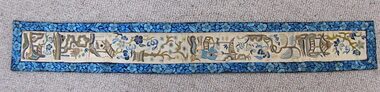
Accessory - Pair of Chinese Embroidered Sleeve Bands, 1880
... Rooster: a symbol of high rank (it's comb/crown (jinguan) is a pun for 'official' guan). Peony: a symbol of wealth. Deer (lu): means wealth and prosperity. ...Rooster: a symbol of high rank (it's comb/crown (jinguan) is a pun for 'official' guan). Peony: a symbol of wealth. Deer (lu): means wealth and prosperity. ...Label attached to record card states "Chinese Embroidery from the Royal Palace, Pekin J.M.S." Chinese sleeve embroidery bands, or wanxiu became popular in the late 19th century during the Qing Dynasty, evolving from the traditional Han cuff embroidery and Manchu styles. These detachable, decorated bands were added to women's informal jackets and robes, often featuring symbolic motifs like landscapes, flowers, and auspicious symbols. They served both a decorative function, displaying artistic skill and personal wishes, and a practical one by covering the sleeves when hands were folded at the waist. History and evolution: Origins: The practice of embroidering cuffs on robes existed during the previous Ming Dynasty for Han women, and this was adopted by the Manchu rulers who founded the Qing Dynasty. Qing Dynasty (1644-1911): The practice was popularized and elaborated upon during this era, with detachable bands becoming a fashionable element for informal wear. Symbolism: The embroidery included a complex visual vocabulary of wishes for a long life, many offspring, and a happy marriage, derived from nature, mythology, and classical literature. Functionality: Women would fold their arms, often with their hands inside the sleeves, so the embroidered bands, which were sewn to hang down the back of the jacket, would be displayed prominently down the front. 19th century peak: The late 19th century was the peak of their popularity, with intricate designs becoming fashionable and even influenced by court tastes, such as those favoured by the Empress Dowager Cixi. Later developments: The late 19th century saw the introduction of chemical 'aniline' dyes from Europe, leading to brighter, bolder colours in embroidery. Motifs and their Meanings: Auspicious symbols: Designs often included symbols for good fortune, wealth, and longevity. Natural imagery: Birds, flowers, and landscapes were common motifs that could represent natural beauty or convey specific symbolic meanings. Figurative scenes: Bands could also feature narrative scenes from classical stories or legends. The choice of motifs allowed women to express personal desires, cultural values, and aesthetic preferences, reflecting a more personal and informal style than official court attire. Pagoda: an omen of good. Two birds (possibly swallows): an omen approaching spring and also of approaching success. Rooster: a symbol of high rank (it's comb/crown (jinguan) is a pun for 'official' guan). Peony: a symbol of wealth. Deer (lu): means wealth and prosperity. Willow: a symbol of spring (chun). Willows with apricot blossoms (xinghuo), willlows (liu) and swallows (yan) symbolizes 'may you attend the spring banquet in the apricot grove (xinglin chunyan), or may you become a successful candidate. Pine: longevity. Mouth organ (sheng): is a pun for giving birth or 'to rise' as in rising in rank.Meaning : this pair of sleeve bands may have been wishing the owner of them good luck, success in an upcoming exam and that he may rapidly rise in rank, live a long life and continue to receive an official salary. Information from 'Hidden Meaning in Chinese Art' Terese Tse BartholomewFine white satin edged in shades oft blue silk flower embroidery. A fine example of Pekin knot stitch outlined with gold thread showing traditional Chinese motifs and figures. From bottom to top there is an outdoor scene with water and a building. Above this are flowers, hills, a rock formation, a pine and an animal (? pig or deer). Another building, blossoms and pine trees and a pot containing a cypress tree. Above the tree there is a male figure holding a bamboo pipe in one hand and a bird in the other. Further buildings follow, with a willow tree and two swallows flying.embroidery, garments, silk embroidery, late 19th century, china, trees, animals, pagoda
