
Showing 13 items matching "percy grainger"
-
 Eltham District Historical Society Inc
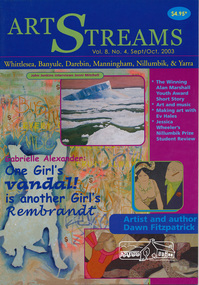
Journal, Peter Doughtery, ArtStreams: Whittlesea, Banyule, Darebin, Manningham, Nillumbik & Yarra; Vol. 8, No. 4, Sep-Oct 2003, 2003
... ...percy grainger...Meadows 3 John Jenkins on Jenni Mitchell 7 Clive Dickson interviews Gabrielle Alexander 10 Student Review: Nillumbik Prize 2003 12 Dawn Fitzpatrick: Cloth artist 14 Ros McMillan on Percy Grainger 17 Peter Oysten on the Open Studio Program 18 Book Review 20 Exhibitions 21 Ev Hales on painting the rhythm of life 23 CD Reviews 25 Artin' About 27 Wining & Dining 30 Listings 32 ...Meadows 3 John Jenkins on Jenni Mitchell 7 Clive Dickson interviews Gabrielle Alexander 10 Student Review: Nillumbik Prize 2003 12 Dawn Fitzpatrick: Cloth artist 14 Ros McMillan on Percy Grainger 17 Peter Oysten on the Open Studio Program 18 Book Review 20 Exhibitions 21 Ev Hales on painting the rhythm of life 23 CD Reviews 25 Artin' About 27 Wining & Dining 30 Listings 32 "Peter Dougherty has been involved in the local art scene for many years. ...Vol. 8, No. 4, Sep-Oct 2003 CONTENTS Short Story by Ian J. Meadows 3 John Jenkins on Jenni Mitchell 7 Clive Dickson interviews Gabrielle Alexander 10 Student Review: Nillumbik Prize 2003 12 Dawn Fitzpatrick: Cloth artist 14 Ros McMillan on Percy Grainger 17 Peter Oysten on the Open Studio Program 18 Book Review 20 Exhibitions 21 Ev Hales on painting the rhythm of life 23 CD Reviews 25 Artin' About 27 Wining & Dining 30 Listings 32 "Peter Dougherty has been involved in the local art scene for many years. As publisher and editor of the arts magazine Artstreams, his comments on the various branches of the arts are widely respected. His "The Arts" column in the Diamond Valley Leader presents a brief summary for a much wider cross section of the local community. Peter also operates his own gallery and the Artstreams Cafe at the St Andrews market. Peter has a wealth of knowledge about present day and historical aspects of local art and artists." - Eltham District Historical Society Newsletter No. 161, March 2005Colour front and back cover with feature articles and literary pieces with photographs and advertisements printed in black and white. 36 pages, 30 cm. Vol. 1, no. 1 (Nov. 1996) - Vol. 10, no. 5 (summer ed. 2005/06) art streams, thompsons amcal pharmacy, j. meadows, eltham wiregrass gallery, arts on burgundy, mercers restaurant, john jenkins, sushi wushi eltham, bundoora homestead, jenni mitchell, antarctica, clive dickson, gabrielle alexander, nillumbik prize, jessica wheeler, bahnhof cafe, montsalvat, dawn fitzpatrick, warrandyte cafe, percy grainger, dynamic vegies, eltham fullife pharmacy, nillumbik artists' open studios, neil douglas, heide museum of modern art, kerry kaskamanidis, city of banyule works on paper art award, ev hales, eltham gourmet poultry & game, st andrews hotel, latrobe university, il primo restaurant carlton, bulleen art & garden centre, hurstbridge nursery, northcote pottery, bendigo bank, hurstbridge & districts community bank branch, robert dessaix -
 Surrey Hills Historical Society Collection
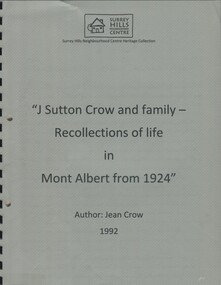
Book, J Sutton Crow family - recollections of life in Mont Albert from 1924, 1992
... ...(mr) percy grainger...A few pages from the Crow family history that relate to life in Mont Albert. victoria crescent mont albert strathmore house names telephone exchange 1930 (miss) winnie thompson union road surrey hills mont albert central school christian endeavour group 1899 telephone services (mr) edward lloyd (mr) tom morris grocer tom morris's grocery schools teachers (mr) - wenborn ormiston girls' school (miss) hazel schlesinger 1916 trams (miss) gwen littleton (mr) alan wills (miss) jean crow (mr) ray crow (miss) nancy barber (mr) - harley trafalgar street wildlife sanctuary greythorn road balwyn (mr) percy grainger A few pages from the Crow family history that relate to life in Mont Albert. ...A few pages from the Crow family history that relate to life in Mont Albert.A few pages from the Crow family history that relate to life in Mont Albert.victoria crescent, mont albert, strathmore, house names, telephone exchange, 1930, (miss) winnie thompson, union road, surrey hills, mont albert central school, christian endeavour group, 1899, telephone services, (mr) edward lloyd, (mr) tom morris, grocer, tom morris's grocery, schools, teachers, (mr) - wenborn, ormiston girls' school, (miss) hazel schlesinger, 1916, trams, (miss) gwen littleton, (mr) alan wills, (miss) jean crow, (mr) ray crow, (miss) nancy barber, (mr) - harley, trafalgar street, wildlife sanctuary, greythorn road, balwyn, (mr) percy grainger -
 Bendigo Historical Society Inc.
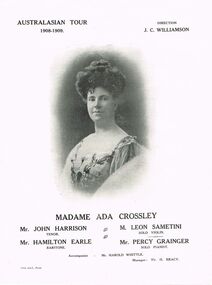
Document - LYDIA CHANCELLOR COLLECTION; MADAME ADA CROSSLEY AUSTRALASIAN TOUR
... Leon Sametini Solo Violin. Mr. Percy Grainger Solo Pianist. Accompanist Mr. Harold Whittle. ...Leon Sametini Solo Violin. Mr. Percy Grainger Solo Pianist. Accompanist Mr. Harold Whittle. ...Yellow paper with black print. On the front cover are the words 'AUSTRALASIAN TOUR 1908-1909. Direction J.C. Williamson MADAME ADA CROSSLEY Mr. John Harrison Tenor. Mr. Hamilton Earle Baritone. M. Leon Sametini Solo Violin. Mr. Percy Grainger Solo Pianist. Accompanist Mr. Harold Whittle. Manager : Mr. H. Bracy. Syd. Day, Print.' There is also a photo of Madame Ada Crossley. On the inside is an outline of the programme. On the back cover is an advertisement for Dunlop Rubber.program, music, madam ada crossley, lydia chancellor, collection, ephemera, madam ada crossley, music, singing, event, person, individual, entertainment, female -
 Parks Victoria - Mount Buffalo Chalet
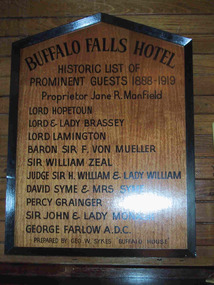
Plaque, "Buffalo Falls Hotel / Historic list of prominent guests 1888-1919"
... David Syme & Mrs Syme. Percy Grainger. Sir John & Lady Monash. George Farlow A.D.C. ...David Syme & Mrs Syme. Percy Grainger. Sir John & Lady Monash. George Farlow A.D.C. ...Possibly predates Chalet. ".There is also a wooden plaque displaying the names of notable guests who stayed at the Buffalo Falls Hotel that once stood at the foot of the mountain. the pioneering Manfield family opened this early hotel in the late 1880's and soon began taking visitors on walking treks up onto the plateau." (Pg 84 Historica, 2011). The Buffalo Falls Hotel was originally known as The Buffalo Falls Temperance Hotel and was built in 1888 by James Manfield. His daughter Alice became well known as a Mt Buffalo guide and was renowned for her mountain knowledge as well as for her distinctive alpine pant suit. The Hotel was constructed opposite the newly opened 'Staker's Track', a walking track , now known as the "Big Walk" was, a steep 6 hour walk, which nevertheless opened the mountain up to early tourism, attracting leading figures from Melbourne Society as well as significant artists, Naturalists and Scientists eager to explore and experience the unique scenery and geological features of the Mountain. Baron Von Mueller as Government botanist was one of the first white men to ascend to the plateau in 1853, collecting alpine specimens . Each of the names on this honor roll were significant cultural and society figures of Victorian/Edwardian Melbourne .Listed in Draft Inventory of Significant Items. Appendix A3. Framed Photographs, Pictures, etc. (Pg 165, Historica, 2011)Wooden plaque with black painted inscription, framed in black painted wood. Plaque is peaked at the top."BUFFALO FALLS HOTEL.... Historic list of prominent guests 1888-1919. Proprietor Jane R. Manfield. Lord Hopetoun. Lord & Lady Brassey. Lord Lamington. Baron Sir F. Von Mueller. Sir William Zeal. Judge Sir H. William & Lady William. David Syme & Mrs Syme. Percy Grainger. Sir John & Lady Monash. George Farlow A.D.C. Prepared by Geo. W. Sykes "Buffalo House'." -
 Bendigo Historical Society Inc.
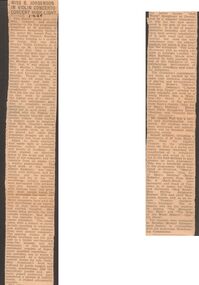
Newspaper - LYDIA CHANCELLOR COLLECTION: MELBOURNE SYMPHONY ORCHESTRA PERFORMANCE SEPTEMBER 1, 1948, 1st July, 1948
... The programme included the Max Bruch's Violin Concerto in G Minor, op. 26; Dvorak 'New World'' Symphony; Weber's ''Oberon'' overture, Debussy's 'L'Apres midi d'un Faune''; chorale, 'Jesu, Joy of Man's Desiring'' (Bach-Roberts,) gavotte from Suit No. 6 (Bach-Wood), Brahms'Fifth and Sixth Hungarian Dances, Percy Grainger 'Country Gardens; (Arr, Earle) 'The Mermaid'' and (Martin Shaw) 'The Song of the Music Makers'' Soloists for the event included: Miss Bertha Jorgenson a Castlemaie Local and well known talent on violin; Miss Kathleen Moore violin; Miss A Walk flute. ...The programme included the Max Bruch's Violin Concerto in G Minor, op. 26; Dvorak 'New World'' Symphony; Weber's ''Oberon'' overture, Debussy's 'L'Apres midi d'un Faune''; chorale, 'Jesu, Joy of Man's Desiring'' (Bach-Roberts,) gavotte from Suit No. 6 (Bach-Wood), Brahms'Fifth and Sixth Hungarian Dances, Percy Grainger 'Country Gardens; (Arr, Earle) 'The Mermaid'' and (Martin Shaw) 'The Song of the Music Makers'' Soloists for the event included: Miss Bertha Jorgenson a Castlemaie Local and well known talent on violin; Miss Kathleen Moore violin; Miss A Walk flute. ...Under the direction of Mr Joseph Post 50 members of the Melbourne Symphony Orchestra (MSO) performed to at crowded house at the Capital Theatre in Bendigo July 1st, 1948. The programme included the Max Bruch's Violin Concerto in G Minor, op. 26; Dvorak 'New World'' Symphony; Weber's ''Oberon'' overture, Debussy's 'L'Apres midi d'un Faune''; chorale, 'Jesu, Joy of Man's Desiring'' (Bach-Roberts,) gavotte from Suit No. 6 (Bach-Wood), Brahms'Fifth and Sixth Hungarian Dances, Percy Grainger 'Country Gardens; (Arr, Earle) 'The Mermaid'' and (Martin Shaw) 'The Song of the Music Makers'' Soloists for the event included: Miss Bertha Jorgenson a Castlemaie Local and well known talent on violin; Miss Kathleen Moore violin; Miss A Walk flute. The concert was sponsored by Bendigo Musical Advancement Society in conjunction with the Austrlisn Broadcasting Commission.bendigo, tourism, theatre performances music -
 Federation University Historical Collection
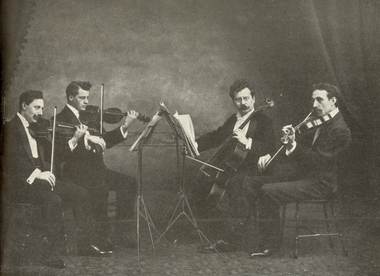
Book, Longman, Green and Co. Ltd, Australia Makes Music, 1948
... Laver, Alberto Zelman, Amy Castles, Peter Dawson, Percy Grainger, Hohn Lemmone, John Amadio, Horace Stevens, Evelyn Scotney (born Ballarat), Una Bourne, Browning Mummery, Daisy Kennedy, Essie Ackland, Dorothy Helmrich, Florence Austral, Bernard heinze, Harold Williams, Arnold Matters, Lauri kennedy, Gladys Moncrief, John Brownlee, John Dudley (born Ballarat), Marjorie Lawrence, Alan Eddy, Eileen Joyce, Joan Hammond, Nancy Weir, Noel Mewton-Wood, Raymond O'connell) 5. ...Laver, Alberto Zelman, Amy Castles, Peter Dawson, Percy Grainger, Hohn Lemmone, John Amadio, Horace Stevens, Evelyn Scotney (born Ballarat), Una Bourne, Browning Mummery, Daisy Kennedy, Essie Ackland, Dorothy Helmrich, Florence Austral, Bernard heinze, Harold Williams, Arnold Matters, Lauri kennedy, Gladys Moncrief, John Brownlee, John Dudley (born Ballarat), Marjorie Lawrence, Alan Eddy, Eileen Joyce, Joan Hammond, Nancy Weir, Noel Mewton-Wood, Raymond O'connell) 5. ...This book was part of the Frank Wright Collection. His early tutor, Percy Code, is mentioned in the book. Percy Code was senior conductor of the ABC, and commenced his musical career as a violinist but transferred his musical talent to the trumpet.Red hard covered book of 197 pages, and a number of black and white images. The book contains the following chapters: - 1. A Century and a Half of Music 2. Music of the Australian Aborigine 3. Personally Speaking 4. Biographical sketches (Amy Sherwin, Ada Crossley, Nellie Stewart, Melba, W.A. Laver, Alberto Zelman, Amy Castles, Peter Dawson, Percy Grainger, Hohn Lemmone, John Amadio, Horace Stevens, Evelyn Scotney (born Ballarat), Una Bourne, Browning Mummery, Daisy Kennedy, Essie Ackland, Dorothy Helmrich, Florence Austral, Bernard heinze, Harold Williams, Arnold Matters, Lauri kennedy, Gladys Moncrief, John Brownlee, John Dudley (born Ballarat), Marjorie Lawrence, Alan Eddy, Eileen Joyce, Joan Hammond, Nancy Weir, Noel Mewton-Wood, Raymond O'connell) 5. Australian Composers (May Brahe, Margaret Sutherland, Roy Agnew, Horace Gleeson, William G. James, Alfred Hill, Frank Hutchins, Lindley Evans, Horace Keats) 6. The Men with the Baton (G. Marhsall-Hall, Henri Verbruggen, Slapoffski, Fritz Hart, , Arundel Orchard, Edgar Bainton, Alberto Zelman, Bernard Heinze, Percy Code (Ballarat), William Cade, Joseph Post, John Farnsworth Hall) 7. Broadcasting in Australia 8. Violin Makers in Australia 9. Life in a Symphony Orchestra Appendices a. Choral Societies of Australia b. Doctors of Music c. A Selection of Records of Australian Composition. frank wright, percy code, music, bernard heinze, zelman, alberto zelman, joseph north, j.w. dawson, louis hattenbach, didgeridoo, nellie stewart, harold williams, lauri kennedy, tarczynski, nelson oliver, william dolphin, radio, new number -
 Emerald Museum & Nobelius Heritage Park
Book - History book, Don Watson, Caledonia Australis Scottish Highlanders on the Frontier of Australia, 6/06/2005 12:00:00 AM
... In addition to regular books, articles and essays, in recent years he has also written feature films, including The Man Who Sued God, starring Billy Connolly and Judy Davis, and Passion, a film about Percy Grainger starring Richard Roxburgh. His 2001 Quarterly Essay Rabbit Syndrome: Australia and America won the inaugural Alfred Deakin Prize in the Victorian Premier's Literary Awards. ...In addition to regular books, articles and essays, in recent years he has also written feature films, including The Man Who Sued God, starring Billy Connolly and Judy Davis, and Passion, a film about Percy Grainger starring Richard Roxburgh. His 2001 Quarterly Essay Rabbit Syndrome: Australia and America won the inaugural Alfred Deakin Prize in the Victorian Premier's Literary Awards. ...Don Watson grew up on a farm in Gippsland, took his undergraduate degree at La Trobe University and a PhD at Monash University and was for ten years an academic historian. He wrote three books on Australian history before turning his hand to TV and the stage. For several years he combined writing political satire for the actor Max Gillies with political speeches for the then Premier of Victoria, John Cain. In 1992 he became Prime Minister of Australia Paul Keating's speech-writer and adviser and his best-selling account of those years, Recollections of a Bleeding Heart: A Portrait of Paul Keating PM, won both The Age Book of the Year and non-fiction Prizes, the Brisbane Courier Mail Book of the Year, the National Biography Award and the Australian Literary Studies Association's Book of the Year. In addition to regular books, articles and essays, in recent years he has also written feature films, including The Man Who Sued God, starring Billy Connolly and Judy Davis, and Passion, a film about Percy Grainger starring Richard Roxburgh. His 2001 Quarterly Essay Rabbit Syndrome: Australia and America won the inaugural Alfred Deakin Prize in the Victorian Premier's Literary Awards. Death Sentence, his book about the decay of public language, was also a best seller and won the Australian Booksellers Association Book of the Year. Watson's Dictionary of Weasel Words was published in 2004 and continued to encourage readers to renounce what he perceives to be meaningless corporate and government jargon that is spreading throughout Australia, and to embrace meaningful, precise language. More recently, Watson contributed the preface to a selection of Mark Twain's writings, The Wayward Tourist. In 2014 "The Bush; Travels in the heart of Australia" was published to critical acclaim for its content and for the beauty and effectiveness of Watson's writing. [6] It is a combination of personal and family memoir, travelogue, history, natural history and reflection in which Watson invites readers to ponder the bush and its place in the story of Australia and Australians, both Indigenous and post-1788 arrivals and their descendants, those of the past and those of today.The publication is historically and socially significant as it documents the impact of Scottish settlers in the Gippsland area.Cream cardboard bound book with colourised picture of highland settlers as well as mirrored picture of an aboriginal holding a spear.Donated by Bob Ayresbook, gippsland, scottish, settlers, don, watson, caledonia, australis -
 Sunshine and District Historical Society Incorporated
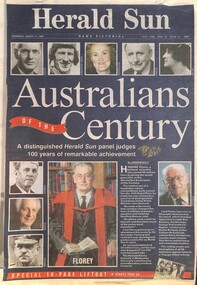
Newspaper - Herald Sun Australians Of The Century Special Edition 11th March 1998, Herald Sun, Herald Sun Australians Of The Century Thursday March 11 1998, 11th March 1999
... "Nugget" Coombs John Curtin John Monash Rupert Murdoch Charles Kingsford Smith Joan Sutherland Macfarlane Burnet Sidney Kidman Fred Hollows Gough Whitman Nellie Melba Banjo Paterson Essington Lewis Douglas Mawson John Flynn Sidney Nolan Isaac Isaacs Sidney Myer Patrick White Daniel Mannix Zelman Cowen Ben Chifley Owen Dixon Alfred Deakin Reg Ansett The Average Australia Dawn Fraser Vida Goldstein Albet Mamatjira Gusttav Nossal Arthur Streeton Daisy Bates Ian Clunles Ross George Coles James Ralph Darling Sim Dusty John Eccles Percy Grainger Germaine Greer Bert Hinkler Barry Humphries Henry Lawson Eddie Mabo Mary MacKillop Roma Mitchell Mark Olophant Peter Weir R. ..."Nugget" Coombs John Curtin John Monash Rupert Murdoch Charles Kingsford Smith Joan Sutherland Macfarlane Burnet Sidney Kidman Fred Hollows Gough Whitman Nellie Melba Banjo Paterson Essington Lewis Douglas Mawson John Flynn Sidney Nolan Isaac Isaacs Sidney Myer Patrick White Daniel Mannix Zelman Cowen Ben Chifley Owen Dixon Alfred Deakin Reg Ansett The Average Australia Dawn Fraser Vida Goldstein Albet Mamatjira Gusttav Nossal Arthur Streeton Daisy Bates Ian Clunles Ross George Coles James Ralph Darling Sim Dusty John Eccles Percy Grainger Germaine Greer Bert Hinkler Barry Humphries Henry Lawson Eddie Mabo Mary MacKillop Roma Mitchell Mark Olophant Peter Weir R. ...A distinguished Herald Sun panel judges 100 years of remarkable achievement by Australians.Newspaper, part only featuring Australians of the Centurynon-fictionA distinguished Herald Sun panel judges 100 years of remarkable achievement by Australians. -
 City of Melbourne Libraries
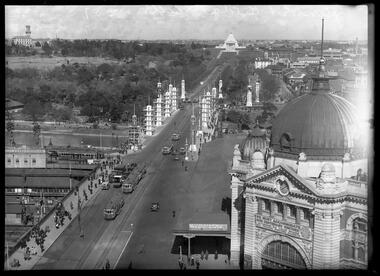
Photograph, Bull, Hugh Jones, 1897-1993, Princes Bridge Centenary pylons under construction
... John Grainger (father of Australian composer Percy Grainger) did the majority of the design work for the bridge. ...John Grainger (father of Australian composer Percy Grainger) did the majority of the design work for the bridge. ...Princes Bridge Centenary pylons under construction Possibly taken from Young and Jacksons Hotel (formerly Princes Bridge Hotel) on the corner of Flinders and Swanston streets, Flinders Street Station’s clocks and main entrance dominate, along with its distinctive copper dome and decorative façade. The time on the main clock is 1.40pm, and the sign underneath, reflecting Melbourne’s upcoming Centenary reads, “We must accommodate our Centenary visitors! Citizens! Do your share by taking paying guests.” At left is the original Princes Bridge Station, today the site of Federation Square. The riverside tram terminus advertises a Café/Tobacconist/Refreshment Room selling cigars & cigarettes, fountain drinks & confectionery, and in smaller text: “Leave your boot repairs here”. Nearly everyone is dressed in dark suits, coats and hats. The footpaths are wide and there are no traffic lights. The roadway stretches towards the Shrine of Remembrance, not yet dedicated but very dominant on the skyline. Government House is clearly visible across the wide parkland that would come to be known as Kings Domain and that is an area of deep importance to the people of the Eastern Kulin. Originally, Birrarung was part of a network of swamps and lagoons linked to the course of the river. From 1896, Public Works Department engineer Carlo Catani, oversaw a new channel to straighten the river and the swamps and lagoons were filled with spoil from the channel works. From the same vantage point today, only the top of the tower of Government House would be visible. The photo captures the pylons along Princes Bridge, mid-construction and being installed to mark Melbourne’s Centenary. The pylons were not without controversy. Both The Argus and The Age bemoaned them for being “made almost entirely of imported softwood timber”, denying work to native hardwood timber workers and sawmillers, and leading visitors to think Australia did not have its own exceptional native hardwoods. The pylons were also variously described in their incomplete state, as unimaginative and resembling an oilfield. Published: The Age 5 September 1934 Featured in "Newsworthy: Melbourne in photographs 1933-1936" exhibition at East Melbourne Library, October to December 2023. Exhibition caption by project volunteer, Louise McKenzie Photographer notations on slide: "Pylons + St Kilda Rd C57" Published: Age (Melbourne, Vic. : 1854 - 1954), Wednesday 5 September 1934, page 11 Published title: DECORATIONS -- THEN AND NOW. Published caption: "Although not completed yet, some impression of the effect of the decorations on Princes-bridge may be obtained from the first picture which shows the majestic sweep of St Kilda road with the Shrine of Remembrance and Government House dominating the horizon. The area to the left of St. Kilda-road and in front of Government House is portion of the area which it is proposed to call the King's Domain, which extends to Domain-road and Anderson-street..." Description: East-facing, elevated view of Flinders Street Station and Princes Bridge, featuring partially completed pylons erected for Melbourne's Centenary celebrations. The Shrine of Remembrance and Government House can be seen in the distance. In the foreground are trams, cars and trucks, pedestrians, Batman Avenue tram terminus and refreshment rooms. Signage on Flinders Street Station encourages citizens to accommodate Centenary visitors. The Melbourne Centenary was held 1934-35 in celebration John Batman's proclamation that Melbourne "the place for a village". Centenary events included a visit by Prince Henry, Duke of Gloucester. A Centenary Cake measuring 50 feet in height and ten tons in weight was cut into 250,000 pieces and sold at 1 shilling per piece for charity. Spectacular floodlighting of city landmarks, the creation of the Pioneer Women's Memorial Garden, and the MacRobertson Air Race from London, were other notable activities. Research by project volunteer, Louise McKenzie: The photo in The Age collage of 5 September 1934 has a slightly cropped foreground. The original photo has been taken from an elevated vantage point, most probably the roof of the Nicholas Building on the corner of Flinders and Swanston streets. The right foreground is dominated by the main “clocks” entrance to Flinders Street Station, showing its distinctive copper dome and decorative façade. The time on the main clock is 1.40 pm. The main sign on the front of the Station reads, "We Must Accommodate our Centenary Visitors! Citizens! Do your share by taking paying guests. Write to The Official Centenary Accommodation Bureau, 436 Collins St. City. Tel M 4671”. Another sign at eye level at the main entrance says: “Cheap Trips on Sundays”. The sign on the end of the roof along the eastern side of the station reads, “The Babies Need Your Help! Support Broadmeadows Foundling Hospital Appeal. July and August”. Run by the Sisters of St Joseph of the Sacred Heart, St Joseph’s Foundling Hospital was a purpose built infants’ home for up to 300 babies, plus accommodation for expectant mothers, mainly single women. In the early 1930s, the department (Victorian Children’s Welfare Department) contracted St Joseph’s Foundling Hospital to care for an additional 60 infant state wards, and up to 175 non wards at any given time. In 1931 it also operated a mothercraft training school. The centre foreground shows the commencement of Princes Bridge. Beneath the left side of the bridge was the site of the original Princes Bridge Station, by this time incorporated into Flinders Street Station, and today the area is the site of Federation Square. It was linked to Flinders Street station by the railway tracks that ran underneath the northern approach to the bridge. This photo shows a tram terminus which has a Café/Tobacconist/Refreshment Room, selling cigars & cigarettes, fountain drinks & confectionary, and a sign: Leave your boot repairs here. In the foreground is a wide roadway running south/north, comprising two vehicle lanes each heading north/south, and a central section containing two sets of tram tracks. There are cars, buses and delivery vans on the roadway. The trams visible are Glen Iris (Route No. 6; tram no. 448), Toorak (Route No. 8, tram no. 333), ? (No. 7), ? (No. 1), and ? (No. 2A). The footpaths are extremely wide. There is a square newspaper/magazine stand on the eastern side footpath. And also a “Ferry” sign. There are no traffic lights, but a policeman is visible on the roadway. There are pedestrians – men, women, children, a porter with trolley, women with prams. Clothing comprises dark suits, coats and hats for nearly everyone. There are double headed “Collins Street” lights along the side of the roadway, and along the northern riverbank. The roadway in the foreground is an extension of Swanston Street, which becomes Princes Bridge, then St Kilda Road, stretching towards the Shrine of Remembrance, and diverting past it. The Shrine had not yet been officially dedicated, and looks very white and dominant on the skyline. On the LHS of St Kilda Road, Government House is clearly visible across the wide parkland to be known as Kings Domain. The Kings Domain area is important to the people of the Eastern Kulin nation, and also has historical importance for its association with the early settlement of Melbourne and the foundation of British colonial administration in Victoria. On the southern side of the Yarra River (Birrarung) an historic rowing boathouse is visible, located adjacent to the Alexandra Gardens. Originally Birrarung was part of a network of swamps and lagoons linked to the course of the river. From 1896, under the guidance of engineer Carlo Catani* a new channel to straighten the river was created and the swamps and lagoons were filled with spoil from the channel works. The gardens were then created and completed in time for a Royal visit by the Duke of York in May 1901. The gardens are named after Alexandra of Denmark, the wife of King Edward VII. Both these areas, plus the Royal Botanic Gardens Victoria, Shrine of Remembrance Reserve, Sidney Myer Music Bowl, Government House, and the Queen Victoria Gardens together form the Domain Parklands. The extent of the subsequent plantings is evident today, where from the same vantage point only the top of the tower of Government House would be visible. *Catani was born in Florence in 1852, but after arriving in Melbourne worked as a civil engineer for the Victorian Government. His last major project was the reclamation of the foreshore of St Kilda, envisaged in the style of a European resort, complete with a split level esplanade, bathing pavilions, dance halls, amusements and a French-Italian style of landscape complete with palms. The gardens at the end of Fitzroy Street, St Kilda, now bear his name. The historic boathouse visible across the Yarra is another glimpse into Melbourne’s past. “Boathouse Row” comprises 7 amateur rowing clubs, the first established in 1859 (Melbourne University Boat Club). Other Clubs were Richmond, Melbourne, Banks, Melbourne Grammar School, Yarra Yarra and Mercantile. South of the river and west of the bridge is an area today developed into the Melbourne arts precinct of Hamer Hall and the Arts Centre. But at this time it was the home of Wirths Olympia Circus, which comprised Wirths Pleasure Park (an amusement park), a 5,000 seat auditorium – Hippodrome, a roller skating rink, a glaciarium, a cinema, and the Green Mill Dance Hall. Dog shows were also held at Olympia. The Green Mill Dance Hall closed in 1950, and the remainder of the Wirth buildings on site were destroyed by fire in December 1953. The feature of the photo is the pylons erected along Princes Bridge to mark Melbourne’s Centenary in 1934. The sixteen plastered pylons were designed by Roy Prentice, the second person to qualify as an architect at The University of Melbourne’s Bachelor of Architecture degree, in 1933, aged 27. Simon Reeves in his article marking the 100th birthday of Roy Prentice on 20 June 2006 reports that the State Electricity Commission sponsored this work, and the Argus reported that “… the pylons were “illuminated from within to give the effect of soft radiance”. Australia Home Beautiful 1 Oct 1934 reports in a very detailed and comprehensive article: The 10 taller pylons, including flagpole, were 48 ft, with a base of 8 ft. Timber-framed and faced with fibrous plaster and galvanised sheet iron, each structure was securely bolted to a concrete foundation three feet in depth. Panels of glass let into the shaft of each pylon were indirectly lit by 40, 100 watt lamps, and the upper bank of internal lamps were dyed so as to flood the panels with a deep red light. The decorative painted shields and flagpoles/pennants were illuminated by three 200 watt projectors concealed in the roof of each pylon, and were part of an electric night light decoration scheme involving 28 miles of wire to supply more than 20,000 lights. An article in the Argus on 18 October 1934 provided minute detail of the lighting erected in Melbourne for the Centenary, converting it “… into a coloured fairyland by night.” The estimated cost of 10 pounds per hour the lights were on. The display included 800 standard light poles 30 feet high which were tiered with electric bulbs concealed in inverted cones, 138 specially designed “Venetian poles” draped in flags trophies and streamers. The streets included in the electric night light decoration scheme were Bourke Street from Spring to William, the entire length of Collins Street, Flinders Street from Elizabeth to Spring, Lonsdale Street from Elizabeth to Swanston, Swanston and Elizabeth Streets from Flinders to Lonsdale, and parts of Springs and Spencer Streets. Together with the Princes Bridge pylons, approximately 28 miles of wire was required to supply power to the more than 20,000 lights. And that is just in the city of Melbourne. It was estimated the same amount of lighting was duplicated among other local councils. The pylons were not without controversy. The Argus on 28 August 1934 in an article headed “Imported Timber in Pylons” reported that the Princes Bridge pylons are “made almost entirely of imported softwood timber”, and have therefore denied work to native hardwood timber workers and sawmillers. The same day the Melbourne Age ran a similar story, bemoaning the fact that foreign oregon had been used which may lead tourists to think Australia did not have its own exceptional native hardwoods. A Camberwell City Councillor described the pylons as unimaginative, and the Herald reported that skeletons of pylons for the Centenary decorations in their present form led the area to resemble an oilfield! The Yarra River and Princes Bridge have long been a focal point of Melbourne life. In the early days of European settlement in Melbourne a rope-hauled punt carried people across the Yarra River. A surge in population and increased shipping traffic created a need for a bridge. There was difficulty in agreeing on a suitable site for the bridge (options were crossing at Elizabeth, Swanston, Queen or Market Streets), but the NSW Government favoured Swanston Street and the Melbourne Town Council decided on a temporary bridge across the Yarra spanning from the foot of Swanston Street. This first bridge was a single span timber toll bridge designed by Scottish born bridge designer David Lennox, and completed in 1845. It was 120 feet long, had a roadway of 17 feet wide, and a footpath on one side of 4 feet. It was leased to the Melbourne Bridge Company in the name of Robert A Balbirnie. The tollhouse was on the north side of the river and the toll keeper, Patrick Doherty, was credited with saving nine lives during the four years he was in charge of the toll station. The second bridge was stone (completed 1850), and named Prince’s Bridge after the HRH Prince of Wales, later Edward VII. It was designed with an elliptical single arc and an exceedingly small rise in proportion to the span. However, this design created an obstacle for flood waters, and together with Melbourne’s increasing population it was quickly apparent that a new bridge was required. At its opening on 15 November 1850 coincided with the imminent declaration of Victoria as a separate colony, it provided a moment of great celebration for Melbournians and “The opening ceremony was described as the grandest processional display witnessed in the colony.” (ToMelbourne.com.au) Princes Bridge in its present form, as depicted in this photograph, was designed by Jenkins, D’Ebro and Grainger, and constructed in 1886-88 by David Munro. John Grainger (father of Australian composer Percy Grainger) did the majority of the design work for the bridge. The structure was to have three arches each 96 feet wide measured across the river, and the banks on both sides were raised to allow more space for floodwater to flow. St Kilda Road was originally many feet below the current level. The bridge is of architectural significance for its substantial size, giant half columns, extensive use of wrought and cast iron, decorative elements (cast-iron lamps) and the skilled stonemasonry in the construction of the abutments and piers. Its main design features are similar to those of Blackfriars Bridge in London (1870). The bluestones were quarried from Footscray, the Malmsbury stones were from quarries at Kyneton, and the granite from Harcourt. The cost was met by the State of Victoria, City of Melbourne, and six out of seven of its municipalities, and their coats of arms feature on the bridge. The building of the bridge reflected the boom period of Melbourne, including the Victorian gold rush 1851- late 1860s, and its contractor, David Munro, was also responsible for the construction of Queens Bridge and Sandridge Railway Bridge. The Centenary pylons are no longer in place, but today this intersection still plays a major part in Melbourne’s daily life: people still meet “under the clocks” at Flinders Street station, and the route in and out of the city along St Kilda Road is often a feature of parades such as Moomba, the Grand Final Parade, and of course the Anzac Day Parade which commences at the Princes Bridge intersection and finishes at the Shrine of Remembrance. There are many tram routes, which cross the Bridge, and it directs pedestrians towards the Arts Precinct, the various components of Domain Park, plus the Southbank restaurant and rowing precincts. Even though this is a street scene, it feels very intimate; the viewer is instantly immersed in the activity of a Melbourne afternoon, looking down St Kilda Road from a viewpoint near today’s Federation Square. References: DECORATIONS -- THEN AND NOW. (1934, September 5). The Age (Melbourne, Vic. : 1854 - 1954), p. 11. Retrieved September 21, 2023, from http://nla.gov.au/nla.news-article205880269 'Flinders Street railway station', Wikipedia, https://en.wikipedia.org/wiki/Flinders_Street_railway_station 'St Joseph’s Foundling Hospital (1901-75)', Finding Records, Department of Health and Human Services, State of Victoria, https://www.findingrecords.dhhs.vic.gov.au/collectionresultspage/St-JosephsFoundling-Hospital-Babies-Home#departmental-administration 'Alexandra Gardens', City of Melbourne, https://www.melbourne.vic.gov.au/community/parks-open-spaces/major-parks-gardens/Pages/alexandra-gardens.aspx 'Wirths Circus', Wikipedia, https://en.wikipedia.org/wiki/Wirth's_Circus 'Roy Prentice: Centenary Architect', Built Heritage Pty Ltd, Simon Reeves, https://www.builtheritage.com.au/downloads/prentice.pdf 'Princes Bridge', Heritage Council Victoria, https://vhd.heritagecouncil.vic.gov.au/places/817 PORT PHILLIP. (1846, April 1). The Sydney Morning Herald (NSW : 1842 - 1954), p. 3. Retrieved September 21, 2023, from http://nla.gov.au/nla.news-article12886251 'Edward VII', Wikipedia, https://en.wikipedia.org/wiki/Edward_VII 'Princes Bridge', ToMelbourne.com, https://tomelbourne.com.au/princes-bridge/ 'Princes Bridge', eMelbourne, https://www.emelbourne.net.au/biogs/EM01189b.htm 'Princes Bridge', Australia for everyone, http://australiaforeveryone.com.au/files/melbourne/princes-bridge.html 'Victorian gold rush', Wikipedia, https://en.wikipedia.org/wiki/Victorian_gold_rush IMPORTED TIMBER IN PYLONS (1934, August 28). The Argus (Melbourne, Vic. : 1848 - 1957), p. 9. Retrieved September 21, 2023, from http://nla.gov.au/nla.news-article10952507 Princes-Bridge Pylons. (1934, August 28). The Age (Melbourne, Vic. : 1854 - 1954), p. 7. Retrieved September 21, 2023, from http://nla.gov.au/nla.news-article205532235 Pylons Appear Near Princes Bridge (1934, August 18). The Herald (Melbourne, Vic. : 1861 - 1954), p. 1. Retrieved September 21, 2023, from http://nla.gov.au/nla.news-article243104375 PRINCES-BRIDGE PYLONS. (1934, September 20). The Age (Melbourne, Vic. : 1854 - 1954), p. 10. Retrieved September 21, 2023, from http://nla.gov.au/nla.news-article205873535 28 Miles of Wire (1934, October 18). The Argus (Melbourne, Vic. : 1848 - 1957), p. 1 (The Junior Argus). Retrieved September 21, 2023, from http://nla.gov.au/nla.news-article10977836 'Historical references for Boathouse Row, Melbourne', http://boathouserowmelbourne.com.au/history/ 'ITALIAN DELEGATION TO HONOUR CARLO CATANI, DESIGNER OF THE ST KILDA FORESHORE, St Kilda Historical Society, 2001, https://web.archive.org/web/20070928061938/http://www.skhs.org.au/~SKHSarticles/articles/Carlo_Catani.html# HISTORY IN LIGHTS (1934, July 12). The Herald (Melbourne, Vic. : 1861 - 1954), p. 16. Retrieved September 21, 2023, from http://nla.gov.au/nla.news-article243172436 'Dressing Melbourne for the Duke', The Australian home beautiful: a journal for the home builder. Vol 12 No. 10 (1 October 1934), page 21, 58. Retrieved September 14, 2023, from http://nla.gov.au/nla.obj-2950922209Photographer notations on slide: "Pylons + St Kilda Rd C57".centenaries, bridges, lighting, flinders street railway station -
Port Melbourne Historical & Preservation Society
Document - Calendar 2022, Historic Port Melbourne - Workers of Yesteryear, September 2019
... Researched, written and designed by Pat Grainger and PMHPS members "Jack" the horse "Dolly" the horse Sandridge Municipal Brigade Port Melbourne Engineering Works Floodgate Hotel Barry's Ideal Dairy Claude BUTCHER Patrick COLLINS Ellen FITZGERALD Tom FITZGERALD Sandridge Volunteer Fire Brigade Swallow Street Transport - Railways Joe COOPER Terry WILLOWS Carole McBRIDE Jonas CONE William CONE Alfred Thomas HARMON R Knight Pty Ltd Robert KNIGHT Robert Walter CARRICK Mrs TURNER John FAWKNER Arthur BUTCHER Wally LOCKHART Percy Allan MAY William Raeburn STUART George BEAZLEY Tom BROADHURST William DOUGHTY Built Environment - Commercial Built Environment - Domestic Business and Traders "Historic Port Melbourne - Workers of Yesteryear" Produced by PMHPS. ...Researched, written and designed by Pat Grainger and PMHPS members"Historic Port Melbourne - Workers of Yesteryear" Produced by PMHPS. Cover has black and white photo of milk horse "Jack" with milkman Claude BUTCHER walking down Butcher's Lane, Port Melbourne. PMHPS logo at bottom right."jack" the horse, "dolly" the horse, sandridge municipal brigade, port melbourne engineering works, floodgate hotel, barry's ideal dairy, claude butcher, patrick collins, ellen fitzgerald, tom fitzgerald, sandridge volunteer fire brigade, swallow street, transport - railways, joe cooper, terry willows, carole mcbride, jonas cone, william cone, alfred thomas harmon, r knight pty ltd, robert knight, robert walter carrick, mrs turner, john fawkner, arthur butcher, wally lockhart, percy allan may, william raeburn stuart, george beazley, tom broadhurst, william doughty, built environment - commercial, built environment - domestic, business and traders -
Port Melbourne Historical & Preservation Society
Exhibition Catalogue, "Sportstuff", 2001
... Ross Street Rovers Watson's Baths Sport - Cricket Sport - Baseball Sport - Lawn Bowls Sport - Football Lifesaving Sport - Shooting Sport - Soccer Sport - Tennis Sport - Trugo Sailing Sport - Quoits Sport - Cycling Sport - Basketball Sport - Boxing Sport - Golf Sport - Gymnastics Sport - Athletics Port Melbourne Cricket Ground J L Murphy Reserve Railway United Football Club Victorian Sunday Football League Port Melbourne Colts Football Club Peggy HOWARD nee ANTONIO Bill PAYNE John MAY John KOSINDUSS Fred COY Jimmy JAMES Ken LINNETT Tony BOGDANOFF Tommy LAHIFF Tony CANNATELLI Graeme ANDERSON Ted FREYER Charles McLEOD James KELLY Robert McLEOD Reginald EARLE William (Bill) TILLEY J Kitchen & Sons Pty Ltd Eli 'Dick' Edwards Ron BEDFORD Peter BEDFORD Jim PENALUNA David HOLT Bill EARLE Percy MAY Jimmy DREW Chris RAEBURN Clyde HOLDING William (Bill) HEGARTY Walter Charles PONT Frank GOMEZ Tony STEWART John W STEWART Ron STRANKS Wilbraham Frederick Evelyn LIARDET Edward C CROCKFORD Town Clerks Sydney Sims ANDERSON Sea Bathing North Port Oval Alteration to document are written in ink Six page draft of catalogue for 2001 "Back to Port" 2 day exhibition "Sportstuff". Held at the Liardet Street Freemason's Hall during Port Melbourne Community Festival, in conjunction with all Port Melbourne sporting clubs "Sportstuff" Exhibition Catalogue Grainger ...No final copy of this catalogue exists, but this draft indicates the level of loans from over a dozen local sporting organisations plushistorical collections and researchon past events and organisations. Rare trophies, pennants and medals (including a Brownlow medal for Peter BEDFORD)required security precautions.Six page draft of catalogue for 2001 "Back to Port" 2 day exhibition "Sportstuff". Held at the Liardet Street Freemason's Hall during Port Melbourne Community Festival, in conjunction with all Port Melbourne sporting clubsAlteration to document are written in inkross street rovers, watson's baths, sport - cricket, sport - baseball, sport - lawn bowls, sport - football, lifesaving, sport - shooting, sport - soccer, sport - tennis, sport - trugo, sailing, sport - quoits, sport - cycling, sport - basketball, sport - boxing, sport - golf, sport - gymnastics, sport - athletics, port melbourne cricket ground, j l murphy reserve, railway united football club, victorian sunday football league, port melbourne colts football club, peggy howard nee antonio, bill payne, john may, john kosinduss, fred coy, jimmy james, ken linnett, tony bogdanoff, tommy lahiff, tony cannatelli, graeme anderson, ted freyer, charles mcleod, james kelly, robert mcleod, reginald earle, william (bill) tilley, j kitchen & sons pty ltd, eli 'dick' edwards, ron bedford, peter bedford, jim penaluna, david holt, bill earle, percy may, jimmy drew, chris raeburn, clyde holding, william (bill) hegarty, walter charles pont, frank gomez, tony stewart, john w stewart, ron stranks, wilbraham frederick evelyn liardet, edward c crockford, town clerks, sydney sims anderson, sea bathing, north port oval -
 Sunshine and District Historical Society Incorporated
Administrative record - City of Sunshine - Commissioner Mr Alexander "Alex" George Gillon Collection 1976 - 1982 - Minutes of the ordinary meeting of council held on 22nd August 1978, City of Sunshine, 22nd August 1978
... City of Sunshine Alexander "Alex" George Gillon Railway Parade Wood Street Deer Park Dickson Street Sunshine Hulett Street Albion Maribyrnong Senior Citizens Club Multi-Cultural Senior Citizens Club Bruce Street Maidstone Branch Library Yardley Street Albanvale Primary School Diamond Avenue Reserve Diamond Avenue Albanvale Sunshine West High School Lachlan Street Sunshine West Oakwood Road Graingers Street Sunshine North Hampshire Road Hertford Road George Street Service Street Massey Ferguson Ballarat Road Glencairn Avenue Hawthorn Avenue Neale Road Wright Street King Edward Avenue Tallintyre Road Thompson Street Maidstone Percy Street Main Road East St. ...Minutes of the Ordinary Meeting of Council held on 22nd August 1978 Report of the Town Clerk's Department Report of the Town Clerk Review of Role and Structure of Local Government Federal Finance for Local Government Use of Melbourne & Metropolitan Board of Works Quarters at O'Shannassy, Wallaby Creek and Robertson Land Transfer Discontinued Right of Way Rear of Railway Parade and Wood Street Deer Park Dickson Street Part Private Street Scheme Loan Programme 1978/79 Hulett Street Construction Scheme Report of the Co-Ordinator of Welfare Services Toddler Groups Toddler Group for Children At Risk Social Work Students Maribyrnong Senior Citizens Club Resource Centre / Toy Library Establishment of a Multi-Cultural Senior Citizens Club in Sunshine West Youth Counselling Service Report of the Acting Chief Health Inspector Quarterly Return of Food Samples Keep Australian Beautiful Council Head Lice Campaign Health Act Registrations Application for Transfer of Proprietorship of Premises under the Health Act Annual Inspections Infant Welfare Centres Sewage Overflow 2 Bruce Street Sunshine Report of the Chief By-Laws Officer Removal of Fire Hazards 1978/79 Dog Act Fixing of Registration Fees Report of the City Librarian Bookmobile Maidstone Branch Library Yardley Street to be Closed 29th September and Replaced with Bookmobile Report of the Municipal Recreation Officer Student's Representative Council University of Melbourne Summer School Seminar Multiple Sclerosis Society of Victoria Request for Land Provision of Minibuses for Community Groups Interim Planning Committee Albanvale Primary School Diamond Avenue Reserve Sunshine West High School Community Use Agreement Report of the City Engineer Preferred Development Areas Newmarket Relocation Proposal Planning Permit Application Subdivision and Detached Houses Oakwood Road Town Planning Appeal Planning Permit Application Extension to Factory Graingers Street Sunshine North Planning Permit Application East Side of Hampshire Road North of Existing Sunshine Shopping Cente Generally Bounded by Hampshire Road, Hertford Road, George Street and Service Street Including the Property Occupied by Massey Ferguson Spare Parts Store South of Service Street Rezoning Application Planning Permit Application Service station and Factory 784 Ballarat Road North West Corner Glencairn Avenue Planning Permit Application Warehouse and Workshop Hawthorn Avenue Planning Permit Application Neale Road Subdivision and Detached Houses Town Planning Appeal Home Occupation Three Phase Power Connection 170 Wright Street Planning Permit Flats 17 King Edward Avenue Planning Permit Application Institutional Home Lot 509 Tallintyre Road Planning Permit Application Nursing Home Thompson Street Maidstone Planning Permit Medical Consultation Room South East Corner Percy Street and Main Road East Planning Permit Application Extension to Existing Factory Marshall Street Plan of Subdivision Ballarat Road and Anderson Road Plan of Subdivision Robinsons Road Strata Subdivision Lot 59 Fabian Court Contract Fire Service Sunshine Tip Consolidation of Title Trafalgar Street Employment of Engineering Students for Vocational Training Provision of Footbridge Over Kororoit Creek Reconstruction of South Road Flooding 7th & 8th August 1978 Establishment of Recycling Depot at Sunshine Tip Provision of Spoil for Sunshine Tip Billingham Road Drain Kororoit Creek to Robinsons Road Resitting of Public Telephones Sunshine Road Declaration of Sewage Area No 3550 Footscray West Mail Centre Hampstead Road Closure of Right of Way Between Chicago Street and Chifley Drive Construction of Right of Way Between Randall Street and Barb Street Derelict Cars and Domestic Ferrous Scrap Report of the Building Surveyor 28 - 30 Ridley Street Albion Cancellation of Permit Lot 119 Ballarat Road Application to Build Over Easement 7 Bella Court Sunshine West Application to Build Over Easement 15 Beech Court Sunshine West Building Permit Fees for Council Buildings Report of the Director of Parks & Recreation Bon Thomas Subdivision and Reserve Development Orders of the Day Accounts Submitted for Payment as at 1st July 1978 & 5th August 1978 Proposal to Construct Hulett Street Under The Provisions of Division 10 of Pary XIX of the Local Government Act 1958 Proposal to Construct Dickson Street Under The Provisions of Division 10 of Pary XIX of the Local Government Act 1958 Proposal to Construct Warrs Road (Northern Section) Under The Provisions of Division 10 of Pary XIX of the Local Government Act 1958 Extraordinary Business Report of the Acting Chief Health Officer The Australian Institute of Health Surveyors' 5th National Conference Report of the City Engineer Planning Permit Application Office and Extension of Amenities Building Railway Siding Wright Street Planning Permit Application Car Port Belvedere Close Maribyrnong city of sunshine, alexander "alex" george gillon, railway parade, wood street, deer park, dickson street, sunshine, hulett street, albion, maribyrnong senior citizens club, multi-cultural senior citizens club, bruce street, maidstone branch library, yardley street, albanvale primary school, diamond avenue reserve, diamond avenue, albanvale, sunshine west high school, lachlan street, sunshine west, oakwood road, graingers street, sunshine north, hampshire road, hertford road, george street, service street, massey ferguson, ballarat road, glencairn avenue, hawthorn avenue, neale road, wright street, king edward avenue, tallintyre road, thompson street, maidstone, percy street, main road east, st. albans, marshall street, anderson road, robinsons road, fabian court, maribyrnong, sunshine tip, trafalgar street, kororoit creek, south road, braybrook, sunshine road, tottenham, hampstead road, chicago street, chifley drive, randall street, barb street, ridley street, bella court, beech court, bon thomas reserve, quinn street, warrs road, belvedere close -
 Sunshine and District Historical Society Incorporated
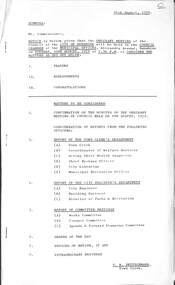
Administrative record - City of Sunshine - Commissioner Mr Alexander "Alex" George Gillon Collection 1976 - 1982 - Notice of ordinary council meeting 22nd August 1978, City of Sunshine, 16th August 1978
... City of Sunshine Alexander "Alex" George Gillon Railway Parade Wood Street Deer Park Dickson Street Sunshine Hulett Street Albion Maribyrnong Senior Citizens Club Multi-Cultural Senior Citizens Club Bruce Street Maidstone Branch Library Yardley Street Maidstone Albanvale Primary School Dover Street Albanvale Sunshine West High School Lachlan Road Sunshine West Oakwood Road Graingers Street Hampshire Road Hertford Road George Street Service Street Ballarat Road Glencairn Avenue Hawthorn Avenue Sunshine North Neale Road Wright Street King Edward Avenue Tallintyre Road Thompson Steet Main Road East Percy Street St. ...Notice of Ordinary Council Meeting 22nd August 1978 Report of the Town Clerk's Department Report of the Town Clerk Review of Role and Structure of Local Government Federal Finance for Local Government Use of Melbourne & Metropolitan Board of Works Quarters at O'Shannassy, Wallaby Creek and Robertson Land Transfer Discontinued Right of Way Rear of Railway Parade and Wood Street Deer Park Dickson Street Part Private Street Scheme Loan Programme 1978/79 Hulett Street Construction Scheme Report of the Co-Ordinator of Welfare Services Toddler Groups Toddler Group for Children At Risk Social Work Students Maribyrnong Senior Citizens Club Resource Centre / Toy Library Establishment of a Multi-Cultural Senior Citizens Club in Sunshine West Youth Counselling Service Report of the Acting Chief Health Inspector Quarterly Return of Food Samples Keep Australian Beautiful Council Head Lice Campaign Health Act Registrations Application for Transfer of Proprietorship of Premises under the Health Act Annual Inspections Infant Welfare Centres Sewage Overflow 2 Bruce Street Sunshine Report of the Chief By-Laws Officer Removal of Fire Hazards 1978/79 Dog Act Fixing of Registration Fees Report of the City Librarian Bookmobile Maidstone Branch Library Yardley Street to be Closed 29th September and Replaced with Bookmobile Report of the Municipal Recreation Officer Student's Representative Council University of Melbourne Summer School Seminar Multiple Sclerosis Society of Victoria Request for Land Provision of Minibuses for Community Groups Interim Planning Committee Albanvale Primary School Diamond Avenue Reserve Sunshine West High School Community Use Agreement Report of the City Engineer Preferred Development Areas Newmarket Relocation Proposal Planning Permit Application Subdivision and Detached Houses Oakwood Road Town Planning Appeal Planning Permit Application Extension to Factory Graingers Street Sunshine North Planning Permit Application East Side of Hampshire Road North of Existing Sunshine Shopping Cente Generally Bounded by Hampshire Road, Hertford Road, George Street and Service Street Including the Property Occupied by Massey Ferguson Spare Parts Store South of Service Street Rezoning Application Planning Permit Application Service station and Factory 784 Ballarat Road North West Corner Glencairn Avenue Planning Permit Application Warehouse and Workshop Hawthorn Avenue Planning Permit Application Neale Road Subdivision and Detached Houses Town Planning Appeal Home Occupation Three Phase Power Connection 170 Wright Street Planning Permit Flats 17 King Edward Avenue Planning Permit Application Institutional Home Lot 509 Tallintyre Road Planning Permit Application Nursing Home Thompson Street Maidstone Planning Permit Medical Consultation Room South East Corner Percy Street and Main Road East Planning Permit Application Extension to Existing Factory Marshall Street Plan of Subdivision Ballarat Road and Anderson Road Plan of Subdivision Robinsons Road Strata Subdivision Lot 59 Fabian Court Contract Fire Service Sunshine Tip Consolidation of Title Trafalgar Street Employment of Engineering Students for Vocational Training Provision of Footbridge Over Kororoit Creek Reconstruction of South Road Flooding 7th & 8th August 1978 Establishment of Recycling Depot at Sunshine Tip Provision of Spoil for Sunshine Tip Billingham Road Drain Kororoit Creek to Robinsons Road Resitting of Public Telephones Sunshine Road Declaration of Sewage Area No 3550 Footscray West Mail Centre Hampstead Road Closure of Right of Way Between Chicago Street and Chifley Drive Construction of Right of Way Between Randall Street and Barb Street Derelict Cars and Domestic Ferrous Scrap Report of the Building Surveyor 28 - 30 Ridley Street Albion Cancellation of Permit Lot 119 Ballarat Road Application to Build Over Easement 7 Bella Court Sunshine West Application to Build Over Easement 15 Beech Court Sunshine West Building Permit Fees for Council Buildings Report of the Director of Parks & Recreation Bon Thomas Subdivision and Reserve Development Orders of the Day Accounts Submitted for Payment as at 1st July 1978 & 5th August 1978 Proposal to Construct Hulett Street Under The Provisions of Division 10 of Pary XIX of the Local Government Act 1958 Proposal to Construct Dickson Street Under The Provisions of Division 10 of Pary XIX of the Local Government Act 1958 Proposal to Construct Warrs Road (Northern Section) Under The Provisions of Division 10 of Pary XIX of the Local Government Act 1958 city of sunshine, alexander "alex" george gillon, railway parade, wood street, deer park, dickson street, sunshine, hulett street, albion, maribyrnong senior citizens club, multi-cultural senior citizens club, bruce street, maidstone branch library, yardley street, maidstone, albanvale primary school, dover street, albanvale, sunshine west high school, lachlan road, sunshine west, oakwood road, graingers street, hampshire road, hertford road, george street, service street, ballarat road, glencairn avenue, hawthorn avenue, sunshine north, neale road, wright street, king edward avenue, tallintyre road, thompson steet, main road east, percy street, st. albans, marshall street, anderson road, fabian court, maribyrnong, sunshine tip, trafalgar street, kororoit creek, south road, braybrook, billingham road, hampstead road, footscray west mail centre, chicago street, chifley drive, randall street, barb street, ridley street, bella court, beech court, bon thomas reserve, quinn street, warrs road
