
Showing 10 items matching "personal toiletry items"
-
 Wodonga & District Historical Society Inc
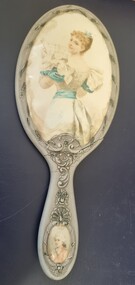
Decorative object - Decorative Hand Mirror, c1920
... Personal toiletry items...This item is significant because it is representative of personal items used in the home from the Victorian era onwards. Personal toiletry items Vintage mirror A small hand mirror featuring a painting of a young woman on the back of the mirror and a man on the handle. ...Hand-painted hand mirrors featuring portraits gained significant popularity during the Victorian era. They were originally a feature of an upper class lady's boudoir. As production techniques were streamlined and allowed for mass production, they became a common feature in most households.This item is significant because it is representative of personal items used in the home from the Victorian era onwards.A small hand mirror featuring a painting of a young woman on the back of the mirror and a man on the handle.personal toiletry items, vintage mirror -
 Wodonga & District Historical Society Inc
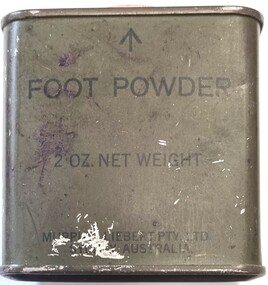
Container - Foot Powder Tin
... Personal toiletry items...The company was highly regarded for producing a wide array of personal care, medical, and household products, many of which were supplied to the Australian Defence Forces This tin of foot powder was standard issue to Australian soldiers serving in the Malayan Emergency and the Vietnam War where tropical conditions caused precautions were necessary to prevent bacterial infections. This item is significant because it represents one of the measures needed to protect Australian soldiers and the wider community from foot health issues. Personal toiletry ...Foot powder was used to absorb potential build up of moisture and protect against possible bacterial infection. Murphy, Liebert Pty Ltd was a notable Sydney-based manufacturing chemist company that operated during the 20th century. The company was highly regarded for producing a wide array of personal care, medical, and household products, many of which were supplied to the Australian Defence Forces This tin of foot powder was standard issue to Australian soldiers serving in the Malayan Emergency and the Vietnam War where tropical conditions caused precautions were necessary to prevent bacterial infections.This item is significant because it represents one of the measures needed to protect Australian soldiers and the wider community from foot health issues.A small tin with perforated lid containing foot powderOn front FOOT POWDER 2 OZ. NET WEIGHT MURPY LIEBERT PTY LTD SYDNEY AUSTRALIA On reverse FORMULA SALICYLIC ACID 3% STARCH 10% TALC 87% personal toiletry items, australian soldiers' personal supplies -
 Flagstaff Hill Maritime Museum and Village
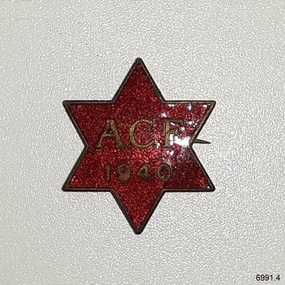
Badge - ACF Australian Comforts Fund badge, P J King Pty Ltd, 1940
... Items that the ACF sent to the troops included personal toiletry items such as toothbrushes and toothpaste, magazines, pyjamas, singlets and socks. ...Items that the ACF sent to the troops included personal toiletry items such as toothbrushes and toothpaste, magazines, pyjamas, singlets and socks. ...This Australian Comforts Fund badge is part of a set of eleven badges collected from the 1920s to the 1940s by Dr W. R. Angus. The badge was sold by the ACF in 1940 to raise funds for gifts to send to the Australian troops serving overseas. The badge is one of a set of badges that represents various organisations that he had interests in. The Australian Comforts Fund was a mostly female, volunteer-run organisation officially recognised by the Government. It began in 1916 as an amalgamation of groups of people who wanted to support the Australian troops abroad with Items of comfort to supplement the essential items provided by the Australian Military Forces. The ACF raised funds to purchase goods, pack them and send them overseas. One of their fund-raising activities was 'button days' where buttons such as this one were given to those who gave donations. The ACF closed down after World War I but was re-formed at the start of World War II. Items that the ACF sent to the troops included personal toiletry items such as toothbrushes and toothpaste, magazines, pyjamas, singlets and socks. They also provided sporting equipment, recreational music, writing materials and postcards. Special hampers were sent to the troops at Christmas time. The maker, P J King, (Percy John King), originally established his engraving and ie casting business in Russell Street, Melbourne in 1893 in partnership with Charles Walder Bridgland, continuing on his own from 1899. Percy and his son John Howard King set up a new business P J King Pty Ltd in 1928 making uniform buttons. In the late 1980s, it merged with two other companies that then became J J Cash, now known as Cash's Australia. The set of badges was donated to Flagstaff Hill Maritime Village by the family of Doctor Angus, Surgeon and Oculist. It is part of the “W.R. Angus Collection” which includes historical medical equipment, surgical instruments and material belonging to Dr Edward Ryan and Dr Thomas Francis Ryan, (both of Nhill, Victoria) and Dr Angus’ own belongings. The Collection’s history spans the medical practices of the two Doctors Ryan, from 1885-1926 plus that of Dr Angus, up until 1969. The W.R. Angus Collection: - The W.R. Angus Collection includes historical medical equipment, surgical instruments and material belonging to Dr Edward Ryan and Dr Thomas Francis Ryan, (both of Nhill, Victoria) and Dr Angus’ own belongings. The Collection’s history spans the medical practices of the two Doctors Ryan, from 1885-1926 plus that of Dr Angus, up until 1969. It includes historical medical and surgical equipment and instruments from the doctors Edward and Thomas Ryan of Nhill, Victoria. Dr Angus married Gladys in 1927 at Ballarat, the nearest big city to Nhill where he began as a Medical Assistant. He was also Acting House surgeon at the Nhill hospital where their two daughters were born. During World War II He served as a Military Doctor in the Australian Defence Force. Dr Angus and his family moved to Warrnambool in 1939, where Dr Angus operated his own medical practice. He later added the part-time Port Medical Officer responsibility and was the last person appointed to that position. Dr Angus and his wife were very involved in the local community, including the planning stages of the new Flagstaff Hill and the layout of the gardens there. Dr Angus passed away in March 1970.This badge represents the efforts of the women volunteers in Australia to support the Australian troops overseas in WWI and WWII. This badge is one of a set of significant badges that connects Doctor Angus with Australian organisations of the early-to-mid 20th century, including those relating to military service support. The W.R. Angus Collection is significant for still being located at the site it is connected with, Doctor Angus being the last Port Medical Officer in Warrnambool. The Collection includes historical medical objects that date back to the late 1800s.The ACF Badge is a star-shaped, gold, glittered red enamel and metal badge. The star has six points. The enamel surface is textured. The border and front inscription of the badge is gold. It is the badge of the Australian Comfort Fund, made by P.J. King and dated 1940. This badge is part of a set of badges collected by Dr W R Angus. the set represents organisations that he was involved in, and is part of the W.R. Angus Collection.Front: “ACF / 1940” Reverse embossed “P.J. KING”flagstaff hill, warrnambool, maritime museum, maritime village, great ocean road, shipwreck coast, metal badges, enamel badges, organisation badges, acf, presbyterian brotherhood, oikumene, w.r. angus, flagstaff hill maritime museum and village, australian comforts fund, button day, volunteer, australian military forces, christmas hamper, 1940 acf badge, fund-raising, p j king pty ltd, percy john king, donor's badge, world war ii, 1939-1945, australians at war, voluntary work, volunteers, home front, w.r. angus collection -
 Flagstaff Hill Maritime Museum and Village
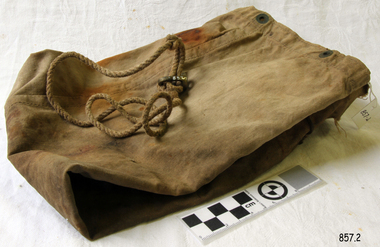
Functional object - Ditty Bag, Late 19th century
... personal gear and some clothes of the sailor. Today, the ditty bag is still issued to recruits and contains a sewing kit, toiletry articles and personal items such as writing paper and pens. ...personal gear and some clothes of the sailor. Today, the ditty bag is still issued to recruits and contains a sewing kit, toiletry articles and personal items such as writing paper and pens. ...A Ditty Bag (or box) was originally called “ditto bag” because it contained at least two of everything, two needles, two spools of thread, two buttons, etc. With the passing of years, the “ditto” was dropped in favour of "ditty" and remains so today. Before World War I, the Navy issued ditty boxes made of wood and styled after footlockers. These carried the personal gear and some clothes of the sailor. Today, the ditty bag is still issued to recruits and contains a sewing kit, toiletry articles and personal items such as writing paper and pens. Another source says a Ditty Box or Ditty Bag is possibly from the Saxon word “dite”, meaning tidy or from the English word “dittis”, a type of canvas material. A small box or bag in which a sailor kept his valuables such as letters, small souvenirs and sewing supplies.An item that is socially significant as it gives insight into a sailors life aboard ship and is another part of marine history. Items such as these although they were regarded at the time as everyday objects help us now to map various aspects of marine archaeology thorough the ages.Sailors Ditty Bag, canvas bag for holding all the sail making and roping tools, with tie and brass clasp. Holed.Noneflagstaff hill, warrnambool, shipwrecked-coast, flagstaff-hill, flagstaff-hill-maritime-museum, maritime-museum, shipwreck-coast, flagstaff-hill-maritime-village -
 Flagstaff Hill Maritime Museum and Village
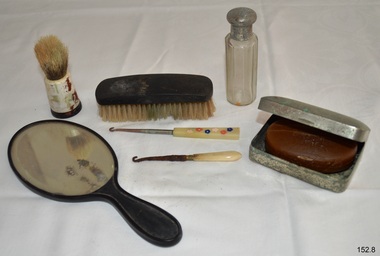
Accessory - Grooming Set, T R Cadman, ca. 1924
... The items were displayed in the Master's Quarters of the Reginald M exhibit at Flagstaff Hill Maritime Museum and Village until 2016 when the ship was decommissioned from Flagstaff Hill's fleet. flagstaff hill warrnambool shipwrecked coast flagstaff hill maritime museum maritime museum shipwreck coast flagstaff hill maritime village great ocean road grooming set men's grooming set personal grooming toiletry set personal care soap box soap container cologne bottle clothes brush shaving brush button hook hand mirror personal efects toiletries T.R. ...This men's grooming set of personal care equipment and toiletries is an example of items packaged in attractive cases and sold as gifts in Australian chemist outlets and department stores in the 1920s to 1940s. This set was originally packaged in a leather-covered, lined and fitted case, with a comb, hair brush, and razor included as well. as the items shown here. The razor, once included with the set, had the inscription "T.R. Cadman and Sons, Sheffield England". The family business began with Luke Cadman in 1748. Thomas Radley Cadmen (1833 - 1917) took over the business in 1871, by which time it was operating in Sheffield. The business became incorporated as T.R. Cadman & Sons in 1924 but shortly afterwards the straight razors manufactured by them were stamped T.R. Cadman & Sons Ltd. The company specialised in pocket knives and razors from 1933 and supplied the British Royal Navy with razors in WWII. Over 80 per cent of sales were for the overseas market including Australia. Some of their razors were sold in stores in Victoria. The business traded in 1965. This grooming set was donated for exhibit in Flagstaff Hill Maritime Museum and Village's exhibit of the vessel 'Reginald M', a two-masted coastal trading ketch built in Port Adelaide in 1922. These items are examples of personal objects sold in Victoria in the 1920s as gifts for men, cased or packaged for special occasions and sold in retail stores. The items are associated with the historic coastal trading ketch 'Reginald M', listed on the Australian Register of Historic Vessels; and active from 1922 until 1975. The items were displayed in the Master's Quarters of the Reginald M exhibit at Flagstaff Hill Maritime Museum and Village until 2016 when the ship was decommissioned from Flagstaff Hill's fleet.Men's grooming set; metal soap container with star decoration, oval soap cake, oval hand mirror in a black frame ten-sided clear glass cologne bottle with silver metal lid, yellow bristle clothes brush with brown wooden hand grip, yellow bristle shaving brush with black base and white body, and two button hooks with white handles; the larger one has floral motifs. Inscriptions were on the razor originally included in the grooming set.Soap container once had star motifs.flagstaff hill, warrnambool, shipwrecked coast, flagstaff hill maritime museum, maritime museum, shipwreck coast, flagstaff hill maritime village, great ocean road, grooming set, men's grooming set, personal grooming, toiletry set, personal care, soap box, soap container, cologne bottle, clothes brush, shaving brush, button hook, hand mirror, personal efects, toiletries, t.r. cadman & sons, reginald m, soap dish -
 Blacksmith's Cottage and Forge
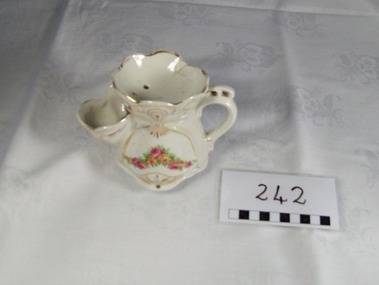
Mug, Shaving
... item...china...mug...bathroom...men...personal...toiletry...Source: www.wikipedia.org Local social history shaving item china mug bathroom men personal toiletry Made in Germany Ornate white china mug with handle. ...A shaving scuttle and shaving mug were developed around the 19th century with the first patent for a shaving mug dating to 1867.[8] As hot water was not common in many households, one way to provide hot lather was to use a scuttle or mug. A traditional scuttle resembles a teapot with a wide spout where hot water is poured in, and this is where it differs from a shaving mug, which has no spout. Both shaving scuttles and mugs usually have a handle, but some have none. Shaving mugs often look like a standard mug, however, some also have a built in brush rest, so the brush does not sit in lather. Modern versions of the scuttle are in limited production, usually by independent potters working in small volumes.[9] At the top of the scuttle or mug is a soap holder. Traditionally, it was used with a hard block of shaving soap (rather than soft soap or cream) and therefore had drain holes at the bottom. Later scuttles and mugs do not include the holes, and thus can be used with creams and soft soaps. Some scuttles and mugs have concentric circles on the bottom, which retain some water thus helping to build lather.[9] In use, the shaving brush is dunked into the wide spout, allowing it to soak into the water and heat up. The soap is placed in the soap holder. When needed, one can take the brush and brush it against the soap, bringing up a layer of lather; excess water is drained back. This allows conservation of water and soap, whilst retaining enough heat to ensure a long shave. Source: www.wikipedia.org Local social historyOrnate white china mug with handle. Cup side to hold brush and saucer shaped top with 3 drainage holes. Gold painted decoration and flower garland of pink and yellow roses. Mother of pearl effect over sides.Made in Germanyshaving, item, china, mug, bathroom, men, personal, toiletry -
 Flagstaff Hill Maritime Museum and Village
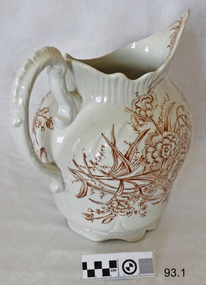
Domestic object - Ewer, Early-to-mid 20th century
... ...personal grroming...toiletry item...The early-to-mid 20th-century ewer set is an example of items used for personal hygiene in the 19th century. flagstaff hill warrnambool flagstaff hill maritime museum maritime museum shipwreck coast flagstaff hill maritime village great ocean road porcelain container toilet container beauty container ceramic decorative object pottery object ewer jug bathing personal grroming toiletry item Ewer or jug, cream ironstone with brown flower spray floral decoration. ...This object and the set of five items is believed to have been made in or around the Staffordshire area in the United Kingdom. Over 1500 pottery firms have operated in Stoke-on-Trent since the early 1700's - Some lasted only a few years and some for well over 200 years. Some potters built and owned their own works. Many others were tenants in works built by others and a succession of potters occupied the same works. It was also a common practice for a works to be split between two different pottery companies or for a larger manufacturer to let out a smaller section of his works to a potter who would make wares which were not of interest to the pot works owner. Some potters purchased 'blanks' from other manufacturers and put their own decoration on them some items have two back stamps some have no marks at all. This adds to the confusion and frustration of trying to trace details of a particular manufacturer such as the subject item.The early-to-mid 20th-century ewer set is an example of items used for personal hygiene in the 19th century.Ewer or jug, cream ironstone with brown flower spray floral decoration.(Part of 5 piece set containing ewer, bowl, brush vase, soap dish lid and soap dish).flagstaff hill, warrnambool, flagstaff hill maritime museum, maritime museum, shipwreck coast, flagstaff hill maritime village, great ocean road, porcelain container, toilet container, beauty container, ceramic, decorative object, pottery object, ewer, jug, bathing, personal grroming, toiletry item -
 Orbost & District Historical Society
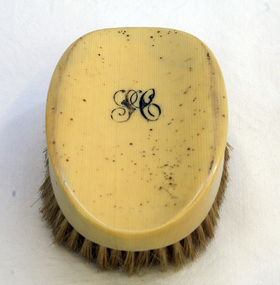
hairbrush, 1930's
... toiletry articles, novelties, photographic film, and many other mass-produced goods. Its popularity began to wane only toward the middle of the 20th century, following the introduction of plastics based on entirely synthetic polymers. This item is an example of a personal ...Celluloid was the first plastic. The first Celluloid experiments began in 1856 by Alexander Parkes in Birmingham, England. Later in the same year, he patented his invention "Parkesine". By 1868, no advancement was achieved, and Parkes' labor and efforts were ended. In 1869, Englishman Daniel Stills created a company called Xylonite to experiment and create a product similar to Parkesine. These efforts ended in 1874 when Stills went bankrupt. Celluloid / xylonite was made into toiletry articles, novelties, photographic film, and many other mass-produced goods. Its popularity began to wane only toward the middle of the 20th century, following the introduction of plastics based on entirely synthetic polymers. This item is an example of a personal item made of this synthetic plastic.A xylonite backed man's hairbrush. Backing is yellowish/cream. There is a small ornate decoration (initials?). The top is scooped. the bristles are possibly boar bristles.toiletries-men's hairbrush xylonite celluloid -
 Orbost & District Historical Society
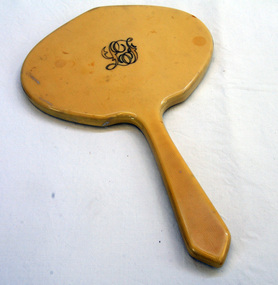
hand mirror, first half 20th century
... toiletry articles, novelties, photographic film, and many other mass-produced goods. Its popularity began to wane only toward the middle of the 20th century, following the introduction of plastics based on entirely synthetic polymers. This item is an example of a personal ...Celluloid was the first plastic. The first Celluloid experiments began in 1856 by Alexander Parkes in Birmingham, England. Later in the same year, he patented his invention "Parkesine". By 1868, no advancement was achieved, and Parkes' labor and efforts were ended. In 1869, Englishman Daniel Stills created a company called Xylonite to experiment and create a product similar to Parkesine. These efforts ended in 1874 when Stills went bankrupt. Celluloid was made into toiletry articles, novelties, photographic film, and many other mass-produced goods. Its popularity began to wane only toward the middle of the 20th century, following the introduction of plastics based on entirely synthetic polymers. This item is an example of a personal effect made from celluloid.A creamy yellow xylonite backed hand mirror with a narrow handle. The back is decorated with a swirling pattern (initials?). -
 Whitehorse Historical Society Inc.
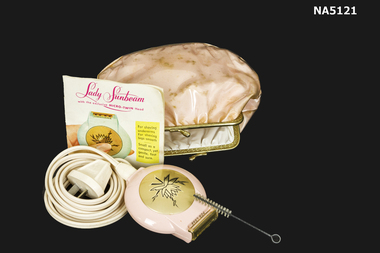
Functional object - Personal ladies shaver, Ladies shaver, C 1960's
... Ladies personal toiletry item...Ladies toiletry equipment 1960s. Ladies personal toiletry item Lady Sunbeam brand. Shaver has brand embossed in plastics cover - For legs, for underarm, embossed either side of blades. ...Belonged to Mrs Lillian Macnaughtan, in the collection of her daughter, Mrs Estelle Bannister.Ladies toiletry equipment 1960s.Ladies shaver in pink plastic purse with power cord(electric) plus instruction manual & cleaning brush.Lady Sunbeam brand. Shaver has brand embossed in plastics cover - For legs, for underarm, embossed either side of blades.ladies personal toiletry item
