
Showing 254 items matching "photographic equipment"
-
 Federation University Historical Collection
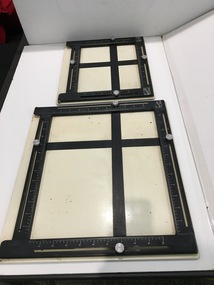
Equipment - Equipment - Photographic, ZILLES COLLECTION: Collection of Photographic Equipment
... Equipment - Photographic...ZILLES COLLECTION: Collection of Photographic Equipment......photographic equipment...Collection of photographic equipment used by Zilles Printers. ...Collection of photographic equipment used by Zilles Printers. zilles printers photographic equipment developing trays image holders tongs thermometer wooden negative holder darkroom safe light globes negative holders darkroom Ilford on plastic developing tray Collection of equipment - negative holders, developing trays - enamel and plastic, globes, thermometer, tongs - metal and plastic, metal frames, measuring cups, ZILLES COLLECTION: Collection of Photographic Equipment Equipment Equipment - Photographic ...Collection of photographic equipment used by Zilles Printers. Collection of equipment - negative holders, developing trays - enamel and plastic, globes, thermometer, tongs - metal and plastic, metal frames, measuring cups, Ilford on plastic developing trayzilles printers, photographic equipment, developing trays, image holders, tongs, thermometer, wooden negative holder, darkroom safe light, globes, negative holders, darkroom -
 Wodonga & District Historical Society Inc
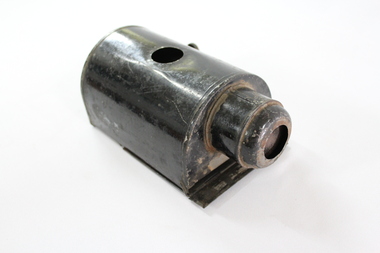
Functional object - Haeusler Collection Photographic Equipment c. early 1900s
... Haeusler Collection Photographic Equipment c. early 1900s...Haeusler Collection Photographic Equipment c. early 1900s...The Haeusler family were one of several German families to migrate from South Australia to Wodonga in the 1860s. This photographic equipment belonged to Louis Haeusler (b.1878) and is one of the many objects in the Haeusler Collection that represent home and social life in early twentieth century Wodonga....It contributes to our understanding of domestic and family life in early twentieth century Wodonga, as well as providing interpretative capacity for themes including local history and social history. photography photos photographic photographs family photos family photography darkroom photography dark room photography wodonga haeusler haeusler collection Film equipment made from alloy coated with black paint Haeusler Collection Photographic Equipment c. early 1900s Functional object Haeusler Collection Photographic Equipment c. early 1900s ...The Wodonga Historical Society Haeusler Collection provides invaluable insight into life in late nineteenth and early twentieth century north east Victoria. The collection comprises manuscripts, personal artefacts used by the Haeusler family on their farm in Wodonga, and a set of glass negatives which offer a unique visual snapshot of the domestic and social lives of the Haeusler family and local Wodonga community. The Haeusler family migrated from Prussia (Germany) to South Australia in the 1840s and 1850s, before purchasing 100 acres of Crown Land made available under the Victorian Lands Act 1862 (also known as ‘Duffy’s Land Act’) in 1866 in what is now Wodonga West. The Haeusler family were one of several German families to migrate from South Australia to Wodonga in the 1860s. This photographic equipment belonged to Louis Haeusler (b.1878) and is one of the many objects in the Haeusler Collection that represent home and social life in early twentieth century Wodonga.This item has well documented provenance and a known owner. It forms part of a significant and representative historical collection which reflects the local history of Wodonga. It contributes to our understanding of domestic and family life in early twentieth century Wodonga, as well as providing interpretative capacity for themes including local history and social history. Film equipment made from alloy coated with black paintphotography, photos, photographic, photographs, family photos, family photography, darkroom photography, dark room photography, wodonga, haeusler, haeusler collection -
 Moorabbin Air Museum
Photograph (Item) - Photographic Equipment - film splicing & joining units with empty reels
... Photographic Equipment - film splicing & joining units with empty reels...Photographic Equipment - film splicing & joining units with empty reels...Photographic Equipment - film splicing & joining units with empty reels Photograph Photographic Equipment - film splicing & joining units with empty reels ... -
Moorabbin Air Museum
Manual (Item) - Photographic Equipment - Data book of General & Technical info - RAAF
... Photographic Equipment - Data book of General & Technical info - RAAF...Photographic Equipment - Data book of General & Technical info - RAAF...Photographic Equipment - Data book of General & Technical info - RAAF Manual Photographic Equipment - Data book of General & Technical info - RAAF ... -
Moorabbin Air Museum
Manual (item) - Photographic Equipment, Materials - Data Sheets - Minister of Aviation
... Photographic Equipment, Materials - Data Sheets - Minister of Aviation...Photographic Equipment, Materials - Data Sheets - Minister of Aviation...Photographic Equipment, Materials - Data Sheets - Minister of Aviation Manual Photographic Equipment, Materials - Data Sheets - Minister of Aviation ... -
 Kiewa Valley Historical Society
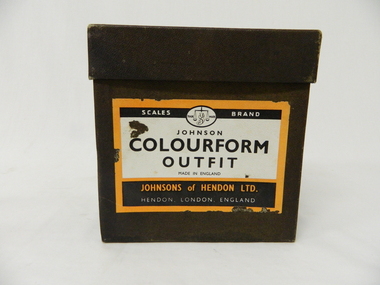
Photographic Equipment - Developer
... Photographic Equipment - Developer...photographic equipment...Wilma Davies, a long term resident of the Kiewa Valley, donated this photographic equipment. photographic equipment photography chemicals processing equipment johnson of hendon kodak colourform outfit photo developer wilma davies Johnson Colourform Outfit on box. ...The photographic developers were used to develop plates, films and lantern slides. They had to be mixed as per instructions on the bottles. These may have been used by an individual or by a local school or organisation.Wilma Davies, a long term resident of the Kiewa Valley, donated this photographic equipment.1 brownish/black cardboard box with hinged lid at top. Label is black, white & orange on front & across top of lid. This label continues down the sides and was a seal. The box contains: 3 clear glass cylinders with white markings used to measure 1 cc of liquid, showing 5cc and 10cc. Also: 1 brown glass, rectangular shaped bottle "Kodak Amidol" 1 ounce nett. It has a black plastic screw lid, a white label on 3 sides with black & orange print. Also: x2 round brown glass bottles with a sealed orange rubber(?) over tin(?) sealed (screw?) lids. Label "Johnson Colourform Developer "A" solution" all around with white label on the front and "Activol" and 'Caution' on the back all in black and orange print.Johnson Colourform Outfit on box. White marks showing 1cc on glass cylinders and 5cc and 10cc. "Kodak Amidol" etc. on 1 bottle "Johnson Colourform developer "A" Solution on 2 bottles.photographic equipment, photography, chemicals, processing equipment, johnson of hendon, kodak, colourform outfit, photo developer, wilma davies -
 Kiewa Valley Historical Society
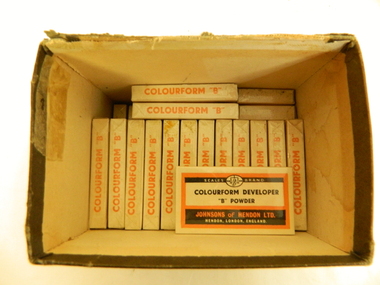
Photographic Equipment - Developer
... Photographic Equipment - Developer...photographic equipment...Wilma Davies, a long term resident of the Kiewa Valley donated this photographic equipment. photographic equipment photography johnsons of hendon colour form developer powder photo developer wilma davies Large box - Johnson Colourform Outfit Small boxes Colourform developer "B" powder. ...The photographic envelopers were used to develop plates, films and lantern slides. They had to be mixed as per instructions on the packet. These may have been used by an individual or by a local school or organisation.Wilma Davies, a long term resident of the Kiewa Valley donated this photographic equipment.Brownish/black cardboard box with no lid (broken off). Label is black, white and orange on front. The remaining parts of the label seal are on the sides with a 'picture' of (weighing) scales and words Trade Mark in black on orange and white. Inside the box are 31 clear plastic sealed cardboard boxes of "Colourform developer "B" Powder". The boxes are white with a label on the front with black and orange print. The ends are clear, the sides have "Colourform "B" in orange and the back has 'Directions' in black .Large box - Johnson Colourform Outfit Small boxes Colourform developer "B" powder.photographic equipment, photography, johnsons of hendon, colour form developer powder, photo developer, wilma davies -
 Kiewa Valley Historical Society
Photographic Equipment - Developer
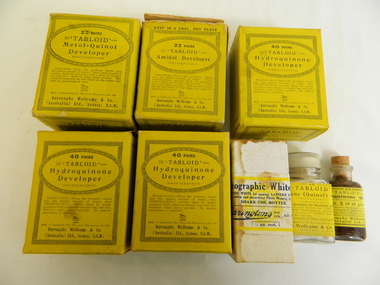
... Photographic Equipment - Developer...photographic equipment...Wilma Davies a long term resident of the Kiewa Valley donated this photographic equipment. photographic equipment chemicals processing equipment burroughs wellcome & co. wilma davies photographic developer tabloid brand Yellow box with black print on all 6 sides including Directions. ...The photographic developers were used to develop plates, films and lantern slides. They had to be mixed as per instructions on the bottles and boxes. These may have been used by an individual or by a local school or organisation.Wilma Davies a long term resident of the Kiewa Valley donated this photographic equipment.5 yellow with black print cardboard boxes with 2 bottles (pairs) in each. Box: 1 larger clear glass rectangular shaped bottle has white 'tablets' and a white-gold sealed screw lid. Smaller bottle: brown glass, oval shaped with push in cork lid and holding small brown tablets. There are: 3 Hydroquinone Developer boxes each with '40 pairs' and the 2 separate bottles (described above) without a box. 1 Metol-Quinol Developer with '22 pairs' and 1 Amidol Developer with '22 pairs'.Yellow box with black print on all 6 sides including Directions. Large bottle - Includes - Hydroqinone (Quinol) Accelarator (black print on yellow label) around 3 sides of bottle and a white label with Caution in red on the 4th side. Small bottle - Includes - Tabloid Hydroquinone (Quinol) (black print on yellow label) around 3 quarters of bottle. photographic equipment, chemicals, processing equipment, burroughs wellcome & co., wilma davies, photographic developer, tabloid brand -
 Wodonga & District Historical Society Inc
Functional object - Haeusler Collection Photographic Dark Room Equipment c. early 1900s
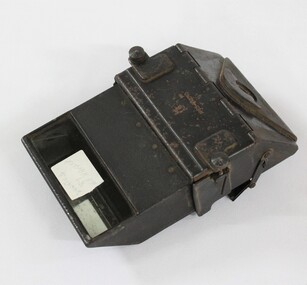
... Haeusler Collection Photographic Dark Room Equipment c. early 1900s...Haeusler Collection Photographic Dark Room Equipment c. early 1900s...Haeusler Collection Photographic Dark Room Equipment c. early 1900s Functional object Haeusler Collection Photographic Dark Room Equipment c. early 1900s ...The Wodonga Historical Society Haeusler Collection provides invaluable insight into life in late nineteenth and early twentieth century north east Victoria. The collection comprises manuscripts, personal artefacts used by the Haeusler family on their farm in Wodonga, and a set of glass negatives which offer a unique visual snapshot of the domestic and social lives of the Haeusler family and local Wodonga community. The Haeusler family migrated from Prussia (Germany) to South Australia in the 1840s and 1850s, before purchasing 100 acres of Crown Land made available under the Victorian Lands Act 1862 (also known as ‘Duffy’s Land Act’) in 1866 in what is now Wodonga West. The Haeusler family were one of several German families to migrate from South Australia to Wodonga in the 1860s. This dark room equipment belonged to Louis Haeusler (b.1878) and is one of the many objects in the Haeusler Collection that represent home and social life in early twentieth century Wodonga. This item has well documented provenance and a known owner. It forms part of a significant and representative historical collection which reflects the local history of Wodonga. It contributes to our understanding of domestic and family life in early twentieth century Wodonga, as well as providing interpretative capacity for themes including local history and social history.Metal box shaped object with mirrors inserted at either end, used in the production of dark room photography. On top of object "N°E5-4/12710"/On underside "TB 13259" and "TD 19014ABI"photograph, photographs, photography, dark room, images, family photos, family photographs -
Moorabbin Air Museum
Manual (Item) - RAF. AP 112P-0001-1 volume 1. General and technical information, Databook of photographic equipment
... Databook of photographic equipment...Databook of photographic equipment Manual RAF. AP 112P-0001-1 volume 1. ... -
Moorabbin Air Museum
Manual (item) - Photographic Equipment Theory and Processes Air Publication 1355B Vol 1 Part 1
... Photographic Equipment Theory and Processes Air Publication 1355B Vol 1 Part 1...Manual Photographic Equipment Theory and Processes Air Publication 1355B Vol 1 Part 1 ... -
 Allan Doney Collection, Bendigo Historical Society Inc.
Negative - Photographic Equipment - Lighting Effects, Allan Doney, 1950 -1970
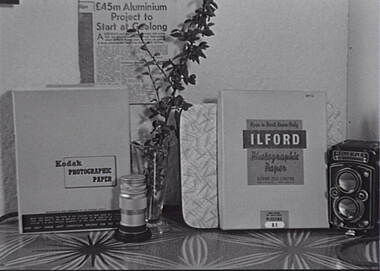
... Photographic Equipment - Lighting Effects...Negative Photographic Equipment - Lighting Effects Allan Doney ...In the years of Allan Doney’s photography, landmark buildings succumbed to fire, neglect and redevelopment. He photographed the grey sand hills from Bendigo’s mining past, the streetscapes, poppet heads, miners’ cottages, gracious homes with ornate verandahs, trams and much more. Above all, his photographs show how much of the city has survived from the 19th century – and how much has not. Through two decades of great change, Allan Doney was there to capture ways people interacted with it. Although he travelled to many other places in Northern Victoria and beyond in search of subjects for his art, he seemed to always return to Bendigo for inspiration. -
 Allan Doney Collection, Bendigo Historical Society Inc.
Negative - Photographic Equipment - Lighting Effects, Allan Doney, 1950 -1970
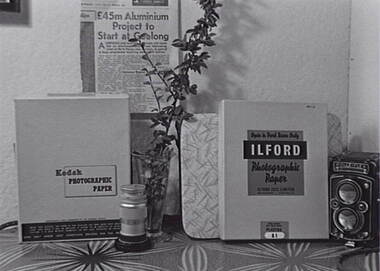
... Photographic Equipment - Lighting Effects...Negative Photographic Equipment - Lighting Effects Allan Doney ...In the years of Allan Doney’s photography, landmark buildings succumbed to fire, neglect and redevelopment. He photographed the grey sand hills from Bendigo’s mining past, the streetscapes, poppet heads, miners’ cottages, gracious homes with ornate verandahs, trams and much more. Above all, his photographs show how much of the city has survived from the 19th century – and how much has not. Through two decades of great change, Allan Doney was there to capture ways people interacted with it. Although he travelled to many other places in Northern Victoria and beyond in search of subjects for his art, he seemed to always return to Bendigo for inspiration. -
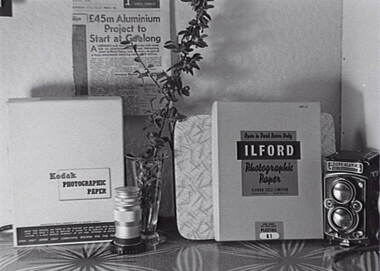 Allan Doney Collection, Bendigo Historical Society Inc.
Negative - Photographic Equipment - Lighting Effects, Allan Doney, 1950 -1970
... Photographic Equipment - Lighting Effects...Negative Photographic Equipment - Lighting Effects Allan Doney ...In the years of Allan Doney’s photography, landmark buildings succumbed to fire, neglect and redevelopment. He photographed the grey sand hills from Bendigo’s mining past, the streetscapes, poppet heads, miners’ cottages, gracious homes with ornate verandahs, trams and much more. Above all, his photographs show how much of the city has survived from the 19th century – and how much has not. Through two decades of great change, Allan Doney was there to capture ways people interacted with it. Although he travelled to many other places in Northern Victoria and beyond in search of subjects for his art, he seemed to always return to Bendigo for inspiration. -
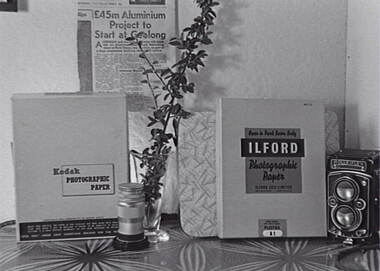 Allan Doney Collection, Bendigo Historical Society Inc.
Negative - Photographic Equipment - Lighting Effects, Allan Doney, 1950 -1970
... Photographic Equipment - Lighting Effects...Negative Photographic Equipment - Lighting Effects Allan Doney ...In the years of Allan Doney’s photography, landmark buildings succumbed to fire, neglect and redevelopment. He photographed the grey sand hills from Bendigo’s mining past, the streetscapes, poppet heads, miners’ cottages, gracious homes with ornate verandahs, trams and much more. Above all, his photographs show how much of the city has survived from the 19th century – and how much has not. Through two decades of great change, Allan Doney was there to capture ways people interacted with it. Although he travelled to many other places in Northern Victoria and beyond in search of subjects for his art, he seemed to always return to Bendigo for inspiration. -
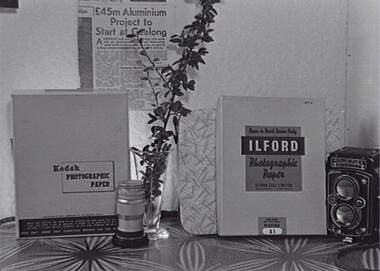 Allan Doney Collection, Bendigo Historical Society Inc.
Negative - Photographic Equipment - Lighting Effects, Allan Doney, 1950 -1970
... Photographic Equipment - Lighting Effects...Negative Photographic Equipment - Lighting Effects Allan Doney ...In the years of Allan Doney’s photography, landmark buildings succumbed to fire, neglect and redevelopment. He photographed the grey sand hills from Bendigo’s mining past, the streetscapes, poppet heads, miners’ cottages, gracious homes with ornate verandahs, trams and much more. Above all, his photographs show how much of the city has survived from the 19th century – and how much has not. Through two decades of great change, Allan Doney was there to capture ways people interacted with it. Although he travelled to many other places in Northern Victoria and beyond in search of subjects for his art, he seemed to always return to Bendigo for inspiration. -
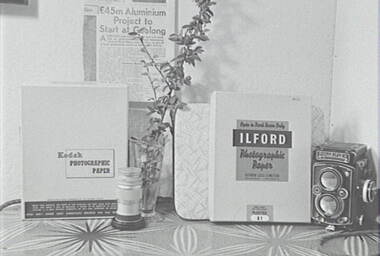 Allan Doney Collection, Bendigo Historical Society Inc.
Negative - Photographic Equipment - Lighting Effects, Allan Doney, 1950 -1970
... Photographic Equipment - Lighting Effects...Negative Photographic Equipment - Lighting Effects Allan Doney ...In the years of Allan Doney’s photography, landmark buildings succumbed to fire, neglect and redevelopment. He photographed the grey sand hills from Bendigo’s mining past, the streetscapes, poppet heads, miners’ cottages, gracious homes with ornate verandahs, trams and much more. Above all, his photographs show how much of the city has survived from the 19th century – and how much has not. Through two decades of great change, Allan Doney was there to capture ways people interacted with it. Although he travelled to many other places in Northern Victoria and beyond in search of subjects for his art, he seemed to always return to Bendigo for inspiration. -
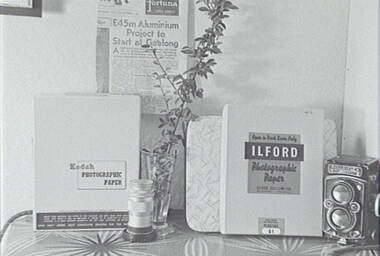 Allan Doney Collection, Bendigo Historical Society Inc.
Negative - Photographic Equipment - Lighting Effects, Allan Doney, 1950 -1970
... Photographic Equipment - Lighting Effects...Negative Photographic Equipment - Lighting Effects Allan Doney ...In the years of Allan Doney’s photography, landmark buildings succumbed to fire, neglect and redevelopment. He photographed the grey sand hills from Bendigo’s mining past, the streetscapes, poppet heads, miners’ cottages, gracious homes with ornate verandahs, trams and much more. Above all, his photographs show how much of the city has survived from the 19th century – and how much has not. Through two decades of great change, Allan Doney was there to capture ways people interacted with it. Although he travelled to many other places in Northern Victoria and beyond in search of subjects for his art, he seemed to always return to Bendigo for inspiration. -
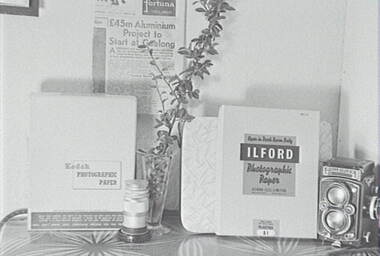 Allan Doney Collection, Bendigo Historical Society Inc.
Negative - Photographic Equipment - Lighting Effects, Allan Doney, 1950 -1970
... Photographic Equipment - Lighting Effects...Negative Photographic Equipment - Lighting Effects Allan Doney ...In the years of Allan Doney’s photography, landmark buildings succumbed to fire, neglect and redevelopment. He photographed the grey sand hills from Bendigo’s mining past, the streetscapes, poppet heads, miners’ cottages, gracious homes with ornate verandahs, trams and much more. Above all, his photographs show how much of the city has survived from the 19th century – and how much has not. Through two decades of great change, Allan Doney was there to capture ways people interacted with it. Although he travelled to many other places in Northern Victoria and beyond in search of subjects for his art, he seemed to always return to Bendigo for inspiration. -
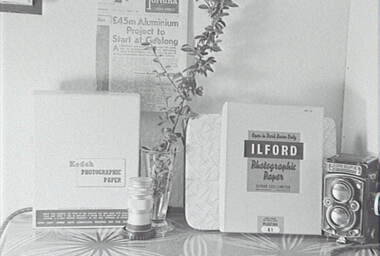 Allan Doney Collection, Bendigo Historical Society Inc.
Negative - Photographic Equipment - Lighting Effects, Allan Doney, 1950 -1970
... Photographic Equipment - Lighting Effects...Negative Photographic Equipment - Lighting Effects Allan Doney ...In the years of Allan Doney’s photography, landmark buildings succumbed to fire, neglect and redevelopment. He photographed the grey sand hills from Bendigo’s mining past, the streetscapes, poppet heads, miners’ cottages, gracious homes with ornate verandahs, trams and much more. Above all, his photographs show how much of the city has survived from the 19th century – and how much has not. Through two decades of great change, Allan Doney was there to capture ways people interacted with it. Although he travelled to many other places in Northern Victoria and beyond in search of subjects for his art, he seemed to always return to Bendigo for inspiration. -
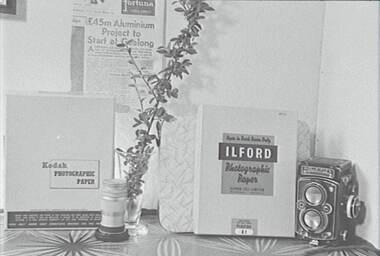 Allan Doney Collection, Bendigo Historical Society Inc.
Negative - Photographic Equipment - Lighting Effects, Allan Doney, 1950 -1970
... Photographic Equipment - Lighting Effects...Negative Photographic Equipment - Lighting Effects Allan Doney ...In the years of Allan Doney’s photography, landmark buildings succumbed to fire, neglect and redevelopment. He photographed the grey sand hills from Bendigo’s mining past, the streetscapes, poppet heads, miners’ cottages, gracious homes with ornate verandahs, trams and much more. Above all, his photographs show how much of the city has survived from the 19th century – and how much has not. Through two decades of great change, Allan Doney was there to capture ways people interacted with it. Although he travelled to many other places in Northern Victoria and beyond in search of subjects for his art, he seemed to always return to Bendigo for inspiration. -
 Flagstaff Hill Maritime Museum and Village
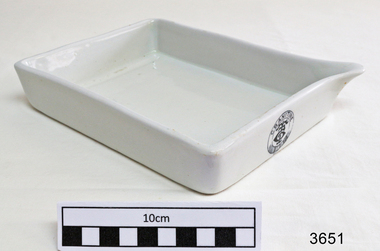
Functional object - Developing Tray, Early 20th century
... ...historic photographic equipment...Dr Angus assisted Dr Tom Ryan, a pioneer in the use of X-rays and in ocular surgery. flagstaff hill warrnambool shipwrecked coast flagstaff hill maritime museum maritime museum shipwreck coast flagstaff hill maritime village great ocean road dr w r angus dr ryan surgical instrument t.s.s. largs bay warrnambool base hospital nhill base hospital mira hospital flying doctor medical treatment medical history developing tray developing tank developing dish photographic equipment historic photographic equipment historic medical equipment spiral loading developing tank Maker’s Mark is circle with “GRANITINE” on top and symbol of buckled belt on bottom, letters “T T C” intertwined in centre of ring. ...This was the earliest system of developing photographs, and was still in use well into the 20th century. The negative was placed in a dish with the developing solution, the photographer judged when development was complete by holding the plate to a safelight. To compensate for wrong exposure or lack of contrast it was normal, at the time, for the constituents of the developer to be altered during development, based on how the image was appearing. This developing tray or dish was used for developing film plates or rolls of film. The tray was donated to Flagstaff Hill Maritime Village by the family of Doctor William Roy Angus, Surgeon and Oculist. It is part of the “W.R. Angus Collection” that includes historical medical equipment, surgical instruments and material once belonging to Dr Edward Ryan and Dr Thomas Francis Ryan, (both of Nhill, Victoria) as well as Dr Angus’ own belongings. It was probably used by Dr. T. F. Ryan in conjunction with his state-of-the-art X-Ray machine. The Collection’s history spans the medical practices of the two Doctors Ryan, from 1885-1926 plus that of Dr Angus, up until 1969. ABOUT THE “W.R.ANGUS COLLECTION” Doctor William Roy Angus M.B., B.S., Adel., 1923, F.R.C.S. Edin.,1928 (also known as Dr Roy Angus) was born in Murrumbeena, Victoria in 1901 and lived until 1970. He qualified as a doctor in 1923 at University of Adelaide, was Resident Medical Officer at the Royal Adelaide Hospital in 1924 and for a period was house surgeon to Sir (then Mr.) Henry Simpson Newland. Dr Angus was briefly an Assistant to Dr Riddell of Kapunda, then commenced private practice at Curramulka, Yorke Peninsula, SA, where he was physician, surgeon and chemist. In 1926, he was appointed as new Medical Assistant to Dr Thomas Francis Ryan (T.F. Ryan, or Tom), in Nhill, Victoria, where his experiences included radiology and pharmacy. In 1927 he was Acting House Surgeon in Dr Tom Ryan’s absence. Dr Angus had become engaged to Gladys Forsyth and they decided he would take time to further his studies overseas in the UK in 1927. He studied at London University College Hospital and at Edinburgh Royal Infirmary and in 1928, was awarded FRCS (Fellow from the Royal College of Surgeons), Edinburgh. He worked his passage back to Australia as a Ship’s Surgeon on the on the Australian Commonwealth Line’s T.S.S. Largs Bay. Dr Angus married Gladys in 1929, in Ballarat. (They went on to have one son (Graham 1932, born in SA) and two daughters (Helen (died 12/07/1996) and Berenice (Berry), both born at Mira, Nhill ) Dr Angus was a ‘flying doctor’ for the A.I.M. (Australian Inland Ministry) Aerial Medical Service in 1928 . The organisation began in South Australia through the Presbyterian Church in that year, with its first station being in the remote town of Oodnadatta, where Dr Angus was stationed. He was locum tenens there on North-South Railway at 21 Mile Camp. He took up this ‘flying doctor’ position in response to a call from Dr John Flynn; the organisation was later known as the Flying Doctor Service, then the Royal Flying Doctor Service. A lot of his work during this time involved dental surgery also. Between 1928-1932 he was surgeon at the Curramulka Hospital, Yorke Peninsula, South Australia. In 1933 Dr Angus returned to Nhill where he’d previously worked as Medical Assistant and purchased a share of the Nelson Street practice and Mira hospital from Dr Les Middleton one of the Middleton Brothers, the current owners of what was once Dr Tom Ryan’s practice. Dr L Middleton was House Surgeon to the Nhill Hospital 1926-1933, when he resigned. [Dr Tom Ryan’s practice had originally belonged to his older brother Dr Edward Ryan, who came to Nhill in 1885. Dr Edward saw patients at his rooms, firstly in Victoria Street and in 1886 in Nelson Street, until 1901. The Nelson Street practice also had a 2 bed ward, called Mira Private Hospital ). Dr Edward Ryan was House Surgeon at the Nhill Hospital 1884-1902 . He also had occasions where he successfully performed veterinary surgery for the local farmers too. Dr Tom Ryan then purchased the practice from his brother in 1901. Both Dr Edward and Dr Tom Ryan work as surgeons included eye surgery. Dr Tom Ryan performed many of his operations in the Mira private hospital on his premises. He too was House Surgeon at the Nhill Hospital 1902-1926. Dr Tom Ryan had one of the only two pieces of radiology equipment in Victoria during his practicing years – The Royal Melbourne Hospital had the other one. Over the years Dr Tom Ryan gradually set up what was effectively a training school for country general-practitioner-surgeons. Each patient was carefully examined, including using the X-ray machine, and any surgery was discussed and planned with Dr Ryan’s assistants several days in advance. Dr Angus gained experience in using the X-ray machine there during his time as assistant to Dr Ryan. Dr Tom Ryan moved from Nhill in 1926. He became a Fellow of the Royal Australasian College of Surgeons in 1927, soon after its formation, a rare accolade for a doctor outside any of the major cities. He remained a bachelor and died suddenly on 7th Dec 1955, aged 91, at his home in Ararat. Scholarships and prizes are still awarded to medical students in the honour of Dr T.F. Ryan and his father, Dr Michael Ryan, and brother, John Patrick Ryan. ] When Dr Angus bought into the Nelson Street premises in Nhill he was also appointed as the Nhill Hospital’s Honorary House Surgeon 1933-1938. His practitioner’s plate from his Nhill surgery states “HOURS Daily, except Tuesdays, Fridays and Saturday afternoons, 9-10am, 2-4pm, 7-8pm. Sundays by appointment”. This plate is now mounted on the doorway to the Port Medical Office at Flagstaff Hill Maritime Village, Warrnambool. Dr Edward Ryan and Dr Tom Ryan had an extensive collection of historical medical equipment and materials spanning 1884-1926 and when Dr Angus took up practice in their old premises he obtained this collection, a large part of which is now on display at the Port Medical Office at Flagstaff Hill Maritime Village in Warrnambool. During his time in Nhill Dr Angus was involved in the merging of the Mira Hospital and Nhill Public Hospital into one public hospital and the property titles passed on to Nhill Hospital in 1939. In 1939 Dr Angus and his family moved to Warrnambool where he purchased “Birchwood,” the 1852 home and medical practice of Dr John Hunter Henderson, at 214 Koroit Street. (This property was sold in1965 to the State Government and is now the site of the Warrnambool Police Station. ). The Angus family was able to afford gardeners, cooks and maids; their home was a popular place for visiting dignitaries to stay whilst visiting Warrnambool. Dr Angus had his own silk worm farm at home in a Mulberry tree. His young daughter used his centrifuge for spinning the silk. Dr Angus was appointed on a part-time basis as Port Medical Officer (Health Officer) in Warrnambool and held this position until the 1940’s when the government no longer required the service of a Port Medical Officer in Warrnambool; he was thus Warrnambool’s last serving Port Medical Officer. (The duties of a Port Medical Officer were outlined by the Colonial Secretary on 21st June, 1839 under the terms of the Quarantine Act. Masters of immigrant ships arriving in port reported incidents of diseases, illness and death and the Port Medical Officer made a decision on whether the ship required Quarantine and for how long, in this way preventing contagious illness from spreading from new immigrants to the residents already in the colony.) Dr Angus was a member of the Australian Medical Association, for 35 years and surgeon at the Warrnambool Base Hospital 1939-1942, He served as a Surgeon Captain during WWII1942-45, in Ballarat, Victoria, and in Bonegilla, N.S.W., completing his service just before the end of the war due to suffering from a heart attack. During his convalescence he carved an intricate and ‘most artistic’ chess set from the material that dentures were made from. He then studied ophthalmology at the Royal Melbourne Eye and Ear Hospital and created cosmetically superior artificial eyes by pioneering using the intrascleral cartilage. Angus received accolades from the Ophthalmological Society of Australasia for this work. He returned to Warrnambool to commence practice as an ophthalmologist, pioneering in artificial eye improvements. He was Honorary Consultant Ophthalmologist to Warrnambool Base Hospital for 31 years. He made monthly visits to Portland as a visiting surgeon, to perform eye surgery. He represented the Victorian South-West subdivision of the Australian Medical Association as its secretary between 1949 and 1956 and as chairman from 1956 to 1958. In 1968 Dr Angus was elected member of Spain’s Barraquer Institute of Barcelona after his research work in Intrasclearal cartilage grafting, becoming one of the few Australian ophthalmologists to receive this honour, and in the following year presented his final paper on Living Intrasclearal Cartilage Implants at the Inaugural Meeting of the Australian College of Ophthalmologists in Melbourne In his personal life Dr Angus was a Presbyterian and treated Sunday as a Sabbath, a day of rest. He would visit 3 or 4 country patients on a Sunday, taking his children along ‘for the ride’ and to visit with him. Sunday evenings he would play the pianola and sing Scottish songs to his family. One of Dr Angus’ patients was Margaret MacKenzie, author of a book on local shipwrecks that she’d seen as an eye witness from the late 1880’s in Peterborough, Victoria. In the early 1950’s Dr Angus, painted a picture of a shipwreck for the cover jacket of Margaret’s book, Shipwrecks and More Shipwrecks. She was blind in later life and her daughter wrote the actual book for her. Dr Angus and his wife Gladys were very involved in Warrnambool’s society with a strong interest in civic affairs. Their interests included organisations such as Red Cross, Rostrum, Warrnambool and District Historical Society (founding members), Wine and Food Society, Steering Committee for Tertiary Education in Warrnambool, Local National Trust, Good Neighbour Council, Housing Commission Advisory Board, United Services Institute, Legion of Ex-Servicemen, Olympic Pool Committee, Food for Britain Organisation, Warrnambool Hospital, Anti-Cancer Council, Boys’ Club, Charitable Council, National Fitness Council and Air Raid Precautions Group. He was also a member of the Steam Preservation Society and derived much pleasure from a steam traction engine on his farm. He had an interest in people and the community He and his wife Gladys were both involved in the creation of Flagstaff Hill, including the layout of the gardens. After his death (28th March 1970) his family requested his practitioner’s plate, medical instruments and some personal belongings be displayed in the Port Medical Office surgery at Flagstaff Hill Maritime Village, and be called the “W. R. Angus Collection”. The W.R. Angus Collection is significant for still being located at the site it is connected with, Doctor Angus being the last Port Medical Officer in Warrnambool. The collection of medical instruments and other equipment is culturally significant, being an historical example of medicine from late 19th to mid-20th century. Dr Angus assisted Dr Tom Ryan, a pioneer in the use of X-rays and in ocular surgery. Developing Tray, white porcelain tray, dish or tank with pouring lip, part of the W. R. Angus Collection. Maker’s Mark is circle with “GRANITINE” on top and symbol of buckled belt on bottom, letters “T T C” intertwined in centre of ring. Early 20th century. Maker’s Mark is circle with “GRANITINE” on top and symbol of buckled belt on bottom, letters “T T C” intertwined in centre of ring.flagstaff hill, warrnambool, shipwrecked coast, flagstaff hill maritime museum, maritime museum, shipwreck coast, flagstaff hill maritime village, great ocean road, dr w r angus, dr ryan, surgical instrument, t.s.s. largs bay, warrnambool base hospital, nhill base hospital, mira hospital, flying doctor, medical treatment, medical history, developing tray, developing tank, developing dish, photographic equipment, historic photographic equipment, historic medical equipment, spiral loading developing tank -
 Federation University Historical Collection
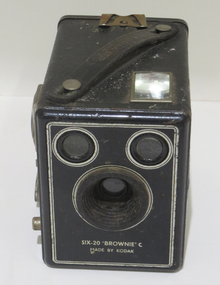
Equipment - Camera, Kodak Six-20 'Brownie' C, c1950
... ...Photographic Equipment...(http://www.brownie-camera.com/71.shtml) camera photography brownie kodak box brownie Photographic Equipment Morocco-grained imitation leather covered metal body with two brilliant finders. ...This model of camera was made between 1946 and 1957. (http://www.brownie-camera.com/71.shtml)Morocco-grained imitation leather covered metal body with two brilliant finders. Plain matt enamel front; metal wind knob and release button with a single blade shutter. (http://www.brownie-camera.com/71.shtml) This camera took box rollfilm, with 629 film size. The picture size was 2 1/4 X 3 1/4" .(http://www.brownie-camera.com/71.shtml) Instruction books for this model are available at http://www.brownie-camera.com/manuals.shtml camera, photography, brownie, kodak, box brownie, photographic equipment -
 Federation University Historical Collection
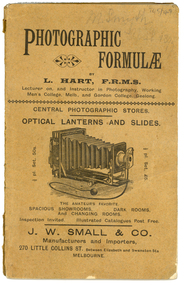
Booklet, L. Hart, Photographic Formulae, 1895, 1895
... ...photographic equipment...This book was most probably used at the Ballarat School of Mines during Photography classes. photography albumen albertype collotype photolithograph gelatine plates xylography L. hart photographic equipment 32 page soft covered book with photographic formulae for students of photography. ...This book was most probably used at the Ballarat School of Mines during Photography classes. 32 page soft covered book with photographic formulae for students of photography.photography, albumen, albertype, collotype, photolithograph, gelatine plates, xylography, l. hart, photographic equipment -
 Federation University Historical Collection
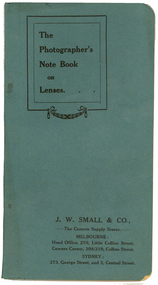
Book, R. & J. Beck Ltd, The Photographers Note Book on Lenses
... ...Photographic Equipment...photography lenses conrad beck Photographic Equipment Blue/green soft covered book of 96 pages. ...Blue/green soft covered book of 96 pages. photography, lenses, conrad beck, photographic equipment -
Federation University Historical Collection
Equipment - Camera, Thornton-Pickard, Thornton Pickard Triple Imperial Extension Camera, c1901
... ...Photographic Equipment...Camera extension camera Photographic Equipment Thornton Pickard Triple Imperial Extension half plate camera nos 529946 and 529947. ...Thornton-Pickard was a famous British camera manufacturer established in 1888. The company was based in Altrincham, near Manchester, and was an early pioneer in the development of the camera industry.Thornton Pickard Triple Imperial Extension half plate camera nos 529946 and 529947. The camera has leather bellows, and was originally mounted on a tripod.camera, extension camera, photographic equipment -
 Federation University Historical Collection
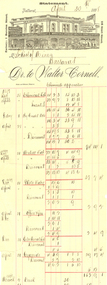
Document - Invoice, Invoice from Walter Cornell to the Ballarat School of Mines, 1898, 30/04/1898
... ...Photographic Equipment...Walter Cornell Ballarat School of Mines Laboratory Chemist pharmacy photography electricity Photographic Equipment Handwritten invoice on printed letterhead. ...During the 1890s the Ballarat School of Mines started teaching photography.Handwritten invoice on printed letterhead. The invoice was for chemicals and apparatus for the Ballarat School of Mines, including items for the Chemical Laboratory, Photography Laboratory, Electrical Laboratory and Cyanide.walter cornell, ballarat school of mines, laboratory, chemist, pharmacy, photography electricity, photographic equipment -
 Federation University Historical Collection
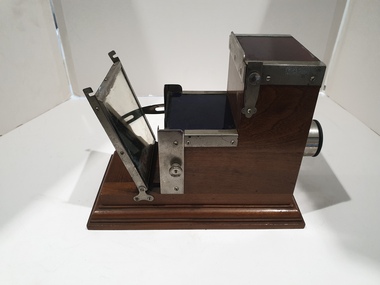
Equipment - Camera, The Junior Kromskop, c1899
... ...Photographic Equipment...Ives Camera club photography colour photography Kromskop Frederic Eugene Ives junior kromskop Photographic Equipment camera A monocular instrument used to reproduce colours, in a mahogany box The viewer combines stereo images from three-colour separation transparencies called Kromograms, these are viewed through red, green and blue filters. ...The Kromskop (pronounced Chromescope) is one of the earliest commercial applications of colour photography, and was invented by Frederic Eugene Ives and announced around 1896, it is described in his English patent of 1895 and in a US patent of 1894. It was shown at a Camera Club in Britain in January 1896 and at the February Royal Photographic Society meeting, and was available for sale from early 1897. The Photochromoscope Syndicate was formed in 1896 or 97 to promote the viewer in Britain, and wound up in 1899. It was manufactured in south London.A monocular instrument used to reproduce colours, in a mahogany box The viewer combines stereo images from three-colour separation transparencies called Kromograms, these are viewed through red, green and blue filters. A Kromogram comprises three monochrome transparencies printed from three-colour separation negatives which are taped together. The order being red image, blue image, green image with a label and caption between the red and blue images. The red image lies horizontally on the top step of the viewer above a red filter, the blue image lies on the lower step above a blue filter, the green image stands vertically at the back of the viewer. The red and blue images are reflected into the eyepieces by transparent mirrors, these are coloured to absorb the light that they reflect to prevent a double image from the rear surface of the mirror, the mirror for the red image is coloured cyan/blue, that used for the blue filter is coloured green (the patent indicates a yellow filter). The green image is illuminated by a yellow reflector. As the mirror below the blue image is green there is no need for a green filter immediately in front of the green image. The viewer can be used in daylight, for some conditions a diffuser is used, this is hinged to the yellow reflector and laid across the steps. An artificial light was also available. The mirrors and image positions can be adjusted in the event that they become misaligned. (http://www.earlyphotography.co.uk/site/entry_V80.html, accessed 08 April 2022) The Junior Kromskop was a mono viewer Kromskop. henry sutton, photochromoscope syndicate, f.e. ives, camera club, photography, colour photography, kromskop, frederic eugene ives, junior kromskop, photographic equipment, camera -
Federation University Historical Collection
Equipment - Object, Large Format Transparency Camera
... ...Photographic Equipment...Used in the Photography Class at SMB TAFE tafe smb camera toyo-view camera toyo photography tripod large format transparency Photographic Equipment R. No. 4 Large Format Transparency Camera on a metal tripod. ...Used in the Photography Class at SMB TAFELarge Format Transparency Camera on a metal tripod.R. No. 4tafe, smb, camera, toyo-view camera, toyo, photography, tripod, large format, transparency, photographic equipment -
 Federation University Historical Collection
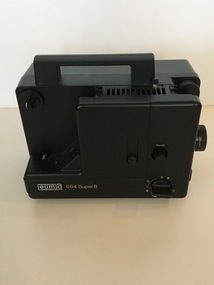
Equipment - Objects, Super 8 Film Equipment
... ...Photographic Equipment...She died after surgical complications on 19 July 1999. super 8 super-8 film making movie making trish lewinski super-8 camera camera film Photographic Equipment Four items relating to Super 8 film making. .1) Nalcom Super-* Synchro Zoom Camera, in black vinyl .2) Johnson Monolight photoflood camera attachment, without bulb .3) Eumig 604 Super8 Film camera .4) A set of 8 reels of film, of various sizes Gift of John Jenkinson in memory of his daughter, Trish Lewinski Super 8 Film Equipment Equipment Objects ...Journalist Trish Lewinski became a member of the University of Ballarat External Relations staff in February 1998. She died after surgical complications on 19 July 1999.Four items relating to Super 8 film making. .1) Nalcom Super-* Synchro Zoom Camera, in black vinyl .2) Johnson Monolight photoflood camera attachment, without bulb .3) Eumig 604 Super8 Film camera .4) A set of 8 reels of film, of various sizes Gift of John Jenkinson in memory of his daughter, Trish Lewinskisuper 8, super-8, film making, movie making, trish lewinski, super-8 camera, camera, film, photographic equipment
