
Showing 6 items matching "physics of surfaces"
-
 Federation University Historical Collection
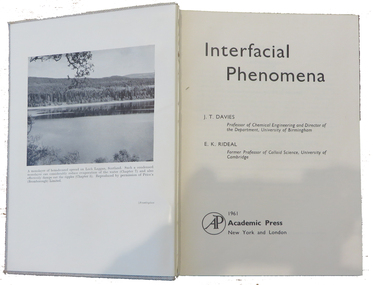
Book, Academic Press Inc, Interfacial phenomena, 1961
... ...physics of surfaces...This is a first edition. interfacial phenomena book j t davies e k rideal chemical engineering physics of surfaces Written in pencil on fly - M Can; (pound symbol) 8-10-0 Stamped on fly - Department of Mining University of Melbourne. ...This is a first edition.Light grey cloth covered hard covered book of 473 pages. On the spine is gold lettering on a dark brown rectangular background. There are photographs and diagrams throughout the book.Written in pencil on fly - M Can; (pound symbol) 8-10-0 Stamped on fly - Department of Mining University of Melbourne.interfacial phenomena, book, j t davies, e k rideal, chemical engineering, physics of surfaces -
 Federation University Historical Collection
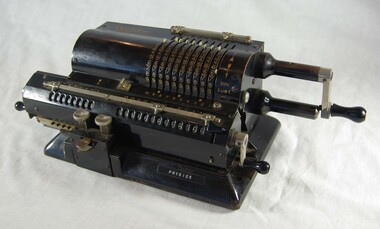
Instrument - equipment, Mechanical Pinwheel Calculator, c1940, 1935-1945
... No. 29-286781.5 Black symotape on base front: "PHYSICS". Maker's identification on top surface. Supplier's label (metal, silver & blue) on back: "STOTT & HOARE Pty. ...No. 29-286781.5 Black symotape on base front: "PHYSICS". Maker's identification on top surface. Supplier's label (metal, silver & blue) on back: "STOTT & HOARE Pty. ...Willgodt T. Odhner invented his very successful “pinwheel” four-function calculator mechanism in Russia in 1874, and his invention was cloned by numerous companies, resulting in dozens of similar models that remained in wide use for almost a century. Numbers are dialed into the sliding levers on the top part of the machine, and are added to the register visible in the carriage at the bottom when the large crank is turned. Shifting the carriage sideways allows multiplication through a sequence of addition operations; the two small cranks zero the registers. The design includes ingenious error-preventing interlocks between all the controls: should the operator fail to return a crank to its resting position, the other controls are frozen until this is corrected. A bell indicates calculations in the negative. Used in Ballarat Institute of Advanced Education (B.I.A.E) Physics department.Black, mechanical calculating machine. Metal. Hand-operated, with three hand-cranks. 10x10 rotor with 13 digit result. Ser. No. 29-286781.5 Black symotape on base front: "PHYSICS". Maker's identification on top surface. Supplier's label (metal, silver & blue) on back: "STOTT & HOARE Pty. Ltd. 171 William St. Melbourne C1 M1991". Stamped on rear panel: "MADE IN SWEDEN". Cast lettering on underside: "M-602 07".calculating machine, pinwheel, calculator, scientific instruments, stott & hoare pty ltd, physics, odhner, ballarat institute of advanced education -
 Federation University Historical Collection
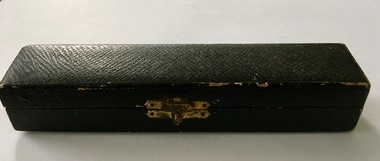
Scientific Instruments, Specific Gravity: Metal Cubes - boxed set of seven
... This would have been in Elementary physics experiments. physics laboratory ballarat school of mines relative density specific gravity metal elementary physics brass lead steel copper aluminium ferrous alloy Number and metal of cubes: 1) Brass; 2) Lead; 3) Steel; 4) Copper; 5) Aluminium; 6) ? a ferrous alloy; 7) ? a ferrous alloy. A set of seven 2-cm cubes, individually numbered 1 - 7, in a hinged-lid storage box with black surface finish. ...Used in Physics Laboratory at Ballarat School of Mines for calculating/confirming relative density (or the specific gravity) of given metal samples. This would have been in Elementary physics experiments.A set of seven 2-cm cubes, individually numbered 1 - 7, in a hinged-lid storage box with black surface finish.Number and metal of cubes: 1) Brass; 2) Lead; 3) Steel; 4) Copper; 5) Aluminium; 6) ? a ferrous alloy; 7) ? a ferrous alloy.physics, laboratory, ballarat school of mines, relative density, specific gravity, metal, elementary physics, brass, lead, steel, copper, aluminium, ferrous alloy -
 The Ed Muirhead Physics Museum
Coolidge X-ray Tube
... Physics, the University of Melbourne Cat. No. 22. Jacqueline Eager Student Projects Placement, Cultural Collections 2005 In 1913 Coolidge overcame the limitation of the narrow operating range of the gas X-ray tubes with the invention of the vacuum X-ray tube. A filament heated by an electric current directly releases electrons by thermionic emission. In thermionic emission, electrons are emitted from a metal surface...Physics, the University of Melbourne Cat. No. 22. Jacqueline Eager Student Projects Placement, Cultural Collections 2005 In 1913 Coolidge overcame the limitation of the narrow operating range of the gas X-ray tubes with the invention of the vacuum X-ray tube. A filament heated by an electric current directly releases electrons by thermionic emission. In thermionic emission, electrons are emitted from a metal surface ...The investigation of the x-ray appears early on to have been a priority research topic at the University of Melbourne’s School of Physics. This interest was sparked by the appointment in 1889 of Professor T.R. Lyle. Lyle, who was head of the school until 1915, is thought to have been the first person in Australia to have taken an x-ray photograph. A copy of this photograph can be found in the School of Physics Archive. For this particular experiment Lyle actually made his own x-ray tube. His successor, Professor Laby, continued to work with x-rays. During the 1920s Laby worked on the x-ray spectra of atoms and in 1930 he co-published with Dr. C.E. Eddy, Quantitative Analysis by X-Ray Spectroscopy. Also with Eddy, Laby produced the landmark paper Sensitivity of Atomic Analysis by X-rays. Laby went on to have an x-ray spectrograph of his own design manufactured by Adam Hilger Ltd. (see cat. No. 38). School of Physics, the University of Melbourne Cat. No. 22. Jacqueline Eager Student Projects Placement, Cultural Collections 2005 In 1913 Coolidge overcame the limitation of the narrow operating range of the gas X-ray tubes with the invention of the vacuum X-ray tube. A filament heated by an electric current directly releases electrons by thermionic emission. In thermionic emission, electrons are emitted from a metal surface directly by the application of an electric current to heat a wire filament. The electrons accelerate to the anode and produce X-rays. The anode has associated cooling fins due to the high temperatures attained by the release of kinetic energy by the electrons on colliding with the anode. Internal Glass sleeve: “A941/L2593/2821” -
The Ed Muirhead Physics Museum
Fluxmeter Cambridge
... Inscribed on underside: “C402373” Dymo label on top face: “Physics/ PT2 222 D5” Body cast in mould. Possibly dipped in coating. Surface finish: Black coloured evenly applied coating. ...Body cast in mould. Possibly dipped in coating. Surface finish: Black coloured evenly applied coating. Inscribed on underside: “C402373” Dymo label on top face: “Physics/ PT2 222 D5” -
The Ed Muirhead Physics Museum
Panel, glass
... Glass panel with “Natural Philosophy School” etched on surface. Taken from east door of Old Physics Building (1973)...University Motto: “Cresam Posteria Laude”. followed by “Natural Philosophy School” Glass panel with “Natural Philosophy School” etched on surface. Taken from east door of Old Physics Building (1973) Panel, glass ...Glass panel with “Natural Philosophy School” etched on surface. Taken from east door of Old Physics Building (1973)University Motto: “Cresam Posteria Laude”. followed by “Natural Philosophy School”
