
Showing 127 items matching "pioneer womens garden"
-
 Returned Nurses RSL Sub-branch
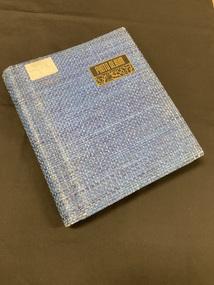
Album - Photograph album, unknown
... Pioneer womens garden...With original photographs of staff and field hospitals from 1915, to more recent references to the 50th and 75th anniversary celebrations. Pioneer womens garden Royal Australian Army Nursing Corps RAANC Anniversaries memorabilia Australian Army nurses War memorials war poems Military Hospitals Australian Imperial Force 2/3 Australian Casual Clearing Station Australian Army Nursing Service- 50th anniversary Australian Army Nursing Service - 75th anniversary 'WWI + WWII' [Handwritten in black ink on a white label attached to the cover] 'Jubilee. 1952-1977' [Handwritten in blue ink at the top of the letter attached to the inside front cover] Blue woven covered photograph album with a black plate attached to the upper right cover that reads photo album in gold lettering. ...A collection of photographs (black + white and coloured) and ephemera celebrating and remembering the Australian Army Nursing Service (AANS) throughout history. With original photographs of staff and field hospitals from 1915, to more recent references to the 50th and 75th anniversary celebrations.Blue woven covered photograph album with a black plate attached to the upper right cover that reads photo album in gold lettering. A white label is attached to the top left corner with WWI and II inscripted on it. The pages are spiral bound adhesive album pages with plastic protective covers on each side. The inside back and front covers have various letters, papers and cards attached. There is a double-sided plastic photograph sleeve containing 6 photos loosely placed inside the back cover.'WWI + WWII' [Handwritten in black ink on a white label attached to the cover] 'Jubilee. 1952-1977' [Handwritten in blue ink at the top of the letter attached to the inside front cover]pioneer womens garden, royal australian army nursing corps, raanc, anniversaries, memorabilia, australian army nurses, war memorials, war poems, military hospitals, australian imperial force, 2/3 australian casual clearing station, australian army nursing service- 50th anniversary, australian army nursing service - 75th anniversary -
 City of Melbourne Libraries
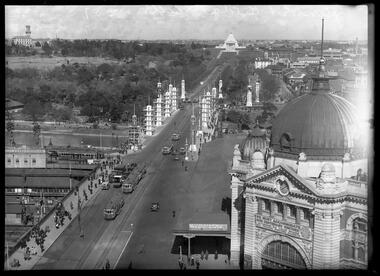
Photograph, Bull, Hugh Jones, 1897-1993, Princes Bridge Centenary pylons under construction
... Spectacular floodlighting of city landmarks, the creation of the Pioneer Women's Memorial Garden, and the MacRobertson Air Race from London, were other notable activities. ...Spectacular floodlighting of city landmarks, the creation of the Pioneer Women's Memorial Garden, and the MacRobertson Air Race from London, were other notable activities. ...Princes Bridge Centenary pylons under construction Possibly taken from Young and Jacksons Hotel (formerly Princes Bridge Hotel) on the corner of Flinders and Swanston streets, Flinders Street Station’s clocks and main entrance dominate, along with its distinctive copper dome and decorative façade. The time on the main clock is 1.40pm, and the sign underneath, reflecting Melbourne’s upcoming Centenary reads, “We must accommodate our Centenary visitors! Citizens! Do your share by taking paying guests.” At left is the original Princes Bridge Station, today the site of Federation Square. The riverside tram terminus advertises a Café/Tobacconist/Refreshment Room selling cigars & cigarettes, fountain drinks & confectionery, and in smaller text: “Leave your boot repairs here”. Nearly everyone is dressed in dark suits, coats and hats. The footpaths are wide and there are no traffic lights. The roadway stretches towards the Shrine of Remembrance, not yet dedicated but very dominant on the skyline. Government House is clearly visible across the wide parkland that would come to be known as Kings Domain and that is an area of deep importance to the people of the Eastern Kulin. Originally, Birrarung was part of a network of swamps and lagoons linked to the course of the river. From 1896, Public Works Department engineer Carlo Catani, oversaw a new channel to straighten the river and the swamps and lagoons were filled with spoil from the channel works. From the same vantage point today, only the top of the tower of Government House would be visible. The photo captures the pylons along Princes Bridge, mid-construction and being installed to mark Melbourne’s Centenary. The pylons were not without controversy. Both The Argus and The Age bemoaned them for being “made almost entirely of imported softwood timber”, denying work to native hardwood timber workers and sawmillers, and leading visitors to think Australia did not have its own exceptional native hardwoods. The pylons were also variously described in their incomplete state, as unimaginative and resembling an oilfield. Published: The Age 5 September 1934 Featured in "Newsworthy: Melbourne in photographs 1933-1936" exhibition at East Melbourne Library, October to December 2023. Exhibition caption by project volunteer, Louise McKenzie Photographer notations on slide: "Pylons + St Kilda Rd C57" Published: Age (Melbourne, Vic. : 1854 - 1954), Wednesday 5 September 1934, page 11 Published title: DECORATIONS -- THEN AND NOW. Published caption: "Although not completed yet, some impression of the effect of the decorations on Princes-bridge may be obtained from the first picture which shows the majestic sweep of St Kilda road with the Shrine of Remembrance and Government House dominating the horizon. The area to the left of St. Kilda-road and in front of Government House is portion of the area which it is proposed to call the King's Domain, which extends to Domain-road and Anderson-street..." Description: East-facing, elevated view of Flinders Street Station and Princes Bridge, featuring partially completed pylons erected for Melbourne's Centenary celebrations. The Shrine of Remembrance and Government House can be seen in the distance. In the foreground are trams, cars and trucks, pedestrians, Batman Avenue tram terminus and refreshment rooms. Signage on Flinders Street Station encourages citizens to accommodate Centenary visitors. The Melbourne Centenary was held 1934-35 in celebration John Batman's proclamation that Melbourne "the place for a village". Centenary events included a visit by Prince Henry, Duke of Gloucester. A Centenary Cake measuring 50 feet in height and ten tons in weight was cut into 250,000 pieces and sold at 1 shilling per piece for charity. Spectacular floodlighting of city landmarks, the creation of the Pioneer Women's Memorial Garden, and the MacRobertson Air Race from London, were other notable activities. Research by project volunteer, Louise McKenzie: The photo in The Age collage of 5 September 1934 has a slightly cropped foreground. The original photo has been taken from an elevated vantage point, most probably the roof of the Nicholas Building on the corner of Flinders and Swanston streets. The right foreground is dominated by the main “clocks” entrance to Flinders Street Station, showing its distinctive copper dome and decorative façade. The time on the main clock is 1.40 pm. The main sign on the front of the Station reads, "We Must Accommodate our Centenary Visitors! Citizens! Do your share by taking paying guests. Write to The Official Centenary Accommodation Bureau, 436 Collins St. City. Tel M 4671”. Another sign at eye level at the main entrance says: “Cheap Trips on Sundays”. The sign on the end of the roof along the eastern side of the station reads, “The Babies Need Your Help! Support Broadmeadows Foundling Hospital Appeal. July and August”. Run by the Sisters of St Joseph of the Sacred Heart, St Joseph’s Foundling Hospital was a purpose built infants’ home for up to 300 babies, plus accommodation for expectant mothers, mainly single women. In the early 1930s, the department (Victorian Children’s Welfare Department) contracted St Joseph’s Foundling Hospital to care for an additional 60 infant state wards, and up to 175 non wards at any given time. In 1931 it also operated a mothercraft training school. The centre foreground shows the commencement of Princes Bridge. Beneath the left side of the bridge was the site of the original Princes Bridge Station, by this time incorporated into Flinders Street Station, and today the area is the site of Federation Square. It was linked to Flinders Street station by the railway tracks that ran underneath the northern approach to the bridge. This photo shows a tram terminus which has a Café/Tobacconist/Refreshment Room, selling cigars & cigarettes, fountain drinks & confectionary, and a sign: Leave your boot repairs here. In the foreground is a wide roadway running south/north, comprising two vehicle lanes each heading north/south, and a central section containing two sets of tram tracks. There are cars, buses and delivery vans on the roadway. The trams visible are Glen Iris (Route No. 6; tram no. 448), Toorak (Route No. 8, tram no. 333), ? (No. 7), ? (No. 1), and ? (No. 2A). The footpaths are extremely wide. There is a square newspaper/magazine stand on the eastern side footpath. And also a “Ferry” sign. There are no traffic lights, but a policeman is visible on the roadway. There are pedestrians – men, women, children, a porter with trolley, women with prams. Clothing comprises dark suits, coats and hats for nearly everyone. There are double headed “Collins Street” lights along the side of the roadway, and along the northern riverbank. The roadway in the foreground is an extension of Swanston Street, which becomes Princes Bridge, then St Kilda Road, stretching towards the Shrine of Remembrance, and diverting past it. The Shrine had not yet been officially dedicated, and looks very white and dominant on the skyline. On the LHS of St Kilda Road, Government House is clearly visible across the wide parkland to be known as Kings Domain. The Kings Domain area is important to the people of the Eastern Kulin nation, and also has historical importance for its association with the early settlement of Melbourne and the foundation of British colonial administration in Victoria. On the southern side of the Yarra River (Birrarung) an historic rowing boathouse is visible, located adjacent to the Alexandra Gardens. Originally Birrarung was part of a network of swamps and lagoons linked to the course of the river. From 1896, under the guidance of engineer Carlo Catani* a new channel to straighten the river was created and the swamps and lagoons were filled with spoil from the channel works. The gardens were then created and completed in time for a Royal visit by the Duke of York in May 1901. The gardens are named after Alexandra of Denmark, the wife of King Edward VII. Both these areas, plus the Royal Botanic Gardens Victoria, Shrine of Remembrance Reserve, Sidney Myer Music Bowl, Government House, and the Queen Victoria Gardens together form the Domain Parklands. The extent of the subsequent plantings is evident today, where from the same vantage point only the top of the tower of Government House would be visible. *Catani was born in Florence in 1852, but after arriving in Melbourne worked as a civil engineer for the Victorian Government. His last major project was the reclamation of the foreshore of St Kilda, envisaged in the style of a European resort, complete with a split level esplanade, bathing pavilions, dance halls, amusements and a French-Italian style of landscape complete with palms. The gardens at the end of Fitzroy Street, St Kilda, now bear his name. The historic boathouse visible across the Yarra is another glimpse into Melbourne’s past. “Boathouse Row” comprises 7 amateur rowing clubs, the first established in 1859 (Melbourne University Boat Club). Other Clubs were Richmond, Melbourne, Banks, Melbourne Grammar School, Yarra Yarra and Mercantile. South of the river and west of the bridge is an area today developed into the Melbourne arts precinct of Hamer Hall and the Arts Centre. But at this time it was the home of Wirths Olympia Circus, which comprised Wirths Pleasure Park (an amusement park), a 5,000 seat auditorium – Hippodrome, a roller skating rink, a glaciarium, a cinema, and the Green Mill Dance Hall. Dog shows were also held at Olympia. The Green Mill Dance Hall closed in 1950, and the remainder of the Wirth buildings on site were destroyed by fire in December 1953. The feature of the photo is the pylons erected along Princes Bridge to mark Melbourne’s Centenary in 1934. The sixteen plastered pylons were designed by Roy Prentice, the second person to qualify as an architect at The University of Melbourne’s Bachelor of Architecture degree, in 1933, aged 27. Simon Reeves in his article marking the 100th birthday of Roy Prentice on 20 June 2006 reports that the State Electricity Commission sponsored this work, and the Argus reported that “… the pylons were “illuminated from within to give the effect of soft radiance”. Australia Home Beautiful 1 Oct 1934 reports in a very detailed and comprehensive article: The 10 taller pylons, including flagpole, were 48 ft, with a base of 8 ft. Timber-framed and faced with fibrous plaster and galvanised sheet iron, each structure was securely bolted to a concrete foundation three feet in depth. Panels of glass let into the shaft of each pylon were indirectly lit by 40, 100 watt lamps, and the upper bank of internal lamps were dyed so as to flood the panels with a deep red light. The decorative painted shields and flagpoles/pennants were illuminated by three 200 watt projectors concealed in the roof of each pylon, and were part of an electric night light decoration scheme involving 28 miles of wire to supply more than 20,000 lights. An article in the Argus on 18 October 1934 provided minute detail of the lighting erected in Melbourne for the Centenary, converting it “… into a coloured fairyland by night.” The estimated cost of 10 pounds per hour the lights were on. The display included 800 standard light poles 30 feet high which were tiered with electric bulbs concealed in inverted cones, 138 specially designed “Venetian poles” draped in flags trophies and streamers. The streets included in the electric night light decoration scheme were Bourke Street from Spring to William, the entire length of Collins Street, Flinders Street from Elizabeth to Spring, Lonsdale Street from Elizabeth to Swanston, Swanston and Elizabeth Streets from Flinders to Lonsdale, and parts of Springs and Spencer Streets. Together with the Princes Bridge pylons, approximately 28 miles of wire was required to supply power to the more than 20,000 lights. And that is just in the city of Melbourne. It was estimated the same amount of lighting was duplicated among other local councils. The pylons were not without controversy. The Argus on 28 August 1934 in an article headed “Imported Timber in Pylons” reported that the Princes Bridge pylons are “made almost entirely of imported softwood timber”, and have therefore denied work to native hardwood timber workers and sawmillers. The same day the Melbourne Age ran a similar story, bemoaning the fact that foreign oregon had been used which may lead tourists to think Australia did not have its own exceptional native hardwoods. A Camberwell City Councillor described the pylons as unimaginative, and the Herald reported that skeletons of pylons for the Centenary decorations in their present form led the area to resemble an oilfield! The Yarra River and Princes Bridge have long been a focal point of Melbourne life. In the early days of European settlement in Melbourne a rope-hauled punt carried people across the Yarra River. A surge in population and increased shipping traffic created a need for a bridge. There was difficulty in agreeing on a suitable site for the bridge (options were crossing at Elizabeth, Swanston, Queen or Market Streets), but the NSW Government favoured Swanston Street and the Melbourne Town Council decided on a temporary bridge across the Yarra spanning from the foot of Swanston Street. This first bridge was a single span timber toll bridge designed by Scottish born bridge designer David Lennox, and completed in 1845. It was 120 feet long, had a roadway of 17 feet wide, and a footpath on one side of 4 feet. It was leased to the Melbourne Bridge Company in the name of Robert A Balbirnie. The tollhouse was on the north side of the river and the toll keeper, Patrick Doherty, was credited with saving nine lives during the four years he was in charge of the toll station. The second bridge was stone (completed 1850), and named Prince’s Bridge after the HRH Prince of Wales, later Edward VII. It was designed with an elliptical single arc and an exceedingly small rise in proportion to the span. However, this design created an obstacle for flood waters, and together with Melbourne’s increasing population it was quickly apparent that a new bridge was required. At its opening on 15 November 1850 coincided with the imminent declaration of Victoria as a separate colony, it provided a moment of great celebration for Melbournians and “The opening ceremony was described as the grandest processional display witnessed in the colony.” (ToMelbourne.com.au) Princes Bridge in its present form, as depicted in this photograph, was designed by Jenkins, D’Ebro and Grainger, and constructed in 1886-88 by David Munro. John Grainger (father of Australian composer Percy Grainger) did the majority of the design work for the bridge. The structure was to have three arches each 96 feet wide measured across the river, and the banks on both sides were raised to allow more space for floodwater to flow. St Kilda Road was originally many feet below the current level. The bridge is of architectural significance for its substantial size, giant half columns, extensive use of wrought and cast iron, decorative elements (cast-iron lamps) and the skilled stonemasonry in the construction of the abutments and piers. Its main design features are similar to those of Blackfriars Bridge in London (1870). The bluestones were quarried from Footscray, the Malmsbury stones were from quarries at Kyneton, and the granite from Harcourt. The cost was met by the State of Victoria, City of Melbourne, and six out of seven of its municipalities, and their coats of arms feature on the bridge. The building of the bridge reflected the boom period of Melbourne, including the Victorian gold rush 1851- late 1860s, and its contractor, David Munro, was also responsible for the construction of Queens Bridge and Sandridge Railway Bridge. The Centenary pylons are no longer in place, but today this intersection still plays a major part in Melbourne’s daily life: people still meet “under the clocks” at Flinders Street station, and the route in and out of the city along St Kilda Road is often a feature of parades such as Moomba, the Grand Final Parade, and of course the Anzac Day Parade which commences at the Princes Bridge intersection and finishes at the Shrine of Remembrance. There are many tram routes, which cross the Bridge, and it directs pedestrians towards the Arts Precinct, the various components of Domain Park, plus the Southbank restaurant and rowing precincts. Even though this is a street scene, it feels very intimate; the viewer is instantly immersed in the activity of a Melbourne afternoon, looking down St Kilda Road from a viewpoint near today’s Federation Square. References: DECORATIONS -- THEN AND NOW. (1934, September 5). The Age (Melbourne, Vic. : 1854 - 1954), p. 11. Retrieved September 21, 2023, from http://nla.gov.au/nla.news-article205880269 'Flinders Street railway station', Wikipedia, https://en.wikipedia.org/wiki/Flinders_Street_railway_station 'St Joseph’s Foundling Hospital (1901-75)', Finding Records, Department of Health and Human Services, State of Victoria, https://www.findingrecords.dhhs.vic.gov.au/collectionresultspage/St-JosephsFoundling-Hospital-Babies-Home#departmental-administration 'Alexandra Gardens', City of Melbourne, https://www.melbourne.vic.gov.au/community/parks-open-spaces/major-parks-gardens/Pages/alexandra-gardens.aspx 'Wirths Circus', Wikipedia, https://en.wikipedia.org/wiki/Wirth's_Circus 'Roy Prentice: Centenary Architect', Built Heritage Pty Ltd, Simon Reeves, https://www.builtheritage.com.au/downloads/prentice.pdf 'Princes Bridge', Heritage Council Victoria, https://vhd.heritagecouncil.vic.gov.au/places/817 PORT PHILLIP. (1846, April 1). The Sydney Morning Herald (NSW : 1842 - 1954), p. 3. Retrieved September 21, 2023, from http://nla.gov.au/nla.news-article12886251 'Edward VII', Wikipedia, https://en.wikipedia.org/wiki/Edward_VII 'Princes Bridge', ToMelbourne.com, https://tomelbourne.com.au/princes-bridge/ 'Princes Bridge', eMelbourne, https://www.emelbourne.net.au/biogs/EM01189b.htm 'Princes Bridge', Australia for everyone, http://australiaforeveryone.com.au/files/melbourne/princes-bridge.html 'Victorian gold rush', Wikipedia, https://en.wikipedia.org/wiki/Victorian_gold_rush IMPORTED TIMBER IN PYLONS (1934, August 28). The Argus (Melbourne, Vic. : 1848 - 1957), p. 9. Retrieved September 21, 2023, from http://nla.gov.au/nla.news-article10952507 Princes-Bridge Pylons. (1934, August 28). The Age (Melbourne, Vic. : 1854 - 1954), p. 7. Retrieved September 21, 2023, from http://nla.gov.au/nla.news-article205532235 Pylons Appear Near Princes Bridge (1934, August 18). The Herald (Melbourne, Vic. : 1861 - 1954), p. 1. Retrieved September 21, 2023, from http://nla.gov.au/nla.news-article243104375 PRINCES-BRIDGE PYLONS. (1934, September 20). The Age (Melbourne, Vic. : 1854 - 1954), p. 10. Retrieved September 21, 2023, from http://nla.gov.au/nla.news-article205873535 28 Miles of Wire (1934, October 18). The Argus (Melbourne, Vic. : 1848 - 1957), p. 1 (The Junior Argus). Retrieved September 21, 2023, from http://nla.gov.au/nla.news-article10977836 'Historical references for Boathouse Row, Melbourne', http://boathouserowmelbourne.com.au/history/ 'ITALIAN DELEGATION TO HONOUR CARLO CATANI, DESIGNER OF THE ST KILDA FORESHORE, St Kilda Historical Society, 2001, https://web.archive.org/web/20070928061938/http://www.skhs.org.au/~SKHSarticles/articles/Carlo_Catani.html# HISTORY IN LIGHTS (1934, July 12). The Herald (Melbourne, Vic. : 1861 - 1954), p. 16. Retrieved September 21, 2023, from http://nla.gov.au/nla.news-article243172436 'Dressing Melbourne for the Duke', The Australian home beautiful: a journal for the home builder. Vol 12 No. 10 (1 October 1934), page 21, 58. Retrieved September 14, 2023, from http://nla.gov.au/nla.obj-2950922209Photographer notations on slide: "Pylons + St Kilda Rd C57".centenaries, bridges, lighting, flinders street railway station -
 City of Moorabbin Historical Society (Operating the Box Cottage Museum)
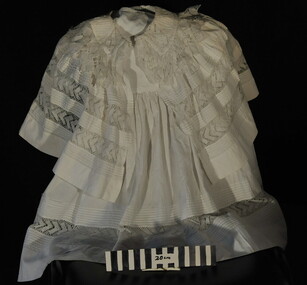
Clothing - Clothing, baby outfit c 1900, c1900
... The Blackburn family were early settlers in Moorabbin Shire This baby's crocheted cape and dress aesethetically significant as an example of the skill of the women of the families who were pioneer settlers and market gardeners in Moorabbin Shire who made their own clothing for their families. ...This baby's crocheted outfit is an example of the clothing made for their children by the families who had settled in the Moorabbin Shire c1900. The Blackburn family were early settlers in Moorabbin ShireThis baby's crocheted cape and dress aesethetically significant as an example of the skill of the women of the families who were pioneer settlers and market gardeners in Moorabbin Shire who made their own clothing for their families. It was made by a member of the early settler Blackburn family and passed down through the generations. This is a white cotton baby's two piece, cape and dress outfit, with extensive hand-crotchet lace trim.clothing, moorabbin, crochet, bentleigh, pioneer settlers, baby outfit -
 City of Moorabbin Historical Society (Operating the Box Cottage Museum)
Clothing - Clothing, girl's dress, c1900
... This girl's white cotton dress is typical of the craftsmanship of the home dressmakers among the pioneer settlers and market gardeners of the Moorabbin Shirec 1900 The pioneer settlers and market gardeners of Moorabbin Shire had to be self reliant and the women made most of the clothing for their families. clothing brighton moorabbin pioneers dendy henry market gardeners dressmakers c1900 girl's dress is made of cotton and is all hand-worked, with cutwork Clothing Clothing, girl's dress home dressmaker ...This girl's white cotton dress is typical of the craftsmanship of the home dressmakers among the pioneer settlers and market gardeners of the Moorabbin Shirec 1900The pioneer settlers and market gardeners of Moorabbin Shire had to be self reliant and the women made most of the clothing for their families.c1900 girl's dress is made of cotton and is all hand-worked, with cutworkclothing, brighton, moorabbin, pioneers, dendy henry, market gardeners, dressmakers -
 City of Moorabbin Historical Society (Operating the Box Cottage Museum)
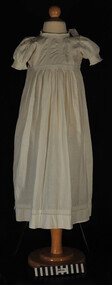
Clothing - Clothing, baby's long dress pin-tucked, c1900
... This long, white cotton pin-tucked baby's dress is an example of the clothing the women of pioneer settlers and market gardeners in Moorabbin Shire made for their families...This long, white cotton pin-tucked baby's dress is an example of the clothing the women of pioneer settlers and market gardeners in Moorabbin Shire made for their families After the 1841 Dendy Special Survey of Brighton, Victoria, allotments of land were rented or sold to pioneer settlers. ...This long, white cotton pin-tucked baby's dress is an example of the clothing the women of pioneer settlers and market gardeners in Moorabbin Shire made for their familiesAfter the 1841 Dendy Special Survey of Brighton, Victoria, allotments of land were rented or sold to pioneer settlers. These settlers had to be self reliant and the women made most of the clothing for their families. This garment is one of the examples of the skills and craftsmanship of these women.A white, cotton, pin-tucked, long Baby's dress c 1900clothing, brighton, moorabbin, dressmaking, dendy henry, market gardeners, pioneer settlers, craft working -
 City of Moorabbin Historical Society (Operating the Box Cottage Museum)
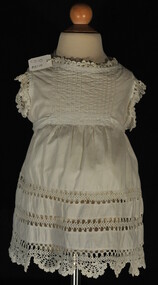
Clothing - Clothing, pinafore crochet work, c1900
... This white, cotton, baby's pinafore with hand crochet work is and example of the dressmaking skills of the women of the families of the pioneer settlers and market gardeners of the Moorabbin Shire....This white, cotton, baby's pinafore with hand crochet work is and example of the dressmaking skills of the women of the families of the pioneer settlers and market gardeners of the Moorabbin Shire. ...This white, cotton, baby's pinafore with hand crochet work is and example of the dressmaking skills of the women of the families of the pioneer settlers and market gardeners of the Moorabbin Shire.The pioneer settlers and market gardeners of Moorabbin Shire had to be self reliant and made their own clothing and utensils. This is one of many items that exhibit the skill and craftsmanship of the women in these families.A white cotton infant's pinafore, with hand crochet work around armholes, and lower edge of garment. Feather stitch embroidery, and pin-tucking on bodice. Waist ties.clothing, crochet work, moorabbin, bentleigh, early settlers, pioneers, market gardeners, dendy special survey, brighton pioneers -
 City of Moorabbin Historical Society (Operating the Box Cottage Museum)
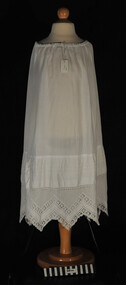
Clothing - Clothing, lady's half petticoat, c1900
... This white, cotton half petticoat with hand crochet work on the hem is an example of the dressmaking skills of the women of the families of the pioneer settlers and market gardeners in the Moorabbin Shire...This white, cotton half petticoat with hand crochet work on the hem is an example of the dressmaking skills of the women of the families of the pioneer settlers and market gardeners in the Moorabbin Shire The pioneer settlers and market gardeners of Moorabbin Shire had to be self reliant and made their own clothing and utensils. ...This white, cotton half petticoat with hand crochet work on the hem is an example of the dressmaking skills of the women of the families of the pioneer settlers and market gardeners in the Moorabbin ShireThe pioneer settlers and market gardeners of Moorabbin Shire had to be self reliant and made their own clothing and utensils. This petticoat is one of many items that exhibit the skill and craftsmanship of the women in these familiesA lady's white cotton half petticoat, with deep hand- crochet border at the hem. brighton, moorabbin, pioneers, dress, bentleigh, early settlers, garments -
 City of Moorabbin Historical Society (Operating the Box Cottage Museum)
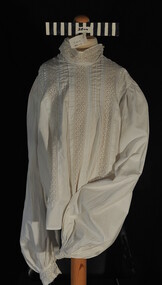
Clothing - Clothing, lady's blouse, c1900
... The pioneer settlers and market gardeners of Moorabbin Shire had to be self reliant and made their own clothing and utensils. This is one of many items that exhibit the skill and craftsmanship of the women in these families. ...The pioneer settlers and market gardeners of Moorabbin Shire had to be self reliant and made their own clothing and utensils. This is one of many items that exhibit the skill and craftsmanship of the women in these families. ...The pioneer settlers and market gardeners of Moorabbin Shire had to be self reliant and made their own clothing and utensils. This is one of many items that exhibit the skill and craftsmanship of the women in these families. This white, cotton Lady's blouse with pin-tucked front and back is and example of the dressmaking skills of the women of the families of the pioneer settlers and market gardeners in the Moorabbin Shire. Ladies long-sleeved white cotton blouse with high collar. Pin-tucking to front and back, guipure lace inserts on front of bodice. Significant tear at lower edge of the garment.clothing, brighton, moorabbin, pioneers, dendy henry, market gardeners, home dressmaker, craft work -
 City of Moorabbin Historical Society (Operating the Box Cottage Museum)
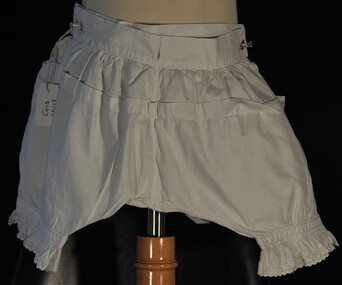
Clothing - Clothing, boy's first underpants, 1907
... The Maggs family were early settlers in the Moorabbin Shire The pioneer settlers and market gardeners of Moorabbin Shire had to be self reliant and made their own clothing and utensils. This is one of many items that exhibit the skill and craftsmanship of the women in these families. clothing brighton moorabbin pioneers dendy henry dressmakers market gardners early settlers maggs geoff White, cotton underwear for a 2 year old boy. ...These white cotton underpants were made for Mr Geoff Maggs by his mother in 1907 as his first underwear at age 2 years old. The Maggs family were early settlers in the Moorabbin ShireThe pioneer settlers and market gardeners of Moorabbin Shire had to be self reliant and made their own clothing and utensils. This is one of many items that exhibit the skill and craftsmanship of the women in these families. White, cotton underwear for a 2 year old boy. Made at home on a sewing machine with hand feather stitching and factory-made guipure lace on leg-bands. Buttons at waist, and a tuck pleat to let down as child grows.clothing, brighton, moorabbin, pioneers, dendy henry, dressmakers, market gardners, early settlers, maggs geoff -
 City of Moorabbin Historical Society (Operating the Box Cottage Museum)
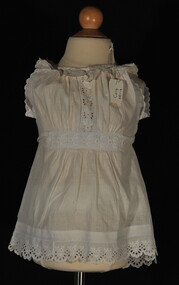
Clothing - Clothing, girl's pinafore, c1900
... pioneer settlers and market gardeners of the Moorabbin Shire 1900. The pioneer settlers and market gardeners of Moorabbin Shire had to be self reliant and made their own clothing and utensils. This is one of many items that exhibit the skill and craftsmanship of the women ...This white fine lawn girls pinafore is an example of the dressmaking skills of the wives of the pioneer settlers and market gardeners of the Moorabbin Shire 1900. The pioneer settlers and market gardeners of Moorabbin Shire had to be self reliant and made their own clothing and utensils. This is one of many items that exhibit the skill and craftsmanship of the women in these families.A white, fine lawn girl's sleeveless pinafore. Guipure lace frill around armholes, neck and hem. Guipure lace insert to bodice and feather-stitch embroidery to skirt. Waist ties.moorabbin, brighton, pioneers, early settlers, market gardeners, home, dressmaker, garments, craftwork -
 City of Moorabbin Historical Society (Operating the Box Cottage Museum)
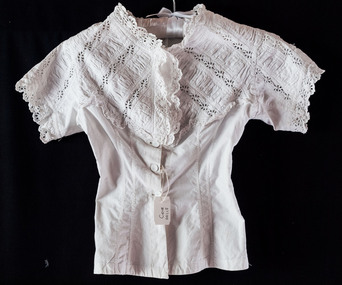
Clothing - Clothing, blouse short sleeve, c1900
... This white, cotton, short-sleeved blouse with eyelet work for a young woman is an example of the dressmaking skills of the women pioneer settlers and market gardeners of the Moorabbin Shire c 1900....This white, cotton, short-sleeved blouse with eyelet work for a young woman is an example of the dressmaking skills of the women pioneer settlers and market gardeners of the Moorabbin Shire c 1900. ...This white, cotton, short-sleeved blouse with eyelet work for a young woman is an example of the dressmaking skills of the women pioneer settlers and market gardeners of the Moorabbin Shire c 1900.The pioneer settlers and market gardeners of Moorabbin Shire had to be self reliant and made their own clothing and utensils. This is one of many items that exhibit the skill and craftsmanship of the women in these families. A white, cotton, short-sleeved blouse, with eyelet work for a young woman .brighton, moorabbin, pioneers, dendy henry, market gardeners, dressmakers, craft work, maggs geoff -
 City of Moorabbin Historical Society (Operating the Box Cottage Museum)
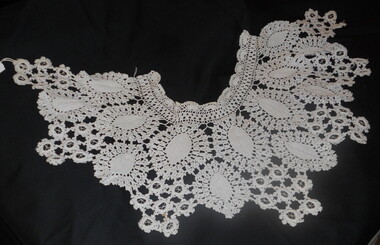
Clothing - Clothing, lace collar, c1880
... This heavy, detachable lace collar is an example of the dressmaking and needle work skills of the women of the families of the pioneer settlers and market gardeners of the Moorabbin Shire c 1880 ...pioneers who established market gardens, dairy farms, fruit gardens and vineyards. The pioneer settlers and market gardeners of Moorabbin Shire had to be self reliant and made their own clothing and utensils. This is one of many items that exhibit the skill and craftsmanship of the women ...This heavy, detachable lace collar is an example of the dressmaking and needle work skills of the women of the families of the pioneer settlers and market gardeners of the Moorabbin Shire c 1880 The Maggs family settled in the Brighton district in the late 1800,s. After the Dendy's Special Survey of the Brighton area in 1841 land allotments were rented or sold to pioneers who established market gardens, dairy farms, fruit gardens and vineyards. The pioneer settlers and market gardeners of Moorabbin Shire had to be self reliant and made their own clothing and utensils. This is one of many items that exhibit the skill and craftsmanship of the women in these familiesThis heavy, lace collar is detachable and consists of hand crochet work.clothing, crochetwork, pioneers, early settlers, dendy henry, maggs geoff, brighton, bentleigh, moorabbin, market gardeners, craft working, dressmakers -
 City of Moorabbin Historical Society (Operating the Box Cottage Museum)
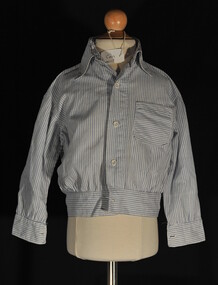
Clothing - Clothing, boys blouse, c1908
... This cotton, boy's blouse is an example of the dressmaking skills of the women of the families of the pioneer settlers and market gardeners of the Moorabbin Shire c1900...This cotton, boy's blouse is an example of the dressmaking skills of the women of the families of the pioneer settlers and market gardeners of the Moorabbin Shire c1900 The Maggs family were early settlers in Moorabbin Shire. ...This cotton, boy's blouse is an example of the dressmaking skills of the women of the families of the pioneer settlers and market gardeners of the Moorabbin Shire c1900The Maggs family were early settlers in Moorabbin Shire. The pioneer settlers and market gardeners of Moorabbin Shire had to be self reliant and made their own clothing and utensils. This is one of many items that exhibit the skill and craftsmanship of the women in these familiesThis is a 2 year old boy's long-sleeved blouse. White cotton with blue pinstripes. Breast pockets and banded waist. C 1910. Some fraying to collar and cuffs. Small tear to body.clothing, brighton, moorabbin, pioneers, bentleigh, dendy henry, market gardeners, dressmakers, early settlers, maggs geoff, garments, craftwork -
 City of Moorabbin Historical Society (Operating the Box Cottage Museum)
Clothing, baby's nightgown, c1900
... This cotton, baby's first nightgown with hand embroidery is an example of the dressmaking skills of the women of the families of the pioneer settlers and market gardeners of the Moorabbin Shire. ...This cotton, baby's first nightgown with hand embroidery is an example of the dressmaking skills of the women of the families of the pioneer settlers and market gardeners of the Moorabbin Shire. ...This cotton, baby's first nightgown with hand embroidery is an example of the dressmaking skills of the women of the families of the pioneer settlers and market gardeners of the Moorabbin Shire. The Maggs family were early settlers in the Moorabbin Shire. The pioneer settlers and market gardeners of Moorabbin Shire had to be self reliant and made their own clothing and utensils. This is one of many items that exhibit the skill and craftsmanship of the women in these families.A white, cotton, baby's first nightgown with hand embroidery.clothing, brighton, moorabbin, pioneers, dendy henry, market gardeners, dressmakers, craft work, maggs geoff -
 City of Moorabbin Historical Society (Operating the Box Cottage Museum)
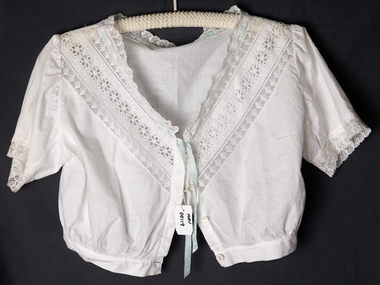
Clothing - Clothing, girl's blouse, c1910
... This white, girl's blouse with ribbon inserts is an example of the dressmaking skills of the women of the families of the pioneer settlers and market gardeners of the Moorabbin Shire....This white, girl's blouse with ribbon inserts is an example of the dressmaking skills of the women of the families of the pioneer settlers and market gardeners of the Moorabbin Shire. ...This white, girl's blouse with ribbon inserts is an example of the dressmaking skills of the women of the families of the pioneer settlers and market gardeners of the Moorabbin Shire.The Maggs family were early settlers in Moorabbin Shire. The pioneer settlers and market gardeners of Moorabbin Shire had to be self reliant and made their own clothing and utensils. This is one of many items that exhibit the skill and craftsmanship of the women in these families. A white cotton , girl's blouse , decorative with ribbon insert.clothing, brighton, moorabbin, dendy henry, market gardeners, dressmakers, craft work, maggs geoff -
 City of Moorabbin Historical Society (Operating the Box Cottage Museum)
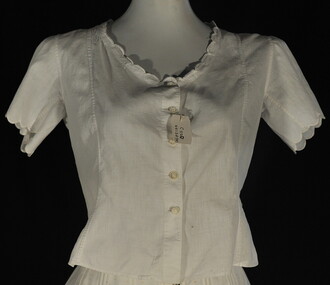
Clothing - Clothing, lady's slip bodice, c1900
... This white cotton lady's slip bodice is an example of the dressmaking skills of the women of the families of the pioneer settlers and market gardeners of the Moorabbin Shire...This white cotton lady's slip bodice is an example of the dressmaking skills of the women of the families of the pioneer settlers and market gardeners of the Moorabbin Shire The Blackburn family were early settlers in Moorabbin Shire. ...This white cotton lady's slip bodice is an example of the dressmaking skills of the women of the families of the pioneer settlers and market gardeners of the Moorabbin ShireThe Blackburn family were early settlers in Moorabbin Shire. The pioneer settlers and market gardeners of Moorabbin Shire had to be self reliant and made their own clothing and utensils. This is one of many items that exhibit the skill and craftsmanship of the women in these families. Fitted, fine white cotton lady's short sleeved slip bodice. Five front buttons. Hand embroidered satin stitch scallops on both sleeves and at neckline.brighton, moorabbin, pioneers, dressmaking, dendy henry, market gardeners, craft work, blackburn nance -
 City of Moorabbin Historical Society (Operating the Box Cottage Museum)
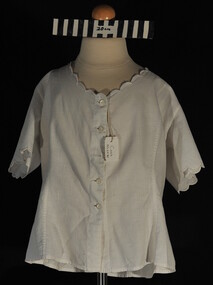
Clothing - Clothing, lady's slip bodice, c1900
... This white cotton lady's slip bodice is an example of the dressmaking skills of the women of the families of the pioneer settlers and market gardeners of the Moorabbin Shire. ...This white cotton lady's slip bodice is an example of the dressmaking skills of the women of the families of the pioneer settlers and market gardeners of the Moorabbin Shire. ...This white cotton lady's slip bodice is an example of the dressmaking skills of the women of the families of the pioneer settlers and market gardeners of the Moorabbin Shire. The Blackburn family were early settlers in Moorabbin Shire. The pioneer settlers and market gardeners of Moorabbin Shire had to be self reliant and made their own clothing and utensils. This is one of many items that exhibit the skill and craftsmanship of the women in these families. Undergarment. Front opening soft, white cotton lady's slip bodice with short sleeves. Hand embroidered satin stitch scallops to both the sleeves and neckline. Five button opening - one button is missing. clothing, brighton, moorabbin, pioneers, dendy henry, dressmakers, market gardners, craft work, early settlers, blackburn nance -
 City of Moorabbin Historical Society (Operating the Box Cottage Museum)
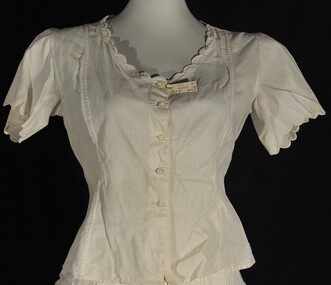
Clothing - Clothing, lady's slip bodice, c1900
... This white cotton lady's slip bodice is an example of the dressmaking skills of the women of the families of the pioneer settlers and market gardeners of the Moorabbin Shire. ...This white cotton lady's slip bodice is an example of the dressmaking skills of the women of the families of the pioneer settlers and market gardeners of the Moorabbin Shire. ...This white cotton lady's slip bodice is an example of the dressmaking skills of the women of the families of the pioneer settlers and market gardeners of the Moorabbin Shire. The Blackburn family were early settlers in Moorabbin Shire. The pioneer settlers and market gardeners of Moorabbin Shire had to be self reliant and made their own clothing and utensils. This is one of many items that exhibit the skill and craftsmanship of the women in these families. Fine white cotton lady's slip bodice. Front opening with five buttons. Hand embroidered satin stitch scalloped edges to both the sleeves and neckline. Good condition.clothing, brighton, moorabbin, pioneers, dendy henry, market gardeners, dressmakers, craft work, blackburn nance -
City of Moorabbin Historical Society (Operating the Box Cottage Museum)
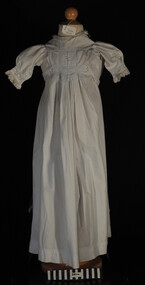
Clothing - Clothing, baby's dress box-pleated, c1900
... This white, fine lawn cotton baby's box pleated dress with collar and matching bib is an example of the dressmaking skills of the women of the families of the pioneer settlers and market gardeners of the Moorabbin Shire....This white, fine lawn cotton baby's box pleated dress with collar and matching bib is an example of the dressmaking skills of the women of the families of the pioneer settlers and market gardeners of the Moorabbin Shire. ...This white, fine lawn cotton baby's box pleated dress with collar and matching bib is an example of the dressmaking skills of the women of the families of the pioneer settlers and market gardeners of the Moorabbin Shire.The Blackburn family were early settlers in Moorabbin Shire. The pioneer settlers and market gardeners of Moorabbin Shire had to be self reliant and made their own clothing and utensils. This is one of many items that exhibit the skill and craftsmanship of the women in these families. A white, fine lawn cotton, box -pleated baby's dress with collar and matching bibclothing, brighton, moorabbin, pioneers, dressmaking, dendy henry, market gardeners, craft work, blackburn nance -
 City of Moorabbin Historical Society (Operating the Box Cottage Museum)
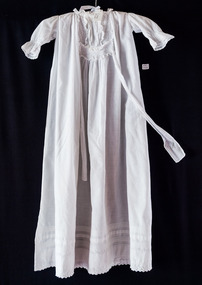
Clothing - Clothing, baby's calico nightgown, c1900
... This long calico baby's nightdress is an example of the dressmaking skills of the women of the families of the pioneer settlers and market gardeners of the Moorabbin Shire....This long calico baby's nightdress is an example of the dressmaking skills of the women of the families of the pioneer settlers and market gardeners of the Moorabbin Shire. ...This long calico baby's nightdress is an example of the dressmaking skills of the women of the families of the pioneer settlers and market gardeners of the Moorabbin Shire.The pioneer settlers and market gardeners of Moorabbin Shire had to be self reliant and made their own clothing and utensils. This is one of many items that exhibit the skill and craftsmanship of the women in these families.A short-sleeved, long calico baby's nightgown. There is extensive hand-embroidery and pin-tucks on the bodice. Waist ties embroidered at the front. Crochet edges to neck and sleeves. The garment opens at the back.clothing, brighton, moorabbin, pioneers, dendy henry, market gardeners, dressmakers, craft work -
 City of Moorabbin Historical Society (Operating the Box Cottage Museum)
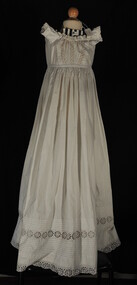
Clothing - Clothing, baby's pintucked christening dress, c1900
... This long, white fine lawn cotton pin-tucked baby's christening dress is an example of the dressmaking skills of the women of the families of the pioneer settlers and market gardeners of the Moorabbin Shire. ...This long, white fine lawn cotton pin-tucked baby's christening dress is an example of the dressmaking skills of the women of the families of the pioneer settlers and market gardeners of the Moorabbin Shire. ...This long, white fine lawn cotton pin-tucked baby's christening dress is an example of the dressmaking skills of the women of the families of the pioneer settlers and market gardeners of the Moorabbin Shire. The pioneer settlers and market gardeners of Moorabbin Shire had to be self reliant and made their own clothing and utensils. This is one of many items that exhibit the skill and craftsmanship of the women in these families.A white, fine lawn cotton, pin-tucked, baby's long christening dressclothing, brighton, moorabbin, pioneers, dressmaking, dendy henry, market gardeners, craft work -
 City of Moorabbin Historical Society (Operating the Box Cottage Museum)
Clothing - Clothing, christening gown, c1900
... This cotton baby's nightgown is an example of the dressmaking skills of the women of the families of the pioneer settlers and market gardeners of the Moorabbin Shire....This cotton baby's nightgown is an example of the dressmaking skills of the women of the families of the pioneer settlers and market gardeners of the Moorabbin Shire. ...This cotton baby's nightgown is an example of the dressmaking skills of the women of the families of the pioneer settlers and market gardeners of the Moorabbin Shire.The Maggs family were early settlers in the Moorabbin Shire. The pioneer settlers and market gardeners of Moorabbin Shire had to be self reliant and made their own clothing and utensils. This is one of many items that exhibit the skill and craftsmanship of the women in these families. A long white cotton infant's Christening or 'walking-out' dress. The neckline and short sleeves have broderie anglais trim. Bodice has extensive cut-work and hand embroidered feather-stitching. There is further hand-embroidered feather-stitching around the waist band. The skirt of the garment has pin-tucking and lower borders of further cut-work The garment is in good condition.clothing, brighton, moorabbin, pioneers, dendy henry, market gardeners, baptism, dressmakers, craft work, maggs nance -
 City of Moorabbin Historical Society (Operating the Box Cottage Museum)
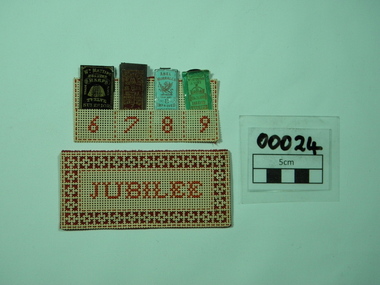
Functional object - Sewing Equipment, needles
... The pioneer settlers and market gardeners of Moorabbin Shire had to be self reliant and made their own clothing and utensils. This is one of many items used to exhibit the skill and craftsmanship of the women in these families. 1887 queen victorias golden jubilee victorian punched card work hand embroidery different packets different gauge sharp needles wm shrimpton and sons william mattins abel morrals copestakes cross stitch In red cot tonCross stitch on one side of the card needle case the word "NEEDLES" is embroidered, and on the other side the word "JUBILEE". ...In the 1820s perforated cardboard first became available. Then, with the invention of the printing press, designs such as sentimental or religious mottos were pre-printed on the card and a Victorian craze began as it provided a simpler and cheaper method of embroidering for the masses compared to the previously far more expensive linen embroidery. Over the following decades embroidering of punched-card grew enormously in popularity and a variety of articles from Christmas decorations to birthday cards, and in this case a Neele case to celebrate Queen Victoria's golden Jubilee in 1887. The pioneer settlers and market gardeners of Moorabbin Shire had to be self reliant and made their own clothing and utensils. This is one of many items used to exhibit the skill and craftsmanship of the women in these families. Small cream coloured Punched-Cardboard needle case,with red satin lining and red cross-stitch decoration. The case contains four paper packets each containing sewing needles of a different gauge. Each packet of needles is 3 1/2 cms long and 1 cm wide. The size of the needles In red cot tonCross stitch on one side of the card needle case the word "NEEDLES" is embroidered, and on the other side the word "JUBILEE". Inside the needle case is four packets of different sized needles, by Wm Mattins1887, queen victorias golden jubilee, victorian punched card work, hand embroidery, different packets, different gauge sharp needles, wm shrimpton and sons, william mattins, abel morrals, copestakes, cross stitch -
 City of Moorabbin Historical Society (Operating the Box Cottage Museum)
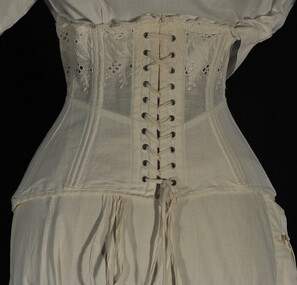
Clothing - Clothing, lady's waist-cinch with suspenders, c1900
... This calico, waist-cich with suspenders is an example of the dressmaking skills of the women of the families of the pioneer settlers and market gardeners of the Moorabbin Shire c 1900...This calico, waist-cich with suspenders is an example of the dressmaking skills of the women of the families of the pioneer settlers and market gardeners of the Moorabbin Shire c 1900 The Maggs family were early settlers in Moorabbin Shire. ...This calico, waist-cich with suspenders is an example of the dressmaking skills of the women of the families of the pioneer settlers and market gardeners of the Moorabbin Shire c 1900The Maggs family were early settlers in Moorabbin Shire. The pioneer settlers and market gardeners of Moorabbin Shire had to be self reliant and made their own clothing and utensils. This is one of many items that exhibit the skill and craftsmanship of the women in these families. This is a lady's calico, waist - cinch with broderie anglais decoration at the top. It has enclosed "stays" in four places to shape and minimise the wearer's waist. There are laces to allow the garment to be pulled to maximum tightness at the back, and a front opening of strong metal hooks and eyes. There are two suspenders hanging at the front of the cinch with metal fastenings to attach to, and hold up, the wearer's stockings. clothing, brighton, moorabbin, pioneers, dressmaking, dendy henry, market gardeners, maggs geoff, craftwork, maggs nancy, flagg sarah, early settlers -
City of Moorabbin Historical Society (Operating the Box Cottage Museum)
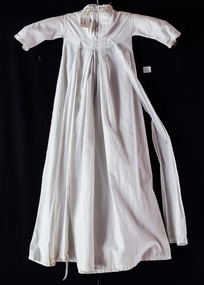
Clothing - Clothing, lady's nightgown, c1900
... women of the families of the pioneer settlers in Moorabbin Shire c1900 The Blackburn family were early settlers in Moorabbin Shire. The pioneer families had to be self reliant and made their own clothing and utensils. This is one of the many items that exhibit the skill and craftsmanship of the women in these families. clothing brighton moorabbin pioneers dressmaking dendy henry market gardeners early settlers blackburn nance craftwork A white cotton lady's nightgown with embroidery and feather stitch Clothing Clothing, lady's nightgown Blackburn family ...This white, cotton, lady's nightgown with embroidery and feather stitch is a fine example of the dressmaking skills of the women of the families of the pioneer settlers in Moorabbin Shire c1900The Blackburn family were early settlers in Moorabbin Shire. The pioneer families had to be self reliant and made their own clothing and utensils. This is one of the many items that exhibit the skill and craftsmanship of the women in these families.A white cotton lady's nightgown with embroidery and feather stitchclothing, brighton, moorabbin, pioneers, dressmaking, dendy henry, market gardeners, early settlers, blackburn nance, craftwork -
 City of Moorabbin Historical Society (Operating the Box Cottage Museum)
Clothing - Clothing, baby's nightdress, c1900
... This long, hand-sewn, cotton, baby's nightdress is an example of the dressmaking skills of the women of the families of the pioneer settlers and market gardeners of the Moorabbin Shire c1900...This long, hand-sewn, cotton, baby's nightdress is an example of the dressmaking skills of the women of the families of the pioneer settlers and market gardeners of the Moorabbin Shire c1900 The Risstrom family were early settlers . ...This long, hand-sewn, cotton, baby's nightdress is an example of the dressmaking skills of the women of the families of the pioneer settlers and market gardeners of the Moorabbin Shire c1900The Risstrom family were early settlers . The pioneer settlers and market gardeners of Moorabbin Shire had to be self reliant and made their own clothing and utensils. This is one of many items that exhibit the skill and craftsmanship of the women in these familiesA long, hand-sewn, baby's cotton nightdress with hand-crochet on neck and hem and a draw-string ribbon around neck.clothing, brighton, moorabbin, pioneers, dressmaking, dendy henry, market gardeners, early settlers -
City of Moorabbin Historical Society (Operating the Box Cottage Museum)
Clothing - Clothing, baby's dress, c1900
... This infant's, heavily hand-embroidered dress is an example of the dressmaking skills of the women of the families of the pioneer settlers and market gardeners of the Moorabbin Shire c1900...This infant's, heavily hand-embroidered dress is an example of the dressmaking skills of the women of the families of the pioneer settlers and market gardeners of the Moorabbin Shire c1900 The pioneer settlers and market gardeners of Moorabbin Shire had to be self reliant and made their own clothing and utensils. ...This infant's, heavily hand-embroidered dress is an example of the dressmaking skills of the women of the families of the pioneer settlers and market gardeners of the Moorabbin Shire c1900The pioneer settlers and market gardeners of Moorabbin Shire had to be self reliant and made their own clothing and utensils. This is one of many items that exhibit the skill and craftsmanship of the women in these families An infant's, white, cotton dress with heavily machine-embroidered bodice and hand-embroidered around neck and sleevesclothing, brighton, moorabbin, pioneers, dressmaking, dendy henry, market gardeners, early settlers, craftwork -
 City of Moorabbin Historical Society (Operating the Box Cottage Museum)
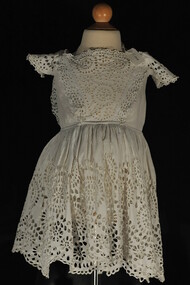
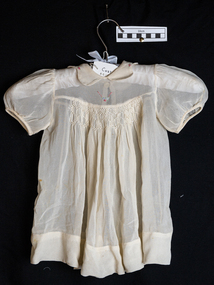
Clothing - Clothing, girl's dress, c1900
... This cream, creme-de-chine, toddlers dress with hand-smocking is an example of the dressmaking skills of the women of the families of the pioneer settlers and market gardeners of the Moorabbin Shire c1900...This cream, creme-de-chine, toddlers dress with hand-smocking is an example of the dressmaking skills of the women of the families of the pioneer settlers and market gardeners of the Moorabbin Shire c1900 The pioneer settlers and market gardeners of Moorabbin Shire had to be self reliant and made their own clothing and utensils. ...This cream, creme-de-chine, toddlers dress with hand-smocking is an example of the dressmaking skills of the women of the families of the pioneer settlers and market gardeners of the Moorabbin Shire c1900The pioneer settlers and market gardeners of Moorabbin Shire had to be self reliant and made their own clothing and utensils. This is one of many items that exhibit the skill and craftsmanship of the women in these families A cream, crepe-de-chine, toddler's dress with hand-smocking.clothing, brighton, moorabbin, pioneers, dressmaking, dendy henry, market gardeners, early settlers, craftwork -
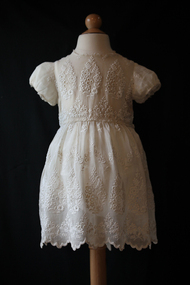 City of Moorabbin Historical Society (Operating the Box Cottage Museum)
Clothing - Clothing, girl's dress, c1900
... This cream, voile, heavily embroidered, small girl's dress is an example of the dressmaking and craftwork skills of the women of the families of the pioneer settlers and market gardeners of the Moorabbin Shire c1900...This cream, voile, heavily embroidered, small girl's dress is an example of the dressmaking and craftwork skills of the women of the families of the pioneer settlers and market gardeners of the Moorabbin Shire c1900 The pioneer settlers and market gardeners of Moorabbin Shire had to be self reliant and made their own clothing and utensils. ...This cream, voile, heavily embroidered, small girl's dress is an example of the dressmaking and craftwork skills of the women of the families of the pioneer settlers and market gardeners of the Moorabbin Shire c1900The pioneer settlers and market gardeners of Moorabbin Shire had to be self reliant and made their own clothing and utensils. This is one of many items that exhibit the skill and craftsmanship of the women in these families A small girl's, cream voile, heavily embroidered dressclothing, brighton, moorabbin, pioneers, dressmaking, dendy henry, early settlers, craftwork, market gardenners -
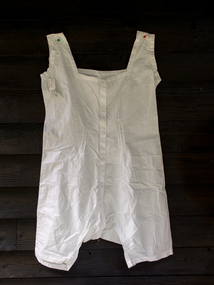 City of Moorabbin Historical Society (Operating the Box Cottage Museum)
Clothing - Clothing, lady's underwear, c1900
... This lady's white calico combination underwear is and example of the dressmaking skills of the women of the pioneer settler families in Moorabbin Shire c1900 The Blackburn family were early settlers in Moorabbin Shire. Early settlers and market gardeners ...This lady's white calico combination underwear is and example of the dressmaking skills of the women of the pioneer settler families in Moorabbin Shire c1900The Blackburn family were early settlers in Moorabbin Shire. Early settlers and market gardeners established their families in Moorabbin Shire and this item shows the skill and craftsmanship of the women of these families Lady's, white, calico, combination underwear c1900clothing, brighton, moorabbin, pioneers, bentleigh, dressmaking, market gardeners, early settlers, blackburn nance, craftwork
