
Showing 49 items matching "place names and meanings."
-
 Victorian Aboriginal Corporation for Languages
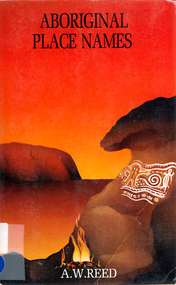
Book, Aboriginal place names and their meanings, 1994
... Aboriginal place names and their meanings...Lists place names and gives simple meanings. Designates which State the word comes from....place names word lists linguistics word lists Lists place names and gives simple meanings. ...Lists place names and gives simple meanings. Designates which State the word comes from.word listsplace names, word lists, linguistics -
 Phillip Island and District Historical Society Inc.
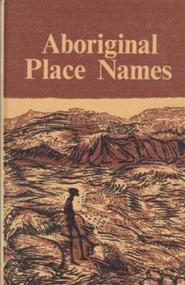
book, Aboriginal place names and their meanings, 1973 reprint, c1967
... Aboriginal place names and their meanings...aboriginal place names and their meanings...ISBN 0589070975 (pbk.) Aboriginal place names and their meanings book ...144 p. ISBN 0589070975 (pbk.)Stamped: Cowes Public Libraryaboriginal place names and their meanings, compiled by a.w. reed, aborigines, australian -- names -
 Phillip Island and District Historical Society Inc.
Book, REED, A.W, Aboriginal place names and their meanings, 1967
... Aboriginal place names and their meanings...names geographical australia australian languages Cowes Public Library Aboriginal place names and their meanings Book REED, A.W. ...Cowes Public Librarynames, geographical, australia, australian languages -
 Victorian Aboriginal Corporation for Languages
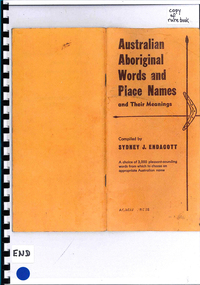
Book, Sydney J Endacott, Australian Aboriginal words and place names and their meanings, 1985
... Australian Aboriginal words and place names and their meanings...(Appear to be different printings) Australian Aboriginal words and place names and their meanings Book Sydney J Endacott ...Word list with definitions. (Appear to be different printings)B&w photographs, word lists -
Victorian Aboriginal Corporation for Languages
Book, Sydney J Endacott, Australian Aboriginal words and place names and their meanings, 1985
... Australian Aboriginal words and place names and their meanings...Australian Aboriginal words and place names and their meanings Book Sydney J Endacott ...Cover has subtitle: A choice of 3,000 pleasant-sounding words from which to choose an appropriate Australian name.word listsglossaries, vocabularies -
 Victorian Aboriginal Corporation for Languages
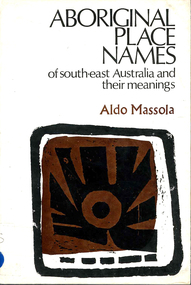
Book, Aldo Massola, Aboriginal place names of south-east Australia and their meanings, 1968
... Aboriginal place names of south-east Australia and their meanings...vocabulary word lists south east Australian languages word lists A first attempt to make a complete collection of all recorded Aboriginal names of towns, shores, homesteads, rivers, swamps, mountains and other natural features of south-east Australia. Gives meanings. Aboriginal place names of south-east Australia and their meanings Book Aldo Massola ...A first attempt to make a complete collection of all recorded Aboriginal names of towns, shores, homesteads, rivers, swamps, mountains and other natural features of south-east Australia. Gives meanings.word listsvocabulary, word lists, south east australian languages -
Victorian Aboriginal Corporation for Languages
Book, New South Wales Aboriginal place names and euphonious words, with their meanings, 1959
... New South Wales Aboriginal place names and euphonious words, with their meanings...Maps, word lists Includes map of NSW tribes, and numerical cross-referencing to those tribes if the language of the place name is known. New South Wales Aboriginal place names and euphonious words, with their meanings Book F D McCarthy ...Includes map of NSW tribes, and numerical cross-referencing to those tribes if the language of the place name is known.Maps, word lists -
Victorian Aboriginal Corporation for Languages
Book, Australian Aboriginal Place-names and their meanings, 1953
... Australian Aboriginal Place-names and their meanings...Australian Aboriginal Place-names and their meanings Book James R Tyrrell ...A short book of Aboriginal place name definitions from around Australia - the state of each name is indicated. -
Victorian Aboriginal Corporation for Languages
Book, Australian Aboriginal place-names and their meanings, 1953
... Australian Aboriginal place-names and their meanings...Australian Aboriginal place-names and their meanings Book James R Tyrrell ...A short book of Aboriginal place name definitions from around Australia - the state of each name is indicated.word listsglossaries, vocabularies -
Tatura Irrigation & Wartime Camps Museum
Small booklet, Frank Endacott (copyright), Australian Aboriginal Words and Place Names and their meanings , compiled by J.Endacott, 1924
... Australian Aboriginal Words and Place Names and their meanings , compiled by J.Endacott....Australian Aboriginal Words and Place Names and their meanings , compiled by J.Endacott. ...A choice of 3,000 pleasant sounding words from which to choose an appropriate Australian name.Peach coloured cardboard cover, with dark red printing. 2 x Spears and boomerang on cover. Small paperback booklet.A choice of 3,000 pleasant-sounding words from which to choose an appropriate Australian name.australian aboriginal names -
Box Hill Historical Society
Book, Endacott, Sydney J, Australian Aboriginal Words and place names and their meanings, 1985
... Australian Aboriginal Words and place names and their meanings...Australian Aboriginal language language A compilation of Australian Aboriginal Words and places names and their meanings. The book contains about 3000 words and meanings of various things and matters, including a great many Australian aboriginal place-names and their meanings. ...A compilation of Australian Aboriginal Words and places names and their meanings. The book contains about 3000 words and meanings of various things and matters, including a great many Australian aboriginal place-names and their meanings. The book also contains three photographs of aborigines.64 pages non-fictionA compilation of Australian Aboriginal Words and places names and their meanings. The book contains about 3000 words and meanings of various things and matters, including a great many Australian aboriginal place-names and their meanings. The book also contains three photographs of aborigines.australian aboriginal language, language -
Lakes Entrance Historical Society
Book, Endacott Sydney J, Australian Aboriginal Words and Place Names and their meanings, 1980
... Australian Aboriginal Words and Place Names and their meanings....Australian Aboriginal Words and Place Names and their meanings. Book Endacott Sydney J ...A choice of 3000 pleasant sounding Australian Aboriginal words and meanings from which to choose an appropriate Australian name.aboriginals -
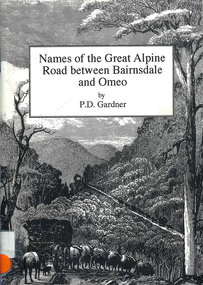 Victorian Aboriginal Corporation for Languages
Book, P D Gardner, Names of the Great Alpine Road between Bairnsdale and Omeo : their origins, meanings and history, 1997
... Lists the place names along the Victorian Alps, with descriptions and meanings....Gunnai Kurnai Ngarigo Jaitmathang Brabiralung Tongiomunjie Tambo Tongio Bruthen Tambo Mount Stringy Swifts Creek Maps, b&w illustrations, b&w photographs Lists the place names along the Victorian Alps, with descriptions and meanings. ...Lists the place names along the Victorian Alps, with descriptions and meanings.Maps, b&w illustrations, b&w photographsgunnai, kurnai, ngarigo, jaitmathang, brabiralung, tongiomunjie, tambo, tongio, bruthen, tambo, mount stringy, swifts creek -
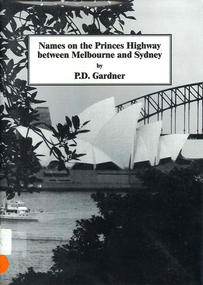 Victorian Aboriginal Corporation for Languages
Book, P D Gardner, Names on the Princes Highway between Melbourne and Sydney : their origins, meanings and history, 2000
... Place name list in a specific area. Giving descriptions and meanings....Dandenong Genoa South Coast NSW Yarra River Moruya Kiama Captain Cook East Gippsland Rosedale Maps, b&w illustrations Place name list in a specific area. Giving descriptions and meanings. ...Place name list in a specific area. Giving descriptions and meanings.Maps, b&w illustrationsdandenong, genoa, south coast nsw, yarra river, moruya, kiama, captain cook, east gippsland, rosedale -
Lakes Entrance Historical Society
Book, Gardner P D, Names of Bass Strait, 1996
... Some of the place names of the Bass Strait coasts, and Bass Strait Islands, and explanations of their meanings. ...Township Social History Topography Some of the place names of the Bass Strait coasts, and Bass Strait Islands, and explanations of their meanings. ...Some of the place names of the Bass Strait coasts, and Bass Strait Islands, and explanations of their meanings. Illustrated with maps and photographs.township, social history, topography -
Lakes Entrance Historical Society
Book, Gardner P D, Names of the Great Alpine Road between Wangaratta and Omeo, 1998
... Some of the place names appearing on the road between Wangaratta and Omeo, and explanations of their meanings. ...Township Social History Some of the place names appearing on the road between Wangaratta and Omeo, and explanations of their meanings. ...Some of the place names appearing on the road between Wangaratta and Omeo, and explanations of their meanings. Illustrated with photographs, drawings and maps.township, social history -
Lakes Entrance Historical Society
Book, P D Gardner, Names of the Great Alpine Road between Bairnsdale and Omeo, c1990
... Some of the place names appearing on the road between Bairnsdale and Omeo and explanation of their meanings illustrated with photographs drawing and maps, Bairnsdale Victoria...Township Social History Signed by author Peter Gardner Some of the place names appearing on the road between Bairnsdale and Omeo and explanation of their meanings illustrated with photographs drawing and maps, Bairnsdale Victoria Names of the Great Alpine Road between Bairnsdale and Omeo Book P D Gardner ...Some of the place names appearing on the road between Bairnsdale and Omeo and explanation of their meanings illustrated with photographs drawing and maps, Bairnsdale VictoriaSigned by author Peter Gardnertownship, social history -
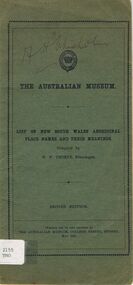 Bendigo Historical Society Inc.
Book - ALEC H CHISHOLM COLLECTION: BOOK 'NSW ABORIGINAL PLACE NAMES' BY W.W.THORPE
... A 16 page booklet (2nd Edition) of NSW aboriginal place names and their meaning. Compiled by W. ...A 16 page booklet (2nd Edition) of NSW aboriginal place names and their meaning. Compiled by W. ...Booklet. ALEC H CHISHOLM COLLECTION. A 16 page booklet (2nd Edition) of NSW aboriginal place names and their meaning. Compiled by W. W. Thorpe (Ethnologist). Set up and printed by the Australian Museum, Sydney in May 1927. Inside are 5 newspaper clippings from an Adelaide paper (no dates) about nomenclature. Catalogue sticker '2155 THO' on front cover together with the signature of A. H. Chisholm.W. W. Thorpebooks, collections, place names, alec h chisholm collection, aborigine, w.w.thorpe, place names -
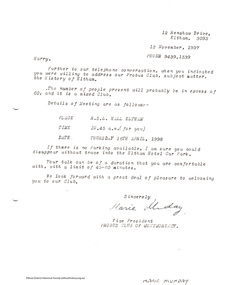 Eltham District Historical Society Inc
Folder, Notes for talk on the History of Eltham by Harry Gilham, 1997
... Notes on discussion on what is local history and reference to local places including bridges and examples of change of names and meanings of place names...Notes on discussion on what is local history and reference to local places including bridges and examples of change of names and meanings of place names harry gilham collection shire of eltham community groups harry gilham HG Booklet 18 10 pages, 9 of handwritten notes Notes for talk on the History of Eltham by Harry Gilham Folder ...Folder includes letter confirming invitation to speak at the Probus Club of Montmorency. A list of community groups, charity funds and other organisations operating in the Shire of Eltham in the 1950s. Notes on discussion on what is local history and reference to local places including bridges and examples of change of names and meanings of place names10 pages, 9 of handwritten notesHG Booklet 18harry gilham collection, shire of eltham, community groups, harry gilham -
 Mission to Seafarers Victoria
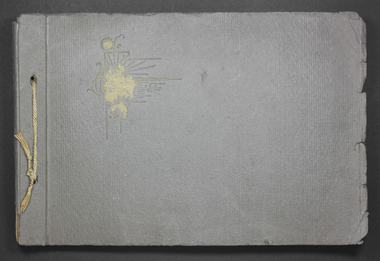
Album (item) - Photographic album, Duncan family photographic album, c.1920
... Some photographs were even taken on board these ships (crossing the line ceremony) meaning they were likely taken by a crew member or a passenger? ...Some photographs were even taken on board these ships (crossing the line ceremony) meaning they were likely taken by a crew member or a passenger? ...The photographic album was compiled by various members of the Duncan family in connection with their social activities and charitable work with the Mission to Seafarers Victoria. Image captions refer to a number of Melbourne families: "Barker", "MacEachern", "Johnston" and "Garven." The following ships are also named: "SS Sesther Dollar", "SS Peterton" and "SS Verbania." Some photographs were even taken on board these ships (crossing the line ceremony) meaning they were likely taken by a crew member or a passenger? This would help knowing who is the photographer and maker of this album. Places named include: "Gembrook", "Portsea" and "Port Melbourne Mission."This is a photograph of social and historic significance, being part of a sub-collection of material that provides a snapshot of the type of individuals involved in the Ladies Harbour Lights Guild and the activities carried out by that organisation. Tooling on the left hand side front cover. Cover and pages tied together with mustard coloured cord as binding.barker, maceachern, johnston, garven, ss sesther dollar, ss peterton, ss oerbania, gembrook, portsea, port melbourne mission, ladies harbour lights guild, social, duncan, lillie duncan, olive duncan, duncan album -
 Sunshine and District Historical Society Incorporated
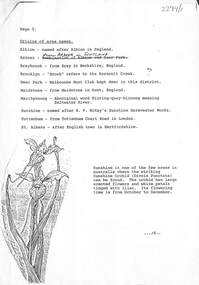
Document - Name Origins OF Historical places
... 2299.01 - Typed report Origins of area names Albion Ardeer Braybrook Deer Park Maidstone Maribyrnong Sunshine Tottenham and St Albans including mentioning Hume & Hovell and the Arndell River (Maribyrnong River)|2299.02 - Typed report Proposal for a Historic Place Names Register for the City of Brimbank|2299.03 - Letter from Public Library of Victoria 28 April 1960 Meaning of Maribyrnong and Early History of Sunshine|2299.04 - Typed report Names changes Sunshine and district Braybrook Sunshine Brimbank Deer Park ICI or ICIANZ MasseyFerguson Olwen Ford Draft|2299.05 - Typed report Naming Sunshine|2299.06 - Typed report Naming Deer Park...2299.01 - Typed report Origins of area names Albion Ardeer Braybrook Deer Park Maidstone Maribyrnong Sunshine Tottenham and St Albans including mentioning Hume & Hovell and the Arndell River (Maribyrnong River)|2299.02 - Typed report Proposal for a Historic Place Names Register for the City of Brimbank|2299.03 - Letter from Public Library of Victoria 28 April 1960 Meaning of Maribyrnong and Early History of Sunshine|2299.04 - Typed report Names changes Sunshine and district Braybrook Sunshine Brimbank Deer Park ICI or ICIANZ MasseyFerguson Olwen Ford Draft|2299.05 - Typed report Naming Sunshine|2299.06 - Typed report Naming Deer Park Collection of documents relating to the Name Origins Historical Names Document Name Origins OF Historical places ...2299.01 - Typed report Origins of area names Albion Ardeer Braybrook Deer Park Maidstone Maribyrnong Sunshine Tottenham and St Albans including mentioning Hume & Hovell and the Arndell River (Maribyrnong River)|2299.02 - Typed report Proposal for a Historic Place Names Register for the City of Brimbank|2299.03 - Letter from Public Library of Victoria 28 April 1960 Meaning of Maribyrnong and Early History of Sunshine|2299.04 - Typed report Names changes Sunshine and district Braybrook Sunshine Brimbank Deer Park ICI or ICIANZ MasseyFerguson Olwen Ford Draft|2299.05 - Typed report Naming Sunshine|2299.06 - Typed report Naming Deer Park -
Glen Eira Historical Society
Document - GLEN HUNTLY (HISTORY OF)
... Appendix J is a list of streets explaining the meanings of their names....Caulfield Historical Society Newsletters Place Names Committee McLeod Ron Aylen D. R. Mr. ...This file contains one item: 1/A loose-leaf, 23-page document titled ‘The History of Glen Huntly’, by Alfred R. Jones, dated 20/06/1991, describing the history of the suburb. The author has drawn heavily from the 4 sources noted in the bibliography. Subjects covered include the ship the suburb is named after, the suburb’s State School, the suburb’s churches, the Rosstown Railway and Sugar Mill, the origin of the name of Carnegie, the suburb’s aerodrome, and the beautification of the Glen Huntly Shopping Centre. The final 12 pages consist of 9 appendices relating to the aforementioned subjects. Appendix A is a typewritten letter from Ron McLeod, secretary of the Place Names Committee, to Mr. D. R. Aylen, CEO of the City of Caulfield, notifying the latter of the alteration of the name ‘Glenhuntly’ to ‘Glen Huntly’. Appendix B is a list of the ministers of St. David’s Uniting Church from its formation in 1916 to the present. Appendix C identifies the persons portrayed in St. David’s stained glass windows. Appendix D is a poster announcing the auction of 41 blocks of land between Hawthorn and Bambra Road formerly owned by William Ross, plus a map identifying said land blocks and another for locality. Appendix E is an A4 plan of the Rosstown Railway. Appendix F is a drawing of the Rosstown Sugar Mill. Appendix G is a poem titled ‘The Swagman’s Retreat’, by Herb Arnott, about the failure of the Mill. Appendix H is a map of Caulfield’s horse tramways plus a list of opening and closing dates. Appendix J is a list of streets explaining the meanings of their names.glen huntly, glenhuntly, local history, ‘glen huntly’ (ship), ‘glen huntlely’ (ship), quarantine stations, glen huntly road, lake street, mernda avenue, glen huntly state school no. 3703, ormond francis, ormond, garden avenue, grange road, churches, congregational church, glen huntly presbyterian church, st. david’s, st. david’s uniting church, anglican church, jenkin william ‘boss’, methodist church, wattle avenue, smith a. w. mr., glen huntly post office, glen huntly road, king f. l. mr., uniting church, child care centre, presbyterian church of eastern australia, glen huntly methodist church, sun aria, miller mary, stained glass, phrenologists, trinity congregational church, primitive methodists, ‘the victorian independent’, mercy mr., greek orthodox original old calendar church, wanalta road, salvation army, halls, myrtle street, catholic church, st. anthony’s roman catholic church, foundation stones, neerim road, mannix archbishop, st. agnes’ anglican church, booran road, sunday schools, clergy residences, ‘see’ anglican news magazine, lees archbishop, booth archbishop, glen huntly presbyterian church, el nido grove, tennis courts, bollard v. w. right rev., waratah avenue, royal avenue, munster avenue, james street, rothschild street, peace memorial organ, singers, bremner marie, scotland betty, carden joan, rosstown railway, south caulfield, plants, marata road, curraweena road, bambra road, ross william murray, ross leila, ross constance, vautin constance, ‘the grange’, north road, leila road, wild cherry road, caulfield roads board, elsternwick, land sales, sugar mills, koornang road, woornack road, elsternwick railway station, riddell parade, clarence street, dover street, oakleigh road, murrumbeena crescent, carlisle crescent, railways, trains, parks and reserves, caulfield council, sussex street, caulfield city council, swamps, rosstown sugar mill, rosstown estate, ‘the swagman’s retreat’, arnott herb, rosstown, carnegie, ‘ross’s folly’, carnegie andrew, rosstown hotel, dandenong road, rosstown road, rosstown plate horse race, caulfield racecourses, ames avenue, rosstown court, hostels, murrumbeena, cinemas, innovations (cabinetry film), films, music, pianos, manchester grove, safeway store, squash courts, airports, lord reserve, aeroplanes, air navigation act 1921, neville street, larkin sopwith aviation company of australasia, lyons street, morgan street, bookmakers, nightsoil, poultry, weatherboard buildings, glen huntly railway station, rosedale avenue, rifle clubs, scout groups, 1st glen huntly troop, ana, dowding jack mr., glen huntly infant welfare and family planning clinic, vermador private hospital, watson grove, rowlands (drapers), bones plant nursery, caulfield railway station, bridges, trams, horse tramways, glen eira road, elsternwick railway station, kooyong road, aboriginal peoples, truganini road, hannan lyn mrs. (urban planning officer), glen huntly shopping centre, sculptures, street beautification scheme, “flying the yellow flag”, moore olive, “return to rosstown”, jowett d. f., weickhardt i. s., “from sand swamp and health”, murray peter r., wells john c., caulfield historical society, newsletters, place names committee, mcleod ron, aylen d. r. mr., jones hugh rev., king joseph, scarfe james, vertigan sidney, vertigan earle, rance victor, flavell cameron, denholm robin, moorhead ken, taliai siupeli, eccles james leslie, little agnes, hutchins william r., dickie may a., gordon ivey agnes, theobald a. a. mrs., brownbill lloyd norman, ash georgette, land sales, auctions, messrs. crews & arkle, street names -
 Victorian Aboriginal Corporation for Languages
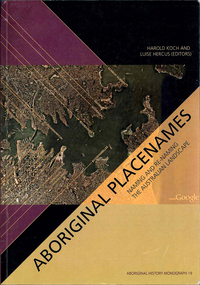
Book, Harold Koch, Aboriginal placenames : naming and re-naming the Australian landscape, 2009
... Richard Kimber Northern Australia: 14. Naming Bardi places /? Claire Bowern 15. Dog-people: the meaning of a north Kimberley story /? ...Richard Kimber Northern Australia: 14. Naming Bardi places /? Claire Bowern 15. Dog-people: the meaning of a north Kimberley story /? ..."Aboriginal approaches to the naming of places across Australia differ radically from the official introduced Anglo-Australian system. However, many of these earlier names have been incorporated into contemporary nomenclature, with considerable reinterpretations of their function and form. Recently, state jurisdictions have encouraged the adoption of a greater number of Indigenous names, sometimes alongside the accepted Anglo-Australian terms, around Sydney Harbour, for example. In some cases, the use of an introduced name, such as Gove, has been contested by local Indigenous people." "The 19 studies brought together in this book present an overview of current issues involving Indigenous placenames across the whole of Australia, drawing on the disciplines of geography, linguistics, history, and anthropology. They include meticulous studies of historical records, and perspectives stemming from contemporary Indigenous communities. The book includes a wealth of documentary information on some 400 specific placenames, including those of Sydney Harbour, the Blue Mountains, Canberra, western Victoria, the Lake Eyre district, the Victoria River District, and southwestern Cape York Peninsula." -- Publisher description. Contents: Introduction: Old and new aspects of Indigenous place-naming /? Harold Koch and Luise Hercus NSW &? ACT: 1. Aboriginal placenames around Port Jackson and Botany Bay, New South Wales, Australia: sources and uncertainties /? Val Attenbrow 2. Reinstating Aboriginal placenames around Port Jackson and Botany Bay /? Jakelin Troy and Michael Walsh 3. The recognition of Aboriginal placenames in New South Wales /? Greg Windsor 4. New insights into Gundungurra place naming /? Jim Smith 5. The methodology of reconstructing Indigenous placenames: Australian Capital Territory and south-eastern New South Wales /? Harold Koch Victoria: 6. Toponymic books and the representation of Indigenous identities /? Laura Kostanski 7. Reviving old Indigenous names for new purposes /? Laura Kostanski and Ian D. Clark 8. Reconstruction of Aboriginal microtoponymy in western and central Victoria: case studies from Tower Hill, the Hopkins River, and Lake Boga /? Ian Clark South Australia &? Central Australia: 'Aboriginal names of places in southern South Australia': placenames in the Norman B.Tindale collection of papers /? Paul Monaghan 10. Why Mulligan is not just another Irish name: Lake Callabonna, South Australia /? J.C. McEntee 11. Murkarra, a landscape nearly forgotten: the Arabana country of the noxious insects, north and northwest of Lake Eyre /? Luise Hercus 12. Some area names in the far north-east of South Australia /? Luise Hercus 13. Placenames of central Australia: European records and recent experience /? Richard Kimber Northern Australia: 14. Naming Bardi places /? Claire Bowern 15. Dog-people: the meaning of a north Kimberley story /? Mark Clendon 16. 'Where the spear sticks up': the variety of locatives in placenames in the Victoria River District, Northern Territory /? Patrick McConvell 17. 'This place already has a name' /? Melanie Wilkinson, Dr R. Marika and Nancy M. Williams 18. Manankurra: what's in a name? placenames and emotional geographies /? John J. Bradley and Amanda Kearney 19. Kurtjar placenames /? Paul Black.Maps, b&w photographs, tables, word listsaustralian placenames, sociolinguistics, linguistics, anthropology, sydney harbour placenames, blue mountains placenames, canberra placenames, western victoria placenames, lake eyre placenames, victoria river district placenames, cape york peninsula placenames -
 Flagstaff Hill Maritime Museum and Village
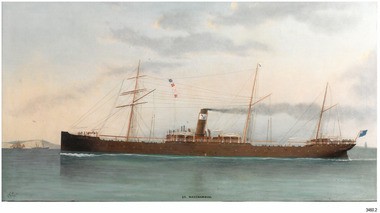
Photograph - Vessel, Sail and Steam Ship, S.S. Warrnambool
... The signal flags on the foremast display ‘M’ ‘R’ ‘V’ ‘B’, with each flag signalling a meaning in the International Code of Signals. ...The signal flags on the foremast display ‘M’ ‘R’ ‘V’ ‘B’, with each flag signalling a meaning in the International Code of Signals. ...This photograph and a matching earlier photograph are images of a 1989 oil-on-canvas painting owned by the donor. They show the British sail and steam ship SS Warrnambool at Dover Strait in the English Channel. Each photograph was accompanied by a letter, one written in 2001 and the other in 2003, confirming that the artist of the painting was by Charles Keith Miller, signed with his initials “CKM” and dated “1893”. The images show the ship’s home flag with a diagonal blue anchor flying from the masthead. The same symbol is painted on the ship’s black funnel. The signal flags on the foremast display ‘M’ ‘R’ ‘V’ ‘B’, with each flag signalling a meaning in the International Code of Signals. While the SS Warrnambool was visiting Melbourne on its maiden voyage on December 1, 1892, a painting of that Lind Line ship by marine artist C.K. Miller was presented to the Town Council of Warrnambool by Mr. William Lund of London, owner of the Lind Line, or Blue Anchor Line. At that time, the Ladies of Warrnambool presented the ship with a ‘house’ flag bearing the Blue Anchor Line’s symbol, made by them especially for the occasion during the preceding moth. On December 6, the homeward bound ship anchored for a short time off the Port of Warrnambool, and a boat was launched from Lady Bay to take a group of friends to the ship with a delivery of gifts. After three cheers each for the ship and its Captain the SS Warrnambool continued its journey towards Britain via Adelaide. Although the painting was gifted in December 1892, it is post-dated “1893”. The reason for the discrepancy is unclear but whatever the reason, the provenance of the painting was confirmed at auctions of this painting and other works by the same artist. CHARLES KEITH MILLER 1836-1907:- Captain Charles Miller left his home in Scotland at the age of 15 years for a life at sea. He earned his Master’s Certificate ten years later. After being the captain of sailing ships, he moved to the steamships because they were faster. He married in 1866 and settled in Glasgow. Over the following eleven years, he and his wife had five children, then sadly, his wife passed away. Captain Miller returned to the sea for a while, but in 1888, he gave up his sea life to spend his time as a marine artist. His understanding of seafaring life and vessels, combined with his artistic skills, enabled him to produce fine art, and several galleries and museums have collections of his sought-after works. S.S. WARRNAMBOOL 1892-1925:- The sail and steamship SS Warrnambool was built in 1892 by the Sunderland Ship Building Company for the Lund Line of London, founded by William Lund in 1869, and registered in London. It efficiently carried passengers and cargo worldwide, including Australia, under its master, Captain Joshua Edward Ilbery, who had many years of experience with the Lund’s Blue Anchor Line, or BAL, which owned a fleet of sail and steamships. The funnels its steamships were painted black, with a white band around the top bearing a diagonal blue anchor and chain, also shown on the company’s house flag. The Lund Line ships were given Australian place names beginning with the letter “W”. Master Mariner, Captain Joshua Ilbery, was lost at sea without a trace in 1909, along with the ship SS Waratah. The ‘no frills’ service carried passengers and cargo to and from Europe around the Cape of Good Hope, stopping at various ports. The ship was involved in bringing home returned soldiers in 1895. At one time, it carried a doctor from Victoria, Australia, to assist at the war front in South Africa. The ship had a very good reputation for its cargo arriving almost always in excellent condition. Exported goods from Australia included iron safes, flour, wool, apples, frozen rabbits, butter, cheese, pork, cattle, poultry and sheep. One remarkable delivery contained Ostriches for Queen Victoria, and they survived the journey well. The SS Warrnambool was sold in 1900 to the British and South American Steam Navigation Co. Ltd of Liverpool and was renamed ‘Harmodius’. R.P. Houston & Company of London managed the company, and its Houston Line funnels were red with a black top. The Harmodius was sold in 1919 to K.S.S. Co. Ltd, managed by Kaye Son & Co. Ltd. of Liverpool, and was renamed ‘Kut’. The line had black funnels with a white ‘K’ in a diamond or between white stripes. In 1926, it was purchased by T.W. Ward Ltd. and broken up. NOTE- other vessels named “Warrnambool” Two other vessels carried the name “Warrnambool” (1)- HMAS Warrnambool J202 (1941-1947), a Bathurst-class corvette vessel owned by the Royal Australian Navy, was destroyed by a mine. (2)- HMAS Warrnambool FCPB204 (1980-2005), a Fremantle Class Patrol Boat of the RAN. The photograph is significant for its association with the painting "SS Warrnambool" by renowned marine artist Charles Keith Miller, whose paintings are well valued. The painting by C K Miller, the photograph, both bear the name Warrnambool, and the house flag of the Lind Line, are connected through the gifts exchanged between the ship company owner, the Town of Warrnambool and the Ladies of Warrnambool. The images connect the SS Warrnambool to the international trade of cargo and passengers. Coloured photograph of a painting depicting the Blue Anchor Line’s 1892 steamship S.S. Warrnambool. The three-masted ship in calm water. Its sails are lowered, and smoke is rising from its funnel. It displays four raised signal flags, a house flag and a blue ensign on the ship. The funnel also bears the house flag's symbol. There are figures on deck. The signature of the painting's artist, CKM (Charles Keith Miller), and a title on the lower edge of the photograph.House flag symbol, [diagonal blue anchor on white background] Text "CKM" and "1893" Text "S. S. WARRNAMBOOL."flagstaff hill, warrnambool, photograph, steam ship warrnambool, flagstaff hill maritime village, shipwreck coast, ss warrnambool, captain, charles keith miller, ckm, 1893, william lund, warrnambool town council, blue anchor line, lund line, ladies of warrnambool, house flag, diagonal blue anchor, captain miller, sunderland ship building company, migrant ship, 1892 ship, home flag, bal, australian export, s.s.warrnambool, dover strait, english chanel, port of warrnambool, lady bay, mrvb, captain charles miller, captain joshua edward iibery, ostriches, queen victoria, british and south american steam navigation co., harmodius, r.p. houston & company, houston line, k.s.s. co. ltd, kaye son & co. ltd, kut, t.w. ward ltd -
 Federation University Historical Collection
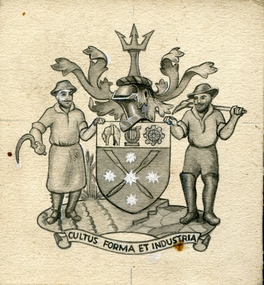
Drawing - Artwork - Drawing, Jeff Zilles, ZILLES COLLECTION: City of Ballarat Coat of Arms, c1975
... The name Ballaarat came from two Aboriginal words: balla and arat, meaning ‘resting place’. ...The name Ballaarat came from two Aboriginal words: balla and arat, meaning ‘resting place’. ...The following research was undertaken for the Coat of Arms in the foyer of Ballarat Civic Hall, painted by Angus Henderson. The Ballarat arms were granted on 10 May 1956. The shield is supported by a farmer and a miner and topped by a trident (referring to Britannia and aquatic sports) with sprigs of wattle and begonias either side. The crossed oars against the Eureka flag refer to rowing events in the 1956 Olympic Games. The importance of farming and industry are shown by the sheep and cogwheel while the lyre reflects the City’s commitment to the arts and Royal South Street Society, which contributed to the design of the Civic Hall. The name Ballaarat came from two Aboriginal words: balla and arat, meaning ‘resting place’. At the time of Council amalgamations, May 1994, Ballarat became the name of the new Council. The Latin motto: Cultus: cultivation, care, worship Formar: form, shape, appearance Industria: diligence, activity, industry Zilles Printers was begun by Lewis Zilles in the early 1930s. It was in McKenzie Street Ballarat. His son Jeffrey also became a printer - letterpress, offset and screen printer. The business became Zilles Printers/Graphics and was in Armstrong Street and later Bell Street Ballarat.Small Ballarat coat of armscity of ballarat coat of arms, crest, zilles printers -
 Federation University Historical Collection
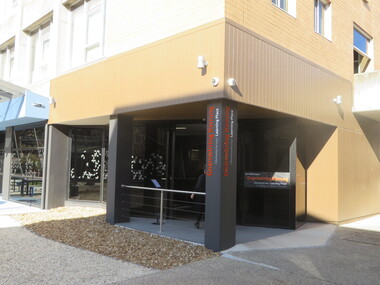
Photograph, Clare Gervasoni, Gnarrwirring Karung (Learning Place), Federation University Mt Helen Campus, 2018, 22/06/2018
... Federation University Australia’s Student Commons Area at the Mt Helen Campus was the first FedUni building to be officially given an Aboriginal name, Gnarrwirring Karung. Meaning Learning Place in the local Wadawurrung language, the re-named centre (pronounced Narrowing Ker Ung) will provide recognition of the area’s cultural heritage and increase the vibrancy, diversity and rich culture throughout the campus. ...Federation University Australia’s Student Commons Area at the Mt Helen Campus was the first FedUni building to be officially given an Aboriginal name, Gnarrwirring Karung. Meaning Learning Place in the local Wadawurrung language, the re-named centre (pronounced Narrowing Ker Ung) will provide recognition of the area’s cultural heritage and increase the vibrancy, diversity and rich culture throughout the campus. ...Federation University Australia’s Student Commons Area at the Mt Helen Campus was the first FedUni building to be officially given an Aboriginal name, Gnarrwirring Karung. Meaning Learning Place in the local Wadawurrung language, the re-named centre (pronounced Narrowing Ker Ung) will provide recognition of the area’s cultural heritage and increase the vibrancy, diversity and rich culture throughout the campus. The re-naming ceremony was held at the Gnarrwirring Karung Student Commons Area, S Building, Mt Helen Campus. “The choice of name follows an extensive process of seeking suggestions from the student body, the University’s Aboriginal Education Centre and local Aboriginal custodians,” Geoff Lord, Chairman of the University’s Reconciliation Action Plan (RAP) Committee, said. “The official naming meets many elements recognised within the FedUni RAP such as enhancing community, embedding culture, providing opportunity and, most importantly, respect. “The ceremony is a fine example of putting Aboriginal culture at the centre of our daily lives.” Jasmine Graham, Manager of the Aboriginal Education Centre, said the re-naming was a milestone for the local Aboriginal community. “The University is committed to greater recognition of Aboriginal heritage and culture throughout all of its campuses,” Ms Graham said. “Gnarrwirring Karung will be an impressive landmark throughout the Mt Helen Campus and a welcoming learning place.” A number of photographs taken at the naming of a Federation University space in the Mt Helen Campus 'S' Building. The space has been named Gnarrwirring Karung, Waddawurrung for Learning Place. waddawurrung, gnarrwirring karung, aboriginal, mt helen campus, reconciliation action plan, s building, waddawurrung language, place names -
 Flagstaff Hill Maritime Museum and Village
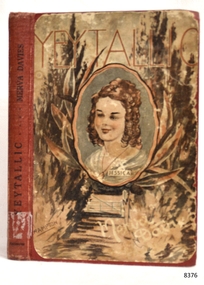
Book, Davies Merva, Yeytallic (Indigenous word meaning "Day before Yesterday", 1945
... Yeytallic Author: Merva Davies Publisher: The National Press P/L Date: 1945 Yeytallic (Indigenous word meaning "Day before Yesterday" Book Davies Merva The National Press Pty. ...This book was very popular during 1945 and was written by Merva Davies and published by the National Press PTY Ltd in Melbourne. It tells the story of a half-caste indigenous child. This book was part of a large group of books referred to as the Pattison Collection, which belonged to the Warrnambool Public Library, part of the Warrnambool Mechanics’ Institute. About RALPH ERIC PATTISON and the ‘PATTISON COLLECTION’ The ‘Pattison Collection’ is a collection of books and records that was originally owned by the Warrnambool Mechanics’ Institute, founded in Warrnambool in 1853. By 1886 the Warrnambool Mechanics’ Institute (WMI) had grown to have a Library, Museum and Fine Arts Gallery, with a collection of “… choice productions of art and valuable specimens in almost every branch and many wonderful national curiosities, are now to be seen there, including historic relics of the town and district.” It later included a School of Design. Although it was very well patronised, the WMI was led to ask the City Council to take it over in 1911 due to a lack of financial support. In 1935 Ralph Pattison was appointed as City Librarian to establish and organise the Warrnambool Public Library as it was then called. Ralph Eric Pattison was born in Rockhampton, Queensland, in 1891. He married Maude Swan from Warrnambool in 1920 and they set up a home in Warrnambool. In 1935 when Pattison accepted the position as City Librarian for the Warrnambool City Council his huge challenge was to make a functional library within two rooms of the Mechanics’ Institute. He tirelessly cleaned, cleared and sorted a disarrayed collection of old books, jars of preserved specimens and other items reserved for exhibition in the city’s museum. He developed and updated the library with a wide variety of books for all tastes, including reference books for students; a difficult task to fulfil during the years following the Depression. He converted all of the lower areas of the building into a library, reference room and reading room for members and the public. The books were sorted and stored using a cataloguing and card index system that he had developed himself. He also prepared the upper floor of the building and established the Art Gallery and later the Museum, a place to exhibit the many old relics that had been stored for years for this purpose. One of the treasures he found was a beautiful ancient clock, which he repaired, restored and enjoyed using in his office during the years of his service there. Ralph Pattison was described as “a meticulous gentleman whose punctuality, floorless courtesy and distinctive neat dress were hallmarks of his character, and ‘his’ clock controlled his daily routine and his opening and closing of the library’s large heavy doors to the minute.” Pattison took leave from 1942 to 1945 to serve in the Royal Australian Navy, Volunteer Reserve as Lieutenant. A few years later he converted one of the Museum’s rooms into a Children’s Library, stocking it with suitable books for the younger generation. This was an instant success. In the 1950’s he had the honour of being appointed to the Victorian Library Board and received more inspiration from the monthly conferences in Melbourne. He was sadly retired in 1959 after over 23 years of service, due to the fact that he had gone over the working age of council officers. However, he continued to take a very keen interest in the continual development of the Library until his death in 1969. THE NEW WARRNAMBOOL LIBRARY When the WMI building was pulled down in 1963 a new civic building was erected on the site and the new Warrnambool Library, on behalf of the City Council, took over all the holdings of the WMI. At this time some of the items were separated and identified as the ‘Pattison Collection’, named after Pattison. Eventually, the components of the WMI were distributed from the Warrnambool Library to various places, including the Art Gallery, Historical Society and Flagstaff Hill. Later some were even distributed to other regional branches of Corangamite Regional Library and passed to and fro. It is difficult now to trace just where all of the items have ended up. The books at Flagstaff Hill Maritime Village generally display stamps and markings from Pattison as well as a variety of other institutions including the Mechanics’ Institute itself. The Pattison Collection, along with other items at Flagstaff Hill Maritime Village, was originally part of the Warrnambool Mechanics' Institute’s collection. The Warrnambool Mechanics’ Institute Collection is primarily significant in its totality, rather than for the individual objects it contains. Its contents are highly representative of the development of Mechanics' Institute libraries across Australia, particularly Victoria. A diversity of publications and themes has been amassed, and these provide clues to our understanding of the nature of and changes in the reading habits of Victorians from the 1850s to the middle of the 20th century. The collection also highlights the Warrnambool community’s commitment to the Mechanics’ Institute, reading, literacy and learning in the regions, and proves that access to knowledge was not impeded by distance. These items help to provide a more complete picture of our community’s ideals and aspirations. The Warrnambool Mechanics Institute book collection has historical and social significance for its strong association with the Mechanics Institute movement and the important role it played in the intellectual, cultural and social development of people throughout the latter part of the nineteenth century and the early twentieth century. The collection of books is a rare example of an early lending library and its significance is enhanced by the survival of an original collection of many volumes. The Warrnambool Mechanics' Institute’s publication collection is of both local and state significance. Yeytallic Author: Merva Davies Publisher: The National Press P/L Date: 1945 The label on the spine cover with typed text PAT FIC DAV Pastedown front endpaper has a sticker from Warrnambool Public Library, with the date of April 1946 The front loose endpaper has a stamp from Warrnambool Public Library. Inside the front loose endpaper has a sticker from Corangamite Regional Library Service. Flyleaf has a stamp from Warrnambool Mechanics Institute and Free Library. flagstaff hil, warrnambool, flagstaff hill maritime museum, maritime museum, shipwreck coast, flagstaff hill maritime village, great ocean road, book, pattison collection, warrnambool library, warrnambool mechanics’ institute, ralph eric pattison, corangamite regional library service, warrnambool city librarian, mechanics’ institute library, victorian library board, warrnambool books and records, warrnambool children’s library, yeytallic, merva davies -
 Greensborough Historical Society
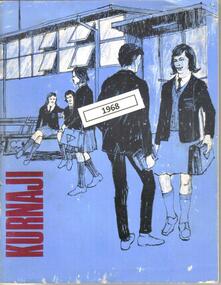
Magazine - School Magazine, Kurnaji 1968 Watsonia High School Yearbook WaHIGH, 1968_
... The word Kurnaji is thought to have been derived from the indigenous Aboriginal language with the meaning "Windy Hill" - refer 1971 Kurnaji Editorial page. ...Depicts events and attitudes, primarily of students as they go through their adolescent years in the late 1960's. The word Kurnaji is thought to have been derived from the indigenous Aboriginal language with the meaning "Windy Hill" - refer 1971 Kurnaji Editorial page.Annual record of teaching staff, students and events that took place over the year by using both photos and reports. Includes Roll Call section with names of all students.Note: This was the 1st Year of Kurnaji's publication, the last being in 1989 (see Record Item 274).52 Pages, Blue cover, Title "Kurnaji" in Red ink. Cover drawing of students. Headmaster / Principal - Mr. C.K. (Ken) Canty. 2 copies.watsonia high school, yearbook, kurnaji, school magazines -
 Flagstaff Hill Maritime Museum and Village
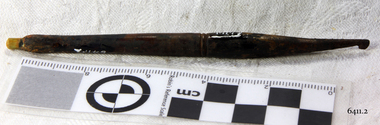
Functional object - Crochet Hook, Mid 19th Century
... Crochet came from the Old French word crochet, meaning ‘small hook.’ This word comes from Croche. ...Crochet came from the Old French word crochet, meaning ‘small hook.’ This word comes from Croche. ...Crochet came from the Old French word crochet, meaning ‘small hook.’ This word comes from Croche. Croche comes from the Germanic word croc. Both mean hook and crochetage, which means a single stitch used to join separate pieces of lace together. People used this term in making French lace in the 1600s and the word crochet describes the hook and the craft. Evidence shows the starting point was the mid-1800s but as early as the late 16th and early 17th century, crocheted braiding was used in clothing and other products. Like on a man’s cape at the Victoria and Albert Museum. Crochet evolved in the early 1700s when stitching material on a tambourine reached Europe after going through India, Persia, North America, Turkey, North Africa and other places around the world. People removed the background fabric used for tambouring. The French named the new technique “crochet in the air.” In the early 1800s, shepherd’s knitting came about, along with the shepherd’s hook. It’s thicker than a modern crochet hook but still with a hooked end. By the mid-1800s, it became known as crochet or slip stitch crochet. In the 60s, the granny square and crocheted home ware appeared and became more popular.A significant domestic item used in crochet or craft work and recovered from the wreck of the Schomberg in the 1970s. For more information regard the wrecking of the Schomberg see note sect this document. The Schomberg has historical significance as one of the first luxurious ships built to bring emigrants to Australia. The collection of recovered artefacts from the Schomberg wreck and held at Flagstaff Hill Museum are significant because of their potential to interpret the story of the Schomberg and its passengers.Crochet hook made from Bovine Bone. It has two sections that screw apart. Recovered from the wreck of the Schomberg. Nonewarrnambool, shipwrecked-coast, flagstaff-hill, flagstaff-hill-maritime-museum, maritime-museum, shipwreck-coast, flagstaff-hill-maritime-village, schomberg, shipwrecked-artefact, clipper ship, black ball line, 1855 shipwreck, aberdeen clipper ship, captain forbes, peterborough shipwreck, ss queen, crochet hook, crocheterage, craft -
 Eltham District Historical Society Inc
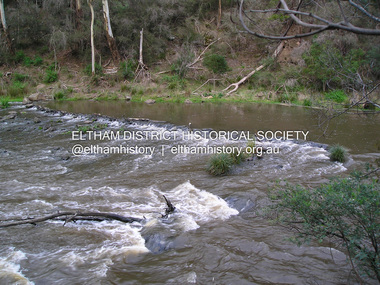
Photograph, Fay Bridge, Ancient Eel trap on the Yarra River at Laughing Waters, Eltham - pre-dating European settlement, 16 May 2015
... Laughing Waters is the name for a stretch of the Yarra Valley Parklands consisting of river flats and hilly riparian bushland. With Birrarung (Yarra River) flowing through, Laughing Waters has been an important gathering place for thousands of years. ...Laughing Waters is the name for a stretch of the Yarra Valley Parklands consisting of river flats and hilly riparian bushland. With Birrarung (Yarra River) flowing through, Laughing Waters has been an important gathering place for thousands of years. ...Laughing Waters is the name for a stretch of the Yarra Valley Parklands consisting of river flats and hilly riparian bushland. With Birrarung (Yarra River) flowing through, Laughing Waters has been an important gathering place for thousands of years. For the Wurundjeri, ‘Garambi Baan’ (the name for Laughing Waters in Woi wurrung) is an important site for growing and harvesting food. Significantly, Wurundjeri iuk (eel) traps remain at Garambi Baan to this day. The Wurundjeri Woi Wurrung People take their name from the Woi wurrung language word ‘wurun’ meaning the Manna Gum (Eucalyptus viminalis) which is common along ‘Birrarung’ (Yarra River), and ‘djeri’, the grub which is found in or near the tree. Wurundjeri are the ‘Manna Gum People’ and their Ancestors have lived on this land for millennia. The site on the Yarra River near the former Morrison property Killeavey was given a language name in 2015 at the instigation of Wurundjeri Elder, Dave Wandin. Garambi Baan means “laughing waters” in the traditional language, Woi wurrung. The site at Warrandyte was rediscovered by Campbell Beardsell OAM in 2007 and is one of only a few known remaining iuk (eel) traps on Country once found the length of the Birrarung (Yarra) and the Maribyrnong. Original Indigenous aquacultural infrastructure was dismantled, taken away from sites and used to build houses, fords and roads by Europeans. The difficult and restricted access to this site is thought to be one of the reasons for its survival. The iuk trap is located within lands managed by Parks Victoria. The Narrap team in partnership with Parks Victoria and Acacia Land Management have been improving the native vegetation with a program of woody weed removal, exclusion fencing and revegetation. Importantly, the team have restored the trap’s infrastructure and have demonstrated its effectiveness.” References: Wurundjeri Woi Wurrung Cultural Heritage Aboriginal Corporation - Laughing Waters. (2023, September 3). Retrieved from https://inplace.org.au/laughing-waters/ GARAMBI BAAN LAUGHING WATERS RESIDENCY CENTRE 2020 2024 Strategic Plan, Nillumbik Shire Council (2023, September 3). Retrieved from https://www.nillumbik.vic.gov.au/files/assets/public/minutes-and-agendas/2020/09-sep/15-sep-cm/ocm.177-20-attachment-1-laughing-waters-arts-program_1.pdffay bridge collection, 2015-05-16, eel trap, laughing waters, yarra river, wurundjeri woi wurrung, garambi baan
