
Showing 163 items matching "plant labels"
-
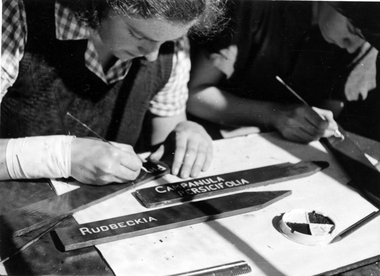 University of Melbourne, Burnley Campus Archives
Photograph - Black and white print, E.M. Gibson, Students Painting Plant Labels, 1949-1951
... Students Painting Plant Labels......plant labels...Black and white photograph of students painting plant names on timber plant labels...students painting plant labels e. m. gibson collection students in class 491/14 Black and white photograph of students painting plant names on timber plant labels Students Painting Plant Labels Photograph Black and white print E.M. ...Black and white photograph of students painting plant names on timber plant labels491/14students, painting, plant labels, e. m. gibson collection, students in class -
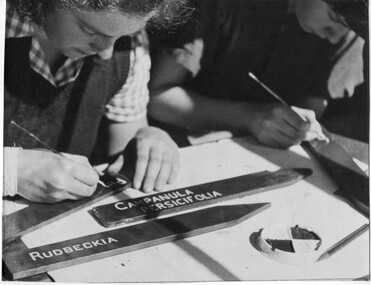 University of Melbourne, Burnley Campus Archives
Photograph - Black and white print, Students Painting Plant Labels, c. 1950
... Students Painting Plant Labels......plant labels...Students Painting Plant Labels identified by T.H. Kneen as Pat Fleming (1951) and Jill Garding (probably Gasking, 1951)....Students Painting Plant Labels Photograph Black and white print ...Black and white photograph . Students Painting Plant Labels identified by T.H. Kneen as Pat Fleming (1951) and Jill Garding (probably Gasking, 1951).students, plant labels, pat fleming, jill gasking, students in class -
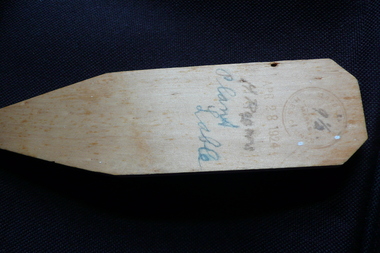 Clunes Museum
Domestic object - PLANT LABEL, WOODEN
... PLANT LABEL, WOODEN...Betty Duncan's thoughts: Harry Rogers made this wooden plant label at the Higher Elementary School Clunes and was given 9 1/2 marks for his effort....Hand made wooden plant label...Betty Duncan's thoughts: Harry Rogers made this wooden plant label at the Higher Elementary School Clunes and was given 9 1/2 marks for his effort. local history school Clunes Higher Elementary handcrafts woodwork APRIL 28 1924 PLANT LABLE (sic) Hand made wooden plant label Domestic object PLANT LABEL, WOODEN ...Betty Duncan's thoughts: Harry Rogers made this wooden plant label at the Higher Elementary School Clunes and was given 9 1/2 marks for his effort.Hand made wooden plant labelAPRIL 28 1924 PLANT LABLE (sic)local history, school, clunes higher elementary, handcrafts, woodwork -
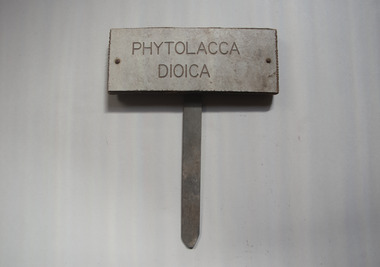 University of Melbourne, Burnley Campus Archives
Sign, Garden Plant Label
... Garden Plant Label......labels...plant...1. Large plant label that can be inserted in the ground. ...Similar, painted red. Garden Plant Label Sign Sign ...Used in gardens as botanical naming labels which are weather proof.1. Large plant label that can be inserted in the ground. Wooden backboard with inscribed metal plate screwed on. Metal stake screwed on. 2. Similar, painted red.1. Phytolacca dioica 2. Alectryon subcinereum Smooth Rambuton plants, labels, plant identification, burnley gardens, burnley campus, artifact -
 University of Melbourne, Burnley Campus Archives
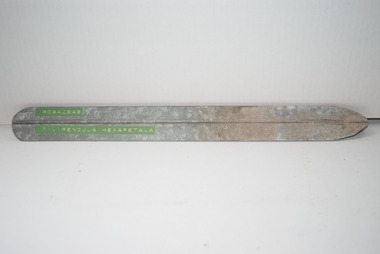
Sign, Garden Plant Label
... Garden Plant Label...Metal stake fashioned into a large plant label that can be inserted in the ground. ...Filipenula hexapetala Metal stake fashioned into a large plant label that can be inserted in the ground. ...Used in the Burnley Gardens for naming plants in a botanical nomenclature. Possibly a cheaper way to identify the plants in the environment.Metal stake fashioned into a large plant label that can be inserted in the ground. Shaped galvanised metal with plastic embossed label stuck onRosaceae. Filipenula hexapetalaplants, labels, identification, artifact -
 University of Melbourne, Burnley Campus Archives
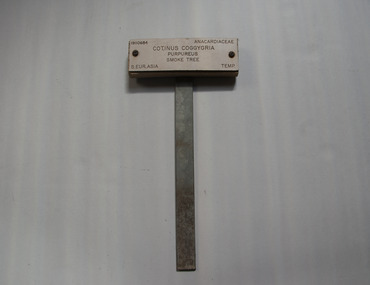
Sign, Garden Plant Label
... Garden Plant Label...plants. Shows the way the gardens became more scientific - see B22.0016 for earlier labels....2 plant labels (smaller than B22.0016) that can be inserted in the ground. ...Metal stake screwed on. Garden Plant Label Sign Sign ...Used in Burnley Gardens on the campus to identify plants. Shows the way the gardens became more scientific - see B22.0016 for earlier labels.2 plant labels (smaller than B22.0016) that can be inserted in the ground. Wooden base with metal inscribed label screwed on. Metal stake screwed on.1. 19110684 Anacardiaceae. Cotinus coggygria purpureus Smoke Tree. S. Eurasia Temp. 2. 12132084 Apocynaceae. Vinca major Greater Periwinkle. Europe.labels, plants, identification, artifact -
 University of Melbourne, Burnley Campus Archives
Photograph - Colour prints, P. Kenyon, Plant Materials, Unknown
... Probably used for Plant ID. Labelled. Not digitised....Probably used for Plant ID. Labelled. Not digitised. Plant Materials Photograph Colour prints P. ...16 colour photographs of native flowering plants. Probably used for Plant ID. Labelled. Not digitised.plants, native plants, flowering plants, plant id -
University of Melbourne, Burnley Campus Archives
Album - Colour 35mm slides, A. Lewis, Grampians Flora, 1984
... Contains list of 98 plants labelled, "Grampians Flora," and corresponding slides (some missing." ...Contains list of 98 plants labelled, "Grampians Flora," and corresponding slides (some missing." ...Plastic folder labelled, "Victorian College of Agriculture & Horticulture-Burnley, Burnley Gardens, Swan St, Richmond Vic 3121." Contains list of 98 plants labelled, "Grampians Flora," and corresponding slides (some missing." Plus one extra slide. Some slides taken by A. Lewis. Slides not scanned.vcah, victorian college of agriculture and horticulture, burnley, burnley gardens, grampians flora, a. lewis, plant list -
University of Melbourne, Burnley Campus Archives
Booklet, Ian Smith et al, Introduction to Entomology, 1993
... Issued for Certificate in Horticulture.By Ian Smith and John Brereton. Plant in Print label on front....entomology certificate in horticulture ian smith john brereton Issued for Certificate in Horticulture.By Ian Smith and John Brereton. Plant in Print label on front. Introduction to Entomology Booklet Ian Smith John Brereton Victorian College of Agriculture and Horticulture ...entomology, certificate in horticulture, ian smith, john brereton -
 University of Melbourne, Burnley Campus Archives
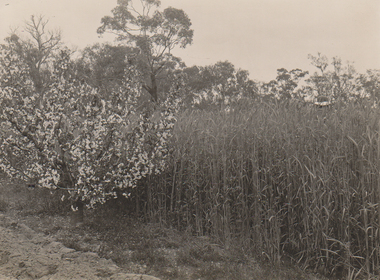
Photograph - Black and white print, Garden Views, Unknown
... Person standing amongst tall grass. (2) 2 copies. Plant label in photograph reads,"Prostanthera sieberi." ...Person standing amongst tall grass. (2) 2 copies. Plant label in photograph reads,"Prostanthera sieberi." ...13 black and white photographs with the same numbering system on reverse. (1) 3 copies fruit tree in blossom, probably almond. Person standing amongst tall grass. (2) 2 copies. Plant label in photograph reads,"Prostanthera sieberi." On reverse of one, "New purple flowers." (3) Plant taken out of its pot. (4) 2 copies. Conifer. (5) Conifers. (6-8) ?fruit trees, blossoms, flowers, garden views, conifers, plants, almond, prostanthera sieberi -
 University of Melbourne, Burnley Campus Archives
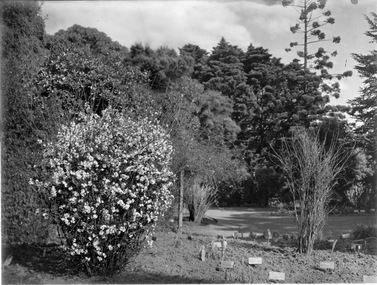
Photograph - Black and white print, Garden View, Unknown
... Prominent tree is Cupressus macrocarpa (Monterey Cypress) one of the earliest trees planted, no longer existant. Labels on plants in the foreground....Prominent tree is Cupressus macrocarpa (Monterey Cypress) one of the earliest trees planted, no longer existant. Labels on plants in the foreground. ...Note by T.H. Kneen, "View from the Principal's Residence to the SE corner of the Gardens. Prominent tree is Cupressus macrocarpa (Monterey Cypress) one of the earliest trees planted, no longer existant. Removed 1984.Black and white photograph. Garden view from Principal's Residence to the SE corner of the Gardens (T. H. Kneen). Prominent tree is Cupressus macrocarpa (Monterey Cypress) one of the earliest trees planted, no longer existant. Labels on plants in the foreground.principal's residence, gardens, cupressus macrocarpa, monterey cypress, garden view -
University of Melbourne, Burnley Campus Archives
Booklet - Handbook, Victorian College of Agriculture and Horticulture, Small Business Management, 1993
... Peter McSweeney (Ed.) Plants in Print price label on front. ...Peter McSweeney (Ed.) Plants in Print price label on front. Small Business Management Booklet Handbook Victorian College of Agriculture and Horticulture Peter McSweeney ...The University of Melbourne logo -
University of Melbourne, Burnley Campus Archives
Booklet - Handbook, Michele Adler, The Seedling Growing Trial, 1997
... Book number 2B. Plant in Print price label on front. ...Book number 2B. Plant in Print price label on front. The Seedling Growing Trial Booklet Handbook Michele Adler Adland Horticultural P/L ...growing seedlings, michele adler, student handbook, teaching -
University of Melbourne, Burnley Campus Archives
Album - Colour slides, Royal Botanic Gardens Plants, 1961-1963
... Approximately 40 slides, labelled, of plants at the Royal Botanic Gardens Melbourne. ...royal botanic gardens melbourne plants Approximately 40 slides, labelled, of plants at the Royal Botanic Gardens Melbourne. ...Approximately 40 slides, labelled, of plants at the Royal Botanic Gardens Melbourne. In compartmentalised wooden box. Not scannedroyal botanic gardens melbourne, plants -
 University of Melbourne, Burnley Campus Archives
Photograph - 35mm Colour slides, Kodachrome, Wilsons Prom./Greenhouse, 1989-2002
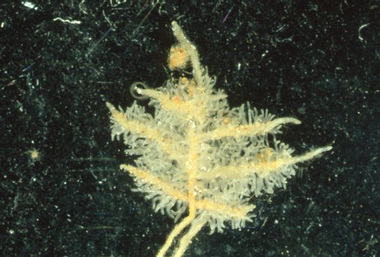
... Mostly photographs of plants in pots labelled with different chemicals in soils Oct, Dec 89. 2 Jun 90 "Proteoid Roots, Pladiges"....Mostly photographs of plants in pots labelled with different chemicals in soils Oct, Dec 89. 2 Jun 90 "Proteoid Roots, Pladiges". ...Box of colour slides. Mostly photographs of plants in pots labelled with different chemicals in soils Oct, Dec 89. 2 Jun 90 "Proteoid Roots, Pladiges".Stamped "OCT 02" and labelled "Wilsons Prom./Greenhouse"wilsons promontory, plants, pots, proteoid roots, pladiges, diseased soils, diseased trees, metalaxyl, n.p.k., plantations, fenamiphos, chemicals in soils, excursions -
University of Melbourne, Burnley Campus Archives
Plan, Royal Botanic Gardens Melbourne, 1978
... Handwritten labelling of beds. (4 - 11) Enlarged photocopies of sections of (1) Handwritten notes and plant labelling. (1). Photgraphed copies by FRESCO 510131-TA. (12) Plan on a grid, coloured. ...Handwritten labelling of beds. (4 - 11) Enlarged photocopies of sections of (1) Handwritten notes and plant labelling. (1). Photgraphed copies by FRESCO 510131-TA. (12) Plan on a grid, coloured. ...Plan of RBG with grid references. Produced by Dept. of Crown Lands and Survey, Victoria, Division of Survey and Mapping. Prepared in 1978 from surveys completed in 1976. (1) 2 copies plan. Main areas, buildings, etc., labelled, beds outlined. (2) Original coloured plan and reduced size photocopy. More labelling, particularly beds (handwritten). Labelled Jeremy J. Wallace with handwritten notes on reverse re a project. (3) Reduced size photocopy. Handwritten labelling of beds. (4 - 11) Enlarged photocopies of sections of (1) Handwritten notes and plant labelling. (1). Photgraphed copies by FRESCO 510131-TA. (12) Plan on a grid, coloured. "No Public Access," areas marked.jeremy j. wallace, royal botanical gardens melbourne, department of crown land and survey division of survey and mapping, ornamental lakes -
 Friends of Ballarat Botanical Gardens History Group
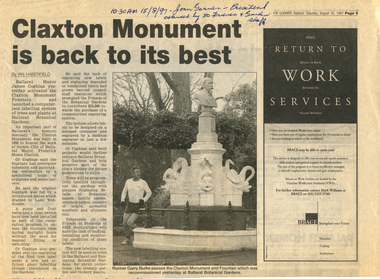
Work on paper - "Claxton Monument is back to its best." Ballarat Courier, 15/8/97 and the launching of a computerised labelling system of trees and plants in the Gardens, The Recommissioning of the Monument in the Ballarat Botanical Gardens and the Engraving of the first tree label, 15/8/1997
... The Claxton Monument and Fountain in the Ballarat Botanical Gardens was recommissioned in 1997 after extensive renovations and a computerised engraving system was purchased for the labelling of plants....The Claxton Monument and Fountain in the Ballarat Botanical Gardens was recommissioned in 1997 after extensive renovations and a computerised engraving system was purchased for the labelling of plants. The Claxton Monument is an important part of Ballarat Botanical Gardens historic statuary. ...The Claxton Monument and Fountain in the Ballarat Botanical Gardens was recommissioned in 1997 after extensive renovations and a computerised engraving system was purchased for the labelling of plants.The Claxton Monument is an important part of Ballarat Botanical Gardens historic statuary. And the new labelling system would help preserve part of City's history.I page (p.5) of yellowed newsprint with a large black and white photograph of the Claxton Monument to the right hand side. Cut out of newspaper at the bottom.At the top of the page, written in blue biro: "10.30 am 15/8/97 - Joan Garner - President attended by 50 Friends and Garden Staff."john garner, doctor, ballarat botanical gardens, friends of the ballarat botanical gardens, claxton monument, restoration, frederick moses claxton, mayor, computerised labelling system, claxton, john garner collection, gardens, ballarat, courier -
 University of Melbourne, Burnley Campus Archives
Album - 35mm Colour slides, Kodachrome, Plant Sales and Garden Week 1990, 1988-1996
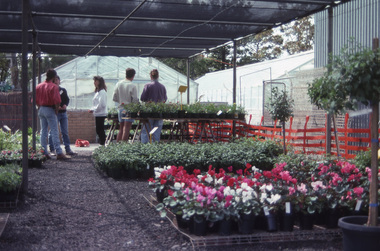
... 1-18. labelled "Oct 29 Plant Sale 1988" Nov 88. 19-36. labelled "Nov 4 Plant Sale 1989" Nov. 37-43. labelled "1990" (Plant Sale) Dec 90. 44-50. labelled "Garden Week 1990" and "Burnley Gardens" Apr 90. 51- 56. labelled "Nov 2 Plant Sale 1991" Nov. 57-66. labelled "Plant Sale 1992" Oct. 82- showing advertising posters for school fairs, one dated Oct 1995 Apr 1996. 67-81.labelled "Plant Sale 1996" Nov. 3 slides of advertising for it Oct. 1 slide "Labelling Austraflore"...plant sale garden week burnley gardens school fairs austraflore garden week 1990 1-18. labelled "Oct 29 Plant Sale 1988" Nov 88. 19-36. labelled "Nov 4 Plant Sale 1989" Nov. 37-43. labelled "1990" (Plant Sale) Dec 90. 44-50. labelled "Garden Week 1990" and "Burnley Gardens" Apr 90. 51- 56. labelled "Nov 2 Plant Sale 1991" Nov. 57-66. labelled "Plant Sale 1992" Oct. 82- showing advertising posters for school fairs, one dated Oct 1995 Apr 1996. 67-81.labelled "Plant Sale 1996" Nov. 3 slides of advertising for it Oct. 1 slide "Labelling Austraflore" Plant Sales and Garden Week 1990 Album 35mm Colour slides Kodachrome ...1-18. labelled "Oct 29 Plant Sale 1988" Nov 88. 19-36. labelled "Nov 4 Plant Sale 1989" Nov. 37-43. labelled "1990" (Plant Sale) Dec 90. 44-50. labelled "Garden Week 1990" and "Burnley Gardens" Apr 90. 51- 56. labelled "Nov 2 Plant Sale 1991" Nov. 57-66. labelled "Plant Sale 1992" Oct. 82- showing advertising posters for school fairs, one dated Oct 1995 Apr 1996. 67-81.labelled "Plant Sale 1996" Nov. 3 slides of advertising for it Oct. 1 slide "Labelling Austraflore"plant sale, garden week, burnley gardens, school fairs, austraflore, garden week 1990 -
University of Melbourne, Burnley Campus Archives
Plan, Identification, Evaluation and Recommendations for Plants in the Shady Walk, Burnley gardens, 2003
... Due date 26.05.2003.Plan of the Shady Walk with plant identified and labelled....Due date 26.05.2003.Plan of the Shady Walk with plant identified and labelled. Identification, Evaluation and Recommendations for Plants in the Shady Walk, Burnley gardens Plan ...Part of Certificate IV - Horticulture Plant Identification 2 Assignment for HRT 416 Recommend Plants, Products and Treatments. By Charlie Dinami, Karl Teschendorff, Lisette Burgess, Lori McNutt and Ros McCully. Due date 26.05.2003.Plan of the Shady Walk with plant identified and labelled.burnley gardens, charlie dinami, karl teschendorff, lisette burgess, lori mcnutt, ros mccully -
 University of Melbourne, Burnley Campus Archives
Album - Colour prints, negatives and 35mm slides, Staff, Collection of Photographs Used by Staff, 1994-2000
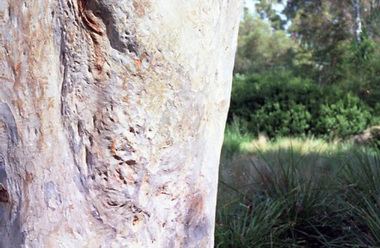
... Some are photographs from excursions, others are teaching material, plants. Some labelled: 1. Ruth Upper Merri Creek - negatives and prints; Merri Creek - negatives and prints; Merri Creek Panorama - prints; Merri Creek Posters 1995 - negatives and prints; Plants - negatives. 2. ...Some are photographs from excursions, others are teaching material, plants. Some labelled: 1. Ruth Upper Merri Creek - negatives and prints; Merri Creek - negatives and prints; Merri Creek Panorama - prints; Merri Creek Posters 1995 - negatives and prints; Plants - negatives. 2. ...Collection of photographs in envelopes which had belonged to staff members. Some are photographs from excursions, others are teaching material, plants. Some labelled: 1. Ruth Upper Merri Creek - negatives and prints; Merri Creek - negatives and prints; Merri Creek Panorama - prints; Merri Creek Posters 1995 - negatives and prints; Plants - negatives. 2. Western District Exhibition, labelled - negatives and prints of paintings; Mt Ridley (Excursion?) - negatives and prints; Energy Education Centre 15 November 1995; Gardens - Spring 1995 negatives (mostly James Hitchmough, Native Grasslands and Luffmann Ponds) Scanned; Student Party June 1994 - negatives; 3. Pot Trial - negatives and prints; Miscellaneous plant trials, Centenial Centre Shop, Arborists, Plants, Excursions - negatives; Excursions , 1 year 2000 - negatives and prints; Orchard (older) - black and white negatives and prints; Arborists - negatives and prints; 4. Staff, Graduate students - negatives and prints; Miscellaneous: Plants, - negatives, slides and prints. 7. Native Garden and other garden views - prints and negativesstaff, excursions, teaching material, merri creek, mt ridley, energy education centre, student party, pot trial, centenial centre shop, arborists, plants, graduates, students, plant database, jill kellow, orchard, james hitchmough grasslands, horticulture shop, ruth beilin, upper merri creek, merri creek panorama, merri creek posters -
 Flagstaff Hill Maritime Museum and Village
Wood Samples, 1891
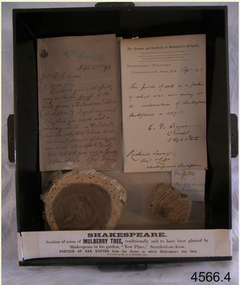
... label are attached on the back of the case. The left round section of wood is from a donated scion (or shoot) derived from the original mulberry tree planted by William Shakespeare at his last home "New Place", Stratford-upon-Avon. ...Cardboard label inside the glass case “Shakespeare Section of Mulberry Tree, traditionally said to have been planted by Shakespeare in his garden, “New Place,” Stratford-on-Avon. ...label are attached on the back of the case. The left round section of wood is from a donated scion (or shoot) derived from the original mulberry tree planted by William Shakespeare at his last home "New Place", Stratford-upon-Avon. ...The timber display case was presented to Mr Richard Standcombe Harris of Warrnambool (1831-1923). He was a councillor (1875-1891) and predominant businessman. Mr C F Loggin had met Mr Harris while on a trip to Stratford upon Avon in the United Kingdom. Upon his return to Warrnambool, Mr Harris donated the item to the Warrnambool Museum and Art Gallery, (established 1886) where Joseph Archibald was Curator: he catalogued the case in 1894. THE LETTERS IN THE CASE The two letters contained within the display case confirm the authenticity of the oak wood sample. The first letter in the case includes the text; "[Stamped Header on banner] High Street, Stratford on Avon [Hand written] Sept. 22nd / 91. Mr. R. S. Harris, Dear Sir, Enclosed you will find [underlined next 3 words] every authentic proof of the Oak from Shakespeare's House (Birth place). I regret very much Sir, that you made a short-day at S. on A. I should have been delighted to have had the honour, & pleasure, of showing you around our Beautiful Country. You did not give [next 3 words underlined] me or yourself a fair chance. But however I hope that we may again some day have more time to go quietly around. With kind regards, and wishing you, Sir, a pleasant voyage, I remain, Dear Sir, Yours very truly, C.F. Loggin. P.S. A paper will be always acceptable to be as how you Jolly Warrnamboolites are desporting yourselves. “ The second letter includes text; “[Printed Letterhead with stamped impression] The Trustees and Guardians of Shakespeare’s Birthplace Incorporated by Act of 54 and 55, Vict. 1891 Secretary and Librarian - Richard Savage Shakespeare’s Birthplace Stratford-upon-Avon [handwritten] 22 Sept 1891 This piece of oak is a portion of what was cut away at at the restoration of Shakespeare’s Birthplace in 1857-58. C. F. Loggins Chemist 3 High Street Richard Savage Sec. – Shakespeare’s Birthplace Mr C F Loggin was connected with the Shakespeare Trust as the person who had originally donated a scion of Shakespeare's mulberry tree to the "Shakespearean Birthday Committee" in 1842. (The scion that was given to the Shakespearean Birthday Committee, from which the Mulberry sample is derived, still grows today in "New Place" garden.) Mr Richard Savage was the Secretary and Liberian of the then renamed “Trustees and Guardians of Shakespeare’s Birthplace when the display case was given to Mr Harris in 1891 by Mr Loggin. WILLIAM SHAKESPEARE Shakespeare was born in 1564 in Stratford-upon-Avon, where he also grew up. He married at 18 years and he and his wife, Anne Hathaway, had three children: They moved to London where he became successful as an actor, writer, and part-owner of a playing company. He later returned to Stratford and purchased his last home, which he called "New Place" in 1602 where he later died in 1616. For the next 150 years, it was known that there existed a black mulberry tree in the garden. At the time there was a fashion for planting mulberry trees. It was the early 17th century after King James had come to the throne, and he imported tens of thousands of saplings in an attempt to get landowners to start a silk industry in England. Unfortunately for posterity, Shakespeare's mulberry was felled around 1756, by the then owner of “New Place" the Reverend Francis Gastrell, who was apparently tired of continual visits by pilgrims asking to see the tree, so he chopped it down. Gastrell had applied for local permission to extend the garden but the application was rejected and his tax was increased. Gastrell retaliated by demolishing the house in 1759, this greatly outraged the local inhabitants. Gastrell was eventually forced to leave town having provoked the wrath of Stratford residents for committing such an act. Today only the garden remains where “New House" used to stand with a scion from the original mulberry tree still growing there. The wood from the felled mulberry tree at “New House" was purchased by an enterprising local clock-maker Thomas Sharp and he spent the next 40 years or so years making souvenirs from the wood. These became early tourist souvenirs and subsequently developed into a profitable sideline for various other makers, including George Cooper and John Marshall. These objects range from relatively small domestic wooden objects, such as snuff boxes and weight scales to large tea caddies and even tables. C. F. Loggin donated a scion or cutting from Shakespeare's mulberry tree to the Shakespeare Birthplace Trust in 1862, he was a chemist who lived and worked in Stratford. There is a note on the frame of the donation that the mulberry sample is from this scion, research shows that from Richard Savage's diary notes that there must have been a lot of wood taken from that scion over the years which was planted in the garden of “New Place” and is still growing there today. The "Trustees and Guardians of Shakespeare’s Birthplace" (1847 -1964) was formed after the house where Shakespeare is believed to have been born fell into disrepair. Subsequently in 1846 after the death of Thomas Court's widow the last owner. Interest in the house was revived when PT Barnum, the American showman, wanted to buy it and ship the house back to America. In response to this, the Shakespeare Birthday Committee was established (by a private Act of Parliament) with the help of such luminaries as Charles Dickens, the Committee of Trustees raised the necessary £3,000 and purchased the house the following year. Once the Committee had acquired the building, restoration work began. Originally the Birthplace formed part of a terrace with later houses built either side. The first stage in its conservation was their destruction. At the time it was thought necessary to avoid the risk of fire spreading to Shakespeare's birthplace. Reconstruction was carried out by the Shakespeare Trust between 1857 and 1864 that restored the outside of the building to its original 16th-century state. It is from this restoration that the donated piece of oak is derived, originally from a beam that was in the house. Communication from The Shakespeare Birthplace Trust, dated April 11th, 2019, confirms that the pieces displayed in this case have good provenance. The wood samples are significant for their association with the history of William Shakespeare. The display case and its content is significant to Warrnambool local history for its association with the establishment in 1886 of the Warrnambool Museum and Art Gallery. However, it should be noted that the letters of authentication that accompany the wood samples are only applicable to the oak sample. None the less, all the pieces have very good provenance, with Richard Savage's certificate of authenticity for the oak, and the mulberry sample with the letter to Mr Harris from Mr CF Loggin having also been the donor of the scion of mulberry in 1862 to the Shakespeare Birthplace Trust. This scion was then established at Shakespeare's garden at "New Home" that had been demolished by Rev Francis Gastrell in 1759. Two wood samples associated with William Shakespeare, presented in a hanging, timber and glass display case with metal trim around the frame. The case also contains two letters and a label printed on a card that refers to the contents, their origins and the donor. A card label with a printed number and a round adhesive label are attached on the back of the case. The left round section of wood is from a donated scion (or shoot) derived from the original mulberry tree planted by William Shakespeare at his last home "New Place", Stratford-upon-Avon. The outer section is light brown coloured while the centre is dark grain. The right wood sample in the case is a section of oak rafter from the house where Shakespeare was born in 1564. The wood is mid brown with a distinct grain. The included letters, each dated 22/9/1891, refer to only the oak sample. - The letter on the left comprises two handwritten pages from Mr CF Loggin to Mr Richard Standcombe Harris. The paper has the printed letterhead address of High Street, Stratford on Avon. - The letter on the right is a handwritten certificate of authenticity signed by Mr CF Loggin and counter signed by Mr Richard Savage, Secretary and Liberian of the Shakespeare Trust. It is on the printed letterhead of The Trustees and Guardians of Shakespeare’s Birthplace Cardboard label inside the glass case “Shakespeare Section of Mulberry Tree, traditionally said to have been planted by Shakespeare in his garden, “New Place,” Stratford-on-Avon. PORTION OF OAK RAFTER from the house in which Shakespeare was born. (Presented by R S Harris 1891.) Printed label on the back of the case “3 2 “ The handwritten adhesive label “0566” flagstaff hill, warrnambool, shipwrecked coast, flagstaff hill maritime museum, maritime museum, shipwreck coast, flagstaff hill maritime village, great ocean road, shakespeare display case, wood samples, oak from shakespeare's birthplace, mulberry from shakespeare's home "new place", stratford-upon-avon, shakespeare's birthplace, the trustees and guardians of shakespeare's birthplace &c., shakespeare trust, shakespeare birthday committee, r.s. harris, brunswick, victoria, richard s harris, brunswick, victoria, c.f. loggins, chemist, 3 high street stratford-on-avon, richard savage, warrnambool museum and art gallery, thomas court, pt barnum, charles dickins, anne hathaway, black mulberry tree, reverend francis gastrell -
 Federation University Historical Collection
Photograph - Photograph - Colour, Equipment from the Carlton and United Brewery, Ballarat, 2007, 2007
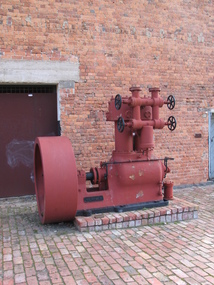
... Label associated with the compressor "The School of Mines and Industries Ballarat Limited 140 ton Ammonia Compressor, c1930 Built by Werner of Richmond, Melbourne, this compressor was removed from the Carlton and United Breweries Richmond factory and installed in Ballarat in 1959 in order to upgrade the refrigeration plant. ...When the Ballarat Brewery was demolished the Ammonia Compressor was moved to near the Brew Tower, Armstrong Street. ballarat brewery ballarat brewing company brew tower brew carlton and united breweries werner brewing tulloch and mclaren brewery Ballarat School of Mines Label associated with the compressor "The School of Mines and Industries Ballarat Limited 140 ton Ammonia Compressor, c1930 Built by Werner of Richmond, Melbourne, this compressor was removed from the Carlton and United Breweries Richmond factory and installed in Ballarat in 1959 in order to upgrade the refrigeration plant. ...When the Ballarat Brewery was demolished the Ammonia Compressor was moved to near the Brew Tower, Armstrong Street.Three photographs of the 140 ton Ammonia Compresor used at the Ballarat Brewery. The compressor was possibly moved to Ballarat from Carlton, and was used from c1930. It was built by Werner of Richmond.Label associated with the compressor "The School of Mines and Industries Ballarat Limited 140 ton Ammonia Compressor, c1930 Built by Werner of Richmond, Melbourne, this compressor was removed from the Carlton and United Breweries Richmond factory and installed in Ballarat in 1959 in order to upgrade the refrigeration plant. Refurbished by members of the former Ballarat Brewery Engine Room it serves as a reminder of the establishment of the brewery on this site by Tulloch and McLaren in 1862."ballarat brewery, ballarat brewing company, brew tower, brew, carlton and united breweries, werner, brewing, tulloch and mclaren, brewery, ballarat school of mines -
 Flagstaff Hill Maritime Museum and Village
Plant specimen - Wood Sample, Herbst, 1759-1765
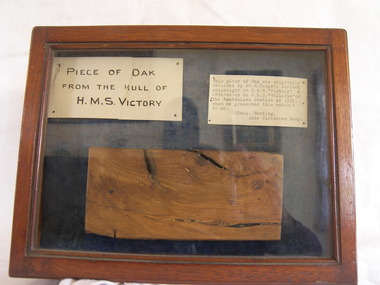
... Other items donated with the display case, and relating to the wood sample: an 1895 photograph, a 1905 newspaper clipping, a 1962 donor's letter (two pages), and a handwritten exhibit label with a border of red lines. Plant specimen Wood Sample Royal Dockyard Herbst H. ...The piece of oak wood sample inside the case was obtained from Mr H. Cooper during the time he served as a shipwright for the British Royal Navy on Nelson’s flagship, HMS Victory, in 1891. By that time, the H.M.S. Victory was around 100 years old, having been built in 1765 and was currently in dry dock undergoing restoration. Cooper’s skills as a shipwright would have been well employed during this period. HMS Victory was, and still is, undergoing continuous restoration to preserve her for display as a museum ship, due to the vessel's significant naval history. It was during that early restoration period that Cooper obtained the piece of Oak from HMS Victory, believed to be from the ship's hull. Cooper was in Australia in September 1891 serving on the HMS Wallaroo, a British Auxiliary Squadron commissioned as part of the British Royal Navy contingent, to serve and operate in Australian waters. The photograph included with the donation of the wood sample is a portrait of Mr H Cooper taken in 1895 in Sydney. The inscription on the photograph describes him as a skilled shipwright from H.M.S. Wallaroo, depicting Cooper as a young man in Royal Navy uniform, with the emblem of a petty officer third class. While Cooper was stationed on the H.M.S. Wallaroo in Sydney, he presented the display case, containing the wood sample from H.M.S. Victory, as well as the exhibit labels, to Charles Harding ("Chas"), late of the Royal Australian Navy. Harding had been based at the H M Naval Torpedo Depot at Williamstown, Victoria. Although not mentioned, it is believed the two men met whilst serving together in Australia in their respective assignments. It could have been a retirement gift from Cooper to Harding, with the photograph of Cooper likely included with the case, and gifted to Harding in 1895, as the date on the photograph indicates. One of the exhibit's labels indicates that Harding had the item on display whilst serving at the Naval Torpedo Depot in Williamstown. The label indicates: "This piece of Oak is part of the hull of H.M.S. 'Victory', Lord Nelson’s renowned flagship, which took such a prominent part in the Battle of Trafalgar. 21st October 1805. Exhibited by Charles Harding, H.M.V. Naval Torpedo Depot, Williamstown.” After Charles Harding died in 1931, the case containing the sample of oak from H.M.S. Victory was donated by his son, Reg Harding, to Mr Murphy in 1962. The display case has since become a treasured item at Flagstaff Hill. A newspaper article dated 1905 included with the donation mentions that the city of Hamilton in Victoria was shortly expecting a mounted piece of the H.M.S. Victory to be included in the city’s commemoration of the centenary of the "Battle of Trafalgar". Battle of Trafalgar: On October 21, 1805, twenty-seven British ships of the line led by Admiral Lord Nelson aboard HMS Victory defeated thirty-three French and Spanish ships of the line under French Admiral Villeneuve. The battle took place in the Atlantic Ocean off the southwest coast of Spain, just west of Cape Trafalgar, near the town of Los Caños de Meca. The victory confirmed the naval supremacy Britain had established during the course of the eighteenth century, and it was achieved in part through Nelson's departure from the prevailing naval tactical orthodoxy of the day. Conventional practice at the time was for opposing fleets to engage each other in single parallel lines, to facilitate signalling and disengagement, and to maximise fields of fire and target areas. Nelson instead arranged his ships into two columns to sail perpendicularly into the enemy fleet's line. During the battle, Nelson was shot by a French musketeer, and he died shortly before the battle ended. Villeneuve was captured, along with his ship Bucentaure. He later attended Nelson's funeral while a captive on parole in Britain. Admiral Federico Gravina, the senior Spanish flag officer, escaped with the remnant of the fleet. He died five months later from wounds sustained during the battle. It was before this battle that Nelson had issued his now-famous final orders to his ships in 12 separate flag-hoists: “England expects that every man will do his duty”. This wood sample is historically significant for its association with Admiral Lord Nelson and the Battle of Trafalgar. Through Nelson’s leadership and unorthodox battle tactics, he secured not only a victory against the French and Spanish but also reaffirmed Britain's naval supremacy, opening the way for Britain to continue the policy of colonisation of many countries, including Australia.Wood sample adhered to the base of a hinged wood and glass display case. Wood is a sample of oak taken from the hull of Vice-Admiral Lord Nelson's flagship, the HMS Victory, built in 1765. The case also contain two exhibit labels pinned above the wood sample. Other items donated with the display case, and relating to the wood sample: an 1895 photograph, a 1905 newspaper clipping, a 1962 donor's letter (two pages), and a handwritten exhibit label with a border of red lines. Photograph Front: printed- "Herbst" "28 Oxford Street, Hyde Park, Sydney", handwritten - "Mr Cooper", "see back". Back: handwritten - "Mr H Cooper, skilled shipwright, H.M.S. Wallaroo 1895" Exhibit labels still in the case: Left: handwritten- “PIECE OF OAK FROM THE HULL OF H.M.S. VICTORY”, Right: typewritten- “This piece of Oak was originally obtained by Mr. H. Cooper, skilled shipwright on H.M.S. “Victory” & afterwards on H.M.S. “Wallaroo” on the Australian Station in 1895, when he presented this exhibit to me. Chas. Harding, Late Victorian Navy.”flagstaff hill, warrnambool, shipwrecked-coast, flagstaff-hill, flagstaff-hill-maritime-museum, maritime-museum, shipwreck-coast, flagstaff-hill-maritime-village, oak, hms victory, vice-admiral lord nelson, horatio nelson, lord nelson, oak piece, piece of oaknelson, battle of trafalgar, maritime technology, ship relics, 18th century warship, british royal navy, h cooper shipwright, hms wallaroo, herbst hyde park sydney, charles harding, hmv naval orpedo depot williamstown, sir home popham’s telegraphic code, admiralty official day signal book -
 The Beechworth Burke Museum
Geological specimen - Fossil Leaves
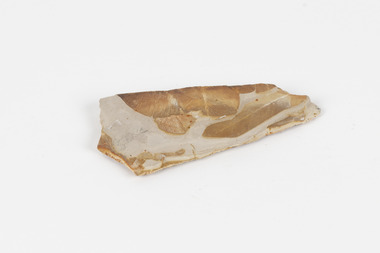
... Existing label: Fossil Leaves / Locality unknown / might be worth checking if this is Glossopteris, a Permian age plant. / C. ...Geological Specimen geology Geology Collection Burke Museum Beechworth fossil leaves fossilization 1868 Geological Survey of Victoria lithified rocks fossilised leaf rock fossils leaves Existing label: Fossil Leaves / Locality unknown / might be worth checking if this is Glossopteris, a Permian age plant. / C. ...A fossil refers to any remains or traces of past life that are preserved in the rock. It could be remains of plants or animals. Fossil leaves are commonly found on different types of rocks. These fossils can go as far back as the Triassic Age just like the series of fossil plants collected at Denmark Hill, Ipswich in Queensland. Fossils leaves are formed when dead plants get buried by sediments like mud, sand, or volcanic ash. Often, it gets detached cleanly from stems along a special layer of weak cells, then twigs, and, less commonly, cones of conifers and fruits and seeds of flowering plants. Over time, the leaves or pieces of leaves get buried by more sediments and eventually gets 'lithified' or hardened into a rock. Erosions and mining can cause the rocks to break and reveal the fossils buried in it. Fossilisation frequently takes place at sites in the lowlands where deposits of clay, silt, sand are found. This is usually due to weathering and erosion of rocks. Fossil leaves can provide information about ancient Australia's way of living. It contributes to Victorian biodiversity records and its botanical collections. It also contributes information on the geographical profile of Victoria as fossilisation usually occur at estuaries and deltas of rivers, river flood plains, ponds and lakes. This specimen is part of a larger collection of geological and mineral specimens collected from around Australia (and some parts of the world) and donated to the Burke Museum between 1868-1880. A large percentage of these specimens were collected in Victoria as part of the Geological Survey of Victoria that begun in 1852 (in response to the Gold Rush) to study and map the geology of Victoria. Collecting geological specimens was an important part of mapping and understanding the scientific makeup of the earth. Many of these specimens were sent to research and collecting organisations across Australia, including the Burke Museum, to educate and encourage further study.Piece of light brown rock with fossilised leaves in shades of golden yellow and brown.Existing label: Fossil Leaves / Locality unknown / might be worth checking if this is Glossopteris, a Permian age plant. / C. William 16/4/21 geological specimen, geology, geology collection, burke museum, beechworth, fossil leaves, fossilization, 1868 geological survey of victoria, lithified, rocks, fossilised leaf, rock, fossils, leaves -
 Flagstaff Hill Maritime Museum and Village
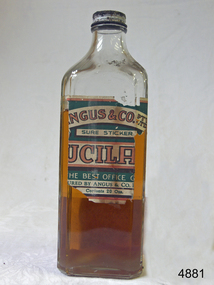
Glue Bottle, Joseph Armstrong Angus & Co, 1920s -1950
... plant (Althaea Officinalis). The inner bark of the slippery elm (Ulmus rubra), a North American tree species, has long been used as a demulcent and cough medicine and is still produced commercially for that purpose. Mucilage mixed with water has been used as a glue, especially for bonding paper items such as labels...plant (Althaea Officinalis). The inner bark of the slippery elm (Ulmus rubra), a North American tree species, has long been used as a demulcent and cough medicine and is still produced commercially for that purpose. Mucilage mixed with water has been used as a glue, especially for bonding paper items such as labels ...Angus & Co. was a large ink, gum, and paste manufacturing company established in Melbourne in 1896 by Joseph Armstrong Angus (1860-1936.) The company's premises included a bottle works to supply bottles for its many products. The company supplied various inks, gums, and paste too many business and domestic customers. Mucilage is a thick, gluey substance produced by nearly all plants and some microorganisms. These micro-organisms include protists who use it for their locomotion. The direction of their movement is always opposite to that of the secretion of mucilage. It is a polar glycoprotein and an exopolysaccharide. The mucilage in plants plays a role in the storage of water and food, seed germination, and thickening membranes. Cacti (and other succulents) and flax seeds are especially rich sources of mucilage. Mucilage is edible. It is used in medicine as it relieves irritation of mucous membranes by forming a protective film. It is known to act as a soluble, or viscous, dietary fiber that thickens the faecal mass, an example being the consumption of fiber supplements containing Psyllium seed husks. Traditionally, marshmallows were made from the extract of the mucilaginous root of the marshmallow plant (Althaea Officinalis). The inner bark of the slippery elm (Ulmus rubra), a North American tree species, has long been used as a demulcent and cough medicine and is still produced commercially for that purpose. Mucilage mixed with water has been used as a glue, especially for bonding paper items such as labels, postage stamps, and envelope flaps. Differing types and varying strengths of mucilage can also be used for other adhesive applications, including gluing labels to metal cans, wood to china, and leather to pasteboard. An early item from the late 1920s for office use as a glue by a well-known Melbourne manufacturer of office supplies of inks, glues, rubber stamps, and mucilage gums, etc.Bottle of Mucilage. Manufactured by Angus & Co Ltd Aust. Contents 20 Ozflagstaff hill, warrnambool, shipwrecked-coast, flagstaff-hill, flagstaff-hill-maritime-museum, maritime-museum, shipwreck-coast, flagstaff-hill-maritime-village -
Federation University Historical Collection
Book, Glenfine South and South Berry Journal
... plant creswick mosquito creek frenchmans gully spring hill A. H. Welsh Squire petticoat gully Handwritten on title page in black ink Address of sawmiller T. J. Brown, Mount Rowan D. W. Hambly 317 Ligar St, Ballarat J. Freeman, C/O Mrs H Simons, Lynch St, Footscray Sleemans Prescription for the bladder in 19009 Mixture No 55983 Tabloids No 55982 Green water marked linen covered journal with maroon spine with red feint lined blue pages. Label ...This Book is associated with former Ballarat School of Mines Student Richard Squire (1875-1876). Gift of the Squire FamilyGreen water marked linen covered journal with maroon spine with red feint lined blue pages. Label on front cover is cream with black printing JOURNAL with handwritten DATA RISIS GLENFINE SOUTH -SOUTH BERRY G.S & S.B Hand written in black and red ink. Plan in back with scale 20 chains to one inch - Has an index. Handwritten on title page in black ink Address of sawmiller T. J. Brown, Mount Rowan D. W. Hambly 317 Ligar St, Ballarat J. Freeman, C/O Mrs H Simons, Lynch St, Footscray Sleemans Prescription for the bladder in 19009 Mixture No 55983 Tabloids No 55982glenfine south, south berry, sleemans, mining, gold mining, glenfine consols, reef, weights of quartz, blacksmiths tools, australian and eagle, davies south east reef drive, brawns, eaglehawk junction, simons letter, machinery, puddlng plant, poppet heads, winding plant, creswick, mosquito creek, frenchmans gully, spring hill, a. h. welsh, squire, petticoat gully -
 Marysville & District Historical Society
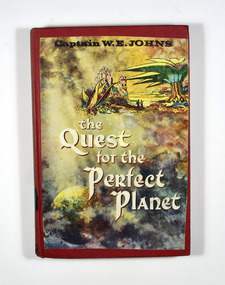
Book (item) - Hardcover book, Captain W.E. Jones, The Quest for the Perfect Planet-A story of Space Exploration, 1961
... labels have been removed leaving behind glue residue. Stamp of the Marysville & District Historical Society Inc/ P.O. Box 22/ Marysville 3779 Hardcover. The cover is red. On the front cover is a picture depicting a planet surrounded by clouds at the bottom edge. At the top of the picture there is a cartoon drawing depicting a landscape with trees and plants ...A novel by Captain W.E. Jones that was held in the Marysville State School library.A book from the Marysville State School library.Stamp of the STATE SCHOOL No. 1273/ UPPER/ 3/ FICTION/ MARYSVILLE In both front and back inside cover's labels have been removed leaving behind glue residue. Stamp of the Marysville & District Historical Society Inc/ P.O. Box 22/ Marysville 3779captain w.e. jones, planet, earth, space exploration, fiction -
 Flagstaff Hill Maritime Museum and Village
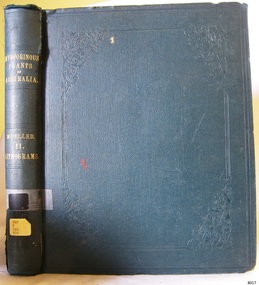
Book, Descriptions and Illustrations of the Myoporinous Plants of Australia Vol 2
... The Warrnambool Mechanics' Institute’s publication collection is of both local and state significance. warrnambool shipwrecked-coast flagstaff-hill flagstaff-hill-maritime-museum maritime-museum shipwreck-coast flagstaff-hill-maritime-village shipwrecked-artefact book pattison collection warrnambool library warrnambool mechanics’ institute ralph eric pattison corangamite regional library service warrnambool city librarian mechanics’ institute library victorian library board warrnambool books and records warrnambool children’s library great ocean road Label on spine cover with typed text PAT F 582 MUE Pastedown front endpaper has sticker from Warrnambool Mechanics Institute and Free Library Front loose endpaper has a sticker from Corangamite Regional Library Service Front loose endpaper has a stamp from Corangamite Regional Library Service Fly page has a stamp from Warrnambool Public Museum and in hand writing "Donation by Premier 1890" Descriptions and Illustrations of the Myoporinous Plants of Australia Vol 2 Author: Baron Ferdinand Von Mueller Publisher: Government Printer Melbourne Date: 1886 Descriptions and Illustrations of the Myoporinous Plants of Australia Vol 2 Book ...This item is from the ‘Pattison Collection’, a collection of books and records that was originally owned by the Warrnambool Mechanics’ Institute, which was founded in Warrnambool in 1853. By 1886 the Warrnambool Mechanics’ Institute (WMI) had grown to have a Library, Museum and Fine Arts Gallery, with a collection of “… choice productions of art, and valuable specimens in almost every branch and many wonderful national curiosities are now to be seen there, including historic relics of the town and district.” It later included a School of Design. Although it was very well patronised, the lack of financial support led the WMI in 1911 to ask the City Council to take it over. In 1935 Ralph Pattison was appointed as City Librarian to establish and organise the Warrnambool Library as it was then called. When the WMI building was pulled down in 1963 a new civic building was erected on the site and the new Warrnambool Library, on behalf of the City Council, took over all the holdings of the WMI. At this time some of the items were separated and identified as the ‘Pattison Collection’, named after Ralph Pattison. Eventually the components of the WMI were distributed from the Warrnambool Library to various places, including the Art Gallery, Historical Society and Flagstaff Hill. Later some were even distributed to other regional branches of Corangamite Regional Library and passed to and fro. It is difficult now to trace just where all of the items have ended up. The books at Flagstaff Hill Maritime Village generally display stamps and markings from Pattison as well as a variety of other institutions including the Mechanics’ Institute itself. RALPH ERIC PATTISON Ralph Eric Pattison was born in Rockhampton, Queensland, in 1891. He married Maude Swan from Warrnambool in 1920 and they set up home in Warrnambool. In 1935 Pattison accepted a position as City Librarian for the Warrnambool City Council. His huge challenge was to make a functional library within two rooms of the Mechanics’ Institute. He tirelessly cleaned, cleared and sorted a disarrayed collection of old books, jars of preserved specimens and other items reserved for exhibition in the city’s museum. He developed and updated the library with a wide variety of books for all tastes, including reference books for students; a difficult task to fulfil during the years following the Depression. He converted all of the lower area of the building into a library, reference room and reading room for members and the public. The books were sorted and stored using a cataloguing and card index system that he had developed himself. He also prepared the upper floor of the building and established the Art Gallery and later the Museum, a place to exhibit the many old relics that had been stored for years for this purpose. One of the treasures he found was a beautiful ancient clock, which he repaired, restored and enjoyed using in his office during the years of his service there. Ralph Pattison was described as “a meticulous gentleman whose punctuality, floorless courtesy and distinctive neat dress were hallmarks of his character, and ‘his’ clock controlled his daily routine, and his opening and closing of the library’s large heavy doors to the minute.” Pattison took leave during 1942 to 1945 to serve in the Royal Australian Navy, Volunteer Reserve as Lieutenant. A few years later he converted one of the Museum’s rooms into a Children’s Library, stocking it with suitable books for the younger generation. This was an instant success. In the 1950’s he had the honour of being appointed to the Victorian Library Board and received more inspiration from the monthly conferences in Melbourne. He was sadly retired in 1959 after over 23 years of service, due to the fact that he had gone over the working age of council officers. However he continued to take a very keen interest in the continual development of the Library until his death in 1969. Warrnambool's Mechanics' Institute (or Institution as it was sometimes called) was one of the earliest in Victoria. On 17th October 1853 a meeting was held where it was resolved to request the Lieutenant Governor of the Colony to grant land for the erection of a Mechanics' Institutes building. A committee was formed at the meeting and Richard Osburne chaired the first meeting of this committee. The land on the North West corner of Banyan and Merri Streets was granted but there were no funds to erect the building. The Formal Rights of the Warrnambool Mechanics' Institute's encompassed its aims and these were officially adopted in1859; "This Institution has for its object the diffusion of literary, scientific, and other useful knowledge amongst its members, excluding all controversial subjects, religious or political. These objects are sought to be obtained by means of a circulating library, a reading room, the establishment of classes, debates, and the occasional delivery of lectures on natural and experimental philosophy, mechanics, astronomy, chemistry, natural history, literature, and the useful and ornamental arts, particularly those which have a more immediate reference to the colony." The Warrnambool Mechanics' Institute opened its first reading room in November1884 in the National School building at the corner of Banyan and Timor Streets. The Institute was funded by member subscription, payable on a quarterly, half yearly or yearly basis. Samuel Hannaford, the Manager of the Warrnambool Bank of Australasia, was the first Honorary Secretary of the Mechanics' Institutes, and an early President and Vice-President. He also gave several of the early lectures in the Reading Room. Another early Secretary, Librarian and lecturer was Marmaduke Fisher, the teacher at the National School. Lecture topics included The Poets and Poetry of Ireland', 'The Birth and Development of the Earth', 'The Vertebrae - with Remarks on the pleasures resulting from the study of Natural History' and 'Architecture'. In 1856 the Reading Room was moved to James Hider's shop in Timor Street, and by 1864 it was located in the bookshop of Davies and Read. In the 1860's the Mechanics' Institute struggled as membership waned but in 1866, after a series of fund raising efforts, the committee was able to purchase land in Liebig Street, on a site then called Market Square, between the weighbridge and the fire station. A Mechanics' Institute building was opened at this site in August 1871. The following year four more rooms were added to the main Reading Room and in 1873 the Artisan School of Design was incorporated into the Institute. The same year Joseph Archibald established a Museum; however it deteriorated when he was transferred to Bendigo in 1877. In 1880, with Archibald's return to Warrnambool, the Museum was re-established, and in 1885 a new building was built at the back of the Institute to accommodate the re-created School of Design, the Art Gallery and the Museum. In 1887 the Museum section was moved to the former court house in Timor Street (for some time the walls of the building formed part of the TAFE cafeteria but all is now demolished)). In 1911 the Museum was transferred back to the original building and the management of the Mechanics' Institute was handed over to the Warrnambool City Council. The Museum and Art Gallery became one and housed many fine works of art, and the Library continued to grow. The building was well patronised, with records showing that at the beginning of the 20th century there were between 500 and 800 visitors. During World War One the monthly figures were in the thousands, with 3,400 people visiting in January 1915. The Museum was a much loved Institution in Warrnambool until the contents of the Museum and Art Gallery were removed to make room for the Warrnambool City Council Engineers' Department. The contents were stored but many of the items were scattered or lost. When the original building was demolished the site became occupied by the Civic Centre, which included the new City Library. (The library was temporarily located in the old Palais building in Koroit Street.) In the process of reorganisation the Collection was distributed amongst the community groups: -The new City Library took some of the historic books and some important documents, historic photographs and newspapers. -The Art Gallery kept the 19th Century art collection and some of the artefacts from the museum. -The Historic Society has some items -The State Museum has some items -Some items were destroyed -Flagstaff Hill Maritime Village has old newspapers, Government Gazettes, most of the Mechanics' Institute Library, ledgers and documents connected to the Mechanics' Institute Library, some framed and unframed art works and some photographs. The Warrnambool Mechanics' Institute Library book collection is deemed to be of great importance because it is one of the few collections in an almost intact state, and many of the books are now very rare and of great value. The Pattison Collection, along with other items at Flagstaff Hill Maritime Village, was originally part of the Warrnambool Mechanics' Institute’s collection. The Warrnambool Mechanics’ Institute Collection is primarily significant in its totality, rather than for the individual objects it contains. Its contents are highly representative of the development of Mechanics' Institute libraries across Australia, particularly Victoria. A diversity of publications and themes has been amassed, and these provide clues to our understanding of the nature of and changes in the reading habits of Victorians from the 1850s to the middle of the 20th century. The collection also highlights the Warrnambool community’s commitment to the Mechanics’ Institute, reading, literacy and learning in the regions, and proves that access to knowledge was not impeded by distance. These items help to provide a more complete picture of our community’s ideals and aspirations. The Warrnambool Mechanics Institute book collection has historical and social significance for its strong association with the Mechanics Institute movement and the important role it played in the intellectual, cultural and social development of people throughout the latter part of the nineteenth century and the early twentieth century. The collection of books is a rare example of an early lending library and its significance is enhanced by the survival of an original collection of many volumes. The Warrnambool Mechanics' Institute’s publication collection is of both local and state significance. Descriptions and Illustrations of the Myoporinous Plants of Australia Vol 2 Author: Baron Ferdinand Von Mueller Publisher: Government Printer Melbourne Date: 1886Label on spine cover with typed text PAT F 582 MUE Pastedown front endpaper has sticker from Warrnambool Mechanics Institute and Free Library Front loose endpaper has a sticker from Corangamite Regional Library Service Front loose endpaper has a stamp from Corangamite Regional Library Service Fly page has a stamp from Warrnambool Public Museum and in hand writing "Donation by Premier 1890" warrnambool, shipwrecked-coast, flagstaff-hill, flagstaff-hill-maritime-museum, maritime-museum, shipwreck-coast, flagstaff-hill-maritime-village, shipwrecked-artefact, book, pattison collection, warrnambool library, warrnambool mechanics’ institute, ralph eric pattison, corangamite regional library service, warrnambool city librarian, mechanics’ institute library, victorian library board, warrnambool books and records, warrnambool children’s library, great ocean road -
 Flagstaff Hill Maritime Museum and Village
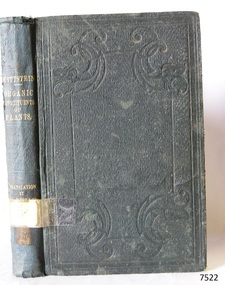
Book, The Organic Constituents of Plants and Vegetable Substances
... The Warrnambool Mechanics' Institute’s publication collection is of both local and state significance. warrnambool shipwrecked-coast flagstaff-hill flagstaff-hill-maritime-museum maritime-museum shipwreck-coast flagstaff-hill-maritime-village shipwrecked-artefact book warrnambool mechanics’ institute pattison collection warrnambool library ralph eric pattison warrnambool city librarian mechanics’ institute library victorian library board warrnambool books and records warrnambool children’s library the organic constituents of plants and vegetable substances and their chemical analysis baron ferdinand von mueller Label on spine cover with typed text PAT 581.994 MUE Pastedown front endpaper has sticker from Warrnambool Mechanics Institute and Free Library Front loose endpaper has a sticker from Corangamite Regional Library Service The Organic Constituents of Plants and Vegetable Substances and Their Chemical Analysis Author: Dr G C Wittstein Authorised translation from the German orginal by Baron Ferdinand Von Mueller Publisher: McCarron Bird & Co Date: 1878 The Organic Constituents of Plants and Vegetable Substances Book ...This item is from the ‘Pattison Collection’, a collection of books and records that was originally owned by the Warrnambool Mechanics’ Institute, which was founded in Warrnambool in 1853. By 1886 the Warrnambool Mechanics’ Institute (WMI) had grown to have a Library, Museum and Fine Arts Gallery, with a collection of “… choice productions of art, and valuable specimens in almost every branch and many wonderful national curiosities are now to be seen there, including historic relics of the town and district.” It later included a School of Design. Although it was very well patronised, the lack of financial support led the WMI in 1911 to ask the City Council to take it over. In 1935 Ralph Pattison was appointed as City Librarian to establish and organise the Warrnambool Library as it was then called. When the WMI building was pulled down in 1963 a new civic building was erected on the site and the new Warrnambool Library, on behalf of the City Council, took over all the holdings of the WMI. At this time some of the items were separated and identified as the ‘Pattison Collection’, named after Ralph Pattison. Eventually the components of the WMI were distributed from the Warrnambool Library to various places, including the Art Gallery, Historical Society and Flagstaff Hill. Later some were even distributed to other regional branches of Corangamite Regional Library and passed to and fro. It is difficult now to trace just where all of the items have ended up. The books at Flagstaff Hill Maritime Village generally display stamps and markings from Pattison as well as a variety of other institutions including the Mechanics’ Institute itself. RALPH ERIC PATTISON Ralph Eric Pattison was born in Rockhampton, Queensland, in 1891. He married Maude Swan from Warrnambool in 1920 and they set up home in Warrnambool. In 1935 Pattison accepted a position as City Librarian for the Warrnambool City Council. His huge challenge was to make a functional library within two rooms of the Mechanics’ Institute. He tirelessly cleaned, cleared and sorted a disarrayed collection of old books, jars of preserved specimens and other items reserved for exhibition in the city’s museum. He developed and updated the library with a wide variety of books for all tastes, including reference books for students; a difficult task to fulfil during the years following the Depression. He converted all of the lower area of the building into a library, reference room and reading room for members and the public. The books were sorted and stored using a cataloguing and card index system that he had developed himself. He also prepared the upper floor of the building and established the Art Gallery and later the Museum, a place to exhibit the many old relics that had been stored for years for this purpose. One of the treasures he found was a beautiful ancient clock, which he repaired, restored and enjoyed using in his office during the years of his service there. Ralph Pattison was described as “a meticulous gentleman whose punctuality, floorless courtesy and distinctive neat dress were hallmarks of his character, and ‘his’ clock controlled his daily routine, and his opening and closing of the library’s large heavy doors to the minute.” Pattison took leave during 1942 to 1942 to serve in the Royal Australian Navy, Volunteer Reserve as Lieutenant. A few years later he converted one of the Museum’s rooms into a Children’s Library, stocking it with suitable books for the younger generation. This was an instant success. In the 1950’s he had the honour of being appointed to the Victorian Library Board and received more inspiration from the monthly conferences in Melbourne. He was sadly retired in 1959 after over 23 years of service, due to the fact that he had gone over the working age of council officers. However he continued to take a very keen interest in the continual development of the Library until his death in 1969. The Pattison Collection, along with other items at Flagstaff Hill Maritime Village, was originally part of the Warrnambool Mechanics' Institute’s collection. The Warrnambool Mechanics’ Institute Collection is primarily significant in its totality, rather than for the individual objects it contains. Its contents are highly representative of the development of Mechanics' Institute libraries across Australia, particularly Victoria. A diversity of publications and themes has been amassed, and these provide clues to our understanding of the nature of and changes in the reading habits of Victorians from the 1850s to the middle of the 20th century. The collection also highlights the Warrnambool community’s commitment to the Mechanics’ Institute, reading, literacy and learning in the regions, and proves that access to knowledge was not impeded by distance. These items help to provide a more complete picture of our community’s ideals and aspirations. The Warrnambool Mechanics Institute book collection has historical and social significance for its strong association with the Mechanics Institute movement and the important role it played in the intellectual, cultural and social development of people throughout the latter part of the nineteenth century and the early twentieth century. The collection of books is a rare example of an early lending library and its significance is enhanced by the survival of an original collection of many volumes. The Warrnambool Mechanics' Institute’s publication collection is of both local and state significance. The Organic Constituents of Plants and Vegetable Substances and Their Chemical Analysis Author: Dr G C Wittstein Authorised translation from the German orginal by Baron Ferdinand Von Mueller Publisher: McCarron Bird & Co Date: 1878 Label on spine cover with typed text PAT 581.994 MUE Pastedown front endpaper has sticker from Warrnambool Mechanics Institute and Free Library Front loose endpaper has a sticker from Corangamite Regional Library Servicewarrnambool, shipwrecked-coast, flagstaff-hill, flagstaff-hill-maritime-museum, maritime-museum, shipwreck-coast, flagstaff-hill-maritime-village, shipwrecked-artefact, book, warrnambool mechanics’ institute, pattison collection, warrnambool library, ralph eric pattison, warrnambool city librarian, mechanics’ institute library, victorian library board, warrnambool books and records, warrnambool children’s library, the organic constituents of plants and vegetable substances and their chemical analysis, baron ferdinand von mueller -
 Flagstaff Hill Maritime Museum and Village
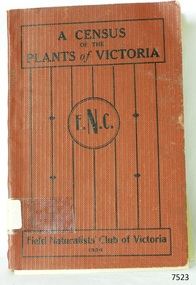
Book - Referance Book, Field Naturalist Club of Victoria, A Census of The Plants of Victoria, 1928
... It contains indexes to aid the students, botanists and plant enthusiasts in their search for information. Label on spine cover with typed text R.A. 581 CEN Front cover: "(F.N.C.V.) within a circle" Fly page: "[flower and initials F.N.C.V.] within a rectangle" Fly page: "3s. 5d." ...The book, 'A Census of the Plants of Victoria', is a comprehensive reference book of plant varieties and their distribution in the Australian State of Victoria. This second edition was published by the Field Naturalists' Club of Victoria, and printed in Melbourne. It contains indexes to aid the students, botanists and plant enthusiasts in their search for information.Orange-brown front cover with black printed text, vertical lines and rectangular borders around the upper title, and lower publishing group, and a central circular logo of the publishing group, Field Naturalists' Club of Victoria. Title: (in full) A Census of the Plants of Victoria With their Regional Distributions and the Vernacular Names as adopted by the Plant Names Committee of the Field Naturalists' Club of Victoria. Publisher: Field Naturalists Club of Victoria Edition: Second Edition Date: 1928non-fictionThe book, 'A Census of the Plants of Victoria', is a comprehensive reference book of plant varieties and their distribution in the Australian State of Victoria. This second edition was published by the Field Naturalists' Club of Victoria, and printed in Melbourne. It contains indexes to aid the students, botanists and plant enthusiasts in their search for information.warrnambool, shipwreck coast, flagstaff hill maritime museum, flagstaff hill maritime village, book, a census of the plants of victoria, field naturalists' club of victoria, plant names, plant species, distribution of plants, victoria's plants, plant identification
