Returned Nurses RSL Sub-branch
Memorabilia - Scrapbook, Beryl Randall Trigellis-Smith (neé Sampson), [various]
... Nurses Club' (handwritten poem with annotations) - 'J M[?] Bilee' & 'CPL R.L. Harrowfield' [Handwritten names? either side of title, author/s of poem assumed], paper has tear marks on reverse where it has been removed from another piece in the past and some writing obscured by area of attachment into current scrapbook. Poem is '(Dedicated to A.I.F Nurses of World War I 1914-18 War) Bendigo / 1976'.
36. 'Living up to an ideal' (black and white newspaper clipping) - by Kayleen Mort out the 'The Sun' Monday, July 10 1972, p.34. Article includes four black and white photographs. Article is about...Nurses Club' (handwritten poem with annotations) - 'J M[?] Bilee' & 'CPL R.L. Harrowfield' [Handwritten names? either side of title, author/s of poem assumed], paper has tear marks on reverse where it has been removed from another piece in the past and some writing obscured by area of attachment into current scrapbook. Poem is '(Dedicated to A.I.F Nurses of World War I 1914-18 War) Bendigo / 1976'.
36. 'Living up to an ideal' (black and white newspaper clipping) - by Kayleen Mort out the 'The Sun' Monday, July 10 1972, p.34. Article includes four black and white photographs. Article is about ...
Scrapbook owned by Beryl Randall Trigellis-Smith (neé Sampson) who served as a nurse in WWI and was an active member of many nursing related organisations include the Returned Nurses Club (Victoria). Contains newspaper & magazine clippings, postcards, poetry, quotes/reflections, pamphlets (Order of services), photocopied correspondence, single page Order of Services/Service announcements, speeches & toasts, booklets, personal stories, contact details, photocopied excerpts, menus, invitations, order of ceremonies, certificates.
Titles and (formats) in order:
1. 'A Maori's stirring dawn address : What Anzac has come to mean' (newspaper clipping) - article providing the full address given by Lt. Colonel C M Bennett DSO at the Dawn Parade ceremony in Wellington (NZ) 1957 [publication unknown].
2. Coat hangers (newspaper clipping) - article about items on display [at a market? date unknown, under handwritten 'Troop Train' heading]
3. 'What's in a name? -just ask the matron' (newspaper clipping) - article providing basic information about Margaret Lang and the Society for the Care of Aged or Incapacitated Nurses by John Hamilton [publication unknown, handwritten note 'August 1973']
4. 'World War I nurse remembers : Continued from page 41' (magazine clipping) - part of the recollections of WWI nurse Sarah Margaret White (neé Furnifull) [1973, Australian Women's Weekly]
5. Sister Rosina Dawson (newspaper clipping) - brief article and photo on Rosina Dawson becoming Victoria's first construction site nurse at site of Collins Place Twin Towers [unknown publication & date]
6. 'A World War 1 nurse remembers...' (magazine clipping) - beginning of clipping #4 [1973, Australian Women's Weekly]
7. The White Tower, Salonika (newspaper clipping) - photo and map of area around Aegean Sea [unknown date and publication]
8. 'A stern hearted chaperone', 'At the top of Mt. Kotos, Salonica, 1918' and 'Life and mirage' (typed poems) - All by Trigellis-Smith circa 1918.
9. 'Boat drill' (typed poem) - By Trigellis-Smith
10. 'Aged 83, she wears her MBE lightly' (newspaper clipping on separate sheet) - Brief biographical article by Barbara Hooks on Beryl Trigellis-Smith receiving her MBE [1976, publication unknown]
11. Leslie Hill (newspaper clipping on back of separate sheet) - Large black & white photograph with caption of Leslie Hill, the gardener who created the flowerbed celebrating the 80th anniversary of the Royal Australian [Army] Nursing Corps and Beryl Trigellis-Smith. [Handwritten notes publication as Herald, December 28 1982]
12. 6/12/17 (newspaper clipping) - Appears to be printed excerpts from a diary of someone [a nurse] serving in WWI [publication and date unknown]
13. 7/3/18 (newspaper clipping) - Appears to be printed excerpts from a diary of someone [a nurse] serving in WWI [publication and date unknown]
14. 'Description of Anzac Day, April 25th, 1916.' & 'A Description of Anzac Day, from Second World War Sister E. F. Jones' (typed excerpts) - first excerpt by E C Dobson, (probably a sister at Mundros), second author in title.
15. [Postcard?] - black and white photograph on glossy card showing an Australian military band posing for photograph on steps in front of multiple storey walls of sandbags [based on Google image search, on the steps in front of Amiens Cathedral circa August 1918].
16. 'A most inglorious war' (newspaper clipping) - Review of 'The forgotten war' by L M Field including information on how the Boer war began and how Australians got involved by Patsy Adam-Smith [unknown publication, circa 1979].
17. 'Order of Divine Service to mark The Commemoration of ANZAC' (pamphlet separate to scrapbook) - took place at Cathedral Church of Saint Paul Melbourne, 22 April, 1979.
18. 'Annual wreath laying service Edith Cavell Memorial' (photocopied typed document) - from 22 April 1979, order of proceedings including an address to be given by Beryl Trigellis-Smith.
19. 'Saturday review' (newspaper clipping) - a captioned black and white illustration of Florence Nightingale in the hospital at Scutari. Reproduced from the 'Illustrated London News' of February 24, 1855. [unknown UK publication and date]
20. 'spirit and pride' (newspaper clipping) - these words clipped from a headline [unknown publication and date].
21. 'Miss Nightingale' (newspaper headline attached to back of newspaper clipping) - by Richard Gordon. Excerpt from book by same 'The private life of Florence Nightingale' [circa 1978, unknown UK publication].
22. (photocopied letter with handwritten 'Beryl' in gap in salutation) - photocopy poor and unable to read who author/sender is [maybe Ms P Adam-Smith?] dated 14 December 1978.
23. 'Shrine of Remembrance (Melbourne, Victoria)' (postcard with handwritten caption) - 'Shaft of sunlight at 11am Remembrance Day 11th November', published by Rose Stereograph Co. [unknown year].
24. 'Annual service of dedication for nurses' (booklet) - Order of service booklett for Wednesday 9th May, 1979, 5:45pm at St Patrick's Cathedral.
25. [No title] (newspaper clipping) - article by Patsy Adam-Smith 'who was at the Anzac Day parade for 'The Age''. [circa 1979]
26. 'Ecumenical service of dedication for nurses' (photocopied service announcement) - St Patrick's Cathedral, Wednesday 9 May 1979, anniversary of the birth of Florence Nightingale.
27. 'Parade of a nation'[sic] (newspaper clipping) - Headline, large black and white photograph by John Lamb with caption of Glen Hickman marching wearing medals [unknown publication, unknown year, circa late 70's].
28. 'Wreath laying ceremony - Edith Cavell Statue / Sunday Aprill 22nd. 1979 / Address by Mrs. Beryl Trigellis-Smith MBE. Ex A.A.N.S.' (typed pages of speech) - Speech includes general important pioneering dates in Australian nursing from 'South African War 1900' to combining of Royal Trained Nurses Association and Royal College of Nursing in 1933 and a call to current nurses to "regard the heritage of the past - dedication, skill, adaption, understanding of authority, some self-sacrifice, with a dedication to the care of life and death."
29. 'No. 72' (colour photograph postcard) - Underneath handwritten heading in blue ink 'Salonica. 1917'. Image on front of postcard shows two young women in the foreground in traditional clothing, water to their left and two other women walking away from them in the background, buildings on the left of the postcard and in the background on the right the White Tower Thessaloniki. [Postcard more likely from 1950's onwards due to it being a colour photograph and the fashion of the women in the background]
30. (colour postcard) - Torn along one edge, depicts a photograph of what appears to be a print artwork (signature at bottom on right of artwork 3eibe?, on left at bottom Gem 64'. 'Part of a diary found in / Returned Nurse Club in / 1979. Name unknown. / She had experience / in Hospital Ships and / in Salonica. / ?eds up & file.' [written in blue ink on reverse].
31. 'Rancourt - Bouchavesnes' (colour photograph postcard) - Aerial colour photograph of a church and graveyard surrounded by fields and a forest in the background. Information on reverse of postcard indicates image is of the Chapel of French Remembrance for the Somme offensive in 1916 during WWI. Underneath heading '1978. R.S.L. Pilgrimage to. France.' [handwritten in blue ink]. There is information on the reverse handwritten describing part of a tour by same writer as for 32.
32. 'Le Memorial Australien à Villers-Bretonneux' (colour photograph postcard [potential photochrom]) with printed caption on front indicating Le Souvenir Français welcoming Australian pilgrims to Villers-Bretonneux 11 November 1978 with a quote from Marshal Foch made 12 November 1918 - reverse of postcard had handwritten letter addressed to Beryl Randall Trigellis-Smith (neé Sampson), from Howard V[?] talking about events of the tour on 11 & 12 November. Underneath heading '1978. R.S.L. Pilgrimage to. France.' [handwritten in blue ink].
33. 'ANZAC Memorial Day 25th April 1919' (colour & black and white souvenir booklet) - published by the Victorian branch of the Returned Sailors' and Soldiers' Imperial League of Australia to mark the fourth national observance. Front cover is in colour, condition is poor with lots of folds, tears and parts missing, also has many dirt/insect marks and foxing. Internally there is black and white photographs depicting various WWI and post scenes with captions and other pages have text, opposite inside back cover is medical photos including tent hospitals, nurses and hospital wards. Back cover is glued to scrapbook.
34. Photocopy of toast proposal given at Royal Australian Army Nursing Corps 75th Anniversary of Australian Army Nursing - toast speech gives some brief chronological information on nursing in Australian Army that the author [assumed to be Beryl Randall Trigellis-Smith (neé Sampson)].
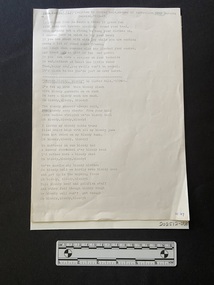
35. 'Poem for our Returned Nurses Club' (handwritten poem with annotations) - 'J M[?] Bilee' & 'CPL R.L. Harrowfield' [Handwritten names? either side of title, author/s of poem assumed], paper has tear marks on reverse where it has been removed from another piece in the past and some writing obscured by area of attachment into current scrapbook. Poem is '(Dedicated to A.I.F Nurses of World War I 1914-18 War) Bendigo / 1976'.
36. 'Living up to an ideal' (black and white newspaper clipping) - by Kayleen Mort out the 'The Sun' Monday, July 10 1972, p.34. Article includes four black and white photographs. Article is about the Royal Australian Army Nursing Corps having provided nurses in wars for 70 years, even though nurses served prior in the Boer War. Article features a photograph of Irene [Mildred] Woodward (neé Clay) then secretary of the Victorian Returned Nurses' Club.
37-39. 'The A.I.F. were healthy, stealthy and chatty' (photocopied typed short story with handwritten annotations) - 'Section one - True experiences / 1976 Repatriation story writing project' headed, first person story [assumed to be written by Beryl Randall Trigellis-Smith (neé Sampson), however point of view appears to be of a soldier, not a nurse] over three pages, glued in separately. Story is autobiographical and mentions 8th Battalion Pastors Hayden and Paddy O'Shea helping morale there and Padre J J Booth helping the unit the protagonist was attached to. Protagonist speaks of shocking sights and the poetry or history that these brought to the surface as well as different aspects of their experience.
40-45. 'St. Vincent - our Atlantic calling port.' & 'They need our help to-day' (typed poems[?]) - Pieces glued, out of order[?], [author assumed to be Beryl Randall Trigellis-Smith (neé Sampson)].
46. 'Burial at sea.' (typed poem and information) - [author assumed to be Beryl Randall Trigellis-Smith (neé Sampson)] four stanzas of a poem followed by partial information about the authors experience of a burial at sea, the return to Australia experience and what the author did after. Information is incomplete, cut off mid sentence and not continued on next part.
47-50. 'The order of the Iris', 'The 42nd Unit transferred to Hill 60.' & 'The sunset call at sea.' (typed poetry and brief information) - A poem missing a beginning, followed by first title listed, then second title begun and continued on to second part, completed over page on third part and final poem on last part. [Author assumed to be Beryl Randall Trigellis-Smith (neé Sampson)]
51. 'Life in Salonica, 1918.' & 'Transport in Salonica - 1918' (typed poems) - [Author assumed to be Beryl Randall Trigellis-Smith (neé Sampson)]
52. 'Whatever happened to Macka?' (newspaper clipping) - Advertisement for the Returned Services League [unknown publication & date].
53. 'Few passengers for free rides' (newspaper clipping) - Article by Bob Millington interviewing Colin Keon-Cohen (then president of Victorian branch of RSL) about the dwindling numbers of WWI veterans, loss of all Boer War vetrans, dinners held for veterans and how popularity in RSL clubs was growing. [unknown publication and date]
54. 'Nurses at war : Reflected in the pages of Nursing Mirror 1888-1978' (newspaper clipping) - Article by Barbara Rogers just prior to the 90th birthday of publication 'Nursing Mirror', describing the "adventurous response made by nurses in wartime". Published in Nursing Mirror, 6 April 1978.
55. 'Names & Addresses cond' (photocopied contact details) - Address and former unit details of people [on a tour?] along with Tour Escort, [tour assumed to be the RSL Pilgrimage to France in 1978].
56. As for 3, except for handwriting on reverse as entire reverse glued to page.
57. 'The crimes of Germany' ([thermal?] photocopy of excerpts [from a newspaper supplement published after 1915]) - Published in London by The Field & Queen (Horace Cox) Ltd., excerpts include the front cover, pages 99-101 headed 'XVI - Poisoned wells.' & 'XVII - The execution of Miss Edith Cavell.'
58. 'War nurses hold jubilee dinner' (newspaper clipping) - Article on dinner held honouring the conferral of Royal to the Royal Australian Army Nursing Corps that included over 560 guests nursing veterans from 1902 (who formed the Australian Army Nursing Service) through to Korean war nursing veterans, the Governor of Victoria (Sir Dallas Brooks), his wife, a Boer war nurse and others. Nurses mentioned by name: Ida O'Dwyer (Royal Red Cross), H[ilda Therese Redderwold] Samsing, E[mma] A[rgyle] Cuthbert, J[essie] McHardy White [neé Williamson], Jane Bell, Mrs P Sutherland [unable to find full and maiden name], Clara [Louisa] Ross, P[riscilla Isabel] Kirby [neé Wardle], Mrs E Lloyd, E[thel] J[essie] Bowe, E[dith] L[ydia] Shaw, J G [Effie Mary] Fussell [neé Garden], E[lizabeth] F[rancis] Johns, J[eanie] Gray Robertson, A[nnie] M[oran] Sage, Grace [Margaret] Wilson, C[harlotte Joan] G[sic] McRae, [Annie] I[na] Laidlaw, M[argaret Irene] Lang and Kathleen [Annie Louise] Best. Also mentioned Sybil Irving (Voluntary Aid Detachment), Major General [Frank] Kingsley Norris (Army Medical Officer).
59. 'Nursing a secret' (newspaper clipping) - Brief article with some biographical details on the wedding reception of Vivian Bullwinkel to Frank Statham and her soon move to Perth to be with Frank. [Publication unknown, circa 1977]
60. 'An Ecumenical Service of dedication for nurses' (pamphlet) - took place at Cathedral Church of Saint Paul Melbourne on Wednesday 10 May, 1978.
61. 'R.S.L. Victorian Branch : 60th Anniversary Remembrance Day Dinner' (menu pamphlet) - took place Friday 10 November 1978.
62. 'Circular : M/31/78' (invitation) - Distributed through RSL Victorian branch. From Premier of Victoria to "all ex-servicemen and women and their families in Victoria to attend the Remembrance Day Ceremony" 11/11/1978.
63. 'Remembrance Day Ceremony' (order of ceremony booklet) - Arranged by 'The Government of Victoria', took place at the Shrine of Remembrance, Melbourne 11/11/1978.
64. (Original certificate) - From the Australian Comforts Fund, Victorian Division to Miss M Ambler [?] "In grateful recognition of valuable services rendered in a voluntary capacity to the Australian Comforts Fund during World War 1939=1945".
65. (Invitation) - To B[eryl Randall] Trigellis-Smith [(neé Sampson)] from Victorian Government "to attend a Luncheon celebrating the Anzac Landing Diamond Jubilee. Location National Gallery of Victoria, 22 April 1975.
66. (Menu) - from event in 65. Includes eight autographs including E M Fussell [?], Margaret Lang, Linda Douglas [?], Chris E Bonwick [?], G J McWilliams [?], Beryl [Randall] Trigellis-Smith [(neé Sampson)], Carl Klu [?], [?].
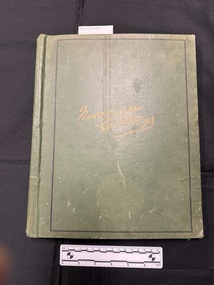
67. (Invitation) - From Florence Nightingale Victorian War Nurses' Trust "Chairman, Air Vice-Marshal E.A. Daley, C.B.E., K.St.J. and trustees invite a representative of Edith Cavell Trust Fund to attend the War Nurses' Memorial Service to be held at the Edith Cavell Statue, Birdwood Avenue, on Sunday, 20th of April, 1975".Green album/scrapbook, covers and spine show wear, water marks and fading. Internally pages have been removed and many items have been put in or attached to the pages. The items inside have degraded but are mostly intact. There is no exact chronology to the scrapbook and some items appear to be out of order either with similar items or date wise. Most of the clippings are not annotated with dates or publications.
Contains newspaper & magazine clippings, postcards, poetry, quotes/reflections, pamphlets (Order of services), photocopied correspondence, single page Order of Services/Service announcements, speeches & toasts, booklets, personal stories, contact details, photocopied excerpts, menus, invitations, order of ceremonies, certificates.
[Multiple throughout scrapbook often indicating newspaper cutting was from and date]beryl randall trigellis-smith (neé sampson), nursing in warfare, royal australian army nursing corps, australian army nursing service, returned services league (rsl), returned nurses club

![''The Nurses If", unknown, [ca.1930]](/media/collectors/50187a8f023fd7201471f198/items/6a4c687a182c0f52f809c367/item-media/6a4f3bfdea2522adccc5cb96/item-fit-380x285.jpg?cb=6) Alfred Hospital Nurses League - Nursing History Collection
Alfred Hospital Nurses League - Nursing History Collection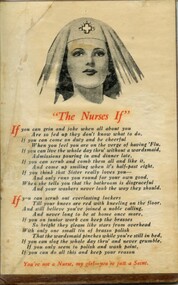 Alfred Hospital Nurses League - Nursing History Collection
 Orbost & District Historical Society
 Orbost & District Historical Society
 Orbost & District Historical Society
 Orbost & District Historical Society
 Returned Nurses RSL Sub-branch
 Returned Nurses RSL Sub-branch