
Showing 5 items matching "pollution free"
-
 Ballarat Tramway Museum
Pamphlet - Pamphlet - Public Transport, Melbourne's Pollution Free Transport
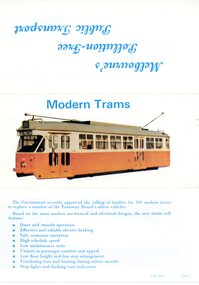
... Melbourne's Pollution Free Transport......pollution free...Outlines Melbourne's Pollution-Free Public Transport - Modern Trams and New Trains for Suburban Network. ...Outlines Melbourne's Pollution-Free Public Transport - Modern Trams and New Trains for Suburban Network. ...Ron Bridger was an avid collector of items related to transport, predominately Trams. These items include newspaper cuttings, pamphlets, reports, timetables, fares prices plus special items relating to events. Items from Melbourne and regional Victoria, interstate - Adelaide and Sydney, plus overseas, make up this collection. Publication produced by the Ministry of Transport in Victoria. Outlines Melbourne's Pollution-Free Public Transport - Modern Trams and New Trains for Suburban Network. The Government called for tenders for 100 modern trams based on the most modern mechanical and electrical designs. Fifty new silver trains have been ordered for Melbourne's suburban electric trains with features previously unknown to commuters.White sheet printed on both sides - blue print Colour photographs - tram, trainSymbol - Ministry of Transportvictorian government, tramway board, pollution free, melbourne suburban trains, ron bridger collection, as box 48a -
 Melbourne Tram Museum
Pamphlet, Minister of Transport, "Melbourne's Pollution Free Public Transport", "Modern Trams", 1973
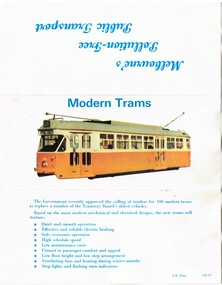
... "Melbourne's Pollution Free Public Transport", "Modern Trams"..."Melbourne's Pollution Free Public Transport", "Modern Trams" Pamphlet Minister of Transport ...Pamphlet, full colour of semi gloss quarto paper, folded into three, providing an image and details and features of new trams (Z class trams) and new Hitachi Silver trains. Issued by the Ministry of Transport. Printed by the Victorian Railways with the VR Print number of 374-73. Features Tram 1041 and a Silver train with a Show Grounds destination. Second copy added 28/11/2016.trams, tramways, public transport, prototype tramcar, z class, hitachi silver train -
 Royal Melbourne Yacht Squadron
Award - Cactus Cup
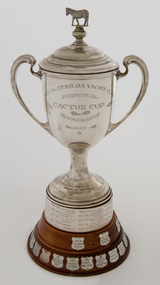
... pollution, the collecting of mussels from the pier was discontinued, so Otto Meik the new provider decided that the format be changed and be replaced by a supper on the day of the race, consisting of bottle mussels, beer and frankfurts. Following the death of Otto Meik in 1979, with no provider for the trophy of replicas, the Squadron in the early 80’s broke tradition by introducing race entry fees. In 2006 the Cactus Cup Tradition was reinstituted by a donation from J.H. (Bert) Ferris – RMYS historian. The Cactus Cup is now free...pollution, the collecting of mussels from the pier was discontinued, so Otto Meik the new provider decided that the format be changed and be replaced by a supper on the day of the race, consisting of bottle mussels, beer and frankfurts. Following the death of Otto Meik in 1979, with no provider for the trophy of replicas, the Squadron in the early 80’s broke tradition by introducing race entry fees. In 2006 the Cactus Cup Tradition was reinstituted by a donation from J.H. (Bert) Ferris – RMYS historian. The Cactus Cup is now free ...“The Squadron’s Most Prestigious Trophy” THE CACTUS STORY Years ago a story was told of a Donkey which lived in the desert. The standard of living was poor, and the main course on the menu when things were tough was cactus. The Donkey accepted the good with the bad, and in bad seasons it was always cactus. One day during his wanderings he came to a high fence. On the other side of the fence was lush grass and all sorts of vegetation and animals in prime condition. The Donkey said to a horse, “things look good in there, how does one get in”. The horse said “go down to the end of this fence, and you will come to a gate, there will be someone at the get, ask to get in”. The Donkey went to the end of the fence, found the gate and asked to get in. The horse at the gate said, “what do you want to come in for, all of us are geldings?”. The Donkey said “if that is the case, it is back to the cactus for me”. It was during the early stages of the great depression of 1929-1932, that this story was simulated to the conditions at the then Royal St. Kilda Yacht Club, when during the yachting season there were very few trophies due to the lack of money. A lot of members were out of work, and each Monday many would front up for the jobs that were offering or those who missed out went back to the dole or as many put it “Back to the Cactus”. The “Cactus Cup” race, to be free of entrance fees, was an idea conceived by H.A. (Toby) Armstrong, soon to be backed by Bert Bryant, Ivor Bowles and Jim Thorpe. It was First sailed March 25, 1922, when 9 yachts on sealed handicaps, raced over a 5 mile rectangular course for a small Trophy donated by Jim E. Thorpe and the winning crew of the yacht Helen, skippered by D.Dowse, entertained at a café after the race by the instigators of the race. The next contest was April 12, 1930, for another small trophy also donated by Jim Thorpe, and the crew of the winning yacht Petrel, skippered by Stan Gamble, later on having to arrange for a mussel supper to the extent of Trophy money at an informal musical evening held in the spar room. From then on races for the Cactus Cup became an annual event. In time the format was changed to result in the crew of the first winning yacht having to collect mussels from the pier on the first Saturday of July, cook and prepare them for a no charge informal supper and entertainment evening held in the spar room, towards which the Club provided a keg of Beer. Member Bob Ellis had a special song for the occasion, “Up at Tumba Bloody Rumba shooting Kanga Bloody Roos”. Jim Thorpe then agreed to purchase a Perpetual Cup to be named the Cactus Cup. As guest of honor at the Cactus Supper Evening, May 1940, a dinner suit function in the Spar room, he presented the Cup along with Replica to Barney Snider who won with Eun-Na-Mara. Soon entries became few, for reason nobody wanted to win because of the penalty of having to collect, cook and prepare the mussels. In the interest of the contest and its revival, it was decided that the crew of the last yacht to finish had to collect, cook and prepare the mussels. On the death of Jim E Thorpe in 1944, the trophy, along with its annual replicas, were then provided for by Ivor Bowles until his death in 1970. In time for reason of pollution, the collecting of mussels from the pier was discontinued, so Otto Meik the new provider decided that the format be changed and be replaced by a supper on the day of the race, consisting of bottle mussels, beer and frankfurts. Following the death of Otto Meik in 1979, with no provider for the trophy of replicas, the Squadron in the early 80’s broke tradition by introducing race entry fees. In 2006 the Cactus Cup Tradition was reinstituted by a donation from J.H. (Bert) Ferris – RMYS historian. The Cactus Cup is now free to enter once again for all. The race is run early and a late afternoon feast of mussels and frankfurts is eaten afterwards.Deep sectioned Silver Cup, 300mm high to lip, tapering to thick plain stem flaring out to stepped footing, has two shaped handles. Silver Lid with Donkey positioned on shaped dome. Overall height 110mm. Cup stands on 145mm high round black base with stepped footing, surrounded with Silver winner inscription band.ROYAL ST. KILDA YACHT CLUB PERPETUAL CACTUS CUP INAUGURATED 1922 INSTIGATED BY H.A. ARMSTRONG ESQ. ORIGINAL CUP PRESENTED BY J.E. THORPE ESQ.cactus cup, trophy -
 Kiewa Valley Historical Society
Photograph Tournapull, Tournapull C Scraper/Single Bucket, circa 1950
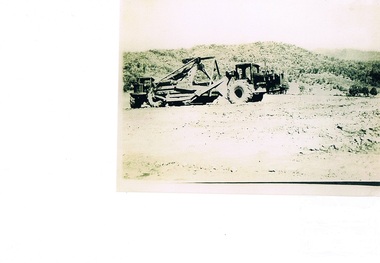
... Air pollution of the major cities and the increase in power demands of both industries and population within them required an alternative pollution free alternative electricity supply. These for runners of Hydro electricity generators required both large supplies of machinery and human resources. ...The machinery in this photo shows a Tournapull C earth moving machine, one of many during this period Circa 1950 - 1960s when hydro electricity powered turbines were being constructed in both the Victoria and New South Wales Alps. This was Australia's answer to a non polluting supply of electricity for a fast growing city population. It was at this time that air pollution from coal powered furnaces was becoming more and more under attack by health authorities.This item is part of a visual account of the construction of dams and hydro electricity facilities during the early 1950s. It was the beginning of the environmental push not to allow the degrading of Australian Alpine regions. Air pollution of the major cities and the increase in power demands of both industries and population within them required an alternative pollution free alternative electricity supply. These for runners of Hydro electricity generators required both large supplies of machinery and human resources. This construction phase within the region brought not only tradesmen but also unskilled workers to an area which had mainly had farming and mining activities. It was the catalyst for the creation of the smaller towns/villages e.g. Bogong Village, Mount Beauty and Bright.Black and white photograph on Kodak Xtralite II paper.(gloss)paper marking on back Kodak Xtralite II papermining, hydro electricity, victorian alps, construction camps, earth moving machines, secv -
 Port Melbourne Historical & Preservation Society
Poster - "Our Choice?", "Port Our City Our Life Our Choice" protest, Pat Grainger, Sep 1987
... Keep Port free of traffic jams and increased pollution. Objections to major development due by 8 September" Photograph B+W Graphics red, blue, white. (3 copies)...Keep Port free of traffic jams and increased pollution. Objections to major development due by 8 September" Photograph B+W Graphics red, blue, white. (3 copies) Poster "Our Choice?" ...This object was one of several 'arts' projects against the SCDC Bayside development. proposals, funded by the Uniting Church's 'Social Justice and the City Project' in 1987. Posters urged residents to take part in the Sept. enquiry into the Environmental Effects statement. "Our Choice?" One of three "Port Our City Our Life Our Choice" series protest posters. Below photograph - "For Port's sake, speak up! Keep Port free of traffic jams and increased pollution. Objections to major development due by 8 September" Photograph B+W Graphics red, blue, white. (3 copies)public action campaigns
