
Showing 18 items matching "pomegranate"
-
 Embroiderers Guild, Victoria
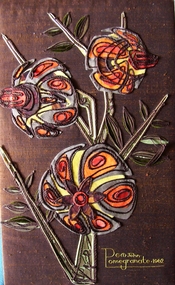
Textile - Edith John Appliqué Embroidery " Pomegranates " Panel, Edith M. John, 1962
... Modern applique embroidery depicting pomegranates in green, brown and orange with detail worked in cords and threads....E.M. John, Pomegranates 1962...Embroidery Panels Applique 1940-60 England E.M. John, Pomegranates 1962 Modern applique embroidery depicting pomegranates in green, brown and orange with detail worked in cords and threads. ...Bought by Mrs Oates from London 1962. Edith M. John. Well known English embroiderer. Modern applique embroidery depicting pomegranates in green, brown and orange with detail worked in cords and threads. E.M. John, Pomegranates 1962 embroidery, panels, applique, 1940-60, england -
 Port Melbourne Historical & Preservation Society
Document - Tall Ships calendar, Pomegranate Calendars and Books, 1988
... Pomegranate Calendars and Books...SS Nippon Maru, Tokyo (cover):SS Sagres, Portugal:SS Golden Hind, USA:SS Gorch Fock, West Germany:SS Esmeralda, Chile:SS Dar Mlodziezy, Poland:SS Svanen, England:SS Krusenstern, USSP:SS Cuauhtemoc, Mexico:SS Sea Cloud, Cayman Island:SS Juan Sebastian Elcano, Spain:SS Simon Bolivar, Venezuela Document Tall Ships calendar Pomegranate Calendars and Books ...Tall Ships calendar: one month per page, each headed with colour prints of a sailing ship, plus cover featuring colour photo of the Nippon Maru. SS Nippon Maru, Tokyo (cover):SS Sagres, Portugal:SS Golden Hind, USA:SS Gorch Fock, West Germany:SS Esmeralda, Chile:SS Dar Mlodziezy, Poland:SS Svanen, England:SS Krusenstern, USSP:SS Cuauhtemoc, Mexico:SS Sea Cloud, Cayman Island:SS Juan Sebastian Elcano, Spain:SS Simon Bolivar, Venezuela transport - shipping, ss nippon maru, ss sagres, ss golden hind, ss gorch fock, ss esmeralda, ss dar mlodziezy, ss svanen, ss krusenstern, ss cuauhtemoc, ss sea cloud, ss juan sebastian elcano, ss simon bolivar -
University of Melbourne, Burnley Campus Archives
Slide, A. Pout, C76, 1949
... ...pomegranate..."Gardens - Punicum granatum Pomegranate in flower." ...The collection was donated to the Archives by Mabs Younger on the 16 November 1990. gardens pomegranate flowers mabs younger slide collection a. pout kodachrome burnley school w. pattinson botanical gardens "Gardens - Punicum granatum Pomegranate in flower." ...The Mabs Younger Slide Collection is made of 20 envelopes containing 24 35mm Kodachrome colour slides. The photographs were taken in December 1949. Photographer A. Pout - Burnley School, W. Pattinson - Melbourne Conserc. C102 1 & 2, A. Pout - Botanical Gardens C99. Labelled and typed list. The collection was donated to the Archives by Mabs Younger on the 16 November 1990. "Gardens - Punicum granatum Pomegranate in flower." gardens, pomegranate, flowers, mabs younger, slide collection, a. pout, kodachrome, burnley school, w. pattinson, botanical gardens -
 Warrnambool and District Historical Society Inc.
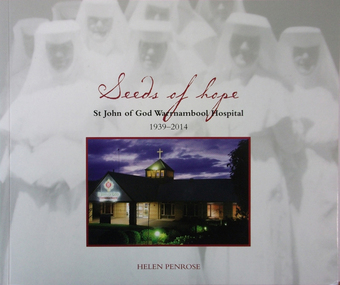
Book, Helen Penrose, Seeds of Hope St John of God Hospital Warrnambool 1939-2014, 2014
... Front Cover: Seeds of Hope –St John of God Warrnambool Hospital, 1939-2014, Helen Penrose Back Cover: Sketch of two pomegranates and text regarding the adoption of the pomegranate by the Sisters as a symbol. ...John of God Hospital, now an important private hospital offering a wide range of health services and therefore an organization with a high profile in the city and one well-respected by the community in general. st john of god warrnambool hospital glenrye healthcare warrnambool History of St John of God Hospital, Warrnambool 1939-2014 Front Cover: Seeds of Hope –St John of God Warrnambool Hospital, 1939-2014, Helen Penrose Back Cover: Sketch of two pomegranates and text regarding the adoption of the pomegranate by the Sisters as a symbol. ...History of St John of God Hospital, Warrnambool 1939-2014This is a book of 78 pages with a stiffened cardboard cover. The cover is greyish-white with a colour photograph of the hospital and background blurred images of St John of God nuns on the front cover. The book contains printed material, maps, tables, black and white and colour photographs and illustrations. non-fiction History of St John of God Hospital, Warrnambool 1939-2014 st john of god warrnambool hospital, glenrye, healthcare, warrnambool -
 Embroiderers Guild, Victoria
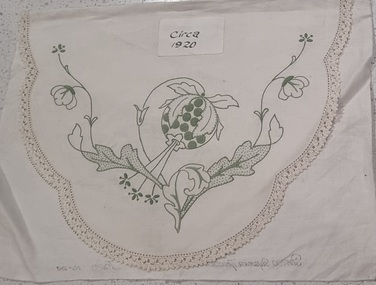
Textile - Semco 1920's Embroidered Sample Mat, Semco, 1920's
... Semco partially embroidered sample depicting green pomegranate in stem stitch and French knots.... • Relocation & Amalgamation: Semco moved to George Street in Sandringham around 1977 and amalgamated with Coats Paton in 1983. embroidery transfer Semco Semco Superior Needlework #920 16 x 14 Adhesive label "Circa 1920" Semco partially embroidered sample depicting green pomegranate in stem stitch and French knots. Textile Semco 1920's Embroidered Sample Mat Semco ...Semco (Australian Needlework & Textiles) • Origins (1907–1910s): Founded in Melbourne in 1907 by Stanley Everard Mullen (whose initials formed "SEM"), initially importing paper goods like postcards and transfers. After Mullen died in 1910 and a fire hit the city building, director C. H. Mylius shifted focus toward fabrics and craft supplies. • Black Rock Era (c. 1918–1977): Operations moved to Cheltenham Road in Black Rock, bayside Melbourne. Semco became known for stamped needlework, embroidery threads, sewing patterns, tablecloths, and fabric goods, as well as supplying shirts for the Australian Defence Force during World War II. • Workplace & Community: The Black Rock site stood out for its landscaped gardens, sports and recreation facilities, fair employment for women, and early adoption of an industrial psychologist. • Relocation & Amalgamation: Semco moved to George Street in Sandringham around 1977 and amalgamated with Coats Paton in 1983. Semco partially embroidered sample depicting green pomegranate in stem stitch and French knots. Semco Superior Needlework #920 16 x 14 Adhesive label "Circa 1920" embroidery, transfer, semco -
 Embroiderers Guild, Victoria
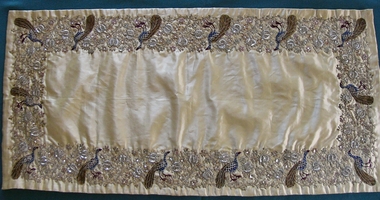
Textile - Table mat
... Pale yellow satin with a classical embroidered border in silver metal threads, and bullions. Flowers and pomegranates. Peacocks in dark blue, red, green and gold metal....Embroidery Mats Metal thread India Pale yellow satin with a classical embroidered border in silver metal threads, and bullions. Flowers and pomegranates. Peacocks in dark blue, red, green and gold metal. ...Found in an opportunity shop. Pale yellow satin with a classical embroidered border in silver metal threads, and bullions. Flowers and pomegranates. Peacocks in dark blue, red, green and gold metal. embroidery, mats, metal thread, india -
 Embroiderers Guild, Victoria
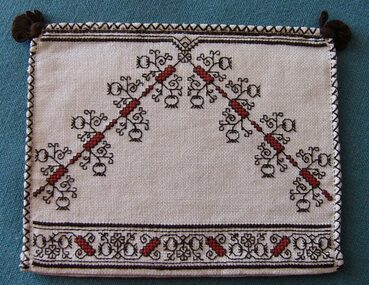
Textile - Blackwork Embroidery Tea Cosy, Early 20th century
... Double running patterns using brown and red in a pomegranate design. Two small brown tassels decorate the top corners....Double running patterns using brown and red in a pomegranate design. Two small brown tassels decorate the top corners. ...Made of even weave ecru linen. Double running patterns using brown and red in a pomegranate design. Two small brown tassels decorate the top corners. embroidery, 1900-20, italy, double running stitch, tea cosy -
 Embroiderers Guild, Victoria
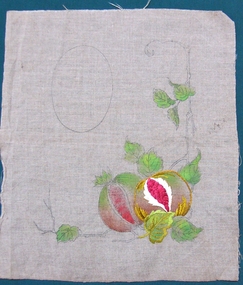
Textile - Silk Embroidery Kit, 1900-20
... Dark ecru linen with a design of pomegranates partly embroidered in the lower right corner. ...Embroidery Silk Embroidery Kits Dark ecru linen with a design of pomegranates partly embroidered in the lower right corner. ...Dark ecru linen with a design of pomegranates partly embroidered in the lower right corner. There is an oval marked in top left corner, which is meant to be cut out for a photograph to be inserted when the piece is mounted (no threads with kit). embroidery, silk embroidery, kits -
 Embroiderers Guild, Victoria
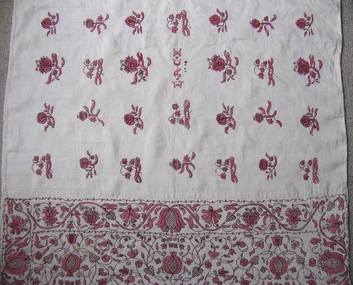
Textile - Jacobean Embroidered Pillow Cover 1704, 1704
... There is a 230 mm band in a pattern of scrolling flowers and pomegranates....There is a 230 mm band in a pattern of scrolling flowers and pomegranates. Textile Jacobean Embroidered Pillow Cover 1704 ...Possibly made from a larger bed hanging. Fine white linen, embroidered in the Jacobean style with linen thread in pink and white, and outlined in a fine gilt, now tarnished. Main area has 34 floral motifs. There is a 230 mm band in a pattern of scrolling flowers and pomegranates. 1704 E.A.C.K. (cross stitch) embroidery, pillow cases, 18th century, england -
University of Melbourne, Burnley Campus Archives
Book - Register, Fruit, 1937-1939
... Handwritten bound register of fruits (plums, peaches, almonds, grapes, quinces, figs, walnuts, guavas, persimmons, pomegranates, loquats, olives and medlars . and Gooseberries) with position on the land in Burnley Gardens Orchard. ...fruits plums peaches almonds grapes quinces figs walnuts guavas persimmons pomegranates loquats olives medlars orchard diagrams register fruit varieties Burnley Gardens FRUIT on spine. ...Handwritten bound register of fruits (plums, peaches, almonds, grapes, quinces, figs, walnuts, guavas, persimmons, pomegranates, loquats, olives and medlars . and Gooseberries) with position on the land in Burnley Gardens Orchard. Register pages hand numbered to Page 111. Includes 2 inserts and 1 diagram. Revised 1937 with some additions in 1938 and 1939. FRUIT on spine. No other title. Revised 1937 Index Subject Fruits listed with page numbers fruits, plums, peaches, almonds, grapes, quinces, figs, walnuts, guavas, persimmons, pomegranates, loquats, olives, medlars, orchard, diagrams, register, fruit varieties, burnley gardens -
 Villa Alba Museum
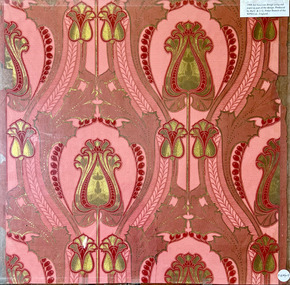
Wallpaper sample - Art Nouveau, 1908
... The pattern features stylized floral motifs, including an elongated tulip-like central element and pomegranate seeds, typical of the Art Nouveau movement's focus on organic, flowing lines. ...The pattern features stylized floral motifs, including an elongated tulip-like central element and pomegranate seeds, typical of the Art Nouveau movement's focus on organic, flowing lines. ...Part of a collection of historic wallpapers collected by Phyllis Murphy, most of whose wallpapers were donated to the collection of Historic Houses Sydney. This wallpaper sample, annotated and encased in mylar was used by Phyllis for educational purposes, and donated by her son to Villa Alba Museum's collection in 2025. 1908 Art Nouveau design using red paper as part of the design. Produced by the C. & J. G. Potter branch of the Wallpaper Manufacturers Ltd. (WPM), England. The pattern features stylized floral motifs, including an elongated tulip-like central element and pomegranate seeds, typical of the Art Nouveau movement's focus on organic, flowing lines. P.W4 (a-n) heritage interiors, wallpapers, art nouveau, floral design, 20th century interior design -
 Villa Alba Museum
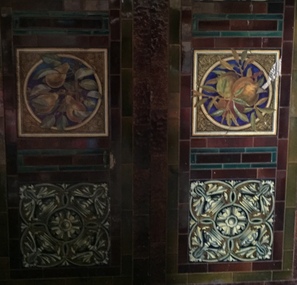
Photograph - Surround Tiles, Dining Room Fireplace, Villa Alba, Mintons Ltd, c.1882
... The central decorative tiles depict pears and pomegranates. Above and below this central pair are abstract floral tiles in shades of olive green, blue and white. ...The central decorative tiles depict pears and pomegranates. Above and below this central pair are abstract floral tiles in shades of olive green, blue and white. ...The Villa Alba Museum is cultural institution committed to the collection, study and display of 19th century interior decorative finishes, and the components of 19th and 20th century interior decoration. Most rooms in this historically and aesthetically significant house have stone (typically marble) fireplaces that are inset with plain and decorative tiles produced by the company of Mintons Ltd. Digital photograph of the pattern of decorative surround tiles on the rear panel of the fireplace in the dining room at Villa Alba. The central decorative tiles depict pears and pomegranates. Above and below this central pair are abstract floral tiles in shades of olive green, blue and white. These six decorative tiles are surrounded by rectangular plain majolica tiles in shades of maroon and teal blue. The tiles were produced by Mintons Ltd. fireplaces, mintons, mintons - tiles, villa alba -- dining room -
 Embroiderers Guild, Victoria
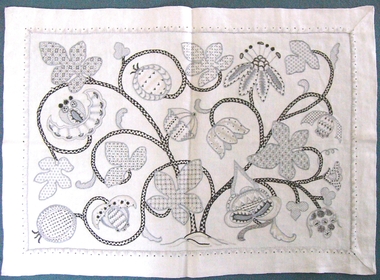
Textile - Jacobean Design Embroidered Mat, Miss G.E. Lawton, Mid 20th century
... ...pomegranate...Lawton Embroidery Surface stitchery Mats Australia 1960-80 Flowers pomegranate Jacobean Mat in natural linen with all over scrolled Jacobean design of flowers and leaves; in counted and surface stitches. ...Designed and worked by Miss G.E. Lawton Mat in natural linen with all over scrolled Jacobean design of flowers and leaves; in counted and surface stitches. Embroidered in black and soft greys. embroidery, surface stitchery, mats, australia, 1960-80, flowers, pomegranate, jacobean -
 Embroiderers Guild, Victoria
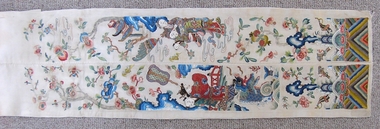
Accessory - Pair of Chinese Embroidered Sleeve Bands, 19 th C
... The head of the sceptre resembles the 'lingzhi' of the 'longevity fungus'. Pomegranate - fertility ie; offspring, a virtue in China. ...Right cuff: Above the water and mountains is a bat, peonies and pomegranates. Above these are three figures and another bat. ...Right cuff: Above the water and mountains is a bat, peonies and pomegranates. Above these are three figures and another bat. ...Chinese sleeve embroidery bands, or wanxiu became popular in the late 19th century during the Qing Dynasty, evolving from the traditional Han cuff embroidery and Manchu styles. These detachable, decorated bands were added to women's informal jackets and robes, often featuring symbolic motifs like landscapes, flowers, and auspicious symbols. They served both a decorative function, displaying artistic skill and personal wishes, and a practical one by covering the sleeves when hands were folded at the waist. History and evolution: Origins: The practice of embroidering cuffs on robes existed during the previous Ming Dynasty for Han women, and this was adopted by the Manchu rulers who founded the Qing Dynasty. Qing Dynasty (1644-1911): The practice was popularized and elaborated upon during this era, with detachable bands becoming a fashionable element for informal wear. Symbolism: The embroidery included a complex visual vocabulary of wishes for a long life, many offspring, and a happy marriage, derived from nature, mythology, and classical literature. Functionality: Women would fold their arms, often with their hands inside the sleeves, so the embroidered bands, which were sewn to hang down the back of the jacket, would be displayed prominently down the front. 19th century peak: The late 19th century was the peak of their popularity, with intricate designs becoming fashionable and even influenced by court tastes, such as those favoured by the Empress Dowager Cixi. Later developments: The late 19th century saw the introduction of chemical 'aniline' dyes from Europe, leading to brighter, bolder colours in embroidery. Motifs and their Meanings: Auspicious symbols: Designs often included symbols for good fortune, wealth, and longevity. Natural imagery: Birds, flowers, and landscapes were common motifs that could represent natural beauty or convey specific symbolic meanings. Figurative scenes: Bands could also feature narrative scenes from classical stories or legends. The choice of motifs allowed women to express personal desires, cultural values, and aesthetic preferences, reflecting a more personal and informal style than official court attire. Symbolism: Mountains and sea, clouds and waves - Good luck. Dragon/fish tail/flaming pearl = Good fortune. This refers to the legend 'liyutiaolongmen' - a carp rising from the waves with the head already changed into a dragon implies the wish for success in the civil service examination. It is an allegory for the persistent effort needed to overcome obstacles. Male with black hat - Zhuang Yuan conferred. Among patterns with implied meanings , patterns related to the pursuits of scholarly honour and official rand include mainly the 'three number ones'. 'Zheng Yuan conferred' and 'carp jumping over the dragon gate'. In feudal society, examiners for the official positions had to go through three different levels of examinations. Bats - the work for bat is 'fu' and is a visual pun for the word happiness 'fu'. Rhino horn - wealth and good fortune. The ruyi sceptre - is a curved decorative Chinese object that symbolizes power, good fortune, and the wish that “things go as you desire.” The head of the sceptre resembles the 'lingzhi' of the 'longevity fungus'. Pomegranate - fertility ie; offspring, a virtue in China. Boy holding the flowering branch in the arms of the woman - in the selection of officials through imperial examinations in feudal society, the winner of an official position is described as ' having picked the crown'. 'Gui' (sweet scented osmanthus) and 'gui' (high rank or official) are very close in sound Chinese. In this design the boy in the woman's arms is seen waving a sweet scented osmanthus, thus an auspicious message is delivered. Information from Dr Rachel Silberstein, visiting Associate Professor at Rhode Island School of Design. "This pair of sleeve bands are two halves of a scene known as "tian xian song zi" or "Heavenly immortals deliver a son". The historical origins of this saying is a story from 'The History of the Wei Imperial records', involving the Emperor Sheng and an immortal maiden who presents him with a son. After this, the expression "tian xian song zi" came to be used as good wishes for marriage, closely associated with 'qilin song zi' (the qilin delivers a son), another popular topic in nianhua popular prints". Both cuffs show figures in an outdoor setting, done in colourful silk thread on a ivory satin. Reading from the bottom to the top of the cuff both have pointed mountains, clouds and sea with a rhino horn and a 'rui' coming out of the waves. Left cuff: above the sea there are a fish/dragon and a flaming pearl. Next two male figures standing on a bridge. One holds a fan and the other is wearing a black hat. More flowers, peonies and blossoms are above the figures. Right cuff: Above the water and mountains is a bat, peonies and pomegranates. Above these are three figures and another bat. The figure in there rear holds a feathered fan, while the front figure holds a child, who is holding a flowering branch. Above the trio is a low pagoda and blossoms. Silk satin stitch, Pekin knots and couched gold metal thread. embroidery, garments, silk embroidery, china, landscape, garden, figures -
 Embroiderers Guild, Victoria
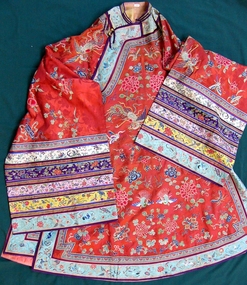
Clothing - Chinese Mandarin Robe, Circa 17th century
... Motifs include phoenix, butterflies, birds, pomegranate, flowers and auspicious symbols. Predominate stitch used is Pekinese Knot Stitch with couched gold outlines of the motifs. ...Motifs include phoenix, butterflies, birds, pomegranate, flowers and auspicious symbols. Predominate stitch used is Pekinese Knot Stitch with couched gold outlines of the motifs. ...Purchased by the donor from a Chinese family on a rubber estate in Malacca for 3 pound in 1922. The country was suffering a deep depression owing to a slump in rubber and many wealthy Chinese were in serious financial difficulties and were realising on anything they could. When the coat was on show at an exhibition the donor was told by someone who had lived in China for many years that it was a very fine example and was possibly 200-300 years old (identified by the cut and fastening of the front panel). The golden pheasants embroidered on the back indicated it came from a Southern state and from a family of high degree. Some years later it was dated as 17th century. Classical style of garment, very long-sleeved in red silk with coloured embroidery. The symbols belong to a high ranking official, symbols of two white doves embroidered on the back, and also the long sleeves with their decorative embroidered bands of turquoise, blue, pink and yellow. The front of the garment overlaps the right side with five small decorative buttons fastened with loops. The buttons were gold and because of their value they were replaced with identical brass buttons. Motifs include phoenix, butterflies, birds, pomegranate, flowers and auspicious symbols. Predominate stitch used is Pekinese Knot Stitch with couched gold outlines of the motifs. The birds and butterflies are worked in satin and long and short stitch. embroidery, garments, china, silk embroidery, oriental, 17th century -
 Embroiderers Guild, Victoria
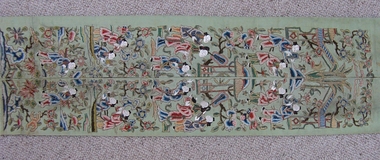
Accessory - Pair of Chinese Sleeve Bands, Late 19th century
... The image of a boy with a mouth organ implies the wish for a son. Pomegranate- symbolizes many sons (or possibly children). ...The image of a boy with a mouth organ implies the wish for a son. Pomegranate- symbolizes many sons (or possibly children). ...Chinese sleeve embroidery bands, or wanxiu became popular in the late 19th century during the Qing Dynasty, evolving from the traditional Han cuff embroidery and Manchu styles. These detachable, decorated bands were added to women's informal jackets and robes, often featuring symbolic motifs like landscapes, flowers, and auspicious symbols. They served both a decorative function, displaying artistic skill and personal wishes, and a practical one by covering the sleeves when hands were folded at the waist. History and evolution: Origins: The practice of embroidering cuffs on robes existed during the previous Ming Dynasty for Han women, and this was adopted by the Manchu rulers who founded the Qing Dynasty. Qing Dynasty (1644-1911): The practice was popularized and elaborated upon during this era, with detachable bands becoming a fashionable element for informal wear. Symbolism: The embroidery included a complex visual vocabulary of wishes for a long life, many offspring, and a happy marriage, derived from nature, mythology, and classical literature. Functionality: Women would fold their arms, often with their hands inside the sleeves, so the embroidered bands, which were sewn to hang down the back of the jacket, would be displayed prominently down the front. 19th century peak: The late 19th century was the peak of their popularity, with intricate designs becoming fashionable and even influenced by court tastes, such as those favoured by the Empress Dowager Cixi. Later developments: The late 19th century saw the introduction of chemical 'aniline' dyes from Europe, leading to brighter, bolder colours in embroidery. Motifs and their Meanings: Auspicious symbols: Designs often included symbols for good fortune, wealth, and longevity. Natural imagery: Birds, flowers, and landscapes were common motifs that could represent natural beauty or convey specific symbolic meanings. Figurative scenes: Bands could also feature narrative scenes from classical stories or legends. The choice of motifs allowed women to express personal desires, cultural values, and aesthetic preferences, reflecting a more personal and informal style than official court attire. Looking at the cuffs from bottom to top: there is a rock formation, a zig zag fence and flowers (chrysanthemums and a branch with Buddha's hand citron). Next is a male figure carrying a halberd over his shoulder and surrounded by flowers, foliage and hillocks. Above are two more males in a boat. One is standing, the other kneeling. The one kneeling holds a bamboo pipe, while the one standing holds a branch with pomegranates. The men are surrounded by more flowers, foliage, rocks and bats . Three more figures come next. A male holding a fan, a woman holding a dish and another male. The woman on the left cuff holds a dish which appears to hold fruit, whereas the woman on the right cuff holds a dish containing a ? hat. Further up is a pagoda with a pomegranate tree and two more male figures. One holds the sacred fungus, the other a vase with a lotus flower. Finally there are two pagodas, leaves, flowers and clouds. Symbolism: Buddha's (foshou) hand citron. This plant derives it's name from the shape of the fruit, which is said to resemble Buddha's hand. 'Foshou' is used as a pun from blessings (fu) and longevity (shou). Chrysanthemum - longevity. Halberd - a spear like object symbolizing rank and military achievement. Halberd (ji) is a pun for rank (ji) and represents rapid promotion and doing well in officialdom or politics. Bamboo pipe or mouth organ (skeng) is a pun for giving birth (skeng). The image of a boy with a mouth organ implies the wish for a son. Pomegranate- symbolizes many sons (or possibly children). Boat - may be travelling from or to. Fan (shan)- longevity, and also a pun for goodness (shan). Boy pointing upwards (?to the sun) - may you rise in rank (zhri goosheng). The act of pointing at the sun is a pun for 'soon' (zhri). Fungus - resembles the head of a wish granting wand (ruyi) and has the same meaning of 'as you wish'. Lotus flower - (he) is a pun for harmony. Vase - (ping) a pun for peace (ping'an) therefore a vase with lotus - peace and harmony. These sleeve bands are more generic but they do convey a wish for many sons who will become officials and bring fortune. Dr Rachel Silberstein, visiting Associate Professor at Rhode Island School of Design. Pair of Chinese Sleeve bands using Pekin knots, satin stitch. Depicts an outdoor scene with pagodas, people, zig zag fences, boats and plants embroidered on a pale green silk ground. Both cuffs have been joined at the bottom. embroidery, garments, silk embroidery, china, sleeve bands, late 19th century, garden, figures -
Tatura Irrigation & Wartime Camps Museum
Book, Pomegranates, 1988
... One chapter only relating to the Internees. Pomegranates Book ...Purchased by Jewish family Brown hard covered book with blue dust cover, 328 pages. Collection of various writers. One chapter only relating to the Internees. dunera, hay internment camp, books, history, local -
 Castlemaine Art Museum
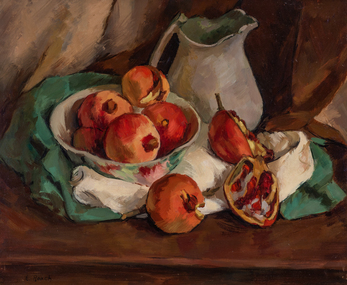
Painting, Elma Roach, Still life - Pomegranates and Jug, c. 1935
... Still life - Pomegranates and Jug Painting Elma Roach ...Purchased with funds from John Northen and Victor Stafford, 2008
