
Showing 5 items matching "pomeroy family"
-
 Mont De Lancey
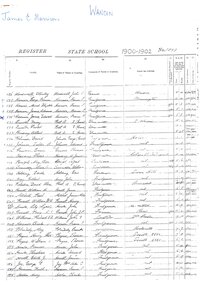
Administrative record - School Register, 1900-1902
... ...Pomeroy Family...A copy of Wandin Yallock State School's enrolment register from the years 1900-1902 1900s Wandin Wandin Yallock State School Australian schools Schools school Woodworth Family Harrison Family Quinton Family Pomeroy Family Robinson Family Johnson Family Gaudion Family Harding Family Rouget Family Saunders Family Helding Family Hogg Family Robertson Family Howell Family Mitchell Family Russell Family Hunter Family Garrett Family Williams Family Blanksby Family Payne Family Joy Family Hooton Family Bell Family Johnstone Family Photocopy of typed register filled out in black pen, 1 onesided A4 page Administrative record School Register ...A copy of Wandin Yallock State School's enrolment register from the years 1900-1902Photocopy of typed register filled out in black pen, 1 onesided A4 page1900s, wandin, wandin yallock state school, australian schools, schools, school, woodworth family, harrison family, quinton family, pomeroy family, robinson family, johnson family, gaudion family, harding family, rouget family, saunders family, helding family, hogg family, robertson family, howell family, mitchell family, russell family, hunter family, garrett family, williams family, blanksby family, payne family, joy family, hooton family, bell family, johnstone family -
 Kew Historical Society Inc
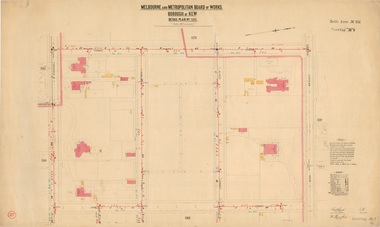
Plan, Melbourne & Metropolitan Board of Works : Borough of Kew : Detail Plan No.1569, 1905
... Pomeroy’ (now ‘Merridale’) in 1885 for James Mickleburgh. ‘Heathfield’ was built in 1888 for Henry Eeles, and was one of many fine homes in Kew, Hawthorn and surrounding suburbs designed by prolific architect John Beswicke; it later became “La Verna” and was a Franciscan monastery. Similarly, in Cotham Road, we can see ‘Bella Vista’ (now demolished), and ‘Charleville’, with its double-storeyed arcade frontage, built in 1889 for Charles Donaldson whose family...Pomeroy’ (now ‘Merridale’) in 1885 for James Mickleburgh. ‘Heathfield’ was built in 1888 for Henry Eeles, and was one of many fine homes in Kew, Hawthorn and surrounding suburbs designed by prolific architect John Beswicke; it later became “La Verna” and was a Franciscan monastery. Similarly, in Cotham Road, we can see ‘Bella Vista’ (now demolished), and ‘Charleville’, with its double-storeyed arcade frontage, built in 1889 for Charles Donaldson whose family ...The Melbourne and Metropolitan Board of Works (MMBW) plans were produced from the 1890s to the 1950s. They were crucial to the design and development of Melbourne's sewerage and drainage system. The plans, at a scale of 40 feet to 1 inch (1:480), provide a detailed historical record of Melbourne streetscapes and environmental features. Each plan covers one or two street blocks (roughly six streets), showing details of buildings, including garden layouts and ownership boundaries, and features such as laneways, drains, bridges, parks, municipal boundaries and other prominent landmarks as they existed at the time each plan was produced. (Source: State Library of Victoria)This plan forms part of a large group of MMBW plans and maps that was donated to the Society by the Mr Poulter, City Engineer of the City of Kew in 1989. Within this collection, thirty-five hand-coloured plans, backed with linen, are of statewide significance as they include annotations that provide details of construction materials used in buildings in the first decade of the 20th century as well as additional information about land ownership and usage. The copies in the Public Record Office Victoria and the State Library of Victoria are monochrome versions which do not denote building materials so that the maps in this collection are invaluable and unique tools for researchers and heritage consultants. A number of the plans are not held in the collection of the State Library of Victoria so they have the additional attribute of rarity.Original survey plan, issued by the MMBW to a contractor with responsibility for constructing sewers in the area identified on the plan within the Borough of Kew. The plan was at some stage hand-coloured, possibly by the contractor, but more likely by officers working in the Engineering Department of the Borough and later Town, then City of Kew. The hand-coloured sections of buildings on the plan were used to denote masonry or brick constructions (pink), weatherboard constructions (yellow), and public buildings (grey). This plan covers parts of Sackville Street, John Street, Thomas Street and Cotham Road, and includes several very large houses in Sackville Street. Job Smith built ‘Berrington’ in about 1888-90 for himself, and ‘Pomeroy’ (now ‘Merridale’) in 1885 for James Mickleburgh. ‘Heathfield’ was built in 1888 for Henry Eeles, and was one of many fine homes in Kew, Hawthorn and surrounding suburbs designed by prolific architect John Beswicke; it later became “La Verna” and was a Franciscan monastery. Similarly, in Cotham Road, we can see ‘Bella Vista’ (now demolished), and ‘Charleville’, with its double-storeyed arcade frontage, built in 1889 for Charles Donaldson whose family occupied it until 1939. This was renamed ‘Ross House’ by the second owner, Dr. Thomas King, and then substantially restored in the 1960s by the Stillwell family, well known as car drivers and dealers. Bella Vista (later ‘Malinda’) was originally designed by the architect Robert Haddon and built for Abel Hoadley, inventor of the Violet Crumble Bar and many other delicious delicacies. He began by manufacturing jams and pickles in South Melbourne using fruit from his own orchard in East Burwood.melbourne and metropolitan board of works, detail plans, mmbw 1569, cartography -
 Kew Historical Society Inc
Book, Maria Island to Merridale: a tribute to my grandmother CP Christina Piesse (née McCrae) 1886-1970 / by Felicity Piesse, 2018
... piesse family - kew (vic)...pomeroy...piesse family - kew (vic) pomeroy - merridale - sackville street - kew (vic) Maria Island to Merridale: a tribute to my grandmother CP Christina Piesse (née McCrae) 1886-1970 / by Felicity Piesse Book Book ...piesse family - kew (vic), pomeroy - merridale - sackville street - kew (vic) -
 Sunbury Family History and Heritage Society Inc.
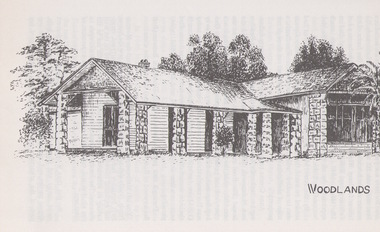
Artwork, other, Ian Symonds, Woodlands Homestead
... William Pomeroy Greene, from Scotland settled on land near Gellibrand Hill and Moonee Ponds Creek at Bulla and built his prefabricated homestead own the site. The Greene family ...The sketch of Woodlands Homestead is a reproduction of Ian Symonds original drawing. He was a Sunbury resident and was an active member in the local art group and gallery. He drew many black and white drawings of interesting homesteads and sites in the district. William Pomeroy Greene, from Scotland settled on land near Gellibrand Hill and Moonee Ponds Creek at Bulla and built his prefabricated homestead own the site.The Greene family were one of the early European settlers to settle in Bulla. A photograph of a black and white sketch of a homestead.WOODLANDSwoodlands homestead, gellibrand hill, william pomeroy greene, bulla, moonee ponds creek -
 Ringwood and District Historical Society
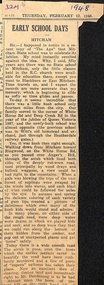
Newspaper, Mitcham State School - Newspaper Clipping from The Age 1935 reprinted 1948 "Early School Days"
... Families and pupils mentioned: Hands, Davis, Schwerkolt, Swartsman, Calder, Miller, Turnbull, Swindon, McPhee, Mashiter, Kendall, Dickson, Kennedy, Murphy, Brown, Sandars, Cox, Smith, Dobbins, Banks, Frost, Clements, Hill, Quigly, Wiggins, Foster, McGhee, Walker, Richard Bros., Voarse, Tankard, de Valles, Pomeroy, Kenny, Schmidt, Ainger, Stein, Lee, Wheeler, Cook, Shannon, Irley, Thum, Tunstall, Hewish. 3. ...Families and pupils mentioned: Hands, Davis, Schwerkolt, Swartsman, Calder, Miller, Turnbull, Swindon, McPhee, Mashiter, Kendall, Dickson, Kennedy, Murphy, Brown, Sandars, Cox, Smith, Dobbins, Banks, Frost, Clements, Hill, Quigly, Wiggins, Foster, McGhee, Walker, Richard Bros., Voarse, Tankard, de Valles, Pomeroy, Kenny, Schmidt, Ainger, Stein, Lee, Wheeler, Cook, Shannon, Irley, Thum, Tunstall, Hewish. 3. ...Newspaper Clipping Summary of the three articles by CoPilot: Together, these three articles form a nostalgic, first‑person account of early schooling in the Mitcham–Heatherdale–White Horse Road district from the late 19th century into the early 20th century. They describe a small, close-knit rural community where education was improvised, roads were rough, and children travelled long distances through bushland to reach school. 1. Early School Days — Mitcham (1948) The writer recalls that Mitcham had no state school fifty years earlier. Lessons were held in the Roman Catholic church, and many children had to walk to Blackburn or East Mitcham for schooling. The family moved to the corner of White Horse Road and Deep Creek Road in 1887, the year of Queen Victoria’s jubilee. A new school was later built near the Heatherdale railway gates. The writer describes the landscape as dense bush with rough roads and towering gum trees, contrasting it with the more developed and less charming Mitcham of 1948. 2. The School Near White Horse Road — Community Memories This article expands the picture by listing the families whose children attended the old school. It emphasises the strong community bonds and the simplicity of early education: one teacher taught all six classes in a single room, assisted by older pupils. The writer imagines the old school site becoming a children’s playground in the future. Families and pupils mentioned: Hands, Davis, Schwerkolt, Swartsman, Calder, Miller, Turnbull, Swindon, McPhee, Mashiter, Kendall, Dickson, Kennedy, Murphy, Brown, Sandars, Cox, Smith, Dobbins, Banks, Frost, Clements, Hill, Quigly, Wiggins, Foster, McGhee, Walker, Richard Bros., Voarse, Tankard, de Valles, Pomeroy, Kenny, Schmidt, Ainger, Stein, Lee, Wheeler, Cook, Shannon, Irley, Thum, Tunstall, Hewish. 3. Early School Days (1935) — Alf Antonio In this continuation piece, Alf Antonio of East Camberwell recalls Mr Sweeney, the teacher who managed the entire school alone. He is remembered as firm but kind, maintaining good discipline without harshness. Serious misbehaviour was rare. Younger students were encouraged to listen to lessons for higher grades, helping them prepare for advancement. Winter memories include children drying wet boots and stockings by the fire. The writer ends by noting that many more memories could be shared but restrains himself to avoid overwhelming the reader. (Co-Pilot 10/10/2026)
