

Physical description
Newspaper Clipping
Inscriptions & markings
Summary of the three articles by CoPilot:
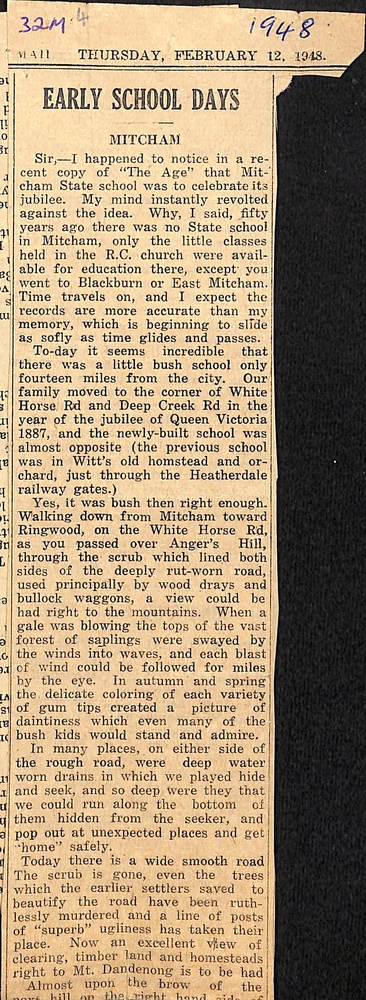
Together, these three articles form a nostalgic, first‑person account of early schooling in the Mitcham–Heatherdale–White Horse Road district from the late 19th century into the early 20th century. They describe a small, close-knit rural community where education was improvised, roads were rough, and children travelled long distances through bushland to reach school.
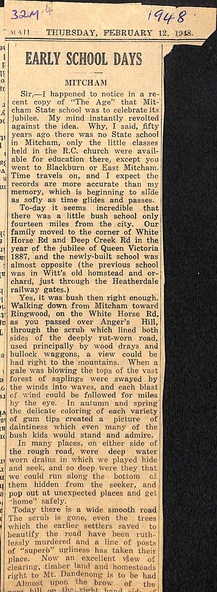
1. Early School Days — Mitcham (1948)
The writer recalls that Mitcham had no state school fifty years earlier. Lessons were held in the Roman Catholic church, and many children had to walk to Blackburn or East Mitcham for schooling. The family moved to the corner of White Horse Road and Deep Creek Road in 1887, the year of Queen Victoria’s jubilee. A new school was later built near the Heatherdale railway gates. The writer describes the landscape as dense bush with rough roads and towering gum trees, contrasting it with the more developed and less charming Mitcham of 1948.
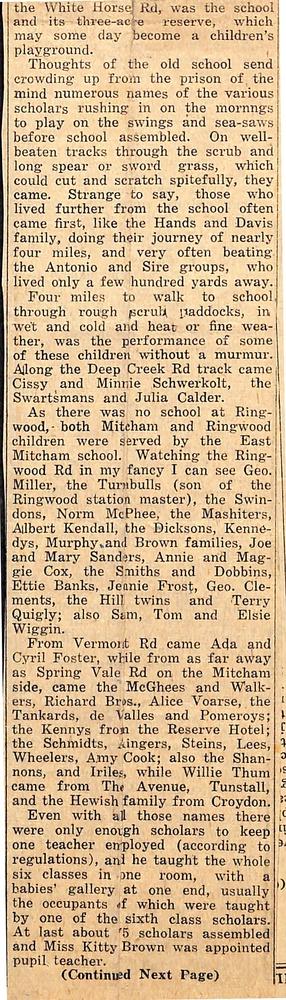
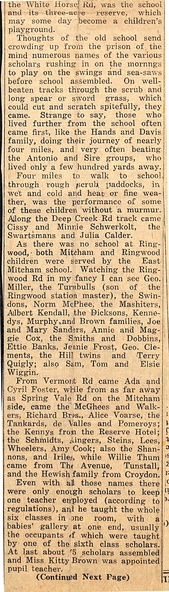
2. The School Near White Horse Road — Community Memories
This article expands the picture by listing the families whose children attended the old school. It emphasises the strong community bonds and the simplicity of early education: one teacher taught all six classes in a single room, assisted by older pupils. The writer imagines the old school site becoming a children’s playground in the future.
Families and pupils mentioned:
Hands, Davis, Schwerkolt, Swartsman, Calder, Miller, Turnbull, Swindon, McPhee, Mashiter, Kendall, Dickson, Kennedy, Murphy, Brown, Sandars, Cox, Smith, Dobbins, Banks, Frost, Clements, Hill, Quigly, Wiggins, Foster, McGhee, Walker, Richard Bros., Voarse, Tankard, de Valles, Pomeroy, Kenny, Schmidt, Ainger, Stein, Lee, Wheeler, Cook, Shannon, Irley, Thum, Tunstall, Hewish.
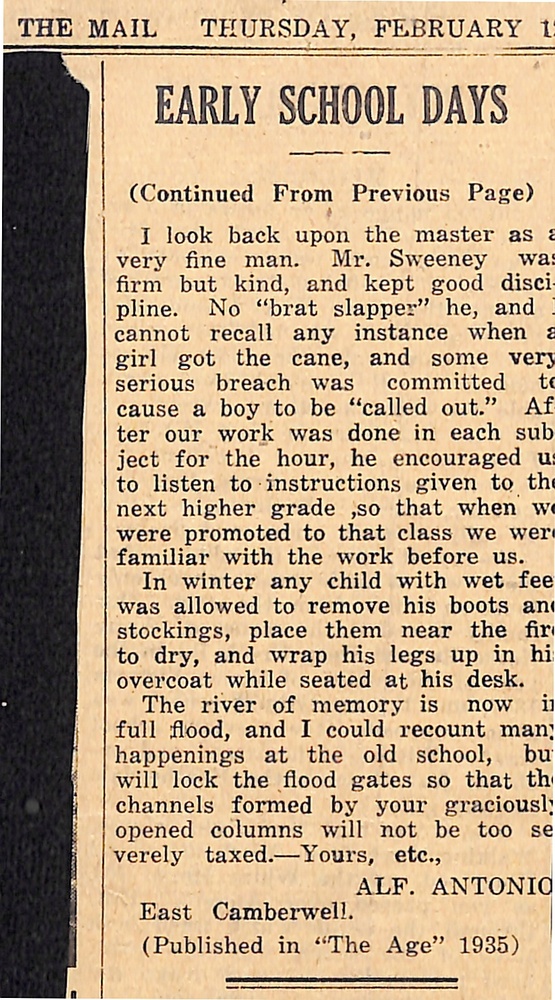
3. Early School Days (1935) — Alf Antonio
In this continuation piece, Alf Antonio of East Camberwell recalls Mr Sweeney, the teacher who managed the entire school alone. He is remembered as firm but kind, maintaining good discipline without harshness. Serious misbehaviour was rare. Younger students were encouraged to listen to lessons for higher grades, helping them prepare for advancement. Winter memories include children drying wet boots and stockings by the fire. The writer ends by noting that many more memories could be shared but restrains himself to avoid overwhelming the reader.
(Co-Pilot 10/10/2026)