
Showing 4 items matching "population ageing"
-
 Broadmeadows Historical Society & Museum
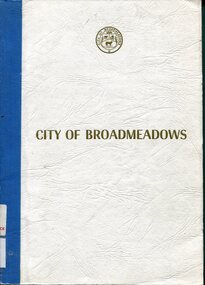
Book - Project Report, Jan Flannagan, The Housing and Accommodation Needs of the Aged in the City of Broadmeadows, 1985
... ...Ageing Population...The study was produced during a period of significant population ageing and growing government concern regarding aged housing provision, independent living, community services, and residential accommodation for elderly people in suburban Melbourne. ...It provides detailed evidence of community needs, government planning responses, and local policy considerations at a time when population ageing was becoming an important social issue. ...Research report investigating the housing and accommodation needs of elderly residents within the City of Broadmeadows. The publication analyses demographic characteristics, housing circumstances, service provision, and future accommodation requirements of older people, providing recommendations to assist local government planning and community welfare initiatives. The report contains statistical data, maps, analysis, and references relating to ageing and housing policy in Broadmeadows during the mid-1980s.Bound report of approximately 95-100 pages comprising introduction, demographic analysis, assessment of housing and accommodation conditions for older residents, maps, statistical data, findings, recommendations, bibliography, and supporting research relating to the City of Broadmeadows.non-fictionResearch report investigating the housing and accommodation needs of elderly residents within the City of Broadmeadows. The publication analyses demographic characteristics, housing circumstances, service provision, and future accommodation requirements of older people, providing recommendations to assist local government planning and community welfare initiatives. The report contains statistical data, maps, analysis, and references relating to ageing and housing policy in Broadmeadows during the mid-1980s.broadmeadows (victoria), city of broadmeadows, older people, ageing population, housing, housing needs, accommodation, aged accommodation, aged care, retirement housing, community welfare, social services, municipal planning, local government, urban development, demographic studies, social policy, community development, public housing, independent living, senior citizens, population ageing, human services, victoria (australia), social research -
 Melbourne Legacy
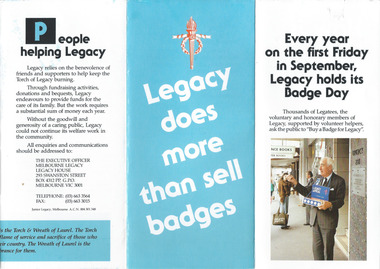
Pamphlet, Legacy does more than sell badges
... population has a large proportion of elderly. The majority of Legacy widows had husbands who served in the World Wars. And so Legacy's emphasis has shifted to the needs of the ageing widows. . . ...population has a large proportion of elderly. The majority of Legacy widows had husbands who served in the World Wars. And so Legacy's emphasis has shifted to the needs of the ageing widows. . . ...A brochure promoting Legacy in the 1990's. Some of the text includes sections on How is Legacy special?; Legacy and the young; Legacy and the Aged. "Legacy and the young. Legacy is committed to the nurturing of its young members, known as Junior Legatees. Legacy helps to make sure stye get the education their fathers would have wished for them and to ensure their families enjoy a normal lifestyle. In addition to the 3,000 Junior Legatees throughout Australia, Legacy also cares for the handicapped dependants of its "family". Recreational outings and educational programs are arranged on a monthly basis. These activities aim to develop self-dependence and once a year, a two-week holiday camp is held - a highlight of the year - and lifelong friendship are often made. / For all its young members, healthy outdoor activities are arranged, financial aid, counselling, tutoring and guidance are given to ensure they are able to make the most of the opportunities open to them. Legacy and the Aged. Nowadays, the Australian population has a large proportion of elderly. The majority of Legacy widows had husbands who served in the World Wars. And so Legacy's emphasis has shifted to the needs of the ageing widows. . . Legacy widows meet for a wide range of activities, including cards, crafts, indoor bowls and theatre excursions. . . This represents a valuable social network and complements the volunteer care given by Legatees."A brochure that promotes Legacy in the 1990's.Colour brochure "Legacy does more than sell badges", folded into 4 sections.legacy promotion, fundraising -
 Melbourne Legacy
Pamphlet, Legacy does more than sell badges, c1990s
... population has a large proportion of elderly. The majority of Legacy widows had husbands who served in the World Wars. And so Legacy's emphasis has shifted to the needs of the ageing widows. . . ...population has a large proportion of elderly. The majority of Legacy widows had husbands who served in the World Wars. And so Legacy's emphasis has shifted to the needs of the ageing widows. . . ...This is an example of Melbourne Legacy promotional material that was issued to inform the public on the work of Legacy. Some of the text includes sections on How is Legacy special?; Legacy and the young; Legacy and the Aged. "Legacy and the young. Legacy is committed to the nurturing of its young members, known as Junior Legatees. Legacy helps to make sure stye get the education their fathers would have wished for them and to ensure their families enjoy a normal lifestyle. In addition to the 3,000 Junior Legatees throughout Australia, Legacy also cares for the handicapped dependants of its "family". Recreational outings and educational programs are arranged on a monthly basis. These activities aim to develop self-dependence and once a year, a two-week holiday camp is held - a highlight of the year - and lifelong friendship are often made. / For all its young members, healthy outdoor activities are arranged, financial aid, counselling, tutoring and guidance are given to ensure they are able to make the most of the opportunities open to them. Legacy and the Aged. Nowadays, the Australian population has a large proportion of elderly. The majority of Legacy widows had husbands who served in the World Wars. And so Legacy's emphasis has shifted to the needs of the ageing widows. . . Legacy widows meet for a wide range of activities, including cards, crafts, indoor bowls and theatre excursions. . . This represents a valuable social network and complements the volunteer care given by Legatees." Was in a folder with marketing material from the 1990s to 2009, see items 01240 to 01258. The collection shows the types of marketing materials that were produced and the celebrities that were helping Legacy.An example of promotional material issued by Legacy in the 1990s. It was in a collection of marketing material from the 1990s to 2000s.Colour brochure promoting Legacy folded into 8 pages.legacy promotion, fundraising -
 Sunshine and District Historical Society Incorporated
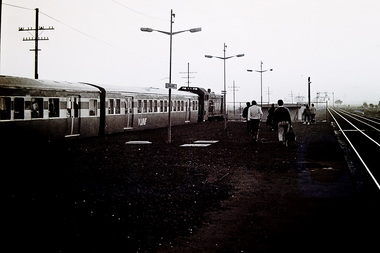
Photograph - Deer Park Railway Station 1988 Photographs, The Sunshine Advocate, 25th May 1988
... By the 1980s and 1990s, the station's ageing infrastructure and limited passenger facilities attracted increasing public and media attention as Deer Park and surrounding suburbs experienced significant population growth. ...By the 1980s and 1990s, the station's ageing infrastructure and limited passenger facilities attracted increasing public and media attention as Deer Park and surrounding suburbs experienced significant population growth. ...These photographs, taken by The Advocate in 1988, feature Deer Park Railway Station at the intersection of Station Road and Railway Parade, Deer Park. The images depict the station during an era when diesel-powered trains operated on the line and the station retained the appearance and facilities of a typical semi-rural railway station. By the 1980s and 1990s, the station's ageing infrastructure and limited passenger facilities attracted increasing public and media attention as Deer Park and surrounding suburbs experienced significant population growth. These photographs formed part of a sustained media and residents campaign urging the State Government and the Department of Transport to finally upgrade Deer Park’s facilities. The station originally opened as Kororoit Railway Station on 2 April 1884 as part of the Serviceton railway line. Early facilities included a passenger platform, goods platform, three-road yard and an interlocked signal box, with the station serving as a crossing loop on the then single-track railway. It was renamed Deer Park Railway Station on 3 December 1889, reflecting the growing identity of the district. More than a century later, the original station was completely rebuilt as part of the Level Crossing Removal Project. The new elevated Deer Park Station opened on 24 April 2023, replacing the historic ground-level station and marking a major transformation of the local transport network.These photographs are significant for documenting Deer Park Railway Station prior to its redevelopment and provide a valuable record of a railway facility that served the community for more than 130 years. They capture the station during a period when it retained many characteristics of a traditional country-style railway station, reflecting the area's transition from a semi-rural district to a growing suburban centre. The photographs have added historical value because they document the original station before its demolition and replacement as part of the Level Crossing Removal Project in 2023. As such, they provide evidence of a now-lost piece of transport infrastructure and the changing character of Melbourne's western suburbs.6849.01 - Deer Park Railway Station 1988 Photographs (Advocate 514.2).JPG 6849.02 - Deer Park Railway Station 1988 Photographs (Advocate 514.2).JPG 6849.03 - Deer Park Railway Station 1988 Photographs (Advocate 514.2).JPG 6849.04 - Deer Park Railway Station 1988 Photographs (Advocate 514.2).JPG 6849.05 - Deer Park Railway Station 1988 Photographs (Advocate 514.2).JPGdeer park railway station, deer park, station road, railway parade
