
Showing 139 items matching "premierships won"
-
 Dandenong & District Historical Society
Booklet, The Redlegs History Book, 8 April 2026
... Premierships won...Premiership information and Key players of the times History of Best & Fairest Players, Team Premierships, Members and Early beginnings Premierships won finalist occassions Best & Fairest players including Ian Abraham 1964 & Jim Miller (Frosty) 1969 Kevin Shinners 1965 Rodney Evasns 1966/67 Hugh Mitchell 1968 Peter Stedwll 1970 Historical aspects and current updates of Football Club at the time. ...Historical aspects and current updates of Football Club at the time.56pp text plus 4 pp cover Printed 4 Colour and Black on White Pagesnon-fictionHistorical aspects and current updates of Football Club at the time.premierships won, finalist occassions, best & fairest players including ian abraham 1964 & jim miller (frosty) 1969, kevin shinners 1965, rodney evasns 1966/67, hugh mitchell 1968, peter stedwll 1970 -
 Surrey Hills Historical Society Collection
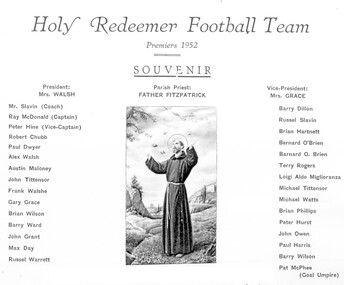
Ephemera, Holy Redeemer Football Club Premiers 1952 souvenir, 1952
... A souvenir of the 1952 premiership won by the Holy Redeemer Football Club. ...holy redeemer church holy redeemer football club football sporting clubs fr tim fitzpatrick, mr slavin, ray mcdonald, peter hine, robert chubb, paul dwyer, alex walsh, austin maloney, john tittensor, frank walshe, gary grace, brian wilson, barry ward, john grant, max day, russel warrett mrs grace, barry dillon,russel slavin, brian hartnett, bernard o'brien, barnard o brien, terry rogers, loigi aldo miglioranza, michael tittensor, michael watts, brian phillips, peter hurst, john owen, paul harris, barry wilson, pat mcphee A souvenir of the 1952 premiership won by the Holy Redeemer Football Club. ...A souvenir of the 1952 premiership won by the Holy Redeemer Football Club. It has a picture of St Francis of Assisi in the centre, either side of which are listed team players and club officials.holy redeemer church, holy redeemer football club, football, sporting clubs, fr tim fitzpatrick, mr slavin, ray mcdonald, peter hine, robert chubb, paul dwyer, alex walsh, austin maloney, john tittensor, frank walshe, gary grace, brian wilson, barry ward, john grant, max day, russel warrett, mrs grace, barry dillon,russel slavin, brian hartnett, bernard o'brien, barnard o brien, terry rogers, loigi aldo miglioranza, michael tittensor, michael watts, brian phillips, peter hurst, john owen, paul harris, barry wilson, pat mcphee -
 Geelong Cycling Club
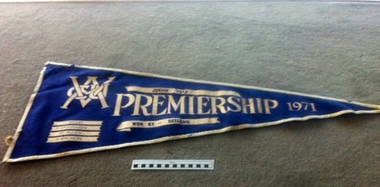
Pennant, 1971
... "VACU/Junior Road/Premiership 1971/Won by Geelong/I Wood/P McKinnon/M Allen/K Salmon"...won a schoolboys championship. This pennant charts his progress. Record of strength of Juniors in the Club vacu; junior road; premiership; 1971; geelong cycling club; gcc; i. wood; p. mckinnon; m. allen; k. salmon; "VACU/Junior Road/Premiership 1971/Won by Geelong/I Wood/P McKinnon/M Allen/K Salmon" Triangular Pennant in blue felt trimmed with white felt. ...Amateurs during this period were strong. Ian Wood had won a schoolboys championship. This pennant charts his progress.Record of strength of Juniors in the ClubTriangular Pennant in blue felt trimmed with white felt. Wording regarding event and winners is embossed in white over the navy blue felt."VACU/Junior Road/Premiership 1971/Won by Geelong/I Wood/P McKinnon/M Allen/K Salmon"vacu; junior road; premiership; 1971; geelong cycling club; gcc; i. wood; p. mckinnon; m. allen; k. salmon; -
 Yarrawonga and Mulwala Pioneer Museum
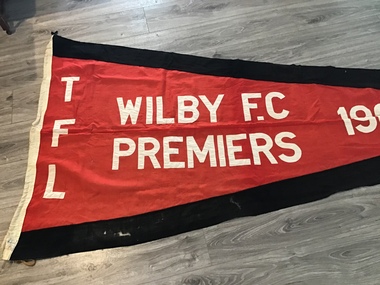
Article - Tungamah Football League Premiership Flag, Wilby Football Club Premiers 1967, 1967
... This was the only premiership won by the Wilby FC and was played against Congupna Road at Mulwala on 28th September 1967. ...This was the only premiership won by the Wilby FC and was played against Congupna Road at Mulwala on 28th September 1967. ...The Tungamah Football League was formed in 1953 and dissolved in the late 1960's. This was the only premiership won by the Wilby FC and was played against Congupna Road at Mulwala on 28th September 1967. Wilby lost to Mulwala in the 1968 Grand Final.Red and black cloth triangular pennant shape. Bound on short side and threaded with rope for hanging from a pole. Red base colour with black edges. White letters stitched in the centreT.F.L. Wilby F. C Premiers 1967 -
Emerald Museum & Nobelius Heritage Park
Flag - Football Premiership flag, 1945
... Emerald Football Club Premiership Flag won in 1945...Emerald Football Club Premiership Flag won in 1945 Emerald Victoria Australia Australian Rules Football emerald football club E.F.C. ...Emerald Football Club Premiership Flag won in 1945red and black triangular pennantE.F.C. Premiers 1945emerald, victoria, australia, australian rules football, emerald football club -
Emerald Museum & Nobelius Heritage Park
Flag - Football Premiership flag, 1946
... Mountain District Football Association premiership flag won by Emerald Football Club 1946....Mountain District Football Association premiership flag won by Emerald Football Club 1946. ...Mountain District Football Association premiership flag won by Emerald Football Club 1946.red and black triangular pennantMDFA E.F.C. Premiers 1946emerald, victoria, australia, australian rules football, emerald football club, mountain district football association -
Emerald Museum & Nobelius Heritage Park
Flag - Football Premiership flag, 1955
... Mountain District Football Association 1955 Premiership Flag won by Emerald Football Club...Mountain District Football Association 1955 Premiership Flag won by Emerald Football Club Emerald Victoria Australia Australian Rules Football emerald football club MDFA Premiers 1955 red and black triangular pennant Flag Football Premiership flag ...Mountain District Football Association 1955 Premiership Flag won by Emerald Football Clubred and black triangular pennantMDFA Premiers 1955emerald, victoria, australia, australian rules football, emerald football club -
Emerald Museum & Nobelius Heritage Park
Flag - Football Premiership flag, 1931
... Mountain District Football Association Premiership Pennant won by Emerald Football Club in 1931...Mountain District Football Association Premiership Pennant won by Emerald Football Club in 1931 Emerald Victoria Australia Australian Rules Football emerald football club MDFA PREMIERS 1931 green and gold pennant Flag Football Premiership flag ...Mountain District Football Association Premiership Pennant won by Emerald Football Club in 1931green and gold pennantMDFA PREMIERS 1931emerald, victoria, australia, australian rules football, emerald football club -
 Canterbury History Group
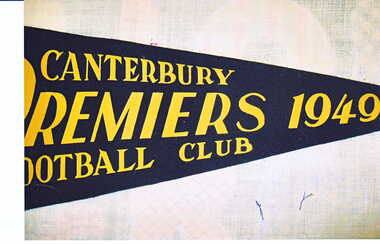
Photograph - Canterbury Football Club Premiership pennant 1949, Jan Pigot, 1/06/2012 12:00:00 AM
... The 1949 Premiership pennant won by Canterbury Football Club. ...The 1949 Premiership pennant won by Canterbury Football Club. ...The 1949 Premiership pennant won by Canterbury Football Club. On permanent loan to the club from the Canterbury History Group.Coloured photograph canterbury, canterbury football club, canterbury history group, flags, football, pigot> jan -
Emerald Museum & Nobelius Heritage Park
Flag - Football Premiership flag, 1981
... Yarra Valley Mountain District Football League Premiership flag won by Emerald Premiers Division 2 1981...Yarra Valley Mountain District Football League Premiership flag won by Emerald Premiers Division 2 1981 Emerald Victoria Australia Australian Rules Football emerald football club YVMDFL Emerald Premiers Div. 2 1981 red and black triangular pennant Flag Football Premiership flag ...Yarra Valley Mountain District Football League Premiership flag won by Emerald Premiers Division 2 1981red and black triangular pennantYVMDFL Emerald Premiers Div. 2 1981emerald, victoria, australia, australian rules football, emerald football club -
Emerald Museum & Nobelius Heritage Park
Flag - Football Premiership flag, 1997
... Yarra Valley Mountain District Football league Premiership flag won by Emerald Div. 2 Seniors 1997...Yarra Valley Mountain District Football league Premiership flag won by Emerald Div. 2 Seniors 1997 Emerald Victoria Australia Australian Rules Football emerald football club YVMDFL Emerald Premiers Div. 2 Seniors 1997 red and black triangular pennant Flag Football Premiership flag ...Yarra Valley Mountain District Football league Premiership flag won by Emerald Div. 2 Seniors 1997red and black triangular pennantYVMDFL Emerald Premiers Div. 2 Seniors 1997emerald, victoria, australia, australian rules football, emerald football club -
Emerald Museum & Nobelius Heritage Park
Flag - Football Premiership flag, 1997
... Yarra Valley Mountain District Football League premiership flag won by Emerald Premiers Division 2 Reserves, 1997...Yarra Valley Mountain District Football League premiership flag won by Emerald Premiers Division 2 Reserves, 1997 Emerald Victoria Australia Australian Rules Football emerald football club YVMDFL Emerald Premiers Div. 2 Reserves 1997 red and black triangular pennant Flag Football Premiership flag ...Yarra Valley Mountain District Football League premiership flag won by Emerald Premiers Division 2 Reserves, 1997red and black triangular pennantYVMDFL Emerald Premiers Div. 2 Reserves 1997emerald, victoria, australia, australian rules football, emerald football club -
Emerald Museum & Nobelius Heritage Park
Flag - Football Premiership flag, 1983
... Yarra Valley MNountain District Football League premiership flag won by Emerald Premiers Division 2 reserves 1983...Yarra Valley MNountain District Football League premiership flag won by Emerald Premiers Division 2 reserves 1983 Emerald Victoria Australia Australian Rules Football emerald football club YVMDFL Emerald Premiers Div. 2 Res. 1983 red and black triangular pennant Flag Football Premiership flag ...Yarra Valley MNountain District Football League premiership flag won by Emerald Premiers Division 2 reserves 1983red and black triangular pennantYVMDFL Emerald Premiers Div. 2 Res. 1983emerald, victoria, australia, australian rules football, emerald football club -
Emerald Museum & Nobelius Heritage Park
Flag - Football Premiership flag, 1954
... Mountain District Football Association 1954 Premiership Flag won by Emerald Football Club 3rd Under 18's...Mountain District Football Association 1954 Premiership Flag won by Emerald Football Club 3rd Under 18's Emerald Victoria Australia Australian Rules Football emerald football club MDFA Premiers 3rd Under 18's 1954 Red and black triangular pennant Flag Football Premiership flag ...Mountain District Football Association 1954 Premiership Flag won by Emerald Football Club 3rd Under 18'sRed and black triangular pennantMDFA Premiers 3rd Under 18's 1954emerald, victoria, australia, australian rules football, emerald football club -
 Geelong Cycling Club
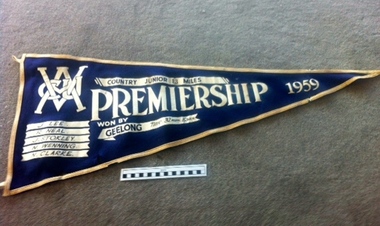
Pennant Flag, 1959
... "VACU/Country Junior 13 Miles Premiership 1959/Won by Geelong/Time 32mins 15secs/J Lee/R Neal/J Stokley/N Wenning/N Clarke"...Record of the importance of Juniors to a strong cycling club. vacu; country junior 13 miles; premiership 1959; j. lee; r. neal; j. stokley; n. wenning; n. clarke; "VACU/Country Junior 13 Miles Premiership 1959/Won by Geelong/Time 32mins 15secs/J Lee/R Neal/J Stokley/N Wenning/N Clarke" Triangular pennant in navy blue felt. ...Juniors in 1950s were important in the Club. In 1959, the year after the death of R. Mockridge, amateurs were in ascendancy after the Olympic Games in Melbourne in 1956. J. Lee had been a schoolboys winner. Record of the importance of Juniors to a strong cycling club.Triangular pennant in navy blue felt. The pennant has a border of white felt and details of the event and the competitors are embossed in white over the blue felt."VACU/Country Junior 13 Miles Premiership 1959/Won by Geelong/Time 32mins 15secs/J Lee/R Neal/J Stokley/N Wenning/N Clarke"vacu; country junior 13 miles; premiership 1959; j. lee; r. neal; j. stokley; n. wenning; n. clarke; -
Emerald Museum & Nobelius Heritage Park
Flag - Football Premiership flag, 1988
... Yarra Valley Mountain District Football League premiership flag won by Emerald Premiers 1st Division under 17's, 1988...Yarra Valley Mountain District Football League premiership flag won by Emerald Premiers 1st Division under 17's, 1988 Emerald Victoria Australia Australian Rules Football emerald football club YVMDFL Emerald Premiers 1st Div. u.17 1988 red and black triangular pennant Flag Football Premiership flag ...Yarra Valley Mountain District Football League premiership flag won by Emerald Premiers 1st Division under 17's, 1988red and black triangular pennantYVMDFL Emerald Premiers 1st Div. u.17 1988emerald, victoria, australia, australian rules football, emerald football club -
Emerald Museum & Nobelius Heritage Park
Flag - Football Premiership flag, 1996
... Yarra Valley mountain District Football League premiership flag won by Emerald Premiers Division 2 under 18's 1996...Yarra Valley mountain District Football League premiership flag won by Emerald Premiers Division 2 under 18's 1996 Emerald Victoria Australia Australian Rules Football emerald football club YVMDFL Emerald Premiers Div. 2 u.18 1996 red and black triangular pennant Flag Football Premiership flag ...Yarra Valley mountain District Football League premiership flag won by Emerald Premiers Division 2 under 18's 1996red and black triangular pennantYVMDFL Emerald Premiers Div. 2 u.18 1996emerald, victoria, australia, australian rules football, emerald football club -
Emerald Museum & Nobelius Heritage Park
Flag - Football Premiership flag, 1981
... Yarra Valley Mountain District Football League premiership flag won by Emerald Under 17 team, Premiers and Champions Division 2 1981...Yarra Valley Mountain District Football League premiership flag won by Emerald Under 17 team, Premiers and Champions Division 2 1981 Emerald Victoria Australia Australian Rules Football emerald football club YVMDFL Emerald Premiers & Champions Div. 2 u.17 1981 red and black triangular pennant Flag Football Premiership flag ...Yarra Valley Mountain District Football League premiership flag won by Emerald Under 17 team, Premiers and Champions Division 2 1981red and black triangular pennantYVMDFL Emerald Premiers & Champions Div. 2 u.17 1981emerald, victoria, australia, australian rules football, emerald football club -
 Sunshine and District Historical Society Incorporated
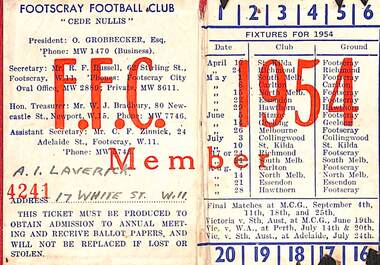
Ephemera - Footscray Football Club 1954 Membership Card, 1954
... |The 1954 VFL premiership was won by the Footscray Football Club, which defeated Melbourne by 51 points in the 1954 VFL Grand Final1. ...|The 1954 VFL premiership was won by the Footscray Football Club, which defeated Melbourne by 51 points in the 1954 VFL Grand Final1. ...A. I. Laverick was Annie Isobel Laverick Nee Heffer, the wife of Francis "Frank" William Laverick. They lived at 89 King Edward Avenue Albion.|The 1954 VFL premiership was won by the Footscray Football Club, which defeated Melbourne by 51 points in the 1954 VFL Grand Final1. Footscray had won 9 premierships in the Victorian Football Association (VFA) before entering the VFL in 1925Small cardboard folded membership card with club name and bulldog on front, Footscray Executive members names & member details on inside of front, fixture for 1954 detailed on inside with round clipped when the member attendedFootscray Football Club F.F.C. 1954 Member No 4241 A. I. Laverick 17 White St Williamstownfootscray football club, football -
 Williamstown Historical Society Inc
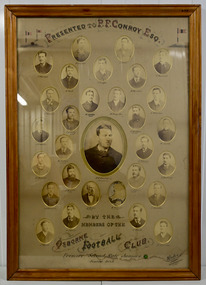
Photograph - Photograph - Osborne Football Club 1885
... Williamstown Juniors won the Premiership for the first time that year. ...Williamstown Juniors won the Premiership for the first time that year. ...A photographic record of the Osborne Football Team Williamstown, part of the Victorian Junior Football Association in 1885, the year they won the premiership. The 1889 Victorian Junior Football Association season was the third season of play. Williamstown Juniors won the Premiership for the first time that year. A framed collecgion of 29 small, sepia individual player photographs arranged around a larger photograph of a thirtieth member of the team, P.F. Conroy, to whom the framed photograph was presented. One photograph is missing from its place. The photograph has been framed in a wooden frame under glass."PRESENTED TO P.F. CONROY ESQ/BY THE MEMBERS OF THE OSBORNE FOOTBALL CLUB. PREMIERS SECOND RATE JUNIORS SEASON 1885./ Rider Williamstown"football, victorian junior football association -
 Kew Historical Society Inc
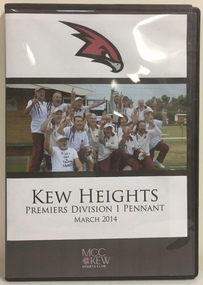
Film - DVD, Kew Heights Premiers Division 1 Pennant, March 2014, 2014
... DVD recording play in the RVBA Division 1 Pennant competition, in March 2014, of which Kew Heights won the premiership. ...The collection illuminates two of the Victorian historic themes - 'Building community life' through forming community organisations and 'Shaping cultural and creative life' by participating in sport and recreation. kew heights sports club - barkers road - kew (vic) kew heights bowling club The names of the team members are listed on the reverse of the DVD case DVD recording play in the RVBA Division 1 Pennant competition, in March 2014, of which Kew Heights won the premiership. Kew Heights Premiers Division 1 Pennant, March 2014 Film DVD MCC Kew Sports Club ...Sports Clubs in Kew in the final decades of the 19th century and in the early 20th century were often umbrella organisations with facilities for a number of sports. Typically in Kew, this included teams in lawn bowls, tennis and croquet. The Kew Bowling Club was formed in 1880 while the privately owned Auburn Heights Recreation Club was opened in 1904. By 1998, the two Clubs decided to amalgamate at the Auburn Heights site in Barkers Road, forming the Kew Heights Sports Club. The combined club was itself taken over by the Melbourne Cricket Club in 2012 becoming MCC Kew Sports Club. In 2017 MCC Kew closed and its landholding was subsequently sold to Carey Baptist Grammar School. Both the Kew and Auburn Heights Clubs assembled important collections. These historically significant and large collections were donated to the Society in 2020. The collections include manuscripts, pictures, trophies, plans, honour boards etc. References Barnard FGA 1910, 'Sports and Pastimes' in Jubilee History of Kew Victoria: Its origin & progress 1803-1910Reeve S 2012, City of Boroondara: Thematic Environmental History, p.216.The combined collections of the four sporting clubs making up the collection number hundreds of items that are historically significant locally. They are also significant to the sporting history of the greater Melbourne area and to the sports of lawn bowls and tennis in Australia in the 19th and 20th centuries. The collection illuminates two of the Victorian historic themes - 'Building community life' through forming community organisations and 'Shaping cultural and creative life' by participating in sport and recreation.DVD recording play in the RVBA Division 1 Pennant competition, in March 2014, of which Kew Heights won the premiership. The names of the team members are listed on the reverse of the DVD casekew heights sports club - barkers road - kew (vic), kew heights bowling club -
 Carlton Football Club
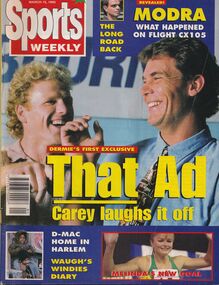
Colour Magazine, Sports Weekly, March 15, 1995
... Previews 1995 season, when Carlton subsequently won the premiership. From Roger Skien Collection....Previews 1995 season, when Carlton subsequently won the premiership. From Roger Skien Collection. ...Previews 1995 season, when Carlton subsequently won the premiership. From Roger Skien Collection.Article on Trent Hotton as a Collingwood player, later played for Carlton. Article on Carlton player Mark Cullen and a predicted best 21 for Carlton. From Roger Skien Collection.Softcover colour magazine -
 Linton and District Historical Society Inc
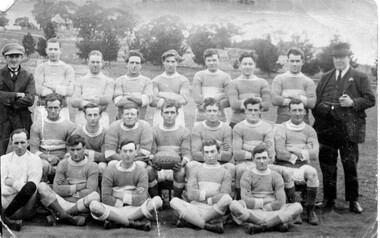
Photograph, Linton Football Club players 1922
... Linton Football Club won the premiership in 1922. This is one of several copies of the photograph in the LDHS collection....Linton Football Club won the premiership in 1922. This is one of several copies of the photograph in the LDHS collection. ...Linton Football Club won the premiership in 1922. This is one of several copies of the photograph in the LDHS collection.Sepia postcard photograph of a group of footballers posed for team photograph. Club officials are on the left and right side of the back row. An umpire wearing light-coloured clothing and long black socks or stockings is on the left of the front row. The player fourth from the left in the middle row is holding a football on which is written "LFC / PREMIERS / 1922 / LFC"."Post card",linton football club, premiership 1922, sports -
 Ballarat Heritage Services
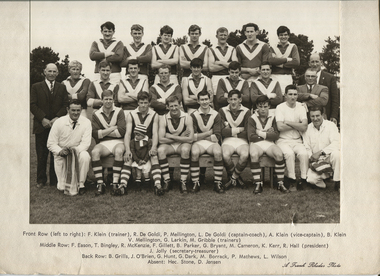
Photograph - Photograph - Black and White, Rokewood-Corindhap Football Club Premiers, 1867, 1967
... Rokewoord Corindhap won the premiership in 1967 with Garry Dark winning the Brunn Trophy for Best and Fairest in the League....Rokewoord Corindhap won the premiership in 1967 with Garry Dark winning the Brunn Trophy for Best and Fairest in the League. ...Rokewoord Corindhap won the premiership in 1967 with Garry Dark winning the Brunn Trophy for Best and Fairest in the League.Large black and white photograph with names typed underneath - in cover.Front Row (left to right): F. Klein (trainer), R. De Goldi, P. Mellington, L. De Goldi (captain-coach), A. Klein (vice-captain), B. Klein, V. Mellington, G. Larkin, M. Gribble (trainers) Middle Row: F. Eason, T. Bingley, R. McKenzie, F. Gillett, B. Parker, G. Bryant, M. Cameron, K. Kerr, R. Hall (president) J. Jolly (secretary-treasurer) Back Row: B. Grills, J. O'Brien, G. Hunt, G. Dark, M. Borrack, P. Mathews, L. Wilson. Absent: Hec Stone, D. Jensen A Frank Rhodes Photorokewood, corindhap,, afl, football, garry dark -
 Whitehorse Historical Society Inc.
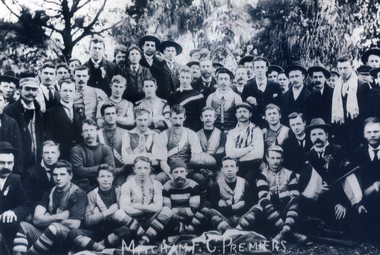
Photograph, Mitcham Football Club, 1904
... Originally the club played on the Reporter and District League where they won premierships in 1904, 1905, 1914, 1915 and 1921, then in the Eastern Suburbs Football League they won a premiership in 1947. ...Originally the club played on the Reporter and District League where they won premierships in 1904, 1905, 1914, 1915 and 1921, then in the Eastern Suburbs Football League they won a premiership in 1947. ...The Mitcham Football Club was established in 1888. Known as the 'Tigers', their colours are black and yellow and their home ground is at Walker Park, Mitcham. Originally the club played on the Reporter and District League where they won premierships in 1904, 1905, 1914, 1915 and 1921, then in the Eastern Suburbs Football League they won a premiership in 1947. At present (2015) they compete in the Eastern Football League and filed senior, reserves, under 19's and 6 junior Teams.Black and white photograph of the Mitcham Football team and supporters taken outside in1904.Mitcham F.C Premises is written on the bottom of photographmitcham football club, sporting clubs, football clubs -
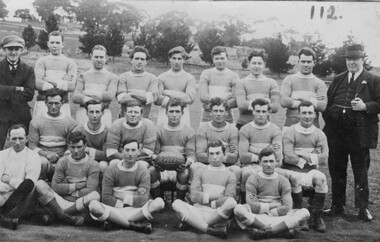 Linton and District Historical Society Inc
Photograph, Linton Football Team, 1922, 1922
... Linton Football Club won the premiership in 1922. This is one of several copies of the photograph in the LDHS collection. ...Linton Football Club won the premiership in 1922. This is one of several copies of the photograph in the LDHS collection. ...Linton Football Club won the premiership in 1922. This is one of several copies of the photograph in the LDHS collection. Photograph is part of Old Lintonian collection ; No. 112.Sepia photograph of a group of footballers in uniform standing and seated, official in suit, hat and fob watch standing at one side, another person wearing a jacket with tie, and peaked cap, standing at other side. An umpire wearing light-coloured clothing and long black socks or stockings is on the left of the front row. The footballer fourth from left in the middle row is holding a ball on which is written "LFC / PREMIERS / 1922 / LFC".linton football club, old lintonian collection -
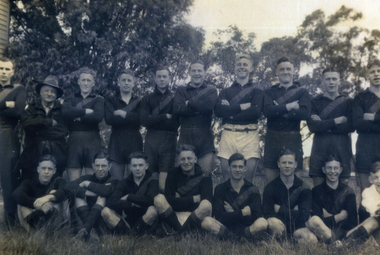 Whitehorse Historical Society Inc.
Photograph, Mitcham Stars Football Club 1935
... In 1935 Mitcham reverted to its own team and won the premiership that year....In 1935 Mitcham reverted to its own team and won the premiership that year. mitcham stars football club mitcham football club supporting clubs football clubs black and white photograph of the Mitcham Stars Football Club in 1935. ...During the Great Depression of the early 1930's, Vermont Football Club merged with Mitcham Football Club for 3 years - 1932 to 1934. In 1935 Mitcham reverted to its own team and won the premiership that year.black and white photograph of the Mitcham Stars Football Club in 1935. Photograph taken outside.mitcham stars football club, mitcham football club, supporting clubs, football clubs -
Linton and District Historical Society Inc
Football Jumper, Loco Sportswear, Football Jumper - Commemorative, Carngham Linton Football Netball Club, 2018, 2018
... Football jumper made from synthetic material to commemorate 100 years of when Linton Football Club won the premiership in 1922. Front of jumper is made up of black, white and red stripes. ...premiership year of 1922. Donated to the Society 100 years later in 2022. Carngham Linton Football Netball Club Linton Football Club Carngham Football Club Michael O'Beirne Football jumper made from synthetic material to commemorate 100 years of when Linton Football Club won the premiership in 1922. ...A heritage jumper worn by the Cargnham Linton Football Netball Club senior football team in the 2018 match against Skipton commemorating the 50th year of the amalgamated Cargnham Linton club. The jumper features the club's red, white and black colours on the front with logos and all football premierships of the Cargnham, Linton and Cargnham Linton football teams. The back of the jumper features a combination of the royal blue and gold sash of the former Linton Football Club and the royal blue and red sash of the former Cargnham Football Club. This jumper was donated to the Linton and District Historical Society has player number 22 on the back. This appropriately recognises 100 years since the Linton Football Club premiership year of 1922. Donated to the Society 100 years later in 2022.Football jumper made from synthetic material to commemorate 100 years of when Linton Football Club won the premiership in 1922. Front of jumper is made up of black, white and red stripes. Across centre front of jumper are three shields representing Carngham, Carngham Linton and Linton football clubs prior to and since amalgamation to one club. Below the shields are lists of when the above teams won significant premierships. Reverse of the jumper has a large number 22 which signifies winning a premiership in 1922 and the centenary year 2022.carngham linton football netball club, linton football club, carngham football club, michael o'beirne -
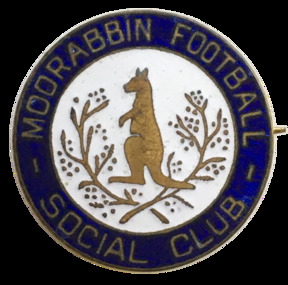 City of Moorabbin Historical Society (Operating the Box Cottage Museum)
Badge - Moorabbin Football - Social Club Badge, 1909-1963
... Moorabbin Football Club was formed in 1909 and was affiliated with Federal Football League (FFL) 1909-1950 and then Victorian Football Association (VFA) 1951-1963. The club won 14 premierships in that time. Their nickname was the Kangaroos. ...Moorabbin Football Club was formed in 1909 and was affiliated with Federal Football League (FFL) 1909-1950 and then Victorian Football Association (VFA) 1951-1963. The club won 14 premierships in that time. Their nickname was the Kangaroos. ...Moorabbin Football Club was formed in 1909 and was affiliated with Federal Football League (FFL) 1909-1950 and then Victorian Football Association (VFA) 1951-1963. The club won 14 premierships in that time. Their nickname was the Kangaroos. After their ground, the Moorabbin Oval, was sold to the VFL club St Kilda in 1963, Moorabbin Football Club disbanded in 1964.Moorabbin Football Club was very successful and popular club in the City of Moorabbin 1909 - 1964Circular Enamelled badge with blue outer circle and cold lettering "Moorabbin Football - Social Club". The inner circle is white with a picture of a kangaroo surrounded by wattle branches in gold.Moorabbin Football - Social Clubmoorabbin football club, social club, federal football league, victorian football association -
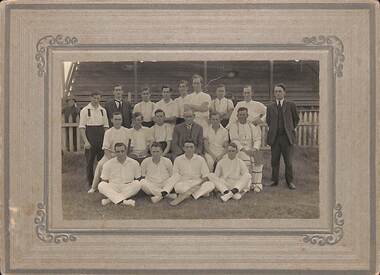 Port Melbourne Historical & Preservation Society
Photograph - Port Melbourne Cricket Club 1934, W CROFT, 1934
... The Club had not won a premiership since the 1918/19 season. It received a well needed boost in 1934 when Tom LAHIFF was captain and coach and went on to win the premiership in the 1937/38 season....The Club had not won a premiership since the 1918/19 season. It received a well needed boost in 1934 when Tom LAHIFF was captain and coach and went on to win the premiership in the 1937/38 season. ...The photograph of the Port Melbourne Cricket Club team of 1934 is mounted on grey striped card. Each corner above the photograph has an ornate scroll in darker grey. The Club had not won a premiership since the 1918/19 season. It received a well needed boost in 1934 when Tom LAHIFF was captain and coach and went on to win the premiership in the 1937/38 season.In pencil on reverse '1934 PMCC'port melbourne cricket club, pmcc, tommy lahiff, sport - cricket
