
Showing 90 items matching "preservations issues"
-
 Victorian Railway History Library
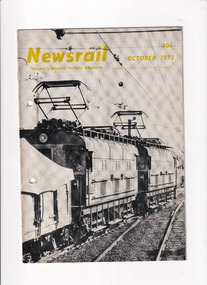
Journal - Newsrail October 1973, Unattributed, Discussion of issues associated with static rolling stock preservation. Disruptions account Spotswood bridge repairs, 1973
... ...Preservations issues...railroad bridges - Victoria - history Preservations issues Two articles from the October 1973 issue of Newsrail. ...Two articles from the October 1973 issue of Newsrail. First - Explorations of problems/issue associated with static preservation of rolling stock, particularly corrosion and moisture damage. Second - Report of delays and diversions to trains due to bridgework at Francis St, Spotswood.Ill, p.20.non-fictionTwo articles from the October 1973 issue of Newsrail. First - Explorations of problems/issue associated with static preservation of rolling stock, particularly corrosion and moisture damage. Second - Report of delays and diversions to trains due to bridgework at Francis St, Spotswood.railroad bridges - victoria - history, preservations issues -
 Ballarat Tramway Museum
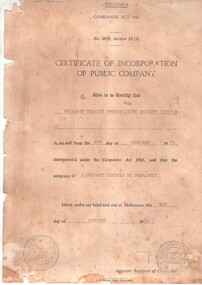
Certificate, Clyde Croft, "Certificate of Incorporation", oct. 1973
... Photocopy of the Certificate of Incorporation of the Ballarat Tramway Preservation Society Limited, issued on the 4th October 1973 by the Assistant Registrar of Companies under the Victorian Companies Act. 1961. ...Tramways trams BTPS Companies Act Incorporation Photocopy of the Certificate of Incorporation of the Ballarat Tramway Preservation Society Limited, issued on the 4th October 1973 by the Assistant Registrar of Companies under the Victorian Companies Act. 1961. ...Photocopy of the Certificate of Incorporation of the Ballarat Tramway Preservation Society Limited, issued on the 4th October 1973 by the Assistant Registrar of Companies under the Victorian Companies Act. 1961. Has the seals of the BTPS and the Victorian Registrar of Companies stamped on it. In poor condition.tramways, trams, btps, companies act, incorporation -
 Flagstaff Hill Maritime Museum and Village
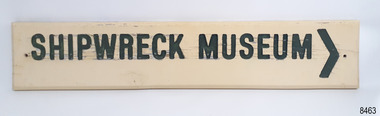
Sign - Shipwreck Museum sign, Flagstaff Hill Historic Park Planning Board, Shipwreck Museum, ca. 1975
... A section of the original internal wall frame and wallpaper that couldn’t be kept in the building due to preservation issues have been saved and become sort of the Flagstaff Hill Collection. ...A section of the original internal wall frame and wallpaper that couldn’t be kept in the building due to preservation issues have been saved and become sort of the Flagstaff Hill Collection. ...This sign is painted on both sides. It was attached to the bluestone wall on the western wing of the Lighthouse Keeper's Quarters, the Assistant Keeper's Quarters, at Flagstaff Hill Maritime Museum and Village for almost 50 years. The Complex was opened to the public on December 11, 1975, and officially opened by Victorian Premier Sir Rupert Hamer on July 8th, 1977. The sign's reverse side reads "Loch Ard Peacock & Museum". The three rooms had displays behind glass showing various ships' fittings, cargo and personal belongings recovered from significant shipwrecks along the southwest coast of Victoria. There was also a display of information about the mysterious Mahogany Ship or Ancient Wreck. The shipwreck artefacts were recovered by local divers in the 1960s and early 1970s. Also on display was the famous Loch Ard Peacock, created in 1873, survived the shipwreck in 1878, was purchased by Flagstaff Hill in 1975 and announced as being on display in The Standard of September 15, 1975. In about 1984 the other side of the sign was painted "SHIPWRECK MUSEUM" and re-displayed on the building. The Loch Ard Peacock was by that time on display in the Entrance building; plans were underway on August 31st 1984 to build a Hall for its unique display. In February 2023 the sign was removed from the building, which was undergoing restoration and preparation for use as a new Temporary Exhibition space. The Loch Ard Peacock continued its journey around the Village; it was moved from the Entrance to the Village's newly completed Public Hal in 1986. It also spent a short time in the Stella Maris Tea Rooms. This was likely around 1998, when the Common School had moved from the Chartroom building to what had been the Public Hall. The Loch Ard Peacock was once again moved in around 2001, this time to be the central attraction and meeting place in the Great Circle Gallery, which opened on December 31st 2002. The sign continued to be displayed on the western wing of the Lighthouse Keeper's Quarters until February 2023. This wing has now been restored and re-fitted to become a facility for short-term exhibitions. A section of the original internal wall frame and wallpaper that couldn’t be kept in the building due to preservation issues have been saved and become sort of the Flagstaff Hill Collection. The sign has guided the visitors of Flagstaff Hill Maritime Museum and Village to the exhibits of artefacts from historic and significant shipwrecks. It has connected the current generations to the people and objects of the past, leading to a better understanding of our Colonial history.Sign, wooden, rectangular, with a hole through each short side. The front and reverse have different painted text. Cream paint for the background colour, green paint for the lettering, and the reverse has a white painted border. The front has an arrow painted on the right-hand side. The sign was used at Flagstaff Hill since its opening.Text on front "SHIPWRECK MUSEUM >" Text on back "LOCH ARD PEACOCK / & MUSEUM"flagstaff hill maritime museum and village, warrnambool, great ocean road, shipwreck coast, sign, building sign, shipwreck museum, loch ard peacock & museum, flagstaff hill history, assistant lighthouse keeper's cottage, assistand lighthouse keeper's quarters, public hall, common school, light keeper -
 The Beechworth Burke Museum
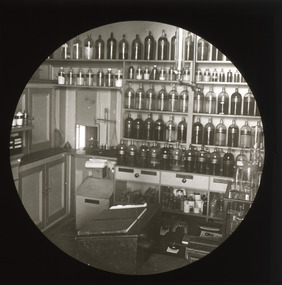
Photograph - Lantern Slide, c1900
... Although Hilda Dow was not Australia's first female pharmacist (this was Caroline Copp in 1880) the preservation of the pharmacy and the stories it presents sheds light on the general issue of recognition for female medical pioneers in Australia. ...Although Hilda Dow was not Australia's first female pharmacist (this was Caroline Copp in 1880) the preservation of the pharmacy and the stories it presents sheds light on the general issue of recognition for female medical pioneers in Australia. ...Chiltern Pharmacy, now called Dow's Pharmacy, opened in 1859 at a time when the township of Chiltern was experiencing a second-wave gold rush that redistributed the balance of commercial and social activity in the region. David McEwan, father of Prime Minister John McEwan, was one of the first pharmacists practicing at the business. It was purchased in 1929 by pharmacist Hilda Dow who ran the business with her apprentice and husband, Roy Dow, until they closed the business in 1968. In 1988, after founding the North East branch of the National Trust, the Dows donated the premises with its entire fittings and stock. Some of the more than 4,000 items in stock at the time of closure in 1968 were present in the shop when the Dows took charge in 1929 and date to the late Nineteenth Century (around the time this image was taken). Hilda Dow (nee Grey) was born in 1897, the daughter of a police magistrate. She enrolled to study at the Victorian College of Pharmacy in 1919 and worked initially for Poynton's Pharmacy in Morwell before purchasing the Chiltern Pharmacy that was later named after her. She was a member of the Pharmaceutical Society of Victoria, a hospital committee and Board, the Red Cross and the Infant Welfare Association and held office for the Chiltern branch of the Country Women's Association. Her sister Helene Grey received an OBE for her work as Lady Superintendent of the Royal Melbourne Hospital. Although Hilda Dow was not Australia's first female pharmacist (this was Caroline Copp in 1880) the preservation of the pharmacy and the stories it presents sheds light on the general issue of recognition for female medical pioneers in Australia. Lantern slides, sometimes called 'magic lantern' slides, are glass plates on which an image has been secured for the purpose of projection. Glass slides were etched or hand-painted for this purpose from the Eighteenth Century but the process became more popular and accessible to the public with the development of photographic-emulsion slides used with a 'Magic Lantern' device in the mid-Nineteenth Century. Photographic lantern slides comprise a double-negative emulsion layer (forming a positive image) between thin glass plates that are bound together. A number of processes existed to form and bind the emulsion layer to the base plate, including the albumen, wet plate collodion, gelatine dry plate and woodburytype techniques. Lantern slides and magic lantern technologies are seen as foundational precursors to the development of modern photography and film-making techniques.This image is significant as it provides insight into social and commercial infrastructure available in the North-East region of Victoria in the late Nineteenth and early Twentieth Centuries. The business pictured is also associated with a Prime Minister of Victoria and some of Victoria's first female medical and pharmaceutical practitioners. Thin translucent sheet of glass with a circular image printed on the front and framed in a black backing. It is held together by metals strips to secure the edges of the slide.burke museum, beechworth, lantern slide, slide, glass slide, plate, burke museum collection, photograph, monochrome, hilda dow, roy dow, chiltern pharmacy, dow's pharmacy, chiltern, indigo shire, north east victoria, history of pharmacies, women in pharmacy, women in medicine, women in business, david mcewan, john mcewan, national trust, national trust victoria, north-east victoria national trust, heritage buildings, industrial heritage, helene grey, pharmaceutical society of victoria, victorian college of pharmacy, country women's association, caroline copp, royal melbourne hospital, red cross, infant welfare association -
 Federation University Historical Collection
Letter - Correspondence, S.C. McBride, Letter concerning the work of Pastor Doug Nicholls and the Aborigines Advancement League, 1958, 11/07/1958
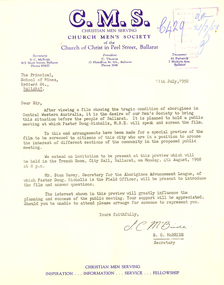
... It is primarily concerned with Aboriginal welfare issues and the preservation of Aboriginal culture and heritage, and is based in Melbourne. ...It is primarily concerned with Aboriginal welfare issues and the preservation of Aboriginal culture and heritage, and is based in Melbourne. ...The Church Men's Society was a part of the Church of Christ in Peel Street, Ballarat. In 1958 the President was C. Thomas, and S.C. McBride was Secretary. The Aborigines Advancement League (also known as the Aboriginal Advancement League) claims to be the oldest Aboriginal organisation in Australia. It is primarily concerned with Aboriginal welfare issues and the preservation of Aboriginal culture and heritage, and is based in Melbourne. The League was established in 1957 as a response to an enquiry by retired magistrate, Charles McLean, into the circumstances of Aboriginal Victorians. McLean was critical of conditions in the Lake Tyers and Framlingham Aboriginal Reserves. McLean recommended that persons of mixed Aboriginal and European descent be removed from the reserves. The people of Lake Tyers objected to this, and the League was formed out of their campaign. The new League drew from two already existing organisations, the Australian Aborigines League, established 1934 and the Save the Aborigines Committee, which had been established in 1955 as a response to the Warburton Ranges crisis. Founding President of the League was Gordon Bryant, with Doris Blackburn as Deputy President, Stan Davey as Secretary and Douglas Nicholls as Field Officer. Early activities included lobbying for a referendum to change the Australian constitution to allow the Federal government to legislate on Aboriginal affairs, and an establishing a legal defence fund for Albert Namatjira, after he was charged with supplying liquor to an Aboriginal ward.[1] By 1967 it had moved to being fully controlled by Aboriginal people with Bill Onus as the first Aboriginal President.Typed letter on Church Men's Society (C.M.S.) letterhead. The letter concerns a film 'showing the tragic condition of aborigines in Central Western Australia ...' The C.M.S. (Ballarat) planned to hold a public meeting in Ballarat at which Pastor Doug Nicholls, M.B.E. will speak and screen the film. doug nicholls, c. thomas, aborigines, ballarat town hall, stan davey, s.c. mcbride, letterhead -
 Federation University Historical Collection
Booklet, The Commission on Preservation and Access et al, 1 Preserving Digital Information: Report of the Task Force on Archiving of Digital Information. .2 Digital Image Collections: Issues and Practice, 1 1st May 1996 .2 December 1996
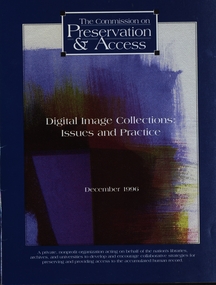
... Used in the library at Federation University by Carmel Grant University of Ballarat Preservation Access Digital Images Digital Collections Practice Issues Report Commission on Preservation and Access Library .1 is a report done by the Task Force on Archiving of Digital Information as part of the Commission on Preservation and Access .2 is a booklet about Digital Image Collections: Issues and Practice. .1 White covered booklet with blue writing and briwn coloured squares .2 Booklet with blue cover, white writing and multicoloured picture in the middle .1 Preserving Digital Information: Report of the Task Force on Archiving of Digital Information. .2 Digital Image Collections: Issues and Practice Booklet The Commission on Preservation and Access Donald Waters John Garrett Michael Ester ....1 is a report done by the Task Force on Archiving of Digital Information as part of the Commission on Preservation and Access .2 is a booklet about Digital Image Collections: Issues and Practice..1 White covered booklet with blue writing and briwn coloured squares .2 Booklet with blue cover, white writing and multicoloured picture in the middlenon-fiction.1 is a report done by the Task Force on Archiving of Digital Information as part of the Commission on Preservation and Access .2 is a booklet about Digital Image Collections: Issues and Practice.university of ballarat, preservation, access, digital images, digital collections, practice, issues, report, commission on preservation and access, library -
 Flagstaff Hill Maritime Museum and Village
Functional object - Bottle Seal, circa 1843-1878
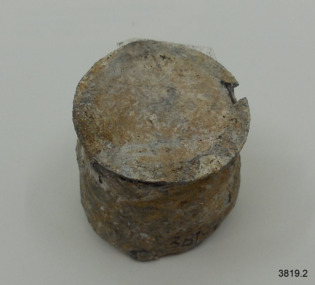
... This lead sealing capsule was made to seal a handmade glass bottle and is historically significant for representing its invention to solve a preservation and integrity issue with bottle seals in the mid-to-late 19th century. ...This lead sealing capsule was recovered from the tragic wreck of the sailing ship ‘Loch Ard’. It may have once been on a bottle amongst the ship's cargo, its provisions or the passengers’ personal luggage. It is now part of the John Chance collection. Bottles in the early 19th century were handmade. They were not necessarily uniform in size or shape, so sealing was not always successful. If the bottles were stored they often became contaminated by rats and mice breaking the cork or wax seals, or by insects attracted to the contents if the seal on the bottle leaked. Lead sealing capsules were used from 1843 to overcome this problem. The lead was heated until it was malleable, then moulded by hand to fit over the sealed bottle’s mouth and neck. This was more successful if wire was also used under the capsule for added security (similar to modern champagne bottles). The capsule couldn’t be re-fitted so it was discarded after the bottle was opened. Capsule designs from about 1862 used tin-plated lead foil and often had the inscriptions and trademarks of the content makers on them. Eventually it was found that the lead was toxic. The lead was replaced by tin, aluminium, and later plastic. Today’s home brewers can buy readymade plastic capsules that fit over the bottle then twist to lock it firmly into place and can be re-used. Digs at archaeological sites often reveal lead sealing capsules. These are collected and catalogued. The information gathered from inscriptions, makers’ marks, logos and descriptions of the bottle contents has provided valuable insights into the history and the dating of other items on the sites. This lead sealing capsule was made to seal a handmade glass bottle and is historically significant for representing its invention to solve a preservation and integrity issue with bottle seals in the mid-to-late 19th century. Its design has evolved and is still in use today. This sealing capsule is representative of their historical use of capsules as a tool for dating and interpreting archaeological sites around the world. The sealing capsule is also significant as it was recovered by John Chance, a diver from the wreck of the Loch Ard in the 1960s-70s. Items that come from several wrecks along Victoria's coast have since been donated to the Flagstaff Hill Maritime Village’s museum collection by his family, illustrating this item’s level of historical value. The sealing capsule is also significant for being connected to the wreck of the Loch Ard (1873-1878), which is historically significant to both Victoria and Australia. The loss of the ship has been described as one of the ‘worst shipwreck tragedies’ and is well known in Victoria for the tragic death of 52 out of the 54 lives on board. The Loch Ard wreck's historical significance as a large international passenger and cargo clipper ship has been recognised and it is now registered on the Victorian Heritage Database, VHR S417. The wreck site is labelled as ‘one of Victoria’s most spectacular diving sites’ and the area is a popular tourist site. It is part of Victoria’s Underwater Shipwreck Discovery Trail.Bottle sealing capsule, cylindrical with thin, round top separated from thicker body (taped in place and fragile). Made from grey-white lead, uneven in thickness and shape. Remnants of a thick substance are inside the capsule.flagstaff hill, warrnambool, flagstaff hill maritime museum, maritime museum, shipwreck coast, flagstaff hill maritime village, great ocean road, john chance, loch ard, bottle seal, bottle capsule, handmade bottle, antique bottle, sealing capsule, lead capsule, bottle closure, bottle foil, bottle preservation, bottle finish -
 Flagstaff Hill Maritime Museum and Village
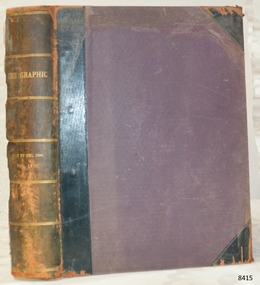
Newspaper - Bound Compilation of Newspapers July to December 1888, R. Clay, Sons, & Taylor, The Graphic Illustrated Newspaper Vol 38, 1888
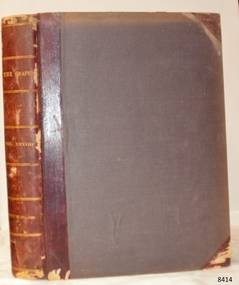
... Because newspapers back then were flimsy, readers or libraries would collect six months' worth of weekly issues and have them custom-bound into a hardback volume for preservation. Paste down front end paper has a sticker from Warrnambool Mechanics Institute and Free Library. ...To understand exactly what this item is, it helps to clear up a common misconception: it is not a book, nor is it a traditional literary novel. Instead, it is a bound volume of The Graphic, a weekly British newspaper that ran from 1869 to 1932. Because newspapers back then were flimsy, readers or libraries would collect six months' worth of weekly issues and have them custom-bound into a hardback volume for preservation.Bound Compilation, The Graphic Illustrated Newspaper Vol 38 Author: Various, Publisher: Edward Joseph Mansfield 1888 Date: 1888 Reddish hardcover with a damaged browns spine, reinforced corners to hardcover gold edging to spine. non-fictionTo understand exactly what this item is, it helps to clear up a common misconception: it is not a book, nor is it a traditional literary novel. Instead, it is a bound volume of The Graphic, a weekly British newspaper that ran from 1869 to 1932. Because newspapers back then were flimsy, readers or libraries would collect six months' worth of weekly issues and have them custom-bound into a hardback volume for preservation.flagstaff hil, warrnambool, flagstaff hill maritime museum, maritime museum, shipwreck coast, flagstaff hill maritime village, great ocean road, book, pattison collection, warrnambool library, warrnambool mechanics’ institute, ralph eric pattison, corangamite regional library service, warrnambool city librarian, mechanics’ institute library, victorian library board, warrnambool books and records, warrnambool children’s library, the graphic illustrated newspaper vol 38, edward joseph mansfield -
 Flagstaff Hill Maritime Museum and Village
Newspaper - Bound Compilation of Newspapers July to December 1898, Edward Joseph Mansfield, Publisher, The Graphic Illustrated Newspaper Vol 58, 1898
... Because newspapers back then were flimsy, readers or libraries would collect six months' worth of weekly issues and have them custom-bound into a hardback volume for preservation. This Compilation of Newspapers has no fly paper. ...To understand exactly what this item is, it helps to clear up a common misconception: it is not a book, nor is it a traditional literary novel. Instead, it is a bound volume of The Graphic, a weekly British newspaper that ran from 1869 to 1932. Because newspapers back then were flimsy, readers or libraries would collect six months' worth of weekly issues and have them custom-bound into a hardback volume for preservation.Bound Compilation, The Graphic Illustrated Newspaper Vol 58 Author: Various, Publisher: Edward Joseph Mansfield 1898 Date: 1898 Reddish hardcover with a damaged browns spine, reinforced corners to hardcover gold edging to spine. non-fictionTo understand exactly what this item is, it helps to clear up a common misconception: it is not a book, nor is it a traditional literary novel. Instead, it is a bound volume of The Graphic, a weekly British newspaper that ran from 1869 to 1932. Because newspapers back then were flimsy, readers or libraries would collect six months' worth of weekly issues and have them custom-bound into a hardback volume for preservation.flagstaff hil, warrnambool, flagstaff hill maritime museum, maritime museum, shipwreck coast, flagstaff hill maritime village, great ocean road, book, pattison collection, warrnambool library, warrnambool mechanics’ institute, ralph eric pattison, corangamite regional library service, warrnambool city librarian, mechanics’ institute library, victorian library board, warrnambool books and records, warrnambool children’s library, the graphic illustrated newspaper vol 58, edward joseph mansfield -
 City of Moorabbin Historical Society (Operating the Box Cottage Museum)
Newsletter - City of Moorabbin Historical Society No. 6 January / February 1962, City of Moorabbin Historical Society Newsletter No. 6 January / February 1962, 1962
... This Issue - Centenary Year Moorabbin; from Pastoral, Fishing, market gardening to suburban industrial; 'The Tuck Family'; Moorabbin City Band; This is No 6 Newsletter of CMHS January / February 196 CMHS obtained a Kingston City Council Community Grant 2016 for the digitization and preservation of these Original CMHS Newsletters commenced in 1961 CITY OF MOORABBIN HISTORICAL / SOCIETY / President T.A Sheehy ...... ...This is Newsletter No.6 produced by CMHS President Mr T.A. Sheehy in January / February 1962 The Aims of the CMHS are ‘to record the history of the City, and register something of the Australian Atmosphere, which the necessary speed-up in post-world-war two (WW11) immigration has caused to be lost; to produce a magazine at regular intervals, featuring the work of pioneers and the changing Australian scene; to work constantly with a long range view towards building a hall where records and exhibits can be housed’ The Original Newsletters reflect the history and heritage of the former City of Moorabbin — derived from Mooroobin, ‘a resting place’ in the Bunurrung spoken language. In 1994, the City of Moorabbin was integrated into the Cities of Bayside, Glen Eira, Kingston and Monash. This Issue - Centenary Year Moorabbin; from Pastoral, Fishing, market gardening to suburban industrial; 'The Tuck Family'; Moorabbin City Band;This is No 6 Newsletter of CMHS January / February 196 CMHS obtained a Kingston City Council Community Grant 2016 for the digitization and preservation of these Original CMHS Newsletters commenced in 1961 2 x pages Foolscap paper printed on 1 side.CITY OF MOORABBIN HISTORICAL / SOCIETY / President T.A Sheehy ...... Ssecretary Mrs L. Harvey ...../ NEWSLETTER No 6 January / February 1962 -
City of Moorabbin Historical Society (Operating the Box Cottage Museum)
Newsletter - City of Moorabbin Historical Society No. 7 March 1962, City of Moorabbin Historical Society Newsletter No. 7 March 1962, 1962
... In 1994, the City of Moorabbin was integrated into the Cities of Bayside, Glen Eira, Kingston and Monash This Issue - MCC Mayor L.R.Coates Speech; 1862 travel; Historical Volume; St John of God Home; Cheltenham Film Society. This is Newsletter No. 7 of CMHS March 1962 CMHS obtained a Kingston City Council Community Grant 2016 for the digitalization and preservation of these Original CMHS Newsletters commenced in 1961 CITY OF MOORABBIN HISTORICAL SOCIETY NEWSLETTER No 7 / ( Affiliated with the Royal Historical Society of Victoria ) March 1962 / President T. ...This is Newsletter No 7 produced in March 1962 by Mr T. A. Sheehy President CMHS The Aims of the CMHS are ‘to record the history of the City, and register something of the Australian Atmosphere, which the necessary speed-up in post-world-war two (WW11) immigration has caused to be lost; to produce a magazine at regular intervals, featuring the work of pioneers and the changing Australian scene; to work constantly with a long range view towards building a hall where records and exhibits can be housed’ The Original Newsletters reflect the history and heritage of the former City of Moorabbin — derived from Mooroobin, ‘a resting place’ in the Bunurrung spoken language. In 1994, the City of Moorabbin was integrated into the Cities of Bayside, Glen Eira, Kingston and Monash This Issue - MCC Mayor L.R.Coates Speech; 1862 travel; Historical Volume; St John of God Home; Cheltenham Film Society. This is Newsletter No. 7 of CMHS March 1962 CMHS obtained a Kingston City Council Community Grant 2016 for the digitalization and preservation of these Original CMHS Newsletters commenced in 1961 2 x pages Foolscap paper printed on 1 side.CITY OF MOORABBIN HISTORICAL SOCIETY NEWSLETTER No 7 / ( Affiliated with the Royal Historical Society of Victoria ) March 1962 / President T. A Sheehy ..... Secretary Mrs L Harvey .... -
City of Moorabbin Historical Society (Operating the Box Cottage Museum)
Newsletter - CMHS Moorabbin Mirror Issue 14 April 2018, CMHS Moorabbin Mirror Newsletter Issue 14 April 2018, 2018
... Topics : ANZAC display, Alonzo Box, 1914 HMAT A20 HORORATA, B Company 6th Battalion 2nd Brigade; Box Cottage grounds flooded by leaking tank Bowls Club 26th Dec ; Barn repairs, Barn storage; Filing Cabinets Inventory; GECC International Women's Day Biographies of 3 local women; GECC Alnutt Park March 18th promotion BCM; Welcome new BCM Volunteer Guides; KCC Network HS meeting; KCC Award Dr G Whitehead; KCC farm machinery preservation; FAHS funding; CMHS meeting dates This is Issue 14 of the Moorabbin Mirror, Newsletter of CMHS April 2018 moorabbin mirror, bader fran, bader holger, patterson geoffrey, box alonzo, 1914 hmat a20 hororata; b company 6th battalion; gallipoli landings 1915; glen eira historical society, glen eira city council, kingston city council, whitehead dr g. farm machinery, international women's day; Moorabbin / Mirror / Newsletter City of Moorabbin Historical Society Inc. ...This is Issue 14 of the Moorabbin Mirror produced by CMHS members Fran & Holger Bader , Geoffrey Paterson, April 2018 The Moorabbin Mirror reflects the history and heritage of the former City of Moorabbin — derived from Mooroobin, ‘a resting place’ in the Bunurrung spoken language. In 1994, the City of Moorabbin was integrated into the Cities of Bayside, Glen Eira, Kingston and Monash. Topics : ANZAC display, Alonzo Box, 1914 HMAT A20 HORORATA, B Company 6th Battalion 2nd Brigade; Box Cottage grounds flooded by leaking tank Bowls Club 26th Dec ; Barn repairs, Barn storage; Filing Cabinets Inventory; GECC International Women's Day Biographies of 3 local women; GECC Alnutt Park March 18th promotion BCM; Welcome new BCM Volunteer Guides; KCC Network HS meeting; KCC Award Dr G Whitehead; KCC farm machinery preservation; FAHS funding; CMHS meeting dates This is Issue 14 of the Moorabbin Mirror, Newsletter of CMHS April 2018A4 x 1 paper folded to A5 x 4pp printed both sides Moorabbin / Mirror / Newsletter City of Moorabbin Historical Society Inc. A0020543 (CMHS) / operating Box Cottage Museum (BCM) / April 2018 Issue 14moorabbin mirror, bader fran, bader holger, patterson geoffrey, box alonzo, 1914 hmat a20 hororata; b company 6th battalion; gallipoli landings 1915; glen eira historical society, glen eira city council, kingston city council, whitehead dr g. farm machinery, international women's day; -
 Queenscliffe Maritime Museum
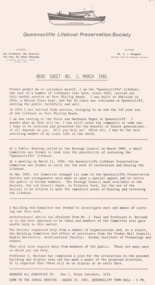
Newsletter - Queenscliffe Lifeboat Preservation Society newsletter #1, QLPS newsletter number 1 March 1981, 1981
... Lifeboat preservation Fist issue original document. historical references Reverse " continuation as page 2 " Original QLPS newsletter #1 March 1981 QLPS newsletter number 1 March 1981 Newsletter Queenscliffe Lifeboat Preservation Society newsletter #1 ...Lifeboat preservationFist issue original document.Original QLPS newsletter #1 March 1981Reverse " continuation as page 2 "historical references -
 Eltham District Historical Society Inc
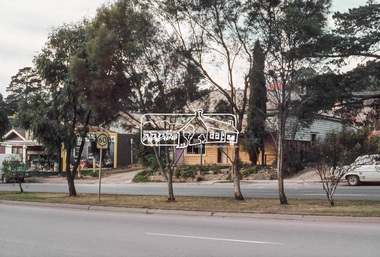
Slide, Joh Ebeli, The old Baker's house prior to demolition, corner of York Street and Main Road, Eltham, c.Sep. 1979
... The issues involved were part of a wider consideration of the matter of preservation of historic buildings. ...The issues involved were part of a wider consideration of the matter of preservation of historic buildings. ...Photo taken immediately prior to the demolition of the old baker's shop on the corner of Main Road and York Street, Eltham. Joh Ebeli and Elwers Howard endeavoured to preserve some parts of the house. The old weatherboard building, possibly dating from the 1860s, comprised a dwelling with a shop in the front room opening off a timber verandah deck which directly fronted the Main Road footpath. At the rear is a brick building of much later date which was for many years used for the bakery. The buildings were demolished for flat construction. Publicity at the time was oriented toward moves to preserve the weatherboard building which came from a number of individuals including members of this society. The society had no official connection with any proposal to retain the building or any part of it on any other site. The issues involved were part of a wider consideration of the matter of preservation of historic buildings. In this case the Society and in particular the committee had been aware for some years of the impending demolition. The possibility of the preservation of the building had been canvassed on a number of occasions. The Society’s view was that whilst the baker’s shop was an interesting old building which contributed to the character of Main Road, it was not of sufficient importance to wage an organised campaign for its preservation. It considered that if the building were to be preserved for historical reasons it would be far more feasible to retain it in its present location than to re-build it on another site.35 mm colour positive transparency Mount - Agfachrome Professional black (Germany) 4 dotsmain road, old eltham bakery, york street -
 Eltham District Historical Society Inc
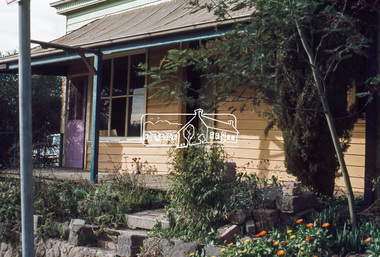
Slide, Joh Ebeli, The old Baker's house prior to demolition, corner of York Street and Main Road, Eltham, c.Sep. 1979
... The issues involved were part of a wider consideration of the matter of preservation of historic buildings. ...The issues involved were part of a wider consideration of the matter of preservation of historic buildings. ...Photo taken immediately prior to the demolition of the old baker's shop on the corner of Main Road and York Street, Eltham. Joh Ebeli and Elwers Howard endeavoured to preserve some parts of the house. The old weatherboard building, possibly dating from the 1860s, comprised a dwelling with a shop in the front room opening off a timber verandah deck which directly fronted the Main Road footpath. At the rear is a brick building of much later date which was for many years used for the bakery. The buildings were demolished for flat construction. Publicity at the time was oriented toward moves to preserve the weatherboard building which came from a number of individuals including members of this society. The society had no official connection with any proposal to retain the building or any part of it on any other site. The issues involved were part of a wider consideration of the matter of preservation of historic buildings. In this case the Society and in particular the committee had been aware for some years of the impending demolition. The possibility of the preservation of the building had been canvassed on a number of occasions. The Society’s view was that whilst the baker’s shop was an interesting old building which contributed to the character of Main Road, it was not of sufficient importance to wage an organised campaign for its preservation. It considered that if the building were to be preserved for historical reasons it would be far more feasible to retain it in its present location than to re-build it on another site.35 mm colour positive transparency Mount - Agfachrome Professional black (Germany) 4 dotsmain road, old eltham bakery, york street -
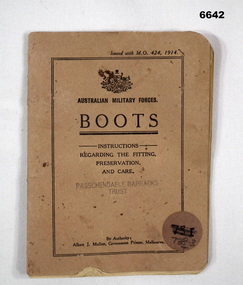 Bendigo Military Museum
Booklet - BOOKLET, BOOTS, INSTRUCTIONS REGARDING THE FITTING, PRESERVATION AND CARE, Albert J. Mullett, Govt Printer, 1914
... issue, wearing and care for. The rear cover has a red tinge. Booklet BOOKLET, BOOTS, INSTRUCTIONS REGARDING THE FITTING, PRESERVATION AND CARE. ...Pocket size booklet, Khaki cardboard cover. Top of front cover has the Australian Crest. front cover printing is in black ink. Inside are 28 pages on boots and shoes - issue, wearing and care for. The rear cover has a red tinge.Inside P.1 PBS stamp and written No's 738-3-T.passchendaele barracks trust, 738.3t, booklet, boots & shoes, ww1 -
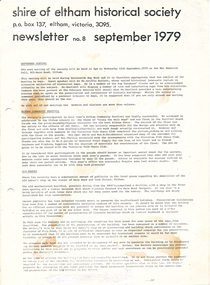 Eltham District Historical Society Inc
Newsletter, Newsletter, No. 8, September 1979
... Contents: • September meeting • Eltham Community Festival • Old Bakery • Preservation of historical buildings • Research notes The Shire of Eltham Historical Society was formed in October 1967. The first newsletter of the Society was issued May 1978 and has been published continuously ever since on a bi-monthly basis. ...Contents: • September meeting • Eltham Community Festival • Old Bakery • Preservation of historical buildings • Research notes The Shire of Eltham Historical Society was formed in October 1967. The first newsletter of the Society was issued May 1978 and has been published continuously ever since on a bi-monthly basis. With the cessation of the Shire of Eltham in late 1994, the Society's name was revised to Eltham District Historical Society and this name first appeared with issue No. 103, July 1995. The collection of the Society's newsletters provides a valuable resource on the history of the Society's activities, office bearers and committee members, guest speakers and subjects of historical interest pertinent to the former Shire of Eltham and the Eltham District.A4 photocopied newsletter distributed to membersnewsletter, eltham district historical society, shire of eltham historical society -
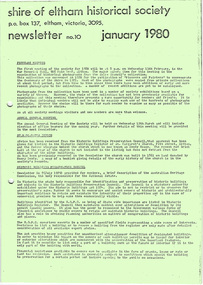 Eltham District Historical Society Inc
Newsletter, Newsletter, No. 10, January 1980
... Contents: • February meeting • Annual General Meeting • St Margaret’s Church • Historic Buildings Preservation Council • Combined Historic Buildings Register The Shire of Eltham Historical Society was formed in October 1967. The first newsletter of the Society was issued ...Contents: • February meeting • Annual General Meeting • St Margaret’s Church • Historic Buildings Preservation Council • Combined Historic Buildings Register The Shire of Eltham Historical Society was formed in October 1967. The first newsletter of the Society was issued May 1978 and has been published continuously ever since on a bi-monthly basis. With the cessation of the Shire of Eltham in late 1994, the Society's name was revised to Eltham District Historical Society and this name first appeared with issue No. 103, July 1995. The collection of the Society's newsletters provides a valuable resource on the history of the Society's activities, office bearers and committee members, guest speakers and subjects of historical interest pertinent to the former Shire of Eltham and the Eltham District.A4 photocopied newsletter distributed to membersnewsletter, eltham district historical society, shire of eltham historical society -
Port Melbourne Historical & Preservation Society
Financial record, Pat Grainger, Port Melbourne Historical & Preservation Society Annual Report 2003, Aug 2003
... These were compiled, designed, printed on photocopier and bound by the Secretary, except for the Tenth anniversary edition. societies clubs unions and other organisations port melbourne historical & preservation society pmhps Annual Report Graham BRIDE Annual Report of the PMH&PS, 2003 A4 12 pp plus cover - graduated blue, Tenth Anniversary issue. ...PMH&PS was incorporated in 1994, and from 1995 was required to hold an AGM and present an Annual Report. These were compiled, designed, printed on photocopier and bound by the Secretary, except for the Tenth anniversary edition.Annual Report of the PMH&PS, 2003 A4 12 pp plus cover - graduated blue, Tenth Anniversary issue. Contains financial reports, list of members, photos and details of Society's activities since inception.societies clubs unions and other organisations, port melbourne historical & preservation society, pmhps, annual report, graham bride -
Port Melbourne Historical & Preservation Society
Letter - From CoPP to Pat Grainger re problems following amalgamation, 1996
... When he was temporarily in charge of the latter, Mrs Grainger approached him re a number of issues on the way Port Melbourne was being handled engineering - roads streets lanes and footpaths built environment parks and gardens town clerks pat grainger peter fussel port melbourne historical & preservation society pmhps david graham Ink scribble at bottom of (.02) Re problems following amalgamation ...David Graham went from CEO of Port Melbourne to an executive position with City of Port Phillip. When he was temporarily in charge of the latter, Mrs Grainger approached him re a number of issues on the way Port Melbourne was being handledRe problems following amalgamation. (.01) - two page letter from David Graham, acting CEO of the new city of Port Phillip in response to complaints letter from Port resident Pat Grainger, 06.11.1996. (.02) - letter from Peter Fussell, Manager of Foreshore and Tourism, City of Port Phillip, as follow up to 2399.01Ink scribble at bottom of (.02)engineering - roads streets lanes and footpaths, built environment, parks and gardens, town clerks, pat grainger, peter fussel, port melbourne historical & preservation society, pmhps, david graham -
Glen Eira Historical Society
Letter - Heritage Watch Caulfield
... issue number three dated June 1991. It includes a paragraph on Rosecraddock, The Grand Union Tram Junction, Caulfield Heritage Study and an invitation to the annual general meeting on 27/06/1991. 4/Financial statement for Caulfield Heritage Watch for November 1989 to May 1991. 5/A handwritten submission to save Rosecraddock from demolition, date and author unknown. Caulfield Train Station Margaret Street 28 Walsh Graham A. Caulfield Manor Grove 1 Shellard Mr. Labassa Derby Road Inkerman Road Kerr Paul Glen Huntly Road Victorian Houses Gladstone Parade Hawthorn Road O’Neill College Miners Cottage Regent Street Elsternwick Buildings Heritage Preservation ...This file contains 5 items: 1/Documents related to the establishment of Heritage Watch in Caulfield. This includes a typed letter to Mrs. And Mr. Campbell from Graham Walsh inviting them to attend a meeting concerning the potential establishment of Heritage Watch – dated 08/11/1989. A nomination form to elect a committee –dated 27/06/1991, and documents outlining goals, maps of proposed area designated by the council, and black-and-white photographs of Miners Cottage Elsternwick and a mansion in Ripponlea, Elsternwick. 2/Minutes of Caulfield Heritage Watch Committee meetings on 04/12/1999, 22./01/1990, 08/10/1990 and 26/11/1990. It includes aims, general business, publicity and discussion on ‘Rosecraddock’. 3/Caulfield Heritage Watch Newsletter issue number three dated June 1991. It includes a paragraph on Rosecraddock, The Grand Union Tram Junction, Caulfield Heritage Study and an invitation to the annual general meeting on 27/06/1991. 4/Financial statement for Caulfield Heritage Watch for November 1989 to May 1991. 5/A handwritten submission to save Rosecraddock from demolition, date and author unknown.caulfield train station, margaret street 28, walsh graham a., caulfield manor grove 1, shellard mr., labassa, derby road, inkerman road, kerr paul, glen huntly road, victorian houses, gladstone parade, hawthorn road, o’neill college, miners cottage regent street elsternwick, buildings, heritage, preservation, urban conservation policy, caulfield city council, campbell mr. + mrs., caulfield heritage watch committee, snowball b., kay w., spencer d., dustan don, dustan david, campbell f., hill tess, jordan p., ritchie jack, architecture, development, cultural structures and establishments, residential development, murray, wells, hopkins sherry, caulfield town hall, rodder a., caulfield contact, spiker mr., elsternwick railway, elsternwick club, committees and inquiries, meetings, rosecraddock, construction sites, property, hill l., mayoress’ room caulfield, city hall, morris e., feehan j., molony v., moore mrs., elsternwick sandham street 19, elsternwick bowling club, ward andrew, shellard mr., construction and demolition, balaclava road, tramways, tram junction, kerr paul, gardens, save rosecraddock neighbourhood group -
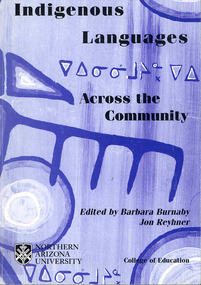 Victorian Aboriginal Corporation for Languages
Conference proceedings, Barbara Burnaby, Indigenous languages across the community, 2002
... Preservation and use. Language - Social function. [Maori: New Zealand Latin]. Language planning. [Language planning in a trans-national speech community]. [The way of the drum - when earth becomes heart] [The need for an ecological cultural community] Community language management. [Methods of madness: The Tuscarora Language Committee] [Daghida: Cold Lake First Nation works towards Dene language revitalization] [The Jicarilla Apache language summer day camp] [Report on the workshop "World of Inukitut"]. Arizona. New Mexico. Oklahoma. Adult education. Women's literacy. [Teaching reading with puppets] [Assessing Lakota language teaching issues...Preservation and use. Language - Social function. [Maori: New Zealand Latin]. Language planning. [Language planning in a trans-national speech community]. [The way of the drum - when earth becomes heart] [The need for an ecological cultural community] Community language management. [Methods of madness: The Tuscarora Language Committee] [Daghida: Cold Lake First Nation works towards Dene language revitalization] [The Jicarilla Apache language summer day camp] [Report on the workshop "World of Inukitut"]. Arizona. New Mexico. Oklahoma. Adult education. Women's literacy. [Teaching reading with puppets] [Assessing Lakota language teaching issues ...Language - Preservation and use. Language - Social function. [Maori: New Zealand Latin]. Language planning. [Language planning in a trans-national speech community]. [The way of the drum - when earth becomes heart] [The need for an ecological cultural community] Community language management. [Methods of madness: The Tuscarora Language Committee] [Daghida: Cold Lake First Nation works towards Dene language revitalization] [The Jicarilla Apache language summer day camp] [Report on the workshop "World of Inukitut"]. Arizona. New Mexico. Oklahoma. Adult education. Women's literacy. [Teaching reading with puppets] [Assessing Lakota language teaching issues on the Cheyenne River Reservation] [Incorporating traditional Nehiyaw/Plains Cree education in the university] [Collecting texts in Crao and Portuguese for teaching] [Early vocabularies and dictionary development: A cautionary note] [The process of spelling standardization of Innu-Aimun (Montagnais)] Pidgin. Creole. [Ojibway hockey CD-ROM in the making] [The use of multimedia and the arts in language revitalization, maintenance and development: The case of the Balsas Nahuas of Guerreo, Mexico] [The languages of Indigenous Peoples in Chukotka and the media] [Meeting of the Inukitut and Yupik family of languages on May 12, 2000]B&w photographs, diagrams,international language forum, community based practice, language research, conference papers, language policy, language and whole community development, literacy development, media, educational advances, canada, united states, new zealand, zimbabwe, mexico, russia, caribbean, inui, yupik -
 Ballarat Tramway Museum
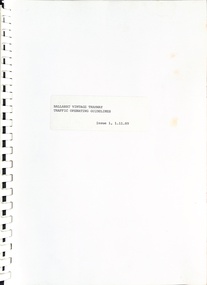
Manual - BTM, Peter Walker, "Traffic Operating Guidelines", 1989
... Provides guidance to Ballarat Tramway Preservation Society conductors about their duties, ticket issuing, pay-ins sales etc. ...Provides guidance to Ballarat Tramway Preservation Society conductors about their duties, ticket issuing, pay-ins sales etc. ...Provides guidance to Ballarat Tramway Preservation Society conductors about their duties, ticket issuing, pay-ins sales etc. Was the first version of this document. Prepared by Peter Walker. Replaced by version 2 of 1/5/1990. See item 1623 for a 1990 version.Demonstrates BTPS documentation for crew use.White comb bound document with card covers, 30 A4 photocopied pages.trams, tramways, conductors, btps, btm, guidelines, manual -
 St Kilda Historical Society
Photograph - Building, St Moritz Ice Skating Rink, 1982
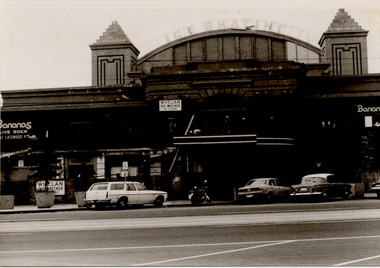
... It was nominated to the Historic Buildings Preservation Council, but a majority of City of St Kilda councillors voted to oppose this action and uphold a demolition permit already issued. ...It was nominated to the Historic Buildings Preservation Council, but a majority of City of St Kilda councillors voted to oppose this action and uphold a demolition permit already issued. ...The St. Moritz Ice Rink was a popular ice skating rink on The Esplanade, St. Kilda, Victoria. It operated between 1939–1981. As one of only two ice rinks in Melbourne in the 1940s and 1950s, it played a central role to the sport of ice hockey in Australia. Closed in 1982, it soon suffered a major fire and was then demolished, an event later seen as a major blow to the heritage of St Kilda. It was first built as the Wattle Path Palais de Danse in 1922, a very large dance hall, designed by architects Beaver & Purnell, The Wattle Path was the venue for the first all-Australian dance championship, and featured some of the best dance bands of Australia, as well as from America. Popular throughout the 1920s, it suffered due to the Great Depression, and closed in the early 1930s. From 1933-1936 the building became a film studio, Efftee Studios, for Frank W. Thring. In 1938, businessman Henry Hans "Harry" Kleiner announced that the Wattle Path would become an ice rink. He was sole proprietor until 1953, when he sold the business to J. Gordon and T. Molony, both champion skaters. Trade declined during the 1970s. The building was sold in 1980 to developers Hudson Conway and trucking magnate Lindsay Fox and was closed in early 1982. It was nominated to the Historic Buildings Preservation Council, but a majority of City of St Kilda councillors voted to oppose this action and uphold a demolition permit already issued. The building infamously suffered a fire later that year, leaving only the facades, which were demolished soon after. The site remained vacant until about 1991, when a mid-price hotel called the St Moritz was constructed. By 1993 it was simply called the Novotel St Kilda. The hotel closed in 2019 and was replaced by an apartment complex. The photograph shows signs and workers of Whelan the Wrecker team, a well-known demolition company in Melbourne.Black and white photograph, unmounteddavid rae collection, st kilda, st moritz -
 St Kilda Historical Society
Photograph - Building, St Moritz Ice Skating Rink, c1970s
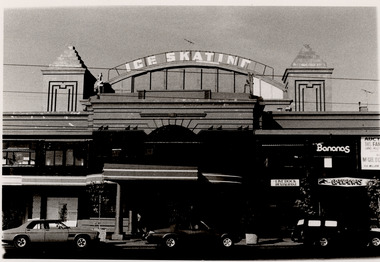
... It was nominated to the Historic Buildings Preservation Council, but a majority of City of St Kilda councillors voted to oppose this action and uphold a demolition permit already issued. ...It was nominated to the Historic Buildings Preservation Council, but a majority of City of St Kilda councillors voted to oppose this action and uphold a demolition permit already issued. ...The St. Moritz Ice Rink was a popular ice skating rink on The Esplanade, St. Kilda, Victoria. It operated between 1939–1981. As one of only two ice rinks in Melbourne in the 1940s and 1950s, it played a central role to the sport of ice hockey in Australia. Closed in 1982, it soon suffered a major fire and was then demolished, an event later seen as a major blow to the heritage of St Kilda. It was first built as the Wattle Path Palais de Danse in 1922, a very large dance hall, designed by architects Beaver & Purnell, The Wattle Path was the venue for the first all-Australian dance championship, and featured some of the best dance bands of Australia, as well as from America. Popular throughout the 1920s, it suffered due to the Great Depression, and closed in the early 1930s. From 1933-1936 the building became a film studio, Efftee Studios, for Frank W. Thring. In 1938, businessman Henry Hans "Harry" Kleiner announced that the Wattle Path would become an ice rink. He was sole proprietor until 1953, when he sold the business to J. Gordon and T. Molony, both champion skaters. Trade declined during the 1970s. The building was sold in 1980 to developers Hudson Conway and trucking magnate Lindsay Fox and was closed in early 1982. It was nominated to the Historic Buildings Preservation Council, but a majority of City of St Kilda councillors voted to oppose this action and uphold a demolition permit already issued. The building infamously suffered a fire later that year, leaving only the facades, which were demolished soon after. The site remained vacant until about 1991, when a mid-price hotel called the St Moritz was constructed. By 1993 it was simply called the Novotel St Kilda. The hotel closed in 2019 and was replaced by an apartment complex.Black and white photograph, unmounteddavid rae collection, st kilda, st moritz -
 St Kilda Historical Society
Photograph - Leisure activity, St Kilda Shout Collective, St Moritz Ice Skating Rink, 1980
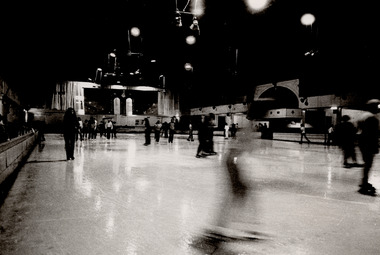
... It was nominated to the Historic Buildings Preservation Council, but a majority of City of St Kilda councillors voted to oppose this action and uphold a demolition permit already issued. ...It was nominated to the Historic Buildings Preservation Council, but a majority of City of St Kilda councillors voted to oppose this action and uphold a demolition permit already issued. ...The St. Moritz Ice Rink was a popular ice skating rink on The Esplanade, St. Kilda, Victoria. It operated between 1939–1981. As one of only two ice rinks in Melbourne in the 1940s and 1950s, it played a central role to the sport of ice hockey in Australia. Closed in 1982, it soon suffered a major fire and was then demolished, an event later seen as a major blow to the heritage of St Kilda. It was first built as the Wattle Path Palais de Danse in 1922, a very large dance hall, designed by architects Beaver & Purnell, The Wattle Path was the venue for the first all-Australian dance championship, and featured some of the best dance bands of Australia, as well as from America. Popular throughout the 1920s, it suffered due to the Great Depression, and closed in the early 1930s. From 1933-1936 the building became a film studio, Efftee Studios, for Frank W. Thring. In 1938, businessman Henry Hans "Harry" Kleiner announced that the Wattle Path would become an ice rink. He was sole proprietor until 1953, when he sold the business to J. Gordon and T. Molony, both champion skaters. Trade declined during the 1970s. The building was sold in 1980 to developers Hudson Conway and trucking magnate Lindsay Fox and was closed in early 1982. It was nominated to the Historic Buildings Preservation Council, but a majority of City of St Kilda councillors voted to oppose this action and uphold a demolition permit already issued. The building infamously suffered a fire later that year, leaving only the facades, which were demolished soon after. The site remained vacant until about 1991, when a mid-price hotel called the St Moritz was constructed. By 1993 it was simply called the Novotel St Kilda. The hotel closed in 2019 and was replaced by an apartment complex.Black and white photograph, unmounteddavid rae collection, st kilda, st moritz -
 St Kilda Historical Society
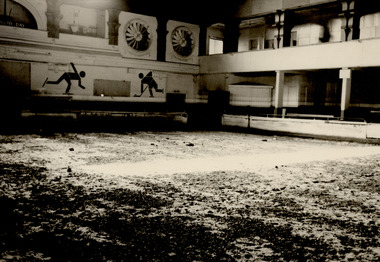
Photograph - Leisure activity, St Moritz Ice Skating Rink, c1980s
... It was nominated to the Historic Buildings Preservation Council, but a majority of City of St Kilda councillors voted to oppose this action and uphold a demolition permit already issued. ...It was nominated to the Historic Buildings Preservation Council, but a majority of City of St Kilda councillors voted to oppose this action and uphold a demolition permit already issued. ...The St. Moritz Ice Rink was a popular ice skating rink on The Esplanade, St. Kilda, Victoria. It operated between 1939–1981. As one of only two ice rinks in Melbourne in the 1940s and 1950s, it played a central role to the sport of ice hockey in Australia. Closed in 1982, it soon suffered a major fire and was then demolished, an event later seen as a major blow to the heritage of St Kilda. It was first built as the Wattle Path Palais de Danse in 1922, a very large dance hall, designed by architects Beaver & Purnell, The Wattle Path was the venue for the first all-Australian dance championship, and featured some of the best dance bands of Australia, as well as from America. Popular throughout the 1920s, it suffered due to the Great Depression, and closed in the early 1930s. From 1933-1936 the building became a film studio, Efftee Studios, for Frank W. Thring. In 1938, businessman Henry Hans "Harry" Kleiner announced that the Wattle Path would become an ice rink. He was sole proprietor until 1953, when he sold the business to J. Gordon and T. Molony, both champion skaters. Trade declined during the 1970s. The building was sold in 1980 to developers Hudson Conway and trucking magnate Lindsay Fox and was closed in early 1982. It was nominated to the Historic Buildings Preservation Council, but a majority of City of St Kilda councillors voted to oppose this action and uphold a demolition permit already issued. The building infamously suffered a fire later that year, leaving only the facades, which were demolished soon after. The site remained vacant until about 1991, when a mid-price hotel called the St Moritz was constructed. By 1993 it was simply called the Novotel St Kilda. The hotel closed in 2019 and was replaced by an apartment complex.Black and white photograph, unmounteddavid rae collection, st kilda, st moritz -
 St Kilda Historical Society
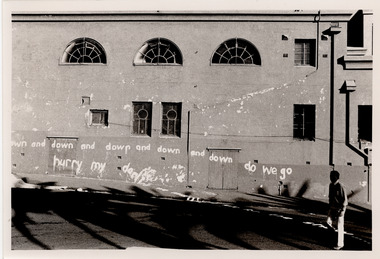
Photograph - Building, St Moritz Ice Skating Rink, c1980s
... It was nominated to the Historic Buildings Preservation Council, but a majority of City of St Kilda councillors voted to oppose this action and uphold a demolition permit already issued. ...It was nominated to the Historic Buildings Preservation Council, but a majority of City of St Kilda councillors voted to oppose this action and uphold a demolition permit already issued. ...The St. Moritz Ice Rink was a popular ice skating rink on The Esplanade, St. Kilda, Victoria. It operated between 1939–1981. As one of only two ice rinks in Melbourne in the 1940s and 1950s, it played a central role to the sport of ice hockey in Australia. Closed in 1982, it soon suffered a major fire and was then demolished, an event later seen as a major blow to the heritage of St Kilda. It was first built as the Wattle Path Palais de Danse in 1922, a very large dance hall, designed by architects Beaver & Purnell, The Wattle Path was the venue for the first all-Australian dance championship, and featured some of the best dance bands of Australia, as well as from America. Popular throughout the 1920s, it suffered due to the Great Depression, and closed in the early 1930s. From 1933-1936 the building became a film studio, Efftee Studios, for Frank W. Thring. In 1938, businessman Henry Hans "Harry" Kleiner announced that the Wattle Path would become an ice rink. He was sole proprietor until 1953, when he sold the business to J. Gordon and T. Molony, both champion skaters. Trade declined during the 1970s. The building was sold in 1980 to developers Hudson Conway and trucking magnate Lindsay Fox and was closed in early 1982. It was nominated to the Historic Buildings Preservation Council, but a majority of City of St Kilda councillors voted to oppose this action and uphold a demolition permit already issued. The building infamously suffered a fire later that year, leaving only the facades, which were demolished soon after. The site remained vacant until about 1991, when a mid-price hotel called the St Moritz was constructed. By 1993 it was simply called the Novotel St Kilda. The hotel closed in 2019 and was replaced by an apartment complex.Black and white photograph, unmounteddavid rae collection, st kilda, st moritz -
 St Kilda Historical Society
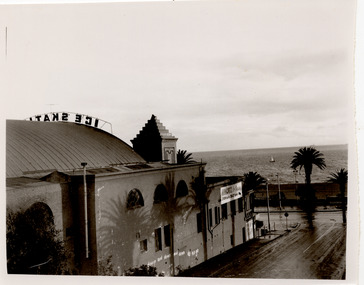
Photograph - Building, St Kilda Shout Collective, St Moritz Ice Skating Rink, 1983
... It was nominated to the Historic Buildings Preservation Council, but a majority of City of St Kilda councillors voted to oppose this action and uphold a demolition permit already issued. ...It was nominated to the Historic Buildings Preservation Council, but a majority of City of St Kilda councillors voted to oppose this action and uphold a demolition permit already issued. ...The St. Moritz Ice Rink was a popular ice skating rink on The Esplanade, St. Kilda, Victoria. It operated between 1939–1981. As one of only two ice rinks in Melbourne in the 1940s and 1950s, it played a central role to the sport of ice hockey in Australia. Closed in 1982, it soon suffered a major fire and was then demolished, an event later seen as a major blow to the heritage of St Kilda. It was first built as the Wattle Path Palais de Danse in 1922, a very large dance hall, designed by architects Beaver & Purnell, The Wattle Path was the venue for the first all-Australian dance championship, and featured some of the best dance bands of Australia, as well as from America. Popular throughout the 1920s, it suffered due to the Great Depression, and closed in the early 1930s. From 1933-1936 the building became a film studio, Efftee Studios, for Frank W. Thring. In 1938, businessman Henry Hans "Harry" Kleiner announced that the Wattle Path would become an ice rink. He was sole proprietor until 1953, when he sold the business to J. Gordon and T. Molony, both champion skaters. Trade declined during the 1970s. The building was sold in 1980 to developers Hudson Conway and trucking magnate Lindsay Fox and was closed in early 1982. It was nominated to the Historic Buildings Preservation Council, but a majority of City of St Kilda councillors voted to oppose this action and uphold a demolition permit already issued. The building infamously suffered a fire later that year, leaving only the facades, which were demolished soon after. The site remained vacant until about 1991, when a mid-price hotel called the St Moritz was constructed. By 1993 it was simply called the Novotel St Kilda. The hotel closed in 2019 and was replaced by an apartment complex. The image was published with an article about the fire and demolition of the rink in the Mar/Apr 1983 edition of community newspaper Shout.Black and white photograph, unmounteddavid rae collection, st kilda, st moritz -
 St Kilda Historical Society
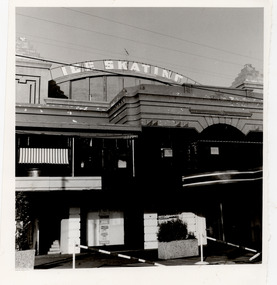
Photograph - Building, St Moritz Ice Skating Rink, c1980s
... It was nominated to the Historic Buildings Preservation Council, but a majority of City of St Kilda councillors voted to oppose this action and uphold a demolition permit already issued. ...It was nominated to the Historic Buildings Preservation Council, but a majority of City of St Kilda councillors voted to oppose this action and uphold a demolition permit already issued. ...The St. Moritz Ice Rink was a popular ice skating rink on The Esplanade, St. Kilda, Victoria. It operated between 1939–1981. As one of only two ice rinks in Melbourne in the 1940s and 1950s, it played a central role to the sport of ice hockey in Australia. Closed in 1982, it soon suffered a major fire and was then demolished, an event later seen as a major blow to the heritage of St Kilda. It was first built as the Wattle Path Palais de Danse in 1922, a very large dance hall, designed by architects Beaver & Purnell, The Wattle Path was the venue for the first all-Australian dance championship, and featured some of the best dance bands of Australia, as well as from America. Popular throughout the 1920s, it suffered due to the Great Depression, and closed in the early 1930s. From 1933-1936 the building became a film studio, Efftee Studios, for Frank W. Thring. In 1938, businessman Henry Hans "Harry" Kleiner announced that the Wattle Path would become an ice rink. He was sole proprietor until 1953, when he sold the business to J. Gordon and T. Molony, both champion skaters. Trade declined during the 1970s. The building was sold in 1980 to developers Hudson Conway and trucking magnate Lindsay Fox and was closed in early 1982. It was nominated to the Historic Buildings Preservation Council, but a majority of City of St Kilda councillors voted to oppose this action and uphold a demolition permit already issued. The building infamously suffered a fire later that year, leaving only the facades, which were demolished soon after. The site remained vacant until about 1991, when a mid-price hotel called the St Moritz was constructed. By 1993 it was simply called the Novotel St Kilda. The hotel closed in 2019 and was replaced by an apartment complex.Black and white photograph, unmounteddavid rae collection, st kilda, st moritz
