
Showing 16 items matching "prisoners of war-sumatra"
-
 Returned Nurses RSL Sub-branch
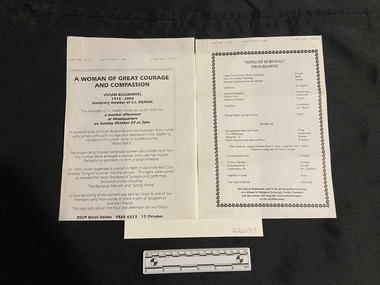
Document - Photocopy of flyer and programme, S I Deakin, A woman of great courage and compassion, 2000
... ...prisoners of war-Sumatra...The afternoon is in remembrance of Sister Vivian Bullwinkel and the Australian Army Nurses who were prisoners of war in Sumatra during World War II. In the prison camp in Sumatra a vocal orchestra was formed. ...The afternoon is in remembrance of Sister Vivian Bullwinkel and the Australian Army Nurses who were prisoners of war in Sumatra during World War II. In the prison camp in Sumatra a vocal orchestra was formed. ...An invitation from the members of S I Deakin to attend a musical afternoon on Sunday October 22, 2000. The afternoon is in remembrance of Sister Vivian Bullwinkel and the Australian Army Nurses who were prisoners of war in Sumatra during World War II. In the prison camp in Sumatra a vocal orchestra was formed. In 1990 Vivian Bullwinkel organised a concert to aid the Red Cross, entitled 'Song of survival', where 74 singers were trained to recreate the Vocal Orchestra of Sumatra. The musical afternoon includes a viewing of the taped recording of that concert with afternoon tea to follow. The second page of the document is a programme of the order of songs and music from the Song of Survival concert.Two sheets of A4 paper. The first contains an invitation in black type with bold headings surrounded by a double-lined border. The second page is a typed programme list, headings in bold type, surrounded by a border made up of a continuous line of musical notes in bold black print.world war two, ww2, wwii, vivian bullwinkel, australian army nurses, prisoners of war-sumatra, vochal orchestra of sumatra, song of survival concert -
![Newspaper - Newspaper clipping, The Weekly Telegraph, Escape from a POW camp brothel, July 19, [?]](/media/collectors/64a5077bc83bd7b7b94f4211/items/69b0bbeb3d5082ac59e59258/item-media/69b0c20e3d5082ac59e6dd79/item-fit-380x285.jpg?cb=6) Returned Nurses RSL Sub-branch
Returned Nurses RSL Sub-branchNewspaper - Newspaper clipping, The Weekly Telegraph, Escape from a POW camp brothel, July 19, [?]
... Prisoner of War Nurses...Ellen Mavis Allgrove...Sumatra...An account of the failed attempt of Japanese soldiers, in the prisoner-of-war camp in Sumatra, to force Australin Nurses to prepare and accompany them to a brothel in the camp....An account of the failed attempt of Japanese soldiers, in the prisoner-of-war camp in Sumatra, to force Australin Nurses to prepare and accompany them to a brothel in the camp. ...An account of the failed attempt of Japanese soldiers, in the prisoner-of-war camp in Sumatra, to force Australin Nurses to prepare and accompany them to a brothel in the camp.Large newspaper clipping. Two large side by side photos across most of the page, with five short columns of text below.wwii, ww2, world war two, prisoner of war nurses, ellen mavis allgrove, sumatra, japanese soldiers -
 Monbulk RSL Sub Branch
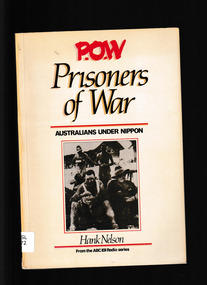
Book, Australian Broadcasting Corporation, P.O.W. : prisoners of war, 1985
... World war 1939 – 1945 - Prisons and prisoners – Japanese World war 1939-1945 - Personal narrativies - Australia Within three months of the Japanese entering World War II on December 8, 1941 over 22 000 Australians had become prisoners-of-war. They went into camps in Timor, Ambon, New Britain, Java, Sumatra ...Within three months of the Japanese entering World War II on December 8, 1941 over 22 000 Australians had become prisoners-of-war. They went into camps in Timor, Ambon, New Britain, Java, Sumatra, Borneo, Singapore and Malaya, and a few were scattered to other points in what was briefly part of the Japanese empire. Later most of the prisoners were to be shifted further north into South-east Asia, Formosa, Korea, Manchuria and Japan itself. They were captives within lands and cultures and to experiences alien to those known to all other Australians. At the end of the war in August 1945, 14315 servicemen and thirty service women were alive to put on new, loose-fitting uniforms and go home. One in three of the prisoners had died. That is, nearly half of the deaths suffered by Australians in the war in the Pacific were among men and women who had surrendered. Another 8174 Australians had been captured in the fighting in Europe, the Middle East and North Africa: but of these men only 265 died as a result of wounds, disease or execution.By any quantitative measure the imprisonment of so many Australians is a major event in Australian history. For many soldiers it was living --and dying --in captivity which made World War II different from that of World War I. But the prisoners have received no permanent place in Australian history. Their story is not immediately recalled on celebratory occasions. In a general history of the nation in which a chapter is given to the war the prisoners might be mentioned in a sentence, or part of a sentence. Where the horror, stoicism and gallantry of Gallipoli have become part of a common tradition shared by all Australians, the ex-prisoners are granted just the horror. The public may be sympathetic; but the horror is for the prisoners alone. To make another comparison: in five months of fighting on the Kokoda Trail in 1942 the Australians lost 625 dead, less than the number who died on Ambon. Yet the events on Ambon are unknown to most Australians. There were no reporters or cameramen on Ambon and, for the 309 who defended Ambon's Laha airfield, no survivors. How many of them died in battle or died as prisoners will never be known. But there are more than just practical reasons why the record of the prisoners of war is so slight and uneven in the general knowledge of Australians. They have not tried to find out. No historian has written a book to cover the range of camps and experiences, and only in specialist medical publications has anyone investigated the impact of prison life on subsequent physical and mental health. The complexity of the experience and its impact on particular lives have not been expressed in a way to give them significance for other Australians.Index, bib, ill, maps, p.224.Within three months of the Japanese entering World War II on December 8, 1941 over 22 000 Australians had become prisoners-of-war. They went into camps in Timor, Ambon, New Britain, Java, Sumatra, Borneo, Singapore and Malaya, and a few were scattered to other points in what was briefly part of the Japanese empire. Later most of the prisoners were to be shifted further north into South-east Asia, Formosa, Korea, Manchuria and Japan itself. They were captives within lands and cultures and to experiences alien to those known to all other Australians. At the end of the war in August 1945, 14315 servicemen and thirty service women were alive to put on new, loose-fitting uniforms and go home. One in three of the prisoners had died. That is, nearly half of the deaths suffered by Australians in the war in the Pacific were among men and women who had surrendered. Another 8174 Australians had been captured in the fighting in Europe, the Middle East and North Africa: but of these men only 265 died as a result of wounds, disease or execution.By any quantitative measure the imprisonment of so many Australians is a major event in Australian history. For many soldiers it was living --and dying --in captivity which made World War II different from that of World War I. But the prisoners have received no permanent place in Australian history. Their story is not immediately recalled on celebratory occasions. In a general history of the nation in which a chapter is given to the war the prisoners might be mentioned in a sentence, or part of a sentence. Where the horror, stoicism and gallantry of Gallipoli have become part of a common tradition shared by all Australians, the ex-prisoners are granted just the horror. The public may be sympathetic; but the horror is for the prisoners alone. To make another comparison: in five months of fighting on the Kokoda Trail in 1942 the Australians lost 625 dead, less than the number who died on Ambon. Yet the events on Ambon are unknown to most Australians. There were no reporters or cameramen on Ambon and, for the 309 who defended Ambon's Laha airfield, no survivors. How many of them died in battle or died as prisoners will never be known. But there are more than just practical reasons why the record of the prisoners of war is so slight and uneven in the general knowledge of Australians. They have not tried to find out. No historian has written a book to cover the range of camps and experiences, and only in specialist medical publications has anyone investigated the impact of prison life on subsequent physical and mental health. The complexity of the experience and its impact on particular lives have not been expressed in a way to give them significance for other Australians.world war 1939 – 1945 - prisons and prisoners – japanese, world war 1939-1945 - personal narrativies - australia -
 Monbulk RSL Sub Branch
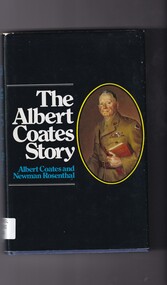
Book, Albert Coates et al, The Albert Coates story, 1977
... prisoners of war - australia world war 1939-1945 - personal narratives - australia A description of Albert Coates and of his imprisonment as a prisoner of the Japanese in Sumatra, Burma and Thailand Index, bibliography, ill (b/w), p.185. ...A description of Albert Coates and of his imprisonment as a prisoner of the Japanese in Sumatra, Burma and ThailandIndex, bibliography, ill (b/w), p.185.non-fictionA description of Albert Coates and of his imprisonment as a prisoner of the Japanese in Sumatra, Burma and Thailandprisoners of war - australia, world war 1939-1945 - personal narratives - australia -
 Alfred Hospital Nurses League - Nursing History Collection
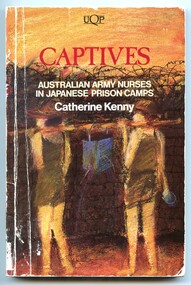
Book - Illustrated Book, Catherine Kenny 1962, Captives: Australian army nurses in Japanese prison camps, 1986
... Twelve drowned when the ship was sunk off the coast of Sumatra, a further 21 died in the Banka Island massacre, and another eight died in captivity Of significance to AHNL as Alfred graduates were among the captives World War 1939-1945 Australian Army Nurses prisoners of War military nursing nurses Experiences of Australian Army nurses who were prisoners of the Japanese during World War two At the bottom left of the first page is a printed coloured donation sticker: AHNL logo, "This book was donated to AHNL Inc-Nursing Archives by" the Alfred Hospital Library 21/3/18 (handwritten in ink) The previous catalogue number is handwritten in ink at top right of this page. ...Experiences of Australian Army nurses who were prisoners of the Japanese during World War twoIllustrated book. Front cover has a painting by Cynthia Breusch depicting two female figures carrying a container hanging from a pole on their shoulders. Behind them is a barbwire topped fence. The book title is printed over this painting in red and white ink. The author's name is printed in white below the title, and the publisher's mark is printed in black above the title. The Spine is cream in colour, with abbreviated title printed in red, author's surname and publishers mark printed in black. The back cover has a cream background, with quotes from two nurses and a summary of the book overprinted in blacknon-fictionExperiences of Australian Army nurses who were prisoners of the Japanese during World War twoworld war 1939-1945, australian army nurses, prisoners of war, military nursing, nurses -
 Alfred Hospital Nurses League - Nursing History Collection
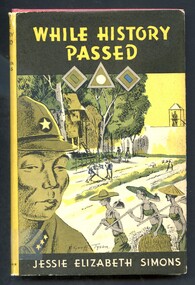
Book - Illustrated book, Jesse Elizabeth Simmons 1911- et al, While history passed: the story of the Australian Nurses who were prisoners of the Japanese for three and a half years, 1954
... Of significance to the AHNL as Alfred graduates were among the prisoners World War 1939-1945 prisoners of war Nurses The author was one of sixty-five Australian Army nurses ordered to leave Singapore aboard the Vyner Brooke. This is their story, including the years spent as prisoners of war in Sumatra ...The author was one of sixty-five Australian Army nurses ordered to leave Singapore aboard the Vyner Brooke. This is their story, including the years spent as prisoners of war in Sumatra by the survivorsIllustrated book with dust jacket. Book has a red cover with title and author's surname embossed in gold on spine. Front of the dust jacket has an illustration of a guard with female prisoners in the background (drawn by Geoff Tyson) Title is printed in yellow on a black background above this illustration, author's name is printed in white on a black background below this illustration. Title, author's and publisher's names are printed in black on a yellow background on the spinenon-fictionThe author was one of sixty-five Australian Army nurses ordered to leave Singapore aboard the Vyner Brooke. This is their story, including the years spent as prisoners of war in Sumatra by the survivorsworld war 1939-1945 prisoners of war, nurses -
 Stawell Historical Society Inc
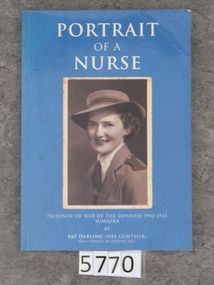
Book, Pat Darling, Portrait of a Nurse - Prisoner of war of the Japanese 1942-1945 Sumatra, 2001
... Portrait of a Nurse - Prisoner of war of the Japanese 1942-1945 Sumatra...Portrait of a Nurse Prisoner of War of the Japanese 1942-1945 Sumatra By Pat Darling (Nee Gunther) Mentioned in Dispatches...Account of a Nuses imprisonment by the Japenese as a prisoner of War from 1942 - 1945 stawell ww2 Portrait of a Nurse Prisoner of War of the Japanese 1942-1945 Sumatra By Pat Darling (Nee Gunther) Mentioned in Dispatches Blue card cover with centered portrait of an Army Nurse in uniform Portrait of a Nurse - Prisoner of war of the Japanese 1942-1945 Sumatra Book Pat Darling ...Account of a Nuses imprisonment by the Japenese as a prisoner of War from 1942 - 1945Blue card cover with centered portrait of an Army Nurse in uniformPortrait of a Nurse Prisoner of War of the Japanese 1942-1945 Sumatra By Pat Darling (Nee Gunther) Mentioned in Dispatchesstawell ww2 -
 Returned Nurses RSL Sub-branch
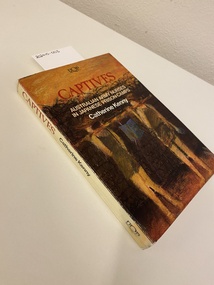
Book, Catherine Kenny et al, Captives : Australian army nurses in Japanese prison camps
... WWII World War 2 World War Two Japan POW POWs Prisoners of War Prisoner of War Australian Army Nursing Service Mitliary Nursing Australian Army "Hunger and humiliation were just some of the privations endured by those members of the Australian Army Nursing Service who were captives of the Japanese during World War II. Of the thirty-two held in Sumatra ..."Hunger and humiliation were just some of the privations endured by those members of the Australian Army Nursing Service who were captives of the Japanese during World War II. Of the thirty-two held in Sumatra and on Banka Island, twenty-four survived the severe physical conditions in the prison camps. Another group captured in Rabaul were held in Japan, where the cold was as bitter as their hunger. This is the dramatic account of those Australian nurses, of their struggles and their support for each other through the long years of war and captivity. In includes the horrifying story of Vivian Bullwinkel, the sole survivor of the callous massacre on Banka Island where twenty-three women were ordered into the sea and shot. It records the degradation of the daily 'tenko', the starvation and appalling lack of hygiene, but also tells how the women were at times able to rise above these miseries through their concerts and the soaring harmonies of the voice choir. Catherine Kenny interviewd many of the nurses and collected photographs, diaries and letters from the Australian War Memorial as well as from the women themselves." Blurb on back cover of book.Colour front cover, drawn image of people carrying a pole with a rectangular bucket suspended on the pole, the people wear hats and the sky is an orangey colour. Back cover has some quotes from nurses featured in the book as well as a blurb describing the book. Book is covered in clear contact.non-fiction"Hunger and humiliation were just some of the privations endured by those members of the Australian Army Nursing Service who were captives of the Japanese during World War II. Of the thirty-two held in Sumatra and on Banka Island, twenty-four survived the severe physical conditions in the prison camps. Another group captured in Rabaul were held in Japan, where the cold was as bitter as their hunger. This is the dramatic account of those Australian nurses, of their struggles and their support for each other through the long years of war and captivity. In includes the horrifying story of Vivian Bullwinkel, the sole survivor of the callous massacre on Banka Island where twenty-three women were ordered into the sea and shot. It records the degradation of the daily 'tenko', the starvation and appalling lack of hygiene, but also tells how the women were at times able to rise above these miseries through their concerts and the soaring harmonies of the voice choir. Catherine Kenny interviewd many of the nurses and collected photographs, diaries and letters from the Australian War Memorial as well as from the women themselves." Blurb on back cover of book.wwii, world war 2, world war two, japan, pow, pows, prisoners of war, prisoner of war, australian army nursing service, mitliary nursing, australian army -
 Returned Nurses RSL Sub-branch
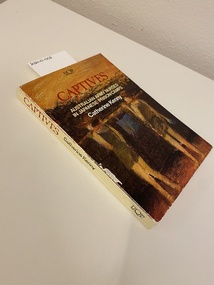
Book, Catherine Kenny et al, Captives : Australian army nurses in Japanese prison camps
... WWII World War 2 World War Two Japan POW POWs Prisoners of War Prisoner of War Australian Army Nursing Service Mitliary Nursing Australian Army "Hunger and humiliation were just some of the privations endured by those members of the Australian Army Nursing Service who were captives of the Japanese during World War II. Of the thirty-two held in Sumatra ..."Hunger and humiliation were just some of the privations endured by those members of the Australian Army Nursing Service who were captives of the Japanese during World War II. Of the thirty-two held in Sumatra and on Banka Island, twenty-four survived the severe physical conditions in the prison camps. Another group captured in Rabaul were held in Japan, where the cold was as bitter as their hunger. This is the dramatic account of those Australian nurses, of their struggles and their support for each other through the long years of war and captivity. In includes the horrifying story of Vivian Bullwinkel, the sole survivor of the callous massacre on Banka Island where twenty-three women were ordered into the sea and shot. It records the degradation of the daily 'tenko', the starvation and appalling lack of hygiene, but also tells how the women were at times able to rise above these miseries through their concerts and the soaring harmonies of the voice choir. Catherine Kenny interviewd many of the nurses and collected photographs, diaries and letters from the Australian War Memorial as well as from the women themselves." Blurb on back cover of book.Colour front cover, drawn image of people carrying a pole with a rectangular bucket suspended on the pole, the people wear hats and the sky is an orangey colour. Back cover has some quotes from nurses featured in the book as well as a blurb describing the book. non-fiction"Hunger and humiliation were just some of the privations endured by those members of the Australian Army Nursing Service who were captives of the Japanese during World War II. Of the thirty-two held in Sumatra and on Banka Island, twenty-four survived the severe physical conditions in the prison camps. Another group captured in Rabaul were held in Japan, where the cold was as bitter as their hunger. This is the dramatic account of those Australian nurses, of their struggles and their support for each other through the long years of war and captivity. In includes the horrifying story of Vivian Bullwinkel, the sole survivor of the callous massacre on Banka Island where twenty-three women were ordered into the sea and shot. It records the degradation of the daily 'tenko', the starvation and appalling lack of hygiene, but also tells how the women were at times able to rise above these miseries through their concerts and the soaring harmonies of the voice choir. Catherine Kenny interviewd many of the nurses and collected photographs, diaries and letters from the Australian War Memorial as well as from the women themselves." Blurb on back cover of book.wwii, world war 2, world war two, japan, pow, pows, prisoners of war, prisoner of war, australian army nursing service, mitliary nursing, australian army -
 Returned Nurses RSL Sub-branch
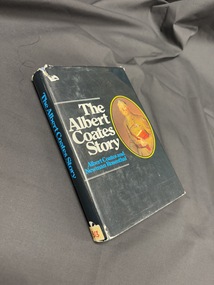
Book, Albert Ernest Coates, The Albert Coates story : The will that found the way, 1977
... World War Two WWII WW2 Prisoner of War Japan 'The Albert Coates story is one of heroism, of courage, endurance and service. he is a great civilian as well as a great soldier and the book tells of his contributions to the development of medical studies and services in Melbourne-but the core of the book is his description of three-and-a-half years as a prisoner of the Japanese in Sumatra, Burma and Thailand. ...'The Albert Coates story is one of heroism, of courage, endurance and service. he is a great civilian as well as a great soldier and the book tells of his contributions to the development of medical studies and services in Melbourne-but the core of the book is his description of three-and-a-half years as a prisoner of the Japanese in Sumatra, Burma and Thailand. Written on scraps of paper of all kinds, toilet paper, anything, in rare moments of solitude between improvising medicines, amputating legs, appealing to the Japanese authorities and administering hospital camps, Albert Coates describes on of history's great feats of medicine. The first and last sections of the book have been written by Newman Rosenthal who also edited the prisoner of war section-so there is continuity of narrative.' [From front dust jacket]Book with a black dustjacket, has a painted portrait of an older man in uniform on cover and white and blue text on cover and spinenon-fiction'The Albert Coates story is one of heroism, of courage, endurance and service. he is a great civilian as well as a great soldier and the book tells of his contributions to the development of medical studies and services in Melbourne-but the core of the book is his description of three-and-a-half years as a prisoner of the Japanese in Sumatra, Burma and Thailand. Written on scraps of paper of all kinds, toilet paper, anything, in rare moments of solitude between improvising medicines, amputating legs, appealing to the Japanese authorities and administering hospital camps, Albert Coates describes on of history's great feats of medicine. The first and last sections of the book have been written by Newman Rosenthal who also edited the prisoner of war section-so there is continuity of narrative.' [From front dust jacket]world war two, wwii, ww2, prisoner of war, japan -
 Returned Nurses RSL Sub-branch
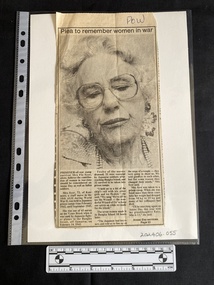
Newspaper - Newspaper clipping, Plea to remember women in war, [1987]
... This article is about Flo Syer, who as a nurse, served during World War 2 and was taken prisoner by the Japanese when the ship she was traveling on was sunk off Sumatra. ...This article is about Flo Syer, who as a nurse, served during World War 2 and was taken prisoner by the Japanese when the ship she was traveling on was sunk off Sumatra. ...This article is about Flo Syer, who as a nurse, served during World War 2 and was taken prisoner by the Japanese when the ship she was traveling on was sunk off Sumatra. Flo believes that women should also be remembered at Anzac Day services.A newspaper article clipped from a larger page with a large black and white photo of an older woman and three columns of text underneath'POW' [blue ink top right of page]ww2, wwll, pow, florence elizabeth syer, banka island -
 Returned Nurses RSL Sub-branch
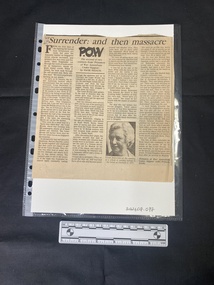
Newspaper - Newspaper clipping, Hank Nelson, Surrender: and then massacre, 26/4/[1985]
... prisoners of war (POW). World War 2 WWII WW2 World War II Olive Dorothy Paschke Vyner Brooke Vivian Bullwinkel Sumatra Palembang Jean Ashton Betty Jeffrey Wah Sui Empire Star Micky Syer Banka Strait Private Kingsley Cecil Kingsley 10th Australian General Hospital 'A[G]E / 26/4'[blue ink, top left] A newspaper clipping consisting of four large columns of text and a small black and white photo of an older woman (head). ...The newspaper clipping is the second of two extract from 'Prisoners of War: Australians Under Nippon', by Hank Nelson. The extract touches on the conditions the nurses serving in Singapore experienced, moving into the eventual evacuation. The first nurses were evacuated on February 10, [1942], with half of the remainder the following day, and the final nurses were evacuated February 13. These sixty-five nurses were aboard the Vyner Brooke with 300 other passengers, mostly women and children. The ship was spotted and bombed the next day. Sister Vivian Bullwinkel, clinging to the side of a lifeboat, came ashore on Radji Beach, Banka Island. She became one of a group of twenty-two nurse, other Vyner Brooke passengers and twenty British soldier from another bombed ship. This group decided to surrender to the Japanese, who proceeded to kill all but one British soldier and Vivian Bullwinkel. After holding out for ten days the pair made their way to Muntok, hiding the evidence they had both survived a massacre. Of the sixty-five nurses to board the Vyner Brooke, twelve had drowned, twenty-one had been killed on the beach and thirty-two became prisoners of war (POW).A newspaper clipping consisting of four large columns of text and a small black and white photo of an older woman (head).'A[G]E / 26/4'[blue ink, top left]world war 2, wwii, ww2, world war ii, olive dorothy paschke, vyner brooke, vivian bullwinkel, sumatra, palembang, jean ashton, betty jeffrey, wah sui, empire star, micky syer, banka strait, private kingsley, cecil kingsley, 10th australian general hospital -
 Returned Nurses RSL Sub-branch
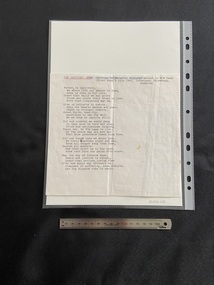
Document - Typed hymn, Margaret Dryburgh, The Captives Hymn, unknown
... Prisoner of War camp. It was first sung on the 5th of July in 1942 at Irenelaan, Palembang, Sumatra. ...Prisoner of War camp. It was first sung on the 5th of July in 1942 at Irenelaan, Palembang, Sumatra. ...A hymn written by Margaret Dryburgh, whilst in a Prisoner of War camp. It was first sung on the 5th of July in 1942 at Irenelaan, Palembang, Sumatra. Margaret Dryburgh was a Presbyterian Missionary in Singapore when the Japanese arrived, she died in a camp hospital in 1945.An A4 sheet of paper that has been cut down to a smaller size. The front contains the typed words of the hymn in black ink, the title in underlined in red pen ink. There are handwritten inscriptions on the back of the page.'Jessie Hookway / (Simons) / AANS 2/13th AGH / passed away / 23 December 2004' [Handwritten in pencil on the back of the paper] [Handwritten information regarding Miss Margaret Dryburgh, written in black ink on the back of the page, refer to media image] prisoners of war, margaret dryburgh -
 Returned Nurses RSL Sub-branch
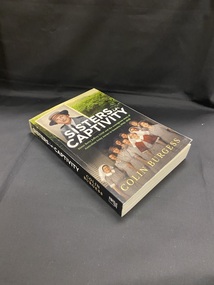
Book - Paperback book, Colin Burgess, Sisters in captivity: Sister Betty Jeffrey OAM and the courageous story of Australian Army nurses in Sumatra, 1942-1945, 2023
... war nurses who survived the bombing of evacuation ship SS Vyner Brooke in February 1942, and subsequently spent three years in Japanese prison camps in Sumatra. During those perilous years surviving in squalid conditions, Sister Jeffrey kept a secret diary of day-to-day events which, after the war, was turned into a hugely successful book and radio serial: White Coolies. She would often write of the powerful sisterhood that evolved as the prisoners ...The incredible account of Sister Betty Jeffrey OAM and the Australian war nurses who survived the bombing of evacuation ship SS Vyner Brooke in February 1942, and subsequently spent three years in Japanese prison camps in Sumatra. During those perilous years surviving in squalid conditions, Sister Jeffrey kept a secret diary of day-to-day events which, after the war, was turned into a hugely successful book and radio serial: White Coolies. She would often write of the powerful sisterhood that evolved as the prisoners of war took strength from each other, even forming a vocal orchestra. White Coolies was a major inspiration for the 1997 film Paradise Road. Sisters in Captivity builds on those diaries to not only re-live the years the nurses spent as POWs but also recounts the early life and influences that encouraged Betty Jeffrey into the field of nursing as a lifelong endeavour. A tireless advocate for returned nurses, she co-founded the Australian Nurses Memorial Centre with sole survivor of the Banka Island Massacre, fellow POW, and her longtime friend Vivian Bullwinkel. Featuring 32 pages of photos including personal mementos of Betty Jeffrey, courtesy of her family, and her drawings from the prison camps, this is a powerful account of women's resilience amidst the devastating brutality of war.--Back cover.Title is printed across the middle of the cover in large white text, followed by the sub title in smaller green print below. There is a photo of Sister Betty Jeffrey in the top left corner and the bottom half of the page shows an image of a group of ten nurses posing for a photo. The background of the cover is dense green jungle.non-fictionThe incredible account of Sister Betty Jeffrey OAM and the Australian war nurses who survived the bombing of evacuation ship SS Vyner Brooke in February 1942, and subsequently spent three years in Japanese prison camps in Sumatra. During those perilous years surviving in squalid conditions, Sister Jeffrey kept a secret diary of day-to-day events which, after the war, was turned into a hugely successful book and radio serial: White Coolies. She would often write of the powerful sisterhood that evolved as the prisoners of war took strength from each other, even forming a vocal orchestra. White Coolies was a major inspiration for the 1997 film Paradise Road. Sisters in Captivity builds on those diaries to not only re-live the years the nurses spent as POWs but also recounts the early life and influences that encouraged Betty Jeffrey into the field of nursing as a lifelong endeavour. A tireless advocate for returned nurses, she co-founded the Australian Nurses Memorial Centre with sole survivor of the Banka Island Massacre, fellow POW, and her longtime friend Vivian Bullwinkel. Featuring 32 pages of photos including personal mementos of Betty Jeffrey, courtesy of her family, and her drawings from the prison camps, this is a powerful account of women's resilience amidst the devastating brutality of war.--Back cover. military nursing, military history, betty jeffrey, royal australian army nursing corps -
 Returned Nurses RSL Sub-branch
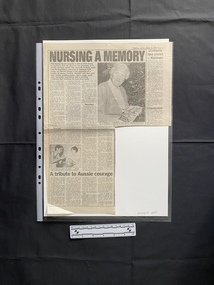
Newspaper - Newspaper clipping, Herald Sun, 'Nursing a memory' & 'A tribute to Aussie courage', 19911026
... Prisoners of War (POWs) during WWII. 'A tribute to Aussie courage': A brief explanatory article on story of the Japanese POW nurses in Muntok and Sumatra that has inspire a sub-committee of the Ex-Prisoners of War Association of Australia to fund raise and organise a memorial to these nurses....Prisoners of War (POWs) during WWII. 'A tribute to Aussie courage': A brief explanatory article on story of the Japanese POW nurses in Muntok and Sumatra that has inspire a sub-committee of the Ex-Prisoners of War Association of Australia to fund raise and organise a memorial to these nurses. ...'Nursing a memory': Article giving brief accounts of the experiences of [Agnes] Betty Jeffrey, Vivian Statham (neé Bullwinkel), Wilma Young (neé Oram) and Jessie [Elizabeth] Hookway (neé Simons) around Banka Straits, the sinking of the Vyner Brooke and being Japanese Prisoners of War (POWs) during WWII. 'A tribute to Aussie courage': A brief explanatory article on story of the Japanese POW nurses in Muntok and Sumatra that has inspire a sub-committee of the Ex-Prisoners of War Association of Australia to fund raise and organise a memorial to these nurses.A large newspaper clipping consisting of two stories with titles and four columns of text each. The larger story also has two black and white photos, on of an older woman holding a book, and the other of two young women leaning in toward each otheragnes betty jeffrey, vivian statham (nee bullwinkel), wilma elizabeth forster young (nee oram), jessie elizabeth hookway (neé simons), ss vyner brooke, banka straits, wwii, ww2, world war two, japanese pows -
 Returned Nurses RSL Sub-branch
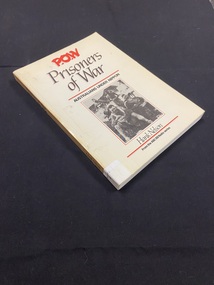
Book, Hank Nelson, P.O.W. Prisoners of War : Australians Under Nipon, 1985
... Prisoners of War...singapore...Thailand...Japan...sumatra...Historical significance is in the first hand accounts of prisoners of war given in interviews with Hank Nelson, and presented on ABC radio. Prisoners of War singapore Thailand Japan sumatra The experiences of Australian prisoners-of-war in Japanese prison camps - Changi prison. '940.5472 / NEL' [Typed on white label at the base of the spine] '940.5472 / NEL / A.3149' [Handwritten in pencil on the inside front cover] 'Clarrie Thornton' [Handsigned in dark blue ink on title page] 'Keith Botterill' [Handsigned in royal blue ink on title page] Soft cover, cream coloured, photograph of soldiers on front cover with the title details above. ...The experiences of Australian prisoners-of-war in Japanese prison camps - Changi prison.Soft cover, cream coloured, photograph of soldiers on front cover with the title details above. Spine has title, subtitle and author and ABC logonon-fictionThe experiences of Australian prisoners-of-war in Japanese prison camps - Changi prison.prisoners of war, singapore, thailand, japan, sumatra,
