
Showing 34 items matching "property rights"
-
 Moorabbin Air Museum
Document (item) - GAF Collection - Memo re Intellectual Property Rights Protection
... GAF Collection - Memo re Intellectual Property Rights Protection...GAF Collection - Memo re Intellectual Property Rights Protection...GAF Collection - Memo re Intellectual Property Rights Protection Document GAF Collection - Memo re Intellectual Property Rights Protection ... -
 Victorian Aboriginal Corporation for Languages
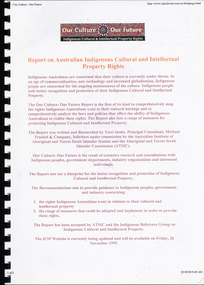
Book, Terri Janke, Our culture : our future : report on Australian Indigenous cultural and intellectual property rights, 1998
... Our culture : our future : report on Australian Indigenous cultural and intellectual property rights...In 1997, ATSIC released the discussion paper Our Culture: Our Future: Proposals for the Protection and Recognition of Indigenous Cultural and Intellectual Property, and invited public comment on the need for protecting and recognising Indigenous Cultural and Intellectual Property Rights. The report extracted here was developed in the light of over 70 submissions received on this discussion paper, and also in consultation with a National Indigenous Reference Group and other relevant individuals, communities and organisations. ...Our culture : our future : report on Australian Indigenous cultural and intellectual property rights Book Terri Janke ...In 1997, ATSIC released the discussion paper Our Culture: Our Future: Proposals for the Protection and Recognition of Indigenous Cultural and Intellectual Property, and invited public comment on the need for protecting and recognising Indigenous Cultural and Intellectual Property Rights. The report extracted here was developed in the light of over 70 submissions received on this discussion paper, and also in consultation with a National Indigenous Reference Group and other relevant individuals, communities and organisations. The Report details the types of rights Indigenous people seek in relation to their cultures and considers the application of current laws. It also makes recommendations for a comprehensive range of measures for improving the level of protection, including legal and non-legal reforms.colour illustrations, chartsindigenous cultural and intellectual property, intellectual property, copyright, native title -
Broadmeadows Historical Society & Museum
Document - Receipt, J. & H. Safstrom Pty Ltd, Copy of Receipt – Right of Carriageway, 14 February 1956
... Property rights...The receipt documents a mid 20th century property related transaction in Glenroy, reflecting suburban development practices and private agreements relating to access rights....This receipt provides documentary evidence of local land use arrangements and commercial activity in Glenroy during the 1950s, contributing to an understanding of suburban development and legal practices at the time. Property rights Local governance Glenroy (Vic.) 1950s local commerce City of Broadmeadows Northern Metropolitan Melbourne Safstroms McDonald & Ray (Location: printed and handwritten text on recto; additional markings verso): “Copy of Receipt”/“J. & H. ...The receipt documents a mid 20th century property related transaction in Glenroy, reflecting suburban development practices and private agreements relating to access rights.This receipt provides documentary evidence of local land use arrangements and commercial activity in Glenroy during the 1950s, contributing to an understanding of suburban development and legal practices at the time.Paper receipt, blue text on light paper, with handwritten annotations on recto and verso.(Location: printed and handwritten text on recto; additional markings verso): “Copy of Receipt”/“J. & H. Safstrom Pty. Ltd.”/“6–8 Post Office Place, Glenroy, 3046”/“14.2.56”/“Received … the sum of £100 (pounds)”/“Being payment in full for right of Carriageway at rear of Belair Ave.”/“Receipt No. 648”property rights, local governance, glenroy (vic.), 1950s local commerce, city of broadmeadows, northern metropolitan melbourne, safstroms, mcdonald & ray -
 Bendigo Historical Society Inc.
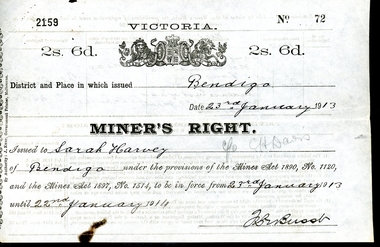
Legal record - WES HARRY COLLECTION: THREE MINER'S RIGHT / RESIDENCY PERMITS
... Unlike the Gold License, the early Miner’s Right, in addition to the right to prospect for gold, also carried with it certain other advantages, such as property rights and voting rights. The Miner’s Right came about as a recommendation of a government-appointed commission, which had been appointed on 1854 to look into the troubles on the Victorian goldfields, especially regarding the Eureka Rebellion....Unlike the Gold License, the early Miner’s Right, in addition to the right to prospect for gold, also carried with it certain other advantages, such as property rights and voting rights. The Miner’s Right came about as a recommendation of a government-appointed commission, which had been appointed on 1854 to look into the troubles on the Victorian goldfields, especially regarding the Eureka Rebellion. wes harry collection miner's right bendigo history long gully bendigo Victorian State Government Three Miner's Rights / Residency Permits for leases on the corner of Holdsworth Road and Wood Street, Long Gully, Bendigo (Area known as American Gully - downstream of the American Mine): a and b No 72 Sarah Harvey, dated 23/01/1913 c and d No 23148 Evalina Gifford Vivian Harvey, dated 14/09/1926 e and f No 23149 Thomas George Harvey, dated 14/09/1926 Issued by the Victorian Government at a cost of two shillings and six pence Legal record WES HARRY COLLECTION: THREE MINER'S RIGHT / RESIDENCY PERMITS ...The Miner’s Right has a long history in Australia. Still in use today, it was first established in Victoria in 1855, as a replacement for the Gold License (which had been introduced in Victoria in 1851). The Miner’s Right was subsequently adopted by other Australian colonies. Unlike the Gold License, the early Miner’s Right, in addition to the right to prospect for gold, also carried with it certain other advantages, such as property rights and voting rights. The Miner’s Right came about as a recommendation of a government-appointed commission, which had been appointed on 1854 to look into the troubles on the Victorian goldfields, especially regarding the Eureka Rebellion.Three Miner's Rights / Residency Permits for leases on the corner of Holdsworth Road and Wood Street, Long Gully, Bendigo (Area known as American Gully - downstream of the American Mine): a and b No 72 Sarah Harvey, dated 23/01/1913 c and d No 23148 Evalina Gifford Vivian Harvey, dated 14/09/1926 e and f No 23149 Thomas George Harvey, dated 14/09/1926 Issued by the Victorian Government at a cost of two shillings and six penceVictorian State Governmentwes harry collection, miner's right, bendigo, history, long gully bendigo -
Ringwood and District Historical Society
Indenture Papers, Typed document formalising separation of Borough of Ringwood from Shire of Lillydale - 25 October 1926, Oct-26
... These comprise a bundle of papers pertaining to the Indenture made between the council of the Lillydale Shire and the council of the Borough of Ringwood, and the apportioning of property, income, assets, rights, liabilities and expenses, etc....These comprise a bundle of papers pertaining to the Indenture made between the council of the Lillydale Shire and the council of the Borough of Ringwood, and the apportioning of property, income, assets, rights, liabilities and expenses, etc. ...These comprise a bundle of papers pertaining to the Indenture made between the council of the Lillydale Shire and the council of the Borough of Ringwood, and the apportioning of property, income, assets, rights, liabilities and expenses, etc.Various council matters between Ringwood and Lilydale. These comprise 44 foolscap pages - some typed, some handwritten. -
 Coal Creek Community Park & Museum
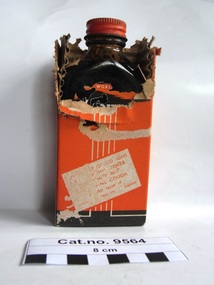
Bottle glass, c. 1935 -1955
... LEGAL ACTION WILL BE TAKEN AGAINST ANY PERSON OR COMPANY VIOLATING THE PROPERTY RIGHTS OF THESE FIRMS' OR COMPANIES' BRANDED BOTTLES........................Taylor Chemical Co..............'. ...LEGAL ACTION WILL BE TAKEN AGAINST ANY PERSON OR COMPANY VIOLATING THE PROPERTY RIGHTS OF THESE FIRMS' OR COMPANIES' BRANDED BOTTLES........................Taylor Chemical Co..............'. ...TROVE: The Advertiser (Adelaide S.A. 1931-1954) Sat 22 June 1935, page 24, Advertising 'PUBLIC NOTICE TO BOTTLERS, BOTTLE DEALERS, ETC., RE PROPERTY BRANDED BOTTLES WHICH ARE NOT SOLD. The undermentioned. Firms and Companies, carrying on business at Sydney and elsewhere. HEREBY GIVE NOTICE that all Bottles delivered by them, to their customers, having a notification moulded thereon that they are, or remain, the property of the Firms and Companies mentioned below. ARE NOT SOLD WITH THE CONTENTS THEREOF, BUT REMAIN THE PROPERTY OF SUCH FIRMS and COMPANIES. Such Bottles are loaned solely for me purpose of enabling the contents to be delivered to the purchasers from the said Firms and Companies, and to all subsequent purchasers of the contents. As soon as the Bottles are emptied of their contents they must not be refilled, destroyed, damaged, or used again for any purpose, but must, on demand, be delivered up to the Companies or Firms whose names are moulded thereon, or to their Accredited Agents:— BUTLER AND NORMAN. LTD., MANDIBLE ST., ALEXANDRIA, NJS.W. The remuneration received by Collectors, Dealers, etc. Is simply an allowance for the safe custody, and collection of the Bottles. LEGAL ACTION WILL BE TAKEN AGAINST ANY PERSON OR COMPANY VIOLATING THE PROPERTY RIGHTS OF THESE FIRMS' OR COMPANIES' BRANDED BOTTLES........................Taylor Chemical Co..............'. TROVE : Courier-Mail (Brisbane, Qld. : 1933 - 1954), Thursday 5 July 1945, page 7, Advertising. DON'T COUGH ALL NIGHT ! take a dose of YCOUGH at bedtime! Y- Cough will relieve your cough or cold while you sleep peacefully! 1'9 AT ALL CHEMISTS AND STORES. On box labels : Taylor Chemical Co. Sydney, Reg. Vic. 3146. Clear, rectangular in section, screw top bottle with orange metal lid and orange, brown & white printed paper label, containing dark brown liquid, in a corrugated cardboard lined orange, dark brown and white printed cardboard box. Embossed on side of bottle in cartouche 'THIS BOTTLE LWAYS REMAINS THE PROPERTY OF TAYLOR CHEMICAL CO. SYDNEY'. Embossed on base of bottle AGM logo with the numerals '16510' along side and the numeral '3' below. On orange metal top printed in white 'Y-COUGH' and 'PLEASANT TO TAKE'. On paper bottle label '....world.......Y-COUGH REGISTERED FOR RELIEF OF COUGHS, OF COLDS, INFLUENXA, BRONCHITUS AND WHOOPING COUGH and for the relief of throat soreness and irritation. DOSE : Adults : one or two teaspoonsful every 2 hours or when cough is troublesome. Children over 6, one teaspoonful every 3 or 4 hours. Under 6, half quantity. FOR Colds and Influenza : one teaspoonful in cup of hot water after getting into bed will give added relief. This package contains 3.77% Potassii Bromidum. Net Contents : 2 1/2 Fl. Oz. Sole Manufacturers TAYLOR CHEMICAL CO. SYDNEY. Reg. Vic. 3146'. Front of box & repeated rear ' Y-COUGH REGISTERED FOR RELIEF OF COUGHS, OF COLDS, INFLUENXA, BRONCHITUS AND WHOOPING COUGH and for relief of throat soreness and irritation. Side 1. of box 'PLEASANT TO TAKE Sole Manufacturers TAYLOR CHEMICAL CO. SYDNEY. Reg. Vic. 3146'. Side 2. of box 'NO HARMFUL DRUGS Sole Manufacturers TAYLOR CHEMICAL CO. SYDNEY. Reg. Vic. 3146'. chemist, medicine, influenza -
 Coal Creek Community Park & Museum
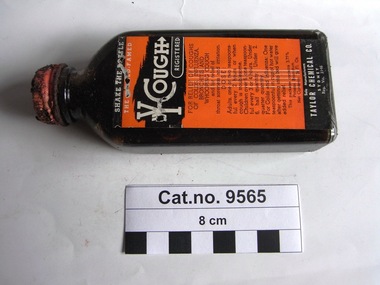
Bottle, glass, c. 1935 -1955
... LEGAL ACTION WILL BE TAKEN AGAINST ANY PERSON OR COMPANY VIOLATING THE PROPERTY RIGHTS OF THESE FIRMS' OR COMPANIES' BRANDED BOTTLES........................Taylor Chemical Co..............'. ...LEGAL ACTION WILL BE TAKEN AGAINST ANY PERSON OR COMPANY VIOLATING THE PROPERTY RIGHTS OF THESE FIRMS' OR COMPANIES' BRANDED BOTTLES........................Taylor Chemical Co..............'. ...TROVE: The Advertiser (Adelaide S.A. 1931-1954) Sat 22 June 1935, page 24, Advertising 'PUBLIC NOTICE TO BOTTLERS, BOTTLE DEALERS, ETC., RE PROPERTY BRANDED BOTTLES WHICH ARE NOT SOLD. The undermentioned. Firms and Companies, carrying on business at Sydney and elsewhere. HEREBY GIVE NOTICE that all Bottles delivered by them, to their customers, having a notification moulded thereon that they are, or remain, the property of the Firms and Companies mentioned below. ARE NOT SOLD WITH THE CONTENTS THEREOF, BUT REMAIN THE PROPERTY OF SUCH FIRMS and COMPANIES. Such Bottles are loaned solely for me purpose of enabling the contents to be delivered to the purchasers from the said Firms and Companies, and to all subsequent purchasers of the contents. As soon as the Bottles are emptied of their contents they must not be refilled, destroyed, damaged, or used again for any purpose, but must, on demand, be delivered up to the Companies or Firms whose names are moulded thereon, or to their Accredited Agents:— BUTLER AND NORMAN. LTD., MANDIBLE ST., ALEXANDRIA, NJS.W. The remuneration received by Collectors, Dealers, etc. Is simply an allowance for the safe custody, and collection of the Bottles. LEGAL ACTION WILL BE TAKEN AGAINST ANY PERSON OR COMPANY VIOLATING THE PROPERTY RIGHTS OF THESE FIRMS' OR COMPANIES' BRANDED BOTTLES........................Taylor Chemical Co..............'. TROVE : Courier-Mail (Brisbane, Qld. : 1933 - 1954), Thursday 5 July 1945, page 7, Advertising. DON'T COUGH ALL NIGHT ! take a dose of YCOUGH at bedtime! Y- Cough will relieve your cough or cold while you sleep peacefully! 1'9 AT ALL CHEMISTS AND STORES. On box labels : Taylor Chemical Co. Sydney, Reg. Vic. 3146. Clear, rectangular in section, screw top bottle with orange metal lid and orange, brown & white printed paper label, containing dark brown liquid, in a corrugated cardboard lined orange, dark brown and white printed cardboard box. Embossed on side of bottle in cartouche 'THIS BOTTLE LWAYS REMAINS THE PROPERTY OF TAYLOR CHEMICAL CO. SYDNEY'. Embossed on base of bottle AGM logo with the numerals '16510' along side and the numeral '3' below. On orange metal top printed in white 'Y-COUGH' and 'PLEASANT TO TAKE'. On paper bottle label '....world.......Y-COUGH REGISTERED FOR RELIEF OF COUGHS, OF COLDS, INFLUENXA, BRONCHITUS AND WHOOPING COUGH and for the relief of throat soreness and irritation. DOSE : Adults : one or two teaspoonsful every 2 hours or when cough is troublesome. Children over 6, one teaspoonful every 3 or 4 hours. Under 6, half quantity. FOR Colds and Influenza : one teaspoonful in cup of hot water after getting into bed will give added relief. This package contains 3.77% Potassii Bromidum. Net Contents : 2 1/2 Fl. Oz. Sole Manufacturers TAYLOR CHEMICAL CO. SYDNEY. Reg. Vic. 3146'. Front of box & repeated rear ' Y-COUGH REGISTERED FOR RELIEF OF COUGHS, OF COLDS, INFLUENXA, BRONCHITUS AND WHOOPING COUGH and for relief of throat soreness and irritation. Side 1. of box 'PLEASANT TO TAKE Sole Manufacturers TAYLOR CHEMICAL CO. SYDNEY. Reg. Vic. 3146'. Side 2. of box 'NO HARMFUL DRUGS Sole Manufacturers TAYLOR CHEMICAL CO. SYDNEY. Reg. Vic. 3146'. chemist, medicine, infuenza -
 Australian Commando Association - Victoria
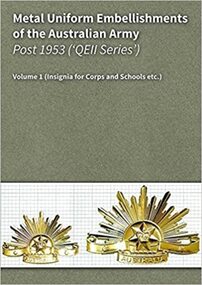
Metal Uniform Embellishments of the Australian Army Post 1953 Volume 1 - Insignia for Corps and Schools, 2017
... This item does not infringe on any copyright, trademark and/or intellectual property rights and we hold specific written publication approval from the Australian Defence Force. ...This item does not infringe on any copyright, trademark and/or intellectual property rights and we hold specific written publication approval from the Australian Defence Force. ...This 236 page, full-colour hard copy reference work, catalogues the metal insignia embellishments used by all Corps and Schools of the Australian Army (including philanthropic organisations), from 1953 through to the present. The book provides images of the front and the back of a given (metal) insignia set for each Corps etc. Each image set depicts the relevant hat badge, collar badges and epaulette title and/or cloth shoulder title applicable. The book's images record three distinctly different 'generations' of insignia manufacturing methods/types, including the: gilt brass and white metal items used in the 1953 to 1964 period; and anodised aluminium 'StayBright' insignia introduced as from 1964[ and 'BriteShine' insignia introduced with effect from 1997 (running through to the present). The full colour photographic images in the book are complimented by written descriptions which cite each item's distinguishing characteristics... including measures of: typical weight, height, width and thickness (at a given point). A discussion of copies and faked items is also provided, including microscope resolution images of 'tell tale' signs to look for. The entries in the book are organised alphabetically and match those used in the Authors' 614 page eBook version of this work (the eBook is a separate edition which provides scalable images of all relevant insignia and many manufacturing variants).The hard copy and electronic editions of this work are able to be used either separately or concurrently, as and when users require. Regards Mark Corcoran & Arthur Butler The Authors charlibravobooks.com Re: Copyright As the original authors we hold the sole copyright authority to sell this work. This item does not infringe on any copyright, trademark and/or intellectual property rights and we hold specific written publication approval from the Australian Defence Force. Soft cover, spiral bound 235 pagesaustralian army, post ww2 insignia -
 Coal Creek Community Park & Museum
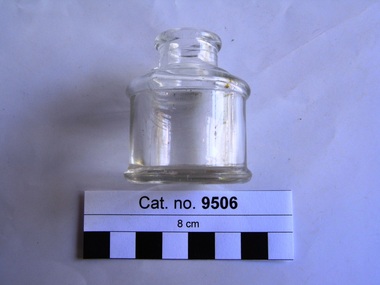
Domestic object - Glass Bottle, Post 1916 - c.1939
... The remuneration received by Collectors, Dealers, etc.,- is simply an allowance for the safe custody and collection of the Bottles LEGAL ACTION WILL BE TAKEN AGAINST ANY PERSON OR COMPANY VIOLATING THE PROPERTY RIGHTS OF THESE FIRMS OR COMPANIES' BRANDED BOTTLES. ...The remuneration received by Collectors, Dealers, etc.,- is simply an allowance for the safe custody and collection of the Bottles LEGAL ACTION WILL BE TAKEN AGAINST ANY PERSON OR COMPANY VIOLATING THE PROPERTY RIGHTS OF THESE FIRMS OR COMPANIES' BRANDED BOTTLES. ...TROVE : Port Philip Gazette and Settler's Journal (Vic. : 1845 - 1850) Saturday 21 April 1849 p 3 Advertising 'On MONDAY, 23RD INSTANT, (WITHOUT RESERVE,) at 12 o'clock, AN INVOICE of Drawings, Prints, Crayons, Portraits, coloured Figures II M. Ships '"Vindictive," "Victory," "Pomona," ''Vanguard," " Carysfoot," " Magicienne," &c., coloured ; the Channel Fleet, Jenny Lind, and a large quantity of Engravings. Three hundred volumes Books, comprising Novels, History, Poetry, School Books, &c., &c., &c. A large quantity of assorted stationery consisting of boxes of India rubber bands, pens, show cases, fancy wafers, satin note paper. One cask Stephen's Fluid Ink, in pints and half-pints. Terms— Cash'. TROVE : The Argus (Melbourne, Vic. : 1848 - 1957) Tuesday 27 March 1956 p 2 Advertising 'PUBLIC NOTICE TO BOTTLERS, BOTTLE DEALERS. Etc., RE PROPERTY BRANDED BOTTLES WHICH ARE NOT SOLD The undermentioned Firms and Companies,' carrying on businesses at Sydney and elsewhere, HEREBY GIVE NOTICE that all Bottles delivered by them to their customers having: a notification moulded thereon (including bottom) that they are, or remain the property of. the Firms and Companies mentioned below ARE NOT SOLD WITH THE CONTENTS THEREOF BUT REMAIN THE PROPERTY OF SUCH FIRMS AND COMPANIES. Such Bottles are loaned solely for the purpose of enabling the contents to be delivered to purchasers from the said Firms and 'Companies and to all subsequent purchasers of the contents. As soon as the Bottles are emptied of their contents they must not be refilled destroyed, damaged, or used again for any purpose, but must, on demand be delivered up to the Companies or Firms whose names are moulded thereon or to their Accredited Agents: BUTLER & NORMAN PTY. LTD., MANDIBLE STREET. ALEXANDRIA, N.S.W. The remuneration received by Collectors, Dealers, etc.,- is simply an allowance for the safe custody and collection of the Bottles LEGAL ACTION WILL BE TAKEN AGAINST ANY PERSON OR COMPANY VIOLATING THE PROPERTY RIGHTS OF THESE FIRMS OR COMPANIES' BRANDED BOTTLES. ABC Mop Co.......................Stephens Ink (Australia) Pty Ltd.......................'.Squat round clear glass ink bottle with embossed text on heel at base and monogram on base'PROPERTY OF STEPHENS INKS AUSTRALIA LTD' on heel of base. Australian Glass Manufacturers monogram on base with embossed illustration of a feather quill.ink bottle -
 Flagstaff Hill Maritime Museum and Village
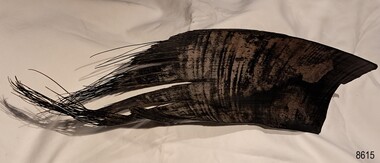
Animal specimen - Baleen
... Rights annually visit the ocean off the southwest coast during the breeding season. In the early 1800s whalers hunted along this coastline in their dangerous pursuit of money for the precious cargoes of whale oil and bones. The population of these large animals dwindled quickly and by the late 1840s the whaling industry dwindled. Whaling recommenced from the 1940s to the 1980s when the whale products were used to make margarine and dog food. The baleen sample has been used to educate people about whaling and about the properties ...A baleen whale has hard bristly baleen that hangs from its upper jaw inside its mouth instead of teeth. Baleen is made from a protein called keratin, just like human hair and fingernails, and its colour can vary between species, from black to yellow or white. The whale uses the tough, flexible baleen like a sieve to catch its food, filtering the small sea creatures out of the sea water it releases from its mouth. In the19th Century, whales were hunted for the products that could be made from their bodies, such as oil for lubricating machinery, soap making, lamps, heaters and fuel for the lighthouse lights. The flexible baleen was used for whip handles, carriage springs and umbrella ribs. It was also used for the skirt hoops, hat ribs, and rigid ‘stays’ in tightly fitting bodices to enhance their figures. The Southern Right Whales, as well as Blue Whales and Humpback Whales, are baleen whales. The Southern Rights annually visit the ocean off the southwest coast during the breeding season. In the early 1800s whalers hunted along this coastline in their dangerous pursuit of money for the precious cargoes of whale oil and bones. The population of these large animals dwindled quickly and by the late 1840s the whaling industry dwindled. Whaling recommenced from the 1940s to the 1980s when the whale products were used to make margarine and dog food. The baleen sample has been used to educate people about whaling and about the properties of baleen. The baleen sample is significant for its association with 19th century women's fashion. It helps to understand how garments were supported to shape a woman's figure. The baleen sample represents a period when whales were hunted and killed to provide income and products for for the local settlers and for the export industry.Baleen sample from a whale's jaw. Its black shiny hard yet flexible surface is slightly rippled and textured. One end is fringed and the other and a smooth cut edge. The colour varies in places, with stripy brown colouring. flagstaff hill maritime museum and village, great ocean road, shipwreck coast, baleen, whalebone, baleen whale, keratin, 19th century, whaling industry, women's fashion, stays, bodice, women's figures, fashion, clothing, whale oil, baleen colour, whale hunting, whale products, southern right whale, blue whale, humpback whale, southwest victoria, whalers, whale bones -
Glenelg Shire Council Cultural Collection
Medal, Stokes and Martin, Portland Golden Jubilee Medal, 1884
... rights over most of their lands. Henty was known as a capable and energetic man and regarded as the chief actor in the early history of Portland Bay. He and his wife Anne Marie Gallie moved to Muntham, a 60,000-acre property that became widely known for its merino sheep and Durham cattle. ...rights over most of their lands. Henty was known as a capable and energetic man and regarded as the chief actor in the early history of Portland Bay. He and his wife Anne Marie Gallie moved to Muntham, a 60,000-acre property that became widely known for its merino sheep and Durham cattle. ...Medal issued to commemorate the 50th anniversary of Edward Henty's arrival in Portland, Victoria. Edward Henty was born in England in 1809 and migrated to Australia, as did his parents and brothers, in 1829. On 19 November 1834 he sailed from Launceston in the Hentys' own schooner, the Thistle, with stock and a small party. His brother Francis followed the next month with a small flock of merino sheep, the first in Victoria. The Henty brothers began whaling at Portland Bay and took their flocks and herds inland to the rich area on the Wannon River. In the 1840s they were eventually granted pre-emptive rights over most of their lands. Henty was known as a capable and energetic man and regarded as the chief actor in the early history of Portland Bay. He and his wife Anne Marie Gallie moved to Muntham, a 60,000-acre property that became widely known for its merino sheep and Durham cattle. It was also known for its extravagant hospitality - to which Henty's social ambition and vanity contributed considerably. This extravagance and Henty's obstinacy eventually led to the degradation of the flocks. Henty lived in Portland and in his Melbourne mansion, Offington, while he served as a member of the Victoria Legislative Assembly. He died on 14 August 1878Portland Jubilee Medal, 1884. White metal, circular, holed at top as issued. One side features portrait of Edward Henty and text 'HENTY JUBILEE / PORTLAND / 19 NOV 1884' on the other side. -
 Ringwood and District Historical Society
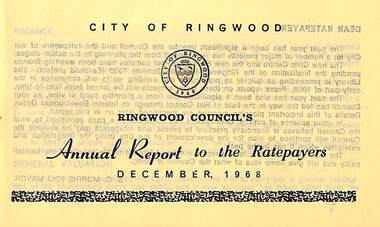
Pamphlet, Ringwood Council's Annual Report To The Ratepayers - December 1968, 1968
... City of Ringwood community information annual report for 1968, including sections covering Finance, General Valuation and Rater Payments, Property Ownership Changes, Refuse, Sanitary Serviced, Sewerage Connections to MMBW, Dandenong Valley Authority, Residential Flat Control Planning Scheme, Immunisation, Home Help, Elderly Citizens' Clubrooms, Library, Civic Centre, Golf Course, Sale of Council Land, Swimming Centre, Holiday Play Centre, Civic Week, Lake Reserve Improvements, Rubbish Dumping, Street Trees, Vandalism, White Ants, Street Construction, Fire Hazards, Dog Nuisance, House Numbering, Citizens' Advisory Service, Infant Welfare Centres, and a list of departing and current Council Representatives. Also includes general reminders regarding rat extermination, free firewood for age pensioners, overhanging vegetation, and spouses voting rights...City of Ringwood community information annual report for 1968, including sections covering Finance, General Valuation and Rater Payments, Property Ownership Changes, Refuse, Sanitary Serviced, Sewerage Connections to MMBW, Dandenong Valley Authority, Residential Flat Control Planning Scheme, Immunisation, Home Help, Elderly Citizens' Clubrooms, Library, Civic Centre, Golf Course, Sale of Council Land, Swimming Centre, Holiday Play Centre, Civic Week, Lake Reserve Improvements, Rubbish Dumping, Street Trees, Vandalism, White Ants, Street Construction, Fire Hazards, Dog Nuisance, House Numbering, Citizens' Advisory Service, Infant Welfare Centres, and a list of departing and current Council Representatives. Also includes general reminders regarding rat extermination, free firewood for age pensioners, overhanging vegetation, and spouses voting rights ...City of Ringwood community information annual report for 1968, including sections covering Finance, General Valuation and Rater Payments, Property Ownership Changes, Refuse, Sanitary Serviced, Sewerage Connections to MMBW, Dandenong Valley Authority, Residential Flat Control Planning Scheme, Immunisation, Home Help, Elderly Citizens' Clubrooms, Library, Civic Centre, Golf Course, Sale of Council Land, Swimming Centre, Holiday Play Centre, Civic Week, Lake Reserve Improvements, Rubbish Dumping, Street Trees, Vandalism, White Ants, Street Construction, Fire Hazards, Dog Nuisance, House Numbering, Citizens' Advisory Service, Infant Welfare Centres, and a list of departing and current Council Representatives. Also includes general reminders regarding rat extermination, free firewood for age pensioners, overhanging vegetation, and spouses voting rights.Obituary - Mr. F.P. Dwerryhouse, Town Clerk for the past 9-1/2 years passed away on 6th December after a short illness.rinx -
 Orbost & District Historical Society
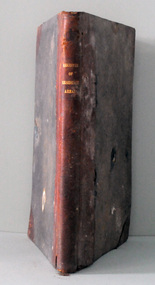
register, Register of Residence Areas, 10.2.1897 - 4.9.1934
... rights on privately owned land and business sites. They include application fotrms and objections to registrations. The areas referred to are Combienbar, Goongerah, Club Terrace, Wombat Creek and Dundong. One of the privileges under the Mines Act, conferred by the holding of a miner's right until 1935 was that of residence on up to one acre on a gold-fields area. Those occupying a residence area were "deemed in law to be possessed ... of such ... parcels ... and the property...rights on privately owned land and business sites. They include application fotrms and objections to registrations. The areas referred to are Combienbar, Goongerah, Club Terrace, Wombat Creek and Dundong. One of the privileges under the Mines Act, conferred by the holding of a miner's right until 1935 was that of residence on up to one acre on a gold-fields area. Those occupying a residence area were "deemed in law to be possessed ... of such ... parcels ... and the property ...This book is a register of land holders with miners' rights. The correspondence is associated with applications for miners' rights on privately owned land and business sites. They include application fotrms and objections to registrations. The areas referred to are Combienbar, Goongerah, Club Terrace, Wombat Creek and Dundong. One of the privileges under the Mines Act, conferred by the holding of a miner's right until 1935 was that of residence on up to one acre on a gold-fields area. Those occupying a residence area were "deemed in law to be possessed ... of such ... parcels ... and the property therein".This is a useful research tool.A large, heavy book with a grey cloth cover and red spine. The end papers are marbled. The inside pages are ruled in grey with red ruled columns. Entries are hand-written. There are copies of correspondence inside. Details given are the registration number and date, the name of the person, the number of the miner's right and its date, a description of the allotment and any remarks or references to other volumes. Any changes of ownership are shown. The book is mostly unused.register-mining miners-rights -
 Ringwood and District Historical Society
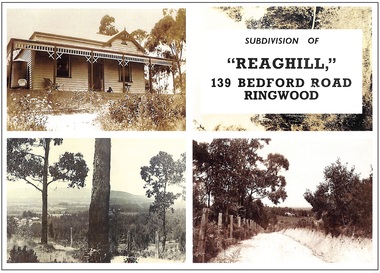
Archive, Richard Carter Collection - REAGHILL Subdivision Research (Parent Record)
... The Subdivision of “Reaghill The subdivision of “Reaghill” was made more viable by the subdivision in 1931 of the property to the north and the creation of Scenic Avenue, Vista Avenue and Grandview Avenue, all of which abutted “Reaghill’s” northern boundary. In fact Geoffrey Francis Seymour Davies bought the freehold to Grandview Avenue, Scenic Avenue and Vista Avenue in July 1955 for £84-9-0 to give him legal rights over those roads. ...The Subdivision of “Reaghill The subdivision of “Reaghill” was made more viable by the subdivision in 1931 of the property to the north and the creation of Scenic Avenue, Vista Avenue and Grandview Avenue, all of which abutted “Reaghill’s” northern boundary. In fact Geoffrey Francis Seymour Davies bought the freehold to Grandview Avenue, Scenic Avenue and Vista Avenue in July 1955 for £84-9-0 to give him legal rights over those roads. ...This record is the Parent Record for researching the subdivision of Reaghill, 139 Bedford Road, Ringwood, compiled by Richard Carter. "Reaghill" is part of an older larger holding of sixty acres which came to comprise Vista Avenue, Vista Court, Homebush Court, Rawson Court and Wombalano ParkTranscript: Researching “Reaghill" The property “Reaghill” originally stood at 139 Bedford Road, Ringwood East before the property was subdivided in the 1950s and took a new address and frontage to Vista Avenue, Ringwood East. The purpose of these notes is to trace the origins of the property from the year 1900 to the present day. Information in the notes is sourced from the archives of Carter Real Estate, from Land Titles Office records and from the book of the history of Ringwood, “Ringwood, Place of Many Eagles” by Hugh Anderson. “Reaghill” is part of an older larger holding of sixty acres. It Is the story of those 60 acres, which now comprise Vista Avenue, Vista Court, Homebush Court, Rawson Court and Wombalano Park, which Is the subject of these notes. Earlier Times A convenient starting point for these notes Is the year 1900. On 11th June 1900 Wallace Bruce of 68 High Street, Windsor became registered as the proprietor of “sixty acres or thereabouts” (24.28 hectares) being part of Crown Allotment 43 Parish of Ringwood County of Mornington. That title. Volume 2773 Folio 485 did not name the streets to which the property abutted but clearly they were Canterbury Road at its intersection with Bedford Road. Title records a lease of the property from Wallace Bruce to Thomas Oates, with the lease endorsed on title on 22 July 1903 and removed 16 June 1908. Wallace Bruce subsequently subdivided the land Into three parcels, two of which he sold to Dora Stanisforth Davies during 1909 and the balance he sold to Frank Leslie Walker in 1914. The Era of the Davies Wallace Bruce firstly sold the western portion of the property, containing twenty four acres three roods and 20 perches (24.875 acres or 10.0667 hectares) on 6 October 1909. The new title, Volume 3381 Folio 021, records the new proprietor as “Dora Stanisforth Davies, wife of Seymour George Pilkington Davies of Burwood Road, Hawthorn, Bank Manager”. Shortly thereafter, Wallace Bruce sold a further parcel of “ten acres or thereabouts” (4 hectares) being the north eastern portion of his original holding. That title, Volume 3384 Folio 795, showed the purchaser once again as “Dora Stanisforth Davies, wife of Seymour George Pilkington Davies of Burwood Road Hawthorn, Bank Manager”. It is noteable that the second, title which is dated 8 December 1909, had no abuttal to any road, nor was it at any time (even when subdivided in the 1950s) consolidated with Davies' adjoining title. Both titles then recorded that Dora Stanisforth Davies died on 19 February 1945 with probate of her will being granted to John Seymour Davies of 69 Grantham Street West Brunswick, Medical Practitioner, and Hugh Percival Hall of 339 Collins Street Melbourne, Solicitor. Almost two years later, on 6th December 1946, both parcels of land were transferred by the Executors to Geoffrey Francis Seymour Davies of 20 Albert Road Strathfield N.S.W, Medical Practitioner. From this chronology it could be surmised that one of Dora Davies’ executors, John Seymour Davies, was probably her son. Was Geoffrey Francis Seymour Davies another son, or was he her grandson? In any event Geoffrey Francis Seymour Davies set about subdividing what was then the property “Reaghill” and its 34.875 acres (14.11 hectares). The Subdivision of “Reaghill The subdivision of “Reaghill” was made more viable by the subdivision in 1931 of the property to the north and the creation of Scenic Avenue, Vista Avenue and Grandview Avenue, all of which abutted “Reaghill’s” northern boundary. In fact Geoffrey Francis Seymour Davies bought the freehold to Grandview Avenue, Scenic Avenue and Vista Avenue in July 1955 for £84-9-0 to give him legal rights over those roads. Title to those roads and the newly created Vista Avenue, Vista Court and Homebush Court remain in his name to this day. It is particularly interesting to note that whilst those streets had typical allotments of about 1000 square metres, the subdivision of Reaghill was into blocks of one to two acres or more (4000 square metres to about one hectare) except for the blocks fronting Bedford Road. That speaks volumes about Davies’ attitude to the land, its natural beauty, its topography and vegetation. “Reaghill” was subdivided into twenty two lots by Plan of Subdivision LP 41463. The first eleven lots came off Vista Avenue and formed an extension of Vista Avenue and a newly created Vista Court. Lot sizes ranged from 1 acre 1 rood 1½ perches (5097 square metres) to 2 acres 3 roods 21½ perches (1.167 hectares). A further four lots came off Homebush Court, a newly created court off Bedford Road. Those lots ranged from 1 acre 1 rood 29 perches (5792 square metres) to 2 acres 1 rood 39 ®/io perches (1.01 hectares). Seven further lots, parallelogram in configuration, fronted Bedford Road and had a typical area of 1518 square metres. The names of the streets (“Vista” Avenue/Court and “Homebush” Court) give an insight into the elevation of the land, the views it offered and the bushland it featured. The Covenant As evidence of Davies’ desire to maintain the bush setting of the property, covenants were imposed on the transfers of Lots 1 to 15 (the acreage lots). That covenant allowed for only one dwelling house to be erected on each of those lots for a period of 15 years from sale. Effectively it froze subdivision for 15 years. But 15 years came around quickly. The Sales “Reaghill” 139 Bedford Road, Ringwood was offered for Private Sale as “22 Excellent Residential Allotments” by estate agents Anderson & Hickling of 239 Collins Street Melbourne (telephone Central 25!), with a “protective covenant” of one dwelling house only on lots 1-15 for a period of 15 years. Solicitors for the vendor were Messrs Meares, Duigan & Hall of 139 Collins Street Melbourne. Sales commenced in 1955 and went through to 1967. Prices were typically from £1350, the price paid for Lot 13 in 1957. The Role of Frank Leslie Walker These notes have so far recorded that of the sixty acres originally owned by Wallace Bruce in 1900, some 34.875 acres were sold to Dora Davies in 1909 and subdivided and sold by her descendants. The balance of Wallace Bruce’s land was sold on 6th April 1914 to Frank Leslie Walker. This is the land at the south east corner of Bruce’s holding fronting Canterbury Road and which now comprises Rawson Court and Wombalano Park. Frank Leslie Walker “of Albany Chambers, Collins Street Melbourne” was described as an Art Decorator. In “Ringwood - Place of Many Eagles” he is shown as living on his land “in a house which was surrounded by a four foot high brick wall and the long drive of rough cream-coloured Lilydale gravel was entered through handsome wrought iron gates obtained from some building wrecker”. The “old rambling house" had been extended and renovated using secondhand doors, windows and timber. “Every inch of wall space seemed to be crammed from floor to ceiling with oils, watercolours, etchings and drawings of all sorts by well known artists”. On 13th August 1954 Frank Leslie Walker transferred an area of 12 acres 3 rood 21 perches (5.213 hectares) to The Mayor Councillors and Burgesses of the Borough of Ringwood for no consideration as a Gift “for the providing of pleasure grounds on places of public resort or public recreation”. That is now Wombalano Park. The balance of his property, containing 6 acres 1 rood 5 perches (2.54 hectares) and including the original homestead (named Wombalano?) was gifted by Frank Leslie Walker to his nephew on 25 November 1955. It was later subdivided as Rawson Court in 1956. The house no longer survives. The “Reaghill” Homestead The original homestead on Wallace Bruce’s holding, as has just been described fronted Canterbury Road in the area which is now Rawson Court. The age of the house is unknown but is described in 1914 as being “old and rambling”. The “Reaghill” homestead is likely to have been built by the Davies and was retained on Lot 11 of their subdivision. Its date of construction is not known but might have been soon after the Davies bought the land in 1909. Lot 11, with “Reaghill” was not sold in the 1950s as part of the land subdivision and sale. It remained as the family home of Dr. Davies until its sale in 1968 (without the 15 year covenant) to James Hamilton Kelly of New York, USA for $15,000. In time, Lot 11 was resubdivided. The house today remains on a reduced site of 7112 square metres, still on the highest point in the locality with fine views. Further Subdivisions Once the 15 year time frame of the covenant expired, the various owners of the lots, having built homes, proceeded to subdivide their surplus land. Lot 1 was first, followed by Lot 7. Only four of the original 15 acreage lots have not been subdivided. Some subdivisions were less respectful of their environment and neighbourhood than others. Maroondah City Council's planning scheme provides for a minimum lot size of 864 square metres in the locality. But the horse has already bolted. Summary “Reaghill” in its heyday, and the acreage properties which later surrounded it, contributed some of the finest and most exclusive properties in Ringwood East. Notably, the locality was home to a significant number of local medicos over the years. Its location dose to the newly relocated Tintern CEGGS gave it added exclusivity. Subdivision over the years has impinged on the beauty and the environment. However it is still a most important part of Ringwood East, with a rich history. R.A Carter January 2005 -
 Eltham District Historical Society Inc
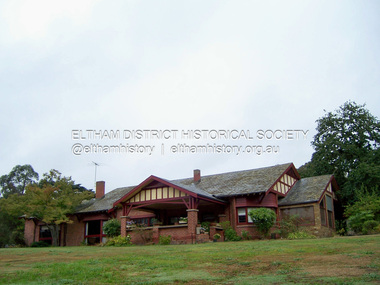
Photograph - Digital Photograph, Marguerite Marshall, 'Worlingworth', 10-26 Banoon Road, Eltham, 30 January 2006
... rights to Aborigines was strengthening. Thomson is best known for his anthropological fieldwork in Cape York, Arnhem Land and Central Australia, but he is also known for his scholarly contributions to ornithology and ecology. Thomson documented every aspect of the daily and ritual life of the Aboriginal world of Cape York and Arnhem Land in the 1930s and 1940s. The huge collection in Museum Victoria includes 11,000 photographs, 7500 items of material culture, 1000 botanical and zoological specimens and 4500 pages of field-notes.2 The film Ten Canoes used Thomson’s photographs as a source. Thomson bought the Eltham property...rights to Aborigines was strengthening. Thomson is best known for his anthropological fieldwork in Cape York, Arnhem Land and Central Australia, but he is also known for his scholarly contributions to ornithology and ecology. Thomson documented every aspect of the daily and ritual life of the Aboriginal world of Cape York and Arnhem Land in the 1930s and 1940s. The huge collection in Museum Victoria includes 11,000 photographs, 7500 items of material culture, 1000 botanical and zoological specimens and 4500 pages of field-notes.2 The film Ten Canoes used Thomson’s photographs as a source. Thomson bought the Eltham property ...'Worlingworth', Eltham, home of noted anthropologist the late Professor Donald Thomson and his wife Dorita Thomson. Covered under Heritage Overlay, Nillumbik Planning Scheme. Published: Nillumbik Now and Then / Marguerite Marshall 2008; photographs Alan King with Marguerite Marshall.; p127 Dubbed as ‘Australia’s Lawrence of Arabia’ anthropologist Donald Thomson lived much of his life in Eltham, at Banoon Road. On his retirement as Professor of Anthropology in 1968, The University of Melbourne professorial board compared Thomson to Lawrence of Arabia because of his work for Aborigines and his controversial personality. Although Thomson is now recognised for his huge contribution, during his lifetime he suffered opposition and his life has been described as ‘tragic’.1 Thomson failed to gain the recognition as a scientist that he felt he deserved and he failed to alter government policy towards Aboriginal people. But towards the end of his life in 1970, anthropologists were moving towards the type of research he had done and the movement to grant land rights to Aborigines was strengthening. Thomson is best known for his anthropological fieldwork in Cape York, Arnhem Land and Central Australia, but he is also known for his scholarly contributions to ornithology and ecology. Thomson documented every aspect of the daily and ritual life of the Aboriginal world of Cape York and Arnhem Land in the 1930s and 1940s. The huge collection in Museum Victoria includes 11,000 photographs, 7500 items of material culture, 1000 botanical and zoological specimens and 4500 pages of field-notes.2 The film Ten Canoes used Thomson’s photographs as a source. Thomson bought the Eltham property known as Worlingworth in 1934. The single-storey 60-square house standing by the Yarra River was built in 1922-23. It is one of the last in Eltham to survive with its farm setting intact. It is also one of the few substantial residences built in the Eltham Shire from the late 19th century to the early 20th century, which signalled a major change in the area towards the residential municipality it is today.3 The original section, built in the mid 1860s, of rose pink hand-made bricks and stone quarried on the property, was incorporated in the new red-brick house built in 1922. An immense oak tree by the house grew from an acorn brought by Patrick Armstrong who first bought the land in March 14, 1862. Armstrong named Worlingworth after his forbears’ village in Suffolk, England. Worlingworth saw grand days when Commander Alan A Barlee (R.N.) bought it in 1922 after winning the Calcutta Sweep. The property then included a nine-hole golf course, a tennis court, a bowling green, a boathouse and a boat-ramp.4 For most of his career Thomson, who was born in 1901, was attached to The University of Melbourne. In 1935 he represented the Commonwealth Government at Caledon Bay in east Arnhem Land to investigate and mediate for four Aborigines accused of killing five Japanese and three Europeans. In 1938 Thomson was awarded a PhD in Anthropology at Cambridge University, and during his career, he received several medals from British Societies, who perhaps appreciated his work better than their Australian counterparts. From World War Two, Thomson suffered a string of hardships, beginning with severe wounding in Dutch New Guinea (for his military service in New Guinea he was awarded an OBE) and he was invalided from service in 1944. That year he was diagnosed with diabetes. A fire in 1946 destroyed what Thomson regarded as perhaps the best record he had made of Aboriginal life – the 20,000 feet, (6096m) of film he had shot in Arnhem Land. In 1954 he and wife, Gladys, divorced. The next year he married his technical assistant, Dorita McColl. Several times during his career Thomson had major disagreements. For instance Professor P Elkin constantly opposed his work. He also opposed Thomson when he campaigned vigorously in 1947 against the establishment of a rocket range at Woomera, South Australia, because of the threat it posed Aborigines. Thomson resigned in frustration from the Victorian Aborigines Welfare Board in 1967, after serving for ten years, because he found that his advice was disregarded. His ashes were scattered over Caledon Bay from the air.This collection of almost 130 photos about places and people within the Shire of Nillumbik, an urban and rural municipality in Melbourne's north, contributes to an understanding of the history of the Shire. Published in 2008 immediately prior to the Black Saturday bushfires of February 7, 2009, it documents sites that were impacted, and in some cases destroyed by the fires. It includes photographs taken especially for the publication, creating a unique time capsule representing the Shire in the early 21st century. It remains the most recent comprehenesive publication devoted to the Shire's history connecting local residents to the past. nillumbik now and then (marshall-king) collection, banoon road, donald thomson, dorita thomson, eltham, worlingworth -
Bendigo Historical Society Inc.
Administrative record - Commercial Egg Producers' Association of Victoria (CEPA) Central Council Correspondence, 1992-1999
... The document strongly objects to the second schedule, citing three main issues: No rights or opportunity for holders to transfer water between properties. No long-term assurance of water supply for entitlement holders, despite ongoing negotiations for bulk entitlements.No compensation for loss of water entitlement, even though such entitlements have significant capital value 8504.48l Coliban Water Investigation Committee Meeting Mar 1996 Agenda and minutes from previous meeting 8504.48m Coliban Water Investigation Committee Meeting Jan 1996 Agenda and minutes from previous meeting 8504.48n Coliban Water Investigation Committee Meeting Jul 1996 Agenda and minutes from previous meeting 8504.48o The document details a special meeting in Aug 1997 convened by C.W.I.C. to address concerns about unsatisfactory water agreements sent to rural users by Coliban Water. ...The document strongly objects to the second schedule, citing three main issues: No rights or opportunity for holders to transfer water between properties. No long-term assurance of water supply for entitlement holders, despite ongoing negotiations for bulk entitlements.No compensation for loss of water entitlement, even though such entitlements have significant capital value 8504.48l Coliban Water Investigation Committee Meeting Mar 1996 Agenda and minutes from previous meeting 8504.48m Coliban Water Investigation Committee Meeting Jan 1996 Agenda and minutes from previous meeting 8504.48n Coliban Water Investigation Committee Meeting Jul 1996 Agenda and minutes from previous meeting 8504.48o The document details a special meeting in Aug 1997 convened by C.W.I.C. to address concerns about unsatisfactory water agreements sent to rural users by Coliban Water. ...The Commercial Egg Producers' Association of Victoria was active by the 1930s, engaging in industry management and lobbying.The Commercial Egg Producer's Association (CEPA) had branches in Bendigo, South Bendigo, Eaglehawk, Wedderburn, Murrabit and Euroa.CEPA Commercial Egg Producer's Association (Bendigo Region) correspondence, for the years 1992-1999. This item includes the following documents: 8504.48a The document outlines the agenda and minutes for an upcoming meeting of the Coliban Water Investigation Committee. Meeting Details:Scheduled for Tuesday, 28th September 1993 at 8:00 p.m. at the T.A.F.E. College (east side of Chapel Street). 8504.48b Coliban Water Investigation Committee meeting agenda for November 23, 1993. Meeting Scheduled for Tuesday, November 23, 1993, at 8:00 p.m. at the T.A.F.E. College (east side of Chapel St.). 8504.48c Coliban Water Investigation Committee meeting agenda and minutes:Meeting. Tuesday, 25th January 1994 at 8:00 p.m. at the T.A.F.E. College (east side of Chapel). 8504.48d The Coliban Water Investigation Committee meeting agenda for September 27, 1994, and minutes of meeting May 1994 8504.48e CEPA Invoice for Affiliation Fee July 1994-93 to the Coliban Water Investigation Committee 8504.48f Coliban Water Investigation Committee Meeting AgendaMeeting Scheduled for Tuesday, May 24, 1994, at 8 p.m.Location: T.A.F.E. College, West side of Chapel Street, Seminar Room. Agenda and previous minutes 8504.48g The Coliban Water Investigation Committee meeting agenda and notices:Meeting DetailsDate & Time: Tuesday, 22nd November 1994, 8:00 p.m.Location: T.A.F.E. College Seminar Room (Chapel St.), and previous minutes. 8504.48h Annual Meeting of the Coliban Water Investigation Committee held on July 25, 1995. Minutes July 1995 8504.48i From Coliban Water May 1996. The document discusses the initial phase of creating a long-term strategy for water source security in the Coliban system.Several unresolved issues were identified that need solutions for comprehensive water security planning. 8504.48j The Coliban Water Investigation Committee meeting August 27th 1997 focused on rural water supply changes and public engagement. 8504.48k Critique of Coliban Water's Agreement's Second Schedule. The document strongly objects to the second schedule, citing three main issues: No rights or opportunity for holders to transfer water between properties. No long-term assurance of water supply for entitlement holders, despite ongoing negotiations for bulk entitlements.No compensation for loss of water entitlement, even though such entitlements have significant capital value 8504.48l Coliban Water Investigation Committee Meeting Mar 1996 Agenda and minutes from previous meeting 8504.48m Coliban Water Investigation Committee Meeting Jan 1996 Agenda and minutes from previous meeting 8504.48n Coliban Water Investigation Committee Meeting Jul 1996 Agenda and minutes from previous meeting 8504.48o The document details a special meeting in Aug 1997 convened by C.W.I.C. to address concerns about unsatisfactory water agreements sent to rural users by Coliban Water. Key points include:Purpose of Meeting:The meeting was called to discuss the actions of Coliban Water in sending unsatisfactory agreements to rural water users on the Coliban channels. 8504.48p Coliban Water Investigation Committee Meeting March 1997 Agenda and minutes from previous meeting 8504.48q Formal letter from Pat McNamara, Deputy Premier Minister for Agriculture; regarding Coliban Water's future supply arrangementsWater has committed to consulting rural users before finalizing new arrangements in 1998.The Committee's views on future trading arrangements have been acknowledged. 8504.48r Coliban Water Investigation Committee Meeting Oct 1997 Agenda and minutes from previous meeting 8504.48s Key Points of Coliban Water's Rural Supply ReformsConsultative Process and Sub-committee Role. The Rural Users' Sub-committee was formed to assist Coliban Water in improving the Rural Water Supply System.Members, including Steve Lottkowitz and Bernie Mannes, provided feedback on options developed by Coliban Water staff. 8504.48t Spreadsheet - Receipts and Expenditure 1995-96 8504.48u Coliban Water Investigation Committee Meeting Jan 1997 Agenda and minutes from previous meeting 8504.48v Coliban Water Investigation Committee Cancellation of Meeting Sept 1995 8504.48w Coliban Water Investigation Committee Meeting Sept 1996 Agenda and minutes from previous meeting 8504.48x Minutes of CWIC meeting Aug 1995 8504.48y Coliban Water Investigation Committee Meeting Aug 2000 Agenda and minutes from previous meetingegg producer's information, correspondence, cepa, commercial egg producers' association -
 Sunshine and District Historical Society Incorporated
Archive - "An Act to repeal the Trustees and Vestries Act 1885 and to consolidate and amend the Law ..." and replace it on 30/9/1910, Diocese of Melbourne, 1910
... (i) Rules relating to Trustees (ii) Rules relating to new churches (iii) Constitution and appointment of Vestries and central councils (iv) Rules for the conduct of parochial meetings (v) Rights, powers and duties of incumbents and vestries relating to (a) Church property (b) Divine Service (c) lay officers (d) Finance (e) Records (vi) Miscellaneous provisions 'List of amendments from 1885 listed as schedule A (p.19)...(i) Rules relating to Trustees (ii) Rules relating to new churches (iii) Constitution and appointment of Vestries and central councils (iv) Rules for the conduct of parochial meetings (v) Rights, powers and duties of incumbents and vestries relating to (a) Church property (b) Divine Service (c) lay officers (d) Finance (e) Records (vi) Miscellaneous provisions 'List of amendments from 1885 listed as schedule A (p.19) Archive "An Act to repeal the Trustees and Vestries Act 1885 and to consolidate and amend the Law ..." and replace it on 30/9/1910 Diocese of Melbourne ...Part of Gwen Mousley collectionreglion, church -
 Victorian Aboriginal Corporation for Languages
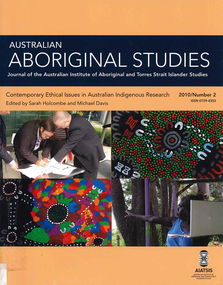
Periodical, Australian Institute of Aboriginal and Torres Strait Islander Studies, Australian Aboriginal studies : journal of the Australian Institute of Aboriginal and Torres Strait Islander Studies, 2010
... Anthropology is not immune from the increasing awareness of the limitations and risks of the intellectual property regime for protecting or managing Indigenous knowledge. The relevance of the Declaration on the Rights of Indigenous Peoples in opening up a ?...Anthropology is not immune from the increasing awareness of the limitations and risks of the intellectual property regime for protecting or managing Indigenous knowledge. The relevance of the Declaration on the Rights of Indigenous Peoples in opening up a ? ...'Whose Ethics?':Codifying and enacting ethics in research settings Bringing ethics up to date? A review of the AIATSIS ethical guidelines Michael Davis (Independent Academic) A revision of the AIATSIS Guidelines for Ethical Research in Indigenous Studies was carried out during 2009-10. The purpose of the revision was to bring the Guidelines up to date in light of a range of critical developments that have occurred in Indigenous rights, research and knowledge management since the previous version of the Guidelines was released in 2000. In this paper I present an outline of these developments, and briefly discuss the review process. I argue that the review, and the developments that it responded to, have highlighted that ethical research needs to be thought about more as a type of behaviour and practice between engaged participants, and less as an institutionalised, document-focused and prescriptive approach. The arrogance of ethnography: Managing anthropological research knowledge Sarah Holcombe (ANU) The ethnographic method is a core feature of anthropological practice. This locally intensive research enables insight into local praxis and culturally relative practices that would otherwise not be possible. Indeed, empathetic engagement is only possible in this close and intimate encounter. However, this paper argues that this method can also provide the practitioner with a false sense of his or her own knowing and expertise and, indeed, with arrogance. And the boundaries between the anthropologist as knowledge sink - cultural translator and interpreter - and the knowledge of the local knowledge owners can become opaque. Globalisation and the knowledge ?commons?, exemplified by Google, also highlight the increasing complexities in this area of the governance and ownership of knowledge. Our stronghold of working in remote areas and/or with marginalised groups places us at the forefront of negotiating the multiple new technological knowledge spaces that are opening up in the form of Indigenous websites and knowledge centres in these areas. Anthropology is not immune from the increasing awareness of the limitations and risks of the intellectual property regime for protecting or managing Indigenous knowledge. The relevance of the Declaration on the Rights of Indigenous Peoples in opening up a ?rights-based? discourse, especially in the area of knowledge ownership, brings these issues to the fore. For anthropology to remain relevant, we have to engage locally with these global discourses. This paper begins to traverse some of this ground. Protocols: Devices for translating moralities, controlling knowledge and defining actors in Indigenous research, and critical ethical reflection Margaret Raven (Institute for Sustainability and Technology Policy (ISTP), Murdoch University) Protocols are devices that act to assist with ethical research behaviour in Indigenous research contexts. Protocols also attempt to play a mediating role in the power and control inherent in research. While the development of bureaucratically derived protocols is on the increase, critiques and review of protocols have been undertaken in an ad hoc manner and in the absence of an overarching ethical framework or standard. Additionally, actors implicated in research networks are seldom theorised. This paper sketches out a typology of research characters and the different moral positioning that each of them plays in the research game. It argues that by understanding the ways actors enact research protocols we are better able to understand what protocols are, and how they seek to build ethical research practices. Ethics and research: Dilemmas raised in managing research collections of Aboriginal and Torres Strait Islander materials Grace Koch (AIATSIS) This paper examines some of the ethical dilemmas for the proper management of research collections of Indigenous cultural materials, concentrating upon the use of such material for Native Title purposes. It refers directly to a number of points in the draft of the revised AIATSIS Guidelines for Ethical Research in Indigenous Studies and draws upon both actual and hypothetical examples of issues that may arise when requests are made for Indigenous material. Specific concerns about ethical practices in collecting data and the subsequent control of access to both the data itself and to published works based upon it are raised within the context of several types of collections, including those held by AIATSIS and by Native Title Representative Bodies. Ethics or social justice? Heritage and the politics of recognition Laurajane Smith (ANU) Nancy Fraser?s model of the politics of recognition is used to examine how ethical practices are interconnected with wider struggles for recognition and social justice. This paper focuses on the concept of 'heritage' and the way it is often uncritically linked to 'identity' to illustrate how expert knowledge can become implicated in struggles for recognition. The consequences of this for ethical practice and for rethinking the role of expertise, professional discourses and disciplinary identity are discussed. The ethics of teaching from country Michael Christie (CDU), with the assistance of Yi?iya Guyula, Kathy Gotha and Dh�?gal Gurruwiwi The 'Teaching from Country' program provided the opportunity and the funding for Yol?u (north-east Arnhem Land Aboriginal) knowledge authorities to participate actively in the academic teaching of their languages and cultures from their remote homeland centres using new digital technologies. As two knowledge systems and their practices came to work together, so too did two divergent epistemologies and metaphysics, and challenges to our understandings of our ethical behaviour. This paper uses an examination of the philosophical and pedagogical work of the Yol?u Elders and their students to reflect upon ethical teaching and research in postcolonial knowledge practices. Closing the gaps in and through Indigenous health research: Guidelines, processes and practices Pat Dudgeon (UWA), Kerrie Kelly (Australian Indigenous Psychologists Association) and Roz Walker (UWA) Research in Aboriginal contexts remains a vexed issue given the ongoing inequities and injustices in Indigenous health. It is widely accepted that good research providing a sound evidence base is critical to closing the gap in Aboriginal health and wellbeing outcomes. However, key contemporary research issues still remain regarding how that research is prioritised, carried out, disseminated and translated so that Aboriginal people are the main beneficiaries of the research in every sense. It is widely acknowledged that, historically, research on Indigenous groups by non-Indigenous researchers has benefited the careers and reputations of researchers, often with little benefit and considerably more harm for Indigenous peoples in Australia and internationally. This paper argues that genuine collaborative and equal partnerships in Indigenous health research are critical to enable Aboriginal and Torres Islander people to determine the solutions to close the gap on many contemporary health issues. It suggests that greater recognition of research methodologies, such as community participatory action research, is necessary to ensure that Aboriginal people have control of, or significant input into, determining the Indigenous health research agenda at all levels. This can occur at a national level, such as through the National Health and Medical Research Council (NHMRC) Road Map on Indigenous research priorities (RAWG 2002), and at a local level through the development of structural mechanisms and processes, including research ethics committees? research protocols to hold researchers accountable to the NHMRC ethical guidelines and values which recognise Indigenous culture in all aspects of research. Researching on Ngarrindjeri Ruwe/Ruwar: Methodologies for positive transformation Steve Hemming (Flinders University) , Daryle Rigney (Flinders University) and Shaun Berg (Berg Lawyers) Ngarrindjeri engagement with cultural and natural resource management over the past decade provides a useful case study for examining the relationship between research, colonialism and improved Indigenous wellbeing. The Ngarrindjeri nation is located in south-eastern Australia, a ?white? space framed by Aboriginalist myths of cultural extinction recycled through burgeoning heritage, Native Title, natural resource management ?industries?. Research is a central element of this network of intrusive interests and colonising practices. Government management regimes such as natural resource management draw upon the research and business sectors to form complex alliances to access funds to support their research, monitoring, policy development, management and on-ground works programs. We argue that understanding the political and ethical location of research in this contemporary management landscape is crucial to any assessment of the potential positive contribution of research to 'Bridging the Gap' or improving Indigenous wellbeing. Recognition that research conducted on Ngarrindjeri Ruwe/Ruwar (country/body/spirit) has impacts on Ngarrindjeri and that Ngarrindjeri have a right and responsibility to care for their lands and waters are important platforms for any just or ethical research. Ngarrindjeri have linked these rights and responsibilities to long-term community development focused on Ngarrindjeri capacity building and shifts in Ngarrindjeri power in programs designed to research and manage Ngarrindjeri Ruwe/Ruwar. Research agreements that protect Ngarrindjeri interests, including cultural knowledge and intellectual property, are crucial elements in these shifts in power. A preliminary review of ethics resources, with particular focus on those available online from Indigenous organisations in WA, NT and Qld Sarah Holcombe (ANU) and Natalia Gould (La Trobe University) In light of a growing interest in Indigenous knowledge, this preliminary review maps the forms and contents of some existing resources and processes currently available and under development in the Northern Territory, Queensland and Western Australia, along with those enacted through several cross-jurisdictional initiatives. A significant majority of ethics resources have been developed in response to a growing interest in the application of Indigenous knowledge in land and natural resource management. The aim of these resources is to ?manage? (i.e. protect and maintain) Indigenous knowledge by ensuring ethical engagement with the knowledge holders. Case studies are drawn on from each jurisdiction to illustrate both the diversity and commonality in the approach to managing this intercultural engagement. Such resources include protocols, guidelines, memorandums of understanding, research agreements and strategic plans. In conducting this review we encourage greater awareness of the range of approaches in practice and under development today, while emphasising that systematic, localised processes for establishing these mechanisms is of fundamental importance to ensuring equitable collaboration. Likewise, making available a range of ethics tools and resources also enables the sharing of the local and regional initiatives in this very dynamic area of Indigenous knowledge rights.b&w photographs, colour photographsngarrindjeri, ethics, ethnography, indigenous research, social justice, indigenous health -
Victorian Aboriginal Corporation for Languages
Conference proceedings, Marleen Haboud, Endangered languages : voices and images, 2011
... Linguistic and Sociolinguistic properties; sociolinguistics and endangered languages; Rights, identities and new technologies; New media cultures and endangered languages; Rebuilding peoples in Ecuador and revitalizing their languages Documentation - successful experience; Language rights of endangered languages...language endangerment Worrorra language technologies documentation Maps, graphs Linguistic and Sociolinguistic properties; sociolinguistics and endangered languages; Rights, identities and new technologies; New media cultures and endangered languages; Rebuilding peoples in Ecuador and revitalizing their languages Documentation - successful experience; Language rights of endangered languages Endangered languages : voices and images Conference proceedings Marleen Haboud Nicholas Ostler ...Linguistic and Sociolinguistic properties; sociolinguistics and endangered languages; Rights, identities and new technologies; New media cultures and endangered languages; Rebuilding peoples in Ecuador and revitalizing their languages Documentation - successful experience; Language rights of endangered languagesMaps, graphslanguage endangerment, worrorra, language technologies, documentation -
 Victorian Aboriginal Corporation for Languages
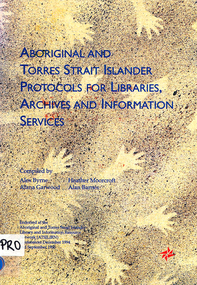
Book, Aboriginal and Torres Strait Islander Protocols for Libraries, Archives and Information Services, 1995
... property...libraries...archives...information services protocols...moral rights...ALIA ATSILIRN intellectual property libraries archives information services protocols moral rights Aboriginal and Torres Strait Islander Protocols for Libraries, Archives and Information Services Book Alex Byrne ...alia, atsilirn, intellectual property, libraries, archives, information services protocols, moral rights -
 Stawell Historical Society Inc
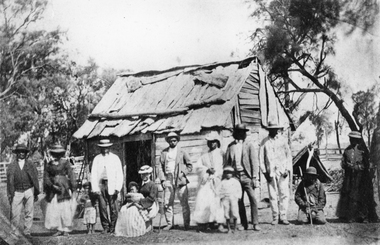
Photograph, Indigenous or First Nations People at Carrs Plains 1874 Richardson River Tribe
... property, a Bullock driver. stawell aboriginal portrait Anthony & Lubra, Donald & Affie my ? Herbal? Black Billie Great Rider, Kitty Supulants? Lubra Jonny Callaghan Jr., Four? Supulant? Harry, Blind Tommy & Lubra, 1874 Reproduction rights ...Photo taken at Carrs Plains in 1874 of Indigenous or First Nation People outside a wood and bark hut. In 1861, William Dennis of Carrs Plains Station, a staunch Methodist became Honorary, Aboriginal Protector for the area. One of his main tasks to give Government supplied food and clothing to the Aboriginals. Many district, remaining First Nations People became based at Carrs Plains, and their dead were buried in a cemetery on the station. The cemetery is show on survey map of Wirchilleva Borough, in corner of camping & water reserve near surveyed Bismarck township. In a Protector's report 1869, Dennis wrote that only one male worked regularly on the property, a Bullock driver.Black and white photograph of a wood and bark hut with a group of men, women and children out the front. Richardson River Tribe.Anthony & Lubra, Donald & Affie my ? Herbal? Black Billie Great Rider, Kitty Supulants? Lubra Jonny Callaghan Jr., Four? Supulant? Harry, Blind Tommy & Lubra, 1874 Reproduction rights reserved Copied by State Library of Victoriastawell aboriginal portrait -
 Ararat Gallery TAMA
David McDiarmid, Untitled (T-shirt), 1984
... rights and was one of the original activists for of the first Sydney Mardi Gras Parade in 1978. Later he served as designer and then artistic director for the Sydney Gay and Lesbian Mardi Gras (1988-1990) and, in 1992, produced a series of posters for the AIDS Council of New South Wales. McDiarmid advocated for artists’ intellectual property...rights and was one of the original activists for of the first Sydney Mardi Gras Parade in 1978. Later he served as designer and then artistic director for the Sydney Gay and Lesbian Mardi Gras (1988-1990) and, in 1992, produced a series of posters for the AIDS Council of New South Wales. McDiarmid advocated for artists’ intellectual property ...David McDiarmid was a queer artist, designer and activist, born in Hobart, and lived between Melbourne, Sydney and New York. McDiarmid’s art practice was kaleidoscopic, celebratory and political. This artwork, Untitled (T-shirt), was presented to Stephen Allkins, a pioneering Sydney DJ, as a gift of the artist. The front of the t-shirt includes the letters for the word, STEPHEN, and the numbers for the year it was made, 84, while the back of the t-shirt includes the letters for the word, SYDNEY. The period in which this artwork was produced was a particularly tumultuous time. The HIV/AIDS epidemic emerged in the early 1980s and rapidly became a global public health emergency. McDiarmid was living in New York at the time, witnessing the forefront of epidemic and with his community deeply affected, and friends and lovers dying, he “suspected he was HIV-Positive…[and] would be dead with two years”. McDiarmid was an important figure in gay activism in Melbourne and Sydney-based protests for gay rights and was one of the original activists for of the first Sydney Mardi Gras Parade in 1978. Later he served as designer and then artistic director for the Sydney Gay and Lesbian Mardi Gras (1988-1990) and, in 1992, produced a series of posters for the AIDS Council of New South Wales. McDiarmid advocated for artists’ intellectual property, presenting at Sydney Writers' Festival and the Arts Law Centre of Australia on the management of artists’ estates in the face of HIV/AIDS epidemic. -
Unions Ballarat
Suffrage to sufferance : a hundred years of women in politics (Don Woodward Collection), Haines, Janine, 1992
... Includes accounts from known and unknown women about the fight for a variety of rights such as property ownership, child custody, representation in parliaments and equal pay....Includes accounts from known and unknown women about the fight for a variety of rights such as property ownership, child custody, representation in parliaments and equal pay. ...The book covers the period from women's being granted suffrage in New Zealand to the present. Includes accounts from known and unknown women about the fight for a variety of rights such as property ownership, child custody, representation in parliaments and equal pay.Political and women's rights. Janine Haynes was a South Australian Senator and leader of the Australian Democrats from 1986 to 1990.Book; 210 pages. Front cover: blue background; one black and white photo of Janine Haines; two colour photos; white and blue lettering; author's name and title.btlc, ballarat trades hall, ballarat trades and labour council, feminism, women in history, women's rights, senate - australia, haines, janine, women's suffrage, voting and elections - australia, australian democrats, politics and government -
 Sunshine and District Historical Society Incorporated
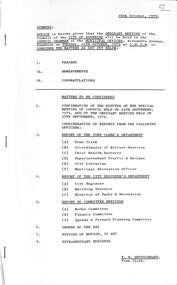
Administrative record - City of Sunshine - Commissioner Mr Alexander Alex George Gillon Collection 1976 - 1982 - Notice of ordinary meeting of the council 16th October 1979, City of Sunshine, 10th October 1979
... Notice of Ordinary Meeting of the Council 16th October 1979 Report of the Town Clerk's Department Report of the Town Clerk Polling Hours Petition for Change Crown Reserves vesting in the Council Land Transfer to the Council from Rosslare Estate Deer Park Funds of Former Western Suburbs Municipal Association Proposed Transfer to Western Region Commission Land Transfer to the Council from Rosslare Estates Deer Park Municipal Association Increase in Subscriptions Supplementary Valuations Western Suburbs Review of Municipal Boundaries Proposed Purchase of Land Maribyrnong Valley Sealing of Land Transfer Rights of Way Rear of Sims Property Deer Park Contract for Cleaning of Council Properties Variation of Municipal Officers Award Award Matters Road Funding New Tax Levy Report of the Co-Ordinator of Welfare Services Western Suburbs Spastic Relief Association Victorian Municipal Welfare Officers Association Quarterly Conference 24th October 1979 Proposal of Upgrading Housing Commission Areas in Sunshine Braybrook / Maidstone Housing Commission Liaison Committee West Sunshine Ethnic Community Child Care Co-Operative Limited to Purchase 90 Murray Street Sunshine West Community Youth Support Scheme Albanvale Playgroup Victorian Council of the Ageing Quarterly Meeting Report of the Chief Health Inspector Report of the Inspector of Weights and Measures Municipal Sunshine Tip Hulett Street Asbestos Dumping of Waste Material by James Hardie & Co Pty Ltd Infant Welfare Installation of a Septic Tank Recirculating Sand Filter System Application for Installation of a Gas Fired Dry Septic Tank Units Draft Environment Protection Policy for the Air Environment of Victoria Sanitary Contract Application for Transfer of Proprietorship of Premises Under the Health Act Health Act Registrations for 1972 Prosecution Proceedings Sunshine Magistrates Court Report of the Superintendent Traffic & By-Laws Dog Act Court Proceedings Parking and Traffic Infringements School Crossing Supervision Snake Eradication Dog Act Increased Fees Lost Dogs' Home Fire Hazard Removal Tenders Season 1979/80 Proposed Control of Stray Cats Amendment to the Local Government Act No 9283 Report of the City Librarian Christmas / New Year 1979/80 Public Hours Report of the Interdepartmental Committee on Joint Use Libraries Report on Melton Library Report of the Municipal Recreation Officer August / September 1979 Holiday Programmes Report of the City Engineer & Planner Survey of Existing Cafes and Restaurants in Sunshine Shopping Centre Planning Permit Application Cafe Lots 2 & 3 (Shops 2 & 3) Watt Street Sunshine Amendment No 127 to the Melbourne Metropolitan Planning Scheme (Retail Facilities) Rezoning of Land North East Corner of Mitchell Street and Hampstead Road Maidstone Planning Permit Application Office Extension to F.B.T. ...Albans Disraeli Street Hertford Road West Avenue Sunshine North Wintersun Drive Albanvale Bunnett Street Fairbairn Road McDonald Road Brooklyn Talmage Street Albion Barclay Reserve King Edward Avenue Somerville Road Conifer Avenue Stradbroke Drive Deakin Street Opie Road Mailey Street Ballarat Road Victor Street Mayne Street Cornhill Street Sunshine High School North Sunshine Fun Playgroup Van Ness Avenue Belvedere Close Maribyrnong Sunshine West High School Lachlan Road McKechnie Street Kermeen Street Churchill Avenue Western Highway Albion Tennis Club Selwyn Park Selwyn Street Aycliffe Drive Pre-School & Infant Welfare Centre Aycliffe Drive Diamond Avenue Pre-School & Infant Welfare Centre Diamond Avenue Bon Thomas Reserve Pre-School Centre Quinn Street Orama Street Pre-School Centre Orama Street Highpoint West Welfare Centre Rosamond Road Billingham Road Warick Road Woodland Drive Entally Drive Cumbernauld Crescent Livingston Street Millbank Drive Raleigh Road Berkshire Road Geelong Road Burgess Road Princess Highway Notice of Ordinary Meeting of the Council 16th October 1979 Report of the Town Clerk's Department Report of the Town Clerk Polling Hours Petition for Change Crown Reserves vesting in the Council Land Transfer to the Council from Rosslare Estate Deer Park Funds of Former Western Suburbs Municipal Association Proposed Transfer to Western Region Commission Land Transfer to the Council from Rosslare Estates Deer Park Municipal Association Increase in Subscriptions Supplementary Valuations Western Suburbs Review of Municipal Boundaries Proposed Purchase of Land Maribyrnong Valley Sealing of Land Transfer Rights of Way Rear of Sims Property Deer Park Contract for Cleaning of Council Properties Variation of Municipal Officers Award Award Matters Road Funding New Tax Levy Report of the Co-Ordinator of Welfare Services Western Suburbs Spastic Relief Association Victorian Municipal Welfare Officers Association Quarterly Conference 24th October 1979 Proposal of Upgrading Housing Commission Areas in Sunshine Braybrook / Maidstone Housing Commission Liaison Committee West Sunshine Ethnic Community Child Care Co-Operative Limited to Purchase 90 Murray Street Sunshine West Community Youth Support Scheme Albanvale Playgroup Victorian Council of the Ageing Quarterly Meeting Report of the Chief Health Inspector Report of the Inspector of Weights and Measures Municipal Sunshine Tip Hulett Street Asbestos Dumping of Waste Material by James Hardie & Co Pty Ltd Infant Welfare Installation of a Septic Tank Recirculating Sand Filter System Application for Installation of a Gas Fired Dry Septic Tank Units Draft Environment Protection Policy for the Air Environment of Victoria Sanitary Contract Application for Transfer of Proprietorship of Premises Under the Health Act Health Act Registrations for 1972 Prosecution Proceedings Sunshine Magistrates Court Report of the Superintendent Traffic & By-Laws Dog Act Court Proceedings Parking and Traffic Infringements School Crossing Supervision Snake Eradication Dog Act Increased Fees Lost Dogs' Home Fire Hazard Removal Tenders Season 1979/80 Proposed Control of Stray Cats Amendment to the Local Government Act No 9283 Report of the City Librarian Christmas / New Year 1979/80 Public Hours Report of the Interdepartmental Committee on Joint Use Libraries Report on Melton Library Report of the Municipal Recreation Officer August / September 1979 Holiday Programmes Report of the City Engineer & Planner Survey of Existing Cafes and Restaurants in Sunshine Shopping Centre Planning Permit Application Cafe Lots 2 & 3 (Shops 2 & 3) Watt Street Sunshine Amendment No 127 to the Melbourne Metropolitan Planning Scheme (Retail Facilities) Rezoning of Land North East Corner of Mitchell Street and Hampstead Road Maidstone Planning Permit Application Office Extension to F.B.T. ...Notice of Ordinary Meeting of the Council 16th October 1979 Report of the Town Clerk's Department Report of the Town Clerk Polling Hours Petition for Change Crown Reserves vesting in the Council Land Transfer to the Council from Rosslare Estate Deer Park Funds of Former Western Suburbs Municipal Association Proposed Transfer to Western Region Commission Land Transfer to the Council from Rosslare Estates Deer Park Municipal Association Increase in Subscriptions Supplementary Valuations Western Suburbs Review of Municipal Boundaries Proposed Purchase of Land Maribyrnong Valley Sealing of Land Transfer Rights of Way Rear of Sims Property Deer Park Contract for Cleaning of Council Properties Variation of Municipal Officers Award Award Matters Road Funding New Tax Levy Report of the Co-Ordinator of Welfare Services Western Suburbs Spastic Relief Association Victorian Municipal Welfare Officers Association Quarterly Conference 24th October 1979 Proposal of Upgrading Housing Commission Areas in Sunshine Braybrook / Maidstone Housing Commission Liaison Committee West Sunshine Ethnic Community Child Care Co-Operative Limited to Purchase 90 Murray Street Sunshine West Community Youth Support Scheme Albanvale Playgroup Victorian Council of the Ageing Quarterly Meeting Report of the Chief Health Inspector Report of the Inspector of Weights and Measures Municipal Sunshine Tip Hulett Street Asbestos Dumping of Waste Material by James Hardie & Co Pty Ltd Infant Welfare Installation of a Septic Tank Recirculating Sand Filter System Application for Installation of a Gas Fired Dry Septic Tank Units Draft Environment Protection Policy for the Air Environment of Victoria Sanitary Contract Application for Transfer of Proprietorship of Premises Under the Health Act Health Act Registrations for 1972 Prosecution Proceedings Sunshine Magistrates Court Report of the Superintendent Traffic & By-Laws Dog Act Court Proceedings Parking and Traffic Infringements School Crossing Supervision Snake Eradication Dog Act Increased Fees Lost Dogs' Home Fire Hazard Removal Tenders Season 1979/80 Proposed Control of Stray Cats Amendment to the Local Government Act No 9283 Report of the City Librarian Christmas / New Year 1979/80 Public Hours Report of the Interdepartmental Committee on Joint Use Libraries Report on Melton Library Report of the Municipal Recreation Officer August / September 1979 Holiday Programmes Report of the City Engineer & Planner Survey of Existing Cafes and Restaurants in Sunshine Shopping Centre Planning Permit Application Cafe Lots 2 & 3 (Shops 2 & 3) Watt Street Sunshine Amendment No 127 to the Melbourne Metropolitan Planning Scheme (Retail Facilities) Rezoning of Land North East Corner of Mitchell Street and Hampstead Road Maidstone Planning Permit Application Office Extension to F.B.T. Pty Ltd Transport Depot North West Corner of Alick Road and Kalingra Road Tottenham Planning Permit Application Amusement Machine Addition to Existing Roller Skating Rink Lot 89 Wright Street Sunshine Amendment No 88 Part 2A to the Melbourne Metropolitan Planning Scheme Planning Permit Application Signs Lot 2 Neale Road Deer Park Proposed Amendment No 104 to the Melbourne Metropolitan Planning Scheme Planning Permit Application Service Premises Additions to Existing Cluster Subdivision 104 Station Road Deer Park Planning Permit Application Place of Worship Vule Street St. Albans Planning Permit Application Cafe and Amusement Parlour Lot 2 Disraeli Street St. Albans Planning Permit Application Additional Roller Skating Rink Lot 89 Wright Street Sunshine Planning Permit Application Three Villa Units Lot 13 Hertford Road Sunshine Planning Permit Application Truck Park Lot 189 West Avenue Sunshine North Enforcement 36 Wintersun Drive Albanvale Panel Beating and Mechanical Repairs Amendment No 81 Part 4 to the Melbourne Metropolitan Planning Scheme Planning Permit Application Factory Extension Lot 1 Bunnett Street Sunshine North Planning Permit Application Medical Consulting Room Lot 173 Fairbairn Road Sunshine West Planning Permit Application Truck Wash Lot 1 McDonald Road Brooklyn Planning Permit Application Licensed Sports Club Talmage Street Albion Planning Permit Application Office Sims Supermarkets 463 Somerville Road Tottenham Home Occupation 3 Phase Power Connection 7 Conifer Avenue Brooklyn Strata Subdivision Lot 583 Stradbroke Drive St. Albans Consolidation of Title 3 Deakin Street Maidstone Cancellation of Easement Opie Road Subdivision Albanvale Strata Subdivision 65 Mailey Street Sunshine West Reuction of Road Reserve Width Opie Road Albanvale Drainage Reserve Ballarat Road and Victor Street Sunshine North Plan of Subdivision 19 Mayne Street Sunshine West Plan of Subdivision Neale Road Deer Park Contract Construction of Right of Way off Cornhill Street St. Albans Tenders for Road Sweeper Tenders for Class 6 Dozer Tenders for Semi-Trailer Type Bookmobile Tenders for Tractor Loader Drainage Stage 2 Sunshine View Estate Neale Road / Station Road Intersection Improvement Works Sunshine High School North Sunshine Fun Playgroup Land Slippage Van Ness Avenue / Belvedere Close Maribyrnong Right of Way Wright Street to Sunshine West High School Road 7 Drain Westerngate North Stage 4 Electrification of Railway to Deer Park Allocation of Funds 1979/80 Joint Works Unclassified Road Country Roads Board Proposed Bus Stop Bookmobile Site 6 McKechnie Street St. Albans Prohibited Parking Kermeen Street Sunshine West Traffic Control Items Civic Guides Reflectorized Pavement Markers Fairbairn Road Vandalism Prohibited Parking Churchill Avenue / Western Highway (Ballarat Road) Maidstone Albion Tennis Club Pavilion Aycliffe Drive Pre-School & Infant Welfare Centre Deer Park Variations Diamond Avenue Pre-School & Infant Welfare Centre Albanvale Variations Bon Thomas Reserve Pre-School Centre Deer Park Variations Orama Street Pre-School Centre Variations Highpoint West Welfare Centre Variations Orama Street Pre-School Centre Sewage Treatment Plant & Effluent Disposal System Bon Thomas Reserve Pre-School Centre Sewage Treatment Plant & Effluent Disposal System Report of the Building Surveyor Building Over Easement Lot 171 Billingham Road Deer Park Building Over Easement 48 Warick Road Sunshine North Building Over Easement 21 Lachlan Road Sunshine West Building Over Easement 41 Woodland Drive Albanvale Siting of Building Lot 980 Entally Drive St. Albans Siting of Building Lot 485 Cumbernauld Crescent Deer Park Siting of Building 504 Neale Road Deer Park Siting of Building Lot 877 Livingston Street Deer Park Siting of Building 46 Millbank Drive Deer Park Fence 33 Raleigh Road Maribyrnong Installation of Underground Tank 76 Berkshire Road Sunshine North Installation of Underground Tank Corner Princess Highway (Geelong Road) and Burgess Road Brooklyn Building in Breach of Regulations Lot 50 Cromer Avenue Sunshine North Orders of the Day Accounts Submitted for Payment as at 25th September 1979 Notice of Motion Setting of General Rate Levymaribyrnong valley, sims, deer park, western suburbs spastic relief association, west sunshine ethnic community child care co-operative, murray street, sunshine west, albanvale playgroup, sunshine tip, hulett street, james hardie & co, watt street, sunshine, mitchell street, hampstead road, maidstone, f.b.t. pty ltd, alick road, kalingra road, tottenham, wright street, neale road, station road, vule street, st. albans, disraeli street, hertford road, west avenue, sunshine north, wintersun drive, albanvale, bunnett street, fairbairn road, mcdonald road, brooklyn, talmage street, albion, barclay reserve, king edward avenue, somerville road, conifer avenue, stradbroke drive, deakin street, opie road, mailey street, ballarat road, victor street, mayne street, cornhill street, sunshine high school, north sunshine fun playgroup, van ness avenue, belvedere close, maribyrnong, sunshine west high school, lachlan road, mckechnie street, kermeen street, churchill avenue, western highway, albion tennis club, selwyn park, selwyn street, aycliffe drive pre-school & infant welfare centre, aycliffe drive, diamond avenue pre-school & infant welfare centre, diamond avenue, bon thomas reserve pre-school centre, quinn street, orama street pre-school centre, orama street, highpoint west welfare centre, rosamond road, billingham road, warick road, woodland drive, entally drive, cumbernauld crescent, livingston street, millbank drive, raleigh road, berkshire road, geelong road, burgess road, princess highway -
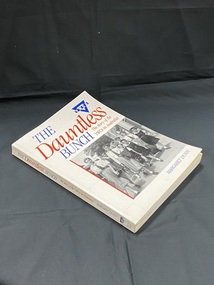 Returned Nurses RSL Sub-branch
Book - Paperback book, Margaret Dunn, The dauntless bunch: the story of the YWCA in Australia, 1991
... . – Whether it was teaching millinery or English as a second language, working for equal rights and social justice, or running employment agencies and cafeterias for working girls, the YWCA has always been there – helping women and meeting their changing needs in a changing world. – The Dauntless Bunch is the story of the women who, through their faith and energy, brought warmth, love and humour to the work of the Young Women’s Christian Association. – This is their story ....... - from Trove 'PROPERTY OF ANZAC HOUSE' [stamped in purple ink on base of page block] 'VICTORIAN BRANCH / LIBRARY / ANZAC HOUSE' [stamped in red ink on first page and title page] '267.5 / DUN / A1484' [handwritten in pencil on the inside front cover] '267.5 / DUN' [typed in black ink on spine label] 'PROPERTY OF VICTORIAN BRANCH RSL [stamped in red ink on title page] 'RECEIVED 7 OCT 1991' [stamped in purple ink on first page] White paperback book . ...Everyone knows that the Young Women’s Christian Association offers safe accommodation and healthy activities for women and girls. But there is much more to the YWCA than hostels and hockey sticks. – Back in 1911 the YWCA was debating equal pay for women, and in the 1920s it ran classes in sex education and psychology. After World War 2, the focus shifted to helping ‘New Australians’ and rebuilding war-torn communities in Japan and Singapore. In the ‘60s and ‘70s the ‘Y’ continued to set the pace, helping working women and single mothers, and running youth clubs and after-school programs. The YWCA also spread its wings during those years of expansion, setting up groups in Papua New Guinea, the new mining towns of north-west Australia and in isolated rural communities. – Whether it was teaching millinery or English as a second language, working for equal rights and social justice, or running employment agencies and cafeterias for working girls, the YWCA has always been there – helping women and meeting their changing needs in a changing world. – The Dauntless Bunch is the story of the women who, through their faith and energy, brought warmth, love and humour to the work of the Young Women’s Christian Association. – This is their story ....... - from TroveWhite paperback book . Title on the cover and spine label are royal blue and red. There is a spine label taped to the base of the spine. The front cover contains a black and white photograph of a group of children in pinafores being led by three older girls wearing blouses and ties, down a paved street.non-fictionEveryone knows that the Young Women’s Christian Association offers safe accommodation and healthy activities for women and girls. But there is much more to the YWCA than hostels and hockey sticks. – Back in 1911 the YWCA was debating equal pay for women, and in the 1920s it ran classes in sex education and psychology. After World War 2, the focus shifted to helping ‘New Australians’ and rebuilding war-torn communities in Japan and Singapore. In the ‘60s and ‘70s the ‘Y’ continued to set the pace, helping working women and single mothers, and running youth clubs and after-school programs. The YWCA also spread its wings during those years of expansion, setting up groups in Papua New Guinea, the new mining towns of north-west Australia and in isolated rural communities. – Whether it was teaching millinery or English as a second language, working for equal rights and social justice, or running employment agencies and cafeterias for working girls, the YWCA has always been there – helping women and meeting their changing needs in a changing world. – The Dauntless Bunch is the story of the women who, through their faith and energy, brought warmth, love and humour to the work of the Young Women’s Christian Association. – This is their story ....... - from Troveywca-australia, young women's christian association, women's organisations -
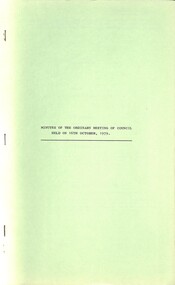 Sunshine and District Historical Society Incorporated
Administrative record - City of Sunshine - Commissioner Mr Alexander Alex George Gillon Collection 1976 - 1982 - Minutes of the ordinary meeting of council held on 16th October 1979, City of Sunshine, 16th October 1979
... Minutes of the Ordinary Meeting of Council held on 16th October 1979 Report of the Town Clerk's Department Report of the Town Clerk Polling Hours Petition for Change Crown Reserves vesting in the Council Land Transfer to the Council from Rosslare Estate Deer Park Funds of Former Western Suburbs Municipal Association Proposed Transfer to Western Region Commission Land Transfer to the Council from Rosslare Estates Deer Park Municipal Association Increase in Subscriptions Supplementary Valuations Western Suburbs Review of Municipal Boundaries Proposed Purchase of Land Maribyrnong Valley Sealing of Land Transfer Rights of Way Rear of Sims Property Deer Park Contract for Cleaning of Council Properties Variation of Municipal Officers Award Award Matters Road Funding New Tax Levy Report of the Co-Ordinator of Welfare Services Western Suburbs Spastic Relief Association Victorian Municipal Welfare Officers Association Quarterly Conference 24th October 1979 Proposal of Upgrading Housing Commission Areas in Sunshine Braybrook / Maidstone Housing Commission Liaison Committee West Sunshine Ethnic Community Child Care Co-Operative Limited to Purchase 90 Murray Street Sunshine West Community Youth Support Scheme Albanvale Playgroup Victorian Council of the Ageing Quarterly Meeting Report of the Chief Health Inspector Report of the Inspector of Weights and Measures Municipal Sunshine Tip Hulett Street Asbestos Dumping of Waste Material by James Hardie & Co Pty Ltd Infant Welfare Installation of a Septic Tank Recirculating Sand Filter System Application for Installation of a Gas Fired Dry Septic Tank Units Draft Environment Protection Policy for the Air Environment of Victoria Sanitary Contract Application for Transfer of Proprietorship of Premises Under the Health Act Health Act Registrations for 1972 Prosecution Proceedings Sunshine Magistrates Court Report of the Superintendent Traffic & By-Laws Dog Act Court Proceedings Parking and Traffic Infringements School Crossing Supervision Snake Eradication Dog Act Increased Fees Lost Dogs' Home Fire Hazard Removal Tenders Season 1979/80 Proposed Control of Stray Cats Amendment to the Local Government Act No 9283 Report of the City Librarian Christmas / New Year 1979/80 Public Hours Report of the Interdepartmental Committee on Joint Use Libraries Report on Melton Library Report of the Municipal Recreation Officer August / September 1979 Holiday Programmes Report of the City Engineer & Planner Survey of Existing Cafes and Restaurants in Sunshine Shopping Centre Planning Permit Application Cafe Lots 2 & 3 (Shops 2 & 3) Watt Street Sunshine Amendment No 127 to the Melbourne Metropolitan Planning Scheme (Retail Facilities) Rezoning of Land North East Corner of Mitchell Street and Hampstead Road Maidstone Planning Permit Application Office Extension to F.B.T. ...Albans Disraeli Street Hertford Road West Avenue Sunshine North Wintersun Drive Albanvale Panel Bunnett Street Fairbairn Road McDonald Brooklyn Talmage Street Barclay Reserve King Edward Avenue Albion Somerville Road Conifer Avenue Stradbroke Drive Deakin Street Opie Road Mailey Street Ballarat Road Victor Street Mayne Street Cornhill Street Sunshine High School North Sunshine Fun Playgroup Van Ness Avenue Belvedere Close McKechnie Street Kermeen Street Churchill Avenue Western Highway Albion Tennis Club Selwyn Park Selwyn Street Aycliffe Drive Pre-School & Infant Welfare Centre Aycliffe Drive Diamond Avenue Pre-School & Infant Welfare Centre Albanvale Bon Thomas Reserve Pre-School Centre Quinn Street Orama Street Pre-School Centre Orama Street Highpoint West Welfare Centre Rosamond Road Billingham Road Warick Road Woodland Drive Entally Drive Cumbernauld Crescent Livingston Street Millbank Drive Raleigh Road Princess Highway Geelong Road Burgess Road Cromer Avenue Oakwood Road Minutes of the Ordinary Meeting of Council held on 16th October 1979 Report of the Town Clerk's Department Report of the Town Clerk Polling Hours Petition for Change Crown Reserves vesting in the Council Land Transfer to the Council from Rosslare Estate Deer Park Funds of Former Western Suburbs Municipal Association Proposed Transfer to Western Region Commission Land Transfer to the Council from Rosslare Estates Deer Park Municipal Association Increase in Subscriptions Supplementary Valuations Western Suburbs Review of Municipal Boundaries Proposed Purchase of Land Maribyrnong Valley Sealing of Land Transfer Rights of Way Rear of Sims Property Deer Park Contract for Cleaning of Council Properties Variation of Municipal Officers Award Award Matters Road Funding New Tax Levy Report of the Co-Ordinator of Welfare Services Western Suburbs Spastic Relief Association Victorian Municipal Welfare Officers Association Quarterly Conference 24th October 1979 Proposal of Upgrading Housing Commission Areas in Sunshine Braybrook / Maidstone Housing Commission Liaison Committee West Sunshine Ethnic Community Child Care Co-Operative Limited to Purchase 90 Murray Street Sunshine West Community Youth Support Scheme Albanvale Playgroup Victorian Council of the Ageing Quarterly Meeting Report of the Chief Health Inspector Report of the Inspector of Weights and Measures Municipal Sunshine Tip Hulett Street Asbestos Dumping of Waste Material by James Hardie & Co Pty Ltd Infant Welfare Installation of a Septic Tank Recirculating Sand Filter System Application for Installation of a Gas Fired Dry Septic Tank Units Draft Environment Protection Policy for the Air Environment of Victoria Sanitary Contract Application for Transfer of Proprietorship of Premises Under the Health Act Health Act Registrations for 1972 Prosecution Proceedings Sunshine Magistrates Court Report of the Superintendent Traffic & By-Laws Dog Act Court Proceedings Parking and Traffic Infringements School Crossing Supervision Snake Eradication Dog Act Increased Fees Lost Dogs' Home Fire Hazard Removal Tenders Season 1979/80 Proposed Control of Stray Cats Amendment to the Local Government Act No 9283 Report of the City Librarian Christmas / New Year 1979/80 Public Hours Report of the Interdepartmental Committee on Joint Use Libraries Report on Melton Library Report of the Municipal Recreation Officer August / September 1979 Holiday Programmes Report of the City Engineer & Planner Survey of Existing Cafes and Restaurants in Sunshine Shopping Centre Planning Permit Application Cafe Lots 2 & 3 (Shops 2 & 3) Watt Street Sunshine Amendment No 127 to the Melbourne Metropolitan Planning Scheme (Retail Facilities) Rezoning of Land North East Corner of Mitchell Street and Hampstead Road Maidstone Planning Permit Application Office Extension to F.B.T. ...Minutes of the Ordinary Meeting of Council held on 16th October 1979 Report of the Town Clerk's Department Report of the Town Clerk Polling Hours Petition for Change Crown Reserves vesting in the Council Land Transfer to the Council from Rosslare Estate Deer Park Funds of Former Western Suburbs Municipal Association Proposed Transfer to Western Region Commission Land Transfer to the Council from Rosslare Estates Deer Park Municipal Association Increase in Subscriptions Supplementary Valuations Western Suburbs Review of Municipal Boundaries Proposed Purchase of Land Maribyrnong Valley Sealing of Land Transfer Rights of Way Rear of Sims Property Deer Park Contract for Cleaning of Council Properties Variation of Municipal Officers Award Award Matters Road Funding New Tax Levy Report of the Co-Ordinator of Welfare Services Western Suburbs Spastic Relief Association Victorian Municipal Welfare Officers Association Quarterly Conference 24th October 1979 Proposal of Upgrading Housing Commission Areas in Sunshine Braybrook / Maidstone Housing Commission Liaison Committee West Sunshine Ethnic Community Child Care Co-Operative Limited to Purchase 90 Murray Street Sunshine West Community Youth Support Scheme Albanvale Playgroup Victorian Council of the Ageing Quarterly Meeting Report of the Chief Health Inspector Report of the Inspector of Weights and Measures Municipal Sunshine Tip Hulett Street Asbestos Dumping of Waste Material by James Hardie & Co Pty Ltd Infant Welfare Installation of a Septic Tank Recirculating Sand Filter System Application for Installation of a Gas Fired Dry Septic Tank Units Draft Environment Protection Policy for the Air Environment of Victoria Sanitary Contract Application for Transfer of Proprietorship of Premises Under the Health Act Health Act Registrations for 1972 Prosecution Proceedings Sunshine Magistrates Court Report of the Superintendent Traffic & By-Laws Dog Act Court Proceedings Parking and Traffic Infringements School Crossing Supervision Snake Eradication Dog Act Increased Fees Lost Dogs' Home Fire Hazard Removal Tenders Season 1979/80 Proposed Control of Stray Cats Amendment to the Local Government Act No 9283 Report of the City Librarian Christmas / New Year 1979/80 Public Hours Report of the Interdepartmental Committee on Joint Use Libraries Report on Melton Library Report of the Municipal Recreation Officer August / September 1979 Holiday Programmes Report of the City Engineer & Planner Survey of Existing Cafes and Restaurants in Sunshine Shopping Centre Planning Permit Application Cafe Lots 2 & 3 (Shops 2 & 3) Watt Street Sunshine Amendment No 127 to the Melbourne Metropolitan Planning Scheme (Retail Facilities) Rezoning of Land North East Corner of Mitchell Street and Hampstead Road Maidstone Planning Permit Application Office Extension to F.B.T. Pty Ltd Transport Depot North West Corner of Alick Road and Kalingra Road Tottenham Planning Permit Application Amusement Machine Addition to Existing Roller Skating Rink Lot 89 Wright Street Sunshine Amendment No 88 Part 2A to the Melbourne Metropolitan Planning Scheme Planning Permit Application Signs Lot 2 Neale Road Deer Park Proposed Amendment No 104 to the Melbourne Metropolitan Planning Scheme Planning Permit Application Service Premises Additions to Existing Cluster Subdivision 104 Station Road Deer Park Planning Permit Application Place of Worship Vule Street St. Albans Planning Permit Application Cafe and Amusement Parlour Lot 2 Disraeli Street St. Albans Planning Permit Application Additional Roller Skating Rink Lot 89 Wright Street Sunshine Planning Permit Application Three Villa Units Lot 13 Hertford Road Sunshine Planning Permit Application Truck Park Lot 189 West Avenue Sunshine North Enforcement 36 Wintersun Drive Albanvale Panel Beating and Mechanical Repairs Amendment No 81 Part 4 to the Melbourne Metropolitan Planning Scheme Planning Permit Application Factory Extension Lot 1 Bunnett Street Sunshine North Planning Permit Application Medical Consulting Room Lot 173 Fairbairn Road Sunshine West Planning Permit Application Truck Wash Lot 1 McDonald Road Brooklyn Planning Permit Application Licensed Sports Club Talmage Street Albion Planning Permit Application Office Sims Supermarkets 463 Somerville Road Tottenham Home Occupation 3 Phase Power Connection 7 Conifer Avenue Brooklyn Strata Subdivision Lot 583 Stradbroke Drive St. Albans Consolidation of Title 3 Deakin Street Maidstone Cancellation of Easement Opie Road Subdivision Albanvale Strata Subdivision 65 Mailey Street Sunshine West Reuction of Road Reserve Width Opie Road Albanvale Drainage Reserve Ballarat Road and Victor Street Sunshine North Plan of Subdivision 19 Mayne Street Sunshine West Plan of Subdivision Neale Road Deer Park Contract Construction of Right of Way off Cornhill Street St. Albans Tenders for Road Sweeper Tenders for Class 6 Dozer Tenders for Semi-Trailer Type Bookmobile Tenders for Tractor Loader Drainage Stage 2 Sunshine View Estate Neale Road / Station Road Intersection Improvement Works Sunshine High School North Sunshine Fun Playgroup Land Slippage Van Ness Avenue / Belvedere Close Maribyrnong Right of Way Wright Street to Sunshine West High School Road 7 Drain Westerngate North Stage 4 Electrification of Railway to Deer Park Allocation of Funds 1979/80 Joint Works Unclassified Road Country Roads Board Proposed Bus Stop Bookmobile Site 6 McKechnie Street St. Albans Prohibited Parking Kermeen Street Sunshine West Traffic Control Items Civic Guides Reflectorized Pavement Markers Fairbairn Road Vandalism Prohibited Parking Churchill Avenue / Western Highway (Ballarat Road) Maidstone Albion Tennis Club Pavilion Aycliffe Drive Pre-School & Infant Welfare Centre Deer Park Variations Diamond Avenue Pre-School & Infant Welfare Centre Albanvale Variations Bon Thomas Reserve Pre-School Centre Deer Park Variations Orama Street Pre-School Centre Variations Highpoint West Welfare Centre Variations Orama Street Pre-School Centre Sewage Treatment Plant & Effluent Disposal System Bon Thomas Reserve Pre-School Centre Sewage Treatment Plant & Effluent Disposal System Report of the Building Surveyor Building Over Easement Lot 171 Billingham Road Deer Park Building Over Easement 48 Warick Road Sunshine North Building Over Easement 21 Lachlan Road Sunshine West Building Over Easement 41 Woodland Drive Albanvale Siting of Building Lot 980 Entally Drive St. Albans Siting of Building Lot 485 Cumbernauld Crescent Deer Park Siting of Building 504 Neale Road Deer Park Siting of Building Lot 877 Livingston Street Deer Park Siting of Building 46 Millbank Drive Deer Park Fence 33 Raleigh Road Maribyrnong Installation of Underground Tank 76 Berkshire Road Sunshine North Installation of Underground Tank Corner Princess Highway (Geelong Road) and Burgess Road Brooklyn Building in Breach of Regulations Lot 50 Cromer Avenue Sunshine North Orders of the Day Accounts Submitted for Payment as at 25th September 1979 Notice of Motion Setting of General Rate Levy Extraordinary Business Report of the City Engineer & Planner Construction of Neale Road West of Oakwood Road Albanvale Planning Permit Application Amusement Parlour Highpoint West Shopping Centremaribyrnong valley, sims, deer park, western suburbs spastic relief association, west sunshine ethnic community child care co-operative, murray street, sunshine west, albanvale playgroup, sunshine tip, hulett street, james hardie & co, watt street, sunshine, mitchell street, hampstead road, maidstone, f.b.t., alick road, kalingra road, tottenham, wright street, neale road, station road, vule street, st. albans, disraeli street, hertford road, west avenue, sunshine north, wintersun drive, albanvale panel, bunnett street, fairbairn road, mcdonald, brooklyn, talmage street, barclay reserve, king edward avenue, albion, somerville road, conifer avenue, stradbroke drive, deakin street, opie road, mailey street, ballarat road, victor street, mayne street, cornhill street, sunshine high school, north sunshine fun playgroup, van ness avenue, belvedere close, mckechnie street, kermeen street, churchill avenue, western highway, albion tennis club, selwyn park, selwyn street, aycliffe drive pre-school & infant welfare centre, aycliffe drive, diamond avenue pre-school & infant welfare centre, albanvale, bon thomas reserve pre-school centre, quinn street, orama street pre-school centre, orama street, highpoint west welfare centre, rosamond road, billingham road, warick road, woodland drive, entally drive, cumbernauld crescent, livingston street, millbank drive, raleigh road, princess highway, geelong road, burgess road, cromer avenue, oakwood road -
Ringwood and District Historical Society
Legal record - Real Estate & Stock Institute of Victoria Contract of Sale of Property (C.E.Carter of Ringwood - Agent), Vendor: Allan Edgar HILL. Purchaser: Alfred William ADAMS - August, 1942
... rights in the event of default, and adjustments for Commonwealth Land Tax. Special wartime conditions required the purchaser to warrant compliance with the National Security (Land Transfer) Regulations, and to sign an acknowledgment under the Farmers’ Debts Adjustment Act 1935. Overall, the document formalises a straightforward freehold land transfer under the legal and regulatory framework of the period. Copy of contract and covering typewritten summary. Property ...Copy of contract and covering typewritten summary. Property - Lot 4, Plan of Subdivision 14672, Part of Crown Allotment 60B, Parish of Scoresby, Certificate of Title Volume 1100 Folio 219803.18661 Hill – Adams AI Summary (30/9/2026) This 1942 contract records the sale of Lot 4, Plan of Subdivision 14672, part of Crown Allotment 60B in the Parish of Scoresby, from Allan Edgar Hill (vendor) to Alfred William Adams (purchaser) for £99, with a £25 deposit and the balance payable within twelve months at 5% interest. The land formed part of the Broxburn Estate (Mountain Highway/Dorset Road Bayswater North) and was sold through C.E. Carter, Ringwood. The purchaser was required to take possession upon acceptance of the vendor’s title and payment of the deposit, and to pay all rates, taxes and outgoings from the date of possession. The contract incorporates the standard 1936 Copyright Conditions of Sale, including provisions for instalment payments, vendor rights in the event of default, and adjustments for Commonwealth Land Tax. Special wartime conditions required the purchaser to warrant compliance with the National Security (Land Transfer) Regulations, and to sign an acknowledgment under the Farmers’ Debts Adjustment Act 1935. Overall, the document formalises a straightforward freehold land transfer under the legal and regulatory framework of the period. -
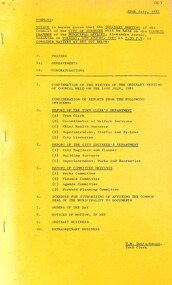 Sunshine and District Historical Society Incorporated
Administrative record - City of Sunshine - Commissioner Mr Alexander Alex George Gillon Collection 1976 - 1982 - Notice of ordinary meeting of the council 4th August 2026, City of Sunshine, 29th July 1981
... Notice of ordinary meeting of the council 4th August 2026 Report of the Town Clerk's Department Report of the Town Clerk Request for Refund of Rates Western Region Commission Annual Contribution Daylight Savings Municipal Association of Victoria Subscriptions 1981/82 Transfer of Land from Department of Administrative Services to Council Leopold Street, Navigator Street, Clyde Street and The Esplanade Maribyrnong Sunshine Swimming Pool Annual Report Land Transfer Lot 36 Station Road Deer Park for Road Widening Executive Committee Municipal Association of Victoria General Revenue Sharing 1981/82 Transfer of Sunshine Tip Tipping Rights from Collins & Davey Motors Pty Ltd to Whelan the Wrecker Holdings Pty Ltd Report of the Co-Ordinator of Welfare Services Community Education Officer Deer Park Disadvantaged Schools Social Work Service in Department of Social Security Community Youth Support Scheme Lions House of Sunshine Elderly Citizens' Club Bingo Report of the Chief Health Surveyor Installation of a Septic Tank Pump System Australian Institute of Health surveyors National Conference Sydney 29th September 1981 to 2nd October 1981 Properties 4 Tribe Street Sunshine, 13 Carlyle Street Maidstone and 8 Treloar Crescent Brayrook Sanitary Contract Health Act Registrations 1981 Anit-Rubella Campaign Report of the Superintendent Traffic & By-Laws Court Proceedings Sunshine Magistrates Court Disposal of Derelict Vehicles Report of the Chief Librarian Sunshine Lions Club (Lions Club of Sunshine) Grant to Corio Street Toy Library Report of the City Engineer & Planner Planning Permit Application 3 Maloney Street Sunshine West Resident Bee Keeping Planning Permit Application Finance Office Shop No 8 266 Hampshire Road Sunshine Planning Permit Application Take Away Food Premise Metherall Street Sunshine North Planning Permit Application Radio Mast Highfield Quarries Pty Ltd Bunting Road Brooklyn Planning Permit Application Three Factories Lot 2 Emu Road Maidstone Planning Permit Application Polyurethane Plant Lot 2 Williamson Road Bounded by Rosamond Road, Wattle Street & Hampstead Road Maidstone Delegated Matters University of Melbourne Proposed Purchase of Land from I.C.I. ...Derrimut Derrimut Maribyrnong River Wright Street Raleigh Road Killeen Street Fairbairn Road Hunt Court Links Street Glengala Road Kynoch Street Ballarat Road McIntyre Road Quinn Street Innis Court Fernhill Court Errol Street Winnington Street Vule Street Hook Street Maribyrnong Reserve Hortense Street Notice of ordinary meeting of the council 4th August 2026 Report of the Town Clerk's Department Report of the Town Clerk Request for Refund of Rates Western Region Commission Annual Contribution Daylight Savings Municipal Association of Victoria Subscriptions 1981/82 Transfer of Land from Department of Administrative Services to Council Leopold Street, Navigator Street, Clyde Street and The Esplanade Maribyrnong Sunshine Swimming Pool Annual Report Land Transfer Lot 36 Station Road Deer Park for Road Widening Executive Committee Municipal Association of Victoria General Revenue Sharing 1981/82 Transfer of Sunshine Tip Tipping Rights from Collins & Davey Motors Pty Ltd to Whelan the Wrecker Holdings Pty Ltd Report of the Co-Ordinator of Welfare Services Community Education Officer Deer Park Disadvantaged Schools Social Work Service in Department of Social Security Community Youth Support Scheme Lions House of Sunshine Elderly Citizens' Club Bingo Report of the Chief Health Surveyor Installation of a Septic Tank Pump System Australian Institute of Health surveyors National Conference Sydney 29th September 1981 to 2nd October 1981 Properties 4 Tribe Street Sunshine, 13 Carlyle Street Maidstone and 8 Treloar Crescent Brayrook Sanitary Contract Health Act Registrations 1981 Anit-Rubella Campaign Report of the Superintendent Traffic & By-Laws Court Proceedings Sunshine Magistrates Court Disposal of Derelict Vehicles Report of the Chief Librarian Sunshine Lions Club (Lions Club of Sunshine) Grant to Corio Street Toy Library Report of the City Engineer & Planner Planning Permit Application 3 Maloney Street Sunshine West Resident Bee Keeping Planning Permit Application Finance Office Shop No 8 266 Hampshire Road Sunshine Planning Permit Application Take Away Food Premise Metherall Street Sunshine North Planning Permit Application Radio Mast Highfield Quarries Pty Ltd Bunting Road Brooklyn Planning Permit Application Three Factories Lot 2 Emu Road Maidstone Planning Permit Application Polyurethane Plant Lot 2 Williamson Road Bounded by Rosamond Road, Wattle Street & Hampstead Road Maidstone Delegated Matters University of Melbourne Proposed Purchase of Land from I.C.I. ...Notice of ordinary meeting of the council 4th August 2026 Report of the Town Clerk's Department Report of the Town Clerk Request for Refund of Rates Western Region Commission Annual Contribution Daylight Savings Municipal Association of Victoria Subscriptions 1981/82 Transfer of Land from Department of Administrative Services to Council Leopold Street, Navigator Street, Clyde Street and The Esplanade Maribyrnong Sunshine Swimming Pool Annual Report Land Transfer Lot 36 Station Road Deer Park for Road Widening Executive Committee Municipal Association of Victoria General Revenue Sharing 1981/82 Transfer of Sunshine Tip Tipping Rights from Collins & Davey Motors Pty Ltd to Whelan the Wrecker Holdings Pty Ltd Report of the Co-Ordinator of Welfare Services Community Education Officer Deer Park Disadvantaged Schools Social Work Service in Department of Social Security Community Youth Support Scheme Lions House of Sunshine Elderly Citizens' Club Bingo Report of the Chief Health Surveyor Installation of a Septic Tank Pump System Australian Institute of Health surveyors National Conference Sydney 29th September 1981 to 2nd October 1981 Properties 4 Tribe Street Sunshine, 13 Carlyle Street Maidstone and 8 Treloar Crescent Brayrook Sanitary Contract Health Act Registrations 1981 Anit-Rubella Campaign Report of the Superintendent Traffic & By-Laws Court Proceedings Sunshine Magistrates Court Disposal of Derelict Vehicles Report of the Chief Librarian Sunshine Lions Club (Lions Club of Sunshine) Grant to Corio Street Toy Library Report of the City Engineer & Planner Planning Permit Application 3 Maloney Street Sunshine West Resident Bee Keeping Planning Permit Application Finance Office Shop No 8 266 Hampshire Road Sunshine Planning Permit Application Take Away Food Premise Metherall Street Sunshine North Planning Permit Application Radio Mast Highfield Quarries Pty Ltd Bunting Road Brooklyn Planning Permit Application Three Factories Lot 2 Emu Road Maidstone Planning Permit Application Polyurethane Plant Lot 2 Williamson Road Bounded by Rosamond Road, Wattle Street & Hampstead Road Maidstone Delegated Matters University of Melbourne Proposed Purchase of Land from I.C.I. Mt. Derrimut Subdivision Local Government (Land Liable to Flooding) Act 1979 Designated of Flood Levels Maribyrnong River Plan of Transfer 134 Wright Street Sunshine The C.R.B. SCRAM Project (Traffic Signal Linking) Raleigh Road East of Navigator Street Maribyrnong Flowmeter (M.M.B.W.) Availability of Sewers Albanvale Road Funding (Municipal Association of Victoria) Country Roads Board Killeen Street Between Fairbairn Road and Hunt Court Sunshine West Standing Restrictions Links Street Corner Glengala Road Sunshine West Restricted Parking Report of the Building Surveyor Ruinous and Dangerous Building 4 Kynoch Street Deer Park (Damaged by Fire) Underground Storage Tank 277 Ballarat Road Braybrook Underground Storage Tank 33 Emu Road Maidstone Underground Storage Tank 44 McIntyre Road Sunshine North Building Over Easement Lot 574 Quinn Street Deer Park Building Over Easement 7 Innis Court Deer Park Building Over Easement 10 Fernhill Court St. Albans Building Over Easement Lot 27 Errol Street Braybrook Building Over Easement Lot 526 Winnington Street Deer Park Building Over Easement Lot 3 Vule Street St. Albans Building Over Easement Lot 1 Hook Street St. Albans Schedule for Authorising of Affixing the Common Seal of the Municipality to Documents Orders of the Day Accounts Submitted for Payment as at 31st July 1981 Proposal to Close Right of Way Rear of Newstead Street, The Esplanade and Raleigh Road Adjacent to The Maribyrnong Reserveleopold street, navigator street, clyde street, the esplanade, maribyrnong, station road, deer park, sunshine swimming pool, kennedy street, sunshine, sunshine tip, collins & davey motors, whelan the wrecker, sunshine elderly citizens' club, lions house of sunshine, corio street, watt street, tribe street, carlyle street, maidstone, treloar crescent, brayrook, sunshine lions club, lions club of sunshine, maloney street, sunshine west, hampshire road, metherall street, sunshine north, highfield quarries, bunting road, brooklyn, emu road, williamson road, rosamond road, wattle street, hampstead road, i.c.i., mt. derrimut, derrimut, maribyrnong river, wright street, raleigh road, killeen street, fairbairn road, hunt court, links street, glengala road, kynoch street, ballarat road, mcintyre road, quinn street, innis court, fernhill court, errol street, winnington street, vule street, hook street, maribyrnong reserve, hortense street -
Ringwood and District Historical Society
Legal record - Real Estate & Stock Institute of Victoria Contract of Sale of Property (C.E.Carter of Ringwood - Agent), Vendor: Alice EVERON. Purchaser: Clarence PROWSE - 1942
... rights. A completed Land Tax Act 1928 – Notice of Change of Ownership form is attached, signed by the vendor, confirming transfer of the land and delivery of possession. Copy of contract and covering typewritten summary. Property ...Copy of contract and covering typewritten summary. Property - Lot 3, Plan of Subdivision 7262, Part of Crown Portion 19B, Parish of Warrandyte, Certificate of Title Volume 4938, Folio 987501.18654 Everon - Prowse AI Summary (24/9/2026) This 1942 contract records the sale of Lot 3 on Plan of Subdivision 7262, part of Crown Portion 19B in the Parish of Warrandyte, County of Evelyn, being land described in Certificate of Title Volume 4938 Folio 987501. The vendor was Alice Everson of Hawthorn East, and the purchaser Clarence Prowse of Sandringham. The agreed price was £160, with a substantial £80 deposit payable on signing. The balance was to be paid by eight consecutive quarterly instalments of £10, with 5% interest calculated on the amount owing at the beginning of each quarter. The first instalment was due on 26 October 1942. The agent for the sale was C. E. Carter of Ringwood. The purchaser’s signature is missing from the contract copy. The special conditions required the purchaser to accept possession upon written acceptance of title and payment of the purchase money, and to sign an acknowledgment under the Farmers’ Debts Adjustment Act 1935. The purchaser warranted compliance with wartime National Security (Land Transfer) Regulations. All rates, taxes, and outgoings were to be paid by the purchaser from the date of possession, with apportionment if necessary. The contract incorporated the standard 1936 Copyright Conditions of Sale, including provisions for default, interest, and the vendor’s rights. A completed Land Tax Act 1928 – Notice of Change of Ownership form is attached, signed by the vendor, confirming transfer of the land and delivery of possession. -
Ringwood and District Historical Society
Legal record - Real Estate & Stock Institute of Victoria Contract of Sale of Property (C.E.Carter of Ringwood - Agent), Vendor: Alfred Edward GEISLER. Purchaser: William Stanley DYER - November, 1940
... rights. Copy of contract and covering typewritten summary. Property - Lot 53 Section D, Parish of Ringwood, County of Mornington, Crown Grant Volume 2632, Folio 526237. ...Copy of contract and covering typewritten summary. Property - Lot 53 Section D, Parish of Ringwood, County of Mornington, Crown Grant Volume 2632, Folio 526237.18657 Geisler - Dyer AI Summary (24/9/2026) This 1940 contract records the sale of Allotment 53D, Parish of Ringwood, being land described in Crown Grant Volume 2632 Folio 526237, together with all buildings and erections. The vendor was Alfred Edward Geisler of Benalla, and the purchaser William Stanley Dyer, chemist of Caulfield. The purchase price was £400, with a £50 deposit payable on signing. The agent was C. E. Carter of Ringwood. The contract form is complete, but both vendor’s and purchaser’s signatures are missing. The original payment clause was crossed out and replaced. Crossed out clause (verbatim excerpt): “Residue by weekly instalments of 20/- together with interest of 6% until 1st November 1945 when balance payable; interest calculated on money owing at beginning of each quarter.” Replacement clause (verbatim excerpt): “Residue by monthly instalments of £3 until 1st November 1945 when balance payable; Purchaser to pay interest on last day of February May August November at rate of 6%.” The special conditions allowed the purchaser to pay off the whole or any part of the purchase money at any time, required the purchaser to pay all rates, taxes and outgoings from the date of sale, and stated that taking possession did not constitute acceptance of title. The purchaser was entitled to make requisitions and objections within 14 days of receiving the vendor signed contract. In the event of default, the vendor could not rescind or retain money paid without first giving 14 days’ written notice to remedy the breach. The contract incorporated the standard 1936 Copyright Conditions of Sale, including provisions for default, interest, and the vendor’s rights.
