
Showing 19 items matching "protective garment"
-
 Flagstaff Hill Maritime Museum and Village
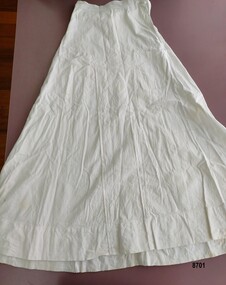
Textile - Overskirt, circa 1910
... ...protective garment...This overskirt is an outer protective garment made of durable cotton and was probably worn over a lady's skirt or dress to protect it whilst they were working. ...This overskirt is an outer protective garment made of durable cotton and was probably worn over a lady's skirt or dress to protect it whilst they were working. ...This item is one of a collection of clothing items that belonged to the Stephenson family who lived at 22 McCracken Street, Kensington, Melbourne. Matthew Stephenson (1861 – 1943) who had grown up on the Bendigo goldfields and shifted to Melbourne in the early 1900’s was a train driver and later, a fireman with the railways. His wife Elizabeth Jane (Betsy) Wigley (1865 – 1953) also grew up on the goldfields around Majorca and Bendigo. They married in 1885 in Bendigo. They had two daughters – Ethel Evelyn Stephenson (1886 – 1956) and Lillian or Lila (1891 – 1977) who were milliners and dressmakers and who continued to live in the family home after the death of their parents. The family are recorded as living at 22 McCracken Street, Kensington, as early as 1914. It is not known who made or owned the clothing that makes up this collection but as it appears to be from the late Victorian and early Edwardian era, the different pieces were probably made and worn by any of the three ladies of the house – Betsy, Ethel and/or Lila. During W.W.2, a local Warrnambool couple (Meryl and Tony Everard) boarded with them – Tony was in the airforce training paratroopers to jump into (and survive) enemy territory and his wife Meryl worked in the Methodist baby Home. The Everards developed a close friendship with the Stephensons and were responsible for clearing out the house (and finding this clothing collection) after Lila died in 1977. This overskirt is an outer protective garment made of durable cotton and was probably worn over a lady's skirt or dress to protect it whilst they were working. The pockets are large enough for the wearer to keep small items in and there is a loop at the back that would allow the wearer to hang it on a hook, when she finished her work. This item is an example of clothing worn by working women in the late 19th and early 20th centuryA heavy cotton ankle length overskirt made with two wide gored sections containing inset pockets joined to a middle T shaped front band. It has a waistband of grosgrain ribbon and a side opening with 3 pairs of metal snaps (one pair is missing) and a hook and eye at the top. The waistband also has a taped loop (for hanging) and an unusual double fabric overlay with unattached curved ends.flagstaff hill maritime museum and village, great ocean road, shipwreck coast, warrnambool, overskirt, needlework, sewing, protective garment, stephenson family -
 Glenelg Shire Council Cultural Collection
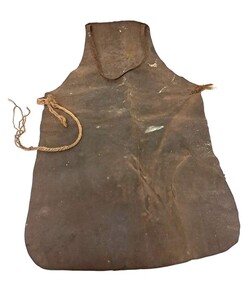
Clothing - Apron - Blacksmith, 1900s
... A leather apron would have been worn as a protective garment by blacksmiths. It would have helped to them from sparks and other hazards whilst they were working. ...A leather apron would have been worn as a protective garment by blacksmiths. It would have helped to them from sparks and other hazards whilst they were working. ...A leather apron would have been worn as a protective garment by blacksmiths. It would have helped to them from sparks and other hazards whilst they were working. Early businesses in Portland included a blacksmith. This would have been vital to the town and its development. Although the provenance of the apron is unknown it is possible that this belonged to a Portland blacksmith.Brown leather apron. Leather neck strap with metal. Metal buckle to the side. Rope pieces have been added where the original leather straps have broken off. Bottom right corner has a triangular shaped rip which has been mended and sewn back together. The leather is fairly brittle with marks and stains on it.blacksmith, leather, leather working, protective clothing, portland, glenelg shire -
 Bendigo Historical Society Inc.
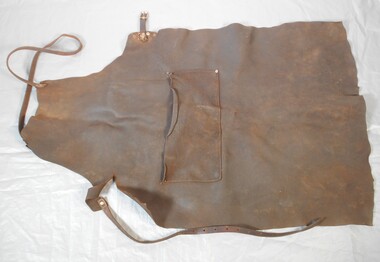
Textile - Blacksmith's apron
... A leather apron is a protective garment worn by blacksmiths to shield their clothing and skin from sparks, heat, and other hazards while working with hot metals. ...A leather apron is a protective garment worn by blacksmiths to shield their clothing and skin from sparks, heat, and other hazards while working with hot metals. ...A leather apron is a protective garment worn by blacksmiths to shield their clothing and skin from sparks, heat, and other hazards while working with hot metals. Leather aprons are typically made of high-quality leather that is durable and resistant to heat and flames. Black leather blacksmith's apron. Used by Norm Harris while working in the blacksmith workshop at the Central Deborah tourist gold mine and while conducting tours of the mine for the tourists.mining, clothing, deborah gold mine, blacksmith, leather apron -
 Falls Creek Historical Society
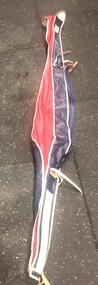
Equipment - Ski Bag, Dynastar, 1960s
... Available Dynastar products has steadily increased since that time to include a wide range of skis, bags, poles, skins and protective garments and equipment. This bag was used for many years, the last time being for a trip to Canada in 2016....Available Dynastar products has steadily increased since that time to include a wide range of skis, bags, poles, skins and protective garments and equipment. This bag was used for many years, the last time being for a trip to Canada in 2016. ...In 1963 near the town of Sallanches, France two manufacturing companies formed a partnership to create new high-performance skis. The partnership between Starflex skis, produced by Synthetic Plastics, and Dynamic resulted in the production of Dynastar skis. Available Dynastar products has steadily increased since that time to include a wide range of skis, bags, poles, skins and protective garments and equipment. This bag was used for many years, the last time being for a trip to Canada in 2016.This item is significant because it is representative of ski equipment developed to make travel easier for regular skiers at Falls Creek and throughout the world.A red, white and blue ski bag made from waterproof material with leather straps and metal buckles.Dynastar / Product of Francedynastar, ski bags -
 Flagstaff Hill Maritime Museum and Village
Clothing - Apron, circa late19th to early 20th Century
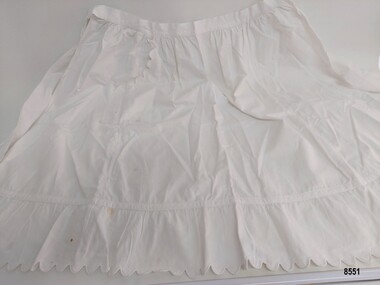
... An apron is an outer protective garment worn over clothes to cover the front of the body. ...An apron is an outer protective garment worn over clothes to cover the front of the body. ...An apron is an outer protective garment worn over clothes to cover the front of the body. In Victorian and Edwardian times, women were using aprons for both utility (they were easier to wash than dresses) and fashion and women's magazines and pattern companies were offering patterns to allow women to be to sew their own aprons at home. There are different styles of aprons including bib aprons, waist or half aprons, pinafores, tabards and pinner aprons. The word "apron" comes from the old French word "naperon" which means a napkin or small tablecloth. This apron is one of two similar aprons that were donated from the estate of Susan Henry nee Vedmore (1944 - 2021). It is in very good condition and appears to be more decorative (and possibly used only on special occasions) rather than everyday wear. Susan's family (Harold and Gladys Vedmore) immigrated to Australia from Wales in 1955 and settled in Warrnambool. Susan was well known in the Warrnambool community for her work supporting children and families across the district - particular those with disabilities, or those who were homeless, unemployed or isolated. Susan was the founding trustee of the "Vedmore Foundation" - a Warrnambool philanthropic trust set up in 2010 to support a range of charitable and not-for-profit causes by providing grant assistance. In 2021, she was awarded a Medal of the Order of Australia for services to the community.This item is an example of clothing worn by working women in the late 19th and early 20th centuryShort white cotton apron featuring gathering along the waist band and a gathered frill with scalloped edging along the bottom. The scalloped trim is repeated on the edge of a single pocket on the right hand side. It has ties attached to both ends of the waist band and the main body of the apron is made of of three rectangular pieces of cotton joined with french seams.warrnambool, great ocean road, textiles, lady's garment, apron, parlour apron, waitress apron, half apron, waist apron, handmade, domestic clothing, domestic work, vedmore foundation, susan henry oam -
 Flagstaff Hill Maritime Museum and Village
Clothing - Apron, circa late19th to early 20th Century
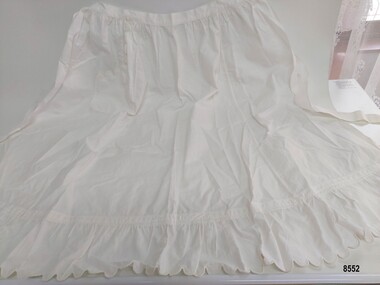
... An apron is an outer protective garment worn over clothes to cover the front of the body. ...An apron is an outer protective garment worn over clothes to cover the front of the body. ...An apron is an outer protective garment worn over clothes to cover the front of the body. In Victorian and Edwardian times, women were using aprons for both utility (they were easier to wash than dresses) and fashion and women's magazines and pattern companies were offering patterns to allow women to be to sew their own aprons at home. There are different styles of aprons including bib aprons, waist or half aprons, pinafores, tabards and pinner aprons. The word "apron" comes from the old French word "naperon" which means a napkin or small tablecloth. This apron is one of two similar aprons that were donated from the estate of Susan Henry nee Vedmore (1944 - 2021). It is in very good condition and appears to be more decorative (and possibly used only on special occasions) rather than everyday wear. Susan's family (Harold and Gladys Vedmore) immigrated to Australia from Wales in 1955 and settled in Warrnambool. Susan was well known in the Warrnambool community for her work supporting children and families across the district - particular those with disabilities, or those who were homeless, unemployed or isolated. Susan was the founding trustee of the "Vedmore Foundation" - a Warrnambool philanthropic trust set up in 2010 to support a range of charitable and not-for-profit causes by providing grant assistance. In 2021, she was awarded a Medal of the Order of Australia for services to the community.This item is an example of clothing worn by working women in the late 19th and early 20th century Long white cotton apron featuring gathering along the waist band and a gathered frill with scalloped edging along the bottom. The scalloped trim is repeated on the edge of a single pocket on the right hand side. It has ties attached to both ends of the waist band and the main body of the apron is made of of three rectangular pieces of cotton joined with french seams.warrnambool, great ocean road, ladies' garment, apron, half apron, waist apron, domestic clothing, domestic work, parlour apron, waitress apron, handmade, sewing, vedmore foundation, susan henry oam -
 Bendigo Military Museum
Equipment - UNDERGARMENT PROTECTION, Red China, pre 2005
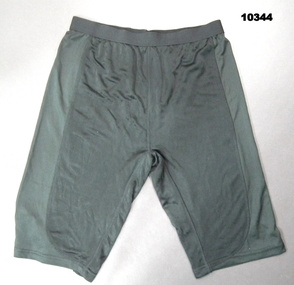
... Lee Palfrey Clothing Under garment Protection Makers printing: “Unisex Pelvic Protective, Anti-microbial Drawers. ...Lee Palfrey collection. Refer Cat No 10263. These under garments were for fragmentation protection. This apparel issued to L.Palfrey during Op Catalyst - Iraq. Aug 2005 - Feb 2006.Black garment - under wear, elastic waist, elastic legs at end.Makers printing: “Unisex Pelvic Protective, Anti-microbial Drawers. Main material: 95% Polyester 5% Elastane. Reinforcements 100% silk. Country of Origin: China” “PO No: 05242” Supplier ID No.: J20.lee palfrey, clothing, under garment, protection -
 Kew Historical Society Inc
Clothing - Shot Silk Dance Frock & Wrap, Park Avenue Gowns, c.1960
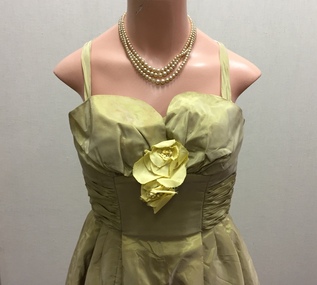
... Items in the collection were largely produced for, or purchased by women in Melbourne, and includes examples of outerwear, protective wear, nightwear, underwear and costume accessories.This 'dance frock' by Park Avenue Gowns is one of a number of garments in the collection by this designer....Items in the collection were largely produced for, or purchased by women in Melbourne, and includes examples of outerwear, protective wear, nightwear, underwear and costume accessories.This 'dance frock' by Park Avenue Gowns is one of a number of garments in the collection by this designer. women's clothing cocktail dresses dance frocks australian fashion - 1960s fashion designers - melbourne (vic) - park avenue gowns Label : "Park Avenue Gowns" Metallic thread silk cocktail dress and wrap by Park Avenue Gowns, 1960. ...The Fashion & Design collection of the Kew Historical Society includes examples of women’s, men’s, children’s and infants’ clothing from the 18th, 19th and 20th centuries. Items in the collection were largely produced for, or purchased by women in Melbourne, and includes examples of outerwear, protective wear, nightwear, underwear and costume accessories.This 'dance frock' by Park Avenue Gowns is one of a number of garments in the collection by this designer.Metallic thread silk cocktail dress and wrap by Park Avenue Gowns, 1960. Virtually identical dresses by the designer were featured in the Australian Women's Weekly in 1960, described as 'dance frocks', to which the wide flairing skirt would be well suited.Label : "Park Avenue Gowns"women's clothing, cocktail dresses, dance frocks, australian fashion - 1960s, fashion designers - melbourne (vic) - park avenue gowns -
 Kew Historical Society Inc
Clothing - Watered Silk Polonaise for a Wedding Dress, 1880s
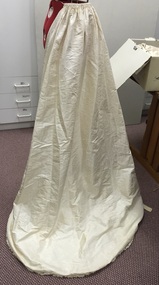
... protective wear, nightwear, underwear and costume accessories. This polonaise is part of the Netta Fuller Collection. Netta Fuller and her husband Alec were long-term residents of Kew. As a boy, Alec had attended East Kew Primary School and was later highly involved in the Kew Presbyterian Church during the 1950s and 60s. Netta's passion was for historic clothing and its exhibition. In 1985, Netta Fuller and Elizabeth Pace launched a parade of garments ...The Fashion & Design collection of the Kew Historical Society includes examples of women’s, men’s, children’s and infants’ clothing from the 18th, 19th and 20th centuries. Items in the collection were largely produced for, or purchased by women in Melbourne, and includes examples of outerwear, protective wear, nightwear, underwear and costume accessories. This polonaise is part of the Netta Fuller Collection.Netta Fuller and her husband Alec were long-term residents of Kew. As a boy, Alec had attended East Kew Primary School and was later highly involved in the Kew Presbyterian Church during the 1950s and 60s. Netta's passion was for historic clothing and its exhibition. In 1985, Netta Fuller and Elizabeth Pace launched a parade of garments sponsored by Kew Historical Society at Holy Trinity Church, Kew. The parade was called 'Downunder Dressmakers' and included a collection of over fifty items of clothing dating from 1800 to 1984. The collection included dresses, hats, scarfs, capes, sporting costumes etc. The core of the parade consisted of a collection of 19th century costumes worn by the ancestors of a Miss Gertrude Murray, a resident of Blackburn. In sourcing items for her collections, Netta Fuller collected costumes stored in old trunks and wardrobes, or even purchased from opportunity shops. (During the period in which she collected and exhibited costumes, the latter could often be a reliable source for the purchase of historic and aesthetically significant costumes.) Not satisfied with purchasing authentic costumes of the period, Netta also used these as models for artistic recreations. Following her retirement from both collecting and exhibiting, Netta Fuller donated a number of 19th Century garments to the Kew Historical Society's costume collection. A number of garments were parts of costumes such as bodices, while others were complete outfits. Some of the latter exhibit signs of old damage, however very few of the costumes had been modified to enable them to be worn in exhibitions. Provenance, apart from that the costumes were donated by Netta Fuller after 1985 is limited to donor information, although some of her donations may have originally been part of the collection owned by the Murray family. While the costumes are old and therefore historic, provenance is less important than the representativeness and/or rarity of the costumes. Similarly, the costumes need to be evaluated as a group and separately, considering their aesthetic and artistic significance as well a their age.Long train of cream, watered silk taffeta lined with silk net. The shattered silk train is believed to date to the 1880s. wedding dresses, trains, polonaises, netta fuller -
 Kew Historical Society Inc
Clothing - Skirt, Part Wedding Dress, 1890s
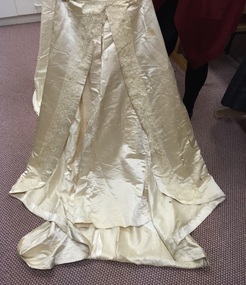
... Items in the collection were largely produced for, or purchased by women in Melbourne, and includes examples of outerwear, protective wear, nightwear, underwear and costume accessories.This (part) wedding dress is one of a number of items donated to the Fashion Collection by Netta Fuller. wedding dresses - 1890s netta fuller women's clothing Very full cream silk skirt with Brussels lace used on the front and hem of the garment. ...The Fashion & Design collection of the Kew Historical Society includes examples of women’s, men’s, children’s and infants’ clothing from the 18th, 19th and 20th centuries. Items in the collection were largely produced for, or purchased by women in Melbourne, and includes examples of outerwear, protective wear, nightwear, underwear and costume accessories.This (part) wedding dress is one of a number of items donated to the Fashion Collection by Netta Fuller.Very full cream silk skirt with Brussels lace used on the front and hem of the garment. At the front there is a separate panel of the same fabric. The skirt is believed to date from the 1890s.The skirt suffers from shattered silk.wedding dresses - 1890s, netta fuller, women's clothing -
 Kew Historical Society Inc
Clothing - Black Lace Evening Dress, 1930-1935
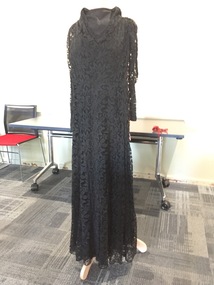
... Items in the collection were largely produced for, or purchased by women in Melbourne, and includes examples of outerwear, protective wear, nightwear, underwear and costume accessories. costumes evening dresses fashion - 1930s fashion design Full length black lace evening dress with a fitted black silk lining. The ‘v’ necked gown has a very full skirt. The lace has an abstract floral pattern. The garment ...The Fashion & Design collection of the Kew Historical Society includes examples of women’s, men’s, children’s and infants’ clothing from the 18th, 19th and 20th centuries. Items in the collection were largely produced for, or purchased by women in Melbourne, and includes examples of outerwear, protective wear, nightwear, underwear and costume accessories.Full length black lace evening dress with a fitted black silk lining. The ‘v’ necked gown has a very full skirt. The lace has an abstract floral pattern. The garment was previously dated to the 1930s.costumes, evening dresses, fashion - 1930s, fashion design -
 Kew Historical Society Inc
Clothing, Rust-coloured Crepe Evening Dress, 1930s
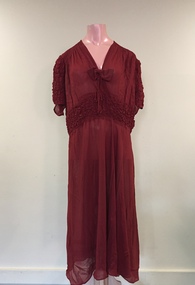
... protective wear, nightwear, underwear and costume accessories. This 1930s evening dress is one of a number of items donated by Teresa Mayer. women's clothing australian fashion - 1930s day wear day dresses Deep rust coloured three-quarter length crepe dress featuring extensive ruching on the bodice and to the short sleeves. A bow of the same fabric with hanging laces (sic) is attached at the neck. The garment ...The Fashion & Design collection of the Kew Historical Society includes examples of women’s, men’s, children’s and infants’ clothing from the 18th, 19th and 20th centuries. Items in the collection were largely produced for, or purchased by women in Melbourne, and includes examples of outerwear, protective wear, nightwear, underwear and costume accessories. This 1930s evening dress is one of a number of items donated by Teresa Mayer.Deep rust coloured three-quarter length crepe dress featuring extensive ruching on the bodice and to the short sleeves. A bow of the same fabric with hanging laces (sic) is attached at the neck. The garment has been dated to the 1930s.women's clothing, australian fashion - 1930s, day wear, day dresses -
 Kew Historical Society Inc
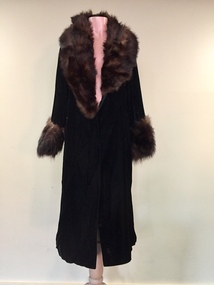
Clothing - Evening Coat, 1930s
... Items in the collection were largely produced for, or purchased by women in Melbourne, and includes examples of outerwear, protective wear, nightwear, underwear and costume accessories. women's clothing evening wear australian fashion evening coats teresa mayer Long black velvet evening coat with an attached wide collar of brown fur. The same fur is used to border the long sleeves. The garment ...The Fashion & Design collection of the Kew Historical Society includes examples of women’s, men’s, children’s and infants’ clothing from the 18th, 19th and 20th centuries. Items in the collection were largely produced for, or purchased by women in Melbourne, and includes examples of outerwear, protective wear, nightwear, underwear and costume accessories.Long black velvet evening coat with an attached wide collar of brown fur. The same fur is used to border the long sleeves. The garment and or the attached fur would appear to be homemade.women's clothing, evening wear, australian fashion, evening coats, teresa mayer -
 Kew Historical Society Inc
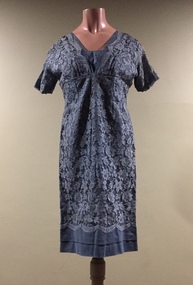
Clothing, Margeaux of Melbourne, Grey Silk & Lace Cocktail Dress, 1950s
... Items in the collection were largely produced for, or purchased by women in Melbourne, and includes examples of outerwear, protective wear, nightwear, underwear and costume accessories.This garment was created by Margeaux (Melbourne) which specialised in the production of "high-class cocktail and evening wear" (The Age, 17 March 1956)....Items in the collection were largely produced for, or purchased by women in Melbourne, and includes examples of outerwear, protective wear, nightwear, underwear and costume accessories.This garment was created by Margeaux (Melbourne) which specialised in the production of "high-class cocktail and evening wear" (The Age, 17 March 1956). australian fashion - 1950s margaux of melbourne cocktail dresses women's clothing Knee length short sleeved grey silk and grey tulle cocktail dress with an attached outer covering of patterned lace of a lighter grey colour. ...The Fashion & Design collection of the Kew Historical Society includes examples of women’s, men’s, children’s and infants’ clothing from the 18th, 19th and 20th centuries. Items in the collection were largely produced for, or purchased by women in Melbourne, and includes examples of outerwear, protective wear, nightwear, underwear and costume accessories.This garment was created by Margeaux (Melbourne) which specialised in the production of "high-class cocktail and evening wear" (The Age, 17 March 1956).Knee length short sleeved grey silk and grey tulle cocktail dress with an attached outer covering of patterned lace of a lighter grey colour. The garment has the label of ‘Margeaux Regd. Imported fabric’. There is a zip at the back. There is some discoloration (due to sun damage?) to the lace at the shoulders. australian fashion - 1950s, margaux of melbourne, cocktail dresses, women's clothing -
 Kew Historical Society Inc
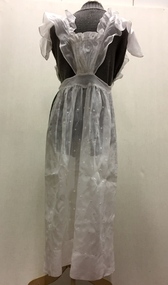
Clothing - Cream Voile Pinafore, c. 1898-1904
... The garments in the Weir Collection were donated to the Kew Historical Society by a granddaughter of Edith Weir in 2017. pinafores women's clothing edith mary weir weir collection aprons protective wear Full-length decorative, spotted cream voile pinafore, designed to be worn over a full long dress. ...An item forming part of a collection of costumes, photographs and documents relating to the Weir family who lived in a mansion, originally named Illapa, at 84 Princess Street, Kew, from c.1917 to 1950. This historically significant collection includes items relating to both George Weir (1866-1937), his wife Edith Mary Weir (1867-1948) and their children. George Weir attained national prominence in the mining industry, becoming General Manager of the North Broken Hill Silver Mining Company in 1903 (later renamed North Broken Hill Mining Company 1905-12, and North Broken Hill Ltd 1912-1988), and subsequently President of the Mine Owners Association. He was to remain General Manager of North Broken Hill Ltd until his retirement in 1926.This garment is part of a collection of women’s clothing, owned and worn by Edith Mary Weir (nee Betteridge) - born in Clare, South Australia 1867, died Kew 1948 - and also by her daughter. The garments date from the 1880s to the 1930s. The collection includes day dresses, evening dresses, evening coats, capes, and undergarments. As the wife and daughter of a mine manager, the collection includes representative examples of clothing worn by upper middle class Australian women in domestic circumstances, and at social and civic events. A number of the costumes from the 1920s to the 1930s are of a particularly fine quality, being both rare, representative and intact examples of Australian fashion of the period. The garments in the Weir Collection were donated to the Kew Historical Society by a granddaughter of Edith Weir in 2017.Full-length decorative, spotted cream voile pinafore, designed to be worn over a full long dress. The pinafore has ruffled shoulder straps and a band of ruffle above the hem. This is one of two pinafores in the Weir Collection. This example, in contrast to the other pinafore, includes a small bodice.pinafores, women's clothing, edith mary weir, weir collection, aprons, protective wear -
 Kew Historical Society Inc
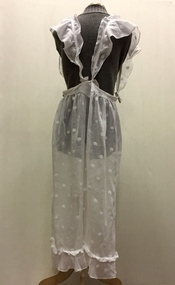
Clothing - Cream Voile Pinafore, c. 1898-1904
... The garments in the Weir Collection were donated to the Kew Historical Society by a granddaughter of Edith Weir in 2017. pinafores weir collection edith mary weir women's clothing aprons protective wear Full-length decorative, spotted cream voile pinafore, designed to be worn over a full long dress. ...An item forming part of a collection of costumes, photographs and documents relating to the Weir family who lived in a mansion, originally named Illapa, at 84 Princess Street, Kew, from c.1917 to 1950. This historically significant collection includes items relating to both George Weir (1866-1937), his wife Edith Mary Weir (1867-1948) and their children. George Weir attained national prominence in the mining industry, becoming General Manager of the North Broken Hill Silver Mining Company in 1903 (later renamed North Broken Hill Mining Company 1905-12, and North Broken Hill Ltd 1912-1988), and subsequently President of the Mine Owners Association. He was to remain General Manager of North Broken Hill Ltd until his retirement in 1926.This garment is part of a collection of women’s clothing, owned and worn by Edith Mary Weir (nee Betteridge) - born in Clare, South Australia 1867, died Kew 1948 - and also by her daughter. The garments date from the 1880s to the 1930s. The collection includes day dresses, evening dresses, evening coats, capes, and undergarments. As the wife and daughter of a mine manager, the collection includes representative examples of clothing worn by upper middle class Australian women in domestic circumstances, and at social and civic events. A number of the costumes from the 1920s to the 1930s are of a particularly fine quality, being both rare, representative and intact examples of Australian fashion of the period. The garments in the Weir Collection were donated to the Kew Historical Society by a granddaughter of Edith Weir in 2017.Full-length decorative, spotted cream voile pinafore, designed to be worn over a full long dress. The pinafore has ruffled shoulder straps. This is one of two pinafores in the Weir Collection. This example, in contrast to the other pinafore, does not include a bodice.pinafores, weir collection, edith mary weir, women's clothing, aprons, protective wear -
 Kew Historical Society Inc
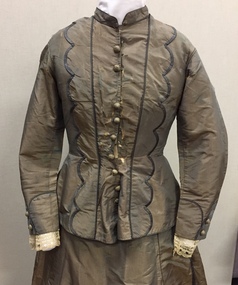
Clothing - Two Piece Iridescent Silk Day Dress, 1868-71
... protective wear, nightwear, underwear and costume accessories. Netta Fuller and her husband Alec were long-term residents of Kew. As a boy, Alec had attended East Kew Primary School and was later highly involved in the Kew Presbyterian Church during the 1950s and 60s. Netta's passion was for historic clothing and its exhibition. In 1985, Netta Fuller and Elizabeth Pace launched a parade of garments ...The Fashion & Design collection of the Kew Historical Society includes examples of women’s, men’s, children’s and infants’ clothing from the 18th, 19th and 20th centuries. Items in the collection were largely produced for, or purchased by women in Melbourne, and includes examples of outerwear, protective wear, nightwear, underwear and costume accessories.Netta Fuller and her husband Alec were long-term residents of Kew. As a boy, Alec had attended East Kew Primary School and was later highly involved in the Kew Presbyterian Church during the 1950s and 60s. Netta's passion was for historic clothing and its exhibition. In 1985, Netta Fuller and Elizabeth Pace launched a parade of garments sponsored by Kew Historical Society at Holy Trinity Church, Kew. The parade was called 'Downunder Dressmakers' and included a collection of over fifty items of clothing dating from 1800 to 1984. The collection included dresses, hats, scarfs, capes, sporting costumes etc. The core of the parade consisted of a collection of 19th century costumes worn by the ancestors of a Miss Gertrude Murray, a resident of Blackburn. In sourcing items for her collections, Netta Fuller collected costumes stored in old trunks and wardrobes, or even purchased from opportunity shops. (During the period in which she collected and exhibited costumes, the latter could often be a reliable source for the purchase of historic and aesthetically significant costumes.) Not satisfied with purchasing authentic costumes of the period, Netta also used these as models for artistic recreations. Following her retirement from both collecting and exhibiting, Netta Fuller donated a number of 19th Century garments to the Kew Historical Society's costume collection. A number of garments were parts of costumes such as bodices, while others were complete outfits. Some of the latter exhibit signs of old damage, however very few of the costumes had been modified to enable them to be worn in exhibitions. Provenance, apart from that the costumes were donated by Netta Fuller after 1985 is limited to donor information, although some of her donations may have originally been part of the collection owned by the Murray family. While the costumes are old and therefore historic, provenance is less important than the representativeness and/or rarity of the costumes. Similarly, the costumes need to be evaluated as a group and separately, considering their aesthetic and artistic significance as well a their age.Two piece olive green and gold shot silk dress comprised of a skirt and top. The very full skirt has a scalloped edge front panel with bands of grey/green silk ribbon. The scalloped panels seem to be backed with later lining fabric (sic). The bodice has decorative buttons at the front from the high round neck to the waist. The bodice, like the skirt has a scalloped panel at the front, which is edged with ribbon. netta fuller, australian fashion - 1860s, women's clothing - 1860s, dresses - 1860s -
 Kew Historical Society Inc
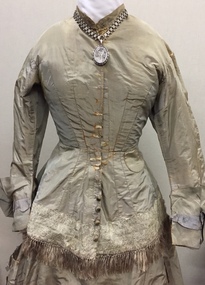
Clothing - Two Piece Pale Green Silk Day Dress, 1876-9
... protective wear, nightwear, underwear and costume accessories. Netta Fuller and her husband Alec were long-term residents of Kew. As a boy, Alec had attended East Kew Primary School and was later highly involved in the Kew Presbyterian Church during the 1950s and 60s. Netta's passion was for historic clothing and its exhibition. In 1985, Netta Fuller and Elizabeth Pace launched a parade of garments ...The Fashion & Design collection of the Kew Historical Society includes examples of women’s, men’s, children’s and infants’ clothing from the 18th, 19th and 20th centuries. Items in the collection were largely produced for, or purchased by women in Melbourne, and includes examples of outerwear, protective wear, nightwear, underwear and costume accessories.Netta Fuller and her husband Alec were long-term residents of Kew. As a boy, Alec had attended East Kew Primary School and was later highly involved in the Kew Presbyterian Church during the 1950s and 60s. Netta's passion was for historic clothing and its exhibition. In 1985, Netta Fuller and Elizabeth Pace launched a parade of garments sponsored by Kew Historical Society at Holy Trinity Church, Kew. The parade was called 'Downunder Dressmakers' and included a collection of over fifty items of clothing dating from 1800 to 1984. The collection included dresses, hats, scarfs, capes, sporting costumes etc. The core of the parade consisted of a collection of 19th century costumes worn by the ancestors of a Miss Gertrude Murray, a resident of Blackburn. In sourcing items for her collections, Netta Fuller collected costumes stored in old trunks and wardrobes, or even purchased from opportunity shops. (During the period in which she collected and exhibited costumes, the latter could often be a reliable source for the purchase of historic and aesthetically significant costumes.) Not satisfied with purchasing authentic costumes of the period, Netta also used these as models for artistic recreations. Following her retirement from both collecting and exhibiting, Netta Fuller donated a number of 19th Century garments to the Kew Historical Society's costume collection. A number of garments were parts of costumes such as bodices, while others were complete outfits. Some of the latter exhibit signs of old damage, however very few of the costumes had been modified to enable them to be worn in exhibitions. Provenance, apart from that the costumes were donated by Netta Fuller after 1985 is limited to donor information, although some of her donations may have originally been part of the collection owned by the Murray family. While the costumes are old and therefore historic, provenance is less important than the representativeness and/or rarity of the costumes. Similarly, the costumes need to be evaluated as a group and separately, considering their aesthetic and artistic significance as well a their age.Two piece pale green and gold shot silk dress comprised of a skirt and top. The very full skirt has a scalloped edge front panel with bands of grey/green silk ribbon. The scalloped panels seem to be backed with later lining fabric (sic). The bodice has decorative buttons at the front from the high round neck to the waist. The bodice, like the skirt has a scalloped panel at the front, which is edged with ribbon. netta fuller, fashion - 1870s, australian fashion - 1870s -
 Kew Historical Society Inc
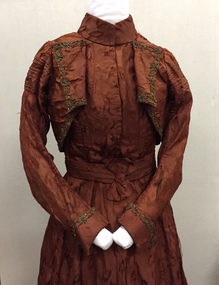
Clothing - Two Piece Brown Silk Day Dress, 1880s
... Items in the collection were largely produced for, or purchased by women in Melbourne, and includes examples of outerwear, protective wear, nightwear, underwear and costume accessories. shattered silk fashion -- 1880s Tan/Rust-coloured silk bodice and skirt. The silk used in the garment ...The Fashion & Design collection of the Kew Historical Society includes examples of women’s, men’s, children’s and infants’ clothing from the 18th, 19th and 20th centuries. Items in the collection were largely produced for, or purchased by women in Melbourne, and includes examples of outerwear, protective wear, nightwear, underwear and costume accessories.Tan/Rust-coloured silk bodice and skirt. The silk used in the garment is self-patterned with a leaf design. The bodice has extensive gold and silver coloured glass beading. The silk used in the sleeves of the bodice and the skirt is badly degraded/‘shattered’.shattered silk, fashion -- 1880s
