
Showing 124 items matching "public telephones"
-
 Hume City Civic Collection
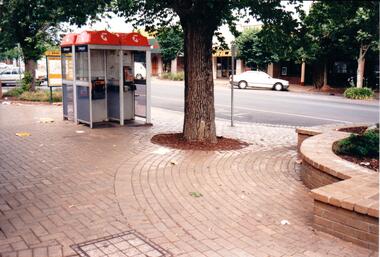
Photograph, Late 1980's
... ...public telephones...A coloured photograph of public telephones and the taxi rank in Evans Street. ...Most of the vandalism occurred on public buildings vandalism evans street taxi ranks public telephones telstra telecom george evans collection A coloured photograph of public telephones and the taxi rank in Evans Street. ...The series of seven photographs highlight examples of vandalism within the town centre precinct. Most of the vandalism occurred on public buildingsA coloured photograph of public telephones and the taxi rank in Evans Street. The telephone directories have been torn up an thrown around the brick pavement along with other litter. The trunk of an elm tree is in the middle of the photograph.vandalism, evans street, taxi ranks, public telephones, telstra, telecom, george evans collection -
 Federation University Historical Collection
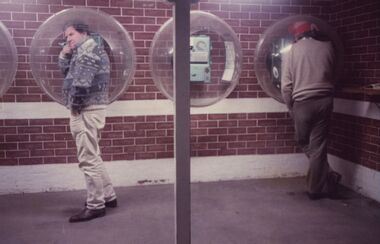
Photograph - Colour, Phone 'boxes', 1970s, 1970s
... ...public telephone...A family friend of Elizabeth (Holmes) and Phil Chatham stands inside if plastic 'bubble' while using a public telephone. ...chatham-holmes collection phone boxes elizabeth holmes brother telephone telephone box public telephone A family friend of Elizabeth (Holmes) and Phil Chatham stands inside if plastic 'bubble' while using a public telephone. ...A family friend of Elizabeth (Holmes) and Phil Chatham stands inside if plastic 'bubble' while using a public telephone. chatham-holmes collection, phone boxes, elizabeth holmes, brother, telephone, telephone box, public telephone -
 Clunes Museum
Sign - METAL SIGN
... TRUNK LINE CALLS AFTER HOURS - CALL TELEGRAMS THE EXCHANGE FROM THE PUBLIC TELEPHONE DURING OFFICE HOURS - APPLY AT THE POST OFFICE COUNTER...LOCAL HISTORY COMMUNICATION TELEPHONIC TRUNK LINE CALLS AFTER HOURS - CALL TELEGRAMS THE EXCHANGE FROM THE PUBLIC TELEPHONE DURING OFFICE HOURS - APPLY AT THE POST OFFICE COUNTER Sign METAL SIGN ...THIS METAL SIGN WAS ORIGINAL AT THE CLUNES POST OFFICE, AND WAS FOUND IN THE ROBBINS FAMILY HOME IN BATH STREET, CLUNES.TRUNK LINE CALLS AFTER HOURS - CALL TELEGRAMS THE EXCHANGE FROM THE PUBLIC TELEPHONE DURING OFFICE HOURS - APPLY AT THE POST OFFICE COUNTERlocal history, communication, telephonic -
 National Communication Museum
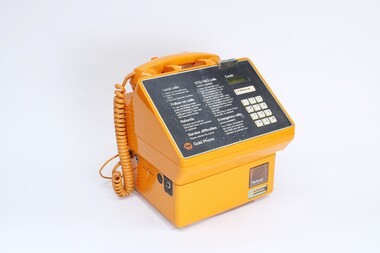
Equipment - Payphone
... public telephone...Although the prevalence of public telephones has decreased alongside the increase in mobile phone usage, public telephones remain under Telstra’s universal service obligation as vital communications infrastructure for low-income citizens and those needing to communicate in disasters. ...Although the prevalence of public telephones has decreased alongside the increase in mobile phone usage, public telephones remain under Telstra’s universal service obligation as vital communications infrastructure for low-income citizens and those needing to communicate in disasters. ...Since their Australian introduction in the early 20th century, public telephones have undergone several design iterations; diversifying methods of payment from coin to card, incorporating solar charging, mobile charging and Wi-fi access and of course, mitigation against vandalism. This model, a coin-operated Gold Phone, replaced the easily pilfered Red Phone and was succeeded by the Blue Phone in the 1990s. Although the prevalence of public telephones has decreased alongside the increase in mobile phone usage, public telephones remain under Telstra’s universal service obligation as vital communications infrastructure for low-income citizens and those needing to communicate in disasters. According to the Conversation, 13 million calls are made annually from public payphones, 200,000 of which are to triple zero.Orange plastic cased public payphone with button dials on face.public telephone, payphone, public services, telecom -
 Charlton Golden Grains Museum Inc
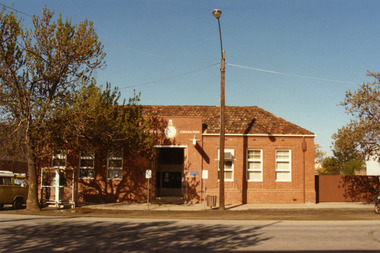
Photograph, Charlton Post Office 1987, c.1987
... Yellow combi van, tree and public telephone on LH side of photo. Street light and rubbish bin on right of entrance. ...Yellow combi van, tree and public telephone on LH side of photo. Street light and rubbish bin on right of entrance. ...First Post Office established in Camp St in 1878. Rebuilt on current site in 1879, current Post Office built 1940. Photo part of a Charlton Shire streetscape series 1987.Colour photo of Charlton Post Office. Red brick single storey building. Clock above entrance shows 5 minutes to nine. Yellow combi van, tree and public telephone on LH side of photo. Street light and rubbish bin on right of entrance. Signage above entrance says Post Office Charlton, ER and crown above the clock. Brown fence to right of building,charlton post office, charlton, business, industry, post office -
 Falls Creek Historical Society
Letter - Damage To Nursery Ski-Ing Slopes By Tractor and other non-compliance issues
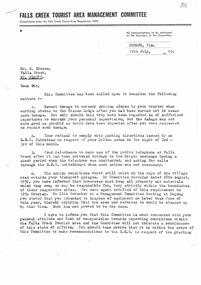
... Issues raised included damage to Nursery skiing slopes by tractor; non-compliance with Parking Directions; reluctance to use the public telephone, an untidy conditions on his site. ...Issues raised included damage to Nursery skiing slopes by tractor; non-compliance with Parking Directions; reluctance to use the public telephone, an untidy conditions on his site. ...Bob Hymans Collection Bob (Herman) Hymans (a former member of the Royal Netherlands Navy) was born in Bloemendaal, Holland on 30th September 1922. During World War II he fought against the Japanese in the Dutch East Indies (now Indonesia) and was imprisoned in Changi and on the Burma Railway. After gaining qualifications as a Ski Instructor, Bob arrived in Falls Creek in July 1950. Working as an Instructor and Supervisor at Bogong Lodge, Bob decided his future was in accommodation. He was successful in negotiating an indenture for land from the State Electricity Commission (SEC). It took Bob two years to build his Grand Coeur Chalet but, tragically, it was burned down in August 1961. Bob also built the first Chairlift in Australia. This was a single chairlift and the structure was built from wooden electricity poles. He was constantly full of new ideas and proposals for the village. Bob Hymans died on 7th July 2007. This Collection of documents and letters tells the story of Bob's endeavours to develop Falls Creek into the ski village it is today.This letter is significant because it reflects the relationship between Bob Hymans and the Management Committee.A letter from the Falls Creek Tourist Area Management Committee raising issues and concerns of Bob Hymans' alleged non-compliance with regulations. Issues raised included damage to Nursery skiing slopes by tractor; non-compliance with Parking Directions; reluctance to use the public telephone, an untidy conditions on his site. The Committee indicated that it had the authority to make recommendations regarding the renewal or revocation of licences.falls creek tourist area management committee, bob hymans -
 Melbourne Tram Museum
Sign, Melbourne & Metropolitan Tramways Board (MMTB), "Notice to Tram Crews", 1950s
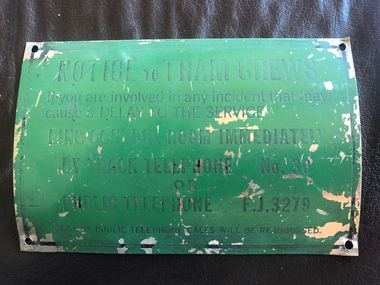
... Gives both the track and public telephone numbers. C1950....Gives both the track and public telephone numbers. C1950. "Notice to Tram Crews" Sign Melbourne & Metropolitan Tramways Board (MMTB) ...Sign, metal - machine inscribed, with black paint infill, black edge and four screw holes in corners largely covered in tramway green paint. Has been curved to fit the curved section above the windows which is rounded - the top rail. Titled "Notice to Tram Crews", advising the crews which numbers to ring or call in the event of a delay to service. Gives both the track and public telephone numbers. C1950.trams, tramways, signs, delays, accidents, incidents, control centre, crews -
 Wodonga & District Historical Society Inc
Photograph - Wodonga West School No. 1058
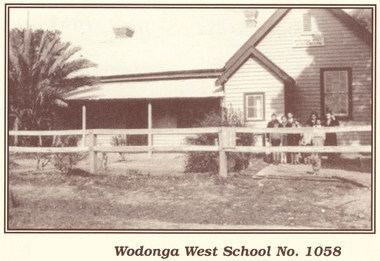
... The school replaced an older school, “Green Hills School, which was located north of the railway line. A public telephone was installed at the school and the mail service operated from the school three days each week. ...The school replaced an older school, “Green Hills School, which was located north of the railway line. A public telephone was installed at the school and the mail service operated from the school three days each week. ...Wodonga West School opened on 24 January 1870 and closed on 9 May 1950. It was located near the current intersection of McKoy Street and the Hume Freeway in West Wodonga on land donated by J.W. Klinge. The school replaced an older school, “Green Hills School, which was located north of the railway line. A public telephone was installed at the school and the mail service operated from the school three days each week. In 1935 a row of 15 ornamental trees was planted along the boundary fence, one for each of the pupils at the school. When this school closed the nine remaining students were transferred to Wodonga Primary School.This image is significant because it documents the early developments in the provision of education in Wodonga, Victoria A black and white photo of a group of children standing outside the Wodonga West School building.wodonga schools, wodonga west primary school, education wodonga -
 Lakes Entrance Historical Society
Photograph - Bicentennial Clock Tower Lakes Entrance Victoria c1988, Lakes Post Newspaper
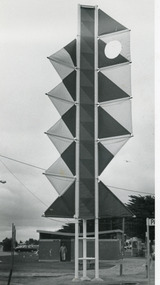
... In background brick public toilet. Also telephone box. Lakes Entrance Victoria...In background brick public toilet. Also telephone box. Lakes Entrance Victoria Photograph Bicentennial Clock Tower Lakes Entrance Victoria c1988 Lakes Post Newspaper ...Black and white photograph of the Bi-Centennial Clock on Esplanade. The clock support of steel and fabric appears to represent ships sails, the clock is missing. Situated on approach to Western Wharf or Post Office Jetty. In background brick public toilet. Also telephone box. Lakes Entrance Victoriajetties, clock tower -
 Eltham District Historical Society Inc
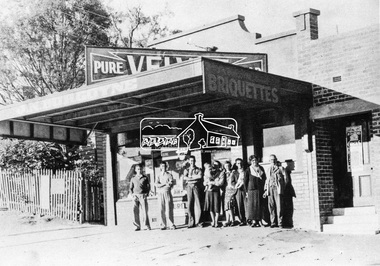
Negative - Photograph, Burgoyne family outside J.N. Burgoyne's Store, Main Road, Eltham, Vic, 1940
... Entry to the exchange was via a separate door on Main Road or via the shop. The public telephone was initially mounted on the wall but later moved to the street. ...Entry to the exchange was via a separate door on Main Road or via the shop. The public telephone was initially mounted on the wall but later moved to the street. ...The store built in 1925 was located on Main Road just south of Bridge Street (present day No. 820 Main Road). An extension was added to the right in 1939. The store was built in late 1925 at the same time as Mr C. Nicholls’s new store was constructed. Both were considered modern shops, and an improvement on most, business establishments of the time. Mr. Nicholls’s store included alongside it a modern, weatherboard villa residence. Mr. Burgoyne’s store incorporated the post and telegraph office, which was operated by John Neville Burgoyne’s half-aunt, Miss Anne Hunniford until her death in 1928 at which time J.N. Burgoyne became postmaster. The unsealed footpath in front is reasonably extensive as not visible is a concrete kerb and channel which was laid from the Post Office to John Street during Nov-Dec 1926. Footpath construction in front of Burgoyne’s store commenced August 1942. The extension to the right of the store was erected in 1939 for a new telephone exchange adjacent to the store and post office. A continuous telephone service operated by Mr Burgoyne and his family commenced operation 18 November 1939. Approximately 70 extensions were routed through the new exchange, 40 of which were transferred from the Greensborough Exchange. Entry to the exchange was via a separate door on Main Road or via the shop. The public telephone was initially mounted on the wall but later moved to the street. Cross Ref: 0701 of the store c.1934This photo forms part of a collection of photographs gathered by the Shire of Eltham for their centenary project book,"Pioneers and Painters: 100 years of the Shire of Eltham" by Alan Marshall (1971). The collection of over 500 images is held in partnership between Eltham District Historical Society and Yarra Plenty Regional Library (Eltham Library) and is now formally known as the 'The Shire of Eltham Pioneers Photograph Collection.' It is significant in being the first community sourced collection representing the places and people of the Shire's first one hundred years.Digital image 4 x 5 inch B&W Negshire of eltham pioneers photograph collection, burgoyne's shop, eltham, main road, post office, shops -
 Federation University Historical Collection
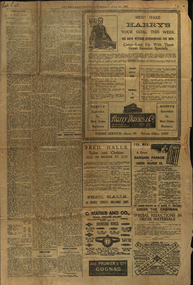
Newspaper, Lal Lal Iron and Coal as reported in the Ballarat Courier, 10/07/1923
... ...Dereel Public Telephone...Page 9 includes articles on Ripon's roads, Mount Cole Springs; Soldier Settlement Rates Beaufort; Creswick brass band Officers; Daylesford Road Deviation to Hepburn Springs; Dereel Public Telephone; State Electricity Supply for Beaufort; Newlyn Valedictory to Mr and Mrs W. ...Page 9 includes articles on Ripon's roads, Mount Cole Springs; Soldier Settlement Rates Beaufort; Creswick brass band Officers; Daylesford Road Deviation to Hepburn Springs; Dereel Public Telephone; State Electricity Supply for Beaufort; Newlyn Valedictory to Mr and Mrs W. ....1) Pages 7 to 10 of the Ballarat Courier, 10 July 1923. Page 7 includes the article 'Cheap electricity' and poses questions such as 'should Ballarat look to Morwell for cheap power?', and should an independent power plant be installed at Crockers, Arnolds, Harry Hall, Ewins, Harry Davies, Fred Halls, The London Drapery there. Page 9 includes articles on Ripon's roads, Mount Cole Springs; Soldier Settlement Rates Beaufort; Creswick brass band Officers; Daylesford Road Deviation to Hepburn Springs; Dereel Public Telephone; State Electricity Supply for Beaufort; Newlyn Valedictory to Mr and Mrs W. E. Bennett Page 9 - Racing at Ascot; Avoca Golf Tournament, Chinese Herbalists Page 10 - Auctions and house sales Advertisements include Harry Davies; Fred Halls; C. Marks and Co., London Drapery, Creer the Cashman; Chamberlain's Cough Remedy; Cornell's Little Liver Pills; Paynes; W. Fley Chemist; Bickart and Dawson; Rivers; Allchin Bros; J. Bartam & Son .2) Ballarat Courier, 30 July 1937, page 1 and 2 Page 1 reports Lal Lal's Iron Ore Company being formed. Page 2 reports the Prospectus of the lal lal Iron and Steel Blast Furnaces Mining Company, No Liability; Mining News - Wattle Gully; Commercial News Advertisements include Crockers, Arnolds, Harry Hall, Ewins, Harry Davies, Fred Halls, The London Drapery electricity, lal lal, lal lal iron, lal lal coalfield, morwell, gippsland, crockers, arnolds, harry hall, ewins, harry davies, fred halls, the london drapery, lal lal brown coal, ripon's roads, mount cole springs, soldier settlement rates beaufort, creswick brass band officers, daylesford road deviation to hepburn springs, dereel public telephone, state electricity supply for beaufort, newlyn, w.e. bennett, ascot, avoca golf tournament, chinese herbalists, c. marks and co., london drapery, creer the cashman, chamberlain's cough remedy, cornell's little liver pills, paynes, w. fley chemist, bickart and dawson, rivers, allchin bros, j. bartam & son, lal lal iron and steel blast furnaces mining company, wattle gully -
 Eltham District Historical Society Inc
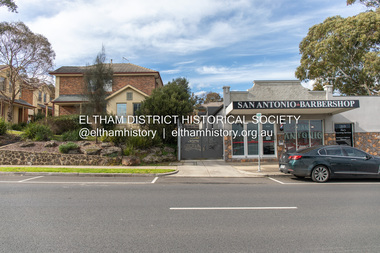
Photograph, Peter Pidgeon, 820 Main Road, Eltham, 2 Aug. 2022
... Entry to the exchange was via a separate door on Main Road or via the shop. The public telephone was initially mounted on the wall but later moved to the street. ...Entry to the exchange was via a separate door on Main Road or via the shop. The public telephone was initially mounted on the wall but later moved to the street. ...In 1855 the first post office opened in Eltham under the management of Thomas Hunniford. It was a weatherboard building located on the eastern side of Main Road just south of Bridge Street. During the 1880s under the managment of Hunniford's daughter, Anne, the building was modernised with a new awning and upper facade. In late 1925 a new brick building was erected immediately next door (820 Main Road). Following the death of Anne Hunniford in December 1928, J.N Burgoyne was appointed Postmaster. The extension to the right of the store was erected in 1939 for a new telephone exchange adjacent to the store and post office. A continuous telephone service operated by Mr Burgoyne and his family commenced operation 18 November 1939. Approximately 70 extensions were routed through the new exchange, 40 of which were transferred from the Greensborough Exchange. Entry to the exchange was via a separate door on Main Road or via the shop. The public telephone was initially mounted on the wall but later moved to the street. The present store is a barber shop and it remains, though heavily modified, one of only three remaining shop fronts from the early 1900s in Eltham. Comparison photo: SEPP_0700, 00140, SEPP_0701, SEPP_0702 Part of a presentation by Peter Pidgeon to the Society, 13 August 2022 showcasing a series of photographs taken by John Henry Clark over the period 1895 to 1930. John Henry Clark was the youngest of three boys born to William Henry Clark (1823-1877) and Maria White (1843-1914). He and his brothers, William Charles Clark (1872-1945), Clement Kent Clark (1874-1912) operated a photography business (Clark Bros.) from 25 Thomas Street, Windsor near Prahran during the period c.1894 to 1914. Following death of Clement in September 1912 and their mother in 1914, the Clark Bros business appears to have dissolved, the premises demolished, and a new house was under construction in 1915. John set up business independently in 1914 operating out of 29 Moor Street, Fitzroy where he is registered in the 1914 and 1915 Electoral Rolls. By 1916 John had relocated to Eltham where he continued his practice as a photographer and took many of the early images around the district of Little Eltham. Around 1930 John changed professions and opened a small cobbler's shop in 1931 near the pond opposite Dalton Street adjacent to the Jarrold family cottage. He never married and continued his profession as a bootmaker from this little shop, maintaining a close relationship with Mrs Jarrold for the rest of their lives. His bootmaker shop remains today beside the Whitecloud cottage and is one of only three remaining shops in the area from the early 20th century.Comparative photo taken 2022 with one taken from same location over 100 years earlier by noted local photographer J.H. ClarkBorn Digitaleltham, j.h. clark photo (2022), main road, 820 main road, burgoyne store -
 Musculoskeletal Health Australia (now held by the Glen Eira Historical Society)
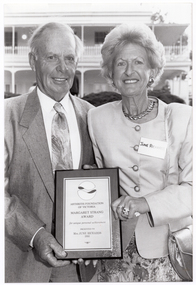
Photograph - Group photo, 1993
... June was an AFV volunteer public speaker, a telephone counsellor, a member of the panel for the Grandparent of the Year program, and the co-ordinator of the annual fundraising fashion parade event....June was an AFV volunteer public speaker, a telephone counsellor, a member of the panel for the Grandparent of the Year program, and the co-ordinator of the annual fundraising fashion parade event. alan sime chairman fundraising committee arthritis foundation of victoria afv rheumatism and arthritis association of victoria raav certificate of appreciation 25th anniversary como house como house and garden historic home wurundjery woiwurrung country armytage B&W photo of a man and a woman holding a framed award certificate. ...In 1993, the Arthritis Foundation of Victoria (AFV) celebrated its 25th anniversary. Formerly known as the Rheumatic and Arthritis Association of Victoria (RAAV), the organisation was founded in 1968 by Dr Leslie Koadlow (1920-2006) with the assistance and support of his secretary, Alice Petty (-1995), and one of his patients, Mollie Riches (1896-1979). The anniversary celebrations were held at the historic Como House and Garden. Built in 1847 by the Armytage family, Como House is located on the corner of Williams Rd and Lechlade Ave, South Yarra, on Wurundjery Woiwurrung country. In this photo, winner of the 1993 Margaret Strang Award, June Richards, poses for a photo with her husband Allen, while holding her framed award. A cropped version of this photo appears on page 5 of the Vol 7 No 2, Winter 1994 issue of the Arthritis Foundation of Victoria's quarterly magazine, Arthritis Update. Under the heading, "Vale", the photo accompanies an obituary announcing June's death. June was an AFV volunteer public speaker, a telephone counsellor, a member of the panel for the Grandparent of the Year program, and the co-ordinator of the annual fundraising fashion parade event.B&W photo of a man and a woman holding a framed award certificate. They are standing on the grounds of a large two-storey house, which is in the background.alan sime, chairman, fundraising committee, arthritis foundation of victoria, afv, rheumatism and arthritis association of victoria, raav, certificate of appreciation, 25th anniversary, como house, como house and garden, historic home, wurundjery woiwurrung country, armytage -
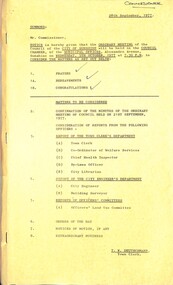 Sunshine and District Historical Society Incorporated
Administrative record - City of Sunshine - Commissioner Mr Alexander Alex George Gillon Collection 1976 - 1982 - Notice of ordinary meeting of the council of the City of Sunshine to be held on 5th October 1977, City of Sunshine, 28th September 1977
... Kilda Land Use Permit Application Service Premises Take Away Food Premise and Caretaker's Residence Addition to Existing Retail Nursery and Bird Aviary Corner Hampstead Road and Emu Street Contract Supply & Maintenance of Vehicles Contract Supply of Tractor & Gang Mower Plan of subdivision Hook Street and Vule Street Plan of Subdivision Stage 26 Albanvale Westerngate Estate Neale Road Bus Routes and Bus Stops Sunshine Bus Lines Suffolk Road Shops Bicycle Racks 407 Ballarat Road (Opposite McDonald) No Standing Anytime Use of Commonwealth Land for Garbage Disposal Purposes Eastern Side of Albion Explosive Factory Monsanto Outfall Drain Brooklyn Telecom Australia Public Telephones in the Maidstone Area Bon Thomas Reserve Development Report of the Building Surveyor Maintenance Organisation Australian Institute of Building Surveyors Annual Conference Fencing Council Contribution towards Shared Fences with Owner Fairbairn Pre-School Centre Fairbairn Road Sunshine West Sunshine Indoor Swimming Pool Sunshine Indoor Swimming Pool Facilities Fencing 34 Adelaide Street Flats Lot 30 Percy Street St. ...Kilda Land Use Permit Application Service Premises Take Away Food Premise and Caretaker's Residence Addition to Existing Retail Nursery and Bird Aviary Corner Hampstead Road and Emu Street Contract Supply & Maintenance of Vehicles Contract Supply of Tractor & Gang Mower Plan of subdivision Hook Street and Vule Street Plan of Subdivision Stage 26 Albanvale Westerngate Estate Neale Road Bus Routes and Bus Stops Sunshine Bus Lines Suffolk Road Shops Bicycle Racks 407 Ballarat Road (Opposite McDonald) No Standing Anytime Use of Commonwealth Land for Garbage Disposal Purposes Eastern Side of Albion Explosive Factory Monsanto Outfall Drain Brooklyn Telecom Australia Public Telephones in the Maidstone Area Bon Thomas Reserve Development Report of the Building Surveyor Maintenance Organisation Australian Institute of Building Surveyors Annual Conference Fencing Council Contribution towards Shared Fences with Owner Fairbairn Pre-School Centre Fairbairn Road Sunshine West Sunshine Indoor Swimming Pool Sunshine Indoor Swimming Pool Facilities Fencing 34 Adelaide Street Flats Lot 30 Percy Street St. ...Notice of Ordinary Meeting of the Council of the City of Sunshine to be held on 5th October 1977 Report of the Town Clerk's Department Report of the Town Clerk Private Street Construction Scheme Sheffield Estate and Cumberland Street Area United Grants From Commonwealth Government through State Government House 6 Corio Street Demolishment Alternative Premises for Citizens Advice Bureau Increases Charges at Sunshine Tip Cultural Centre for Western Region Henderson House Footscray Crossing over Railway Line at Ardeer Land Acquisition Maribyrnong Valley Zoning Officer's Committees Reports Method of Presentation Home Help Service Housekeepers Speaking Different Languages Sale of Land Derby Road and Anderson Road to Education Department Report of the Co-Ordinator of Welfare Services The Combined Pensioners Association Report of the Chief Health Inspector Training & Registration of Public Swimming Pool Operators Prosecutions Proceedings Sunshine Magistrate Court Application for Septic Tank Warranties Report of City Engineer Land Use Permit Application Poultry Farming Service Premises and Take Away Food Premise 159 - 161 Rosamond Road Maribyrnong Land Use Permit Application Extension to Existing Holy Eucharist Primary School, Holy Eucharist Church and Holy Eucharist Parish Centre Oleander Drive Land Use Permit Application Service Premises Mitchell Street Land Use Permit Application External Paging System 556 Ballarat Road Land Use Permit Application Car Sales Yard Lots 497 & 498 St. Albans Road Land Use Permit Application Two Illuminated signs 501 Ballarat Road Albion Land Use Permit Application Light Industry Loy 76 Lawton Street Braybrook Enforcement under the Town and Country Planning Act Massage Parlours Cities of Essendon & St. Kilda Land Use Permit Application Service Premises Take Away Food Premise and Caretaker's Residence Addition to Existing Retail Nursery and Bird Aviary Corner Hampstead Road and Emu Street Contract Supply & Maintenance of Vehicles Contract Supply of Tractor & Gang Mower Plan of subdivision Hook Street and Vule Street Plan of Subdivision Stage 26 Albanvale Westerngate Estate Neale Road Bus Routes and Bus Stops Sunshine Bus Lines Suffolk Road Shops Bicycle Racks 407 Ballarat Road (Opposite McDonald) No Standing Anytime Use of Commonwealth Land for Garbage Disposal Purposes Eastern Side of Albion Explosive Factory Monsanto Outfall Drain Brooklyn Telecom Australia Public Telephones in the Maidstone Area Bon Thomas Reserve Development Report of the Building Surveyor Maintenance Organisation Australian Institute of Building Surveyors Annual Conference Fencing Council Contribution towards Shared Fences with Owner Fairbairn Pre-School Centre Fairbairn Road Sunshine West Sunshine Indoor Swimming Pool Sunshine Indoor Swimming Pool Facilities Fencing 34 Adelaide Street Flats Lot 30 Percy Street St. Albans Extension to House 2 Kevin Street Sunshine Installation of Overhead Tank 44 Berkshire Road Sunshine North Report of Land Use Committee Orders of the Day Accounts Submitted for Payment as at 15th September 1977 Notice of Motion Commissioner Gillon to Move Rates Commissioner Gillon to Move Sanitary Commissioner Gillon to Move Valuation city of sunshine, alexander "alex" george gillon, cumberland street, sunshine north, corio street, sunshine, maribyrnong valley, derby road, anderson road, citizens advice bureau, sunshine tip, rosamond road, maribyrnong, holy eucharist primary school, holy eucharist church, holy eucharist parish centre, oleander drive, st. albans, mitchell street, maidstone, ballarat road, st. albans road, lawton street, braybrook, hampstead road, emu street, hook street, vule street, neale road, albanvale, deer park, suffolk road, albion explosive factory, monsanto, bon thomas reserve, quinn street, fairbairn pre-school centre, fairbairn road, sunshine indoor swimming pool, albion, percy street, kevin street, berkshire road, adelaide street -
 Sunshine and District Historical Society Incorporated
Administrative record - City of Sunshine - Commissioner Mr Alexander Alex George Gillon Collection 1976 - 1982 - Minutes of the ordinary meeting of council held on 5th October 1977, City of Sunshine, 5th October 1977
... Kilda Land Use Permit Application Service Premises Take Away Food Premise and Caretaker's Residence Addition to Existing Retail Nursery and Bird Aviary Corner Hampstead Road and Emu Street Contract Supply & Maintenance of Vehicles Contract Supply of Tractor & Gang Mower Plan of subdivision Hook Street and Vule Street Plan of Subdivision Stage 26 Albanvale Westerngate Estate Neale Road Bus Routes and Bus Stops Sunshine Bus Lines Suffolk Road Shops Bicycle Racks 407 Ballarat Road (Opposite McDonald) No Standing Anytime Use of Commonwealth Land for Garbage Disposal Purposes Eastern Side of Albion Explosive Factory Monsanto Outfall Drain Brooklyn Telecom Australia Public Telephones in the Maidstone Area Bon Thomas Reserve Development Report of the Building Surveyor Maintenance Organisation Australian Institute of Building Surveyors Annual Conference Fencing Council Contribution towards Shared Fences with Owner Fairbairn Pre-School Centre Fairbairn Road Sunshine West Sunshine Indoor Swimming Pool Sunshine Indoor Swimming Pool Facilities Fencing 34 Adelaide Street Flats Lot 30 Percy Street St. ...Kilda Land Use Permit Application Service Premises Take Away Food Premise and Caretaker's Residence Addition to Existing Retail Nursery and Bird Aviary Corner Hampstead Road and Emu Street Contract Supply & Maintenance of Vehicles Contract Supply of Tractor & Gang Mower Plan of subdivision Hook Street and Vule Street Plan of Subdivision Stage 26 Albanvale Westerngate Estate Neale Road Bus Routes and Bus Stops Sunshine Bus Lines Suffolk Road Shops Bicycle Racks 407 Ballarat Road (Opposite McDonald) No Standing Anytime Use of Commonwealth Land for Garbage Disposal Purposes Eastern Side of Albion Explosive Factory Monsanto Outfall Drain Brooklyn Telecom Australia Public Telephones in the Maidstone Area Bon Thomas Reserve Development Report of the Building Surveyor Maintenance Organisation Australian Institute of Building Surveyors Annual Conference Fencing Council Contribution towards Shared Fences with Owner Fairbairn Pre-School Centre Fairbairn Road Sunshine West Sunshine Indoor Swimming Pool Sunshine Indoor Swimming Pool Facilities Fencing 34 Adelaide Street Flats Lot 30 Percy Street St. ...Minutes of the Ordinary Meeting of Council held on 5th October 1977 Report of the Town Clerk's Department Report of the Town Clerk Private Street Construction Scheme Sheffield Estate and Cumberland Street Area United Grants From Commonwealth Government through State Government House 6 Corio Street Demolishment Alternative Premises for Citizens Advice Bureau Increases Charges at Sunshine Tip Cultural Centre for Western Region Henderson House Footscray Crossing over Railway Line at Ardeer Land Acquisition Maribyrnong Valley Zoning Officer's Committees Reports Method of Presentation Home Help Service Housekeepers Speaking Different Languages Sale of Land Derby Road and Anderson Road to Education Department Report of the Co-Ordinator of Welfare Services The Combined Pensioners Association Report of the Chief Health Inspector Training & Registration of Public Swimming Pool Operators Prosecutions Proceedings Sunshine Magistrate Court Application for Septic Tank Warranties Report of City Engineer Land Use Permit Application Poultry Farming Service Premises and Take Away Food Premise 159 - 161 Rosamond Road Maribyrnong Land Use Permit Application Extension to Existing Holy Eucharist Primary School, Holy Eucharist Church and Holy Eucharist Parish Centre Oleander Drive Land Use Permit Application Service Premises Mitchell Street Land Use Permit Application External Paging System 556 Ballarat Road Land Use Permit Application Car Sales Yard Lots 497 & 498 St. Albans Road Land Use Permit Application Two Illuminated signs 501 Ballarat Road Albion Land Use Permit Application Light Industry Loy 76 Lawton Street Braybrook Enforcement under the Town and Country Planning Act Massage Parlours Cities of Essendon & St. Kilda Land Use Permit Application Service Premises Take Away Food Premise and Caretaker's Residence Addition to Existing Retail Nursery and Bird Aviary Corner Hampstead Road and Emu Street Contract Supply & Maintenance of Vehicles Contract Supply of Tractor & Gang Mower Plan of subdivision Hook Street and Vule Street Plan of Subdivision Stage 26 Albanvale Westerngate Estate Neale Road Bus Routes and Bus Stops Sunshine Bus Lines Suffolk Road Shops Bicycle Racks 407 Ballarat Road (Opposite McDonald) No Standing Anytime Use of Commonwealth Land for Garbage Disposal Purposes Eastern Side of Albion Explosive Factory Monsanto Outfall Drain Brooklyn Telecom Australia Public Telephones in the Maidstone Area Bon Thomas Reserve Development Report of the Building Surveyor Maintenance Organisation Australian Institute of Building Surveyors Annual Conference Fencing Council Contribution towards Shared Fences with Owner Fairbairn Pre-School Centre Fairbairn Road Sunshine West Sunshine Indoor Swimming Pool Sunshine Indoor Swimming Pool Facilities Fencing 34 Adelaide Street Flats Lot 30 Percy Street St. Albans Extension to House 2 Kevin Street Sunshine Installation of Overhead Tank 44 Berkshire Road Sunshine North Report of Land Use Committee Orders of the Day Accounts Submitted for Payment as at 15th September 1977 Notice of Motion Commissioner Gillon to Move Rates Commissioner Gillon to Move Sanitary Commissioner Gillon to Move Valuation city of sunshine, alexander "alex" george gillon, cumberland street, sunshine north, corio street, sunshine, maribyrnong valley, derby road, anderson road, rosamond road, maribyrnong, holy eucharist primary school, holy eucharist church, holy eucharist parish centre, oleander drive, st. albans, mitchell street, maidstone, ballarat road, albion, st. albans road, lawton street, braybrook, hampstead road, emu street, hook street, vule street, albanvale, neale road, deer park, suffolk road, albion explosive factory, monsanto, brooklyn, bon thomas reserve, quinn street, fairbairn pre-school centre, fairbairn road, sunshine west, sunshine indoor swimming pool, adelaide street, percy street, kevin street, berkshire road -
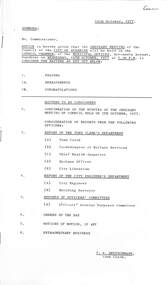 Sunshine and District Historical Society Incorporated
Administrative record - City of Sunshine - Commissioner Mr Alexander Alex George Gillon Collection 1976 - 1982 - Notice of ordinary meeting of the council of the City of Sunshine to be held on 19th October 1977, City of Sunshine, 12th October 1977
... Albans Kindergarten & Deer Park Kindergarten Transitional Funding Migrant Workers Report of the Chief Health Inspector Quarterly Return of Food Samples Removal of a Dwelling Outside the Municipality 104 RAAF Base Tottenham to Shire of Ballan Prosecutions Proceedings Sunshine Magistrates Court Weights & Measures Report for the Tow Months Ending 30th September 1977 Annual Conference Caravan Parks Report of the Medical Officer of Health Report of the By-Laws Officer Court Proceedings Parking Infringements Report of the City Librarian Library Association of Australia 19th Biennial Conference Children's Libraries Section Library Association of Australia Story Telling Workshop Report of the City Engineer Land Use Permit Application Store Lot 2 Paramount Road Land Use Permit Application Flats 52B Forrest Street Land Use Permit Application Take Away Food Premises and Cafe Pizza Parlour 70 Hampshire Road Land Use Permit Application Flats Lot 472 Hendry Street North West Corner Carter Street Land Use Permit Application Flats Lot 1 Monash Street North West Corner Cornwall Road Rezoning Land 245 - 247 Sunshine Road Land Use Permit Display Home Centre Lots 603, 604 & 605 Camelot Drive and Lots 686, 687 & 688 Trafalgar Street Land Use Permit Application Stan Cash Property Corner Halstead Street and Ashley Street Maidstone Land Use Permit Application Garden and Building Supples Francis Street and Geelong Road Land Use Permit Application Home Occupation Installation of 3 Phase Power 54 South Road Plan of Consolidation Denton Avenue Strata Subdivision 4 Leopold Street Strata Subdivision 133 Wright Street Plan of Subdivision Corner The Esplanade & Plantation Street Plan of Subdivision Fairbairn Road Dalgety Subdivision Fencing and Installation of Vehicle Wash New Sunshine Tip Site Albion Defective Asphalt Fourth Avenue Private Street Scheme Telecom Australia Public Telephones in the Sunshine Telephone Exchange Citizens Against Freeways Transport Regulations Board Notice of Application Minor Alteration of Bus Route Parking in Millers Road Brooklyn Sidney Cooke Chemicals Pty Ltd Attendance of City Engineer at Hospitals Conference in Canberra 27th to 29th October 1977 Reconstruction of Sydney Street Concrete Reinstatement Gang Kororoit Creek Creation of Easement from Melbourne and Metropolitan Board of Works Neale Road Construction Tenders Fleet and Plant Purchases Australian Asphalt Pavement Association Practical Asphalting Allocation of Rubbish Skips Proposed Public Open Space Land in Moira Street, Wright Street and Thyra Street Sunshine Statcon Programme Additions to Existing Primary Road Network Report of Building Surveyor Cricket Pavilion Dempster Park Infant Welfare Centre Building Programme Highpoint West Complex Tender Fairbairn Road Pre-School Centre Siting of House Lot 73 Oleander Drive St. ...Albans Kindergarten & Deer Park Kindergarten Transitional Funding Migrant Workers Report of the Chief Health Inspector Quarterly Return of Food Samples Removal of a Dwelling Outside the Municipality 104 RAAF Base Tottenham to Shire of Ballan Prosecutions Proceedings Sunshine Magistrates Court Weights & Measures Report for the Tow Months Ending 30th September 1977 Annual Conference Caravan Parks Report of the Medical Officer of Health Report of the By-Laws Officer Court Proceedings Parking Infringements Report of the City Librarian Library Association of Australia 19th Biennial Conference Children's Libraries Section Library Association of Australia Story Telling Workshop Report of the City Engineer Land Use Permit Application Store Lot 2 Paramount Road Land Use Permit Application Flats 52B Forrest Street Land Use Permit Application Take Away Food Premises and Cafe Pizza Parlour 70 Hampshire Road Land Use Permit Application Flats Lot 472 Hendry Street North West Corner Carter Street Land Use Permit Application Flats Lot 1 Monash Street North West Corner Cornwall Road Rezoning Land 245 - 247 Sunshine Road Land Use Permit Display Home Centre Lots 603, 604 & 605 Camelot Drive and Lots 686, 687 & 688 Trafalgar Street Land Use Permit Application Stan Cash Property Corner Halstead Street and Ashley Street Maidstone Land Use Permit Application Garden and Building Supples Francis Street and Geelong Road Land Use Permit Application Home Occupation Installation of 3 Phase Power 54 South Road Plan of Consolidation Denton Avenue Strata Subdivision 4 Leopold Street Strata Subdivision 133 Wright Street Plan of Subdivision Corner The Esplanade & Plantation Street Plan of Subdivision Fairbairn Road Dalgety Subdivision Fencing and Installation of Vehicle Wash New Sunshine Tip Site Albion Defective Asphalt Fourth Avenue Private Street Scheme Telecom Australia Public Telephones in the Sunshine Telephone Exchange Citizens Against Freeways Transport Regulations Board Notice of Application Minor Alteration of Bus Route Parking in Millers Road Brooklyn Sidney Cooke Chemicals Pty Ltd Attendance of City Engineer at Hospitals Conference in Canberra 27th to 29th October 1977 Reconstruction of Sydney Street Concrete Reinstatement Gang Kororoit Creek Creation of Easement from Melbourne and Metropolitan Board of Works Neale Road Construction Tenders Fleet and Plant Purchases Australian Asphalt Pavement Association Practical Asphalting Allocation of Rubbish Skips Proposed Public Open Space Land in Moira Street, Wright Street and Thyra Street Sunshine Statcon Programme Additions to Existing Primary Road Network Report of Building Surveyor Cricket Pavilion Dempster Park Infant Welfare Centre Building Programme Highpoint West Complex Tender Fairbairn Road Pre-School Centre Siting of House Lot 73 Oleander Drive St. ...Notice of Ordinary Meeting of the Council of the City of Sunshine to be held on 19th October 1977 Report of the Town Clerk's Department Report of Town Clerk School Holiday Programme Revaluation Western Region Commission Future Administration Playing of Bingo on Council Property Albion Rovers Soccer & Athletic Club Selwyn Park Subsidies for Pre-School Centres Council Representative for the Western Suburbs Regional Consultative Committee Swimming Pools Charges for Admission, Etc Report of the Co-Ordinator of Welfare Services Family & Community Services Programme Kindergartens - St. Albans Kindergarten & Deer Park Kindergarten Transitional Funding Migrant Workers Report of the Chief Health Inspector Quarterly Return of Food Samples Removal of a Dwelling Outside the Municipality 104 RAAF Base Tottenham to Shire of Ballan Prosecutions Proceedings Sunshine Magistrates Court Weights & Measures Report for the Tow Months Ending 30th September 1977 Annual Conference Caravan Parks Report of the Medical Officer of Health Report of the By-Laws Officer Court Proceedings Parking Infringements Report of the City Librarian Library Association of Australia 19th Biennial Conference Children's Libraries Section Library Association of Australia Story Telling Workshop Report of the City Engineer Land Use Permit Application Store Lot 2 Paramount Road Land Use Permit Application Flats 52B Forrest Street Land Use Permit Application Take Away Food Premises and Cafe Pizza Parlour 70 Hampshire Road Land Use Permit Application Flats Lot 472 Hendry Street North West Corner Carter Street Land Use Permit Application Flats Lot 1 Monash Street North West Corner Cornwall Road Rezoning Land 245 - 247 Sunshine Road Land Use Permit Display Home Centre Lots 603, 604 & 605 Camelot Drive and Lots 686, 687 & 688 Trafalgar Street Land Use Permit Application Stan Cash Property Corner Halstead Street and Ashley Street Maidstone Land Use Permit Application Garden and Building Supples Francis Street and Geelong Road Land Use Permit Application Home Occupation Installation of 3 Phase Power 54 South Road Plan of Consolidation Denton Avenue Strata Subdivision 4 Leopold Street Strata Subdivision 133 Wright Street Plan of Subdivision Corner The Esplanade & Plantation Street Plan of Subdivision Fairbairn Road Dalgety Subdivision Fencing and Installation of Vehicle Wash New Sunshine Tip Site Albion Defective Asphalt Fourth Avenue Private Street Scheme Telecom Australia Public Telephones in the Sunshine Telephone Exchange Citizens Against Freeways Transport Regulations Board Notice of Application Minor Alteration of Bus Route Parking in Millers Road Brooklyn Sidney Cooke Chemicals Pty Ltd Attendance of City Engineer at Hospitals Conference in Canberra 27th to 29th October 1977 Reconstruction of Sydney Street Concrete Reinstatement Gang Kororoit Creek Creation of Easement from Melbourne and Metropolitan Board of Works Neale Road Construction Tenders Fleet and Plant Purchases Australian Asphalt Pavement Association Practical Asphalting Allocation of Rubbish Skips Proposed Public Open Space Land in Moira Street, Wright Street and Thyra Street Sunshine Statcon Programme Additions to Existing Primary Road Network Report of Building Surveyor Cricket Pavilion Dempster Park Infant Welfare Centre Building Programme Highpoint West Complex Tender Fairbairn Road Pre-School Centre Siting of House Lot 73 Oleander Drive St. Albans Garage 27 Little Street Deer Park Extension of Building Permit 86 - 88 Berkshire Road Sunshine North Building Conference Orders of the Day Accounts Submitted for Payment as at 20th September 1977 & 28th September 1977 city of sunshine, alexander "alex" george gillon, albion rovers soccer & athletics club, selwyn park, selwyn street, albion, st. albans kindergarten, deer park kindergarten, paramount road, tottenham, forrest street, hampshire road, sunshine, hendry street, carter street, sunshine west, monash street, cornwall road, sunshine road, camelot drive, trafalgar street, albanvale, stan cash, halstead street, ashley street, maidstone, francis street, geelong road, brooklyn, south road, braybrook, denton avenue, st. albans, leopold street, maribyrnong, wright street, the esplanade, plantation street, fairbairn road, sunshine tip, fourth avenue, sidney cooke, millers road, sydney street, kororoit creek, neale road, deer park, moira street, thyra street, dempster park, phoenix street, highpoint west, rosamond road, fairbairn road pre-school centre, oleander drive, little street, berkshire road, sunshine north -
 Sunshine and District Historical Society Incorporated
Administrative record - City of Sunshine - Commissioner Mr Alexander Alex George Gillon Collection 1976 - 1982 - Minutes of the ordinary meeting of council held on 19th October 1977, City of Sunshine, 19th October 1977
... Albans Kindergarten & Deer Park Kindergarten Transitional Funding Migrant Workers Report of the Chief Health Inspector Quarterly Return of Food Samples Removal of a Dwelling Outside the Municipality 104 RAAF Base Tottenham to Shire of Ballan Prosecutions Proceedings Sunshine Magistrates Court Weights & Measures Report for the Tow Months Ending 30th September 1977 Annual Conference Caravan Parks Report of the Medical Officer of Health Report of the By-Laws Officer Court Proceedings Parking Infringements Report of the City Librarian Library Association of Australia 19th Biennial Conference Children's Libraries Section Library Association of Australia Story Telling Workshop Report of the City Engineer Land Use Permit Application Store Lot 2 Paramount Road Land Use Permit Application Flats 52B Forrest Street Land Use Permit Application Take Away Food Premises and Cafe Pizza Parlour 70 Hampshire Road Land Use Permit Application Flats Lot 472 Hendry Street North West Corner Carter Street Land Use Permit Application Flats Lot 1 Monash Street North West Corner Cornwall Road Rezoning Land 245 - 247 Sunshine Road Land Use Permit Display Home Centre Lots 603, 604 & 605 Camelot Drive and Lots 686, 687 & 688 Trafalgar Street Land Use Permit Application Stan Cash Property Corner Halstead Street and Ashley Street Maidstone Land Use Permit Application Garden and Building Supples Francis Street and Geelong Road Land Use Permit Application Home Occupation Installation of 3 Phase Power 54 South Road Plan of Consolidation Denton Avenue Strata Subdivision 4 Leopold Street Strata Subdivision 133 Wright Street Plan of Subdivision Corner The Esplanade & Plantation Street Plan of Subdivision Fairbairn Road Dalgety Subdivision Fencing and Installation of Vehicle Wash New Sunshine Tip Site Albion Defective Asphalt Fourth Avenue Private Street Scheme Telecom Australia Public Telephones in the Sunshine Telephone Exchange Citizens Against Freeways Transport Regulations Board Notice of Application Minor Alteration of Bus Route Parking in Millers Road Brooklyn Sidney Cooke Chemicals Pty Ltd Attendance of City Engineer at Hospitals Conference in Canberra 27th to 29th October 1977 Reconstruction of Sydney Street Concrete Reinstatement Gang Kororoit Creek Creation of Easement from Melbourne and Metropolitan Board of Works Neale Road Construction Tenders Fleet and Plant Purchases Australian Asphalt Pavement Association Practical Asphalting Allocation of Rubbish Skips Proposed Public Open Space Land in Moira Street, Wright Street and Thyra Street Sunshine Statcon Programme Additions to Existing Primary Road Network Report of Building Surveyor Cricket Pavilion Dempster Park Infant Welfare Centre Building Programme Highpoint West Complex Tender Fairbairn Road Pre-School Centre Siting of House Lot 73 Oleander Drive St. ...Albans Kindergarten & Deer Park Kindergarten Transitional Funding Migrant Workers Report of the Chief Health Inspector Quarterly Return of Food Samples Removal of a Dwelling Outside the Municipality 104 RAAF Base Tottenham to Shire of Ballan Prosecutions Proceedings Sunshine Magistrates Court Weights & Measures Report for the Tow Months Ending 30th September 1977 Annual Conference Caravan Parks Report of the Medical Officer of Health Report of the By-Laws Officer Court Proceedings Parking Infringements Report of the City Librarian Library Association of Australia 19th Biennial Conference Children's Libraries Section Library Association of Australia Story Telling Workshop Report of the City Engineer Land Use Permit Application Store Lot 2 Paramount Road Land Use Permit Application Flats 52B Forrest Street Land Use Permit Application Take Away Food Premises and Cafe Pizza Parlour 70 Hampshire Road Land Use Permit Application Flats Lot 472 Hendry Street North West Corner Carter Street Land Use Permit Application Flats Lot 1 Monash Street North West Corner Cornwall Road Rezoning Land 245 - 247 Sunshine Road Land Use Permit Display Home Centre Lots 603, 604 & 605 Camelot Drive and Lots 686, 687 & 688 Trafalgar Street Land Use Permit Application Stan Cash Property Corner Halstead Street and Ashley Street Maidstone Land Use Permit Application Garden and Building Supples Francis Street and Geelong Road Land Use Permit Application Home Occupation Installation of 3 Phase Power 54 South Road Plan of Consolidation Denton Avenue Strata Subdivision 4 Leopold Street Strata Subdivision 133 Wright Street Plan of Subdivision Corner The Esplanade & Plantation Street Plan of Subdivision Fairbairn Road Dalgety Subdivision Fencing and Installation of Vehicle Wash New Sunshine Tip Site Albion Defective Asphalt Fourth Avenue Private Street Scheme Telecom Australia Public Telephones in the Sunshine Telephone Exchange Citizens Against Freeways Transport Regulations Board Notice of Application Minor Alteration of Bus Route Parking in Millers Road Brooklyn Sidney Cooke Chemicals Pty Ltd Attendance of City Engineer at Hospitals Conference in Canberra 27th to 29th October 1977 Reconstruction of Sydney Street Concrete Reinstatement Gang Kororoit Creek Creation of Easement from Melbourne and Metropolitan Board of Works Neale Road Construction Tenders Fleet and Plant Purchases Australian Asphalt Pavement Association Practical Asphalting Allocation of Rubbish Skips Proposed Public Open Space Land in Moira Street, Wright Street and Thyra Street Sunshine Statcon Programme Additions to Existing Primary Road Network Report of Building Surveyor Cricket Pavilion Dempster Park Infant Welfare Centre Building Programme Highpoint West Complex Tender Fairbairn Road Pre-School Centre Siting of House Lot 73 Oleander Drive St. ...Minutes of the Ordinary Meeting of Council held on 19th October 1977 Report of the Town Clerk's Department Report of Town Clerk School Holiday Programme Revaluation Western Region Commission Future Administration Playing of Bingo on Council Property Albion Rovers Soccer & Athletic Club Selwyn Park Subsidies for Pre-School Centres Council Representative for the Western Suburbs Regional Consultative Committee Swimming Pools Charges for Admission, Etc Report of the Co-Ordinator of Welfare Services Family & Community Services Programme Kindergartens - St. Albans Kindergarten & Deer Park Kindergarten Transitional Funding Migrant Workers Report of the Chief Health Inspector Quarterly Return of Food Samples Removal of a Dwelling Outside the Municipality 104 RAAF Base Tottenham to Shire of Ballan Prosecutions Proceedings Sunshine Magistrates Court Weights & Measures Report for the Tow Months Ending 30th September 1977 Annual Conference Caravan Parks Report of the Medical Officer of Health Report of the By-Laws Officer Court Proceedings Parking Infringements Report of the City Librarian Library Association of Australia 19th Biennial Conference Children's Libraries Section Library Association of Australia Story Telling Workshop Report of the City Engineer Land Use Permit Application Store Lot 2 Paramount Road Land Use Permit Application Flats 52B Forrest Street Land Use Permit Application Take Away Food Premises and Cafe Pizza Parlour 70 Hampshire Road Land Use Permit Application Flats Lot 472 Hendry Street North West Corner Carter Street Land Use Permit Application Flats Lot 1 Monash Street North West Corner Cornwall Road Rezoning Land 245 - 247 Sunshine Road Land Use Permit Display Home Centre Lots 603, 604 & 605 Camelot Drive and Lots 686, 687 & 688 Trafalgar Street Land Use Permit Application Stan Cash Property Corner Halstead Street and Ashley Street Maidstone Land Use Permit Application Garden and Building Supples Francis Street and Geelong Road Land Use Permit Application Home Occupation Installation of 3 Phase Power 54 South Road Plan of Consolidation Denton Avenue Strata Subdivision 4 Leopold Street Strata Subdivision 133 Wright Street Plan of Subdivision Corner The Esplanade & Plantation Street Plan of Subdivision Fairbairn Road Dalgety Subdivision Fencing and Installation of Vehicle Wash New Sunshine Tip Site Albion Defective Asphalt Fourth Avenue Private Street Scheme Telecom Australia Public Telephones in the Sunshine Telephone Exchange Citizens Against Freeways Transport Regulations Board Notice of Application Minor Alteration of Bus Route Parking in Millers Road Brooklyn Sidney Cooke Chemicals Pty Ltd Attendance of City Engineer at Hospitals Conference in Canberra 27th to 29th October 1977 Reconstruction of Sydney Street Concrete Reinstatement Gang Kororoit Creek Creation of Easement from Melbourne and Metropolitan Board of Works Neale Road Construction Tenders Fleet and Plant Purchases Australian Asphalt Pavement Association Practical Asphalting Allocation of Rubbish Skips Proposed Public Open Space Land in Moira Street, Wright Street and Thyra Street Sunshine Statcon Programme Additions to Existing Primary Road Network Report of Building Surveyor Cricket Pavilion Dempster Park Infant Welfare Centre Building Programme Highpoint West Complex Tender Fairbairn Road Pre-School Centre Siting of House Lot 73 Oleander Drive St. Albans Garage 27 Little Street Deer Park Extension of Building Permit 86 - 88 Berkshire Road Sunshine North Building Conference Orders of the Day Accounts Submitted for Payment as at 20th September 1977 & 28th September 1977 Extraordinary Business Officers' General Purpose Committee city of sunshine, alexander "alex" george gillon, albion rovers soccer & athletic club, selwyn park, selwyn street, albion, st. albans kindergarten, deer park kindergarten, deer park, st. albans, paramount road, tottenham, forrest street, hampshire road, sunshine road, hendry street, carter street, sunshine west, monash street, cornwall road, camelot drive, trafalgar street, albanvale, halstead street, ashley street, maidstone, francis street, geelong road, brooklyn, south road, braybrook, denton avenue, leopold street, wright street, the esplanade, plantation street, maribyrnong, fairbairn road, sunshine tip, fourth avenue, sidney cooke chemicals, millers road, ydney street, kororoit creek, neale road, moira street, thyra street, dempster park, phoenix street, highpoint west, rosamond road, fairbairn road pre-school centre, oleander drive, little street, berkshire road, sunshine north -
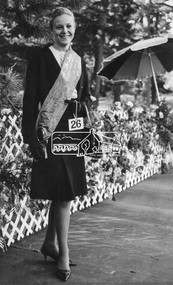 Eltham District Historical Society Inc
Photograph, Joy Chapman, Miss Eltham, April 1965, Apr 1965
... There was a Public Telephone there which was the only contact to anyone else. ...There was a Public Telephone there which was the only contact to anyone else. ...My Recollections of Eltham Past by Margaret Joy Harding (nee Joy Chapman.) My family of Elizabeth and Alec Chapman moved to Eltham in 1946 into a cottage on the opposite side of the Diamond Creek from where the little train now operates in the Lower Park. At that time Eltham truly was a country town and the Pub was the main meeting place for most inhabitants on a Saturday afternoon in the beer garden. I attended Eltham Primary School where I started as a 4-year-old (my birthday being slightly after the mid-year intake) that happened then. My mother spent a lot of days taking me back to school when I had dismissed myself and walked the one kilomtre home alone. Bremner's Common (now Wingrove Park) was a big attraction with its dam and tad poling which I found much more entertaining than school. (Mrs Bremner ran a Service Station on the site of the current one). Another attraction at this site was the circus that came a couple of times a year. Watching them put up the circus tent was very interesting and even more of an attraction was the feeding of the Lions in cages and the monkeys and elephants among the other animals that are not found in a circus these days. At school then we were provided with hot chocolate at morning recess where the mothers would prepare it in the shelter shed. The only form of classroom heating was an open fire. Worse was the warm milk given in the summer months. By the time I was near finishing at Primary school we used to be able to walk along the Main Road at lunchtime to Mrs. Mitchell's shop to a delicious hot pie. As I recall there was no supervision for this departure from the school grounds. It is interesting that some of the other children I started school with I still have contact with, in fact one is a very good friend although now living in Perth. That is the other thing about Eltham; many who grew up here continue to live in the area. Following primary school, the natural progression was to Eltham High School. There was only the main building at that time and I can remember our first assembly at the front entrance. During the time I was at High School several new class rooms were added and the school hall. I remember the musical plays such as HMS Pinafore and other classical musicals being performed. I also remember countless hours doing marching practice. The main street shops when I was young consisted of the Blue Gum milk bar at the far end, a Grocery store and a shoe maker where Coles currently stands. Opposite there was Lyon's Garage. They also provided a bus service and when we got off the train this little bus would tour the back streets taking each individual to their home, sometimes this could take quite considerable time. There was also a Black Smith next to the Chiropractic Practice opposite Alistair Knox Park, another Milk Bar/General Store on the comer of Bridge Street/Main Road where a shop currently still operates. There was also a Butcher's shop down from the pub opposite Franklin Street. The only doctor was next to the courthouse on the other side of Brougham Street. On Saturday afternoon I was occasionally allowed to go the movies in the Town Hall which also stood on the site of the Coles centre. Often the Fire Alarm would sound and everyone would run outside to watch the fire truck leave with the volunteers clutching on the back. The other attraction during summer of course was the swimming pool which was a small concrete pool filled with water pumped from the Diamond Creek, sometimes it was like a mud puddle so for me the nearer to home Yarra/Diamond Creek junction was a much better option. We swam in the water hole which was quite deep and with fallen trees and sometimes carcasses of cows and kangaroos floating past. As recreation, the churches were another attraction for the Sunday school picnics to Mordialloc in the back of the moving van with benches tied into the back for us to "sit" on. Too bad when we went around a corner! In the early days we had an Ice Man deliver the ice once a week for "refrigeration". The green grocer came around in a horse and cart as did the milkman and the bread was delivered but I constantly got into trouble for eating the middle out on the way from the box it was delivered to in Mt Pleasant road across the paddock. The milkman finally would not come down our street after his horse bolted one morning and took off across the paddock. We also had the "Pan Man" come weekly and whose visit I would avoid. Our nearest shop was where the flower stall is located opposite the Lower Park. It consisted of a Tea Room and Milk Bar. There was a Public Telephone there which was the only contact to anyone else. We were a one car family so my mother’s movements were very limited as the Eltham Station was a couple of kilometres away and a trip to the city was an event. Being an only child growing up was a little lonely however rambling along the creek with my Mum, picking mushrooms and picking cherry plums for jam and the dogs catching rabbits which we ate if we could get them away from the dogs. We also liked to go into the Lower Park during school holidays when the Greek people came to camp and they would sing and dance around the camp fire and it all seemed so different to us as this was early days of immigration. Childhood was relatively simple and carefree and I wish the kids of today had the freedom of my youth and the healthy outdoor lifestyle of the "olden days". SHOW GIRL COMPETITION In 1965 Eltham was more like a country town than the suburb it has become today. People knew each other, if not personally then certainly of the family name. The big event for the year was a Gymkhana or show at Lower Eltham Park. I can remember marching as a teenager from the town centre to the park in the marching girls with the decorated floats. In 1965, just on a whim on the day, I decided to enter the Miss Eltham Show Girl which was a part of the festivities at the park. I seem to remember that the show mainly consisted of horse events, cattle judging and dog show. As I had not given any serious thought to entering the competition, I wore a suit that I had for work which was brown wool, with a coffee coloured shirt under, black shoes, bag, and gloves but no hat. I duly paraded for the judges and much to my surprise I was announced the winner. I eventually went on to compete at the Miss Victoria Show Girl competition which was held at the Royal Melbourne Show. There I met many country girls who were representing their rural Victoria home. I made it into a final round of judging but I think justice prevailed when someone from a country background was crowned. It was fun to go into the show as I had not really been before and to see the displays of handcraft, cooking and wood chopping events was great as well as the judging of farm animals interesting. It is hard to remember the Eltham I grew up in. The Lyons Garage company bus that actually drove you home (or close to it) when we got off the train at night. The Eltham Hotel on a Saturday afternoon a usual social meeting place where people just sat and chatted. The pictures held in the Town Hall and when the fire alarm sounded all the men just jumped up and ran to help. Suburbia has now swallowed most of that life but thankfully we at least do have the trestle bridge and parkland. Digital file only - Black and white photo print on loan for scanning by EDHSalec chapman, annie bremner, blacksmith, bremner's flat, brougham steet, bus services, circus, diamond creek, dianne bell, doctor bradbury, easter gymkhana, elizabeth chapman, eltham high school, eltham hotel, eltham lower park, eltham public hall, eltham state school, eltham trestle bridge, general store, grace mitchell, ice man, joy chapman, lyons garage, margaret harding, milk bar, miss eltham 1965, miss victoria show girl, mount pleasant road, pan man, rodda parade, shops, show girl competition, swimming pool, water hole, yarra river -
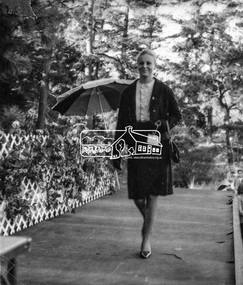 Eltham District Historical Society Inc
Photograph, Joy Chapman parading before the judges, Miss Eltham 1965, Apr 1965
... There was a Public Telephone there which was the only contact to anyone else. ...There was a Public Telephone there which was the only contact to anyone else. ...My Recollections of Eltham Past by Margaret Joy Harding (nee Joy Chapman.) My family of Elizabeth and Alec Chapman moved to Eltham in 1946 into a cottage on the opposite side of the Diamond Creek from where the little train now operates in the Lower Park. At that time Eltham truly was a country town and the Pub was the main meeting place for most inhabitants on a Saturday afternoon in the beer garden. I attended Eltham Primary School where I started as a 4-year-old (my birthday being slightly after the mid-year intake) that happened then. My mother spent a lot of days taking me back to school when I had dismissed myself and walked the one kilomtre home alone. Bremner's Common (now Wingrove Park) was a big attraction with its dam and tad poling which I found much more entertaining than school. (Mrs Bremner ran a Service Station on the site of the current one). Another attraction at this site was the circus that came a couple of times a year. Watching them put up the circus tent was very interesting and even more of an attraction was the feeding of the Lions in cages and the monkeys and elephants among the other animals that are not found in a circus these days. At school then we were provided with hot chocolate at morning recess where the mothers would prepare it in the shelter shed. The only form of classroom heating was an open fire. Worse was the warm milk given in the summer months. By the time I was near finishing at Primary school we used to be able to walk along the Main Road at lunchtime to Mrs. Mitchell's shop to a delicious hot pie. As I recall there was no supervision for this departure from the school grounds. It is interesting that some of the other children I started school with I still have contact with, in fact one is a very good friend although now living in Perth. That is the other thing about Eltham; many who grew up here continue to live in the area. Following primary school, the natural progression was to Eltham High School. There was only the main building at that time and I can remember our first assembly at the front entrance. During the time I was at High School several new class rooms were added and the school hall. I remember the musical plays such as HMS Pinafore and other classical musicals being performed. I also remember countless hours doing marching practice. The main street shops when I was young consisted of the Blue Gum milk bar at the far end, a Grocery store and a shoe maker where Coles currently stands. Opposite there was Lyon's Garage. They also provided a bus service and when we got off the train this little bus would tour the back streets taking each individual to their home, sometimes this could take quite considerable time. There was also a Black Smith next to the Chiropractic Practice opposite Alistair Knox Park, another Milk Bar/General Store on the comer of Bridge Street/Main Road where a shop currently still operates. There was also a Butcher's shop down from the pub opposite Franklin Street. The only doctor was next to the courthouse on the other side of Brougham Street. On Saturday afternoon I was occasionally allowed to go the movies in the Town Hall which also stood on the site of the Coles centre. Often the Fire Alarm would sound and everyone would run outside to watch the fire truck leave with the volunteers clutching on the back. The other attraction during summer of course was the swimming pool which was a small concrete pool filled with water pumped from the Diamond Creek, sometimes it was like a mud puddle so for me the nearer to home Yarra/Diamond Creek junction was a much better option. We swam in the water hole which was quite deep and with fallen trees and sometimes carcasses of cows and kangaroos floating past. As recreation, the churches were another attraction for the Sunday school picnics to Mordialloc in the back of the moving van with benches tied into the back for us to "sit" on. Too bad when we went around a corner! In the early days we had an Ice Man deliver the ice once a week for "refrigeration". The green grocer came around in a horse and cart as did the milkman and the bread was delivered but I constantly got into trouble for eating the middle out on the way from the box it was delivered to in Mt Pleasant road across the paddock. The milkman finally would not come down our street after his horse bolted one morning and took off across the paddock. We also had the "Pan Man" come weekly and whose visit I would avoid. Our nearest shop was where the flower stall is located opposite the Lower Park. It consisted of a Tea Room and Milk Bar. There was a Public Telephone there which was the only contact to anyone else. We were a one car family so my mother’s movements were very limited as the Eltham Station was a couple of kilometres away and a trip to the city was an event. Being an only child growing up was a little lonely however rambling along the creek with my Mum, picking mushrooms and picking cherry plums for jam and the dogs catching rabbits which we ate if we could get them away from the dogs. We also liked to go into the Lower Park during school holidays when the Greek people came to camp and they would sing and dance around the camp fire and it all seemed so different to us as this was early days of immigration. Childhood was relatively simple and carefree and I wish the kids of today had the freedom of my youth and the healthy outdoor lifestyle of the "olden days". SHOW GIRL COMPETITION In 1965 Eltham was more like a country town than the suburb it has become today. People knew each other, if not personally then certainly of the family name. The big event for the year was a Gymkhana or show at Lower Eltham Park. I can remember marching as a teenager from the town centre to the park in the marching girls with the decorated floats. In 1965, just on a whim on the day, I decided to enter the Miss Eltham Show Girl which was a part of the festivities at the park. I seem to remember that the show mainly consisted of horse events, cattle judging and dog show. As I had not given any serious thought to entering the competition, I wore a suit that I had for work which was brown wool, with a coffee coloured shirt under, black shoes, bag, and gloves but no hat. I duly paraded for the judges and much to my surprise I was announced the winner. I eventually went on to compete at the Miss Victoria Show Girl competition which was held at the Royal Melbourne Show. There I met many country girls who were representing their rural Victoria home. I made it into a final round of judging but I think justice prevailed when someone from a country background was crowned. It was fun to go into the show as I had not really been before and to see the displays of handcraft, cooking and wood chopping events was great as well as the judging of farm animals interesting. It is hard to remember the Eltham I grew up in. The Lyons Garage company bus that actually drove you home (or close to it) when we got off the train at night. The Eltham Hotel on a Saturday afternoon a usual social meeting place where people just sat and chatted. The pictures held in the Town Hall and when the fire alarm sounded all the men just jumped up and ran to help. Suburbia has now swallowed most of that life but thankfully we at least do have the trestle bridge and parkland. Digital file only - Black and white photo print on loan for scanning by EDHSalec chapman, annie bremner, blacksmith, bremner's flat, brougham steet, bus services, circus, diamond creek, dianne bell, doctor bradbury, easter gymkhana, elizabeth chapman, eltham high school, eltham hotel, eltham lower park, eltham public hall, eltham state school, eltham trestle bridge, general store, grace mitchell, ice man, joy chapman, lyons garage, margaret harding, milk bar, miss eltham 1965, miss victoria show girl, mount pleasant road, pan man, rodda parade, shops, show girl competition, swimming pool, water hole, yarra river -
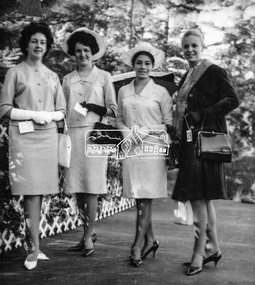 Eltham District Historical Society Inc
Photograph, Joy Chapman, Miss Eltham 1965 with other contestants, Apr 1965
... There was a Public Telephone there which was the only contact to anyone else. ...There was a Public Telephone there which was the only contact to anyone else. ...My Recollections of Eltham Past by Margaret Joy Harding (nee Joy Chapman.) My family of Elizabeth and Alec Chapman moved to Eltham in 1946 into a cottage on the opposite side of the Diamond Creek from where the little train now operates in the Lower Park. At that time Eltham truly was a country town and the Pub was the main meeting place for most inhabitants on a Saturday afternoon in the beer garden. I attended Eltham Primary School where I started as a 4-year-old (my birthday being slightly after the mid-year intake) that happened then. My mother spent a lot of days taking me back to school when I had dismissed myself and walked the one kilomtre home alone. Bremner's Common (now Wingrove Park) was a big attraction with its dam and tad poling which I found much more entertaining than school. (Mrs Bremner ran a Service Station on the site of the current one). Another attraction at this site was the circus that came a couple of times a year. Watching them put up the circus tent was very interesting and even more of an attraction was the feeding of the Lions in cages and the monkeys and elephants among the other animals that are not found in a circus these days. At school then we were provided with hot chocolate at morning recess where the mothers would prepare it in the shelter shed. The only form of classroom heating was an open fire. Worse was the warm milk given in the summer months. By the time I was near finishing at Primary school we used to be able to walk along the Main Road at lunchtime to Mrs. Mitchell's shop to a delicious hot pie. As I recall there was no supervision for this departure from the school grounds. It is interesting that some of the other children I started school with I still have contact with, in fact one is a very good friend although now living in Perth. That is the other thing about Eltham; many who grew up here continue to live in the area. Following primary school, the natural progression was to Eltham High School. There was only the main building at that time and I can remember our first assembly at the front entrance. During the time I was at High School several new class rooms were added and the school hall. I remember the musical plays such as HMS Pinafore and other classical musicals being performed. I also remember countless hours doing marching practice. The main street shops when I was young consisted of the Blue Gum milk bar at the far end, a Grocery store and a shoe maker where Coles currently stands. Opposite there was Lyon's Garage. They also provided a bus service and when we got off the train this little bus would tour the back streets taking each individual to their home, sometimes this could take quite considerable time. There was also a Black Smith next to the Chiropractic Practice opposite Alistair Knox Park, another Milk Bar/General Store on the comer of Bridge Street/Main Road where a shop currently still operates. There was also a Butcher's shop down from the pub opposite Franklin Street. The only doctor was next to the courthouse on the other side of Brougham Street. On Saturday afternoon I was occasionally allowed to go the movies in the Town Hall which also stood on the site of the Coles centre. Often the Fire Alarm would sound and everyone would run outside to watch the fire truck leave with the volunteers clutching on the back. The other attraction during summer of course was the swimming pool which was a small concrete pool filled with water pumped from the Diamond Creek, sometimes it was like a mud puddle so for me the nearer to home Yarra/Diamond Creek junction was a much better option. We swam in the water hole which was quite deep and with fallen trees and sometimes carcasses of cows and kangaroos floating past. As recreation, the churches were another attraction for the Sunday school picnics to Mordialloc in the back of the moving van with benches tied into the back for us to "sit" on. Too bad when we went around a corner! In the early days we had an Ice Man deliver the ice once a week for "refrigeration". The green grocer came around in a horse and cart as did the milkman and the bread was delivered but I constantly got into trouble for eating the middle out on the way from the box it was delivered to in Mt Pleasant road across the paddock. The milkman finally would not come down our street after his horse bolted one morning and took off across the paddock. We also had the "Pan Man" come weekly and whose visit I would avoid. Our nearest shop was where the flower stall is located opposite the Lower Park. It consisted of a Tea Room and Milk Bar. There was a Public Telephone there which was the only contact to anyone else. We were a one car family so my mother’s movements were very limited as the Eltham Station was a couple of kilometres away and a trip to the city was an event. Being an only child growing up was a little lonely however rambling along the creek with my Mum, picking mushrooms and picking cherry plums for jam and the dogs catching rabbits which we ate if we could get them away from the dogs. We also liked to go into the Lower Park during school holidays when the Greek people came to camp and they would sing and dance around the camp fire and it all seemed so different to us as this was early days of immigration. Childhood was relatively simple and carefree and I wish the kids of today had the freedom of my youth and the healthy outdoor lifestyle of the "olden days". SHOW GIRL COMPETITION In 1965 Eltham was more like a country town than the suburb it has become today. People knew each other, if not personally then certainly of the family name. The big event for the year was a Gymkhana or show at Lower Eltham Park. I can remember marching as a teenager from the town centre to the park in the marching girls with the decorated floats. In 1965, just on a whim on the day, I decided to enter the Miss Eltham Show Girl which was a part of the festivities at the park. I seem to remember that the show mainly consisted of horse events, cattle judging and dog show. As I had not given any serious thought to entering the competition, I wore a suit that I had for work which was brown wool, with a coffee coloured shirt under, black shoes, bag, and gloves but no hat. I duly paraded for the judges and much to my surprise I was announced the winner. I eventually went on to compete at the Miss Victoria Show Girl competition which was held at the Royal Melbourne Show. There I met many country girls who were representing their rural Victoria home. I made it into a final round of judging but I think justice prevailed when someone from a country background was crowned. It was fun to go into the show as I had not really been before and to see the displays of handcraft, cooking and wood chopping events was great as well as the judging of farm animals interesting. It is hard to remember the Eltham I grew up in. The Lyons Garage company bus that actually drove you home (or close to it) when we got off the train at night. The Eltham Hotel on a Saturday afternoon a usual social meeting place where people just sat and chatted. The pictures held in the Town Hall and when the fire alarm sounded all the men just jumped up and ran to help. Suburbia has now swallowed most of that life but thankfully we at least do have the trestle bridge and parkland. Digital file only - Black and white photo print on loan for scanning by EDHSalec chapman, annie bremner, blacksmith, bremner's flat, brougham steet, bus services, circus, diamond creek, dianne bell, doctor bradbury, easter gymkhana, elizabeth chapman, eltham high school, eltham hotel, eltham lower park, eltham public hall, eltham state school, eltham trestle bridge, general store, grace mitchell, ice man, joy chapman, lyons garage, margaret harding, milk bar, miss eltham 1965, miss victoria show girl, mount pleasant road, pan man, rodda parade, shops, show girl competition, swimming pool, water hole, yarra river -
 Eltham District Historical Society Inc
Photograph, Peter Pidgeon, The original Miss Eltham 1965 sash, 17 May 2019
... There was a Public Telephone there which was the only contact to anyone else. ...There was a Public Telephone there which was the only contact to anyone else. ...My Recollections of Eltham Past by Margaret Joy Harding (nee Joy Chapman.) My family of Elizabeth and Alec Chapman moved to Eltham in 1946 into a cottage on the opposite side of the Diamond Creek from where the little train now operates in the Lower Park. At that time Eltham truly was a country town and the Pub was the main meeting place for most inhabitants on a Saturday afternoon in the beer garden. I attended Eltham Primary School where I started as a 4-year-old (my birthday being slightly after the mid-year intake) that happened then. My mother spent a lot of days taking me back to school when I had dismissed myself and walked the one kilomtre home alone. Bremner's Common (now Wingrove Park) was a big attraction with its dam and tad poling which I found much more entertaining than school. (Mrs Bremner ran a Service Station on the site of the current one). Another attraction at this site was the circus that came a couple of times a year. Watching them put up the circus tent was very interesting and even more of an attraction was the feeding of the Lions in cages and the monkeys and elephants among the other animals that are not found in a circus these days. At school then we were provided with hot chocolate at morning recess where the mothers would prepare it in the shelter shed. The only form of classroom heating was an open fire. Worse was the warm milk given in the summer months. By the time I was near finishing at Primary school we used to be able to walk along the Main Road at lunchtime to Mrs. Mitchell's shop to a delicious hot pie. As I recall there was no supervision for this departure from the school grounds. It is interesting that some of the other children I started school with I still have contact with, in fact one is a very good friend although now living in Perth. That is the other thing about Eltham; many who grew up here continue to live in the area. Following primary school, the natural progression was to Eltham High School. There was only the main building at that time and I can remember our first assembly at the front entrance. During the time I was at High School several new class rooms were added and the school hall. I remember the musical plays such as HMS Pinafore and other classical musicals being performed. I also remember countless hours doing marching practice. The main street shops when I was young consisted of the Blue Gum milk bar at the far end, a Grocery store and a shoe maker where Coles currently stands. Opposite there was Lyon's Garage. They also provided a bus service and when we got off the train this little bus would tour the back streets taking each individual to their home, sometimes this could take quite considerable time. There was also a Black Smith next to the Chiropractic Practice opposite Alistair Knox Park, another Milk Bar/General Store on the comer of Bridge Street/Main Road where a shop currently still operates. There was also a Butcher's shop down from the pub opposite Franklin Street. The only doctor was next to the courthouse on the other side of Brougham Street. On Saturday afternoon I was occasionally allowed to go the movies in the Town Hall which also stood on the site of the Coles centre. Often the Fire Alarm would sound and everyone would run outside to watch the fire truck leave with the volunteers clutching on the back. The other attraction during summer of course was the swimming pool which was a small concrete pool filled with water pumped from the Diamond Creek, sometimes it was like a mud puddle so for me the nearer to home Yarra/Diamond Creek junction was a much better option. We swam in the water hole which was quite deep and with fallen trees and sometimes carcasses of cows and kangaroos floating past. As recreation, the churches were another attraction for the Sunday school picnics to Mordialloc in the back of the moving van with benches tied into the back for us to "sit" on. Too bad when we went around a corner! In the early days we had an Ice Man deliver the ice once a week for "refrigeration". The green grocer came around in a horse and cart as did the milkman and the bread was delivered but I constantly got into trouble for eating the middle out on the way from the box it was delivered to in Mt Pleasant road across the paddock. The milkman finally would not come down our street after his horse bolted one morning and took off across the paddock. We also had the "Pan Man" come weekly and whose visit I would avoid. Our nearest shop was where the flower stall is located opposite the Lower Park. It consisted of a Tea Room and Milk Bar. There was a Public Telephone there which was the only contact to anyone else. We were a one car family so my mother’s movements were very limited as the Eltham Station was a couple of kilometres away and a trip to the city was an event. Being an only child growing up was a little lonely however rambling along the creek with my Mum, picking mushrooms and picking cherry plums for jam and the dogs catching rabbits which we ate if we could get them away from the dogs. We also liked to go into the Lower Park during school holidays when the Greek people came to camp and they would sing and dance around the camp fire and it all seemed so different to us as this was early days of immigration. Childhood was relatively simple and carefree and I wish the kids of today had the freedom of my youth and the healthy outdoor lifestyle of the "olden days". SHOW GIRL COMPETITION In 1965 Eltham was more like a country town than the suburb it has become today. People knew each other, if not personally then certainly of the family name. The big event for the year was a Gymkhana or show at Lower Eltham Park. I can remember marching as a teenager from the town centre to the park in the marching girls with the decorated floats. In 1965, just on a whim on the day, I decided to enter the Miss Eltham Show Girl which was a part of the festivities at the park. I seem to remember that the show mainly consisted of horse events, cattle judging and dog show. As I had not given any serious thought to entering the competition, I wore a suit that I had for work which was brown wool, with a coffee coloured shirt under, black shoes, bag, and gloves but no hat. I duly paraded for the judges and much to my surprise I was announced the winner. I eventually went on to compete at the Miss Victoria Show Girl competition which was held at the Royal Melbourne Show. There I met many country girls who were representing their rural Victoria home. I made it into a final round of judging but I think justice prevailed when someone from a country background was crowned. It was fun to go into the show as I had not really been before and to see the displays of handcraft, cooking and wood chopping events was great as well as the judging of farm animals interesting. It is hard to remember the Eltham I grew up in. The Lyons Garage company bus that actually drove you home (or close to it) when we got off the train at night. The Eltham Hotel on a Saturday afternoon a usual social meeting place where people just sat and chatted. The pictures held in the Town Hall and when the fire alarm sounded all the men just jumped up and ran to help. Suburbia has now swallowed most of that life but thankfully we at least do have the trestle bridge and parkland. Born digitalalec chapman, annie bremner, blacksmith, bremner's flat, brougham steet, bus services, circus, diamond creek, dianne bell, doctor bradbury, easter gymkhana, elizabeth chapman, eltham high school, eltham hotel, eltham lower park, eltham public hall, eltham state school, eltham trestle bridge, general store, grace mitchell, ice man, joy chapman, lyons garage, margaret harding, milk bar, miss eltham 1965, miss victoria show girl, mount pleasant road, pan man, rodda parade, shops, show girl competition, swimming pool, water hole, yarra river -
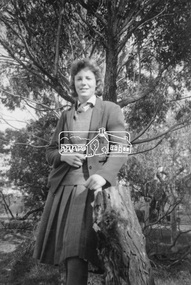 Eltham District Historical Society Inc
Photograph, Joy Chapman in rear playground of Eltham High School, 1959, 1959
... There was a Public Telephone there which was the only contact to anyone else. ...There was a Public Telephone there which was the only contact to anyone else. ...My Recollections of Eltham Past by Margaret Joy Harding (nee Joy Chapman.) My family of Elizabeth and Alec Chapman moved to Eltham in 1946 into a cottage on the opposite side of the Diamond Creek from where the little train now operates in the Lower Park. At that time Eltham truly was a country town and the Pub was the main meeting place for most inhabitants on a Saturday afternoon in the beer garden. I attended Eltham Primary School where I started as a 4-year-old (my birthday being slightly after the mid-year intake) that happened then. My mother spent a lot of days taking me back to school when I had dismissed myself and walked the one kilomtre home alone. Bremner's Common (now Wingrove Park) was a big attraction with its dam and tad poling which I found much more entertaining than school. (Mrs Bremner ran a Service Station on the site of the current one). Another attraction at this site was the circus that came a couple of times a year. Watching them put up the circus tent was very interesting and even more of an attraction was the feeding of the Lions in cages and the monkeys and elephants among the other animals that are not found in a circus these days. At school then we were provided with hot chocolate at morning recess where the mothers would prepare it in the shelter shed. The only form of classroom heating was an open fire. Worse was the warm milk given in the summer months. By the time I was near finishing at Primary school we used to be able to walk along the Main Road at lunchtime to Mrs. Mitchell's shop to a delicious hot pie. As I recall there was no supervision for this departure from the school grounds. It is interesting that some of the other children I started school with I still have contact with, in fact one is a very good friend although now living in Perth. That is the other thing about Eltham; many who grew up here continue to live in the area. Following primary school, the natural progression was to Eltham High School. There was only the main building at that time and I can remember our first assembly at the front entrance. During the time I was at High School several new class rooms were added and the school hall. I remember the musical plays such as HMS Pinafore and other classical musicals being performed. I also remember countless hours doing marching practice. The main street shops when I was young consisted of the Blue Gum milk bar at the far end, a Grocery store and a shoe maker where Coles currently stands. Opposite there was Lyon's Garage. They also provided a bus service and when we got off the train this little bus would tour the back streets taking each individual to their home, sometimes this could take quite considerable time. There was also a Black Smith next to the Chiropractic Practice opposite Alistair Knox Park, another Milk Bar/General Store on the comer of Bridge Street/Main Road where a shop currently still operates. There was also a Butcher's shop down from the pub opposite Franklin Street. The only doctor was next to the courthouse on the other side of Brougham Street. On Saturday afternoon I was occasionally allowed to go the movies in the Town Hall which also stood on the site of the Coles centre. Often the Fire Alarm would sound and everyone would run outside to watch the fire truck leave with the volunteers clutching on the back. The other attraction during summer of course was the swimming pool which was a small concrete pool filled with water pumped from the Diamond Creek, sometimes it was like a mud puddle so for me the nearer to home Yarra/Diamond Creek junction was a much better option. We swam in the water hole which was quite deep and with fallen trees and sometimes carcasses of cows and kangaroos floating past. As recreation, the churches were another attraction for the Sunday school picnics to Mordialloc in the back of the moving van with benches tied into the back for us to "sit" on. Too bad when we went around a corner! In the early days we had an Ice Man deliver the ice once a week for "refrigeration". The green grocer came around in a horse and cart as did the milkman and the bread was delivered but I constantly got into trouble for eating the middle out on the way from the box it was delivered to in Mt Pleasant road across the paddock. The milkman finally would not come down our street after his horse bolted one morning and took off across the paddock. We also had the "Pan Man" come weekly and whose visit I would avoid. Our nearest shop was where the flower stall is located opposite the Lower Park. It consisted of a Tea Room and Milk Bar. There was a Public Telephone there which was the only contact to anyone else. We were a one car family so my mother’s movements were very limited as the Eltham Station was a couple of kilometres away and a trip to the city was an event. Being an only child growing up was a little lonely however rambling along the creek with my Mum, picking mushrooms and picking cherry plums for jam and the dogs catching rabbits which we ate if we could get them away from the dogs. We also liked to go into the Lower Park during school holidays when the Greek people came to camp and they would sing and dance around the camp fire and it all seemed so different to us as this was early days of immigration. Childhood was relatively simple and carefree and I wish the kids of today had the freedom of my youth and the healthy outdoor lifestyle of the "olden days". SHOW GIRL COMPETITION In 1965 Eltham was more like a country town than the suburb it has become today. People knew each other, if not personally then certainly of the family name. The big event for the year was a Gymkhana or show at Lower Eltham Park. I can remember marching as a teenager from the town centre to the park in the marching girls with the decorated floats. In 1965, just on a whim on the day, I decided to enter the Miss Eltham Show Girl which was a part of the festivities at the park. I seem to remember that the show mainly consisted of horse events, cattle judging and dog show. As I had not given any serious thought to entering the competition, I wore a suit that I had for work which was brown wool, with a coffee coloured shirt under, black shoes, bag, and gloves but no hat. I duly paraded for the judges and much to my surprise I was announced the winner. I eventually went on to compete at the Miss Victoria Show Girl competition which was held at the Royal Melbourne Show. There I met many country girls who were representing their rural Victoria home. I made it into a final round of judging but I think justice prevailed when someone from a country background was crowned. It was fun to go into the show as I had not really been before and to see the displays of handcraft, cooking and wood chopping events was great as well as the judging of farm animals interesting. It is hard to remember the Eltham I grew up in. The Lyons Garage company bus that actually drove you home (or close to it) when we got off the train at night. The Eltham Hotel on a Saturday afternoon a usual social meeting place where people just sat and chatted. The pictures held in the Town Hall and when the fire alarm sounded all the men just jumped up and ran to help. Suburbia has now swallowed most of that life but thankfully we at least do have the trestle bridge and parkland. Digital file only - Black and white photo print on loan for scanning by EDHSalec chapman, annie bremner, blacksmith, bremner's flat, brougham steet, bus services, circus, diamond creek, dianne bell, doctor bradbury, easter gymkhana, elizabeth chapman, eltham high school, eltham hotel, eltham lower park, eltham public hall, eltham state school, eltham trestle bridge, general store, grace mitchell, ice man, joy chapman, lyons garage, margaret harding, milk bar, miss eltham 1965, miss victoria show girl, mount pleasant road, pan man, rodda parade, shops, show girl competition, swimming pool, water hole, yarra river -
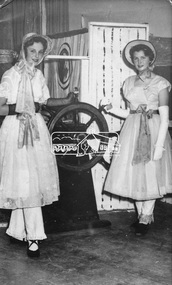 Eltham District Historical Society Inc
Photograph, Joy Chapman (left) with Dianne Bell in HMS Pinafore, 1960, 1960
... There was a Public Telephone there which was the only contact to anyone else. ...There was a Public Telephone there which was the only contact to anyone else. ...My Recollections of Eltham Past by Margaret Joy Harding (nee Joy Chapman.) My family of Elizabeth and Alec Chapman moved to Eltham in 1946 into a cottage on the opposite side of the Diamond Creek from where the little train now operates in the Lower Park. At that time Eltham truly was a country town and the Pub was the main meeting place for most inhabitants on a Saturday afternoon in the beer garden. I attended Eltham Primary School where I started as a 4-year-old (my birthday being slightly after the mid-year intake) that happened then. My mother spent a lot of days taking me back to school when I had dismissed myself and walked the one kilomtre home alone. Bremner's Common (now Wingrove Park) was a big attraction with its dam and tad poling which I found much more entertaining than school. (Mrs Bremner ran a Service Station on the site of the current one). Another attraction at this site was the circus that came a couple of times a year. Watching them put up the circus tent was very interesting and even more of an attraction was the feeding of the Lions in cages and the monkeys and elephants among the other animals that are not found in a circus these days. At school then we were provided with hot chocolate at morning recess where the mothers would prepare it in the shelter shed. The only form of classroom heating was an open fire. Worse was the warm milk given in the summer months. By the time I was near finishing at Primary school we used to be able to walk along the Main Road at lunchtime to Mrs. Mitchell's shop to a delicious hot pie. As I recall there was no supervision for this departure from the school grounds. It is interesting that some of the other children I started school with I still have contact with, in fact one is a very good friend although now living in Perth. That is the other thing about Eltham; many who grew up here continue to live in the area. Following primary school, the natural progression was to Eltham High School. There was only the main building at that time and I can remember our first assembly at the front entrance. During the time I was at High School several new class rooms were added and the school hall. I remember the musical plays such as HMS Pinafore and other classical musicals being performed. I also remember countless hours doing marching practice. The main street shops when I was young consisted of the Blue Gum milk bar at the far end, a Grocery store and a shoe maker where Coles currently stands. Opposite there was Lyon's Garage. They also provided a bus service and when we got off the train this little bus would tour the back streets taking each individual to their home, sometimes this could take quite considerable time. There was also a Black Smith next to the Chiropractic Practice opposite Alistair Knox Park, another Milk Bar/General Store on the comer of Bridge Street/Main Road where a shop currently still operates. There was also a Butcher's shop down from the pub opposite Franklin Street. The only doctor was next to the courthouse on the other side of Brougham Street. On Saturday afternoon I was occasionally allowed to go the movies in the Town Hall which also stood on the site of the Coles centre. Often the Fire Alarm would sound and everyone would run outside to watch the fire truck leave with the volunteers clutching on the back. The other attraction during summer of course was the swimming pool which was a small concrete pool filled with water pumped from the Diamond Creek, sometimes it was like a mud puddle so for me the nearer to home Yarra/Diamond Creek junction was a much better option. We swam in the water hole which was quite deep and with fallen trees and sometimes carcasses of cows and kangaroos floating past. As recreation, the churches were another attraction for the Sunday school picnics to Mordialloc in the back of the moving van with benches tied into the back for us to "sit" on. Too bad when we went around a corner! In the early days we had an Ice Man deliver the ice once a week for "refrigeration". The green grocer came around in a horse and cart as did the milkman and the bread was delivered but I constantly got into trouble for eating the middle out on the way from the box it was delivered to in Mt Pleasant road across the paddock. The milkman finally would not come down our street after his horse bolted one morning and took off across the paddock. We also had the "Pan Man" come weekly and whose visit I would avoid. Our nearest shop was where the flower stall is located opposite the Lower Park. It consisted of a Tea Room and Milk Bar. There was a Public Telephone there which was the only contact to anyone else. We were a one car family so my mother’s movements were very limited as the Eltham Station was a couple of kilometres away and a trip to the city was an event. Being an only child growing up was a little lonely however rambling along the creek with my Mum, picking mushrooms and picking cherry plums for jam and the dogs catching rabbits which we ate if we could get them away from the dogs. We also liked to go into the Lower Park during school holidays when the Greek people came to camp and they would sing and dance around the camp fire and it all seemed so different to us as this was early days of immigration. Childhood was relatively simple and carefree and I wish the kids of today had the freedom of my youth and the healthy outdoor lifestyle of the "olden days". SHOW GIRL COMPETITION In 1965 Eltham was more like a country town than the suburb it has become today. People knew each other, if not personally then certainly of the family name. The big event for the year was a Gymkhana or show at Lower Eltham Park. I can remember marching as a teenager from the town centre to the park in the marching girls with the decorated floats. In 1965, just on a whim on the day, I decided to enter the Miss Eltham Show Girl which was a part of the festivities at the park. I seem to remember that the show mainly consisted of horse events, cattle judging and dog show. As I had not given any serious thought to entering the competition, I wore a suit that I had for work which was brown wool, with a coffee coloured shirt under, black shoes, bag, and gloves but no hat. I duly paraded for the judges and much to my surprise I was announced the winner. I eventually went on to compete at the Miss Victoria Show Girl competition which was held at the Royal Melbourne Show. There I met many country girls who were representing their rural Victoria home. I made it into a final round of judging but I think justice prevailed when someone from a country background was crowned. It was fun to go into the show as I had not really been before and to see the displays of handcraft, cooking and wood chopping events was great as well as the judging of farm animals interesting. It is hard to remember the Eltham I grew up in. The Lyons Garage company bus that actually drove you home (or close to it) when we got off the train at night. The Eltham Hotel on a Saturday afternoon a usual social meeting place where people just sat and chatted. The pictures held in the Town Hall and when the fire alarm sounded all the men just jumped up and ran to help. Suburbia has now swallowed most of that life but thankfully we at least do have the trestle bridge and parkland. Digital file only - Black and white photo print on loan for scanning by EDHSalec chapman, annie bremner, blacksmith, bremner's flat, brougham steet, bus services, circus, diamond creek, dianne bell, doctor bradbury, easter gymkhana, elizabeth chapman, eltham high school, eltham hotel, eltham lower park, eltham public hall, eltham state school, eltham trestle bridge, general store, grace mitchell, ice man, joy chapman, lyons garage, margaret harding, milk bar, miss eltham 1965, miss victoria show girl, mount pleasant road, pan man, rodda parade, shops, show girl competition, swimming pool, water hole, yarra river -
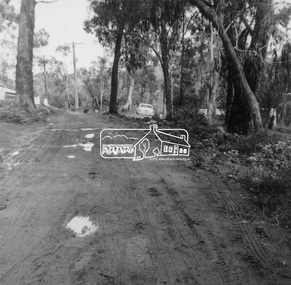 Eltham District Historical Society Inc
Photograph, Rodda Parade looking towards the creek, 1960. Chapman home to the right, 1960
... There was a Public Telephone there which was the only contact to anyone else. ...There was a Public Telephone there which was the only contact to anyone else. ...My Recollections of Eltham Past by Margaret Joy Harding (nee Joy Chapman.) My family of Elizabeth and Alec Chapman moved to Eltham in 1946 into a cottage on the opposite side of the Diamond Creek from where the little train now operates in the Lower Park. At that time Eltham truly was a country town and the Pub was the main meeting place for most inhabitants on a Saturday afternoon in the beer garden. I attended Eltham Primary School where I started as a 4-year-old (my birthday being slightly after the mid-year intake) that happened then. My mother spent a lot of days taking me back to school when I had dismissed myself and walked the one kilomtre home alone. Bremner's Common (now Wingrove Park) was a big attraction with its dam and tad poling which I found much more entertaining than school. (Mrs Bremner ran a Service Station on the site of the current one). Another attraction at this site was the circus that came a couple of times a year. Watching them put up the circus tent was very interesting and even more of an attraction was the feeding of the Lions in cages and the monkeys and elephants among the other animals that are not found in a circus these days. At school then we were provided with hot chocolate at morning recess where the mothers would prepare it in the shelter shed. The only form of classroom heating was an open fire. Worse was the warm milk given in the summer months. By the time I was near finishing at Primary school we used to be able to walk along the Main Road at lunchtime to Mrs. Mitchell's shop to a delicious hot pie. As I recall there was no supervision for this departure from the school grounds. It is interesting that some of the other children I started school with I still have contact with, in fact one is a very good friend although now living in Perth. That is the other thing about Eltham; many who grew up here continue to live in the area. Following primary school, the natural progression was to Eltham High School. There was only the main building at that time and I can remember our first assembly at the front entrance. During the time I was at High School several new class rooms were added and the school hall. I remember the musical plays such as HMS Pinafore and other classical musicals being performed. I also remember countless hours doing marching practice. The main street shops when I was young consisted of the Blue Gum milk bar at the far end, a Grocery store and a shoe maker where Coles currently stands. Opposite there was Lyon's Garage. They also provided a bus service and when we got off the train this little bus would tour the back streets taking each individual to their home, sometimes this could take quite considerable time. There was also a Black Smith next to the Chiropractic Practice opposite Alistair Knox Park, another Milk Bar/General Store on the comer of Bridge Street/Main Road where a shop currently still operates. There was also a Butcher's shop down from the pub opposite Franklin Street. The only doctor was next to the courthouse on the other side of Brougham Street. On Saturday afternoon I was occasionally allowed to go the movies in the Town Hall which also stood on the site of the Coles centre. Often the Fire Alarm would sound and everyone would run outside to watch the fire truck leave with the volunteers clutching on the back. The other attraction during summer of course was the swimming pool which was a small concrete pool filled with water pumped from the Diamond Creek, sometimes it was like a mud puddle so for me the nearer to home Yarra/Diamond Creek junction was a much better option. We swam in the water hole which was quite deep and with fallen trees and sometimes carcasses of cows and kangaroos floating past. As recreation, the churches were another attraction for the Sunday school picnics to Mordialloc in the back of the moving van with benches tied into the back for us to "sit" on. Too bad when we went around a corner! In the early days we had an Ice Man deliver the ice once a week for "refrigeration". The green grocer came around in a horse and cart as did the milkman and the bread was delivered but I constantly got into trouble for eating the middle out on the way from the box it was delivered to in Mt Pleasant road across the paddock. The milkman finally would not come down our street after his horse bolted one morning and took off across the paddock. We also had the "Pan Man" come weekly and whose visit I would avoid. Our nearest shop was where the flower stall is located opposite the Lower Park. It consisted of a Tea Room and Milk Bar. There was a Public Telephone there which was the only contact to anyone else. We were a one car family so my mother’s movements were very limited as the Eltham Station was a couple of kilometres away and a trip to the city was an event. Being an only child growing up was a little lonely however rambling along the creek with my Mum, picking mushrooms and picking cherry plums for jam and the dogs catching rabbits which we ate if we could get them away from the dogs. We also liked to go into the Lower Park during school holidays when the Greek people came to camp and they would sing and dance around the camp fire and it all seemed so different to us as this was early days of immigration. Childhood was relatively simple and carefree and I wish the kids of today had the freedom of my youth and the healthy outdoor lifestyle of the "olden days". SHOW GIRL COMPETITION In 1965 Eltham was more like a country town than the suburb it has become today. People knew each other, if not personally then certainly of the family name. The big event for the year was a Gymkhana or show at Lower Eltham Park. I can remember marching as a teenager from the town centre to the park in the marching girls with the decorated floats. In 1965, just on a whim on the day, I decided to enter the Miss Eltham Show Girl which was a part of the festivities at the park. I seem to remember that the show mainly consisted of horse events, cattle judging and dog show. As I had not given any serious thought to entering the competition, I wore a suit that I had for work which was brown wool, with a coffee coloured shirt under, black shoes, bag, and gloves but no hat. I duly paraded for the judges and much to my surprise I was announced the winner. I eventually went on to compete at the Miss Victoria Show Girl competition which was held at the Royal Melbourne Show. There I met many country girls who were representing their rural Victoria home. I made it into a final round of judging but I think justice prevailed when someone from a country background was crowned. It was fun to go into the show as I had not really been before and to see the displays of handcraft, cooking and wood chopping events was great as well as the judging of farm animals interesting. It is hard to remember the Eltham I grew up in. The Lyons Garage company bus that actually drove you home (or close to it) when we got off the train at night. The Eltham Hotel on a Saturday afternoon a usual social meeting place where people just sat and chatted. The pictures held in the Town Hall and when the fire alarm sounded all the men just jumped up and ran to help. Suburbia has now swallowed most of that life but thankfully we at least do have the trestle bridge and parkland. Digital file only - Black and white photo print on loan for scanning by EDHSalec chapman, annie bremner, blacksmith, bremner's flat, brougham steet, bus services, circus, diamond creek, dianne bell, doctor bradbury, easter gymkhana, elizabeth chapman, eltham high school, eltham hotel, eltham lower park, eltham public hall, eltham state school, eltham trestle bridge, general store, grace mitchell, ice man, joy chapman, lyons garage, margaret harding, milk bar, miss eltham 1965, miss victoria show girl, mount pleasant road, pan man, rodda parade, shops, show girl competition, swimming pool, water hole, yarra river -
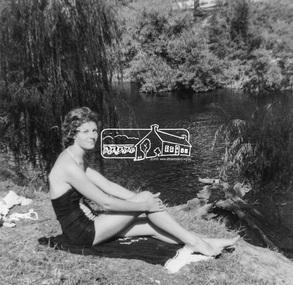 Eltham District Historical Society Inc
Photograph, Joy Chapman at the river junction, February 1962, Feb 1962
... There was a Public Telephone there which was the only contact to anyone else. ...There was a Public Telephone there which was the only contact to anyone else. ...My Recollections of Eltham Past by Margaret Joy Harding (nee Joy Chapman.) My family of Elizabeth and Alec Chapman moved to Eltham in 1946 into a cottage on the opposite side of the Diamond Creek from where the little train now operates in the Lower Park. At that time Eltham truly was a country town and the Pub was the main meeting place for most inhabitants on a Saturday afternoon in the beer garden. I attended Eltham Primary School where I started as a 4-year-old (my birthday being slightly after the mid-year intake) that happened then. My mother spent a lot of days taking me back to school when I had dismissed myself and walked the one kilomtre home alone. Bremner's Common (now Wingrove Park) was a big attraction with its dam and tad poling which I found much more entertaining than school. (Mrs Bremner ran a Service Station on the site of the current one). Another attraction at this site was the circus that came a couple of times a year. Watching them put up the circus tent was very interesting and even more of an attraction was the feeding of the Lions in cages and the monkeys and elephants among the other animals that are not found in a circus these days. At school then we were provided with hot chocolate at morning recess where the mothers would prepare it in the shelter shed. The only form of classroom heating was an open fire. Worse was the warm milk given in the summer months. By the time I was near finishing at Primary school we used to be able to walk along the Main Road at lunchtime to Mrs. Mitchell's shop to a delicious hot pie. As I recall there was no supervision for this departure from the school grounds. It is interesting that some of the other children I started school with I still have contact with, in fact one is a very good friend although now living in Perth. That is the other thing about Eltham; many who grew up here continue to live in the area. Following primary school, the natural progression was to Eltham High School. There was only the main building at that time and I can remember our first assembly at the front entrance. During the time I was at High School several new class rooms were added and the school hall. I remember the musical plays such as HMS Pinafore and other classical musicals being performed. I also remember countless hours doing marching practice. The main street shops when I was young consisted of the Blue Gum milk bar at the far end, a Grocery store and a shoe maker where Coles currently stands. Opposite there was Lyon's Garage. They also provided a bus service and when we got off the train this little bus would tour the back streets taking each individual to their home, sometimes this could take quite considerable time. There was also a Black Smith next to the Chiropractic Practice opposite Alistair Knox Park, another Milk Bar/General Store on the comer of Bridge Street/Main Road where a shop currently still operates. There was also a Butcher's shop down from the pub opposite Franklin Street. The only doctor was next to the courthouse on the other side of Brougham Street. On Saturday afternoon I was occasionally allowed to go the movies in the Town Hall which also stood on the site of the Coles centre. Often the Fire Alarm would sound and everyone would run outside to watch the fire truck leave with the volunteers clutching on the back. The other attraction during summer of course was the swimming pool which was a small concrete pool filled with water pumped from the Diamond Creek, sometimes it was like a mud puddle so for me the nearer to home Yarra/Diamond Creek junction was a much better option. We swam in the water hole which was quite deep and with fallen trees and sometimes carcasses of cows and kangaroos floating past. As recreation, the churches were another attraction for the Sunday school picnics to Mordialloc in the back of the moving van with benches tied into the back for us to "sit" on. Too bad when we went around a corner! In the early days we had an Ice Man deliver the ice once a week for "refrigeration". The green grocer came around in a horse and cart as did the milkman and the bread was delivered but I constantly got into trouble for eating the middle out on the way from the box it was delivered to in Mt Pleasant road across the paddock. The milkman finally would not come down our street after his horse bolted one morning and took off across the paddock. We also had the "Pan Man" come weekly and whose visit I would avoid. Our nearest shop was where the flower stall is located opposite the Lower Park. It consisted of a Tea Room and Milk Bar. There was a Public Telephone there which was the only contact to anyone else. We were a one car family so my mother’s movements were very limited as the Eltham Station was a couple of kilometres away and a trip to the city was an event. Being an only child growing up was a little lonely however rambling along the creek with my Mum, picking mushrooms and picking cherry plums for jam and the dogs catching rabbits which we ate if we could get them away from the dogs. We also liked to go into the Lower Park during school holidays when the Greek people came to camp and they would sing and dance around the camp fire and it all seemed so different to us as this was early days of immigration. Childhood was relatively simple and carefree and I wish the kids of today had the freedom of my youth and the healthy outdoor lifestyle of the "olden days". SHOW GIRL COMPETITION In 1965 Eltham was more like a country town than the suburb it has become today. People knew each other, if not personally then certainly of the family name. The big event for the year was a Gymkhana or show at Lower Eltham Park. I can remember marching as a teenager from the town centre to the park in the marching girls with the decorated floats. In 1965, just on a whim on the day, I decided to enter the Miss Eltham Show Girl which was a part of the festivities at the park. I seem to remember that the show mainly consisted of horse events, cattle judging and dog show. As I had not given any serious thought to entering the competition, I wore a suit that I had for work which was brown wool, with a coffee coloured shirt under, black shoes, bag, and gloves but no hat. I duly paraded for the judges and much to my surprise I was announced the winner. I eventually went on to compete at the Miss Victoria Show Girl competition which was held at the Royal Melbourne Show. There I met many country girls who were representing their rural Victoria home. I made it into a final round of judging but I think justice prevailed when someone from a country background was crowned. It was fun to go into the show as I had not really been before and to see the displays of handcraft, cooking and wood chopping events was great as well as the judging of farm animals interesting. It is hard to remember the Eltham I grew up in. The Lyons Garage company bus that actually drove you home (or close to it) when we got off the train at night. The Eltham Hotel on a Saturday afternoon a usual social meeting place where people just sat and chatted. The pictures held in the Town Hall and when the fire alarm sounded all the men just jumped up and ran to help. Suburbia has now swallowed most of that life but thankfully we at least do have the trestle bridge and parkland. Digital file only - Black and white photo print on loan for scanning by EDHSalec chapman, annie bremner, blacksmith, bremner's flat, brougham steet, bus services, circus, diamond creek, dianne bell, doctor bradbury, easter gymkhana, elizabeth chapman, eltham high school, eltham hotel, eltham lower park, eltham public hall, eltham state school, eltham trestle bridge, general store, grace mitchell, ice man, joy chapman, lyons garage, margaret harding, milk bar, miss eltham 1965, miss victoria show girl, mount pleasant road, pan man, rodda parade, shops, show girl competition, swimming pool, water hole, yarra river -
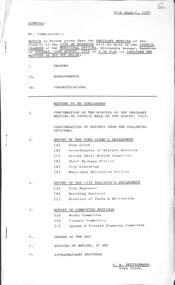 Sunshine and District Historical Society Incorporated
Administrative record - City of Sunshine - Commissioner Mr Alexander "Alex" George Gillon Collection 1976 - 1982 - Notice of ordinary meeting of the council of the City of Sunshine to be held on 22nd August 1978, City of Sunshine, 16th August 1978
... Notice of ordinary meeting of the council of the City of Sunshine to be held on 22nd August 1978 Report of the Town Clerk's Department Report of the Town Clerk Review of Role and Structure of Local Government Federal Finance for Local Government Use of Melbourne & Metropolitan Board of Works Quarters at O'Shannassy, Wallaby Creek and Robertson Land Transfer Discontinued Right of Way Rear of Railway Parade and Wood Street Deer Park Dickson Street Part Private Street Scheme Loan Programme 1978/79 Hulett Street Construction Scheme Report of the Co-Ordinator of Welfare Services Toddler Groups Toddler Group for Children At Risk Social Work Students Maribyrnong Senior Citizens Club Resource Centre / Toy Library Establishment of a Multi-Cultural Senior Citizens Club in Sunshine West Youth Counselling Service Report of the Acting Chief Health Inspector Quarterly Return of Food Samples Keep Australian Beautiful Council Head Lice Campaign Health Act Registrations Application for Transfer of Proprietorship of Premises under the Health Act Annual Inspections Infant Welfare Centres Sewage Overflow 2 Bruce Street Sunshine Report of the Chief By-Laws Officer Removal of Fire Hazards 1978/79 Dog Act Fixing of Registration Fees Report of the City Librarian Bookmobile Maidstone Branch Library Yardley Street to be Closed 29th September and Replaced with Bookmobile Report of the Municipal Recreation Officer Student's Representative Council University of Melbourne Summer School Seminar Multiple Sclerosis Society of Victoria Request for Land Provision of Minibuses for Community Groups Interim Planning Committee Albanvale Primary School Diamond Avenue Reserve Sunshine West High School Community Use Agreement Report of the City Engineer Preferred Development Areas Newmarket Relocation Proposal Planning Permit Application Subdivision and Detached Houses Oakwood Road Town Planning Appeal Planning Permit Application Extension to Factory Graingers Street Sunshine North Planning Permit Application East Side of Hampshire Road North of Existing Sunshine Shopping Cente Generally Bounded by Hampshire Road, Hertford Road, George Street and Service Street Including the Property Occupied by Massey Ferguson Spare Parts Store South of Service Street Rezoning Application Planning Permit Application Service station and Factory 784 Ballarat Road North West Corner Glencairn Avenue Planning Permit Application Warehouse and Workshop Hawthorn Avenue Planning Permit Application Neale Road Subdivision and Detached Houses Town Planning Appeal Home Occupation Three Phase Power Connection 170 Wright Street Planning Permit Flats 17 King Edward Avenue Planning Permit Application Institutional Home Lot 509 Tallintyre Road Planning Permit Application Nursing Home Thompson Street Maidstone Planning Permit Medical Consultation Room South East Corner Percy Street and Main Road East Planning Permit Application Extension to Existing Factory Marshall Street Plan of Subdivision Ballarat Road and Anderson Road Plan of Subdivision Robinsons Road Strata Subdivision Lot 59 Fabian Court Contract Fire Service Sunshine Tip Consolidation of Title Trafalgar Street Employment of Engineering Students for Vocational Training Provision of Footbridge Over Kororoit Creek Reconstruction of South Road Flooding 7th & 8th August 1978 Establishment of Recycling Depot at Sunshine Tip Provision of Spoil for Sunshine Tip Billingham Road Drain Kororoit Creek to Robinsons Road Resitting of Public Telephones Sunshine Road Declaration of Sewage Area No 3550 Footscray West Mail Centre Hampstead Road Closure of Right of Way Between Chicago Street and Chifley Drive Construction of Right of Way Between Randall Street and Barb Street Derelict Cars and Domestic Ferrous Scrap Report of the Building Surveyor 28 - 30 Ridley Street Albion Cancellation of Permit Lot 119 Ballarat Road Application to Build Over Easement 7 Bella Court Sunshine West Application to Build Over Easement 15 Beech Court Sunshine West Building Permit Fees for Council Buildings Report of the Director of Parks & Recreation Bon Thomas Subdivision and Reserve Development Orders of the Day Accounts Submitted for Payment as at 1st July 1978 & 5th August 1978 Proposal to Construct Hulett Street Under The Provisions of Division 10 of Pary XIX of the Local Government Act 1958 Proposal to Construct Dickson Street Under The Provisions of Division 10 of Pary XIX of the Local Government Act 1958 Proposal to Construct Warrs Road (Northern Section) Under The Provisions of Division 10 of Pary XIX of the Local Government Act 1958...Albans Marshall Street Anderson Road Fabian Court Maribyrnong Sunshine Tip Trafalgar Street Kororoit Creek South Road Braybrook Billingham Road Hampstead Road Footscray West Mail Centre Chicago Street Chifley Drive Randall Street Barb Street Ridley Street Bella Court Beech Court Bon Thomas Reserve Quinn Street Warrs Road Notice of ordinary meeting of the council of the City of Sunshine to be held on 22nd August 1978 Report of the Town Clerk's Department Report of the Town Clerk Review of Role and Structure of Local Government Federal Finance for Local Government Use of Melbourne & Metropolitan Board of Works Quarters at O'Shannassy, Wallaby Creek and Robertson Land Transfer Discontinued Right of Way Rear of Railway Parade and Wood Street Deer Park Dickson Street Part Private Street Scheme Loan Programme 1978/79 Hulett Street Construction Scheme Report of the Co-Ordinator of Welfare Services Toddler Groups Toddler Group for Children At Risk Social Work Students Maribyrnong Senior Citizens Club Resource Centre / Toy Library Establishment of a Multi-Cultural Senior Citizens Club in Sunshine West Youth Counselling Service Report of the Acting Chief Health Inspector Quarterly Return of Food Samples Keep Australian Beautiful Council Head Lice Campaign Health Act Registrations Application for Transfer of Proprietorship of Premises under the Health Act Annual Inspections Infant Welfare Centres Sewage Overflow 2 Bruce Street Sunshine Report of the Chief By-Laws Officer Removal of Fire Hazards 1978/79 Dog Act Fixing of Registration Fees Report of the City Librarian Bookmobile Maidstone Branch Library Yardley Street to be Closed 29th September and Replaced with Bookmobile Report of the Municipal Recreation Officer Student's Representative Council University of Melbourne Summer School Seminar Multiple Sclerosis Society of Victoria Request for Land Provision of Minibuses for Community Groups Interim Planning Committee Albanvale Primary School Diamond Avenue Reserve Sunshine West High School Community Use Agreement Report of the City Engineer Preferred Development Areas Newmarket Relocation Proposal Planning Permit Application Subdivision and Detached Houses Oakwood Road Town Planning Appeal Planning Permit Application Extension to Factory Graingers Street Sunshine North Planning Permit Application East Side of Hampshire Road North of Existing Sunshine Shopping Cente Generally Bounded by Hampshire Road, Hertford Road, George Street and Service Street Including the Property Occupied by Massey Ferguson Spare Parts Store South of Service Street Rezoning Application Planning Permit Application Service station and Factory 784 Ballarat Road North West Corner Glencairn Avenue Planning Permit Application Warehouse and Workshop Hawthorn Avenue Planning Permit Application Neale Road Subdivision and Detached Houses Town Planning Appeal Home Occupation Three Phase Power Connection 170 Wright Street Planning Permit Flats 17 King Edward Avenue Planning Permit Application Institutional Home Lot 509 Tallintyre Road Planning Permit Application Nursing Home Thompson Street Maidstone Planning Permit Medical Consultation Room South East Corner Percy Street and Main Road East Planning Permit Application Extension to Existing Factory Marshall Street Plan of Subdivision Ballarat Road and Anderson Road Plan of Subdivision Robinsons Road Strata Subdivision Lot 59 Fabian Court Contract Fire Service Sunshine Tip Consolidation of Title Trafalgar Street Employment of Engineering Students for Vocational Training Provision of Footbridge Over Kororoit Creek Reconstruction of South Road Flooding 7th & 8th August 1978 Establishment of Recycling Depot at Sunshine Tip Provision of Spoil for Sunshine Tip Billingham Road Drain Kororoit Creek to Robinsons Road Resitting of Public Telephones Sunshine Road Declaration of Sewage Area No 3550 Footscray West Mail Centre Hampstead Road Closure of Right of Way Between Chicago Street and Chifley Drive Construction of Right of Way Between Randall Street and Barb Street Derelict Cars and Domestic Ferrous Scrap Report of the Building Surveyor 28 - 30 Ridley Street Albion Cancellation of Permit Lot 119 Ballarat Road Application to Build Over Easement 7 Bella Court Sunshine West Application to Build Over Easement 15 Beech Court Sunshine West Building Permit Fees for Council Buildings Report of the Director of Parks & Recreation Bon Thomas Subdivision and Reserve Development Orders of the Day Accounts Submitted for Payment as at 1st July 1978 & 5th August 1978 Proposal to Construct Hulett Street Under The Provisions of Division 10 of Pary XIX of the Local Government Act 1958 Proposal to Construct Dickson Street Under The Provisions of Division 10 of Pary XIX of the Local Government Act 1958 Proposal to Construct Warrs Road (Northern Section) Under The Provisions of Division 10 of Pary XIX of the Local Government Act 1958 Foolscap sized document. ...Notice of ordinary meeting of the council of the City of Sunshine to be held on 22nd August 1978 Report of the Town Clerk's Department Report of the Town Clerk Review of Role and Structure of Local Government Federal Finance for Local Government Use of Melbourne & Metropolitan Board of Works Quarters at O'Shannassy, Wallaby Creek and Robertson Land Transfer Discontinued Right of Way Rear of Railway Parade and Wood Street Deer Park Dickson Street Part Private Street Scheme Loan Programme 1978/79 Hulett Street Construction Scheme Report of the Co-Ordinator of Welfare Services Toddler Groups Toddler Group for Children At Risk Social Work Students Maribyrnong Senior Citizens Club Resource Centre / Toy Library Establishment of a Multi-Cultural Senior Citizens Club in Sunshine West Youth Counselling Service Report of the Acting Chief Health Inspector Quarterly Return of Food Samples Keep Australian Beautiful Council Head Lice Campaign Health Act Registrations Application for Transfer of Proprietorship of Premises under the Health Act Annual Inspections Infant Welfare Centres Sewage Overflow 2 Bruce Street Sunshine Report of the Chief By-Laws Officer Removal of Fire Hazards 1978/79 Dog Act Fixing of Registration Fees Report of the City Librarian Bookmobile Maidstone Branch Library Yardley Street to be Closed 29th September and Replaced with Bookmobile Report of the Municipal Recreation Officer Student's Representative Council University of Melbourne Summer School Seminar Multiple Sclerosis Society of Victoria Request for Land Provision of Minibuses for Community Groups Interim Planning Committee Albanvale Primary School Diamond Avenue Reserve Sunshine West High School Community Use Agreement Report of the City Engineer Preferred Development Areas Newmarket Relocation Proposal Planning Permit Application Subdivision and Detached Houses Oakwood Road Town Planning Appeal Planning Permit Application Extension to Factory Graingers Street Sunshine North Planning Permit Application East Side of Hampshire Road North of Existing Sunshine Shopping Cente Generally Bounded by Hampshire Road, Hertford Road, George Street and Service Street Including the Property Occupied by Massey Ferguson Spare Parts Store South of Service Street Rezoning Application Planning Permit Application Service station and Factory 784 Ballarat Road North West Corner Glencairn Avenue Planning Permit Application Warehouse and Workshop Hawthorn Avenue Planning Permit Application Neale Road Subdivision and Detached Houses Town Planning Appeal Home Occupation Three Phase Power Connection 170 Wright Street Planning Permit Flats 17 King Edward Avenue Planning Permit Application Institutional Home Lot 509 Tallintyre Road Planning Permit Application Nursing Home Thompson Street Maidstone Planning Permit Medical Consultation Room South East Corner Percy Street and Main Road East Planning Permit Application Extension to Existing Factory Marshall Street Plan of Subdivision Ballarat Road and Anderson Road Plan of Subdivision Robinsons Road Strata Subdivision Lot 59 Fabian Court Contract Fire Service Sunshine Tip Consolidation of Title Trafalgar Street Employment of Engineering Students for Vocational Training Provision of Footbridge Over Kororoit Creek Reconstruction of South Road Flooding 7th & 8th August 1978 Establishment of Recycling Depot at Sunshine Tip Provision of Spoil for Sunshine Tip Billingham Road Drain Kororoit Creek to Robinsons Road Resitting of Public Telephones Sunshine Road Declaration of Sewage Area No 3550 Footscray West Mail Centre Hampstead Road Closure of Right of Way Between Chicago Street and Chifley Drive Construction of Right of Way Between Randall Street and Barb Street Derelict Cars and Domestic Ferrous Scrap Report of the Building Surveyor 28 - 30 Ridley Street Albion Cancellation of Permit Lot 119 Ballarat Road Application to Build Over Easement 7 Bella Court Sunshine West Application to Build Over Easement 15 Beech Court Sunshine West Building Permit Fees for Council Buildings Report of the Director of Parks & Recreation Bon Thomas Subdivision and Reserve Development Orders of the Day Accounts Submitted for Payment as at 1st July 1978 & 5th August 1978 Proposal to Construct Hulett Street Under The Provisions of Division 10 of Pary XIX of the Local Government Act 1958 Proposal to Construct Dickson Street Under The Provisions of Division 10 of Pary XIX of the Local Government Act 1958 Proposal to Construct Warrs Road (Northern Section) Under The Provisions of Division 10 of Pary XIX of the Local Government Act 1958 city of sunshine, alexander "alex" george gillon, railway parade, wood street, deer park, dickson street, sunshine, hulett street, albion, maribyrnong senior citizens club, multi-cultural senior citizens club, bruce street, maidstone branch library, yardley street, maidstone, albanvale primary school, dover street, albanvale, sunshine west high school, lachlan road, sunshine west, oakwood road, graingers street, hampshire road, hertford road, george street, service street, ballarat road, glencairn avenue, hawthorn avenue, sunshine north, neale road, wright street, king edward avenue, tallintyre road, thompson steet, main road east, percy street, st. albans, marshall street, anderson road, fabian court, maribyrnong, sunshine tip, trafalgar street, kororoit creek, south road, braybrook, billingham road, hampstead road, footscray west mail centre, chicago street, chifley drive, randall street, barb street, ridley street, bella court, beech court, bon thomas reserve, quinn street, warrs road -
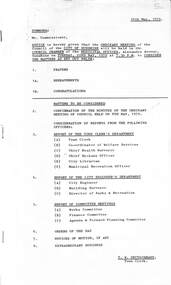 Sunshine and District Historical Society Incorporated
Administrative record - City of Sunshine - Commissioner Mr Alexander Alex George Gillon Collection 1976 - 1982 - Notice of ordinary meeting of the council 22nd May 1979, City of Sunshine, 16th May 1979
... Albans Relocation of Public Telephone Outside 38A Melton Street to between 26 & 28 Melon Street Braybrook Sewerage Facilities Declaration of Sewerage Area No 3760 Noxious Trades Outfall Sewer Replacement Lacy Street, Ballarat Road & Ashley Street, Braybrook and Thomson Street, Burns Street & Studley Street Maidstone Sewerage Facilities Council Reserve Larisa Road St. ...Albans Relocation of Public Telephone Outside 38A Melton Street to between 26 & 28 Melon Street Braybrook Sewerage Facilities Declaration of Sewerage Area No 3760 Noxious Trades Outfall Sewer Replacement Lacy Street, Ballarat Road & Ashley Street, Braybrook and Thomson Street, Burns Street & Studley Street Maidstone Sewerage Facilities Council Reserve Larisa Road St. ...Notice of Ordinary Meeting of the Council 22nd May 1979 Report of the Town Clerk's Department Report of the Town Clerk Interim Report The Role of Local Government in Victoria Activities of the Municipal Association of Victoria Propose Lease Extension Tottenham Technical School 27 Duke Street Rate Recovery Sale 2nd December 1979 Land Transfer Fairbairn Road Widening Proposed Purchase of Land Station Road for Multi-Functional Building Local Authorities Superannuation Scheme Report of the Co-Ordinator of Welfare Services Teenage Holiday Programme Australian National Youth Workers' Conference Freemantle Western Australia 18th to 24th July 1979 Family and Community Service Program Election to Committee Concessions for Telephone Installation and Rental for Pensioners Residential Tenancies Bill Braybrook Pre-School Child Care Facility Cherry Crescent Braybrook Early Childhood Development Programme Braybrook Maidstone Housing Commission Liaison Committee Report of the Chief Health Surveyor Health Act registrations for 1979 Application for Transfer of Proprietorship of Premises under the Health Act J.L. MacTaggart (Victoria) Pty Ltd Maria Street Laverton North Town and Country Planning and Health Act Objections Offensive Trades Report of the Chief By-Laws Officer Proposed No Standing Area Majorca Street St. Albans Proposed No Standing Area Martin Street Sunshine Report of the City Librarian Australian Olympic Team Fund Report of the City Engineer & Planner Planning Permit Community Health Centre Andrea Street St. Albans Planning Permit Application Temporary Child Care Centre Andrea Street St. Albans Planning Permit Application Sky Sign Lot 8 Churchill Avenue Braybrook Planning Permit Application Service Premises & Caretaker's Dwelling Lots 317 & 318 Dover Street Albanvale Planning Permit Three Factories Lot 67 Somerville Road South West Corner of McDonald Road Brooklyn Planning Permit Application Hairdressing Salon Service Premise and Caretaker's Dwelling Lot 1 Ballarat Road Planning Permit Application Travel Agency Shop 1A Lot 3 Princess Street St. Albans Planning Permit Application Small Panel Sign Lot 4 McIntyre Road Sunshine North Planning Permit Application Display Homes Lots 1, 2, 3, 4, 5 & 6 Camelot Drive South East Corner Main Road West Albanvale Planning Permit Application Alterations to Shops Lots 1 & 2 Ballarat Road Deer Park Planning Permit Application Motor Workshop Lot 1 McIntyre Road Sunshine North Planning Permit Application Medical Consulting Room and Residence Lot 1 Ballarat Road South West Corner of Burnside Street Deer Park Planning Permit Application New Offices and Showrooms Railway Lot 24 North West Corner of Berkshire Road and Steers Street Sunshine North Strata Subdivision 5 & 7 Craddock Court Sunshine North Plan of Subdivision Westerngate Estate Subdivision Westerngate Estate Stage 1A Subdivision Consolidation of Title 811 - 811A Ballarat Road Deer Park Cancellation of Easement St. Albans Road Abutting Gilmour Road Sunshine North Strata Subdivision 101 Ballarat Road Maidstone Strata Subdivision 1 & 3 Craddock Court Sunshine North Replacement of Ford Falcon Utilities and Station Wagons Boring Operations by Melbourne & Metropolitan Board of Works Station Road, Gladstone Street & Washington Street St. Albans Relocation of Public Telephone Outside 38A Melton Street to between 26 & 28 Melon Street Braybrook Sewerage Facilities Declaration of Sewerage Area No 3760 Noxious Trades Outfall Sewer Replacement Lacy Street, Ballarat Road & Ashley Street, Braybrook and Thomson Street, Burns Street & Studley Street Maidstone Sewerage Facilities Council Reserve Larisa Road St. Albans Infant Welfare Centre Alexandra Avenue Sunshine Castley Hall in Poor Condition Exterior Security Lighting Central Library and Infant Welfare Centre Report of the Building Surveyor Building Over Easement 144 Murray Street Ardeer Building Over Easement 4 Tania Street Sunshine North Building Over Easement Lots 77, 78 & 79 Somers Street Sunshine North Siting of Building 39 Dunbar Avenue Sunshine Siting of Building 4 Norma Street Sunshine Building on Flood Prone Land 27 Navigator Street Maribyrnong Building on Flood Prone Land Lot 18 Riverview Court Maribyrnong Installation of Underground Tanks 3 Millers Road Brooklyn Installation of Underground Tanks Corner Ballarat Road and Lacy Street Braybrook Uniform Building Regulations Enforcement Staff Needs Report of the Director of Parks & Recreations Winslow Crescent Application to Use Land Bon Thomas Child Care Centre Landscaping Quotes Orders of the Day Accounts Submitted for Payment as at 30th April 1979 Uniform Building Regulations Enforcement Staff Needs Confirmation of Loan with the Melbourne & Metropolitan Board of Workstottenham technical school, duke street, sunshine, station road, deer park, south road, braybrook, braybrook pre-school childcare centre, cherry crescent, braybrook maidstone housing commission liaison committee, j.l. mactaggart, maria street, laverton north, majorca street, st. albans, martin street, andrea street, andrea street community health care centre, churchill avenue, dover street, albanvale, somerville road, mcdonald road, brooklyn, ballarat road, princess street, mcintyre road, sunshine north, camelot drive, main road west, burnside street, berkshire road, steers street, craddock court, maidstone, gladstone street, washington street, melton street, lacy street, ashley street, thomson street, burns street, studley street, larisa reserve, larisa road, alexandra avenue infant welfare centre, alexandra avenue, castley hall, simmie street, sunshine west, murray street, ardeer, tania street, somers street, dunbar avenue, norma street, navigator street, riverview court, maribyrnong, millers road, bon thomas child care centre, quinn street -
 Sunshine and District Historical Society Incorporated
Administrative record - City of Sunshine - Commissioner Mr Alexander "Alex" George Gillon Collection 1976 - 1982 - Minutes of the ordinary meeting of council held on 22nd August 1978, City of Sunshine, 22nd August 1978
... Minutes of the Ordinary Meeting of Council held on 22nd August 1978 Report of the Town Clerk's Department Report of the Town Clerk Review of Role and Structure of Local Government Federal Finance for Local Government Use of Melbourne & Metropolitan Board of Works Quarters at O'Shannassy, Wallaby Creek and Robertson Land Transfer Discontinued Right of Way Rear of Railway Parade and Wood Street Deer Park Dickson Street Part Private Street Scheme Loan Programme 1978/79 Hulett Street Construction Scheme Report of the Co-Ordinator of Welfare Services Toddler Groups Toddler Group for Children At Risk Social Work Students Maribyrnong Senior Citizens Club Resource Centre / Toy Library Establishment of a Multi-Cultural Senior Citizens Club in Sunshine West Youth Counselling Service Report of the Acting Chief Health Inspector Quarterly Return of Food Samples Keep Australian Beautiful Council Head Lice Campaign Health Act Registrations Application for Transfer of Proprietorship of Premises under the Health Act Annual Inspections Infant Welfare Centres Sewage Overflow 2 Bruce Street Sunshine Report of the Chief By-Laws Officer Removal of Fire Hazards 1978/79 Dog Act Fixing of Registration Fees Report of the City Librarian Bookmobile Maidstone Branch Library Yardley Street to be Closed 29th September and Replaced with Bookmobile Report of the Municipal Recreation Officer Student's Representative Council University of Melbourne Summer School Seminar Multiple Sclerosis Society of Victoria Request for Land Provision of Minibuses for Community Groups Interim Planning Committee Albanvale Primary School Diamond Avenue Reserve Sunshine West High School Community Use Agreement Report of the City Engineer Preferred Development Areas Newmarket Relocation Proposal Planning Permit Application Subdivision and Detached Houses Oakwood Road Town Planning Appeal Planning Permit Application Extension to Factory Graingers Street Sunshine North Planning Permit Application East Side of Hampshire Road North of Existing Sunshine Shopping Cente Generally Bounded by Hampshire Road, Hertford Road, George Street and Service Street Including the Property Occupied by Massey Ferguson Spare Parts Store South of Service Street Rezoning Application Planning Permit Application Service station and Factory 784 Ballarat Road North West Corner Glencairn Avenue Planning Permit Application Warehouse and Workshop Hawthorn Avenue Planning Permit Application Neale Road Subdivision and Detached Houses Town Planning Appeal Home Occupation Three Phase Power Connection 170 Wright Street Planning Permit Flats 17 King Edward Avenue Planning Permit Application Institutional Home Lot 509 Tallintyre Road Planning Permit Application Nursing Home Thompson Street Maidstone Planning Permit Medical Consultation Room South East Corner Percy Street and Main Road East Planning Permit Application Extension to Existing Factory Marshall Street Plan of Subdivision Ballarat Road and Anderson Road Plan of Subdivision Robinsons Road Strata Subdivision Lot 59 Fabian Court Contract Fire Service Sunshine Tip Consolidation of Title Trafalgar Street Employment of Engineering Students for Vocational Training Provision of Footbridge Over Kororoit Creek Reconstruction of South Road Flooding 7th & 8th August 1978 Establishment of Recycling Depot at Sunshine Tip Provision of Spoil for Sunshine Tip Billingham Road Drain Kororoit Creek to Robinsons Road Resitting of Public Telephones Sunshine Road Declaration of Sewage Area No 3550 Footscray West Mail Centre Hampstead Road Closure of Right of Way Between Chicago Street and Chifley Drive Construction of Right of Way Between Randall Street and Barb Street Derelict Cars and Domestic Ferrous Scrap Report of the Building Surveyor 28 - 30 Ridley Street Albion Cancellation of Permit Lot 119 Ballarat Road Application to Build Over Easement 7 Bella Court Sunshine West Application to Build Over Easement 15 Beech Court Sunshine West Building Permit Fees for Council Buildings Report of the Director of Parks & Recreation Bon Thomas Subdivision and Reserve Development Orders of the Day Accounts Submitted for Payment as at 1st July 1978 & 5th August 1978 Proposal to Construct Hulett Street Under The Provisions of Division 10 of Pary XIX of the Local Government Act 1958 Proposal to Construct Dickson Street Under The Provisions of Division 10 of Pary XIX of the Local Government Act 1958 Proposal to Construct Warrs Road (Northern Section) Under The Provisions of Division 10 of Pary XIX of the Local Government Act 1958 Extraordinary Business Report of the Acting Chief Health Officer The Australian Institute of Health Surveyors' 5th National Conference Report of the City Engineer Planning Permit Application Office and Extension of Amenities Building Railway Siding Wright Street Planning Permit Application Car Port Belvedere Close Maribyrnong...Albans Marshall Street Anderson Road Robinsons Road Fabian Court Maribyrnong Sunshine Tip Trafalgar Street Kororoit Creek South Road Braybrook Sunshine Road Tottenham Hampstead Road Chicago Street Chifley Drive Randall Street Barb Street Ridley Street Bella Court Beech Court Bon Thomas Reserve Quinn Street Warrs Road Belvedere Close Minutes of the Ordinary Meeting of Council held on 22nd August 1978 Report of the Town Clerk's Department Report of the Town Clerk Review of Role and Structure of Local Government Federal Finance for Local Government Use of Melbourne & Metropolitan Board of Works Quarters at O'Shannassy, Wallaby Creek and Robertson Land Transfer Discontinued Right of Way Rear of Railway Parade and Wood Street Deer Park Dickson Street Part Private Street Scheme Loan Programme 1978/79 Hulett Street Construction Scheme Report of the Co-Ordinator of Welfare Services Toddler Groups Toddler Group for Children At Risk Social Work Students Maribyrnong Senior Citizens Club Resource Centre / Toy Library Establishment of a Multi-Cultural Senior Citizens Club in Sunshine West Youth Counselling Service Report of the Acting Chief Health Inspector Quarterly Return of Food Samples Keep Australian Beautiful Council Head Lice Campaign Health Act Registrations Application for Transfer of Proprietorship of Premises under the Health Act Annual Inspections Infant Welfare Centres Sewage Overflow 2 Bruce Street Sunshine Report of the Chief By-Laws Officer Removal of Fire Hazards 1978/79 Dog Act Fixing of Registration Fees Report of the City Librarian Bookmobile Maidstone Branch Library Yardley Street to be Closed 29th September and Replaced with Bookmobile Report of the Municipal Recreation Officer Student's Representative Council University of Melbourne Summer School Seminar Multiple Sclerosis Society of Victoria Request for Land Provision of Minibuses for Community Groups Interim Planning Committee Albanvale Primary School Diamond Avenue Reserve Sunshine West High School Community Use Agreement Report of the City Engineer Preferred Development Areas Newmarket Relocation Proposal Planning Permit Application Subdivision and Detached Houses Oakwood Road Town Planning Appeal Planning Permit Application Extension to Factory Graingers Street Sunshine North Planning Permit Application East Side of Hampshire Road North of Existing Sunshine Shopping Cente Generally Bounded by Hampshire Road, Hertford Road, George Street and Service Street Including the Property Occupied by Massey Ferguson Spare Parts Store South of Service Street Rezoning Application Planning Permit Application Service station and Factory 784 Ballarat Road North West Corner Glencairn Avenue Planning Permit Application Warehouse and Workshop Hawthorn Avenue Planning Permit Application Neale Road Subdivision and Detached Houses Town Planning Appeal Home Occupation Three Phase Power Connection 170 Wright Street Planning Permit Flats 17 King Edward Avenue Planning Permit Application Institutional Home Lot 509 Tallintyre Road Planning Permit Application Nursing Home Thompson Street Maidstone Planning Permit Medical Consultation Room South East Corner Percy Street and Main Road East Planning Permit Application Extension to Existing Factory Marshall Street Plan of Subdivision Ballarat Road and Anderson Road Plan of Subdivision Robinsons Road Strata Subdivision Lot 59 Fabian Court Contract Fire Service Sunshine Tip Consolidation of Title Trafalgar Street Employment of Engineering Students for Vocational Training Provision of Footbridge Over Kororoit Creek Reconstruction of South Road Flooding 7th & 8th August 1978 Establishment of Recycling Depot at Sunshine Tip Provision of Spoil for Sunshine Tip Billingham Road Drain Kororoit Creek to Robinsons Road Resitting of Public Telephones Sunshine Road Declaration of Sewage Area No 3550 Footscray West Mail Centre Hampstead Road Closure of Right of Way Between Chicago Street and Chifley Drive Construction of Right of Way Between Randall Street and Barb Street Derelict Cars and Domestic Ferrous Scrap Report of the Building Surveyor 28 - 30 Ridley Street Albion Cancellation of Permit Lot 119 Ballarat Road Application to Build Over Easement 7 Bella Court Sunshine West Application to Build Over Easement 15 Beech Court Sunshine West Building Permit Fees for Council Buildings Report of the Director of Parks & Recreation Bon Thomas Subdivision and Reserve Development Orders of the Day Accounts Submitted for Payment as at 1st July 1978 & 5th August 1978 Proposal to Construct Hulett Street Under The Provisions of Division 10 of Pary XIX of the Local Government Act 1958 Proposal to Construct Dickson Street Under The Provisions of Division 10 of Pary XIX of the Local Government Act 1958 Proposal to Construct Warrs Road (Northern Section) Under The Provisions of Division 10 of Pary XIX of the Local Government Act 1958 Extraordinary Business Report of the Acting Chief Health Officer The Australian Institute of Health Surveyors' 5th National Conference Report of the City Engineer Planning Permit Application Office and Extension of Amenities Building Railway Siding Wright Street Planning Permit Application Car Port Belvedere Close Maribyrnong Foolscap plain paper sheets stapled along the left edge into booklet format. ...Minutes of the Ordinary Meeting of Council held on 22nd August 1978 Report of the Town Clerk's Department Report of the Town Clerk Review of Role and Structure of Local Government Federal Finance for Local Government Use of Melbourne & Metropolitan Board of Works Quarters at O'Shannassy, Wallaby Creek and Robertson Land Transfer Discontinued Right of Way Rear of Railway Parade and Wood Street Deer Park Dickson Street Part Private Street Scheme Loan Programme 1978/79 Hulett Street Construction Scheme Report of the Co-Ordinator of Welfare Services Toddler Groups Toddler Group for Children At Risk Social Work Students Maribyrnong Senior Citizens Club Resource Centre / Toy Library Establishment of a Multi-Cultural Senior Citizens Club in Sunshine West Youth Counselling Service Report of the Acting Chief Health Inspector Quarterly Return of Food Samples Keep Australian Beautiful Council Head Lice Campaign Health Act Registrations Application for Transfer of Proprietorship of Premises under the Health Act Annual Inspections Infant Welfare Centres Sewage Overflow 2 Bruce Street Sunshine Report of the Chief By-Laws Officer Removal of Fire Hazards 1978/79 Dog Act Fixing of Registration Fees Report of the City Librarian Bookmobile Maidstone Branch Library Yardley Street to be Closed 29th September and Replaced with Bookmobile Report of the Municipal Recreation Officer Student's Representative Council University of Melbourne Summer School Seminar Multiple Sclerosis Society of Victoria Request for Land Provision of Minibuses for Community Groups Interim Planning Committee Albanvale Primary School Diamond Avenue Reserve Sunshine West High School Community Use Agreement Report of the City Engineer Preferred Development Areas Newmarket Relocation Proposal Planning Permit Application Subdivision and Detached Houses Oakwood Road Town Planning Appeal Planning Permit Application Extension to Factory Graingers Street Sunshine North Planning Permit Application East Side of Hampshire Road North of Existing Sunshine Shopping Cente Generally Bounded by Hampshire Road, Hertford Road, George Street and Service Street Including the Property Occupied by Massey Ferguson Spare Parts Store South of Service Street Rezoning Application Planning Permit Application Service station and Factory 784 Ballarat Road North West Corner Glencairn Avenue Planning Permit Application Warehouse and Workshop Hawthorn Avenue Planning Permit Application Neale Road Subdivision and Detached Houses Town Planning Appeal Home Occupation Three Phase Power Connection 170 Wright Street Planning Permit Flats 17 King Edward Avenue Planning Permit Application Institutional Home Lot 509 Tallintyre Road Planning Permit Application Nursing Home Thompson Street Maidstone Planning Permit Medical Consultation Room South East Corner Percy Street and Main Road East Planning Permit Application Extension to Existing Factory Marshall Street Plan of Subdivision Ballarat Road and Anderson Road Plan of Subdivision Robinsons Road Strata Subdivision Lot 59 Fabian Court Contract Fire Service Sunshine Tip Consolidation of Title Trafalgar Street Employment of Engineering Students for Vocational Training Provision of Footbridge Over Kororoit Creek Reconstruction of South Road Flooding 7th & 8th August 1978 Establishment of Recycling Depot at Sunshine Tip Provision of Spoil for Sunshine Tip Billingham Road Drain Kororoit Creek to Robinsons Road Resitting of Public Telephones Sunshine Road Declaration of Sewage Area No 3550 Footscray West Mail Centre Hampstead Road Closure of Right of Way Between Chicago Street and Chifley Drive Construction of Right of Way Between Randall Street and Barb Street Derelict Cars and Domestic Ferrous Scrap Report of the Building Surveyor 28 - 30 Ridley Street Albion Cancellation of Permit Lot 119 Ballarat Road Application to Build Over Easement 7 Bella Court Sunshine West Application to Build Over Easement 15 Beech Court Sunshine West Building Permit Fees for Council Buildings Report of the Director of Parks & Recreation Bon Thomas Subdivision and Reserve Development Orders of the Day Accounts Submitted for Payment as at 1st July 1978 & 5th August 1978 Proposal to Construct Hulett Street Under The Provisions of Division 10 of Pary XIX of the Local Government Act 1958 Proposal to Construct Dickson Street Under The Provisions of Division 10 of Pary XIX of the Local Government Act 1958 Proposal to Construct Warrs Road (Northern Section) Under The Provisions of Division 10 of Pary XIX of the Local Government Act 1958 Extraordinary Business Report of the Acting Chief Health Officer The Australian Institute of Health Surveyors' 5th National Conference Report of the City Engineer Planning Permit Application Office and Extension of Amenities Building Railway Siding Wright Street Planning Permit Application Car Port Belvedere Close Maribyrnong city of sunshine, alexander "alex" george gillon, railway parade, wood street, deer park, dickson street, sunshine, hulett street, albion, maribyrnong senior citizens club, multi-cultural senior citizens club, bruce street, maidstone branch library, yardley street, albanvale primary school, diamond avenue reserve, diamond avenue, albanvale, sunshine west high school, lachlan street, sunshine west, oakwood road, graingers street, sunshine north, hampshire road, hertford road, george street, service street, massey ferguson, ballarat road, glencairn avenue, hawthorn avenue, neale road, wright street, king edward avenue, tallintyre road, thompson street, maidstone, percy street, main road east, st. albans, marshall street, anderson road, robinsons road, fabian court, maribyrnong, sunshine tip, trafalgar street, kororoit creek, south road, braybrook, sunshine road, tottenham, hampstead road, chicago street, chifley drive, randall street, barb street, ridley street, bella court, beech court, bon thomas reserve, quinn street, warrs road, belvedere close -
 Sunshine and District Historical Society Incorporated
Administrative record - City of Sunshine - Commissioner Mr Alexander "Alex" George Gillon Collection 1976 - 1982 - Minutes of the Ordinary Meeting of Council Held on 3rd October 1978, City of Sunshine, 3rd October 1978
... Allocation of Funds 1978/79 Joint Works Unclassified Roads Telecom Australia Modernisation of Public Telephones St. Albans Area Ashley Street / South Road Proposed Traffic Lights Maribyrnong River Flood Plan Acting Commissioner of Police Sewerage Facilities St. ...Allocation of Funds 1978/79 Joint Works Unclassified Roads Telecom Australia Modernisation of Public Telephones St. Albans Area Ashley Street / South Road Proposed Traffic Lights Maribyrnong River Flood Plan Acting Commissioner of Police Sewerage Facilities St. ...Minutes of the Ordinary Meeting of Council Held on 3rd October 1978 Reports on the Town Clerk's Department Report of the Town Clerk Victorian Beer Alcoholic Content Proposal for Reduction Land Transfer Adjacent to Deer Park Hotel Medway Golf Club Payment in Lieu of Rates Diamond Avenue Infant Welfare Centre Non-Availability of Subsidy Untied Grants Proposed Library Highpoint West Shopping Centre Land Transfer Discontinued Right of Way Rear of Railway Parade Deer Park Supplementary Valuations Community Youth Support Scheme Report of the Chief Health Inspector Nuisance Condition at 403 Ballarat Road Sunshine Removal of Dwelling Outside the Municipality Health Act Registrations Monsanto Application for Approval to Install Septic Tank Recirculating Sand Filter System at the Stansfield Steel Project Fairbairn Road Sunshine West Health (Tent) Regulations 1978 Draft Rubbish In and Around Flats Quarry Hole Commonwealth Land J.L. MacTaggart (Australia) Pty Ltd Noise By-Law Application for Transfer of Proprietorship of Premises Under the Health Act Infectious Diseases Sewerage Overflow 2 Bruce Street Albion Smoking in Public Buildings Immunisation Sunshine North Institute of Weights & Measures Annual National Conference Report of the Chief By-Laws Officer Court Proceedings Parking and Traffic Infringements Prohibited Parking Links Street Prohibited Parking Princess Street Area Prohibited Parking Gould Street Report of the City Librarian Bookmobile sites Municipal library Subsidy 1978/79 Bookmobile Seminar Children's Literature seconds National Seminar September 1st to 5th 1978 Report of the Municipal Recreation Officer Municipal Recreation Service Gound Allocations School Summer Season Holiday Programmes September 1978 Report of the City Engineer Proposed Children's Reception Centre for Erection in the City of Sunshine Planning Permit Application Illuminated Sign Churchill Avenue Planning Permit Application Grazing of Horses Furlong Road Planning Permit Application Offices Main Road West Planning Permit Application Extension to Exising Car Sales Yard Rosamond Road Planning Permit Application Corner of Neale Road and Station Road Deer Park Proposed Amendment No 81 to the Melbourne Metropolitan Planning Scheme Proposed Widening of Station Road Planning Permit Application Motor Repair Station Wright Street Planning Permit Application Sky Sign Hampshire Road Planning Permit Application Extension to Existing Warehouse McIntyre Road Planning Permit Application Consulting Rooms, Pharmacy, Service Premises and Caretaker's Dwelling Corner of Tamar Drive and Billingham Road Planning Permit Application Horse Grazing Judge Street & Norman Street Planning Permit Application Signs Geelong Road Planning Permit Application Factory Extension Carrington Drive Planning Permit Application Sky Sign Ballarat Road Sunshine Planning Permit Application Factory and Office Gee Street Sunshine North Planning Permit Application Drive in Bottle Shop and Extensions to St. Albans Hotel McKechnie Street Planning Permit Application Sky Sign & Fascia Signs Ballarat Road Sunshine Planning Permit Application Store Addition to Existing Office Geelong Road Plan of Subdivision Boral Resources Ballarat Road & Hulett Street Plan of Subdivision R.D.C. Projects Evergreen Avenue and Pineneedle Court Plan of Subdivision McPhersons Mitchell Street Plan of Subdivision Navigator Street Consolidation of Title Marshall Street Consolidation of Title Kevin Dennis Motors Ballarat Road and Annersley Street Consolidation of Title Lots 37 & 38 Balfour Avenue Contract Playground Equipment Various Reserves Contract Reconstruction of Sydney Street Contract Gooding Street 40 Hour Week Victorian Sewerage and Drainage Contractors' Group Declaration of Sewered Properties General Notice Sewerage Facilities M.M.B.W. Allocation of Funds 1978/79 Joint Works Unclassified Roads Telecom Australia Modernisation of Public Telephones St. Albans Area Ashley Street / South Road Proposed Traffic Lights Maribyrnong River Flood Plan Acting Commissioner of Police Sewerage Facilities St. Albans (Albanvale) Warrs Road Northern Section Private Street Scheme Use of C.R.B. land McIntyre Road for Recreation Purposes Garaging of Meals on Wheels Vehicles at Maidstone Hall Thomson Street Maidstone Relocation of Steel Framed Steel Clad Sheds to Errington Reserve and Robert Bruce Reserve Rosamond Bowling Club Report of the Building Surveyor Building Over Easement 135 Devonshire Road Sunshine Building Over Easement 10 Sproul Street Sunshine North Building Over Easement Lot 552 Oakwood Road St. Albans Building Over Easement 6 Haven Close Sunshine West Building Over Easement 75 Norwood Street Albion Building Over Easement182 Wright Street Sunshine West Building Over Easement 176 McIntyre Road Sunshine North Installation of Underground Tanks Corner Raleigh Road and Navigator Street Maribyrnong Ruinous and Dangerous Building Lots 6 & 7 Furlong Road Sunshine North Orders of the Day Accounts for Payment as at 15th September 1978, 26th September 1978 Extraordinary Business Report of the City Engineer Planning Permit Application Medical Consulting Rooms Clarke Street Sunshine Planning Permit Application Take away Food Premises Cafe Amusement Parlour Highpoint City Rosamond Road city of sunshine, alexander "alex" george gillon, deer park hotel, ballarat road, deer park, medway golf club, omar street, maidstone, diamond avenue infant welfare centre, diamond avenue, albanvale, highpoint west shopping centre, rosamond road, maribyrnong, railway parade, sunshine, monsanto, somerville road, footscray west, fairbairn road, sunshine west, j.l. mactaggart (australia) pty ltd, bruce street, albion, links street, princess street, st. albans, gould street, churchill avenue, braybrook, main road west, furlong road, sunshine north, neale road, station road, wright street, hampshire road, mcintyre road, tamar drive, billingham road, judge street, norman street, geelong road, brooklyn, carrington drive, gee street, st. albans hotel, mckechnie street, hulett street, pineneedle court, mitchell street, navigator street, marshall street, kevin dennis motors, annersley street, balfour avenue, sydney street, gooding street, ashley street, south road, maribyrnong river, warrs road, maidstone hall, thomson street, errington reserve, robert bruce reserve, rosamond bowling club, main road east, devonshire road, sproul street, oakwood road, haven close, norwood street, raleigh road, clarke street, highpoint city -
 Sunshine and District Historical Society Incorporated
Administrative record - City of Sunshine - Commissioner Mr Alexander Alex George Gillon Collection 1976 - 1982 - Minutes of the ordinary meeting of council held on 22nd May 1979, City of Sunshine, 22nd May 1979
... Albans Relocation of Public Telephone Outside 38A Melton Street to between 26 & 28 Melon Street Braybrook Sewerage Facilities Declaration of Sewerage Area No 3760 Noxious Trades Outfall Sewer Replacement Lacy Street, Ballarat Road & Ashley Street, Braybrook and Thomson Street, Burns Street & Studley Street Maidstone Sewerage Facilities Council Reserve Larisa Road St. ...Albans Relocation of Public Telephone Outside 38A Melton Street to between 26 & 28 Melon Street Braybrook Sewerage Facilities Declaration of Sewerage Area No 3760 Noxious Trades Outfall Sewer Replacement Lacy Street, Ballarat Road & Ashley Street, Braybrook and Thomson Street, Burns Street & Studley Street Maidstone Sewerage Facilities Council Reserve Larisa Road St. ...Minutes of the Ordinary Meeting of Council held on 22nd May 1979 Report of the Town Clerk's Department Report of the Town Clerk Interim Report The Role of Local Government in Victoria Activities of the Municipal Association of Victoria Propose Lease Extension Tottenham Technical School 27 Duke Street Rate Recovery Sale 2nd December 1979 Land Transfer Fairbairn Road Widening Proposed Purchase of Land Station Road for Multi-Functional Building Local Authorities Superannuation Scheme Report of the Co-Ordinator of Welfare Services Teenage Holiday Programme Australian National Youth Workers' Conference Freemantle Western Australia 18th to 24th July 1979 Family and Community Service Program Election to Committee Concessions for Telephone Installation and Rental for Pensioners Residential Tenancies Bill Braybrook Pre-School Child Care Facility Cherry Crescent Braybrook Early Childhood Development Programme Braybrook Maidstone Housing Commission Liaison Committee Report of the Chief Health Surveyor Health Act registrations for 1979 Application for Transfer of Proprietorship of Premises under the Health Act J.L. MacTaggart (Victoria) Pty Ltd Maria Street Laverton North Town and Country Planning and Health Act Objections Offensive Trades Report of the Chief By-Laws Officer Proposed No Standing Area Majorca Street St. Albans Proposed No Standing Area Martin Street Sunshine Report of the City Librarian Australian Olympic Team Fund Report of the City Engineer & Planner Planning Permit Community Health Centre Andrea Street St. Albans Planning Permit Application Temporary Child Care Centre Andrea Street St. Albans Planning Permit Application Sky Sign Lot 8 Churchill Avenue Braybrook Planning Permit Application Service Premises & Caretaker's Dwelling Lots 317 & 318 Dover Street Albanvale Planning Permit Three Factories Lot 67 Somerville Road South West Corner of McDonald Road Brooklyn Planning Permit Application Hairdressing Salon Service Premise and Caretaker's Dwelling Lot 1 Ballarat Road Planning Permit Application Travel Agency Shop 1A Lot 3 Princess Street St. Albans Planning Permit Application Small Panel Sign Lot 4 McIntyre Road Sunshine North Planning Permit Application Display Homes Lots 1, 2, 3, 4, 5 & 6 Camelot Drive South East Corner Main Road West Albanvale Planning Permit Application Alterations to Shops Lots 1 & 2 Ballarat Road Deer Park Planning Permit Application Motor Workshop Lot 1 McIntyre Road Sunshine North Planning Permit Application Medical Consulting Room and Residence Lot 1 Ballarat Road South West Corner of Burnside Street Deer Park Planning Permit Application New Offices and Showrooms Railway Lot 24 North West Corner of Berkshire Road and Steers Street Sunshine North Strata Subdivision 5 & 7 Craddock Court Sunshine North Plan of Subdivision Westerngate Estate Subdivision Westerngate Estate Stage 1A Subdivision Consolidation of Title 811 - 811A Ballarat Road Deer Park Cancellation of Easement St. Albans Road Abutting Gilmour Road Sunshine North Strata Subdivision 101 Ballarat Road Maidstone Strata Subdivision 1 & 3 Craddock Court Sunshine North Replacement of Ford Falcon Utilities and Station Wagons Boring Operations by Melbourne & Metropolitan Board of Works Station Road, Gladstone Street & Washington Street St. Albans Relocation of Public Telephone Outside 38A Melton Street to between 26 & 28 Melon Street Braybrook Sewerage Facilities Declaration of Sewerage Area No 3760 Noxious Trades Outfall Sewer Replacement Lacy Street, Ballarat Road & Ashley Street, Braybrook and Thomson Street, Burns Street & Studley Street Maidstone Sewerage Facilities Council Reserve Larisa Road St. Albans Infant Welfare Centre Alexandra Avenue Sunshine Castley Hall in Poor Condition Exterior Security Lighting Central Library and Infant Welfare Centre Report of the Building Surveyor Building Over Easement 144 Murray Street Ardeer Building Over Easement 4 Tania Street Sunshine North Building Over Easement Lots 77, 78 & 79 Somers Street Sunshine North Siting of Building 39 Dunbar Avenue Sunshine Siting of Building 4 Norma Street Sunshine Building on Flood Prone Land 27 Navigator Street Maribyrnong Building on Flood Prone Land Lot 18 Riverview Court Maribyrnong Installation of Underground Tanks 3 Millers Road Brooklyn Installation of Underground Tanks Corner Ballarat Road and Lacy Street Braybrook Uniform Building Regulations Enforcement Staff Needs Report of the Director of Parks & Recreations Winslow Crescent Application to Use Land Bon Thomas Child Care Centre Landscaping Quotes Orders of the Day Accounts Submitted for Payment as at 30th April 1979 Uniform Building Regulations Enforcement Staff Needs Confirmation of Loan with the Melbourne & Metropolitan Board of Works Extraordinary Business Report of the Town Clerk Election of Council Representative Metropolitan Fire Brigade's Boardtottenham technical school, duke street, sunshine, station road, deer park, south road, braybrook, braybrook pre-school child care facility, cherry crescent, j.l. mactaggart, maria street, laverton north, majorca street, st. albans, martin street, andrea street community health care centre, andrea street, churchill avenue, dover street, albanvale, somerville road, mcdonald road, brooklyn, princess street, mcintyre road, sunshine north, camelot drive, main road west, ballarat road, burnside street, berkshire road, steers street, craddock court, st. albans road, gilmour road, maidstone, gladstone street, washington street, melton street, lacy street, ashley street, thomson street, burns street, studley street, laris reserve, larisa road, alexandra avenue infant welfare centre, alexandra avenue, castley hall, simmie street, sunshine west, murray street, ardeer, tania street, somers street, dunbar avenue, norma street, navigator street, riverview court, maribyrnong, millers road, bon thomas child care centre, quinn street
