
Showing 8 items matching "queen alexandra's imperial military nursing service medal"
-
 Returned Nurses RSL Sub-branch
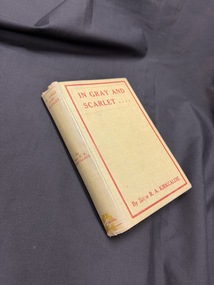
Book - Illustrated hardback book, R[osa] A[ngela] Kirkcaldie, The Australian Army Medical Corps in Egypt : An illustrated and detailed account of the early organisation and work of the Australian medical units in Egypt in 1914-1915, 1922
... Queen Alexandra's Imperial Military Nursing Service Medal...WWI WW1 World War One Australian Nurses Army Nurse Naval Nurse Queen Alexandra's Imperial Military Nursing Service Reserve Queen Alexandra's Imperial Military Nursing Service Medal R[osa] A[ngela] Kirkcaldie A memoir about author's experience of working as a nurse for the Australian Army during World War One. ...A memoir about author's experience of working as a nurse for the Australian Army during World War One. [Appears to have been fleshed out from diary/journal entries]A hardback book bound in pale olive green bookcloth with red text and details on the cover and spine. The book has damage to the edges of the covers and inside the front cover part of the original dust jacket is glued.non-fictionA memoir about author's experience of working as a nurse for the Australian Army during World War One. [Appears to have been fleshed out from diary/journal entries]wwi, ww1, world war one, australian nurses, army nurse, naval nurse, queen alexandra's imperial military nursing service reserve, queen alexandra's imperial military nursing service medal, r[osa] a[ngela] kirkcaldie -
 Returned Nurses RSL Sub-branch
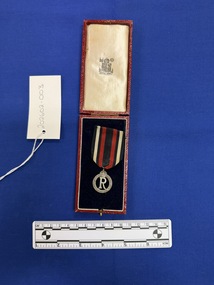
Badge - Qualification badge Queen Alexandra's Imperial Military Nursing Service Reserve, Royal Mint, unknown
... The medal has a large voided 'R' in the centre with a crown on top, surrounded by the words Queen Alexandra's Imperial Military Nursing Service Reserve. ...The medal has a large voided 'R' in the centre with a crown on top, surrounded by the words Queen Alexandra's Imperial Military Nursing Service Reserve. ...Qualification badges for the Queen Alexandra's Imperial Military Nursing Service Reserve were worn pinned to the uniform shoulder cape. (Australian War Memorial website - see references)Small silver medal hanging on a piece of red ribbon with a dark blue central stripe and dark blue, white and dark blue side stripes. The medal has a large voided 'R' in the centre with a crown on top, surrounded by the words Queen Alexandra's Imperial Military Nursing Service Reserve. The medal and ribbon sit inside the lower half of a Royal mint box on a blue cushion with the Royal Mint logo stamped on the upper inside and a red covering on the outside of the box.wwi, world war one, ww1, nursing in warfare, queen alexandra's imperial military nursing service reserve -
 Alfred Hospital Nurses League - Nursing History Collection
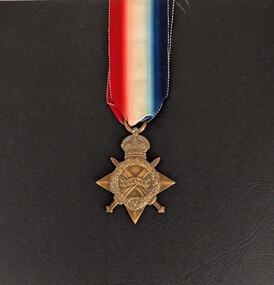
Medal - War War I medal, Royal Mint, 1914-1915 Star (Leah Rosenthal), ca.1918
... Imperial forces against the Central European Powers in any theatre of the Great War between 5 August 1914 and 31 December 1915, provided they had not already received the 1914 Star. The period of eligibility was prior to the Military Service Act 1916, which introduced conscription in Britain. Recipients also received the British War Medal and the Victory Medal. Leah Rosenthal volunteered with Queen Alexandra's Imperial Nursing...Imperial forces against the Central European Powers in any theatre of the Great War between 5 August 1914 and 31 December 1915, provided they had not already received the 1914 Star. The period of eligibility was prior to the Military Service Act 1916, which introduced conscription in Britain. Recipients also received the British War Medal and the Victory Medal. Leah Rosenthal volunteered with Queen Alexandra's Imperial Nursing ...The 1914–15 Star was instituted in December 1918 and was awarded to all who served in the British and Imperial forces against the Central European Powers in any theatre of the Great War between 5 August 1914 and 31 December 1915, provided they had not already received the 1914 Star. The period of eligibility was prior to the Military Service Act 1916, which introduced conscription in Britain. Recipients also received the British War Medal and the Victory Medal. Leah Rosenthal volunteered with Queen Alexandra's Imperial Nursing Service Reserve, serving in France, and also was awarded the Associate Royal Red CrossOf significance to the AHNL as the recipient was an Alfred Hospital GraduateThe medal, based on the design of the earlier 1914 Star, is a four-pointed star of bright bronze, ensigned with a crown. The medal and suspension assembly was struck in one piece. The obverse has two crossed gladii (swords) with their blades upwards, the points and grips of which form what might appear to be four additional points to the star. The swords are overlaid by a wreath of oak leaves, with the Royal Cypher of King George V at the base of the wreath and an overlaying central scroll inscribed "1914–15". The reverse is plain and is impressed with the recipient's details [LIEUT. /J. ROSENTHAL. RANC] The attached ribbon has the red, white and blue colours of the flag of the United Kingdom in shaded and watered bands. The medal has been mounted on card together with recipient's British War Medal and Victory Medalalfred hospital, world war 1914-1918, nurses, leah rosenthal, queen alexandra's imperial military nursing service reserve -
 Alfred Hospital Nurses League - Nursing History Collection
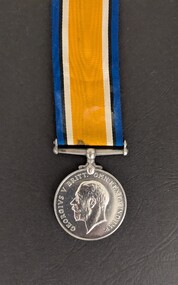
Medal - World War 1 medal, Royal Mint, British War Medal (Leah Rosenthal), 1919
... The British War Medal was awarded to British and Imperial forces for service during World War 1.Recipients also received the Military Star( where applicable) and the Victory Medal. Leah Rosenthal volunteered with Queen Alexandra's Imperial Nursing...The British War Medal was awarded to British and Imperial forces for service during World War 1.Recipients also received the Military Star( where applicable) and the Victory Medal. Leah Rosenthal volunteered with Queen Alexandra's Imperial Nursing ...The British War Medal was awarded to British and Imperial forces for service during World War 1.Recipients also received the Military Star( where applicable) and the Victory Medal. Leah Rosenthal volunteered with Queen Alexandra's Imperial Nursing Service Reserve, serving in France, and also was awarded the Associate Royal Red CrossOf significance to the AHNL as Leah Rosental was an Alfred nursing graduateRound silver medal with a straight clasp suspender without swivel. The front of the medal depicts the bare head effigy of King George V facing left. Around the perimeter "GEORGIVS V BRITT: OMN: REX ET IND: IMP:" (George V, King of all the British Isles and Emperor of India). The reverse, designed by William McMillan, shows Saint George naked on horseback and armed with a short sword, an allegory of the physical and mental strength which achieved victory over Prussianism. The horse tramples on the Prussian eagle shield and the emblems of death, a skull and crossbones. In the background are ocean waves and just off-centre near the right upper rim is the risen sun of Victory. The years "1914" and "1918" appear on the perimeter in the left and right fields respectively. The attached ribbon consists of a central broad golden-yellow stripe flanked by white and black stipes with royal blue borders. The medal has been mounted on card along with the 1914-1915 Military Star and The Victory Medalworld war 1, world war 1914-1918, leah rosenthal, queen alexandra's imperial nursing service reserve, military medals, british war medal -
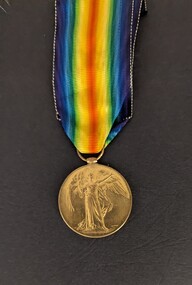 Alfred Hospital Nurses League - Nursing History Collection
Medal - World War 1 medal, Royal Mint, Victory Medal (Leah Rosenthal), [ca.1919]
... This medal was awarded to Leah Rosenthal (Alfred Hospital trained nurse)who served with Queen Alexandra's Nursing Service Reserve in France during World War 1 Of significance to the AHNL as the recipient had trained at the Alfred Hospital, graduating in 1904 World War 1 Military Medals World War 1 Victory Medal Leah Rosenthal Queen Alexandra's Imperial Military Nursing Service Reserve The reverse side bears the inscription "THE GREAT /WAR FOR/CIVILISATION/1914-1919" within a laurel wreath Round bronze medal with attached ring and ribbon. ...This medal was awarded to Leah Rosenthal (Alfred Hospital trained nurse)who served with Queen Alexandra's Nursing Service Reserve in France during World War 1Of significance to the AHNL as the recipient had trained at the Alfred Hospital, graduating in 1904Round bronze medal with attached ring and ribbon. The front of the medal displays a full-length winged figure (Victory) holding a palm leaf in her right hand. The ribbon has vertical stripes of red yellow, green,blue and violet from centre outwards. Has been mounted on a card along with the recipients 1914-1915 Military Star and British War MedalThe reverse side bears the inscription "THE GREAT /WAR FOR/CIVILISATION/1914-1919" within a laurel wreathworld war 1, military medals, world war 1 victory medal, leah rosenthal, queen alexandra's imperial military nursing service reserve -
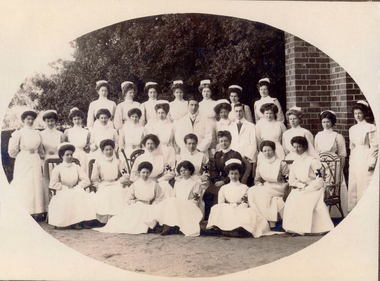 Ballarat Base Hospital Trained Nurses League
Priscilla Wardle - Trainee Ballarat District Hospital, 27/02/1905 to 01/03/1908 and WW1 Nurse. Also Edith Popplewell & Lily MacKenzie
... Queen Alexandra’s Imperial Military Nursing Service Reserve (QAIMNSR) uniform. Notice the distinctive grey cape with “wine coloured” border Priscilla is also wearing her QAIMNSR qualification badge (medal) on the right side. ...Queen Alexandra’s Imperial Military Nursing Service Reserve (QAIMNSR) uniform. Notice the distinctive grey cape with “wine coloured” border Priscilla is also wearing her QAIMNSR qualification badge (medal) on the right side. ...No 1: Matron Eagleton with Nursing Staff, Ballarat & District Hospital. Priscilla Wardle, far right - trainee nurse 1905-1908. No 2: This could be a group of trainee nurses at Ballarat Hospital. Circa 1906/1907. The nurses with the grey looking sleeves in this black and white photograph may be wearing the lilac uniform of Trainee nurses. The sitting nurse on the far right may already be qualified because she appears to be wearing the white of a trained nurse. Sitting in the middle with the cheeky grin could be Priscilla and the standing nurse on the far left could be Edith Popplewell. No 3: This photograph is labelled 1907 and Priscilla would have just commenced her training. She appears to be “fanning” a female patient presumably to cool her down. This could be upstairs in the Queen Victoria’s Women’s Ward. Priscilla graduated as a nurse in 1908. In this photograph Priscilla was at age 23 years. No 5: Sheila Kelly (left) and Priscilla Wardle. This photograph is labelled 1909 and shows Priscilla in an all white uniform indicating she has qualified as a nurse. Sheila Kelly appears to have darker sleeves/blouse (lilac) and may still be a trainee. No 6: There is a very good chance that this photograph is Edith Popplewell, standing left, Lily MacKenzie , standing on the right and Priscilla seated. Writing in her album is very hard to read but it appears to be “Pop McK & I”. The arm bands with the St John Cross denote they are “charge nurses” maybe in charge of a ward. Taking all this into account the photograph could be circa 1909/1910. No 8 & 9: Priscilla painting what appears to be a gate while wearing her nurse uniform. She has a big grin on her face. Together with Lily MacKenzie they were the principals in the Mount Stuart Private Hospital at 18 Duke Street. Daylesford. This property is now known as Mount Stuart House. Priscilla appears to be on Central Spring Road with the Daylesford Post Office in the background. Photograph 9 is labelled 1914 which would make it near the end of their tenancy between 1911 and 1914. No 10: This photograph raises some questions. Priscilla appears to have darker sleeves /blouse (lilac) which may indicate she is still a trainee however Priscilla is also wearing a “charge nurse” arm band. While my research shows trainee nurses can be a “charge nurse” this is not common practise. The scene appears to be at the door of a house/home. I am not sure if the children’s ward/orphanage at the Ballarat Hospital at this time was in such a building. It could be that it is at the Mount Stuart Hospital but this would mean Priscilla and Lily have duplicated the wearing of the “charge nurse” arm band. The St John’s logo looks different too. Priscilla Isabel “Pearl” Wardle (1884-1967). The armband indicates Priscilla is a Charge Nurse at the Ballarat Hospital. Nothing else known. No 11: Mary & I at Mount Stuart – House Daylesford – This is probably the nursery at the Mount Stuart House Private Hospital being run by Priscilla Isabel “Pearl” Wardle (1884 – 1967) and Selina Lily (Lil) MacKenzie or McKenzie (1882 – 1975) between 1910 and 1914. Mary is certainly Mary Young MacKenzie or McKenzie (1865- 1942) Lily’s stepsister who trained at Ballarat Hospital as “Mary Young “at the same time as Priscilla and Lily. Mount Stuart House still stands at 18 Duke Street Daylesford. Photo date 1912. No 12: Priscilla wearing her distinctive Queen Alexandra’s Imperial Military Nursing Service Reserve cape and badge. Possibly while nursing in London for a month in 1919 after the war. No 12A: Priscilla Wardle - WW1 Diary, OCR enabled. No 13: Priscilla and friends at No. 7 General Hospital, Malassises, Saint Omer, France in July 1915 The old monastery being used as a hospital can be seen in the background. The tents are the nurses quarters. This photograph may have been taken at the same time as the group photograph on page 250 of the diary transcription. Priscilla is thought to be the nurse at the centre in the QAIMNSR uniform. The nurses quarters at the No 7 General Hospital in Saint Omer in France where Priscilla worked for most of the first year of her Diary. Their Monastery (Hospital) at Malassises can be seen in the background. No 15: Priscilla is an Acting Sister working at the 2nd General Hospital for Officers in Havre, France, between March and July 1918. The nurses were enjoying their “tea party”. (see also page 253 of the Diary transcription) No 17: Priscilla at Havre - at 2nd General Hospital (Officers Hospital) in Havre., France Friday 29 March 1918 to Monday 29 July 1918 note the two dark bands on her right sleeve denoting that she is an “Acting Sister”. Priscilla is 34 years of age in this picture and in the three weeks prior to this posting she met Cyril Terence Charles Kirby (1892-1968) her future husband at the 42nd Stationary Hospital in Flixecourt while he was serving with the British Army during the battle and evacuation of Amiens. No 18: Priscilla Wardle at No 8 Stationary Hospital Wimereux, France - from Saturday 24 June 1916 to Tuesday 18 September 1917, Priscilla worked at this hospital for 15 months her longest time in one hospital. during the war. While at Wimereux on Sunday 1 July 1917 she was appointed an Acting Sister. Priscilla once said she disliked nursing in her cape and badges and here she is in her favourite “uniform” for work “the robe” as she called it. She may be leaving the “operating theatre” at Wimereux in this photograph. No 19: Priscilla worked in various operating theatres throughout France. This could be after she became an anaesthetist in 1918 and worked with this team. She is wearing her favourite uniform which is more comfortable. She did not like the collars and capes that were required to be worn. No 20: Priscilla and Sister Michael Meeke? (details not found) are having a quiet drink at the 2nd General Hospital for Officers in Havre, France. Note the dark bands on their sleeves denote their rank as nursing “Sisters”. While it looks like they are smoking look more closely they are in fact holding a “flute” style probably “cocktail” glass. Tea parties and cocktails, Havre could almost have been fun. No 22: 1913 – Ballarat nurse Priscilla Isabell “Pearl” Wardle (1884-1967) in Cannes on the French Riviera during leave from between Friday 20 February 1918 and Friday 6 March 1918.Priscilla is second from the left wearing her distinctive QAIMNSR cape of grey with dark “wine” coloured border. The other nurses are wearing their “travelling” army uniform. They were rudely called “Salvation Army Lassies” by American nurses for the way they were dressed. (see page 232 of Priscilla’s War Diary) The description of 1913 on this photograph is confusing. No 23: Priscilla with her best friend Edith Victoria Donaldson somewhere in the “mysterious far east” on their trip on the Orontes. Priscilla is second from left - this may have been taken at Durban during Priscilla's return to Australia in 1919. No 25: Priscilla Wardle, Ballarat nurse in her Queen Alexandra’s Imperial Military Nursing Service Reserve (QAIMNSR) uniform. Notice the distinctive grey cape with “wine coloured” border Priscilla is also wearing her QAIMNSR qualification badge (medal) on the right side. Because she has no dark (wine coloured) bands on her sleeves so this photograph may be before 1 July 1918. No 26: Priscilla met her husband to be English army Lieutenant Cyril Terrence Charles Kirby during the battle and subsequent evacuation of Amiens in France. As an army nursing “Sister” Priscilla also held the rank of Lieutenant. Priscilla was stationed at the 42nd Stationary Hospital between 7/3/18 and 23/3/18. She had just completed a fortnight break at Cannes on the French Riviera. They were married at Priscilla’s home “Waverley" at 215 Dawson Street Ballarat on Saturday 15 November 1919. Nov 15, 1919 – Mr and Mrs Kirby. The bride Priscilla Isabell “Pearl” Kirby (nee Wardle) (1884-1967) and the groom Cyril Terence Charles Kirby (1892– 1968) on their wedding day. Priscilla was 34 years of age and Cyril 27 years of age however their marriage certificate states that they were both 34 years of age. Their marriage certificate states they were married at Waverley, Dawson St, South, Ballarat in a Presbyterian service conducted by the Rev. John Walker, a Minister of the Presbyterian Church of Australia and the Moderator General of the Church we think for Victoria. Was it in an outdoor setting as the surrounds in this photograph seem to indicate. Their witnesses were Robert and Olive, Priscilla’s brother and sister. Cyril signed as C. Terence. C. Kirby and Priscila signed as Priscilla I. Wardle. The certificate lists Cyril (Terence) as a Bachelor, Born at sea on a British ship and his occupation as Sailor. His father interestingly is listed as Charles John Kirby, of independent means and his mother as Emily Newman. Priscilla is listed as a Spinster, born in Ballarat with occupation as a Nurse. Her father is listed as Henry Thomas Wardle, Timber Merchant and her mother as Isabella Allan. They are both resident at 215 Dawson St. Ballarat which was Waverley the Wardle family home. No 28: Reverse in Poppy’s handwriting: “Lovingly yours Poppy, Dec 1908” Taken the year after Poppy qualified at BBH. No 29: Reverse in Poppy’s handwriting: “With much love to you Cilla, Poppy 1915” This picture was taken in the same year as the Marquette sinking incident. Edith Catheina Popplewell RRC (1884-1972) in her New Zealand Army Nursing Service (NZANS) Uniform. Poppy is at age 29 years in this photograph. Poppy was awarded the Royal Red Cross (RRC) medal for her heroism during the sinking of the Marquette transport ship. She lost her best friend NZ nurse Lorna Ratray. No 30: Taken in Cairo. Poppy is in the centre and wearing her New Zealand army badge and cape. The two nurses on either side are Australian nurses probably wearing their unique silver Australian Army sunrise badge and cape. No 31: Reverse in Poppy’s handwriting: “Ward 7 on Xmas day 1917, with my love, Poppy, A Happy New Year to you – had the sweetest letter from Bobbie”. (Bobbie is Priscilla’s brother Robert). It is thought the nurse in the centre of the three on the left is Poppy. It is 1917 two years after the Marquette sinking. Poppy appears to be a “sister” note the two dark bands on her sleeve. The uniform also matches that of Poppy 2. This photograph is in Post Card form very common during WWI. Edith Popplewell RRC is the “Sister” in the middle of the group of three nurses on the left. She is a sister not a general nurse because of the two bands on her left wrist denoting her rank. She was in fact the Charge Nurse ( in charge) of Ward 7 at this time. Note the Christmas decorations. Poppy is at age 33 years of age in this photograph.Bobbie is Priscilla’s brother Robert Norman “Bobbie” Wardle (1895-1979). No 32: Lilly MacKenzie & Poppy – Otaki - Australian nurse Selina Lily (Lil) MacKenzie sometimes McKenzie (1882– 975) grew up and trained as a nurse in Ballarat Victoria. After completing her training Lily and Priscilla Isabell “Pearl” Wardle (1884 – 1967) conducted the Mount Stuart House Private Hospital in Daylesford Victoria. In late 1913 Lily travelled to Otaki, 32 kms north of Wellington in New Zealand and worked at the Otaki Cottage Hospital with close friend Edith Catheina Popplewell “Poppy” (1884-1976) who also grew up and trained as a nurse at the Ballarat Hospital. In 1914 Lily was matron of a private hospital in Taihape 150kms north of Wellington. Both Lily and Poppy volunteered for New Zealand but as New Zealand were not accepting Australian trained nurses she returned to Australia and enlisted in the Australian Army Nursing Service (AANS) in October 1915. Lily went on to serve in Egypt, England, France and Italy where she was awarded the Royal Red Cross (RRC) medal for her service. This photograph is while Lily and Poppy were working at Otaki Cottage Hospital in New Zealand. Circa 1914. trainee, charge sister, ballarat, hospital, 1905, 1908, ww1, mount stuart house, sleeman, wardle, popplewell, mackenzie, military, queen alexandra's imperial military nursing service reserve, daylesford, nurses, private hospital, edith popplewell, france, cairo, diary, ww1 diary, havre, lily mackenzie, eagleton, matron, otaki, new zealand, donaldson, malassises, kelly, young, kirby, priscilla -
![Medal - Royal Red Cross Medal & miniature in box, Garrard & Co. Limited, [circa 1918]](/media/collectors/64a5077bc83bd7b7b94f4211/items/6a695a9b154863c24680e420/item-media/6a695b3e154863c24680fd40/item-fit-380x285.jpg?cb=6) Returned Nurses RSL Sub-branch
Returned Nurses RSL Sub-branchMedal - Royal Red Cross Medal & miniature in box, Garrard & Co. Limited, [circa 1918]
... [https://collectionswa.net.au/items/25f38e85-6c15-429f-95b6-0a24c241e199] Minnie Maud McNab WWI WW1 World War One Royal Red Cross 1st Class Royal Red Cross Queen Alexandra's Imperial Military Nursing Service Reserve 'M47' [red ink on white sticker attached to top of box] 'RNC / J McCarthy' [black ink on white sticker attached to underneath of box] 'M.M.McNAB / 1914-1919' [Engraved on bottom of the lower part of the full sized medal's cross] A thin, black, textured leather coated box with gold lettering 'R R C' in the centre and '1st' in the bottom left corner. ...This Royal Red Cross was awarded to Minnie Maud McNab who served as a nurse then Sister in Queen Alexandria's Imperial Military Nursing Staff Reserve, Dr Bird's Unit during WWI. "Appointed to QAIMNSR 22 January 1915 Arrived in Egypt 22 January 1915 Embarked Bombay 18 April 1917 Disembarked Basrah 26 April 1917 Posted No 3 British General Hospital 26 April 1917 Admitted to hospital 03 May 1917 Discharged 07 May 1917 Joined for duty at Bagdad 23 May 1917 Appointed Assistant Matron to 31 BSH at Basrah 01 December 1917 Mentioned in Lieut General Sir F S Mande's despatch dated 02 November 1917 London Gazette No 30570 Joined for temporary duty Baghdad 24 May 1918 Admitted OCD 29 July 1918 Discharged 17 August 1918 and returned to Duty Left unit to proceed on leave to India 24 August 1918 Proceeded to India on leave per 'Kina' 01 September 1918 Returned from Leave 31 October 1918 Rejoined unit from leave Baghdad 10 November 1918 Awarded Royal Red Cross 1st Class in recognition of valuable services with the British Forces in Mesopotamia 26 August 1918 (Gazette No 30865) Mentioned in despatches by Lt. General W R Marshall in his despatch dated 15 April 1918 (Gazette No 30867) Admitted to Hospital 11 January 1919 Discharged from Hospital 10 February 1919 31 B S Hospital 'Sister Minnie Maud McNab QAIMNS Reserve has served under me for eighteen months as Sister and Assistant Matron, the duties of the latter she performed to my entire satisfaction. I consider her a thoroughly well trained Nurse, most kind and attentive to the patients, she is energetic, reliable, punctual, tactful and good tempered. Her powers of administration and initiative are excellent and she has great ability in instructing the orderlies. I recommend her for further service if required, promotion and for full gratuity.' Transferred to UK for duty 21 February 1919 Embarked 'Vasna' 21 February 1919 or UK Appointment terminated 21 July 1919 Departed from her unit 21 July 1919 After taking a holiday in Scotland asked for temporary duty if her passage home was not available. Posted to Royal Herbert Hospital, Woolwich 08 September 1919 Postal address whilst awaiting repatriation Berrington War Hospital, Shrewbury Returning to Australia per 'Northumberland' trans-shipped at Bombay ex 'Macedonia' embarked England 01 November 1919" (https://ausww1nurses.weebly.com/mca-mcn.html) "The Royal Red Cross is a military decoration awarded in the United Kingdom and Commonwealth for exceptional services in military nursing. It was established on 27 April 1883 by Queen Victoria... The Royal Red Cross was originally a single class of Member and it was first awarded to the founder of modern nursing, Florence Nightingale. A second class, Associate, was added during World War I in 1917. The award is awarded to a fully trained nurse of an officially recognized nursing service, military or civilian, who has shown exceptional devotion and competence in the performance of nursing duties, over a continuous and long period, or who has performed an exceptional act of bravery and devotion at her or his post of duty. The decoration was conferred exclusively to women until 1976. Recipients of the Royal Red Cross are entitled to use the post-nominal letters “RRC” or “ARRC” for Members and Associates respectively." [https://collectionswa.net.au/items/25f38e85-6c15-429f-95b6-0a24c241e199] A thin, black, textured leather coated box with gold lettering 'R R C' in the centre and '1st' in the bottom left corner. Has a white sticker attached to the top right hand corner with red handwritten 'M47'. The box has a small metal button on bottom section that when pushed opens the box. The leather is damaged and fraying around the edges and corners of the box and there are various scratch marks that have removed the black paint/dye from the leather in places. Inside, the box lid is lined with padded fabric (likely silk or satin), has the manufacturer details printed at the centre of lid. There is a small blue ink mark on the fabric in the top left of the inside of the lid and minor holes and wear in the upper portion of the lid. The bottom part of the box is a mount covered in blue velvet. The mount and velvet have a depression in the shape of the main Royal Red Cross (RRC) medal and ribbon. The velvet is dusty and has some fibres in the creases and across the whole area. "The badge for the RRC is in the shape of a golden cross, 1.375 inches (3.49 cm) wide, the obverse enamelled red, with a circular medallion, bearing an effigy of the reigning monarch at its centre. The words "Faith", "Hope" and "Charity" are inscribed on the upper limbs of the cross, with the year "1883" in the lower limb. The reverse is plain except a circular medallion bearing the royal cypher of the reigning monarch" [Wikipedia - see References], on this medal the initials are GRJ. The ribbon is a dark blue stripe between crimson edge stripes and forms a landscape oriented bow that the medal hangs from the middle. This box also contains a miniature medal, bearing the same description as above being of [approximately quarter size]. There is a white sticker on the underside of the box that has handwritten in black ink 'RNC / J McCarthy' 'M47' [red ink on white sticker attached to top of box] 'RNC / J McCarthy' [black ink on white sticker attached to underneath of box] 'M.M.McNAB / 1914-1919' [Engraved on bottom of the lower part of the full sized medal's cross]minnie maud mcnab, wwi, ww1, world war one, royal red cross 1st class, royal red cross, queen alexandra's imperial military nursing service reserve -
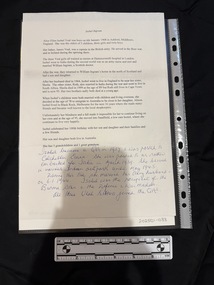 Returned Nurses RSL Sub-branch
Document - Brief biographical document, [Alison - Daughter of subject], 'Isobel Ingram', [post 20080106]
... Queen Alexandra's Imperial Military Nursing Service (QAIMNS)) nurse Alice Ellen Isobel Ingram (neé Veal). WWII WW2 World War Two Queen Alexandra's Imperial Military Nuring Service Alice Ellen Isobel Ingram (neé Veal) 'Isobel became a QA in 1937 & was posted to / Colchester, Essex. She was posted to another [?] / embarked for India in March 1939. She served / in various Indian outposts until May 1945. / During this time she married her Army husband - / on 6.1.1944. Isobel was the recipient of the / Burma Star & the Defence & War Medals ...Brief biographical and service information about WWII English (Queen Alexandra's Imperial Military Nursing Service (QAIMNS)) nurse Alice Ellen Isobel Ingram (neé Veal). Single sheet of paper with text on one side, the upper 2/3 of the page is printed text and below is handwriting in blue ink.'Isobel became a QA in 1937 & was posted to / Colchester, Essex. She was posted to another [?] / embarked for India in March 1939. She served / in various Indian outposts until May 1945. / During this time she married her Army husband - / on 6.1.1944. Isobel was the recipient of the / Burma Star & the Defence & War Medals. / All three Veal Sisters joined the QAs.' [Blue ink lower 1/3 of page]wwii, ww2, world war two, queen alexandra's imperial military nuring service, alice ellen isobel ingram (neé veal)
