
Showing 11 items matching "quilt heritage"
-
 National Wool Museum
Book, Australian Quilt Heritage
... Australian Quilt Heritage...AUSTRALIAN / QUILT / HERITAGE / MARGARET ROLFE...Quilting - History AUSTRALIAN / QUILT / HERITAGE / MARGARET ROLFE Australian Quilt Heritage Book ...This book gives an overview of the history of quilts in Australia.AUSTRALIAN / QUILT / HERITAGE / MARGARET ROLFEquilting - history -
 National Wool Museum
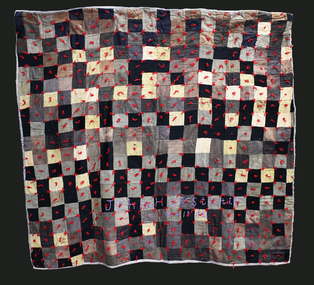
Textile - Quilt, 1921
... ...Quilt Heritage...Ozark Missouri USA Textile History Quilt Heritage Front embroidered. Purple handstitching: "John Huffstutter / 13 Oct 1921" Reverse. ...Now 100 years old, this quilt belonged to the donor’s grandfather John William Huffstutter. John was Born in 1898 in a log cabin in the Ozark mountains of Missouri, USA. Tragically, John’s mother died when he was four years old. John said that he could always remember her voice calling his name as he hid under the porch in one of the many thunderstorms that frequent the area with his dog. John was raised by his grandmother and was treated as the youngest to her other children, growing up with his aunties and uncles rather than brothers and sisters. John began to study engineering at the State University of Iowa before serving in the US Army Engineer Corps in The Great War. He enlisted when he became eligible and served briefly before the Great War ended. He then returned to his engineering studies in Iowa, and shortly after finishing his studies got his first job with Westinghouse in Pittsburgh at age 23. It was when John was leaving for this job that he was given the quilts as a reminder of home from his grandmother Sarah Jane "Sallie" Tindall Coble, and her daughter (John's Aunt) Ottie Maude Coble Bittick. Widowed at age 78, John took to sleeping in his screen porch under one of these quilts. John remembered one winter in Missouri waking in his log cabin to find snow covering him and his quilt. When he died at age 94, the quilt he used was completely worn out and discarded. This remaining quilt was shipped to Australia, where Carol’s (the donor) immediate family had emigrated in 1970. Opening the box that contained the quilt released a wave of comforting smells, emotions, and a flood of childhood memories. Carol distinctly remembers sleeping under these quilts for afternoon naps at her grandparents' house. The quilt is 74 x 80 inches (1880 x 2030mm), matching the size of a modern-day king bed. It is made of various four-inch (100mm) squares. These squares are made of old men woollen suits in dark colours of browns and greys. The quilt is layered with a wool backing fabric and a batting lawyer of unknown material, possibly cotton or wool. The quilt is tied together with red wool yarn and the backing fabric is folded over the edge to be used as a binding. Embroidered across the front of the quilt in purple wool yarn is "John Huffstutter", "13 Oct 1921". A small, printed cloth label "HUFFSTUTTER" is pinned on the reverse of the quilt. The quilt is well-worn but in good condition considering its age. The care instructions passed down by word of mouth with the quilt were to "never wash, only air".Front embroidered. Purple handstitching: "John Huffstutter / 13 Oct 1921" Reverse. Printed cloth label: "HUFFSTUTTER"ozark, missouri, usa, textile history, quilt heritage -
 Whitehorse Historical Society Inc.
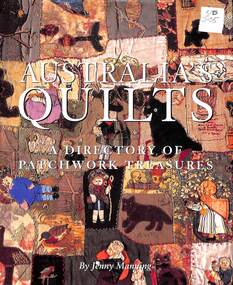
Book, Australia's Quilts, 1999
... "Australia's Quilts " celebrates the country's rich history through the heritage of quilts to be seen on public display...."Australia's Quilts " celebrates the country's rich history through the heritage of quilts to be seen on public display. ...A directory of patchwork treasuresnon-fictionA directory of patchwork treasuresquilts, manning jenny -
 Wangaratta Historical Society
Wangaratta Historical Society
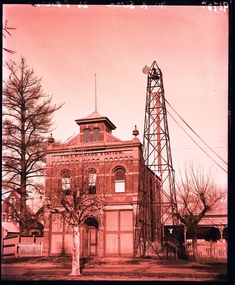
... Also owned by the WHS is the Maianne Gibson crazy patchwork quilt made by a Wangaratta woman in the 1890s and now Heritage listed. This Quilt is housed in an specially controlled conditions. ...Also owned by the WHS is the Maianne Gibson crazy patchwork quilt made by a Wangaratta woman in the 1890s and now Heritage listed. This Quilt is housed in an specially controlled conditions. ...The Wangaratta Historical Society Inc. (WHS) was established in 1959 and moved into its present home in the 1970s. Wangaratta in North East Victoria has a population of over 27 thousand people and is situated at the junction of the King and the Ovens Rivers. Agriculture has always been a big part of its history as well as education, health and manufacturing. The museum was originally a fire station built 1895 and included living quarters for its staff. The building is owned by the Rural City of Wangaratta who are great supporters of the WHS The museum was bequeathed 10,000 glass negatives from the late 1800s to the 1950s these were by the Vine & Thelma studios of mostly, portraits, weddings and historical photos. Also owned by the WHS is the Maianne Gibson crazy patchwork quilt made by a Wangaratta woman in the 1890s and now Heritage listed. This Quilt is housed in an specially controlled conditions. The Wangaratta Historical Society Museum was accredited in 2012 under the Museums Accreditation Program. -
 Wangaratta Historical Society
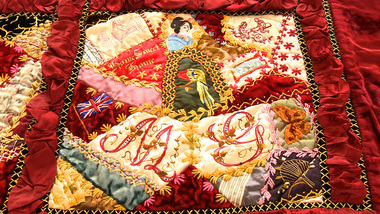
Marianne Gibson Quilt, 1891-1895
... The Marianne Gibson Quilt is owned by the Wangaratta Historical Society and was placed on the Victorian Heritage Register in 2011. ...The quilt is"...one of the finest examples of a crazy patchwork quilt in the world" (Victorian Heritage Register) and is composed of 9 blocks featuring silks and velvets with a backing of beige silk. ...In this era women of Marianne Gibson's position in society were chaperoned and chauffeured, their role was that of wife and mother, busy in their home. Women did not have the vote and those who worked were servants who lived with families. The Gibson family was well respected in the community and Marianne was the mother of 8 children.The Marianne Gibson Quilt is one of the finest examples of crazy patchwork quilting known to exist globally. It features items from her husband's hardware shop, household objects, oriental designs as well as local fauna and flora and the quality of the needlework is outstanding. It is extremely well preserved and unfaded. For a short film about the Marianne Gibson Quilt, visit Culture Victoria: http://www.cv.vic.gov.au/stories/marianne-gibsons-crazy-patchwork-quilt/11762/marianne-gibsons-crazy-patchwork-quilt/The Marianne Gibson Quilt is owned by the Wangaratta Historical Society and was placed on the Victorian Heritage Register in 2011. Marianne Gibson was born in Ireland and 1863 and married her cousin Alexander McCulla Gibson in 1864 in Wangaratta. The quilt is"...one of the finest examples of a crazy patchwork quilt in the world" (Victorian Heritage Register) and is composed of 9 blocks featuring silks and velvets with a backing of beige silk. The crazy patchwork style popular between 1876 and 1920 encompasses many different patterns that tell stories of that age and uniquely showcases local flora and fauna. Marianne made the quilt between 1891 and 1896. She loved flowers, birds, her garden and especially her family. This is evident in her quilt embroidery and stitching so lovingly demonstrated. Marianne died on 8th March 1911. She left the quilt to her daughters Clara and Edith who gave it to their housekeeper Miss Alma Gard in 1934. When Miss Gard retired to a nursing home in 1985 the quilt was donated to the Wangaratta Historical Society. MG 1891marianne gibson quilt crazy patchwork local fauna flora -
Malmsbury Historical Society
Photograph (Item), Quilting Display At Malmsbury Heritage Week, Malmsbury ca1990
... Buildings - Malmsbury Town Hall Quilting Display At Malmsbury Heritage Week, Malmsbury ca1990 Photograph Photograph ...Buildings - Malmsbury Town Hall -
Kew Historical Society Inc
Journal, Kew Historical Society, Newsletter No.116, September 2016
... Heritage issues / Brad Miles p3. What's On - September to December / Brad Miles p3. New Strategic Plan / Brad Miles p4. Not a Ragbag Wagga: the Kew patchwork quilt / Suzanne McWha p5. ...Back to Kew 1875 / Judith Scurfield p1. Heritage issues / Brad Miles p3. What's On - September to December / Brad Miles p3. New Strategic Plan / Brad Miles p4. Not a Ragbag Wagga: the Kew patchwork quilt / Suzanne McWha p5. The Great War in Kew: 1916 those who went / Andrew Frost p7. The Kew Festival Gazette 5 October 1895 / Don Garden p7. The Skilled Artisan: Bertie Robert Edgar Greenwood / Robert Baker, John Torpey, Judith Vimpani p9. Jill O'Brien / Robert Baker p9. More examples of Lost Kew - Clutha / Robert Baker; Fernhurst / Kerry Fairbank; Blackhall / Felicity Renowden; Kew Railway Station / Robert Baker p10. AGM Form of appointment of proxy p11. AGM Nomination form p11.Published quarterly since 1977, the newsletters of the Kew Historical Society contain significant research by members exploring relevant aspects of the Victorian and Australian Framework of Historical Themes. Frequently, articles on people, places and artefacts are the only source of information about an aspect of Kew, and Melbourne’s history.non-fictionBack to Kew 1875 / Judith Scurfield p1. Heritage issues / Brad Miles p3. What's On - September to December / Brad Miles p3. New Strategic Plan / Brad Miles p4. Not a Ragbag Wagga: the Kew patchwork quilt / Suzanne McWha p5. The Great War in Kew: 1916 those who went / Andrew Frost p7. The Kew Festival Gazette 5 October 1895 / Don Garden p7. The Skilled Artisan: Bertie Robert Edgar Greenwood / Robert Baker, John Torpey, Judith Vimpani p9. Jill O'Brien / Robert Baker p9. More examples of Lost Kew - Clutha / Robert Baker; Fernhurst / Kerry Fairbank; Blackhall / Felicity Renowden; Kew Railway Station / Robert Baker p10. AGM Form of appointment of proxy p11. AGM Nomination form p11.kew historical society (vic.) -- periodicals., kew historical society (vic.) -- newsletters, kew historical society (vic.) -- journals -
Whitehorse Historical Society Inc.
Article, Heritage festival, 21/04/1999 12:00:00 AM
... Activities which are featured at Schwerkolt Cottage on the Open Day including blacksmiths, wood turners, lace makers, artists, spinners and weavers, paper-makers, quilters and patch workers. Heritage festival Article Article ...Activities which are featured at Schwerkolt Cottage on the Open Day including blacksmiths, wood turners, lace makers, artists, spinners and weavers, paper-makers, quilters and patch workers.Activities which are featured at Schwerkolt Cottage on the Open Day including blacksmiths, wood turners, lace makers, artists, spinners and weavers, paper-makers, quilters and patch workers.Activities which are featured at Schwerkolt Cottage on the Open Day including blacksmiths, wood turners, lace makers, artists, spinners and weavers, paper-makers, quilters and patch workers.heritage festivals, schwerkolt cottage, nunawading and district historical society, rotary club of forest hill, tymms, pat, durham, norm, lavis, andrew -
 Whitehorse Historical Society Inc.
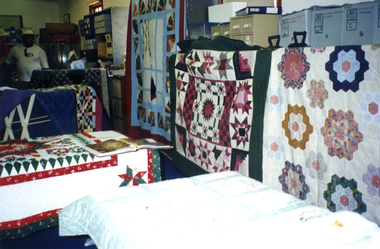
Photograph, Open Day 2000, 1/04/2000 12:00:00 AM
... Photograph of Quilt Display at Society's Open Day at Schwerkolt Cottage and Museum Complex for Heritage Festival 2000....nunawading & district historical society heritage festival 2000 Photograph of Quilt Display at Society's Open Day at Schwerkolt Cottage and Museum Complex for Heritage Festival 2000. ...Photograph of Quilt Display at Society's Open Day at Schwerkolt Cottage and Museum Complex for Heritage Festival 2000.nunawading & district historical society, heritage festival 2000 -
 Embroiderers Guild, Victoria
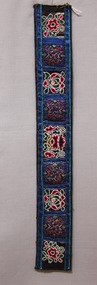
Textile - Geyi Miao Chinese Patchwork Band, 20 th C
... When young girls are taught the necessary textile skills of their cultural heritage, they are also learning the ways of the past in order to become guardians of the future. The Quilter...When young girls are taught the necessary textile skills of their cultural heritage, they are also learning the ways of the past in order to become guardians of the future. The Quilter ...Women from the many tribal groups that live in south-west China are the de-facto guardians of their tribes' textile culture, safeguarding it for subsequent generations. Upon marriage a woman has to produce a trousseau, which includes a number of distinctive wedding blankets. These are the decorative central panels for a duvet cover. Depending on the location and group, these covers might be woven, embroidered, wax or rice resist indigo dyed, or made of patchwork. These last are produced mainly in a relatively small area of south-west China, where southern Guizhou Province abuts the northern Guangxi Province. The groups involved are the Buyi, the Zhang and a few MIao who live in their own villages in close proximity to each other. The finished cover is a composite of stitched blocks like a checker board. Each block is made up of several layers of old cloth built up into a small wad and stitched together, with the final decorative portion sitting on top. These are generally appliquéd and can also be embroidered. One group of the Zhang people divide with a central 'x' featured throughout. More elaborate symbols might include phoenixes, butterflies, fish and flowers, with fertility, long life and 'double happiness'(for the newly married couple) being predominant themes. Despite the variations in style, each place and group has its own distinctive forms which have been passed down over time. When young girls are taught the necessary textile skills of their cultural heritage, they are also learning the ways of the past in order to become guardians of the future. The Quilter # 147 Summer 2016A "Geyi Miao" panel (band) of tiny stitched squares of silk fabric, with alternate squares of embroidered and folded patchwork fabrics, all enclosed with dark blue ribbon. Colours - dark blue, green, pink, yellow and cream. Back shows it was made on paper.patchwork, band, silk, china -
 Embroiderers Guild, Victoria
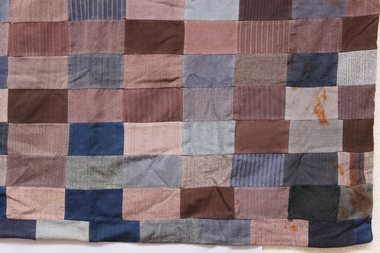
Textile - Wagga Quilt Margaretta Egan 1860-1940, Margaretta Ross Egan 1860-1940, Wagga Quilt, Early 1900's
... A Wagga quilt is a resourceful, utilitarian Australian quilt, traditionally made from repurposed materials like jute (burlap) sacks, old blankets, and clothing scraps, embodying the spirit of "making do" in the bush for drovers, swagmen, and families. Named likely from Wagga Wagga flour bags, these functional, often rough, creations served as warm bedding, distinct from fancier patchwork, and showcase a unique part of Australian textile heritage. ...A Wagga quilt is a resourceful, utilitarian Australian quilt, traditionally made from repurposed materials like jute (burlap) sacks, old blankets, and clothing scraps, embodying the spirit of "making do" in the bush for drovers, swagmen, and families. Named likely from Wagga Wagga flour bags, these functional, often rough, creations served as warm bedding, distinct from fancier patchwork, and showcase a unique part of Australian textile heritage. ...A Wagga quilt is a resourceful, utilitarian Australian quilt, traditionally made from repurposed materials like jute (burlap) sacks, old blankets, and clothing scraps, embodying the spirit of "making do" in the bush for drovers, swagmen, and families. Named likely from Wagga Wagga flour bags, these functional, often rough, creations served as warm bedding, distinct from fancier patchwork, and showcase a unique part of Australian textile heritage. Suiting fabric made into a Wagga (quilt). Lined with cotton.Margaretta Egan, Portland on reverse.patchwork, suiting fabric, waggas
