
Showing 58 items matching "r. franklin"
-
 Port Melbourne Historical & Preservation Society
Document - Tender, A R Franklin, Erection of 40 four-room houses and 40 five-room houses, Port Melbourne, 11 Sep 1923
... Tender, A R Franklin, Erection of 40 four-room houses and 40 five-room houses, Port Melbourne......a r franklin...local government - city of port melbourne built environment - domestic a r franklin Tender for erection of 40 x four room houses from A.R. ...Tender for erection of 40 x four room houses from A.R. Franklin, 1923. Presented on the City of Port Melbourne Official Tendering Form (Refer other tenders: items 543, 549, 552 and 554)local government - city of port melbourne, built environment - domestic, a r franklin -
Federation University Historical Collection
Magazine, Quadrangle: The Magazine of the Ballarat Junior Technical School, 1962, 1962
... ...R. Franklin...Watson K.G. Hamilton R. Franklin R. Karvinen Michael Chung Keith E. ...The Ballarat Junior Technical School was a division of the Ballarat Schoo of Mines.Blue soft covered book of 32 pages.ballarat junior technical school, r.r. watson, k.g. hamilton, r. franklin, r. karvinen, michael chung, keith e. rash, old boys association, robert titheridge, bruce mckinnon, robert baldock, max berriman, john bettles, colin hughes, reijo karvinen, william lowe, bill lowe, ian pym, robert withers, lindsay hocking, paul clifton, z. albert, p. seddon, aistralian air training school, h.e. linaker, graham beanland, m.b. john, a.e. stohr, e.a. bald, harold arblaster, b. bogicevic, john benn, r.l. whitla, r. cairns, baseball, m. chung, g. rykers -
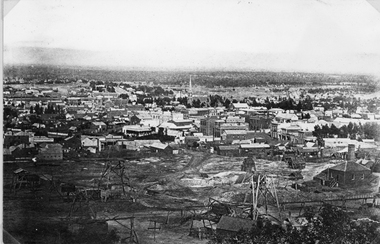 Stawell Historical Society Inc
Photograph, Panorama of Stawell from Big Hill with Whims & Poppet Heads Victorian Views Collection C Herbert c.1880s
... Agnew Draper. J R Franklin? Draper. Coffee Palace formerly Castlemaine Hotel , Town Hall visible...Agnew Draper. J R Franklin? Draper. Coffee Palace formerly Castlemaine Hotel , Town Hall visible stawell panorama mining streetscape Victorian Views. ...Views from Big Hill Sloane Street Fisher Street areas looking towards West. Mining in foreground of photo. Upper Main Street and Patrick Street Streetscapes visible. Mathers and Franklin. Agnew Draper. J R Franklin? Draper. Coffee Palace formerly Castlemaine Hotel , Town Hall visiblePanorama of Stawell from Big Hill showing Sloane's St. / Fisher St. areas. The photo has Whims & Poppet Heads in the foreground. There are around 6 copes of the photograph. Victorian Views. C. Herbert. Photo. Copyright Registered. Stawellstawell, panorama, mining, streetscape -
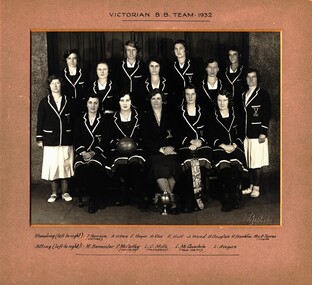 Netball Victoria
Photograph, 1932
... Wood, B. Douglas, R. Franklin, Mrs O Ferres (Coach) Sitting (left to right): M. ...Wood, B. Douglas, R. Franklin, Mrs O Ferres (Coach) Sitting (left to right): M. ...Team photo of the 1932 Victorian Women's Basketball Team, featuring some very important people for years to come (McConchie). This team won the 1932 interstate carnivalThe inclusion of such important people makes this photo significant. This team would win the interstate carnival for 1932, and many of these players featured as players or coaches later in the decade where Victoria would dominate. L.C Mills was the foundation president for the V.W.B.B.A, while Edith Hull, Ethel McCarthy, Lorna McConchie and Becky Douglas would either play, captain or coach the national team, while McConchie would umpire in later decades.Team photo of the Victorian Women's Basketball State Team in 1932.Victorian B.B. Team 1932. Standing (left to right): L. Harrison (umpire), A O'Dea, E. beyer, A. Elso, E. Hull, J. Wood, B. Douglas, R. Franklin, Mrs O Ferres (Coach) Sitting (left to right): M. Bannister, E. McCarthy (Captain), L.C. Mills (President), L. McConchie (Vice Capt), L. Angus.womens basketball, women's basketball, netball, victoria, netball victoria, 1930, 1930s,victorian team, womens netball, women's netball, sport, vic, netball australia, harrison, o'dea, beyer, elso, edith hull, wood, becky douglas, franklin, o ferres, bannister, ethel mccarthy, mills, l.c.mills, lorna mcconchie, angus, interstate, carnival, alice elso, jean wood -
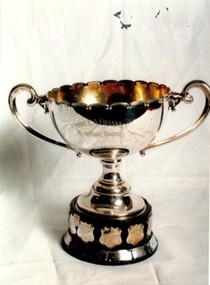 Royal Brighton Yacht Club
Cup, E. A. Franklin Memorial Trophy (Cup)
... First Winner: Leander, R. Franklin 1947/48 ...First Winner: Leander, R. Franklin 1947/48 dragon franklin dick franklin life deed of gift E. ...E. A. Franklin Memorial Trophy (Cup) Donor: Edward Alfred Franklin Deed of Gift: Yes The trophy was originally donated by past Commodore E. A. Franklin and awarded to the International Star Class. He was Commodore in 1947/50 and again in 1953/55. After his death in 1962, his son Rae Franklin changed the deed of the gift to become the E. A. Franklin memorial trophy and with the decline of the Star Class was for a short time then awarded to the Soling Class, and then to the E22 class. However, it seems to have been awarded to the Dragon class instead and perhaps the Spooks Franklin Trophy which is awarded to the E22 replaced it. First Winner: Leander, R. Franklin 1947/48 dragon, franklin, dick franklin life, deed of gift -
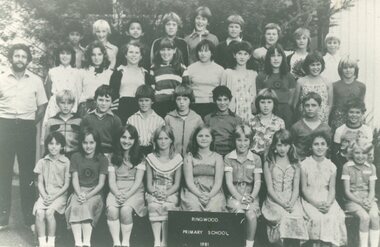 Ringwood and District Historical Society
Photograph, Ringwood State School - Grade 6, 1981
... "Attached to photograph" Back Row- L to R: Dale Franklin, Nigel Mason, Hue Quin, Roger Graham, David Postlethwaite, Mathew Jobling, Nick Grey, Robert McDougall, Craig (?). ..."Attached to photograph" Back Row- L to R: Dale Franklin, Nigel Mason, Hue Quin, Roger Graham, David Postlethwaite, Mathew Jobling, Nick Grey, Robert McDougall, Craig (?). ...Black and white photograph - Grade 6, 1981."Attached to photograph" Back Row- L to R: Dale Franklin, Nigel Mason, Hue Quin, Roger Graham, David Postlethwaite, Mathew Jobling, Nick Grey, Robert McDougall, Craig (?). 2nd Row- L to R: Kerryn Hopgood, ?, Karen (?), Rachel McEwan, Lexie Jenkinson, Leslie Gallager, Nicole Mathieson, Sari Beattie, Julie Rigg. 3rd Row- L to R: Steven Davis, Johnnie Tomado, Robbie (?), James Edith, Simon Ignatious, Mark Yost, George Dallas, ?. Front Row- L to R: Ellen Hodgeson, Karen Evans, Anthoula (?), Lori Mays, Jenny Murray, Katrina de Jersey, Tania Alhouse, Olga Houritid, Tracey Williams. Teacher: Steven Gough -
 Sunshine and District Historical Society Incorporated
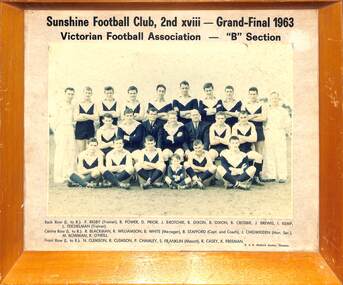
Photograph - Sunshine Football Club 2md XVIII Grand Final 1963 Victorian Football Association "B" Section Team Photo, R. & R. Mudford Studios Sunshine
... Clemson R. Clemson P. Chamley S. Franklin R. Casey K. Freeman...Clemson R. Clemson P. Chamley S. Franklin R. Casey K. Freeman Faded color photograph in wooden frame Photograph Sunshine Football Club 2md XVIII Grand Final 1963 Victorian Football Association "B" Section Team Photo R. & R. ...Sunshine Football Club 2md XVIII Grand Final 1963 Victorian Football Association "B" Section|Back Row F. Rigby B. Power D. Prior J. Brotchie R. Dixon B. Crosbie J. Brewis I. Kemp L. Teichelman|Centre Row R. Blackman R. Williamson B. White B. Stafford J. Chigwidden M. Bowman K. O'Neill|Front Row N. Clemson R. Clemson P. Chamley S. Franklin R. Casey K. Freemansunshine football club, football, team photograph -
 Greensborough Historical Society
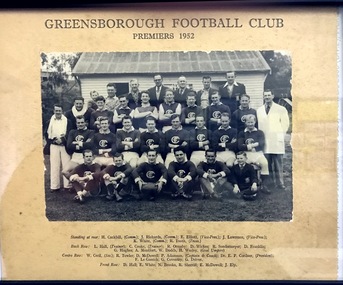
Photograph, Greensborough Football Club Premiers 1952, 1952_
... Ormsby D. Wickes R. Sondemeyer D. Franklin G. Hughes A. Montfort W. Dodds H. ...Ormsby D. Wickes R. Sondemeyer D. Franklin G. Hughes A. Montfort W. Dodds H. ...A team photograph of the 1952 Australian Rules Football team from the Greensborough Football Club. Includes players and support staff. This photograph is a record of those involved with the club in a Premiership year 1952.Black and White photograph of the Greensborough Football Team 1952. Includes name of players and support team. Mounted on brown card. Greensborough Football Club. Premiers 1952. Team names: Standing at rear: H. Cockbill (Committee) J. Richards (Committee) E. Elliott (Vice President) J. Lawrence (Vice President) K. White (Committee) R. Tooth (Treasurer). Back row: L. Hall (Trainer) C. Cook (Trainer) R. Ormsby D. Wickes R. Sondemeyer D. Franklin G. Hughes A. Montfort W. Dodds H. Wasley(Goal umpire) Centre Row: W. Cecil (Secretary) R. Towler D. McDowell P. Adamson (Captain and Coach) Dr E. P. Cordner (President) F. LeGassick G. Coventry G. Driver Front Row: D. Hall E. White N. Brooks R. Sherriff E. McDowell J. Elygreensborough football club, premiers 1952 -
 Federation University Historical Collection
Book, Shire of Ballarat, 1963, 1963
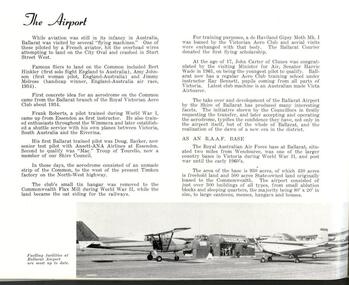
... franklin caravans...kirk's reservoir...white swan reservoir...electricity...lucas...unilever australia...ballarat gas company...coronet caravans...lindsay gunn...martin stoneware...w. r...ballarat shire shire of ballarat c.e. brown learmonth sire hall gold memorial miners rest reticulated water australian timken ballarat airport joe white maltings franklin caravans kirk's reservoir white swan reservoir electricity lucas unilever australia ballarat gas company coronet caravans lindsay gunn martin stoneware w. r. walton m.b. john ballarat agricultural and pastoral society planning scheme webcona estate brown's heavy haulage ballarat mental hospital alfredton pre-school centre wendouree recreaton reserve wendouree pre-school wendouree youth club corporation saleyards arch of victory lake burrumbeet perry park ballarat high school wendouree west state school ewing house ballarat grammar school ballarat teachers' college learmonth presbyterian church st mathew's wendouree st mary's redemptorist monastery norm doodt pre-mixed concrete wendouree bowls club ballarat shire councillors rex hollioake david baird thomas ford william troup wilfred hirst charles brown charles giot william walton david powell john pemberton hugh patterson alexander mcdonald edward edwards james mitchell White covered book with multiple images. ...White covered book with multiple images.ballarat shire, shire of ballarat, c.e. brown, learmonth sire hall, gold memorial, miners rest reticulated water, australian timken, ballarat airport, joe white maltings, franklin caravans, kirk's reservoir, white swan reservoir, electricity, lucas, unilever australia, ballarat gas company, coronet caravans, lindsay gunn, martin stoneware, w. r. walton, m.b. john, ballarat agricultural and pastoral society, planning scheme, webcona estate, brown's heavy haulage, ballarat mental hospital, alfredton pre-school centre, wendouree recreaton reserve, wendouree pre-school, wendouree youth club, corporation saleyards, arch of victory, lake burrumbeet, perry park, ballarat high school, wendouree west state school, ewing house, ballarat grammar school, ballarat teachers' college, learmonth presbyterian church, st mathew's wendouree, st mary's redemptorist monastery, norm doodt, pre-mixed concrete, wendouree bowls club, ballarat shire councillors, rex hollioake, david baird, thomas ford, william troup, wilfred hirst, charles brown, charles giot, william walton, david powell, john pemberton, hugh patterson, alexander mcdonald, edward edwards, james mitchell -
 Federation University Historical Collection
Magazine, J.A. Hoskin & Son, Quadrangle: Magazine of the Junior Technical School Ballarat, 1960, 1960
... franklin...tresize...prefects...tennis court...Peter Trezise...Doug Rash...Wong Chik Min...John Gilbert...John mcDonald...Ray Bilney...Denis Moy...John Crawley...Roberto Venier...Reijo Karvinen...Cheetham Salt Works...Graeme Cummins...Gerald Kessel...James Colligan...Alan Everett...David Newman...Air Training Corps...Ken Wach...Athletics team...Tunnel Ball Team...Cross Country Team...Basketball Team...Softball Team...Football Team...Swimming team...Cycling Team...Cricket Team...R...Watkins. ballarat junior technica school ballarat school of mines whitford watson paterson w.j. paterson george cornell franklin tresize prefects tennis court Peter Trezise Doug Rash Wong Chik Min John Gilbert John mcDonald Ray Bilney Denis Moy John Crawley Roberto Venier Reijo Karvinen Cheetham Salt Works Graeme Cummins Gerald Kessel James Colligan Alan Everett David Newman Air Training Corps Ken Wach Athletics team Tunnel Ball Team Cross Country Team Basketball Team Softball Team Football Team Swimming team Cycling Team Cricket Team R. ...The 1960 Quadrangle magazine committee were Kelvin Whitford, Bill Heywood, Ken Delayney, Daryl Burt, John Cornish, John McDonald, Ross Gray, and Messrs I. Chisholm and N. Watkins.Salmon coloured soft covered magazine of 46 pages. Contents include: Villiers Internal Combustion Engine, Geelong, School Song, Death of W.J. Paterson, Old Boys Newsletter (Keith Rash), Pine plantation. Robert Champneys, Air Training Corps, Mothers' Club Images include: R. Watson (headmaster), staff, prefects, tennis court, Peter Trezise, Doug Rash, Wong Chik Min, John Gilbert, John McDonald, Ray Bilney, Denis Moy, John Crawley, Roberto Venier, Reijo Karvinen, Cheetham Salt Works; Graeme Cummins, Gerald Kessel, James Colligan, Alan Everett, David Newman, Air Training Corps, Ken Wach, Athletics team, Tunnel Ball Team, Cross Country Team, Basketball Team, Softball Team, Football Team, Swimming team, Cycling Team, Cricket Team, ballarat junior technica school, ballarat school of mines, whitford, watson, paterson, w.j. paterson, george cornell, franklin, tresize, prefects, tennis court, peter trezise, doug rash, wong chik min, john gilbert, john mcdonald, ray bilney, denis moy, john crawley, roberto venier, reijo karvinen, cheetham salt works, graeme cummins, gerald kessel, james colligan, alan everett, david newman, air training corps, ken wach, athletics team, tunnel ball team, cross country team, basketball team, softball team, football team, swimming team, cycling team, cricket team, r. watson, kelvin whitford, bill heywood, ken delayney, daryl burt, john cornish, ross gray, william paterson obituary, ron kirner, keith rash, air training cadets, i. pym, c. antonio, k. woodyatt, b. middleton, a. everett, b. clarke, d. riddiford, i. trembath, j. myers, l. goldsmith, p. chanler, p. edge, s. riddiford, r. cook, j. holt, k. fellows, d. coldicott, douglas rash, g. angow, n. jones, john dellaca, j. angwin, w. scanlon, m. chung, g. holt, r. bilney, w. carey, r. carmichael, b. mckinnon, n. bedggood, r. robinson, c. cunninham, r. grubb, l. skevington, g. cole, w. whiting, ronaldson-tippett, palmer bros, h. dubberley & son, m.b. john and hatersley limited, h.a. davis motor service, alexandria tea rooms -
 Federation University Historical Collection
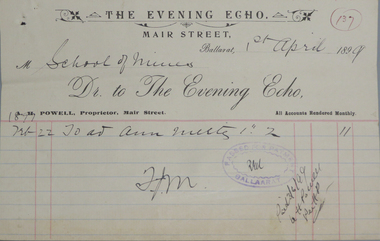
Book - Scrapbook, Ballarat School of Mines Invoices, 01/07/1895 - 05/05/1899
... r. collie & co....walter cornell...john fiscalini...mcvitty & co...j. miller & co...a.g. corbett...ben franklin...The invoices glued into the scrapbook relate to purchases from the Ballarat School of Mines invoices ballarat school of mines tunbridges pringle receipts w. hamer plumber eyres brothers j.h. trotman g. batchelor n. guthridge w. doepel frank fiscalini huddart, barker and co. a. gaunt h. wardle and son turron & mcgavin e.e. campbell g.f. hocking william sutherland f. vale victoria insurance company r. collie & co. walter cornell john fiscalini mcvitty & co j. miller & co a.g. corbett ben franklin printing works middleton & morris melbourne glass bottle works co eldon chambers e.l. stubbs j. jones firewood mrs soderstrom museum ballarat school of mines museum hill & paine h. hebestadt f.w. commons sculptor cherry & robins alex e. monsbourgh alex purdie andrew cant ballarat star frederick martell goodfellows evening echo a.h. powell Phillately A very large dark green hard covered volume with read leather face spine and corners. ...The invoices glued into the scrapbook relate to purchases from the Ballarat School of MinesA very large dark green hard covered volume with read leather face spine and corners. Black ornamental bands across the spine. Leather strap with buckle for securing covers when not in use. Plain pages of brown "wrapping paper". Receipts glued to pages, folded and then numbered consecutively by hand i blue pencil. First receipt No. 996 (01 July 1895), numbering restarts after 1000 (three times). Last receipt is No. 155 (05 May 1899).invoices, ballarat school of mines, tunbridges, pringle, receipts, w. hamer, plumber, eyres brothers, j.h. trotman, g. batchelor, n. guthridge, w. doepel, frank fiscalini, huddart, barker and co., a. gaunt, h. wardle and son, turron & mcgavin, e.e. campbell, g.f. hocking, william sutherland, f. vale, victoria insurance company, r. collie & co., walter cornell, john fiscalini, mcvitty & co, j. miller & co, a.g. corbett, ben franklin printing works, middleton & morris, melbourne glass bottle works co, eldon chambers, e.l. stubbs, j. jones, firewood, mrs soderstrom, museum, ballarat school of mines museum, hill & paine, h. hebestadt, f.w. commons, sculptor, cherry & robins, alex e. monsbourgh, alex purdie, andrew cant, ballarat star, frederick martell, goodfellows, evening echo, a.h. powell, phillately -
 Federation University Historical Collection
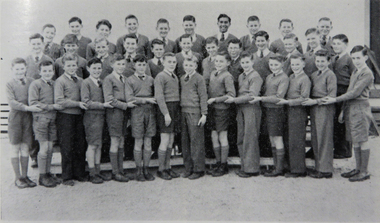
Photograph - Image, Ballarat Junior Technical School Choir, 1956, 1956
... r. wilson...j. carroll...m. tucker...f. trigg...i. franklin...R. Wilson. J. Carroll, M. Tucker, F. Trigg, I. Franklin, N. Dell, N. ...R. Wilson. J. Carroll, M. Tucker, F. Trigg, I. Franklin, N. Dell, N. ...The Ballarat Junior Technical School Back Row L-R: R.J. King, J. Halliday, B. Antonio, P. Montgomery, W. Wilkins, G. Kiddie, J. Clarke, G. Nicholls, K. Burge, J. Gullock Middle Row L-R: W. Doyle, I. Treganza, M. Moore, D. McLeod, B. Gamble, M. Elsey, W. Dowler Front Row: J. Taylor, G. Caddy, B. Flood, G. Rapkins, R. Whitten, R. Priddle, R. Wilson. J. Carroll, M. Tucker, F. Trigg, I. Franklin, N. Dell, N. Yean, C. Judd.ballarat junior technical school, choir, r.j. king, j. halliday, b. antonio, p. montgomery, w. wilkins, g. kiddie, j. clarke, g. nicholls, k. burge, j. gullock, w. doyle, i. treganza, m. moore, d. mcleod, b. gamble, m. elsey, w. dowler, j. taylor, g. caddy, b. flood, g. rapkins, r. whitten, r. priddle, r. wilson, j. carroll, m. tucker, f. trigg, i. franklin, n. dell, n. yean, c. judd -
 Federation University Historical Collection
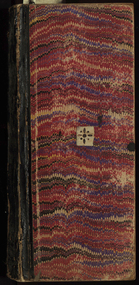
Book - Ledger, Ballarat School of Mines Rough Cash Book, 1901-1907, 1901-1907
... r. mann...thomas de gruchy...j.r.m. blight...h. valentine...james galbally...a. mcd. ritchie...j. sutherland...h. herbert...p.a. pratt...w.m. williams...g. cornell...d. lilley...elsie cutter...g. bicknell...john g. brittain...f.l. cooper...g.s. hepburn...karl noone...a. hugelmann...h. heath...w.a. mason...thomas bradley...charles e. hill...r.r. mitchell...a. phillipson...thomas davies...l. lewin...william gilbert...a.e. loveland...c.r. mccracken...george lawri...h.b. cooke...john usher...d.m. lilley...james holt...j. kenna...charles lund...j. o'dwyer...charles quaddock...william e. figgis...j.k. sim...w. heinz...willis franklin...cash book ballarat school of mines cash book assay fees guage testing treatment of ores gold selling student fees a.p.wood c. craddock l. craddock w.h. callister c. fleahy j.friend edward horwood james leckie a. peacock hilary dowling f. horsfall frank dalton arthur howard charles fryer henry clark r. allan w. barton r. mckay wolliam albert patrick anderson joseph rickard n. kavanagh percy miller h.e. gronow david hamilton andrew hamilton cyril mctaggart ernest lumley fred bicknell herbert bicknell charles fleay d.c. urquhart r. clark victor mckay ralph mckay j.b. robinson r. mann thomas de gruchy j.r.m. blight h. valentine james galbally a. mcd. ritchie j. sutherland h. herbert p.a. pratt w.m. williams g. cornell d. lilley elsie cutter g. bicknell john g. brittain f.l. cooper g.s. hepburn karl noone a. hugelmann h. heath w.a. mason thomas bradley charles e. hill r.r. mitchell a. phillipson thomas davies l. lewin william gilbert a.e. loveland c.r. mccracken george lawri h.b. cooke john usher d.m. lilley james holt j. kenna charles lund j. o'dwyer charles quaddock william e. figgis j.k. sim w. heinz willis franklin roy booth f. herman george christie g. davenport edward richards j.f. murphy i. holmes f. sior i sim w. caldwell james leggo g. nightingale rupert king h.j. semmens h.r. kofoed theo holmes h.b. waldron w. bell j. curnow j.f. d'oliveyra w. bolitho m. bade e. gregory g. hopwood j. o'bern a. robin a.e. tandy a.d. galloway j.f. boyce n. buley f.w. calaby a. elshang a.e. ebbels j. leggo r.e. holdsworth k. thiessen m. metz l. bult w. clift e. bonwick h. koefed h.j. saw j.l. sim e. wardle n.c. le gerche e. crossley b. humffray l. blick a.e. burgess g. lides p.f. browne f.a. richardson h. dahlenburg miles webster l. nott j.d. brokenshire beet wai n. la gerche e.m. boyer h.g. hawkesworth o. williams f. abel w.e. eyres c. rawlings a.j. robin p. grenfell f. eustice j. brokenshire w. mccartney herbert stephenson g. ditchburn c. steele f.j. webb h.o.e. bieske o. mccabe art library ballarat east school fees a. miles m. growcott a. gent arthur gates ida farmer gertrude bailey d. brigstiche d. bonan a.a. buley a.h. lilburne a.b. benoit l.e. waldie i. dilena harold herbert Ballarat Technical Art School Large ledger with marbled cover. ...Large ledger with marbled cover. It is a Ballarat School of Mines Rough Cash Book. The books list payments of students fees, assay fees, salaries and wages, guage testing, treatment of ores. Some student names outlined in keywords. cash book, ballarat school of mines cash book, assay fees, guage testing, treatment of ores, gold selling, student fees, a.p.wood, c. craddock, l. craddock, w.h. callister, c. fleahy, j.friend, edward horwood, james leckie, a. peacock, hilary dowling, f. horsfall, frank dalton, arthur howard, charles fryer, henry clark, r. allan, w. barton, r. mckay, wolliam albert, patrick anderson, joseph rickard, n. kavanagh, percy miller, h.e. gronow, david hamilton, andrew hamilton, cyril mctaggart, ernest lumley, fred bicknell, herbert bicknell, charles fleay, d.c. urquhart, r. clark, victor mckay, ralph mckay, j.b. robinson, r. mann, thomas de gruchy, j.r.m. blight, h. valentine, james galbally, a. mcd. ritchie, j. sutherland, h. herbert, p.a. pratt, w.m. williams, g. cornell, d. lilley, elsie cutter, g. bicknell, john g. brittain, f.l. cooper, g.s. hepburn, karl noone, a. hugelmann, h. heath, w.a. mason, thomas bradley, charles e. hill, r.r. mitchell, a. phillipson, thomas davies, l. lewin, william gilbert, a.e. loveland, c.r. mccracken, george lawri, h.b. cooke, john usher, d.m. lilley, james holt, j. kenna, charles lund, j. o'dwyer, charles quaddock, william e. figgis, j.k. sim, w. heinz, willis franklin, roy booth, f. herman, george christie, g. davenport, edward richards, j.f. murphy, i. holmes, f. sior, i sim, w. caldwell, james leggo, g. nightingale, rupert king, h.j. semmens, h.r. kofoed, theo holmes, h.b. waldron, w. bell, j. curnow, j.f. d'oliveyra, w. bolitho, m. bade, e. gregory, g. hopwood, j. o'bern, a. robin, a.e. tandy, a.d. galloway, j.f. boyce, n. buley, f.w. calaby, a. elshang, a.e. ebbels, j. leggo, r.e. holdsworth, k. thiessen, m. metz, l. bult, w. clift, e. bonwick, h. koefed, h.j. saw, j.l. sim, e. wardle, n.c. le gerche, e. crossley, b. humffray, l. blick, a.e. burgess, g. lides, p.f. browne, f.a. richardson, h. dahlenburg, miles webster, l. nott, j.d. brokenshire, beet wai, n. la gerche, e.m. boyer, h.g. hawkesworth, o. williams, f. abel, w.e. eyres, c. rawlings, a.j. robin, p. grenfell, f. eustice, j. brokenshire, w. mccartney, herbert stephenson, g. ditchburn, c. steele, f.j. webb, h.o.e. bieske, o. mccabe, art library, ballarat east school fees, a. miles, m. growcott, a. gent, arthur gates, ida farmer, gertrude bailey, d. brigstiche, d. bonan, a.a. buley, a.h. lilburne, a.b. benoit, l.e. waldie, i. dilena, harold herbert, ballarat technical art school -
 Federation University Historical Collection
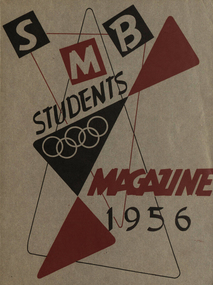
Magazine - Booklet, Ballarat School of Mines Students' Magazine, 1956, 1956
... r. wilson...j. carroll...m. tucker...f. trigg...i. franklin...School Council, Members of Staff, Editorial, Principal's Page, Prominent Personalities, The Worshipful Company of Plumbers, Controlling the Menace of Radio-active Bombs, Sports Awards 1956, Football, Athletics, Cricket, Baseball, Tennis, Literary Society, The Dear Departing, The Struggle for Malayan Merdeka (Independence), Junior School, Boys' Form Notes, House Notes, Ballarat North Technical School, Roll Call, Ballarat Junior Technical School - Members of Staff and Students', Ballarat North Junior Technical School - Members of Staff and Students' ballarat school of mines students' magazine school council members of staff staff sports i. tregenza mrs hanrahan mr r. t. white mrs r. t. white mr and mrs l. f. wilson mrs barnett r. j. king j. halliday b. antonio p. montgomery w. wilkins g. keddie j. clarke g. nicholls k. burgej. gullock w. doyle m. moore d. mcleod b. gamble j. allen g. wilson r. elshaug r. chibnall r. gamble m. elsey w. dowler j. taylor g. caddy b. flood g. rapkins r. whitten r. priddle r. wilson j. carroll m. tucker f. trigg i. franklin n. dell n. yean c. judd j. richards w. sawall w. wilson k. penna k. rogers b. harrison g. martin l. mcdonald a. brumby r. mckenzie g. manning j. sarah t. fletcher john clelland john collier john matthews norman leckie phil kempe harold steane russell ewins jeff coward cliff restarick don stevens frank whitworth bill burrow keith mccoll marian ritchie elizabeth kinnane ballarat girls' junior technical school dressmaking commercial mascot m.b. john aggregate shield hume and iser swimming shield alf clark warwick wtty garner n. haig p. agrums raaf cadets sunshine biscuit factory north tech choir hor khoo norman dalton bill sadler neville spears ian schunke john wolfe bernie gallagher nelson hails don overall brian tozer harry brue beverly briggs denis bryans barry singleton alan clarke beth byrne n. hails j. matthews b. gallagher j. collier d. overall p. robinson john benn fred leigh j. lacy mr garner warwick etty worshipful company of plumbers plumbing Air training corps cadets Ballarat North Junior Technical School Ballarat north technical school R.W. ...School Council, Members of Staff, Editorial, Principal's Page, Prominent Personalities, The Worshipful Company of Plumbers, Controlling the Menace of Radio-active Bombs, Sports Awards 1956, Football, Athletics, Cricket, Baseball, Tennis, Literary Society, The Dear Departing, The Struggle for Malayan Merdeka (Independence), Junior School, Boys' Form Notes, House Notes, Ballarat North Technical School, Roll Call, Ballarat Junior Technical School - Members of Staff and Students', Ballarat North Junior Technical School - Members of Staff and Students'Gray front page soft cover with red and black inscriptions on front cover, 84 pages.ballarat school of mines students' magazine, school council, members of staff, staff, sports, i. tregenza, mrs hanrahan, mr r. t. white, mrs r. t. white, mr and mrs l. f. wilson, mrs barnett, r. j. king, j. halliday, b. antonio, p. montgomery, w. wilkins, g. keddie, j. clarke, g. nicholls, k. burgej. gullock, w. doyle, m. moore, d. mcleod, b. gamble, j. allen, g. wilson, r. elshaug, r. chibnall, r. gamble, m. elsey, w. dowler, j. taylor, g. caddy, b. flood, g. rapkins, r. whitten, r. priddle, r. wilson, j. carroll, m. tucker, f. trigg, i. franklin, n. dell, n. yean, c. judd, j. richards, w. sawall, w. wilson, k. penna, k. rogers, b. harrison, g. martin, l. mcdonald, a. brumby, r. mckenzie, g. manning, j. sarah, t. fletcher, john clelland, john collier, john matthews, norman leckie, phil kempe, harold steane, russell ewins, jeff coward, cliff restarick, don stevens, frank whitworth, bill burrow, keith mccoll, marian ritchie, elizabeth kinnane, ballarat girls' junior technical school, dressmaking, commercial, mascot, m.b. john aggregate shield, hume and iser swimming shield, alf clark, warwick wtty, garner, n. haig, p. agrums, raaf cadets, sunshine biscuit factory, north tech, choir, hor khoo, norman dalton, bill sadler, neville spears, ian schunke, john wolfe, bernie gallagher, nelson hails, don overall, brian tozer, harry brue, beverly briggs, denis bryans, barry singleton, alan clarke, beth byrne, n. hails, j. matthews, b. gallagher, j. collier, d. overall, p. robinson, john benn, fred leigh, j. lacy, mr garner, warwick etty, worshipful company of plumbers, plumbing, air training corps, cadets, ballarat north junior technical school, ballarat north technical school, r.w. richards, richard w. richards, dick richards, l.f. wilson -
 Federation University Historical Collection
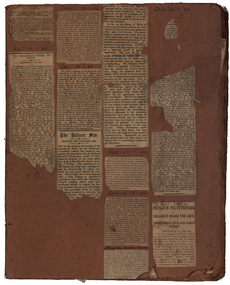
Book - Scrapbook, Ballarat School of Mines Scrapbook, 1899, 1872-1908
... franklin...frank bruce...Henry Rivett Bland...J.N. Dunn...Dr Pinnick...theo williams...Steiglitz Gold Mines...meredith...A.f. balderson...J.M. Bickett...f.j. martell...cosmo newberry...m. lindsay...pyrites...pyrites roaster...Blucjer Amagamator...Ludovico hart...photographer...Art Gallery Association's Technical Art School...Ballarat East School of Art...Otto Riegelbuth...Hugh Colquhoun...Louis lemp...G.A.F. Soderstron...e. gude...A.f. tweedie...M.L. Tuxen...George H. Bicknell...c.v. brind...a.h. troon...r...franklin frank bruce Henry Rivett Bland J.N. Dunn Dr Pinnick theo williams Steiglitz Gold Mines meredith A.f. balderson J.M. Bickett f.j. martell cosmo newberry m. lindsay pyrites pyrites roaster Blucjer Amagamator Ludovico hart photographer Art Gallery Association's Technical Art School Ballarat East School of Art Otto Riegelbuth Hugh Colquhoun Louis lemp G.A.F. Soderstron e. gude A.f. tweedie M.L. Tuxen George H. Bicknell c.v. brind a.h. troon r ....1) Scrapbook of newspaper clipping in oversize scrapbook .2) White file of newspaper clippings 1872-1908newsclips, newspaper cuttings, schools of mines, sale school of mines, bairnsdale school of mines, daylesford school of mines, castlemaine school of mines, bendigo school of mines, stawell school of mines, st arnaud school of mines, alfred mica smith, industrial institute, james bickett, redmond barry, ballarat school of mines opening, mining engineering, pottery, charles fenner, pottery classes, maurice copland, plumbing, harold herbert, ballarat school of mines statistics, andrew anderson, j.c. molloy, art schools, ballarat west art school, herbert h. smith, amelia h. troon, martha pinkerton, r.t. vale, david ham, clunes, rivett bland obituary, university of melbourne affiliation, gilbert dawbarn, kernot, james patterson, john rowe, cassilis chlorination, r.w. lamb, j. flegeltaub, tasmanian examination, balarat school of mines museum, latham watson, state school students, w. longstafff, daisy ditchburn, e. grownow, ballarat east art school, art gallery association technical art school, e. guse, j.g. williamson, m.f. williamson, george biknell, print engraving, a.e.c. kerr, a.n.a. fete, hannay electro-cyanide process, james oddie, r.m. serjeant, xrays, roentgen xrays, lizzie drape, mines bill, henry forster, technical education in germany, deeble's patent, p. cohen, deeble's cyanide plant donation, h. rosales, thomas hart, ballarat observatory, robert denham pinnock, isaac james jones, edward ivan rosenblum, samuel ernest figgis, r.w. best, thomas f. morkham, beatrice j. flude, bertha craig, drucilla hopwood, george bird, james galbally, mining exchange, transit theodilite, univerisity of melbourne, affiliation, t.d. wanliss, scrapbook, s.e. figgis, j. dawbarn, gilbert dawbarn, g.g. simpson, brown coal, parwan, bacchus marsh, a. berry, f.m. krause, practical mining, cassilis, tasmanian exhibition, ballarat school of mines dilapidated, thomas bath, cyanide, elextirc rock drills, herbert franklin, frank bruce, henry rivett bland, j.n. dunn, dr pinnick, theo williams, steiglitz gold mines, meredith, a.f. balderson, j.m. bickett, f.j. martell, cosmo newberry, m. lindsay, pyrites, pyrites roaster, blucjer amagamator, ludovico hart, photographer, art gallery association's technical art school, ballarat east school of art, otto riegelbuth, hugh colquhoun, louis lemp, g.a.f. soderstron, e. gude, a.f. tweedie, m.l. tuxen, george h. bicknell, c.v. brind, a.h. troon, r. flohm, c.s. proctor, m. oddie, b.s. williamson, f.h.w. robinson, photography classes, i.g. wittkowski, h.r. murphy, mary browne, technical education, andrew berry, r-ray, xray, watson's focus tubes, rohmkorff coil, treloar, wooster, t.e. molloy, w/m/ acheson, ladies art association, ballarat art gallery association, maud glover, bertha s. williamson, hnery foster, native telurides of gold, eliza kershaw, edith curnow -
 Federation University Historical Collection
Magazine, Quadrangle: Magazine of the Ballarat Technical School, 1972, 1972
... r. hazlett...g. reeve...a. peart...f. bishop...g. campbell...t. mccue...g. snibson...s. bessan...george lewis...e. quillam...e. raker...m. palmer...b. knipe...bob sabo...g. petrie...f. reus...charles brown...j. llewellyn...g. hulston...g. murphy...h. niesler...s. wilson...brian hetherington...murray robertson...brad johns...ian murray...peter donald...ian cox...philip spiers...john stewart...smythesdale camp...peter elliott...hepburn springs...mount franklin...In 1972 prefects of the Ballarat Technical School were dispensed of replaced by Form Captains, ballarat school of mines ballarat junior technical school ballarat technical school kevin murray b. bogicevic k. scull j. hennessy f. sordello c. plumb r. lawless heather durant b. scott k. barry r. mcfarlane g. pike a. pesart r. hazlett g. reeve a. peart f. bishop g. campbell t. mccue g. snibson s. bessan george lewis e. quillam e. raker m. palmer b. knipe bob sabo g. petrie f. reus charles brown j. llewellyn g. hulston g. murphy h. niesler s. wilson brian hetherington murray robertson brad johns ian murray peter donald ian cox philip spiers john stewart smythesdale camp peter elliott hepburn springs mount franklin stephen sargent alan strange mark foord wayne saunders colin newitt noel young martin owen robert pearce david peverill peter gallagher greg giles colin brown dary; crawley keit eastwell ian eustice craig bodey greg eason russel madin trevor remington glenn mcgregor simon higgins geoff wilson colin young ron taylor joyce lewis alex maksacheff john bainbridge Blue soft covered magazine with numerous small portraits. ...In 1972 prefects of the Ballarat Technical School were dispensed of replaced by Form Captains,Blue soft covered magazine with numerous small portraits. ballarat school of mines, ballarat junior technical school, ballarat technical school, kevin murray, b. bogicevic, k. scull, j. hennessy, f. sordello, c. plumb, r. lawless, heather durant, b. scott, k. barry, r. mcfarlane, g. pike, a. pesart, r. hazlett, g. reeve, a. peart, f. bishop, g. campbell, t. mccue, g. snibson, s. bessan, george lewis, e. quillam, e. raker, m. palmer, b. knipe, bob sabo, g. petrie, f. reus, charles brown, j. llewellyn, g. hulston, g. murphy, h. niesler, s. wilson, brian hetherington, murray robertson, brad johns, ian murray, peter donald, ian cox, philip spiers, john stewart, smythesdale camp, peter elliott, hepburn springs, mount franklin, stephen sargent, alan strange, mark foord, wayne saunders, colin newitt, noel young, martin owen, robert pearce, david peverill, peter gallagher, greg giles, colin brown, dary; crawley, keit eastwell, ian eustice, craig bodey, greg eason, russel madin, trevor remington, glenn mcgregor, simon higgins, geoff wilson, colin young, ron taylor, joyce lewis, alex maksacheff, john bainbridge -
Federation University Historical Collection
Document - Class Roll, Ballarat School of Mines Class Roll, 1893-1896
... Franklin...A. Older...J. Foresight...W. Gilbert...J. Lawson. W. Latimer. P. Williams...R...Franklin, J. Foresight, W. Gilbert, J. Lawson. W. Latimer. P. Williams, R. Inglis, D. ...Franklin A. Older J. Foresight W. Gilbert J. Lawson. W. Latimer. P. Williams R. ....1 1896 [Practical Mining (Williamson, Fleckwood, Food, Bailey, Coombs, Norton, Hillingston) Lecturer John Rowe Practical Mining (Williamson, Phillipson, Fleckwood, Food, Bailey, Coombs, Ultuwatt, Barnard) Lecturer John Rowe Practical Mining (Williamson, Coombs, Barnard, Curry, Walley, Phillipson) Lecturer John Rowe Practical Mining (Williamson, Barnard, Coyte, Curry, Bailey, Walley, Phillipson, Booth, Rogers) Lecturer John Rowe .2 1894 Practical Mining (G. Williams, Paul, E.W. Weston. J.A. Elthwatt)) Lecturer John Rowe 1894 Mathematics (Action, Flegeltaub, Wittkowski, Collinar, H. Murphy, H. Brickhill, J. Uthwatt, C. Remschel, M. Marks, W. Reid, E. Weston, Radcliff, J. Black, J. Richardson) Lecturer E. Bennett .3 . 1893 Practical Physics (H.W. Wright, J. Cardiff, J. Nicol.W. Nicholls, R. Roberts, E. Emery, J. Paisley, H. McKenzie, H. Seiley, W. Jasper, W. Johns, R. Ingles, W. Lambert, E. Munro, J. Ewart, M. Haiwood, M. Bell, A. Deeble, E. Dunstan, H. Seeley, W. Wisherdon, Cardiff)) Lecturer Daniel Walker 1893 Physics (L. Harvey, J. Barr, S. Harrison, H. Hardy, D. Macwilliam, J. Grenfell, Prat, Barker. Wingrave)) Lecturer Daniel Walker 1893 Physics (H. Imrey, W. Hines, H. Sheeran, E. Pillios, H. Franklin, A. Older, H. Franklin, J. Foresight, W. Gilbert, J. Lawson. W. Latimer. P. Williams, R. Inglis, D. Hin, Florence Boylenas, J. Attenborough, Elsie Rail) Lecturer Daniel Walker) 1893 Physics (E. Hudson, Eva Corlett, Emily Slater, A. Dixon, A. Potts, H. Wyatt, Merlin, H. Martill, F. seal, E. Geddise, M. Preston, P. Spielvogel, A. Flegeltaub, Morris, Bradford) Lecturer Daniel Walker) .4 1895 Practical Mining (Solly, Clark, Flegeltaub, Harvey, Cressey) Lecturer John Roweballarat school of mines, mining, physics, practical mining, john rowe, daniel walker, e. bennett, class list, a. flegeltaub, p. spielvogel, eva corlett, florence boyle, emily slater, women, e. hudson, a. dixon, a. potts, h. wyatt, merlin, h. martill, f. seal, e. geddise, m. preston, morris, h. imrey, w. hines, h. sheeran, e. pillios, h. franklin, a. older, j. foresight, w. gilbert, j. lawson. w. latimer. p. williams, r. inglis, d. hin, florence boylenas, j. attenborough, elsie rail, bradford, williamson, fleckwood, food, bailey, coombs, norton, hillingston, solly, clark, flegeltaub, harvey, cressey -
Federation University Historical Collection
Magazine - Booklet, Ballarat School of Mines Students' Magazine, 1955, 1955
... r. burge...b. reid...l. reed...g. nicholls...w. wilkins...b. pittard...w. ellis...d. hodgers...j. witherden...b. antonio...n. malthouse...g. keddie...c. harris...n. currie...j. mcadam...b. flynn...j. whelan...b. tait...w. troughton...n. bedggood...i. franklin...The activities of the Air Cadets, Girls' House Notes, Junior Technical School, Ballarat North Junior Technical School - Headmaster's Page, Ballarat North Junior Technical - School Members' of Staff - Students' ballarat school of mines magazine glen baxendale john skuja graham willey stan kisler r. w. richards janet steele john collier jim murray eillen grundell john clelland bill maxwell ron furlong judy johnson russ whitcher anita young jimmy durant alf hannah gordon thurling r. dunlop j. wolfe i. schunke d. schmidt j. murray b. tozer r. furlong b. singleton n. richards f. andrewartha j. barnes p. collier a. orgill w. maxwell n. brogden b. bellingham b. gallagher g. rasdell j. williams j. clelland n. spears t. prior b. matthews b. dixon j. barker g. ditchfield a. clarke t. seabrook w. saggers b. mclennan n. beanland p. nally i. fraser j. gowan g. hewitt s. nandhabiwat p. quinlan g. crawford jim mcneil bill saggers frank andrewartha john barnes peter ditchfield richard dunlop alan orgill pat quinlan david schmidt terry seabrook russell whitcher john williams barrie r. smith saml. l. clemens beth byrne beverley briggs john procter studios "buck" rodger jack aitkin diana mainwaring bob jones brian blenkiron geoff o'brian peter nunn douglas poole denis bryans brian duthie g. bromley b. thompson graham paddle j. spencer j. leckie w. widdop m. eggleton m. marshall c. veal m. judd r. day b. conry h. smith a. minotti e. kinnane r. white j. mchenry m. o'brien w. edmends n. slocum a. bethune g. mckenzie l. jones g. weightman r. whitcher r. janson k. delaland g. blomley l. leckie l. matthews r. widgery g. gilmer t. lugg l. tuddenham g. wright j. hamilton b. parker d. wakeling r. cutter g. cheeseman b. patterson n. hocking g. pett b. stevens j. mckenzie l. dean w, tresize m. lesins marcia ellsworth betty gist b. o'connell j. mortimer janice rowe k. mcbeath b. augustine c. ludbrook v. gill b. squire m. walsh j. pollock i. sproule j. cromb r. duncan g. sawyer g. walker n. porter e. waller r. carlson k. johnston l. willis s. mcgregor a. clark i. boyd norma davies i. kinnane p. agrums r. latter r. harwood d. sarah d. mclennan n. delosa g. stevens j. furlong g. hocking j. davenport v. scott d. pollock laraine edwards helen smith janet mchenry merle gillingham j. hunt j. strange e. r. willingham r. handmer j. rash a. f. hetherington d. dow w. etty a. haywood j. vincent p. athanitis l. kinnane d. hughes l. fox j. caldwell r. champneys d. ridgway j. van berkel m. ritchie m. bolster j. hankin n. pike j. bennett g. tonkin n. davies h. wunhym b. hay j. carroll r. gilchrist glenys spielvogel b. strange g. lee h. a. smith w. leishman j. flynn a. wright g. henderson j. vagg k. howell g. collinson s. stepnell j. clarke r. brown g. spiers k. jenkins l. deppler b. silvey n. bromley j. sarah g. hinks g. dunstone b. mciver r. hepburn b. gavin b. clack k. fisher l. mcdonald r. mckenzie p. hall b. harrison d. vincent b. lugg j. allen w. sawall a. brumby j. richards e. jamieson m. litchfield g. munning g. martin n. nugent t. fletcher j. mcnicol d. mackay kevin rogers g. turnbull b. gamble g. russell i. watkins a. brogan r. chibnall j. gullock r. kinnersley g. brown w. parkinson r. priddle r. burge b. reid l. reed g. nicholls w. wilkins b. pittard w. ellis d. hodgers j. witherden b. antonio n. malthouse g. keddie c. harris n. currie j. mcadam b. flynn j. whelan b. tait w. troughton n. bedggood i. franklin n. yean j. caroll r. elshaug r. whitten f. loader g. pike n. dell William Saggers Front inside cover has signatures. ...School Council, Members of Staff, Editorial, Principal's Page, Prominent Personalities, Tales from Malaya, Literary Society, Boys' Sport, Football, Baseball, Cricket, Tennis, Swimming, Athletics, Amateur Cycling, The Dear Departing, Magazine Committee, Accident!, The Apprentices, Bee-Keeping, Roll Call, Junior School, Ballarat Junior Technical School Members of Staff, House Notes, A.T.C. The activities of the Air Cadets, Girls' House Notes, Junior Technical School, Ballarat North Junior Technical School - Headmaster's Page, Ballarat North Junior Technical - School Members' of Staff - Students' Gray soft covered magazine with red and blue titlesFront inside cover has signatures.ballarat school of mines, magazine, glen baxendale, john skuja, graham willey, stan kisler, r. w. richards, janet steele, john collier, jim murray, eillen grundell, john clelland, bill maxwell, ron furlong, judy johnson, russ whitcher, anita young, jimmy durant, alf hannah, gordon thurling, r. dunlop, j. wolfe, i. schunke, d. schmidt, j. murray, b. tozer, r. furlong, b. singleton, n. richards, f. andrewartha, j. barnes, p. collier, a. orgill, w. maxwell, n. brogden, b. bellingham, b. gallagher, g. rasdell, j. williams, j. clelland, n. spears, t. prior, b. matthews, b. dixon, j. barker, g. ditchfield, a. clarke, t. seabrook, w. saggers, b. mclennan, n. beanland, p. nally, i. fraser, j. gowan, g. hewitt, s. nandhabiwat, p. quinlan, g. crawford, jim mcneil, bill saggers, frank andrewartha, john barnes, peter ditchfield, richard dunlop, alan orgill, pat quinlan, david schmidt, terry seabrook, russell whitcher, john williams, barrie r. smith, saml. l. clemens, beth byrne, beverley briggs, john procter studios, "buck" rodger, jack aitkin, diana mainwaring, bob jones, brian blenkiron, geoff o'brian, peter nunn, douglas poole, denis bryans, brian duthie, g. bromley, b. thompson, graham paddle, j. spencer, j. leckie, w. widdop, m. eggleton, m. marshall, c. veal, m. judd, r. day, b. conry, h. smith, a. minotti, e. kinnane, r. white, j. mchenry, m. o'brien, w. edmends, n. slocum, a. bethune, g. mckenzie, l. jones, g. weightman, r. whitcher, r. janson, k. delaland, g. blomley, l. leckie, l. matthews, r. widgery, g. gilmer, t. lugg, l. tuddenham, g. wright, j. hamilton, b. parker, d. wakeling, r. cutter, g. cheeseman, b. patterson, n. hocking, g. pett, b. stevens, j. mckenzie, l. dean, w, tresize, m. lesins, marcia ellsworth, betty gist, b. o'connell, j. mortimer, janice rowe, k. mcbeath, b. augustine, c. ludbrook, v. gill, b. squire, m. walsh, j. pollock, i. sproule, j. cromb, r. duncan, g. sawyer, g. walker, n. porter, e. waller, r. carlson, k. johnston, l. willis, s. mcgregor, a. clark, i. boyd, norma davies, i. kinnane, p. agrums, r. latter, r. harwood, d. sarah, d. mclennan, n. delosa, g. stevens, j. furlong, g. hocking, j. davenport, v. scott, d. pollock, laraine edwards, helen smith, janet mchenry, merle gillingham, j. hunt, j. strange, e. r. willingham, r. handmer, j. rash, a. f. hetherington, d. dow, w. etty, a. haywood, j. vincent, p. athanitis, l. kinnane, d. hughes, l. fox, j. caldwell, r. champneys, d. ridgway, j. van berkel, m. ritchie, m. bolster, j. hankin, n. pike, j. bennett, g. tonkin, n. davies, h. wunhym, b. hay, j. carroll, r. gilchrist, glenys spielvogel, b. strange, g. lee, h. a. smith, w. leishman, j. flynn, a. wright, g. henderson, j. vagg, k. howell, g. collinson, s. stepnell, j. clarke, r. brown, g. spiers, k. jenkins, l. deppler, b. silvey, n. bromley, j. sarah, g. hinks, g. dunstone, b. mciver, r. hepburn, b. gavin, b. clack, k. fisher, l. mcdonald, r. mckenzie, p. hall, b. harrison, d. vincent, b. lugg, j. allen, w. sawall, a. brumby, j. richards, e. jamieson, m. litchfield, g. munning, g. martin, n. nugent, t. fletcher, j. mcnicol, d. mackay, kevin rogers, g. turnbull, b. gamble, g. russell, i. watkins, a. brogan, r. chibnall, j. gullock, r. kinnersley, g. brown, w. parkinson, r. priddle, r. burge, b. reid, l. reed, g. nicholls, w. wilkins, b. pittard, w. ellis, d. hodgers, j. witherden, b. antonio, n. malthouse, g. keddie, c. harris, n. currie, j. mcadam, b. flynn, j. whelan, b. tait, w. troughton, n. bedggood, i. franklin, n. yean, j. caroll, r. elshaug, r. whitten, f. loader, g. pike, n. dell, william saggers -
 Ringwood and District Historical Society
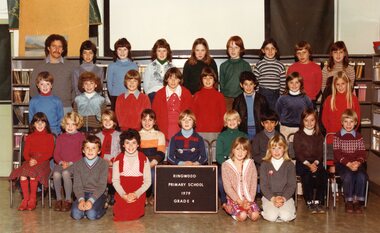
Photograph, Ringwood State School - Grade 4, 1979
... , Mathew Jobling, Lexie Jenkinson, Kerryn Hopgood, Simon Ignatious, Jenny Murray, Julie Rigg. 3rd Row L to R: Ellen Hodgson, Tracey Williams, Tania Alhouse, Anthoula (?), Robert McDougall, Nigel Mason, Dale Franklin, Karen Evans, Craig McDonald. ..., Mathew Jobling, Lexie Jenkinson, Kerryn Hopgood, Simon Ignatious, Jenny Murray, Julie Rigg. 3rd Row L to R: Ellen Hodgson, Tracey Williams, Tania Alhouse, Anthoula (?), Robert McDougall, Nigel Mason, Dale Franklin, Karen Evans, Craig McDonald. ...Colour photograph - Grade 4,1979."Attached to photograph" Back Row-L to R: Mark (?), Leslie (?), Bronwyn (?), Rachel McEwan, David Postlethwaite, ?, ?, Nicole Mathieson. 2nd Row- L to R: James Edis, Kerry (?), Mathew Jobling, Lexie Jenkinson, Kerryn Hopgood, Simon Ignatious, Jenny Murray, Julie Rigg. 3rd Row L to R: Ellen Hodgson, Tracey Williams, Tania Alhouse, Anthoula (?), Robert McDougall, Nigel Mason, Dale Franklin, Karen Evans, Craig McDonald. Front Row- L to R: Johnny Tomado, Kylie Balinger, Lori Mays, Katrina de Jerseys, -
 Ringwood and District Historical Society
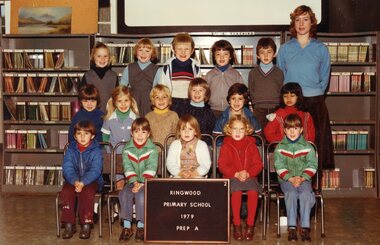
Photograph, Ringwood State School - Prep A, 1979
... "Attached to photograph" Back Row-L to R: Michelle Bingham, Wendy Graham, Jeremy Scholtus, David Beattie, Mark Guscot. 2nd Row- L to R: Kim Evans, Vivienne Magibbon, ?, Shannon Beath, Steven Thorpe, Rosabel Franklin. ..."Attached to photograph" Back Row-L to R: Michelle Bingham, Wendy Graham, Jeremy Scholtus, David Beattie, Mark Guscot. 2nd Row- L to R: Kim Evans, Vivienne Magibbon, ?, Shannon Beath, Steven Thorpe, Rosabel Franklin. ...Colour photograph - Prep A,1979."Attached to photograph" Back Row-L to R: Michelle Bingham, Wendy Graham, Jeremy Scholtus, David Beattie, Mark Guscot. 2nd Row- L to R: Kim Evans, Vivienne Magibbon, ?, Shannon Beath, Steven Thorpe, Rosabel Franklin. Front Row- L to R: ?, Cindy Bartlett, Stacey Forfar, Joanne Williams, Stephanie Bartlett. -
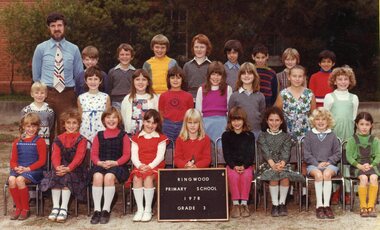 Ringwood and District Historical Society
Photograph, Ringwood State School - Grade 3, 1978
... R: Simon (?), Johnny Tomada, ?, David Postlewaite, Mark Hirt, ?, Robert McDougall, Dale Franklin. 2nd Row- L to R: Craig McDonald, ?...R: Simon (?), Johnny Tomada, ?, David Postlewaite, Mark Hirt, ?, Robert McDougall, Dale Franklin. 2nd Row- L to R: Craig McDonald, ? ...Colour photograph - Grade 3, 1978."Attached to photograph" Back Row-L to R: Simon (?), Johnny Tomada, ?, David Postlewaite, Mark Hirt, ?, Robert McDougall, Dale Franklin. 2nd Row- L to R: Craig McDonald, ?, Nichole Mathieson, Kerryn Hopgood, Rachel McEwen, ?, Lexie Jenkinson, ?. Front Row- L to R: Tania Alhaus, ?, Jenny Murray, Anthoula (?), Julie Rigg, Tania (?), ?, Tracey Williams, Ellen Hodgson. Teacher: Mr Hatfield. -
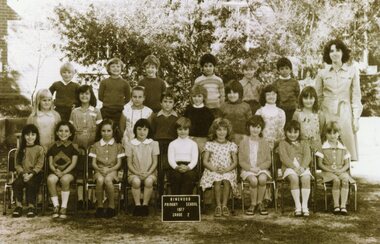 Ringwood and District Historical Society
Photograph, Ringwood State School - Grade 2, 1977
... R: Craig McDonald, ?, James Edis, Simon Ignations, Robert McDougall, Dale Franklin. 2nd Row- L to R: Julie Rigg, Kerryn Hopgood, Lexie Jenkinson, Johnny Tomada, ?...R: Craig McDonald, ?, James Edis, Simon Ignations, Robert McDougall, Dale Franklin. 2nd Row- L to R: Julie Rigg, Kerryn Hopgood, Lexie Jenkinson, Johnny Tomada, ? ...Black and white photograph - Grade 2, 1977"Attached to photograph" Back Row- L to R: Craig McDonald, ?, James Edis, Simon Ignations, Robert McDougall, Dale Franklin. 2nd Row- L to R: Julie Rigg, Kerryn Hopgood, Lexie Jenkinson, Johnny Tomada, ?, Racheal McEwan, ?, Nicole Mathieson. Front Row- L to R: Ellen Hodgson, ?, ?, ?, Jenny Murray, Kerry (?), ?, ?, Tania Alhouse. Teacher: Miss Harmon (American Exchange Teacher) -
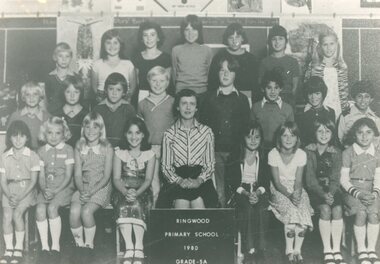 Ringwood and District Historical Society
Photograph, Ringwood State School - Grade 5A, 1980
... , Rachael McEwan, Lexie Jenkinson, Kerryn Hopgood, Julie Rigg. 2nd Row- L to R: Nigel Mason, Robert McDougall, Johnny Lomada, Jason (?), David Postlethwaite, Simon Ignatious, Robbie (?), Dale Franklin..., Rachael McEwan, Lexie Jenkinson, Kerryn Hopgood, Julie Rigg. 2nd Row- L to R: Nigel Mason, Robert McDougall, Johnny Lomada, Jason (?), David Postlethwaite, Simon Ignatious, Robbie (?), Dale Franklin ...Black and white photograph - Grade 5A, 1980"Attached to photograph" Back Row- L to R: Craig (?), Jenny Murray, Kerry (?), Rachael McEwan, Lexie Jenkinson, Kerryn Hopgood, Julie Rigg. 2nd Row- L to R: Nigel Mason, Robert McDougall, Johnny Lomada, Jason (?), David Postlethwaite, Simon Ignatious, Robbie (?), Dale Franklin. Front Row- L to R: Ellen Hodgerson, Tracey Williams, Katrina de Jersey, Anthoula (?), Sharon Evans, Lori Mays, Janice ALhouse, Olga Itouritit. Teacher: -
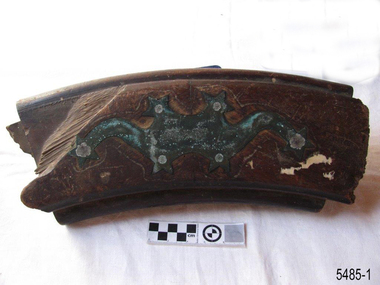 Flagstaff Hill Maritime Museum and Village
Functional object - Ship's Wheel, 1871 or earlier
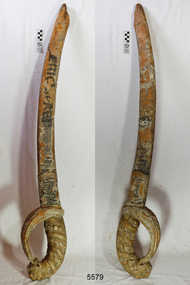
... Franklin. Some of the vessels yards and portions of her masts were on shore. The pieces of canvas attached to the yards and masts confirmed that the vessel had been under sail. The beach there was piled with debris several feet high. There were many cases of Diamond Oil kerosene, labelled R...Franklin. Some of the vessels yards and portions of her masts were on shore. The pieces of canvas attached to the yards and masts confirmed that the vessel had been under sail. The beach there was piled with debris several feet high. There were many cases of Diamond Oil kerosene, labelled R ...The ship building company E. & A. Sewall, from Bath, Maine, USA, built many ships that had wheels with the same decorative, starburst pattern on them as this particular wheel segment, including the Eric the Red. The wheel was manufactured by their local Bath foundry, Geo. Moulton & Co. and sold to the Sewall yard for $100, according to the construction accounts of the vessel. Eric the Red was a wooden, three masted clipper ship. She had 1,580 tons register and was the largest full-rigged ship built at Bath, Maine, USA in 1871. She was built and registered by Arthur Sewall, later to become the partnership E. & A. Sewall, and was the 51st ship built by this company. The annually-published List of Merchant Vessels of the U.S. shows that Bath was still the home port of Eric the Red in 1880. The vessel was named after the Viking discoverer, Eric the Red, who was the first European to reach the shores of North America (in 980AD). The ship Eric the Red at first traded in coal between America and Britain, and later traded in guano nitrates from South America. In 1879 she was re-metalled and was in first class condition. On 10th June 1880 (some records say 12th June) Eric the Red departed New York for Melbourne and then Sydney. She had been commissioned by American trade representatives to carry a special cargo of 500 exhibits (1400 tons) - about a quarter to a third of America’s total exhibits - from America for the U.S.A. pavilion at Melbourne’s first International Exhibition. The exhibits included furniture, ironmongery, wines, chemicals, dental and surgical instruments, paper, cages, bronze lamp trimmings, axles, stamped ware, astronomical and time globes, samples of corn and the choicest of leaf tobacco. Other general cargo included merchandise such as cases of kerosene and turpentine, brooms, Bristol's Sarsaparilla, Wheeler and Wilson sewing machines, Wheeler’s thresher machine, axe handles and tools, cases of silver plate, toys, pianos and organs, carriages and Yankee notions. The Eric the Red left New York under the command of Captain Z. Allen (or some records say Captain Jacques Allen) and 24 other crew including the owner’s son third mate Ned Sewall. There were 2 saloon passengers also. On 4th September 1880 the ship had been sailing for an uneventful 85 days and the voyage was almost at its end. Eric the Red approached Cape Otway in a moderate north-west wind and hazy and overcast atmosphere. Around 1:30am Captain Allen sighted the Cape Otway light and was keeping the ship 5-6 miles offshore to stay clear of the hazardous Otway Reef. However he had badly misjudged his position. The ship hit the Otway Reef about 2 miles out to sea, south west of the Cape Otway light station. Captain Allen ordered the wheel to be put ‘hard up’ thinking that she might float off the reef. A heavy sea knocked the man away from the wheel, broke the wheel ropes and carried away the rudder. The sea swamped the lifeboats, the mizzenmast fell, with all of its rigging, then the mainmast fell and the ship broke in two. Some said that the passenger Vaughan, who was travelling for his health and not very strong, was washed overboard and never seen again. The ship started breaking up. The forward house came adrift with three of the crew on it as well as a longboat, which the men succeeded in launching and keeping afloat by continually bailing with their sea boots. The captain, the third mate (the owner’s son) and others clung to the mizzenmast in the sea. Then the owner’s son was washed away off the mast. Within 10 minutes the rest of the ship was in pieces, completely wrecked, with cargo and wreckage floating in the sea. The captain encouraged the second mate to swim with him to the deckhouse where there were other crew but the second mate wouldn’t go with him. Eventually the Captain made it to the deckhouse and the men pulled him up. At about 4:30am the group of men on the deckhouse saw the lights of a steamer and called for help. At the same time they noticed the second mate and the other man had drifted nearby, still on the spur, and pulled them both onto the wreck. The coastal steamer Dawn was returning to Warrnambool from Melbourne, its sailing time different to its usual schedule. Cries were heard coming from out of the darkness. Captain Jones sent out two life boats, and fired off rockets and blue lights to illuminate the area. They picked up the three survivors who were in the long boat from Eric the Red. Two men were picked up out of the water, one being the owner’s son who was clinging to floating kerosene boxes. At daylight the Dawn then rescued the 18 men from the floating portion of the deckhouse, which had drifted about 4 miles from where they’d struck the reef. Shortly after the rescue the deckhouse drifted onto breakers and was thrown onto rocks at Point Franklin, about 2 miles east of Cape Otway. Captain Jones had signalled to Cape Otway lighthouse the number of the Eric the Red and later signalled that there was a wreck at Otway Reef but there was no response from the lighthouse. The captain and crew of the Dawn spent several more hours searching unsuccessfully for more survivors, even going back as far as Apollo Bay. On board the Dawn the exhausted men received care and attention to their needs and wants, including much needed clothing. Captain Allen was amongst the 23 battered and injured men who were rescued and later taken to Warrnambool for care. Warrnambool’s mayor and town clerk offered them all hospitality, the three badly injured men going to the hospital and others to the Olive Branch Hotel, then on to Melbourne. Captain Allen’s leg injury prevented him from going ashore so he and three other men travelled on the Dawn to Portland. They were met by the mayor who also treated them all with great kindness. Captain Allen took the train back to Melbourne then returned to America. Those saved were Captain Z. Allen (or Jacques Allen), J. Darcy chief mate, James F. Lawrence second mate, Ned Sewall third mate and owner’s son, John French the cook, C. Nelson sail maker, Clarence W. New passenger, and the able seamen Dickenson, J. Black, Denis White, C. Herbert, C. Thompson, A. Brooks, D. Wilson, J. Ellis, Q. Thompson, C. Newman, W. Paul, J. Davis, M. Horenleng, J. Ogduff, T. W. Drew, R. Richardson. Four men had lost their lives; three of them were crew (Gus Dahlgreen ship’s carpenter, H. Ackman steward, who drowned in his cabin, and George Silver seaman) and one a passenger (J. B. Vaughan). The body of one of them had been found washed up at Cape Otway and was later buried in the lighthouse cemetery; another body was seen on an inaccessible ledge. Twelve months later the second mate James F. Lawrence, from Nova Scotia, passed away in the Warrnambool district; an obituary was displayed in the local paper. The captain and crew of the Dawn were recognised by the United States Government in July 1881 for their humane efforts and bravery, being thanked and presented with substantial monetary rewards, medals and gifts. Neither the ship, nor its cargo, was insured. The ship was worth about £15,000 and the cargo was reportedly worth £40,000; only about £2,000 worth had been recovered. Cargo and wreckage washed up at Apollo Bay, Peterborough, Port Campbell, Western Port and according to some reports, even as far away as the beaches of New Zealand. The day after the wreck the government steam ship Pharos was sent from Queenscliff to clear the shipping lanes of debris that could be a danger to ships. The large midship deckhouse of the ship was found floating in a calm sea near Henty Reef. Items such as an American chair, a ladder and a nest of boxes were all on top of the deckhouse. As it was so large and could cause danger to passing ships, Captain Payne had the deckhouse towed towards the shore just beyond Apollo Bay. Between Apollo Bay and Blanket Bay the captain and crew of Pharos collected Wheeler and Wilson sewing machines, nests of boxes, bottles of Bristol’s sarsaparilla, pieces of common American chairs, axe handles, a Wheelers’ Patent thresher and a sailor’s trunk with the words “A. James” on the front. A ship’s flag-board bearing the words “Eric the Red” was found on the deckhouse; finally those on board the Pharos had the name of the wrecked vessel. During this operation Pharos came across the government steamer Victoria and also a steamer S.S. Otway, both of which were picking up flotsam and wreckage. A whole side of the hull and three large pieces of the other side of the hull, with some of the copper sheathing stripped off, had floated on to Point Franklin. Some of the vessels yards and portions of her masts were on shore. The pieces of canvas attached to the yards and masts confirmed that the vessel had been under sail. The beach there was piled with debris several feet high. There were many cases of Diamond Oil kerosene, labelled R. W. Cameron and Company, New York. There were also many large planks of red pine, portions of a small white boat and a large, well-used oar. Other items found ashore included sewing machines (some consigned to ‘Long and Co.”) and notions, axe and scythe handles, hay forks, wooden pegs, rolls of wire (some branded “T.S” and Co, Melbourne”), kegs of nails branded “A.T. and Co.” from the factory of A. Field and Son, Taunton, Massachusetts, croquet balls and mallets, buggy fittings, rat traps, perfumery, cutlery and Douay Bibles, clocks, bicycles, chairs, a fly wheel, a cooking stove, timber, boxes, pianos, organs and a ladder. (Wooden clothes pegs drifted in for many years). There seemed to be no personal luggage or clothing. The Pharos encountered a long line, about one and a half miles, of floating wreckage about 10 miles off land, south east of Cape Otway, and in some places about 40 feet wide. It seemed that more than half of it was from Eric the Red. The ship’s crew rescued 3 cases that were for the Melbourne Exhibition and other items from amongst the debris. There were also chairs, doors, musical instruments, washing boards, nests of trunks and fly catchers floating in the sea. Most of the goods were saturated and smelt of kerosene. A section of the hull lies buried in the sand at Parker River Beach. An anchor with chain is embedded in the rocks east of Point Franklin and a second anchor, thought to be from Eric the Red, is on display at the Cape Otway light station. (There is a photograph of a life belt on the verandah of Rivernook Guest House in Princetown with the words “ERIC THE RED / BOSTON”. This is rather a mystery as the ship was registered in Bath, Maine, USA.) Parts of the ship are on display at Bimbi Park Caravan Park and at Apollo Bay Museum. Flagstaff Hill Maritime Village also has part of the helm (steering wheel), a carved wooden sword (said to be the only remaining portion of the ship’s figurehead; further research is currently being carried out), a door, a metal rod, samples of wood and a medal for bravery. Much of the wreckage was recovered by the local residents before police and other authorities arrived at the scene. Looters went to great effort to salvage goods, being lowered down the high cliff faces to areas with little or no beach to collect items from the wreckage, their mates above watching out for dangerous waves. A Tasmanian newspaper reports on a court case in Stawell, Victoria, noting a man who was caught 2 months later selling tobacco from the wreckage of Eric the Red. Some of the silverware is still treasured by descendants of Mr Mackenzie who was given these items by officials for his help in securing the cargo. The gifts included silver coffee and tea pots, half a dozen silver serviette rings and two sewing machines. The wreck and cargo were sold to a Melbourne man who salvaged a quantity of high quality tobacco and dental and surgical instruments. Timbers from the ship were salvaged and used in the construction of houses and sheds around Apollo Bay, including a guest house, Milford House (since burnt down in bushfires), which had furniture, fittings and timber on the dining room floor from the ship. A 39.7 foot long trading ketch, the Apollo, was also built from its timbers by Mr Burgess in 1883 and subsequently used in Tasmanian waters. It was the first attempt at ship building in Apollo bay. In 1881 a red light was installed about 300 feet above sea level at the base of the Cape Otway lighthouse to warn ships when they were too close to shore; It would not be visible unless a ship came within 3 miles from it. This has proved to be an effective warning. The State Library of Victoria has a lithograph in its collection depicting the steamer Dawn and the shipwrecked men, titled. "Wreck of the ship Eric the Red, Cape Otway: rescue of the crew by the Dawn". “The Eric the Red is historically significant as one of Victoria's major 19th century shipwrecks. (Heritage Victoria Eric the Red; HV ID 239) The wreck led to the provision of an additional warning light placed below the Cape Otway lighthouse to alert mariners to the location of Otway Reef. The site is archaeologically significant for its remains of a large and varied cargo and ship's fittings being scattered over a wide area. The site is recreationally and aesthetically significant as it is one of the few sites along this coast where tourists can visit identifiable remains of a large wooden shipwreck, and for its location set against the background of Cape Otway, Bass Strait, and the Cape Otway lighthouse.“ (Victorian Heritage Database Registration Number S239, Official Number 8745 USA) Segment of a ship's wheel, or helm, from the wreck of the sailing ship Eric the Red. The wheel part is an arc shape from the outer rim of the wheel and is made up of three layers of timber. The centre layer is a dark, dense timber and is wider than the two outer layers, which are less dense and lighter in colour. The wheel segment has a vertically symmetrical, decorative copper plate inlaid on the front. The plate has a starburst pattern; six stars decorate it, each at a point where there is a metal fitting going through the three layers of timber to the rear side of the wheel. On the rear each of the six fittings has an individual copper star around it. The edges of the helm are rounded and bevelled, polished to a shine in a dark stain. Around each of the stars, front and back, the wood is a lighter colour, as though the metal in that area being polished frequently. The length of the segment suggests that it has probably come from a wheel or helm that had ten spokes. (Ref: F.H.M.M. 16th March 1994, 239.6.610.3.7. Artefact Reg No ER/1.)flagstaff hill, warrnambool, shipwrecked-coast, flagstaff-hill, flagstaff-hill-maritime-museum, maritime-museum, shipwreck-coast, flagstaff-hill-maritime-village, ship's-wheel, eric-the-red, helm, shei's wheel, ship's steering wheel -
 Flagstaff Hill Maritime Museum and Village
Decorative object - Sword, 1871 or earlier
... Franklin. Some of the vessels yards and portions of her masts were on shore. The pieces of canvas attached to the yards and masts confirmed that the vessel had been under sail. The beach there was piled with debris several feet high. There were many cases of Diamond Oil kerosene, labelled R...Franklin. Some of the vessels yards and portions of her masts were on shore. The pieces of canvas attached to the yards and masts confirmed that the vessel had been under sail. The beach there was piled with debris several feet high. There were many cases of Diamond Oil kerosene, labelled R ...This wooden sword is said to “possibly be the only remaining part of the figurehead from the sailing ship Eric the Red.” It was previously part of the collection of the old Warrnambool Museum and the entry in its inventory says “Wooden sword, portion of the figurehead, held by “Eric the Red” at the bow.” A large part of the ship’s hull was found on the rocks and a figurehead may have been attached or washed up on the shore. The shipping records for E. & A. Sewall, the builders, owners and managers of Eric the Red, are now preserved in the Maine Maritime Museum. There is no photograph on record of Eric the Red but photographs of other ships built around that time by the same company show that these did not have figureheads, and there is no record found of a figurehead for Eric the Red being ordered or paid for. Further research is being carried out. The ship building company E. & A. Sewall, from Bath, Maine, USA, built Eric the Red, a wooden, three masted clipper ship. She had 1,580 tons register and was the largest full-rigged ship built at Bath, Maine, USA in 1871. She was built and registered by Arthur Sewall, later to become the partnership E. & A. Sewall, and was the 51st ship built by this company. The annually-published List of Merchant Vessels of the U.S. shows that Bath was still the home port of Eric the Red in 1880. The vessel was named after the Viking discoverer, Eric the Red, who was the first European to reach the shores of North America (in 980AD). The ship Eric the Red at first traded in coal between America and Britain, and later traded in guano nitrates from South America. In 1879 she was re-metalled and was in first class condition. On 10th June 1880 (some records say 12th June) Eric the Red departed New York for Melbourne and then Sydney. She had been commissioned by American trade representatives to carry a special cargo of 500 exhibits (1400 tons) - about a quarter to a third of America’s total exhibits - from America for the U.S.A. pavilion at Melbourne’s first International Exhibition. The exhibits included furniture, ironmongery, wines, chemicals, dental and surgical instruments, paper, cages, bronze lamp trimmings, axles, stamped ware, astronomical and time globes, samples of corn and the choicest of leaf tobacco. Other general cargo included merchandise such as cases of kerosene and turpentine, brooms, Bristol's Sarsaparilla, Wheeler and Wilson sewing machines, Wheeler’s thresher machine, axe handles and tools, cases of silver plate, toys, pianos and organs, carriages and Yankee notions. The Eric the Red left New York under the command of Captain Z. Allen (or some records say Captain Jacques Allen) and 24 other crew including the owner’s son third mate Ned Sewall. There were 2 saloon passengers also. On 4th September 1880 the ship had been sailing for an uneventful 85 days and the voyage was almost at its end. Eric the Red approached Cape Otway in a moderate north-west wind and hazy and overcast atmosphere. Around 1:30am Captain Allen sighted the Cape Otway light and was keeping the ship 5-6 miles offshore to stay clear of the hazardous Otway Reef. However he had badly misjudged his position. The ship hit the Otway Reef about 2 miles out to sea, south west of the Cape Otway light station. Captain Allen ordered the wheel to be put ‘hard up’ thinking that she might float off the reef. A heavy sea knocked the man away from the wheel, broke the wheel ropes and carried away the rudder. The sea swamped the lifeboats, the mizzenmast fell, with all of its rigging, then the mainmast fell and the ship broke in two. Some said that the passenger Vaughan, who was travelling for his health and not very strong, was washed overboard and never seen again. The ship started breaking up. The forward house came adrift with three of the crew on it as well as a longboat, which the men succeeded in launching and keeping afloat by continually bailing with their sea boots. The captain, the third mate (the owner’s son) and others clung to the mizzenmast in the sea. Then the owner’s son was washed away off the mast. Within 10 minutes the rest of the ship was in pieces, completely wrecked, with cargo and wreckage floating in the sea. The captain encouraged the second mate to swim with him to the deckhouse where there were other crew but the second mate wouldn’t go with him. Eventually the Captain made it to the deckhouse and the men pulled him up. At about 4:30am the group of men on the deckhouse saw the lights of a steamer and called for help. At the same time they noticed the second mate and the other man had drifted nearby, still on the spur, and pulled them both onto the wreck. The coastal steamer Dawn was returning to Warrnambool from Melbourne, its sailing time different to its usual schedule. Cries were heard coming from out of the darkness. Captain Jones sent out two life boats, and fired off rockets and blue lights to illuminate the area. They picked up the three survivors who were in the long boat from Eric the Red. Two men were picked up out of the water, one being the owner’s son who was clinging to floating kerosene boxes. At daylight the Dawn then rescued the 18 men from the floating portion of the deckhouse, which had drifted about 4 miles from where they’d struck the reef. Shortly after the rescue the deckhouse drifted onto breakers and was thrown onto rocks at Point Franklin, about 2 miles east of Cape Otway. Captain Jones had signalled to Cape Otway lighthouse the number of the Eric the Red and later signalled that there was a wreck at Otway Reef but there was no response from the lighthouse. The captain and crew of the Dawn spent several more hours searching unsuccessfully for more survivors, even going back as far as Apollo Bay. On board the Dawn the exhausted men received care and attention to their needs and wants, including much needed clothing. Captain Allen was amongst the 23 battered and injured men who were rescued and later taken to Warrnambool for care. Warrnambool’s mayor and town clerk offered them all hospitality, the three badly injured men going to the hospital and others to the Olive Branch Hotel, then on to Melbourne. Captain Allen’s leg injury prevented him from going ashore so he and three other men travelled on the Dawn to Portland. They were met by the mayor who also treated them all with great kindness. Captain Allen took the train back to Melbourne then returned to America. Those saved were Captain Z. Allen (or Jacques Allen), J. Darcy chief mate, James F. Lawrence second mate, Ned Sewall third mate and owner’s son, John French the cook, C. Nelson sail maker, Clarence W. New passenger, and the able seamen Dickenson, J. Black, Denis White, C. Herbert, C. Thompson, A. Brooks, D. Wilson, J. Ellis, Q. Thompson, C. Newman, W. Paul, J. Davis, M. Horenleng, J. Ogduff, T. W. Drew, R. Richardson. Four men had lost their lives; three of them were crew (Gus Dahlgreen ship’s carpenter, H. Ackman steward, who drowned in his cabin, and George Silver seaman) and one a passenger (J. B. Vaughan). The body of one of them had been found washed up at Cape Otway and was later buried in the lighthouse cemetery; another body was seen on an inaccessible ledge. Twelve months later the second mate James F. Lawrence, from Nova Scotia, passed away in the Warrnambool district; an obituary was displayed in the local paper. The captain and crew of the Dawn were recognised by the United States Government in July 1881 for their humane efforts and bravery, being thanked and presented with substantial monetary rewards, medals and gifts. Neither the ship, nor its cargo, was insured. The ship was worth about £15,000 and the cargo was reportedly worth £40,000; only about £2,000 worth had been recovered. Cargo and wreckage washed up at Apollo Bay, Peterborough, Port Campbell, Western Port and according to some reports, even as far away as the beaches of New Zealand. The day after the wreck the government steam ship Pharos was sent from Queenscliff to clear the shipping lanes of debris that could be a danger to ships. The large midship deckhouse of the ship was found floating in a calm sea near Henty Reef. Items such as an American chair, a ladder and a nest of boxes were all on top of the deckhouse. As it was so large and could cause danger to passing ships, Captain Payne had the deckhouse towed towards the shore just beyond Apollo Bay. Between Apollo Bay and Blanket Bay the captain and crew of Pharos collected Wheeler and Wilson sewing machines, nests of boxes, bottles of Bristol’s sarsaparilla, pieces of common American chairs, axe handles, a Wheelers’ Patent thresher and a sailor’s trunk with the words “A. James” on the front. A ship’s flag-board bearing the words “Eric the Red” was found on the deckhouse; finally those on board the Pharos had the name of the wrecked vessel. During this operation Pharos came across the government steamer Victoria and also a steamer S.S. Otway, both of which were picking up flotsam and wreckage. A whole side of the hull and three large pieces of the other side of the hull, with some of the copper sheathing stripped off, had floated on to Point Franklin. Some of the vessels yards and portions of her masts were on shore. The pieces of canvas attached to the yards and masts confirmed that the vessel had been under sail. The beach there was piled with debris several feet high. There were many cases of Diamond Oil kerosene, labelled R. W. Cameron and Company, New York. There were also many large planks of red pine, portions of a small white boat and a large, well-used oar. Other items found ashore included sewing machines (some consigned to ‘Long and Co.”) and notions, axe and scythe handles, hay forks, wooden pegs, rolls of wire (some branded “T.S” and Co, Melbourne”), kegs of nails branded “A.T. and Co.” from the factory of A. Field and Son, Taunton, Massachusetts, croquet balls and mallets, buggy fittings, rat traps, perfumery, cutlery and Douay Bibles, clocks, bicycles, chairs, a fly wheel, a cooking stove, timber, boxes, pianos, organs and a ladder. (Wooden clothes pegs drifted in for many years). There seemed to be no personal luggage or clothing. The Pharos encountered a long line, about one and a half miles, of floating wreckage about 10 miles off land, south east of Cape Otway, and in some places about 40 feet wide. It seemed that more than half of it was from Eric the Red. The ship’s crew rescued 3 cases that were for the Melbourne Exhibition and other items from amongst the debris. There were also chairs, doors, musical instruments, washing boards, nests of trunks and fly catchers floating in the sea. Most of the goods were saturated and smelt of kerosene. A section of the hull lies buried in the sand at Parker River Beach. An anchor with chain is embedded in the rocks east of Point Franklin and a second anchor, thought to be from Eric the Red, is on display at the Cape Otway light station. (There is a photograph of a life belt on the verandah of Rivernook Guest House in Princetown with the words “ERIC THE RED / BOSTON”. This is rather a mystery as the ship was registered in Bath, Maine, USA.) Parts of the ship are on display at Bimbi Park Caravan Park and at Apollo Bay Museum. Flagstaff Hill Maritime Village also has part of the helm (steering wheel), a carved wooden sword (said to be the only remaining portion of the ship’s figurehead; further research is currently being carried out), a door, a metal rod, samples of wood and a medal for bravery. Much of the wreckage was recovered by the local residents before police and other authorities arrived at the scene. Looters went to great effort to salvage goods, being lowered down the high cliff faces to areas with little or no beach to collect items from the wreckage, their mates above watching out for dangerous waves. A Tasmanian newspaper reports on a court case in Stawell, Victoria, noting a man who was caught 2 months later selling tobacco from the wreckage of Eric the Red. Some of the silverware is still treasured by descendants of Mr Mackenzie who was given these items by officials for his help in securing the cargo. The gifts included silver coffee and tea pots, half a dozen silver serviette rings and two sewing machines. The wreck and cargo were sold to a Melbourne man who salvaged a quantity of high quality tobacco and dental and surgical instruments. Timbers from the ship were salvaged and used in the construction of houses and sheds around Apollo Bay, including a guest house, Milford House (since burnt down in bushfires), which had furniture, fittings and timber on the dining room floor from the ship. A 39.7 foot long trading ketch, the Apollo, was also built from its timbers by Mr Burgess in 1883 and subsequently used in Tasmanian waters. It was the first attempt at ship building in Apollo bay. In 1881 a red light was installed about 300 feet above sea level at the base of the Cape Otway lighthouse to warn ships when they were too close to shore; It would not be visible unless a ship came within 3 miles from it. This has proved to be an effective warning. The State Library of Victoria has a lithograph in its collection depicting the steamer Dawn and the shipwrecked men, titled. "Wreck of the ship Eric the Red, Cape Otway: rescue of the crew by the Dawn".The Eric the Red is historically significant as one of Victoria's major 19th century shipwrecks. (Heritage Victoria Eric the Red; HV ID 239) The wreck led to the provision of an additional warning light placed below the Cape Otway lighthouse to alert mariners to the location of Otway Reef. The site is archaeologically significant for its remains of a large and varied cargo and ship's fittings being scattered over a wide area. The site is recreationally and aesthetically significant as it is one of the few sites along this coast where tourists can visit identifiable remains of a large wooden shipwreck, and for its location set against the background of Cape Otway, Bass Strait, and the Cape Otway lighthouse. (Victorian Heritage Database Registration Number S239, Official Number 8745 USA)This carved wooden sword, recovered from the Eric the Red, is possibly the only portion of the figurehead recovered after the wreck. There are spirals carved from the base of the handle to the top of the sword. The hilt of the sword is a lion’s head holding its tail in its mouth, the tail forming the handle. The blade of the sword has engraved patterns on it. Tiny particles of gold leaf and dark blue paint fragments can be seen between the carving marks. There are remnants of yellowish-orange and crimson paint on the handle. At some time after the sword was salvaged the name of the ship was hand painted on the blade in black paint. The tip of the sword has broken or split and the remaining part is charcoal in appearance. On both the tip and the base of the handle are parts made where the sword could have been joined onto the figurehead There is a white coating over some areas of the sword, similar to white lead putty used in traditional shipbuilding. The words “ERIC the RED” have been hand painted on the blade of the sword in black paint sometime after it was salvaged.flagstaff hill, flagstaff hill maritime museum and village, warrnambool, maritime museum, maritime village, great ocean road, shipwreck coast, sword, wooden sword, eric the red, carved sword, figurehead, snake head on sword -
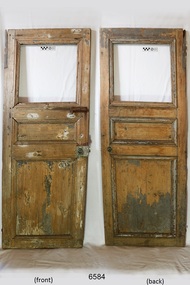 Flagstaff Hill Maritime Museum and Village
Furniture - Door, 1871 or earlier
... Franklin. Some of the vessels yards and portions of her masts were on shore. The pieces of canvas attached to the yards and masts confirmed that the vessel had been under sail. The beach there was piled with debris several feet high. There were many cases of Diamond Oil kerosene, labelled R...Franklin. Some of the vessels yards and portions of her masts were on shore. The pieces of canvas attached to the yards and masts confirmed that the vessel had been under sail. The beach there was piled with debris several feet high. There were many cases of Diamond Oil kerosene, labelled R ...The wooden door was salvaged from the wreck of the sailing ship Eric the Red, which was a wooden, three masted clipper ship. Eric the Red was the largest full-rigged ship built at Bath, Maine, USA in 1871, having had a 1,580 tons register. She was built and registered by Arthur Sewall, later to become the partnership E. & A. Sewall, the 51st ship built by this company. The annually-published List of Merchant Vessels of the U.S. shows Bath was still the home port of Eric the Red in 1880. The vessel was named after the Viking discoverer, Eric the Red, who was the first European to reach the shores of North America (in 980AD). The ship Eric the Red at first traded in coal between America and Britain, and later traded in guano nitrates from South America. In 1879 she was re-metalled and was in first class condition. On 10th June 1880 (some records say 12th June) Eric the Red departed New York for Melbourne and then Sydney. She had been commissioned by American trade representatives to carry a special cargo of 500 exhibits (1400 tons) – about a quarter to a third of America’s total exhibits - from America for the U.S.A. pavilion at Melbourne’s first International Exhibition. The exhibits included furniture, ironmongery, wines, chemicals, dental and surgical instruments, paper, cages, bronze lamp trimmings, axles, stamped ware, astronomical and time globes, samples of corn and the choicest of leaf tobacco. Other general cargo included merchandise such as cases of kerosene and turpentine, brooms, Bristol's Sarsaparilla, Wheeler and Wilson sewing machines, Wheeler’s thresher machine, axe handles and tools, cases of silver plate, toys, pianos and organs, carriages and Yankee notions. The Eric the Red left New York under the command of Captain Z. Allen (or some records say Captain Jacques Allen) and 24 other crew including the owner’s son third mate Ned Sewall. There were 2 saloon passengers also. The ship had been sailing for an uneventful 85 days and the voyage was almost at its end. On 4th September 1880 the Eric the Red approached Cape Otway with a moderate north-west wind and hazy and overcast atmosphere. Around 1:30am Captain Allen sighted the Cape Otway light and was keeping the ship 5-6 miles offshore to stay clear of the hazardous Otway Reef. However he had badly misjudged his position. The ship hit the Otway Reef about 2 miles out to sea, south west of the Cape Otway light station. He ordered the wheel to be put ‘hard up’ thinking that she might float off the reef. A heavy sea knocked the man away from the wheel, broke the wheel ropes and carried away the rudder. The sea swamped the lifeboats. The mizzenmast fell, with all of its rigging, then the mainmast also fell and the ship broke in two. Some said that the passenger Vaughan, who was travelling for his health and not very strong, was washed overboard and never seen again. The ship started breaking up. The forward house came adrift with three of the crew on it as well as a longboat, which the men succeeded in launching and keeping afloat by continually bailing with their sea boots. The captain, the third mate (the owner’s son) and others clung to the mizzenmast in the sea. Then the owner’s son was washed away off the mast. Within 10 minutes the rest of the ship was in pieces, completely wrecked, with cargo and wreckage floating in the sea. The captain encouraged the second mate to swim with him to the deckhouse where there were other crew but the second mate wouldn’t go with him. Eventually the Captain made it to the deckhouse and the men pulled him up. At about 4:30am the group of men on the deckhouse saw the lights of a steamer and called for help. At the same time they noticed the second mate and the other man had drifted nearby, still on the spur, and pulled them both onto the wreck. The coastal steamer Dawn was returning to Warrnambool from Melbourne, its sailing time different to its usual schedule. Captain Jones sent out two life boats, and fired off rockets and blue lights to illuminate the area. They picked up the three survivors who were in the long boat from Eric the Red. Two men were picked up out of the water, one being the owner’s son who was clinging to floating kerosene boxes. At daylight the Dawn then rescued the 18 men from the floating portion of the deckhouse, which had drifted about 4 miles from where they’d struck the reef. Shortly after the rescue the deckhouse drifted onto breakers and was thrown onto rocks at Point Franklin, about 2 miles east of Cape Otway. Captain Jones had signalled to Cape Otway lighthouse the number of the Eric the Red and later signalled that there was a wreck at Otway Reef but there was no response from the lighthouse. The captain and crew of the Dawn spent several more hours searching unsuccessfully for more survivors, even going back as far as Apollo Bay. On board the Dawn the exhausted men received care and attention to their needs and wants, including much needed clothing. Captain Allen was amongst the 23 battered and injured men who were rescued and later taken to Warrnambool for care. Warrnambool’s mayor and town clerk offered them all hospitality, the three badly injured men going to the hospital for care and others to the Olive Branch Hotel, then on to Melbourne. Captain Allen’s leg injury prevented him from going ashore so he and three other men travelled on the Dawn to Portland. They were met by the mayor who also treated them all with great kindness. Captain Allen took the train back to Melbourne then returned to America. Those saved were Captain Z. Allen (or Jacques Allen), J. Darcy chief mate, James F. Lawrence second mate, Ned Sewall third mate and owner’s son, John French the cook, C. Nelson sail maker, Clarence W. New passenger, and the able seamen Dickenson, J. Black, Denis White, C. Herbert, C. Thompson, A. Brooks, D. Wilson, J. Ellis, Q. Thompson, C. Newman, W. Paul, J. Davis, M. Horenleng, J. Ogduff, T. W. Drew, R. Richardson. Four men had lost their lives; three of them were crew (Gus Dahlgreen ship’s carpenter, H. Ackman steward, who drowned in his cabin, and George Silver seaman) and one a passenger (J. B. Vaughan). The body of one of them had been found washed up at Cape Otway and was later buried in the lighthouse cemetery; another body was seen on an inaccessible ledge. Twelve months later the second mate James F. Lawrence, from Nova Scotia, passed away in the Warrnambool district; an obituary was displayed in the local paper. The captain and crew of the Dawn were recognised by the United States Government in July 1881 for their humane efforts, being thanked and presented with substantial monetary rewards, medals and gifts. Neither the ship, nor its cargo, was insured. The ship was worth about £15,000 and the cargo was reportedly worth £40,000; only about £2,000 worth had been recovered. Cargo and wreckage washed up at Apollo Bay, Peterborough, Port Campbell, Western Port and according to some reports, even as far away as the beaches of New Zealand. The day after the wreck the government steam ship Pharos was sent from Queenscliff to clear the shipping lanes of debris that could be a danger to ships. The large midship deckhouse of the ship was found floating in a calm sea near Henty Reef. Items such as an American chair, a ladder and a nest of boxes were all on top of the deckhouse. As it was so large and could cause danger to passing ships, Captain Payne had the deckhouse towed towards the shore just beyond Apollo Bay. Between Apollo Bay and Blanket Bay the captain and crew of Pharos collected Wheeler and Wilson sewing machines, nests of boxes, bottles of Bristol’s sarsaparilla, pieces of common American chairs, axe handles, a Wheelers’ Patent thresher and a sailor’s trunk with the words “A. James” on the front. A ship’s flag-board bearing the words “Eric the Red” was found on the deckhouse; finally those on board the Pharos had the name of the wrecked vessel. During this operation Pharos came across the government steamer Victoria and also a steamer S.S. Otway, both of which were picking up flotsam and wreckage. A whole side of the hull and three large pieces of the other side of the hull, with some of the copper sheathing stripped off, had floated on to Point Franklin. Some of the vessels yards and portions of her masts were on shore. The pieces of canvas attached to the yards and masts confirmed that the vessel had been under sail. The beach there was piled with debris several feet high. There were many cases of Diamond Oil kerosene, labelled R. W. Cameron and Company, New York. There were also many large planks of red pine, portions of a small white boat and a large, well-used oar. Other items found ashore included sewing machines (some consigned to ‘Long and Co.”) and notions, axe and scythe handles, hay forks, wooden pegs, rolls of wire (some branded “T.S” and Co, Melbourne”), kegs of nails branded “A.T. and Co.” from the factory of A. Field and Son, Taunton, Massachusetts, croquet balls and mallets, buggy fittings, rat traps, perfumery, cutlery and Douay Bibles, clocks, bicycles, chairs, a fly wheel, a cooking stove, timber, boxes, pianos, organs and a ladder. (Wooden clothes pegs drifted in for many years). There seemed to be no personal luggage or clothing. The Pharos encountered a long line, about one and a half miles, of floating wreckage about 10 miles off land, south east of Cape Otway, and in some places about 40 feet wide. It seemed that more than half of it was from Eric the Red. The ship’s crew rescued 3 cases that were for the Melbourne Exhibition and other items from amongst the debris. There were also chairs, doors, musical instruments, washing boards, nests of trunks and fly catchers floating in the sea. Most of the goods were saturated and smelt of kerosene. A section of the hull lies buried in the sand at Parker River Beach. An anchor with chain is embedded in the rocks east of Point Franklin and a second anchor, thought to be from Eric the Red, is on display at the Cape Otway light station. (There is a photograph of a life belt on the verandah of Rivernook Guest House in Princetown with the words “ERIC THE RED / BOSTON”. This is rather a mystery as the ship was registered in Bath, Maine, USA.) Parts of the ship are on display at Bimbi Park Caravan Park and at Apollo Bay Museum. Flagstaff Hill Maritime Village also has part of the helm (steering wheel), a carved wooden sword (said to be the only remaining portion of the ship’s figurehead; further research is currently being carried out), a door, a metal rod and samples of wood. Much of the wreckage was recovered by the local residents before police and other authorities arrived at the scene. Looters went to great effort to salvage goods, being lowered down the high cliff faces to areas with little or no beach to collect items from the wreckage, their mates above watching out for dangerous waves. A Tasmanian newspaper reports on a court case in Stawell, Victoria, noting a man who was caught 2 months later selling tobacco from the wreckage of Eric the Red. Some of the silverware is still treasured by descendants of Mr Mackenzie who was given these items by officials for his help in securing the cargo. The gifts included silver coffee and tea pots, half a dozen silver serviette rings and two sewing machines. The wreck and cargo were sold to a Melbourne man who salvaged a quantity of high quality tobacco and dental and surgical instruments. Timbers from the ship were salvaged and used in the construction of houses and sheds around Apollo Bay, including a guest house, Milford House (since burnt down in bushfires), which had furniture, fittings and timber on the dining room floor from the ship. A 39.7 foot long trading ketch, the Apollo, was also built from its timbers by Mr Burgess in 1883 and subsequently used in Tasmanian waters. It was the first attempt at ship building in Apollo bay. In 1881 a red light was installed about 300 feet above sea level at the base of the Cape Otway lighthouse to warn ships when they were too close to shore; It would not be visible unless a ship came within 3 miles from it. This has proved to be an effective warning. The State Library of Victoria has a lithograph in its collection depicting the steamer Dawn and the shipwrecked men, titled. "Wreck of the ship Eric the Red, Cape Otway: rescue of the crew by the Dawn". “The Eric the Red is historically significant as one of Victoria's major 19th century shipwrecks. (Heritage Victoria Eric the Red; HV ID 239) The wreck led to the provision of an additional warning light placed below the Cape Otway lighthouse to alert mariners to the location of Otway Reef. The site is archaeologically significant for its remains of a large and varied cargo and ship's fittings being scattered over a wide area. The site is recreationally and aesthetically significant as it is one of the few sites along this coast where tourists can visit identifiable remains of a large wooden shipwreck, and for its location set against the background of Cape Otway, Bass Strait, and the Cape Otway lighthouse.“ (Victorian Heritage Database Registration Number S239, Official Number 8745 USA) Door from the wreck of the ship Eric the Red. The wooden singular rectangular door includes three insert panel sections. The top section is square shaped and is missing its panel or glass. The centre timber panel is about a third of the height of the top panel and the bottom timber panel is approximately equal in height to the total height of the two upper panels. The door fastenings include both a metal door latch and traditional door bolt. They are both attached to the front right hand side of the door. The bolt is just below the top panel, and the door latch is in approximately the centre of that side. The door latch has a round mark where a handle could have been attached. The wood of the door has scraping marks in a semi-circle around the door latch where the latch has swung around on its one remaining fastening and grazed the surface. There is a metal hinge at the top section of the door on the opposite side to the latch. The painted surface has been scraped back to expose the wood. The door is shorter than the average height of a person. On the reverse of the door there are lines on the panels, just inside their edges, is what appears to be pencil. The door is not aligned straight but is skew to centre.warrnambool, flagstaff hill, flagstaff hill maritime village, maritime museum, shipwreck coast, great ocean road, shipwreck artefact, eric the red, jaques allen, sewall, 1880, melbourne exhibition 1880, cape otway, otway reef, victorian shipwreck, bass strait, eric-the-red, door -
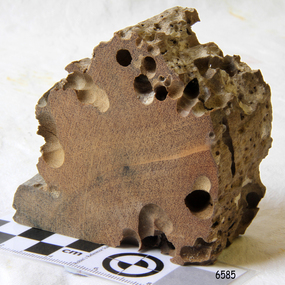 Flagstaff Hill Maritime Museum and Village
Wood Sample, about 1871
... Franklin. Some of the vessels yards and portions of her masts were on shore. The pieces of canvas attached to the yards and masts confirmed that the vessel had been under sail. The beach there was piled with debris several feet high. There were many cases of Diamond Oil kerosene, labelled R...Franklin. Some of the vessels yards and portions of her masts were on shore. The pieces of canvas attached to the yards and masts confirmed that the vessel had been under sail. The beach there was piled with debris several feet high. There were many cases of Diamond Oil kerosene, labelled R ...This piece of timber from the ship Eric the Red has been eaten through by the marine animals called Teredo Worms, sometimes called sea worms or ‘termites of the sea’. The worms bore holes into wood that is immersed in sea water and bacteria inside the worms digest the wood. Shipbuilders tried to prevent this problem by using coatings of tar, wax, lead or pitch. In the 18th and 19th centuries the outside of their ships were sheathed in copper or a combination of copper and zinc (called Muntz metal) and would be re-metalled periodically to ensure the sheathing would remain effective. In more recent times the ships are protected with a toxic coating. The American ship Eric the Red was a wooden, three masted clipper ship. She had 1,580 tons register and was the largest full-rigged ship built at Bath, Maine, USA in 1871. She was built and registered by Arthur Sewall, later to become the partnership E. & A. Sewall, the 51st ship built by this company. The annually-published List of Merchant Vessels of the U.S. shows Bath was still the home port of Eric the Red in 1880. The vessel was named after the Viking discoverer, Eric ‘the Red-haired’ Thorvaldsson , who was the first European to reach the shores of North America (in 980AD). The ship Eric the Red at first traded in coal between America and Britain, and later traded in guano nitrates from South America. In 1879 she was re-metalled and was in first class condition. On 10th June 1880 (some records say 12th June) Eric the Red departed New York for Melbourne and then Sydney. She had been commissioned by American trade representatives to carry a special cargo of 500 exhibits (1400 tons) – about a quarter to a third of America’s total exhibits - for the U.S.A. pavilion at Melbourne’s first International Exhibition. The exhibits included furniture, ironmongery, wines, chemicals, dental and surgical instruments, paper, cages, bronze lamp trimmings, axles, stamped ware, astronomical and time globes, samples of corn and the choicest of leaf tobacco. Other general cargo included merchandise such as cases of kerosene and turpentine, brooms, Bristol's Sarsaparilla, Wheeler and Wilson sewing machines, Wheeler’s thresher machine, axe handles and tools, cases of silver plate, toys, pianos and organs, carriages and Yankee notions. The Eric the Red left New York under the command of Captain Zaccheus Allen (or some records say Captain Jacques Allen) and 24 other crew including the owner’s son third mate Ned Sewall. There were also 2 saloon passengers on board. The ship had been sailing for an uneventful 85 days and the voyage was almost at its end. As Eric the Red approached Cape Otway there was a moderate north-west wind and hazy and overcast atmosphere. On 4th September 1880 at about 1:30am Captain Allen sighted the Cape Otway light and was keeping the ship 5-6 miles offshore to stay clear of the hazardous Otway Reef. However he had badly misjudged his position. The ship hit the Otway Reef about 2 miles out to sea, south west of the Cape Otway light station. Captain Allen ordered the wheel to be put ‘hard up’ thinking that she might float off the reef. The sea knocked the helmsman away from the wheel, broke the wheel ropes and carried away the rudder. The lifeboats were swamped, the mizzenmast fell, with all of its rigging, then the mainmast also fell and the ship broke in two. Some said that the passenger Vaughan, who was travelling for his health and not very strong, was washed overboard and never seen again. The ship started breaking up. The forward house came adrift with three of the crew on it as well as a longboat, which the men succeeded in launching and keeping afloat by continually bailing with their sea boots. The captain, the third mate (the owner’s son) and others clung to the mizzenmast in the sea. Then the owner’s son was washed away off the mast. Within 10 minutes the rest of the ship was in pieces, completely wrecked, with cargo and wreckage floating in the sea. The captain encouraged the second mate to swim with him to the deckhouse where there were other crew but the second mate wouldn’t go with him. Eventually the Captain made it to the deckhouse and the men pulled him up. At about 4:30am the group of men on the deckhouse saw the lights of a steamer and called for help. At the same time they noticed the second mate and the other man had drifted nearby, still on the spur, and pulled them both onto the wreck. The coastal steamer SS Dawn was returning to Warrnambool from Melbourne, its sailing time different to its usual schedule. She was built in 1876 and bought by the Portland and Belfast Steam Navigation Co. in 1877. At the time of this journey she was commanded by Captain Jones, and was sailing between Melbourne and Portland via Warrnambool. The provedore of the Dawn, Benjamin Lear, heard cries of distress coming through the portholes of the saloon. He gave the alarm and the engines were stopped. Cries could be heard clearly, coming from the land. Captain Jones sent out crew in two boats, and fired off rockets and blue lights to illuminate the area. They picked up the three survivors who were in the long boat from Eric the Red. Two men were picked up out of the water, one being the owner’s son who was clinging to floating kerosene boxes. At daylight the Dawn then rescued the 18 men from the floating portion of the deckhouse, which had drifted about 4 miles from where they’d struck the reef. Shortly after the rescue the deckhouse drifted onto breakers and was thrown onto rocks at Point Franklin, about 2 miles east of Cape Otway. Captain Jones had signalled to Cape Otway lighthouse the number of the Eric the Red and later signalled that there was a wreck at Otway Reef but there was no response from the lighthouse. The captain and crew of the Dawn spent several more hours searching unsuccessfully for more survivors, even going back as far as Apollo Bay. On board the Dawn the exhausted men received care and attention to their needs and wants, including much needed clothing. Captain Allen was amongst the 23 battered and injured men who were rescued and later taken to Warrnambool for care. Warrnambool’s mayor and town clerk offered them all hospitality, the three badly injured men going to the hospital for care and others to the Olive Branch Hotel, then on to Melbourne. Captain Allen’s leg injury prevented him from going ashore so he and three other men travelled on the Dawn to Portland. They were met by the mayor who also treated them all with great kindness. Captain Allen took the train back to Melbourne then returned to America. Those saved were Captain Zaccheus Allen (or Jacques Allen), J. Darcy chief mate, James F. Lawrence second mate, Ned Sewall third mate and owner’s son, John French the cook, C. Nelson sail maker, Clarence W. New passenger, and the able seamen Dickenson, J. Black, Denis White, C. Herbert, C. Thompson, A. Brooks, D. Wilson, J. Ellis, Q. Thompson, C. Newman, W. Paul, J. Davis, M. Horenleng, J. Ogduff, T. W. Drew, R. Richardson. Four men had lost their lives; three of them were crew (Gus Dahlgreen ship’s carpenter, H. Ackman steward, who drowned in his cabin, and George Silver seaman) and one a passenger (J. B. Vaughan). The body of one of them had been found washed up at Cape Otway and was later buried in the lighthouse cemetery; another body was seen on an inaccessible ledge. Twelve months later the second mate James F. Lawrence, from Nova Scotia, passed away in the Warrnambool district; an obituary was displayed in the local paper. Neither the ship, nor its cargo, was insured. The ship was worth about £15,000 and the cargo was reportedly worth £40,000; only about £2,000 worth had been recovered. Cargo and wreckage washed up at Apollo Bay, Peterborough, Port Campbell, Western Port and according to some reports, even as far away as the beaches of New Zealand. The day after the wreck the government steam ship Pharos was sent from Queenscliff to clear the shipping lanes of debris that could be a danger to ships. The large midship deckhouse of the ship was found floating in a calm sea near Henty Reef. Items such as an American chair, a ladder and a nest of boxes were all on top of the deckhouse. As it was so large and could cause danger to passing ships, Captain Payne had the deckhouse towed towards the shore just beyond Apollo Bay. Between Apollo Bay and Blanket Bay the captain and crew of Pharos collected Wheeler and Wilson sewing machines, nests of boxes, bottles of Bristol’s sarsaparilla, pieces of common American chairs, axe handles, a Wheelers’ Patent thresher and a sailor’s trunk with the words “A. James” on the front. A ship’s flag-board bearing the words “Eric the Red” was found on the deckhouse; finally those on board the Pharos had the name of the wrecked vessel. During this operation Pharos came across the government steamer Victoria and also a steamer S.S. Otway, both of which were picking up flotsam and wreckage. A whole side of the hull and three large pieces of the other side of the hull, with some of the copper sheathing stripped off, had floated on to Point Franklin. Some of the vessels yards and portions of her masts were on shore. The pieces of canvas attached to the yards and masts confirmed that the vessel had been under sail. The beach there was piled with debris several feet high. There were many cases of Diamond Oil kerosene, labelled R. W. Cameron and Company, New York. There were also many large planks of red pine, portions of a small white boat and a large, well-used oar. Other items found ashore included sewing machines (some consigned to ‘Long and Co.”) and notions, axe and scythe handles, hay forks, wooden pegs, rolls of wire (some branded “T.S” and Co, Melbourne”), kegs of nails branded “A.T. and Co.” from the factory of A. Field and Son, Taunton, Massachusetts, croquet balls and mallets, buggy fittings, rat traps, perfumery, cutlery and Douay Bibles, clocks, bicycles, chairs, a fly wheel, a cooking stove, timber, boxes, pianos, organs and a ladder. (Wooden clothes pegs drifted in for many years). There seemed to be no personal luggage or clothing. The Pharos encountered a long line, about one and a half miles, of floating wreckage about 10 miles off land, south east of Cape Otway, and in some places about 40 feet wide. It seemed that more than half of it was from Eric the Red. The ship’s crew rescued 3 cases that were for the Melbourne Exhibition and other items from amongst the debris. There were also chairs, doors, musical instruments, washing boards, nests of trunks and fly catchers floating in the sea. Most of the goods were saturated and smelt of kerosene. A section of the hull lies buried in the sand at Parker River Beach. An anchor with chain is embedded in the rocks east of Point Franklin and a second anchor, thought to be from Eric the Red, is on display at the Cape Otway light station. (There is a photograph of a life belt on the verandah of Rivernook Guest House in Princetown with the words “ERIC THE RED / BOSTON”. This is rather a mystery as the ship was registered in Bath, Maine, USA.) Parts of the ship are on display at Bimbi Park Caravan Park and at Apollo Bay Museum. Flagstaff Hill Maritime Village also has part of the helm (steering wheel), a carved wooden sword (said to be the only remaining portion of the ship’s figurehead; further research is currently being carried out), a door, a metal rod, several samples of wood and a medal for bravery, awarded to Nelson Johnson, a crew member of the S.S. Dawn by the U.S. President, for the rescue of the crew. Much of the wreckage was recovered by the local residents before police and other authorities arrived at the scene. Looters went to great effort to salvage goods, being lowered down the high cliff faces to areas with little or no beach to collect items from the wreckage, their mates above watching out for dangerous waves. A Tasmanian newspaper reports on a court case in Stawell, Victoria, noting a man who was caught 2 months later selling tobacco from the wreckage of Eric the Red. Some of the silverware is still treasured by descendants of Mr Mackenzie who was given these items by officials for his help in securing the cargo. The gifts included silver coffee and tea pots, half a dozen silver serviette rings and two sewing machines. A Mr G.W. Black has in his possession a medal and a purse that were awarded to his father, another Dawn crew member who was part of the rescue team. The medal is inscribed and named “To John Black ….” (from “Shipwrecks” by Margaret E. Mackenzie, 3rd edition, published 1964). The wreck and cargo were sold to a Melbourne man who salvaged a quantity of high quality tobacco and dental and surgical instruments. Timbers from the ship were salvaged and used in the construction of houses and sheds around Apollo Bay, including a guest house, Milford House (since burnt down in bushfires), which had furniture, fittings and timber on the dining room floor from the ship. A 39.7 foot long trading ketch, the Apollo, was also built from its timbers by Mr Burgess in 1883 and subsequently used in Tasmanian waters. It was the first attempt at ship building in Apollo bay. In 1881 a red light was installed about 300 feet above sea level at the base of the Cape Otway lighthouse to warn ships when they were too close to shore; It would not be visible unless a ship came within 3 miles from it. This has proved to be an effective warning. Nelson Johnson, recipient of the medal for bravery, married Elizabeth Howard in 1881 and they had 10 children. They lived in South Melbourne, Victoria. Nelson died in 1922 in Fitzroy Victoria, age 66. In 1895 the owners of the S.S. Dawn, the Portland and Belfast Steam Navigation Co., wound up and sold out to the Belfast Company who took over the Dawn for one year before selling her to Howard Smith. She was condemned and sunk in Suva in 1928. The State Library of Victoria has a lithograph in its collection depicting the steamer Dawn and the shipwrecked men, titled. "Wreck of the ship Eric the Red, Cape Otway: rescue of the crew by the Dawn".The wood (timber) sample is listed on the Collections Australia Database, Heritage Victoria, number 239 00010 A “The Eric the Red is historically significant as one of Victoria's major 19th century shipwrecks. (Heritage Victoria Eric the Red; HV ID 239) The wreck led to the provision of an additional warning light placed below the Cape Otway lighthouse to alert mariners to the location of Otway Reef. The site is archaeologically significant for its remains of a large and varied cargo and ship's fittings being scattered over a wide area. The site is recreationally and aesthetically significant as it is one of the few sites along this coast where tourists can visit identifiable remains of a large wooden shipwreck, and for its location set against the background of Cape Otway, Bass Strait, and the Cape Otway lighthouse.“ (Victorian Heritage Database Registration Number S239, Official Number 8745 USA) Wood sample from the wreck of the ship Eric the Red. Triangular shaped, full of sea worm (Teredo worm) holes. The wood is dark in colour and is very light in weight.flagstaff hill, warrnambool, shipwrecked-coast, flagstaff-hill, flagstaff-hill-maritime-museum, maritime-museum, shipwreck-coast, flagstaff-hill-maritime-village, shipwreck-artefact, eric-the-red, zaccheus-allen, sewall, 1880, melbourne-exhibition, cape-otway, otway-reef, wood-sample, s.s.-dawn -
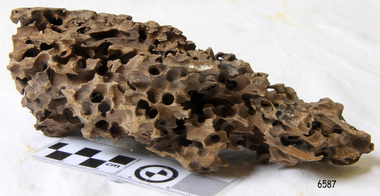 Flagstaff Hill Maritime Museum and Village
Wood Sample, About 1871
... Franklin. Some of the vessels yards and portions of her masts were on shore. The pieces of canvas attached to the yards and masts confirmed that the vessel had been under sail. The beach there was piled with debris several feet high. There were many cases of Diamond Oil kerosene, labelled R...Franklin. Some of the vessels yards and portions of her masts were on shore. The pieces of canvas attached to the yards and masts confirmed that the vessel had been under sail. The beach there was piled with debris several feet high. There were many cases of Diamond Oil kerosene, labelled R ...This piece of timber from the ship Eric the Red has been eaten through by the marine animals called Teredo Worms, sometimes called sea worms or ‘termites of the sea’. The worms bore holes into wood that is immersed in sea water and bacteria inside the worms digest the wood. Shipbuilders tried to prevent this problem by using coatings of tar, wax, lead or pitch. In the 18th and 19th centuries the outside of their ships were sheathed in copper or a combination of copper and zinc (called Muntz metal) and would be re-metalled periodically to ensure the sheathing would remain effective. In more recent times the ships are protected with a toxic coating. The American ship Eric the Red was a wooden, three masted clipper ship. She had 1,580 tons register and was the largest full-rigged ship built at Bath, Maine, USA in 1871. She was built and registered by Arthur Sewall, later to become the partnership E. & A. Sewall, the 51st ship built by this company. The annually-published List of Merchant Vessels of the U.S. shows Bath was still the home port of Eric the Red in 1880. The vessel was named after the Viking discoverer, Eric ‘the Red-haired’ Thorvaldsson , who was the first European to reach the shores of North America (in 980AD). The ship Eric the Red at first traded in coal between America and Britain, and later traded in guano nitrates from South America. In 1879 she was re-metalled and was in first class condition. On 10th June 1880 (some records say 12th June) Eric the Red departed New York for Melbourne and then Sydney. She had been commissioned by American trade representatives to carry a special cargo of 500 exhibits (1400 tons) – about a quarter to a third of America’s total exhibits - for the U.S.A. pavilion at Melbourne’s first International Exhibition. The exhibits included furniture, ironmongery, wines, chemicals, dental and surgical instruments, paper, cages, bronze lamp trimmings, axles, stamped ware, astronomical and time globes, samples of corn and the choicest of leaf tobacco. Other general cargo included merchandise such as cases of kerosene and turpentine, brooms, Bristol's Sarsaparilla, Wheeler and Wilson sewing machines, Wheeler’s thresher machine, axe handles and tools, cases of silver plate, toys, pianos and organs, carriages and Yankee notions. The Eric the Red left New York under the command of Captain Zaccheus Allen (or some records say Captain Jacques Allen) and 24 other crew including the owner’s son third mate Ned Sewall. There were also 2 saloon passengers on board. The ship had been sailing for an uneventful 85 days and the voyage was almost at its end. As Eric the Red approached Cape Otway there was a moderate north-west wind and hazy and overcast atmosphere. On 4th September 1880 at about 1:30am Captain Allen sighted the Cape Otway light and was keeping the ship 5-6 miles offshore to stay clear of the hazardous Otway Reef. However he had badly misjudged his position. The ship hit the Otway Reef about 2 miles out to sea, south west of the Cape Otway light station. Captain Allen ordered the wheel to be put ‘hard up’ thinking that she might float off the reef. The sea knocked the helmsman away from the wheel, broke the wheel ropes and carried away the rudder. The lifeboats were swamped, the mizzenmast fell, with all of its rigging, then the mainmast also fell and the ship broke in two. Some said that the passenger Vaughan, who was travelling for his health and not very strong, was washed overboard and never seen again. The ship started breaking up. The forward house came adrift with three of the crew on it as well as a longboat, which the men succeeded in launching and keeping afloat by continually bailing with their sea boots. The captain, the third mate (the owner’s son) and others clung to the mizzenmast in the sea. Then the owner’s son was washed away off the mast. Within 10 minutes the rest of the ship was in pieces, completely wrecked, with cargo and wreckage floating in the sea. The captain encouraged the second mate to swim with him to the deckhouse where there were other crew but the second mate wouldn’t go with him. Eventually the Captain made it to the deckhouse and the men pulled him up. At about 4:30am the group of men on the deckhouse saw the lights of a steamer and called for help. At the same time they noticed the second mate and the other man had drifted nearby, still on the spur, and pulled them both onto the wreck. The coastal steamer SS Dawn was returning to Warrnambool from Melbourne, its sailing time different to its usual schedule. She was built in 1876 and bought by the Portland and Belfast Steam Navigation Co. in 1877. At the time of this journey she was commanded by Captain Jones, and was sailing between Melbourne and Portland via Warrnambool. The provedore of the Dawn, Benjamin Lear, heard cries of distress coming through the portholes of the saloon. He gave the alarm and the engines were stopped. Cries could be heard clearly, coming from the land. Captain Jones sent out crew in two boats, and fired off rockets and blue lights to illuminate the area. They picked up the three survivors who were in the long boat from Eric the Red. Two men were picked up out of the water, one being the owner’s son who was clinging to floating kerosene boxes. At daylight the Dawn then rescued the 18 men from the floating portion of the deckhouse, which had drifted about 4 miles from where they’d struck the reef. Shortly after the rescue the deckhouse drifted onto breakers and was thrown onto rocks at Point Franklin, about 2 miles east of Cape Otway. Captain Jones had signalled to Cape Otway lighthouse the number of the Eric the Red and later signalled that there was a wreck at Otway Reef but there was no response from the lighthouse. The captain and crew of the Dawn spent several more hours searching unsuccessfully for more survivors, even going back as far as Apollo Bay. On board the Dawn the exhausted men received care and attention to their needs and wants, including much needed clothing. Captain Allen was amongst the 23 battered and injured men who were rescued and later taken to Warrnambool for care. Warrnambool’s mayor and town clerk offered them all hospitality, the three badly injured men going to the hospital for care and others to the Olive Branch Hotel, then on to Melbourne. Captain Allen’s leg injury prevented him from going ashore so he and three other men travelled on the Dawn to Portland. They were met by the mayor who also treated them all with great kindness. Captain Allen took the train back to Melbourne then returned to America. Those saved were Captain Zaccheus Allen (or Jacques Allen), J. Darcy chief mate, James F. Lawrence second mate, Ned Sewall third mate and owner’s son, John French the cook, C. Nelson sail maker, Clarence W. New passenger, and the able seamen Dickenson, J. Black, Denis White, C. Herbert, C. Thompson, A. Brooks, D. Wilson, J. Ellis, Q. Thompson, C. Newman, W. Paul, J. Davis, M. Horenleng, J. Ogduff, T. W. Drew, R. Richardson. Four men had lost their lives; three of them were crew (Gus Dahlgreen ship’s carpenter, H. Ackman steward, who drowned in his cabin, and George Silver seaman) and one a passenger (J. B. Vaughan). The body of one of them had been found washed up at Cape Otway and was later buried in the lighthouse cemetery; another body was seen on an inaccessible ledge. Twelve months later the second mate James F. Lawrence, from Nova Scotia, passed away in the Warrnambool district; an obituary was displayed in the local paper. Neither the ship, nor its cargo, was insured. The ship was worth about £15,000 and the cargo was reportedly worth £40,000; only about £2,000 worth had been recovered. Cargo and wreckage washed up at Apollo Bay, Peterborough, Port Campbell, Western Port and according to some reports, even as far away as the beaches of New Zealand. The day after the wreck the government steam ship Pharos was sent from Queenscliff to clear the shipping lanes of debris that could be a danger to ships. The large midship deckhouse of the ship was found floating in a calm sea near Henty Reef. Items such as an American chair, a ladder and a nest of boxes were all on top of the deckhouse. As it was so large and could cause danger to passing ships, Captain Payne had the deckhouse towed towards the shore just beyond Apollo Bay. Between Apollo Bay and Blanket Bay the captain and crew of Pharos collected Wheeler and Wilson sewing machines, nests of boxes, bottles of Bristol’s sarsaparilla, pieces of common American chairs, axe handles, a Wheelers’ Patent thresher and a sailor’s trunk with the words “A. James” on the front. A ship’s flag-board bearing the words “Eric the Red” was found on the deckhouse; finally those on board the Pharos had the name of the wrecked vessel. During this operation Pharos came across the government steamer Victoria and also a steamer S.S. Otway, both of which were picking up flotsam and wreckage. A whole side of the hull and three large pieces of the other side of the hull, with some of the copper sheathing stripped off, had floated on to Point Franklin. Some of the vessels yards and portions of her masts were on shore. The pieces of canvas attached to the yards and masts confirmed that the vessel had been under sail. The beach there was piled with debris several feet high. There were many cases of Diamond Oil kerosene, labelled R. W. Cameron and Company, New York. There were also many large planks of red pine, portions of a small white boat and a large, well-used oar. Other items found ashore included sewing machines (some consigned to ‘Long and Co.”) and notions, axe and scythe handles, hay forks, wooden pegs, rolls of wire (some branded “T.S” and Co, Melbourne”), kegs of nails branded “A.T. and Co.” from the factory of A. Field and Son, Taunton, Massachusetts, croquet balls and mallets, buggy fittings, rat traps, perfumery, cutlery and Douay Bibles, clocks, bicycles, chairs, a fly wheel, a cooking stove, timber, boxes, pianos, organs and a ladder. (Wooden clothes pegs drifted in for many years). There seemed to be no personal luggage or clothing. The Pharos encountered a long line, about one and a half miles, of floating wreckage about 10 miles off land, south east of Cape Otway, and in some places about 40 feet wide. It seemed that more than half of it was from Eric the Red. The ship’s crew rescued 3 cases that were for the Melbourne Exhibition and other items from amongst the debris. There were also chairs, doors, musical instruments, washing boards, nests of trunks and fly catchers floating in the sea. Most of the goods were saturated and smelt of kerosene. A section of the hull lies buried in the sand at Parker River Beach. An anchor with chain is embedded in the rocks east of Point Franklin and a second anchor, thought to be from Eric the Red, is on display at the Cape Otway light station. (There is a photograph of a life belt on the verandah of Rivernook Guest House in Princetown with the words “ERIC THE RED / BOSTON”. This is rather a mystery as the ship was registered in Bath, Maine, USA.) Parts of the ship are on display at Bimbi Park Caravan Park and at Apollo Bay Museum. Flagstaff Hill Maritime Village also has part of the helm (steering wheel), a carved wooden sword (said to be the only remaining portion of the ship’s figurehead; further research is currently being carried out), a door, a metal rod, several samples of wood and a medal for bravery, awarded to Nelson Johnson, a crew member of the S.S. Dawn by the U.S. President, for the rescue of the crew. Much of the wreckage was recovered by the local residents before police and other authorities arrived at the scene. Looters went to great effort to salvage goods, being lowered down the high cliff faces to areas with little or no beach to collect items from the wreckage, their mates above watching out for dangerous waves. A Tasmanian newspaper reports on a court case in Stawell, Victoria, noting a man who was caught 2 months later selling tobacco from the wreckage of Eric the Red. Some of the silverware is still treasured by descendants of Mr Mackenzie who was given these items by officials for his help in securing the cargo. The gifts included silver coffee and tea pots, half a dozen silver serviette rings and two sewing machines. A Mr G.W. Black has in his possession a medal and a purse that were awarded to his father, another Dawn crew member who was part of the rescue team. The medal is inscribed and named “To John Black ….” (from “Shipwrecks” by Margaret E. Mackenzie, 3rd edition, published 1964). The wreck and cargo were sold to a Melbourne man who salvaged a quantity of high quality tobacco and dental and surgical instruments. Timbers from the ship were salvaged and used in the construction of houses and sheds around Apollo Bay, including a guest house, Milford House (since burnt down in bushfires), which had furniture, fittings and timber on the dining room floor from the ship. A 39.7 foot long trading ketch, the Apollo, was also built from its timbers by Mr Burgess in 1883 and subsequently used in Tasmanian waters. It was the first attempt at ship building in Apollo bay. In 1881 a red light was installed about 300 feet above sea level at the base of the Cape Otway lighthouse to warn ships when they were too close to shore; It would not be visible unless a ship came within 3 miles from it. This has proved to be an effective warning. Nelson Johnson, recipient of the medal for bravery, married Elizabeth Howard in 1881 and they had 10 children. They lived in South Melbourne, Victoria. Nelson died in 1922 in Fitzroy Victoria, age 66. In 1895 the owners of the S.S. Dawn, the Portland and Belfast Steam Navigation Co., wound up and sold out to the Belfast Company who took over the Dawn for one year before selling her to Howard Smith. She was condemned and sunk in Suva in 1928. The State Library of Victoria has a lithograph in its collection depicting the steamer Dawn and the shipwrecked men, titled. "Wreck of the ship Eric the Red, Cape Otway: rescue of the crew by the Dawn".The wood (timber) sample is listed on the Collections Australia Database, Heritage Victoria, number 239 00010 A “The Eric the Red is historically significant as one of Victoria's major 19th century shipwrecks. (Heritage Victoria Eric the Red; HV ID 239) The wreck led to the provision of an additional warning light placed below the Cape Otway lighthouse to alert mariners to the location of Otway Reef. The site is archaeologically significant for its remains of a large and varied cargo and ship's fittings being scattered over a wide area. The site is recreationally and aesthetically significant as it is one of the few sites along this coast where tourists can visit identifiable remains of a large wooden shipwreck, and for its location set against the background of Cape Otway, Bass Strait, and the Cape Otway lighthouse.“ (Victorian Heritage Database Registration Number S239, Official Number 8745 USA) Wood sample from the wreck of the ship Eric the Red. Oblong shaped, full of sea worm (Teredo worm) holes. The wood is dark in colour and is very light in weight. flagstaff hill, warrnambool, shipwrecked-coast, flagstaff-hill, flagstaff-hill-maritime-museum, maritime-museum, shipwreck-coast, flagstaff-hill-maritime-village, shipwreck-artefact, eric-the-red, zaccheus-allen, sewall, 1880, melbourne-exhibition, cape-otway, otway-reef, wood-sample, s.s.-dawn -
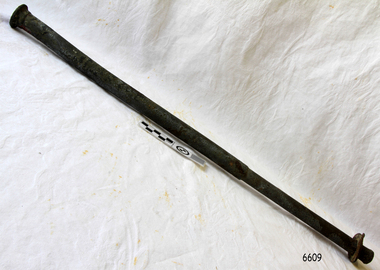 Flagstaff Hill Maritime Museum and Village
Functional object - Rod, Approx. 1871
... Franklin. Some of the vessel's yards and portions of its masts were on shore with pieces of canvas attached, confirming that the vessel had been under sail. On shore were many cases of Diamond Oil kerosene labelled R...Franklin. Some of the vessel's yards and portions of its masts were on shore with pieces of canvas attached, confirming that the vessel had been under sail. On shore were many cases of Diamond Oil kerosene labelled R ...This rod was salvaged from the American three-masted wooden clipper ship, Eric the Red, named after the Viking discoverer, Eric the Red. The ship first traded in coal between America and Britain and later traded in guano nitrates from South America. In 1879 its hull was re-metalled and the vessel was in first class condition. On 10th June 1880 Eric the Red departed New York under the command of Captain Z Allen, with 24 crew plus two passengers. It was heading for Melbourne and then Sydney. The ship was commissioned by American trade representatives to carry a special cargo of 500 American exhibits for the U.S.A. pavilion at Melbourne’s first International Exhibition. The items included furniture, ironmongery, wines, chemicals, dental and surgical instruments, paper, cages, bronze lamp trimmings, axles, stamped ware, astronomical and time globes, and samples of corn and the choicest of leaf tobacco. Also on board was general merchandise such as cases of kerosene and turpentine, brooms, Bristol's Sarsaparilla, Wheeler and Wilson sewing machines, Wheeler’s thresher machine, axe handles and tools, cases of silver plate, toys, pianos and organs, carriages and Yankee notions. The ship had been at sea for 85 days when, on 4th September 1880, it hit the Otway Reef on the southwest coast of Victoria and was quickly wrecked. Captain and crew ended up on floating parts, or in the long boat or the sea. He was amongst the 23 battered and injured men who were rescued by the steamer Dawn and later taken to Warrnambool, where they received great hospitality and care. Four men lost their lives; three crew and one passenger. Captain Allen took the train back to Melbourne and then returned to America. The captain and crew of the Dawn were recognised by the United States Government in July 1881 for their humane efforts, being thanked and presented with substantial monetary rewards, medals and gifts. The salvaging ship Pharos collected Wheeler and Wilson sewing machines, nests of boxes, bottles of Bristol’s sarsaparilla, pieces of common American chairs, axe handles, a Wheelers’ Patent thresher and a sailor’s trunk with the words “A. James” on the front. A ship’s flag board bearing the words “Eric the Red” was found on the deckhouse; finally, those on board the Pharos had found the name of the wrecked vessel. The government steamer Victoria and a steamer S.S. Otway picked up flotsam and wreckage. A whole side of the hull and three large pieces of the other side of the hull, with some of the copper sheathing stripped off, had floated onto Point Franklin. Some of the vessel's yards and portions of its masts were on shore with pieces of canvas attached, confirming that the vessel had been under sail. On shore were many cases of Diamond Oil kerosene labelled R. W. Cameron and Company, New York. large planks of red pine, portions of a small white boat and a large, well-used oar. There were sewing machines, some consigned to ‘Long and Co.”, and notions, axe and scythe handles, hay forks, wooden pegs, rolls of wire, some branded “T.S” and Co, Melbourne”, and kegs of nails branded “A.T. and Co.” from the factory of A. Field and Son, Taunton, Massachusetts. Other cargo remains included croquet balls and mallets, buggy fittings, rat traps, perfumery, cutlery and Douay Bibles, clocks, bicycles, chairs, a flywheel, a cooking stove, timber, boxes, pianos, organs, wooden clothes pegs and a ladder. There were three cases of goods meant for the Exhibition Other items salvaged from amongst the debris floating in the sea were chairs, doors, musical instruments, washing boards, nests of trunks and flycatchers. Most of the goods were saturated and smelt of kerosene. A section of the hull lies buried in the sand at Parker River Beach. An anchor with a chain is embedded in the rocks east of Point Franklin and a second anchor, thought to be from Eric the Red, is on display at the Cape Otway light station. A life belt was once on the veranda of Rivernook Guest House in Princetown with the words “ERIC THE RED / BOSTON”. Parts of the ship are on display at Bimbi Park Caravan Park and Apollo Bay Museum. Flagstaff Hill Maritime Village also has several artefacts from the wreck. There seemed to be no personal luggage or clothing. “The Eric the Red is historically significant as one of Victoria's major 19th century shipwrecks. (Heritage Victoria Eric the Red; HV ID 239) The wreck led to the provision of an additional warning light placed below the Cape Otway lighthouse to alert mariners to the location of Otway Reef. The site is archaeologically significant for its remains of a large and varied cargo and ship's fittings being scattered over a wide area. The site is recreationally and aesthetically significant as it is one of the few sites along this coast where tourists can visit identifiable remains of a large wooden shipwreck, and for its location set against the background of Cape Otway, Bass Strait, and the Cape Otway lighthouse.“ (Victorian Heritage Database Registration Number S239, Official Number 8745 USA)Iron rod with flat lugged washer. The rod is made of a heavy metal with encrustations and signs of rusting on the surface. It is stepped down in diameter mid-shaft and is slightly bowed on the narrower end. The narrow end flares out slightly in the last few centimetres with a burred foot and has a circular head on the wider end. The washer on the narrower end cannot move past the centre or the narrow end of the rod. The washer is a different metal from the rod and has a small lug jutting out along the circumference in one position. The rod was recovered from the wreck of the ship the Eric the Red.flagstaff hill, warrnambool, shipwrecked-coast, flagstaff-hill, flagstaff-hill-maritime-museum, maritime-museum, shipwreck-coast, flagstaff-hill-maritime-village, rod, iron-rod, eric the red, steamer dawn, cape otway reef, 1880, captain allen, usa pavillion, melbourne exhibition, melbourne international exhibition, captain jones, medal, united states government, pharos, a. james, flag board, steamer victoria, steamer otway, diamond oil, r w cameron and company, long and co., t s and co melbourne, a. field and son, taunton, massachusetts, ketch apollo, ship nail -
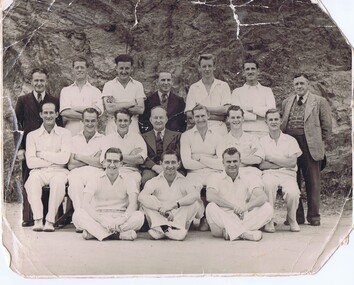 Greensborough Historical Society
Photograph, Greensborough Cricket Club, 1950s
... Kerison (with glasses), unknown, Maurie O'Connor; Middle row: L to R: Frank Smith, Lindsay Hall, Wally Butterworth, Alf Montford, Lyle Hall, Doug Hall; Back row: unknown (in suit), Arthur Franklin, Charlie Cook, unknown (in suit), Don Franklin, unknown, Mr Franklin (umpire)....Kerison (with glasses), unknown, Maurie O'Connor; Middle row: L to R: Frank Smith, Lindsay Hall, Wally Butterworth, Alf Montford, Lyle Hall, Doug Hall; Back row: unknown (in suit), Arthur Franklin, Charlie Cook, unknown (in suit), Don Franklin, unknown, Mr Franklin (umpire). greensborough cricket club Original Photograph and copy of Photograph with names Greensborough Cricket Club Photograph Photograph ...Photograph of Greensborough Cricket Club with names supplied by Betty McKenzie, Leigh Cameron and Gary Partington. Front row seated left: ? Kerison (with glasses), unknown, Maurie O'Connor; Middle row: L to R: Frank Smith, Lindsay Hall, Wally Butterworth, Alf Montford, Lyle Hall, Doug Hall; Back row: unknown (in suit), Arthur Franklin, Charlie Cook, unknown (in suit), Don Franklin, unknown, Mr Franklin (umpire).Original Photograph and copy of Photograph with namesgreensborough cricket club
