
Showing 7 items matching "rabbit plague"
-
 Art Gallery of Swan Hill
Painting, BYRNE, Sam, Rabbit plague - rounding up rabbits, c1970
... Rabbit plague - rounding up rabbits...Rabbit plague - rounding up rabbits Painting BYRNE, Sam ... -
Art Gallery of Swan Hill
Painting, BYRNE, Sam, Cremation - rabbit plague 1896, c1977
... Cremation - rabbit plague 1896...Cremation - rabbit plague 1896 Painting BYRNE, Sam ... -
Marysville & District Historical Society
Article (item) - Book Extract, Aboriginal History, Unknown
... ...rabbit plague...The extract also covers current (1991) status of Aboriginal affairs and European settlement of the area. kulin nation woiworung taungurong bunurong watherong jajowrong wurrundjeri-willam waring-ilam-balluk goulburn valley acheron valley upper goulburn district eildon-thornton eildon homestead o'rourke thornton assistant protector thomas yarra valley kilmore mount william jt gellibrand william buckley major mitchell port phillip murray river yorta yorta yowung-illam-balluk waring-illam-balluk ngurai-illam-wurrung kurnai nation protectorate system victoria george robinson chief protector willam thomas james dredge edward parker charles sievewright central board for the protection of aborigines presbyterian mission anglican mission moravian mission wonga munnarin beaning murrin murrin parugean baruppin koo-gurrin acheron river little river acheron run peter snodgrass stephen jones barak dividing range black spur watts river badger creek healesville coranderrk victorian christmas bush aboriginal and torres strait islander heritage protection act 1984 archaelological and aboriginal relics preservation act 1972 camp jungai rubicon warrawa college victorian archaeological survey hume and hovell molesworth broadford william hamilton alexandra mansfield avenel tallarook worrough john cotton trawool valley seymour pyalong gold mining central victoria strath creek reedy creek yea jamieson marysville jordan goldfields comet mine wandong melbourne-albury railway rabbit plague narbethong lord kitchener puckapunyal military camp 1944 decentralisation policy eildon weir hume freeway bypass timber industry australian paper manufacturers mill An extract from a book regarding a brief history of the Kulin nation of the North Central district of Victoria. ...An extract from a book regarding a brief history of the Kulin nation of the North Central district of Victoria.An extract from a book regarding a brief history of the Kulin nation of the North Central district of Victoria. This history covered is both prior to European history and post-European history. The extract also covers current (1991) status of Aboriginal affairs and European settlement of the area.kulin nation, woiworung, taungurong, bunurong, watherong, jajowrong, wurrundjeri-willam, waring-ilam-balluk, goulburn valley, acheron valley, upper goulburn district, eildon-thornton, eildon homestead, o'rourke, thornton, assistant protector thomas, yarra valley, kilmore, mount william, jt gellibrand, william buckley, major mitchell, port phillip, murray river, yorta yorta, yowung-illam-balluk, waring-illam-balluk, ngurai-illam-wurrung, kurnai nation, protectorate system, victoria, george robinson, chief protector, willam thomas, james dredge, edward parker, charles sievewright, central board for the protection of aborigines, presbyterian mission, anglican mission, moravian mission, wonga, munnarin, beaning, murrin murrin, parugean, baruppin, koo-gurrin, acheron river, little river, acheron run, peter snodgrass, stephen jones, barak, dividing range, black spur, watts river, badger creek, healesville, coranderrk, victorian christmas bush, aboriginal and torres strait islander heritage protection act 1984, archaelological and aboriginal relics preservation act 1972, camp jungai, rubicon, warrawa college, victorian archaeological survey, hume and hovell, molesworth, broadford, william hamilton, alexandra, mansfield, avenel, tallarook, worrough, john cotton, trawool valley, seymour, pyalong, gold mining, central victoria, strath creek, reedy creek, yea, jamieson, marysville, jordan goldfields, comet mine, wandong, melbourne-albury railway, rabbit plague, narbethong, lord kitchener, puckapunyal military camp, 1944 decentralisation policy, eildon weir, hume freeway bypass, timber industry, australian paper manufacturers mill -
 Kiewa Valley Historical Society
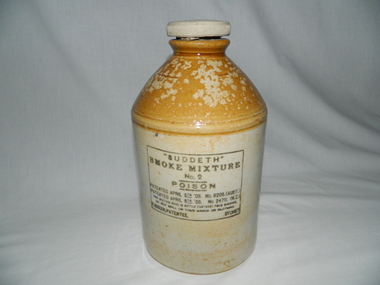
Jug Glazed, 1930s to 1950s
... This item was used in conjunction with the Suddeth (Sudden Death) Carbon Bi-siilphide fumigator during many rabbit plagues that invaded Victoria and NSW before CSIRO introduced the myxomatosis virus in 1950....This item was used in conjunction with the Suddeth (Sudden Death) Carbon Bi-siilphide fumigator during many rabbit plagues that invaded Victoria and NSW before CSIRO introduced the myxomatosis virus in 1950. ...This item was used in conjunction with the Suddeth (Sudden Death) Carbon Bi-siilphide fumigator during many rabbit plagues that invaded Victoria and NSW before CSIRO introduced the myxomatosis virus in 1950.The contents of this jug was very important pre 1950 for all rural areas which suffered under the annual mice plagues, especially the wheat producing regions. Milk producers suffered from the mice by products contaminating their fresh milk containers and storage facilities. Rabbit warrens causing farm machinery instabilities and also horseback activities eg mustering herds.This glazed pottery jug has a screw on lid and a cream coloured body with a caramel brown neck. The remnance of a handle, which has been broken off is located at the top just below the the rim of the lid.On one side below the neck and within a black boundary mark "SUDDETH" and below "SMOKE MIXTURE No. 2" and sandwiched between two black lines "POISON". Below this and in five lines "PATENTED APRIL 6th '08 No. 11205(AUST.)" "PATENTED APRIL 6th '08 No. 24711 (N.Z.)" "THIS MIXTURE GOES IN BOTTLE FURTHEST FROM MACHINE" "DO NOT SPILL ON YOUR HANDS OR CLOTHING" "F, GREER, PATENTEE SYDNEY"ceramic bowls, contamination of farm produce, domestic farm hygiene, vermin extermination poisons -
 City of Moorabbin Historical Society (Operating the Box Cottage Museum)
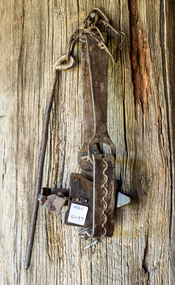
Manufactured Object, Rabbit trap Austral Box c1930, 20thC
... Rabbits were brought to Australia on the First Fleet as a source of food. However the plague of rabbits appears to have originated with the release of 24 wild rabbits by Thomas Austin for hunting purposes in October 1859, on his property, Barwon Park, near Winchelsea, Victoria. ...Rabbits were brought to Australia on the First Fleet as a source of food. However the plague of rabbits appears to have originated with the release of 24 wild rabbits by Thomas Austin for hunting purposes in October 1859, on his property, Barwon Park, near Winchelsea, Victoria. ...Rabbits were brought to Australia on the First Fleet as a source of food. However the plague of rabbits appears to have originated with the release of 24 wild rabbits by Thomas Austin for hunting purposes in October 1859, on his property, Barwon Park, near Winchelsea, Victoria. This a typical Rabbit trap used by residents of Moorabbin Shire c1930Austral Box Steel Rabbit trap 20thCAUSTRAL -
Hymettus Cottage & Garden Ballarat
Book - Minute Book, Minutes of the Gre Gre Village Rabbit Club
... A rare record from the early twentieth century of the methods employed to combat the rabbit plagues that swept across Victoria's Wimmera/Malley. ...non-fictiongre gre, marnoo, 1908, rabbit clubs, st arnaud, donald -
 Emerald Museum & Nobelius Heritage Park
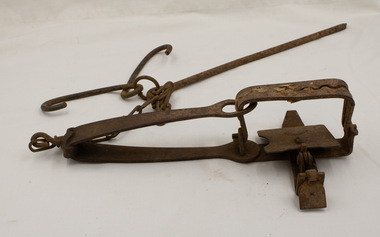
Equipment - Rabbit Trap
... After rabbits were released in Australia in the 1850s, they multiplied to plague proportions and the demand for traps grew. ...After rabbits were released in Australia in the 1850s, they multiplied to plague proportions and the demand for traps grew. ...This trap is designed so that the metal jaws snap shut against each other when the trap is activated by the application of weight to the pressure plate. In use, traps are set with open jaws, buried lightly just below the surface of the earth. When an animal steps on the pressure plate, the jagged teeth of the jaws snap around the animal's leg, usually breaking bone and sinew, thus immobilising the animal. After rabbits were released in Australia in the 1850s, they multiplied to plague proportions and the demand for traps grew. Henry Lane's 'Ace' trap was first made in 1935 and was the most commonly used rabbit trap in Australia until about 1970. Rabbits were trapped for food especially during the Great Depression. Today, rabbit trapping is considered labour intensive, inefficient and ineffective for large-scale rabbit control in Australia. It is also considered cruel.Rabbit trapping would have been a common practice in the local Emerald area from the 19th century until more recently.A steel-jawed trap constructed on a base consisting of a bar of steel, the stock bar, which is bent over to form a powerful bow spring. At the end of the spring is a hole, the spring eye, which encircles and closes the jaws when the trap is triggered. They close over the top of the bridge, plate and tongue mechanism that is designed to trigger the trap. An 8-link chain is attached by a hook on the bent end of the trap's spring. A long steel spike is looped over the last link of the other end of the chain together with two hooks. The jaws of the trap are flat, without ridges. Some small scraps of old newspaper are caught between the jaws.rabbit trap, great depression
