
Showing 18 items matching "railway houses wodonga"
-
 Wodonga & District Historical Society Inc
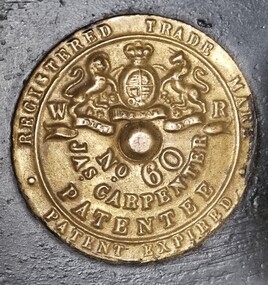
Functional object - Door lock and floor nails, railway home, 2 Ethel Lane, Wodonga
... Railway Houses Wodonga...railway cottage at 2 Ethel Lane, Wodonga. One is a diamond-headed timber nail and the others are simple round headed nails. They were designed so the head of the flooring nail when driven into the Baltic pine flooring was covered over by the timber so was not visible. The cottage was built about 1890. It featured many items labelled with the emblem of Victorian Railways. The house...This lock is significant because it came from an early railway home in Wodonga. Railway Houses Wodonga Jas Carpenter Locksmith On Lock - Trademark disc Around edge - REGISTERED TRADEMARK PATENT EXPIRED In centre: Royal Warrant Symbol of Rampant Lion and Unicorn above words NO. 60 JAS CARPENTER PATENTEE On striker plate: VR Flooring nails - one diamond headed timber nail and four other nails from railways cottage at 2 Ethel Lane, Wodonga. ...These flooring nails and lock came from a railway cottage at 2 Ethel Lane, Wodonga. One is a diamond-headed timber nail and the others are simple round headed nails. They were designed so the head of the flooring nail when driven into the Baltic pine flooring was covered over by the timber so was not visible. The cottage was built about 1890. It featured many items labelled with the emblem of Victorian Railways. The house was demolished in November 2006. This lock is significant because it came from an early railway home in Wodonga.Flooring nails - one diamond headed timber nail and four other nails from railways cottage at 2 Ethel Lane, Wodonga. Door lock and striker plate from a railway cottage at Ethel Lane.On Lock - Trademark disc Around edge - REGISTERED TRADEMARK PATENT EXPIRED In centre: Royal Warrant Symbol of Rampant Lion and Unicorn above words NO. 60 JAS CARPENTER PATENTEE On striker plate: VRrailway houses wodonga, jas carpenter locksmith -
 Wodonga & District Historical Society Inc
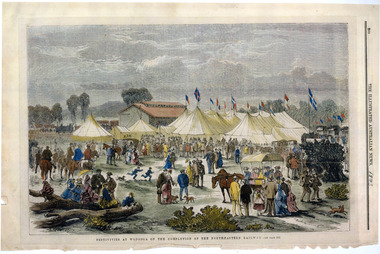
Article - Festivities for arrival of North-Eastern Railway in Wodonga, The Illustrated Australian News, 1873
... Railway to Wodonga. It depicts crowds of people congregated near the railway line area. Large tents have been erected to house visitors and special activities. ...railway line in Wodonga. Northeast Railway Line Wodonga Transport A colourised version of a newspaper article documenting the celebrations for the arrival of the North Eastern Railway to Wodonga. It depicts crowds of people congregated near the railway line area. Large tents have been erected to house ...The arrival of the railway from Melbourne to Wodonga was celebrated on 21st November 1873. The railway line between Melbourne and Wodonga was constructed in three sections. The first section from Essendon to Seymour was fifty-six miles. It was constructed by Messrs. O'Grady, Leggatt and Noonan at a cost of £305,558. The second section from Seymour to Benalla was sixty miles under contract to Messrs. Styles, Murray and Co. for £314,994. The final section of sixty six miles to Wodonga was constructed by Messrs. Cain, Dalrymple and Holton for £350,100. The Illustrated Australian News for Home Readers 4 December 1873 reported extensively on the event. The Victorian Government was determined to celebrate the event with a banquet, to which twelve hundred guests were invited. Four special trains had departed Melbourne to bring dignitaries to Wodonga. The Governor Sir George Bowen, Lady Bowen and, two Misses Bowen, were among the guests. Sir George Bowen proposed a toast to the “Prosperity to the North-eastern railway”. The banquet was held in marquees erected for the event, although the facilities struggled to cater adequately for the more than 5,000 people who arrived to celebrate. The estimated population of Wodonga was 500 only people. That evening a ball was held in the goods' shed, which was handsomely decorated with flags, evergreens and flowers. About five hundred guests were present. It would be another decade before New South Wales completed the line from Sydney to Albury and a connecting rail bridge was built over the Murray River.This item is significant because it documents the festivities celebrating the arrival of the railway line in Wodonga.A colourised version of a newspaper article documenting the celebrations for the arrival of the North Eastern Railway to Wodonga. It depicts crowds of people congregated near the railway line area. Large tents have been erected to house visitors and special activities. The railway goods shed can be seen in the background and a steam locomotive is on the track. The image was accompanied by a lengthy article which detailed the development of the railway line.northeast railway line, wodonga transport -
 Wodonga & District Historical Society Inc
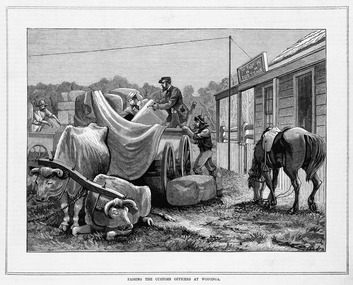
Work on paper - Passing the Customs Officers at Wodonga, Australasian Sketcher, 1881
... Belvoir (later to become Wodonga) was a made a port of entry with its own Customs House gazetted on 22nd December 1854. The Government set aside 500 Pounds in 1859 to build Belvoir's own Customs House. After the arrival of the Railways...Belvoir (later to become Wodonga) was a made a port of entry with its own Customs House gazetted on 22nd December 1854. The Government set aside 500 Pounds in 1859 to build Belvoir's own Customs House. After the arrival of the Railways ...This image appeared in the Australasian Sketcher on 13th August 1881. The initials in the corner indicate the artist may have been J D Cooper who worked with the Australasian Sketcher at that time. The Australia Customs Service played an important role in the history of Wodonga and a major part in the federation of the colonies of Australia. In 1852 the colonies were given the right to collect import duties on items such as coffee, tea, tobacco, chocolate and spirits. NSW was first to impose collection of duties in 1853. At that time Wodonga was not an official port of entry and was not allowed to collect duties. This regulation made it illegal for people to transport dutiable goods across the Murray River from NSW which provided an incentive for smuggling, while at the same time strangling the legitimate trade. Belvoir (later to become Wodonga) was a made a port of entry with its own Customs House gazetted on 22nd December 1854. The Government set aside 500 Pounds in 1859 to build Belvoir's own Customs House. After the arrival of the Railways to Wodonga in 1873, Customs Officers also checked travellers on the trains. The Sydney Morning Herald on 31st March 1881 reported:- "Luggage Scrutinised: The discomfort attending travellers proceeding overland from Sydney having to submit to their luggage being scrutinised by the Custom House officials at Wodonga is about to be increased. Passengers doing this journey must now be present on the platform at the Wodonga terminus three-quarters of an hour before the train leaves for Melbourne; and the Customs authorities have intimated that unless passengers attend as indicated, with the keys of their portmanteaus ready to open them for the inspection of the officers, the luggage will be detained until the next train, when it will be forwarded under bond, the owners having to pay the carriage." Tariffs were one of the most contentious issues which influenced discussions surrounding Federation. They were abolished when Federation was achieved in 1901. This item is significant because it depicts an early view of Wodonga when it was still an important customs post.A print from a pencil sketch which was published in the Australasian Sketcher 1881. It features a scene at the customs office in Wodonga. Initials JD in bottom right cornerearly wodonga, wodonga customs office -
 Wodonga & District Historical Society Inc
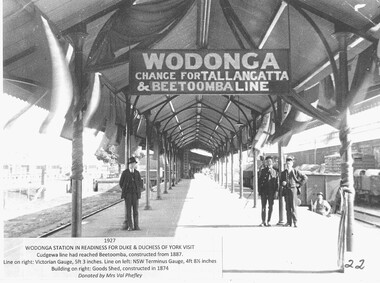
Photograph - Wodonga Station decorated for the Royal Train, 1927
... House in Canberra. Their tour also served as a show of gratitude for the sacrifices made by the Dominions during World War I and to strengthen ties between Australia and the British Empire. Part of their journey from Canberra to Melbourne was onboard the Royal Train which travelled through Wodonga and was reported in the Argus. Argus, Wednesday 11 May 1927, page 19 "The Royal train will leave Albury, according to the railway...House in Canberra. Their tour also served as a show of gratitude for the sacrifices made by the Dominions during World War I and to strengthen ties between Australia and the British Empire. Part of their journey from Canberra to Melbourne was onboard the Royal Train which travelled through Wodonga and was reported in the Argus. Argus, Wednesday 11 May 1927, page 19 "The Royal train will leave Albury, according to the railway ...The Duke and Duchess of York (later King George VI and Queen Elizabeth) visited Australia and New Zealand in 1927 primarily to open the provisional Parliament House in Canberra. Their tour also served as a show of gratitude for the sacrifices made by the Dominions during World War I and to strengthen ties between Australia and the British Empire. Part of their journey from Canberra to Melbourne was onboard the Royal Train which travelled through Wodonga and was reported in the Argus. Argus, Wednesday 11 May 1927, page 19 "The Royal train will leave Albury, according to the railway time table arrangements at 9.54 a.m. and Wodonga at 9.20. Principal towns on the route to Melbourne will be passed as follows:- Wangaratta 10.10; Benalla 11.16; Seymour 12.45; and Spencer street 2.50. From Albury the Sydney express which leaves at 20 minutes past 8 o'clock will be used as the pilot train for the Royal train."This image is significant because it captures Wodonga Railway Station during an important Royal Visit to Australia in 1927.Two black and white images of people at the Wodonga Railway Station waiting for the Royal Train carrying the Duke and Duchess of York in 1927. royal visit 1927, duke and duchess of york 1927 -
 Wodonga & District Historical Society Inc
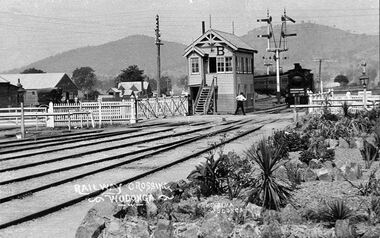
Photograph - Train approaching Wodonga Crossroads, Thomas Bonsema, c1915
... A black and white image showing a train approaching the Wodonga Railway Station from Albury. horse and buggy are waiting at the gates. Moloney’s house is located left of centre. ...Wodonga in 1876. The railway was a critical element in the development of Wodonga. Bonsema Photography Thomas Peter John Bonsema Railways Wodonga RAILWAY CROSSING WODONGA BONSEMA WODONGA A black and white image showing a train approaching the Wodonga Railway Station from Albury. horse and buggy are waiting at the gates. Moloney’s house ...Our Collection includes several photographs signed BONSEMA WODONGA or sometimes simply TBW. Thomas Peter John Bonsema was born in Wodonga in 1876 to Peter John Bonsema and Mary Ann nee Nash. His name first appears on the Electoral Roll for Wodonga in 1909 and on the Electoral Roll in 1912 he is listed as a photographer. His photographs capture many scenes and events around Wodonga and surrounding areas. Thomas Bonsema married Minna Louisa Jones in 1912. By 1914 he had moved to Chiltern, Victoria where he established Bonsema’s Photographic Studio. From this time onward many of his works bore the signature “BONSEMA CHILTERN”. As well as continuing to photograph landscapes and important buildings, Mr Bonsema was often the official photographer at school and community celebrations. He also sold many framed photographs and postcards from his premises at 68 -70 Conness Street, Chiltern. By 1943 Thomas John Bonsema had relocated to New South Wales and died in Beecroft, NSW on 14th July 1944. Some of his photographs are held in the Victorian State Library and Mitchell Library Sydney Collections.These images are significant because they are the work of a recognised photographer Thomas Bonsema who was born in Wodonga in 1876. The railway was a critical element in the development of Wodonga.A black and white image showing a train approaching the Wodonga Railway Station from Albury. horse and buggy are waiting at the gates. Moloney’s house is located left of centre. RAILWAY CROSSING WODONGA BONSEMA WODONGAbonsema photography, thomas peter john bonsema, railways wodonga -
 Wodonga & District Historical Society Inc
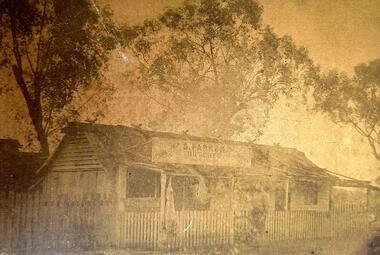
Photograph - Samuel Skelton Parker's Butchery and Bakery, Barnawartha, Victoria
... His horse drawn butchers cart made a run to Wodonga three days a week supplying the wayside pubs and Railway Gate House owners. ...His horse drawn butchers cart made a run to Wodonga three days a week supplying the wayside pubs and Railway Gate House owners. ...Samuel Skelton Parker was a native of Ballymena in the County of Antrim, Ireland and came to Melbourne, Australia in 1854. He was engaged for two years as a storeman. After mining in the Ovens district for five years he next became overseer on a station in New South Wales. He was married to Bridget Cusack in 1865 and they had a family of 4 sons and a daughter. After returning to Victoria Samuel Skelton Parker started a butchering business at Barnawartha and in 1881 he combined it with a bakery. This was the first business established in Barnawartha. Samuel had several properties in the township as well as his business premises and private residence. His horse drawn butchers cart made a run to Wodonga three days a week supplying the wayside pubs and Railway Gate House owners. Bread was sold for five loaves for one shilling, meat was two pennies per pound. In 1890 Skelton decided to give up butchering and baking and moved to Wodonga. He bought a 'Bush Block' of 150 acres on Fergusons Lane, now Parkers Road. Skelton called the property 'Park Hall' after his home in Ireland. On this new property Skelton raised sheep and he also sold chaff around the district. When Skelton died on 14 October 1897 the farm was split up with two sons Sam and Jack continuing the running of the farm, whilst the other two sons William and James joined the Victorian railways. Samuel and Jack continued to successfully manage the farm until 1974 when the Albury Wodonga Development Corporation acquired the land for the planned development of the region. In 2026 this is the location of Park Hall Retirement Village and the Wodonga Golf Club are situated on Parkers Road.This image is significant because it records one of the earliest businesses established in Barnawartha, Victoria.Two black and white images of Samuel Parker's business in Barnawartha, Northeast Victoria.parker family wodonga, early wodonga settlers, barnawartha, samuel skelton parker -
 Wodonga & District Historical Society Inc
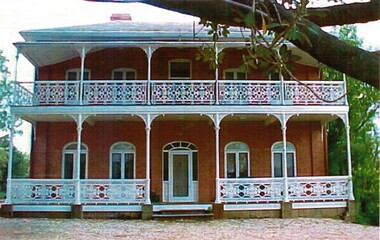
Photograph - de Kerilleau Homestead
... house is its two-storey cast-iron verandah which has been restored to its original condition. When the Governor, Sir George Bowen, his wife and two daughters needed accommodation overnight after having taken part in the celebration of the railway in Wodonga in 1873, they stayed at de Kerilleau. ...house is its two-storey cast-iron verandah which has been restored to its original condition. When the Governor, Sir George Bowen, his wife and two daughters needed accommodation overnight after having taken part in the celebration of the railway in Wodonga in 1873, they stayed at de Kerilleau. ...The Huon family were early pastoralists in the Wodonga area. They built the mansion, de Kerilleau in 1870 and named after the family's ancestral estate in France. The original lease of the Wodonga Run was granted to Paul Huon as No. 202 on 7th February 1837, about a year after his cousin Charles Huon had squatted on the land. In August 1849, this run was transferred to Paul's son, William. Paul Huon was one of the children of Gabriel Louis Marie Huon de Kerilleau, a French nobleman who fled France during the French Revolution and travelled under a false identity with the Second Fleet in 1794. The mansion, De Kerilleau was built by William Huon in 1870. It is a solid two storey red brick building with cream brick flat window arches. The main feature of the house is its two-storey cast-iron verandah which has been restored to its original condition. When the Governor, Sir George Bowen, his wife and two daughters needed accommodation overnight after having taken part in the celebration of the railway in Wodonga in 1873, they stayed at de Kerilleau. Sir George planted a Moreton Bay fig tree in the grounds and it still stands today. de Kerilleau is a significant building in Wodonga which has been classified by the National Trust.Coloured photographs showing a variety of features of de Kerilleau homestead.huon family, de kerilleau, de kerilleau homestead -
 Wodonga & District Historical Society Inc
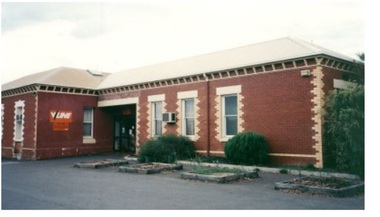
Photograph - Wodonga old Railway Station complex
... house six more engines. The location of the railway tracks and station were a constant cause of congestion in the centre of Wodonga as the tracks crossed over Sydney Road (later named High Street). ...Wodonga closed and the station fell quiet. The area has now been redeveloped as Junction Place and the old buildings now house a restaurant, cafe and the Goods Shed Craft Beer Cafe. These images are of local, state and national significance as the Wodonga Railway ...\When the railway reached Wodonga from Melbourne on 19th November 1873 the first station building, which included a refreshment room and dining room, was a temporary structure. It was 300 ft. long and was removed and taken to Beechworth when the new station was built in 1874 by contractor J. Richardson. The Goods shed was 100 feet long and was built by Frew & Hill in 1873. One year later it was extended an additional 150 feet by James Nation. The date of the construction of the Locomotive shed is not known but predates 1883. It was a galvanised iron clad building which housed 4 engines on 2 tracks; in 1910 it was extended to 250 feet in length to house six more engines. The location of the railway tracks and station were a constant cause of congestion in the centre of Wodonga as the tracks crossed over Sydney Road (later named High Street). Lines of traffic were frequently banked up as the gates were closed to allow trains to cross. The Wodonga Rail Bypass project moved Wodonga station from the original central location to a position on a new line on the northern edge of the town. Not only did this release land in the middle of the city for commercial and public use, but also eliminated 10 level crossings. The project actually commenced in 2008 with the last passenger train passing through Wodonga on 8 November 2008. On 23 July 2010, the new rail bypass was opened, the original line through Wodonga closed and the station fell quiet. The area has now been redeveloped as Junction Place and the old buildings now house a restaurant, cafe and the Goods Shed Craft Beer Cafe.These images are of local, state and national significance as the Wodonga Railway complex formed a vital link in the Victorian state, interstate and national railway system.A collection of colour photos of the buildings at the former Wodonga Railway Stationwodonga railways, railway station wodonga, junction place wodonga -
 Wodonga & District Historical Society Inc
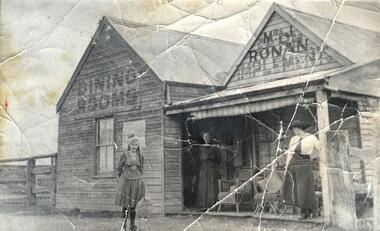
Photograph - Mrs. Ronan's Dining Room, Wodonga, c1914
... Wodonga Coffee Palace in High Street, beside the railway gates in 1921. The construction of the Hume Weir had begun and some construction workers boarded at the Coffee Palace. Her 3 children achieved success due to their mother’s hard work to ensure their futures. Bill trained for the priesthood and was a parish priest, but died from tuberculosis 1n 1939 aged of 41. Katie became a highly accomplished music teacher, including 32 years at Albury Public School. In the 1930s she was able to buy a house...Wodonga Coffee Palace in High Street, beside the railway gates in 1921. The construction of the Hume Weir had begun and some construction workers boarded at the Coffee Palace. Her 3 children achieved success due to their mother’s hard work to ensure their futures. Bill trained for the priesthood and was a parish priest, but died from tuberculosis 1n 1939 aged of 41. Katie became a highly accomplished music teacher, including 32 years at Albury Public School. In the 1930s she was able to buy a house ...When Mrs Julia Ronan nee Arundel lost her husband John to tuberculosis in 1906, she quickly decided to move from their small farm into Wodonga with her 3 children. She was granted the lease of the ground she needed to establish her eating house at one shilling per year in a shed on the Dalgety's saleyard block. Two established merchants Albert Schlink and John Whan and butcher Jack Garrett agreed to allow her credit which enabled her to open Ronan's Dining Rooms at the Saleyards. It was often a challenging environment, with drovers, and horse- breakers, auctioneers and bushmen bringing huge mobs of cattle and horses to the saleyards. Stories of the premises include the unexpected arrival in the passage of a lively bullock which finished up on the girls' bed. Mrs Ronan persevered and beat all obstacles to finally move from the saleyards to the Wodonga Coffee Palace in High Street, beside the railway gates in 1921. The construction of the Hume Weir had begun and some construction workers boarded at the Coffee Palace. Her 3 children achieved success due to their mother’s hard work to ensure their futures. Bill trained for the priesthood and was a parish priest, but died from tuberculosis 1n 1939 aged of 41. Katie became a highly accomplished music teacher, including 32 years at Albury Public School. In the 1930s she was able to buy a house at 49 High Street, Wodonga where she lived with her mother and sister Mary. Mary trained in office work at Edmondson’s solicitors and then worked on the Albury Council. After living with her daughters in the High Street house, Julia passed away on her 90th birthday in 1958. Mary died on 6 January 1983. Katie passed away in Wodonga at the age of 97 on the 16 September 1996. All members of the family are buried at Yackandandah, Victoria.A black and white image of Miss Mary Ronan, Mrs Julia Ronan and Miss Teresa Trudewind at the Old Saleyards Dining Room, Wodonga.On front of building: DINING ROOMS/ MRS. J. RONANmrs. ronan, dining rooms wodonga sale yards, wodonga businesses, wodonga pioneers -
 Wodonga & District Historical Society Inc
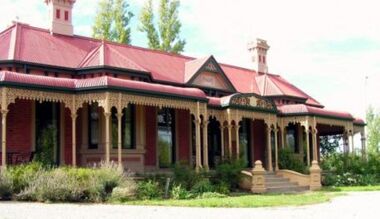
Photograph - Cambourne House
... Wodonga Run was granted and sold the following year. The allotments on which the five-acre Cambourne property developed, were purchased in 1873 and 1876, coinciding with the opening of the Railway from Melbourne. The property was purchased by Rebecca Carkeek in June 1899, wife of William Carkeek, Publican of Wodonga and Shire Councillor. Local architects Gordon and Gordon have been credited with the design of Cambourne. The house...Wodonga Run was granted and sold the following year. The allotments on which the five-acre Cambourne property developed, were purchased in 1873 and 1876, coinciding with the opening of the Railway from Melbourne. The property was purchased by Rebecca Carkeek in June 1899, wife of William Carkeek, Publican of Wodonga and Shire Councillor. Local architects Gordon and Gordon have been credited with the design of Cambourne. The house ...Cambourne homestead was built by 1903 for Rebecca S. Carkeek, who purchased the property in Wodonga in 1899. Cambourne is situated on the original Wodonga Run which was established in 1836. In 1855 the pre-emptive right of 171 acres of the Wodonga Run was granted and sold the following year. The allotments on which the five-acre Cambourne property developed, were purchased in 1873 and 1876, coinciding with the opening of the Railway from Melbourne. The property was purchased by Rebecca Carkeek in June 1899, wife of William Carkeek, Publican of Wodonga and Shire Councillor. Local architects Gordon and Gordon have been credited with the design of Cambourne. The house at Cambourne was built at some stage between 1900 and 1903 as a large single storey homestead. It was constructed in red brick with corrugated iron roof and encircling verandah. Cambourne is a probable work of architects Gordon and Gordon, it is amongst their best preserved and one of their few surviving buildings in Victoria. Today Cambourne remains on a reduced allotment due to the acquisition of land in 1972 by the Country Roads Board and in 2006 by Vic Roads for road works adjacent to the property.Cambourne, Wodonga is of architectural and historical significance to the State of Victoria.A set of coloured photos depicting Cambourne in Wodonga. Part of a collection documented a heritage listed pioneer home.cambourne wodonga, cambourne homestead wodonga, historic buildings wodonga -
 Wodonga & District Historical Society Inc
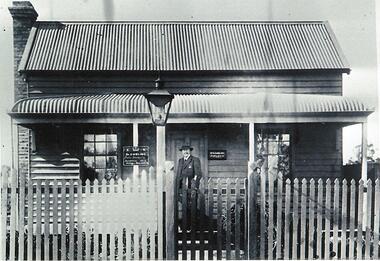
Photograph - Dr. W. H. Embling - Public Vaccinator
... railways throughout Victoria. Dr. Embling died from pneumonia in St. Kilda, Victoria on 24 May 1912. This item is significant because it depicts a doctor who provided an important service to Wodonga and to the wider Victorian community. Dr. W. H. Embling Wodonga Medical Services Public Vaccinator Wodonga Signs to left of door: Below Crown and Letters C. R. Dr Embling Public Vaccinator Vaccinations Every Friday Free Service To Right of Door: Dr Embling Surgeon A black and white photograph of Dr. Embling standing in front of his consulting room in a house ...William Henry Embling was born in London on September 25, 1840, and came to Victoria with his parents when he was about 9 years old. When still in his teens, William was sent to Germany, and afterwards to England, to study for the medical profession. Whilst in London he became involved with the British Legion which sailed for Italy and fought in the Garibaldian campaign. He rose to the rank of Lieutenant. After moving to Glasgow to study for the Licentiate of the Royal College of Surgeons, William returned to Australia in 1863 and set up practice in St. Kilda, Victoria. Embling was appointed resident surgeon at Melbourne Hospital, practiced in Ballarat from 1866-1873 and was an honorary physician at the Alfred Hospital in 1877 In 1878 he was appointed to the Central Board of Health, and in this role travelled to many rural areas including Wodonga as the Public Vaccinator. For some time, he was regularly in Wodonga on Fridays. He was also Chairman of the Police Medical Board and President of the Working Men's College in Melbourne. In 1892 William Embling was elected as a member of the Legislative Council. One of the many roles he filled as a politician was as a member of the Parliamentary Standing Committee on Railways. In this role he also visited Wodonga when consultations were in progress for development of the new railways throughout Victoria. Dr. Embling died from pneumonia in St. Kilda, Victoria on 24 May 1912.This item is significant because it depicts a doctor who provided an important service to Wodonga and to the wider Victorian community.A black and white photograph of Dr. Embling standing in front of his consulting room in a house in Wodonga.Signs to left of door: Below Crown and Letters C. R. Dr Embling Public Vaccinator Vaccinations Every Friday Free Service To Right of Door: Dr Embling Surgeon dr. w. h. embling, wodonga medical services, public vaccinator wodonga -
 Wodonga & District Historical Society Inc
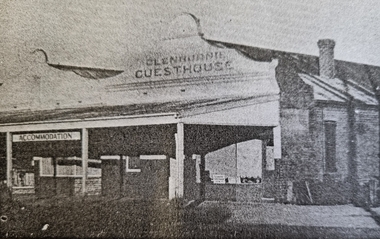
Photograph - Glenburnie Guest House, Wodonga
... In the early 1900s a new Coffee Palace was erected on the first railway land to be leased for private business in Wodonga. This Coffee Palace (later to become Glenburnie Guest House) was situated in High Street opposite the former Customs House which at the time was being used as the Wodonga Police Station. ...In the early 1900s a new Coffee Palace was erected on the first railway land to be leased for private business in Wodonga. This Coffee Palace (later to become Glenburnie Guest House) was situated in High Street opposite the former Customs House which at the time was being used as the Wodonga Police Station. ...In the early 1900s a new Coffee Palace was erected on the first railway land to be leased for private business in Wodonga. This Coffee Palace (later to become Glenburnie Guest House) was situated in High Street opposite the former Customs House which at the time was being used as the Wodonga Police Station. It was built by Mr Denny Donovan and operated by his wife. An article in the Wodonga and Towong Sentinel declared that “No expense has been spared in the erection and fitting up of the Palace, which is intended to supply a long felt want”. The building consists entirely of brick and the rooms are lofty, spacious and well-ventilated. The bedsteads are modern, and will satisfy the most fastidious. The motto of the proprietress is “Cleanliness, civility and attention”. Mr Donovan died in January 1908 and in 1909 the Wodonga Coffee Palace was sold by Mrs Donovan to Mrs P. Egan who advertised hot and cold shower baths with meals at all hours. In 1913 the Wodonga Coffee Palace was taken over by Mrs Cuthbertson and Miss Steele. In 1921 Wodonga Coffee Palace was taken over by Julia Ronan who had successfully conducted the dining rooms at the Wodonga Saleyards for 15 years until those premises burned down. The Wodonga and Towong Sentinel on 10 January 1936 reported that “the business premises formerly conducted by Mrs Ronan have been renovated and refurbished. The new proprietresses are Misses Breen, who have had extensive experience in managing such businesses. The new premises will be known as the Glenburnie Guest House.” Changes of ownership continued with Mrs M.E. Elliot taking over in December 1940, followed by Mrs Stella Victoria Wong in 1945. In 1953 it was again taken over by Mrs E.M. Moran. The date of the closure of Glenburnie Guest House is uncertain but the building was demolished in the early 1970s.This image is significant because it is one of the few remaining links to an important Wodonga business.A photo taken from a newspaper article about Glenburnie Guest Houseglenburnie guest house, early wodonga businesses, coffee palaces -
 Wodonga & District Historical Society Inc
Photograph - Codling Collection 01 - Wodonga's Second Police Station
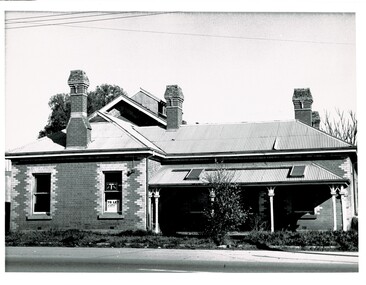
... WODONGA'S SECOND POLICE STATION - This building was located on the west side of High Street near the railway line at the corner of High Street and Bond Street. The building in the background was the Bond Store which was later repurposed to become the Court House. ...WODONGA'S SECOND POLICE STATION - This building was located on the west side of High Street near the railway line at the corner of High Street and Bond Street. The building in the background was the Bond Store which was later repurposed to become the Court House. ...Miss Olive Codling was a Foundation Member and a Life Member of the Wodonga Historical Society. Many of her prize-winning photos are held in the Society Collection. She also held a range of roles and committee positions in a wide range of Wodonga community organisations. WODONGA'S SECOND POLICE STATION - This building was located on the west side of High Street near the railway line at the corner of High Street and Bond Street. The building in the background was the Bond Store which was later repurposed to become the Court House. This Police Station, which began operation on this site c1905, had originally been the house of the customs officer. It had a front office and a Sergeant's and an Inspector's office as well as 2 barrack rooms and a laundry at the rear. In the backyard was a blue stone cell block and a night soil toilet, as well as a stable used previously for horse and carriage. Opposite the police station was a boarding house which supplied meals to prisoners. This police station was in use until its move to Elgin Street, Wodonga in December 1967.This photo collection is significant as it documents how the businesses and buildings in Wodonga have evolved and contributed to community throughout the 20th century.Two black and white photos of the 2nd Police Station built in Wodonga with the former Bond Store in the background.high st wodonga, police stations wodonga -
 Wodonga & District Historical Society Inc
Drawing - Cambourne House, Kevin P. Clark, 1984
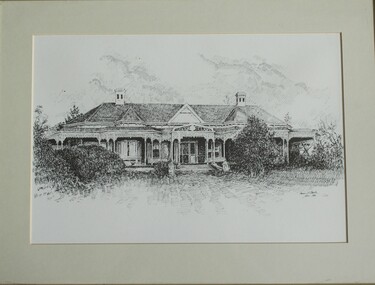
... Wodonga run was granted and sold the following year. The allotments on which the five-acre Cambourne property developed, were purchased in 1873 and 1876, coinciding with the opening of the railway from Melbourne. The property was purchased by Rebecca Carkeek in June 1899, wife of William Carkeek, publican of Wodonga and shire councillor. Local architects Gordon and Gordon have been credited with the design of Cambourne. The house...Wodonga run was granted and sold the following year. The allotments on which the five-acre Cambourne property developed, were purchased in 1873 and 1876, coinciding with the opening of the railway from Melbourne. The property was purchased by Rebecca Carkeek in June 1899, wife of William Carkeek, publican of Wodonga and shire councillor. Local architects Gordon and Gordon have been credited with the design of Cambourne. The house ...Cambourne homestead was built by 1903 for Rebecca S. Carkeek, who purchased the property in Wodonga in 1899. Cambourne is situated on the original Wodonga run which was established in 1836. The township of Belvoir, later renamed as Wodonga. In 1855 the pre-emptive right of 171 acres of the Wodonga run was granted and sold the following year. The allotments on which the five-acre Cambourne property developed, were purchased in 1873 and 1876, coinciding with the opening of the railway from Melbourne. The property was purchased by Rebecca Carkeek in June 1899, wife of William Carkeek, publican of Wodonga and shire councillor. Local architects Gordon and Gordon have been credited with the design of Cambourne. The house at Cambourne was built at some stage between 1900 and 1903 as a large single storey homestead. It was constructed in red brick with corrugated iron roof and encircling verandah. Cambourne is a probable work of architects Gordon and Gordon, it is amongst their best preserved and one of their few surviving buildings in Victoria. Today Cambourne remains on a reduced allotment due to the acquisition of land in 1972 by the Country Roads Board and in 2006 by Vic Roads for road works adjacent to the property.This drawing is significant as a representation of Cambourne in Wodonga. Cambourne is of historical significance due to its links with the early settlement of the district and as an example of closer settlement which occurred in regional centres of the State. Cambourne, Wodonga is also of architectural significance as a largely intact late Victorian style house with elaborate decorative cast iron work and distinctive transverse plan. As a probable work of architects Gordon and Gordon, it is amongst their best preserved and one of their few surviving buildings in Victoria. A framed drawing of historic home, Cambourne in Wodonga. The drawing has been mounted and framed.On bottom right corner" Kevin P. Clark 1984"cambourne wodonga, gordon and gordon architects, historic buildings wodonga, heritage buildings wodonga -
 Wodonga & District Historical Society Inc
Functional object - Large Pinking Shears, Comete Ninci, 1948
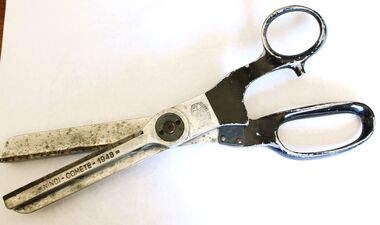
... Her father had many jobs including carriage cleaner with Victoria Railways at Wodonga and her mother was at House Creek State School No. 2266. ...Her father had many jobs including carriage cleaner with Victoria Railways at Wodonga and her mother was at House Creek State School No. 2266. ...Pinking shears or scissors were a valuable accessory for any professional or home dressmaker. Pinking shears have serrated edges and they leave trimmed fabric with a decorative edge as well as preventing the fabric from fraying. The words under the trademark "Marque Depose" mean trademark pending. These pinking shears were owned by Mrs. Betty Sheather of Gordon Street, Wodonga, Victoria. Betty was the daughter of James and Elizabeth Fletcher. Her father had many jobs including carriage cleaner with Victoria Railways at Wodonga and her mother was at House Creek State School No. 2266. Betty worked in Arnold's Store, the store of Costelloe & Smith as well as the Bethanga Park homestead as well as Drummonds at Walwa and the Hotel at Ebden. As a younger woman she lived with the Whan family at Stonleigh which was then a rope factory.Betty was a keen golfer and belonged to a club which played at the Wodonga Racecourse and was a member of the Bandiana Golf Club. These shears were owned by a well-known member of Wodonga and were representative of dressmaking implements used in the mid 1900s.Large vintage Comete Pinking Shears / zigzag scissors produced in Italy from metal alloy.On outer side of blade : NINCI COMETE 1948. Beside central hinge in ring shape: COMETE/ITALY/NINCI/ MARQUE DEPOSE.pinking shears, dressmaking -
 Wodonga & District Historical Society Inc
Memorabilia - China Bowl Ronan's Coffee Palace, Grindley Hotel Ware, C.1921 - 1930
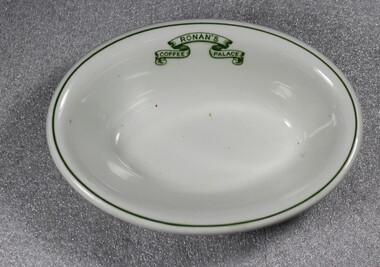
... Wodonga in the early days were the Railway Coffee Palace and the Wodonga Coffee Palace. In 1908 Wodonga Coffee Palace was advertised for sale, having 15 rooms, a 15 stall stable and feed-room. In 1921 Wodonga Coffee Palace was taken over by Julia Ronan who had successfully conducted the dining rooms at the Wodonga Sale-yards for 15 years. The building of the Hume Weir was in progress and many of the workers boarded at the Coffee Palace. In 1936 Wodonga Coffee Palace became “Glenburnie” Guest House...Wodonga in the early days were the Railway Coffee Palace and the Wodonga Coffee Palace. In 1908 Wodonga Coffee Palace was advertised for sale, having 15 rooms, a 15 stall stable and feed-room. In 1921 Wodonga Coffee Palace was taken over by Julia Ronan who had successfully conducted the dining rooms at the Wodonga Sale-yards for 15 years. The building of the Hume Weir was in progress and many of the workers boarded at the Coffee Palace. In 1936 Wodonga Coffee Palace became “Glenburnie” Guest House ...Coffee Palaces were developed throughout Australia with the backing of the Temperance Movement as an alternative venue to pubs in the late 19th century. Two Coffee Palaces identified in Wodonga in the early days were the Railway Coffee Palace and the Wodonga Coffee Palace. In 1908 Wodonga Coffee Palace was advertised for sale, having 15 rooms, a 15 stall stable and feed-room. In 1921 Wodonga Coffee Palace was taken over by Julia Ronan who had successfully conducted the dining rooms at the Wodonga Sale-yards for 15 years. The building of the Hume Weir was in progress and many of the workers boarded at the Coffee Palace. In 1936 Wodonga Coffee Palace became “Glenburnie” Guest House. Mr. Loftus Henry Moran, born in Winchelsea, Victoria, was well-known in the tea trade, originally working with Griffiths Bros Ltd. He started his own business, Loftus Moran Pty Ltd in 1909. Loftus Moran's company imported chinaware from Britain and sold it into the Australian market. They specialised in supplying to hotels, businesses and institutions.This bowl is an excellent example of earthen ware items used throughout Australia in hotels, cafes and other institutions. Loftus Moran Pty Ltd, was a major distributor and successful Melbourne Company. Mrs. Ronan's Coffee Palace was an important business in Wodonga and an alternate food and accommodation venue for those who preferred not to stay in public houses or hotels.A small white bowl bearing the logo of Ronan's Coffee Palace in Wodonga printed in green.In a scroll at the top edge "RONAN'S COFFEE PALACE" Underneath the bowl in green writing below a green crown "GRINDLEY HOTEL WARE/ENGLAND/VITRIFIED/LOFTUS, MORAN/ MELBOURNE"coffee palace, wodonga business, wodonga, mrs. ronan wodonga, 1920s wodonga -
 Wodonga & District Historical Society Inc
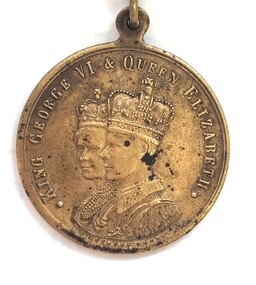
Medal - Coronation of KIng George VI and Queen Elizabeth, Stokes & Son, 1937
... House in Canberra. Their tour also served as a show of gratitude for the sacrifices made by the Dominions during World War I and to strengthen ties between Australia and the British Empire. Part of their journey from Canberra to Melbourne was onboard the Royal Train which travelled through Wodonga and was reported in the Argus. Argus, Wednesday 11 May 1927, page 19 "The Royal train will leave Albury, according to the railway...House in Canberra. Their tour also served as a show of gratitude for the sacrifices made by the Dominions during World War I and to strengthen ties between Australia and the British Empire. Part of their journey from Canberra to Melbourne was onboard the Royal Train which travelled through Wodonga and was reported in the Argus. Argus, Wednesday 11 May 1927, page 19 "The Royal train will leave Albury, according to the railway ...This commemorative medal was distributed to Victorian school children to celebrate the coronation of King George VI in 1937. It was often issued with a patriotic red, white and blue ribbon. King George VI became king unexpectedly because his older brother, Edward VIII, abdicated the throne in December 1936. As the Duke and Duchess of York , King George VI and Queen Elizabeth had visited Australia and New Zealand in 1927 primarily to open the provisional Parliament House in Canberra. Their tour also served as a show of gratitude for the sacrifices made by the Dominions during World War I and to strengthen ties between Australia and the British Empire. Part of their journey from Canberra to Melbourne was onboard the Royal Train which travelled through Wodonga and was reported in the Argus. Argus, Wednesday 11 May 1927, page 19 "The Royal train will leave Albury, according to the railway time table arrangements at 9.54 a.m. and Wodonga at 9.20. Principal towns on the route to Melbourne will be passed as follows:- Wangaratta 10.10; Benalla 11.16; Seymour 12.45; and Spencer street 2.50. From Albury the Sydney express which leaves at 20 minutes past 8 o'clock will be used as the pilot train for the Royal train."This medal is significant because it represents the Coronation of King George VI which was of importance to the majority of Wodonga residents. His Majesty had paseed through Wodonga by train in 1927.A gilt brass, double-sided, circular medal struck to celebrate the Coronation of King George VI & Queen Elizabeth on 12th May 1937. The obverse features the conjoined crowned portraits of the King and Queen facing left. The centre of the reverse displays the official Coat of Arms of the State of Victoria with the word 'VICTORIA' above and the motto 'PEACE AND PROSPERITY' below. There is an attached metal loop and split ring at the top edge. A ribbon would have been inserted through the ring to enable it to be hung or worn. On the obverse side: 'KING GEORGE VI & QUEEN ELIZABETH' around the upper circumference of the medal. The maker's details appear at the bottom. On the reverse: Around the edge of the medal 'TO COMMEMORATE THEIR MAJESTIES' CORONATION MAY 12TH 1937'.coronation of king george vi, royal memorabilia -
 Wodonga & District Historical Society Inc
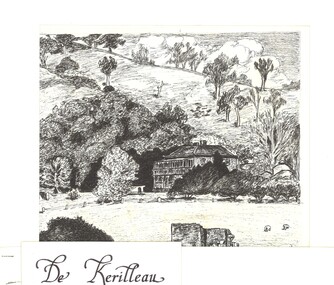
Work on paper - de Kerilleau Homestead, Wodonga, Des Martin, 1987
... house is its two-storey cast-iron verandah which has been restored to its original condition. When the Governor, Sir George Bowen, his wife and two daughters needed accommodation overnight after having taken part in the celebration of the railway in Wodonga in 1873, they stayed at de Kerilleau. ...house is its two-storey cast-iron verandah which has been restored to its original condition. When the Governor, Sir George Bowen, his wife and two daughters needed accommodation overnight after having taken part in the celebration of the railway in Wodonga in 1873, they stayed at de Kerilleau. ...Paul Huon's son, William, arrived at "Belvoir Homestead" on the Woodonga Run in 1857 to learn the management of the Run so he could take over the role from his Uncle Charles. He spent five years residing at "Belvoir." In 1862 he built a new stone home on Wodonga Creek at the base of Huon's Hill. William gave this home the family traditional name " De Kerilleau." In the 1870s, William built the "de Kerilleau" homestead that still stands today. The first "De Kerilleau" homestead was almost completely demolished in 1907. It is a solid two storey red brick building with cream brick flat window arches. The main feature of the house is its two-storey cast-iron verandah which has been restored to its original condition. When the Governor, Sir George Bowen, his wife and two daughters needed accommodation overnight after having taken part in the celebration of the railway in Wodonga in 1873, they stayed at de Kerilleau. Sir George planted a Moreton Bay fig tree in the grounds and it still stands today. The historic homestead became the property of the Watson family in 1922 and again changed hands in recent years. It is listed by the National Trust.Donated by Des Martin & Rosemary BoyesPart of a set of original sketches by Des Martin for "A Record of the 150th Anniversary" Celebrations of the Rural City of Wodonga held on 30th October 1986.huon family, early wodonga
