
Showing 6 items matching "rangefinder"
-
 Flagstaff Hill Maritime Museum and Village
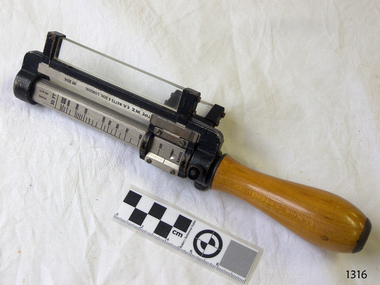
Rangefinder, E R Watts & Sons, 1930-1945
... Rangefinder......rangefinder...Naval Rangefinder with a vertical wooden handle, and an arrangement of optical lenses. ...inscribed "Rangefinder Cotton Type Mk II" Calibrated scale up to 5000 yds (50 ft), 5000 yds (35 ft), 4000 yds (25 ft) made by E. ...Watts & Son. Naval Rangefinder with a vertical wooden handle, and an arrangement of optical lenses. ...E. R. Watts and Son, makers of theodolites and other surveying instruments, of 123 Camberwell Road, London. The company was established in 1856 by Edwin Watts at twenty-three he had saved £100 from his earnings to start the business with his staff consisting of one boy and later Alexander Clarkson as an apprentice with the workshop a small room over a Bemondsey stable. Watts' first order was from Negretti and Zambra for a mining dial Alexander Clarkson In the early days the firm worked mainly on marine compasses. Edwin Watts would go down to the Docks to adjust the compasses once they had been installed on the ships. In May 1873 the business moved to larger premises a house with a garden. The workshop was also the home of Mr and Mrs Watts and their five sons and three daughters. By now there were fifteen to twenty men employed by the firm. The company were commissioned to supply the Theodolites and Levels for the construction to the Canadian Pacific Railway in 1881. Towards the end of the century, the firm began to make heliographs continuing to produce them for the government until just before the Second World War when by agreement assigned their manufacture to another firm. 1904 The first dividing engine was completed by George William Watts. It was so remarkable an instrument at the time and for years afterwards, In 1907 Arthur Ames went to Canada and started an organisation in Winnipeg in 1909 this became a separate company called E. R. Watts and Son Ltd. of Ottawa. This firm developed considerably and was eventually with the co-operation of three other instrument companies (Cambridge Instrument Co, Ross, and Negretti and Zambra), were reconstituted as ”Instruments Ltd” of Ottawa and Toronto. During the next ten years, the firm expanded greatly to include glass grinding, leather work, dividing and engraving, testing, adjusting and packing. This expansion was continued during the First World War when workshops were completed and the machinery installed and running within eleven weeks from the start of construction. During the war, a Sergeant Coles, among the rats, lice and mud of the trenches, fitted various bits of scrap into his cocoa tin and made the first Flash Spotter for plotting the positions of enemy guns. Coles was rushed home to the firm's factory where he and George William Watts designed a spotter not made out of a cocoa tin and as a result, the Watts Vertical Force Variometer was developed during WWI. Other Watts instruments made in the First World War included the Light Mountain Theodolites which were taken on Mt Everest expeditions. In 1919 ER Watts and Sons was incorporated as a limited company and in 1939 G. A. Whipple joined the Board of Directors. Shortly afterwards, Frank Charles Watts died having been Chairman of the firm for over 37 years and seen it through the First World War with all its expansions and difficulties. He was succeeded by his brother George William Watts with the vacant post of Managing Director being filled by G. A. Whipple. During the Second World War, the company expanded further and the number of employees rose to well over 1,300. In 1946 Watts acquired 78% of Adam Hilger and the microscope maker James Swift and Son Who were Manufacturers of Theodolites, Levels, Alidades, Meteorological Instruments, Variometers, and many other types of scientific instruments Then in 1948 the company amalgamated with Adam Hilger as Hilger and Watts which was then incorporated as a public company.Naval Rangefinder with a vertical wooden handle, and an arrangement of optical lenses. Three reversible brass inserts calibrated on both sides in yards, correspond to various base heights, (20 and 25 feet, 30 and 35 feet and 40 and 50 feet). They are fitted along the axis of the instrument. When the scale for the appropriate base height is selected and inserted, the carriage can be slid for coincidence and the distance read at the index mark on the sliding carriage.inscribed "Rangefinder Cotton Type Mk II" Calibrated scale up to 5000 yds (50 ft), 5000 yds (35 ft), 4000 yds (25 ft) made by E. R. Watts & Son.flagstaff hill, warrnambool, shipwrecked coast, flagstaff hill maritime museum, maritime museum, shipwreck coast, flagstaff hill maritime village, great ocean road, rangefinder, cotton type, e r watts & sons, naval range finder, marine equipment -
 Moorabbin Air Museum
Manual (item) - Feasibility Study of an Airborne Laser Rangefinder for The Mirage III O, Department of Defence ,Feasibility Study of an Airborne Laser Rangefinder for The Mirage III O
... Department of Defence ,Feasibility Study of an Airborne Laser Rangefinder for The Mirage III O...Department of Defence ,Feasibility Study of an Airborne Laser Rangefinder for The Mirage III O Manual Feasibility Study of an Airborne Laser Rangefinder for The Mirage III O ... -
The Ed Muirhead Physics Museum
Canonet QL17 Camera, c 1965
... Silver and black compact rangefinder with associated storage case....Silver and black compact rangefinder with associated storage case. Canonet QL17 Camera ...Business card belonging to Betty Laby inside.Cannot QL17 model camera. Silver and black compact rangefinder with associated storage case. -
 Glenelg Shire Council Cultural Collection
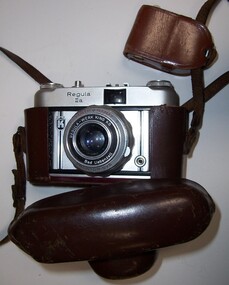
Functional object - Regula IIIa Camera with Case and Light Reader, Regula, Germany, 1956-1959
... The King Regula III series were a range of 35mm viewfinder and rangefinder cameras made by King between 1956-1959. ...The King Regula III series were a range of 35mm viewfinder and rangefinder cameras made by King between 1956-1959. ...Displayed in History House. The King Regula III series were a range of 35mm viewfinder and rangefinder cameras made by King between 1956-1959. The Regula III series models all have a similar look and have a characteristic front plate. This is a flat rectangular Eloxal (ELectrolytic OXidation of ALuminum) plate, with distinctive chrome-black-chrome stripes each side. The King logo is at the top of the left-hand stripe, and a PC flash sync connector on the bottom right stripe. The other common things across the range are the film advance/film counter lever, a "cold" accessory shoe, rewind knob, 1/4" tripod socket, textured leatherette and having the model name engraved on the front of the camera. The film counter on all models is on the film advance lever but has a reliability issue, it relies on a tiny rod in the film advance lever, and a fixed rod on the camera body pushing against each other every time the lever is advanced; the problem is the rods are so small that they wear down with repeated use until the film counter stops working.Regula IIIa Camera Regula IIIa is a basic viewfinder camera with a Prontor-SVS shutter, but no focus aids, light meter, frame lines in the viewfinder or strap lugs on the body. 367.1 - Single lens reflex camera. 367.2 - Light metre in leather case. 367.3 - Brown leather case.Front: Regula-werk king KG/Bad Liebenzell/Prontor - SVS (on lens) Regula/IIIa (on body)camera, photography -
 Department of Energy, Environment and Climate Action
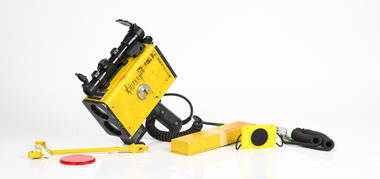
Equipment - Criterion Survey Laser
... The LTI Criterion Survey Laser and Rangefinder was a powerful instrument that could measure and record tree height, diameter at any visible point up the tree and branch take-off points. ...The LTI Criterion Survey Laser and Rangefinder was a powerful instrument that could measure and record tree height, diameter at any visible point up the tree and branch take-off points. ...There had been timber assessments in Victorian State forests since the late 1920s, coinciding with arrival of the three Norwegian foresters. The program was accelerated during the post-war housing boom. It was driven by the push eastwards away from the Central Highlands to find timber resources after the 1939 bushfire salvage was completed. Spending time in the field with assessment branch was a “rite of passage” for many young forestry graduates leaving Creswick. The work was arduous, and measurements were taken with simple and robust equipment like Gunters chains, prismatic compass, Abney levels, barometers and clinometers. Data was recorded by hand onto waterproof paper. The Statewide Forest Resource Inventory (SFRI) project began in 1993 and followed a few years after the release Timber industry Strategy. The aim was to bolster the existing 1:25000 scale mapping and improve the accuracy of the volume and growth estimates for the forest estate. This scary looking gadget looks like a speed radar used by the cops. The LTI Criterion Survey Laser and Rangefinder was a powerful instrument that could measure and record tree height, diameter at any visible point up the tree and branch take-off points. It was used to identify and map tree faults such as branches, scars and knots and to calculate tree taper functions. When used correctly, it has an accuracy of better than 1% for height and diameter. It could also measure survey information such as asmuth, distance and elevation. It was expensive back in the day (more than $20,000) - this one was manufactured in 1996 - and heavy. This item was donated to the Beechworth museum by Peter Black in 2015 and is now at Altona and recorded in Victorian Collections Criterion Survey Laser with box and batteryLaser Technology Inc, Englewood, Colorado, USAsurveying, forest measurement -
Australian Commando Association - Victoria
Functional Object - Rangefinder and Theodolite
... Functional Object Rangefinder and Theodolite ...
