
Showing 33 items matching "reading rest"
-
 Flagstaff Hill Maritime Museum and Village
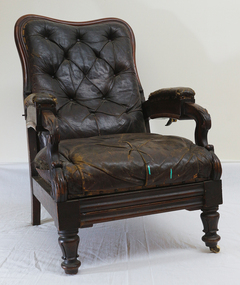
Furniture - Chair, Haberfield Chair, Michael Bradshaw, Circa 1860s-1890s
... ...reading rest...rest is mounted on a brass pedestal. Its angle can be conveniently adjusted using a screw to move the ball and socket joint, ensuring personalised reading comfort. ...Flagstaff Hill Maritime Museum and Village Great Ocean Road Shipwreck Coast armchair reclining armchair reading board Mahogany chair Haberfield Chair furniture living room furniture domestic furniture 19th century luxury Morroco leather book stand book rest side table music stand reading stand reading rest foot rest reading table In pen and ink: “Made from Mahogany Ship wrecked near Tower Hill, July 3, 1835: made by Michael Bradshaw 18-2-“ [originally thought to read 1842] The Haberfield Chair is a reclining armchair that includes a footrest and a detachable book rest. ...This elegant reclining armchair is generously on loan from the local Haberfield family. Mrs Haberfield is a member of the Anderson family from the Tower Hill region, and the chair was handed down to her from them. When it arrived at Flagstaff Hill in 2009, it was at least 100 years old. The maker, Michael Bradshaw, is currently unknown. The origin of the chair's timber has been lost through the generations, but some have named the armchair the 'Mahogany Chair' after the legendary Mahogany Ship. In August 2009, the wood was expertly examined. The structure of the wood specimens was found to be consistent with: • Pale coloured carcass timber - Fagus sylvatica – Beech (European) • Pale coloured frame timber - Agathis sp – NZ Kauri • Dark coloured timber chair legs (solid) - Swietenia sp. – True Mahogany • Dark coloured timber veneer - Swietenia sp. – True Mahogany • Repair fill-in piece – Quercus sp. – White Oak ( Northern hemisphere) • Repair fill-in piece (fine textured) – Populus sp. – Poplar • Runner wood - Eucalyptus sp – Pale coloured ash group, or messmate The chair is significant for its local origin and history, being connected to generations of the Anderson and Haberfield families. It is also significant for its elaborate and unusual design, the quality of its workmanship and materials. It is a fine example of good quality furniture of the late 19th century.The Haberfield Chair is a reclining armchair that includes a footrest and a detachable book rest. The chair features a dark timber frame and dark burgundy (now dark brown), Morocco goat skin leather upholstery. The backrest is finished with button detailing, and its frame is distinguished by gracefully curved corners, lending the chair an elegant appearance. The chair’s padded leather armrests have attractive, crafted carvings at each end. A lever located below the armrest operates the recliner’s ratchet mechanism, which also causes a footrest to slide forward for greater comfort. The turned and carved front legs are equipped with wheels, allowing for easy movement. The removable book rest is mounted on a brass pedestal. Its angle can be conveniently adjusted using a screw to move the ball and socket joint, ensuring personalised reading comfort. There is a handwritten inscription on the underside of the back rail. The chair is kindly on loan from the local Haberfield family. In pen and ink: “Made from Mahogany Ship wrecked near Tower Hill, July 3, 1835: made by Michael Bradshaw 18-2-“ [originally thought to read 1842]flagstaff hill maritime museum and village, great ocean road, shipwreck coast, armchair, reclining armchair, reading board, mahogany chair, haberfield chair, furniture, living room furniture, domestic furniture, 19th century, luxury, morroco leather, book stand, book rest, side table, music stand, reading stand, reading rest, foot rest, reading table -
 Ballarat Tramway Museum
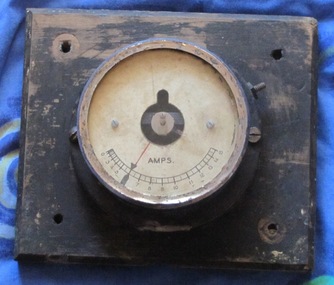
Functional Object - Electrical Meter, 24/01/2011 12:00:00 AM
... White meter face, has a marked reading of 6Amps. Rest of the meter is generally painted black except for the bottom and rear of the timber which is unpainted. ...White meter face, has a marked reading of 6Amps. Rest of the meter is generally painted black except for the bottom and rear of the timber which is unpainted. ...Possibly has a strong association with the Ballarat depot and the equipment used there.Electrical Current or Amp Meter mounted onto a piece of timber. Meter has the current marked in Amps from 0 to 15. No manufacturer or use details known, would have been collected from the depot. Could have been used for the grinder or wheel lathe. Wood block has four mounting holes, bevelled edges and opening for cables on the lower edge. White meter face, has a marked reading of 6Amps. Rest of the meter is generally painted black except for the bottom and rear of the timber which is unpainted. trams, tramways, depot, meters, electrical equipment -
 Flagstaff Hill Maritime Museum and Village
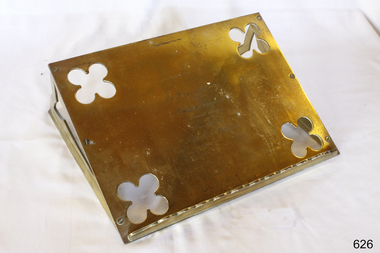
Functional object - Table-top Missal stand, after 1938
... rest...tabletop lectern...bible reading...Nicholas Seamen's church as it was dedicated to a family member. flagstaff hill warrnambool shipwrecked coast flagstaff hill maritime museum maritime museum shipwreck coast flagstaff hill maritime village great ocean road religious service missions to seamen victoria st nicholas seaman’s church williamstown church furniture religious worship bible rest tabletop lectern bible reading preaching accessory book rest memorial object M A Hodgkiss Richard Hodgkiss Missel table book stand book stand Bible stand table-top stand table-top book rest table-top Missal stand Missal desk "In Loving Memory of Richard Hodgkiss - passed away 14 12 38. ...This decorative brass table-top Missal stand was presented to the Missions to Seamen in Williamstown in memory of Richard Hodgkiss, after his death on December 14th 1938, by Mrs M A Hodgkiss. Decorative book rests like this one were used to support the Bible during services at the Williamstown Missions to Seamen and is now part of the St. Nicholas Seamen's Church Collection. THE MISSIONS TO SEAMEN (Brief History): - The Missions to Seamen was an Anglican charity in Great Britain that has served the world's seafarers since 1856. Its symbol is a Flying Angel, inspired by a Bible verse. Today, there are centres in over 200 ports worldwide where seamen of all backgrounds are offered a warm welcome and provided with a wide range of facilities. In Victoria, the organisation began in Williamstown in 1857 as a Sailors’ Church, also known as ‘Bethel’ or the ‘Floating Church’ in an old hulk floating in Hobson’s Bay, Port of Melbourne. It soon became part of the Missions to Seamen, Victoria. In the year 2000, the organisation, now named Mission to Seafarers, still operated locally in Melbourne, Portland, Geelong and Hastings. The Ladies’ Harbour Lights Guild was formed in 1906 to support the Missions to Seamen in Melbourne and other centres, such as Williamstown. Two of the most significant ladies of the Guild were founder Ethel Augusta Godfrey and foundation member Alice Sibthorpe Tracy (who established a branch of the Guild in Warrnambool in 1920). The Guild continued its work until the 1960s. In 1943, a former Williamstown bank was purchased for the Missions to Seaman Club. The chapel was named St Nicholas’ Seamen’s Church and was supported by the Ladies’ Harbour Lights Guild, the Williamstown Lightkeepers’ Auxiliary and the League of Soldiers’ and Sailors’ Friends. It ceased operation in 1966. A Missions to Seamen Chapel and Recreation Room was a significant feature of ports during the late 1800s and into the 1900s. It seemed appropriate for Flagstaff Hill to include such a representation within the new Maritime Village, so the Melbourne Board of Management of Missions to Seamen Victoria gave its permission on 21st May 1979 for the entire furnishings of the Williamstown chapel to be transferred to Flagstaff Hill. The St Nicholas Seamen’s Church was officially opened on October 11, 1981, and closely resembles the Williamstown chapel.This table-top Missal stand is historically significant for its origin in the St Nicholas Mission to Seamen's Church in Williamstown, established in 1857 to cater for the physical, social, and spiritual needs of seafarers. It originated in Bristol, England, when a Seamen's Mission was formed in 1837. It is socially important for its connection to the Williamstown St. Nicholas Seamen's church as it was dedicated to a family member.Table-top Missal stand, also called a Bible rest, book rest or table top stand: brass, rectangular surface with clover motifs holes in each corner. The triangular leg frames are screwed beneath the short sides to create a slope. The lower edge has a vertical, decorative shelf. The inscription on the top surface dedicates the book stand to Richard Hodgkiss, 1938. This book stand is part of the St. Nicholas Seamen's Church Collection. "In Loving Memory of Richard Hodgkiss - passed away 14 12 38. Presented by Mrs M A Hodgkiss."flagstaff hill, warrnambool, shipwrecked coast, flagstaff hill maritime museum, maritime museum, shipwreck coast, flagstaff hill maritime village, great ocean road, religious service, missions to seamen victoria, st nicholas seaman’s church williamstown, church furniture, religious worship, bible rest, tabletop lectern, bible reading, preaching accessory, book rest, memorial object, m a hodgkiss, richard hodgkiss, missel table book stand, book stand, bible stand, table-top stand, table-top book rest, table-top missal stand, missal desk -
 Mission to Seafarers Victoria
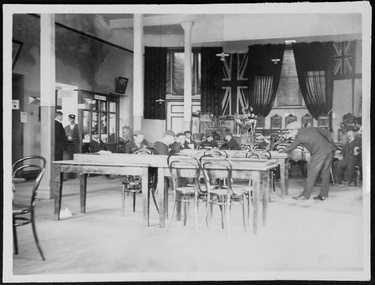
Photograph - Photograph, Sepia, c. 1910
... Men resting in the main hall of the Missions to seamen institute, Siddeley Street. Some are reading, the man standing is playing bagatelle, a form of pool game. ...seaman siddeley street institute main hall letters bentwood chairs post office bagatelle pool billiard games sailors In pencil: 137 Men resting in the main hall of the Missions to seamen institute, Siddeley Street. Some are reading, the man standing is playing bagatelle, a form of pool game. ...Men resting in the main hall of the Missions to seamen institute, Siddeley Street. Some are reading, the man standing is playing bagatelle, a form of pool game. On the left side at the back is the boot with sign saying: Sailors' lettersIn pencil: 137seaman, siddeley street institute, main hall, letters, bentwood chairs, post office, bagatelle, pool, billiard, games, sailors -
 Flagstaff Hill Maritime Museum and Village
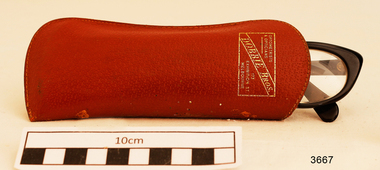
Functional object - Spectacles and case, c. 1969
... rest on the nose. Spectacles were still usually held in place with the hand whilst being used temporarily for a brief period of reading or close inspection. ...rest on the nose. Spectacles were still usually held in place with the hand whilst being used temporarily for a brief period of reading or close inspection. ...The history of spectacles The earliest form of spectacles are generally agreed to have been invented in Northern Italy in the thirteenth century. Over hundreds of years of innovation and refinement, they have been perfected into the stylish and functional designs you see today worn by millions of people to correct their eyesight. Here's a look at the key moments that defined the history of spectacles. Thirteenth century - Rivet spectacles The earliest form of spectacles was simply two mounted lenses riveted together at the handle ends. They had no sides and were secured to the face by clamping the nose between the rims, some of which had notches which may have been intended to improve the grip. Even then the wearer could only keep them in place by remaining relatively still and would normally support them with the hand. These spectacles contained convex lenses for the correction of presbyopic long-sightedness and were generally suited only to those few who lived beyond their forties and had the ability to read. Sixteenth century - Nose spectacles Nose spectacles were in more common use by the early sixteenth century. These often had a bow-shaped continuous bridge, almost of a modern appearance, that was sometimes flexible depending upon the material, for example leather or whalebone. The bridge was as much an area to be gripped as to rest on the nose. Spectacles were still usually held in place with the hand whilst being used temporarily for a brief period of reading or close inspection. By now the lenses could be used to correct both long and short sight. The general design changed little through the seventeenth century, though certain refinements increased the flexibility and comfort for some wearers. In some localised areas, notably in Spain, people experimented with ear loops made of string. This allowed them to walk around with their spectacles on. Eighteenth century - Temple glasses Only in the eighteenth century did the first modern eyewear, or ‘glasses’ as we would understand them, start to appear. The lenses might be glass, rock crystal or any other transparent mineral substance and were prone to smashing if the spectacles fell off, so there was an impetus to develop frames that could be worn continuously and would stay in place. London optician Edward Scarlett is credited with developing the modern style of spectacles which were kept in place with arms, known as ‘temples’. These were made of iron or steel and gripped the side of the head but did not yet hook over the ears because often the ears were concealed beneath a powdered wig, such as was fashionable at the time. As temples developed they were made with wide ring ends through which the wearer could pass a ribbon, thus tying the spectacles securely to the head. As spectacles were no longer primarily for use in sedentary activities, people began to be noticed out and about in their spectacles and might come to be identified as a ‘spectacle wearer’. By the end of the eighteenth century, people who needed correction for both distance and near could choose bifocals. Nineteenth century - Pince-nez Pince-nez were a nineteenth century innovation that literally translates as ‘pinching the nose’. They had a spring clip to retain the item in place under its own tension. Sometimes this clip was too tight and the wearer struggled to breathe. If it was too loose the pince-nez could fall off so, for safety and security, they were often connected to the wearer's clothing by a cord or a chain to avoid them being dropped or lost. Pince-nez were sometimes chosen by people who felt that large spectacles were too prominent and drew attention to a physical defect. They were also suitable for mounting lenses that could correct astigmatism. Twentieth century spectacles Spectacle wearing continued to become more widespread, key developments being the supply of spectacles to troops in the First World War, cheaper spectacles being subsidised through insurance schemes arranged by friendly societies, and the beginning of the National Health Service in 1948, when free spectacles were made available to all who might benefit from them. This normalised spectacle wearing and led to a significant increase in the scale of production. Entirely separate categories of women’s spectacles and sports eyewear both emerged in the 1930s. The latter half of the twentieth century saw spectacles become more fashionable and stylish as frames with different shapes, materials, and colours became available. Plastics frames, in particular, allowed a greater choice of colours and textured finishes. Plastic lenses were more durable and could be made lighter and thinner than glass, spurring a renewed interest in rimless designs. Designer eyewear bearing popular high-street brand names encouraged patients to regard spectacles as a desirable commodity, even as a fashion accessory, not just a disability aid. https://www.college-optometrists.org/the-british-optical-association-museum/the-history-of-spectacles These spectacles and case were used by Dr. Angus in his surgery in Warrnambool to test patients' eye sight. They were donated to Flagstaff Hill Maritime Village by the family of Doctor William Roy Angus, Surgeon and Oculist. It is part of the “W.R. Angus Collection” that includes historical medical equipment, surgical instruments and material once belonging to Dr Edward Ryan and Dr Thomas Francis Ryan, (both of Nhill, Victoria) as well as Dr Angus’ own belongings. The Collection’s history spans the medical practices of the two Doctors Ryan, from 1885-1926 plus that of Dr Angus, up until 1969. ABOUT THE “W.R.ANGUS COLLECTION” Doctor William Roy Angus M.B., B.S., Adel., 1923, F.R.C.S. Edin.,1928 (also known as Dr Roy Angus) was born in Murrumbeena, Victoria in 1901 and lived until 1970. He qualified as a doctor in 1923 at University of Adelaide, was Resident Medical Officer at the Royal Adelaide Hospital in 1924 and for a period was house surgeon to Sir (then Mr.) Henry Simpson Newland. Dr Angus was briefly an Assistant to Dr Riddell of Kapunda, then commenced private practice at Curramulka, Yorke Peninsula, SA, where he was physician, surgeon and chemist. In 1926, he was appointed as new Medical Assistant to Dr Thomas Francis Ryan (T.F. Ryan, or Tom), in Nhill, Victoria, where his experiences included radiology and pharmacy. In 1927 he was Acting House Surgeon in Dr Tom Ryan’s absence. Dr Angus had become engaged to Gladys Forsyth and they decided he would take time to further his studies overseas in the UK in 1927. He studied at London University College Hospital and at Edinburgh Royal Infirmary and in 1928, was awarded FRCS (Fellow from the Royal College of Surgeons), Edinburgh. He worked his passage back to Australia as a Ship’s Surgeon on the on the Australian Commonwealth Line’s T.S.S. Largs Bay. Dr Angus married Gladys in 1929, in Ballarat. (They went on to have one son (Graham 1932, born in SA) and two daughters (Helen (died 12/07/1996) and Berenice (Berry), both born at Mira, Nhill ) Dr Angus was a ‘flying doctor’ for the A.I.M. (Australian Inland Ministry) Aerial Medical Service in 1928 . The organisation began in South Australia through the Presbyterian Church in that year, with its first station being in the remote town of Oodnadatta, where Dr Angus was stationed. He was locum tenens there on North-South Railway at 21 Mile Camp. He took up this ‘flying doctor’ position in response to a call from Dr John Flynn; the organisation was later known as the Flying Doctor Service, then the Royal Flying Doctor Service. A lot of his work during this time involved dental surgery also. Between 1928-1932 he was surgeon at the Curramulka Hospital, Yorke Peninsula, South Australia. In 1933 Dr Angus returned to Nhill where he’d previously worked as Medical Assistant and purchased a share of the Nelson Street practice and Mira hospital from Dr Les Middleton one of the Middleton Brothers, the current owners of what was once Dr Tom Ryan’s practice. Dr L Middleton was House Surgeon to the Nhill Hospital 1926-1933, when he resigned. [Dr Tom Ryan’s practice had originally belonged to his older brother Dr Edward Ryan, who came to Nhill in 1885. Dr Edward saw patients at his rooms, firstly in Victoria Street and in 1886 in Nelson Street, until 1901. The Nelson Street practice also had a 2 bed ward, called Mira Private Hospital ). Dr Edward Ryan was House Surgeon at the Nhill Hospital 1884-1902 . He also had occasions where he successfully performed veterinary surgery for the local farmers too. Dr Tom Ryan then purchased the practice from his brother in 1901. Both Dr Edward and Dr Tom Ryan work as surgeons included eye surgery. Dr Tom Ryan performed many of his operations in the Mira private hospital on his premises. He too was House Surgeon at the Nhill Hospital 1902-1926. Dr Tom Ryan had one of the only two pieces of radiology equipment in Victoria during his practicing years – The Royal Melbourne Hospital had the other one. Over the years Dr Tom Ryan gradually set up what was effectively a training school for country general-practitioner-surgeons. Each patient was carefully examined, including using the X-ray machine, and any surgery was discussed and planned with Dr Ryan’s assistants several days in advance. Dr Angus gained experience in using the X-ray machine there during his time as assistant to Dr Ryan. Dr Tom Ryan moved from Nhill in 1926. He became a Fellow of the Royal Australasian College of Surgeons in 1927, soon after its formation, a rare accolade for a doctor outside any of the major cities. He remained a bachelor and died suddenly on 7th Dec 1955, aged 91, at his home in Ararat. Scholarships and prizes are still awarded to medical students in the honour of Dr T.F. Ryan and his father, Dr Michael Ryan, and brother, John Patrick Ryan. ] When Dr Angus bought into the Nelson Street premises in Nhill he was also appointed as the Nhill Hospital’s Honorary House Surgeon 1933-1938. His practitioner’s plate from his Nhill surgery states “HOURS Daily, except Tuesdays, Fridays and Saturday afternoons, 9-10am, 2-4pm, 7-8pm. Sundays by appointment”. This plate is now mounted on the doorway to the Port Medical Office at Flagstaff Hill Maritime Village, Warrnambool. Dr Edward Ryan and Dr Tom Ryan had an extensive collection of historical medical equipment and materials spanning 1884-1926 and when Dr Angus took up practice in their old premises he obtained this collection, a large part of which is now on display at the Port Medical Office at Flagstaff Hill Maritime Village in Warrnambool. During his time in Nhill Dr Angus was involved in the merging of the Mira Hospital and Nhill Public Hospital into one public hospital and the property titles passed on to Nhill Hospital in 1939. In 1939 Dr Angus and his family moved to Warrnambool where he purchased “Birchwood,” the 1852 home and medical practice of Dr John Hunter Henderson, at 214 Koroit Street. (This property was sold in1965 to the State Government and is now the site of the Warrnambool Police Station. ). The Angus family was able to afford gardeners, cooks and maids; their home was a popular place for visiting dignitaries to stay whilst visiting Warrnambool. Dr Angus had his own silk worm farm at home in a Mulberry tree. His young daughter used his centrifuge for spinning the silk. Dr Angus was appointed on a part-time basis as Port Medical Officer (Health Officer) in Warrnambool and held this position until the 1940’s when the government no longer required the service of a Port Medical Officer in Warrnambool; he was thus Warrnambool’s last serving Port Medical Officer. (The duties of a Port Medical Officer were outlined by the Colonial Secretary on 21st June, 1839 under the terms of the Quarantine Act. Masters of immigrant ships arriving in port reported incidents of diseases, illness and death and the Port Medical Officer made a decision on whether the ship required Quarantine and for how long, in this way preventing contagious illness from spreading from new immigrants to the residents already in the colony.) Dr Angus was a member of the Australian Medical Association, for 35 years and surgeon at the Warrnambool Base Hospital 1939-1942, He served as a Surgeon Captain during WWII 1941-45, in Ballarat, Victoria, and in Bonegilla, N.S.W., completing his service just before the end of the war due to suffering from a heart attack. During his convalescence he carved an intricate and ‘most artistic’ chess set from the material that dentures were made from. He then studied ophthalmology at the Royal Melbourne Eye and Ear Hospital and created cosmetically superior artificial eyes by pioneering using the intrascleral cartilage. Angus received accolades from the Ophthalmological Society of Australasia for this work. He returned to Warrnambool to commence practice as an ophthalmologist, pioneering in artificial eye improvements. He was Honorary Consultant Ophthalmologist to Warrnambool Base Hospital for 31 years. He made monthly visits to Portland as a visiting surgeon, to perform eye surgery. He represented the Victorian South-West subdivision of the Australian Medical Association as its secretary between 1949 and 1956 and as chairman from 1956 to 1958. In 1968 Dr Angus was elected member of Spain’s Barraquer Institute of Barcelona after his research work in Intrasclearal cartilage grafting, becoming one of the few Australian ophthalmologists to receive this honour, and in the following year presented his final paper on Living Intrasclearal Cartilage Implants at the Inaugural Meeting of the Australian College of Ophthalmologists in Melbourne In his personal life Dr Angus was a Presbyterian and treated Sunday as a Sabbath, a day of rest. He would visit 3 or 4 country patients on a Sunday, taking his children along ‘for the ride’ and to visit with him. Sunday evenings he would play the pianola and sing Scottish songs to his family. One of Dr Angus’ patients was Margaret MacKenzie, author of a book on local shipwrecks that she’d seen as an eye witness from the late 1880’s in Peterborough, Victoria. In the early 1950’s Dr Angus, painted a picture of a shipwreck for the cover jacket of Margaret’s book, Shipwrecks and More Shipwrecks. She was blind in later life and her daughter wrote the actual book for her. Dr Angus and his wife Gladys were very involved in Warrnambool’s society with a strong interest in civic affairs. Their interests included organisations such as Red Cross, Rostrum, Warrnambool and District Historical Society (founding members), Wine and Food Society, Steering Committee for Tertiary Education in Warrnambool, Local National Trust, Good Neighbour Council, Housing Commission Advisory Board, United Services Institute, Legion of Ex-Servicemen, Olympic Pool Committee, Food for Britain Organisation, Warrnambool Hospital, Anti-Cancer Council, Boys’ Club, Charitable Council, National Fitness Council and Air Raid Precautions Group. He was also a member of the Steam Preservation Society and derived much pleasure from a steam traction engine on his farm. He had an interest in people and the community He and his wife Gladys were both involved in the creation of Flagstaff Hill, including the layout of the gardens. After his death (28th March 1970) his family requested his practitioner’s plate, medical instruments and some personal belongings be displayed in the Port Medical Office surgery at Flagstaff Hill Maritime Village, and be called the “W. R. Angus Collection”. The W.R. Angus Collection is significant for still being located at the site it is connected with, Doctor Angus being the last Port Medical Officer in Warrnambool. The collection of medical instruments and other equipment is culturally significant, being an historical example of medicine from late 19th to mid-20th century. Dr Angus assisted Dr Tom Ryan, a pioneer in the use of X-rays and in ocular surgery. Spectacles and case, from the W.R. Angus Collection and used by Dr. Angus for testing the sight of his patients. Black rimmed spectacles in tan, open ended pouch. Inscription is stamped into frame and printed in gold lettering on the case. c. 1969 Inscriptions read on spectacles;“52 (square) 18” and “RODENSTOCK > ELBA < 130“ and printed in gold lettering on the pouch “DOBBIE BROS. / OPTOMETRISTS & OPTICIANS / 173 EXHIBITION ST. MELBOURNE”flagstaff hill, warrnambool, shipwrecked coast, flagstaff hill maritime museum, maritime museum, shipwreck coast, flagstaff hill maritime village, great ocean road, dr w r angus, dr ryan, surgical instrument, t.s.s. largs bay, warrnambool base hospital, nhill base hospital, mira hospital, flying doctor, medical treatment, spectacles and case, optical testing, optometrist examination, dobbie bros melbourne -
 Flagstaff Hill Maritime Museum and Village
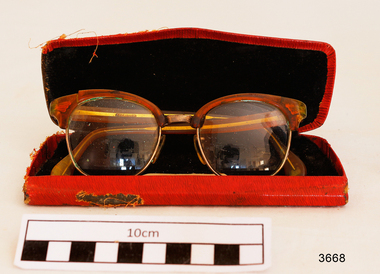
Functional object - Spectacles and Case, 1930s - 1960s
... rest on the nose. Spectacles were still usually held in place with the hand whilst being used temporarily for a brief period of reading or close inspection. ...rest on the nose. Spectacles were still usually held in place with the hand whilst being used temporarily for a brief period of reading or close inspection. ...The history of spectacles The earliest form of spectacles are generally agreed to have been invented in Northern Italy in the thirteenth century. Over hundreds of years of innovation and refinement, they have been perfected into the stylish and functional designs you see today worn by millions of people to correct their eyesight. Here's a look at the key moments that defined the history of spectacles. Thirteenth century - Rivet spectacles The earliest form of spectacles was simply two mounted lenses riveted together at the handle ends. They had no sides and were secured to the face by clamping the nose between the rims, some of which had notches which may have been intended to improve the grip. Even then the wearer could only keep them in place by remaining relatively still and would normally support them with the hand. These spectacles contained convex lenses for the correction of presbyopic long-sightedness and were generally suited only to those few who lived beyond their forties and had the ability to read. Sixteenth century - Nose spectacles Nose spectacles were in more common use by the early sixteenth century. These often had a bow-shaped continuous bridge, almost of a modern appearance, that was sometimes flexible depending upon the material, for example leather or whalebone. The bridge was as much an area to be gripped as to rest on the nose. Spectacles were still usually held in place with the hand whilst being used temporarily for a brief period of reading or close inspection. By now the lenses could be used to correct both long and short sight. The general design changed little through the seventeenth century, though certain refinements increased the flexibility and comfort for some wearers. In some localised areas, notably in Spain, people experimented with ear loops made of string. This allowed them to walk around with their spectacles on. Eighteenth century - Temple glasses Only in the eighteenth century did the first modern eyewear, or ‘glasses’ as we would understand them, start to appear. The lenses might be glass, rock crystal or any other transparent mineral substance and were prone to smashing if the spectacles fell off, so there was an impetus to develop frames that could be worn continuously and would stay in place. London optician Edward Scarlett is credited with developing the modern style of spectacles which were kept in place with arms, known as ‘temples’. These were made of iron or steel and gripped the side of the head but did not yet hook over the ears because often the ears were concealed beneath a powdered wig, such as was fashionable at the time. As temples developed they were made with wide ring ends through which the wearer could pass a ribbon, thus tying the spectacles securely to the head. As spectacles were no longer primarily for use in sedentary activities, people began to be noticed out and about in their spectacles and might come to be identified as a ‘spectacle wearer’. By the end of the eighteenth century, people who needed correction for both distance and near could choose bifocals. Nineteenth century - Pince-nez Pince-nez were a nineteenth century innovation that literally translates as ‘pinching the nose’. They had a spring clip to retain the item in place under its own tension. Sometimes this clip was too tight and the wearer struggled to breathe. If it was too loose the pince-nez could fall off so, for safety and security, they were often connected to the wearer's clothing by a cord or a chain to avoid them being dropped or lost. Pince-nez were sometimes chosen by people who felt that large spectacles were too prominent and drew attention to a physical defect. They were also suitable for mounting lenses that could correct astigmatism. Twentieth century spectacles Spectacle wearing continued to become more widespread, key developments being the supply of spectacles to troops in the First World War, cheaper spectacles being subsidised through insurance schemes arranged by friendly societies, and the beginning of the National Health Service in 1948, when free spectacles were made available to all who might benefit from them. This normalised spectacle wearing and led to a significant increase in the scale of production. Entirely separate categories of women’s spectacles and sports eyewear both emerged in the 1930s. The latter half of the twentieth century saw spectacles become more fashionable and stylish as frames with different shapes, materials, and colours became available. Plastics frames, in particular, allowed a greater choice of colours and textured finishes. Plastic lenses were more durable and could be made lighter and thinner than glass, spurring a renewed interest in rimless designs. Designer eyewear bearing popular high-street brand names encouraged patients to regard spectacles as a desirable commodity, even as a fashion accessory, not just a disability aid. https://www.college-optometrists.org/the-british-optical-association-museum/the-history-of-spectacles The company Optical Prescription Spectacle Makers (OPSM ) was formed in Sydney in 1932 and publically listed in 1953. These spectacles and case were used by Dr. Angus when testing patients' eyes. The spectacles and case were donated to Flagstaff Hill Maritime Village by the family of Doctor William Roy Angus, Surgeon and Oculist. It is part of the “W.R. Angus Collection” that includes historical medical equipment, surgical instruments and material once belonging to Dr Edward Ryan and Dr Thomas Francis Ryan, (both of Nhill, Victoria) as well as Dr Angus’ own belongings. The Collection’s history spans the medical practices of the two Doctors Ryan, from 1885-1926 plus that of Dr Angus, up until 1969. ABOUT THE “W.R.ANGUS COLLECTION” Doctor William Roy Angus M.B., B.S., Adel., 1923, F.R.C.S. Edin.,1928 (also known as Dr Roy Angus) was born in Murrumbeena, Victoria in 1901 and lived until 1970. He qualified as a doctor in 1923 at University of Adelaide, was Resident Medical Officer at the Royal Adelaide Hospital in 1924 and for a period was house surgeon to Sir (then Mr.) Henry Simpson Newland. Dr Angus was briefly an Assistant to Dr Riddell of Kapunda, then commenced private practice at Curramulka, Yorke Peninsula, SA, where he was physician, surgeon and chemist. In 1926, he was appointed as new Medical Assistant to Dr Thomas Francis Ryan (T.F. Ryan, or Tom), in Nhill, Victoria, where his experiences included radiology and pharmacy. In 1927 he was Acting House Surgeon in Dr Tom Ryan’s absence. Dr Angus had become engaged to Gladys Forsyth and they decided he would take time to further his studies overseas in the UK in 1927. He studied at London University College Hospital and at Edinburgh Royal Infirmary and in 1928, was awarded FRCS (Fellow from the Royal College of Surgeons), Edinburgh. He worked his passage back to Australia as a Ship’s Surgeon on the on the Australian Commonwealth Line’s T.S.S. Largs Bay. Dr Angus married Gladys in 1929, in Ballarat. (They went on to have one son (Graham 1932, born in SA) and two daughters (Helen (died 12/07/1996) and Berenice (Berry), both born at Mira, Nhill ) Dr Angus was a ‘flying doctor’ for the A.I.M. (Australian Inland Ministry) Aerial Medical Service in 1928 . The organisation began in South Australia through the Presbyterian Church in that year, with its first station being in the remote town of Oodnadatta, where Dr Angus was stationed. He was locum tenens there on North-South Railway at 21 Mile Camp. He took up this ‘flying doctor’ position in response to a call from Dr John Flynn; the organisation was later known as the Flying Doctor Service, then the Royal Flying Doctor Service. A lot of his work during this time involved dental surgery also. Between 1928-1932 he was surgeon at the Curramulka Hospital, Yorke Peninsula, South Australia. In 1933 Dr Angus returned to Nhill where he’d previously worked as Medical Assistant and purchased a share of the Nelson Street practice and Mira hospital from Dr Les Middleton one of the Middleton Brothers, the current owners of what was once Dr Tom Ryan’s practice. Dr L Middleton was House Surgeon to the Nhill Hospital 1926-1933, when he resigned. [Dr Tom Ryan’s practice had originally belonged to his older brother Dr Edward Ryan, who came to Nhill in 1885. Dr Edward saw patients at his rooms, firstly in Victoria Street and in 1886 in Nelson Street, until 1901. The Nelson Street practice also had a 2 bed ward, called Mira Private Hospital ). Dr Edward Ryan was House Surgeon at the Nhill Hospital 1884-1902 . He also had occasions where he successfully performed veterinary surgery for the local farmers too. Dr Tom Ryan then purchased the practice from his brother in 1901. Both Dr Edward and Dr Tom Ryan work as surgeons included eye surgery. Dr Tom Ryan performed many of his operations in the Mira private hospital on his premises. He too was House Surgeon at the Nhill Hospital 1902-1926. Dr Tom Ryan had one of the only two pieces of radiology equipment in Victoria during his practicing years – The Royal Melbourne Hospital had the other one. Over the years Dr Tom Ryan gradually set up what was effectively a training school for country general-practitioner-surgeons. Each patient was carefully examined, including using the X-ray machine, and any surgery was discussed and planned with Dr Ryan’s assistants several days in advance. Dr Angus gained experience in using the X-ray machine there during his time as assistant to Dr Ryan. Dr Tom Ryan moved from Nhill in 1926. He became a Fellow of the Royal Australasian College of Surgeons in 1927, soon after its formation, a rare accolade for a doctor outside any of the major cities. He remained a bachelor and died suddenly on 7th Dec 1955, aged 91, at his home in Ararat. Scholarships and prizes are still awarded to medical students in the honour of Dr T.F. Ryan and his father, Dr Michael Ryan, and brother, John Patrick Ryan. ] When Dr Angus bought into the Nelson Street premises in Nhill he was also appointed as the Nhill Hospital’s Honorary House Surgeon 1933-1938. His practitioner’s plate from his Nhill surgery states “HOURS Daily, except Tuesdays, Fridays and Saturday afternoons, 9-10am, 2-4pm, 7-8pm. Sundays by appointment”. This plate is now mounted on the doorway to the Port Medical Office at Flagstaff Hill Maritime Village, Warrnambool. Dr Edward Ryan and Dr Tom Ryan had an extensive collection of historical medical equipment and materials spanning 1884-1926 and when Dr Angus took up practice in their old premises he obtained this collection, a large part of which is now on display at the Port Medical Office at Flagstaff Hill Maritime Village in Warrnambool. During his time in Nhill Dr Angus was involved in the merging of the Mira Hospital and Nhill Public Hospital into one public hospital and the property titles passed on to Nhill Hospital in 1939. In 1939 Dr Angus and his family moved to Warrnambool where he purchased “Birchwood,” the 1852 home and medical practice of Dr John Hunter Henderson, at 214 Koroit Street. (This property was sold in1965 to the State Government and is now the site of the Warrnambool Police Station. ). The Angus family was able to afford gardeners, cooks and maids; their home was a popular place for visiting dignitaries to stay whilst visiting Warrnambool. Dr Angus had his own silk worm farm at home in a Mulberry tree. His young daughter used his centrifuge for spinning the silk. Dr Angus was appointed on a part-time basis as Port Medical Officer (Health Officer) in Warrnambool and held this position until the 1940’s when the government no longer required the service of a Port Medical Officer in Warrnambool; he was thus Warrnambool’s last serving Port Medical Officer. (The duties of a Port Medical Officer were outlined by the Colonial Secretary on 21st June, 1839 under the terms of the Quarantine Act. Masters of immigrant ships arriving in port reported incidents of diseases, illness and death and the Port Medical Officer made a decision on whether the ship required Quarantine and for how long, in this way preventing contagious illness from spreading from new immigrants to the residents already in the colony.) Dr Angus was a member of the Australian Medical Association, for 35 years and surgeon at the Warrnambool Base Hospital 1939-1942, He served as a Surgeon Captain during WWII 1941-45, in Ballarat, Victoria, and in Bonegilla, N.S.W., completing his service just before the end of the war due to suffering from a heart attack. During his convalescence he carved an intricate and ‘most artistic’ chess set from the material that dentures were made from. He then studied ophthalmology at the Royal Melbourne Eye and Ear Hospital and created cosmetically superior artificial eyes by pioneering using the intrascleral cartilage. Angus received accolades from the Ophthalmological Society of Australasia for this work. He returned to Warrnambool to commence practice as an ophthalmologist, pioneering in artificial eye improvements. He was Honorary Consultant Ophthalmologist to Warrnambool Base Hospital for 31 years. He made monthly visits to Portland as a visiting surgeon, to perform eye surgery. He represented the Victorian South-West subdivision of the Australian Medical Association as its secretary between 1949 and 1956 and as chairman from 1956 to 1958. In 1968 Dr Angus was elected member of Spain’s Barraquer Institute of Barcelona after his research work in Intrasclearal cartilage grafting, becoming one of the few Australian ophthalmologists to receive this honour, and in the following year presented his final paper on Living Intrasclearal Cartilage Implants at the Inaugural Meeting of the Australian College of Ophthalmologists in Melbourne In his personal life Dr Angus was a Presbyterian and treated Sunday as a Sabbath, a day of rest. He would visit 3 or 4 country patients on a Sunday, taking his children along ‘for the ride’ and to visit with him. Sunday evenings he would play the pianola and sing Scottish songs to his family. One of Dr Angus’ patients was Margaret MacKenzie, author of a book on local shipwrecks that she’d seen as an eye witness from the late 1880’s in Peterborough, Victoria. In the early 1950’s Dr Angus, painted a picture of a shipwreck for the cover jacket of Margaret’s book, Shipwrecks and More Shipwrecks. She was blind in later life and her daughter wrote the actual book for her. Dr Angus and his wife Gladys were very involved in Warrnambool’s society with a strong interest in civic affairs. Their interests included organisations such as Red Cross, Rostrum, Warrnambool and District Historical Society (founding members), Wine and Food Society, Steering Committee for Tertiary Education in Warrnambool, Local National Trust, Good Neighbour Council, Housing Commission Advisory Board, United Services Institute, Legion of Ex-Servicemen, Olympic Pool Committee, Food for Britain Organisation, Warrnambool Hospital, Anti-Cancer Council, Boys’ Club, Charitable Council, National Fitness Council and Air Raid Precautions Group. He was also a member of the Steam Preservation Society and derived much pleasure from a steam traction engine on his farm. He had an interest in people and the community He and his wife Gladys were both involved in the creation of Flagstaff Hill, including the layout of the gardens. After his death (28th March 1970) his family requested his practitioner’s plate, medical instruments and some personal belongings be displayed in the Port Medical Office surgery at Flagstaff Hill Maritime Village, and be called the “W. R. Angus Collection”. The W.R. Angus Collection is significant for still being located at the site it is connected with, Doctor Angus being the last Port Medical Officer in Warrnambool. The collection of medical instruments and other equipment is culturally significant, being an historical example of medicine from late 19th to mid-20th century. Dr Angus assisted Dr Tom Ryan, a pioneer in the use of X-rays and in ocular surgery. Spectacles and case, from the W.R. Angus Collection and used by Dr. Angus testing the sight of his patients. Metal case covered in red leather, black velvet lining. Tan rimmed spectacles. Maker is OPSM. Inscriptions on case, inside case and on spectacle rim.Inscribed on spectacle arms “CONTORA”. Inscription on case in gold print “OPSM Optical Prescription Spectacle Makers Pty Ltd”. Inscription on white oval label inside case is illegible. flagstaff hill, warrnambool, shipwrecked coast, flagstaff hill maritime museum, maritime museum, shipwreck coast, flagstaff hill maritime village, great ocean road, dr w r angus, spectacles and case, optical testing, optometrist examination, opsm optical prescription spectacle makers -
 Flagstaff Hill Maritime Museum and Village
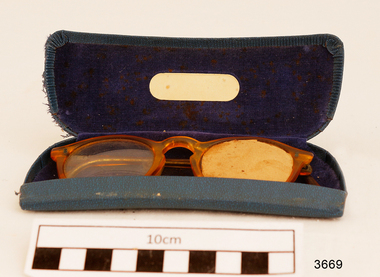
Functional object - Spectacles and Case, Mid 20th Century
... rest on the nose. Spectacles were still usually held in place with the hand whilst being used temporarily for a brief period of reading or close inspection. ...rest on the nose. Spectacles were still usually held in place with the hand whilst being used temporarily for a brief period of reading or close inspection. ...The history of spectacles The earliest form of spectacles are generally agreed to have been invented in Northern Italy in the thirteenth century. Over hundreds of years of innovation and refinement, they have been perfected into the stylish and functional designs you see today worn by millions of people to correct their eyesight. Here's a look at the key moments that defined the history of spectacles. Thirteenth century - Rivet spectacles The earliest form of spectacles was simply two mounted lenses riveted together at the handle ends. They had no sides and were secured to the face by clamping the nose between the rims, some of which had notches which may have been intended to improve the grip. Even then the wearer could only keep them in place by remaining relatively still and would normally support them with the hand. These spectacles contained convex lenses for the correction of presbyopic long-sightedness and were generally suited only to those few who lived beyond their forties and had the ability to read. Sixteenth century - Nose spectacles Nose spectacles were in more common use by the early sixteenth century. These often had a bow-shaped continuous bridge, almost of a modern appearance, that was sometimes flexible depending upon the material, for example leather or whalebone. The bridge was as much an area to be gripped as to rest on the nose. Spectacles were still usually held in place with the hand whilst being used temporarily for a brief period of reading or close inspection. By now the lenses could be used to correct both long and short sight. The general design changed little through the seventeenth century, though certain refinements increased the flexibility and comfort for some wearers. In some localised areas, notably in Spain, people experimented with ear loops made of string. This allowed them to walk around with their spectacles on. Eighteenth century - Temple glasses Only in the eighteenth century did the first modern eyewear, or ‘glasses’ as we would understand them, start to appear. The lenses might be glass, rock crystal or any other transparent mineral substance and were prone to smashing if the spectacles fell off, so there was an impetus to develop frames that could be worn continuously and would stay in place. London optician Edward Scarlett is credited with developing the modern style of spectacles which were kept in place with arms, known as ‘temples’. These were made of iron or steel and gripped the side of the head but did not yet hook over the ears because often the ears were concealed beneath a powdered wig, such as was fashionable at the time. As temples developed they were made with wide ring ends through which the wearer could pass a ribbon, thus tying the spectacles securely to the head. As spectacles were no longer primarily for use in sedentary activities, people began to be noticed out and about in their spectacles and might come to be identified as a ‘spectacle wearer’. By the end of the eighteenth century, people who needed correction for both distance and near could choose bifocals. Nineteenth century - Pince-nez Pince-nez were a nineteenth century innovation that literally translates as ‘pinching the nose’. They had a spring clip to retain the item in place under its own tension. Sometimes this clip was too tight and the wearer struggled to breathe. If it was too loose the pince-nez could fall off so, for safety and security, they were often connected to the wearer's clothing by a cord or a chain to avoid them being dropped or lost. Pince-nez were sometimes chosen by people who felt that large spectacles were too prominent and drew attention to a physical defect. They were also suitable for mounting lenses that could correct astigmatism. Twentieth century spectacles Spectacle wearing continued to become more widespread, key developments being the supply of spectacles to troops in the First World War, cheaper spectacles being subsidised through insurance schemes arranged by friendly societies, and the beginning of the National Health Service in 1948, when free spectacles were made available to all who might benefit from them. This normalised spectacle wearing and led to a significant increase in the scale of production. Entirely separate categories of women’s spectacles and sports eyewear both emerged in the 1930s. The latter half of the twentieth century saw spectacles become more fashionable and stylish as frames with different shapes, materials, and colours became available. Plastics frames, in particular, allowed a greater choice of colours and textured finishes. Plastic lenses were more durable and could be made lighter and thinner than glass, spurring a renewed interest in rimless designs. Designer eyewear bearing popular high-street brand names encouraged patients to regard spectacles as a desirable commodity, even as a fashion accessory, not just a disability aid. https://www.college-optometrists.org/the-british-optical-association-museum/the-history-of-spectacles These spectacles and case from F.G. and R.G. Bennett of Warrnambool were used by Dr. Angus to test his patients' eye sight. They were donated to Flagstaff Hill Maritime Village by the family of Doctor William Roy Angus, Surgeon and Oculist. It is part of the “W.R. Angus Collection” that includes historical medical equipment, surgical instruments and material once belonging to Dr Edward Ryan and Dr Thomas Francis Ryan, (both of Nhill, Victoria) as well as Dr Angus’ own belongings. The Collection’s history spans the medical practices of the two Doctors Ryan, from 1885-1926 plus that of Dr Angus, up until 1969. ABOUT THE “W.R.ANGUS COLLECTION” Doctor William Roy Angus M.B., B.S., Adel., 1923, F.R.C.S. Edin.,1928 (also known as Dr Roy Angus) was born in Murrumbeena, Victoria in 1901 and lived until 1970. He qualified as a doctor in 1923 at University of Adelaide, was Resident Medical Officer at the Royal Adelaide Hospital in 1924 and for a period was house surgeon to Sir (then Mr.) Henry Simpson Newland. Dr Angus was briefly an Assistant to Dr Riddell of Kapunda, then commenced private practice at Curramulka, Yorke Peninsula, SA, where he was physician, surgeon and chemist. In 1926, he was appointed as new Medical Assistant to Dr Thomas Francis Ryan (T.F. Ryan, or Tom), in Nhill, Victoria, where his experiences included radiology and pharmacy. In 1927 he was Acting House Surgeon in Dr Tom Ryan’s absence. Dr Angus had become engaged to Gladys Forsyth and they decided he would take time to further his studies overseas in the UK in 1927. He studied at London University College Hospital and at Edinburgh Royal Infirmary and in 1928, was awarded FRCS (Fellow from the Royal College of Surgeons), Edinburgh. He worked his passage back to Australia as a Ship’s Surgeon on the on the Australian Commonwealth Line’s T.S.S. Largs Bay. Dr Angus married Gladys in 1929, in Ballarat. (They went on to have one son (Graham 1932, born in SA) and two daughters (Helen (died 12/07/1996) and Berenice (Berry), both born at Mira, Nhill ) Dr Angus was a ‘flying doctor’ for the A.I.M. (Australian Inland Ministry) Aerial Medical Service in 1928 . The organisation began in South Australia through the Presbyterian Church in that year, with its first station being in the remote town of Oodnadatta, where Dr Angus was stationed. He was locum tenens there on North-South Railway at 21 Mile Camp. He took up this ‘flying doctor’ position in response to a call from Dr John Flynn; the organisation was later known as the Flying Doctor Service, then the Royal Flying Doctor Service. A lot of his work during this time involved dental surgery also. Between 1928-1932 he was surgeon at the Curramulka Hospital, Yorke Peninsula, South Australia. In 1933 Dr Angus returned to Nhill where he’d previously worked as Medical Assistant and purchased a share of the Nelson Street practice and Mira hospital from Dr Les Middleton one of the Middleton Brothers, the current owners of what was once Dr Tom Ryan’s practice. Dr L Middleton was House Surgeon to the Nhill Hospital 1926-1933, when he resigned. [Dr Tom Ryan’s practice had originally belonged to his older brother Dr Edward Ryan, who came to Nhill in 1885. Dr Edward saw patients at his rooms, firstly in Victoria Street and in 1886 in Nelson Street, until 1901. The Nelson Street practice also had a 2 bed ward, called Mira Private Hospital ). Dr Edward Ryan was House Surgeon at the Nhill Hospital 1884-1902 . He also had occasions where he successfully performed veterinary surgery for the local farmers too. Dr Tom Ryan then purchased the practice from his brother in 1901. Both Dr Edward and Dr Tom Ryan work as surgeons included eye surgery. Dr Tom Ryan performed many of his operations in the Mira private hospital on his premises. He too was House Surgeon at the Nhill Hospital 1902-1926. Dr Tom Ryan had one of the only two pieces of radiology equipment in Victoria during his practicing years – The Royal Melbourne Hospital had the other one. Over the years Dr Tom Ryan gradually set up what was effectively a training school for country general-practitioner-surgeons. Each patient was carefully examined, including using the X-ray machine, and any surgery was discussed and planned with Dr Ryan’s assistants several days in advance. Dr Angus gained experience in using the X-ray machine there during his time as assistant to Dr Ryan. Dr Tom Ryan moved from Nhill in 1926. He became a Fellow of the Royal Australasian College of Surgeons in 1927, soon after its formation, a rare accolade for a doctor outside any of the major cities. He remained a bachelor and died suddenly on 7th Dec 1955, aged 91, at his home in Ararat. Scholarships and prizes are still awarded to medical students in the honour of Dr T.F. Ryan and his father, Dr Michael Ryan, and brother, John Patrick Ryan. ] When Dr Angus bought into the Nelson Street premises in Nhill he was also appointed as the Nhill Hospital’s Honorary House Surgeon 1933-1938. His practitioner’s plate from his Nhill surgery states “HOURS Daily, except Tuesdays, Fridays and Saturday afternoons, 9-10am, 2-4pm, 7-8pm. Sundays by appointment”. This plate is now mounted on the doorway to the Port Medical Office at Flagstaff Hill Maritime Village, Warrnambool. Dr Edward Ryan and Dr Tom Ryan had an extensive collection of historical medical equipment and materials spanning 1884-1926 and when Dr Angus took up practice in their old premises he obtained this collection, a large part of which is now on display at the Port Medical Office at Flagstaff Hill Maritime Village in Warrnambool. During his time in Nhill Dr Angus was involved in the merging of the Mira Hospital and Nhill Public Hospital into one public hospital and the property titles passed on to Nhill Hospital in 1939. In 1939 Dr Angus and his family moved to Warrnambool where he purchased “Birchwood,” the 1852 home and medical practice of Dr John Hunter Henderson, at 214 Koroit Street. (This property was sold in1965 to the State Government and is now the site of the Warrnambool Police Station. ). The Angus family was able to afford gardeners, cooks and maids; their home was a popular place for visiting dignitaries to stay whilst visiting Warrnambool. Dr Angus had his own silk worm farm at home in a Mulberry tree. His young daughter used his centrifuge for spinning the silk. Dr Angus was appointed on a part-time basis as Port Medical Officer (Health Officer) in Warrnambool and held this position until the 1940’s when the government no longer required the service of a Port Medical Officer in Warrnambool; he was thus Warrnambool’s last serving Port Medical Officer. (The duties of a Port Medical Officer were outlined by the Colonial Secretary on 21st June, 1839 under the terms of the Quarantine Act. Masters of immigrant ships arriving in port reported incidents of diseases, illness and death and the Port Medical Officer made a decision on whether the ship required Quarantine and for how long, in this way preventing contagious illness from spreading from new immigrants to the residents already in the colony.) Dr Angus was a member of the Australian Medical Association, for 35 years and surgeon at the Warrnambool Base Hospital 1939-1942, He served as a Surgeon Captain during WWII 1941-45, in Ballarat, Victoria, and in Bonegilla, N.S.W., completing his service just before the end of the war due to suffering from a heart attack. During his convalescence he carved an intricate and ‘most artistic’ chess set from the material that dentures were made from. He then studied ophthalmology at the Royal Melbourne Eye and Ear Hospital and created cosmetically superior artificial eyes by pioneering using the intrascleral cartilage. Angus received accolades from the Ophthalmological Society of Australasia for this work. He returned to Warrnambool to commence practice as an ophthalmologist, pioneering in artificial eye improvements. He was Honorary Consultant Ophthalmologist to Warrnambool Base Hospital for 31 years. He made monthly visits to Portland as a visiting surgeon, to perform eye surgery. He represented the Victorian South-West subdivision of the Australian Medical Association as its secretary between 1949 and 1956 and as chairman from 1956 to 1958. In 1968 Dr Angus was elected member of Spain’s Barraquer Institute of Barcelona after his research work in Intrasclearal cartilage grafting, becoming one of the few Australian ophthalmologists to receive this honour, and in the following year presented his final paper on Living Intrasclearal Cartilage Implants at the Inaugural Meeting of the Australian College of Ophthalmologists in Melbourne In his personal life Dr Angus was a Presbyterian and treated Sunday as a Sabbath, a day of rest. He would visit 3 or 4 country patients on a Sunday, taking his children along ‘for the ride’ and to visit with him. Sunday evenings he would play the pianola and sing Scottish songs to his family. One of Dr Angus’ patients was Margaret MacKenzie, author of a book on local shipwrecks that she’d seen as an eye witness from the late 1880’s in Peterborough, Victoria. In the early 1950’s Dr Angus, painted a picture of a shipwreck for the cover jacket of Margaret’s book, Shipwrecks and More Shipwrecks. She was blind in later life and her daughter wrote the actual book for her. Dr Angus and his wife Gladys were very involved in Warrnambool’s society with a strong interest in civic affairs. Their interests included organisations such as Red Cross, Rostrum, Warrnambool and District Historical Society (founding members), Wine and Food Society, Steering Committee for Tertiary Education in Warrnambool, Local National Trust, Good Neighbour Council, Housing Commission Advisory Board, United Services Institute, Legion of Ex-Servicemen, Olympic Pool Committee, Food for Britain Organisation, Warrnambool Hospital, Anti-Cancer Council, Boys’ Club, Charitable Council, National Fitness Council and Air Raid Precautions Group. He was also a member of the Steam Preservation Society and derived much pleasure from a steam traction engine on his farm. He had an interest in people and the community He and his wife Gladys were both involved in the creation of Flagstaff Hill, including the layout of the gardens. After his death (28th March 1970) his family requested his practitioner’s plate, medical instruments and some personal belongings be displayed in the Port Medical Office surgery at Flagstaff Hill Maritime Village, and be called the “W. R. Angus Collection”. The W.R. Angus Collection is significant for still being located at the site it is connected with, Doctor Angus being the last Port Medical Officer in Warrnambool. The collection of medical instruments and other equipment is culturally significant, being an historical example of medicine from late 19th to mid-20th century. Dr Angus assisted Dr Tom Ryan, a pioneer in the use of X-rays and in ocular surgery. Spectacles and case, from the W.R. Angus Collection and used by Dr. Angus testing the sight of his patients. Metal case covered in blue leather, blue velvet lining. Orange/yellow rimmed spectacles, one lens covered with cardboard. White oval label inside case. Inscription on case with maker’s details in gold print.Inscription on case reads “F. G. & R. G. BENNETT / WARRNAMBOOL”. flagstaff hill, warrnambool, shipwrecked coast, flagstaff hill maritime museum, maritime museum, shipwreck coast, flagstaff hill maritime village, great ocean road, dr w r angus, spectacles and case, optical testing, optometrist examination, f.g. and r.g. bennett of warrnambool -
 Mission to Seafarers Victoria
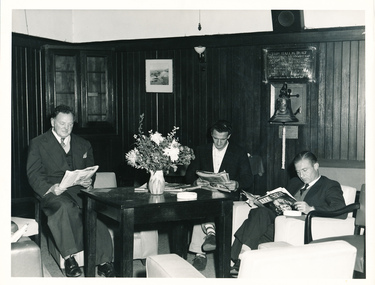
Photograph - Digital copy, Black and white, Melbourne Harbour Trust, 1959
... The third man is seated in an armchair reading a copy of Life International magazine, with an ashtray resting on the arm of the chair....The third man is seated in an armchair reading a copy of Life International magazine, with an ashtray resting on the arm of the chair. ...Photograph taken in the Celia Little Room at Mission to Seafarers Melbourne. The Celia Little Room was named in honour of the aunt of one of the serving (and resident) chaplains. The room is a multi-function room, being used at times for banquets or, as the photograph shows, for relaxation, by visiting seafarers. The magazine read by the man on the right is the International version of the Life magazine published dated from 24 November 1958, with actress Kim Novak holding a black cat on cover. This photograph was published in the Port of Melbourne Quarterly (July-September 1959) held in the Mission's archives. It was probably donated by the trust to Padre Oliver.Photograph displays the way in which the Celia Little Room, and by extension the Mission to Seafarers, was used by those who utilised the facility during this period.Black and white photograph of three men sitting in Celia Little Room at Mission to Seafarers. Man on left is in a suit, sitting on the arm of a chair, reading a newspaper. There is a coffee table with flowers separating him from the second man, also sitting reading a newspaper. The third man is seated in an armchair reading a copy of Life International magazine, with an ashtray resting on the arm of the chair.armchairs, reading, newspapers, wainscoting, ashtray, robin kent, life magazine, mission to seafarers, mission to seamen, celia little room, coffee table, bell, moreton bay, flowers, seamen, sailors, memorial plaque -
 Kiewa Valley Historical Society
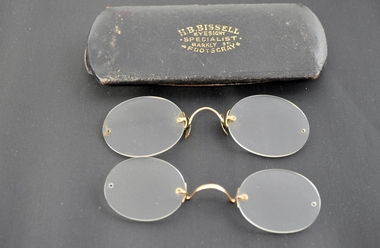
Spectacles Reading, circa early 1900s
... reading glasses is made from gold plated copper wire. There are three nose bridges each with a slightly different angle and shape, each has a different magnification. This may suggest that they were in use at different developmental periods during the wearers ages. Each of the three lenses were fixed onto the frame by a screw and fastened directly onto the glass. Two of the glasses have nose "guides/rests...reading glasses is made from gold plated copper wire. There are three nose bridges each with a slightly different angle and shape, each has a different magnification. This may suggest that they were in use at different developmental periods during the wearers ages. Each of the three lenses were fixed onto the frame by a screw and fastened directly onto the glass. Two of the glasses have nose "guides/rests ...These reading glasses plus the two additional replacement lenses were highly fashionable in the late 1800's and early 1900's due to their light frames ie. wire. They are of light material and are not as obtrusive, or heavy, as horn rimmed reading glasses.This minimisation of the eye wear was to allow the facial features to be presented without any obstructing eye wear, "au naturel". The "light weight" wire connections to nose and ears was to minimise weight upon those physical areas. It was an eye piece preferred by accountants and all forms of "book worms". This was a period when the "written word" was at its peak. This was well before the light enhanced computer screen and at an age where the "written word" was in the majority as compared to the typed word. These reading glasses are very significant to the Kiewa Valley as they provide additional material which supports the "isolational factors" which were prevalent in the 1800's and early 1900's. Poor lighting and lack of available optical technicians in rural areas, required those suffering with eye troubles in these rural areas to go to Melbourne. An advertisement placed by H B Bissel "eyesight specialist" in the "Independent" Newspaper in 1915 on page 3 " Every person's eyes are liable to be affected by some little weakness or other and these weaknesses, if not corrected at once, are apt to assume a most serious aspect as time goes on". This type of advertisement is putting "the fear of God" on those with slight eyesight problems. It also does not factor the poor lighting used by most in rural areas at this point in time. By the mid to late 1950's, electricity in the Kiewa Valley was available to all households and improved lighting helped nighttime readers. These reading glasses, made in Melbourne, highlight the fact that the Kiewa Valley and its region were still reliant on Melbourne based "specialists" and travel to and from these highly professional health practitioners not only involved a long, and time consuming journey, but also an expensive one.The frames of this oval wire reading glasses is made from gold plated copper wire. There are three nose bridges each with a slightly different angle and shape, each has a different magnification. This may suggest that they were in use at different developmental periods during the wearers ages. Each of the three lenses were fixed onto the frame by a screw and fastened directly onto the glass. Two of the glasses have nose "guides/rests" and one without.. The fine wire ear "loops" has a small "ball" feature at its end (to stop the glasses from slipping off the face).personal effects, spectacles, eye fashion, reading glasses -
 J. Ward Museum Complex
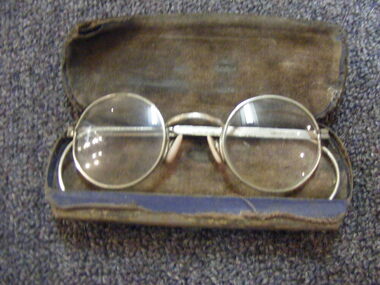
Accessory - Spectacles & Case
... readingglasses reading spectacles nil Spectacles with metal frame, circular lenses & pink-coloured nose rests. ...Spectacles with metal frame, circular lenses & pink-coloured nose rests.nilreadingglasses, reading, spectacles -
 Bendigo Historical Society Inc.
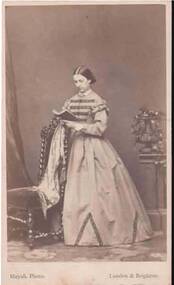
Photograph - PORTRAIT OF A LADY
... Small full length portrait of a lady standing beside a chair reading a book which is resting on the back of the chair. ...PHOTOGRAPH Portrait female Portrait of a Lady Mayall Mayall, 224 Regent Street, London. 90 King's Road, Brighton Small full length portrait of a lady standing beside a chair reading a book which is resting on the back of the chair. ...Small full length portrait of a lady standing beside a chair reading a book which is resting on the back of the chair. She is wearing a long high neck dress with frills at the sleeve tops and dark bands across the bodice. The dark material is also repeated at the hem in a V shape. Photographer's name and address printed on the front and back.Mayall, 224 Regent Street, London. 90 King's Road, Brightonphotograph, portrait, female, portrait of a lady, mayall -
 Bendigo Historical Society Inc.
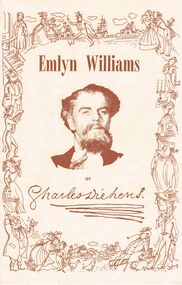
Document - EMLYN WILLIAMS AS CHARLES DICKENS, 1958
... Reading' Criterion Theatre solo performance novels.' actor had been a star of . . . Personal Manager for Emlyn Williams: Alan Cambell. Stage Director: Tony Ward. Secretary and Accountant: Aubrey Thomas. Manager for the Australian Elizabethan Theatre Trust: Mary Rawdon. actor... playwright of director (often in all three capacities simultaneously) degree of M.A. Oxford. Born in Flintshire... North Wales... in 1905... village inn-keeper... spoke Welsh learned English at school. comedy... 'The Druid's Rest...Reading' Criterion Theatre solo performance novels.' actor had been a star of . . . Personal Manager for Emlyn Williams: Alan Cambell. Stage Director: Tony Ward. Secretary and Accountant: Aubrey Thomas. Manager for the Australian Elizabethan Theatre Trust: Mary Rawdon. actor playwright of director (often in all three capacities simultaneously) degree of M.A. Oxford. Born in Flintshire North Wales in 1905 village inn-keeper spoke Welsh learned English at school. comedy 'The Druid's Rest ...Emlyn Williams as Charles Dickens. Giving a Solo Performance of Scenes from the Famous Novels and Stories. Tour of New Zealand and Australia, 1958. D D O'Conner Productions Ltd.., in association with the Australian Elizabethan Theatre Trust. 1 Moving in Society. 2 Paul. 3 Mr Bob Sawyer Gives a Bachelor Party. 4 The Signalman. 5 Mr Chops. 6 The Fancy Ball. The Adoptions . . . The Desk . . . The Nature of the Performance. During the fifties of the last century, Charles Dickens, at the Height of his fame as a novelist, ventured on something quite new; he gave, in Birmingham, a public 'reading' of one of his stories. This turned out to be an historic occasion, opening up an extraordinary career for the great writer. Each 'Reading' was more sensationally successful than the last. The word was put into inverted commas because nothing could have been less like reading than Dickens's dramatic performance. Something like a hundred years later at the Criterion Theatre, EMILYN WILLIAMS appeared before the London public 'as Charles Dicken's, giving a solo performance of scenes from the novels.' At this point the actor had been a star of . . . Personal Manager for Emlyn Williams: Alan Cambell. Stage Director: Tony Ward. Secretary and Accountant: Aubrey Thomas. Manager for the Australian Elizabethan Theatre Trust: Mary Rawdon. EMILYN WILLIAMS. Emlyn Williams, as actor, playwright of director (often in all three capacities simultaneously) has been in the theatre since he acquired the degree of M.A. and shook from his feet the dust of Oxford. Born in Flintshire, North Wales, in 1905, the son of a village inn-keeper, he spoke only Welsh as a child and learned English at school - a boyhood freely depicted in his comedy, 'The Druid's Rest.' At the age of ten he won a scholarship to the local Holywell County School, and at the age of seventeen another scholarship (in French) to Christ Church, Oxford. Once at the University hw discovered the theatre, by means of the Dramatic Society, and realized at once it was to dominate his life. While he . . . Includes photo of E Williams. Advertisement for DECCA Records, Emlyn Williams as Charles Dickens, Volume 1.Back cover photograph of Emlyn Williams. Second Programme in Australia: Emlyn Williams as 'A Boy Growing Up' An entertainment from the stories of Dylan Thomas. 'Gorgeously Funny' - The observer, London. Cover well decorated with sketches and photo of Emlyn WilliamsPeerless Press Pty. Ltd.cottage, miners, emlyn williams as charles dickens. giving a solo performance of scenes from the famous novels and stories. tour of new zealand and australia, 1958. d d o'conner productions ltd.., in association with the australian elizabethan theatre trust. 1 moving in society. 2 paul. 3 mr bob sawyer gives a bachelor party. 4 the signalman. 5 mr chops. 6 the fancy ball. the adoptions . . . the desk . . . the nature of the performance. during the fifties of the last century, novelist, ventured on something quite new, in birmingham, a public 'reading'. an historic occasion, opening up a career 'reading' criterion theatre solo performance novels.' actor had been a star of . . . personal manager for emlyn williams: alan cambell. stage director: tony ward. secretary and accountant: aubrey thomas. manager for the australian elizabethan theatre trust: mary rawdon. actor, playwright of director (often in all three capacities simultaneously) degree of m.a. oxford. born in flintshire, north wales, in 1905, village inn-keeper, spoke welsh learned english at school. comedy, 'the druid's rest.' won a scholarship to the local holywell county school, and at the age of seventeen another scholarship (in french) to christ church, oxford. university he discovered the theatre, dramatic society. photo of e williams. advertisement for decca records, as charles dickens, volume 1.back cover photograph of emlyn williams. second programme in australia: emlyn williams as 'a boy growing up' stories of dylan thomas. 'gorgeously funny' - the observer, london. -
 Narre Warren and District Family History Group
Book, Narre Warren & District Family History Group Inc, Casey Cardinia Collection - Koo Wee Rup Information File, 2013
... Mar 2005 General Historical Information 15 Dec 2004 Huxtable, Ken: obituary 23 Jun 1993 Egan Family celebrates 100 years in Gippsland 15 Sep 2004 Jeffrey, Violet: obituary 01 Nov 2006 New War Memorial on track 20 Jun 2007 Ingram, Lynette: profile 18 Jul 2007 Koo Wee Rup High School: 1st captains 11 Oct 2017 Alumni Invited Back to School - Koo Wee Rup Secondary College 11 Oct 2021 History Builds a Lasting Legacy - Koo Wee Rup Secondary College 6 Feb 2013 Peter’s Our Top Citizen - Peter Boekel 15 Apr 2015 Uncle Taken too Soon - Claude Leeson 1 Oct 2014 Rita, the Reliever - Rita Matthews 15 Apr 2015 The Address of Honour 14 Jan 2015 What an Innings - Kathleen Glasscock 22 Oct 2014 Lasting Military Legacy 14 Jan 2015 Imbued with Sporting Spirit - Peter Levey 18 Jul 2007 Challenges for Society 18 Jul 2007 Meet a Home Town Policeman - Stuart Halligan 8 Oct 2008 Pylons v Potatoes 10 Oct 2007 Players Still do the Rounds - Windmill Theatre 26 Oct 2016 St Sofia Comes to Town 16 Jun 2021 The Queen of Volunteers - May Ridgway 21 Oct 2015 “Once in a Million” Mal - Mal Pugh 3 Oct 2007 100 is Well Worth the Wait - Albert Townley 15 Jul 2015 Ron Won’t Surrender - Ron Ingram 11 Mar 2009 Mona Keeps Memories Alive - Mona Mynard 28 Mar 2012 Deserving Demons 15 Jul 2015 After 100 Years, Blood Worth Bottling - Red Cross 24 Sep 2005 Bowling in the Rough 24 Sep 2005 The :Family” Cricket Association Celebrates a Milestone Jul 2009 Resident of the Month - Joyce Games 18 Feb 2009 Dynasties That Helped Build the Swamp - Lineham family 15 Jul 2015 Herbs Add a Zest for Life 4 Feb 2009 Better School Rises From Ashes - Koo Wee Rup High School 15 Jun 2016 Horses, High Stakes and Honours - Colin Alderson 4 Apr 2018 Koowee Through and Through - Jack Ingram UNKNOWN Koo Wee Rup Swamp Historical Society - pamphlet 14 Apr 2021 Royal Remembered - Heather Arnold 11 Mar 2020 Swamp Museum Reopens 23 Aug 2017 Reading at Random 14 Mar 2018 Heritage house of History - Harewood House 8 Apr 2015 Digger Honours 27 Sep 2018 The Lowdown Q&A - Heather Arnold 15 Dec 2021 Claudia’s Legacy of Note - Claudia Barker 15 Dec 2021 Claudia Passes the Baton - Claudia Barker 15 Dec 2021 Teacher’s Musical Journey - Claudia Barker 18 Oct 2023 Five Decades of Tradition 20 Dec 2023 Decades of Dedication - Leonie McGinley 12 July 2023 It’s History in the Making - Heather Arnold 26 Jan 2022 Koo Wee Rup Names Dianne its Citizen of the Year - Dianne Divola 21 Dec 2005 Cut Above the Rest 20 Apr 2022 An Enduring Love Story - Olive and Geoff Stokes 2 May 2007 Tea to Celebrate 59 Years Together - Doug and Lois Beer 21 Dec 2022 Minnie’s Major Injustice - Minnie Eason 27 July 2022 Jaydee’s Epic Run - Jaydee Miller 28 Jun 2006 Show Goes on for Blue-ribbon Couple - Bob & Robyn Johnson 18 May2022 Keeping the Past Alive - Harewood House 27 Sep 2006 Grower Thrilled with Record Crop - Charlie Motta 15 Nov 2023 His Legacy of Conviction - Russell Broadbent 6 Feb 2019 Wright Earns Senior Gong - June Wright 6 Feb 2019 Meaghan’s Massive Efforts for Youth are Rewarded - Meaghan Venables 7 Aug 2024 Swamp a Flood Zone 6 Nov 2024 St Sophia Celebrations 2 Oct 2024 Theatre Buffs to Reunite 8 May 2024 Frustration as Anzac Day Service Billed 22 May2024 Second to None - Leonie McGinley 23 Oct 2024 Beautiful Train Mural Underway at Koo Wee Rup 14 May2025 Russell’s Long Legacy - Russell Broadbent 7 May 2025 Last Harvest for the Giles 12 Mar 2025 A Love of Koo Wee Rup - Caroline Roff 28 Jan 2026 “Heart of Gold” Earns OAM - Bev Edwards 11 Dec 2024 Biggest Train Mural Unveiled 29 Oct 2025 Honouring Saint Sofia 24 Sep 2025 Legacy Honoured 18 Feb 2026 Tributes Flow For O’Hehir - Barry O’Hehir 18 Feb 2026 Wilson Remembered Across Gippy Region - Trevor Wilson...Mar 2005 General Historical Information 15 Dec 2004 Huxtable, Ken: obituary 23 Jun 1993 Egan Family celebrates 100 years in Gippsland 15 Sep 2004 Jeffrey, Violet: obituary 01 Nov 2006 New War Memorial on track 20 Jun 2007 Ingram, Lynette: profile 18 Jul 2007 Koo Wee Rup High School: 1st captains 11 Oct 2017 Alumni Invited Back to School - Koo Wee Rup Secondary College 11 Oct 2021 History Builds a Lasting Legacy - Koo Wee Rup Secondary College 6 Feb 2013 Peter’s Our Top Citizen - Peter Boekel 15 Apr 2015 Uncle Taken too Soon - Claude Leeson 1 Oct 2014 Rita, the Reliever - Rita Matthews 15 Apr 2015 The Address of Honour 14 Jan 2015 What an Innings - Kathleen Glasscock 22 Oct 2014 Lasting Military Legacy 14 Jan 2015 Imbued with Sporting Spirit - Peter Levey 18 Jul 2007 Challenges for Society 18 Jul 2007 Meet a Home Town Policeman - Stuart Halligan 8 Oct 2008 Pylons v Potatoes 10 Oct 2007 Players Still do the Rounds - Windmill Theatre 26 Oct 2016 St Sofia Comes to Town 16 Jun 2021 The Queen of Volunteers - May Ridgway 21 Oct 2015 “Once in a Million” Mal - Mal Pugh 3 Oct 2007 100 is Well Worth the Wait - Albert Townley 15 Jul 2015 Ron Won’t Surrender - Ron Ingram 11 Mar 2009 Mona Keeps Memories Alive - Mona Mynard 28 Mar 2012 Deserving Demons 15 Jul 2015 After 100 Years, Blood Worth Bottling - Red Cross 24 Sep 2005 Bowling in the Rough 24 Sep 2005 The :Family” Cricket Association Celebrates a Milestone Jul 2009 Resident of the Month - Joyce Games 18 Feb 2009 Dynasties That Helped Build the Swamp - Lineham family 15 Jul 2015 Herbs Add a Zest for Life 4 Feb 2009 Better School Rises From Ashes - Koo Wee Rup High School 15 Jun 2016 Horses, High Stakes and Honours - Colin Alderson 4 Apr 2018 Koowee Through and Through - Jack Ingram UNKNOWN Koo Wee Rup Swamp Historical Society - pamphlet 14 Apr 2021 Royal Remembered - Heather Arnold 11 Mar 2020 Swamp Museum Reopens 23 Aug 2017 Reading at Random 14 Mar 2018 Heritage house of History - Harewood House 8 Apr 2015 Digger Honours 27 Sep 2018 The Lowdown Q&A - Heather Arnold 15 Dec 2021 Claudia’s Legacy of Note - Claudia Barker 15 Dec 2021 Claudia Passes the Baton - Claudia Barker 15 Dec 2021 Teacher’s Musical Journey - Claudia Barker 18 Oct 2023 Five Decades of Tradition 20 Dec 2023 Decades of Dedication - Leonie McGinley 12 July 2023 It’s History in the Making - Heather Arnold 26 Jan 2022 Koo Wee Rup Names Dianne its Citizen of the Year - Dianne Divola 21 Dec 2005 Cut Above the Rest 20 Apr 2022 An Enduring Love Story - Olive and Geoff Stokes 2 May 2007 Tea to Celebrate 59 Years Together - Doug and Lois Beer 21 Dec 2022 Minnie’s Major Injustice - Minnie Eason 27 July 2022 Jaydee’s Epic Run - Jaydee Miller 28 Jun 2006 Show Goes on for Blue-ribbon Couple - Bob & Robyn Johnson 18 May2022 Keeping the Past Alive - Harewood House 27 Sep 2006 Grower Thrilled with Record Crop - Charlie Motta 15 Nov 2023 His Legacy of Conviction - Russell Broadbent 6 Feb 2019 Wright Earns Senior Gong - June Wright 6 Feb 2019 Meaghan’s Massive Efforts for Youth are Rewarded - Meaghan Venables 7 Aug 2024 Swamp a Flood Zone 6 Nov 2024 St Sophia Celebrations 2 Oct 2024 Theatre Buffs to Reunite 8 May 2024 Frustration as Anzac Day Service Billed 22 May2024 Second to None - Leonie McGinley 23 Oct 2024 Beautiful Train Mural Underway at Koo Wee Rup 14 May2025 Russell’s Long Legacy - Russell Broadbent 7 May 2025 Last Harvest for the Giles 12 Mar 2025 A Love of Koo Wee Rup - Caroline Roff 28 Jan 2026 “Heart of Gold” Earns OAM - Bev Edwards 11 Dec 2024 Biggest Train Mural Unveiled 29 Oct 2025 Honouring Saint Sofia 24 Sep 2025 Legacy Honoured 18 Feb 2026 Tributes Flow For O’Hehir - Barry O’Hehir 18 Feb 2026 Wilson Remembered Across Gippy Region - Trevor Wilson Casey Cardinia Collection - Koo Wee Rup Information File Book Narre Warren & District Family History Group Inc. ...Folder containing a table of contents and various newspaper clippings and other information pertaining to the Koo Wee Rup area. The date the articles were published, and title of articles are listed below. Mar 2005 General Historical Information 15 Dec 2004 Huxtable, Ken: obituary 23 Jun 1993 Egan Family celebrates 100 years in Gippsland 15 Sep 2004 Jeffrey, Violet: obituary 01 Nov 2006 New War Memorial on track 20 Jun 2007 Ingram, Lynette: profile 18 Jul 2007 Koo Wee Rup High School: 1st captains 11 Oct 2017 Alumni Invited Back to School - Koo Wee Rup Secondary College 11 Oct 2021 History Builds a Lasting Legacy - Koo Wee Rup Secondary College 6 Feb 2013 Peter’s Our Top Citizen - Peter Boekel 15 Apr 2015 Uncle Taken too Soon - Claude Leeson 1 Oct 2014 Rita, the Reliever - Rita Matthews 15 Apr 2015 The Address of Honour 14 Jan 2015 What an Innings - Kathleen Glasscock 22 Oct 2014 Lasting Military Legacy 14 Jan 2015 Imbued with Sporting Spirit - Peter Levey 18 Jul 2007 Challenges for Society 18 Jul 2007 Meet a Home Town Policeman - Stuart Halligan 8 Oct 2008 Pylons v Potatoes 10 Oct 2007 Players Still do the Rounds - Windmill Theatre 26 Oct 2016 St Sofia Comes to Town 16 Jun 2021 The Queen of Volunteers - May Ridgway 21 Oct 2015 “Once in a Million” Mal - Mal Pugh 3 Oct 2007 100 is Well Worth the Wait - Albert Townley 15 Jul 2015 Ron Won’t Surrender - Ron Ingram 11 Mar 2009 Mona Keeps Memories Alive - Mona Mynard 28 Mar 2012 Deserving Demons 15 Jul 2015 After 100 Years, Blood Worth Bottling - Red Cross 24 Sep 2005 Bowling in the Rough 24 Sep 2005 The :Family” Cricket Association Celebrates a Milestone Jul 2009 Resident of the Month - Joyce Games 18 Feb 2009 Dynasties That Helped Build the Swamp - Lineham family 15 Jul 2015 Herbs Add a Zest for Life 4 Feb 2009 Better School Rises From Ashes - Koo Wee Rup High School 15 Jun 2016 Horses, High Stakes and Honours - Colin Alderson 4 Apr 2018 Koowee Through and Through - Jack Ingram UNKNOWN Koo Wee Rup Swamp Historical Society - pamphlet 14 Apr 2021 Royal Remembered - Heather Arnold 11 Mar 2020 Swamp Museum Reopens 23 Aug 2017 Reading at Random 14 Mar 2018 Heritage house of History - Harewood House 8 Apr 2015 Digger Honours 27 Sep 2018 The Lowdown Q&A - Heather Arnold 15 Dec 2021 Claudia’s Legacy of Note - Claudia Barker 15 Dec 2021 Claudia Passes the Baton - Claudia Barker 15 Dec 2021 Teacher’s Musical Journey - Claudia Barker 18 Oct 2023 Five Decades of Tradition 20 Dec 2023 Decades of Dedication - Leonie McGinley 12 July 2023 It’s History in the Making - Heather Arnold 26 Jan 2022 Koo Wee Rup Names Dianne its Citizen of the Year - Dianne Divola 21 Dec 2005 Cut Above the Rest 20 Apr 2022 An Enduring Love Story - Olive and Geoff Stokes 2 May 2007 Tea to Celebrate 59 Years Together - Doug and Lois Beer 21 Dec 2022 Minnie’s Major Injustice - Minnie Eason 27 July 2022 Jaydee’s Epic Run - Jaydee Miller 28 Jun 2006 Show Goes on for Blue-ribbon Couple - Bob & Robyn Johnson 18 May2022 Keeping the Past Alive - Harewood House 27 Sep 2006 Grower Thrilled with Record Crop - Charlie Motta 15 Nov 2023 His Legacy of Conviction - Russell Broadbent 6 Feb 2019 Wright Earns Senior Gong - June Wright 6 Feb 2019 Meaghan’s Massive Efforts for Youth are Rewarded - Meaghan Venables 7 Aug 2024 Swamp a Flood Zone 6 Nov 2024 St Sophia Celebrations 2 Oct 2024 Theatre Buffs to Reunite 8 May 2024 Frustration as Anzac Day Service Billed 22 May2024 Second to None - Leonie McGinley 23 Oct 2024 Beautiful Train Mural Underway at Koo Wee Rup 14 May2025 Russell’s Long Legacy - Russell Broadbent 7 May 2025 Last Harvest for the Giles 12 Mar 2025 A Love of Koo Wee Rup - Caroline Roff 28 Jan 2026 “Heart of Gold” Earns OAM - Bev Edwards 11 Dec 2024 Biggest Train Mural Unveiled 29 Oct 2025 Honouring Saint Sofia 24 Sep 2025 Legacy Honoured 18 Feb 2026 Tributes Flow For O’Hehir - Barry O’Hehir 18 Feb 2026 Wilson Remembered Across Gippy Region - Trevor Wilsonnon-fictionkoo wee rup (vic.) -
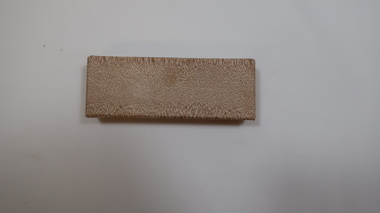 Kiewa Valley Historical Society
Pin Badge - Boy Scout
... reading BS. Box-Used for storage of pin: Cardboard box with a higed lid. Covered with a buff coloured, wookgrain printed paper. Inside lid: Cream Ladle/ E.P.N.S. / Made in APEX Reg. Australia Trade Mark Inside box is a cardboard insert with a slot cut out for resting...reading BS. Box-Used for storage of pin: Cardboard box with a higed lid. Covered with a buff coloured, wookgrain printed paper. Inside lid: Cream Ladle/ E.P.N.S. / Made in APEX Reg. Australia Trade Mark Inside box is a cardboard insert with a slot cut out for resting ...Metal lapel pin - brass?. Head: Fleur-de-lise shape at top with two black stars. Black horse-shoe shaped reading BS. Box-Used for storage of pin: Cardboard box with a higed lid. Covered with a buff coloured, wookgrain printed paper. Inside lid: Cream Ladle/ E.P.N.S. / Made in APEX Reg. Australia Trade Mark Inside box is a cardboard insert with a slot cut out for resting an object.Pin Face: 'Boy Scouts'-embossed over black enamel.Rear: 'Stokes'scouts, badge, mt beauty, boys club -
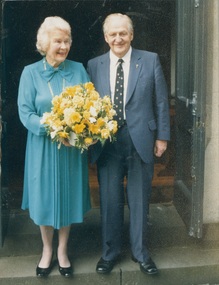 Uniting Church Archives - Synod of Victoria
Colour photo, 1986
... rest of his life, he retained an avid interest in the Loch Ness Monster and its attendant scientific debate. While in Scotland, Gordon wrote a weekly article for The Messenger, the official journal of the Presbyterian Church of Victoria. This led to a life as an author of articles and books. He also wrote long letters home to his mother, a habit that later led to his weekly "Dad's Diaries", which were distributed to the wider family. Failing eyesight put an end to his reading...rest of his life, he retained an avid interest in the Loch Ness Monster and its attendant scientific debate. While in Scotland, Gordon wrote a weekly article for The Messenger, the official journal of the Presbyterian Church of Victoria. This led to a life as an author of articles and books. He also wrote long letters home to his mother, a habit that later led to his weekly "Dad's Diaries", which were distributed to the wider family. Failing eyesight put an end to his reading ...1911–2005: Gordon George Powell, who has died at 94, was for many years the highly influential minister at St Stephen's Presbyterian Church in Sydney and a popular radio broadcaster and author. He began Wednesday services at St Stephen's in Macquarie Street soon after arriving in Sydney from Melbourne in 1952. They grew to become the biggest regular lunch-hour services in the world, with up to 1300 people crowding the church and the hall below. In 1953, with the help of Vernon Turner of the Christian Broadcasting Association, services were broadcast on radio. The broadcasts continued even when Gordon moved back to Melbourne, so for 30 years he maintained a successful weekly radio ministry. While at St Stephen's, he was also involved in the 1959 Billy Graham Crusade in Sydney, attended by 980,000 people over two weeks. Gordon was born in Warrnambool, Victoria, the son of a dentist, George Powell, and his wife, Louisa (nee Clarke). He went to school at Scotch College. He gave up plans to become an electrical engineer after hearing a call to the ministry and studied arts and then theology at the University of Melbourne, where he formed a close friendship with Edward (Weary) Dunlop. Gordon rowed in the Ormond crew, winning the university's inter-college trophy five times. He was a passionate sports lover all his life. He was awarded a scholarship to Trinity College, Glasgow University, in 1935, and for three months stayed with the great Scottish churchman George (later Lord) MacLeod. While on a cycling trip around Scotland, he stopped by the shores of Loch Ness and saw a long neck appear. The monster swam about 300 metres at great speed; Gordon counted three or four humps. Later, when he saw a skeleton of a plesiosaurus at the Victoria and Albert Museum, he recognised it as Nessie. For the rest of his life, he retained an avid interest in the Loch Ness Monster and its attendant scientific debate. While in Scotland, Gordon wrote a weekly article for The Messenger, the official journal of the Presbyterian Church of Victoria. This led to a life as an author of articles and books. He also wrote long letters home to his mother, a habit that later led to his weekly "Dad's Diaries", which were distributed to the wider family. Failing eyesight put an end to his reading and writing two years ago. On returning to Australia in late 1936, he became assistant minister at Toorak, the second-biggest Presbyterian church in Melbourne. There, at last, Gordon married Gwen Gilchrist, whom he had courted for nine years. They moved from the wealthiest church to one of the poorest, at Port Adelaide, which was still in the grip of the Depression. There, he was finally ordained, in May 1938, and the first two of their four children, Rosemary and David, were born. In 1941, Gordon became assistant minister to Scots Church in Melbourne and the following year, after the birth of his third child, Mardi, he reluctantly volunteered as an RAAF chaplain. He was a pacifist but felt bad at not being in uniform. For the following three years, he was stationed in New Guinea and Australia. His war reminiscences were published as Two Steps to Tokyo and sold 6000 copies in 1945 alone. At 34, by then the father of four children, he was invited to be minister of the Collins Street Independent Church in the heart of Melbourne, now St Michael's Uniting Church Before being inducted, he undertook a lecture tour of the US, speaking to Rotary clubs in 48 centres, from Michigan to Maryland. He met, and was impressed by, the liberal theologian Harry Emerson Fosdick, and the US religious leader and author Norman Vincent Peale, who became a close friend and mentor. Back in Australia, Gordon founded and fostered the first Alcoholics Anonymous group in Melbourne. In 1952, he took up what was to become his happiest ministry, at St Stephen's in Sydney. When Queen Elizabeth and Prince Philip toured two years later, Gordon and Gwen were not only invited to lunch with them, but sat beside them. This was a highlight for Gordon, an ardent monarchist. In 1960, Gordon and Gwen embarked on a world tour that included the US, where he was invited to give the opening prayer in the Senate, with vice-president Richard Nixon presiding. After another five years at St Stephen's, Gordon returned to Scots Church in Melbourne. It was a time of bitter debates over church union with the Methodists and Congregationalists. Gordon was in favour, but Scots ultimately voted to stay out and remain Presbyterian. By then in his mid-60s, he and Gwen moved to New York, where Peale was his neighbour. They had six happy years there before retiring to Melbourne. Gordon is survived by Gwen, and children David, Mardi and Jenny (daughter Rosemary died in 1992), 13 grandchildren and 10 great-grandchildren. [From the obituary in the Sydney Morning Herald, 2005, written by Jenny (Powell)] Gwen and Gordon Powell coming out of the Toorak Uniting Church 50 years after they were married there. Gwen and Gordon Powell coming out of the Toorak Uniting Church 50 years after they were married there.gordon powell; gwen powell; port adelaide; toorak presbyterian church; st stephen's presbyterian church sydney; presbyterian minister -
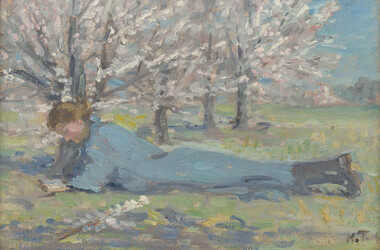 Benalla Art Gallery
Painting, Marie TUCK, Girl resting, Not dated
... Impressionism Landscape Figure Reading Trees Blossom Spring Australian art Recto: Signed "M.Tuck" in brown paint l.r.c of composition; Not dated; Not titled Figure in blue dress lying on grass under trees reading. Gold painted frame. Girl resting Painting Marie TUCK ...Born: Mt Torrens, South Australia, Australia 1872; Died: 1947ImpressionismLedger Gift, 1988Figure in blue dress lying on grass under trees reading. Gold painted frame.Recto: Signed "M.Tuck" in brown paint l.r.c of composition; Not dated; Not titledlandscape, figure, reading, trees, blossom, spring, australian art -
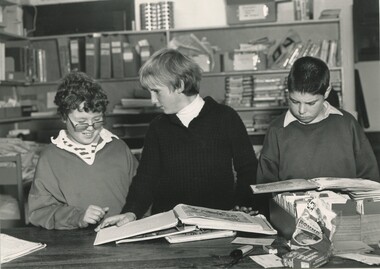 Vision Australia
Photograph - Image, Three boys reading Braille, 1989
... rest some print Braille volumes. One boy smiles as he looks down at the open volume, which another boy is about to turn the page of. An illustration in the book sits opposite a Braille page. The third boy is looking downward at the clear Braille sheet which sits over a large image. Braille and Talking Book Library Braille 1 black and white photograph of three boys looking at print braille books Three boys reading ...Three school boys standing at a table in the backroom of the library, where braille volumes and folders sit on shelves and a trolley rests behind them. On the work table rest some print Braille volumes. One boy smiles as he looks down at the open volume, which another boy is about to turn the page of. An illustration in the book sits opposite a Braille page. The third boy is looking downward at the clear Braille sheet which sits over a large image.1 black and white photograph of three boys looking at print braille booksbraille and talking book library, braille -
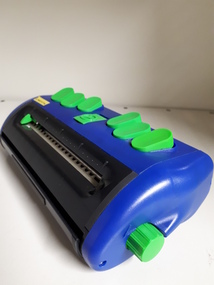 Vision Australia
Equipment - Object, Quantum Technology, Jot a Dot Brailler, 2005
... A built-in reading stand keeps the unit stable when resting on hard surfaces. ...A built-in reading stand keeps the unit stable when resting on hard surfaces. ...The Jot a Dot Pocket Brailler is a portable, manual Braille writer designed for use by individuals who are blind or have low vision. This small, lightweight brailler has six keys for Braille entry. The keys have high contrast colors for identification by users with low vision. Braille is written from the left hand side of the page to the right, with 20 cells of braille per line. The user can read Braille as it is written by turning the unit over. A built-in reading stand keeps the unit stable when resting on hard surfaces. Tactile line and cell indicators show the current location on the page. The line indicator shows which line is being Brailled, and the cell indicator shows the position of the embossing head on the line. By turning the device over, the user can read the Braille as they write it. This Brailler uses standard photocopy paper in A5 and A6 paper sizes. The unit is constructed in one piece, so there are no parts that can be lost. 1 rectangular blue Braille unit with 6 bright green keys Yellow sticker LN017a on front. On back Jot a Dot F07077 sponsored by Guide Dogs. braille equipment, assistive devices -
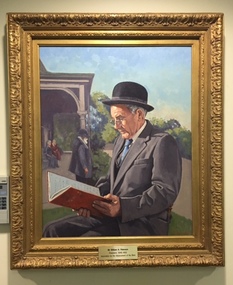 Vision Australia
Painting - Artwork, Portrait of William Paterson, 2002
... He sits outside a house reading a red coloured book, whilst in the background an elderly man takes a step out on to the gravelled driveway. Two women, one with a white cane, rest on chairs under the verendah of the building. ...He sits outside a house reading a red coloured book, whilst in the background an elderly man takes a step out on to the gravelled driveway. Two women, one with a white cane, rest on chairs under the verendah of the building. ...aFramed portrait of William Paterson who was President of the Association for the Advancement of the Blind, from 1948-1952. It is part of a series of paintings commissioned by the VAF Board to commemorate the work of past presidents of the organisation. Mr Paterson is dressed in a 3 piece gray suit, white shirt and wearing a blue tie and black hat. He sits outside a house reading a red coloured book, whilst in the background an elderly man takes a step out on to the gravelled driveway. Two women, one with a white cane, rest on chairs under the verendah of the building. The plaque at the base of the painting reads 'Mr William H. Paterson / President 1948-1952 / Association for Advancement of the Blind'. 1 art original in gold frameThe plaque at the base of the painting reads 'Mr William H. Paterson / President 1948-1952 / Association for Advancement of the Blind'association for the advancement of the blind, william paterson -
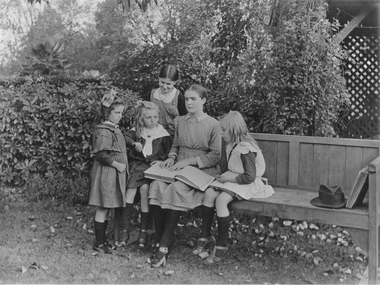 Vision Australia
Photograph - Image, Girl reading to younger children, 1880s
... reading Braille on a park bench. Believed to be Tilly Aston, the older girl has her hair in plaits and appears to be concentrated on the Braille pages in front of her. At the end of the park bench rests...reading Braille on a park bench. Believed to be Tilly Aston, the older girl has her hair in plaits and appears to be concentrated on the Braille pages in front of her. At the end of the park bench rests ...Four girls surround an older girl, who is reading Braille on a park bench. Believed to be Tilly Aston, the older girl has her hair in plaits and appears to be concentrated on the Braille pages in front of her. At the end of the park bench rests a man's hat and another book of Braille. This image has been reproduced widely and in a variety of black and white or sepia tones. Possibly a publicity image used by the RVIB. On one copy, there is a note that image was made around 1918, based upon clothing, which would rule out Tilly Aston who would have been in her late 40s around then.B/W photograph of girl sitting on park bench reading Braille surrounded by four other girlstilly aston, royal victorian institute for the blind, braille -
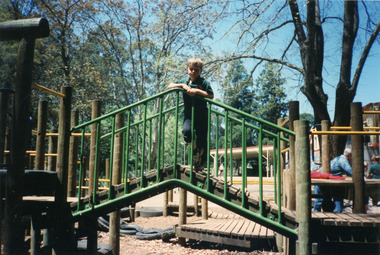 Mt Dandenong & District Historical Society Inc.
Photograph, Mount Dandenong Primary School 1997, 1997
... When she retired Miss Bell built a home in Jeeves Avenue where she lived out the rest of her life with her Siamese cats. Miss Bell helped the children with reading, grammar spelling and history. ...When she retired Miss Bell built a home in Jeeves Avenue where she lived out the rest of her life with her Siamese cats. Miss Bell helped the children with reading, grammar spelling and history. ...Miss Bell (1900 – 1984) The ‘Miss Bell Playground’ was named after Miss Rebecca Adelaide Bell, a retired teacher who regularly helped out at Mt Dandenong Primary school for 8 years. Born in NSW, Miss Bell had taught in several states and had fond memories of holidays spent at ‘Mountjoy’ in the Dandenong Ranges. When she retired Miss Bell built a home in Jeeves Avenue where she lived out the rest of her life with her Siamese cats. Miss Bell helped the children with reading, grammar spelling and history. She really cared about the children and her school visits brought her a lot of happiness. Student standing on section of play equipment in Miss Bell Playground 1997.mount dandenong, mt dandenong school, miss bell, rebecca adelaide bell, school, playground -
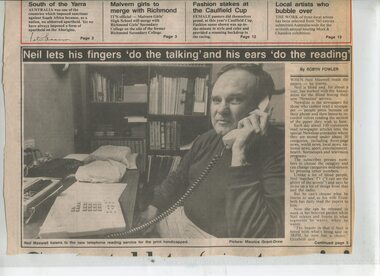 Vision Australia
Article - Text, Neil lets his fingers 'do the talking' and his ears 'do the reading' by Robyn Fowler
... rests on a desk in a study, and turns towards camera. Association for the Blind Elizabeth Maxwell Neil Maxwell Newsline Robyn Fowler Summary update of Centenary Appeal 1 cut out article from a suburban newspaper Neil lets his fingers 'do the talking' and his ears 'do the reading' by Robyn Fowler Article Text ...Discussion of Newsline service provided by the AFB and how it is used by Neil Maxwell. Article includes an image of Neil holding a phone, whose base rests on a desk in a study, and turns towards camera.1 cut out article from a suburban newspapernon-fictionassociation for the blind, elizabeth maxwell, neil maxwell, newsline, robyn fowler -
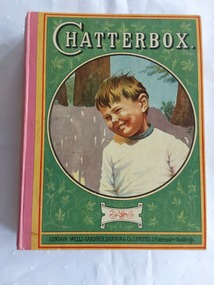 Mont De Lancey
Book, Wells Gardner, Darton & Co. Limited, Chatterbox, 1918
... rest of the tribe in the background. The title of the picture is 'The Wilderness Road'. The title page has the title plus Funded by J. Erskine Clarke, M.A and publisher details with a black lined illustration of children, a woman with children at her knee reading and flowers. ...rest of the tribe in the background. The title of the picture is 'The Wilderness Road'. The title page has the title plus Funded by J. Erskine Clarke, M.A and publisher details with a black lined illustration of children, a woman with children at her knee reading and flowers. ...A vintage 1929 Chatterbox collection of puzzles, poetry and stories for children with black lined illustrations and coloured plates throughout.A vintage 1929 hardcover children's book with the title Chatterbox printed in white lettering at the top of the front cover which has a green coloured background with an illustration in a large circle showing a boy wearing a white jumper in front of trees. The publisher details are printed at the bottom. Red tape binds the covers on the spine. The faded yellow coloured back cover has an advertisement for 'Allenbury's' The Progressive System of Infant Feeding, which was a similar composition to mother's milk. The manufacturer details are added at the bottom. Inside the front cover are black and white printed advertisements for 'Ovaltine' Tonic Food Beverage and "Blackbird" Fountpens. The coloured frontispiece illustration inside depicts an Indigenous American First Nations Indian riding a horse with his family and rest of the tribe in the background. The title of the picture is 'The Wilderness Road'. The title page has the title plus Funded by J. Erskine Clarke, M.A and publisher details with a black lined illustration of children, a woman with children at her knee reading and flowers. There are further coloured plates in the collection. The book contains plenty of puzzles, poetry, and stories for children. Pp. 316. At the back are advertisements for 'Pears the pure soap', Wright's coal tar soap, Chatterbox publications and Macintosh's Toffee de Luxe and Carnival Assortment. fictionA vintage 1929 Chatterbox collection of puzzles, poetry and stories for children with black lined illustrations and coloured plates throughout. children's books, books, children's stories, adventure stories -
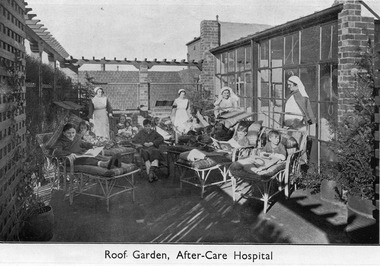 Royal District Nursing Service (now known as Bolton Clarke)
Photograph - Digital Image, c.1935
... There are three boys and four girls resting on cane lounges; some are reading books and one girl is holding a doll. ...There are three boys and four girls resting on cane lounges; some are reading books and one girl is holding a doll. ...This digital image shows the sun roof on the Melbourne District Nursing Society After-Care Hospital, 45 Victoria Parade, Collingwood. It shows some of the children nursed at the home. Many children were nursed there long term during the Poliomyelitis epidemic in the 1930s. It also shows uniforms worn by nurses and Sisters in the 1930s. The Melbourne District Nursing Society After-Care Home was originally established to provide nurse-managed convalescent care to poor and underprivileged patients who could not look after themselves at home due to illness, or on release from hospital. Opening in 1926 following a public appeal for funds, at a cost of £27,000, the Home included maternity, children’s and adult wards as well as accommodation for Matron, twelve Sisters and four domestic staff. Many children were nursed there, some long term, during the Polio epidemic and the Society employed two School Teachers. The Society now ran two divisions, the After-Care with its own Sisters and nurses and the District division. The Society were the first in Melbourne, in early 1928, to recognize some patients leaving the After-Care, and many at home, needed further social care and they set up ‘Almoners’ from their committee to visit these patients and be intermediaries in getting them social assistance. It was late the following year before the first training of Almoners took place in Melbourne. In 1930 the Society employed a full time kindergarten teacher to visit poor children in their homes. That year the Society were pioneers in opening an Ante-Natal Clinic at the After-Care, setting a high standard with equipment, keeping records and providing leaflets with instructions in how to keep healthy during pregnancy, what complications to look for and what to do when labour commenced. In 1934 the Society were pioneers again when they opened the first Women’s Welfare Clinic, including at the time a very controversial Family Planning Clinic, the first of its kind in Australia which was opened to support women at risk following multiple and difficult pregnancies, giving advice on birth-control. At first the clinic was attended by their own patients, but then accepting patients from public hospitals until their own clinics were opened. . Major extensions in 1934 led to the After-Care 'Home' having a name change to 'Hospital'. A trained Almoner was employed in 1934 but she resigned after twelve months due to the work load. Unable to procure another due to a shortage of trained Almoners, a Social Service Officer was employed at the After-Care who successfully gained better housing from the Housing Commission for families living under unsuitable conditions. Following Government intervention, the After-Care Hospital was separated from the Melbourne District Nursing Society in 1957. The After-care Hospital continued to operate at the same address until 1985 when it became the Melbourne Geriatric Centre. This digital Image shows two nurses and two Trained nurses (Sisters) supervising convalescing children in the roof garden of the Melbourne District Nursing Society After-Care Hospital . The two nurses are with the rear children, one on the left and one on the right. Both are wearing long white aprons over their long sleeved dark grey uniforms, and both are wearing white caps over their dark hair. On the right rear, in front of a row of glass windows, the upper portion of a Sister can be seen wearing a white uniform and white veil. In the right front is another Sister who is wearing glasses and is wearing a white uniform and dark coloured cape. She is wearing a white veil over her short dark hair. There are three boys and four girls resting on cane lounges; some are reading books and one girl is holding a doll. Another boy, who is wearing a dressing gown, is sitting on a cane chair. There is a trellis and a wall of windows on the left of the image and some brick work and a wall of windows on the right hand side behind the Sisters.. Some pots with low and tall plants can be seen.A tiled hip roof of a building can be seen in the rear of the image.mdns, melbourne district nursing society, after- care hospital, nurses uniforms -
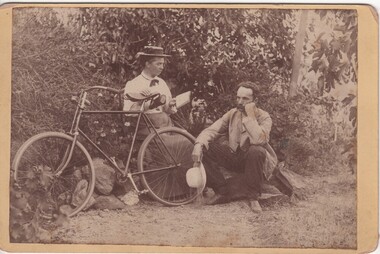 Rutherglen Historical Society
Photograph - Image, 1900s (Approximate)
... Black and white oblong photograph of a male resting and female reading by the roadside next to a bicycle....Black and white oblong photograph of a male resting and female reading by the roadside next to a bicycle. ...Black and white oblong photograph of a male resting and female reading by the roadside next to a bicycle.On back: "Rutherglen people [about] early 1900s" The word about has been crossed through.portrait photograph -
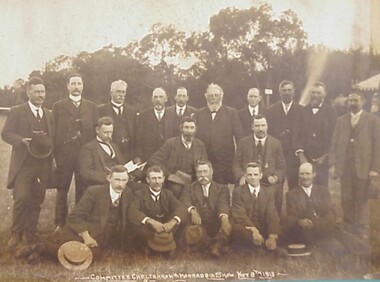 City of Kingston
Photograph - Sepia, Percy Fairlam, Cheltenham and Moorabbin Show Committee, 1913
... resting on their knees or on the ground. Three men are, presumably, seated behind them on chairs, with the man on the left reading a document or book. ...resting on their knees or on the ground. Three men are, presumably, seated behind them on chairs, with the man on the left reading a document or book. ...This image shows the group of men who formed the committee for the Cheltenham and Moorabbin Show. The men have been identified as: Seated (left to right) Mr R L Amess (Hon Sec), Cr George Brownfield (President), Mr Harold Irwin (Hon Treasurer). Standing (left to right) Messrs P White, F Wilson, E T Fenny, J H Butler, G Wells, R Mills, H F North, G T Allnutt, J Shields, F Reynolds. Seated (in front) Messrs F Moorhouse, E Marriott, A Hewitt, CD Scullin, R Potts.The Moorabbin Horticultural, Poultry and Dog Society Show became an annual event in 1898, following a 35 year tradition of Brighton Horticultural, Poultry and Dog Society annual exhibition. Sepia toned image of the Committee of Cheltenham and Moorabbin Show. Five men are seated on the ground in the front row, with hats resting on their knees or on the ground. Three men are, presumably, seated behind them on chairs, with the man on the left reading a document or book. Ten men are standing at the rear. -
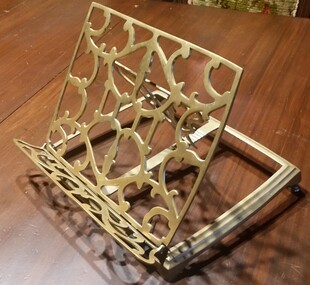 Hymettus Cottage & Garden Ballarat
Functional object - Table book-rest/lectern, Table bookstand
... Brass, bookstand, book-rest, altar lectern, reading, library, display, 19th century. church....This example was purchased to enhance reading in a household private library and also used to display books when on loan in the public domain in libraries and other repositories. Brass, bookstand, book-rest ...Nineteenth century brass bookstand or table lectern used to hold book for reading or display purpose often deemed an essential item for the nineteenth and early twentieth century library. Also used as altar lectern in church items. This example was purchased to enhance reading in a household private library and also used to display books when on loan in the public domain in libraries and other repositories.brass, bookstand, book-rest, altar lectern, reading, library, display, 19th century. church. -
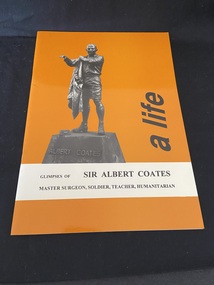 Returned Nurses RSL Sub-branch
Book - Paperback book, Walter and Winifred Gherardin, A life : glimpses of Sir Albert Coates, master surgeon, soldier, teacher, humanitarian, 2000
... In black lowercase letters on the right hand side, reading sideways, are the words 'a life'. In a panel across the lower part of the book in black text is the rest of the subheading....In black lowercase letters on the right hand side, reading sideways, are the words 'a life'. In a panel across the lower part of the book in black text is the rest of the subheading. ...The life story of Sir Albert Ernest Coates. ' "Bertie" Coates was an outstanding Australian Surgeon, and elected to stay in Sumatra to attend the many sick and wounded needing attention rather than continuing on to Australia. His dedication, far beyond the call of duty, is just another example of a well-earned award never granted or recognised by Army Headquarters.' [From page one]Orange coloured paperback book with an image of a statue of a man putting on a jacket, the base of the statue reds "Albert Coates'. In black lowercase letters on the right hand side, reading sideways, are the words 'a life'. In a panel across the lower part of the book in black text is the rest of the subheading.non-fictionThe life story of Sir Albert Ernest Coates. ' "Bertie" Coates was an outstanding Australian Surgeon, and elected to stay in Sumatra to attend the many sick and wounded needing attention rather than continuing on to Australia. His dedication, far beyond the call of duty, is just another example of a well-earned award never granted or recognised by Army Headquarters.' [From page one]sir albert ernest coats, surgeon - biography, ww2, wwii, world war 2 -
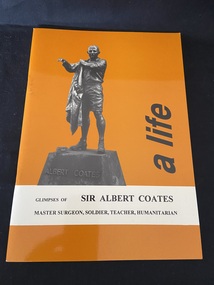 Returned Nurses RSL Sub-branch
Book - Paperback book, Walter and Winifred Gherardin, A life : glimpses of Sir Albert Coates, master surgeon, soldier, teacher, humanitarian, 2000
... In black lowercase letters on the right hand side, reading sideways, are the words 'a life'. In a panel across the lower part of the book in black text is the rest of the subheading....In black lowercase letters on the right hand side, reading sideways, are the words 'a life'. In a panel across the lower part of the book in black text is the rest of the subheading. ...The life story of Sir Albert Ernest Coates. ' "Bertie" Coates was an outstanding Australian Surgeon, and elected to stay in Sumatra to attend the many sick and wounded needing attention rather than continuing on to Australia. His dedication, far beyond the call of duty, is just another example of a well-earned award never granted or recognised by Army Headquarters.' [From page one]Orange coloured paperback book with an image of a statue of a man putting on a jacket, the base of the statue reds "Albert Coates'. In black lowercase letters on the right hand side, reading sideways, are the words 'a life'. In a panel across the lower part of the book in black text is the rest of the subheading.non-fictionThe life story of Sir Albert Ernest Coates. ' "Bertie" Coates was an outstanding Australian Surgeon, and elected to stay in Sumatra to attend the many sick and wounded needing attention rather than continuing on to Australia. His dedication, far beyond the call of duty, is just another example of a well-earned award never granted or recognised by Army Headquarters.' [From page one]sir albert ernest coats, surgeon - biography, ww2, wwii, world war 2 -
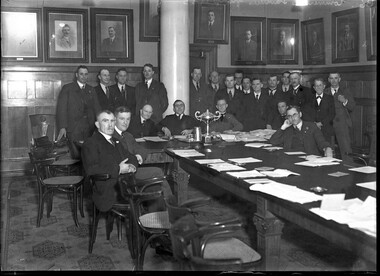 City of Melbourne Libraries
Photograph, Bull, Hugh Jones, 1897-1993, Commercial Travellers' Association, Victoria, Board Room
... Reading Room ran the whole width of the building. Arthur Streeton’s painting “Between the Lights, Princes Bridge 1888” and Frederick McCubbin’s “Looking North from Mount Macedon” were hung there, as well as paintings by renowned Australian artists Hans Heysen, Walter Withers, John Mather, Jan Hendrik Scheltema. The Argus 30 May 1914 quipped “Around the walls hang evidences that the commercial traveller's soul has not been killed in his pursuit of commerce”. The blackwood panelled room was furnished with Queen Anne style tables and chairs and green leather armchairs with inviting rocker foot rests...Reading Room ran the whole width of the building. Arthur Streeton’s painting “Between the Lights, Princes Bridge 1888” and Frederick McCubbin’s “Looking North from Mount Macedon” were hung there, as well as paintings by renowned Australian artists Hans Heysen, Walter Withers, John Mather, Jan Hendrik Scheltema. The Argus 30 May 1914 quipped “Around the walls hang evidences that the commercial traveller's soul has not been killed in his pursuit of commerce”. The blackwood panelled room was furnished with Queen Anne style tables and chairs and green leather armchairs with inviting rocker foot rests ...Seven seated and fifteen standing men dressed in suits around a long table in a panelled room hung with formal portraits of men. A trophy sits on the long table amongst loose paper sheets. Research by project volunteer, Fiona Collyer: The Commercial Travellers’ Association of Victoria (CTA) was formed at a meeting of 40 commercial travellers held at the Duke of Rothesay Hotel, 24 Elizabeth Street on 1 December 1880. Their charter was to advocate for better working conditions for commercial travelling salesmen, including improved accommodation at discounted rates and travel concession fares. At first by locomotive, horse and buggy, steamers and horseback, later also by motor car and motorcycle, “The Man on the Road” went into the back-blocks of the country to extend the interests of commerce to the stores and households of Australian regional towns and isolated settlements. Affiliated organisations existed in all states and New Zealand and in 1895 they integrated to form the United Commercial Travellers’ Association of Australasia (UCTAA). By the turn of the 20th century, the Victorian branch of the CTA had 421 Association Members and 520 Club members. The CTA continued to hold meetings in leased rooms in hotels and offices until 1898 when they commissioned purpose-built premises at 190-192 Flinders Street (extant, now the Macstore, next to former Metropolitan Gas Company Buildings). Designed by leading architectural firm of brothers H.W. & F.B.Tompkins (Dimmey’s Model Store, Swan Street, London Stores, Herald and Weekly Times, Myer building, Diamond House, Centreway Arcade, Manton’s Store) in the Queen Anne Revival style at the cost of £20,000, the four storey building had a facade of red Northcote bricks and an entrance of Pyrmont stone. It was very modern for the time, featuring elevators, offices, bars, kitchen, dining, card and billiard rooms and 31 bedrooms with shared bathrooms for the footsore travellers. However, despite adding two storeys in 1901, and another storey and a basement in 1905, they soon outgrew their premises, and in 1912 the CTA commissioned a new building at 328 Flinders Street. At this time, buildings in Melbourne were constrained by the city height limit of 132 feet (40 metres)- the maximum height of firefighting ladders. The new CTA building was the tallest building in Melbourne until 1932 when regulations changed allowing the Manchester Unity Building to be built. The new CTA headquarters was the epitome of comfort and luxury with cutting edge facilities to ease the fatigued salesman and prepare him for another stint on the road. General Secretary, James Davies travelled to Britain and America to acquire the very best and latest innovations. After visiting the new premises, Punch magazine 11 June 1914 reported “furnishings, appliances, and labour-saving conveniences which were more than up to date- they were up to-morrow.” The Edwardian Baroque style building was again designed by architects H.W. & F.B. Tompkins at the cost of £100,000 and built by contractors F.E. Shillabeer and Sons (Nicholas Building, Kellow-Falkiner Pty Ltd car showroom). The nine storey plus basement building is of steel frame construction with concrete floors. The ground floor facade is of grey granite and above that it is faced with cream glazed bricks chosen to combat discolouration from the pollution emitted by Flinders Street Station trains across the road. The facade is decorated with mascarons, gum leaf trim and balconies with classical style balustrade. The club was entered through revolving doors into a two storey high, circular, domed lobby with white columns, American oak panelled walls and intricate mosaic flooring. The ceiling is festooned with plaster gum leaf and gum nut detail, a theme that is repeated throughout the building. The basement kitchen had modern, labour saving appliances that would be the envy of any Edwardian housewife, including an electric toaster, a potato peeling machine, heated dumb waiter, dishwashing machine and electric refrigeration and cooking. It serviced the commodious second floor dining room which seated 200 people and the cafe/breakfast room, 80 people. Members were permitted to entertain their lady friends there for afternoon tea between the hours of 3 and 5 pm every day, except Sunday. The members’ facilities included a barbershop, clothes pressing machine, boot cleaning chair, pipe and cigar stall with electric humidor, public telephones, lockers and safe deposit. The building was serviced with five elevators, a built in vacuum cleaning plant, hot water radiators and linen and postal chutes. The first floor was devoted to business and relaxing, containing the Board, Writing, Reading and four Business Rooms. The board room had Queensland maple panelling with huge blackwood tables topped with blue morocco and golden tortoise-shell trim and cane bottomed chairs. Large framed photographs of past presidents since 1884 lined the walls. The Reading Room ran the whole width of the building. Arthur Streeton’s painting “Between the Lights, Princes Bridge 1888” and Frederick McCubbin’s “Looking North from Mount Macedon” were hung there, as well as paintings by renowned Australian artists Hans Heysen, Walter Withers, John Mather, Jan Hendrik Scheltema. The Argus 30 May 1914 quipped “Around the walls hang evidences that the commercial traveller's soul has not been killed in his pursuit of commerce”. The blackwood panelled room was furnished with Queen Anne style tables and chairs and green leather armchairs with inviting rocker foot rests allowing weary travellers to relax after traversing the railways and dusty roads of Victoria while planning their next sales trip. “The Australasia Traveller” Volume 10, Number 2, April 1914 page 35 noted “An attendant will be constantly employed on this floor to take care of the stationary supply, to tidy up newspapers, and generally study the convenience of members.” The third floor was for amusements with billiards, a bar and four rooms for playing cards, dominoes and chess. The huge billiard room had seven Alcock billiard tables including a table in a partitioned match-room for tournaments, exhibitions and matches. The walls were lined with members’ cues and for spectators, comfortable lounges with marble topped tables and electric bell pushes for drinks service. There were 150 bedrooms over five floors, each with their own telephone and wash basin and five suites with a private sitting room attached. There were four bathrooms per bedroom floor and capacious, well-lighted shaving rooms. Top rate club tariff for bed and breakfast - 6 shillings, if called for a country train leaving Melbourne before 8am - 4 shillings, suite and breakfast- 9 shillings, sixpence. “The Australasia Traveller” Volume 10, Number 2, April 1914 page 35 reported “All “early calls” will be made from the Club Office to Bedrooms by means of the Telephone, so that instead of waking everybody else up on the corridor, only the member concerned will know that it is his unpleasant duty to get up.” The new CTA premises was widely regarded as the finest club in the Southern Hemisphere. The CTA also built the adjacent six storey Commerce House with 52 sample rooms for travellers to display their wares with the remainder rented to retail businesses and a post and telegraph office. After the CTA moved into their new, larger premises in 1914, neighbouring department store Ball & Welch expanded into the former CTA. The CTA saw themselves in a nation building role and were an influential lobby group to the Government. They advocated for inter city trunk telephone lines, standard gauge railway lines between NSW and Victoria, improved roads and highways, the Murray River water scheme and maintaining the White Australia Policy. They were very active in fund raising for the war efforts. The CTA offered its members support in other ways with benevolent funds for widows and orphans, mortuary, accident, sickness and an annuities fund for members over 65 years. There were scholarships for members’ children and home purchase scheme to assist with home ownership. A secondary membership scheme provided access to non commercial travellers (men only) to its exclusive club premises. They also organised social events and activities such as billiard tourneys, golf tournaments, dances and an annual “Smoke Social” which was a social event where men gathered for a formal dinner, community singing, lectures, speeches and of course, to smoke! Daylesford born James Davies OBE, (1865-1931) worked at the CTA for 50 years, starting as an office boy and working his way up to General Secretary and editor of the monthly trade journal for UCTAA members, “The Traveller” (1890-1905, later “The Australasian Traveller” 1905-1924 and then “The Australian Traveller” 1925-1976) and the annual colour supplement magazine “Australia To-Day” (1904-1973). “The Australasia Traveller” featured commentary on the issues of the day like wars, tariffs and trade, articles on new products and hotel recommendations and their rates and lots of advertising, especially alcohol, tobacco and accommodation in regional hotels. There were regular columns, each illustrated with a line drawing and these included “Our Immigration Record” a state by state summary of arrivals of “desirable immigrants” to Australia, while bemoaning the declining (white) birth rate. The column followed the arrival of British boys sent to Australia as agricultural apprentices to work on rural properties which were short of labour. Between 1913-1928, 1750 “Barwell Boys”, some as young as 14 years of age arrived in South Australia to work. NSW had a similar program known as the Dreadnaught Boys Scheme where 5595 boys immigrated between 1911-1939. The boys were considered of “good British stock”. There was a “Home Page For The Ladies” showcasing the latest fashions in women’s clothing, millinery and hairstyles and tips and trends in home furnishings.“Children’s Corner for Dear Little Folks” which featured puzzles, jokes and stories and members could send in photographs of their children. “Road Echoes” devoted to “The Man On The Road” and his doings. “Face Massage, Smiling is the Best Face Massage”, the humour page full of jokes and funny stories. “Railway Rumbles” news of innovations, timetables, tickets and grumbles about lavatories, food and drinking water on trains and at railway stations. And in case we forget that members had a home away from their CTA home, gardening tips with “The C.T. as Gardener”column. The annual magazine “Australia To-Day” was a vehicle to promote Australia here and overseas as a modern, prosperous country with abundant opportunities and pleasant climate. It sought to showcase its manufacturing, agriculture and tourism and encourage British immigration to Australia. The magazine featured articles about recently arrived migrants at work, quirky native flora and fauna, beach culture, recreation and the Australian way of life in the settler nation. Many of the articles were written by politicians of the day, including Robert Menzies. The UCTAA commissioned original artwork for the front covers and feature articles of “Australia To-day” from leading Australian artists. These included Norman Lindsay, Frederick McCubbin, Napier Waller, Lionel Lindsay, Hans Heysen, C Dudley Wood, Louis McCubbin, Penleigh Boyd, Louis Buvelot, Christian Waller and Ellis Rowan and her Australian wildflowers. Some of the photographs in “Australia To-Day” were provided by state and federal government departments as well as manufacturers, newspapers and mining companies. Amongst of the credited photographers was Helmut Newton who later earned world acclaim as a fashion photographer and architectural and industrial photographer Wolfgang Sievers (unfortunately their photographs remain in copyright and aren’t available online). Also featured was Richard C. Strangman, a professional photographer from Canberra, William Howieson of Melbourne, who has 22 photographs in the collection of NGV, Tasmanian wilderness photographer Frederick Smithies, Athol Shmith, portrait photographer and educator from Melbourne, Gordon de Lisle, a Melbourne commercial, industrial, aerial and society portrait photographer. (One of Gordon’s assignments was as the stills photographer for the 1959 movie “On The Beach” filmed in Melbourne). Photographs taken by acclaimed Antarctic and official war photographer Captain Frank Hurley OBE for Adelaide’s Centenary were also featured. The Australian Government was keenly aware of the influence and quality of the UCTAA publications. On 1 June 1914 The Age reported that to advertise Australia in Great Britain and elsewhere, the Department of External Affairs purchased 6500 copies of “Australia To-Day” magazine for £515 to distribute free to “places where they are most likely to come under the notice of a desirable class of immigrants.” In 1950, the office of Prime Minister Robert Menzies ordered 2550 copies of that year’s issue of “Australia To-Day” for the Department of Commerce and Information to distribute. The CTA donated their archives to University of Melbourne Archives which includes original artworks and photos used in “Australia To-Day” (Melbourne University has digitised 1114 photos) and sundry items including trophies, ashtrays, commemorative souvenirs, menus, a rare “Safechek” sovereign changer, a bust of James Davies and even a CTA embossed wash bowl and chamber pot. After the death of General Secretary James Davies in 1931, the CTA held the annual “James Davies Memorial Cup” golf tournament at various Melbourne golf courses, the winner receiving a splendid silver cup. “Table Talk” magazine photographs from 29 June 1933 depict the travellers beautifully (and I would say correctly) attired in tweedy plus fours, Fair Isle knitwear, flat caps and of course fringed brogues. I have been unable to ascertain whether the trophy in our photo is for golf or another CTA social activity. The CTA Victoria membership peaked in 1951 with 4,672 Aassociation members and 3,693 Club members. In 1959, Hollywood came to Melbourne when film stars Gregory Peck, Ava Gardner, Anthony Perkins and Fred Astaire descended to film ‘On the Beach,’ directed by Stanley Kramer. The film is based on the bestselling Neville Shute novel about the aftermath of World War Three, a nuclear war that has obliterated most of the Northern Hemisphere. Radioactive dust is heading toward Australia and everyone is preparing for death. Scenes with Anthony Perkins were filmed in the CTA billiards room as the exclusive Pastoral Club. Anthony Perkins’ character, Lieutenant Commander Peter Holmes of RAN tells Gregory Peck’s character, Commander Dwight Lionel, that The Pastoral Club is…”A mahogany and polished brass sort of place-some people claim it was the stuffiest club in the Commonwealth” before assuring him that despite shortages, the club is likely to have some Scotch left. In a scene at the Pastoral Club two, old (probably red faced) codgers discuss the challenge of drinking all of the 400 bottles of Gould Campbell vintage port in the club wine cellar before they succumb to radiation sickness in five months time. The NGV has 12 photographs in their collection of wardrobe stills of Ava Gardner modelling costumes designed by the Fontana Sisters of Rome for “On The Beach”, taken by Italian photographer G.B.Poletto. During the filming, Gregory Peck and his family stayed at “Kurneh” 206 Domain Road, South Yarra, the former home of three times Grand Slam winner Norman Brookes. Through the decades, Australian society was changing and in order to stay relevant, the CTA had to change too. In 1971, two women were elected for club membership, although they were only granted limited access to the club’s facilities and in 1972, women were invited for the first time to participate in the previously men only annual “Smoke Social”. In 1975, dwindling membership forced the closure of The Commercial Travellers’ Association building and in 1977, the building was sold, with the CTA ceasing to operate in 2014. It was the end of the road for the “Knights of the Road”. In 1992, the CTA building at 328 Flinders Street was placed on the Victorian Heritage Register in recognition of its architectural and cultural significance. The building has been meticulously restored with many of the original fittings, decorative plasterwork, mosaic flooring, stained glass windows, columns, chandeliers and the panelling made from Australian timbers retained. After renovations the building became first the Euro Asia Hotel, then the Duxton Hotel and in 2005 The Rendezvous Hotel, Melbourne. In tribute to the history of the building and the film “On The Beach”, the Rendezvous Hotel has the Ms Ava Bar, Perkins room, Mr Tompkins restaurant, Commerce Room and the Davies Room. References: COMMERCIAL TRAVELLERS' ASSOCIATION OF VICTORIA. (1899, May 27). The Australasian (Melbourne, Vic. : 1864 - 1946), p. 25. Retrieved February 21, 2025, from http://nla.gov.au/nla.news-article138615498 COMMERCIAL TRAVELLERS. (1914, May 30). The Argus (Melbourne, Vic. : 1848 - 1957), p. 8. Retrieved February 13, 2025, from http://nla.gov.au/nla.news-article7272511 NEWS OF THE DAY. (1914, June 1). The Age (Melbourne, Vic. : 1854 - 1954), p. 8. Retrieved February 19, 2025, from http://nla.gov.au/nla.news-article189414314 COMMERCIAL TRAVELLERS' "AT HOME." (1914, June 11). Punch (Melbourne, Vic. : 1900 - 1918; 1925), p. 32. Retrieved March 19, 2025, from http://nla.gov.au/nla.news-article129699692 https://archives.library.unimelb.edu.au/nodes/view/69669 https://vhd.heritagecouncil.vic.gov.au/places/757 http://www.pikitiapress.com/blog/2015/1/26/australia-today Commercial Travellers at Yarra Yarra (1933, June 29). Table Talk (Melbourne, Vic. : 1885 - 1939), p. 6. Retrieved February 28, 2025, from http://nla.gov.au/nla.news-article149547845 https://archives.library.unimelb.edu.au/nodes/view/537460 https://viewer.slv.vic.gov.au/?entity=IE7420895&file=FL19171568&mode=browse https://www.history.sa.gov.au/wp-content/uploads/2021/03/Barwell_Boys_Catalogue-compressed-compressed-compressed.pdf Australia Today," 1927 (1926, December 11). Weekly Times (Melbourne, Vic. : 1869 - 1954), p. 15. Retrieved March 17, 2025, from http://nla.gov.au/nla.news-article223844810 https://blogs.unimelb.edu.au/librarycollections/2020/12/19/an-inhabited-space-helmut-newtons-lovers/ https://www.ngv.vic.gov.au/explore/collection/artist/2075/ https://www.ngv.vic.gov.au/?s=Poletto+&type=collection https://rendezvousmelbourne.com.au/digital-history-tour/Photographer notations on slide: "Commercial Travellers Group B6".clubs, department stores, 1930-1939, commerce, manufacturing, federation/edwardian style architecture, railways, tourism, games, agriculture
