
Showing 45 items matching "recruit course"
-
 Ambulance Victoria Museum
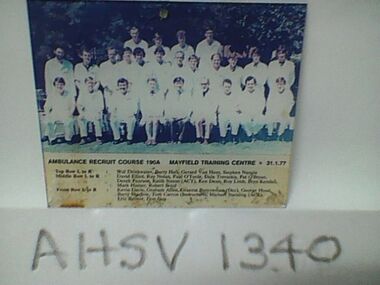
Photograph, Ambulance Recruit Course 190A, Mayfield Training Centre, 31 January 1977, 1977
... Photograph, Ambulance Recruit Course 190A, Mayfield Training Centre, 31 January 1977...ambulance recruit course, mayfield training centre, instructors, act...Colour photograph of Ambulance Recruit Course, Mayfield Training Centre trainees,...Top Row L to R: Wal Drinkwater, Barry Hall, Gerard Van Hees, Stephen Nangle. ambulance recruit course, mayfield training centre, instructors, act Colour photograph of Ambulance Recruit Course, Mayfield Training Centre trainees, Photograph, Ambulance Recruit Course 190A, Mayfield Training Centre, 31 January 1977 ...Front Row L to R: Kevin Davis, Graham Allen, Graeme Barrowman (Dec), George Hood, Barry Shadlow, Tom Carron (Instructors), Michael Standing (ACT), Eric Rennie, Don Guy. Middle Row L to R: David Elliot, Ray Nolan, Paul O'Toole, Dale Trevaskis, Pat O'Bryan, Derek Pearson, Keith Simon (ACT), Ken Dean, Roy Limb, Bryn Kendall, Mark Hamer, Robert Boyd. Top Row L to R: Wal Drinkwater, Barry Hall, Gerard Van Hees, Stephen Nangle.Colour photograph of Ambulance Recruit Course, Mayfield Training Centre trainees,ambulance recruit course, mayfield training centre, instructors, act -
 Bendigo Military Museum
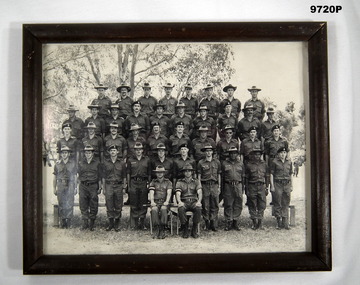
Photograph - GROUP PORTRAIT - 8/7 RVR RECRUIT COURSE 1981, 1981
... GROUP PORTRAIT - 8/7 RVR RECRUIT COURSE 1981......Recruit Course...On the back is :- 75/06 P.16 1981 1981 Recruit Course 'Puka' featuring Cpl Johnson....8/7 RVR is a Victorian Army Reserve Unit (Citizen Military Forces). Photograph Recruit Course CMF Training 8/7 RVR On the back is :- 75/06 P.16 1981 1981 Recruit Course 'Puka' featuring Cpl Johnson. ...8/7 RVR is a Victorian Army Reserve Unit (Citizen Military Forces).This is a B & W portrait of C.M.F. soldiers. It is in a simple brown wooden frame. The portrait shows 4 rows of soldiers on a stand. In front of them, seated, is an instructor holding a cane and a Lieutenant. They are wearing GP boots, jungle green pattern shirts and trousers. Head dress is a variety of slouch hats and berets.On the back is :- 75/06 P.16 1981 1981 Recruit Course 'Puka' featuring Cpl Johnson.photograph, recruit course, cmf training, 8/7 rvr -
 8th/13th Victorian Mounted Rifles Regimental Collection
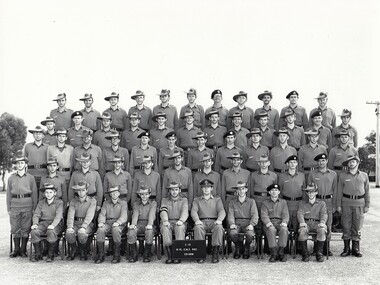
Photograph - Recruit Course at Wangaratta
... Recruit Course at Wangaratta...Black and white photograph of a rows of soldiers at the 3/73 CMF Recruit Course. Several soldiers of 8/13 Victorian Mounted Rifles are identified by their headgear and badges. ...Course appears to have been held at Beersheba Barracks Sisely Avenue Wangaratta. Photograph Recruit Course at Wangaratta ...Soldiers were recruited by regimental efforts. Recruit training was carried out under Brigade control.Black and white photograph of a rows of soldiers at the 3/73 CMF Recruit Course. Several soldiers of 8/13 Victorian Mounted Rifles are identified by their headgear and badges. Course appears to have been held at Beersheba Barracks Sisely Avenue Wangaratta.recruit, wangaratta, beersheba barracks, nulla -
 Ambulance Victoria Museum
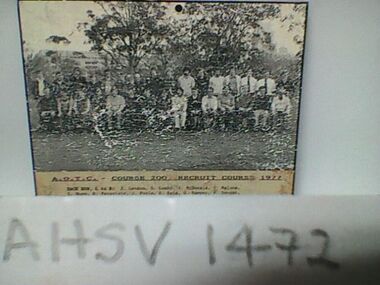
Photograph, Ambulance Officers Training Centre Course 200, Recruit Course, 1977, 1977
... Photograph, Ambulance Officers Training Centre Course 200, Recruit Course, 1977...Worboys. ambulance officers training centre, recruits Black and White photograph of ambulance officer recruits Photograph, Ambulance Officers Training Centre Course 200, Recruit Course, 1977 ...Front Row L to R: J. Brereton, d. Catteral, M. Chilton, L. Cooke, P. Crew, K Crowle, J. Engledow, K. Filcock, K. Ford, R. Green, K. Holt, M. Hunting, C. Linke, S. Lamb, J. Lee. Back Row L to R: J. Lennon, D. Lumby. J. McDonald, P. Malone, T. Nunn, R. Paravinic, J. Poole, R. Reid, W. Sampey, P. Sanger, E. Schanssema, K Struthers, P. Turner, N. White, R. Williams, P. Williams. P. Worboys.Black and White photograph of ambulance officer recruitsambulance officers training centre, recruits -
 8th/13th Victorian Mounted Rifles Regimental Collection
Photograph
... All arms recruit courses were conducted on a Brigade basis. ...Black and white photograph of No 4 Recruit Course ( All arms ) October 1975....All arms recruit courses were conducted on a Brigade basis. ...All arms recruit courses were conducted on a Brigade basis. Units including 8/13 VMR provided instructors.Black and white photograph of No 4 Recruit Course ( All arms ) October 1975." 4 Rec Crs 27.8.75 4 Pl' -
 4th/19th Prince of Wales's Light Horse Regiment Unit History Room
Presentation photo folder, 11/121982
... ...9/82 recruit course...The photos were taken at Puckapunyal at the 9/82 Recruit Course passing out parade...band 9/82 recruit course carlyon A plain white card folder presented to Tpr W Carlyon on his discharge in Feb 1983. ...A plain white card folder presented to Tpr W Carlyon on his discharge in Feb 1983. It contains three colour photographs of the 4/19 PWLH Band. Two are of the band marching and one of the Band posed, with all the members named underneath. The photos were taken at Puckapunyal at the 9/82 Recruit Course passing out paradeband, 9/82 recruit course, carlyon -
Lara RSL Sub Branch
Flag
... RAAF Recruit Course 448 Pennant...RAAF Recruit Course 448 Pennant Flag ...RAAF Recruit Course 448 Pennant -
 Ambulance Victoria Museum
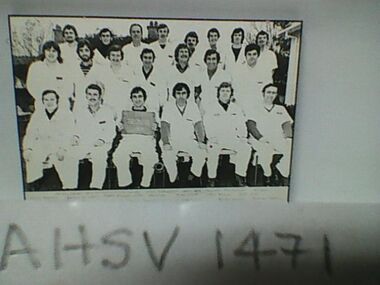
Photograph, Ambulance Officers Training Centre Course 185, Recruit August 1976, 1976
... Photograph, Ambulance Officers Training Centre Course 185, Recruit August 1976...ambulance officers training centre, recruits Black and White photograph of ambulance officer recruits Photograph, Ambulance Officers Training Centre Course 185, Recruit August 1976 ...Michael Rienits, David MacPherson, Roy LeSueur, Wayne Heatherington, Paul Judd, Peter Rensome(?), Ian Hughs, Trevor Niklaus(?), Douglas Quilliam, Robert Bowman, Lindsay Shawcross, Stuart Ansett, 'Lorry' Hanson, Brett Torey, Wayne Ryan, James Stephenson, David Seymour, John Duffy, Dennis Sampler(?), Desmond Corrigan(?).Black and White photograph of ambulance officer recruitsambulance officers training centre, recruits -
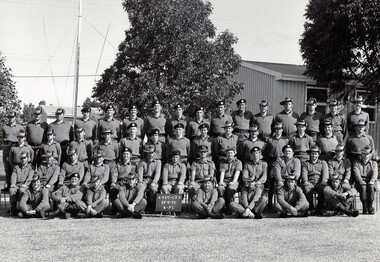 8th/13th Victorian Mounted Rifles Regimental Collection
Photograph
... Black and white group photograph being 4th Platoon, No. 4 Recruit Course conducted at Puckapunyal August 1975. ...Black and white group photograph being 4th Platoon, No. 4 Recruit Course conducted at Puckapunyal August 1975. ...Black and white group photograph being 4th Platoon, No. 4 Recruit Course conducted at Puckapunyal August 1975. Includes soldiers from 8/13 VMR.On board at front centre : " 4 - Rec - Crs, 27 - 8 - 75, 4 - Pl ". -
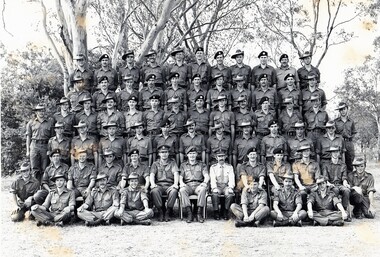 8th/13th Victorian Mounted Rifles Regimental Collection
Photograph
... Variety of head dress and badges indicate the group is a recruit course. Some 8/13 Victorian Mounted Rifles members are included....Variety of head dress and badges indicate the group is a recruit course. Some 8/13 Victorian Mounted Rifles members are included. ...Recruit training was often carried out on a Brigade basis with recruits and instructors from units.Black and white photograph of large group of soldiers posed in 6 tiers. Variety of head dress and badges indicate the group is a recruit course. Some 8/13 Victorian Mounted Rifles members are included. -
 Bendigo Military Museum
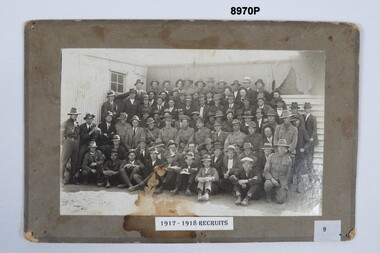
Photograph - 1917-1918 Recruits, 1917-1918
... 1917-1918 Recruits at Bendigo Race Course. It is not known which Unit of enlistment this is at this point....On the front in black "1917-1918" Recruits". On the back "1917 Bendigo, 1918 Race Course"....1917-1918 Recruits at Bendigo Race Course. It is not known which Unit of enlistment this is at this point. ...1917-1918 Recruits at Bendigo Race Course. It is not known which Unit of enlistment this is at this point.Black and white photo on card backing with group of soldiers and civilians in front of a building.On the front in black "1917-1918" Recruits". On the back "1917 Bendigo, 1918 Race Course".passchendaele barracks trust, pbt9, photograph, ww1 -
 8th/13th Victorian Mounted Rifles Regimental Collection
Photograph
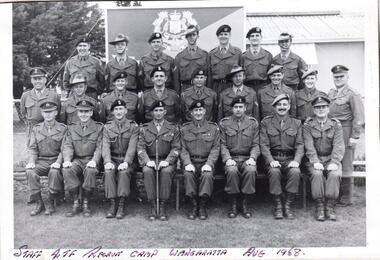
... They combined to conduct recruit training courses. On this occasion it was held at the 8/13 VMR depot in Siseley Avenue, Wangaratta. ...They combined to conduct recruit training courses. On this occasion it was held at the 8/13 VMR depot in Siseley Avenue, Wangaratta. ...The4th Task Force ( 4TF ) was a grouping of all arms ans services in Victoria. They combined to conduct recruit training courses. On this occasion it was held at the 8/13 VMR depot in Siseley Avenue, Wangaratta. Named are Back -, -, Sgt. Steffard, -, SGT.Tehaar,. Centre : Sgt. Bainer ( in centre ) Front: -, -, -, RSM White DCM 4/19th PWLH,Major Neale OC, Captain Horne 4/19th PWLH,-,-.Black and white photograph of twenty - four Officers and NCO's posed in three tiers. Mixture of headdress and badges indicate they come from a variety of regiments.Staff 4TF Recruit Camp Wangaratta August 1968. -
 Wodonga & District Historical Society Inc
Banner - Souvenir Banner 2/23rd Battalion - Albury's Own
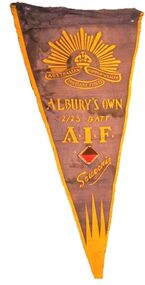
... Under the command of Lieutenant Colonel Bernard Evans, a small cadre of experienced personnel drawn from Victorian Militia units were concentrated at Victoria Barracks prior to the battalion headquarters being relocated to Albury, New South Wales, where a large number of volunteers were completing their recruit training at the 4th Recruit Training Battalion. Upon the conclusion of this course, the recruits were posted to the 2/23rd and the battalion – over 900 strong– moved to Bonegilla, Victoria, just across the border, where more complex collective training was completed prior to departure overseas. ...Under the command of Lieutenant Colonel Bernard Evans, a small cadre of experienced personnel drawn from Victorian Militia units were concentrated at Victoria Barracks prior to the battalion headquarters being relocated to Albury, New South Wales, where a large number of volunteers were completing their recruit training at the 4th Recruit Training Battalion. Upon the conclusion of this course, the recruits were posted to the 2/23rd and the battalion – over 900 strong– moved to Bonegilla, Victoria, just across the border, where more complex collective training was completed prior to departure overseas. ...Established at Victoria Barracks, in Melbourne, in June 1940, the 2/23rd Battalion was raised as part of the all-volunteer Second Australian Imperial Force and assigned to the 26th Brigade. Under the command of Lieutenant Colonel Bernard Evans, a small cadre of experienced personnel drawn from Victorian Militia units were concentrated at Victoria Barracks prior to the battalion headquarters being relocated to Albury, New South Wales, where a large number of volunteers were completing their recruit training at the 4th Recruit Training Battalion. Upon the conclusion of this course, the recruits were posted to the 2/23rd and the battalion – over 900 strong– moved to Bonegilla, Victoria, just across the border, where more complex collective training was completed prior to departure overseas. A large majority of the battalion's initial intake of volunteers came from the Albury–Wodonga region and as a result, the 2/23rd became known as "Albury's Own"This item is part of a collection of items owned by Arthur Lock, a member of the 2/23rd Battalion, an all-volunteer Second Australian Imperial Force which served as part of the garrison during the Siege of Tobruk, then at El Alamein, New Guinea and Borneo. It has particular local significance as the battalion was know as "Albury's Own" because a large majority of the battalion's initial intake of volunteers came from the Albury–Wodonga region.A souvenir banner representing the 2/23rd Battalion - Albury's Own. The banner incorporates the insignia of the Commonwealth of Australia Military Forces. It also includes the Unit colour patch which is a lozenge shape, divided into brown over red, with a grey trim. This patch was used from 1940 to 1942 when the patch representing service at Tobruk was introduced. world war 11, 2/23rd battalion, albury's own, arthur lock -
 Wodonga & District Historical Society Inc
Plaque - Plaque 2/23rd Battalion - Albury's Own
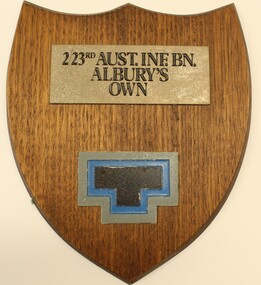
... Under the command of Lieutenant Colonel Bernard Evans, a small cadre of experienced personnel drawn from Victorian Militia units were concentrated at Victoria Barracks prior to the battalion headquarters being relocated to Albury, New South Wales, where a large number of volunteers were completing their recruit training at the 4th Recruit Training Battalion. Upon the conclusion of this course, the recruits were posted to the 2/23rd and the battalion – over 900 strong– moved to Bonegilla, Victoria, just across the border, where more complex collective training was completed prior to departure overseas. ...Under the command of Lieutenant Colonel Bernard Evans, a small cadre of experienced personnel drawn from Victorian Militia units were concentrated at Victoria Barracks prior to the battalion headquarters being relocated to Albury, New South Wales, where a large number of volunteers were completing their recruit training at the 4th Recruit Training Battalion. Upon the conclusion of this course, the recruits were posted to the 2/23rd and the battalion – over 900 strong– moved to Bonegilla, Victoria, just across the border, where more complex collective training was completed prior to departure overseas. ...Established at Victoria Barracks, in Melbourne, in June 1940, the 2/23rd Battalion was raised as part of the all-volunteer Second Australian Imperial Force and assigned to the 26th Brigade. Under the command of Lieutenant Colonel Bernard Evans, a small cadre of experienced personnel drawn from Victorian Militia units were concentrated at Victoria Barracks prior to the battalion headquarters being relocated to Albury, New South Wales, where a large number of volunteers were completing their recruit training at the 4th Recruit Training Battalion. Upon the conclusion of this course, the recruits were posted to the 2/23rd and the battalion – over 900 strong– moved to Bonegilla, Victoria, just across the border, where more complex collective training was completed prior to departure overseas. A large majority of the battalion's initial intake of volunteers came from the Albury–Wodonga region and as a result, the 2/23rd became known as "Albury's Own"This item is part of a collection of items owned by Arthur Lock, a member of the 2/23rd Battalion, an all-volunteer Second Australian Imperial Force which served as part of the garrison during the Siege of Tobruk, then at El Alamein, New Guinea and Borneo. It has particular local significance as the battalion was know as "Albury's Own" because a large majority of the battalion's initial intake of volunteers came from the Albury–Wodonga region.A wooden plaque in the shape of a shield commemorating the 2/23rd Battalion known as "Abury's Own". It incorporates a representation of the 2/23rd Battalion colour patch worn after the Siege of Tobruk. At top of plaque "2/23RD AUST.IN.BN./ALBURY'S/OWN"world war 11, rats of tobruk, tobruk, arthur lock -
 Wodonga & District Historical Society Inc
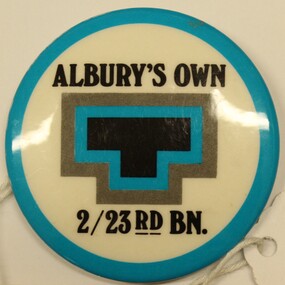
Badge - 2/23rd Battalion - Albury's Own
... Under the command of Lieutenant Colonel Bernard Evans, a small cadre of experienced personnel drawn from Victorian Militia units were concentrated at Victoria Barracks prior to the battalion headquarters being relocated to Albury, New South Wales, where a large number of volunteers were completing their recruit training at the 4th Recruit Training Battalion. Upon the conclusion of this course, the recruits were posted to the 2/23rd and the battalion – over 900 strong– moved to Bonegilla, Victoria, just across the border, where more complex collective training was completed prior to departure overseas. ...Under the command of Lieutenant Colonel Bernard Evans, a small cadre of experienced personnel drawn from Victorian Militia units were concentrated at Victoria Barracks prior to the battalion headquarters being relocated to Albury, New South Wales, where a large number of volunteers were completing their recruit training at the 4th Recruit Training Battalion. Upon the conclusion of this course, the recruits were posted to the 2/23rd and the battalion – over 900 strong– moved to Bonegilla, Victoria, just across the border, where more complex collective training was completed prior to departure overseas. ...Established at Victoria Barracks, in Melbourne, in June 1940, the 2/23rd Battalion was raised as part of the all-volunteer Second Australian Imperial Force and assigned to the 26th Brigade. Under the command of Lieutenant Colonel Bernard Evans, a small cadre of experienced personnel drawn from Victorian Militia units were concentrated at Victoria Barracks prior to the battalion headquarters being relocated to Albury, New South Wales, where a large number of volunteers were completing their recruit training at the 4th Recruit Training Battalion. Upon the conclusion of this course, the recruits were posted to the 2/23rd and the battalion – over 900 strong– moved to Bonegilla, Victoria, just across the border, where more complex collective training was completed prior to departure overseas. A large majority of the battalion's initial intake of volunteers came from the Albury–Wodonga region and as a result, the 2/23rd became known as "Albury's Own"This item is part of a collection of items owned by Arthur Lock, a member of the 2/23rd Battalion, an all-volunteer Second Australian Imperial Force which served as part of the garrison during the Siege of Tobruk, then at El Alamein, New Guinea and Borneo. It has particular local significance as the battalion was know as "Albury's Own" because a large majority of the battalion's initial intake of volunteers came from the Albury–Wodonga region.Circular tin lapel button with pin back fastening. The front is made of paper and covered with clear plastic. The printed design on the front shows the post 1942 T-shaped colour patch of the 2/23 Battalion surrounded by the words "ALBURY'S OWN 2/23RD BN." There are 3 similar badges in our collection. Above colour patch "ALBURY'S OWN" Below colour patch "2/23RD BN."world war 11, rats of tobruk, tobruk, arthur lock -
 Wodonga & District Historical Society Inc
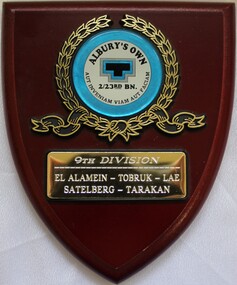
Plaque - Albury's Own 2/23rd Battalion 9th Division
... Under the command of Lieutenant Colonel Bernard Evans, a small cadre of experienced personnel drawn from Victorian Militia units were concentrated at Victoria Barracks prior to the battalion headquarters being relocated to Albury, New South Wales, where a large number of volunteers were completing their recruit training at the 4th Recruit Training Battalion. Upon the conclusion of this course, the recruits were posted to the 2/23rd and the battalion – over 900 strong– moved to Bonegilla, Victoria, just across the border, where more complex collective training was completed prior to departure overseas. ...Under the command of Lieutenant Colonel Bernard Evans, a small cadre of experienced personnel drawn from Victorian Militia units were concentrated at Victoria Barracks prior to the battalion headquarters being relocated to Albury, New South Wales, where a large number of volunteers were completing their recruit training at the 4th Recruit Training Battalion. Upon the conclusion of this course, the recruits were posted to the 2/23rd and the battalion – over 900 strong– moved to Bonegilla, Victoria, just across the border, where more complex collective training was completed prior to departure overseas. ...Established at Victoria Barracks, in Melbourne, in June 1940, the 2/23rd Battalion was raised as part of the all-volunteer Second Australian Imperial Force and assigned to the 26th Brigade. Under the command of Lieutenant Colonel Bernard Evans, a small cadre of experienced personnel drawn from Victorian Militia units were concentrated at Victoria Barracks prior to the battalion headquarters being relocated to Albury, New South Wales, where a large number of volunteers were completing their recruit training at the 4th Recruit Training Battalion. Upon the conclusion of this course, the recruits were posted to the 2/23rd and the battalion – over 900 strong– moved to Bonegilla, Victoria, just across the border, where more complex collective training was completed prior to departure overseas. A large majority of the battalion's initial intake of volunteers came from the Albury–Wodonga region and as a result, the 2/23rd became known as "Albury's Own"This item is part of a collection of items owned by Arthur Lock, a member of the 2/23rd Battalion, an all-volunteer Second Australian Imperial Force which served as part of the garrison during the Siege of Tobruk, then at El Alamein, New Guinea and Borneo. It has particular local significance as the battalion was know as "Albury's Own" because a large majority of the battalion's initial intake of volunteers came from the Albury–Wodonga region.A plaque commemorating "Albury's Own" - the 2/23rd Battalion. It incorprates the Unit badge and a a list of battlefronts they served in as part of the 9th Brigade. The Latin in the centre of the badge translates as "I will either find a way or make one". In circular badge "ALBURY'S OWN/ 2/23 RD BN. AUT VIAM INVENIAM AUT FACIAM " On metal oblong "9th DIVISION /EL ALAMEIN -TOBRUK- LAE/ SATELEBERG - TARAKAN"world war 11, 2/23rd battailon, albury's own -
 Wodonga & District Historical Society Inc
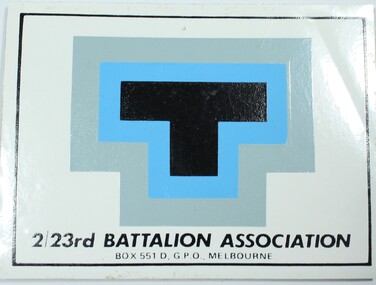
Memorabilia - 2/23rd Battalion logo transfer on card
... Under the command of Lieutenant Colonel Bernard Evans, a small cadre of experienced personnel drawn from Victorian Militia units were concentrated at Victoria Barracks prior to the battalion headquarters being relocated to Albury, New South Wales, where a large number of volunteers were completing their recruit training at the 4th Recruit Training Battalion. Upon the conclusion of this course, the recruits were posted to the 2/23rd and the battalion – over 900 strong– moved to Bonegilla, Victoria, just across the border, where more complex collective training was completed prior to departure overseas. ...Under the command of Lieutenant Colonel Bernard Evans, a small cadre of experienced personnel drawn from Victorian Militia units were concentrated at Victoria Barracks prior to the battalion headquarters being relocated to Albury, New South Wales, where a large number of volunteers were completing their recruit training at the 4th Recruit Training Battalion. Upon the conclusion of this course, the recruits were posted to the 2/23rd and the battalion – over 900 strong– moved to Bonegilla, Victoria, just across the border, where more complex collective training was completed prior to departure overseas. ...Established at Victoria Barracks, in Melbourne, in June 1940, the 2/23rd Battalion was raised as part of the all-volunteer Second Australian Imperial Force and assigned to the 26th Brigade. Under the command of Lieutenant Colonel Bernard Evans, a small cadre of experienced personnel drawn from Victorian Militia units were concentrated at Victoria Barracks prior to the battalion headquarters being relocated to Albury, New South Wales, where a large number of volunteers were completing their recruit training at the 4th Recruit Training Battalion. Upon the conclusion of this course, the recruits were posted to the 2/23rd and the battalion – over 900 strong– moved to Bonegilla, Victoria, just across the border, where more complex collective training was completed prior to departure overseas. A large majority of the battalion's initial intake of volunteers came from the Albury–Wodonga region and as a result, the 2/23rd became known as "Albury's Own"This item is part of a collection of items owned by Arthur Lock, a member of the 2/23rd Battalion, an all-volunteer Second Australian Imperial Force which served as part of the garrison during the Siege of Tobruk, then at El Alamein, New Guinea and Borneo. It has particular local significance as the battalion was know as "Albury's Own" because a large majority of the battalion's initial intake of volunteers came from the Albury–Wodonga region. This 2/23rd Battalion Association transfer has been laminated and attached to a card. This logo became the colour patch for the unit after their service in Tobruk. Below colour patch "2/23rd BATTALION ASSOCIATION/ BOX 551D, G.P.O. MELBOURNE"world war 11, rats of tobruk, 2/23rd battalion -
 Federation University Historical Collection
Letter, Letter on Australian Force Vietnam Letterhead, 1971, 29/08/1971
... A letter regarding the possible further education of a National Service recruit following their discharge from service. bernard livingston e.j. barker vietnam australian force vietnam ballarat school of mines vocational education visual arts national service Quarto sized white paper with blue 'Australian Force Vietnam' letterhead. Handwritten letter from Bernard Livingston to the Principal of the Ballarat School of Mines, Jack Barker, relating to courses ...A letter regarding the possible further education of a National Service recruit following their discharge from service. Quarto sized white paper with blue 'Australian Force Vietnam' letterhead. Handwritten letter from Bernard Livingston to the Principal of the Ballarat School of Mines, Jack Barker, relating to courses offered at the Ballarat School of Mine. A second sheet of paper is a carbon copy of a typed response from Jack Barker, bernard livingston, e.j. barker, vietnam, australian force vietnam, ballarat school of mines, vocational education, visual arts, national service -
Nhill Aviation Heritage Centre
Book - RAAF Tutorial lessons, Instructional Course for Air Crew Reservists (Mathematics and Physics) Lessons 1 to 21, c 1940
... This book was used by Merv Schneider whilst in the Airforce Reserve Squadron at Nhill during his High School days c1940 Mathematics and Physics RAAF No.1 Recruiting Centre 104 Russell St., Melbourne C.1. written inside back cover Beige cover with blue fabric binding Instructional Course for Air Crew Reservists (Mathematics and Physics) Lessons 1 to 21 Book RAAF Tutorial lessons Sands & McDougall Pty Ltd ...Beige cover with blue fabric bindingnon-fictionmathematics and physics -
Federation University Historical Collection
Book - Book - Scrapbook, Ballarat School of MInes: Scrapbook of Newspaper Cuttings, Book 76, October 1996 to January 1997
... The papers concerned are The Courier, Ballarat, The Australian, The Age and other region papers over the period of 25 October 1996 to 16 January 1997 teaching positions advertised pre-employment courses courses available enrolment for smb courses certificate in work education course students with disabilities smb founder's day brian mclennan kerrie cross bill gribble dennis olmstead susanne mckenzie sue labbett frank kitchen david nicholson max palmer mobile training facility farm machinery course murray cook phillip kinnersly performing arts "heat" and "heat 2" smb ceramics exhibition smb tafe college offer police recruitment testing tafe teachers in pay strike australian education union organiser eric sinkis derek van der bom ballarat uni smb launch writing course'smb seek part of $200m funds smb council demands explanation on axing bill gribble smb council president aboriginal art on display deanne jakiel ballarat academy of performing arts rich cultural heritage steinway gift to academy amy young smb subjects on internet the brewery complex farewell to long serving staff frank hurley pat hope bob morrell smb expands into ararat and asia self-styled award winners women in building industry janet bruce in course for females education ministers visit ballarat senator amanda vanstone phil honeywood victorian minister pam davies president smb council $145500 to smb edgar bartrop scholarship to jayson ryder Book with yellow cover, front, spiral bound. ...Collection of newspaper articles related to Ballarat School Of Mines.They cover activities and advertisements for staff. The papers concerned are The Courier, Ballarat, The Australian, The Age and other region papers over the period of 25 October 1996 to 16 January 1997Book with yellow cover, front, spiral bound. teaching positions advertised, pre-employment courses, courses available, enrolment for smb courses, certificate in work education course, students with disabilities, smb founder's day, brian mclennan, kerrie cross, bill gribble, dennis olmstead, susanne mckenzie, sue labbett, frank kitchen, david nicholson, max palmer, mobile training facility, farm machinery course, murray cook, phillip kinnersly, performing arts "heat" and "heat 2", smb ceramics exhibition, smb tafe college offer police recruitment testing, tafe teachers in pay strike, australian education union organiser eric sinkis, derek van der bom, ballarat uni smb launch writing course'smb seek part of $200m funds, smb council demands explanation on axing, bill gribble smb council president, aboriginal art on display, deanne jakiel, ballarat academy of performing arts, rich cultural heritage, steinway gift to academy, amy young, smb subjects on internet, the brewery complex, farewell to long serving staff, frank hurley, pat hope, bob morrell, smb expands into ararat and asia, self-styled award winners, women in building industry, janet bruce in course for females, education ministers visit ballarat, senator amanda vanstone, phil honeywood victorian minister, pam davies president smb council, $145500 to smb, edgar bartrop scholarship to jayson ryder -
Federation University Historical Collection
Book - Book - Scrapbook, Ballarat School of MInes: Scrapbook of Newspaper Cuttings, Book 78, April 1997 to June 1997
... The papers concerned are The Courier, Ballarat, The Australian, The Age and other region papers over the period of 4 April 1997 to 5 June 1997. teaching positions advertised pre-employment courses courses available enrolment for smb courses asian trip to lift profiles uni ans smb unit to fight outsider peter bailey champion welder trip to world titles angela mazur keeps up tradition graduates aid uni recruiting ballarat - a centre of educational excellence safer food handling uni proposal to wimmera merger would provide benefits wimmera institute of tafe horsham campus overseas campus coup malaysian tertiary campus contract ararat tafe stands to benefit from merger apprentice andrew rodgers takes top award support for arts assets drive smb expands training program uni to offer courses in indonesia trainees a credit to employers trainee of the year award academy needs help to succeed arthur senior - obituary ashes to be scattered near the heads smb new course in hygiene smb presents "ship of fools" $18m to ballarat program puts rural women into study maeve mckeown co-ordinator of rwap uni chief hits back at call for mergers joint venture in china newspaper important teaching tool tertiary merger closer early childhood studies at smb your university - message from vice-chancellor interview with dr ron wild university tafe plan worries australian education union tertiary merger hinges on smb talks video link overcomes distance opportunity and agriculture smb seeks extra time bapa launch smb will keep title in merger smb awards night Book with yellow cover, front, spiral bound. ...Collection of newspaper articles related to Ballarat School Of Mines.They cover activities and advertisements for staff. The papers concerned are The Courier, Ballarat, The Australian, The Age and other region papers over the period of 4 April 1997 to 5 June 1997. Book with yellow cover, front, spiral bound. teaching positions advertised, pre-employment courses, courses available, enrolment for smb courses, asian trip to lift profiles, uni ans smb unit to fight outsider, peter bailey champion welder, trip to world titles, angela mazur keeps up tradition, graduates aid uni recruiting, ballarat - a centre of educational excellence, safer food handling, uni proposal to wimmera, merger would provide benefits, wimmera institute of tafe, horsham campus, overseas campus coup, malaysian tertiary campus contract, ararat tafe stands to benefit from merger, apprentice andrew rodgers takes top award, support for arts assets drive, smb expands training program, uni to offer courses in indonesia, trainees a credit to employers, trainee of the year award, academy needs help to succeed, arthur senior - obituary, ashes to be scattered near the heads, smb new course in hygiene, smb presents "ship of fools", $18m to ballarat, program puts rural women into study, maeve mckeown co-ordinator of rwap, uni chief hits back at call for mergers, joint venture in china, newspaper important teaching tool, tertiary merger closer, early childhood studies at smb, your university - message from vice-chancellor, interview with dr ron wild, university tafe plan worries australian education union, tertiary merger hinges on smb talks, video link overcomes distance, opportunity and agriculture, smb seeks extra time, bapa launch, smb will keep title in merger, smb awards night -
Federation University Historical Collection
Book - Book - Scrapbook, Ballarat Institute of Advanced Education: Scrapbook of newspaper cutting, Book 9; April 1974 to September 1974
... recruit teachers...geology students...school plantations to be felled...mini-computer...chemistry students move to new building...carol yates wins r w richards medal...sister josepha caine...profile-jack barker...biae ceramics student lyn oliver...smb apprenticeship ball...college men at biae conference...higher degrees required for college posts...derek woolley...librarianship course...The cuttings cover the period from 29 April 1974 to 14 September 1974. ballarat institute of advanced education biae employment advertisements application for enrolment outline of courses election candidates for ballarat anne freeman engineer engineering interest for biae visitor library open to residents of ballarat biae in uni admission scheme $500 scholarship to philip brumley call to merge biae and teachers' college alp 'for the people' biae graduates in geelong ceremony cyclist western district colin smith bachelor of applied science degrees they favour biae men peter storey wins apprentice award campaign to recruit teachers geology students school plantations to be felled mini-computer chemistry students move to new building carol yates wins r w richards medal sister josepha caine profile-jack barker biae ceramics student lyn oliver smb apprenticeship ball college men at biae conference higher degrees required for college posts derek woolley librarianship course approved mrs rungkat shortage of science personnel predicted Book with yellow cover, front. ...Newspaper cuttings relating to Ballarat Institute of Advanced Education. These are from various newspapers and include The Age, Ballarat Courier, The Australian, The Herald. The cuttings cover the period from 29 April 1974 to 14 September 1974. Book with yellow cover, front. Spiral bound.ballarat institute of advanced education, biae, employment advertisements, application for enrolment, outline of courses, election candidates for ballarat, anne freeman engineer, engineering interest for biae visitor, library open to residents of ballarat, biae in uni admission scheme, $500 scholarship to philip brumley, call to merge biae and teachers' college, alp 'for the people', biae graduates in geelong ceremony, cyclist, western district, colin smith, bachelor of applied science degrees, they favour biae men, peter storey wins apprentice award, campaign to recruit teachers, geology students, school plantations to be felled, mini-computer, chemistry students move to new building, carol yates wins r w richards medal, sister josepha caine, profile-jack barker, biae ceramics student lyn oliver, smb apprenticeship ball, college men at biae conference, higher degrees required for college posts, derek woolley, librarianship course approved, mrs rungkat, shortage of science personnel predicted -
 Lara RSL Sub Branch
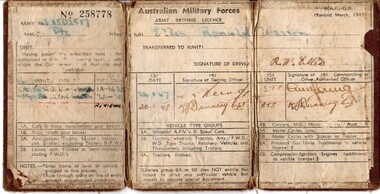
Drivers Licence, Australian Military Forces Army Driving Licence
... Recruit Training Battalion at Greta west of Newcastle, NSW. After 3 months training, he was sent to the Service Corps Training Centre for driver and maintenance training in Ingleburn, south of Sydney. When this course...Recruit Training Battalion at Greta west of Newcastle, NSW. After 3 months training, he was sent to the Service Corps Training Centre for driver and maintenance training in Ingleburn, south of Sydney. When this course ...Cpl. Ronald Warren Ellis, EM (VX502517) was born in Brunswick in 1927. His family moved to Lara when he was young, and his schooling took place at the Lara State School. After finishing his education, Ron took up employment at Sims Coopers in Corio. Ron was enlisted in the second AIF at Melbourne, and posted to the 3rd Recruit Training Battalion at Greta west of Newcastle, NSW. After 3 months training, he was sent to the Service Corps Training Centre for driver and maintenance training in Ingleburn, south of Sydney. When this course was completed, Ron was posted to the Australian Army Service Corps as a driver motor vehicle with the 2nd AIF. Rons service with the AIF lasted 425 days, when he was then transferred to the Interim Army for a further 309 days. The duration of his service was in NSW. Ron was discharged from the Army in Melbourne on the 4th of May 1948. In 1957, Ron enlisted in the CMF and served with 22nd Construction Squadron for 17 years with the last 5 as a Corporal, and was awarded the Efficiency Medal for long service and good conduct.Brown canvas booklet that is folded into three. Licence gives details of Army number, name, rank and type of vehicle that is able to be driven. Licence has been issued to Private Ronald Warren Ellis on 24/01/1948. No. 258778 Army No. V?SOL517 Rank: Private Name in full: Ellis, Ronald Warren Unit: Transferred to (unit): Having passed the prescribed tests ... authorised to drive... types of ... vehicles within the Commonwealth of Australia and Territories. Signature of Driver: drivers licence, australian military forces, army, private, ellis, ww2, wwii, world war two, second world war -
 Lara RSL Sub Branch
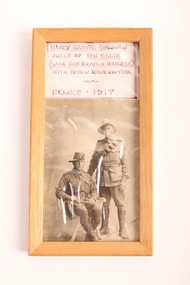
Photo, Harry Grove
... Recruit Training Battalion at Greta west of Newcastle, NSW. After 3 months training, he was sent to the Service Corps Training Centre for driver and maintenance training in Ingleburn, south of Sydney. When this course...Recruit Training Battalion at Greta west of Newcastle, NSW. After 3 months training, he was sent to the Service Corps Training Centre for driver and maintenance training in Ingleburn, south of Sydney. When this course ...This photo is from 1917 and is of Private Harry Groves (standing) with his cousin Arthur Whitter (seated). Private Groves was the Uncle of Ron Ellis, who was a Lara Sub-Branch member. Cpl. Ronald Warren Ellis, EM (VX502517) was born in Brunswick in 1927. His family moved to Lara when he was young, and his schooling took place at the Lara State School. After finishing his education, Ron took up employment at Sims Coopers in Corio. Ron was enlisted in the second AIF at Melbourne, and posted to the 3rd Recruit Training Battalion at Greta west of Newcastle, NSW. After 3 months training, he was sent to the Service Corps Training Centre for driver and maintenance training in Ingleburn, south of Sydney. When this course was completed, Ron was posted to the Australian Army Service Corps as a driver motor vehicle with the 2nd AIF. Rons service with the AIF lasted 425 days, when he was then transferred to the Interim Army for a further 309 days. The duration of his service was in NSW. Ron was discharged from the Army in Melbourne on the 4th of May 1948. In 1957, Ron enlisted in the CMF and served with 22nd Construction Squadron for 17 years with the last 5 as a Corporal, and was awarded the Efficiency Medal for long service and good conduct. This photo represents the connection that Lara RSL members and their family members have to the conflicts that Australia has been involved in over time. Photograph of Harry Grove (standing) with his cousin Arthur Witter (seated) - France 1917. The black and white photo is framed within a wooden frame, and above it is a piece of paper with details about the photo written in red texta. The photo is black and white, and in the bottom right corner in pencil is written: Sincerely Yours, Arthur. The remainder of the text extends under the frame, but looks as though it says: Arthur, France. world war 1, ww1, wwi, photo, family, private, corporal -
 Montmorency–Eltham RSL Sub Branch
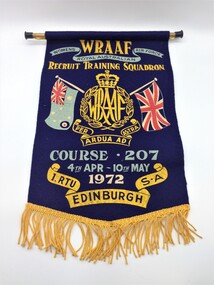
Banner - WRAAF Training School Banner
... Felt banner recording course attendance for Recruit Training Squadron (see media photo). ...WRAAF WOMENS ROYAL AUSTRALIAN AIR FORCE RECRUIT TRAINING SQUADRON WRAAF PER ARDUA AD ASTRA COURSE 207 4TH APRIL - 10TH MAY 1972 1.RTU EDINBURGH S.A....Felt banner recording course attendance for Recruit Training Squadron (see media photo). ...Felt banner recording course attendance for Recruit Training Squadron (see media photo). Wooden dowel support.WRAAF WOMENS ROYAL AUSTRALIAN AIR FORCE RECRUIT TRAINING SQUADRON WRAAF PER ARDUA AD ASTRA COURSE 207 4TH APRIL - 10TH MAY 1972 1.RTU EDINBURGH S.A.wraaf, banner -
 Bendigo Military Museum
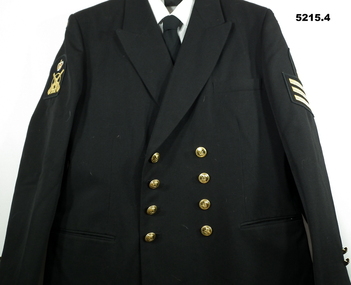
Uniform - UNIFORM, WINTER CEREMONIAL NAVY, ADA - Australian Defence Apparel, 1994-1996
... recruit age 15 years 9 months at HMAS Leeuwin. Passed out as Ordinary Seamen QMG and posted to HMAS Sydney 111 in Sept 1973. Jan 1974 - Feb 1981 with HMAS Derwent River Class Destroyer. Feb 1981 posted to HMAS Flinders Survey Ship. Sept 1981 promoted to Provisional Petty Officer QMG and then to HMAS Cerberus Gunnery School. Promoted to Petty Officer QMG then to HMAS Yarra 1984 then to HMAS Gladstone. Discharged from the RAN June 1987. Re Enlist 1996 and did a refresher course...recruit age 15 years 9 months at HMAS Leeuwin. Passed out as Ordinary Seamen QMG and posted to HMAS Sydney 111 in Sept 1973. Jan 1974 - Feb 1981 with HMAS Derwent River Class Destroyer. Feb 1981 posted to HMAS Flinders Survey Ship. Sept 1981 promoted to Provisional Petty Officer QMG and then to HMAS Cerberus Gunnery School. Promoted to Petty Officer QMG then to HMAS Yarra 1984 then to HMAS Gladstone. Discharged from the RAN June 1987. Re Enlist 1996 and did a refresher course ...David Dixon RAN R112262. Enlisted July 1972 as a Junior recruit age 15 years 9 months at HMAS Leeuwin. Passed out as Ordinary Seamen QMG and posted to HMAS Sydney 111 in Sept 1973. Jan 1974 - Feb 1981 with HMAS Derwent River Class Destroyer. Feb 1981 posted to HMAS Flinders Survey Ship. Sept 1981 promoted to Provisional Petty Officer QMG and then to HMAS Cerberus Gunnery School. Promoted to Petty Officer QMG then to HMAS Yarra 1984 then to HMAS Gladstone. Discharged from the RAN June 1987. Re Enlist 1996 and did a refresher course and posted to HMAS Success Fleet Tanker then HMAS Brisbane till 2001. Posted to HMAS Kuttabul with Recurring Back Injury and Discharged from the RAN May 2002. Total 21 years service with 17 off at Sea.1. Jacket - Black, Wool/Polyester, Insignias, yellow metal buttons. 2. Trousers - Black, Wool/Polyester. 3. Shirt - White, Polyester/Cotton. 4. Tie - Black, Polyester/Viscose. 5. Officers Peaked Cap - Plastic, White and Black, polyester, Elasticised band, Petty Officer Insignia.1. On Jacket - 3 stipes in gold braid. Petty Officer Insignia on Left Shoulder. Category Insignia on Right shoulder - Quartermaster Gunner.uniform, navy -
 Waverley RSL Sub Branch
R.A.A.F. Long Service Medal
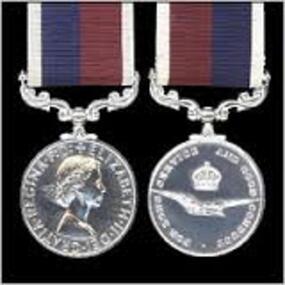
... Unfortunately there was a very limited pool of civilian dental mechanics to recruit from, and as a result the RAAF set up a training school at Laverton (which was later moved to Ascot Vale) in June 1941 which conducted an intensive 6 month course in Dental mechanics. ...Awarded to Alan Bowers (A236814) who was a R.A.A.F. dental mechanic who serverd during WWII including service in Darwin, and then continued in the R.A.A.F. for some years after the end of WWII The Royal Australian Air Force (and all Commonwealth Air Forces) Long Service and Good Conduct Medal: Awarded to NCOs and ORs of the RAAF (RAF, RCAF etc) for 15 years service. A cupro-nickel plated medal, the obverse features the sovereign's head, the reverse features the crown and eagle emblem of the RAAF (and RAF). Officers are eligible for the award provided they have served a minimum 12 years in the ranks. The riband is dark blue and maroon with white edges. This medal ceased to be awarded in Australia in 1975 when it was replaced by the National Medal (and sbsequently the DFSM and DLSM) in the Australian system of honours and awards. http://www.heritagemedals.com.au/medals-1/service-long-service/air-force-long-service-and-good-conduct-medal.html History of the RAAF Dental Branch It took six years following the formation of the RAAF in 1921 for the first Dental Clinic to be established at Point Cook, Victoria. On 10th June 1927 Flying Officer James Carl Rosenbrock commenced work as an RAAF Dental Officer for the FlyingTraining School at Point Cook. As personnel numbers were still relatively small, Rosenbrock was also responsible for the dental care of all Victorian RAAF units, which involved treating members at 1AD Laverton, as well as Air Force Headquarters at Victoria Barracks in Melbourne. As Army Dental Officers were currently caring for RAAF personnel at Richmond, NSW, the Senior Dental Officer of the 3rd Military District in Victoria (SDO 3MD) requested through the military board that a similar arrangement be established, where that the newly appointed RAAF Dentist provide part time dental services to the Army units stationed at Queenscliff. This was seen as an effective reciprocal arrangement, with both units having a Dental Officer in attendance for, in total, around 3-4 weeks a year. Rosenbrock continued to serve as the sole RAAF Dental Officer until the middle of 1933, when the Air Board asked for his service to be terminated following ‘behaviour unbecoming of a RAAF officer'. He had borrowed several sums of money, of around 40 Pounds or so, from junior ranks on base (as well as from the Regimental Sergeant Major) and had failed to pay the money back. He was replaced by a fellow Victorian, FLGOFF Norman Henry Andrews, on the 18th Sep 1933, who went on to become our first Director of Dental Services, and was instrumental in establishing the organisations and conditions of the Branch that are still present today. Through a fair amount of persistence and hard work on the part of Norman Andrews, the RAAF Dental Branch began to expand from 1937, with the introduction of 2 additional positions, at RAAF station Richmond, and at the FlyingTraining School at Point Cook. This gave the RAAF 3 uniformed Dental Officers, which was expanded to 5 in the months leading up to WW2. 4 of these Dental Officers were based in Victoria and 1 at Richmond, with the other two RAAF units being cared for by the Army (as in the case of Pearce in WA) or by civilians (as in Darwin). With the sudden increase in RAAF personnel required at the outbreak of WW2, the number of RAAF Dental Officers increased dramatically, from 5 in 1939, 28 in 1940, 64 in 1941, 147 in 1942, 193 in 1943, 219 in 1944, and peaking at 227 in 1945. RAAF Dental Officers were required to work in a variety of locations, both in and out of Australia. Between 1940 and 1942 a massive construction programme occurred, with new dental clinics being established around Australia. Priority was given to aircrew training units in order to get these personnel dentally fit for operational deployment, but Dental Officers could equally find themselves posted to recruit depots, fixed stations, medical clearance stations, mobile dental sections, and RAAF and civilian hospitals. RAAF Dental Officers were posted to the large dental centres at Ascot Vale (Vic) and Bradfield Park (NSW) when first appointed, where they received military and clinical training, before being deployed to their needed location. Mobile Dental Units When Japan entered the war in 1941, the rapid deployment of troops to northern operational areas with less than ideal dental fitness was extremely high. As a result, the RAAF deployed a range of mobile dental units, either alone or with medical sections, to support the increasing number of isolated deployed personnel within Australia and overseas. There were three types of mobile unit used: a. Mobile Dental Unit – relied on using either a semi-trailer to get around or by building a surgery directly on to the truck chassis, and installing hydraulic chairs, units, x-rays, and laboratory equipment. They were able to move around between small units, such as RAAF radar stations, where they could plug into the local power supply and work immediately. b. Transportable Dental Units – used for stops of longer duration, where field equipment was carried in panniers from one unit to another by road or rail and housed in whatever accommodation was available at the destination. They were often carried within Australia on Tiger Moths and Dakota aircraft. c. Itinerant Dental Units – in some areas, the dental equipment was installed at the RAAF unit and the Dental Officer and their staff would travel from unit to unit, using the equipment available at each location. RAAF Dental BadgeAs the war developed in Europe, it soon became obvious that the RAF Dental support was not capable of supporting the increasing numbers of RAAF aircrew that were being sent for service with the RAF, with only enough Dental Officers available to provide one to every 2000 men ( instead of the preferred 1 to 600). As a result, the RAAF provided a mobile dental unit, fitted out in a caravan and pulled by a Ford V8 Coupe, to travel around England in support of RAAF personnel at various squadrons. Some degree of tact was needed to ensure that the RAF did not take this as a comment on the treatment they were providing, but it proved successful in maintaining a satisfactory state of dental fitness in RAAF personnel, and a second mobile unit was soon dispatched. They were also set up with a laboratory on board as well as the surgery, which was a major difference between the RAF and RAAF, as the RAF did not provide dentures for their troops (the RAAF would, providing they had served for 6 years). In 1943 the RAF was no longer able to provide Dental support to Australian troops in the Middle East, which resulted in the need for a transportable dental unit to be deployed from Australia. It functioned in a similar manner to the RAF, by moving from one squadron to another. It served in the Middle East and Africa, from Cairo across North Africa, to Italy, and eventually back to England to treat returned prisoners of war. GPCAPT Norman Andrews The growth and development of the RAAF Dental Branch owes a debt to one man in particular, GPCAPT Norman Andrews. As the second RAAF Dental Officer to enlist on 18 Sep 1933, Andrews became the principal architect of the structure and organisation of the RAAF Dental Branch leading up to and during WW2. Until early 1940, the RAAF Dental Branch was administered by the Director of Medical Services (Air), which placed it under the control of the Army Medical staff. The Army would provide their Inspector of Dental Services for advice whenever needed. In April 1940, the RAAF Medical service separated from the Army, resulting in the control of the RAAF Dental Branch shifting back to the RAAF. Andrews became the first Director of Dental Services, when the position was created in 1943 as recognition of the higher profile the Dental Branch was now playing in the RAAF Medical service. Until this time, Andrews's title had been as the Dental Staff Officer to the RAAF Medical Service. Andrews was responsible for the establishment of the war-time structure of the Dental service, establishing new dental centres at all major bases, creating mobile and transportable dental units, ensuring the continual growth of the Branch, maintaining professional development of staff through the establishment of a professional journal, and by organising renowned lecturers to speak at RAAF bases. He also believed in visiting as many dental units as possible to see for himself what conditions were like and to talk first-hand to staff in remote units. His itinerary during the war years, both in and out of Australia, shows a large number of trips in a variety of modes of transport in order to reach remote areas where units were serving. He was promoted to GPCAPT in July 1944, as the numbers of Dental Officers soon peaked at 227 towards the end of the war (1 GPCAPT, 9 WGCDRs, 60 SQNLDRs, and 157 FLTLTs). After the war, with the reduction in RAAF personnel required in uniform, the Dental Branch also reduced its numbers significantly. By 1947 there were only 18 Dental Officers serving (many part-time), with 1 GPCAPT, 1 WGCDR, 10 SQNLDRs, and 6 FLTLTs, and only 13 by 1950. With the decrease in Branch personnel numbers, the ‘powers to be' saw fit to reduce the Director of Dental Service rank to WGCDR, and as a result Norman Andrews found that in order to continue serving in the RAAF he would have to wear a reduced rank. This appears to have been a contributing factor in his decision to discharge at the relatively early age of 43 and accept an administrative job as Director of the Victorian Government's School Dental Service. Norman Andrews holds the proud honour of being the founder of the RAAF Dental Branch, which during the war was instrumental in educating servicemen of the importance of dental health and maintaining the dental fitness of troops in a variety of areas. Dental Orderlies (Assistants) The dental orderly mustering was first introduced in 1937. Until that time, medical orderlies were assigned to assist the Dental officer with their duties. As early as 1931 it had been noted by both RAAF and Army Dental Officers working in Victoria and Richmond that a lot of the troubles they were having would be solved by appointing a permanent Dental Orderly. Often they would find that the medical orderly they were assigned was a different one each day, and as a result the administration and work in general was very inefficient. By 1937, with the increase in Dental Officers to 3, it was realised that a Dental Orderly mustering needed to be created. Dental Mechanics/Technicians Before WW2, dental laboratory work was provided by civilian laboratories, as most RAAF units were stationed around metropolitan areas. At this time, service personnel were still required to pay for their own dentures, unless they had served for six years or had their dentures damaged during performance of their duties. In July 1940, mainly in response to the development of more remote RAAF dental units and the increasing demand for dental prostheses, the Dental Mechanic mustering was established. Unfortunately there was a very limited pool of civilian dental mechanics to recruit from, and as a result the RAAF set up a training school at Laverton (which was later moved to Ascot Vale) in June 1941 which conducted an intensive 6 month course in Dental mechanics. Dental mechanics were quickly in demand. In all fixed and mobile dental units at least 1 Mechanic was supplied for each Dental Officer, and indeed the RAAF supplied Dental Mechanics throughout all its deployments, something the RAF were unwilling, or unable, to do. Two grades of dental mechanic existed: the Senior Mechanic (with the rank of NCO), who was competent in all phases of laboratory work; and the Junior Mechanic, who could only handle routine work and not more advanced denture work. The progression to Senior required a further trade test in techniques including setting up, clasp-forming, casting and backing teeth. During the course of the War, two special courses were held for Mechanics. The first, directed at senior mechanics so that they could instruct others, was in 1942 when Acrylic Resin was first introduced as a denture base material, as an alternative to the current option of vulcanite. Later, towards the end of the War, a ‘refresher' course was provided for those that had served for the greatest period of time in order to allow them retraining in techniques that they had not practised during their service and which were common in civilian life. This included cast base dentures, crowns and bridges, partial dentures, and retainers. Towards the end of the War, a course was held with WAAAF trainees to train them as Mechanics. However, as the War was soon to end they never had the opportunity to progress within the mustering to become Senior Mechanics. The RAAF Dental Branch has survived 75 years of turbulence, with reviews of its viability occurring regularly every few years from as early as 1937. The Branch continues to provide excellent service to the ADF community and, despite reduced manpower, will continue to play an important role in Air Force Health operations. http://www.defence.gov.au/health/about/docs/RAAFDental.pdf40cm cupro-nickel plated medal, the obverse features the sovereign's head, the reverse features the crown and eagle emblem of the RAAF (and RAF). A23814 BOWERS.A. A. F.r.a.a.f long service medal, r.a.a.f good conduct, r.a.a.f. dental service medal -
 Bendigo Military Museum
Photograph - PHOTOGRAPH MEDAL PRESENTATION
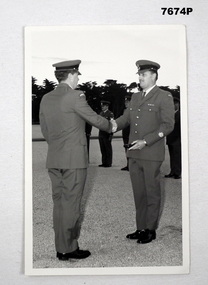
... He did recruit training in S.A. and Course training in Wagga. Following was a series of postings to Point Cook 1969, Malaysia 1971, back to Point Cook in 1976, to ACT in 1978, to Laverton in 1981, to East Sale in 1982, back to Malaysia in 1984 then back to Point Cook until he retired in 1987....He did recruit training in S.A. and Course training in Wagga. Following was a series of postings to Point Cook 1969, Malaysia 1971, back to Point Cook in 1976, to ACT in 1978, to Laverton in 1981, to East Sale in 1982, back to Malaysia in 1984 then back to Point Cook until he retired in 1987. ..."Peter Stocklahsa" No. A317352 joined the RAAF in 1966. He did recruit training in S.A. and Course training in Wagga. Following was a series of postings to Point Cook 1969, Malaysia 1971, back to Point Cook in 1976, to ACT in 1978, to Laverton in 1981, to East Sale in 1982, back to Malaysia in 1984 then back to Point Cook until he retired in 1987.Black and white photo of Peter Stocklahsa being presented with a medal while on Parade, in full uniform and shaking hands with another Officer.Written on back "546".air force, photograph, peter stocklahsa -
 Wangaratta RSL Sub Branch
Poster - Framed Poster, C1915
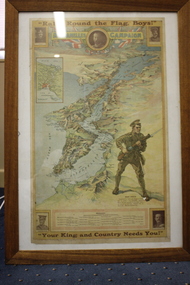
... recruiting poster Includes photographs of King George V; Major-General Sir W.T. Bridges; Brigadier General G.D. Legge; General Sir Ian Hamilton; and Lieut-General Sir William Birdwood and list of Australian Commonwealth Brigade Commanders Posters were used for various government propaganda campaigns over the course of World War I, most significantly to encourage enlistment, but also to raise money for war charities, to encourage saving and frugality and to rally the home front. ww1 recruiting poster In top margin: "Rally round the flag, boys!" ...Map of the Dardanelles Strait, Turkey, used as a World War I recruiting poster Includes photographs of King George V; Major-General Sir W.T. Bridges; Brigadier General G.D. Legge; General Sir Ian Hamilton; and Lieut-General Sir William Birdwood and list of Australian Commonwealth Brigade CommandersPosters were used for various government propaganda campaigns over the course of World War I, most significantly to encourage enlistment, but also to raise money for war charities, to encourage saving and frugality and to rally the home front.Timber framed poster of map of Dardanelle Peninsula featuring image soldier holding rifleIn top margin: "Rally round the flag, boys!" In lower margin: "Your King and country needs you!" ww1, recruiting poster -
 8th/13th Victorian Mounted Rifles Regimental Collection
Badge - Woods badges, 1917 circa
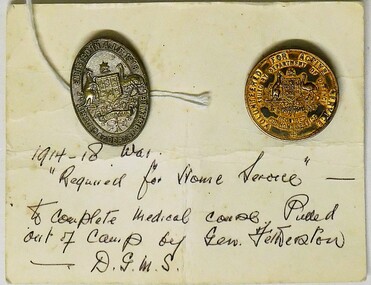
... course. Pulled / out of camp by Gen Fetherson / DGMS" Two lapel badges pinned to a piece of paper with a handwritten notation. One is a Demobilised Soldiers badge issued to new recruits training in Australia at the time of the Armistice on 11 November 1918 or those who had enlisted but had not yet been called into camp for training, and the other a Volunteer Home Service Badge issued to employees of the Department of Defence who had volunteered for active service abroad but who had been denied due to their services being required in Australia. . ...These badges were almost certainly issued to Leslie Samuel Woods of Albury who enlisted 10 May 1915 having completed first year medicine at Melbourne University. He served a year at the Convalescent Hospital, Harefield UK, before being ordered home to complete his medical studies. He would have completed his studies near the end on 1918 and attempted to re-enlist but had not entered training before the Armistice. Doctor Leslie Woods was a General Practitioner in Albury till his death. He is buried in Albury Waugh Road Cemetery.Well provenanced object illustrating the WWI experience of a young Albury man.Two lapel badges pinned to a piece of paper with a handwritten notation. One is a Demobilised Soldiers badge issued to new recruits training in Australia at the time of the Armistice on 11 November 1918 or those who had enlisted but had not yet been called into camp for training, and the other a Volunteer Home Service Badge issued to employees of the Department of Defence who had volunteered for active service abroad but who had been denied due to their services being required in Australia. ."14-18 War / 'required for Home Service' / to complete medical course. Pulled / out of camp by Gen Fetherson / DGMS"military, wwi, world war one, woods, enlist, enlistment, non-enlistment
