
Showing 13 items matching "red cross calling"
-
 National Vietnam Veterans Museum (NVVM)
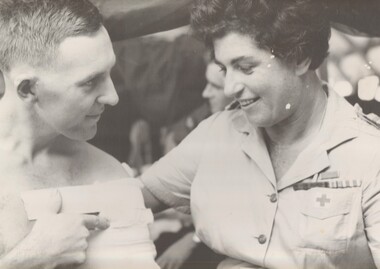
Photograph, Red Cross Calling
... Red Cross Calling...Red Cross 1st Australian Field Hospital Miss Hilda Zinner MBE (Red Cross) A black and white photograph taken at Vung Tau, 26 August 1966. Bandsman/Stretcher Bearer Pte Graeme Davis, 6 RAR talking to an Australian Red Cross worker Miss Hilda Zinner MBE during her routine visit to 1st Australian Field Hospital Red Cross Calling Photograph ...Photograph taken by WO2 WJ Cunneen, Army Public Relations photographer, Educational Unit, 26 August 1966.A black and white photograph taken at Vung Tau, 26 August 1966. Bandsman/Stretcher Bearer Pte Graeme Davis, 6 RAR talking to an Australian Red Cross worker Miss Hilda Zinner MBE during her routine visit to 1st Australian Field Hospitalphotograph, vung tau, pte graeme davis (bandsman/stretcher bearer), 6 rar, red cross, 1st australian field hospital, miss hilda zinner mbe (red cross) -
 Brimbank City Council
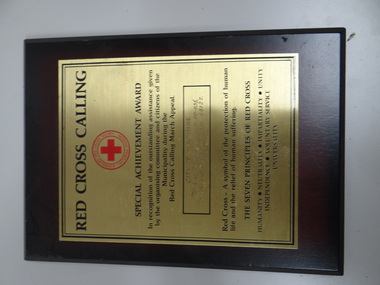
Plaque, Red Cross Calling, 1992
... Red Cross Calling...Dark wooden plaque with gold imitation plate Red Cross Calling Plaque ...Dark wooden plaque with gold imitation plate -
 Marysville & District Historical Society
THE TRIANGLE NEWS-VOL 3 NO 6-MARCH 17 1978
... ...red cross calling...marysville victoria australia red cross calling wirreanda committee meeting postponed letter to the editors marysville senior citizens community care centre situations vacant thanks read any good westerns book swap wanted to buy kindergarten roster buxton badminton auction sale tupperware party alexandra h.s. mothers' club toddler group best wishes fruit salad farm birthday wishes golf club 1st marysville scouts & cubs swimming club fire brigade football club health hints-scalds & burns THE TRIANGLE NEWS-VOL 3 NO 6-MARCH 17 1978 ...marysville, victoria, australia, red cross calling, wirreanda committee meeting postponed, letter to the editors, marysville senior citizens, community care centre, situations vacant, thanks, read any good westerns book swap, wanted to buy, kindergarten roster, buxton badminton, auction sale, tupperware party, alexandra h.s. mothers' club, toddler group, best wishes, fruit salad farm, birthday wishes, golf club, 1st marysville scouts & cubs, swimming club, fire brigade, football club, health hints-scalds & burns -
Glen Eira Historical Society
Document - CAULFIELD RED CROSS UNIT
... Red Cross unit... Caulfield Citizens’ Advice Bureau... Caulfield Welfare Department... Caulfield Royal District Nursing Service... Chisholm Institute of Technology... Red Cross... Salvation Army... Caulfield Council... Caulfield Hospital... Caulfield Racecourse... Caulfield Citizens’ Red Cross Appeal Committee... District Citizens’ Appeal Committee of Red Cross... Southern Memorial Hospital... Elsternwick... Mayor... Mayoress... Campbell Jack Cr. (mayor)... Campbell AJ... ANZAC Day... Heart Foundation... Community Services... Voluntary Workers... Welfare Establishments... Accidents and Disasters... Emergency Services... Fundraising... Charitable Organisations... Remembrance Day... Red Cross Calling...Caulfield Caulfield ‘F’ Red Cross unit Caulfield Citizens’ Advice Bureau Caulfield Welfare Department Caulfield Royal District Nursing Service Chisholm Institute of Technology Red Cross Salvation Army Caulfield Council Caulfield Hospital Caulfield Racecourse Caulfield Citizens’ Red Cross Appeal Committee District Citizens’ Appeal Committee of Red Cross Southern Memorial Hospital Elsternwick Mayor Mayoress Campbell Jack Cr. (mayor) Campbell AJ ANZAC Day Heart Foundation Community Services Voluntary Workers Welfare Establishments Accidents and Disasters Emergency Services Fundraising Charitable Organisations Remembrance Day Red Cross Calling ...This file contains one item about this organisation: 1/Original copy of typewritten document titled ‘Forty Eighth Annual Report of the Caulfield ‘F’ Red Cross Unit from 01/07/1986 to 30/06/1987.’ This document includes details of members’ activities during the aforesaid year such as first aid training, fundraising, voluntary aid emergencies.caulfield, caulfield ‘f’ red cross unit, caulfield citizens’ advice bureau, caulfield welfare department, caulfield royal district nursing service, chisholm institute of technology, red cross, salvation army, caulfield council, caulfield hospital, caulfield racecourse, caulfield citizens’ red cross appeal committee, district citizens’ appeal committee of red cross, southern memorial hospital, elsternwick, mayor, mayoress, campbell jack cr. (mayor), campbell aj, anzac day, heart foundation, community services, voluntary workers, welfare establishments, accidents and disasters, emergency services, fundraising, charitable organisations, remembrance day, red cross calling, markets, disabled people, local government, blood bank, life line, telecross service, fires, central citizens’ appeal committee -
 Stawell Historical Society Inc
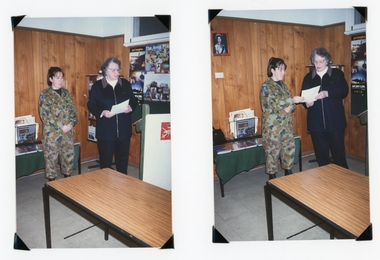
Photograph, Red Cross Vice President Mrs Marion Shirreff presenting certificates of appreciation to cadet Megan Croft 1999
... Certificate of appreciation for the Red Cross calling help. ...Certificate of appreciation for the Red Cross calling help. Two similar coloured photographs of two people, one in cadet uniform. ...2 Photos of Red Cross Vice President Mrs Marion Shirreff presenting certificates of appreciation to cadet Megan Croft for assisting with "Door Knock Appeal" 1999.Two similar coloured photographs of two people, one in cadet uniform.1st photo: Vice pres. Marion Shirreff presenting cadet with certificate of appreciation for help for Red Cross calling for 1999 Megan Croft & Marion. 2nd photo: Megan Croft & Marion Shirreff July 1999. Certificate of appreciation for the Red Cross calling help. stawell medical -
 St Patrick's College
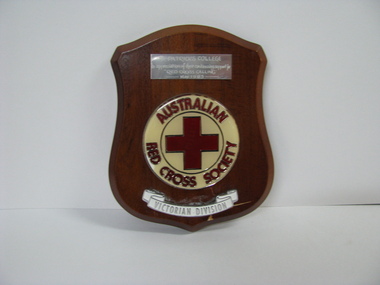
Wooden plaque
... St Patrick's College / In appreciation of their continuing support for / 'Red Cross Calling' / May 1985 / Australian Red Cross Society / Victorian Division....St Patrick's College / In appreciation of their continuing support for / 'Red Cross Calling' / May 1985 / Australian Red Cross Society / Victorian Division. ...Timber plaque with Australian Red Cross logo and banner attached, with small brass etched plate at top of plaque.St Patrick's College / In appreciation of their continuing support for / 'Red Cross Calling' / May 1985 / Australian Red Cross Society / Victorian Division. -
 Ringwood and District Historical Society
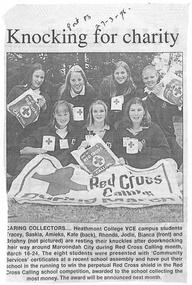
Newspaper, Heathmont College - Newspaper Clipping - 27-3-1996 - "Knocking for Charity"
... Summary:Heathmont College VCE students spent a week door‑knocking around Maroondah for Red Cross Calling, collecting donations between March 16–24. ...Summary:Heathmont College VCE students spent a week door‑knocking around Maroondah for Red Cross Calling, collecting donations between March 16–24. ...Summary:Heathmont College VCE students spent a week door‑knocking around Maroondah for Red Cross Calling, collecting donations between March 16–24. They received Community Services certificates at assembly, and their efforts put the school in the running for the perpetual Red Cross shield, awarded to the school that raises the most money. (Co-Pilot 27/6/2026). Caption: Caring Collectors with first names of students. -
 Melbourne Tram Museum
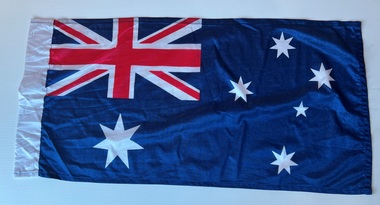
Flag - Tramway - set of 12, late 1980s
... Set of 12 flags collected by the donor, unused, manufactured during the late 1980s. 1 - Australian flag - see also item 790 for a used example 2 - Support Legacy 3 - March is Red Cross calling month. 4 - 100 years of trams - see also item 2608 5 - Victoria 150 6 - Architecture Week 7 - Energy Week - May 1987 8 - Spoleto festival - blue background 9 - Spoleto festival - purple background 10 - Women 150 art festival 11 - Girl Guides 12 - ESTO '88 Melbourne - ESTO is a world-wide cultural festival for expatriate Estonians which has taken place every four years since its beginning in 1972...Set of 12 flags collected by the donor, unused, manufactured during the late 1980s. 1 - Australian flag - see also item 790 for a used example 2 - Support Legacy 3 - March is Red Cross calling month. 4 - 100 years of trams - see also item 2608 5 - Victoria 150 6 - Architecture Week 7 - Energy Week - May 1987 8 - Spoleto festival - blue background 9 - Spoleto festival - purple background 10 - Women 150 art festival 11 - Girl Guides 12 - ESTO '88 Melbourne - ESTO is a world-wide cultural festival for expatriate Estonians which has taken place every four years since its beginning in 1972 Demonstrates the type of flags that were made for use on Melbourne trams during the late 1980s. trams flags melbourne tramways legacy festivals 100 years of electric trams 150th Anniversary Victoria Set of 12 flags made for use on tramcars - unused - nylon woven fabric and printed on various coloured cloths. ...Set of 12 flags collected by the donor, unused, manufactured during the late 1980s. 1 - Australian flag - see also item 790 for a used example 2 - Support Legacy 3 - March is Red Cross calling month. 4 - 100 years of trams - see also item 2608 5 - Victoria 150 6 - Architecture Week 7 - Energy Week - May 1987 8 - Spoleto festival - blue background 9 - Spoleto festival - purple background 10 - Women 150 art festival 11 - Girl Guides 12 - ESTO '88 Melbourne - ESTO is a world-wide cultural festival for expatriate Estonians which has taken place every four years since its beginning in 1972Demonstrates the type of flags that were made for use on Melbourne trams during the late 1980s.Set of 12 flags made for use on tramcars - unused - nylon woven fabric and printed on various coloured cloths. Sewn with a loop at the left hand end to enable a wooden dowell to be fitted and secured and flown on a W class tramcar.trams, flags, melbourne, tramways, legacy, festivals, 100 years of electric trams, 150th anniversary victoria -
 Wodonga & District Historical Society Inc
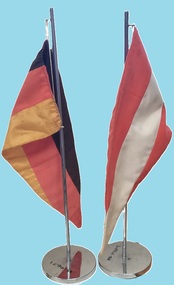
Memorabilia - German and Austrian miniature flags, Unknown
... The Club raised $23,000 for the Wodonga Hospital, had numerous fundraisers to assist in bushfires and drought situations and was involved in the Red Cross Calling campaign for many years. After much fundraising, hard work and making their way through extensive government red tape, the Club moved to its new premises in McFarland Road on 1st August 1981. ...The Club raised $23,000 for the Wodonga Hospital, had numerous fundraisers to assist in bushfires and drought situations and was involved in the Red Cross Calling campaign for many years. After much fundraising, hard work and making their way through extensive government red tape, the Club moved to its new premises in McFarland Road on 1st August 1981. ...Thousands of German migrants started a new life at Bonegilla, Victoria in the 1950s. Among them were five men who met each other in Wodonga, became friends and decided to form a German Austrian Club, where they could enjoy the company of likeminded individuals. They were Kurt Mueller, Willi Klimt, Toni Krischa and Erwin Klein from Germany and Manfred Teissl from Austria. On the 16th July 1960, after advertising in the Border Morning Mail, the German Austrian Club in Wodonga was born. Office bearers were Paul Peters as President. Gerhard Ziermann as Secretary and Günter Schmehl as Treasurer. Their aim was "To promote the upkeep of the German language in written and spoken form and to promote good German fellowship, while enjoying functions of a cultural and entertaining nature". By 1963 the Club boasted 40 members, holding meetings at the RSL Clubrooms and other suitable locations before they found a house in Hovell Street, Wodonga. It was used for meetings, Skat meetings, film nights and "Sonnabendschule” or Saturday school where children of members could continue to learn German. The Committee organised a wide range of activities and functions in their small rooms but dreamed of having a bigger home. This became reality in July 1979, when the Committee purchased land from the Albury Wodonga Development Corporation at 5 McFarland Road, Wodonga. The first brick was laid on the Club's land in May 1980, and the double-storey brick building was completed within 12 months voluntarily by Club members. At the same time members supported other organisations and charities in the Wodonga and wider community. The first Oktoberfest in Wodonga was held in 1975, drawing 4,000 attendees. The event was organized to promote German culture, and the profits from the first year were donated to the Wodonga District Hospital, raising $20,000. In 2001 the German Austrian Club was presented with the Certificate of Meritorious Service by the Government of Victoria for Community Works in Wodonga and district. The Club raised $23,000 for the Wodonga Hospital, had numerous fundraisers to assist in bushfires and drought situations and was involved in the Red Cross Calling campaign for many years. After much fundraising, hard work and making their way through extensive government red tape, the Club moved to its new premises in McFarland Road on 1st August 1981. The members continued to make necessary internal adjustments and sought an alcohol licence. The building was officially opened in May 1983. The Club prospered and had 300 members, making it necessary for new applicants to be put on a waiting list to be accepted as members. Interest groups consisted of Competition Air Rifle Shooting Group, a Skat (German Card game) Group, Folk Dancing Group, Ladies Group, Table Tennis Group, Darts Group, Chess Group and the Billiard Group. In later years, as so many Australians became members, the Club’s name was changed to the German Austrian Australian Club. Over recent years patronage and interest in the Club and its activities changed. Children of the original members had become “real Aussies” and did not always want to carry on traditions. Aging membership and lack of volunteers forced the Club to disband in 2025. The Club building has been gifted to the Albury Wodonga Theatre Company.These items are significant because they are representative of an important cultural organisation which operated in Wodonga for over 60 years.Two small flags of Germany and Austria attached to metal stands with string. Each stand has a metal circular base. "Lufthansa" is inscribed on the base.On base: Lufthansagerman austrian australian club, german austrian club -
 Wodonga & District Historical Society Inc
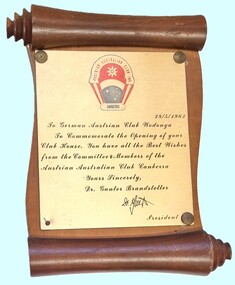
Plaque - German-Austrian Club Wodonga Opening, 1983
... The Club raised $23,000 for the Wodonga Hospital, had numerous fundraisers to assist in bushfires and drought situations and was involved in the Red Cross Calling campaign for many years. After much fundraising, hard work and making their way through extensive government red tape, the Club moved to its new premises in McFarland Road on 1st August 1981. ...The Club raised $23,000 for the Wodonga Hospital, had numerous fundraisers to assist in bushfires and drought situations and was involved in the Red Cross Calling campaign for many years. After much fundraising, hard work and making their way through extensive government red tape, the Club moved to its new premises in McFarland Road on 1st August 1981. ...Thousands of German migrants started a new life at Bonegilla, Victoria in the 1950s. Among them were five men who met each other in Wodonga, became friends and decided to form a German Austrian Club, where they could enjoy the company of likeminded individuals. They were Kurt Mueller, Willi Klimt, Toni Krischa and Erwin Klein from Germany and Manfred Teissl from Austria. On the 16th July 1960, after advertising in the Border Morning Mail the German Austrian Club in Wodonga was born. Office bearers were Paul Peters as President. Gerhard Ziermann as Secretary and Günter Schmehl as Treasurer. Their aim was "To promote the upkeep of the German language in written and spoken form and to promote good German fellowship, while enjoying functions of a cultural and entertaining nature". By 1963 the Club boasted 40 members, holding meetings at the RSL Clubrooms and other suitable locations before they found a house in Hovell Street, Wodonga. It was used for meetings, Skat meetings, film nights and Sonnabendschule” or Saturday school where children of members could continue to learn German. The Committee organised a wide range of activities and functions in their small rooms but dreamed of having a bigger home. This became reality in July 1979, when the Committee purchased land from the Albury Wodonga Development Corporation at 5 McFarland Road, Wodonga. The first brick was laid on the Club's land in May 1980, and the double-story brick building was completed within 12 months voluntarily by Club members. At the same time members supported other organisations and charities in the Wodonga and wider community. The first Oktoberfest in Wodonga was held in 1975, drawing 4,000 attendees. The event was organized to promote German culture, and the profits from the first year were donated to the Wodonga District Hospital, raising $20,000. In 2001 the German Austrian Club was presented with the Certificate of Meritorious Service by the Government of Victoria for Community Works in Wodonga and district. The Club raised $23,000 for the Wodonga Hospital, had numerous fundraisers to assist in bushfires and drought situations and was involved in the Red Cross Calling campaign for many years. After much fundraising, hard work and making their way through extensive government red tape, the Club moved to its new premises in McFarland Road on 1st August 1981. The members continued to make necessary internal adjustments and sought an alcohol licence. The building was officially opened in May 1983. The Club prospered and had 300 members, making it necessary for new applicants to be put on a waiting list to be accepted as members. Interest groups formed consisted of Competition Air Rifle Shooting Group, a Skat (German Card game) Group, Folk Dancing Group, Ladies Group, Table Tennis Group, Darts Group, Chess Group and the Billiard Group. In later years, as so many Australians became members, the Club’s name was changed to the German Austrian Australian Club. Over recent years patronage and interest in the Club and its activities changed. Children of the original members had become “real Aussies” and did not always want to carry on traditions. Aging membership and lack of volunteers forced the Club to disband in 2025. The Club building has been gifted to the Albury Wodonga Theatre Company. These items are significant because they are representative of an important cultural organisation which operated in Wodonga for over 60 years.A metal plaque attached to a wooden backing shaped like a scroll. The text is in the form of a letter.Emblem of the Austrian - Australian Clubs Inc. Canberra 28/5/1983 To German Austrian Club Wodonga To Commemorate the Opening of your Club House. You have all the Best Wishes from the Committee & Members of the Austrian Australian Club Canberra Yours Sincerely, Dr. Gunter Brandstetter Presidentgerman austrian australian club, german migrants wodonga -
 Wodonga & District Historical Society Inc
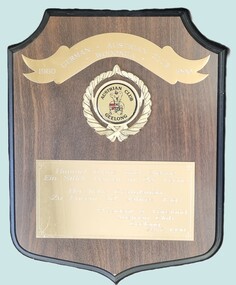
Plaque - German-Austrian Club Wodonga 30th Anniversary, 1990
... The Club raised $23,000 for the Wodonga Hospital, had numerous fundraisers to assist in bushfires and drought situations and was involved in the Red Cross Calling campaign for many years. After much fundraising, hard work and making their way through extensive government red tape, the Club moved to its new premises in McFarland Road on 1st August 1981. ...The Club raised $23,000 for the Wodonga Hospital, had numerous fundraisers to assist in bushfires and drought situations and was involved in the Red Cross Calling campaign for many years. After much fundraising, hard work and making their way through extensive government red tape, the Club moved to its new premises in McFarland Road on 1st August 1981. ...Thousands of German migrants started a new life at Bonegilla, Victoria in the 1950s. Among them were five men who met each other in Wodonga, became friends and decided to form a German Austrian Club, where they could enjoy the company of likeminded individuals. They were Kurt Mueller, Willi Klimt, Toni Krischa and Erwin Klein from Germany and Manfred Teissl from Austria. On the 16th July 1960, after advertising in the Border Morning Mail the German Austrian Club in Wodonga was born. Office bearers were Paul Peters as President. Gerhard Ziermann as Secretary and Günter Schmehl as Treasurer. Their aim was "To promote the upkeep of the German language in written and spoken form and to promote good German fellowship, while enjoying functions of a cultural and entertaining nature". By 1963 the Club boasted 40 members, holding meetings at the RSL Clubrooms and other suitable locations before they found a house in Hovell Street, Wodonga. It was used for meetings, Skat meetings, film nights and Sonnabendschule” or Saturday school where children of members could continue to learn German. The Committee organised a wide range of activities and functions in their small rooms but dreamed of having a bigger home. This became reality in July 1979, when the Committee purchased land from the Albury Wodonga Development Corporation at 5 McFarland Road, Wodonga. The first brick was laid on the Club's land in May 1980, and the double-story brick building was completed within 12 months voluntarily by Club members. At the same time members supported other organisations and charities in the Wodonga and wider community. The first Oktoberfest in Wodonga was held in 1975, drawing 4,000 attendees. The event was organized to promote German culture, and the profits from the first year were donated to the Wodonga District Hospital, raising $20,000. In 2001 the German Austrian Club was presented with the Certificate of Meritorious Service by the Government of Victoria for Community Works in Wodonga and district. The Club raised $23,000 for the Wodonga Hospital, had numerous fundraisers to assist in bushfires and drought situations and was involved in the Red Cross Calling campaign for many years. After much fundraising, hard work and making their way through extensive government red tape, the Club moved to its new premises in McFarland Road on 1st August 1981. The members continued to make necessary internal adjustments and sought an alcohol licence. The building was officially opened in May 1983. The Club prospered and had 300 members, making it necessary for new applicants to be put on a waiting list to be accepted as members. Interest groups formed consisted of Competition Air Rifle Shooting Group, a Skat (German Card game) Group, Folk Dancing Group, Ladies Group, Table Tennis Group, Darts Group, Chess Group and the Billiard Group. In later years, as so many Australians became members, the Club’s name was changed to the German Austrian Australian Club. Over recent years patronage and interest in the Club and its activities changed. Children of the original members had become “real Aussies” and did not always want to carry on traditions. Aging membership and lack of volunteers forced the Club to disband in 2025. The Club building has been gifted to the Albury Wodonga Theatre Company.This item is significant because it is representative of an important cultural organisation which operated in Wodonga for over 60 years.A wooden plaque with metal insignia and a plate with text in German. This plaque was presented by the German Austrian Club of Geelong on the occasion of the 30th Anniversary of the Wodonga Club and bears its insignia.Himmel Glanz und Sterne Ein Stuck Heimat in Der Fern Herzliche Gratulation Zu Eurem 30 Jahres Tag President and Vorstand Translation Sky, splendour and stars A piece of home away from home Congratulations On your 30th anniversary President and Board of Directorsgerman austrian australian club, german migrants wodonga -
 Wodonga & District Historical Society Inc
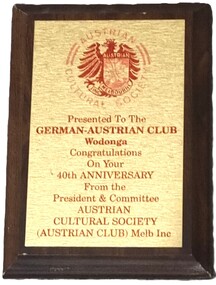
Plaque - German-Austrian Club Wodonga 40th Anniversary, 2000
... The Club raised $23,000 for the Wodonga Hospital, had numerous fundraisers to assist in bushfires and drought situations and was involved in the Red Cross Calling campaign for many years. After much fundraising, hard work and making their way through extensive government red tape, the Club moved to its new premises in McFarland Road on 1st August 1981. ...The Club raised $23,000 for the Wodonga Hospital, had numerous fundraisers to assist in bushfires and drought situations and was involved in the Red Cross Calling campaign for many years. After much fundraising, hard work and making their way through extensive government red tape, the Club moved to its new premises in McFarland Road on 1st August 1981. ...Thousands of German migrants started a new life at Bonegilla, Victoria in the 1950s. Among them were five men who met each other in Wodonga, became friends and decided to form a German Austrian Club, where they could enjoy the company of likeminded individuals. They were Kurt Mueller, Willi Klimt, Toni Krischa and Erwin Klein from Germany and Manfred Teissl from Austria. On the 16th July 1960, after advertising in the Border Morning Mail the German Austrian Club in Wodonga was born. Office bearers were Paul Peters as President. Gerhard Ziermann as Secretary and Günter Schmehl as Treasurer. Their aim was "To promote the upkeep of the German language in written and spoken form and to promote good German fellowship, while enjoying functions of a cultural and entertaining nature". By 1963 the Club boasted 40 members, holding meetings at the RSL Clubrooms and other suitable locations before they found a house in Hovell Street, Wodonga. It was used for meetings, Skat meetings, film nights and Sonnabendschule” or Saturday school where children of members could continue to learn German. The Committee organised a wide range of activities and functions in their small rooms but dreamed of having a bigger home. This became reality in July 1979, when the Committee purchased land from the Albury Wodonga Development Corporation at 5 McFarland Road, Wodonga. The first brick was laid on the Club's land in May 1980, and the double-story brick building was completed within 12 months voluntarily by Club members. At the same time members supported other organisations and charities in the Wodonga and wider community. The first Oktoberfest in Wodonga was held in 1975, drawing 4,000 attendees. The event was organized to promote German culture, and the profits from the first year were donated to the Wodonga District Hospital, raising $20,000. In 2001 the German Austrian Club was presented with the Certificate of Meritorious Service by the Government of Victoria for Community Works in Wodonga and district. The Club raised $23,000 for the Wodonga Hospital, had numerous fundraisers to assist in bushfires and drought situations and was involved in the Red Cross Calling campaign for many years. After much fundraising, hard work and making their way through extensive government red tape, the Club moved to its new premises in McFarland Road on 1st August 1981. The members continued to make necessary internal adjustments and sought an alcohol licence. The building was officially opened in May 1983. The Club prospered and had 300 members, making it necessary for new applicants to be put on a waiting list to be accepted as members. Interest groups formed consisted of Competition Air Rifle Shooting Group, a Skat (German Card game) Group, Folk Dancing Group, Ladies Group, Table Tennis Group, Darts Group, Chess Group and the Billiard Group. In later years, as so many Australians became members, the Club’s name was changed to the German Austrian Australian Club. Over recent years patronage and interest in the Club and its activities changed. Children of the original members had become “real Aussies” and did not always want to carry on traditions. Aging membership and lack of volunteers forced the Club to disband in 2025. The Club building has been gifted to the Albury Wodonga Theatre Company.This item is significant because it is representative of an important cultural organisation which operated in Wodonga for over 60 years.A small metal plaque on a wooden backing with red text. It includes the insignia of the Austrian Cultural Society of Melbourne.Presented To The GERMAN-AUSTRIAN CLUB Wodonga Congratulations On Your 40th ANNIVERSARY From the President & Committee AUSTRIAN CULTURAL SOCIETY (AUSTRIAN CLUB) Melb Incgerman austrian australian club, german migrants wodonga -
 Wodonga & District Historical Society Inc
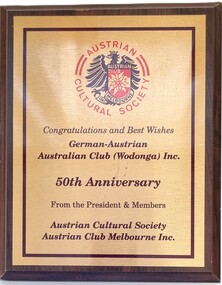
Plaque - German-Austrian Club Wodonga 50th Anniversary, 2010
... The Club raised $23,000 for the Wodonga Hospital, had numerous fundraisers to assist in bushfires and drought situations and was involved in the Red Cross Calling campaign for many years. After much fundraising, hard work and making their way through extensive government red tape, the Club moved to its new premises in McFarland Road on 1st August 1981. ...The Club raised $23,000 for the Wodonga Hospital, had numerous fundraisers to assist in bushfires and drought situations and was involved in the Red Cross Calling campaign for many years. After much fundraising, hard work and making their way through extensive government red tape, the Club moved to its new premises in McFarland Road on 1st August 1981. ...Thousands of German migrants started a new life at Bonegilla, Victoria in the 1950s. Among them were five men who met each other in Wodonga, became friends and decided to form a German Austrian Club, where they could enjoy the company of likeminded individuals. They were Kurt Mueller, Willi Klimt, Toni Krischa and Erwin Klein from Germany and Manfred Teissl from Austria. On the 16th July 1960, after advertising in the Border Morning Mail the German Austrian Club in Wodonga was born. Office bearers were Paul Peters as President. Gerhard Ziermann as Secretary and Günter Schmehl as Treasurer. Their aim was "To promote the upkeep of the German language in written and spoken form and to promote good German fellowship, while enjoying functions of a cultural and entertaining nature". By 1963 the Club boasted 40 members, holding meetings at the RSL Clubrooms and other suitable locations before they found a house in Hovell Street, Wodonga. It was used for meetings, Skat meetings, film nights and Sonnabendschule” or Saturday school where children of members could continue to learn German. The Committee organised a wide range of activities and functions in their small rooms but dreamed of having a bigger home. This became reality in July 1979, when the Committee purchased land from the Albury Wodonga Development Corporation at 5 McFarland Road, Wodonga. The first brick was laid on the Club's land in May 1980, and the double-story brick building was completed within 12 months voluntarily by Club members. At the same time members supported other organisations and charities in the Wodonga and wider community. The first Oktoberfest in Wodonga was held in 1975, drawing 4,000 attendees. The event was organized to promote German culture, and the profits from the first year were donated to the Wodonga District Hospital, raising $20,000. In 2001 the German Austrian Club was presented with the Certificate of Meritorious Service by the Government of Victoria for Community Works in Wodonga and district. The Club raised $23,000 for the Wodonga Hospital, had numerous fundraisers to assist in bushfires and drought situations and was involved in the Red Cross Calling campaign for many years. After much fundraising, hard work and making their way through extensive government red tape, the Club moved to its new premises in McFarland Road on 1st August 1981. The members continued to make necessary internal adjustments and sought an alcohol licence. The building was officially opened in May 1983. The Club prospered and had 300 members, making it necessary for new applicants to be put on a waiting list to be accepted as members. Interest groups formed consisted of Competition Air Rifle Shooting Group, a Skat (German Card game) Group, Folk Dancing Group, Ladies Group, Table Tennis Group, Darts Group, Chess Group and the Billiard Group. In later years, as so many Australians became members, the Club’s name was changed to the German Austrian Australian Club. Over recent years patronage and interest in the Club and its activities changed. Children of the original members had become “real Aussies” and did not always want to carry on traditions. Aging membership and lack of volunteers forced the Club to disband in 2025. The Club building has been gifted to the Albury Wodonga Theatre Company.This item is significant because it is representative of an important cultural organisation which operated in Wodonga for over 60 years.A small metal plaque on a wooden backing with red text. It includes the insignia of the Austrian Cultural Society of Melbourne.Congratulations and Best Wishes German-Austrian Australian Club (Wodonga) Inc. 50th Anniversary From the President & Members Austrian Cultural Society Austrian Club Melbourne Inc.german austrian australian club, german migrants wodonga
