
Showing 5 items matching "registered clubs association of victoria"
-
 Heidelberg Golf Club
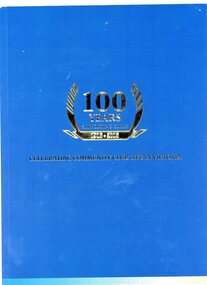
Book, Community Clubs Victoria, Celebrating community club life in Victoria: 100 years supporting clubs, 1916-2016, 2016
... Registered Clubs Association of Victoria...A short history of the Registered Clubs Association of Victoria, with reports on 30 clubs including Rosanna Golf Club....Heidelberg Golf Club 8 Main Road Lower Plenty 3093 A short history of the Registered Clubs Association of Victoria, with reports on 30 clubs including Rosanna Golf Club. ...A short history of the Registered Clubs Association of Victoria, with reports on 30 clubs including Rosanna Golf Club.HGC is a member of this AssociationDark blue soft cover with gold writing. 152p., col. Illus. registered clubs association of victoria, rosanna golf club -
 Glen Eira Historical Society
Letter - ELSTERNWICK POST OFFICE
... Victoria)... Public Works Department... Architectural styles... Calder G.K. Councillor... Wills Cathie... Lyall Kerry... Marsden John Hudson... Town Clerk... Hill Douglas... Caulfield Progress Association... Caulfield South... Glen Eira Road... Hawthorn Road... Mac Neil J.R.... Neville Street... Glenhuntly... Marten Veronika... Ballantyne Richard... Royal Historical Society of Victoria... Dunstan Don... Alfada Street South... Hardy Joan... Baird Rob... Snowball Betty... Ward Andrew... Hoddle Robert... Foot Henry... Ebden Charles Hodson... Elster... Oldham Mary Kate... English ‘Queen Anne’ Revival style... Rifle Club... Coulson Herbert H.... Fick P.G.... railway... City Manager... Austin G.B. H.... Architects... Builders... architectural features... Australia Post... Register...Victoria) Public Works Department Architectural styles Calder G.K. Councillor Wills Cathie Lyall Kerry Marsden John Hudson Town Clerk Hill Douglas Caulfield Progress Association Caulfield South Glen Eira Road Hawthorn Road Mac Neil J.R. Neville Street Glenhuntly Marten Veronika Ballantyne Richard Royal Historical Society of Victoria Dunstan Don Alfada Street South Hardy Joan Baird Rob Snowball Betty Ward Andrew Hoddle Robert Foot Henry Ebden Charles Hodson Elster Oldham Mary Kate English ‘Queen Anne’ Revival style Rifle Club Coulson Herbert H. Fick P.G. railway City Manager Austin G.B. H. Architects Builders architectural features Australia Post Register ...This file contains seven items about the significance of this building and how this was established : 1/ Photocopies of a handwritten application (in duplicate) by Walter Kay of Elsternwick dated 13/10/1985 and Rodney H Bush’s dated 16/10/1985 to the Historic Buildings Council to register the former Elsternwick Post Office building, and an original typewritten letter dated 17/10/1985 from the Historic Buildings Council to Caulfield and Historic Society advising them of an application and inviting them to submit relevant information about the building with a copy of application attached. 2/ Six pieces of correspondence between various interested parties (Caulfield Council , Caulfield Historical Society, National Trust, of Australia and Ministry for Planning and Environment on behalf of Historic Buildings Council, Victoria) about the significance of the former Elsternwick Post Office building and the progress of efforts to include it on the Register of Historic buildings. Dated between November 1985 and May 1986. 3/ Two pieces of correspondence between the Caulfield Progress Association and the Caulfield Historical Society dated April and May 1986, regarding the efforts of the Historical Society to save the former Elsternwick Post Office building. 4/ Two pieces of ephemera by the Caulfield Progress Association, one original undated and one photocopy undated in 1986. Both appealing to the public for support to help the former Elsternwick Post Office building and to protest a proposal to demolish it, by Caulfield Council. 5/Original newspaper article dated 07/06/1989 from the Malvern-Caulfield Progress newspaper written by Robert Carmody. The article talks about the approval by the Historic Buildings Council of Caulfield Council’s restoration program of the former Elsternwick Post Office building worth approximately $850,000. The refurbishment would consist of a shop and office space which would then be rented out. Mayor Emil Braun outlines the progress to implement the plans. 6/ Caulfield Conservation Study by Andrew Ward dated September 1994 of former Elsternwick Post Office Building. The building plans for the Elizabethan Style building were approved in 1891. The original timber verandahs were replaced by the present brickworks in circa 1918 rear extensions in 1941-42. Similar Post Offices were built at Kew, Queenscliff and Portarlington. 7/ Computer printout dated 19/03/2010 of Statement of Significance held by the Victorian Heritage database of the former Elsternwick Post Office Building. It was built in 1891 in the ‘Queen Anne’ style. The substantial two story red brick building was set on a bluestone plinth with an ornate façade incorporating cement dressings. There is a brief summary of the settlement and development of the Elsternwick area with mention of how important the building is to the Elsternwick Community. Original date and author is unknown.elsternwick post office, glenhuntly road, elsternwick, riddell parade, office buildings, postal services, caulfield city council, kay walter, regent street, caulfield, bush rodney h, gisborne street, city of caulfield, braun emil councillor, mayors, aylen doug, aylen douglas r, historic buildings council, caulfield historical society, ministry for planning and environment, head stephen, historic buildings act 1981, anderson p, national trust of australia (victoria), public works department, architectural styles, calder g.k. councillor, wills cathie, lyall kerry, marsden john hudson, town clerk, hill douglas, caulfield progress association, caulfield south, glen eira road, hawthorn road, mac neil j.r., neville street, glenhuntly, marten veronika, ballantyne richard, royal historical society of victoria, dunstan don, alfada street south, hardy joan, baird rob, snowball betty, ward andrew, hoddle robert, foot henry, ebden charles hodson, elster, oldham mary kate, english ‘queen anne’ revival style, rifle club, coulson herbert h., fick p.g., railway, city manager, austin g.b. h., architects, builders, architectural features, australia post, register of historical buildings, grey karen, planning appeal board, heritage overlay no h029, victorian government gazette no. 60 dated 16/07/1986, historic building no640, certificate of title volume 5817, kennan james harley, nelson ivor, blake alison, neale anne, telegraph offices, wardell, ward andrew -
 Australian Gliding Museum
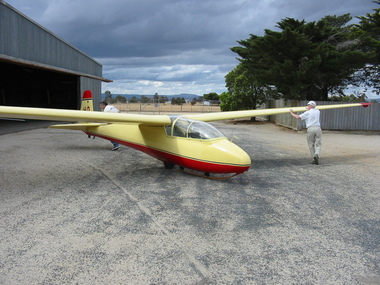
Machine - Glider – Sailplane, Kaiser Ka 2B Rhonschwalbe, 1960
... Club of Sydney. The glider registered as VH-GHO and first flew in October 1960. However, within a short time it was badly damaged and needed major repairs which took over a year to complete. After about 10 years service at Illawarra Soaring Club it was transferred in February 1972 to W.G. Hingston, Rosebud, Victoria, and flown with the Peninsula Soaring Association...Club of Sydney. The glider registered as VH-GHO and first flew in October 1960. However, within a short time it was badly damaged and needed major repairs which took over a year to complete. After about 10 years service at Illawarra Soaring Club it was transferred in February 1972 to W.G. Hingston, Rosebud, Victoria, and flown with the Peninsula Soaring Association ...The Ka 2, a tandem two seat training sailplane of 15 metre wing span, was designed by Rudolf Kaiser for Schleicher in 1953. It was a versatile craft due to its good cross country soaring capability. With the Ka 2B, the design was improved in 1955 by lengthening the wing span to 16 metres and increasing the dihedral and tip washout. The fuselage was lengthened slightly as well. Schleicher built 42 Ka2s from 1953 to 1955 and 75 Ka 2Bs from 1955 to 1957. In addition Schleicher supplied kits for construction of the sailplane by independent builders. The Australian Gliding Museum’s example is the single Ka 2b built in Australia from plans and is designated as GFA-HB-47. The club concerned was the Illawarra Soaring Club of Sydney. The glider registered as VH-GHO and first flew in October 1960. However, within a short time it was badly damaged and needed major repairs which took over a year to complete. After about 10 years service at Illawarra Soaring Club it was transferred in February 1972 to W.G. Hingston, Rosebud, Victoria, and flown with the Peninsula Soaring Association, a small club of about 20 members, operating at the Moorooduc Airfield. The Ka2b was disposed of to the Stirling Gliding Club in Western Australia in August 1976. Once again it suffered damage in a landing accident in 1978. The damaged glider was put into storage at Northam where it remained for approximately 11 years. It was acquired by Mike Valentine in 1989 and brought back to flying condition at Bacchus Marsh, Victoria. The last entry in the log book is dated January 1997 at which time it had accumulated 1170 hours from 2446 flights. The last owner prior to transfer to the Australian Gliding Museum was John Ashford of the Geelong Gliding Club. The Museum's Ka 2B sailplane is a potentially airworthy example of this German 1950s sailplane type. It is a rarity in Australia as the only Ka 2b appearing on the Australian register.Tandem two seat sailplane of wood and fabric construction finished in cream and red colour schemeRegistration VH-GHO (with "HO" letters painted on the fin / rudder) Serial number - GFA HB 47 australian gliding, glider, sailplane, schleicher, kaiser, ka 2, illawarra soaring club, stirling gliding club, valentine, ashford, peninsulasoaring association -
 Australian Gliding Museum
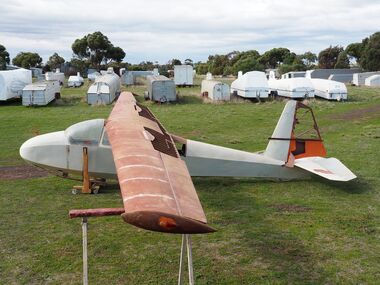
Machine - ES56 Nymph Sailplane
... VH-GHG on 20 August 1957 Re-registered VH-GHA on 11 October 2016 Currently Raywood, Victoria Believed airworthy Nymph-II Serial Number 20 Original owner – R.A.N. Gliding Association Registered VH-GDX on 20 May 1957 Currently Locksley, Victoria. In storage Nymph-II Serial Number 21 Original owner – Gliding Club... VH-GHG on 20 August 1957 Re-registered VH-GHA on 11 October 2016 Currently Raywood, Victoria Believed airworthy Nymph-II Serial Number 20 Original owner – R.A.N. Gliding Association Registered VH-GDX on 20 May 1957 Currently Locksley, Victoria. In storage Nymph-II Serial Number 21 Original owner – Gliding Club ...ES 56 Nymph Following the successful introduction of the ES 52 Kookaburra two-seater in mid-1954, Edmund Schneider Ltd designed a higher performance single seat sailplane of similar construction and with similar handling qualities. It was designated the ES 56 and became known as the ES56 “Nymph”. The ES56 Nymph was a success in that it delivered the anticipated performance and was found to have satisfactory flying characteristics. However, only the prototype (“Nymph -I”) and three production examples (“Nymph-II”) were built. Schneiders made some changes to the design before building the production version. The wing chord at the tip on the prototype measured 650 mm. This was reduced to 500 mm for subsequent builds. The explanation is that provision was made in the original design for the possible lengthening of the tapered wing to 13 metres. However, apparently it was decided to retain the 11.900 metre span which allowed the tip chord to be reduced slightly. Other changes included the installation of scissor type air brakes in the wing instead of simple hinged flap spoilers and the addition of a landing wheel behind the skid on the fuselage. On one of the Nymph-II a dorsal was added on top of the fuselage forward of the vertical fin when repairs were made rectifying damage incurred as a result of an accident at Benalla on 31 March 1963. Even before these ES56 gliders were finished, Edmund Schneider Ltd decided to offer a less expensive single seat design to cater in particular for newly solo pilots, the ES57 Kingfisher. With the Kingfisher, Schneiders reverted to a traditional airfoil (Gott 549) for the wing instead of the laminar flow section that was chosen for the Nymph in the pursuit of performance. As such, the Kingfisher was more appropriately characterised as a single seat version of the Kookaburra in comparison to the Nymph. Schneiders continued for a time to offer the ES56 Nymph as a high-performance sailplane. However, its place in the market was soon overtaken by imported designs with superior performance, such as the Schleicher KA6, which Schneiders also imported and built under license. Nymph-I was test flown in December 1955 and entered by Harry Schneider into the gliding championships held at Waikerie from 5th to 16th of that month. Harry finished 12th in the individual placing out of a field of approximately 24. The capabilities of the Nymph were further demonstrated by Harry Schneider in January 1956 with a Gold C flight of 193 miles from Gawler in South Australia to Walpeup in Victoria. Nymph-I was acquired by the Port Pirie Gliding Club in South Australia. It has been saved and restored and is a regular feature at vintage glider rallies in Victoria and New South Wales. See Museum Newsletter No 35 Winter Edition 2017 pages 3 -6, for that story. The Nymph-II production models were delivered by Edmund Schneider Ltd in October 1956 to the Gliding Club of Victoria, the Victorian Motorless Flight Group and the Royal Australian Navy Gliding Association. The VMFG flew its Nymph in the First National Gliding Championships at Tocumwal, NSW, in December 1956 and all three were flown at the Second National Gliding Championships at Benalla in 29th December 1958 to 8th January 1959, delivering competitive performances based on handicap. Nymph-I Serial Number 17 Original owner – Port Pirie Gliding Club, S.A. Registered VH-GHG on 20 August 1957 Re-registered VH-GHA on 11 October 2016 Currently Raywood, Victoria Believed airworthy Nymph-II Serial Number 20 Original owner – R.A.N. Gliding Association Registered VH-GDX on 20 May 1957 Currently Locksley, Victoria. In storage Nymph-II Serial Number 21 Original owner – Gliding Club of Victoria Registered VH-GHU on 27 August 1957 Currently Bendick Murrell, N.S.W. In storage Nymph-II Serial Number 22 Original owner – Victorian Motorless Flight Group Registered VH-GFE on 5 March 1957 Currently Bacchus Marsh, Victoria Under restoration for display. The Museum’s exhibit is the ES56, serial number 22, registered as VH-GFE. The glider was flown by the VMFG in Victoria until approximately September 1968. GFA records show that it was transferred to Queensland in 1968, and it passed through several owners until the mid-1970s. Information received indicates that it was flown by the Leichardt Soaring Club at Mount Isa in the (late?) 1960s. The history from then is not presently known except to say that it has been kept in dry storage for many years. It is not known when the glider was last flown. What is Significant? The Schneider ES 56 Nymph single seat sailplane, serial number 22, designed and built in 1955-1956, by Edmund Schneider Ltd in Adelaide. It was delivered to its original owner, the Victorian Motorless Flight Group, in October 1956, and registered as VH-GFE on 5 March 1957. How it is Significant? The ES56 Nymph is of historical, aesthetic, scientific and research, and social significance to the Australian gliding community. Why it is Significant? The ES56 is of historical significance as it was designed and built by Edmund and Harry Schneider. The Schneiders immigrated to Australia after the end of the second world war bringing with them considerable expertise in relation to glider design and construction. Over the following decades they maintained a close association with the Gliding Federation of Australia and the gliding clubs and through their glider production made a major contribution to the sport. The ES56 is part of that story. The ES56 in its design and construction exhibits the glider construction technology of the time, which principally consisted of lightweight wooden framework skinned with ply and doped fabric. It exbibits design innovation, notably the use of a laminar flow wing profile in pursuit of better glide performance. Also, considerable attention was given to simplifying the structure in order to keeping cost and the weight low. The ES56 played a useful role at gliding clubs where it was operated, especially the late 1950s and early 1960s and is remembered well by pilots who flew her. The glider is in the course of restoration and provides an insight into the skills and workmanship that were involved in design, building and maintenance of these wooden aircraft. It is of aesthetic and scientific and research significance. Glider airframe of a traditional wood and fabric covered constructionNoneglider, sailplane, edmund schneider, harry schneider, es56, nymph, es57, kingfisher, victorian motorless flight group, gliding club of victoria, ran gliding association, port pirie gliding club, leichardt soaring club. -
 Ballarat Heritage Services
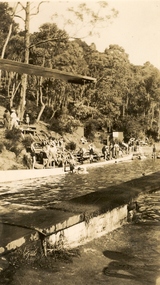
Photograph - Photograph - Black and White, Hepburn Springs Swimming Pool
... Victoria's Favourite Built Place in 2004 as part of the Victorian Government's involvement in the International Year of the Built Environment. It was included on the Victorian Heritage Register following a nomination and comparative analysis of pre Olympic Swimming Pools in Victoria by Lisa Gervasoni. hepburn springs swimming pool hepburn springs hepburn pool pre-olympic swimming pools albert zelman bellinzona annette Kellerman frank Beaurepaire Victorian Amateur Swimming Association Hepburn Amateur Swimming Club Black and white photograph of the Hepburn Pool in Spring Creek, including the diving board. ...The Hepburn Pool was built in Spring Creek during the 1930s by the Zelmans of Bellinzona Guest House. Alberto Zelman paid for local workers to construct the pool to their specifications so the visitors to local guest houses could swim on hot days. The Hepburn Pool was used for the Victorian Swimming Championships, with 6 stones marked at one end for each lane. It is 50 yards long, the length required for competitions. In 1935 the Hepburn Amateur Swimming Club organised their first swimming carnival, the meeting conducted by the Victorian Amateur Swimming Association, In 1969 the Daylesford Olympic Swimming Pool was constructed so this 'old swimming pool' was neglected. Fortunately in 1993 local volunteers associated with the Savoia Hotel returned the pool to its former glory with the help of old photos and a lot of hard work. Two well known swimmers swam at the pool in the Victorian swimming Championships, they were Annette Kellerman and Frank Beaurepaire. The Pool was named Victoria's Favourite Built Place in 2004 as part of the Victorian Government's involvement in the International Year of the Built Environment. It was included on the Victorian Heritage Register following a nomination and comparative analysis of pre Olympic Swimming Pools in Victoria by Lisa Gervasoni.Black and white photograph of the Hepburn Pool in Spring Creek, including the diving board.hepburn springs swimming pool, hepburn springs, hepburn pool, pre-olympic swimming pools, albert zelman, bellinzona, annette kellerman, frank beaurepaire, victorian amateur swimming association, hepburn amateur swimming club
