
Showing 12 items matching "religious family readings"
-
 Warrnambool and District Historical Society Inc.
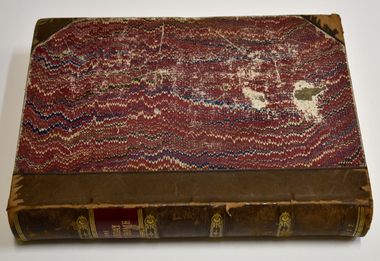
Book - Sunday Reading, Religious Tract Society of London, The Sunday At Home A Family Magazine For Sabbath Reading, 1877
... a family magazine for sabbath reading...religious... in the 19th Century. 19th century Sunday activities. the sunday at home a family magazine for sabbath reading religious family readings Sunday readings including fiction and non fiction This is a book of 828 pages with reprints of a religious magazine and several full page advertisements at the back. ...Sunday readings including fiction and non fictionThis is a book of 828 pages with reprints of a religious magazine and several full page advertisements at the back. The pages contain stories, sketches, black and white and coloured illustrations, the latter on toned paper. The cover has a red based, mottled design on the front and the back and the leather covered spine has gold decoration and printing. The corners of the cover are reinforced with leather. The cover is scuffed. The pages are edged in a mottled pattern.fictionSunday readings including fiction and non fiction19th century sunday activities., the sunday at home, a family magazine for sabbath reading, religious family readings -
 Flagstaff Hill Maritime Museum and Village
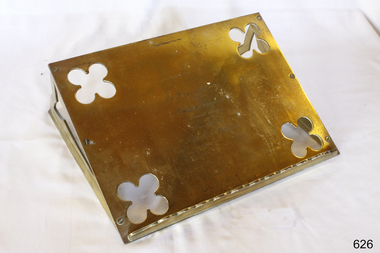
Functional object - Table-top Missal stand, after 1938
... Nicholas Seamen's church as it was dedicated to a family member. flagstaff hill warrnambool shipwrecked coast flagstaff hill maritime museum maritime museum shipwreck coast flagstaff hill maritime village great ocean road religious service missions to seamen victoria st nicholas seaman’s church williamstown church furniture religious worship bible rest tabletop lectern bible reading preaching accessory book rest memorial object M A Hodgkiss Richard Hodgkiss Missel table book stand book stand Bible stand table-top stand table-top book rest table-top Missal stand Missal desk "In Loving Memory of Richard Hodgkiss - passed away 14 12 38. ...This decorative brass table-top Missal stand was presented to the Missions to Seamen in Williamstown in memory of Richard Hodgkiss, after his death on December 14th 1938, by Mrs M A Hodgkiss. Decorative book rests like this one were used to support the Bible during services at the Williamstown Missions to Seamen and is now part of the St. Nicholas Seamen's Church Collection. THE MISSIONS TO SEAMEN (Brief History): - The Missions to Seamen was an Anglican charity in Great Britain that has served the world's seafarers since 1856. Its symbol is a Flying Angel, inspired by a Bible verse. Today, there are centres in over 200 ports worldwide where seamen of all backgrounds are offered a warm welcome and provided with a wide range of facilities. In Victoria, the organisation began in Williamstown in 1857 as a Sailors’ Church, also known as ‘Bethel’ or the ‘Floating Church’ in an old hulk floating in Hobson’s Bay, Port of Melbourne. It soon became part of the Missions to Seamen, Victoria. In the year 2000, the organisation, now named Mission to Seafarers, still operated locally in Melbourne, Portland, Geelong and Hastings. The Ladies’ Harbour Lights Guild was formed in 1906 to support the Missions to Seamen in Melbourne and other centres, such as Williamstown. Two of the most significant ladies of the Guild were founder Ethel Augusta Godfrey and foundation member Alice Sibthorpe Tracy (who established a branch of the Guild in Warrnambool in 1920). The Guild continued its work until the 1960s. In 1943, a former Williamstown bank was purchased for the Missions to Seaman Club. The chapel was named St Nicholas’ Seamen’s Church and was supported by the Ladies’ Harbour Lights Guild, the Williamstown Lightkeepers’ Auxiliary and the League of Soldiers’ and Sailors’ Friends. It ceased operation in 1966. A Missions to Seamen Chapel and Recreation Room was a significant feature of ports during the late 1800s and into the 1900s. It seemed appropriate for Flagstaff Hill to include such a representation within the new Maritime Village, so the Melbourne Board of Management of Missions to Seamen Victoria gave its permission on 21st May 1979 for the entire furnishings of the Williamstown chapel to be transferred to Flagstaff Hill. The St Nicholas Seamen’s Church was officially opened on October 11, 1981, and closely resembles the Williamstown chapel.This table-top Missal stand is historically significant for its origin in the St Nicholas Mission to Seamen's Church in Williamstown, established in 1857 to cater for the physical, social, and spiritual needs of seafarers. It originated in Bristol, England, when a Seamen's Mission was formed in 1837. It is socially important for its connection to the Williamstown St. Nicholas Seamen's church as it was dedicated to a family member.Table-top Missal stand, also called a Bible rest, book rest or table top stand: brass, rectangular surface with clover motifs holes in each corner. The triangular leg frames are screwed beneath the short sides to create a slope. The lower edge has a vertical, decorative shelf. The inscription on the top surface dedicates the book stand to Richard Hodgkiss, 1938. This book stand is part of the St. Nicholas Seamen's Church Collection. "In Loving Memory of Richard Hodgkiss - passed away 14 12 38. Presented by Mrs M A Hodgkiss."flagstaff hill, warrnambool, shipwrecked coast, flagstaff hill maritime museum, maritime museum, shipwreck coast, flagstaff hill maritime village, great ocean road, religious service, missions to seamen victoria, st nicholas seaman’s church williamstown, church furniture, religious worship, bible rest, tabletop lectern, bible reading, preaching accessory, book rest, memorial object, m a hodgkiss, richard hodgkiss, missel table book stand, book stand, bible stand, table-top stand, table-top book rest, table-top missal stand, missal desk -
 Flagstaff Hill Maritime Museum and Village
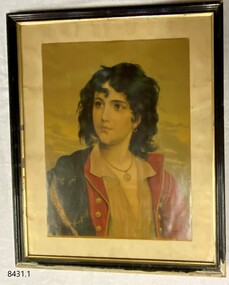
Artwork, other - A religious print and almanac, Australasian Church of Christ, 1892
... religious almanac with biblical imagery listed the Churches of Christ in Australasia and scripture readings for a calendar year of 1892. The almanac was produced and updated annually to reflect current information. The Churches of Christ in Australia is a Reformed Restorationist denomination. Congregations in South Australia, Victoria and New South Wales were established by individuals who travelled to these colonies to pursue employment opportunities, elsewhere in Australia Churches of Christ congregations were established as missionary initiatives. Churches of Christ in Victoria began with the arrival of the Ingram and Picton families...religious almanac with biblical imagery listed the Churches of Christ in Australasia and scripture readings for a calendar year of 1892. The almanac was produced and updated annually to reflect current information. The Churches of Christ in Australia is a Reformed Restorationist denomination. Congregations in South Australia, Victoria and New South Wales were established by individuals who travelled to these colonies to pursue employment opportunities, elsewhere in Australia Churches of Christ congregations were established as missionary initiatives. Churches of Christ in Victoria began with the arrival of the Ingram and Picton families ...This religious almanac with biblical imagery listed the Churches of Christ in Australasia and scripture readings for a calendar year of 1892. The almanac was produced and updated annually to reflect current information. The Churches of Christ in Australia is a Reformed Restorationist denomination. Congregations in South Australia, Victoria and New South Wales were established by individuals who travelled to these colonies to pursue employment opportunities, elsewhere in Australia Churches of Christ congregations were established as missionary initiatives. Churches of Christ in Victoria began with the arrival of the Ingram and Picton families from England who established regular meetings in Prahran and officially constituted a congregation in 1855. In Warrnambool plans were drawn up in 1883 for the erection of a Church of Christ at 12 Spence Street. The church was opened in 1885 with visiting pastors until a resident minister, A. J. Fisher, was appointed in 1915. This church was closed early in the 21st century when a new church, Gateway Church of Christ, was opened in Ragland Parade in Warrnambool. A rare survival of social and spiritual ephemera related to the Christian worship throughout Australia during the late nineteenth century. Portrait of a religious female figure wearing a naval type of coat and pendent around her neck. On the rear of the frame is an 1892 Australasian Church of Christ Almanac for suggested scripture readings. One of a pair.flagstaff hill, warrnambool, maritime museum, 1892, almanac, scripture readings, australiasian church of christ, church, religion, christianity -
 Flagstaff Hill Maritime Museum and Village
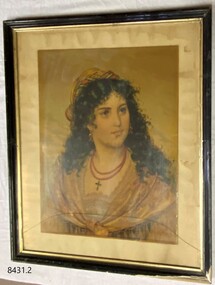
Artwork, other - A religious print and almanac, Australasian Church of Christ, 1892
... religious almanac with biblical imagery listed the Churches of Christ in Australasia and scripture readings for a calendar year of 1892. The almanac was produced and updated annually to reflect current information. The Churches of Christ in Australia is a Reformed Restorationist denomination. Congregations in South Australia, Victoria and New South Wales were established by individuals who travelled to these colonies to pursue employment opportunities, elsewhere in Australia Churches of Christ congregations were established as missionary initiatives. Churches of Christ in Victoria began with the arrival of the Ingram and Picton families...religious almanac with biblical imagery listed the Churches of Christ in Australasia and scripture readings for a calendar year of 1892. The almanac was produced and updated annually to reflect current information. The Churches of Christ in Australia is a Reformed Restorationist denomination. Congregations in South Australia, Victoria and New South Wales were established by individuals who travelled to these colonies to pursue employment opportunities, elsewhere in Australia Churches of Christ congregations were established as missionary initiatives. Churches of Christ in Victoria began with the arrival of the Ingram and Picton families ...This religious almanac with biblical imagery listed the Churches of Christ in Australasia and scripture readings for a calendar year of 1892. The almanac was produced and updated annually to reflect current information. The Churches of Christ in Australia is a Reformed Restorationist denomination. Congregations in South Australia, Victoria and New South Wales were established by individuals who travelled to these colonies to pursue employment opportunities, elsewhere in Australia Churches of Christ congregations were established as missionary initiatives. Churches of Christ in Victoria began with the arrival of the Ingram and Picton families from England who established regular meetings in Prahran and officially constituted a congregation in 1855. In Warrnambool plans were drawn up in 1883 for the erection of a Church of Christ at 12 Spence Street. The church was opened in 1885 with visiting pastors until a resident minister, A. J. Fisher, was appointed in 1915. This church was closed early in the 21st century when a new church, Gateway Church of Christ, was opened in Ragland Parade in Warrnambool. A rare survival of social and spiritual ephemera related to the Christian worship throughout Australia during the late nineteenth century. Portrait of a religious female figure wearing a simple dress with a crucifix around her neck. On the rear of the frame is an 1892 Australasian Church of Christ Almanac for suggested scripture readings. One of a pair.flagstaff hill, warrnambool, maritime museum, 1892, almanac, scripture readings, australiasian church of christ, church, religion, christianity -
 Kiewa Valley Historical Society
Books and Certificates - Baker Family
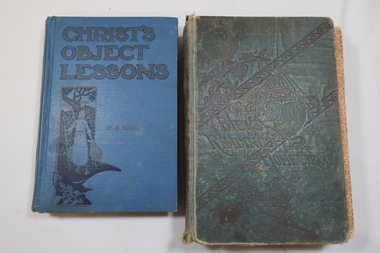
... Religious Organisation The Baker family lived in the Kiewa Valley. Their herd of 15 cows yielded an average of 5614 lbs. Milk 5.2% average test and 301.71 lbs. Butterfat in 273 days with allowances for junior cows in the year 1930-31 Baker Family Kiewa Valley Jehovah's Witness Dairy Farming 1. Book - 'Bible Readings ...History and Beliefs of Jehovah's Witness Religious OrganisationThe Baker family lived in the Kiewa Valley. Their herd of 15 cows yielded an average of 5614 lbs. Milk 5.2% average test and 301.71 lbs. Butterfat in 273 days with allowances for junior cows in the year 1930-31 1. Book - 'Bible Readings for Home Circle' 1906 2. Book - 'Christ's Object Lessons' 3. 8 small folded papers each with a religious message 4. Certificate to Mr J. Baker presented by the Royal Agricultural Society of Victoria re Dairy Herd in Oct. 1931 5. Certificate to L.A.C.I. G. Baker 49th Optl. Based Unit R.A.A.F. Shire of Yackandandah Feb. 1946baker family, kiewa valley, jehovah's witness, dairy farming -
 Eltham District Historical Society Inc
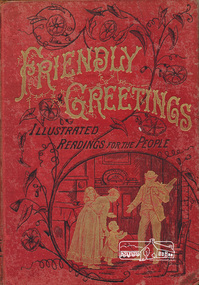
Book, Friendly Greetings: Illustrated Readings for the People. Profusely illustrated by the best artists
... religious theme and fine pencil illustrations. One of five items relating to the Shillinglaw Family collection The book was presented in 1886 to Caroline Shillinglaw, daughter of pioneer settlers in the Eltham area. shillinglaw family collection religious stories [written on loose flyleaf] Eltham Primitive Methodist Sabbath School - Presented to Caroline Shillinglaw as her share of Mr(?) Thompson's Special Prize for 2nd best attendance at Sabbath School, equally divided between her and her brother Willie, Sept 13th 1886 Hardcover Friendly Greetings: Illustrated Readings ...Book published before 1886 by The Religious Tract Society [England] including short stories with a religious theme and fine pencil illustrations. One of five items relating to the Shillinglaw Family collectionThe book was presented in 1886 to Caroline Shillinglaw, daughter of pioneer settlers in the Eltham area.Hardcover[written on loose flyleaf] Eltham Primitive Methodist Sabbath School - Presented to Caroline Shillinglaw as her share of Mr(?) Thompson's Special Prize for 2nd best attendance at Sabbath School, equally divided between her and her brother Willie, Sept 13th 1886shillinglaw family collection, religious stories -
 Warrnambool and District Historical Society Inc.
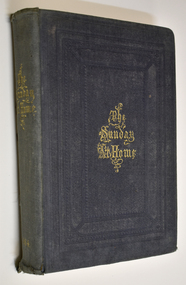
Book, The Religious Tract Society, The Sunday At Home A Family Magazine For Sabbath Reading, 1864
... religious readings warrnambool Sunday religious readings containing fiction and non fiction. This is a book of 844 pages. The cover is made of dark blue patterned material with gold printing on the front and spine. The pages contain articles, stories, sketches and black and white and coloured illustrations. The cover is damaged, particularly on the spine. Some of the pages are partly detached. The Sunday At Home A Family ...Sunday religious readings containing fiction and non fiction.This is a book of 844 pages. The cover is made of dark blue patterned material with gold printing on the front and spine. The pages contain articles, stories, sketches and black and white and coloured illustrations. The cover is damaged, particularly on the spine. Some of the pages are partly detached.fictionSunday religious readings containing fiction and non fiction.the sunday at home, religious readings, warrnambool -
 Uniting Church Archives - Synod of Victoria
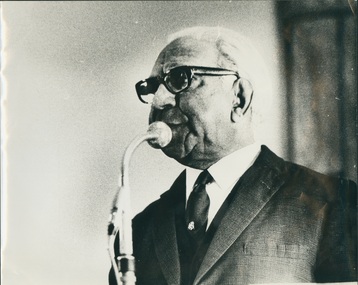
B&W photo of another photo or newspaper photograph of Pastor Sir Douglas Nicholls, Undated
... reading. His army service was brief, however, and he was discharged in Melbourne on compassionate grounds on 22 January 1942. His biographer claimed that the Fitzroy police requested his return to mediate in the racial tensions developing between servicemen and the mostly respectable Aboriginal families living in crowded and dilapidated Fitzroy housing; Aboriginal people maintain that they requested his release. Nicholls began welfare work and religious...reading. His army service was brief, however, and he was discharged in Melbourne on compassionate grounds on 22 January 1942. His biographer claimed that the Fitzroy police requested his return to mediate in the racial tensions developing between servicemen and the mostly respectable Aboriginal families living in crowded and dilapidated Fitzroy housing; Aboriginal people maintain that they requested his release. Nicholls began welfare work and religious ...Sir Douglas Ralph Nicholls (1906-1988), footballer, pastor, activist and governor, was born on 9 December 1906 at Cummeragunja Aboriginal mission, New South Wales, fifth child of Herbert Nicholls, seasonal worker, and his wife Florence, née Atkinson. Doug grew up at Cummeragunja, on the Murray River near Barmah, in its golden years of Aboriginal autonomy. Thomas Shadrach James gave him and other Yorta Yorta children a sound primary education, reinforcing the pride and self-assurance gained from their parents. As Doug grew, so too did the powers of the State’s Aboriginal Protection Board. Doug’s elder sister Hilda was removed about 1915. When Doug reached 14, he was moved off under the Aborigines Protection Act (1909) to find work. He took a job with dredging teams constructing levees on the Murray. Like other youths in the region Nicholls played Australian rules football, emulating kinsmen who had won local premierships since the 1890s. Doug and his brother Herbert (‘Dowie’) played with Tongala in the mid-1920s. Melbourne football beckoned, Doug trying out unsuccessfully for Carlton in 1927. He signed with the Northcote Victorian Football Association team, despite his nervousness about his Aboriginality, and was given a job with Northcote City Council. ‘Dowie’ joined him for a season. Doug was short at 5 ft 2 ins (158 cm), but muscular and lightning fast. He competed regularly during a boom in professional running, winning many heat and place prizes. In 1929 he won the Nyah and Warracknabeal gifts, earning a sash and £100 in each, together with a case of cutlery in the latter. Using his speed on the wing for Northcote, he produced great spring and agility from his compact body. The Sporting Globe reported in 1929 that ‘he flashes through packs of big men, whisks around small men . . . and attempts marks at the back of any six-footer’. In front-on clashes he was flattened only to rise again. The sole Aborigine in the VFA, he was known affectionately as the ‘flying Abo’ but called worse by his opponents’ barrackers. He competed for five seasons, being named ‘best and fairest’ twice, appearing in three association grand finals and winning in 1929. Keen to earn more than a seasonal wage, in 1931 Nicholls accepted a three-year contract with Jimmy Sharman’s travelling boxing show. The bouts matched opposites, local against tent boxer, white against black, and sometimes men of different sizes. He faced stiff competition from those who wanted to best the noted Melbourne black footballer, the crowd adding racial abuse. A far better footballer than boxer, he copped some punishment. Fighting in the Melbourne Stadium in December 1931, he was described by Truth as ‘slow and awkward’, but packing a ‘good wallop’. In 1932 Sharman, who treated his boxers fairly, released Nicholls to join the Fitzroy Victorian Football League team, which agreed to employ him as its groundsman. He played fifty-four games for Fitzroy over six seasons until knee trouble forced him out in 1937. Winning cups in 1934 and 1935, he played alongside Haydn Bunton and Wilfred (‘Chicken’) Smallhorn. Grand finals eluded him but he represented Victoria twice. Following his mother’s death, Nicholls revisited the Church of Christ chapel in Northcote, where they had worshipped together. On 17 July 1932 he experienced a conversion. He was soon baptised and witnessed openly, leading his fellow footballers to occasional church parades. Nicholls exhibited leadership qualities. William Cooper, founder of the Australian Aborigines’ League and Nicholls’ Yorta Yorta kinsman and fellow Christian, encouraged the young footballer. In February 1935 Cooper, Nicholls and others lobbied Thomas Paterson, the Commonwealth minister for the interior, over the need for Federal control of Aboriginal affairs. Nicholls attended the Day of Mourning protest for Aborigines held in Sydney on 26 January 1938, declaring: ‘after 150 years our people are still influenced and bossed by white people. I know we can proudly hold our own with others if given the chance’. When Cooper retired in November 1940 Nicholls became secretary of the AAL. On 2 June 1941 Nicholls enlisted in the Citizen Military Forces. He trained at Seymour and Bonegilla before being posted to the 29th Battalion. As Major Frank Corr’s batman, he was popular with other soldiers who tolerated his preaching and Bible reading. His army service was brief, however, and he was discharged in Melbourne on compassionate grounds on 22 January 1942. His biographer claimed that the Fitzroy police requested his return to mediate in the racial tensions developing between servicemen and the mostly respectable Aboriginal families living in crowded and dilapidated Fitzroy housing; Aboriginal people maintain that they requested his release. Nicholls began welfare work and religious services from an Aboriginal home in Gertrude Street, Fitzroy. In April 1942, ‘Dowie’ died of road accident trauma, leaving his wife, Gladys, née Bux, and three children. On 26 December 1942 at Moama Methodist Church, New South Wales, Nicholls married her, a caring gesture which developed into a loving partnership. In January 1943 he initiated ‘Aboriginal Sunday’, featuring a gum leaf orchestra and choir. By 1955 this service had moved to July and later evolved into National Aborigines and Islanders Day Observance Committee (NAIDOC) week. Ordained a Churches of Christ pastor in 1945, Nicholls conducted a vigorous ministry from a chapel in Gore Street, Fitzroy. His work survived on donations, a small honorarium, and his employment as team coach (1947) and curator at the Northcote Football Ground. In the 1950s Gladys established grocery and opportunity shops to earn income and provide services. Their house soon overflowed with people in need or visitors to Melbourne. Nicholls also hosted inspiring African American visitors such as the pianist Winifred Attwell and the singer Harry Belafonte. His ministry extended to Aboriginal country communities. Gladys taught Sunday school, undertook endless fund-raising and welfare work beside her husband, and became his greatest supporter and financial manager. They formed an Aboriginal Girls’ Hostel in 1956, for which they acted as house parents, and bought holiday units for Aborigines at Queenscliff. Persistently advocating Aboriginal rights, Nicholls protested about the impact of the Woomera rocket range on the people of the Warburton Ranges, co-ordinated the production of a concert, Out of the Dark, scripted by Jean Campbell, to rectify the omission of Aborigines from Victoria’s Commonwealth jubilee celebrations, and criticised the Victorian Aboriginal Protection Board. In 1957 when the board was transformed into the Aborigines’ Welfare Board, he and Harold Blair were appointed as Aboriginal representatives. Maintaining the stance of a political moderate, he did not bear grudges and sought to build bridges between black and white. He co-operated with any group that aided the cause, including the Council of Aboriginal Rights, whose executive were members of the Communist Party of Australia. This association attracted the attention of the Australian Security Intelligence Organization, which in 1957 began to keep a file on Nicholls. In May 1957 Nicholls formed the Victorian Aborigines Advancement League with Doris Blackburn and Gordon Bryant, a Federal parliamentarian. As its paid field officer and spokesman, Nicholls contested assimilation policies and used film to raise awareness of issues. When the Welfare Board attempted to close Lake Tyers reserve, Gippsland, he resigned in disgust and led a protest march on parliament in May 1963. The AAL also petitioned the United Nations on land rights in June, perhaps the first indigenous body to do so. He argued for new premises at 58 Cunningham Street, Northcote, opened in 1966 as the ‘Doug Nicholls Centre’. In 1958 Nicholls was a foundation member of the Federal Council for Aboriginal Advancement (Federal Council for the Advancement of Aboriginal and Torres Strait Islanders after 1964), which he served as national field officer (1961) and Victorian secretary (1962-63). While an innovator in tactics, he was alarmed by the influence of confrontational ‘black power’ politics in the AAL and resigned as a director amid turmoil on this issue in 1969, claiming the concept was a ‘bitter word’, not needed in Australia. Similar tensions in FCAATSI led him to join with Kath Walker (Oodgeroo Noonuccal) in establishing the short-lived National Tribal Council as an alternative forum. As the AAL leadership moderated their stance, he returned as president (1969-74) of the new all-Aboriginal organisation. He was also a keen patron of the National Aboriginal Sports Foundation, founded in 1969. Many honours were conferred on Nicholls: he was appointed MBE (1957) and OBE (1968) and knighted (1972). In 1962 he was named Victorian ‘Father of the Year’ and the State’s second Aboriginal justice of the peace. Crowned Melbourne’s 1973 King of Moomba, he was declared Bapu Mamus (a Torres Strait term for ‘headman’) by the NTC. On 1 December 1976 Sir Douglas was appointed Governor of South Australia, but his health deteriorated within weeks, making it difficult for him to perform his official duties. In March 1977 he hosted Queen Elizabeth during her royal tour and was appointed KCVO. He relinquished his governorship on 30 April 1977 following a stroke. Ill health continued to dog him during retirement, but he played his Nelson Eddy records, enjoyed his expanding family, and when able, ministered to the Aboriginal Church at the League’s premises. Sir Douglas Nicholls died on 4 June 1988 at Mooroopna, predeceased (1981) by his wife and survived by his five children. He was given a state funeral and buried in tribal ground at Cummeragunja cemetery. Among the many tributes to him are an oval at Northcote, handed to the AAL in 1982, a Canberra suburb gazetted in 1991, and a fellowship for Indigenous leadership established in 2003, all in his name, and a statue of Sir Doug and Lady Nicholls by Louis Laumen, unveiled in 2007 in Parliament Gardens, Melbourne. Sir Douglas Nicholls is shown speaking at a microphone; head and shoulders; dressed in a suit.Pastor Douglas Nicholls -
 Mont De Lancey
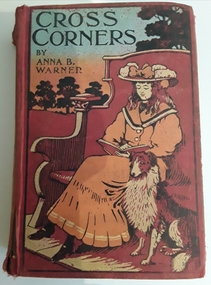
Book, Anna B Warner et al, Cross Corners, late 1800's
... religious themes. The life of a young girl in the late 1800's and her family. 1922 Hardcover novel, Cross Corners by Anna B Werner with red cover and coloured illustration of a young girl seated on a chair reading with her dog at her side. ...A late 18th Century novel with religious themes. The life of a young girl in the late 1800's and her family.Hardcover novel, Cross Corners by Anna B Werner with red cover and coloured illustration of a young girl seated on a chair reading with her dog at her side. Black lettering for title and author on cover and spine which also has a floral pattern and publisher listed.fictionA late 18th Century novel with religious themes. The life of a young girl in the late 1800's and her family.fiction, children's books, books, religion -
 Mont De Lancey
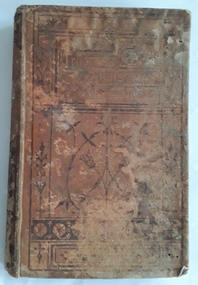
Book, The Religious Tract Society, Little Christmas and her friends, 1800's
... family life in the 1800's with it's trials and tribulations. Strong religious themes throughout. Lily Sebire for good attendance Tho. Hogg. Supt. Jan 1st 1878 A small badly damaged brown hardcover book with a floral and lined pattern in black on the front cover and spine including the title Little Christmas and her friends which is difficult to see due to its poor condition. Black and white illustrations throughout with a father and daughter reading ...A story of family life in the 1800's with it's trials and tribulations. Strong religious themes throughout.A small badly damaged brown hardcover book with a floral and lined pattern in black on the front cover and spine including the title Little Christmas and her friends which is difficult to see due to its poor condition. Black and white illustrations throughout with a father and daughter reading depicted on the title page. Book is badly water damaged and mould marks seen. The back cover has The Religious Tract Society symbol is embossed on the back cover. 160p.fictionA story of family life in the 1800's with it's trials and tribulations. Strong religious themes throughout.family life fiction, religous stories -
 Mont De Lancey
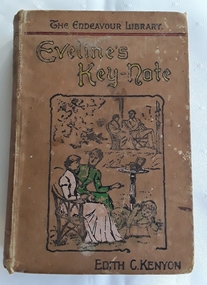
Book, Edith C. Kenyon, Eveline's Key-Note or In Harmony with Life, late 1800's
... family life fiction religious stories Victorian fiction with a moral slant for young women about life, growing up and relationships in an English village. M.S.S. Wandin Yallock Awarded to Nellie Gaudion for diligence & attendance. John Downham Supt. T Sebire Sec. March 31st 1906 Brown fabric hardcover book - Eveline's Key-Note by Edith C. Kenyon has an illustration in black. pink and green of two young women sitting on a garden seat with a girl lying on the grass next to them reading ...Victorian fiction with a moral slant for young women about life, growing up and relationships in an English village.Brown fabric hardcover book - Eveline's Key-Note by Edith C. Kenyon has an illustration in black. pink and green of two young women sitting on a garden seat with a girl lying on the grass next to them reading. In the background a couple are chatting. The top of the edges of the pages are gold. The Endeavour Library is written at the top in black lettering with the title in yellow underneath. The spine has the title, series and publisher initials at the bottom for The Sunday School Union, The frontispiece has a black and white illustration the same as is on the front cover. and there are five full page black and white illustrations throughout. The chapter heads have an Illuminated style decoration called a vignette. 192p.fictionVictorian fiction with a moral slant for young women about life, growing up and relationships in an English village. family life fiction, religious stories -
 Kilmore Historical Society
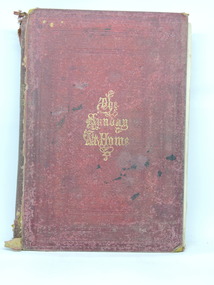
The Sunday at Home, 1875
... A British family magazine for Sabbath reading. Various religious themes....A British family magazine for Sabbath reading. Various religious themes. british family magazine whitburgh cottage collection sunday reading Nil. ...A British family magazine for Sabbath reading. Various religious themes.Red cloth-bound hardcover book. Front and back covers detached from spine, spine torn and very worn. Title and date (1875) in gold print front cover & spine. Fly leaf, title page and pp. 1-2 missing. last pages & back flyleaf missing. Foxing throughout, torn/ragged-edged pages. Pages gilt edged. 826 pp. Very poor condition.Nil.british family magazine, whitburgh cottage collection, sunday reading
