
Showing 3 items matching "robert milne-murray"
-
 Emerald Museum & Nobelius Heritage Park
Instrument - Obstetricah forceps, Milne-Murray, Robert, 1890s-1920s
... ...robert milne-murray...These Victorian-era 'action traction' obstetrical forceps were invented by Dr Robert Milne-Murray, a practicing physician at the Royal Maternity and the Simpson Memorial Pavilion in Edinburgh in 1891. ...Milne-Murray, Robert...These Victorian-era 'action traction' obstetrical forceps were invented by Dr Robert Milne-Murray, a practicing physician at the Royal Maternity and the Simpson Memorial Pavilion in Edinburgh in 1891. ...These Victorian-era obstetrical forceps are from the collection of equipment used by Dr William Bottomley. Dr Bottomley was born in Fitzroy in 1881 and obtained a Bachelor of Surgery from the University of Melbourne in 1906. He lived in South Yarra with a weekend log cabin called Forest Lodge in Emerald and practiced in Collins Street in Melbourne. These Victorian-era 'action traction' obstetrical forceps were invented by Dr Robert Milne-Murray, a practicing physician at the Royal Maternity and the Simpson Memorial Pavilion in Edinburgh in 1891. They were designed to allow the attending physician to obtain a secure hold on the infant before pulling backwards on the handle to facilitate the baby's birth. In the 1920s Dr Bottomley and business partner W.H. Treganowan initiated the Emerald Country Club syndicate to purchase land from Carl Axel Nobelius' Gembrook Nurseries estate, which led to the formation of the golf course and Country Club facilities. Bottomley Drive in Emerald is named after Dr Bottomley; the street is located near Silver Birches, the house commissioned by the doctor from modernist architect Harry Norris. 'Action traction' obstetrical forceps were invented by Dr Robert Milne-Murray, a practicing physician at the Royal Maternity and the Simpson Memorial Pavilion in Edinburgh in 1891. They were designed to allow the attending physician to obtain a secure hold on the infant before pulling backwards on the handle to facilitate the baby's birth. Forceps to extract fetuses from women who would otherwise die during complications in labour have been used as a last resort since 1500 BCE, though it has only been in the last 300-500 years that forcep design has shifted to focusing on saving the lives of both mother and infant. These are fenestrated forceps, with a hollow 'blade' or loop, which have been superseded as a design by solid models that are less likely to cause compression damage to the baby's head.These items are significant as they provide insights into medical practice in the early twentieth-century in Melbourne and surrounds. They are also significant because they were used by Dr William Bottomley, who owned property in Emerald and whose business dealings significantly shaped the development of the town.The silver-coloured item is approximately thirty centimetres long and features two rounded metal loops opened and closed by manipulating the stem of the object, which ends in short feet that attach to a separate handle.1890s, 1900s, 1910s william bottomley, w.h. treganowan, medical practice, women's health, obstetrics, forceps, robert milne-murray, birth, forest lodge, silver birches, harry norris, emerald country club and golf course -
Emerald Museum & Nobelius Heritage Park
Instrument - Obstetrical forceps, Milne-Murray, Robert, 1890s-1920s
... 'Action traction' obstetrical forceps were invented by Dr Robert Milne-Murray, a practicing physician at the Royal Maternity and the Simpson Memorial Pavilion in Edinburgh in 1891. ...Milne-Murray, Robert...'Action traction' obstetrical forceps were invented by Dr Robert Milne-Murray, a practicing physician at the Royal Maternity and the Simpson Memorial Pavilion in Edinburgh in 1891. ...These Victorian-era obstetrical forceps are from the collection of equipment used by Dr William Bottomley. Dr Bottomley was born in Fitzroy in 1881 and obtained a Bachelor of Surgery from the University of Melbourne in 1906. He lived in South Yarra with a weekend log cabin called Forest Lodge in Emerald and practiced in Collins Street in Melbourne. In the 1920s Dr Bottomley and business partner W.H. Treganowan initiated the Emerald Country Club syndicate to purchase land from Carl Axel Nobelius' Gembrook Nurseries estate, which led to the formation of the golf course and Country Club facilities. Bottomley Drive in Emerald is named after Dr Bottomley; the street is located near Silver Birches, the house commissioned by the doctor from modernist architect Harry Norris. 'Action traction' obstetrical forceps were invented by Dr Robert Milne-Murray, a practicing physician at the Royal Maternity and the Simpson Memorial Pavilion in Edinburgh in 1891. They were designed to allow the attending physician to obtain a secure hold on the infant before pulling backwards on the handle to facilitate the baby's birth. Forceps to extract fetuses from women who would otherwise die during complications in labour have been used as a last resort since 1500 BCE, though it has only been in the last 300-500 years that forceps design has shifted to focusing on saving the lives of both mother and infant. These are fenestrated forceps, with a hollow 'blade' or loop, which have been superseded as a design by solid models that are less likely to cause compression damage to the baby's head.These items are significant as they provide insights into medical practice in the early Twentieth-Century in Melbourne and surrounds. They are also significant because they were used by Dr William Bottomley, who owned property in Emerald and whose business dealings significantly shaped the development of the town.The silver-coloured item is approximately fifteen centimetres long; it has a solid metal handle bar and a stem leading to a flat panel with two holes that are designed to connect it to the body of the forceps. These forceps are from the collection of equipment used by Dr William Bottomley, who practiced in Collins Street in Melbourne after receiving his Bachelor of Surgery from the University of Melbourne in 1906. Dr Bottomley had a weekend residence in Emerald. In the 1920s Dr Bottomley and his business partner W.H. Treganowan initiated the Emerald Country Club syndicate and purchased land from the Gembrook Nurseries estate to build a golf course and Country Club.1890s, 1900s, 1910s william bottomley, w.h. treganowan, medical equipment, women's health, medical practice, forceps, birth, obstetrics, forest lodge, silver birches, harry norris, emerald country club and golf course -
 Lorne Historical Society
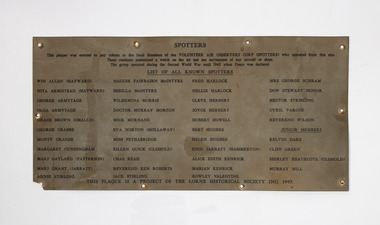
Plaque - Spotters Plaque, Tribute plaque to the local Members of the Volunteer Air Observers Corps ( spotters)
... It listed all the names of the know Spotters, Win Allen, Nita Armistead, George Armitage, Olga Armitage, Grace Brown, George Crabbe, Monty Craig’s, Margaret Cunningham, Marj Gaylord, Marj Grant, Annie Stirling, Margie Fairbairn, Sheila McIntyre, Wilhemena Morris, Murray Morton, Nick Murnane, Eva Norton, Miss Pethabridge, Eileen Quick, Chas Read, Rev Ken Robert’s, Jack Stirling, Fred Harlock, Nellie Harlock, Cleve Herbert, Joyce Herbert, Hubert Howell, Bert Hughes, Helen Hughes, Enid Jarrett, Alice Kendrick, Marion Kendrick, Rowley Valentine, Mrs G Schram, Don Stewart , Hector Stribling, Cyril Barcoe, Rev Wilson, Kevin Dare, Cliff Green, Shirley Heathcote, Murray Milne. ...It listed all the names of the know Spotters, Win Allen, Nita Armistead, George Armitage, Olga Armitage, Grace Brown, George Crabbe, Monty Craig’s, Margaret Cunningham, Marj Gaylord, Marj Grant, Annie Stirling, Margie Fairbairn, Sheila McIntyre, Wilhemena Morris, Murray Morton, Nick Murnane, Eva Norton, Miss Pethabridge, Eileen Quick, Chas Read, Rev Ken Robert’s, Jack Stirling, Fred Harlock, Nellie Harlock, Cleve Herbert, Joyce Herbert, Hubert Howell, Bert Hughes, Helen Hughes, Enid Jarrett, Alice Kendrick, Marion Kendrick, Rowley Valentine, Mrs G Schram, Don Stewart , Hector Stribling, Cyril Barcoe, Rev Wilson, Kevin Dare, Cliff Green, Shirley Heathcote, Murray Milne. ...In World War 2 residents of Victoria were concerned about enemy attack so a series of Spotters Huts were established along the coast. In Lorne the Spotters Hut was at Queenspark in the old recreation building. Many locals volunteered their time. The plaque was made by the Lorne Historical Society to honour these people who volunteered to join the Air Observers Corp. A rectangular thin Metal sheet , with black printing. This plaque was made in 1997 as a project of the Lorne Historical Society to pay tribute to the Spotters who worked in the spotters cabin at Queens Park Lorne during the Second World War. It listed all the names of the know Spotters, Win Allen, Nita Armistead, George Armitage, Olga Armitage, Grace Brown, George Crabbe, Monty Craig’s, Margaret Cunningham, Marj Gaylord, Marj Grant, Annie Stirling, Margie Fairbairn, Sheila McIntyre, Wilhemena Morris, Murray Morton, Nick Murnane, Eva Norton, Miss Pethabridge, Eileen Quick, Chas Read, Rev Ken Robert’s, Jack Stirling, Fred Harlock, Nellie Harlock, Cleve Herbert, Joyce Herbert, Hubert Howell, Bert Hughes, Helen Hughes, Enid Jarrett, Alice Kendrick, Marion Kendrick, Rowley Valentine, Mrs G Schram, Don Stewart , Hector Stribling, Cyril Barcoe, Rev Wilson, Kevin Dare, Cliff Green, Shirley Heathcote, Murray Milne. The plaque was placed on the Spotters Hut in 1997 but removed when the hut was remodeledspotters, world war 2, queens park, second world war
