
Showing 13 items matching "roman catholic church - bishops"
-
 The Celtic Club
Book, Colm Kiernan, Daniel Mannix and Ireland, 1984
... ...Roman catholic Church - Bishops...Daniel Mannix - Biography Roman catholic Church - Bishops Daniel Mannix, ardent Irish nationalist, spent half of his long life as Catholic bishop of Melbourne. ...Daniel Mannix, ardent Irish nationalist, spent half of his long life as Catholic bishop of Melbourne. The author traces the influence of Irish nationalism on one of the twentieth century's most remarkable churchmen.Index, bib, ill, maps. p.226.non-fictionDaniel Mannix, ardent Irish nationalist, spent half of his long life as Catholic bishop of Melbourne. The author traces the influence of Irish nationalism on one of the twentieth century's most remarkable churchmen.daniel mannix - biography, roman catholic church - bishops -
 Bendigo Historical Society Inc.
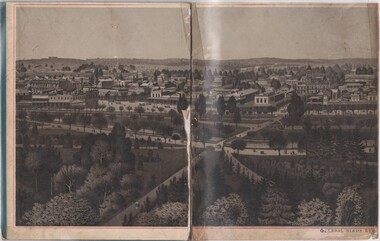
Photograph - National Trust Collection: "Album of Sandhurst Views" sketches of Bendigo buildings forming a leporello (folding book), 09/06/2025
... Paul's Church, All Saints Church, Roman Catholic Bishop's Palace, & Roman Catholic St. ...Paul's Church, All Saints Church, Roman Catholic Bishop's Palace, & Roman Catholic St. ...historic buildingNational Trust Collection: 12 pages with 24 sketches of buildings in Sandhurst (Bendigo), circa 1888. The book has been dismantled and the pages mounted on paper. The book was produced by Schutze, Steffens and Company, 272 Little Collins Street, Melbourne (refer 3084.101H). The book contains B&W high quality sketches of Sandhurst / Bendigo. 3084.101A & 3084.101B Cover of the book has been affixed to the paper no longer accessible. The two sketches, along with the two sketches on 3084.101B, provide a "general bird's eye view" of the development of Bendigo around 1888 across Rosiland Park 3084.101C Seven sketches - Sandhurst Savings Bank, Wesleyan Church, Congregational Church, S. Paul's Church, All Saints Church, Roman Catholic Bishop's Palace, & Roman Catholic St. Killian's Church 3084.101D Four sketches - Sandhurst Mechanic's Institute and School of Mines, Masonic Hall, Sandhurst Benevolent Asylum & Sandhurst State Scholl (Camp Hill PS) 3084.101E Three sketches - Alexandra Fountain and Pall Mall from Charing Cross, The Mining Exchange & Sandhurst Hospital 3084.101F Two sketches - Sandhurst Post office and Telegraph Offices, & Town Hall 3084.101G Four sketches - The Fernery in the City Reserve, The City Family Hotel, The New Chum Line of Reef, & Pioneer Battery at Long Gully. Also includes a newspaper cutting showing the redevelopment of the ANZ Bank site (Williamson Street & Pall Mall) which incorporates the wrought iron balustrade from the prior building on the site 3084.101H Messrs Schutze , Steffens & Company, 272 Little Collins Street Melbourne (the company produced the "Album of Sandhurst Views" book)views of significant buildings in sandhurst / bendigo circa 1888 -
 Flagstaff Hill Maritime Museum and Village
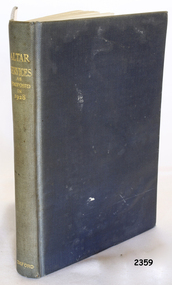
Book - Religious Reference liturgical Text, Oxford University Press, Alter Services as Proposed in 1928 (Holy Communion & 1928 Additions), 1927-1928
... In the 1920s the Church of England undertook a major revision of the Book of Common Prayer, chiefly to give more scope to Anglo Catholic eucharistic theology and practice, permitting reservation of the Sacrament, an alternative form of consecration closer to older Catholic patterns, and other changes. The revised book was approved by the Church Assembly and the bishops, but Parliament rejected it twice, in 1927 and 1928, after fierce debate in the Commons, largely on the grounds that it moved too far toward Roman Catholic doctrine on the Eucharist. ...In the 1920s the Church of England undertook a major revision of the Book of Common Prayer, chiefly to give more scope to Anglo Catholic eucharistic theology and practice, permitting reservation of the Sacrament, an alternative form of consecration closer to older Catholic patterns, and other changes. The revised book was approved by the Church Assembly and the bishops, but Parliament rejected it twice, in 1927 and 1928, after fierce debate in the Commons, largely on the grounds that it moved too far toward Roman Catholic doctrine on the Eucharist. ...This is a Church of England liturgical publication tied to the famous 1928 Prayer Book controversy. The subject book is a separately printed "altar service" edition of the Communion service, not a full Prayer Book, but the Communion rite alone, formatted for use at the altar, often in large print for the celebrant. Its full title spells out exactly what it contains: "The Order Of The Administration Of The Lord's Supper Or Holy Communion With The Additions And Deviations Proposed In 1928." These books are often catalogued informally under the spine title "Altar Services as proposed in 1928." It presents the traditional 1662 Communion service but interleaves or appends the changes proposed for the 1928 revision, hence "additions and deviations." This lets a priest see, side by side, what the existing 1662 rite said and what the proposed 1928 revision would change, for example, an added prayer, an alternative prayer of consecration, a repositioned Prayer of Oblation, etc.Hard cover book. Alter Services as Proposed in 1928 (Holy Communion & 1928 Additions) Author: Not Individually Authored Publisher: Oxford University Press. Milford House, London. Date: 1927-1928 Further Information: Hard cloth covered book blue in colour with gilt lettering to spine.non-fictionThis is a Church of England liturgical publication tied to the famous 1928 Prayer Book controversy. The subject book is a separately printed "altar service" edition of the Communion service, not a full Prayer Book, but the Communion rite alone, formatted for use at the altar, often in large print for the celebrant. Its full title spells out exactly what it contains: "The Order Of The Administration Of The Lord's Supper Or Holy Communion With The Additions And Deviations Proposed In 1928." These books are often catalogued informally under the spine title "Altar Services as proposed in 1928." It presents the traditional 1662 Communion service but interleaves or appends the changes proposed for the 1928 revision, hence "additions and deviations." This lets a priest see, side by side, what the existing 1662 rite said and what the proposed 1928 revision would change, for example, an added prayer, an alternative prayer of consecration, a repositioned Prayer of Oblation, etc.flagstaff hill, warrnambool, shipwrecked-coast, flagstaff-hill, flagstaff-hill-maritime-museum, maritime-museum, shipwreck-coast, flagstaff-hill-maritime-village, the order of the administration of the lords supper, book, communion text, religious book -
 The Beechworth Burke Museum
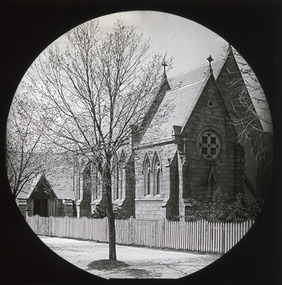
Photograph - Lantern Slide, c1900
... Roman Catholic Church in the town. Roman Catholicism quickly grew to be the second largest religious group in the area; this was primarily due to the work of Father William Tierney, a priest from Dublin who arrived in Beechworth in 1859. Tierney personally fostered the growth of many Catholic schools and churches in Beechworth, as he viewed it to be a significant area for the prosperity of the religion. St. Josephs Church was officially established in 1866, with the Bishop...Roman Catholic Church in the town. Roman Catholicism quickly grew to be the second largest religious group in the area; this was primarily due to the work of Father William Tierney, a priest from Dublin who arrived in Beechworth in 1859. Tierney personally fostered the growth of many Catholic schools and churches in Beechworth, as he viewed it to be a significant area for the prosperity of the religion. St. Josephs Church was officially established in 1866, with the Bishop ...Taken in the year 1900, this glass slide captures an image of St. Joseph's Church, a Roman Catholic Church that is still present today at 9 Church Street, Beechworth. This was one of many churches that was established in Beechworth during the second half of the nineteenth-century. This trend began with a focus on Anglican faith; however, in the early 1850s, Father Patrick Smyth, a priest from Maynooth, Ireland, advocated for the establishment of a Roman Catholic Church in the town. Roman Catholicism quickly grew to be the second largest religious group in the area; this was primarily due to the work of Father William Tierney, a priest from Dublin who arrived in Beechworth in 1859. Tierney personally fostered the growth of many Catholic schools and churches in Beechworth, as he viewed it to be a significant area for the prosperity of the religion. St. Josephs Church was officially established in 1866, with the Bishop of Melbourne, Dr Goold, laying the foundational stone of the building. The estimated cost of the building in its entirety was approximately twenty-thousand pounds. Further additions to the building - including a second aisle, tower and spire - were proposed for the church, but were ultimately never built. Lantern slides, sometimes called 'magic lantern' slides, are glass plates on which an image has been secured for the purpose of projection. Glass slides were etched or hand-painted for this purpose from the Eighteenth Century but the process became more popular and accessible to the public with the development of photographic-emulsion slides used with a 'Magic Lantern' device in the mid-Nineteenth Century. Photographic lantern slides comprise a double-negative emulsion layer (forming a positive image) between thin glass plates that are bound together. A number of processes existed to form and bind the emulsion layer to the base plate, including the albumen, wet plate collodion, gelatine dry plate and woodburytype techniques. Lantern slides and magic lantern technologies are seen as foundational precursors to the development of modern photography and film-making techniques.This glass slide captures social and historical significance as it represents the development of Beechworth as a prosperous and thriving town; a development that occurred during the second half of the nineteenth-century. It also shows the development of religious institutions in the area, specifically the growth of Catholicism. Thin translucent sheet of glass with a circular image printed on the front and framed in a black backing. It is held together by metal strips to secure the edges of the slide.burke museum, beechworth, lantern slide, slide, glass slide, plate, burke museum collection, photograph, monochrome, churches beechworth, st. joseph's church, catholicism beechworth, roman catholic churches beechworth, father patrick smyth, father william tierney -
 Bendigo Historical Society Inc.
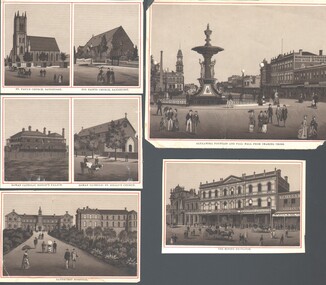
Photograph - WES HARRY COLLECTION: SANDHURST VIEWS, 1888
... Paul's Church, Sandhurst, All saints Church, Sandhurst, (b) Roman Catholic Bishop's Palace, Roman Catholic St. ...Bishops Palace St. Kilian's Church St. Paul's All Saints A collection of artists drawings cut from 'Album of Sandhurst Views' 1888. (a) St. Paul's Church, Sandhurst, All saints Church, Sandhurst, (b) Roman Catholic Bishop's Palace, Roman Catholic St. ...A collection of artists drawings cut from 'Album of Sandhurst Views' 1888. (a) St. Paul's Church, Sandhurst, All saints Church, Sandhurst, (b) Roman Catholic Bishop's Palace, Roman Catholic St. Kilian's Church, (c) The Mining Exchange, (d) Sandhurst Hospital, (e) Alexandra Fountain and Pall Mall from Charing Cross.buildings, vaious, alexandra fountain, charing cross, pall mall, hospital, mining exchange, bishops palace, st. kilian's church, st. paul's, all saints -
 Bendigo Historical Society Inc.
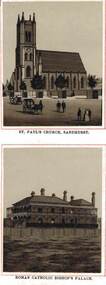
Photograph - ST PAUL'S CHURCH SANDHURST / ROMAN CATHOLIC BISHOP'S PALACE
... Sepia photos taken from the 'Album of Sandhurst Views' Published by Messrs Schutz & Co, Melbourne, Pictured are the St Paul's Church Sandhurst & Roman Catholic Bishop's Palace. St Pauls photo has street scene showing a horse drawn cabs, one to the left, and one to the right. ...ORGANIZATION Church bendigo churches Bendigo Churches Sandhurst Churches Churches Sepia photos taken from the 'Album of Sandhurst Views' Published by Messrs Schutz & Co, Melbourne, Pictured are the St Paul's Church Sandhurst & Roman Catholic Bishop's Palace. St Pauls photo has street scene showing a horse drawn cabs, one to the left, and one to the right. ...Sepia photos taken from the 'Album of Sandhurst Views' Published by Messrs Schutz & Co, Melbourne, Pictured are the St Paul's Church Sandhurst & Roman Catholic Bishop's Palace. St Pauls photo has street scene showing a horse drawn cabs, one to the left, and one to the right. The Bishop's Palace has open ground in the foreground and a high picket fence in front of the building.organization, church, bendigo churches, bendigo churches, sandhurst churches, churches -
 Port Melbourne Historical & Preservation Society
Photograph - O'Collins family, parents, 8 children, a bishop, 2 priests, 2 nuns, a doctor, a lawyer and a school teacher, 1930s
... O'Collins family Joe O'COLLINS Gerald O'COLLINS Madge O'COLLINS Will O'COLLINS Frank O'COLLINS Mollie O'COLLINS Pat O'COLLINS James O'COLLINS Ellen O'COLLINS Alice O'COLLINS Religion - Roman Catholic Church (St Josephs) Photo of the O'Collins family. Mother, father and 8 children comprising a Bishop, 2 priests, 2 nuns, a doctor, a lawyer and school teacher Photograph O'Collins family, parents, 8 children, a bishop, 2 priests, 2 nuns, a doctor, a lawyer and a school teacher ...O'COLLINS Family. Standing L - R- Joe, Gerald, Madge, Will, Frank. Seated L - R Mollie, Pat (Father) James, Ellen (Mother) Alice .Photo of the O'Collins family. Mother, father and 8 children comprising a Bishop, 2 priests, 2 nuns, a doctor, a lawyer and school teachero'collins family, joe o'collins, gerald o'collins, madge o'collins, will o'collins, frank o'collins, mollie o'collins, pat o'collins, james o'collins, ellen o'collins, alice o'collins, religion - roman catholic church (st josephs) -
Glen Eira Historical Society
Plan - St Patrick’s Roman Catholic Church, Murrumbeena
... Bishop... Parish... North Road... Ellis Robert O... Clergy... Malvern East... Memorials... Parish of Ormond... East Boundary Road... Dalny Road... Rovira William Rev... Quillinan James Rev... Church furniture... Murrumbeena Road.... Memorial Stone... Mannix Daniel Archbishop... Pollard K... Catholic Church... M.P Arbory and Co.... St Patrick’s Roman...church exterior as the cover and two photographs of the reverends. Inside the booklet. Glen Huntly Religious Services Tweedy E. V Cremin Patrick Rev. Murrumbeena Fox Bishop Parish North Road Ellis Robert O Clergy Malvern East Memorials Parish of Ormond East Boundary Road Dalny Road Rovira William Rev Quillinan James Rev Church furniture Murrumbeena Road. Memorial Stone Mannix Daniel Archbishop Pollard K Catholic Church M.P Arbory and Co. St Patrick’s Roman ...There is a photocopy of the commemorating booklet for the blessing and opening of St Patrick’s Memorial Catholic Church Murrumbeena on 15 August 1963. It also includes a brief history of the parish, a plan of the church and a sketch of the church exterior. Second there is an unattributed undated research note of the memorial stones for St Patrick’s Catholic Church and school Murrumbeena. Third is an unattributed, undated handwritten notes on St Patrick’s School buildings regarding teaching sisters and dates when additional classrooms were built. The fourth document is a six page brochure seeking donations from parishioners to commence on 10/04/1966. It includes the church’s financial statement, a picture of the church exterior as the cover and two photographs of the reverends. Inside the booklet.glen huntly, religious services, tweedy e. v, cremin patrick rev., murrumbeena, fox bishop, parish, north road, ellis robert o, clergy, malvern east, memorials, parish of ormond, east boundary road, dalny road, rovira william rev, quillinan james rev, church furniture, murrumbeena road., memorial stone, mannix daniel archbishop, pollard k, catholic church, m.p arbory and co., st patrick’s roman catholic church murrumbeena -
 Lake Bolac & District Historical Society
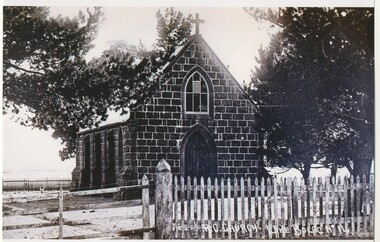
Black and white photograph, St. Bernards Roman Catholic Church, Lake Bolac
... St Bernard's Roman Catholic Church, Lake Bolac, Pitkethley, Bishop Gould...Roman Catholic Church, Lake Bolac. Built by Robert Pitkethley on the west bank of the lake and completed in 1874. It was consecrated by Bishop...St Bernard's Roman Catholic Church, Lake Bolac, Pitkethley, Bishop Gould St. Bernards Roman Catholic Church, Lake Bolac. ...St Bernard's Roman Catholic Church, Lake Bolac. Built by Robert Pitkethley on the west bank of the lake and completed in 1874. It was consecrated by Bishop Gould of Melbourne.st bernard's roman catholic church, lake bolac, pitkethley, bishop gould -
 Wodonga & District Historical Society Inc
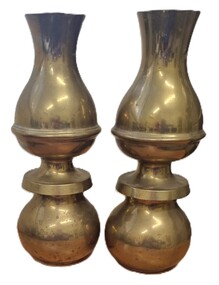
Decorative object - Brassware - St Augustines Church, Wodonga, T. Gaunt & Co, c1900
... St Augustine’s Church, Wodonga The Roman Catholic religion first came to the Wodonga area with travelling clergymen in about 1843. It was not until 4th October that 1860 Bishop Goold of the Chiltern parish visited Wodonga and consecrated St. ...St Augustine’s Church, Wodonga The Roman Catholic religion first came to the Wodonga area with travelling clergymen in about 1843. It was not until 4th October that 1860 Bishop Goold of the Chiltern parish visited Wodonga and consecrated St. ...St Augustine’s Church, Wodonga The Roman Catholic religion first came to the Wodonga area with travelling clergymen in about 1843. It was not until 4th October that 1860 Bishop Goold of the Chiltern parish visited Wodonga and consecrated St. Francis Chapel, a small weatherboard building which was erected on the site of the present St Augustine’s Church. Wodonga was officially separated from the Chiltern parish in 1899. Father James Ryan became the first Parish Priest of St Augustine's and oversaw the construction of the new church. The present St. Augustine’s was blessed and opened on 27 April 1902. Between 1918–1919 under Father Francis Flynn, the church was extended, and significant features such as the marble altar and stained-glass windows were added. Major refurbishments were completed in 1927, including further extension of the primary school. T. Gaunt & Co. Thomas Gaunt arrived in Melbourne in about 1856. He was a trained clockmaker and opened a business in Bourke Street, later moving to The Royal Arcade. Although he also made and sold wrist watches, jewellery, silver and brassware, Thomas was possibly most well-known for a chronometer he donated to the Victorian Racing Club for whom he was official timekeeper. It displayed the time of a race to an accuracy of .25 of a second. Gaunt had strong beliefs and connection to the Catholic Church of supplied much of its ecclesiastical silver and brassware such as this item. After Thomas Gaunt died in 1890, his executors continued the business, which was renamed T. Gaunt & Co. in 1893. The company operated for almost a century before closing in 1960. These items are significant because they were used in an important Wodonga church.A set of four brass vases manufactured by T Gaunt & Co.Beneath each vase T. GAUNT & Co.church brassware, st augustine's church wodonga, t gaunt & co -
 Ballarat Heritage Services
Photograph, Italian Holy Cards from the 1860s
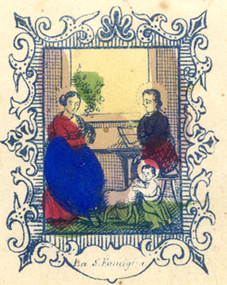
... Church as a Martyr. Many Roman Catholics also venerate her to this day as one of the great virgin saints of the early Church. During the medieval period, St. Catherine was one of the most famous saints of the Church. She has was a popular subject in renaissance art and many paintings from the period are dedicated to her. St. Henry, son of Henry, Duke of Bavaria, and of Gisella, daughter of Conrad, King of Burgundy, was born in 972. He received an excellent education under the care of St. Wolfgang, Bishop...Church as a Martyr. Many Roman Catholics also venerate her to this day as one of the great virgin saints of the early Church. During the medieval period, St. Catherine was one of the most famous saints of the Church. She has was a popular subject in renaissance art and many paintings from the period are dedicated to her. St. Henry, son of Henry, Duke of Bavaria, and of Gisella, daughter of Conrad, King of Burgundy, was born in 972. He received an excellent education under the care of St. Wolfgang, Bishop ...The Sanctuary of the Blessed Virgin of the Coast is located in the picturesque municipality of San Giovanni Bianco, is a fascinating example of a subsidiary church immersed in the greenery of the mountains. Its privileged location, at an altitude offering breathtaking views, has made this place an important point of reference for the local community since its founding. The church, characterized by a simple yet elegant architectural style, features a façade that exudes serenity and welcome, inviting visitors to discover its history and significance. The feast of the Blessed Virgin of the Coast is celebrated every year on 15 August, becoming a moment of joy and sharing for the community. True Image of the Blessed Virgin venerated in the Church of the Costa of St. Gall One black and white holy card shows an artwork of the Blessed Virgin, St. Joseph, and the Magi and is venerated in the Church of the Costa of S. Gallo. The history of the sanctuary has its roots in an extraordinary event that occurred on 04 April 1492. A sacred image depicting the Virgin Mary, kept in the home of Caterina Lupis, was the scene of a miracle: tears of blood flowed from the painting. This event, interpreted as a divine sign, stirred great emotion and devotion in the local community. After a series of miraculous events, the Madonna herself expressed the desire to build a sanctuary in her honor, in a specific place: the coast overlooking the town and the hamlets of San Giovanni. Construction of the sanctuary began in 1492, marking the beginning of a story of faith and devotion that continues to this day. S. Antonio Abate, or St Anthony the Abbot Anthony the Abbot, Saint Anthony the Great, Saint Anthony of Egypt, Saint Anthony of the Fire, Saint Anthony of the Desert and Saint Anthony the Anchorite , ( Qumans , 12 January 251 – Thebaid Desert , 17 January 356 ) was an Egyptian abbot and hermit. A contemporary of Paul of Thebes, he is considered the founder of Christian monasticism and the first of the abbots; he is responsible for the permanent establishment of families of monks who, under the guidance of a spiritual father, abba, consecrated themselves to the service of God. His life has been handed down by his disciple Athanasius of Alexandria. He is one of the four Fathers of the Eastern Church who bear the title of "Great" together with Athanasius himself, Basil and Photius of Constantinople. He is remembered in the Calendar of Saints of the Catholic Church and the Lutheran Church on January 17, but the Coptic Orthodox Church celebrates him on January 31, which corresponds, in its calendar, to the 22nd of the month of Tobit . St Catherine of Alexandra was a martyr. T he emperor angrily ordered her to be executed on a breaking wheel. The breaking wheel is an ancient form of torture where a person's limbs are threaded among the spokes and their bones are shattered by an executioner with a heavy rod. It is a brutal punishment that results in a slow and painful death, normally reserved for the worst criminals. When Catherine was presented before the wheel, she touched it and a miracle occurred that caused the wheel to shatter. Unable to torture her to death, the emperor simply ordered her beheaded. Around the year 800, a legend spread that her body has been found with her hair still growing and a constant stream of oil coming from her body. Nothing exists to this day of her remains, and her very existence has been called into question. Despite these questions, and the possibility that her story may be confused with that of one or more other saints, she is still venerated in the Eastern Orthodox Church as a Martyr. Many Roman Catholics also venerate her to this day as one of the great virgin saints of the early Church. During the medieval period, St. Catherine was one of the most famous saints of the Church. She has was a popular subject in renaissance art and many paintings from the period are dedicated to her. St. Henry, son of Henry, Duke of Bavaria, and of Gisella, daughter of Conrad, King of Burgundy, was born in 972. He received an excellent education under the care of St. Wolfgang, Bishop of Ratisbon. In 995, St. Henry succeeded his father as Duke of Bavaria, and in 1002, upon the death of his cousin, Otho III, he was elected emperor. Firmly anchored upon the great eternal truths, which the practice of meditation kept alive in his heart, he was not elated by this dignity and sought in all things, the greater glory of God. He was most watchful over the welfare of the Church and exerted his zeal for the maintenance of ecclesiastical discipline through the instrumentality of the Bishops. He gained several victories over his enemies, both at home and abroad, but he used these with great moderation and clemency. In 1014, he went to Rome and received the imperial crown at the hands of Pope Benedict VIII. On that occasion he confirmed the donation, made by his predecessors to the Pope, of the sovereignty of Rome and the exarchate of Ravenna. Circumstances several times drove the holy Emperor into war, from which he always came forth victorious. He led an army to the south of Italy against the Saracens and their allies, the Greeks, and drove them from the country. The humility and spirit of justice of the Saint were equal to his zeal for religion. He cast himself at the feet of Herebert, Bishop of Cologne, and begged his pardon for having treated him with coldness, on account of a misunderstanding. He wished to abdicate and retire into a monastery, but yielded to the advice of the Abbot of Verdun, and retained his dignity. Both he and his wife, St. Cunegundes, lived in perpetual chastity, to which they had bound themselves by vow. The Saint made numerous pious foundations, gave liberally to pious institutions and built the Cathedral of Bamberg. His holy death occurred at the castle of Grone, near Halberstad, in 1024. His feast day is July 13th. He is the patron saint of the childless, of Dukes, of the handicapped and those rejected by Religious Order. What we know of St. Elizabeth comes from the Gospel, the book of Luke, in particular. In Luke, Elizabeth, a daughter of the line of Aaron, and the wife of Zechariah, was "righteous before God" and was "blameless" but childless. Elizabeth is also a cousin to the Virgin Mary.What we know of St. Elizabeth comes from the Gospel, the book of Luke, in particular. In Luke, Elizabeth, a daughter of the line of Aaron, and the wife of Zechariah, was "righteous before God" and was "blameless" but childless. Elizabeth is also a cousin to the Virgin Mary. Five holy cards from San Gallo, Lombardy, Italy, carried by Luigi Gervasoni in a small prayer book that he carried to Australia. Two of the Holy Cards are hand coloured, and one mentions the Church were he was baptised, The Chiesa della Costa di S. Gallo. caterina lupis, san gallo, luigi gervasoni, italy, saint elizabeth, san giovanni bianco, chiesa di costa san giovanni bianco, holy family, saint anthony the abbot, st catherine -
 Ballarat Heritage Services
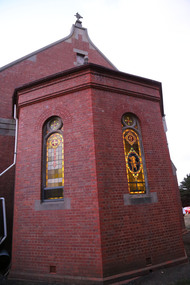
Digital photographs, L.J. Gervasoni, St Brigid's Crossley - Christmas Carols - stained glass windows night, 12/2016
... CHURCH. BLESSING AND OPENING CEREMONY. A lasting testimony to the faithful generosity of the Catholic community at Crossley was vouchsafed on Sunday last, when the beautiful new church of St. Brigid was formally blessed and opened, in the presence of a particularly large congregation of adherents of the Roman Catholic faith, and many supporters of the doctrines of other churches. The function was further enhanced by the presence of two noted Catholics in Dr. Higgins (Bishop...CHURCH. BLESSING AND OPENING CEREMONY. A lasting testimony to the faithful generosity of the Catholic community at Crossley was vouchsafed on Sunday last, when the beautiful new church of St. Brigid was formally blessed and opened, in the presence of a particularly large congregation of adherents of the Roman Catholic faith, and many supporters of the doctrines of other churches. The function was further enhanced by the presence of two noted Catholics in Dr. Higgins (Bishop ..."NEW CROSSLEY CHURCH. BLESSING AND OPENING CEREMONY. A lasting testimony to the faithful generosity of the Catholic community at Crossley was vouchsafed on Sunday last, when the beautiful new church of St. Brigid was formally blessed and opened, in the presence of a particularly large congregation of adherents of the Roman Catholic faith, and many supporters of the doctrines of other churches. The function was further enhanced by the presence of two noted Catholics in Dr. Higgins (Bishop of Ballarat) and Dr. Mannix (Coadjutor Archbishop of Melbourne.) Upon arrival at the church the prelates were received by a guard of honor formed by the members of the H.A.C.B. Society, and were introduced to the members of the local committee. Then his Lordship the Bishop formally blessed the exterior and interior of the building. The building is handsome and commo dious, and one that should suffice for the population of the Crossley district for many years to come. Standing upon the highest point in the vicinity it occupies a commanding position and is a prominent landmark for many miles around. At first it was intended to pull down the old church and erect the new one upon the space occupied by it, but subsequently the land adjoining was purchased, and the sacred edifice built upon it. The style of architecture is a free treatment of the Romanesque. In a short space of time the grounds and walks were transformed by working bees and made to conform to the beauty of the building. The interior is most artistic, and would be difficult to improve upon in elegance of design, while the furnishings are most appropriate, and harmonise excellently with the general scheme of decoration. It seats 400 people and in addition there is a choir gallery with a seating capacity of 60. The church is lighted with leaded Cathedral glass windows, and the front presents a pleasing appearance, the entrance porch being surmounted with a semi-Gothic window. The floor is tiled throughout. The ceilings are semi-circular in form, with beautiful designs worked in fibrous plaster. The brickwork of the structure is faced with cement, and it has a slate roof. It is undoubtedly an addition to the ecclesiastical buildings of the district, and was universally admired. The architect was Mr. A. A. Fritsch, of Melbourne, and the contractors Messrs F. and E. Deague, of North Fitzroy. On the doors being thrown open for the admission of the congregation, the seating accommodation was immediately fully taxed, and the lengthy service and sermon were listened to with the greatest interest and attention. Missa Cantata was sung, the Rev. Father Phelan, Koroit, being the celebrant. The musical arrangements were in the capable hands of Mr. Renwick, of Warrnambool, while Miss Logan presided at the organ. Mrs. Dan. Ryan was the soprano soloist, and sang Gounod's Ave Maria at the offertory very sweetly and expressively. At the consecration Rossi's Tantum Ergo was sung by Messrs Crowley and Renwick; Farmer's Kyrie Gloria and Agnus Dei and Webb's Credo were rendered during mass, and while the collection was being taken additional numbers were sung. The occasional sermon was preached by the Coadjutor Archbishop (Dr. Mannix), who based his remarks upon the Gospel for the day, St. Luke V., verses I to II, dealing with the miraculous draught of fish. On His return from Galilee Christ found that the fishermen had been toiling all night, and had caught nothing. He entered one of the ships, and addressed the multitude on shore. It was a beautiful picture, and no doubt he spoke to them about the kingdom to be established on earth. When He had finished speaking He told the fishermen to launch out into the deep. Peter said " Master, we have fished all night, and have found nothing." Still, they obeyed His command, and the nets were filled almost to breaking point. Having brought their ships to land they left everything and followed Him. In that lesson they had a symbol of God's dealing with men through the church He has established on earth. Their confidence was richly rewarded, and Christ founded His church upon those twelve Apostles. At that time the world was mostly pagan, steeped in iniquity and sin. The chosen people of God worshipped with their lips, but their hearts were far from it. When Christ wanted to estab lish His church on earth, and leave an organisation to carry on the work, did He select the most intellectual, or the most rich or powerful men? Neither did the time seem propitious. He selected twelve men who from a human point of view were quite incapable of accomplishing anything. What happened when the Jews put Him to death? The chosen twelve left Him at the critical hour, and when He came to die on the cross they were not there, but hid themselves from the hate and fury of the Jews. When the Holy Ghost came down upon them and strengthened them they became courageous and went forth at the bidding of their Master to teach all nations. Their success was not confined to the first meet ing after Pentecost, at which they made 5000 converts, but continued until the whole world had been brought into the net. It was surely a consolation to them as well as to him (the preacher), that they came from a land which of all others had been faithful to the teaching of Jesus Christ. The sons and daughters of St. Patrick had taken a great part in bringing men into the meshes of the church. It was due to the nation they belonged to that the church flourished not only in Ireland, but in England, Scotland, Ame rica, and Australia. It may have seemed hard that in the providence of God so many had to leave their homes and find a home in other lands. They had emi grated to the towns of England and Scotland, and had been the means of keeping the Catholic faith living in those places. In the United States and Canada many had made a home for themselves, and were always found faithful to God and to the true church. If to-day the Irish Catholics and Catholics of Irish des cent were taken out of the English and Scotch population there would be little left of the true Church of God. Perhaps they had not the learning of other nations. Certainly they had not the wealth of other nations, and not the power of the sword, but God was with them, and the faith they took from the old land nourished in the distant places. There was a time in Aus tralia when those opposed to God and God's Church thought they could rule Providence and make Australia a Pro testant land. They had lived to see whe ther God or His enemies are the more powerful, and the names of those who tried to stamp out the Catholic religion were forgotten, or only remembered be cause of their persecution. They had lived to see the glorious success which rested upon the Catholic Church in Aus-tralia, which the Irish people had built up stone by stone. Nowhere was it held in higher esteem than in these islands, and the people would always be faithful to God and His church. It was an inspira tion to go into the glorious church opened that day. It stood for loyalty and faith fulness and was a credit and a consola tion to the Bishop and people of the diocese, to the architect, and to the priests and the honest and zealous administrator of the parish. There was hope and an inspiration in that day's celebrations, and surely the Catholic faith would sink deeper and deeper into the people as time went on, and the progress of the last fifty years would be small as compared to the progress of the future. He congratulated the Bishop and priests who had raised that temple, and the people of Crossley upon their generosity and self-sacrifice. He prayed that the blessing of God and St. Brigid would rest upon them, their children, and their children's children. He hoped that not one of those who had received the sacrament at that church would be missing when called before the Judgment Seat, and that all would be counted into the enjoyment of eternal bliss. The Rev. Father Kerin then made a statement of the position of the finances, after which a special col lection was made towards the cost of the building. A list of subscribers of £l and upwards was read, to which Bishop Higgins contributed £250, Rev. Father Kerin £20, and the Coadjutor Archbishop £5. The amount totalled £1245 10s 7d. Pre vious donations totalled £1077 3s, and His Lordship gave an additional £250. An indebtedness of £3974 had been reduced by £1245, leaving a debit balance of £2728. The cost ot the church completed was £6250. They had broken the back of the debt, and were not frightened of it. It was also announced that the beautiful Stations of the Cross, which adorn the walls, had been donated by the following: Mr and Mrs. P. Crowe, Mr. and Mrs. T. Bushell, Mr. and Mrs. P. Gorman, Miss M. Dunne, Mr. Mugavin and Miss Mugavin, Mr. and Mrs. C. Conway, Misses A. and F. Broderick, Mr. and Mrs. Michael Hennessy, Miss K. A. M'Carthy, Mr. and Mrs. Wm. Dalton, Mrs. M. J. Greene, Mrs. and Miss K. Dwyer, Mr. and Mrs. John Mugavin, and the Rev. J. J. Manning. The new Estey organ was contributed by the school children, as the result of an enter tainment. Other donors of furnishings, etc., were Mrs. Brown, senr., (Kirkstall), and Mrs. James Maloney (Killarney), and Mrs. and Miss O'Donohue. The vestments were the gifts of Mr. and Mrs. M. Foley, of Killarney. The furnishings, carpeting, etc., of the sanctuary have been carried out by the Crossley Altar Society, of which Mrs. Jno. O'Brien is president, and Miss Mary Ryan secretary. In the course of a brief address Dr. Higgins expressed his deep indebtedness to the Coadjutor Archbishop for coming amongst them at a great sacrifice to assist in the ceremonies. He heartily thanked the people for their unbounded generosity, and congratulated priests and people upon the magnificent results of their efforts. They had an able champion in Dr. Mannix, who since coming amongst them had distinguished himself by his zeal for the church in this new land. He hoped he would be spared for many years to come to use his splendid talents in the service of the church. (Koroit Sentinel and Tower Hill Advocate, Saturday 4 July 1914, page 2)Digital images of the cathedral leadlight windowns in St Brigid's catholic Church, Crossley. st brigid's crossley, st brigid's, catholic church, catholic, church, religion, celebrations, christmas, christmas carols, carols, stained glass, window -
 Sunbury Family History and Heritage Society Inc.
Photograph
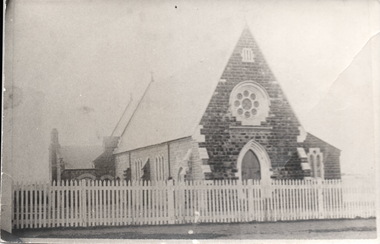
... Mary's Roman Catholic Church which is in Macedon Street, Sunbury. The Catholic Bishop of Melbourne, Rev. ...Mary's Roman Catholic Church which is in Macedon Street, Sunbury. The Catholic Bishop of Melbourne, Rev. ...This is an early photograph of St. Mary's Roman Catholic Church which is in Macedon Street, Sunbury. The Catholic Bishop of Melbourne, Rev. D J Gould laid the foundation stone on 13th December 1864. Since then the stone cannot be located on its original site. Later the church was renamed Our Lady of Mount Carmel to avoid confusion as the Anglican Church was named St. Mary's Church of England.An old black and white photograph of a bluestone church with a pitched roof and a white picket fence across the front.our lady of mount carmel catholic church, macedon street, st. mary's roman catholic church
