
Showing 15 items matching "rome - travel"
-
 Mrs Aeneas Gunn Memorial Library
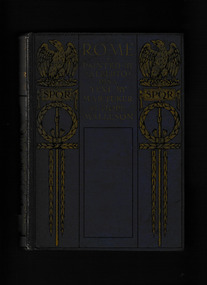
Book, A.C. Black et al, Rome, 1905
... ...Rome - Travel...Rome - Description Rome - Travel A travellers guide to Rome Index, ill, p.267. ...A travellers guide to RomeIndex, ill, p.267.non-fictionA travellers guide to Romerome - description, rome - travel -
 Mrs Aeneas Gunn Memorial Library
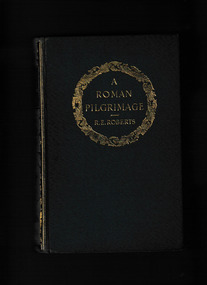
Book, Methuen, Roman pilgrimage, 1911
... ...Rome - Travel...Rome - Description Rome - Travel A travellers guide to Roma Index, ill, p.274. ...A travellers guide to RomaIndex, ill, p.274.non-fictionA travellers guide to Romarome - description, rome - travel -
 Ballarat Heritage Services
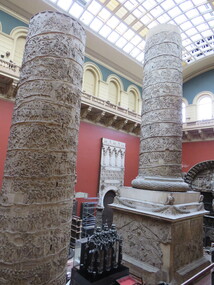
Digital photograph, Dorothy Wickham, Trajan's Columns, Victoria & Albert Museum, London, 2016, 09/2016
... Displayed in the Architectural Courts from the time of their opening in 1873, it provided the opportunity for students (and others not able to travel to Rome) to see this iconic monument of the classical world. ...Displayed in the Architectural Courts from the time of their opening in 1873, it provided the opportunity for students (and others not able to travel to Rome) to see this iconic monument of the classical world. ...These original columns are marble, made in 113AD. They come from Rome, Italy and are held in the Cast Courts at the Victoria & Albert Museum, London. The collection of casts at the museum is one of the most important in the world. Their original purpose was educational when it was not easy to trail and see original works. they thus provided an opportunity for students to study. The Cast Courts opened in 1873 and allowed the display of large monuments. These galleries are currently divided by nationality. Photograph of a cast of Trajan's Column at the Victoria & Albert Museum, London. The column has been displayed in two parts. he massive cast is a tremendous feat of both engineering and casting. Displayed in the Architectural Courts from the time of their opening in 1873, it provided the opportunity for students (and others not able to travel to Rome) to see this iconic monument of the classical world. The cast of the column is made up of sections of plaster reliefs that are attached to an inner chimney built of brick. Each section was individually numbered so that the column could easily be assembled like a giant jigsaw puzzle. (http://www.vam.ac.uk/content/articles/t/trajans-column/)trajan's column, roman forum, plaster casts -
 Federation University Historical Collection
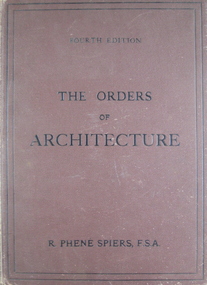
Book - Books, Spiers, R. Phene, The Order Of Architecture: Greek, Roman, and Italian, 1902 (exact)
... travelling scholarship of the Royal Academy, and the Soane medal of the R.I.B.A. He worked with Sir Digby Wyatt and William Burges. Spiers travelled in France, Spain, Egypt, Syria and the East, and besides his work as an architect, he made many water-colour sketches. His works and publications covered a wide range of subjects in architecture such as, History of Architecture, Architectural Drawing; The Architecture of Greece and Rome...travelling scholarship of the Royal Academy, and the Soane medal of the R.I.B.A. He worked with Sir Digby Wyatt and William Burges. Spiers travelled in France, Spain, Egypt, Syria and the East, and besides his work as an architect, he made many water-colour sketches. His works and publications covered a wide range of subjects in architecture such as, History of Architecture, Architectural Drawing; The Architecture of Greece and Rome ...A large brown hardcover book. Title and author's name are written in black on front cover and in gold on spine. This is the 4th ed., containing twenty-seven plates. It includes a preface to 4th and 1st ed., a list of plates, 20 p. of text and a list of references. This book contains a selection of architectural designs of the Orders as employed in ancient buildings.r phene spiers, greek roman italian architecture, the doric order, the ionic order, the corinthian order, the composite order, the temple of theseus athens, the theatre of marcellus rome, temple of vespasian rome, library plate, book plate -
 Flagstaff Hill Maritime Museum and Village
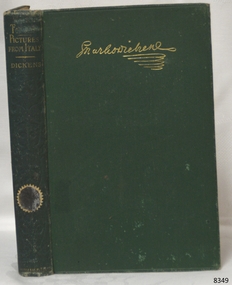
Book - A Travel & Political Critique, Charles Dickens, Hard Times and Pictures from Italy, 1866-1870’s
... Rome, Venice, Florence, and other cities. It mixes vivid descriptions of art, landscape, and carnival life with his characteristic observations on social inequality and political fragmentation in pre unification Italy. Together this combined volume offers both a major insight on Victorian industrial England and a lighter, more personal travel ...Charles Dickens (1812–1870) was one of the great English novelists of the Victorian era, famous for vivid characters, social criticism, and stories that were first published in serial form. He began as a journalist, rose to enormous popularity during his lifetime, and wrote major works such as Oliver Twist, David Copperfield, and Great Expectations. Pictures from Italy first published 1846 is a travelogue describing Dickens’s 1844 journey through Italy with his family that included Rome, Venice, Florence, and other cities. It mixes vivid descriptions of art, landscape, and carnival life with his characteristic observations on social inequality and political fragmentation in pre unification Italy. Together this combined volume offers both a major insight on Victorian industrial England and a lighter, more personal travel narrative showing Dickens from two sides, the social reformer and the acute observer tourist.Hard Cover edition, Hard Times and Pictures for Italy. Author: Charles Dickens. Publisher: Chapman & Hall Ltd, London. Date: 1866-1870’s first published in book form 1846 (See note section this document for more information on Edition). Green cloth hardcover, Spine black has Author and Title in gold lettering. The spine has a Library label and no Volume information.non-fictionCharles Dickens (1812–1870) was one of the great English novelists of the Victorian era, famous for vivid characters, social criticism, and stories that were first published in serial form. He began as a journalist, rose to enormous popularity during his lifetime, and wrote major works such as Oliver Twist, David Copperfield, and Great Expectations. Pictures from Italy first published 1846 is a travelogue describing Dickens’s 1844 journey through Italy with his family that included Rome, Venice, Florence, and other cities. It mixes vivid descriptions of art, landscape, and carnival life with his characteristic observations on social inequality and political fragmentation in pre unification Italy. Together this combined volume offers both a major insight on Victorian industrial England and a lighter, more personal travel narrative showing Dickens from two sides, the social reformer and the acute observer tourist.book, the old curiosity shop, charles dickens, shipwrecked-coast, flagstaff-hill, flagstaff-hill-maritime-museum, warrnambool, maritime-museum, flagstaff-hill-maritime-village, pattison collection, warrnambool library, warrnambool mechanics’ institute, ralph eric pattison, corangamite regional library service, warrnambool city librarian, mechanics’ institute library, victorian library board, warrnambool books and records, warrnambool children’s library, great ocean road, hard times for these times -
![[Landscape] by Jean Sutherland](/media/collectors/4fcc533e023fd71268453c3f/items/634bed9f7154cba68569e092/item-media/634bee2b7154cba68569e2c0/item-fit-380x285.jpg?cb=6) Victorian Interpretive Projects Inc.
Victorian Interpretive Projects Inc.Photograph, Jean P. Sutherland, [Landscape] by Jean Sutherland
... Travelling Scholarship. After four years training and exhibiting in London, Brittany and Rome, she returned to Victoria in 1927, exhibiting with the Melbourne Society of Women Painters for a number of years. ...Travelling Scholarship. After four years training and exhibiting in London, Brittany and Rome, she returned to Victoria in 1927, exhibiting with the Melbourne Society of Women Painters for a number of years. ...Jean Parker SUTHERLAND (06 June 1902-July 1978 ) In 1923 Sutherland was awarded the National Gallery of Victoria's prestigious Travelling Scholarship. After four years training and exhibiting in London, Brittany and Rome, she returned to Victoria in 1927, exhibiting with the Melbourne Society of Women Painters for a number of years. She joined the Melbourne Society of Women Painters in 1940 and met Sybil Craig , who became her closest friend. Framed watercolour Landscapejean sutherland, landscape -
 Bendigo Historical Society Inc.
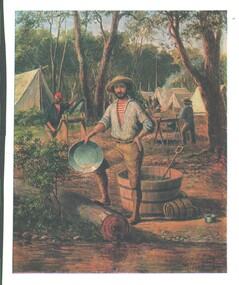
Print - WES HARRY COLLECTION: 'I HAVE GOT IT ', 1854
... Rome. From around 1839 to 1844, he studied landscape painting at the Dusseldorf Academy, and travelled widely. In 1852, he moved to London, and in August that year decided to travel to Victoria, Australia to try his luck on the goldfields. ...Rome. From around 1839 to 1844, he studied landscape painting at the Dusseldorf Academy, and travelled widely. In 1852, he moved to London, and in August that year decided to travel to Victoria, Australia to try his luck on the goldfields. ..."I have got it" is the title of this painting created on the goldfienlds in Ballarat in 1854. Eugene von Guérard, painter and teacher, was born in November 1811 in Vienna. From 1826, he toured Italy with his artist father and between 1830 and 1832 resided in Rome. From around 1839 to 1844, he studied landscape painting at the Dusseldorf Academy, and travelled widely. In 1852, he moved to London, and in August that year decided to travel to Victoria, Australia to try his luck on the goldfields. He arrived at Geelong on 24 December 1852, and made many sketches of the mining districts around Ballarat until 1854. He moved to Melbourne, and in 1870 was appointed the first Master of the School of Painting, National Gallery of Victoria. He retired from this position at the end of 1881, and in 1882 departed for Europe. In 1891, he moved to London, and died in London on 17 April 1901. He is buried in Brompton Cemetery, Chelsea, England.Print of an oil painting by Eugene von Guerard called 'I have got it ', painted in 1854. It depicts a mining camp in the bush, there are several tents in the background and two men using windlasses, in front of these there is a digger posing with a gold dish with gold visible at the base of the dish. Behind him there is a wooden tub and bucket, with a spade resting in the tub. This painting is from a collection at the State Library of Victoria.Eugene von Guerardmining, i have got it, eugene von guerard -
 Bendigo Historical Society Inc.
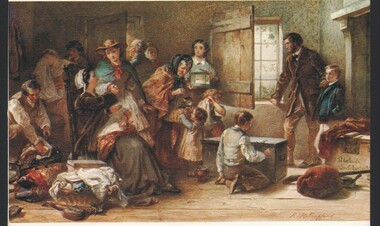
Card - WES HARRY COLLECTION: EMIGRANTS TO SOUTH AUSTRALIA, Mid 1800's
... Rome, Florence and Naples, where worked for several years, producing paintings of Italian life. He returned to London in 1864 and first exhibited at the Royal Academy in 1866. It was at this time that he began to work on historical subjects, especially of the Napoleonic Wars. He was a regular exhibitor at the Royal Academy, British Institution and at other galleries. This artwork would have been painted in approx. the 1860s, when he had returned to London and when many form his country were travelling...Rome, Florence and Naples, where worked for several years, producing paintings of Italian life. He returned to London in 1864 and first exhibited at the Royal Academy in 1866. It was at this time that he began to work on historical subjects, especially of the Napoleonic Wars. He was a regular exhibitor at the Royal Academy, British Institution and at other galleries. This artwork would have been painted in approx. the 1860s, when he had returned to London and when many form his country were travelling ...Robert Alexander Hillingford (!828-1904), was an English painter who specialised in historical pictures, often battle scenes. Hillingford was born in London on 28 January 1828, and studied at the Kunstakademie Düsseldorf for five years from 1841. He travelled to Munich, Rome, Florence and Naples, where worked for several years, producing paintings of Italian life. He returned to London in 1864 and first exhibited at the Royal Academy in 1866. It was at this time that he began to work on historical subjects, especially of the Napoleonic Wars. He was a regular exhibitor at the Royal Academy, British Institution and at other galleries. This artwork would have been painted in approx. the 1860s, when he had returned to London and when many form his country were travelling to Australia.A print from a water colour by Robert Alexander Hillingford called ' Emigrants to South Australia '. Original is from The Rex Nan Kivell collection, National Library of Australia.Robert Alexander Hillingfordprint, watercolour, australian landscape, watercolour paintings, early colonial life. emigrants, south australia -
 Robin Boyd Foundation
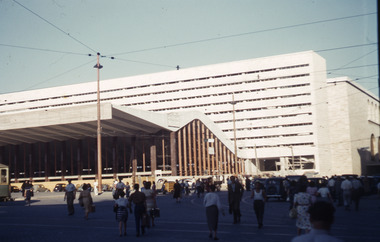
Slide, Robin Boyd, 1950
... Haddon Travelling Scholarship Haddon robin boyd slide Rome / Rly. Stat'n / 440 Trains / 120,000 People Day / 1950 (All Handwritten) Colour slide in a mount. ...Penleigh Boyd, Robin and Patricia Boyd's son, writes “Prior to 1950 Robin, like most other amateur or hobby photographers, took black and white printed photographs. The oldest slides date from 1950 when Robin and Patricia travelled to Europe on Robin’s Robert Haddon Travelling Scholarship.” In 1948 Robin Boyd was awarded ‘joint first place’ in the Robert Haddon competition for his design of Mildura art gallery. The scholarship helped fund their first overseas trip. Robin and Patricia were passengers on the Greek ship “Cyrenia” departing in May 1950, passing through the Suez Canal and landing in Genoa five weeks later. For six months, they travelled extensively throughout Europe (predominantly driving themselves) - France, Italy, United Kingdom, Sweden, Denmark, Germany, Austria, Switzerland and Spain.Colour slide in a mount. Stazione Termini, Rome, Italy, 1937-47, 1948-51. (Architects: Eugenio Montuori et al.)Rome / Rly. Stat'n / 440 Trains / 120,000 People Day / 1950 (All Handwritten)haddon travelling scholarship, haddon, robin boyd, slide -
 Robin Boyd Foundation
Slide, Robin Boyd, 1950
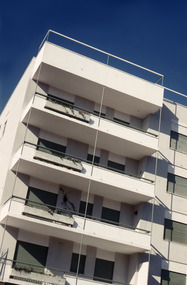
... Haddon Travelling Scholarship Haddon robin boyd slide Rome / Flats / 1950 (All Handwritten) Colour slide in a mount. ...Penleigh Boyd, Robin and Patricia Boyd's son, writes “Prior to 1950 Robin, like most other amateur or hobby photographers, took black and white printed photographs. The oldest slides date from 1950 when Robin and Patricia travelled to Europe on Robin’s Robert Haddon Travelling Scholarship.” In 1948 Robin Boyd was awarded ‘joint first place’ in the Robert Haddon competition for his design of Mildura art gallery. The scholarship helped fund their first overseas trip. Robin and Patricia were passengers on the Greek ship “Cyrenia” departing in May 1950, passing through the Suez Canal and landing in Genoa five weeks later. For six months, they travelled extensively throughout Europe (predominantly driving themselves) - France, Italy, United Kingdom, Sweden, Denmark, Germany, Austria, Switzerland and Spain.Colour slide in a mount. Flats, Rome, ItalyRome / Flats / 1950 (All Handwritten)haddon travelling scholarship, haddon, robin boyd, slide -
 Robin Boyd Foundation
Slide, Robin Boyd, 1950
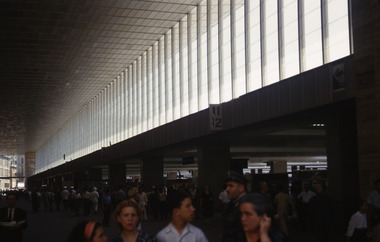
... Haddon Travelling Scholarship Haddon robin boyd slide Rome / Station / 1950 (All Handwritten) Colour slide in a mount. ...Penleigh Boyd, Robin and Patricia Boyd's son, writes “Prior to 1950 Robin, like most other amateur or hobby photographers, took black and white printed photographs. The oldest slides date from 1950 when Robin and Patricia travelled to Europe on Robin’s Robert Haddon Travelling Scholarship.” In 1948 Robin Boyd was awarded ‘joint first place’ in the Robert Haddon competition for his design of Mildura art gallery. The scholarship helped fund their first overseas trip. Robin and Patricia were passengers on the Greek ship “Cyrenia” departing in May 1950, passing through the Suez Canal and landing in Genoa five weeks later. For six months, they travelled extensively throughout Europe (predominantly driving themselves) - France, Italy, United Kingdom, Sweden, Denmark, Germany, Austria, Switzerland and Spain.Colour slide in a mount. Stazione Termini, Rome, Italy, 1937-47, 1948-51. (Architects: Eugenio Montuori et al.)Rome / Station / 1950 (All Handwritten)haddon travelling scholarship, haddon, robin boyd, slide -
 Robin Boyd Foundation
Slide, Robin Boyd, 1950
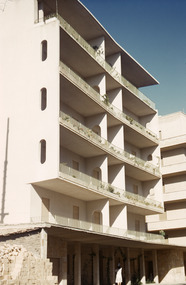
... Haddon Travelling Scholarship Haddon robin boyd slide Rome / Flats / 1950 (All Handwritten) Colour slide in a mount. ...Penleigh Boyd, Robin and Patricia Boyd's son, writes “Prior to 1950 Robin, like most other amateur or hobby photographers, took black and white printed photographs. The oldest slides date from 1950 when Robin and Patricia travelled to Europe on Robin’s Robert Haddon Travelling Scholarship.” In 1948 Robin Boyd was awarded ‘joint first place’ in the Robert Haddon competition for his design of Mildura art gallery. The scholarship helped fund their first overseas trip. Robin and Patricia were passengers on the Greek ship “Cyrenia” departing in May 1950, passing through the Suez Canal and landing in Genoa five weeks later. For six months, they travelled extensively throughout Europe (predominantly driving themselves) - France, Italy, United Kingdom, Sweden, Denmark, Germany, Austria, Switzerland and Spain.Colour slide in a mount. Flats, Rome, ItalyRome / Flats / 1950 (All Handwritten)haddon travelling scholarship, haddon, robin boyd, slide -
 Robin Boyd Foundation
Slide, Robin Boyd, 1950
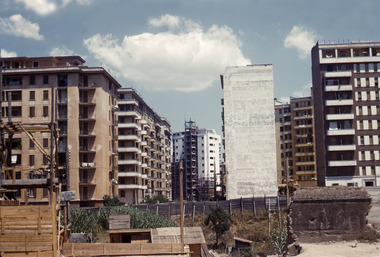
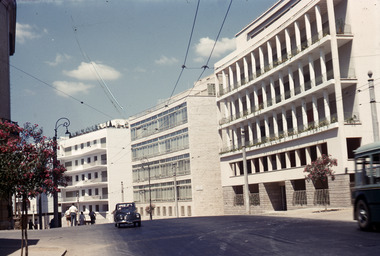
... Haddon Travelling Scholarship Haddon robin boyd slide Rome / Prewar Flats (All Handwritten) Colour slide in a mount. ...Penleigh Boyd, Robin and Patricia Boyd's son, writes “Prior to 1950 Robin, like most other amateur or hobby photographers, took black and white printed photographs. The oldest slides date from 1950 when Robin and Patricia travelled to Europe on Robin’s Robert Haddon Travelling Scholarship.” In 1948 Robin Boyd was awarded ‘joint first place’ in the Robert Haddon competition for his design of Mildura art gallery. The scholarship helped fund their first overseas trip. Robin and Patricia were passengers on the Greek ship “Cyrenia” departing in May 1950, passing through the Suez Canal and landing in Genoa five weeks later. For six months, they travelled extensively throughout Europe (predominantly driving themselves) - France, Italy, United Kingdom, Sweden, Denmark, Germany, Austria, Switzerland and Spain.Colour slide in a mount. Pre-war flats, Rome, ItalyRome / Prewar Flats (All Handwritten)haddon travelling scholarship, haddon, robin boyd, slide -
 Robin Boyd Foundation
Slide, Robin Boyd, 1950
... Haddon Travelling Scholarship Haddon robin boyd slide Rome / Flats / New District / 1950 (All Handwritten) Colour slide in a mount. ...Penleigh Boyd, Robin and Patricia Boyd's son, writes “Prior to 1950 Robin, like most other amateur or hobby photographers, took black and white printed photographs. The oldest slides date from 1950 when Robin and Patricia travelled to Europe on Robin’s Robert Haddon Travelling Scholarship.” In 1948 Robin Boyd was awarded ‘joint first place’ in the Robert Haddon competition for his design of Mildura art gallery. The scholarship helped fund their first overseas trip. Robin and Patricia were passengers on the Greek ship “Cyrenia” departing in May 1950, passing through the Suez Canal and landing in Genoa five weeks later. For six months, they travelled extensively throughout Europe (predominantly driving themselves) - France, Italy, United Kingdom, Sweden, Denmark, Germany, Austria, Switzerland and Spain.Colour slide in a mount. Flats in a new district, Rome, ItalyRome / Flats / New District / 1950 (All Handwritten)haddon travelling scholarship, haddon, robin boyd, slide -
 Melbourne Legacy
Postcard, Postcards of Europe
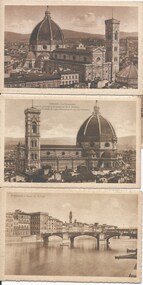
... Postcards were a common form of souvenirs for soldiers who were travelling either during World War 1, or just after, or while returning to Australia. These postcard scenes include the Cathedral and a bridge in Florence, and church and the Pantheon in Rome, a view of Lausanne and a fountain in Versailles and an interior from Brussels. ...Postcards were a common form of souvenirs for soldiers who were travelling either during World War 1, or just after, or while returning to Australia. These postcard scenes include the Cathedral and a bridge in Florence, and church and the Pantheon in Rome, a view of Lausanne and a fountain in Versailles and an interior from Brussels. ...Postcards were a common form of souvenirs for soldiers who were travelling either during World War 1, or just after, or while returning to Australia. These postcard scenes include the Cathedral and a bridge in Florence, and church and the Pantheon in Rome, a view of Lausanne and a fountain in Versailles and an interior from Brussels. These were with other World War 1 memorabilia that has come from Private John Basil McLean, 2nd Reinforcements, 37th Battalion, A.I.F. There was a large collection of postcards so he may have been collecting them as souvenirs. J.B. McLean (Service No. 13824) was from near Maffra, Victoria and enlisted on 22 January 1916. He embarked on 16 December 1916 for Europe. His full war record is available from AWM. He spent time with the Australian Field Artillery (Pack Section). At the end of the war he worked for a year at the A.I.F. Headquarters in London before returning to Australia on the 'Ceramic', arriving Portsea in 1920.Postcards were a very common form of communication in the first World War. Postcards as souvenirs or as correspondence would have been familiar to the first Legatees as they had served in World War 1. Postcards x 12 with images from Rome and Florence in Italy, Lausanne in Switzerland, a fountain in Versailles, France, and an interior in Brussels.01138.1 Firenze - La Cattedrale (the Cathedral in Florence) 01138.2 Firenze - La Cattedrale vista in panorama di sopra ad Or. S. Michele (Alnolfa di Lapo, Brunelleschi ed altri Maestri) 01138.3 Firenze - Ponte S. Trinità 01138.4 Firenze - Piazza delia Signoria, Loggia dei Priori detta dei Lanzi 01138.5 Roma - Il Pantheon 01138.6 Roma - Via Appia Anitca - Tombe. 01138.7 Roma - Via Appia - Aquedotti 01138.8 Capella S. Petri Claver, Romae 01138.9 Lausanne - Ochy 01138.10 Lausanne - Hotel Victoria 01138.11 Parc de Versailles - Bassin des Domes 01138.12 Bruxelles Each one has the word POST CARD on the reverse with room for an address and an area for Correspondence. Different makers.souvenir, world war one
