
Showing 11 items matching "rufous"
-
 The Beechworth Burke Museum
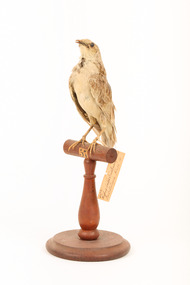
Animal specimen - Rufous Songlark, Trustees of the Australian Museum, 1860-1880
... ...rufous...The Rufous Songlark is not a social bird and can only be seen and heard during breeding season. ...This Rufous Songlark has a beige belly and neck. ...Swing-tag: 40a / Rufous-Tinted Cincloramphus/ See catalogue page 14 Wooden perch: 57...The Rufous Songlark is not a social bird and can only be seen and heard during breeding season. ...The Rufous Songlark is not a social bird and can only be seen and heard during breeding season. They have a brown appearance with a pale underbody. This species reside in open grass areas, grassy woodlands, farms and mulgas (an Australian plant). Although the Rufous Songlark can be seen all around Australia, they are most commonly found in Queensland, New South Wales, and Western Australia. Since this is a taxidermy mount, there are some inconsistencies to the real life bird. The main inconsistency being that the colour of the bird's wings, back, head and tail should be a darker brown. This specimen is part of a collection of almost 200 animal specimens that were originally acquired as skins from various institutions across Australia, including the Australian Museum in Sydney and the National Museum of Victoria (known as Museums Victoria since 1983), as well as individuals such as amateur anthropologist Reynell Eveleigh Johns between 1860-1880. These skins were then mounted by members of the Burke Museum Committee and put-on display in the formal space of the Museum’s original exhibition hall where they continue to be on display. This display of taxidermy mounts initially served to instruct visitors to the Burke Museum of the natural world around them, today it serves as an insight into the collecting habits of the 19th century.This specimen is part of a significant and rare taxidermy mount collection in the Burke Museum. This collection is scientifically and culturally important for reminding us of how science continues to shape our understanding of the modern world. They demonstrate a capacity to hold evidence of how Australia’s fauna history existed in the past and are potentially important for future environmental research. This collection continues to be on display in the Museum and has become a key part to interpreting the collecting habits of the 19th century.This Rufous Songlark has a beige belly and neck. The wings, back, head and tail are a dark brown colour. Near the tips of the wings are there are some spots of grey and light brown. On the throat, under the beak, there is a patch of dark brown. This specimen stands upon a wooden perch and has an identification tag ties around its leg.Swing-tag: 40a / Rufous-Tinted Cincloramphus/ See catalogue page 14 Wooden perch: 57taxidermy, taxidermy mount, animalia, burke museum, beechworth, australian museum, skin, reynell eveleigh jones, bird, rufous songlark, rufous, australian birds -
 The Beechworth Burke Museum
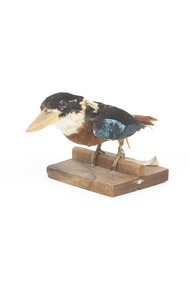
Animal specimen - Rufous-bellied Kookaburra (female), Trustees of the Australian Museum, 1860-1880
... The Rufous-bellied Kookaburra is a large member of the Kingfisher family. ...The Rufous-bellied Kookaburra is a large Kingfisher with a black coloured cap on the head, white collar around the neck, blue feathers on the wings and rump and a rufous belly. ...The Rufous-bellied Kookaburra is a large member of the Kingfisher family. ...The Rufous-bellied Kookaburra is a large member of the Kingfisher family. It commonly resides in the dense rainforests of lowland New Guinea, Saibai Island, Indonesia, Biak, Maluku/Moluccas Islands, Papua New Guinea, Melanesia and Queensland in Australia. This is unlike other species of Kookaburra which commonly prefer to reside in locations of open country. Another aspect which makes this bird unique to other Kookaburra is its tendency to live in pairs and not in family groups which is typical of other Kookaburras. In the case of the Rufous-bellied Kookaburra, both parents incubate and care for the eggs/chicks. This Kookaburra feeds on small mammals, birds, reptiles and insects. The Rufous-bellied Kookaburra was originally named the Gaudichaud's Kookaburra after the French botanist Charles Gaudichaud-Beaupré. This species of Kookaburra is among the most colorful varieties of the Kookaburra alongside the Spangled Kookaburra. This specimen is part of a collection of almost 200 animal specimens that were originally acquired as skins from various institutions across Australia, including the Australian Museum in Sydney and the National Museum of Victoria (known as Museums Victoria since 1983), as well as individuals such as amateur anthropologist Reynell Eveleigh Johns between 1860-1880. These skins were then mounted by members of the Burke Museum Committee and put-on display in the formal space of the Museum’s original exhibition hall where they continue to be on display. This display of taxidermy mounts initially served to instruct visitors to the Burke Museum of the natural world around them, today it serves as an insight into the collecting habits of the 19th century.This specimen is part of a significant and rare taxidermy mount collection in the Burke Museum. This collection is scientifically and culturally important for reminding us of how science continues to shape our understanding of the modern world. They demonstrate a capacity to hold evidence of how Australia’s fauna history existed in the past and are potentially important for future environmental research. This collection continues to be on display in the Museum and has become a key part to interpreting the collecting habits of the 19th century. The Rufous-bellied Kookaburra is a large Kingfisher with a black coloured cap on the head, white collar around the neck, blue feathers on the wings and rump and a rufous belly. The female Kookaburra has a brown/rufous coloured tail, as is the case for this particular specimen which identifies it as female. This bird has a large white bill and pale coloured legs. The head is a large square shape and the body is stocky.Label: National Museum Victoria / 159a /taxidermy mount, taxidermy, animalia, burke museum, beechworth, australian museum, skin, reynell eveleigh johns, bird, australian birds, kingfisher, kookaburra, rufous-bellied kookaburra -
 The Beechworth Burke Museum
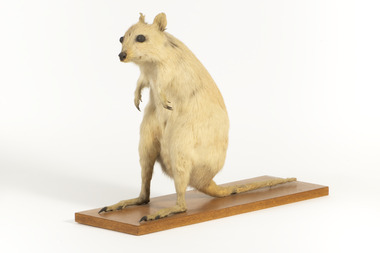
Animal specimen - Rufous Bettong, Trustees of the Australian Museum, 1860–1880
... A rufous bettong is about the size of a rabbit, with body length ranging from 30cm to 38cm among species. ...Average sized rufous bettong with large clawed hind legs, small clawed fore legs, and a long tail that is roughly the length of its body and covered lightly in fur. ...A rufous bettong is about the size of a rabbit, with body length ranging from 30cm to 38cm among species. ...A rufous bettong is about the size of a rabbit, with body length ranging from 30cm to 38cm among species. All bettongs have long tails, roughly equal to body length. Body weight ranges from 1.2 kg in the smallest species (Northern Bettong) to 2.8kg in the Rufous Bettong, the largest of the group. Males tend to be slightly larger than females. Bettongs have furry coats, ranging in colour from grey to ginger and brown. The bettong is endemic to Australia, and is an important part of Australia's Indigenous biodiversity. There are five living species of bettong; Eastern Bettong, Burrowing Bettong, Brush-tailed Bettong, Northern Bettong, Rufous Bettong. The bettong is a member of the Potoroidae family along with the endangered Potoroos, and the extinct Desert Rat-Kangaroos. This specimen is part of a collection of almost 200 animal specimens that were originally acquired as skins from either the Trustees of the Australian Museum or from the amateur anthropologist Reynell Eveleigh Johns between 1860-1880 and mounted by members of the Burke Museum Committee around the same time. When all Taxidermy mounts were completed, they were quickly put-on display in the formal space of the Museum’s original exhibition hall where they continue to be on display. This display of taxidermy mounts initially served to instruct visitors to the Burke Museum of the natural world around them, today it serves as an insight into the collecting habits of the 19th century.This specimen is part of a significant and rare taxidermy mount collection in the Burke Museum. This collection is scientifically and culturally important for reminding us of how science continues to shape our understanding of the modern world. They demonstrate a capacity to hold evidence of how Australia’s fauna history existed in the past and are potentially important for future environmental research. This collection continues to be on display in the Museum and has become a key part to interpreting the collecting habits of the 19th century.Average sized rufous bettong with large clawed hind legs, small clawed fore legs, and a long tail that is roughly the length of its body and covered lightly in fur. The pelage of the bettong is fine and soft with the body fur cream and pale ochre in colouring with specks of brown while the underbelly is a solid cream colour. The head is small with a short muzzle and two small rounded ears, and features two round dark brown eyes made from clay.On mounting board: BMM5893/burke museum, taxidermy, taxidermy mount, bettong, rat kangaroo, bettongia, fauna, animal, animalia, potoroidae, reynell eveleigh johns, rufous bettong, rufous rat-kangaroo -
 The Beechworth Burke Museum
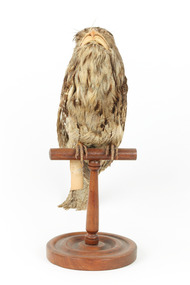
Animal specimen - Tawny Frogmouth, Trustees of the Australian Museum, 1860-1880
... The plumage on the head and back of the bird is a combination of darker and rufous browns, mottled with streaks of cream and grey. ...The plumage on the head and back of the bird is a combination of darker and rufous browns, mottled with streaks of cream and grey. ...The Tawny Frogmouth, although often mistaken for an owl, is a nocturnal Australian bird of the Podargidae family that is more closely related to the nightjars. They are widespread in terms of distribution and can be found all across mainland Australia and Tasmania in a diverse variety of habitats from woodlands, forests and urban areas. Masters of camouflage, the Tawny Frogmouth sleeps during the day on tree branches in a stiff upward facing position (as with this specimen) to mimic broken tree branches, their feathers assist in this deception as the mottled grey and brown colours blend into the environment seamlessly. This specimen differs in colours from the usual appearance of a Tawny Frogmouth, as the beak is usually a olive-grey to blackish tone and the plumage is generally more dominantly grey all over the bird. This specimen is part of a collection of almost 200 animal specimens that were originally acquired as skins from various institutions across Australia, including the Australian Museum in Sydney and the National Museum of Victoria (known as Museums Victoria since 1983), as well as individuals such as amateur anthropologist Reynell Eveleigh Johns between 1860-1880. These skins were then mounted by members of the Burke Museum Committee and put-on display in the formal space of the Museum’s original exhibition hall where they continue to be on display. This display of taxidermy mounts initially served to instruct visitors to the Burke Museum of the natural world around them, today it serves as an insight into the collecting habits of the 19th century.This specimen is part of a significant and rare taxidermy mount collection in the Burke Museum. This collection is scientifically and culturally important for reminding us of how science continues to shape our understanding of the modern world. They demonstrate a capacity to hold evidence of how Australia’s fauna history existed in the past and are potentially important for future environmental research. This collection continues to be on display in the Museum and has become a key part to interpreting the collecting habits of the 19th century.This Tawny Frogmouth has a broad head and a creamy beige coloured wide triangular beak with a hooked tip. The plumage on the head and back of the bird is a combination of darker and rufous browns, mottled with streaks of cream and grey. The underside of the bird from the bottom of the beak to the tail tip is a lighter cream colour with streaks of rufous-brown. The feet are an orange-brown colour. This specimen is adopting the skyward looking pose associated with the species, mimicking dead tree branches.1a. / More-Park / See Catalogue, page 7 /taxidermy mount, taxidermy, burke museum, beechworth, australian museum, skin, reynell eveleigh johns, bird, australian birds, tawny frogmouth, frogmouth -
 The Beechworth Burke Museum
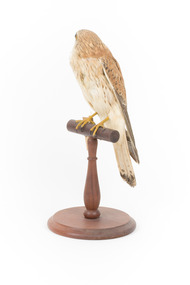
Animal specimen - Nankeen Kestrel, Trustees of the Australian Museum, 1860-1880
... The females of the species are distinguished by their darker patterns and red-brown (rufous) tones, as well as their larger size, whilst the males are more greyish. ...It has a stockier appearance, with the upper parts of its body, such as the head and the tops of its wings, being a light red-brown (rufous) colour and the tips of its wings appearing dipped in black. ...The females of the species are distinguished by their darker patterns and red-brown (rufous) tones, as well as their larger size, whilst the males are more greyish. ...The Nankeen Kestrel, also known as the Australian Kestrel, is a common native to the open country's grasslands and farmlands, preferring agricultural areas. They are drawn to animal pests like mice, insects, small animals, reptiles, and birds. Due to the shape and ability of their tail feathers, which allows them to hoover over their prey, they do not rely on speed to catch their meal like most falcons in their family group. These birds are among the smallest raptors in the Falcon family, having well-known face characteristics and body shapes. The females of the species are distinguished by their darker patterns and red-brown (rufous) tones, as well as their larger size, whilst the males are more greyish. The yellow markings around the eyes and top of the beak, as well as the noticeable black dipped wings, distinguish each species. This specimen is part of a collection of almost 200 animal specimens that were originally acquired as skins from various institutions across Australia, including the Australian Museum in Sydney and the National Museum of Victoria (known as Museums Victoria since 1983), as well as individuals such as amateur anthropologist Reynell Eveleigh Johns between 1860-1880. These skins were then mounted by members of the Burke Museum Committee and put-on display in the formal space of the Museum’s original exhibition hall where they continue to be on display. This display of taxidermy mounts initially served to instruct visitors to the Burke Museum of the natural world around them, today it serves as an insight into the collecting habits of the 19th century.This specimen is part of a significant and rare taxidermy mount collection in the Burke Museum. This collection is scientifically and culturally important for reminding us of how science continues to shape our understanding of the modern world. They demonstrate a capacity to hold evidence of how Australia’s fauna history existed in the past and are potentially important for future environmental research. This collection continues to be on display in the Museum and has become a key part to interpreting the collecting habits of the 19th century.The Nankeen Kestrel is a small raptor in the Falcon family. It has a stockier appearance, with the upper parts of its body, such as the head and the tops of its wings, being a light red-brown (rufous) colour and the tips of its wings appearing dipped in black. The top of the beak and the eye rings are both yellow, and this bird's falcon appearance shows its inherent dark streak markings visible near the eyes and on the chest. The underparts are pale, with a tail feather that spreads out to help it hover and is ornamented with fine black decorations.20. / Unnamed / Catalogue page 5 / taxidermy mount, taxidermy, animalia, burke museum, beechworth, australian museum, skin, reynell eveleigh johns, bird, nankeen kestrel -
 The Beechworth Burke Museum
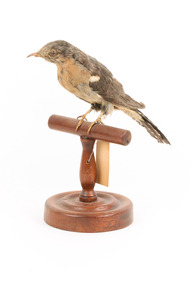
Animal specimen - Fan-tailed Cuckoo, Trustees of the Australian Museum, 1860-1880
... The front of the face is pale rufous and blends into the black at the top of the head and neck. ...The front of the face is pale rufous and blends into the black at the top of the head and neck. ...Fan-tailed Cuckoos are found throughout eastern and south-western Australia. They are also sometimes found in nearby small island nations as far as New Caledonia. Their call is a distinct, descending trill, which they are known to make even outside their breeding season. The neck is thin compared to a typical Fan-tailed Cuckoo - potentially a taxidermy error or damage. Otherwise, the specimen is reasonably representative. This specimen is part of a collection of almost 200 animal specimens that were originally acquired as skins from various institutions across Australia, including the Australian Museum in Sydney and the National Museum of Victoria (known as Museums Victoria since 1983), as well as individuals such as amateur anthropologist Reynell Eveleigh Johns between 1860-1880. These skins were then mounted by members of the Burke Museum Committee and put-on display in the formal space of the Museum’s original exhibition hall where they continue to be on display. This display of taxidermy mounts initially served to instruct visitors to the Burke Museum of the natural world around them, today it serves as an insight into the collecting habits of the 19th century.This specimen is part of a significant and rare taxidermy mount collection in the Burke Museum. This collection is scientifically and culturally important for reminding us of how science continues to shape our understanding of the modern world. They demonstrate a capacity to hold evidence of how Australia’s fauna history existed in the past and are potentially important for future environmental research. This collection continues to be on display in the Museum and has become a key part to interpreting the collecting habits of the 19th century.This fan-tailed cuckoo has a dark grey/brown back and a pale rufous (a yellowy brown) underside. The tail is also brown with white spots on some of the feather tips. The front of the face is pale rufous and blends into the black at the top of the head and neck. Some of the feathers around the neck are grey. There is a patch of white on halfway down the body on the left wing. The eyes are brown, the feet are yellow, and the beak, which is missing at the bottom, is yellow. The bird stands on a brown, wooden perch with a circular bar, curved stand, and circular base. It has an identification tag tied around its right leg. There is a swing-tag on the left leg.Swing-tag: 71a. / Fan-tailed Cuckoo / See Catalogue, Page 21 /taxidermy mount, taxidermy, animalia, burke museum, beechworth, skin, reynell eveleigh johns, bird, fan-tailed cuckoo, cuckoo, australian bird, australian museum, australian animal -
 The Beechworth Burke Museum
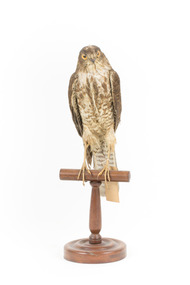
Animal specimen - Brown Goshawk Juvenile, Trustees of the Australian Museum, 1860-1880
... It has a streaky appearance, with a buff to pale rufous base color on its underparts adorned with bold, dark brown streaks. ...It has a streaky appearance, with a buff to pale rufous base color on its underparts adorned with bold, dark brown streaks. ...This specimen is a Brown Goshawk juvenile. The Brown Goshawk is widely distributed across Australia, Wallacea, New Guinea, New Caledonia, Vanuatu, and Fiji. In Australia, it predominantly inhabits eucalypt forests, woodlands, farmland, and urban areas, while in the Pacific, it is primarily associated with rainforest environments. Historically, it was also present on Norfolk Island until around 1790, potentially representing an undescribed subspecies. However, the limited material available—consisting of a single historical skin and nine subfossil bones—precludes confirmation through scientific analysis. This specimen was originally identified as a Nankeen Kestral and is catalogued as such in the original Public Library and Burke Museum catalogue. The specimen is part of a collection of almost 200 animal specimens that were originally acquired as skins from various institutions across Australia, including the Australian Museum in Sydney and the National Museum of Victoria (known as Museums Victoria since 1983), as well as individuals such as amateur anthropologist Reynell Eveleigh Johns between 1860-1880. These skins were then mounted by members of the Burke Museum Committee and put-on display in the formal space of the Museum’s original exhibition hall where they continue to be on display. This display of taxidermy mounts initially served to instruct visitors to the Burke Museum of the natural world around them, today it serves as an insight into the collecting habits of the 19th century.This specimen is part of a significant and rare taxidermy mount collection in the Burke Museum. This collection is scientifically and culturally important for reminding us of how science continues to shape our understanding of the modern world. They demonstrate a capacity to hold evidence of how Australia’s fauna history existed in the past and are potentially important for future environmental research. This collection continues to be on display in the Museum and has become a key part to interpreting the collecting habits of the 19th century.This specimen exhibits distinctive plumage compared to its adult counterparts. It has a streaky appearance, with a buff to pale rufous base color on its underparts adorned with bold, dark brown streaks. The upperparts are brown, with a slightly mottled or scalloped effect due to pale feather edges. Its eyes are yellow and legs are a pale yellow. The wings are broad and rounded, and the tail is long and barred. Identification swing tag with catalogue page number reads: 4. / Nankeen Kestrel - / See Catalogue,/ Page 2. /taxidermy mount, taxidermy, animalia, burke museum, beechworth, australian museum, skin, reynell eveleigh johns, bird, birds of prey, goshawk, ornithological, nankeen kestral -
 The Beechworth Burke Museum
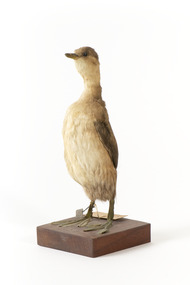
Animal specimen - Australasian Grebe, Trustees of the Australian Museum, 1860-1880
... This species has rufous red colouring on the chest and neck and darker colouring on the head during the breeding season. ...This species has rufous red colouring on the chest and neck and darker colouring on the head during the breeding season. ...The Australasian Grebe is a small duck-like bird with a hyperactive nature. These birds reside in small, shallow, freshwater lakes and ponds, small waterways or sheltered caves and bays. They can be found throughout Australia and the Pacific region and New Zealand. The Australasian Grebe eat mainly small freshwater fish, crayfish, shellfish and leeches which they catch by diving underwater. This specimen is part of a collection of almost 200 animal specimens that were originally acquired as skins from various institutions across Australia, including the Australian Museum and the National Museum of Victoria, as well as individuals such amateur anthropologist Reynell Eveleigh Johns between 1860-1880. These skins were then mounted by members of the Burke Museum Committee and put-on display in the formal space of the Museum’s original exhibition hall where they continue to be on display. This display of taxidermy mounts initially served to instruct visitors to the Burke Museum of the natural world around them, today it serves as an insight into the collecting habits of the 19th century. This specimen is part of a significant and rare taxidermy mount collection in the Burke Museum. This collection is scientifically and culturally important for reminding us of how science continues to shape our understanding of the modern world. They demonstrate a capacity to hold evidence of how Australia’s fauna history existed in the past and are potentially important for future environmental research. This collection continues to be on display in the Museum and has become a key part to interpreting the collecting habits of the 19th century.This Australasian Grebe is in a standing position on a wooden platform with identification tags tied to the right leg. It has dark glass eyes and pale grey bill and legs. The plumage of this specimen consists of dark greys and browns on the rear with lighter colours on the underside. These colours align with those of the non-breeding season. This species has rufous red colouring on the chest and neck and darker colouring on the head during the breeding season. Paper tag: "34a Dabchick Catalogue, page, 64" Metal Tag: "4496"taxidermy mount, taxidermy, animalia, burke museum, beechworth, australian museum, skin, reynell eveleigh johns, bird, grebe, australasian grebe, dabchick -
 The Beechworth Burke Museum
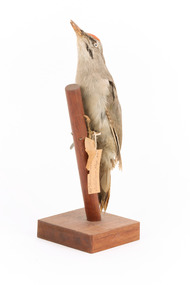
Animal specimen - Grey-headed Woodpecker, Trustees of the Australian Museum, 1860-1880
... The underwing feathers are a light rufous-brown with white dots. The specimen is mounted on a sloping vertical wooden cylindrical stick attached to a mount. ...The underwing feathers are a light rufous-brown with white dots. The specimen is mounted on a sloping vertical wooden cylindrical stick attached to a mount. ...The Grey-headed Woodpecker is a medium-sized woodpecker of the Picidae family, that is sometimes mistaken for the similar-looking Green Woodpecker. The species is known to have a grey face, neck, and underparts, with green wings and back, and underwing feathers that are a dark brown to dark grey-black with white dots. Although this can vary depending on location, with European and Northeast Asian birds having overall paler colours, to mainland Asian birds being darker overall. The species has a distinctive black mustache-like stripe on both sides of the face and the mature males have a red patch on the top of the head. These tree-clinging woodpeckers usually feast on ants, insects, and berries. This specimen differs in appearance from the common Grey-headed Woodpecker as its back feathers appear a dark grey, where in the wild these birds have sometimes quite vibrant green feathers. The eyes of the grey-headed woodpecker are also usually red with black iris, not white with black iris as in this specimen. The beak is also a pale yellowish colour on this bird, whereas commonly the species has a grey upper beak and pale yellow lower beak. This specimen is part of a collection of almost 200 animal specimens that were originally acquired as skins from various institutions across Australia, including the Australian Museum in Sydney and the National Museum of Victoria (known as Museums Victoria since 1983), as well as individuals such as amateur anthropologist Reynell Eveleigh Johns between 1860-1880. These skins were then mounted by members of the Burke Museum Committee and put-on display in the formal space of the Museum’s original exhibition hall where they continue to be on display. This display of taxidermy mounts initially served to instruct visitors to the Burke Museum of the natural world around them, today it serves as an insight into the collecting habits of the 19th century.This specimen is part of a significant and rare taxidermy mount collection in the Burke Museum. This collection is scientifically and culturally important for reminding us of how science continues to shape our understanding of the modern world. They demonstrate a capacity to hold evidence of how Australia’s fauna history existed in the past and are potentially important for future environmental research. This collection continues to be on display in the Museum and has become a key part to interpreting the collecting habits of the 19th century.This male Grey-headed Woodpecker has a bright red head patch and distinctive black mustache-like stripes on both sides of the face, with additional black stripes running from the pale yellowish beak to the inner corner of the eye. The underbelly is a light grey and the back is a slightly darker grey. The underwing feathers are a light rufous-brown with white dots. The specimen is mounted on a sloping vertical wooden cylindrical stick attached to a mount. There are also two paper swing tags, one of which is torn in half.149a. / Unnamed / Catalogue page 60 /taxidermy mount, taxidermy, animalia, burke museum, beechworth, australian museum, skin, reynell eveleigh johns, bird, woodpecker, grey-headed woodpecker, gray-headed woodpecker -
 The Beechworth Burke Museum
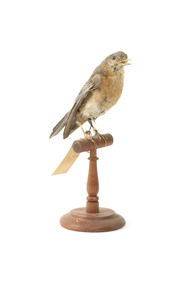
Animal specimen - Bluebird
... This female bluebird (likely Eastern) has a medium brown head and back, a rufous breast, and a cream belly. The bird has blue-tinged wing and tail feathers. .... / Metal tag: 107 This female bluebird (likely Eastern) has a medium brown head and back, a rufous breast, and a cream belly. The bird has blue-tinged wing and tail feathers. ...Eastern bluebirds are well-known song birds that live in eastern North America. They are sexually dimorphic, easily recognised by the male's bright royal blue upper plumage, chest of reddish brown and white abdomen. The females is duller in colour than the male, with greyer upperparts and blue tinges to her wings. These Bluebirds, the European variety, are the most common of the three Bluebird species. When not nesting, these birds fly in small flocks around the countryside. Bluebirds feed on small insects including moths, termites and mosquitoes. They also eat grasshoppers, crickets and caterpillars. The Bluebird can spot caterpillars and other insects in tall grass from a distance of over 45 meters. The Bluebird is commonly identified in numerous cultures as being symbolic as a harbinger of happiness. Often in Russian fairytales, the Bluebird is used as a symbol of hope. This specimen is part of a collection of almost 200 animal specimens that were originally acquired as skins from various institutions across Australia, including the Australian Museum in Sydney and the National Museum of Victoria (known as Museums Victoria since 1983), as well as individuals such as amateur anthropologist Reynell Eveleigh Johns between 1860-1880. These skins were then mounted by members of the Burke Museum Committee and put-on display in the formal space of the Museum’s original exhibition hall where they continue to be on display. This display of taxidermy mounts initially served to instruct visitors to the Burke Museum of the natural world around them, today it serves as an insight into the collecting habits of the 19th century.This specimen is part of a significant and rare taxidermy mount collection in the Burke Museum. This collection is scientifically and culturally important for reminding us of how science continues to shape our understanding of the modern world. They demonstrate a capacity to hold evidence of how Australia’s fauna history existed in the past and are potentially important for future environmental research. This collection continues to be on display in the Museum and has become a key part to interpreting the collecting habits of the 19th century.This female bluebird (likely Eastern) has a medium brown head and back, a rufous breast, and a cream belly. The bird has blue-tinged wing and tail feathers. The bill is short and has been stylized with the bill partly open to provide the illusion that the bird is making a call. This specimen stands upon a wooden mount and has an identification tag tied around its leg. The bird's plumage has faded since it was first preserved; females generally have duller colouring than their male counterparts but the colour of this particular specimen is paler than it would have been.Label: 122a. Blue-Bird / Catalogue Page 29. / Metal tag: 107taxidermy mount, taxidermy, animalia, burke museum, beechworth, australian museum, skin, reynell eveleigh johns, bird, american birds, bluebird -
 The Beechworth Burke Museum
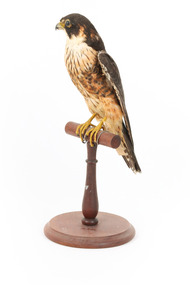
Animal specimen - Australian Hobby, Trustees of the Australian Museum, 1860-1880
... The flank is a dappled dark brown, rufous-brown and cream, which transitions back into cream with brown streaks near the legs. ...The flank is a dappled dark brown, rufous-brown and cream, which transitions back into cream with brown streaks near the legs. ...The Australian Hobby is a medium-sized falcon of the Falconidae family, similar in look to the larger sized Peregrine Falcon. This species is widespread and can be found across most of mainland Australia and Tasmania, preferring lightly wooded areas such as timbered wetlands, open wooded farmland, and some urban areas. Their diet consists of small birds, bats, and flying insects, which are caught mid-air. They sometimes hunt cooperatively to catch their prey. This specimen is an accurate depiction of an Australian Hobby. This specimen is part of a collection of almost 200 animal specimens that were originally acquired as skins from various institutions across Australia, including the Australian Museum in Sydney and the National Museum of Victoria (known as Museums Victoria since 1983), as well as individuals such as amateur anthropologist Reynell Eveleigh Johns between 1860-1880. These skins were then mounted by members of the Burke Museum Committee and put-on display in the formal space of the Museum’s original exhibition hall where they continue to be on display. This display of taxidermy mounts initially served to instruct visitors to the Burke Museum of the natural world around them, today it serves as an insight into the collecting habits of the 19th century.This specimen is part of a significant and rare taxidermy mount collection in the Burke Museum. This collection is scientifically and culturally important for reminding us of how science continues to shape our understanding of the modern world. They demonstrate a capacity to hold evidence of how Australia’s fauna history existed in the past and are potentially important for future environmental research. This collection continues to be on display in the Museum and has become a key part to interpreting the collecting habits of the 19th century.This Australian Hobby has a dark brown cap and cream-coloured half-collar. The back feathers of the bird are also a dark brown colour, while the neck is a cream with lighter brown streaks. The flank is a dappled dark brown, rufous-brown and cream, which transitions back into cream with brown streaks near the legs. The underwing feathers appear to be a banded dark brown and cream. The tip of the hooked beak is black which recedes to light blue-grey and then to yellowish near the head join. The legs are also yellow. The specimen is perched on a wooden perch mount with a swing tag tied around its left leg.23. / Australian Hobby / See catalogue, page, 6 / taxidermy mount, taxidermy, burke museum, beechworth, australian museum, skin, reynell eveleigh johns, bird, australian hobby, australian birds, little falcon
