
Showing 60 items matching "running races"
-
 Bendigo Historical Society Inc.
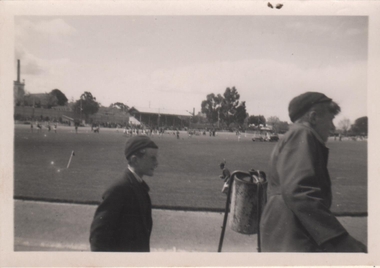
Photograph - GEORGE BOSOMWORTH COLLECTION: RUNNING RACES AT THE SPORTSGROUND
... GEORGE BOSOMWORTH COLLECTION: RUNNING RACES AT THE SPORTSGROUND...Photograph GEORGE BOSOMWORTH COLLECTION: RUNNING RACES AT THE SPORTSGROUND ...Small black and white photograph showing a running race at the Bendigo sportsground. The photo is dated 10/10/1952.photograph, landscape, bendigo -
 Stawell Historical Society Inc
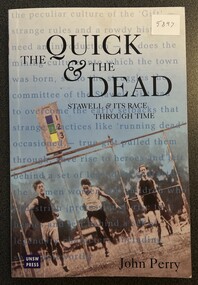
Book, John Perry, The Quick And The Dead, 2002
... ...Running Races...Stawell History Professional Sports Running Races Photographs Central Park $8.00 on Cover Stawell and its race through Time. ...History of Stawell Easter GiftStawell and its race through Time. Author - John Perry Blue Cover Finish of Easter Gift 1928 - Colour Photo$8.00 on Coverstawell athletic club. stawell easter gift. stawell history, professional sports, running races, photographs, central park -
 Sunbury Family History and Heritage Society Inc.
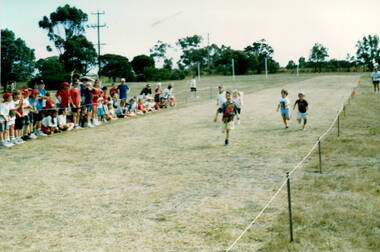
Photograph, School Sports Day, c1980s
... ...Running Races...District sports meeting at Mickleham for Bulla Primary School and surrounding area school sports meetings Mickleham Bulla Primary School Running Races A coloured photograph of little children running in a race while other children cheer them on . ...District sports meeting at Mickleham for Bulla Primary School and surrounding areaA coloured photograph of little children running in a race while other children cheer them on . school sports meetings, mickleham, bulla primary school, running races -
 Linton and District Historical Society Inc
Account Book, Financial Records, St Patrick's Day Sports, Linton, 1928
... The St Patrick's Day sports meeting was an annual event during the 1920s and 1930s, and included running races and horse racing. R. O'Beirne was Secretary of the sports day committee....The St Patrick's Day sports meeting was an annual event during the 1920s and 1930s, and included running races and horse racing. R. O'Beirne was Secretary of the sports day committee. ...The St Patrick's Day sports meeting was an annual event during the 1920s and 1930s, and included running races and horse racing. R. O'Beirne was Secretary of the sports day committee.Dark blue 'Banco' exercise book. Contains records of receipts and expenditure for the St Patrick's Day sports meeting, held in Linton on March 24th, 1928.On front cover: "R.O'Beirne, Hon Sec, St Patrick's Day Sports, Commenced Jan 28th 1928". Inside front cover: "St. Patrick's Day Sports Held March 10th (this crossed out & replaced) 24th-28". Inside back cover: Numerous calculations in pencil (of amounts of money?)events, st patrick's day sports, r. o'beirne, documents and records -
 Ithacan Historical Society
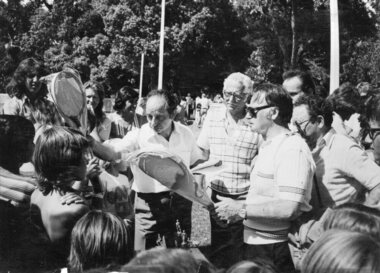
Photograph, Ithacan picnic, late 70s - early 80s
... The photograph was taken at an Ithacan picnic during the running races. IPS committee members, L-R Stathi Raftopoulos, Michael Black and Nick Varigos are presenting prizes of tennis rackets to race winners....The photograph was taken at an Ithacan picnic during the running races. IPS committee members, L-R Stathi Raftopoulos, Michael Black and Nick Varigos are presenting prizes of tennis rackets to race winners. ...The photograph was taken at an Ithacan picnic during the running races. IPS committee members, L-R Stathi Raftopoulos, Michael Black and Nick Varigos are presenting prizes of tennis rackets to race winners.The annual Ithacan picnic which is held towards the end of summer is a popular event allowing friends and families to mingle and relax. The running races are a popular feature for the young.A black and white photograph of a crowd of people outdoors. Two men are holding wrapped tennis rackets while another man is talking to a child in the group. -
 Ithacan Historical Society
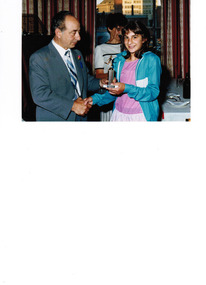
Photograph, Award recipient
... Stathi Raftopoulos presents Koula Megalogenis with an award from the running races held at annual picnic. The awards were presented at a function which took place in the Ithacan Philanthropic Society's club rooms....Stathi Raftopoulos presents Koula Megalogenis with an award from the running races held at annual picnic. The awards were presented at a function which took place in the Ithacan Philanthropic Society's club rooms. ...Stathi Raftopoulos presents Koula Megalogenis with an award from the running races held at annual picnic. The awards were presented at a function which took place in the Ithacan Philanthropic Society's club rooms.A coloured photograph of a man shaking the hands of a young girl s, who is holding a trophy. Another lady is standing in the background.raftopoulos, megalogenis, awards, stathi -
Linton and District Historical Society Inc
Notebook, St Patrick's Day Races, Linton, 1929
... In 1929 the events included running races for children, horse racing and motor car driving. ...In 1929 the events included running races for children, horse racing and motor car driving. ...The St Patrick's Day sports meeting was an annual event in Linton during the 1920s and 1930s. In 1929 the events included running races for children, horse racing and motor car driving. R. O'Beirne was Secretary of the sports day committee.Green 'Banco' exercise book which contains information compiled for the St Patrick's Day Sports held March 9th 1929. Includes timetable of events, information on race distances, horses entered in races, penalty weights, handicaps, protests lodged, amounts paid in winnings etc. Also includes brief information on entries, winners and prize money paid for "Motor Car Driving" and "Musical Chairs in Cars" events, and summary of takings for the day.On front cover: "R.O'Beirne, St Patrick's Day Races, March 9th 1929, Commenced 9th/2?[illegible]/1929". Inside front cover: "1929 1930". Inside back cover: Race notes in pencil.events, st patrick's day sports, horse racing, r.o'beirne -
 Ithacan Historical Society
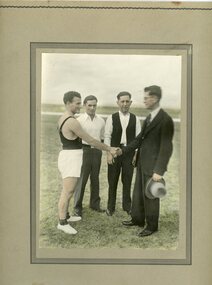
Photograph, Stratos Paizis, 1936
... Stratos Paizis is being congratulated by Andreas Papadopoulos following a win in the running races a the annual Ithacan picnic. Andreas was president of the Ithacan Philanthropic Society from 1934 - 1939. ...Stratos Paizis is being congratulated by Andreas Papadopoulos following a win in the running races a the annual Ithacan picnic. Andreas was president of the Ithacan Philanthropic Society from 1934 - 1939. ...Stratos Paizis is being congratulated by Andreas Papadopoulos following a win in the running races a the annual Ithacan picnic. Andreas was president of the Ithacan Philanthropic Society from 1934 - 1939. Also pictured centre, l-r, Peter Razos and George Paizis (Leris).Black & white photograph of four men congratulating an oarsman after a race. -
 Ithacan Historical Society
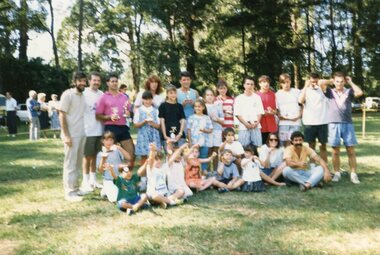
Photograph, Ithacan picnic, c2000s
... The Ithacan Philanthropic Society's annual picnic has been held at various locations over the years, including Mount Evelyn, Bacchus Marsh, and in latter years at the reserve at Ferny Creek at which this photo is taken. Running races have been a highlight of the picnics. ...The Ithacan Philanthropic Society's annual picnic has been held at various locations over the years, including Mount Evelyn, Bacchus Marsh, and in latter years at the reserve at Ferny Creek at which this photo is taken. Running races have been a highlight of the picnics. ...The Ithacan Philanthropic Society's annual picnic has been held at various locations over the years, including Mount Evelyn, Bacchus Marsh, and in latter years at the reserve at Ferny Creek at which this photo is taken. Running races have been a highlight of the picnics. Pictured on the left are Dennis Katsamas, Anthony Drakopoulos and Greg Varigos together with the place-getters displaying their medals. The annual Ithacan Picnic has always been an important and popular social event for members and friends of the Ithacan Society. The first picnic was held in 1918. A coloured photograph of a picnic scene. -
 Ithacan Historical Society
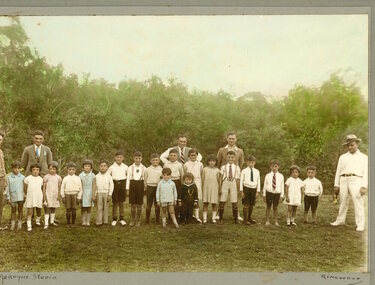
Photograph, Ithacan picnic
... For many years Maddingley Reserve, Bacchus Marsh was the regular location; and more recently Ferny Creek Reserve. Running races continue to be run for all age groups are a popular activity during the day. ...For many years Maddingley Reserve, Bacchus Marsh was the regular location; and more recently Ferny Creek Reserve. Running races continue to be run for all age groups are a popular activity during the day. ...The photograph was taken at an Ithacan Club annual picnic. The picnic were held on recreation grounds located on Melbourne's rural fringe. For many years Maddingley Reserve, Bacchus Marsh was the regular location; and more recently Ferny Creek Reserve. Running races continue to be run for all age groups are a popular activity during the day. In this photograph the children are lining up for the 75 yards race.A sepia photograph taken in the country of a row of children lining up at thew start of a race. Five men are standing behind them. -
 Ithacan Historical Society
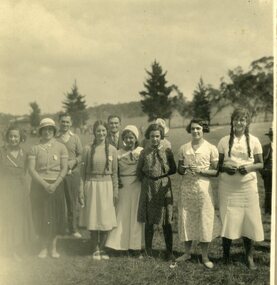
Photograph, Picnic race, c1932
... The picnic remains an annual event on the club's calendar. Running races continue to be popular and in this photo the young women look to be preparing for their event. ...The picnic remains an annual event on the club's calendar. Running races continue to be popular and in this photo the young women look to be preparing for their event. ...The photograph was taken at an annual picnic organised by the Ithacan Philanthropic Society in the ealry 1930s. The picnic remains an annual event on the club's calendar. Running races continue to be popular and in this photo the young women look to be preparing for their event. Pictured on the far right is Marguerite Panaretos (nee Black/Mavrokefalos) and next to her Fife Krizos. Fourth from the right is May Theordore, sister of Alma Theodore-Paizis, and behind her John Raftopoulos (Patakias). A sepia photograph of six young women lining up at the start of a race with three race officials standing behind the group in an open area. -
 Bendigo Historical Society Inc.
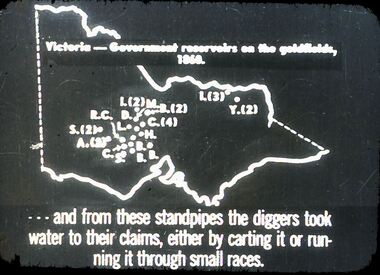
Slide - DIGGERS & MINING. GETTING THE GOLD, c1860
... And from these standpipes the diggers took water to their claims, either by carting it or running it through small races. Markings: 72 994.LIF:4. ...And from these standpipes the diggers took water to their claims, either by carting it or running it through small races. Markings: 72 994.LIF:4. ...Diggers & Mining. Getting the Gold. Slide: Map of Victoria. Victoria - Government reservoirs on the goldfields, 1860. Letters on map relate to the position of the reservoirs standpipes. And from these standpipes the diggers took water to their claims, either by carting it or running it through small races. Markings: 72 994.LIF:4. Used as a teaching aid.hanimounteducation, tertiary, goldfields -
Vision Australia
Film - Video recording, 20th Century movies from RVIB, 1940s
... RVIB sign, outside front of RVIB building and a group of adults sit on benches under the giant central trees, children have running races, children cheer and one receives a ribbon for her sash that is over her school uniform, a woman writes down the results, a man uses a device, various shots of children, games such as ball tossing, winding up string race, younger children have a running race holding hands with nursing staff. 28. ...RVIB sign, outside front of RVIB building and a group of adults sit on benches under the giant central trees, children have running races, children cheer and one receives a ribbon for her sash that is over her school uniform, a woman writes down the results, a man uses a device, various shots of children, games such as ball tossing, winding up string race, younger children have a running race holding hands with nursing staff. 28. ...Various movies made by the RVIB and transferred on to digital media. These were created for raising awareness of the RVIB and to appeal for donations from the general public. Most are assumed to be from the 1940s. 1. Brief image of children at RVIB. Various girls knitting in the grounds of St Kilda road, with a quick cutaway to two babies in prams. In the middle of the girls is a globe with a rainbow style surround that reads "The sun will never set on our Empire / Because we have the will to win!" The Australia flag and Union Jack flutter above the words and in the middle is the AIF rising sun badge. There is a brief shot of uniformed girls holding up a rug. 2. Two men stand beside a Clarke and Smith talking book player. One man guides the other to the cartridge and to open the cartridge mailing container. 3. "The work and play of the babies and children give our supporters never ending interest and enthusiasm!" A boy weaving cane on to a timber frame, a girl reads her piano music as she plays, whilst another writes in Braille. 4. "This girl is studying for her leaving Certificate to enter the University for the Degree of Bachelor of Arts!" Phyllis Lawson at a typewriter, a classroom of students and a girl reading a book. 5. "Arithmetic and algebra sums are worked out by steel pins placed in octagonal holes." Students using a Taylor's Slate. 6. "Born into a world of darkness. They depend upon for the LIGHT! Through education, training, recreation." A teacher helps a girl read a raised map, a boy finds the South American landmass on the globe, and a boy feels his way around a toy galleon. 7. "You can quite understand why the School Inspector said the manual training and work of our pupils would do credit to a normal School!" A boy adjusts the rear wheels of a wooden model biplane and spins the propeller when done. 8. "Little fingers which are frequently stiff and clumsy through lack of training are guided into confidence and self help." Various children are shown weaving canework baskets or stringing beads, and a younger child creates plasticine models. 9. "Out of the Shadows of ignorance into the Sunshine" of Happy, useful Citizenship. With your help!" Two children make a bed in a dormitory, a girl brushes her teeth and washes and dries her hands in a dormitory bathroom, children eat with napkins tucked under their chins at tables covered in cloth and with flower centrepieces in a dining room, and girls in various costumes dance in the garden. 10. "They afford an object lesson on how to tackle and vanquish misfortune!" Four children row an adult on Albert Park Lake, children play on a swing carousel next to a building on which is painted 'Blind Babies Nursery', a boy winds up a train and places in on the track, and two children play with blocks. 11. "And now we come to our blind toddlers! Our Nursery School is the only one in the Southern Hemisphere!" Children play with dolls, a playhouse and a rocker swing. 12. "Only for your support their lives might have been pitiful tragedies!" Children cuddle or play with soft toys, rocker swing and playhouse whilst a younger child sits in a chair. 13. "All that sight means stimulates our minds to express the sympathy of our heart to them." Three girls sing their dolls to sleep as they cradle and rock them. 14. Outside of St Kilda Road building from various views. 15. "Our hostels for young blind." Raleigh Street hostel. 16. "The Lighthouse is the symbol of the Institute's activities. It spreads light through education and training into the lives of all eligible blind babies, children and adults of Victoria! A peep into our factories!" View of factory building, workers making millet brooms, weaving mats and basket weaving. 17. "Although our income totals 40,000 pounds annually the hand made articles of our sightless workers have to be sold at a heavy loss to compete with machine made goods! This loss, and the 10,000 pounds given annually in compassionate allowances to the adult blind to help them to support their wives and families can only be maintained by donations from Citizens!" Various workers making a range of brooms in the factory. 18. "All our blind adults live in their own homes. They receive 36,000 pounds annually, including nearly 10,000 pounds in compassionate allowances! We can NEVER THEREFORE BE SELF SUPPORTING." The range of goods produced by RVIB (baskets, mats, brooms and brushes) is shown hanging from the swing carousel in the children's playground. "Our blind workers can support their wives and families by constant employment only if Citizens ask Storekeepers for "BLIND INSTITUTE" goods. 19. A man adjusts the dampeners on a piano. "Please engage our expert blind piano tuners and repairers. They attend to more than 1000 pianos and pianolas every year!" A man puts in a row of dampeners and then tunes the piano. 20. "Our gymnasium, social, dancing, cricket and other forms of recreation give the sightless endless pleasure!" Male on a stationary bike, using a skipping rope, weightlifting and Greco-Roman wrestling in the gym, men playing cricket, people playing cards, a tile game, dominoes, checkers and a pinball game. 21. A girl using a wireless set. "For many years now we have given and maintained FREE wireless sets to all needy applicants throughout Victoria!" Girl puts on headphones and adjusts the dials. 22. " "TALKING BOOKS" have now been invented for the education and entertainment of the sightless. Literature of all kinds is thereby read to them by means of special records." A boy puts on headphones to listening to a recording. 23. Couples dance as the RVIB Orchestra plays on stage. Plates of cakes are passed around a table amongst tired dancers. The camera pans across the four piece orchestra (piano, saxophone, drummer and double bass). 24. "To lighten their darkness is a work of mercy! Please help us to give them The courage of usefulness, The privilege of work, The happiness of comradeship". 25. Various people at a meeting, one with a dog guide at his feet and some with dark glasses. Three men stand near a Clarke & Smith cartridge player talking. Two of them appeared earlier. 26. Women working in a room. A man gives dictation to a women, who is using possibly a Stainsby-Wayne embossed shorthand typewriter, a telephone operator connects calls, a man takes notes on a Stainsby-Wayne crab writer, a room full of people working, a metal device moves between two springs and two men work with timber. 27. RVIB sign, outside front of RVIB building and a group of adults sit on benches under the giant central trees, children have running races, children cheer and one receives a ribbon for her sash that is over her school uniform, a woman writes down the results, a man uses a device, various shots of children, games such as ball tossing, winding up string race, younger children have a running race holding hands with nursing staff. 28. "Melbourne, Blind Childrens' Annual Sports". Outside of RVIB building and sign, children compete in a variety of games as adults watch on. 29. "Melbourne, Swimming Under Handicap". Children walking along a street, past a Holden, to enter the City Baths. Inside they swim, learn to swim, jump and dive into the pool under the watchful gaze of a group of women. This portion of the film then is repeated in segments.1 colour video recordings with no soundroyal victorian institute for the blind, phyllis gration, rvib nursery, rvib school, rvib orchestra, braille equipment, braille music, recreation, fundraising, education, employment, buildings, raleigh street hostel, audio books -
 Orbost & District Historical Society
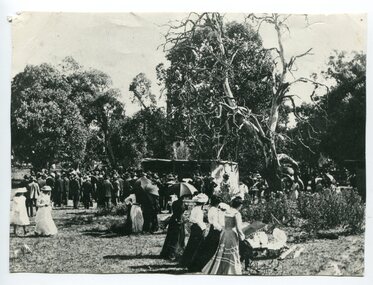
black and white photograph, C1890
... running of the Orbost Cup in 1890s. The Orbost Race Club was founded in 1890. Many early members were: George Morgan, James Cowell, J. Farquhar, J. Cameron, L. Herbert, S. J. Lynn, Arch. Rodwell, J. Ashby, A. W. McLeod, W. Middleton, W. Archer, J. Pleydell and J. Drew. The races...running of the Orbost Cup in 1890s. The Orbost Race Club was founded in 1890. Many early members were: George Morgan, James Cowell, J. Farquhar, J. Cameron, L. Herbert, S. J. Lynn, Arch. Rodwell, J. Ashby, A. W. McLeod, W. Middleton, W. Archer, J. Pleydell and J. Drew. The races ...This photo shows people at the running of the Orbost Cup in 1890s. The Orbost Race Club was founded in 1890. Many early members were: George Morgan, James Cowell, J. Farquhar, J. Cameron, L. Herbert, S. J. Lynn, Arch. Rodwell, J. Ashby, A. W. McLeod, W. Middleton, W. Archer, J. Pleydell and J. Drew. The races were conducted on a course laid out in a paddock of Mr James Cowell at Jarrahmond. (info. from Newsletter HISTORY OF ORBOST) This item is associated with horse racing in early Orbost.A black / white photograph of a large group of men, women and children at an outing in a bush setting with a large flat area. They appear to be watching an event. Many of the women are holding opened large umbrellas. It is on a grey buff card.horse-racing-orbost orbost-race-club -
 Eltham District Historical Society Inc
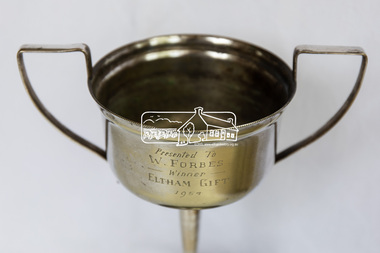
Decorative object - Trophy, Winner's Cup, Eltham Gift 1954, 1954
... The Eltham Gift was a running race similar to many other 'Gift' races around the the Melbourne suburbs and country towns. ...The Eltham Gift was a running race similar to many other 'Gift' races around the the Melbourne suburbs and country towns. ...Presented to W. Forbes Raymond (Billy) William Forbes 1934-2008 Born Nyah West, Vic and died Echuca, Vic, Billy was a painter and decorator in the 1950s before joining the Melbourne Metropolitan Fire Brigade in the 1960s. In the 1970s he was employed at the Melbourne Metropolitan Board of Works until his retirement in 1991. In the 1930s he was raised in Nyah West then moved to Wallan in the 1940s, Collingwood/Carlton in the 1950s, Reservoir in 1970 then Torrumbarry, Vic from the 1990s. Billy undertook National Service in the 1950s and played football with the Carlton Royals in the 1950s and 1960s. Billy was presented with this Winner's Trophy for the 1954 Eltham Gift. The Eltham Gift was a running race similar to many other 'Gift' races around the the Melbourne suburbs and country towns. And that is where the mystery lies as press reports of the day have a completely different person winning the Eltham Gift in 1954. Bert Edwards was recorded in local news as winning the 1954 Eltham Gift held at Central Park Eltham. Brass alloy silver plated cup (engraved) on brown baketlite platic basePresented to W. Forbes, Winner, Eltham Gift, 1954eltham gift 1954, raymond (billy) william forbes 1934-2008, running race, sports, trophy, w. forbes, winner's cup, central park, athletics -
 Kiewa Valley Historical Society
Programme - 29th Annual Combined Sports 1971, Kiewa Valley Schools' Sports Association
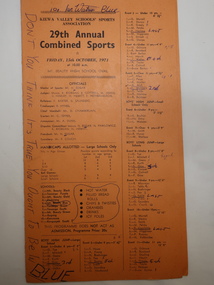
... Races boys and girls. Championship for Boys and Girls Under and Over 10 years.Relay Team Open, Skip Ball Open. Tunnel Ball Open,.Circle Gap Open and a Boys and Girls Circle Gap 220 yards. Primary Schools from the Kiewa Valley held athletic sports each year. The schools consisted of small and big schools in the Kiewa Valley. The events included running ...Combined school athletic sports were held annually. This one was between 11 teams: Mt. Beauty Black, Tawonga Purple, Mt Beauty Gold, Dederang, Mt Beauty Blue, Tawonga South, Mt Beauty Green, Bogong, Kancoona and Kergunyah South. Events included High Jump, Long Jump for Boys and Girls and Triple Jump for Boys. Also, Potato Race, Zig Zag team of 6, and Bounce Ball. Flat Races boys and girls. Championship for Boys and Girls Under and Over 10 years.Relay Team Open, Skip Ball Open. Tunnel Ball Open,.Circle Gap Open and a Boys and Girls Circle Gap 220 yards.Primary Schools from the Kiewa Valley held athletic sports each year. The schools consisted of small and big schools in the Kiewa Valley. The events included running and jumping as well as team 'fun/novelty' events.Events were run according to age and differed between boys and girls.Orange cardboard athletic sports programme folded in half with 69 events listed with "Officials" named and children's names or teams listed. "Don't you Think It's True You Ought To Be in Blue" penned on the front. "Good Old Blue. Blue Forever. We stick to First Place." "Blue is the Best" "No Sweat to Blue" penned on the fold in the middle. "Good Old Blue" and "Blue" penned on the back.athletics., athletics sports day, school sports, kiewa valley sports -
 Kiewa Valley Historical Society
Sash and Rosettes Tartan
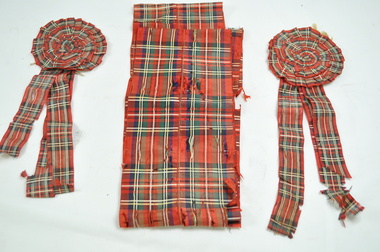
... An integral part of child development and socialising within the formal school environment sash rosettes school foot races Highland clan to be identified Sash made from fine cotton weave with Scottish highland tartan. Width 12cm and sides fine stitched. Pattern (Royal Stewart) running ...Early athletics year 11 school championships Kiewa Valley School Carnival circa 1920 - 1950s Historical and social significance of school based physical development of children through dedicated sports programs. An integral part of child development and socialising within the formal school environmentSash made from fine cotton weave with Scottish highland tartan. Width 12cm and sides fine stitched. Pattern (Royal Stewart) running length of ribbon.Two rosettes of same material 9cm diameter with three 3cm wide ribbons attached lengths 16cm, 20.5cm and 28cm The "Glen" designHighland clan to be identified sash, rosettes, school foot races -
 Bendigo Historical Society Inc.
Slide - DIGGERS & MINING. GETTING THE GOLD, c1850s
... Slide: On some fields, but notably at Ballarat and Daylesford, the diggers soon began building water races from streams and springs, and running the race water into small reservoirs near their claims. ...Slide: On some fields, but notably at Ballarat and Daylesford, the diggers soon began building water races from streams and springs, and running the race water into small reservoirs near their claims. ...Diggers & Mining. Getting the Gold. Slide: On some fields, but notably at Ballarat and Daylesford, the diggers soon began building water races from streams and springs, and running the race water into small reservoirs near their claims. (Water races, as we have seen, were also constructed all over the Ovens field for sluicing purposes.) Later in the gold decade, the building of water races went on space - chiefly by large co-operative groups of diggers engaged in small scale mining operations. Markings: 69 994.LIF:4. Used as a teaching aid.hanimounteducation, tertiary, goldfields -
 Bendigo Historical Society Inc.
Newspaper - JENNY FOLEY COLLECTION: WORLD CHAMPION
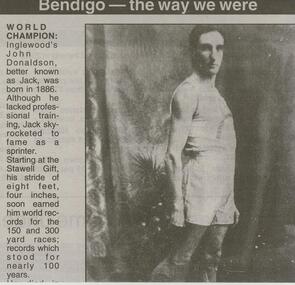
... races, exhibitions and challenge events. He moved to New York in 1919 where he married Ethel Auer in 1925. He ran a gymnasium in NY but committed suicide in 1933. He is remembered each year with the running...races, exhibitions and challenge events. He moved to New York in 1919 where he married Ethel Auer in 1925. He ran a gymnasium in NY but committed suicide in 1933. He is remembered each year with the running ...John (Jack ) Donaldson was born in Raywood in 1886 but he was raised in Inglewood. A natural runner he held 6 world records in sprint events from 100 yards to 400 yards. He came second in his first appearance at the Stawell Gift in 1906. He was nicknamed "The Blue Streak" and raced all over the world in official professional races, exhibitions and challenge events. He moved to New York in 1919 where he married Ethel Auer in 1925. He ran a gymnasium in NY but committed suicide in 1933. He is remembered each year with the running of the "Jack Donaldson 200m. handicap " race at the Stawell Gift meeting.Bendigo Advertiser ''the way we were'' from Friday, January 2, 2004. World champion: Inglewood's John Donaldson, better known as Jack, was born in 1886. Although he lacked professional training, Jack skyrocketed to fame as a sprinter. Starting at the Stawell gift, his stride of eight feet, four inches, soon earned him world records for the 150 and 300 yard races; records which stood for nearly 100 years. He died in 1933 at the age of 49. The clip is in a folder.newspaper, bendigo advertiser, the way we were -
 Bendigo Historical Society Inc.
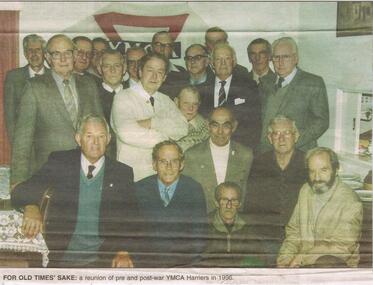
Newspaper - JENNY FOLEY COLLECTION: FOR OLD TIMES SAKE
... races. It is believed the name "Harrier" referred to a British game "hare hunters" in which a "hare", the lead runner would leave a trail of papers for the "hounds" to follow. Now Harriers clubs cover a variety of athletic events including running...races. It is believed the name "Harrier" referred to a British game "hare hunters" in which a "hare", the lead runner would leave a trail of papers for the "hounds" to follow. Now Harriers clubs cover a variety of athletic events including running ...Bendigo Harriers had their first Cross-country race on Weds 3rd May 1893 and continued to hold weekly races. It is believed the name "Harrier" referred to a British game "hare hunters" in which a "hare", the lead runner would leave a trail of papers for the "hounds" to follow. Now Harriers clubs cover a variety of athletic events including running and jumping.Bendigo Advertiser '' The way we were'' from 2002. For old times' sake: a reunion of pre and post-war YMCA Harriers in 1996. The clip is in a folder.newspaper, bendigo advertiser, the way we were -
 Bendigo Historical Society Inc.
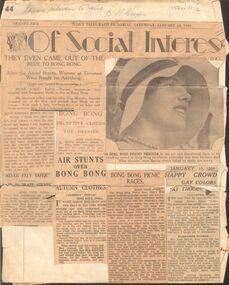
Newspaper - HOWARD AND VIOLET JOLLEY COLLECTION: NEWSPAPER ARTICLES
... RACES Bachelors bag won by Orwell Phillips. Alan Binnie, Lady de Chair, Lt Graham de Chair, Miss Susan Spencer, Mr & Mrs Blomfield; HAPPY CROWD GAY COLOURS AT TIRRANNA, two men wore fly nets, Mrs Alan Binnie remarked at the state of the ground. Binnie family rider Jack Melville had to borrow plumes as his riding kit had displaced from the car's running...RACES Bachelors bag won by Orwell Phillips. Alan Binnie, Lady de Chair, Lt Graham de Chair, Miss Susan Spencer, Mr & Mrs Blomfield; HAPPY CROWD GAY COLOURS AT TIRRANNA, two men wore fly nets, Mrs Alan Binnie remarked at the state of the ground. Binnie family rider Jack Melville had to borrow plumes as his riding kit had displaced from the car's running ...From THE DAILY TELEGRAPH items include from Jan 18 & 10, 1930 Of Social Interest. THEY EVEN CAME OUT OF THE BLUE TO BONG BONG, After the air-stunts, Women at Tirranna Were Ready For Anything, Racing excitement mingled with aeroplane thrills at Bong Bong; Barbara Aird as passenger, Never felt safer; LADY IN PLANE STUNTS; Gypsy Moth; Howard Jolley and pilot Guy Menzies, Dick Allen DECEPTIVE CLOUDS; THE DRESSES; AIR STUNTS OVER BONG BONG; AUTUMN CLOTHES; BONG BONG PICNIC RACES Bachelors bag won by Orwell Phillips. Alan Binnie, Lady de Chair, Lt Graham de Chair, Miss Susan Spencer, Mr & Mrs Blomfield; HAPPY CROWD GAY COLOURS AT TIRRANNA, two men wore fly nets, Mrs Alan Binnie remarked at the state of the ground. Binnie family rider Jack Melville had to borrow plumes as his riding kit had displaced from the car's running board on route to the races. From MONDAY 11th Nov 1929, Croppa Creek picnic races, history as Messrs Jolley & Leggatt arrived by plane. From Sydney Morning Herald of 18/3/1930 The Town Hall was densely packed last night for the Irish national concert held in connection with St Patrick's Day celebrations with programme numbers drawing enthusiastic applause.daily telegraph, airplanes, picnic races -
 Ithacan Historical Society
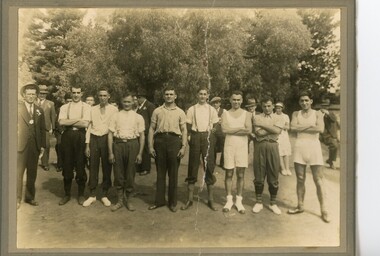
Photograph, Ithacan picnic, men's races, c 1930s
... A scanned bl;ack and white photograph of eight men and the starter lined up before the start of a race at an outdoor function with onlookers behind the group. two of the men are dressed in shorts and singlet while some others in the group have rolled up their suit trousers and are wearing running shoes. Ithacan picnic, men's races Photograph ...The photograph was taken at an annual Ithacan Philanthropic Society picnic some time in the mid to late 1930s. The men appear to be lined up for a running race, a highlight of the picnic. First on the left is Andreas Papadopoulos president at the time (president from 1934-39); man in suit in the background unknown; Diogenes Cominos, Hector Andrews (Anagnostatos); George Kouvalias (behind him is Nick Fatouros (Fisher)); Spiros Digaletos, a keen wrestler as a a young man; Peter Zavitsanos (Shanos); Peter Drakopoulos; Stratos Paizis; Nick Mavrokefalos (Black).The Ithacan Greeks who settled in Melbourne between the two world wars worked long hours in their family businesses, however, Sunday was a day set aside for socialising within their community. A much anticipated event was the annual picnic where families gathered for the day at a picnic ground on the outskirts of Melbourne, such as Bacchus Marsh, Werribee and Mount Evelyn. The picnic today is still an important event in the club's social calendar. A scanned bl;ack and white photograph of eight men and the starter lined up before the start of a race at an outdoor function with onlookers behind the group. two of the men are dressed in shorts and singlet while some others in the group have rolled up their suit trousers and are wearing running shoes. -
 Ithacan Historical Society
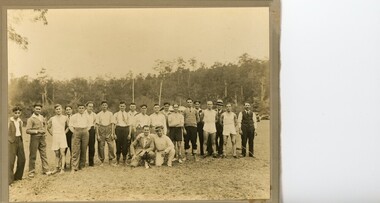
Photograph, Ithacan Picnic races, c1933
... running shoes. The group are standing in a picnic ground in a valley which is surrounded by trees. Ithacan Picnic races Photograph ...The photograph was taken at an Ithacan Philanthropic Society annual picnic sometime in the late 1920s or early 1930s. Races were always a feature at the annual picnic. In those early most families travelled to the picnic ground in hired furniture vans. The annual picnic is still held today in February of each year. Pictured standing L-R: ? Kasamias; unknown; Nick Kandiliotis; Andreas Razos; unknown; unknown; unknown; Spiros Digaletos; Paizis?; Dimitri Megalogenis; unknown; Paris Gabriel; Kallinikos ?; unknown; unknown; Gerasimos Papadopoulos (Tsinis); Stratos Paizis; Cominos (Bourazanis)?; Kneeling: Nikos Stratos; Platon Varvarigos. The annual picnic gave Ithacans the chance to relax and mingle away from their work on Sunday. It was and still is an important social event in the society's calendar.A scanned black and white photograph seventeen men standing in a line and two others crouched down in the front. They are either preparing to have a race or they have completed one as four of them are wearing shorts and singlets while some of the others have rolled up their trouser legs and a lot of them are wearing running shoes. The group are standing in a picnic ground in a valley which is surrounded by trees. -
 Melbourne Tram Museum
Slide - Caulfield Races traffic, Warren Doubleday, 22/10/1972
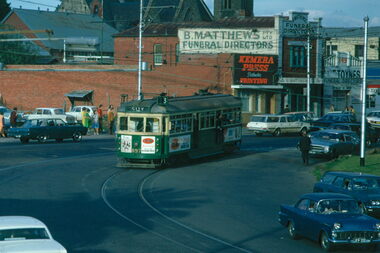
... running a route 3 to the City. Yields information about the use of W7 1024 in all over advertising for a pet food company and Matthews Ave, Airport West. tramways Caulfield Races Caulfield railway ave W2 class tram 1024 tram 897 SW6 class Has in pencil slide number "4/72/2, 3 & 6" Colour slide - Kodak cardboard mount - set of 3 Slide Caulfield Races traffic Warren Doubleday ...Set of 3 colour slides of trams using the Caulfield loop and sidings for the 1972 Caulfield Cup event, 22/10/1972. 1 - SW6 897 with Kamera Press, B Matthews funeral directors and Toynes in the background. 2 - Line up of W2s in the loop track waiting for punters with Downards Furniture removal store in the background 3 - W7 1024 advertising Dulux paints running a route 3 to the City.Yields information about the use of W7 1024 in all over advertising for a pet food company and Matthews Ave, Airport West.Colour slide - Kodak cardboard mount - set of 3Has in pencil slide number "4/72/2, 3 & 6"tramways, caulfield races, caulfield, railway ave, w2 class, tram 1024, tram 897, sw6 class -
 Melton City Libraries
Photograph, Wendy Barrie, Unknown
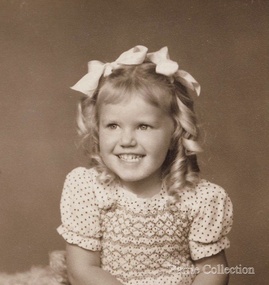
... Races at Ballarat when the crowds were hurrying home to Melbourne. Train travel had changed very little from the time my mothers generation to mine. The timetable meant the usual rush to Melton South by bike in her case and if she was running late the train pulled up on the crossing. ...Races at Ballarat when the crowds were hurrying home to Melbourne. Train travel had changed very little from the time my mothers generation to mine. The timetable meant the usual rush to Melton South by bike in her case and if she was running late the train pulled up on the crossing. ...Eldest daughter of Edna and Bon Barrie, born on 03 November 1943 in Melbourne, Victoria, Memoirs of Wendy Barrie, recalling the early formative years of life in Melton: In 1949 I started school at Melton State School no 430 and was driven the 2½ miles to there by my parents at first. Later we walked home in the afternoons or were picked up by car as we made our way home along the Western Highway. In 1956 I went to Bacchus Marsh High School. There were 4 students in grade 6 and 3 of us went to the High School. The students from Melton, Melton South and Toolern Vale State Schools went by bus to Bacchus Marsh High School as far a fifth form. My parents drove me to the pick up point and during the five years of travel to High School. The bus travelled via Toolern Vale and later went through Exford and through Parwan. On the return journey in the afternoon the bus went in the reverse direction. The bridge at Exford was an old narrow wooden one, and the students had to get off the bus and walk across, with the driver crossing in the empty bus for safety reasons. There was a travelling allowance paid to parents and it was estimated from the distance the crow flies, a straight line. We lived a Ferris Lane, just where the Harness Racing entrance is now situated about 2 ½ miles by road to school too close to qualify for the subsidy. While at State School Melton we would walk home in a group with the Nixon and Gillespie children, along the main road over the bridge near the Shire Offices and down a hill. I was being dinked on Joyce Gillespie’s bike while holding onto the seat, toppled off the bike striking my chin and teeth on the bitumen and cracking my jaw. I was about 9 years old and stayed a couple of days in the Quamby Hospital in Bacchus Marsh, it seemed like and eternity at the time and quite traumatic being separated from my family. I can remember contemplating how I could get out of the window and run away but realised it was too far to walk home. Often we would cut across the Common on our way home from school picking up stray golf balls and collecting them from the creek when it dried out. We were warned about not accepting lifts from strangers passing along the Melbourne/ Ballarat Road. The only danger we faced was being swooped by the magpies particularly on the open ground on the Common. We were also fairly cautious when the Gypsies camped on the Common in the area just about opposite the small reservoir. “Mum” grandma Myers loved to have us call in on our way home, and usually would cut a slice of Jongebloed’s bread and spread it with home made butter. Sometimes we waited there until we were collected by car, usually driven by our mother. Margaret Nixon and Joyce Gillespie were a few grades ahead of me and Barbara Nixon was born just two months earlier than me. Our mothers were great friends for over 6o years, born in the same month three years apart. They lived within a few days of the same age as each other at the time their deaths. Dad and George Nixon attended Melton school at the same time. Sarah nee Hornbuckle Nixon and my grandfather Frederick Myers Snr were at school together at the same in the 1880s. The Nixon family lived in Keilor Road just past the Toolern Creek near the turnoff. Tom and Ann Collins lived on the southern side of the Western highway and Keilor road intersection. Jim and Ruby Gillespie’s house was further long Keilor road on the right. They backed onto the Myers who lived on the north side of Western Highway east of Myers Gully (Ryans Creek). The Bridge over the Toolern Creek as very narrow and as truck traffic increased there were accidents. One truck took out the side railing and plunged upside down into the bank and into the shallow water. Another fatal accident happened between a car and a truck right in front of the Myers house. Grandfather Fred had been a bike rider all his life, as far as the Riverina in his younger years, wryly made the comment about the drivers the speeding along the Ballarat Road were setting out to kill themselves. The road was busy particularly after the Races at Ballarat when the crowds were hurrying home to Melbourne. Train travel had changed very little from the time my mothers generation to mine. The timetable meant the usual rush to Melton South by bike in her case and if she was running late the train pulled up on the crossing. I was driven to the Station from home past Keith and Mary Gillespie’s house near the Ferris Road rail crossing to Bridge road to Melton South for the 7.32 train. While attending Sunshine High School in 1961 I would meet up with three other students, two of whom I knew from Bacchus Marsh High School days. We usually got into the same compartment on the train, it was a typical country train with a corridor along the side and compartments with a door, roof racks and sometimes heated metal containers for the feet in the winter. Some of the trains came through from Horsham and Ballarat, and the Overland from Adelaide passed through in the evening, we could hear it in the distance from the Ferris Lane home. The carriages had 1st and economy class compartments showing photographs of county scenes and holiday destinations. The engine was the large A class diesel. They are still running to Bacchus Marsh 50 years later, due to the need for the greatly increased number of commuters travelling to work in the city. Sometimes the carriages were pull by a Steam engine, these were a problem in the summer time because the sparks caused fires along the train lines and then quickly spread into the dry grass, crops and stubble. The Motor Train left Spencer Street at 4.23 pm and was the best train for me to catch. Ferris Road was a designated stop and train pulled up on the road crossing. It had steps at the door and rungs to hold while alighting to the ground. The ballast along the tracks was rough and uneven and awkward to land on. The train was painted blue and yellow with the letters VR pained on the front. This saved may parents the afternoon trip to collect me from the Station. On the walk home on the gravel road I would pass Uncle Tom and Aunty May’s house before reaching home. Melva Gillespie was studying at Sunshine Technical School and we sometimes both got off the train at the same time. On other occasions the Motor Train was replaced with a diesel engine with carriages, it was also required to stop and the driver had to be notified in advance. This meant getting into the guards van a Rockbank. It was more difficult alighting from the carriage as the gap was greater and more precarious to swing out and land on the ground. A few times in my last year of study at Melbourne Teachers College in Grattan Street Carlton. I managed to catch the 2.30 pm train to Serviceton, it was express to Melton and was very quick trip. The last train, was the 5.25 pm diesel to Ballarat and I usually caught this train to Melton South Station. On one occasion after being held up on the tram in Bourke street I had to make a mad dash to the platform chasing the train as it was just moving off and yelling to the guard, fortunately I was noticed and the train ground to halt. I scrambled into the end door and took most of the journey home to recover. After the last year at High School I continued to travel on the train, 2 years to Prahran Technical School changing at North Melbourne. There were a lot school children travelling to private schools and some at the primary level and mainly from Bacchus Marsh. Rockbank children also travelled by train from the beginning of their high school years, quite a few went to Sunshine High School. During my third year of teacher training I travelled to Flinders Street to RMIT for ceramics classes and Grattan St Teachers College located in the grounds of Melbourne University. There were many teachers being trained at the Secondary Teachers College due to the baby bulge creating a great shortage of teachers. Sunshine High School was very well represented amongst the different courses in Primary, Secondary and Art and Crafts. I attended Melbourne University lectures, studying a Fine Art subject. Bernard Smith was the most notable of the lecturers. he replaced Professor Joseph Bourke who had taken leave for the years. In 1962 he published the art book “Australian Painting”. The secondary art and craft student teachers from the College were in the majority, taking this subject and were well regarded due to their practical art and craft methods and their teaching round experience. In December 1964 I graduated as a Trained Secondary Teacher – Art and Crafts. The graduating ceremony was held at Wilson Hall. I received my appointment to work at Maryborough High School. Uncle Max and Aunty Rosemary Myers arranged my accommodation. Uncle Max was a teacher at the Maryborough Technical School fat the time. The appointment was suddenly changed when just before the school year was about to start when I received notification that I was now required to move to Warracknabeal High School. I was subject to a bond for the three years of training and three years of teaching and was under an obligation to comply with the directive of the Education Department. My father stood as guarantor when I was accepted as student at the Melbourne Teachers’ College, thus enabling me to receive my teacher training, and a 5 pounds a week allowance for expenses. After teaching for two years at Warracknabeal High School I was fortunate enough the gain a transfer to Sunshine West High School, returning to live at home in Melton and travelling by car to work with a fellow colleague, Jock Smith who lived at Station road Melton. I completed bond obligation and resigned at the end of the year. The employment regulations at that time did not allow the option of leave of absence for, indefinite overseas travel. I returned to Australia in October 1969. Visiting Arthur Hart the Principal of Sunshine High School he arranged with the Education Department for my re-employment at Sunshine High School until the end of the year. In 1970 I was transferred, and returned to Sunshine West High School where I worked for the next three years. In January 1968 I sailed on the “Oriana” to South Hampton with two teaching friends from Warracknabeal High School on a travelling and working holiday. Doreen Kiely, a former Bacchus Marsh High student and fellow train traveller from Bacchus Marsh, was already working in London, had arranged our accommodation at the London Travellers Club Hotel, Braham Gardens, Earls Court SW5. We based our stay at this address in London and travelled around Scotland, Ireland and England. In the summer we took a four month trip around the Continent and the Mediterranean. I registered with The Royal Borough Of Kingston Upon Thames as a Supply teacher, and worked at Chessington School form autumn to spring the following year and living with Mrs Rose Gillies at Kinross Avenue, Worcester Park, Surrey. In the spring of 1969 visiting Norway, Sweden and Finland joining an organised camping group to the Artic Circle, entered Russia at Leningrad (St Petersburg) Moscow, Minsk, to Poland and Czechoslovakia. In August returning to Worcester Park for the flight to Montreal to stay with cousin Lynette and husband Jurgen. A side trip was taken to Toronto, Niagara Falls and New York. The flight home from Montreal to Melbourne took 52 hours. A ½ day break in Vancouver before boarding the Qantas boeing 707 via San Francisco, Honolulu, Fiji, Sydney to Melbourne. Around the world in 21 months. Photographs of Wendy local identities -
 Sunbury Family History and Heritage Society Inc.
Photograph, Sunbury Racecourse
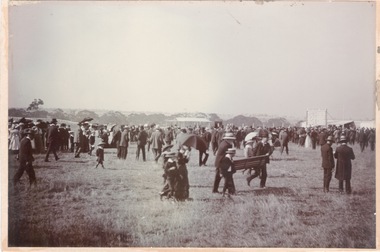
... The race meetings in Sunbury were well attended with special trains running from Melbourne on race days. Sunbury Race Meetings Racecourse Road Races Stud Farms A non-digital sepia photograph mounted on cardboard of a crowd of people caught in a sudden shower of rain and running for shelter at a race meeting. ...The photograph was taken at a Sunbury Race meeting, when a sudden shower of rain caused the spectators to run for cover. Sunbury Race Course was situated along Racecourse Road about 2kms from the railway station. The land has been sold and it is now a housing estate. The race meetings in Sunbury were well attended with special trains running from Melbourne on race days.A non-digital sepia photograph mounted on cardboard of a crowd of people caught in a sudden shower of rain and running for shelter at a race meeting.sunbury race meetings, racecourse road, races, stud farms -
 Falls Creek Historical Society
Poster - Kangaroo Hoppet 2019
... After running the event for 10 years, it was decided they should become part of the Worldloppet series of marathon ski races. ...After running the event for 10 years, it was decided they should become part of the Worldloppet series of marathon ski races. ...The Kangaroo Hoppet is Australia’s premier long distance cross country ski race, and a member of the Worldloppet series of international cross country ski events. The first race at Falls Creek was held in 1979 under the name of “Australian Birkebeiner”. It was a 21km race with about 80 participants organised by the Birkebeiner Nordic Ski Club of Mount Beauty. The course started and finished at Falls Creek Alpine Resort and took participants out into the Bogong High Plains. After running the event for 10 years, it was decided they should become part of the Worldloppet series of marathon ski races. Representatives from the Birkebeiner Nordic Ski Club and the Australian Ski Federation attended the Worldloppet Annual Meeting in Finland in June 1990 to put the case for the acceptance of an Australian event into the Worldloppet series. Before being admitted, they had to demonstrate that the Birkebeiner Club could run a world class event, so three months later in August 1990 a 42km event named the Australian International Ski Marathon was held at Falls Creek together with a 21km Birkebeiner race and a 7km event called the Birkebeiner Lite. The event was approved by delegates from USA, Norway and Austria, in 1991 Australia became the 12th member of Worldloppet, with the condition that there had to be a name change. After some late night discussion allegedly involving red wine from North East Victoria the main event became the 42km Kangaroo Hoppet, with the minor events being the 21km Australian Birkebeiner, and 7km Joey Hoppet. In the winter of 1991, the first Kangaroo Hoppet was held. It was a great success and has been a regular fixture on the international ski calendar ever since. It features the main 42km event as well as a 21km event and a 7km event. The Hoppet brings the Australian snowfields to an international audience. In 2019 the Kangaroo Hoppet attracted 1070 entries from 26 nations. The Men's Winner was Valerio Leccardi from Switzerland in a time of 1:43:19.5. The winner of the Women's event was Iris Pessey of France in a time of 2:04:29.2. This poster is significant because it documents an event which brings international attention to Falls Creek and the surrounding region.A poster featuring an image of a lone skier with mountains in the background. Logos of Worldloppet, AGL, Falls Creek, Alpine Shire Council, Victorian State Government, the Birkebeiner Nordic Ski Club. FIS and Kangaroo Hoppet are across the bottom of the poster. Text: KANGAROO HOPPET No. 29 24 August 2019 FALLS CREEK AUSTRALIA 7 km 21 km 42 km Beside the logos: www.hoppet.com.au kangaroo hoppet, worldloppet events, falls creek, mt. beauty -
 Falls Creek Historical Society
Poster - Kangaroo Hoppet 2024
... After running the event for 10 years, it was decided they should become part of the Worldloppet series of marathon ski races. ...After running the event for 10 years, it was decided they should become part of the Worldloppet series of marathon ski races. ...The Kangaroo Hoppet is Australia’s premier long distance cross country ski race, and a member of the Worldloppet series of international cross country ski events. The first race at Falls Creek was held in 1979 under the name of “Australian Birkebeiner”. It was a 21km race with about 80 participants organised by the Birkebeiner Nordic Ski Club of Mount Beauty. The course started and finished at Falls Creek Alpine Resort and took participants out into the Bogong High Plains. After running the event for 10 years, it was decided they should become part of the Worldloppet series of marathon ski races. Representatives from the Birkebeiner Nordic Ski Club and the Australian Ski Federation attended the Worldloppet Annual Meeting in Finland in June 1990 to put the case for the acceptance of an Australian event into the Worldloppet series. Before being admitted, they had to demonstrate that the Birkebeiner Club could run a world class event, so three months later in August 1990 a 42km event named the Australian International Ski Marathon was held at Falls Creek together with a 21km Birkebeiner race and a 7km event called the Birkebeiner Lite. The event was approved by delegates from USA, Norway and Austria, in 1991 Australia became the 12th member of Worldloppet, with the condition that there had to be a name change. After some late night discussion allegedly involving red wine from North East Victoria the main event became the 42km Kangaroo Hoppet, with the minor events being the 21km Australian Birkebeiner, and 7km Joey Hoppet. In the winter of 1991, the first Kangaroo Hoppet was held. It was a great success and has been a regular fixture on the international ski calendar ever since. It features the main 42km event as well as a 21km event and a 7km event. The Hoppet brings the Australian snowfields to an international audience. Unfortunately due to rapidly deteriorating snow conditions on the course, combined with a weather forecast of warm temperatures and rain in the days preceding the event, the Kangaroo Hoppet was cancelled for 2024.This poster is significant because it documents an event which brings international attention to Falls Creek and the surrounding region.A poster featuring a variety of symbols representing the Falls Creek Hoppet within the outline of a kangaroo head. Logos of Worldloppet, AGL, Falls Creek, Alpine Shire Council, the Birkebeiner Nordic Ski Club, Ski Classics and Kangaroo Hoppet are across the bottom of the poster. Text: KANGAROO HOPPET 24th August 2024 Australia's Premier XC Ski Race 7 km 21 km 42 km FALLS CREEK, VIC kangaroo hoppet, worldloppet events, falls creek, mt. beauty -
 Falls Creek Historical Society
Poster - Kangaroo Hoppet 2023
... After running the event for 10 years, it was decided they should become part of the Worldloppet series of marathon ski races. ...After running the event for 10 years, it was decided they should become part of the Worldloppet series of marathon ski races. ...The Kangaroo Hoppet is Australia’s premier long distance cross country ski race, and a member of the Worldloppet series of international cross country ski events. The first race at Falls Creek was held in 1979 under the name of “Australian Birkebeiner”. It was a 21km race with about 80 participants organised by the Birkebeiner Nordic Ski Club of Mount Beauty. The course started and finished at Falls Creek Alpine Resort and took participants out into the Bogong High Plains. After running the event for 10 years, it was decided they should become part of the Worldloppet series of marathon ski races. Representatives from the Birkebeiner Nordic Ski Club and the Australian Ski Federation attended the Worldloppet Annual Meeting in Finland in June 1990 to put the case for the acceptance of an Australian event into the Worldloppet series. Before being admitted, they had to demonstrate that the Birkebeiner Club could run a world class event, so three months later in August 1990 a 42km event named the Australian International Ski Marathon was held at Falls Creek together with a 21km Birkebeiner race and a 7km event called the Birkebeiner Lite. The event was approved by delegates from USA, Norway and Austria, in 1991 Australia became the 12th member of Worldloppet, with the condition that there had to be a name change. After some late night discussion allegedly involving red wine from North East Victoria the main event became the 42km Kangaroo Hoppet, with the minor events being the 21km Australian Birkebeiner, and 7km Joey Hoppet. In the winter of 1991, the first Kangaroo Hoppet was held. It was a great success and has been a regular fixture on the international ski calendar ever since. It features the main 42km event as well as a 21km event and a 7km event. The Hoppet brings the Australian snowfields to an international audience. Unfortunately in 2023 due to poor snow conditions it was decided that a fair and safe competition could not be held on the course and the Kangaroo Hoppet was cancelled.This poster is significant because it documents an event which brings international attention to Falls Creek and the surrounding region.A poster featuring an image of female two skiers after a previous Hoppet presentation. Logos of Worldloppet, AGL, Falls Creek, Alpine Shire Council, Victorian State Government, the Birkebeiner Nordic Ski Club. FIS, Bendigo Bank and Kangaroo Hoppet are across the bottom of the poster. Text: KANGAROO HOPPET Australia's Premier X-Country Ski Race 26 August 2023 Below the logos: 26 August 2023 FALLS CREEK AUSTRALIA 7 km 21 km 42 km hoppet.com.au kangaroo hoppet, worldloppet events, falls creek, mt. beauty -
 Falls Creek Historical Society
Poster - Kangaroo Hoppet 2001
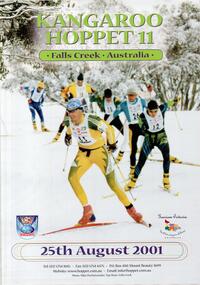
... After running the event for 10 years, it was decided they should become part of the Worldloppet series of marathon ski races. ...After running the event for 10 years, it was decided they should become part of the Worldloppet series of marathon ski races. ...The Kangaroo Hoppet is Australia’s premier long distance cross country ski race, and a member of the Worldloppet series of international cross country ski events. The first race at Falls Creek was held in 1979 under the name of “Australian Birkebeiner”. It was a 21km race with about 80 participants organised by the Birkebeiner Nordic Ski Club of Mount Beauty. The course started and finished at Falls Creek Alpine Resort and took participants out into the Bogong High Plains. After running the event for 10 years, it was decided they should become part of the Worldloppet series of marathon ski races. Representatives from the Birkebeiner Nordic Ski Club and the Australian Ski Federation attended the Worldloppet Annual Meeting in Finland in June 1990 to put the case for the acceptance of an Australian event into the Worldloppet series. Before being admitted, they had to demonstrate that the Birkebeiner Club could run a world class event, so three months later in August 1990 a 42km event named the Australian International Ski Marathon was held at Falls Creek together with a 21km Birkebeiner race and a 7km event called the Birkebeiner Lite. The event was approved by delegates from USA, Norway and Austria, in 1991 Australia became the 12th member of Worldloppet, with the condition that there had to be a name change. After some late night discussion allegedly involving red wine from North East Victoria the main event became the 42km Kangaroo Hoppet, with the minor events being the 21km Australian Birkebeiner, and 7km Joey Hoppet. In the winter of 1991, the first Kangaroo Hoppet was held. It was a great success and has been a regular fixture on the international ski calendar ever since. It features the main 42km event as well as a 21km event and a 7km event. The Hoppet brings the Australian snowfields to an international audience. In 2001 the Men's Winner was Ben Derrick from Australia in a time of 1:52:43. The winner of the Women's event was Belinda Phillips of Australia in a time of 2:13:09.This poster is significant because it documents an event which brings international attention to Falls Creek and the surrounding region.A coloured poster featuring an image of a group of competitors in the 2000 Kangaroo Hoppet led by Ben Derrick of Australia. The logos of Worldloppet and Tourism Victoria featured on either side of the text at the bottom.In green text at the top: KANGAROO HOPPET 11 FALLS CREEK AUSTRALIA Beneath the image: 25th August 2001 Tel: (03) 5754 3103 - Fax: (03) 5754 4475 - P.O. Box 400 Mount Beauty 3699 Website: http://www.netc.net.au/-hoppet/ Email: [email protected] Photo: Mike PIschetsrieder. Top Shots Falls Creek kangaroo hoppet, worldloppet events, falls creek, mt. beauty
