
Showing 20 items matching "rural careers"
-
 University of Melbourne, Burnley Campus Archives
Newspaper, The Weekly Times, Ex-Servicewomen Undertake Rural Training, 1949
... ...rural careers...commonwealth reconstruction training scheme crts servicewomen valerie sloane lee myers lillian moore kathleen way shirley stewart foster rural careers careers horticulture Article in Weekly Times 09.03.1949. ...commonwealth reconstruction training scheme, crts, servicewomen, valerie sloane, lee myers, lillian moore, kathleen way, shirley stewart foster, rural careers, careers, horticulture -
Federation University Historical Collection
Programme, Memorial Service Booklet for Hugh Dean Thomas Williamson, 1985
... "He witnessed first-hand the difficulties of rural life exacerbated by a world war that had stripped whole towns of their young men, and the long, lean years of the Depression were to define the way he lived the rest of his life. Hard work, constancy, eschewing wastage of any kind along with a hunger to seize opportunities wherever they presented themselves were the principles that informed his life and career and which, in time, gave rise to a commitment to others and to organisations and communities in which he saw the same ideals. ..."He witnessed first-hand the difficulties of rural life exacerbated by a world war that had stripped whole towns of their young men, and the long, lean years of the Depression were to define the way he lived the rest of his life. Hard work, constancy, eschewing wastage of any kind along with a hunger to seize opportunities wherever they presented themselves were the principles that informed his life and career and which, in time, gave rise to a commitment to others and to organisations and communities in which he saw the same ideals. ...Hugh D.T. WIlliamson C.B.E. was born in Ballarat on 04 February 1901 and died on 20 December 1985. "He witnessed first-hand the difficulties of rural life exacerbated by a world war that had stripped whole towns of their young men, and the long, lean years of the Depression were to define the way he lived the rest of his life. Hard work, constancy, eschewing wastage of any kind along with a hunger to seize opportunities wherever they presented themselves were the principles that informed his life and career and which, in time, gave rise to a commitment to others and to organisations and communities in which he saw the same ideals. Hugh attained the rank of Honorary Colonel in the Salvation Army and attained its highest award in 1978 when he was presented with its Distinguished Service Medal. In his time with the Salvation Army, Hugh helped establish the Red Shield Appeal and established scholarships to support senior officers to obtain business management training at the Australian Administrative Staff College in Mt Eliza (operated from a property formerly owned by Sir Reginald Ansett). He began his working life at age 16 at the Ballarat Banking Company. He steadily worked his way up through the ranks of the banking industry to become General Manager of the ANZ Bank from which he retired in 1961. Hugh was also a founding Trustee of the William Buckland Foundation, an association which strongly influenced his decision to set up his own foundation."Yellow Order of Service booklet for the funeral of Hugh Williamson. hugh williamson, hugh d.t. williamson, memorial service, martin carlson, j. davis mccaughey, francis macnab, frank linsell, john norman, ian harrison -
Federation University Historical Collection
Book - Book - Scrapbook, Ballarat School of MInes: Scrapbook of Newspaper Cuttings, Book 79. June 1997 to August 1997
... career in food...row looms over staff offers...jeff kennet cuts...new attitude to education...victorian primary industries board apprenticeships...rural...The papers concerned are The Courier, Ballarat, The Australian, The Age and other region papers over the period of 7 June 1997 to 5 August 1997. teaching positions advertised pre-employment courses courses available enrolment for smb courses nathan holliday nrma top apprentice scott brady ballarat's gallows mystery solved federal tafe plan worries smb head memorial plaque to hanged men freighter's engineering traineeship tafe merger creates super-college smb agrees to merger wimmera tafe rejects merger new evidence points to remains' location peter bailey to compete in youth skills olympics switzerland merger official course on providing a home away from home roy schrieke retires descendant against memorial peter bailey gold medallist skill olympics in st gallen excellent results for ballarat region aquaculture course historic sites listed henry sutton reverse tafe decision stawell times-news more host families needed david belford award winner city yearning for cultural heart corporate learning gold medal for peter bailey competition on apprentice funding'play revisits our history town and gown debate viticulture traineeship program one tafe division career in food row looms over staff offers jeff kennet cuts new attitude to education victorian primary industries board apprenticeships rural studies department Book with yellow cover, front, spiral bound. ...Collection of newspaper articles related to Ballarat School Of Mines.They cover activities and advertisements for staff. The papers concerned are The Courier, Ballarat, The Australian, The Age and other region papers over the period of 7 June 1997 to 5 August 1997. Book with yellow cover, front, spiral bound. teaching positions advertised, pre-employment courses, courses available, enrolment for smb courses, nathan holliday, nrma top apprentice, scott brady, ballarat's gallows mystery solved, federal tafe plan worries smb head, memorial plaque to hanged men, freighter's engineering traineeship, tafe merger creates super-college, smb agrees to merger, wimmera tafe rejects merger, new evidence points to remains' location, peter bailey to compete in youth skills olympics, switzerland, merger official, course on providing a home away from home, roy schrieke retires, descendant against memorial, peter bailey gold medallist, skill olympics in st gallen, excellent results for ballarat region, aquaculture course, historic sites listed, henry sutton, reverse tafe decision, stawell times-news, more host families needed, david belford award winner, city yearning for cultural heart, corporate learning, gold medal for peter bailey, competition on apprentice funding'play revisits our history, town and gown debate, viticulture traineeship program, one tafe division, career in food, row looms over staff offers, jeff kennet cuts, new attitude to education, victorian primary industries board apprenticeships, rural studies department -
Federation University Historical Collection
Book - Book - Scrapbook, Ballarat College of Advanced Education: Scrapbook of newspaper cutting, Book 7; January 1980 to September 1980
... career scope for chemists...grant for wood pulping research...dispute halts work on hall...music department has superb facilities...grant for water pollution research...david hemmings at bcae...college staff to hold stop-work...canberra moves on colleges...name decided for 'great hall'...notable year for bcae...victoria lagging in farm safety laws...$40000computer plan...students attend memorial lecture...ceramics exhibition...boom in part-time study...open day at mt helen...visiting ceramics lecturer...information technology week...science students win bursaries...margaret haddon...francis brown...seminar on rural...The cuttings cover the period from 31 January 1980 to 5 September 1980. . employment advertisements application for enrolment outline of courses colleges spend up education needs publicity college pay review prof compes professor of safety class of 1930 class of '46 cae prizes presented mineral boom jobless boon wes walters wins archibald prize lismore art prize to margaret bennett track and field competion bcae second in national titles library files on film bill hitchins enrolments inrease bcae head praises mp's efforts re-opening of mine at berringa bcae graduates michael and gregory stowe richards medal presentation bcae help for national squad the need for innovation prof john crisp institution of engineers australia move for archaeological society anne freeman elected graeme lowe introduces new law elective for teachers career scope for chemists grant for wood pulping research dispute halts work on hall music department has superb facilities grant for water pollution research david hemmings at bcae college staff to hold stop-work canberra moves on colleges name decided for 'great hall' notable year for bcae victoria lagging in farm safety laws $40000computer plan students attend memorial lecture ceramics exhibition boom in part-time study open day at mt helen visiting ceramics lecturer information technology week science students win bursaries margaret haddon francis brown seminar on rural television toxic effects of sea wasp Book with grey cover, front. ...Newspaper cuttings relating to Ballarat College of Advanced Education. These are from various newspapers and include The Age, Ballarat Courier, The Australian, The Herald. The cuttings cover the period from 31 January 1980 to 5 September 1980. . Book with grey cover, front. Image of two trotters. Spiral bound.employment advertisements, application for enrolment, outline of courses, colleges spend up, education needs publicity, college pay review, prof compes, professor of safety, class of 1930, class of '46, cae prizes presented, mineral boom jobless boon, wes walters wins archibald prize, lismore art prize to margaret bennett, track and field competion, bcae second in national titles, library files on film, bill hitchins, enrolments inrease, bcae head praises mp's efforts, re-opening of mine at berringa, bcae graduates, michael and gregory stowe, richards medal presentation, bcae help for national squad, the need for innovation, prof john crisp, institution of engineers australia, move for archaeological society, anne freeman elected, graeme lowe introduces new law elective for teachers, career scope for chemists, grant for wood pulping research, dispute halts work on hall, music department has superb facilities, grant for water pollution research, david hemmings at bcae, college staff to hold stop-work, canberra moves on colleges, name decided for 'great hall', notable year for bcae, victoria lagging in farm safety laws, $40000computer plan, students attend memorial lecture, ceramics exhibition, boom in part-time study, open day at mt helen, visiting ceramics lecturer, information technology week, science students win bursaries, margaret haddon, francis brown, seminar on rural television, toxic effects of sea wasp -
 Flagstaff Hill Maritime Museum and Village
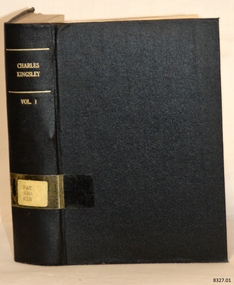
Book - Letters/Journals, Charles Kingsley, Charles Kingsley: His Letters and Memories of His Life Vol 1, 1879
... His early career as an Anglican clergyman in the rural parish of Eversley is covered, alongside his rise to national prominence in the late 1840s and 1850s as a social reformer. ...The focus of this book is not a standard biography written by an outside observer; it is a life story told through letters and personal journals. The volume is seamlessly woven together with editorial commentary by Kingsley’s widow, Frances "Fanny" Grenfell. Because this is Volume 1, it covers the first half of Charles Kingsley's life. It documents his childhood, his time at Cambridge University, and his intense courtship of Fanny. His early career as an Anglican clergyman in the rural parish of Eversley is covered, alongside his rise to national prominence in the late 1840s and 1850s as a social reformer. The text highlights his role in the Christian Socialist movement and his writing under the pen name "Parson Lot" to advocate for the working class. It also explores the writing and reception of his famous early novels, such as Alton Locke and Yeast, which tackled themes of poverty and systemic inequality.Charles Kingsley: His Letters and Memories of His Life Vol 1 Author: Charles Kingsley Edited by his wife ( Frances "Fanny" Grenfell) Publisher: C Kegan Paul & Co Date: 1879 Further Information: Sixth Abridged Editionnon-fictionThe focus of this book is not a standard biography written by an outside observer; it is a life story told through letters and personal journals. The volume is seamlessly woven together with editorial commentary by Kingsley’s widow, Frances "Fanny" Grenfell. Because this is Volume 1, it covers the first half of Charles Kingsley's life. It documents his childhood, his time at Cambridge University, and his intense courtship of Fanny. His early career as an Anglican clergyman in the rural parish of Eversley is covered, alongside his rise to national prominence in the late 1840s and 1850s as a social reformer. The text highlights his role in the Christian Socialist movement and his writing under the pen name "Parson Lot" to advocate for the working class. It also explores the writing and reception of his famous early novels, such as Alton Locke and Yeast, which tackled themes of poverty and systemic inequality.flagstaff hill, warrnambool, shipwrecked coast, flagstaff hill maritime museum, maritime museum, shipwreck coast, flagstaff hill maritime village, great ocean road, book, pattison collection, warrnambool library, warrnambool mechanics’ institute, ralph eric pattison, corangamite regional library service, warrnambool city librarian, mechanics’ institute library, victorian library board, warrnambool books and records, warrnambool children’s library, charles kingsley: his letters and memories of his life vol 1, frances "fanny" grenfell, mrs kingsley -
 Eltham District Historical Society Inc
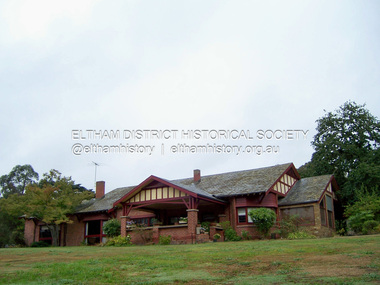
Photograph - Digital Photograph, Marguerite Marshall, 'Worlingworth', 10-26 Banoon Road, Eltham, 30 January 2006
... career Thomson had major disagreements. For instance Professor P Elkin constantly opposed his work. He also opposed Thomson when he campaigned vigorously in 1947 against the establishment of a rocket range at Woomera, South Australia, because of the threat it posed Aborigines. Thomson resigned in frustration from the Victorian Aborigines Welfare Board in 1967, after serving for ten years, because he found that his advice was disregarded. His ashes were scattered over Caledon Bay from the air. This collection of almost 130 photos about places and people within the Shire of Nillumbik, an urban and rural ...'Worlingworth', Eltham, home of noted anthropologist the late Professor Donald Thomson and his wife Dorita Thomson. Covered under Heritage Overlay, Nillumbik Planning Scheme. Published: Nillumbik Now and Then / Marguerite Marshall 2008; photographs Alan King with Marguerite Marshall.; p127 Dubbed as ‘Australia’s Lawrence of Arabia’ anthropologist Donald Thomson lived much of his life in Eltham, at Banoon Road. On his retirement as Professor of Anthropology in 1968, The University of Melbourne professorial board compared Thomson to Lawrence of Arabia because of his work for Aborigines and his controversial personality. Although Thomson is now recognised for his huge contribution, during his lifetime he suffered opposition and his life has been described as ‘tragic’.1 Thomson failed to gain the recognition as a scientist that he felt he deserved and he failed to alter government policy towards Aboriginal people. But towards the end of his life in 1970, anthropologists were moving towards the type of research he had done and the movement to grant land rights to Aborigines was strengthening. Thomson is best known for his anthropological fieldwork in Cape York, Arnhem Land and Central Australia, but he is also known for his scholarly contributions to ornithology and ecology. Thomson documented every aspect of the daily and ritual life of the Aboriginal world of Cape York and Arnhem Land in the 1930s and 1940s. The huge collection in Museum Victoria includes 11,000 photographs, 7500 items of material culture, 1000 botanical and zoological specimens and 4500 pages of field-notes.2 The film Ten Canoes used Thomson’s photographs as a source. Thomson bought the Eltham property known as Worlingworth in 1934. The single-storey 60-square house standing by the Yarra River was built in 1922-23. It is one of the last in Eltham to survive with its farm setting intact. It is also one of the few substantial residences built in the Eltham Shire from the late 19th century to the early 20th century, which signalled a major change in the area towards the residential municipality it is today.3 The original section, built in the mid 1860s, of rose pink hand-made bricks and stone quarried on the property, was incorporated in the new red-brick house built in 1922. An immense oak tree by the house grew from an acorn brought by Patrick Armstrong who first bought the land in March 14, 1862. Armstrong named Worlingworth after his forbears’ village in Suffolk, England. Worlingworth saw grand days when Commander Alan A Barlee (R.N.) bought it in 1922 after winning the Calcutta Sweep. The property then included a nine-hole golf course, a tennis court, a bowling green, a boathouse and a boat-ramp.4 For most of his career Thomson, who was born in 1901, was attached to The University of Melbourne. In 1935 he represented the Commonwealth Government at Caledon Bay in east Arnhem Land to investigate and mediate for four Aborigines accused of killing five Japanese and three Europeans. In 1938 Thomson was awarded a PhD in Anthropology at Cambridge University, and during his career, he received several medals from British Societies, who perhaps appreciated his work better than their Australian counterparts. From World War Two, Thomson suffered a string of hardships, beginning with severe wounding in Dutch New Guinea (for his military service in New Guinea he was awarded an OBE) and he was invalided from service in 1944. That year he was diagnosed with diabetes. A fire in 1946 destroyed what Thomson regarded as perhaps the best record he had made of Aboriginal life – the 20,000 feet, (6096m) of film he had shot in Arnhem Land. In 1954 he and wife, Gladys, divorced. The next year he married his technical assistant, Dorita McColl. Several times during his career Thomson had major disagreements. For instance Professor P Elkin constantly opposed his work. He also opposed Thomson when he campaigned vigorously in 1947 against the establishment of a rocket range at Woomera, South Australia, because of the threat it posed Aborigines. Thomson resigned in frustration from the Victorian Aborigines Welfare Board in 1967, after serving for ten years, because he found that his advice was disregarded. His ashes were scattered over Caledon Bay from the air.This collection of almost 130 photos about places and people within the Shire of Nillumbik, an urban and rural municipality in Melbourne's north, contributes to an understanding of the history of the Shire. Published in 2008 immediately prior to the Black Saturday bushfires of February 7, 2009, it documents sites that were impacted, and in some cases destroyed by the fires. It includes photographs taken especially for the publication, creating a unique time capsule representing the Shire in the early 21st century. It remains the most recent comprehenesive publication devoted to the Shire's history connecting local residents to the past. nillumbik now and then (marshall-king) collection, banoon road, donald thomson, dorita thomson, eltham, worlingworth -
 Eltham District Historical Society Inc
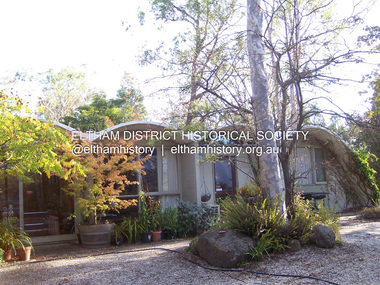
Photograph - Digital Photograph, Marguerite Marshall, Rice House, 69 Ryans Road, Eltham, 27 March 2007
... career wherein his qualifications exceeded his talent. World Peace had broken out and all were hip to the ‘People’s’ century. Kevin went with the Modernist’s concrete, Alister went with the peasant’s mudbrick. “If this is the future,” my dad said,”I don’t like it.” And we drove back to medieval Montsalvat. This collection of almost 130 photos about places and people within the Shire of Nillumbik, an urban and rural ...Built in 1953, the Rice House was leading Melbourne architect Kevin Borland's first commssion and was one of two houses of its kind. The design of the shell-like structure was inspired by the Arch of Ctesiphon, built in the second century south of Baghdad. Cement with a waterproofing agent was applied in layers to a form of regularly spaced timber arches covered in hessian. This ctesiphon system was developed in the United Kingdom by engineer J.H. de Waller in 1947. Commissioned in 1951 by Harrie and Lorna Rice, after Harrie, then an art student, met Borland at The Age Small Homes Service. Borland suggested they buy land in Eltham because at that time it was the only council in Melbourne that would grant a permit for such an innovative house. Covered under Victorian Heritage. Inspired by an ancient arch in Iraq, a house stands on top of a hill in a private position, off Ryans Road, Eltham. One of only two houses of its kind, it was leading Melbourne architect Kevin Borland’s first commissioned house, which he built in 1953. The shell-like structure, partially screened by giant trees and cacti, was inspired by the Arch of Ctesiphon south of Baghdad, built in the second century.1 Cement with a waterproofing agent was applied in layers to a form of regularly spaced timber arches tightly covered by hessian. This ctesiphon system was developed in the United Kingdom by engineer J H de Waller in 1947. This house was the first of three such structures built in Victoria, of which only one other remains, although substantially altered.2 It is the Wood House and supermarket, at the corner of Cleveland Road and High Street Road, Ashwood, designed by Robin Boyd in 1952. The Rice House demonstrates Kevin Borland’s innovative and experimental work. It is an outstanding example of the post-war period of experimentation in domestic architecture in Melbourne – by Robin Boyd, Kevin Borland and others – for The Age Small Homes Service from 1947 to 1953. This was partly an expression of late-Modernism and also necessitated by the post-war shortage of building materials. In Eltham, the post-war shortage of building materials largely resulted in mud-brick houses. Examples of Borland’s public work include contributions to the Olympic Swimming Pool in Melbourne and the Preshil Junior School in Kew. After more than 50 years of living in the house, Harrie and Lorna Rice still love it. Facing north-east with large windows overlooking the garden and two courtyards, it is well lit and benefits from a through breeze. The couple commissioned the extraordinary house after Harrie, then an art student, met Borland in 1951 at The Age Small Homes Service. Harrie was so impressed by the recently graduated Borland’s enthusiasm, that he asked him to design them an interesting house for a low budget. The unusual design presented several hurdles for the young couple before they could construct it. Borland suggested that they buy land in Eltham, because at that time it had the only council in Melbourne that would allow such an innovative house. Another hurdle was to gain finance for this remarkable house. The State Savings Bank Manager refused finance on the grounds that it was ‘unliveable’ and a ‘disgrace’. Fortunately, through a family connection, the couple borrowed money from the National Bank. But they discovered years later, that the bank’s evaluation stated the two ‘concrete sheds’ were of no value! The house built in off-white concrete, consists of two sections. The main house has four arches supported by brick and concrete walls that create a series of inter-connected rooms. Inside, the ceiling follows the roofline. Originally this section was only ten square metres, because of building restrictions at the time. But in 1973 Borland added two rooms and a carport. The second structure of two arches was originally a garage and a studio for art teacher Harrie Rice. To accommodate the growing family, in the mid 1950s, Borland converted the second structure into two children’s bedrooms, a kitchenette, a bathroom and a living room. The two structures were originally linked by a covered way of suspended draped-concrete, but this collapsed in the 1980s. The design has several maintenance problems. Cracks developed where two halves of the shells were joined. Then the material sprayed over the cracks became brittle, causing leaks. Fortunately Harrie found another material he could use. The valleys between the arches collect water, requiring annual painting with a waterproof material to prevent leaking. Lorna framed the house with native and exotic plants, which provide privacy and as a bonus, the garden attracted the rare Eltham Copper Butterfly. Published: Nillumbik Now and Then / Marguerite Marshall 2008; photographs Alan King with Marguerite Marshall.; p157 Comments about the Rice House on Lost Eltham page on Facebook June 2018 https://www.facebook.com/Lost-Eltham-1535993463348408/ Kate Borland: My dad designed this house. It is the Rice house and it is being renovated to its original glory as we speak.... Katherine Fox: I remember Harry and Lorna's, there was a secret room...! And the best loo with a view as I recall. Katherine Fox: Love this house! Wish I'd known it was up for sale. Looking forward to seeing progress if possible...If I recall correctly, the concrete swag over the walk-way collapsed at some stage. Marcus Skipper: In our little green Landrover, my dad and Alister Knox drove up dirt roads, a dirt track through the bush and finally to the ridge to check out this joint in about 1960. After the war at some time, they were all together at RMIT studying building design. Alister was the only one to graduate. A situation that resulted, my father would joke, in Alister having a career wherein his qualifications exceeded his talent. World Peace had broken out and all were hip to the ‘People’s’ century. Kevin went with the Modernist’s concrete, Alister went with the peasant’s mudbrick. “If this is the future,” my dad said,”I don’t like it.” And we drove back to medieval Montsalvat.This collection of almost 130 photos about places and people within the Shire of Nillumbik, an urban and rural municipality in Melbourne's north, contributes to an understanding of the history of the Shire. Published in 2008 immediately prior to the Black Saturday bushfires of February 7, 2009, it documents sites that were impacted, and in some cases destroyed by the fires. It includes photographs taken especially for the publication, creating a unique time capsule representing the Shire in the early 21st century. It remains the most recent comprehenesive publication devoted to the Shire's history connecting local residents to the past. nillumbik now and then (marshall-king) collection, eltham, rice house, ryans road, kevin borland -
Royal Australian and New Zealand College of Obstetricians & Gynaecologists (RANZCOG)
Flag - Aboriginal flag presented to Sister Alison Christine Bush on her induction as an Honorary Fellow of RANZCOG
... Alison’s professional career began at Marrickville Hospital, Sydney, in 1960, and following further studies in midwifery and infant welfare in New Zealand, she began her illustrious years at Royal Prince Alfred Hospital in 1969. It was in this environment, a teaching hospital of the University of Sydney, which valued its association with the nearby urban Indigenous community of Redfern, and which received numerous complex referrals from rural New South Wales, that Alison became a valued advocate for Indigenous people. ...Alison’s professional career began at Marrickville Hospital, Sydney, in 1960, and following further studies in midwifery and infant welfare in New Zealand, she began her illustrious years at Royal Prince Alfred Hospital in 1969. It was in this environment, a teaching hospital of the University of Sydney, which valued its association with the nearby urban Indigenous community of Redfern, and which received numerous complex referrals from rural New South Wales, that Alison became a valued advocate for Indigenous people. In all situations, she eloquently demonstrated the importance of cultural sensitivity and respect, bringing calm to sometimes chaotic situations. Alison received many awards such as this one. (O&G Magazine) Following her appointment in 1993 as the Aboriginal liaison midwife, she also provided consultation and education across all hospital departments and to community agencies, ever in demand for her expertise both within the hospital and the broader community. Across these years, she undertook a substantial responsibility in teaching and skills transfer, and in serving on a range of advisory and planning committees for the State of New South Wales and the nation.This Aboriginal flag was presented by Sister Alison Christine Bush RN CM ECC to RANZCOG President Dr Michael O'Connor in Canberra 30 April 1998. At this ASM, Sister Alison Bush, an Aboriginal midwife, was presented an Honorary Fellowship of the RANZCOG. -
 Warrnambool and District Historical Society Inc.
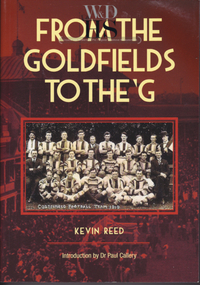
Book, Kevin Reed, From the Goldfields to the G, 2014
... Reed’s book describes the development of Australian Football in rural and suburban Victoria. It contains information on the footballing career of Dr John Douglas, a former resident of Warrnambool and important chapters on football and cricket in the Warrnambool district in the 1970s, 80s and 90s and the footballing personalities who came from the area over the years. ...Reed’s book describes the development of Australian Football in rural and suburban Victoria. It contains information on the footballing career of Dr John Douglas, a former resident of Warrnambool and important chapters on football and cricket in the Warrnambool district in the 1970s, 80s and 90s and the footballing personalities who came from the area over the years. ...An account of the development of Australian Rules football in both rural and suburban Victoria.This is a paper back book with a red and gold cover with a photograph of Costerfield Football Team, 1919 on the cover (335 pages) The book is signed inside by Kevin Reed non-fictionAn account of the development of Australian Rules football in both rural and suburban Victoria.warrnambool, kevin reed, dr john douglas, warrnambool cricket 1980's, warrnambool football 1970's 1980's -
 Alfred Hospital Nurses League - Nursing History Collection
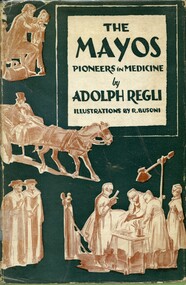
Book - Illustrated book, Adolph Regli 1896-1952 et al, The Mayos - pioneers in medicine, 1942
... careers of the Mayo family, particularly Dr. William Worrall Mayo and his sons Dr. William (Will) and Dr. Charles (Charlie). It tells the story of how Dr William started practicing in rural Minnesota and how with his sons (Dr Will and Dr Charlie) helped build the Mayo Clinic into a world-renowned institution. ...This book chronicles the lives and careers of the Mayo family, particularly Dr. William Worrall Mayo and his sons Dr. William (Will) and Dr. Charles (Charlie). It tells the story of how Dr William started practicing in rural Minnesota and how with his sons (Dr Will and Dr Charlie) helped build the Mayo Clinic into a world-renowned institution.Illustrated book with dustjacket. The book has a light green cover with purple print. on the front cover is the letter 'M' inside a circle with a snake coiled around a staff. Title, author's surname and publishers name are printed on the spine. The dustjacket has been covered with a clear protective film. The dust jacket has a dark green background, on the front on a cream square the title, author's and illustrator's names are printed in dark green, there are also four illustrations in light brown ink of doctors in various roles (Rafaello Busoni) Title, auth's and publisher's name are printed on the spine. There is a brown and white photograph of the author on the back of the dustjacket, along with some information about him.non-fictionThis book chronicles the lives and careers of the Mayo family, particularly Dr. William Worrall Mayo and his sons Dr. William (Will) and Dr. Charles (Charlie). It tells the story of how Dr William started practicing in rural Minnesota and how with his sons (Dr Will and Dr Charlie) helped build the Mayo Clinic into a world-renowned institution.wlliam worrall mayo, william james mayo, charles horace mayo, mayo clinic -
Eltham District Historical Society Inc
Document - Folder, Nyberg, Keith
... Contents Newspaper article: "Rural life", Diamond Valley News, 3 September 1997, describing Keith Nyberg's career to date as a lacrosse player. ...Contents Newspaper article: "Rural life", Diamond Valley News, 3 September 1997, describing Keith Nyberg's career to date as a lacrosse player. ...Keith Nyberg began playing lacrosse at Eltham Primary School, later playing in the 1990 Australian lacrosse championships and in America; he played for the Eltham Lacrosse Club. Contents Newspaper article: "Rural life", Diamond Valley News, 3 September 1997, describing Keith Nyberg's career to date as a lacrosse player. Newspaper article: "Gold medal on agenda", Diamond Valley Leader, 7 August 2019, describing Keith Nyberg's career to date as a lacrosse player.Newspaper clippings, A4 photocopies, etckeith nyberg, eltham primary school, eltham lacrosse club -
 Warrnambool and District Historical Society Inc.
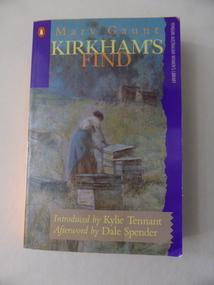
Book, Penguin Books, Kirkham's Find Mary Gaunt, 1988
... The novel outlines the difficulties faced by a woman in the 19th century if she wished to pursue a career and gives us a good description of 19th century rural Australia. ...The novel outlines the difficulties faced by a woman in the 19th century if she wished to pursue a career and gives us a good description of 19th century rural Australia. ...A novel outlining the difficulties faced by 19th century women wishing to pursue a career.This is a soft cover book of 340 pages. It has a purple cover with a reproduction of a 19th century painting on the front cover and material about the contents of the book on the back cover. The spine is an orange colour with black and white printing. The book has an introduction by Kylie Tennant, an afterword by Dale Spender and 29 chapters of a novel. fictionA novel outlining the difficulties faced by 19th century women wishing to pursue a career.mary gaunt, history of warrnambool, women in literature -
 Warrnambool and District Historical Society Inc.
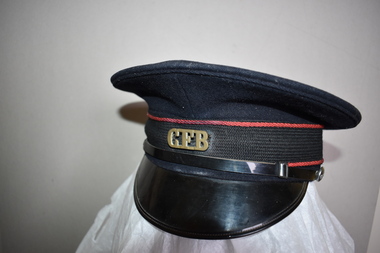
Country Fire Brigade Hat, Commonwealth Government Clothing Factory, Mid 20th century
... The organization now known as the Country Fire Authority was established in 1945 as a volunteer and community-based organization providing fire fighting and emergency services in regional and rural areas in Victoria. Today the organization includes career fire-fighters and funding is partly provided by a levy included in local Council rates. ...The organization now known as the Country Fire Authority was established in 1945 as a volunteer and community-based organization providing fire fighting and emergency services in regional and rural areas in Victoria. Today the organization includes career fire-fighters and funding is partly provided by a levy included in local Council rates. ...This hat was part of the uniform of the Country Fire Brigade. The organization now known as the Country Fire Authority was established in 1945 as a volunteer and community-based organization providing fire fighting and emergency services in regional and rural areas in Victoria. Today the organization includes career fire-fighters and funding is partly provided by a levy included in local Council rates. The owner of this hat is not known. This hat is of minor interest and is retained for display purposesThis is a hat with a circular flat crown made of black felt with 4 eyelets. Around the edge of the crown is a brown leather band with a fabric bow fastening and a black cloth ribbon with a red corded edging. In the centre is a brass badge with letters on it. The peak is made of patent leather with a black leather band on the upper edge with metal buttons. The inside of the peak is made of green leather. Inside the hat is a plastic covering with a leather band. There is a cloth label with yellow printing. Commonwealth Government Clothing Factory Melbourne 7 C.F.B. country fire fighting services warrnambool, history of warrnambool -
 National Wool Museum
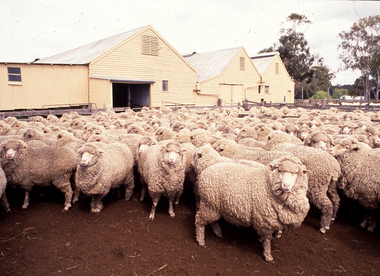
Photograph - Slide, Stuart Ascough, Sheep Ready for Shearing, 1990s
... career Stuart travelled extensively, and in the 1990s worked at many topmaking mills in China on quality improvement projects. He also provided technical advice and training at mills in India, Ukraine, Lithuania, Kyrgyzstan, Russia, Latvia, Byelorussia and other parts of Europe and Asia. wool industry australia Australian Wool Board International Wool Secretariat factory training shearing shed sheep rural property 35mm colour transparency mounted in plastic slide mount showing sheep in stockyards in the foreground, with shearing sheds in the background. ...This slide is part of a collection of visual resources used by Stuart Ascough while conducting training and technical advice at mills in China, India, Russia and Australia. This item is part of a collection of books, manuals, photographs, letters and clothing relating to the working life of Stuart Ascough. Stuart's career in the wool industry spanned over 43 years from 1960 to 2003 in various roles including Topmaking Plant Manager at Courtaulds Ltd. in Spennymore, U.K., Operations Manager at Port Phillip Mills in Williamstown Victoria, Marketing Executive, Early Stage Wool Processing at the International Wool Secretariat Melbourne, Australia and General Manager of Victoria Wool Processors Pty. Ltd. in Laverton North, Victoria. Throughout his career Stuart travelled extensively, and in the 1990s worked at many topmaking mills in China on quality improvement projects. He also provided technical advice and training at mills in India, Ukraine, Lithuania, Kyrgyzstan, Russia, Latvia, Byelorussia and other parts of Europe and Asia.35mm colour transparency mounted in plastic slide mount showing sheep in stockyards in the foreground, with shearing sheds in the background.wool, industry, australia, australian wool board international wool secretariat, factory, training, shearing shed, sheep, rural property -
 Ararat Gallery TAMA
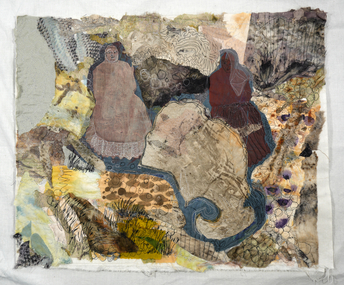
Carole Mules, Women at Lake Buninjon, 2020
... After studying art and teaching at the School of Mines in Ballarat, Carole moved to Melbourne to raise a family where she developed her interest in photography, textiles and ceramics, while pursuing a career in community development. A move to rural SE Queensland in the early 1980s saw Carole set up art and theatre programmes, and study to gain a degree in Land Management. ...After studying art and teaching at the School of Mines in Ballarat, Carole moved to Melbourne to raise a family where she developed her interest in photography, textiles and ceramics, while pursuing a career in community development. A move to rural SE Queensland in the early 1980s saw Carole set up art and theatre programmes, and study to gain a degree in Land Management. ...Carole Mules (nee Anderson) was born in 1946 at the Willaura Bush Nursing Hospital to parents Arthur and Dulcie, who were working at Mt William Station a few kilometres out of town. After studying art and teaching at the School of Mines in Ballarat, Carole moved to Melbourne to raise a family where she developed her interest in photography, textiles and ceramics, while pursuing a career in community development. A move to rural SE Queensland in the early 1980s saw Carole set up art and theatre programmes, and study to gain a degree in Land Management. Having returned to Western Victoria in the 2010s, Carole undertook further study to develop her textiles practice, and drew on the history and memories of Willaura and surrounding regions for inspiration. Carole created a rich palette of textures and colours using combinations of contact printing with native plants and found objects, freehand machine stitching, hand stitching, cut and collage, floral resist, and tying and folding fabric. -
 Federation University Art Collection
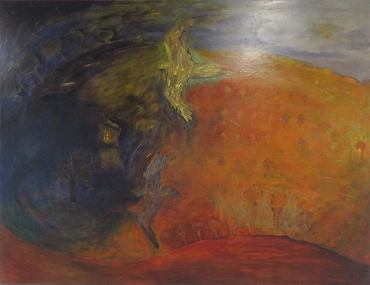
Painting, 'From Day into Night' by Rosalind Lawson, 1998
... Rosalind LAWSON (11 January 1948 - )
Born Ballarat, Victoria
Rosalind Lawson has spent much of her career working in rural environements, in Australia and Ireland. ...Rosalind LAWSON (11 January 1948 - )
Born Ballarat, Victoria
Rosalind Lawson has spent much of her career working in rural environements, in Australia and Ireland. ...This work was exhibited at 'Stories from Kitty's Lead Road' at Chiara Goya Gallery in 1999. Of the exhibition Ros Lawson explained: "Beyond the city, before the outback, lies a little-explored , unfashionable space - the "bushland" of suburbia. I explore this landscape of tension between nature and human settlement. It is the activities that occur within the lanscape that are of interest: animal husbandry, feral animals, nature walks, star gazing and more mythic qualities of the area. Within these themes lie the reflections of the artist I regard to the erfurbishment of the landscape and the desire to observe, classify and make significant in order to preserve nature."Rosalind LAWSON (11 January 1948 - ) Born Ballarat, Victoria Rosalind Lawson has spent much of her career working in rural environements, in Australia and Ireland. She has exhibited widely, and in 1997 won the Broken Hill Outback Art Prize. She holds a Master of Fine Art from R.M.I.T. (1995), a Diploma of Fine Art from R.M.I.T, A Diploma of Physical Education, from the University of Melbourne, and a Trained Teachers' Certificate from Melbourne Secondary Teachers' College . Between 1989 and 2012 Ros Lawson Lecturered in painting, drawing, papermaking, and was a tutor in Art History at the University of Ballarat Arts Academy (now Federation University). Her studio practice includes painting, drawing and paper art using handmade paper. This item is part of the Federation University Art Collection. The Art Collection features over 2000 works and was listed as a 'Ballarat Treasure' in 2007.art, artwork, rosalind lawson, lawson, ros lawson, birds -
 Federation University Art Collection
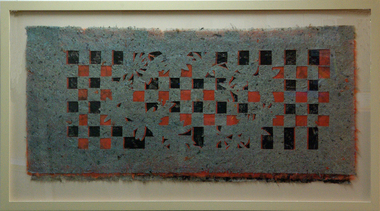
Artwork, other, Rosalind Lawson, 'Of Picnics and Billabongs Grey' by Rosalind Lawson, 2009
... Rosalind LAWSON (11 January 1948 - ) Born Ballarat, Victoria Rosalind Lawson has spent much of her career working in rural environements, in Australia and Ireland. ...Rosalind LAWSON (11 January 1948 - ) Born Ballarat, Victoria Rosalind Lawson has spent much of her career working in rural environements, in Australia and Ireland. ...Rosalind LAWSON (11 January 1948 - ) Born Ballarat, Victoria Rosalind Lawson has spent much of her career working in rural environements, in Australia and Ireland. She has exhibited widely, and in 1997 won the Broken Hill Outback Art Prize. She holds a Master of Fine Art from R.M.I.T. (1995), a Diploma of Fine Art from R.M.I.T, A Diploma of Physical Education, from the University of Melbourne, and a Trained Teachers' Certificate from Melbourne Secondary Teachers' College . Between 1989 and 2012 Ros Lawson Lecturered in painting, drawing, papermaking, and was a tutor in Art History, at the University of Ballarat Arts Academy (now Federation University). Her studio practice includes painting, drawing and paper art using handmade paper. This item is part of the Federation University Art Collection. The Art Collection features over 2000 works and was listed as a 'Ballarat Treasure' in 2007.Framed stencilled and cut handmade paper in grey, black and orange.art, artwork, rosalind lawson, paper, papermaking, lawson, hand made paper, abstract -
Northern District School of Nursing. Managed by Bendigo Historical Society Inc.
Newsletter - Northern District School of Nursing Graduates Association - Background Information on the School, 27 June 1988
... careers and community awareness. The school was instrumental in raising nursing education standards in the region for nearly forty years. Staff Nurses received additional training in administration after their basic three-year course. There were aspirations for postgraduate opportunities in rural...careers and community awareness. The school was instrumental in raising nursing education standards in the region for nearly forty years. Staff Nurses received additional training in administration after their basic three-year course. There were aspirations for postgraduate opportunities in rural ...The Northern District School of Nursing in Victoria, Australia Graduates Association: Historical overview of the Northern District School of Nursing: After World War Two, Australian hospitals, especially in rural areas, faced a severe shortage of nurses due to low interest and challenging working conditions. Nurses endured strict discipline, poor wages, long hours, and restrictive living arrangements. The Hospital & Charities Commission appointed Miss Gwen Williams as the first Executive Officer of Nursing Services, who played a pivotal role in founding the regional training school at 'Lister House' in Bendigo in March 1950. Bendigo was selected for a pilot scheme to improve the correlation between theoretical and practical nurse training. The school staff worked to standardize training across regional hospitals and ensure students gained practical experience after theoretical instruction. A circular training scheme was introduced, allowing students from smaller hospitals to rotate through base hospitals for broader experience. Over time, affiliated hospitals changed as some de-registered and others joined. Founding staff, Miss Nancy Long and Miss Margot Scott, set high educational and professional standards, acting as educators, supervisors, and mentors.Training combined theory with hands-on practice, including procedures, instrument handling, and patient care. In 1973, the school began admitting students not attached to any specific hospital, allocating them to wards after study blocks to better align practice with theory. The Victorian Nursing Council later required the school to control clinical rotations. Male students were finally admitted to general nurse training in the 1960s after several failed attempts.Nurses' Week, started in 1952 by Miss Williams, aimed to promote nursing careers and community awareness. The school was instrumental in raising nursing education standards in the region for nearly forty years. Staff Nurses received additional training in administration after their basic three-year course. There were aspirations for postgraduate opportunities in rural areas, but country students continued to face challenges compared to their metropolitan counterparts.Northern District School of Nursing Graduates Association - Background Information on the School - 2 typed sheets This item contains the following document: 3792.7a Background Information on the School - 2 typed sheetsnurse training, lister house, history -
 Returned Nurses RSL Sub-branch
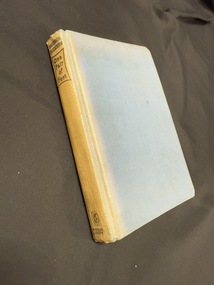
Book, Monica Dickens, One pair of feet, 1942 (original publication), 1958 (this edition)
... Nursing England 'As the effects of the war raging in Europe begins to be felt at home in London, Monica Dickens decides to do her bit and to pursue a new career, and so enrols as a student nurse at a hospital in rural Hertfordshire. ...'As the effects of the war raging in Europe begins to be felt at home in London, Monica Dickens decides to do her bit and to pursue a new career, and so enrols as a student nurse at a hospital in rural Hertfordshire. By nature clever and spirited, she struggles to submit to the iron rule of the Matron and Sisters, and is alternately infuriated and charmed by her patients. That's not to mention the mountains of menial work that are a trainee's lot. But there are friends among the staff and patients, night-time escapades to dances with dashing army men, and her secret writing project to keep her going.' [From Trove record]Book has no dustjacket, is bound with blue book cloth and has gold text on the spinenon-fiction'As the effects of the war raging in Europe begins to be felt at home in London, Monica Dickens decides to do her bit and to pursue a new career, and so enrols as a student nurse at a hospital in rural Hertfordshire. By nature clever and spirited, she struggles to submit to the iron rule of the Matron and Sisters, and is alternately infuriated and charmed by her patients. That's not to mention the mountains of menial work that are a trainee's lot. But there are friends among the staff and patients, night-time escapades to dances with dashing army men, and her secret writing project to keep her going.' [From Trove record]nursing, england -
Eltham District Historical Society Inc
Document - Folder, Wilson, Michael
... Michael Wilson's career to date. Newspaper article: "Rural Life", Diamond Valley News, 10 September 1997. ...Michael Wilson's career to date. Newspaper article: "Rural Life", Diamond Valley News, 10 September 1997. ...Silversmith Michael Wilson moved to Eltham and established a newellery business. Contents Photocopy, sketch map of Eltham, drawn by Peter Green, commissioned by Michael Wilson, undated, showing cultural sites. Newspaper article: "Silversmith is in ten top", Heidelberger, 21 October 1983. Michael Wilson's design in top ten Gown of the Year. Newspaper article: "Mike tries his hand with gold", Green Valley, ~1985. Michael Wilson's career to date. Newspaper article: "Rural Life", Diamond Valley News, 10 September 1997. Michael Wilson adopted the cicada as his signature for his work. Newspaper article: "Art and design venue", Diamond Valley News, 14 August 1996. Michael Wilson converted his studio into a showroom. Newspaper article: "Quality, value in jewellery", Diamond Valley Leader, 8 June 2005. History of Michael Wilson's business. Newspaper article: "Q and A", Diamond Valley Leader, 25 June 2005. Newspaper article: "Q and A", Diamond Valley Leader, 27 August 2008. Newspaper article: "Retail Therapy: Michael Wilson Diamond Jewellers, Eltham", The Weekly Review, 28 October 2015. About Michael Wilson business. Newspaper article: "A golden touch - three decades of jewellery making", Heidelberg and Valley Weekly, 7 November 2006. Michael Wilson's 30-year retrospective. Newspaper article: "The right contacts for diamonds", Diamond Valley Leader, 26 May 2010. About Michael Wilson business. Newspaper article: "Facets of a brilliant career", The Weekly Review, 16 March 2011. About Michael Wilson. Newspaper article: "Bush living but close to city", Diamond Valley Leader, 23 October 2019. Michael Wilson explains why his enjoys living in Eltham. Newspaper article: "Jeweller a cut above rest", unknown title and date. Details of Michael Wilson business. Text of speech by Michael Wilson at Eltham Cemetery, 1 July 2015. Michael Wilson newsletter, December 2010. Michael Wilson newsletter, December 2011. Michael Wilson newsletter, December 2013. Michael Wilson newsletter, December 2015.Newspaper clippings, A4 photocopies, etcmichael wilson, eltham goldsmithery, eltham gallery, montsalvat, country arts store, john mills pottery, gallery 4 eltham, shillinglaw cottage, wiregrass gallery, community centre eltham, artisans minting eltham, wendy wilson, alessi design house, carlo alessi, marianne brandt, susan cohn, matcham skipper, simon icarus baigent, angela abbott, peter glass, max meldrum, percy leason, alice bale, walter withers, margery withers, richard mccann, veronica wilson, gown of the year award, silmar designers award, united nations world music council award, emile hafner, tiana sweeney, aaron wilson, tony mcmanus, andrea pollard, carmel mcconnell, michael wilson diamond jewellers, constellation cup, tribute to john lennon, de beers supreme diamond design award, gold and silversmith guild, eltham copper butterfly collection, central australian collection, celtic collection, wendy green, jeanette dyke, harold mitchell,
