
Showing 5 items matching "rural life in the western district"
-
 Warrnambool and District Historical Society Inc.
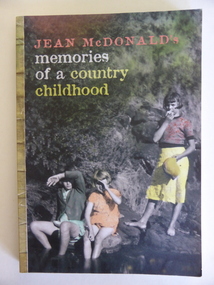
Book, Memories of a Country Childhood, 2008
... ...Rural Life in the Western District...Jean McDonald Grassmere Cooramook Rural Life in the Western District ‘M. Jansen’ This is a soft cover book of 189 pages. ...This is a book by Jean McDonald (nee Henderson) telling of her childhood experiences. Born in 1924 Jean McDonald was one of seven children who grew up at Rivery Park, a dairy farm in Grassmere in the 1930s and 40s. She went to school in Cooramook and Warrnambool. This book is of interest as it describes the life of Jean McDonald in Grassmere. It is an important social history of the life and times of a local woman. This is a soft cover book of 189 pages. The front cover has a coloured photograph of three children near a stream and the back cover has an extract from the book and some comments on it. The book contains ten chapters and many black and white photographs. ‘M. Jansen’ jean mcdonald, grassmere, cooramook, rural life in the western district -
 Bendigo Historical Society Inc.
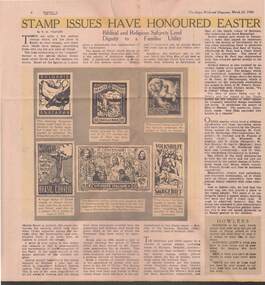
Document - BUSH COLLECTION: EPHEMERA
... District Acts No 3437, 1925, 5 pages ; f. Scrapbook with cuttings from papers relating to Australia's history, scenery, flora and fauna, Farming, Industry, Rodeo, Horse Racing, Rural, Surf Life Saving, Religion, Federation, Explorers, Gold, Birds, - some loose cuttings in back; g. Land Tax Act, Schedule L 1910 (blank sheet); h. Commission of Public Health - three day tour of Western...District Acts No 3437, 1925, 5 pages ; f. Scrapbook with cuttings from papers relating to Australia's history, scenery, flora and fauna, Farming, Industry, Rodeo, Horse Racing, Rural, Surf Life Saving, Religion, Federation, Explorers, Gold, Birds, - some loose cuttings in back; g. Land Tax Act, Schedule L 1910 (blank sheet); h. Commission of Public Health - three day tour of Western ...Ephemera from Original Box 313; This is not a catalogued description of the contents but a broad-brush overall description. a. Book with 'Ledger' on cover; has newspaper cuttings re stage and screen on 8 of 94 pages (remaining, mostly blank); b. Gordon & Gotch - Sample Calendar No. 3 1935.( 61 cm x 50 cm) x2; c. Gordon & Gotch - Sample Calendar No. 2 (61 cm x 50 cm) x 2; d. Victorian Act of Parliament No 3041 (amending the Law relating to Public Health, 1919, 176 pages; e. Victorian Act of Parliament -(amending the Sewerage District Acts No 3437, 1925, 5 pages ; f. Scrapbook with cuttings from papers relating to Australia's history, scenery, flora and fauna, Farming, Industry, Rodeo, Horse Racing, Rural, Surf Life Saving, Religion, Federation, Explorers, Gold, Birds, - some loose cuttings in back; g. Land Tax Act, Schedule L 1910 (blank sheet); h. Commission of Public Health - three day tour of Western District (Warrnambool, port Fairy, Colac) from Melbourne; i. Collection of cuttings, envelopes; j. Newspapers - Argus, Advertiser pages late 1930s; (not scanned) k. Collection of newspaper cuttings; l. Collection of Public Health Regulations, 7 parts; m. Act of Parliament, Victoria No. 2632 - Law relating to Amendment of the Constitution; n. Folder containing issues of The Bendigo Church News, 25 parts 1930s-1950s; o. Collection of book lists/catalogues; p. AA (Automobile Association) Members Handbook 1963; q. Collection of varied sheets and pamphlets; r. Articles of Association - Ocean Salt Company; s.. Sydney Symphony Orchestra program 1953; t. Queen Mary's Message to the people, Jan 1936; u. various notices for display of historical items (BHS Collection)ephemera, mementoes -
 Nhill and District Historical Society Inc.
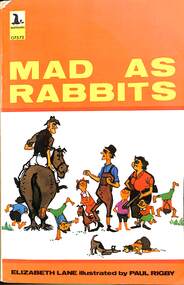
Book - Mad as Rabbits, Elizabeth Lane Illustrated by Paul Rigby
... Western Australia with her family in 1968. Her biography of Hal Gye, entitled “Hal Gye: The Man and His Work” was published in 1986. Farm life -- Victoria -- Wimmera -- History. Country life family relationships Short story growing up Biographies & True Stories Humour--Comedy Rural life Autobiographies Story of the author's childhood years as one of 12 children on a farm in the Victorian Wimmera district during the 1920s and 1930s. ...Story of the author's childhood years as one of 12 children on a farm in the Victorian Wimmera district during the 1920s and 1930s.18cm tall paperback book with ogrange strip from top to 7cm down the cover with the Title in Bold capital Yellow font, then a cream strip of approx 9cms picturing cartoon farm charaters - a man on a horse back view a farmer with his fists raised, his wife next to him with a rifle and seven children and two dogs scattered across the scene in several different poses., and othe orange strip 1.5 cm to the bottom of the cover with the author and lillustrators names in bold black font.non-fictionStory of the author's childhood years as one of 12 children on a farm in the Victorian Wimmera district during the 1920s and 1930s.farm life -- victoria -- wimmera -- history., country life, family relationships, short story, growing up, biographies & true stories, humour--comedy, rural life, autobiographies -
 Nhill and District Historical Society Inc.
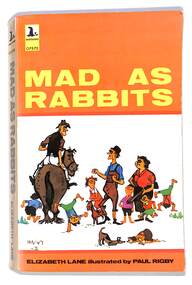
Book - Mad as Rabbits, Elizabeth Lane Illustrated by Paul Rigby
... Western Australia with her family in 1968. Her biography of Hal Gye, entitled “Hal Gye: The Man and His Work” was published in 1986. Farm life -- Victoria -- Wimmera -- History. Country life family relationships Short story growing up Biographies & True Stories Humour--Comedy Rural life Autobiographies Story of the author's childhood years as one of 12 children on a farm in the Victorian Wimmera district during the 1920s and 1930s. ...Story of the author's childhood years as one of 12 children on a farm in the Victorian Wimmera district during the 1920s and 1930s.18cm tall paperback book with ogrange strip from top to 7cm down the cover with the Title in Bold capital Yellow font, then a cream strip of approx 9cms picturing cartoon farm charaters - a man on a horse back view a farmer with his fists raised, his wife next to him with a rifle and seven children and two dogs scattered across the scene in several different poses., and othe orange strip 1.5 cm to the bottom of the cover with the author and lillustrators names in bold black font.non-fictionStory of the author's childhood years as one of 12 children on a farm in the Victorian Wimmera district during the 1920s and 1930s.farm life -- victoria -- wimmera -- history., country life, family relationships, short story, growing up, biographies & true stories, humour--comedy, rural life, autobiographies -
 Arapiles Historical Society
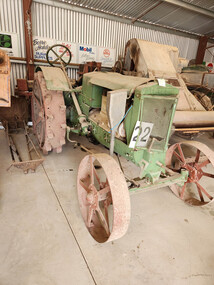
Vehicle - WALLIS Tractor
... western Victoria. The tractor demonstrates the transition from horse-drawn implements to engine-powered machinery and represents an important stage in the evolution of Australian farming practices. Machines such as this reduced the reliance on horse teams and enabled farmers to increase productivity on larger holdings. As a surviving example of an early imported tractor, it provides valuable insight into the development of agricultural technology and the changing nature of rural life in the Natimuk district...western Victoria. The tractor demonstrates the transition from horse-drawn implements to engine-powered machinery and represents an important stage in the evolution of Australian farming practices. Machines such as this reduced the reliance on horse teams and enabled farmers to increase productivity on larger holdings. As a surviving example of an early imported tractor, it provides valuable insight into the development of agricultural technology and the changing nature of rural life in the Natimuk district ...FROM - Albert KLOWSS of Natimuk Lake This Wallis tractor represents one of the early generations of internal-combustion-powered agricultural machinery that transformed farming practices during the first decades of the twentieth century. Manufactured by the Wallis Tractor Company of Racine, Wisconsin, USA, these tractors gained a reputation for durability and reliability and were imported into Australia in significant numbers. Wallis tractors were widely used throughout grain-growing regions such as the Wimmera, where they gradually replaced horse teams for ploughing, cultivation, seeding and haulage work. Their introduction allowed farmers to cultivate larger areas, reduce labour requirements and improve efficiency during critical farming operations. The tractor belongs to a period when Australian agriculture was undergoing rapid mechanisation. Early tractors such as this often worked alongside horses for many years before fully replacing animal power on farms. Significance: This Wallis tractor is significant as an example of the machinery that helped usher in the mechanised farming era in Australia. It illustrates the technological advances that transformed agricultural production during the early twentieth century and contributed to the expansion of grain farming throughout western Victoria. The tractor demonstrates the transition from horse-drawn implements to engine-powered machinery and represents an important stage in the evolution of Australian farming practices. Machines such as this reduced the reliance on horse teams and enabled farmers to increase productivity on larger holdings. As a surviving example of an early imported tractor, it provides valuable insight into the development of agricultural technology and the changing nature of rural life in the Natimuk district and the wider Wimmera region. An early Wallis tractor mounted on four steel-spoked wheels, featuring a compact engine unit positioned between the front and rear axles. The tractor is finished in green paint, much of which has weathered and worn through years of agricultural use. The machine incorporates a large radiator assembly at the front, an exposed engine and transmission, operator's platform, steering wheel and steel wheel lugs designed to provide traction in cultivated soil. The tractor retains many of its original mechanical components, including the engine, transmission housing, steering system and drawbar arrangement. Its narrow profile and steel wheels are characteristic of tractors manufactured during the transition from horse-powered farming to mechanised agriculture in the early twentieth century.farm equipment, transport, klowss, wallis
