



Historical information
FROM - Albert KLOWSS of Natimuk Lake
This Wallis tractor represents one of the early generations of internal-combustion-powered agricultural machinery that transformed farming practices during the first decades of the twentieth century. Manufactured by the Wallis Tractor Company of Racine, Wisconsin, USA, these tractors gained a reputation for durability and reliability and were imported into Australia in significant numbers. Wallis tractors were widely used throughout grain-growing regions such as the Wimmera, where they gradually replaced horse teams for ploughing, cultivation, seeding and haulage work. Their introduction allowed farmers to cultivate larger areas, reduce labour requirements and improve efficiency during critical farming operations. The tractor belongs to a period when Australian agriculture was undergoing rapid mechanisation. Early tractors such as this often worked alongside horses for many years before fully replacing animal power on farms.
Significance: This Wallis tractor is significant as an example of the machinery that helped usher in the mechanised farming era in Australia. It illustrates the technological advances that transformed agricultural production during the early twentieth century and contributed to the expansion of grain farming throughout western Victoria. The tractor demonstrates the transition from horse-drawn implements to engine-powered machinery and represents an important stage in the evolution of Australian farming practices. Machines such as this reduced the reliance on horse teams and enabled farmers to increase productivity on larger holdings. As a surviving example of an early imported tractor, it provides valuable insight into the development of agricultural technology and the changing nature of rural life in the Natimuk district and the wider Wimmera region.
Physical description
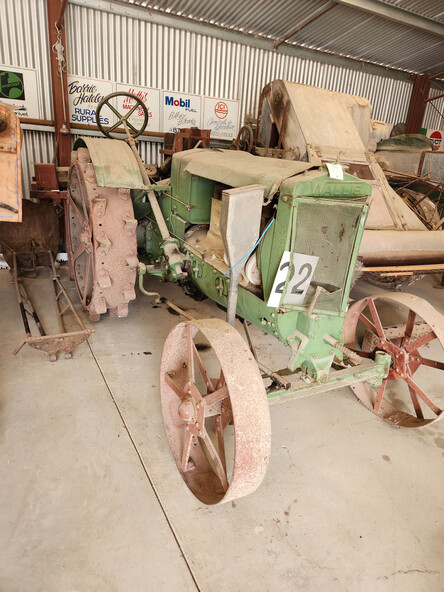
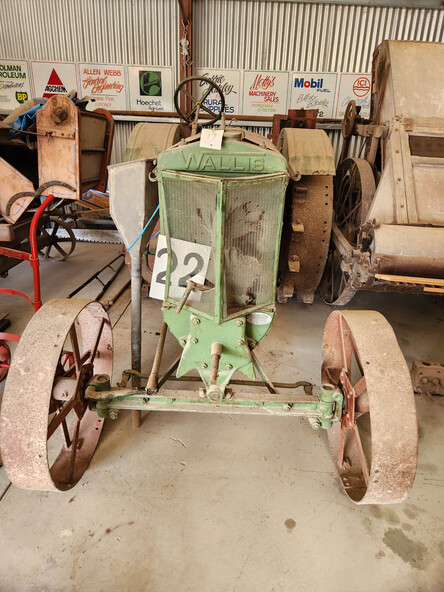
An early Wallis tractor mounted on four steel-spoked wheels, featuring a compact engine unit positioned between the front and rear axles. The tractor is finished in green paint, much of which has weathered and worn through years of agricultural use. The machine incorporates a large radiator assembly at the front, an exposed engine and transmission, operator's platform, steering wheel and steel wheel lugs designed to provide traction in cultivated soil. The tractor retains many of its original mechanical components, including the engine, transmission housing, steering system and drawbar arrangement. Its narrow profile and steel wheels are characteristic of tractors manufactured during the transition from horse-powered farming to mechanised agriculture in the early twentieth century.
